


Since the 19802 there has been a one-third increase in the worldwide twin pregnancy rate per 1000 births, from 9.1 to 12.0 (Monden et al., Reference Monden, Pison and Smits2021). Due to the increased morbidity and mortality associated with twin pregnancies for both mother and infant, obstetric management during these pregnancies until delivery presents a challenge. Twin pregnancies carry a higher risk of maternal and neonatal complications than singleton pregnancies. This risk includes an increased likelihood of maternal blood loss throughout pregnancy and in the postpartum period (Kramer et al., Reference Kramer, Berg, Abenhaim, Dahhou, Rouleau, Mehrabadi and Joseph2013). Compared to singleton pregnancies, the increased risk of blood loss during multiple gestations is primarily attributable to an enlarged uterus and a higher rate of operative deliveries (Ende et al., Reference Ende, Lozada, Chestnut, Osmundson, Walden, Shotwell and Bauchat2021). It has been demonstrated that early planned intervention and identification of women at risk for postpartum hemorrhage (PPH) reduce maternal morbidity and mortality (McLintock, Reference McLintock2020). Some studies have shown that developing a predictive warning system for serious diseases and detecting pregnant women with high-risk factors can provide early diagnosis, timely prevention and treatment, and help reduce the occurrence of PPH (Krishnamoorthy et al., Reference Krishnamoorthy, Liu and Liu2022).
Predictive models for postpartum hemorrhage have been previously designed; however, their applicability to different populations and at various stages of the delivery process has proven restricted (Koopmans et al., Reference Koopmans, van der Tuuk, Groen, Doornbos, de Graaf, van der Salm, Porath, Kuppens, Wijnen, Aardenburg, van Loon, Akerboom, van der Lans, Mol and van Pampus2014; Rubio-Álvarez et al., Reference Rubio-Álvarez, Molina-Alarcón, Arias-Arias and Hernández-Martínez2018). In these prediction studies, parameters such as maternal age, macrosomia, cesarean delivery, multiple pregnancies, previous PPH history, oxytocin induction, prolongation of the second stage of labor, operative vaginal birth, and preeclampsia were used (Ekin et al., Reference Ekin, Gezer, Solmaz, Taner, Dogan and Ozeren2015). PPH prediction continues to challenge obstetricians; therefore, additional research involving contemporary modeling techniques is required. Applying conventional statistical and artificial intelligence (AI) techniques may lead to better predictive capability. Normal programming techniques create output using input data and given rules, whereas AI may develop rules and models using input and output data. To identify potential relationships between multiple biological data sets, AI uses advanced algorithms (DeStephano et al., Reference DeStephano, Bakkum-Gamez, Kaunitz, Ridgeway and Sherman2020). AI can improve the accuracy of diagnosis and therapy in human clinical practice by producing predictions about health problems (Wang et al., Reference Wang, Pan, Jin, Li, Geng, Gao, Chen, Wang, Ma and Liao2019). As a result of this, it is possible that AI approaches can precisely identify women at the highest risk of PPH to improve obstetric decision-making and clinical results.
Although there are studies in the literature using AI for the prediction of PPH (Liu et al., Reference Liu, Wang, Yan, Lu, Bai, Wang and Li2022; Venkatesh et al., Reference Venkatesh, Strauss, Grotegut, Heine, Chescheir, Stringer, Stamilio, Menard and Jelovsek2020), we did not find any AI studies that evaluated only twin pregnancies and cesarean deliveries. Our study aimed to create a risk prediction model with AI to identify patients at higher risk of postpartum hemorrhage by using perinatal characteristics that may later be associated with postpartum hemorrhage in twin pregnancies undergoing cesarean sections (CS).
Materials and Methods
Study Design
The study was planned as a retrospective cohort study in which the postpartum hemorrhages of twin pregnancies delivered by cesarean section were evaluated at the Perinatology clinic of Necmettin Erbakan University Meram Medical Faculty Hospital between January 2015 and September 2023. Approval for the study was received from the university’s ethics committee with number 2024/4793. The rules of the Declaration of Helsinki were followed throughout the study. Written consent was obtained from all patients participating in the study.
Participants
Participants in the study included mothers with twin pregnancies between the ages of 18 and 45 who delivered by cesarean section after the 24th week. All mothers in the study consisted of patients in whom normal birth was not attempted and induction was not applied. Twin pregnant women with fetal anomalies, single intrauterine fetal deaths, vaginal deliveries, and whose data could not be accessed in electronic records were excluded from the study. Patients with blood disorders diagnosed in all twins were excluded from the study (such as platelet problems). All twin cesarean deliveries were categorized into two groups: those with and those without PPH. Under our clinical protocol, 20 IU of oxytocin in 500 ml of liquid is administered intravenously to all patients as soon as the babies are born. When diagnosing PPH, the American College of Obstetricians and Gynecologists (ACOG) definition of more than 1000 ml of blood loss within 24 hours after birth or blood loss accompanied by signs or symptoms of hypovolemia was used (Practice Bulletin No. 183: Postpartum Hemorrhage, 2017).
Data Handling and Machine Learning
To conduct risk modeling, the following factors were considered: maternal age, number of gravidae and parity, number of prior cesarean sections, history of pelvic surgery, presence of myoma in this pregnancy, history of myomectomy, chorionicity, and complications associated with chorionicity; for example, twin reversed arterial perfusion, twin-twin transfusion), anesthesia type, method of conception — e.g., assisted reproductive techniques (ART) versus spontaneous, use of anticoagulants, urgent and planned cases, preoperative hemoglobin-hematocrit levels, preeclampsia, gestational diabetes, ablation, placenta previa, placenta accreta spectrum (PAS), and preterm premature rupture of membrane (PPROM).
Using the perinatal characteristics of the cases, four different machine learning classifiers were created: logistic regression (LR), support vector machine (SVM; Suthaharan et al., Reference Suthaharan2016), random forest (RF; Qi, Reference Qi, Zhang and Ma2012), and multilayer perceptron (MLP; Tang et al., Reference Tang, Deng and Huang2015). Logistic regression is a linear model that estimates the probability of a binary outcome (such as PPH or non-PPH) using a logistic function. Support vector machines work by finding the hyperplane that best separates the data into classes. At the same time, random forests are ensemble methods that create multiple decision trees during training and output the majority class predicted by those trees. The multilayer perceptron, a type of neural network, is a more complex, nonlinear model that uses multiple layers of neurons to learn patterns in the data.
To account for imbalances in the dataset (e.g., fewer cases of PPH compared to non-PPH), LR, RF, and SVM models were created again with class weights(Zhang et al., Reference Zhang, Song, Xu, He, Li, Yu, Liang, Wu and Wang2022), which adjust the cost of misclassifying each class, giving more weight to minority class errors. In the end, a train-test split (80−20%) was applied to the data, and all seven models were trained using the training data.
We assessed the models’ performance using several evaluation metrics. In addition to accuracy, which measures the overall correctness of the model, we used the area under the curve (AUC) of the receiver operating characteristic (ROC) curve, also known as the C statistic. The AUC indicates the model’s ability to distinguish between classes, with a value of 1.0 indicating perfect classification and 0.5 representing random guessing. A higher AUC suggests better model performance in discriminating between PPH and non-PPH cases.
We also computed specificity, sensitivity, positive predictive value (PPV), and negative predictive value (NPV) to understand model performance comprehensively. Sensitivity (also known as recall) measures the model’s ability to correctly identify true positive cases (PPH cases), while specificity measures its ability to correctly classify true negative cases (non-PPH cases). PPV indicates the proportion of cases predicted as PPH that are truly PPH, and NPV reflects the proportion of cases predicted as non-PPH that are non-PPH. These metrics are crucial in medical prediction models, where the consequences of false positives (unnecessary interventions) and false negatives (missed diagnoses) are significant.
The formula for accuracy was defined as the sum of correctly predicted non-PPH and PPH cases divided by the total number of cases. This metric gives an overall sense of correctness, but it may not be as informative when dealing with imbalanced datasets, which is why the AUC and other metrics were also considered.
Statistical Analysis
Every statistical analysis was conducted utilizing SPSS version 20.0(IBM Corp., Armonk, NY, USA). The distribution was examined for normality using the Kolmogorov-Smirnov test and histograms. The values used to represent numerical variables were means and standard deviations. When comparing two independent groups, those with a normal distribution were analyzed using the independent sample t test, while those with a non-normal distribution were analyzed using the Mann-Whitney U test. To compare categorical data, the chi-square test was applied; values were provided as n (%). A statistical significance level of p < .05 was applied to the values.
Results
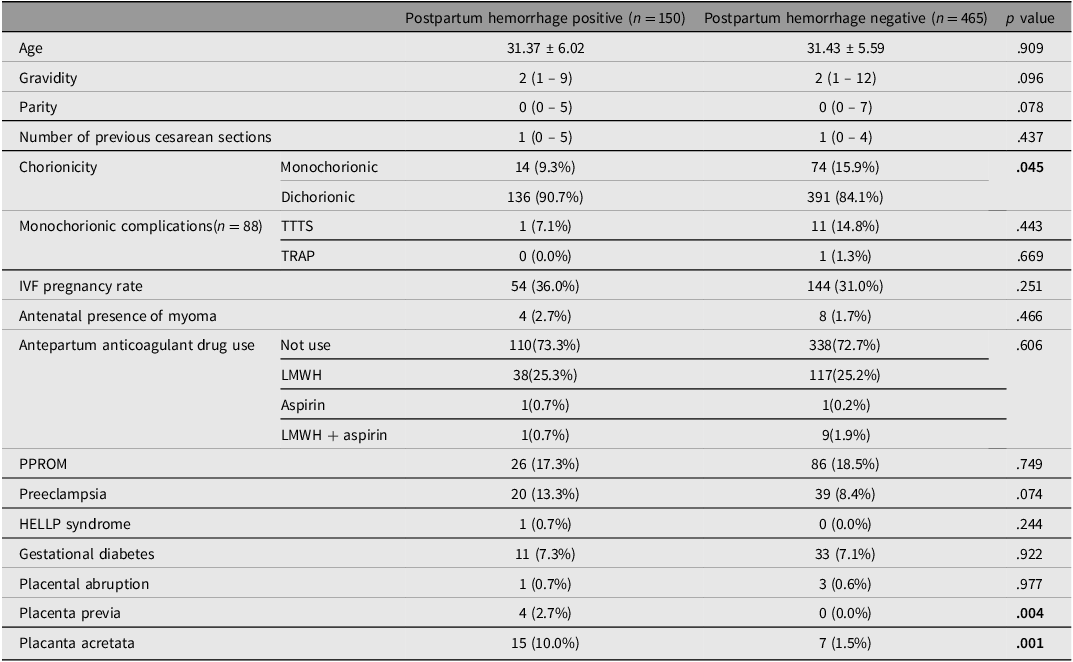
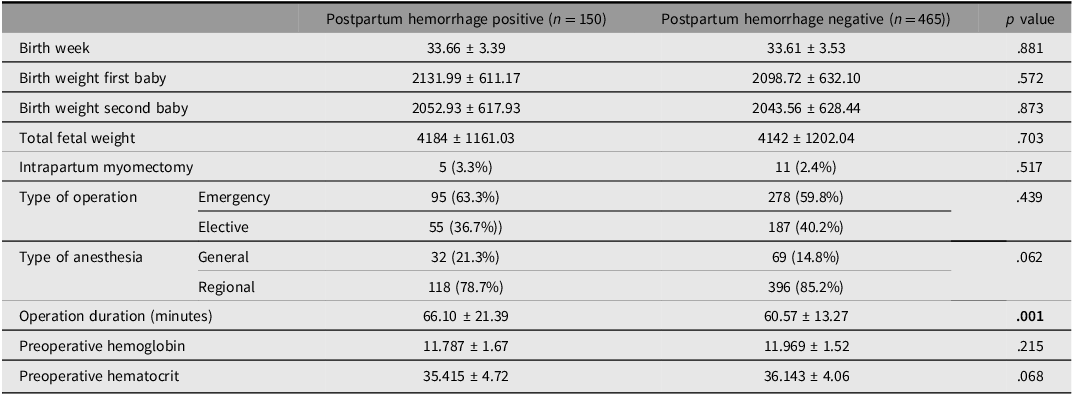
A total of 615 twin pregnancies were included in the study. All patients were delivered via CS. There were 150 twin pregnancies with PPH and 465 twin pregnancies without PPH. There was no statistically significant difference between the PPH positive and PPH negative groups in terms of age, gravidity, parity, or number of previous cesarean sections. When chorionicity was evaluated, 9.3% (n = 14) of the PPH-positive group were monochorionic twins, while 90.7% (n = 136) were dichorionic twin pregnancies, and the difference was found to be statistically significant (p = .045). Placenta previa was significantly higher in the PPH positive group with 2.7% (n = 4) compared to the PPH negative group with zero percent (n = 0, p = .004). Similarly, placenta accreta was 10.0% (n = 15) in the PPH positive group, significantly higher than in the PPH negative group 1.5% (n = 7, p = .001) (Table 1). The mean operation time was 66.10 ± 21.39 minutes in PPH-positive patients and 60.57 ± 13.27 minutes in PPH-negative patients (p = .001). Birth weeks, fetal weights, anesthesia types, preoperative hemoglobin and hematocrit values were similar in both groups (Table 2).
Sociodemographic and pregnancy characteristics according to postpartum bleeding status

Note: LMWH, low molecular weight heparin; TTTS, twin-to-twin transfusion syndrome; TRAP, twin reversed arterial perfusion; IVF, in-vitro fertilization; PPROM, preterm premature rupture of membrane. Statistically significant data, with p < .05, is highlighted in bold type.
Operative characteristics in postpartum hemorrhage positive and postpartum hemorrhage negative patients

Note: Statistically significant data, with p < .05, is highlighted in bold type.
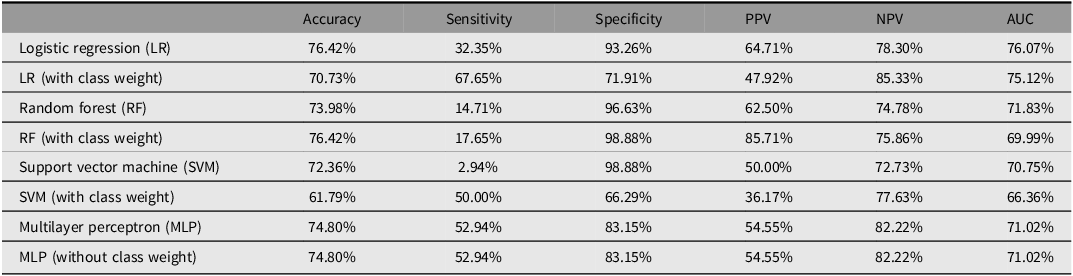
LR and RF models have similar accuracy rates, but the LR model can be considered better in terms of overall performance as it has a higher AUC value. Adding Class Weight significantly increased the sensitivity of the LR and SVM models, but decreased their accuracy rates. This indicates that these models are better at detecting PPH-positive cases but with a decrease in overall accuracy. The MLP performed almost the same both with and without class weight. This may indicate that the MLP model is not sensitive to class weight adjustment for this dataset (Table 3). The AUC in our LR with class weight model was 75.12% with an accuracy of 70.73%, a PPV of 47.92%, and an NPV of 85.33% in our data (Figure 1). An analysis of the importance of the variables using the LR with class weight is demonstrated in Figure 2. Positive values: Indicate features with a positive relationship with the target variable. For a binary classification problem, the probability of the target being classified as the positive class (often coded as 1) increases as the feature value increases. Correlation analysis of perinatal features for PPH was evaluated by Spearman correlation (Figure 3).
The performance of machine learning models for postpartum hemorrhage

Note: AUC, the area under the receiver operating curve; PPV, positive predictive value; NPV, negative predictive value.
The ROC curves of the different machine-learning approaches.

Top 10 feature importances for logistic regression with class weights.
Note: ivfsp: conception method, hellp: hemolysis, elevated liver enzymes, low platelet; gdm: gestational diabetes mellitus.

Evaluation of perinatal characteristics used in postpartum hemorrhage prediction with Spearman correlation.

Dıscussıon
This study aimed to create a risk-determination model for PPH in twin pregnancies delivered by cesarean section. We observed that our LR with class weight model, which we created with obstetric, maternal and fetal parameters before and during birth, could predict postpartum hemorrhage cases with 70.7% accuracy. By incorporating our model into clinical practice, healthcare providers will be able to have the ability to rapidly evaluate a patient’s susceptibility to hemorrhage.
PPH is the primary cause of maternal mortality, as recorded by the WHO (Say et al., Reference Say, Chou, Gemmill, Tunçalp, Moller, Daniels, Gülmezoglu, Temmerman and Alkema2014). Increased uterine blood circulation, and uterine atony due to excessive distention of the uterus, which may affect myometrial contractility, and a higher rate of cesarean deliveries have been associated with the risk of PPH in twin pregnancies (American College of Obstetricians and Gynecologists [ACOG] 2006). In twin pregnancies, cardiac output and plasma volume increase by 20% compared to single pregnancies, and these physiological changes contribute to the possibility of PPH (Dilla et al., Reference Dilla, Waters and Yazer2013). However, only a small percentage of twin pregnancies result in clinically important hemorrhage, and the optimal method for identifying patients who are particularly prone to postpartum hemorrhage is still unknown. Potentially, precise risk stratification may help in the identification of the safest method of delivery, obstetric care, and proper patient counseling.
In the study of di Marco et al. (Reference di Marco, Bevilacqua, Passananti, Neri, Airoldi, Maccarrone, Ciavarro, Lanzone and Familiari2023), it was reported that PPH was more common in twins who had operative vaginal births than in planned or unplanned CS births. In the same study, it was stated that PPH was less common as gestational age and fetal weight decreased. On the other hand, another study showed that cesarean delivery after attempted labor in twins was associated with an increased risk of PPH compared to spontaneous vaginal delivery (Easter et al., Reference Easter, Robinson, Lieberman and Carusi2017). Pregnant women who had prenatal anemia had a 2.09-fold increased risk of experiencing postpartum hemorrhage compared to those who did not have anemia (Liu et al., Reference Liu, Chen, Huang, Yan and Jiang2023). In a large retrospective study involving twins, nulliparity, general anesthesia, diabetes and low hematocrit levels were observed as risk factors for PPH requiring blood transfusion (Blitz et al., Reference Blitz, Yukhayev, Pachtman, Reisner, Moses, Sison, Greenberg and Rochelson2020). In another study, while diabetes and preeclampsia were not seen as risk factors, IVF, placenta previa, general anesthesia and obesity were found to be risk factors for PPH (Kong & To, Reference Kong and To2023). The features that our model used most when determining the risk were anesthesia, premature rupture of membranes, placenta accreta, placenta previa, chorionicity, and preeclampsia.
According to the results of this study, placental disorders like placenta previa and PAS raise the risk of severe PPH. Regardless of measured risk factors, twin gestation elevated the incidence of PAS compared to singleton pregnancies (Miller et al., Reference Miller, Leonard, Fox, Carusi and Lyell2021). Additionally, assisted reproductive technology is independently associated with the PAS in twin pregnancies (Jiang et al., Reference Jiang, Gao, He, Tang, Cao, Wang, Liu, Wang, Liu, Sun, Zhong, Liu, Liao, Liu and Yang2021). Twins are more likely to have PAS due to the reasons stated above. These findings are consistent with prior research demonstrating the important role of placental abnormalities in raising the risk of severe PPH (Committee on Practice Bulletins—Obstetrics, 2017; Seo et al., Reference Seo, Kim, Lee, Lee and Lee2023). Considering chorionicity, Feng et al. (Reference Feng, Zhai and Cai2018) found in their study that severe PPH was 4% in MC twins and 4.7% in DC twins, and they concluded that chorionicity had no significant effect on PPH. In the study by Cao et al. (Reference Cao, Luo, Zhou, Zhao, Qin, Liu and Xu2022), they reported that PPH was more common in dichorionic twin pregnancies than in monochorionic twin pregnancies. In the same study, this condition was attributed to fetal growth discordance and placental vascular dysfunction. In our series, 90.7% of the cases with PPH were dichorionic twins. This situation can be explained by a larger placenta and uterine overdistension or by the high number of dichorionic cases.
A few prior researches have employed machine learning techniques to identify postpartum hemorrhage risk in patients with limited success (Betts et al., Reference Betts, Kisely and Alati2019). By finding appropriate models to identify those at risk of PPH, targeted interventions such as the availability of blood products and potentially even transfer of patients to a center that offers a higher level of maternal care can be provided. Westcott et al. reported that they predicted patients with 98.1% accuracy in the machine learning model they created using all variables in the patient’s previous file (including previous birth information) for PPH (Westcott et al., Reference Westcott, Hughes, Liu, Grivainis, Hoskins and Fenyo2022). Qi et al. (Reference Qi, Tian, Wang and Jiao2018) applied an improved K Nearest Neighbor algorithm to predict various causes of hemorrhage and achieved an AUC of 0.7 for predictive performance. In Liu et al.’s (Reference Liu, Wang, Yan, Lu, Bai, Wang and Li2022) study, the Lightgbm + Logistic Regression machine learning model had excellent discriminatory power in predicting PPH events during transvaginal deliveries and performed relatively well when contractile features were included. In our study, the logistic regression with class weight machine learning model had the power to predict postpartum hemorrhage events during twin cesarean deliveries with 70% accuracy and 85% NPV. Clinicians could potentially be able to estimate PPH risk earlier by integrating this model into clinical practice and utilizing clinical electronic medical record data information to predict PPH risk.
One of the limitations of the study is that bleeding histories from previous births and current platelet counts were not added to the model, and there is a risk of errors due to the data being drawn retrospectively and electronically. Other limitations include the twin population cohort from a single tertiary care center, the absence of a history of postpartum hemorrhage in a previous delivery, and the inclusion of neonatal birth weight in the risk modeling, even though it was obtained postpartum.
Conclusion
Applying machine learning to build predictive models of clinical risk factors is useful for improving PPH’s predictive accuracy. Although the 70% accuracy rate of our model is encouraging, it is not sufficient. The increasing use of machine learning modeling in medicine necessitates further study and validation before incorporating it into clinical practice.
Data availability statement
Data can be shared if requested by the editorial board.
Acknowledgements
Thanks all colleagues.
Author contributions
SD: Study design, patient management, and manuscript writing/editing; HU: Data analysis, FKY: Patient management, FA: Data analysis, patient management. PB: Data analysis, patient management, Data collection. AA: Contributed to and approved of the final version of the manuscript.
Funding
None.
Competing interests
Authors state no conflict of interest.