





Introduction
High-profile Islamist terrorist attacks in the early 2000s, including, most notably, 9/11, triggered a wave of research into how citizens in Western democracies respond to such violence. This literature has generated consensus that Islamist terrorism shifts political attitudes in three main ways (Godefroidt Reference Godefroidt2023). First, it increases citizens’ willingness to trade off civil liberties in favor of restrictive security policies, bolsters support for a more aggressive foreign policy, and more generally strengthens authoritarian attitudes (e.g., Davis and Silver Reference Davis and Silver2004; Hetherington and Suhay Reference Hetherington and Suhay2011; Merolla and Zechmeister Reference Merolla and Zechmeister2009). Second, it hardens Western citizens’ attitudes toward outgroups, such as Arabs, Muslims, and immigrants more generally (e.g., Echebarria-Echabe and Fernández-Guede Reference Echebarria-Echabe and Fernández-Guede2006; Panagopoulos Reference Panagopoulos2006), and tends to boost support for restrictive immigration measures and other policies targeting outgroup members (e.g., Van de Vyver et al. Reference Van de Vyver, Houston, Abrams and Vasiljevic2016). Third, Islamist terrorism often triggers rally-around-the-flag effects, including higher support for incumbents, stronger in-group identification, and greater political participation (e.g., Hersh Reference Hersh2013; Lambert et al. Reference Lambert, Scherer, Schott, Olson, Andrews, O’Brien and Zisser2010; Landau et al. Reference Landau, Solomon, Greenberg, Cohen, Pyszczynski, Arndt, Miller, Ogilvie and Cook2004). Such shifts in political attitudes matter: they can influence election results (Montalvo Reference Montalvo2011), motivate policy changes (Helbling and Meierrieks Reference Helbling and Meierrieks2022), and bolster the narratives of extremist organizations (Bail, Merhout, and Ding Reference Bail, Merhout and Ding2018).
In recent years, however, scholars and commentators have increasingly started to question whether Islamist terrorism still holds the same power to shape political attitudes. Countries such as France, the UK, or the USA have repeatedly been targeted by Islamist terrorists (Marone Reference Marone, Bonino and Ricucci2021; Nesser Reference Nesser2018; Vidino and Hughes Reference Vidino, Hughes, Bonino and Ricucci2021), with one estimate putting the total number of Islamist attacks in Western democracies at over 200 (Fondapol 2019). This growing number has led a number of scholars and pundits to suggest that Islamist terrorism has become normalized in the West and therefore no longer evokes the same reactions. News headlines such as ‘We’ve Become Desensitized to Terror’ (Jenkins Reference Jenkins2020) or ‘Are We Becoming Numb to Terrorism?’ (Doble, McGregor, and Gallier Reference Doble, McGregor and de Gallier2016) attest to this growing narrative. In a similar vein, political scientists increasingly invoke desensitization as an explanation for null findings in studies of recent Islamist terrorist attacks (e.g., Amarasingam and Clarke Reference Amarasingam and Clarke2017; Castanho Silva Reference Castanho Silva2018; Markoulis and Katsikides Reference Markoulis and Katsikides2020; Nussio Reference Nussio2020). Yet, despite its growing prominence, the concept of desensitization remains undertheorized and lacks systematic empirical evidence.
We provide the first large-scale, systematic assessment of the hypothesis that the effects of Islamist terrorism on political attitudes have declined in Western democracies. We focus on Islamist terrorism in Western democracies for three reasons. First, the desensitization hypothesis has most frequently been invoked in the context of Islamist terrorism, making it an obvious place to start. Second, Islamist terrorism is by far the most frequently studied form of terrorism, providing us with a uniquely rich evidence base for a temporal meta-analysis (Godefroidt Reference Godefroidt2023). Finally, Islamist terrorism remains politically relevant and continues to be used by governments to justify strict surveillance measures and other counterterrorism legislation (e.g., ‘Martyn’s Law’ in the UK, named after a victim of the 2017 Manchester Arena bombing). Understanding how public responses to Islamist terrorism have (or have not) changed is therefore essential for understanding the microfoundations of counterterrorism policy-making.
We begin by clarifying what desensitization entails and why it might occur, and then contrast it with two theoretical alternatives: response stability and escalation. More specifically, we argue that desensitization implies a gradual weakening of public responses to Islamist attacks, driven by reduced emotional and cognitive reactions as exposure accumulates. However, because Islamist terrorism remains comparatively rare in Western democracies and symbolically powerful, attitudinal responses may also exhibit stability, with broadly similar effects persisting despite previous exposure. Finally, there is a third possibility: repeated attacks could successively escalate threat perceptions, leading to ever-stronger attitudinal responses. By theorizing these divergent pathways, we move beyond post-hoc interpretations and provide a more comprehensive framework for understanding how public reactions to terrorism might evolve over time.
We provide two complementary tests to determine whether attitudinal responses to Islamist terrorism have changed. First, we analyze a meta-analytical dataset spanning 20 years of empirical research on Islamist terrorism and political attitudes. If responses to Islamist terrorism have changed over time, this should be reflected in existing studies. Indeed, a previous narrative review has found evidence for a decline in effect sizes over time (Nussio Reference Nussio2020). However, narrative reviews may suffer from incomplete coverage and struggle to account for heterogeneity between previous studies. Meta-analytical data allows us to test such claims more rigorously. Our analysis comprises approximately 840 effect estimates from over 170 studies published between 2003 and 2023. Accounting for variation in attack and study features, we find no evidence for a significant decline (or increase) in effects over time. We also find little evidence for a correlation between the number of previous Islamist terrorist attacks – whether in the same country or across Western democracies – and the size of effects on political attitudes.
Second, we conduct a more tightly controlled comparison of the effects of two recent Islamist attacks: the 2017 and 2019 London Bridge attacks. Both London Bridge attacks occurred during a broader wave of Islamist terrorism and share several important features, including their location, timing, (more limited) scale, and the perpetrators’ affiliation. This makes them good test cases for desensitization (or escalation). Our design leverages data from Voting Advice Applications (VAAs), which attract large numbers of voters during election campaigns, thereby enabling us to capture short-term changes in political attitudes with high accuracy and precision. The results show that both the 2017 and 2019 London Bridge attacks increased support for restrictive security and immigration policies, as well as in-group identification. The magnitude of the effects was similar in both years and broadly in line with the effects of earlier attacks measured in previous studies.
In sum, our results suggest that Islamist terrorism has not lost its political sway over Western citizens. Different attacks may affect political attitudes in different ways, but this variation appears to emerge due to a complex combination of contextual factors and study design, and not due to a process of desensitization or escalation. These findings do not preclude that repeated exposure to political violence could alter attitudinal responses in other contexts; however, Islamist terrorism may remain too infrequent to produce such broader shifts in Western democracies. Consequently, Islamist terrorism retains its potential to generate volatile consequences for public opinion, underscoring its continued relevance for political behavior and policy-making.
Possible consequences of repeated exposure to Islamist terrorist attacks
Does Islamist terrorism still have similar effects on political attitudes? To assess this question, it is first necessary to understand the cognitive and affective mechanisms through which Islamist terrorism can influence political attitudes. On the cognitive side, Islamist terrorism has been shown to prime the unpredictability and inevitability of death (Pyszczynski, Solomon, and Greenberg Reference Pyszczynski, Solomon and Greenberg2003), instill a sense of danger for oneself and one’s country (Huddy, Khatib, and Capelos Reference Huddy, Khatib and Capelos2002; Jost et al. Reference Jost, Glaser, Kruglanski and Sulloway2003), amplify perceptions of injustice (Lambert, Eadeh, and Hanson Reference Lambert, Eadeh and Hanson2019; Skitka and Mullen Reference Skitka and Mullen2002), and prompt blame attributions (Kimhi, Canetti-Nisim, and Hirschberger Reference Kimhi, Canetti-Nisim and Hirschberger2009; Sadler et al. Reference Sadler, Lineberger, Correll and Park2005). On the affective side, Islamist terrorism elicits negative emotions including fear, anger, despair, and sadness, which are likely to mediate public opinion responses (Jost Reference Jost2019; Pliskin and Halperin Reference Pliskin, Halperin, Borgida, Federico and Miller2020; Vasilopoulos et al. Reference Vasilopoulos, Marcus, Valentino and Foucault2019). In combination, these cognitive and emotional reactions are likely to drive shifts in several domains of public opinion, including increased support for restrictive security policies, heightened authoritarianism, greater hostility toward outgroups, and rally effects (Godefroidt Reference Godefroidt2023). However, it remains unclear whether these causal processes continue to operate in the same way after repeated exposure to Islamist terrorism.
The idea that public reactions to Islamist terrorism have weakened over time has gained increasing traction in recent years. Most notably, Nussio (Reference Nussio2020) reached this conclusion after a detailed narrative review of the empirical literature. Similar suggestions have been made by several other studies of recent Islamist terrorist attacks (e.g., Assche and Dierckx Reference Assche and Dierckx2021; Castanho Silva Reference Castanho Silva2018; Larsen, Cutts, and Goodwin Reference Larsen, Cutts and Goodwin2020; Markoulis and Katsikides Reference Markoulis and Katsikides2020), and the idea is also popular among political commentators (e.g., Doble, McGregor, and Gallier Reference Doble, McGregor and de Gallier2016; Jenkins Reference Jenkins2020). The explanation that Nussio and others have offered is that responses to Islamist terrorism have weakened due to repeated exposure and a process of cognitive and affective desensitization. In what follows, we discuss the theoretical rationale for the desensitization hypothesis, beginning with the concept’s origins in (media) psychology. After this, we interrogate the applicability of desensitization theory to the case of Islamist terrorism in Western democracies and discuss two theoretical alternatives. Finally, we discuss the (lack of) empirical evidence for desensitization.
The desensitization hypothesis
The concept of desensitization originates in research on repeated exposure to violent media, such as violent films or video games (e.g., Brockmyer Reference Brockmyer2015; Carnagey, Anderson, and Bushman Reference Carnagey, Anderson and Bushman2007; Funk et al. Reference Funk, Buchman, Jenks and Bechtoldt2003). According to that literature, desensitization refers to a psychological process involving two interrelated mechanisms: (1) a dampening of affective responses after repeated exposure to violence in media (e.g., reduced fear, sadness, or anger) and (2) cognitive normalization, whereby violent events are increasingly seen as routine, unremarkable, or to be expected. Consequently, repeated exposure to violence is argued to, among other things, diminish moral concern and increase tolerance for aggression (Bushman and Anderson Reference Bushman and Anderson2009; Funk et al. Reference Funk, Baldacci, Pasold and Baumgardner2004). In a broader sense, the concept of desensitization also resonates with habituation theory from neuroscience and behavioral psychology, which suggests that growing accustomization to a situation or stimulus can reduce responsiveness (Lader and Mathews Reference Lader and Mathews1968; Thompson and Spencer Reference Thompson and Spencer1966; Watts Reference Watts1979). Finally, there are parallels with the notion of compassion fatigue in healthcare, which posits that prolonged exposure to human suffering can trigger emotional disengagement (Joinson Reference Joinson1992; Sinclair et al. Reference Sinclair, Shelley Raffin-Bouchal, Mijovic-Kondejewski and Smith-MacDonald2017).
Previous literature suggests that desensitization may not be limited to video media, but extends to the case of Islamist terrorism (Amarasingam and Clarke Reference Amarasingam and Clarke2017; Castanho Silva Reference Castanho Silva2018; Markoulis and Katsikides Reference Markoulis and Katsikides2020; Nussio Reference Nussio2020). Specifically, the argument is that since Western citizens have been exposed to a growing number of attacks, they are likely to increasingly see Islamist terrorism as part of everyday life. As a result of increasing normalization, emotional responses become more muted, and citizens become less likely to update their perceptions of threat, mortality salience, and injustice.Footnote 1 Furthermore, increasing normalization may lead to reduced and less emotionally charged media coverage, thus further reducing the salience of Islamist attacks. As Nussio (Reference Nussio2020, p. 1152) explains, this process eventually culminates in a situation where Islamist terrorism no longer produces detectable changes in political attitudes.
Limited empirical evidence and theoretical alternatives
However, despite the concept’s increasing popularity, it remains unclear whether desensitization extends to the case of Islamist terrorism in Western democracies. Most of the existing evidence for desensitization comes from media psychology, where exposure is very frequent and typically involves fictional depictions of nonpolitical violence (e.g., daily play of first-person shooter games). These studies rarely examine political attitudes, focusing instead on outcomes such as empathy for victims or tolerance for aggression (e.g., Brockmyer Reference Brockmyer2015; Bushman and Anderson Reference Bushman and Anderson2009; Ferguson Reference Ferguson2015; Funk et al. Reference Funk, Baldacci, Pasold and Baumgardner2004; Prescott, Sargent, and Hull Reference Prescott, Sargent and Hull2018). Hence, the conditions under which desensitization has been predominantly demonstrated differ markedly from those that characterize terrorism.
A key open question is whether Islamist terrorism is frequent enough in Western democracies to trigger desensitization. Islamist terrorism remains, at best, a semi-regular experience for most Western citizens. Furthermore, habituation theory suggests that emotional responses are only likely to decrease if stimuli remain similar in intensity and form (Lader and Mathews Reference Lader and Mathews1968; Thompson and Spencer Reference Thompson and Spencer1966; Watts Reference Watts1979). Yet, Islamist terrorist attacks tend to differ in terms of their locations, methods, targets, and lethality (etc.). In agreement with this, research suggests that most citizens of Western countries continue to see Islamist terrorist attacks as particularly transgressive events (Bove et al. Reference Bove, Efthyvoulou and Pickard2024; Nussio, Böhmelt, and Bove Reference Nussio, Böhmelt and Bove2021; Völker Reference Völker2024). In addition, Islamist terrorism in the West remains typically associated with perpetrators from ethno-religious outgroups, which has been shown to amplify perceived moral violations and blame (Bilali, Tropp, and Dasgupta Reference Bilali, Tropp and Dasgupta2012; Noor et al. Reference Noor, Kteily, Siem and Mazziotta2019). As a result, Islamist terrorism may not become normalized in the same way as depictions of high-frequency violence in fictional media. Despite repeated exposure, Islamist attacks may continue to activate the same cognitive and emotional mechanisms and therefore continue to have similar effects on political attitudes.
A third theoretical possibility is response escalation. Recurrent terrorist attacks may be interpreted as evidence of institutional failure and a lack of state capacity (Montalvo Reference Montalvo2011), which could successively increase threat perceptions and mortality salience. Similarly, repeated norm violations could reinforce moral outrage rather than diminish it and therefore increasingly harden attitudes toward perpetrators and associated outgroups. Accordingly, repeated exposure may not diminish but intensify attitudinal responses to Islamist terrorism.
Ultimately, whether public responses to Islamist terrorism have weakened, remained stable, or intensified is an empirical question. Yet the evidence for change in public responsiveness to Islamist terrorism remains limited. Few existing studies explicitly test for changes in responses to Islamist terrorism over time; instead, desensitization is often invoked as a post-hoc explanation for null findings in recent studies. Furthermore, many claims of desensitization are based on single-case studies, which cannot establish broader temporal trends. Meanwhile, the best available evidence stems from a narrative review, which is able to provide a broader overview (Nussio Reference Nussio2020); yet, narrative reviews are susceptible to incomplete coverage, selective emphasis, and heterogeneity between studies.
Reliably establishing trends in reported effect sizes is far from straightforward. In any larger body of literature, results are bound to be mixed. The literature on the effects of Islamist terrorism on public opinion is no exception. As Nussio has observed, many studies of older Islamist attacks report sizable effects on public opinion (e.g., Hobfoll, Canetti-Nisim, and Johnson Reference Hobfoll, Canetti-Nisim and Johnson2006; Lerner et al. Reference Lerner, Gonzalez, Small and Fischhoff2003). However, there are also notable exceptions reporting much smaller or even null effects (e.g., Dinesen and Jager Reference Dinesen and Meier Jæger2013; Legewie Reference Legewie2013; Vlandas and Halikiopoulou Reference Vlandas and Halikiopoulou2025). Studies of more recent Islamist attacks similarly report a variety of different results (e.g., Castanho Silva Reference Castanho Silva2018; Muñoz, Falcó-Gimeno, and Hernández Reference Muñoz, Falcó-Gimeno and Hernández2020; Larsen, Cutts, and Goodwin Reference Larsen, Cutts and Goodwin2020; Schmidt-Catran and Czymara Reference Schmidt-Catran and Czymara2020; Vlandas and Halikiopoulou Reference Vlandas and Halikiopoulou2025). The high variability in reported effects makes it difficult to reliably aggregate results by hand. Furthermore, it suggests that effect sizes are shaped by a variety of factors, potentially including repeated exposure but also broader context factors (e.g., country of study, attack severity, and the target) and a study’s research design (e.g., the precise outcome variable, the sample, or the quality of causal inferences).Footnote 2 It follows that apparent trends in reported effect sizes may not reflect the consequences of repeated exposure, but other factors. Overall, the significant heterogeneity in terms of reported findings, the methods used, and the contexts studied renders narrative reviews an unreliable tool for the establishment of trends in reported effects. Testing whether public responses to Islamist terrorism have changed requires a more systematic approach.
Study 1: Meta-analysis
We begin by evaluating whether the effects of Islamist terrorism on political attitudes have weakened, persisted, or escalated in Western democracies using a meta-analysis of empirical studies published between 2003 and 2023. The comprehensive scope of our dataset minimizes the risk of biased coverage, and unlike narrative reviews, our approach enables us to formally test for changes in reported effect sizes while accounting for the design of studies and contextual factors.
Data
Study 1 builds on a previously published meta-analytical dataset that compiles estimates of the effects of terrorism on political attitudes from quantitative studies (Godefroidt Reference Godefroidt2023). The dataset adopts a broad definition of political attitudes, encompassing (a) orientations toward security policy, the protection of civil liberties, right-wing authoritarianism, and related ideological positions; (b) attitudes toward outgroups, including prejudice, stereotyping, and support for (anti-)immigration policies; and (c) rally-around-the-flag responses, such as national identification, political trust, and political participation. To be included in the dataset, studies had to provide individual-level effect estimates; be written in English, French, or Dutch; and report sufficient information to compute standardized effect sizes.
Godefroidt (Reference Godefroidt2023) used this dataset to examine general patterns across all forms of terrorism worldwide. Our study narrows this scope in two ways. First, we restrict the sample to studies of Islamist terrorism, excluding those on unspecified or other forms of terrorism (e.g., far-right or far-left terrorism). Second, we focus exclusively on Western democracies, including countries in Europe (excluding Belarus and Russia), North America, Australia, and New Zealand.Footnote 3
Analyzing change in effect sizes requires good coverage of recent attacks. Hence, we extended the temporal coverage of Godefroidt’s original dataset. Whereas the original data included studies available up to December 2019, we added all relevant studies formally published or otherwise made available (e.g., pre-prints) between January 2020 and March 2023. To ensure consistency and comparability, we applied the same inclusion and exclusion criteria and used the same four-part search strategy for the identification of relevant manuscripts:
-
(1) Searches in Web of Science, ProQuest, and EBSCO with the same search terms;
-
(2) Screening of recent narrative reviews;
-
(3) Public calls for unpublished work via social media and mailing lists;
-
(4) Backward and forward citation tracking.
SI Appendix § 1.1 provides further details on the data collection process. With the temporal update included, our meta-analytical dataset comprises 837 estimates of the effects of Islamist terrorism on political attitudes. These estimates are drawn from 130 manuscripts (15 added as part of our update), which include 170 unique studies conducted between 2001 and 2019. Importantly, effect estimates are based on diverse methodologies: 165 (20%) stem from randomized experiments (e.g., vignette or priming experiments), 351 (42%) from natural experiments (e.g., pre/post comparisons of cross-sectional or panel data), and 321 (38%) from correlational designs (e.g., associations between threat perceptions and political attitudes). The most frequently studied outcome category is attitudes toward outgroups (42% of estimates), followed by preferences for tougher security policies and other conservative shifts (36%), and finally, rally-around-the-flag responses (22%). The 837 effect estimates span a total of 24 Western countries, including Australia, Austria, Belgium, Canada, Czechia, Denmark, Estonia, Finland, France, Germany, Ireland, Italy, Luxembourg, the Netherlands, Norway, Poland, Romania, Slovakia, Slovenia, Spain, Sweden, Switzerland, the UK, and the USA.
The original manuscripts report effect estimates in various ways, including bivariate correlations, multiple regression coefficients, and mean differences. To facilitate cross-study comparisons, we converted all estimates into Cohen’s
 d
coefficients and calculated corresponding sampling variances. Cohen’s
d
coefficients and calculated corresponding sampling variances. Cohen’s
 d
is a standardized effect size measure that reflects the difference between two group means as a proportion of the outcome’s standard deviation. Where necessary, we reversed the direction of the coefficients so that positive values consistently indicate a shift to the political right (e.g., greater outgroup hostility) and stronger rally-around-the-flag tendencies (e.g., increased national identification).
d
is a standardized effect size measure that reflects the difference between two group means as a proportion of the outcome’s standard deviation. Where necessary, we reversed the direction of the coefficients so that positive values consistently indicate a shift to the political right (e.g., greater outgroup hostility) and stronger rally-around-the-flag tendencies (e.g., increased national identification).
Results
We examine changes in attitudinal responses to Islamist terrorism in three ways. First, we test for an overall time trend by regressing reported effect sizes on the study year. Second, we assess whether reported effects correlate with the number of previous attacks in the studied country and across all Western countries. Third, we compare estimates of the effects of specific Islamist attacks. We also conduct several robustness checks, including tests for publication bias and sensitivity analyses. As a preliminary first step, however, we establish the baseline effect of Islamist terrorism on political attitudes across all previous studies.
We use a three-level random-intercept model to estimate the average effect of Islamist terrorism across studies, which accounts for both the sampling variance of reported effects and the hierarchical structure of the data (i.e., statistical dependencies within and between manuscripts) (Cheung Reference Cheung2015; Noortgate et al. Reference Noortgate, López-López, Marín-Martínez and Sánchez-Meca2013). The full model specification is provided in SI Appendix § 1.2. We find that Islamist terrorism is generally associated with a small-to-moderate rightward shift in political attitudes in the existing literature ( $d = 0.22$
, SE
$d = 0.22$
, SE $ = 0.03$
,
$ = 0.03$
, $p \lt .001$
, 95% CI
$p \lt .001$
, 95% CI $\left[ {0.16,{\rm{\;}}0.27} \right]$
). Note that this represents the average effect across studies and not the average effect of an Islamist attack, which is smaller since selected high-profile attacks associated with comparatively large effect sizes have been studied more frequently (see below).Footnote
4
$\left[ {0.16,{\rm{\;}}0.27} \right]$
). Note that this represents the average effect across studies and not the average effect of an Islamist attack, which is smaller since selected high-profile attacks associated with comparatively large effect sizes have been studied more frequently (see below).Footnote
4
Over-time variation
If repeated exposure to Islamist terrorism leads to smaller (larger) effects on political attitudes, then we should find that more recent studies tend to report smaller (larger) effects. We test for the existence of a time trend in reported effects by adding the study year to our baseline specification (see above). For natural experiments, the study year generally corresponds to the year of the attack.Footnote 5 For correlational studies and randomized experiments, we use the year in which the survey or experiment was fielded. For better interpretability, we recoded the study year so that the earliest year in our dataset (2001) is coded as 0. Since the most recent study year is 2019, the variable ranges from 0 to 18. We were unable to retrieve the study year for 113 effect sizes (13.5% of the data). This leaves us with 109 manuscripts and 724 effect estimates for this analysis.
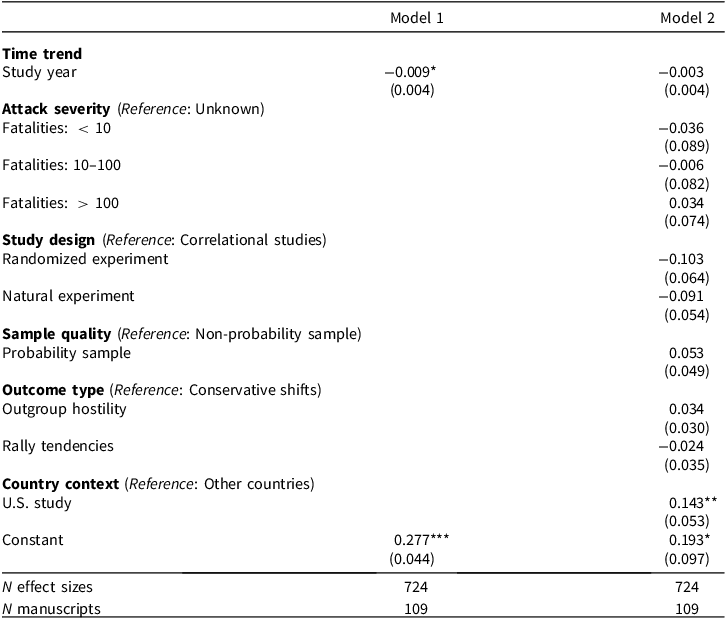
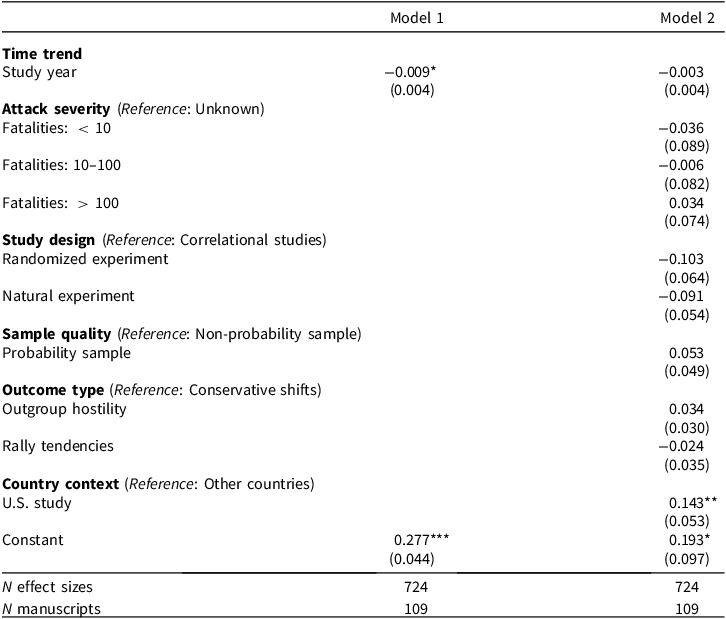
Model 1 in Table 1 shows the raw time trend. We find that the reported effects of Islamist terrorism on political attitudes decreased by an average of around 0.01 Cohen’s $d$
every year since 2001 (
$d$
every year since 2001 ( $p = 0.02$
). This initial result is consistent with the desensitization hypothesis. However, the raw time trend does not account for heterogeneity across manuscripts in the attacks they study and their study designs. For example, bias could emerge since more recent attacks tend to have fewer casualties, and attack severity may independently shape public reactions. Furthermore, methodological improvements or other changes could have led to smaller reported effects over time.
$p = 0.02$
). This initial result is consistent with the desensitization hypothesis. However, the raw time trend does not account for heterogeneity across manuscripts in the attacks they study and their study designs. For example, bias could emerge since more recent attacks tend to have fewer casualties, and attack severity may independently shape public reactions. Furthermore, methodological improvements or other changes could have led to smaller reported effects over time.
Annual change in reported effects of Islamist terrorism on political attitudes in Western democracies
Note: * $p \lt $
0.05; **
$p \lt $
0.05; ** $p\lt$
0.01; ***
$p\lt$
0.01; *** $p \lt $
0.001.
$p \lt $
0.001.
To mitigate omitted-variable bias, we add controls for attack severity (fatalities) and several aspects of study design: design type (correlational, natural experiment, randomized experiment), sample quality (probability vs. non-probability), and outcome domain (conservative shifts, outgroup attitudes, rally tendencies). We also include a U.S. dummy to capture systematic contextual differences, as prior work suggests that terrorism studies conducted in the U.S. yield larger effect sizes (Godefroidt Reference Godefroidt2023).
Model 2 shows the results: with relevant controls included, the time trend is close to zero ( $b = - 0.003$
) and clearly not statistically significant (
$b = - 0.003$
) and clearly not statistically significant ( $p = 0.44$
). This suggests that while reported effects have decreased over time, this is likely due to factors other than desensitization. In particular, our results show that studies with a U.S. focus tend to yield significantly larger effects (
$p = 0.44$
). This suggests that while reported effects have decreased over time, this is likely due to factors other than desensitization. In particular, our results show that studies with a U.S. focus tend to yield significantly larger effects ( $b = 0.14,p = 0.007$
), and earlier studies are disproportionately more often focused on the U.S. (63% of studies conducted before 2005 were conducted in the U.S. compared to only 22% thereafter). Put another way, the raw negative time trend is statistically explained by the overrepresentation of U.S. studies in earlier years, many of which were focused on 9/11 and yielded comparatively large effects.Footnote
6
We also find some evidence that attacks with higher numbers of fatalities, as well as less well-identified correlational studies, tend to yield slightly larger effects. However, these effects are not statistically significant at the conventional 5% level.
$b = 0.14,p = 0.007$
), and earlier studies are disproportionately more often focused on the U.S. (63% of studies conducted before 2005 were conducted in the U.S. compared to only 22% thereafter). Put another way, the raw negative time trend is statistically explained by the overrepresentation of U.S. studies in earlier years, many of which were focused on 9/11 and yielded comparatively large effects.Footnote
6
We also find some evidence that attacks with higher numbers of fatalities, as well as less well-identified correlational studies, tend to yield slightly larger effects. However, these effects are not statistically significant at the conventional 5% level.
Correlation with the number of previous attacks
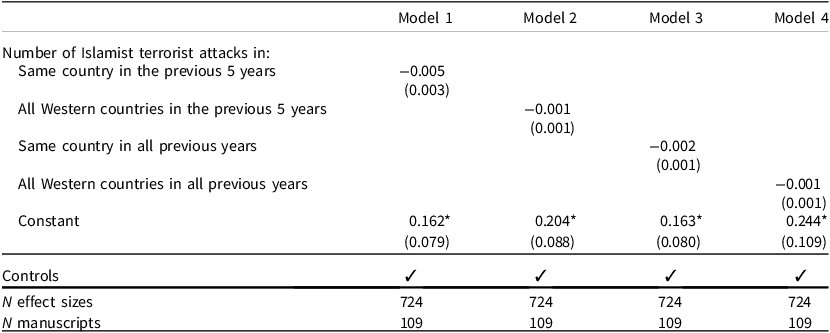
The results thus far suggest that, ceteris paribus, the effects of Islamist terrorism on political attitudes have not changed over time. However, time is only an indirect proxy for repeated exposure to Islamist terrorism. In a second step, we therefore consider a more direct measure of exposure: the cumulative number of Islamist terrorist attacks prior to the study year. We draw data on the number of Islamist attacks from Fondapol (2019). Because it is unclear whether desensitization (or escalation) is primarily a function of recent or all prior attacks, we test both the number of attacks in the preceding five years and the total number of prior attacks. Analogously, we consider both the number of prior attacks in the same country and across all Western democracies. All models contain the full set of controls, including attack severity, study design, sample quality, outcome domain, and country context. Table 2 reports the results. We find little evidence for changes in reported effect sizes due to repeated exposure, irrespective of our measurement approach.
Association between past Islamist terrorist attacks and reported effects of Islamist terrorism on political attitudes in Western democracies
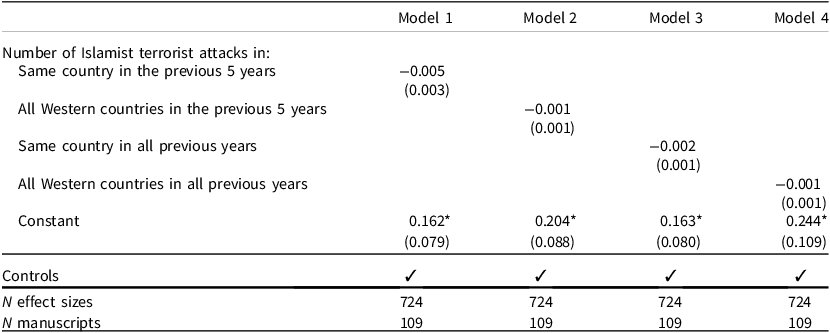
Note: All models include the control variables as specified in Table 1. * $p\lt $
0.05; **
$p\lt $
0.05; ** $p\lt $
0.01; ***
$p\lt $
0.01; *** $p\lt $
0.001.
$p\lt $
0.001.
Specific attacks
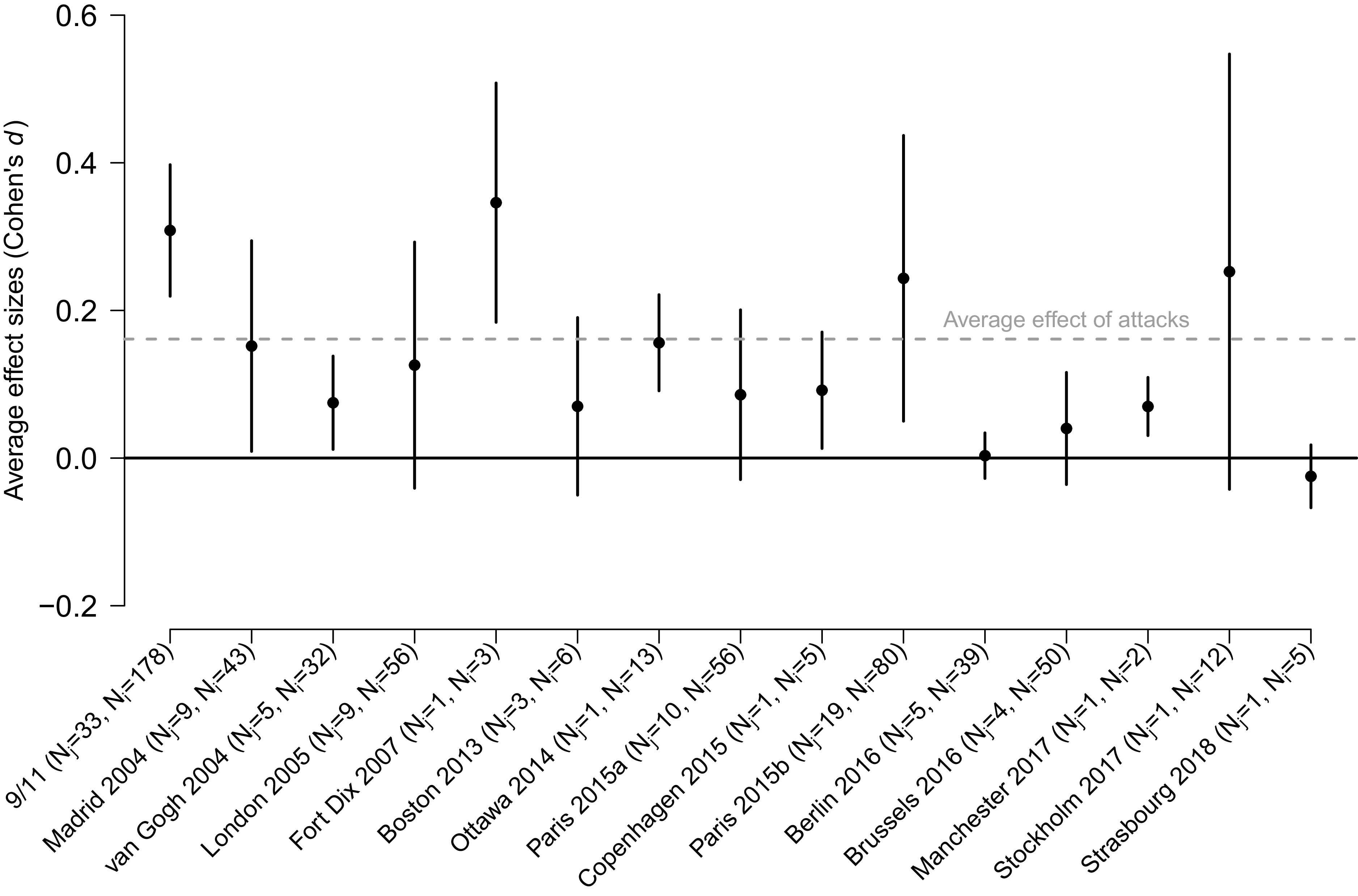
Finally, we examine whether there is an observable trend in the effect estimates for specific Islamist attacks. For this analysis, we restrict the sample to estimates tied to concrete Islamist terrorist events, dropping estimates from correlational and experimental studies that focus on generic Islamist terrorism without reference to a particular attack. This yields a sample of 580 effect estimates from 91 manuscripts, covering 15 Islamist attacks perpetrated between 2001 and 2018. Analogously to our analysis of the overall effect across studies, we estimate the average effect of each attack using three-level random-intercept models that account for dependencies within and between manuscripts. For reference, we also establish the average effect of an Islamist terrorist attack using a four-level meta-analytical model that, in addition, accounts for clustering of effect sizes within attacks. This takes into account that each attack has specific features, such as context, scale, or method, which may make it more or less likely to affect attitudes.
We find that the average effect of an Islamist attack is $d = 0.16$
(SE
$d = 0.16$
(SE $ = 0.04$
,
$ = 0.04$
, $p \lt .001$
, 95% CI
$p \lt .001$
, 95% CI $\left[ {0.09,{\rm{\;}}0.23} \right]$
). However, we observe substantial variability in effect sizes (see Figure 1). Some attacks, such as 9/11, the 2007 Fort Dix plot, or the November 2015 Paris attacks, are estimated to have produced comparatively large effects, with Cohen’s
$\left[ {0.09,{\rm{\;}}0.23} \right]$
). However, we observe substantial variability in effect sizes (see Figure 1). Some attacks, such as 9/11, the 2007 Fort Dix plot, or the November 2015 Paris attacks, are estimated to have produced comparatively large effects, with Cohen’s $d$
values exceeding 0.20 and in some cases even 0.30. Other attacks, such as the 2004 van Gogh murder, the 2017 Manchester Arena bombing, or the 2015 Copenhagen shootings, are associated with much smaller effects (
$d$
values exceeding 0.20 and in some cases even 0.30. Other attacks, such as the 2004 van Gogh murder, the 2017 Manchester Arena bombing, or the 2015 Copenhagen shootings, are associated with much smaller effects ( $d \approx 0.05$
–
$d \approx 0.05$
– $0.10$
). Finally, in nearly half of the cases, the confidence intervals include zero (e.g., the 2005 London bombings, 2013 Boston Bombing, or 2016 Berlin truck attack). Most importantly, though, we do not detect any systematic trend of decline (or increase) in public responsiveness over time. Instead, the observed heterogeneity appears to vary with attack characteristics and research design features.
$0.10$
). Finally, in nearly half of the cases, the confidence intervals include zero (e.g., the 2005 London bombings, 2013 Boston Bombing, or 2016 Berlin truck attack). Most importantly, though, we do not detect any systematic trend of decline (or increase) in public responsiveness over time. Instead, the observed heterogeneity appears to vary with attack characteristics and research design features.
Average reported effects of different Islamist terrorist attacks.
Note: ${N_i}$
= number of effect estimates;
${N_i}$
= number of effect estimates; ${N_j}$
= number of manuscripts.
${N_j}$
= number of manuscripts.

Robustness checks and additional analyses
We report several robustness checks and complementary analyses in SI Appendix § 1.3. First, we show that our main (over-time) analysis is robust to a range of alternative specifications. Specifically, our findings remain similar when (a) excluding estimates of broader, trait-like predispositions that may be less malleable (e.g., right-wing authoritarianism, social dominance orientation; though see Onraet et al. (Reference Onraet, Hiel, Dhont and Pattyn2013) and Shaffer and Duckitt (Reference Shaffer and Duckitt2013)); (b) restricting the sample to natural experiments (i.e., panel studies and pre/post survey comparisons), which arguably provide the strongest evidence; (c) excluding estimates derived from multiple regression coefficients; and (d) dropping statistical outliers.
Second, we test for nonlinear temporal patterns and nonlinear cumulative exposure effects. We find no evidence for curvilinear trajectories. Third, we examine whether the proportion of null results reported in the previous literature has increased or decreased over time. We find no trend in the proportion of null results. Fourth, we assess publication bias. While we find some evidence for publication bias, tests such as trim-and-fill and Egger’s regression suggest that it is unlikely to be strong enough to overturn our key result: attitudinal responses to Islamist terrorism have remained similar despite repeated exposure.
Finally, we perform two tests of effect heterogeneity. On the one hand, we disaggregate the outcome variable and separately assess whether repeated exposure led to changes in the effects of Islamist terrorism on conservative shifts, outgroup attitudes, and rally-around-the-flag responses. We do not find any evidence for changes in attitudinal responses for any of the different outcome domains. On the other hand, we leverage variation in the composition of samples of previous studies to assess subgroup effects. The results suggest that repeated exposure did not lead any of the subgroups we are able to consider to react differently to Islamist terrorism, including younger and older citizens, males and females, student and non-student populations, and U.S. and non-U.S. samples. This suggests that the stability in attitudinal responses at the aggregate level is unlikely to mask countervailing tendencies in the population (i.e., some citizens becoming desensitized and others reacting more strongly after repeated exposure, the effects of which are canceling out). Instead, aggregate-level stability appears to emerge due to stable responses at the individual level.
Study 2: Natural experiments
Overall, Study 1 suggests that the effect of Islamist terrorism on political attitudes has not changed systematically as a result of repeated exposure. That said, we also found significant variation in causal estimates between different attacks and studies. This likely reflects differences in attack location and severity, as well as variation across studies in terms of the quality of causal inference, sample sizes, and outcome measures. While the meta-analysis controlled for the number of fatalities and basic study features, broad statistical controls may not fully account for heterogeneity between studies and attacks. To further assess whether the effects of Islamist terrorism have changed, we conduct a more controlled comparison of the effects of two similar Islamist terrorist attacks using a comparable research design. Study 2 also innovates by introducing a new data source to terrorism studies.
Case selection
Study 2 analyzes the effects of the 2017 and 2019 London Bridge attacks. The 2017 London Bridge attack involved a group of terrorists deliberately ramming a van into pedestrians on the London Bridge and subsequently stabbing people in a nearby food market. A total of 11 people died, including the three perpetrators, and 48 more were wounded. The 2019 London Bridge attack involved a single perpetrator stabbing several people in the same area. Three people died, including the perpetrator, and three more were injured.
We argue that the two London Bridge attacks represent a strong testing ground for the desensitization hypothesis, for three main reasons. First, while no two terrorist attacks are ever identical, the two London Bridge attacks share several important characteristics that could plausibly shape public responses. Both attacks occurred in practically the same location in the heart of London; in both, the perpetrators wore fake suicide vests and were ultimately shot dead by police on the scene; both were claimed by the same terrorist organization, the Islamic State; both occurred during election campaigns; and, although the 2017 attack led to a higher number of casualties, both were comparatively small in scale. In the absence of desensitization (and escalation), we would therefore expect that the two London Bridge attacks generated broadly similar responses.
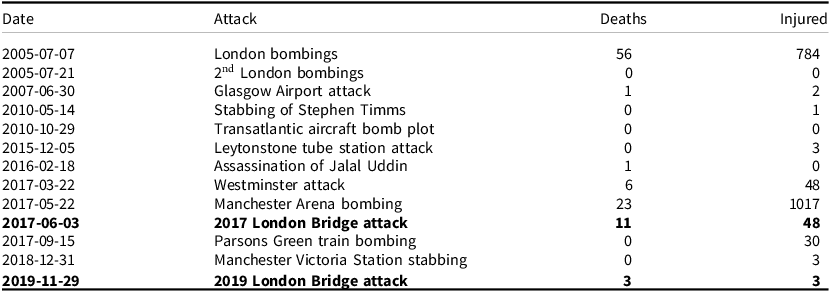
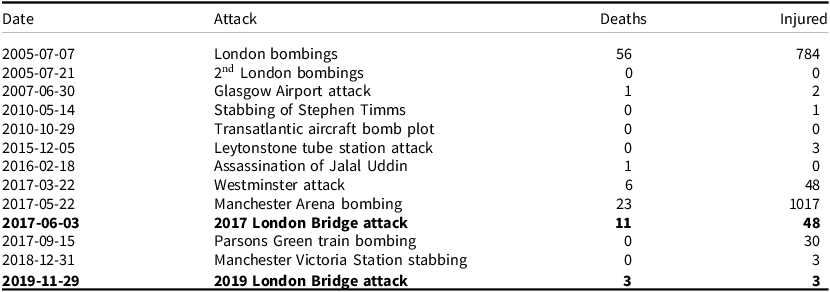
Second, the two London Bridge attacks were by no means the first Islamist attacks in the UK (see Table 3). In the two years before the 2017 London Bridge attack alone, there were four Islamist terrorist attacks, including one (i.e., the Manchester Arena bombing) only two weeks prior and another (i.e., the Westminster attack) just three months prior.Footnote 7 There were two more attacks between the 2017 and 2019 London Bridge attacks (i.e., the 2017 Parsons Green Train bombing and the 2018 Manchester Victoria Station stabbing). If there was desensitization, it should therefore be visible in the London Bridge attacks. Specifically, we should observe comparatively small effects after both attacks, especially after the 2019 attack. Analogously, if there was response escalation, we would expect comparatively large effects, especially after the 2019 attack.
Finally, since both London Bridge attacks occurred during election campaigns, we are able to estimate their effects using a constant data source including similar or even identical outcome measures (see below). This increases our ability to attribute changes in effect sizes to desensitization or escalation.
Research design
We follow several recent studies and leverage the exogenous timing of the London Bridge attacks during the collection of cross-sectional survey data (e.g., Balcells and Torrats-Espinosa Reference Balcells and Torrats-Espinosa2018; Bove, Efthyvoulou, and Pickard Reference Bove, Efthyvoulou and Pickard2024; Breton and Eady Reference Breton and Eady2022; Castanho Silva Reference Castanho Silva2018; Giani Reference Giani2021; Muñoz, Falcó-Gimeno, and Hernández Reference Muñoz, Falcó-Gimeno and Hernández2020; Nussio Reference Nussio2020). However, unlike previous studies, we do not rely on commercial or academic surveys, but on data from two Voting Advice Applications (VAAs). VAAs are online information tools that are made available to voters before elections (Germann and Gemenis Reference Germann and Gemenis2019). VAA data has a key advantage for our purposes since VAAs tend to be used by large numbers of people over a short period of time. By contrast, the daily number of interviews in more commonly used surveys in this field of study tends to be more limited. Therefore, previous studies often had to rely on relatively long temporal bandwidths spanning weeks or even months, which increase the risk of bias due to other, unrelated events (for exceptions, see Balcells and Torrats-Espinosa Reference Balcells and Torrats-Espinosa2018; Breton and Eady Reference Breton and Eady2022; Giani Reference Giani2021). Our reliance on VAA data allows us to significantly reduce the temporal bandwidth while maintaining high statistical power. Another notable advantage of VAA data is that VAA users have a clear incentive to reveal their true policy preferences, which reduces the risk of social desirability bias. Of course, VAA data is no panacea. Pre/post comparisons hinge on several strong identification assumptions (Muñoz, Falcó-Gimeno, and Hernández Reference Muñoz, Falcó-Gimeno and Hernández2020), and additional concerns arise due to the self-selected nature of VAA data. We perform a large number of tests to assess the plausibility of our identifying assumptions, the comparability of effect estimates across years, and their generalizability to the population of British voters.
Data source
We draw our data from WhoGetsMyVoteUK, a VAA that was made freely available before all recent UK general elections. In both 2017 and 2019, users of WhoGetsMyVoteUK were first asked to enter their preferences on a range of salient policy issues on a webpage. The tool then compared users’ policy preferences with the positions of political parties. Finally, it informed users about their level of agreement with the different parties. In both years, WhoGetsMyVoteUK also included several supplementary questions on demographics, general political attitudes, and political behavior. SI Appendix § 2.1 describes the application design in more detail.
WhoGetsMyVoteUK was used by tens of thousands of voters in both 2017 and 2019, though the 2017 version (circa 80,000 users) was somewhat more popular than the 2019 version (circa 50,000 users). The main reason was that the developers had a larger advertisement budget in 2017.Footnote 8 WhoGetsMyVoteUK was promoted using a variety of channels, such as press releases, articles in newspapers, and interviews in print and broadcast media. However, in both years, the majority of traffic was generated through paid social media advertisements.
Following best practice in the VAA literature (Andreadis Reference Andreadis, D. and S.2014; Wheatley and Mendez Reference Wheatley and Mendez2021), we perform all analyses on a lightly cleaned dataset. Specifically, we remove (1) likely repeated attempts by the same individuals; (2) users who indicated that they are not eligible to vote in the UK; and (3) speeders who rushed through the tool in less than one-third of the average time. This leads us to drop approximately 5% of all observations (see SI Appendix § 2.2). Finally, VAA samples tend to overrepresent younger, better-educated, and more politically engaged voters (Germann, Mendez, and Gemenis Reference Germann, Mendez and Gemenis2023; Marschall Reference Marschall, Garzia and Marschall2014). WhoGetsMyVoteUK is no exception. Still, our samples are demographically diverse, and, critically, the demographic composition is fairly similar in 2017 and 2019 (see SI Appendix § 2.3).
Estimation
We estimate the effects of the London Bridge attacks on political attitudes by comparing voters who accessed WhoGetsMyVoteUK within one, two, and three days of the attacks. As it can be unclear whether people were immediately exposed to news about the attacks, we always remove users who accessed the tool on the day of the attacks. We use regular ordinary least squares regression and control for the following standard set of covariates: age, gender, educational attainment, region of residence, political interest, general political predisposition, and past voting behavior (see SI Appendix § 2.4). Despite the short temporal bandwidths, our sample sizes range from around 2,500 to more than 20,000, depending on the outcome variable, temporal bandwidth, and year.
Outcomes
Our data allows us to study the impacts of the London Bridge attacks on three frequently studied political attitudes. First, we rely on a selection of the policy statements to tap effects on people’s willingness to trade some of their civil liberties for toughened security (e.g., ‘The security services should be allowed to monitor people’s Internet use’). Second, we use policy statements related to immigration to tap outgroup prejudice (e.g., ‘The UK should introduce quotas to limit the number of immigrants coming into the country’). Users provided their answers to policy statements on 5-point Likert scales ranging from ‘Completely disagree’ to ‘Completely agree’. Users also had a ‘No opinion’ option, which we treat as missing data. With the exception of security preferences in 2017, there are always multiple relevant policy statements. Where applicable, we combine relevant statements into summated rating scales.
Third, we gauge rally-around-the-flag tendencies using two questions that asked VAA users to rate the extent to which they feel English and British, respectively. The in-group identification questions used a scale of 0 (not at all) to 10 (perfectly). Only users from England are considered in analyses of English identification. SI Appendix § 2.5 provides additional details on our outcome variables, including all question wordings.
Identifying assumptions
Our identification strategy rests on three main assumptions (Muñoz, Falcó-Gimeno, and Hernández Reference Muñoz, Falcó-Gimeno and Hernández2020). First, users who accessed the tool after the attacks must have been exposed to news about the terrorist attacks (compliance assumption). Second, the changes in policy preferences must be attributable to the terrorist attacks and not other events that occurred around the same time or an unrelated time trend (excludability assumption). Third, whether somebody accessed the VAA before or after the attacks must be as if random (ignorability assumption). We provide evidence in support of our identifying assumptions in SI Appendix § 2.6.
First, we investigate the content of top headline news stories published around the time of the London Bridge attacks (Balcells and Torrats-Espinosa Reference Balcells and Torrats-Espinosa2018). We find that almost all major British newspapers led with news about the attacks in the first three days after the attacks, suggesting that subjects in our post-attack samples were likely aware of them.Footnote 9 We also find that British newspapers led with a potpourri of stories in the run-up to the attacks, most of which are highly unlikely to have significant effects on our outcome variables. Overall, the media analysis strengthens confidence in both the compliance and the excludability assumption.
Second, we compare the demographic profile of VAA users before and after the London Bridge attacks. We find that voters who used WhoGetsMyVoteUK shortly before and shortly after the terrorist attacks are comparable in terms of a large number of demographics, including their gender, age, education, political interest, past vote in general elections, and past vote in the Brexit referendum. This increases confidence in the ignorability assumption.
Finally, we perform several placebo checks, including placebo treatment tests comparing users who accessed WhoGetsMyVoteUK at various points during the pre-treatment period. We also test for effects of the London Bridge attacks on several placebo outcomes that, according to extant theories, should not be affected by Islamist terrorism (i.e., preferences for economic redistribution, state intervention in the economy, and environmental protection). We find no evidence for pre-treatment trends and no effects on placebo outcomes. This increases confidence in both the excludability and ignorability assumptions.
Self-selection into VAA usage
Voters decide themselves whether and when they use a VAA, which leads to several potential concerns. First, self-selection could threaten causal estimates if exposure to Islamist terrorism makes some voters more or less likely to use a VAA. Yet, as already noted, we do not find evidence that a particular demographic became more or less likely to use our VAA after the London Bridge attacks. We also find little evidence to suggest that users’ propensity to answer outcome questions changed significantly after the attacks (see SI Appendix § 2.6.4). This suggests that self-selection is unlikely to be a major concern for the internal validity of our estimates. Still, we note that we cannot fully rule out bias due to attrition.
Second, the lack of representativeness could hamper our ability to generalize the effects to the population of British voters. Furthermore, while the 2017 and 2019 samples have similar demographic composition, small or unobserved differences could still hamper our ability to compare effects across years. We assess these concerns in four ways (see SI Appendix § 2.7 for the complete results). First, we explore several potential sources of effect heterogeneity, including age, gender, education, general political orientation, and political engagement. We do not find any consistent evidence for effect heterogeneity. This allays concerns about lack of representativeness and differences in sample composition (Coppock Reference Coppock2019). In addition, this also allays concerns that stability in attitudinal responses to Islamist terrorism could be masking countervailing tendencies in different subgroups.
Second, we include survey weights that adjust the samples to census targets. The results remain similar. Third, to improve the comparability of our samples, we rerun all analyses while restricting the samples to traffic coming from a single source: Facebook. Again, the results remain similar.
Finally, we perform a sensitivity analysis in which we add artificial observations to the (somewhat smaller) 2019 sample such that the sample size matches the (somewhat larger) 2017 sample. This assesses the potential concern that the different sample sizes could, at least partly, be owed to contextual factors, such as the fact that the 2017 election was closer than the 2019 election. We variably assume that the effect of exposure to the 2019 attack among artificial observations was zero, 50% of the measured effect, 150% of the measured effect, and 200% of the measured effect. The effects with artificial observations included remain broadly comparable with the actually measured effects. Furthermore, the effects of the 2019 attack remain broadly comparable to the effects of the 2017 attack even with artificial observations included. This applies, in particular, to in-group identification and, therefore, the only outcomes for which we have questions with the exact same wording in both 2017 and 2019.
Overall, our supporting evidence suggests that effect estimates are broadly generalizable to the population of British voters and comparable across years.
Results
We proceed to discuss the effects of the 2017 and 2019 London Bridge attacks on political attitudes. We report all effects as Cohen’s $d$
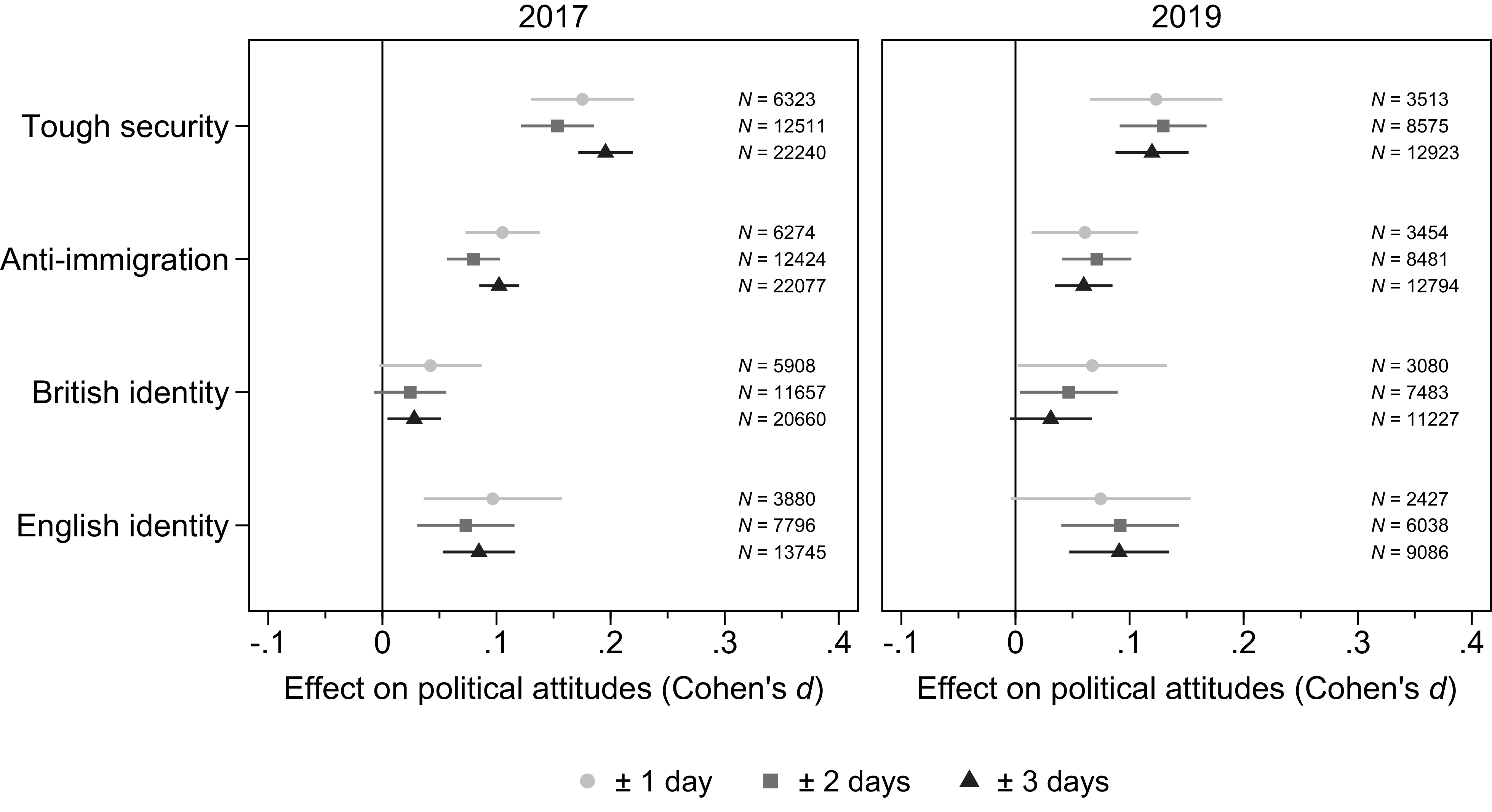
values (i.e., effects divided by the standard deviation of the outcome variable) to improve comparability between outcome variables and with Study 1. Higher values indicate stronger support for restrictive security and immigration policies as well as heightened in-group identification. The spikes represent 95% confidence intervals.
$d$
values (i.e., effects divided by the standard deviation of the outcome variable) to improve comparability between outcome variables and with Study 1. Higher values indicate stronger support for restrictive security and immigration policies as well as heightened in-group identification. The spikes represent 95% confidence intervals.
Figure 2 shows the results. We find that even though the UK was subject to several Islamist terrorist attacks in the years, months, and even weeks prior, the 2017 London Bridge attack led to changes in political attitudes that are broadly comparable to previous attacks in the UK and elsewhere.Footnote
10
The largest effect emerges in the case of support for tough security policies ( $d = 0.15-0.20$
). We also observe substantial increases in anti-immigrant sentiment (
$d = 0.15-0.20$
). We also observe substantial increases in anti-immigrant sentiment ( $d = 0.08-0.11$
) and a rally effect, although, interestingly, we find a stronger effect on English identification (
$d = 0.08-0.11$
) and a rally effect, although, interestingly, we find a stronger effect on English identification ( $d = 0.07-0.10$
) than on British identification (
$d = 0.07-0.10$
) than on British identification ( $d = 0.02-0.04$
). A possible reason is that British identity tends to be seen as more ethno-religiously inclusive, and Islamist terrorism may be especially likely to activate more narrow, White, and Christian identities.
$d = 0.02-0.04$
). A possible reason is that British identity tends to be seen as more ethno-religiously inclusive, and Islamist terrorism may be especially likely to activate more narrow, White, and Christian identities.
Short-term effects of the 2017 and 2019 London Bridge attacks on political attitudes.
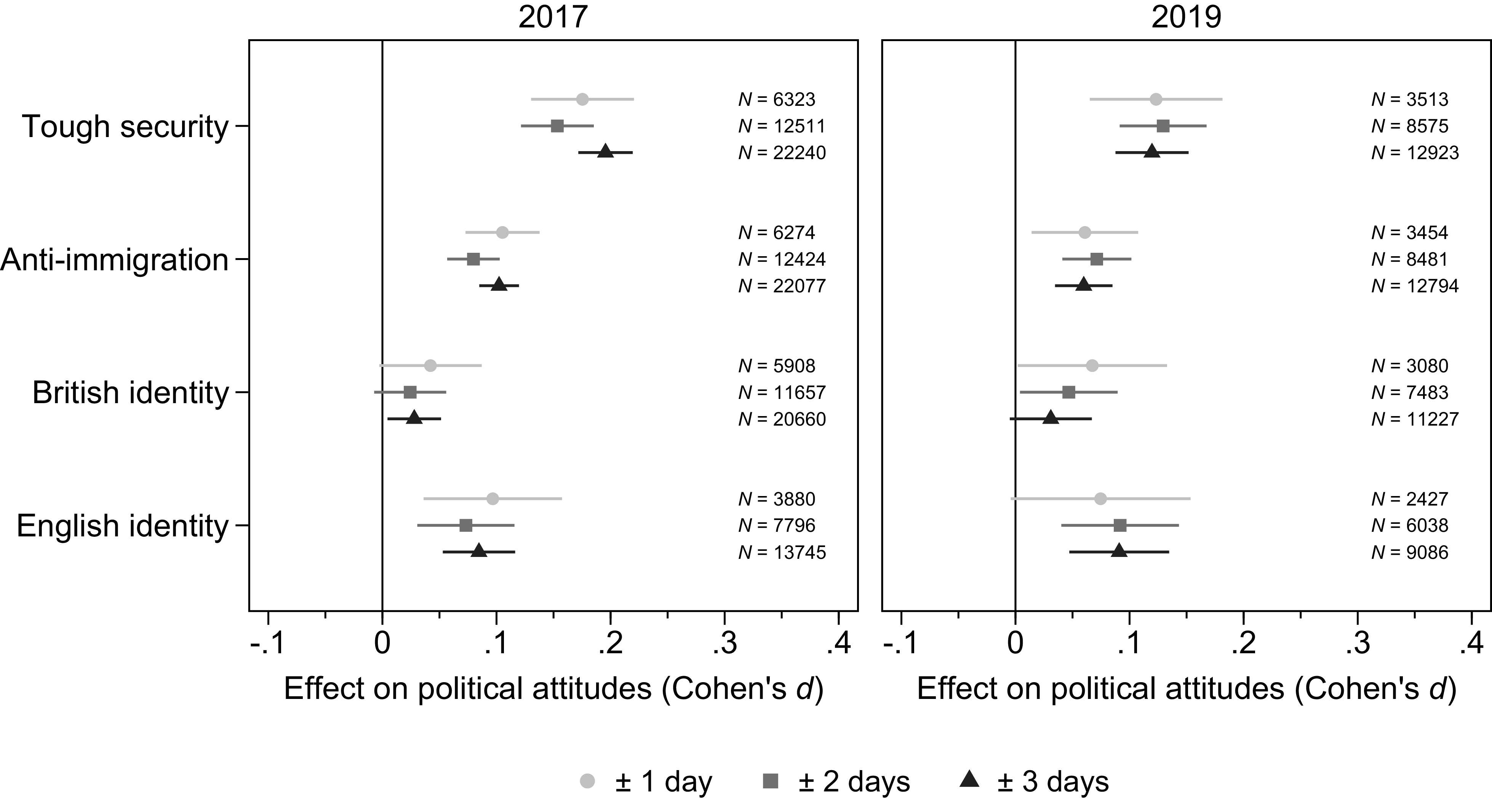
Islamist terrorism continued in the months after the 2017 London Bridge attack. Despite this, the 2019 London Bridge attack had broadly comparable effects on political attitudes. This applies, in particular, to the effects on English ( $d = 0.07-0.09$
) and British identification (
$d = 0.07-0.09$
) and British identification ( $d = 0.03-0.07$
), which had the exact same wordings in both years. Meanwhile, the effects on security (
$d = 0.03-0.07$
), which had the exact same wordings in both years. Meanwhile, the effects on security ( $d = 0.12-0.13$
) and immigration policy (
$d = 0.12-0.13$
) and immigration policy ( $d = 0.06-0.07$
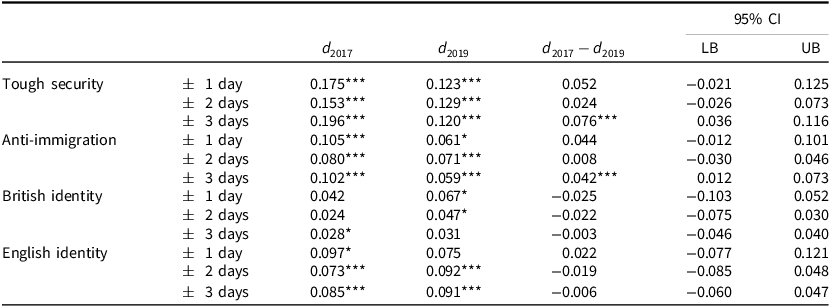
) are somewhat smaller in 2019, but the differences are moderately sized and most do not reach statistical significance (see Table 4). Notably, the wordings of the policy statements related to security and immigration policy differed somewhat between the years (see SI Appendix § 2.5).
$d = 0.06-0.07$
) are somewhat smaller in 2019, but the differences are moderately sized and most do not reach statistical significance (see Table 4). Notably, the wordings of the policy statements related to security and immigration policy differed somewhat between the years (see SI Appendix § 2.5).
Formal comparisons of the short-term effects of the 2017 and 2019 London Bridge attacks
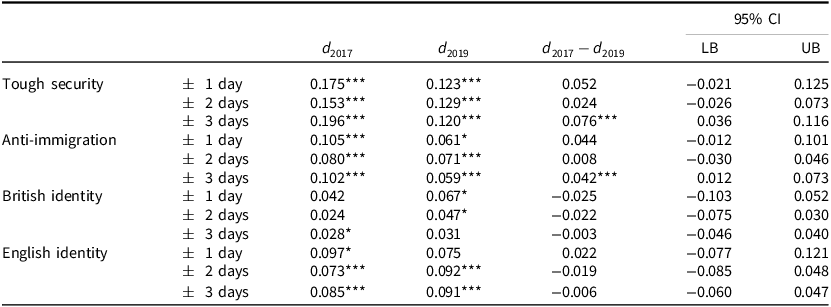
Note: The table provides the standardized impacts of the 2017 and 2019 London Bridge attacks (Cohen’s $d$
), the differences between them, and the 95% confidence intervals of the differences. We estimate the statistical significance of differences between 2017 and 2019 using seemingly unrelated estimation. CI = confidence interval; LB = lower bound; UB = upper bound. *
$d$
), the differences between them, and the 95% confidence intervals of the differences. We estimate the statistical significance of differences between 2017 and 2019 using seemingly unrelated estimation. CI = confidence interval; LB = lower bound; UB = upper bound. * $p \lt$
0.05; **
$p \lt$
0.05; ** $p\lt$
0.01; ***
$p\lt$
0.01; *** $p\lt$
0.001.
$p\lt$
0.001.
Overall, the results of Study 2 point to response stability. Despite many prior attacks, several of which were in the recent past, both London Bridge attacks had comparable effects on political attitudes. The effect sizes we report are also comparable to those found for other attacks in previous studies, including two attacks in the UK: the 2005 London bombings ( $d = 0.13$
) and the 2017 Manchester Arena bombing (
$d = 0.13$
) and the 2017 Manchester Arena bombing ( $d = 0.07$
).
$d = 0.07$
).
Additional robustness checks and analyses
We report several additional robustness checks in SI Appendix § 2.8. First, we provide the full-sample results including all observations that were removed as part of the data cleaning. Second, we report the results when we match exactly on all covariates instead of using linear regression. Exact matching fully removes any measured imbalances between treatment and control groups and thus increases confidence in the ignorability assumption. Third, we report naive pre/post comparisons that do not include any control variables. The results are always similar.
In SI Appendix § 2.9, we consider the effects of the terrorist attacks on each of the individual policy questions making up our summated rating scales measuring security and immigration attitudes. We find that the effects are generally similar across items, with the most notable difference being that we find particularly large increases in people’s opposition to accepting refugees from war-torn countries.
Finally, in SI Appendix § 2.10 we investigate the durability of the effects of the London Bridge attacks beyond the three-day time window. We find that the effects remained similar in size over a period of up to two weeks after the attacks. Notably, the effects also remained visible on election day in both 2017 and 2019. Unfortunately, our data does not allow us to establish effects beyond the two-week mark (VAAs tend to stop data collection after election day). We note that effects become less well-identified the longer the time frame.
Conclusion
This article offered the first systematic test of whether the effects of Islamist terrorism on political attitudes have changed over time. Study 1 synthesized the full body of existing evidence to assess whether reported effect sizes have changed over time. The results suggest that newer studies tend to report smaller effects, but this negative time trend vanishes after controlling for attack severity, study design, and country context. Controlling for the same factors, we also found little evidence for a correlation between the number of prior Islamist attacks and the size of effects on political attitudes. These findings were robust to a large number of additional analyses, including tests for publication bias.
Overall, Study 1 suggests that Islamist terrorism continues to have similar effects on political attitudes in Western democracies. However, this does not mean that every attack has the same impact. Our meta-analysis illustrates that reported effect sizes vary significantly. Yet, this variation does not seem to be driven by repeated exposure to Islamist terrorism but by contextual factors and study features. This, importantly, points to a potential limitation of Study 1: basic indicators of study design and the research context may not fully account for the heterogeneity in previous literature. Hence, we also conducted a more tightly controlled comparison of the effects of two recent Islamist terrorist attacks in the UK using a comparable research design.
Study 2 drew on a novel data source – VAAs – that provides large numbers of observations over short time frames. This allowed us to estimate short-term causal effects on political attitudes with high accuracy and precision. The results suggest that both the 2017 and 2019 London Bridge attacks increased preferences for restrictive security and immigration policies, as well as in-group identification. The effect sizes were similar in both years, especially for outcomes that used the exact same wording in both years. Additional analyses lent support to our identifying assumptions and suggest that effect estimates can at least broadly be generalized to the population of British voters. While limited to the UK, Study 2 provides further evidence against desensitization (or response escalation). The London Bridge attacks occurred amid a wave of Islamist terrorism in the UK and elsewhere. Despite this, the London Bridge attacks had effects comparable to those of other attacks, including earlier attacks in the UK.
In sum, our evidence points to the conclusion that the effects of Islamist terrorism on political attitudes in Western democracies have neither decreased nor increased. Importantly, we find no evidence for effect heterogeneity in either study, suggesting that the stability in aggregate-level responses likely reflects stability in individual-level responses. These results challenge the increasingly popular desensitization hypothesis and have important policy implications. Changes in policy preferences and outgroup attitudes of the sort we document could help legitimize restrictive security and immigration laws that compromise civil liberties and human rights. Increased hostility toward outgroups may translate into increased support for populist and anti-immigrant parties (Helbling and Meierrieks Reference Helbling and Meierrieks2022), especially when attacks occur close to elections, as was the case with both London Bridge attacks. Finally, increased outgroup prejudice can induce a vicious cycle as outgroup members who are discriminated against may become more vulnerable to radicalization (Bail, Merhout, and Ding Reference Bail, Merhout and Ding2018).
Future research should explore in more detail why different attacks yield different effects. Our findings that effects tend to be stronger in the U.S. and weaker in natural experiments provide a starting point. However, it is likely that the effects of Islamist attacks are shaped by several other factors that we could not consider, such as the extent and style of media coverage or the symbolic value of attack locations. Future research may also want to explore the possibility of more complex temporal dynamics that we could not consider due to data limitations, such as whether repeated exposure to Islamist terrorism affects the durability of effects on political attitudes (Bozzoli and Müller Reference Bozzoli and Müller2011; Epifanio, Giani, and Ivandic Reference Epifanio, Giani and Ivandic2023). Finally, it is conceivable that the reason we do not observe desensitization (or escalation) is that Islamist terrorism in Western democracies remains too infrequent. Future research should therefore assess the consequences of repeated exposure to political violence in other contexts, especially where violence is more prevalent and frequent.
Supplementary material
The supplementary material for this article can be found at https://doi.org/10.1017/S1475676526101017.
Data availability statement
All data and statistical code necessary for replicating the analyses reported in this paper can be accessed in the Harvard Dataverse at https://doi.org/10.7910/DVN/ALYGQS.
Acknowledgments
Previous versions of this manuscript were presented at the Annual Meeting of the Midwest Political Science Association, the Academic Convention of the German Political Science Association, the European Political Science Association Conference, and at research seminars and workshops at the Norwegian University of Science and Technology, the University of Bath, the University of Oxford, and the University of Warwick. We thank Peter Allen, Vincenzo Bove, Henning Finseraas, Marco Giani, Bethany Lacina, Enzo Nussio, Carl Müller-Crepon, Harry Pickard, Ana Weeks, four anonymous reviewers, and all conference, workshop, and seminar participants for helpful comments and suggestions.
Funding statement
This study benefited from funding by the Economic and Social Research Council (Grant Reference Number: ES/W000598/1), the European Research Council (Grant Agreement ID: 772160), and the Research Foundation Flanders (Grant Number: 12D1523N).
Competing interests
The authors do not have any conflicts of interest.






 Open access

