

Introduction
In Finland, 2024 was a year of elections, with the National Coalition Party/Kokoomus (KOK) winning both the presidential and European Parliament elections. At the same time, the party was leading a government that was particularly unpopular. It had promised economic growth and a reduction of public deficit, and in 2024, the government's attention was particularly on the restructuring of social and health as well as labour services through legislation. The opposition mobilised criticism of the government on regional policy, labour industry relations, nature and climate, asylum seekers’ rights and particularly on social and health services, which included regional hospital closures. This was visible in the way the Left Alliance/Vasemmistoliitto (VAS) secured second place in the European Parliament (EP) elections, arguably on the strength of its popular candidate and party leader, Li Andersson. The Finns Party/Perussuomalaiset (PS) played a double role, being at the forefront of the austerity government while challenging the political elites at the same time. The strong performance of the small red-green parties in the elections and the fact that the Social Democratic Party/Suomen Sosialidemokraattinen puolue (SDP) remained popular in the polls throughout the year indicate growing mobilisation among left-leaning and green voters.
Election report
Two important elections were held in Finland in 2024. The presidential elections in January gained a lot of attention, and the turnout was 71.5 per cent (increasing from 69.9 per cent in 2018). The European Parliamentary elections were held in June and saw a 40.4 per cent turnout (declining from 43.7 per cent in 2019). Finland's candidate-centered electoral system and nationwide open list for EP elections meant that the presidential elections offered a platform for some candidates to gain visibility in their bid for the European Parliament. The campaigning started relatively late for the EP elections and did not receive as much attention in the media, which was more focused on the government-opposition dynamic. Politically, both elections were important as they were centred on the theme of security. In Finland, a country that shares a border with Russia and had recently joined the North-Atlantic Treaty Organisation (NATO), security was a particularly prominent issue. Both the presidential institution and European Union membership have traditionally been important safeguards for security.
Presidential elections
The Finnish presidential elections took place at the beginning of 2024. The first round was held on 28 January 2024 and the second round two weeks after, on 11 February. There were nine candidates running for this post. Even if the powers of the president have been redistributed over the years, in Finland's semi-presidential system, the constitution states that the president is responsible for foreign policy alongside the government.
Two candidates outshone others, making it to the second round. First was Alexander Stubb (KOK, b. 1968), who had served as Prime Minister, KOK party leader, Minister of Foreign Affairs, Member of the European Parliament (MEP), Member of the Finnish Parliament Eduskunta (MP), but he had retired from active politics to the European University Institute, where he led the School of Transnational Governance. The contender, Pekka Haavisto (b. 1958), was a former Green Movement party leader and Minister of Foreign Affairs (both in the 1990s and in the 2010s), MEP and MP. Haavisto was running for the third time in the Presidential elections.
As President Sauli Niinistö (KOK) had reached his two-term limit, Stubb was nominated as the party's candidate. Stubb's approach was Europeanist and Trans-Atlanticist, while Haavisto was known for his skills in peace negotiation and with a more globalist perspective to international relations. Otherwise, they both represented an outward-looking stance. Both also had foreign-born spouses. The spouse issue became politicised in the second round, as Haavisto is in a same-sex marriage. As neither of the candidates was conservative in a traditionalist sense and Stubb also supports same-sex marriage, this feature was considered decisive to some second-round voters. Some recognised Haavisto as a better representative of the non-urban Finland even if his voters were predominantly in the cities.
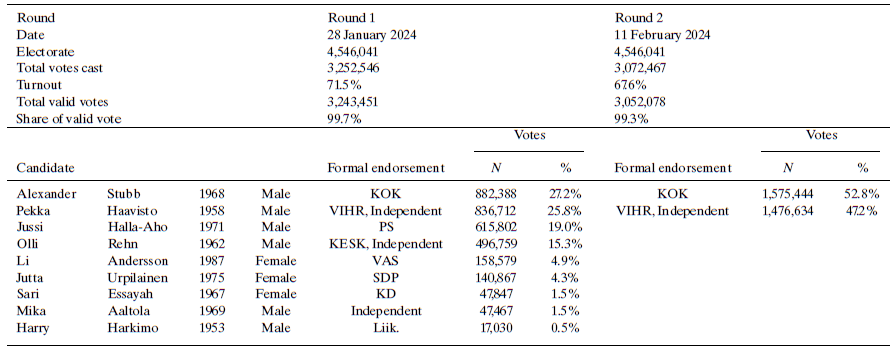
The race was tight (see Table 1). In the first round, Stubb obtained 27.7 per cent of the vote and Haavisto 25.8 per cent, with a difference of 45,676 votes. In the second round, the outcome was 51.6 per cent for Stubb and 48.8 per cent for Haavisto, with 98,810 votes in between. The victory of Stubb over Haavisto not only gave Finland a Trans-Atlanticist-Europeanist president from the liberal wing of the National Coalition Party, who is an academic and a polyglot, but also an Iron Man, known for his talent in triathlon and great at sports, including golf, but also a First Lady from the United Kingdom. Countrywide, the gap in their regional support was not large, although Haavisto overtook Stubb in most urban centres. Haavisto was more popular than Stubb in the Swedish-speaking Åland Islands, Lapland and middle-Finnish regions around Tampere and Jyväskylä as well as in Helsinki. Stubb's support was the strongest on the West coast, where there are many Swedish-speaking municipalities, and the South-East region.

Note: In all relevant cases, ‘Independent’ endorsement refers to the candidate's presidential electoral association.
Sources: Oikeusministeriö (28 January 2024) Presidentinvaalit 2024. 1. vaali [Presidential elections 2024. First election] (https://tulospalvelu.vaalit.fi/TPV-2024_1/); Oikeusministeriö (11 February 2024) Presidentinvaalit 2024. 2. vaali [Presidential elections 2024. Second election] (https://tulospalvelu.vaalit.fi/TPV-2024_2/).
The first-round candidates were Jussi Halla-aho (b. 1971), the MP and chair of the Finnish Parliament, former party leader and former MEP for the PS, who got 19.0 per cent of the vote. Olli Rehn (b. 1962) who, like Haavisto, was running for an election association rather than directly for the party in a new trend where presidents are seen as ‘above’ political parties, got 10.3 per cent. Rehn, from the Centre Party/Keskusta (KESK), is the Governor of the Bank of Finland. He had also been commissioner for Finland in the Barroso European Commissions, vice-president of the European Parliament, MEP and MP. Both Halla-aho and Rehn's vote share was just roughly a percentage point below their parties’ support in the 2023 Parliamentary elections (20.1 per cent and 11.3 per cent, respectively), showing little volatility into Stubb's direction.
Among the minor candidates, VAS party leader Li Andersson (b. 1987) secured fifth place with 4.9 per cent of the vote. This result placed her ahead of the SDP candidate, the Commissioner for Finland Jutta Urpilainen (b. 1975), who was also a former party leader, MEP and MP, and finished sixth with 4.3 per cent. Christian Democratic Party/Kristillisdemokraatit (KD) party leader and Minister in the Orpo I government Sari Essayah (b. 1967), secured 1.5 per cent of the vote. The independent candidate and head of the Finnish Institute for Foreign Affairs, Mika Aaltola (b. 1969), also received 1.5 per cent. Aaltola, who had run an independent campaign with a high public profile, was later elected as an MEP for the KOK. Harry Harkimo (b. 1953) of the declining Movement Now (Liik) received only marginal support with 0.5 per cent.
European Parliamentary elections
In Finland, the European Parliament elections were held on 9 June 2024 for the 15 seats available. The electoral district included the whole country, just as in the Presidential elections, and so the candidates carried out nationwide campaigns. For some candidates and parties, the Presidential campaign had been an early start for the European Parliament elections. The low turnout implied that mainly those citizens who were interested in European politics voted on the summer weekend, or beforehand through postal ballot.
The national political scene was particularly intense in the spring, and the campaign was marked by the confrontation between government and opposition. The critical campaign themes were security, due to the importance of EU membership for Finland's security, and Social Europe. There was also a strong presence of campaign messages contesting the far right.
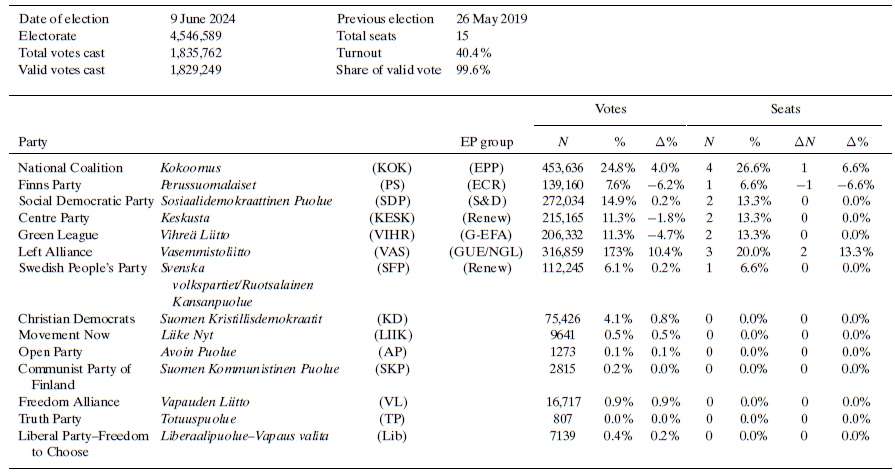
At the time, the most popular party at the polls was the SDP, and there were no clear indications that support for the PS had shrunken (Piirainen Reference Piirainen2025). Overall, there was an expectation that the PS would benefit from a Europe-wide turn to the far right. Still, the SDP did gain two seats, and the PS managed to keep only one of its two seats in the elections. The parties that won the most seats were the KOK (four seats in European People's Party group) and the VAS (three seats in the Left Group). As a party, KOK is strongly ‘Europhilic’ and pro-integration, but so is today's VAS (Herkman & Palonen Reference Herkman, Palonen, Herkman and Palonen2024).
Since Russia's full-scale attack on Ukraine was still going on and Finland had recently joined NATO, and the presidential elections had focused heavily on foreign policy, security emerged as a key theme for many candidates in the EP elections. KOK gained from this sentiment (Table 2), which was leveraged by Mika Aaltola, the party's most popular candidate with 5.2 per cent of the personal vote. Aaltola, director of the Finnish Institute of International Affairs, was an academic who had profiled himself, particularly since 2022, as an expert on national security in several media appearances. He campaigned as an independent on KOK's list, seeking also votes from religious Lutheran communities in Finland. Henna Virkkunen, a sitting MEP for KOK, gained almost the same number of votes. She later became the commissioner for Finland. The other two successful candidates from KOK also held distinct profiles. Pekka Toveri, a first-term MP and now first-term MEP, had a profile similar to Aaltola in that both had backgrounds in security expertise. The third successful candidate, Aura Salla, was also a first-term MP who had held various roles in Brussels before entering national politics. Sitting MEP Sirpa Pietikäinen, from the more climate-conscious and social-liberal wing of the party, secured a seat as reserve when Virkkunen became a Commissioner. On an open party list system, this voter preference over more economy-focused candidates shows how the KOK strategically leveraged the theme of security, gathering 24.8 per cent of the total vote. The personal support of Aaltola would have been enough to secure him a seat even as an independent candidate, had he been able to make as successful a campaign without the party.

Note: Christian Democrats (KD) and Movement Now (LIIK) ran in an electoral alliance.
The prominence of its candidates was also behind VAS’ success, which, for the first time, secured the second largest share of the votes at an EP election (Poyet Reference Poyet2024). Li Andersson's nationwide appeal as perhaps the most talented politician in her generation, with her ability to explain complex issues and confront those with whom she disagrees with, played a role in this. While the party received an unprecedented share of 17.3 per cent of the vote nationwide, Anderssons’ personal votes overall reached 13.5 per cent. The party's three seats came as a total surprise. Previously, VAS had struggled to get one seat, with the traditionally more Europhilic green and social democratic parties overtaking them. With three MEPs, the whole party leadership changed. Former MEP Merja Kyllönen renewed her seat from the 2014-19 parliamentary term, and Andersson's support carried through, also vice-chair Jussi Saramo. The three Finns also made a particular presence in the European Parliament's Left Group, as they follow the Finnish geopolitical position of supporting European anti-Russian efforts in Ukraine in contrast with the position of other group members.
The SDP did not match their nationwide success in the polls but kept their two seats. Former party leader Eero Heinäluoma renewed his seat, and the long-term MP Maria Guzenina became a new MEP for the Socialists and Democrats group in the European Parliament.
KESK also renewed its two seats, electing two women who both got a significant share of the votes in their regions. Elsi Katainen, from the East of Finland, renewed her seat, and the former party leader Katri Kulmuni, from the North of Finland, became a first-term MEP into the Renew group.
The Green League (VIHR) lost one of their three seats (they had received the extra seat Finland gained after the United Kingdom's Brexit). The two seats went to the former party leader Maria Ohisalo and the sitting MEP and former party leader Ville Niinistö.
Anna-Maja Henriksson was elected as the new MEP from the Swedish People's Party/Svenska folkpartiet/Ruotsalainen kansanpuolue (SFP/RKP) and sat with the Renew group in the European Parliament.
Against all predictions, the PS only got one seat for the ECR group. The MP Sebastian Tynkkynen, known as an early social-media politician native to YouTube, got elected to the European Parliament, but did not manage to pull in Vilhelm Junnila, who had a short-lived experience as a minister in the Orpo government in 2023 (Palonen Reference Palonen2024). The decline of their support is likely related to a weak candidate base as well as disinterest in the European Parliament. The party's core supporters may have viewed as negative the absence of the regular maverick politicians, as well as the party's involvement in the austerity government (Lahti & Palonen Reference Lahti and Palonen2025).
Unlike in 2019, climate change was not a trending issue in these elections, which rather focused on opposing the government's austerity politics, making Social Europe a more prominent overarching theme. Many who could otherwise have voted for other parties took the opportunity to vote for Andersson's to elect her to a position where her talent could be recognised. As the short curricula vitaes CVs of the MEPs indicate, expertise was valued.
The EP elections marked an interesting moment in Finnish politics, as among the 15 national delegates there were four former ministers of the all-female led, five-party Marin I government: Andersson (VAS), Hendriksson (SFP/RKP), Ohisalo (VIHR) and Kulmuni (KESK). The post-pandemic resentment in politics that was felt in the 2023 elections, which Sanna Marin lost (Palonen Reference Palonen2024), was reversed in 2025 where, on the open list ballot, Finns backed the politicians who had handled the pandemic in Finland (Karv et al. Reference Karv, Palonen, Bäck, Lodge, Smith and Fotopoulos2025).
Cabinet report
As the Orpo I government entered its second year in 2024, it began to implement its key policies. The government was set out to push a sustained agenda aimed at cutting the budget deficit, their election promise in 2023. The right-wing government's agenda also included restrictions on migration, tax cuts, cuts on welfare services and funding to non-governmental associations and civil society organisations, as well as the cultural sector, on a historic scale. Public-sector funding cuts were made to shrink the size of the state. The yearly report of the government highlighted the importance of the issue with the following facts: ‘The imbalance between public expenditure and revenue increased in 2024 compared to the previous year. According to preliminary data, the public deficit was 4.5 per cent of GDP. Tax and social security contribution revenue grew only slightly in 2024, while expenditure growth was faster. Public finances are structurally in deficit’ (Finnish Government 2025: 21).
The reforms of the social and health services targeted the deficit and addressed the lack of personnel in the Welfare Service Counties. The Ministry of Health proposed, in early 2024, significant reductions to the number of hospitals in the country (Paukkeri & Tolkki Reference Paukkeri and Tolkki2024). In its report, the government acknowledged that the reforms might not lead to improvements but cuts to services (Finnish Government 2025: 26). The government also implemented reforms to general housing allowances and income support for low-income households, which were intended to reduce dependency on public welfare and generate significant budget savings. Payment of the state pension abroad was discontinued.
Despite Finland's top position in the Organisation for Economic Co-operation and Develoment OECD's Programme for International Student Assessment (PISA), Finns have been concerned about the learning environment in schools. To address this, the government added funding to increase early access to support. The hours dedicated to the mother tongue and maths teaching were increased in Grades 1–2 as for the mother tongue and literature in Grades 3–6. The government also proposed a ban on cell phone use in schools, which would be taking effect in 2025. This policy, which was a subject of intense public debate, was significant in a country whose economy had been shaped by the early mobile boom and the legacy of NOKIA phones.
A small but significant policy change was the decision to increase the state funding for private schools. These would now receive full support on a per-student basis. The marketisation of schools or communities of knowledge was rare in Finland, and the issue did not receive much attention. The decision, which would take effect from September 2024, was significant in two respects. First, in contrast to Sweden, where the reform of welfare state services included the privatisation of schools, Finland had favoured a same-public-education-for-all approach with its homogeneous population, low levels of authority and warm school lunches believed to be behind the excellent PISA results. Second, there are only 80 private schools in Finland, typically either Steiner Schools, International Schools or Christian Schools of different religious communities. The decision stemmed from the right-wing's historic criticism of the comprehensive education system (Ahonen Reference Ahonen, Blossing, Imsen and Moos2014) and a need to satisfy the support base of the Christian Democrats, the junior coalition partner.
Labour reform was a more visible issue. The responsibility for unemployment services was moved to the municipalities. The Unemployment Security Act and the Act amending the Unemployment Security Act were revamped, shrinking funding to those in longer-term unemployment. The labour legislation reform that was initiated in the autumn of 2023 had led to industrial action in late 2023 (Palonen Reference Palonen2024), and mobilisations were still active in 2024. The government justified its reforms on the basis of public savings. The legislation, which came into force on 2 September, included amendments to the Unemployment Security Act and the Act on the Financing of Unemployment Benefits abolishing the increased benefits tied to periods of job searching, including the removal of the protection component (i.e., previously one could earn 300 euros without that affecting unemployment benefits and the first day of sick-leave being unpaid) (Finnish Government 2025: 31).
There was a tension between the Ministry of the Interior's cautious line on migration and the need for migrant labour acknowledged by the Ministry of Economic Affairs and Employment (YLE News 2024). The Finnish citizenship legislation was tightened through amendments to the Citizenship Act. The time required to access citizenship was extended from five to eight years, while the five-year term would still apply to those fulfilling the language criterium, those aged 15–17 and those with a Finnish spouse. Furthermore, the criteria are not reduced for applicants seeking international protection (Ministry of the Interior 2024). Plans were made for reducing the residence permits of unemployed non-citizens to up to three to six months of unemployment, which was not well received in the business and migrant and expat communities (Ramachandran D'souza Reference Ramachandran D'souza2024), The government issued an action plan against labour exploitation (Ministry of Economic Affairs and Employment of Finland 2024) to cut down the grey economy and address the labour shortage in Finland as well as the maltreatment of migrant labour.
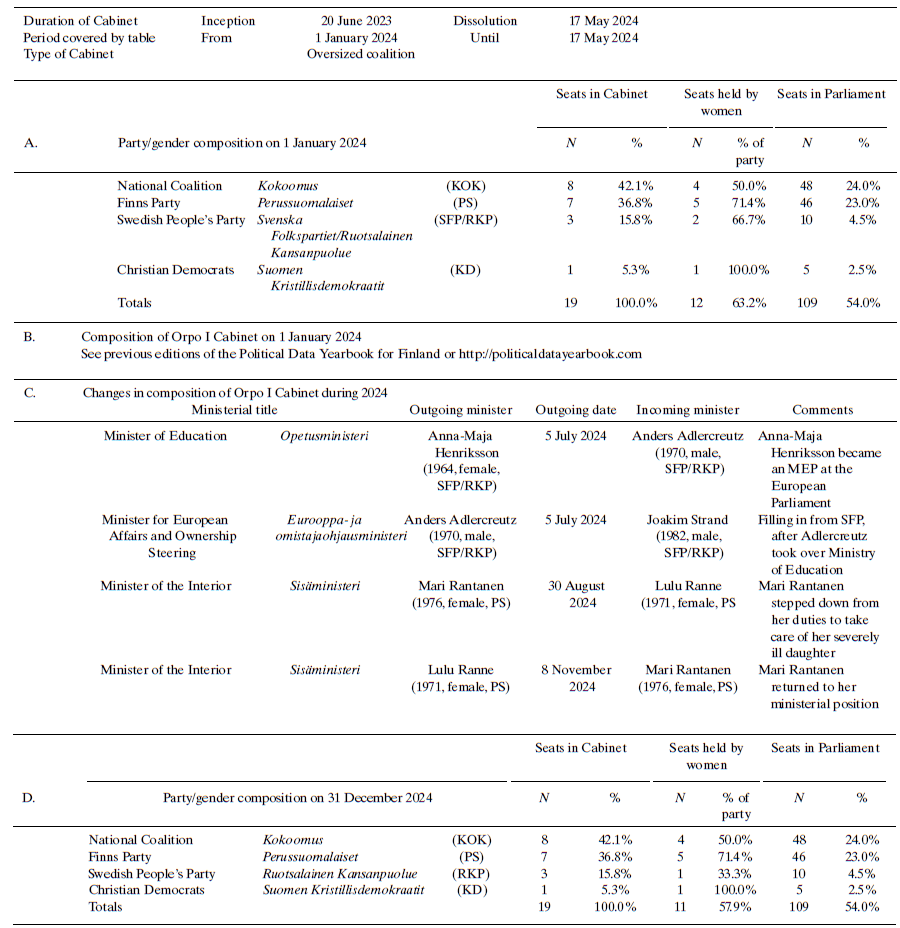
There were no major Cabinet changes, simply replacements. One was due to the SFP/RKP party leadership change following the election of Anna-Maja Hendriksson to the EP. The other in PS when Lulu Ranne agreed to lead briefly two ministries while Mari Rantanen was absent due to family reasons.
The composition of the Orpo I Cabinet can be found in Table 3.

Note: Lulu Ranne held both ministerial duties as Minister of Transport and Communication and Minister of the Interior from 30 August 2024 to 8 November 2024.
Sources: Finnish Parliament Eduskunta webpages, Kansanedustajien sukupuolijakauma eduskuntaryhmittäin (www.eduskunta.fi/FI/naineduskuntatoimii/tilastot/kansanedustajat/Sivut/hex8160_Kansanedustajien%20sukupuolijakauma.aspx) and changes in Muutokset eduskunnan kokoonpanossa vaalikaudella 2023, Eduskunta, (www.eduskunta.fi/FI/naineduskuntatoimii/tilastot/kansanedustajat/Sivut/hex8240_Vaalikauden%20aikana%20tapahtuneet%20muutokset.aspx); https://yle.fi/a/74-20106567.
Parliament report
As the government was busy pushing through major institutional changes, the opposition was equally busy contesting their politics. The parliamentary debate was polarising, and it was also often visible in the electoral campaigns of the spring 2024. Altogether, eight votes of confidence were brought up in the Parliament, reaching the record numbers of 2012 and 2014 (Pelli Reference Pelli2024; see also Arter Reference Arter2025). The first vote (signed by Antti Lindtman, SDP, Sofia Virta, VIHR, Li Andersson, VAS, as the chairs of the parties and 54 other parliamentarians) addressed the labour legislation in its many dimensions and particularly the government's unwillingness to include trade unions in the negotiations. The next ones dealt with regional policy (Antti Kurvinen, KESK and 23 others), the closure of the hospitals (Kim Berg, SDP, and 74 others), economic policy (Markus Lohi, KESK and 23 others), the nature and climate policy (Maria Ohisalo, VIHR, and 51), and equal pay, particularly in the social and health sector (Niina Malm, SDP and 77 others).
The most ardent debate on the matter of the reforms was held in the Committee on Social and Health Affairs, which was led by the opposition politician and former minister Krista Kiuru (SDP). Against the proposals, the committee supported fertility treatments as part of the health service, and not covering this was seen by SDP, VAS and VIHR as discrimination (e.g., to same-sex couples and single parents), directly or indirectly. Moreover, the opposition parties’ representatives walked out of a meeting suggesting hospital closures that could lead to up to 200 km journeys for services in the vast country. By autumn 2025, passing legislation through the committee and to the Parliament became so difficult that it was suggested that a part-time committee would be formed to take over some of the Committee responsibilities. The workload was large, and the work was seen as having been deliberately delayed by the Committee chair, who opposed the changes. The last meeting of the year reached 17 hours of work (Toivonen et al. Reference Toivonen, Lakka and Kinnunen2024). One of the last items was the cuts to the hospital network, which included closing hospitals and restricting overnight emergency care regionally, and which the Parliament had accepted prior to the Christmas break with votes 101–96 (Hallikainen Reference Hallikainen2024).
Cabinet minister Wille Rydman (PS, until 2023 KOK; see Palonen Reference Palonen2023) faced two votes of non-confidence related to his personal life where harassment charges had been raised on the treatment of women. One, tabled by VAS, SDP and VIHR, stressed that Rydman had used his ministerial position as he accused private persons and media of misconduct that caused him reputation loss; for the opposition, these would be part of the public office's scrutiny. The other, tabled by KESK, argued that Rydman was unfit to act as minister. There were no charges on the matter, and Rydman remained minister. KOK and the FSP/RKP declared he could not work as a minister in their parties, but they did support their PS partner in the votes of non-confidence, which, therefore, failed to pass in Eduskunta.
Changes to the Parliament composition were mainly due the departure of some MPs to the European Parliament after the EP elections. This brought in new parliamentarians, including Jesse Jokelainen (VAS), who was accused by the Chair of the Finnish Parliament Eduskunta Jussi-Halla-aho (PS) to break parliamentary norms for wearing a white t-shirt. This was discussed for about a month in the Finnish press. This issue only brought more attention to Jokelainen, a relatively unknown female politician from Oulu who had already developed a following on TikTok for her anti-capitalist and anti-government content, while it also drew attention to the PS fostering confrontational rhetoric and polarisation.
In the margins of Eduskunta, the Finnish Parliament, the Finns Party had already established a reputation for rhetoric and behaviour that was seen as unconventional and provocative, including bad manners, to cater to its anti-elitist or far-right constituencies. The MP Teemu Keskisarja (PS) chose to attend the rally organised by a far-right movement for the national day rather than joining the traditional ball at the President's castle, as it was organised for the Finnish political and institutional elite, representatives of key organisations and selected individuals such as sportsmen, artists and other people the President had met over the year. The rally, which claimed not to be ‘political’ but was the main far-right event in Finland, was attended by the openly fascist Blue Black Movement, who had been removed from the party register the previous year (Palonen Reference Palonen2024; see also for comparison Salojärvi et al. Reference Salojärvi, Palonen, Horsmanheimo and Kylli2023) and the Soldiers of Odin group (Ikola & Niemi Reference Ikola and Niemi2024).
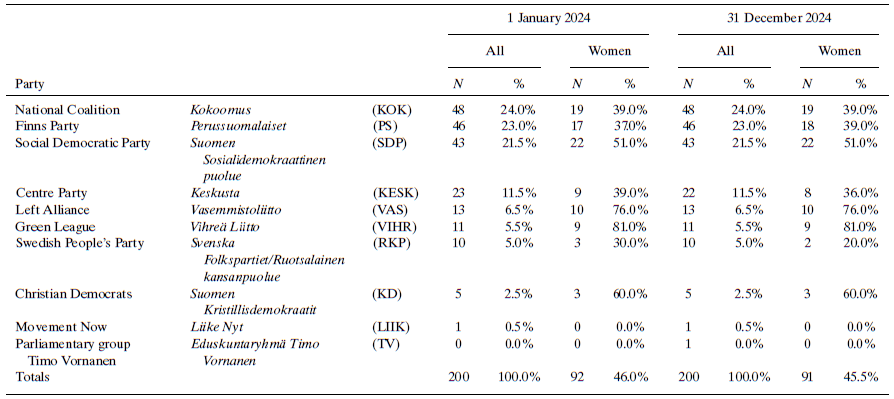
The composition of the Finnish Parliament in 2024 can be seen in Table 4.

Notes:
1. The European Parliament called for three VAS, two KOK, one SDP, one KESK, one PS, and one SFP's sitting MPs. This changed gender composition in parliamentary groups for PS by one more female MP and KESK and SFP by one less.
2. The MP for PS Timo Vornanen from had to leave the parliamentary group and form his own after a scandal that involved him firing a gun outside a popular Helsinki nightclub.
3. Priest and theologist in the Conservative Laestadian Lutheran revival movement and a KESK MP for the Oulu region Pekka Aittakumpu moved to the PS group.
4. RKP includes Åland's representative.
Source: Finnish Parliament Eduskunta webpage (www.eduskunta.fi).
Political party report
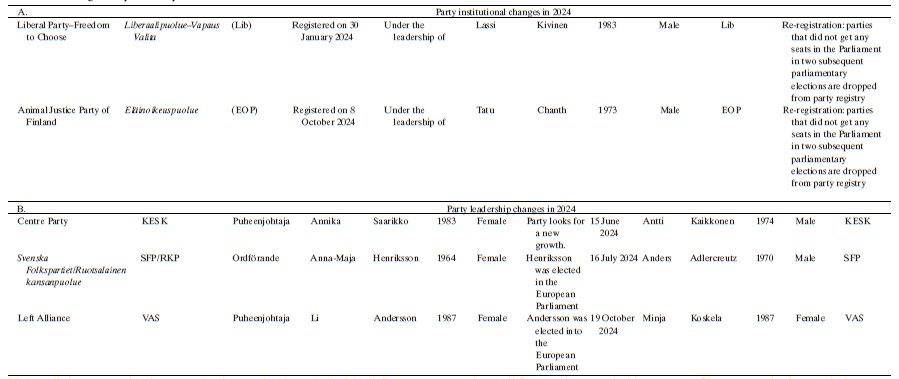
In 2024, leadership changes among the Finnish political parties (Table 5) were related to the European Parliamentary elections covered above. The newly elected MEPs Li Andersson (VAS) and Anna-Maja Henriksson (SFP/RKP) needed replacements. Maria Ohisalo (VIHR) had already been replaced in 2023 (Palonen Reference Palonen2024). Annika Saarikko (KESK) did not run for the European Parliament but stepped down nevertheless and was replaced by Antti Kaikkonen. VAS’ vice-chair, Jussi Saramo, had also been elected to the European Parliament and was replaced by the MP from Helsinki Minja Koskela, who did not come from the old party cadres. Henriksson was replaced by Anders Adlercreutz, who had run against Henriksson in 2016 when she had been elected. In contrast to Henriksson, who was from the west coast, Adlercreutz was from the south of Finland. He was against the closure of hospitals there.

Note: All three party leaders were in the pandemic period's Marin I government, where all five parties were led by women. Changes marked an end of an era.
Source: https://puoluerekisteri.fi/.
Throughout the year, KOK and SDP were leading the polls, the lead position consolidating with SDP at 24.3 and KOK at 18.8 (Piirainen Reference Piirainen2025). The PS's support declined to 15.1, with KESK following very closely at 13.1 per cent support in December. The historic result of VAS in the European Parliament elections seemed to have been based on personal support for Li Andersson, as both VAS and VIHR were polling at 8 per cent, just as in the beginning of the year.
No splinters took place in the party field. No new parties emerged. The two registered parties were re-registrations of parties that had not received seats in the Eduskunta in two consecutive elections.
Institutional change report
The shifting of the responsibility for unemployment from a nationwide body to the municipalities was a structural change.
A major change affecting fundamental rights was the Border Security Act (Act on Temporary Measures to Combat Instrumentalised Migration), due to take effect at the end of 2026. It was designed to restrict the reception of international protection applications in response to instrumentalised migration, particularly from Russia. A related legislative amendment also took effect on 1 September 2024, implementing a new border procedure for asylum applications and modifying the conditions for the right to work for asylum seekers to allow border guards to impede access to the country and make decisions on the border to remove asylum seekers. The Parliament approved the Border Security Act legislation with a clear majority 167–31, but it also faced criticism among experts who were raising the humanitarian concern, arguing the legislation was against international law. Finland maintained the closure of its eastern border with Russia throughout 2024, continuing a policy initiated in December 2023 to manage the risk of instrumentalised migration.
Issues in national politics
As the previous sections show, confrontation between the opposition parties and the government was strong. The popularity of the Orpo government at the end of 2024 had shrunken to circa 41.2 per cent (Piirainen Reference Piirainen2025), which was historically low, as even the relatively unpopular Sipilä government had still in the same period been polling at 47 per cent. Moreover, Sanna Marin's left-wing government had maintained over 50 per cent combined support ratings for the government parties throughout.
Issues in national politics mainstreamed the Finns Party's agenda in Finnish politics. The Orpo government reversed much of the previous left-and-centre Marin government policies, pushing legislation that affected labour laws and even fostered private schooling.
In the spring, the PS used visual content on social media, featuring party leader Riikka Purra with scissors and chopping boards. This was widely interpreted as a clear signal that the PS was in the front row of the cuts to welfare services. In the party's welfare-chauvinist thinking, it was imperative to curtail migrants’ access to these services, and they were presumably willing to sacrifice these on the premise that the typical PS-voter base did not need benefits. Tensions between the need for a labour force in a country with a shrinking population and policies that negatively affected migrant populations spilled out of the government to the population at large. Cultural services and NGOs were also affected by budget cuts. This policy, which was driven by the Finns Party (PS), was seen by critics as a strategic move to dismantle what the party considers to be a left-leaning establishment (Saresma & Palonen Reference Saresma, Palonen, Eslen-Ziya and Giorgi2022), and contributed to the state's diminished capacity to defend the poor, migrants and marginalised communities. The government sought tax cuts for their constituencies, but the services that those taxes would provide, from hospitals to a state-subsidised arts and culture, were also shrinking. Job cuts in the public sector and a slow economic recovery generated a negative cycle of existential insecurity. This was coupled with the fear of neighbouring warmongering Russia, on which the iron men of KOK were, at least judging by the 2024 election results, able to provide security.
Acknowledgments
Open access publishing facilitated by Helsingin yliopisto, as part of the Wiley - FinELib agreement.

 Open access

