





Management Implications
Invasive winter annual grasses such as Taeniatherum caput-medusae (medusahead) are problematic weeds across many plant community types in the western United States. Herbicides can be used to control these weeds with the goal of increasing forage production and plant biodiversity. Studies in greenhouses and California annual grasslands have shown that aminopyralid applied in the spring can reduce invasive annual grass seed viability. In this study, we tested whether spring (postemergence) aminopyralid applications at two ecologically different sites in Idaho and Utah resulted in control of T. caput-medusae. Applications were also made preemergence in fall to allow comparisons with the currently recommended approach for managing T. caput-medusae with aminopyralid. Patterns of control and seed viability were similar across study sites, but climate differences and application timings created nuanced outcomes. Corroborating results from California annual grasslands, preemergence aminopyralid application successfully controlled T. caput-medusae at both study sites. Postemergence aminopyralid applications also controlled T. caput-medusae, but a higher rate (206 g ae ha−1) was more effective in Utah, where environmental conditions were harsher. Postemergence aminopyralid applications reduced seed viability 38% to 91% relative to nontreated plants at both sites. Reduced germination rates in one year resulted in improved control the following year. Postemergence application timing may influence germination rates: in Utah, an early spring application timing (T. caput-medusae < 2-cm tall) resulted in a germination rate that was 90% less than nontreated plants. However, a late spring application timing (T. caput-medusae > 12-cm tall) resulted in a germination rate that was only 38% less than nontreated plants. These findings expand the conditions under which aminopyralid can control T. caput-medusae, either directly with a fall preemergence application or indirectly via reduced seed viability with a spring postemergence application. For land managers, the postemergence application geographic window is broadened from the Mediterranean climate of California to the colder climate of the Intermountain West. The low rate (103 g ae ha−1) can be used where climate and site conditions are more favorable to plant growth, but a higher rate will improve results under drier and severely degraded conditions.
Introduction
Nonindigenous winter annual grasses negatively impact millions of hectares of natural areas in the western United States by decreasing biodiversity and forage production and increasing wildfire risk (DiTomaso Reference DiTomaso2000; Sheley and Petroff Reference Sheley and Petroff1999). Medusahead [Taeniatherum caput-medusae (L.) Nevski] is an invasive winter annual grass estimated to infest more than 2 million ha in nine western U.S. states and British Columbia, Canada (Duncan and Jachetta Reference Duncan, Jachetta, Duncan and Clark2005). In 2004, T. caput-medusae was spreading at a rate of 12% per year (Duncan and Jachetta Reference Duncan, Jachetta, Duncan and Clark2005). Originally from Eurasia, T. caput-medusae was first reported in North America in the 1880s (Furbush Reference Furbush1953). Taeniatherum caput-medusae typically colonizes sites where the existing perennial vegetation has been eliminated or weakened (Miller et al. Reference Miller, Clausnitzer, Borman, Sheley and Petroff1999). It is listed as a noxious weed in many states and is highly competitive, forming monotypic stands that transform the ecological function of its invaded habitat to better facilitate its own survival to the detriment of the entire invaded ecosystem (Davies and Johnson Reference Davies and Johnson2008; James et al. Reference James, Gornish, DiTomaso, Davy, Doran, Becchetti, Lile, Brownsey and Laca2015). In the western United States, T. caput-medusae generally occurs in two broad climatic regions: the Mediterranean climate of California, with its hot, dry summers and warm, moist winters; and the Intermountain West, with its warm summers and cold, wet winters, when precipitation often arrives as snow (Nafus and Davies Reference Nafus and Davies2014). In California, T. caput-medusae occurs in annual grasslands, chaparral communities, and oak (Quercus spp.) woodlands (Young Reference Young1992). In the Intermountain West, T. caput-medusae primarily occurs in shrub–bunchgrass steppe (most commonly big sagerush (Artemisia tridentata Nutt.) and little sagebrush (Artemisia arbuscula Nutt.)) and perennial grasslands (Nafus and Davies Reference Nafus and Davies2014).
Taeniatherum caput-medusae invasion is a critical management concern, because it reduces biodiversity, decreases forage production, degrades wildlife habitat, increases fire risk, and alters ecosystem function (D’Antonio and Vitousek Reference D’Antonio and Vitousek1992; Davies Reference Davies2011; Davies and Svejcar Reference Davies and Svejcar2008). Taeniatherum caput-medusae invasion is correlated with decreased native vegetation and plant diversity (Davies Reference Davies2011; Young Reference Young1992) and up to 80% reduced grazing capacity of rangelands (Hironaka Reference Hironaka1961), both of which threaten wildlife (Davies and Svejcar Reference Davies and Svejcar2008). Taeniatherum caput-medusae’s negative environmental impacts lead to increased management costs (control, revegetation, fire suppression) for ranchers, land managers, and rural communities (Kyser et al. Reference Kyser, DiTomaso, Davies, Davy and Smith2014). Thus, effectively managing existing populations of T. caput-medusae is a high priority (Davies and Johnson Reference Davies and Johnson2008).
Herbicide treatment is a common method to control invasive plants and can be combined with seeding to promote desirable vegetation (Hobbs and Humphries Reference Hobbs and Humphries1995; Ortega and Pearson Reference Ortega and Pearson2011). Commonly used herbicides for controlling T. caput-medusae are glyphosate, imazapic, or rimsulfuron, all of which have varying levels of efficacy and impacts to non-target plants (Nafus and Davies Reference Nafus and Davies2014). Aminopyralid, a herbicide typically used for broadleaf weeds, (1) controlled T. caput-medusae when applied preemergence or early postemergence in the fall (Kyser et al. Reference Kyser, Peterson, Davy and DiTomaso2012b) and (2) decreased viability of T. caput-medusae seed when applied at the boot stage (Rinella et al. Reference Rinella, Bellows and Roth2014, Reference Rinella, Davy, Kyser, Mashiri, Bellows, James and Peterson2018, Reference Rinella, Bellows, Davy, Forero, Hatler and James2021). In a California annual grassland, a high rate (245 g ae ha−1) preemergence application of aminopyralid reduced T. caput-medusae and allowed desirable annual grasses to increase (Kyser et al. Reference Kyser, Peterson, Davy and DiTomaso2012b).
Herbicides are categorized into “Groups” by mode of action, that is, how they kill a target plant. Aminopyralid is a Group 4 growth regulator herbicide that mimics auxin, a naturally produced growth regulator that influences cell elongation and cell wall formation (Shaner Reference Shaner2014). While typically used on broadleaf plants, growth regulator herbicides affect many processes in grasses, producing root (Chen et al. Reference Chen, Switzer and Fletcher1972) and leaf (Friesen et al. Reference Friesen, Born, Keys, Dryden, Molberg and Siemens1968) abnormalities, delayed maturity and plant height reductions (Quimby and Nalewaja Reference Quimby and Nalewaja1966), stem weakness (Scragg Reference Scragg1952), and seed protein increases (Martin et al. Reference Martin, Miller and Alley1989). Synthetic auxins can damage graminoid species at the germination and seedling stages (Hsueh and Lou Reference Hsueh and Lou1947; Huffman and Jacoby Reference Huffman and Jacoby1984; Kaeser and Kirkman Reference Kaeser and Kirkman2010). Germinating seeds are sensitive to synthetic auxins, because they contain higher relative auxin concentrations than adult plants to allow for rapid growth (Fedtke and Duke Reference Fedtke, Duke, Hock and Elstner2005). When germinating seeds with naturally higher auxin concentrations are exposed to synthetic auxins, the increased concentration of auxin causes a disruption to growth such that the plant may be lethally damaged (Grossmann Reference Grossmann2010). For example, crop injury and yield reduction were reported when dicamba, also a Group 4 herbicide, was applied postemergence on winter wheat (Triticum aestivum L.) (Schroeder and Banks Reference Schroeder and Banks1989) and sorghum [Sorghum bicolor (L.) Moench] (Besancon et al. Reference Besancon, Riar, Heiniger, Weisz and Everman2016). In addition, the number of underdeveloped seeds of ‘Wakefield’ winter wheat increased to 85% to 100% when dicamba was applied at the boot stage (Rinella et al. Reference Rinella, Kells and Ward2001). Growth regulator herbicides can also negatively impact seeds by disrupting meiotic cell division in pollen and egg mother cells (Pinthus and Natowitz Reference Pinthus and Natowitz1967) and decreasing assimilate supply to developing seeds (Tottman and Duval Reference Tottman and Duval1987). Use of growth regulator herbicides can be harmful to desirable plants in addition to weeds. Aminopyralid, however, tends to have low toxicity to both seedling and well-established desirable perennial grasses compared with other growth regulator herbicides (Kyser et al. Reference Kyser, Peterson, Davy and DiTomaso2012b).
Evidence of T. caput-medusae control and reduced seed viability from aminopyralid application exists only from California annual grasslands and greenhouse studies. In addition, a single aminopyralid application controls plants for only a single season, as seeds can survive in the soil for at least 1 yr (Sharp et al. Reference Sharp, Hironaka and Tisdale1957). We tested whether sequential preemergence and postemergence aminopyralid applications at two sites in the Intermountain West resulted in multiyear control of T. caput-medusae and increased cover of desirable vegetation. Because aminopyralid application in spring or fall can control broadleaf weed species, this single herbicide may be effective for controlling T. caput-medusae in addition to co-occurring broadleaf weeds.
Materials and Methods
Study Sites
We conducted small-scale plot trials in Fenn, ID, from September 2017 to July 2019 and in Honeyville, UT, from September 2017 to July 2020. The Idaho site was in a pasture with Shebang silt loam soil (fine, smectitic, mesic Xeric Argialbolls) (Soil Survey Staff n.d.) that was fenced to exclude grazing during the experiment. In addition to T. caput-medusae, dominant vegetation present at the Idaho site included ventenata [Ventenata dubia (Leers) Coss.], rattail fescue [Vulpia myuros (L.) C.C. Gmel.], meadow foxtail (Alopecurus pratensis L.), Kentucky bluegrass (Poa pratensis L.), and Canada bluegrass (Poa compressa L.). The Utah site was degraded and adjacent to a gravel pit; while the soil was mapped as a Bingham gravelly loam (fine-loamy over sandy or sandy-skeletal, mixed, superactive, mesic Calcic Argixerolls) (Soil Survey Staff n.d.), personal observation showed there was almost no topsoil. In addition to T. caput-medusae, dominant vegetation present at the Utah site included purple threeawn (Aristida purpurea Nutt.) and bulbous bluegrass (Poa bulbosa L.). Details about 30-yr normal precipitation and temperature and observed water year (October to September) precipitation are in Table 1. All climate data were retrieved from the PRISM Climate Group (2023). The climate of the Idaho site is generally cooler and wetter than that of the Utah site.

Experimental Design
Herbicide treatments consisted of aminopyralid (Milestone®, Corteva Agriscience, Indianapolis, IN, USA) applied at low (103 g ae ha−1) or high (206 g ae ha−1) rates in sequential fall (preemergence) and/or spring (postemergence) seasons (Table 2). An additional herbicide treatment was tested with a winter (postemergence) application of the high rate of aminopyralid tank mixed with 532 g ai ha−1 of glyphosate (Accord® XRT II, Corteva Agriscience). Herbicides were applied using a CO2-pressurized backpack sprayer calibrated to deliver 168 to 187 L ha−1. In both locations, the study design was randomized complete blocks of seven treatments (Table 2) plus a nontreated check in plots measuring 3 by 9 m. Idaho had three treatment replications, and Utah had eight replications. Perennial grasses were dormant at the time of all applications.
Herbicide application rates and timings
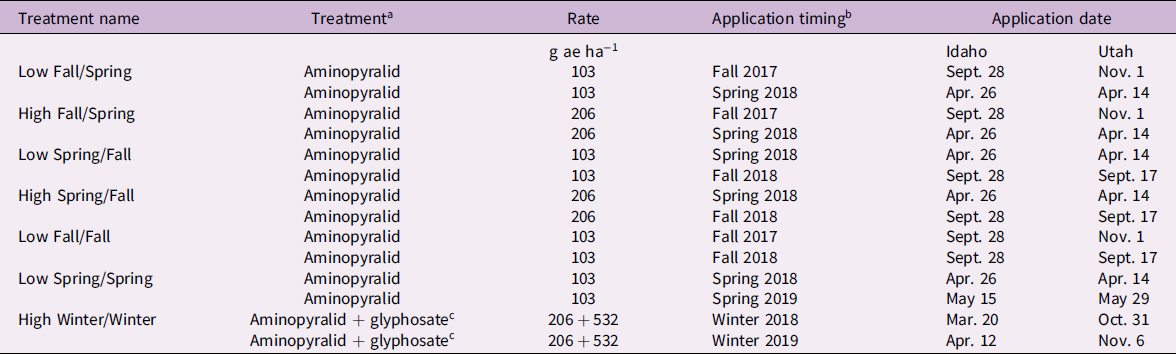
a All treatments were applied with 0.25% v/v non-ionic surfactant (Induce®, Helena, Collierville, TN, USA).
b Fall timing is preemergence, winter and spring timings are postemergence of Taeniatherum caput-medusae.
c Glyphosate is expressed as g ai ha−1.
Cumulative growing degree days (GDD), a measure of heat accumulation used to predict plant development, for each site and application date are listed in Table 3. Air temperature was determined at 4-km resolution around the point location of each study site (PRISM Climate Group 2023). Because no model exists for the amount of moisture needed to initiate T. caput-medusae germination, we used V. dubia moisture requirements (Wallace et al. Reference Wallace, Pavek and Prather2015), because V. dubia has a life history similar to that of T. caput-medusae. From the V. dubia model, we used a threshold of 13 mm of precipitation to begin the GDD accumulation, starting from 7 d before the preemergence application. At the spring 2018 application, most T. caput-medusae plants in Idaho were in the tillering stage (before flowering) and averaged about 7.6 cm in height; most T. caput-medusae plants in Utah were at the leaf development stage and not tillering, averaging about 1.3 cm in height. At the spring 2019 application, most T. caput-medusae plants in Idaho were in the tillering stage (before flowering) and averaged about 10 cm in height; most T. caput-medusae plants in Utah were in the boot to seedhead emergence stage and averaged about 12.7 cm in height. The T. caput-medusae phenological stages at the winter applications were not recorded.
Cumulative growing degree days (GDD) at time of herbicide application

a Fall applications were preemergence; spring and winter applications were postemergence of Taeniatherum caput-medusae.
b
Growing degree days calculated from the date that cumulative precipitation reached 13 mm (starting from 7 d before preemergence application) until the application date, using the formula ${{\left( {{T_{{\rm{max}}}}\; + \;{T_{{\rm{min}}}}} \right)} \over 2} - {T_{{\rm{base}}}}$
, where T = temperature and T
base = 10 C. Negative GDD calculations were adjusted to zero.
${{\left( {{T_{{\rm{max}}}}\; + \;{T_{{\rm{min}}}}} \right)} \over 2} - {T_{{\rm{base}}}}$
, where T = temperature and T
base = 10 C. Negative GDD calculations were adjusted to zero.
Data Collection
In Idaho, we recorded plant cover data by species from two quadrats sized 0.5 by 0.25 m placed near the plot center, with the two quadrats typically 2 to 3 m apart. Evaluations occurred on July 13, 2018, and July 30, 2019. Taeniatherum caput-medusae control was calculated by comparing cover in plots by block to the nontreated control plot in the same block, that is, average cover in each plot was divided by the average cover in nontreated plots, and the result was subtracted from 100 to give percent control. At the Utah site, assessments of T. caput-medusae control were made by comparing visual estimates of the cover of T. caput-medusae in nontreated control plots and plots that had been treated with herbicide. Visual assessments were estimated while standing at the front and back of each plot (along the side measuring 3 m). Because there was no dominant vegetation other than T. caput-medusae, the observer had a clear view of each plot. The nontreated control was considered 0% control and plots with no T. caput-medusae were classified as 100% control. Thus, treatments were evaluated relative to the nontreated controls. Visual T. caput-medusae control evaluations were made on July 21, 2018, June 12, 2019, and July 1, 2020. According to Lotz et al. (Reference Lotz, Kropff, Wallinga, Bos and Groeneveld1994), plant cover based on visual estimations (as used in Utah) were slightly higher than cover estimates made using quadrats (as used in Idaho). Specifically, weed cover estimated using quadrats was on average 70% to 90% of the cover estimated visually (Lotz et al. Reference Lotz, Kropff, Wallinga, Bos and Groeneveld1994). Thus, for example, if 80% control was assessed in Utah, 56% to 72% control would likely have been assessed in Idaho. Because T. caput-medusae control was assessed differently at the two study sites, direct comparisons of raw values cannot be made with confidence.
Ten mature seedheads of T. caput-medusae were randomly collected from each plot at both sites in 2018 (July 19 and September 17, in Idaho and Utah, respectively) and 2019 (July 30 and August 23, in Idaho and Utah, respectively) for later testing of seed viability. Timing of seedhead collection corresponded to when seeds were mature (cured) but before many had dropped. At the same time seedheads were collected, seedhead density per 0.09 m2 was counted at two central locations in each plot. Seedheads were stored at room temperature in paper bags for at least 4 mo after harvest to allow for afterripening. Before conducting germination tests, we separated the seeds from seedheads, randomly selected 20 seeds from each plot, and cut the awns off the selected seeds. Following methods from Rinella et al. (Reference Rinella, Bellows and Roth2014), in a 9-cm petri plate, we placed a polyurethane foam disk with a hole in the center, in which we placed a cotton ball wetted with deionized water. We placed filter paper on top of the foam and cotton, evenly distributed the 20 seeds on top of the paper, and put the lid on the plate. We placed the plates in a Conviron BDR16 growth chamber (Controlled Environments Inc., Pembina, North Dakota, USA) with cool-white fluorescent bulbs (PAR = 28 μmol m−2 s−1) supplying a 12-h light period, with light and dark temperatures of 21 C and 15 C, respectively. Water was added every few days as needed. Seeds were recorded as germinable and were discarded if radicle length was at least 2 mm within 30 d. Thus, we calculated germination rates of 60 seeds per treatment in Idaho and 160 seeds per treatment in Utah.
Statistical Analysis
Within a site, year, and treatment, measured values outside 1.5 times the interquartile range were considered outliers and removed from analyses (Schwertman et al. Reference Schwertman, Owens and Adnan2004). This method of detecting outliers meant eight control and three germination data points (of 192 total) were removed from analysis from the Utah site and one germination data point (of 54 total) was removed from analysis from the Idaho site. Due to substantial interannual variability and environmental differences between sites, data were analyzed within site and year. In addition, weed control data collection differed at the two sites, requiring us to use relative rankings to compare between sites within each year. Percent control and percent germination were evaluated using a beta regression in the betareg R package (Cribari-Neto and Zeileis Reference Cribari-Neto and Zeileis2010), because observations are rates bounded by zero and one. When differences were present, pairwise comparisons of treatments were evaluated with the Tukey method using estimated marginal means (aka least-squares means) from the emmeans R package (Lenth Reference Lenth2022). Percent cover of perennial grasses in Idaho was also evaluated with a beta regression with Tukey pairwise comparisons. All analyses were conducted in R v. 4.2.2 (R Core Team 2022).
Results and Discussion
Taeniatherum caput-medusae Control
At the time of the summer 2018 evaluations in Idaho, three treatments had received both applications (Low Fall/Spring, High Fall/Spring, and Low Fall/Fall), while the rest had received one application (Table 2). At the Idaho site, control was highest and averaged 94% to 100% when both applications had been made; these treatments included both low and high rates of aminopyralid (P ≤ 0.04; Figure 1). The first applications in these treatments all occurred preemergence. Pairwise comparisons indicated no difference among all preemergence treatments (P ≥ 0.97). The remaining treatments (Low Spring/Fall, High Spring/Fall, Low Spring/Spring, and High Winter/Winter), which had received only one herbicide application, controlled T. caput-medusae by 59% to 65% on average (Figure 1). Pairwise comparisons indicated no differences among the treatments that had received one herbicide application (P ≥ 0.98). Control data among these same treatments were more variable, with a standard deviation (SD) up to 37%.
Average Taeniatherum caput-medusae control relative to the nontreated check in Idaho (2018 and 2019) and Utah (2018, 2019, and 2020). Bars denote standard error, and within years, columns that do not share letters are significantly different (P ≤ 0.05). In 2018, treatments left of the red dashed line had received both herbicide applications; treatments right of the red dashed line had received one application. Low = 103 g ae ha−1; High = 206 g ae ha−1 of aminopyralid. Winter applications also included 532 g ai ha−1 of glyphosate. Treatment timings in italics indicate future applications. Data from the High Winter/Winter treatment in Utah are not shown, because both applications had not been made. There are no control data from Idaho in 2020. Refer to Table 2 for detailed treatment descriptions and timings.

At the time of the summer 2018 evaluations in Utah, three treatments had received both applications (Low Fall/Spring, High Fall/Spring, and Low Fall/Fall), while the rest had received one application (Table 2). Control results in Utah were similar to those in Idaho. Control was highest and averaged 94% to 99% from treatments that received both applications (Low Fall/Spring, High Fall/Spring, and Low Fall/Fall; P < 0.001; Figure 1). Pairwise comparisons of the three treatments that had both applications indicated that control from the High Fall/Spring treatment was greater than control from the Low Fall/Spring and Low Fall/Fall treatments (P = 0.01). The Low Spring/Fall, High Spring/Fall, and Low Spring/Spring treatments, which had received only one herbicide application, controlled T. caput-medusae by 62% to 76% on average (Figure 1). Pairwise comparisons of these treatments indicated that control from the High Spring/Fall treatment was greater than control from the Low Spring/Spring treatment (P < 0.001). There are no control data for the High Winter/Winter treatment, because no applications had occurred before the evaluation.
At the time of the summer 2019 evaluations, all plots in Idaho had received both herbicide applications (Table 2). At the Idaho site, control averaged 76% to 100% from all treatments except the High Winter/Winter treatment, which averaged 32% control (P ≤ 0.006; Figure 1). Pairwise comparisons indicated no difference among the treatments with 76% to 100% control (P ≥ 0.97).
At the time of the summer 2019 evaluations, all plots in Utah had received both herbicide applications, except the High Winter/Winter treatment, which had one application (Table 2). Compared with 2019 results in Idaho, patterns were similar at the Utah site, in that control was highest and averaged 85% to 99% from all treatments, except the High Winter/Winter treatment (P < 0.001; Figure 1). Pairwise comparisons of the treatments with 85% to 99% control indicated that control from the High Spring/Fall treatment was greater than control from the Low Fall/Spring, Low Fall/Fall, and Low Spring/Spring treatments (P ≤ 0.03). The Low Spring/Fall treatment was not different from this group of treatments (P ≥ 0.36), because the application timings were more recent, with both applications occurring in 2018. Control from the High Fall/Spring treatment was greater compared with control from the Low Spring/Spring treatment (P = 0.017) and equivalent to the High Spring/Fall treatment (P = 0.79). We speculate that environmental conditions at the Utah site, in contrast to those at the Idaho site, may explain the differential pairwise comparisons of the treatments in 2019. As stated previously, the Utah site is warmer and drier than the Idaho site, which creates harsher conditions for T. caput-medusae. Conversely, the Utah site had minimal interspecific competition, which should favor T. caput-medusae. Finally, the Utah site has highly degraded gravelly soil with little topsoil, whereas the soil at the Idaho site is a silt loam (Soil Survey Staff n.d.). The High Winter/Winter treatment, which had received only one herbicide application, had the lowest control, averaging 0% (data not shown). Additionally, the month before the winter 2018 application, Utah experienced exceptionally dry conditions, which may have resulted in no fall germination of T. caput-medusae, and thus no emerged plants to intercept the first High Winter/Winter application. The lack of control achieved by this treatment at both study sites indicates it is not a good option for controlling T. caput-medusae in the Intermountain West. Prior studies indicated inconsistent T. caput-medusae control with glyphosate (Kyser et al. Reference Kyser, Creech, Zhang and DiTomaso2012a, Reference Kyser, Hazebrook and DiTomaso2013). The Low Spring/Spring treatment was the only treatment that used two postemergence applications, which are generally less effective than preemergence applications (Anonymous 2021; Kyser et al. Reference Kyser, Peterson, Davy and DiTomaso2012b; but see Rinella et al. [Reference Rinella, Davy, Kyser, Mashiri, Bellows, James and Peterson2018] showing lower preemergence efficacy compared with postemergence). To the best of our knowledge, there is no study testing efficacy of aminopyralid applied early postemergence to T. caput-medusae. The herbicide label for Milestone®, for which aminopyralid is the active ingredient, states that in general, control of T. caput-medusae is poor when applied after seeds have germinated (Anonymous 2021).
In summer 2020, only the Utah site was evaluated, because the most recent (winter) application was made at the end of 2019, after the summer 2019 evaluation. However, in Idaho, the most recent (spring) application was made before the summer 2019 evaluation, so treatment effects were captured in the 2019 evaluation. Control values in Utah generally declined relative to prior evaluations as expected, as it had been longer since the applications occurred. Control from the Low Spring/Spring and High Winter/Winter treatments was highest, averaging 88% and 81% control, respectively, compared with all other treatments (P ≤ 0.012; Figure 1). The Low Spring/Spring treatment also reduced seed germination rates to 3% and 53% in 2018 and 2019, respectively (see “Taeniatherum caput-medusae Seed Germination”). The reduced seed germination rates for two consecutive years may explain why control was still moderate two growing seasons after the last herbicide application. The remaining treatments averaged 59% to 73% control (Figure 1). Increased variability in control was observed for the Low Fall/Spring, High Fall/Spring, Low Spring/Fall, and Low Spring/Spring treatments (SD: 11% to 14%). The 81% control achieved from the High Winter/Winter treatment was notably higher than the 0% control observed in 2019, likely because of seasonal weather differences between years.
Taeniatherum caput-medusae Seed Germination
We calculated germination rates of 60 randomly collected mature seeds per treatment in Idaho and 160 randomly collected mature seeds per treatment in Utah in 2018 and 2019. Plants treated with aminopyralid in spring often had deformed seeds (Figure 2). At the time of seed collection in 2018, only the Low Fall/Spring, High Fall/Spring, and Low Fall/Fall treatments had received both applications, while the rest had received one application (Table 2). At the Idaho site, all herbicide treatments resulted in reduced seed germination rates relative to rates from the nontreated plots (P ≤ 0.04; Figure 3). The greatest reductions in germination rates were from the Low Spring/Fall, High Spring/Fall, and Low Spring/Spring treatments.
Mature Taeniatherum caput-medusae seedheads collected in Idaho on July 19, 2018. The left seedhead was from a nontreated plot, and the right seedhead was from a plot treated with 103 g ae ha−1 aminopyralid (low rate) on April 26, 2018.

Average Taeniatherum caput-medusae seed germination rates in Idaho and Utah (2018 and 2019). Bars denote standard error, and within years, columns that do not share letters are significantly different (P ≤ 0.05). In 2018, treatments left of the red dashed line had received both herbicide applications; treatments right of the red dashed line had received one application. Low = 103 g ae ha−1; High = 206 g ae ha−1 of aminopyralid. Winter applications also included 532 g ai ha−1 of glyphosate. Treatment timings in italics indicate future applications. Data from the High Winter/Winter treatment in Utah are not shown because both applications had not been made. Refer to Table 2 for detailed treatment descriptions and timings.

A slightly different pattern of germination rates was observed in Utah. At the Utah site, all herbicide treatments except the Low Fall/Fall treatment resulted in reduced seed germination rates relative to rates from the nontreated plots (P < 0.001; Figure 3). The treatments with reduced germination rates all received one spring aminopyralid application, and there were no pairwise differences (P > 0.41) among them. Germination rates from these treatments were lower compared with the rates from these treatments in Idaho. One possible explanation for the lower seed viability in Utah was that 2018 had only 62% of the normal precipitation, whereas Idaho had 116% of the normal precipitation. Because drought stress during seed development can reduce seed germination and vigor (Farooq et al. Reference Farooq, Wahid, Kobayashi, Fujita and Basra2009), it likely added to the decreased seed viability we observed in Utah.
At the time of the summer 2019 evaluations, all plots in Idaho had received both herbicide applications (Table 2). At the Idaho site, the Low Spring/Spring treatment resulted in reduced seed germination rates relative to rates from the nontreated plots (P < 0.001; Figure 3). The Low Spring/Spring treatment was applied most recently. It is notable that while control tended to be lower from this treatment, there was a greater reduction in seed germination rates. The remaining treatments had no pairwise differences (P > 0.11).
At the time of the summer 2019 evaluations, all plots in Utah had received both herbicide applications except the High Winter/Winter treatment, which had one application (Table 2). At the Utah site, the High Fall/Spring, Low Spring/Fall, and Low Spring/Spring treatments resulted in reduced seed germination rates relative to rates from the nontreated plots (P ≤ 0.04; Figure 3). The reduced germination from the High Fall/Spring and Low Spring/Fall treatments was surprising, because their most recent spring applications were in 2018. There were no pairwise differences among the High Fall/Spring, Low Spring/Fall, and Low Spring/Spring treatments (P ≥ 0.44). Germination rates from the nontreated plots were equivalent to rates from the remaining treatments. The Low Fall/Fall treatment had never received spring aminopyralid applications, but the Low Fall/Spring and High Spring/Fall treatments had received an aminopyralid application in spring 2018 at the same time as the High Fall/Spring and Low Spring/Fall treatments. We hypothesize that the drier than normal 2017 to 2018 water year in Utah may have negatively impacted seed development, which could explain the variable germination rates from seed collected in 2019 from plots treated in spring 2018.
Seed germination results from both years correspond well to research in California annual grasslands and a greenhouse study from Rinella et al. (Reference Rinella, Bellows and Roth2014, Reference Rinella, Davy, Kyser, Mashiri, Bellows, James and Peterson2018, Reference Rinella, Bellows, Davy, Forero, Hatler and James2021) showing spring application of aminopyralid at rates as low as 55 g ae ha−1 decreased seed viability of T. caput-medusae. However, there was differential reduction between the Idaho and Utah sites. At the Idaho site, the Low Spring/Spring treatment resulted in germination rates that were reduced to 17% and 13% for 2018 and 2019, respectively. At the Utah site, this same treatment resulted in germination rates that were reduced to 3% and 53% for 2018 and 2019, respectively, which is notably more variable than what was observed in Idaho. Timing of the spring applications may explain the differences. From 2018 to 2019, the spring application was 19 d (180 GDD) later in Idaho but 45 d (249 GDD) later in Utah. The spring 2018 application in Utah occurred when T. caput-medusae averaged 1.3 cm in height and was in the early vegetative stage. In contrast, the spring 2019 application in Utah occurred when T. caput-medusae averaged 12.7 cm in height and was in the boot to seedhead emergence stage. Rinella et al. (Reference Rinella, Bellows, Davy, Forero, Hatler and James2021) observed that just 12 d separated the least and most effective timings for T. caput-medusae control, though in their case, the early timing, when plants were tillering and jointing, was less effective. Additionally, like Rinella et al. (Reference Rinella, Bellows, Davy, Forero, Hatler and James2021), we observed a link between reduced T. caput-medusae germination in one year and reduced T. caput-medusae cover (improved control) the following year. While the initial spring 2018 application only moderately controlled T. caput-medusae (average: 60% to 76%) in the first year, 2018 germination from plants in those plots was substantially reduced (average: 2% to 18%), resulting in improved control in 2019 (average: 82% to 100%). Across study sites and years, there was no pattern in the density of T. caput-medusae seedheads in one year and control the following year. Instead, seed viability was more important in explaining control than seedhead density (Figure 2).
Non-target Effects
Non-target effects could only be assessed at the Idaho site because of the lack of species diversity at the Utah site. Thus, because non-target effects were assessed from only one location, results are less robust than target effects discussed earlier. At the Idaho site, we recorded non-target effects on desirable perennial grasses and V. dubia, an invasive winter annual grass. There was an insufficient abundance of forbs for analysis.
In 2018, perennial grass cover in the nontreated plots (average: 16%) was equivalent to that of the treated plots (average: 3% to 35%). However, perennial grass cover in the Low Spring/Fall and High Winter/Winter treatments was lower compared with the Low Fall/Spring, High Fall/Spring, Low Fall/Fall, and Low Spring/Spring treatments (Figure 4). At the time of evaluation, T. caput-medusae control was greatest from the Low Fall/Spring, High Fall/Spring, and Low Fall/Fall treatments (Figure 1), which were the only treatments to have received both herbicide applications. The correlation between high T. caput-medusae control and higher perennial grass cover indicates that successful control of T. caput-medusae can release desirable grasses from competition and make them more vigorous (Kyser et al. Reference Kyser, Peterson, Davy and DiTomaso2012b; Monaco et al. Reference Monaco, Osmond and Dewey2005; Rinella et al. Reference Rinella, Davy, Kyser, Mashiri, Bellows, James and Peterson2018, Reference Rinella, Bellows, Davy, Forero, Hatler and James2021). Research from Young and Mangold (Reference Young and Mangold2008) supports our finding, as they found increasing density of T. caput-medusae seedlings significantly decreased the biomass of squirreltail [Elymus elymoides (Raf.) Swezey] seedlings, a perennial bunchgrass.
Average perennial grass foliar cover (sum of all species) in Idaho (2018 and 2019). Bars denote standard error, and within years, columns that do not share letters are significantly different (P ≤ 0.05). In 2018, treatments left of the red dashed line had received both herbicide applications; treatments right of the red dashed line had received one application. Low = 103 g ae ha−1; High = 206 g ae ha−1 of aminopyralid. Winter applications also included 532 g ai ha−1 of glyphosate. Treatment timings in italics indicate future applications. There are no perennial grass data from Utah. Refer to Table 2 for detailed treatment descriptions and timings.

In 2019, perennial grass cover in the nontreated plots (average: 23%) was equivalent to the treated plots (average: 14% to 36%). There was a pairwise difference in perennial grass cover between the High Fall/Spring and High Winter/Winter treatments, with the former having the most cover and the latter having the least cover (P = 0.017; Figure 4). At the time of evaluation, T. caput-medusae control was lowest in the High Winter/Winter treatment (Figure 1). While perennial grass cover in nearly all treated plots increased slightly from 2018 to 2019, it is notable that cover in plots that received the Low Spring/Fall treatment increased 6-fold. These plots also experienced a marked increase in T. caput-medusae control from 2018 to 2019, suggesting that even the low rate of aminopyralid resulted in release of perennial grass from competition. In Oregon, herbicide treatments provided the best control of T. caput-medusae and resulted in the greatest increases in native perennial vegetation (Davies Reference Davies2010; Davies and Sheley Reference Davies and Sheley2011). Rinella et al. (Reference Rinella, Bellows, Davy, Forero, Hatler and James2021) also demonstrated that spring aminopyralid applications reduced T. caput-medusae cover and increased forage grass cover at the small plot and pasture scale.
In 2018 and 2019, V. dubia cover at the Idaho site averaged 35% in nontreated plots. At the 2018 evaluation, only the High Winter/Winter treatment, which also contained glyphosate, controlled V. dubia 77%. Control from the other treatments was 45% or less. At the 2019 evaluation, control of V. dubia from the High Winter/Winter treatment dropped to 63% and control from the remaining treatments was 55% or less. Compared with other herbicides available for V. dubia control (Koby et al. Reference Koby, Prather, Quicke, Beuschlein and Burke2019; Wallace and Prather Reference Wallace and Prather2016), the results here suggest variable levels of control when contrasted with one Idaho study where control was higher (unpublished data). In 2019, we collected and tested germination rates of V. dubia seeds following the same procedure we used for T. caput-medusae. Only the Low Spring/Spring treatment reduced seed germination to zero (P < 0.001; data not shown). All other treatments, including the nontreated check, were equivalent, with germination rates of 48% to 61% (P ≥ 0.27; data not shown). Our results support laboratory research demonstrating that aminopyralid can reduce V. dubia seed production by 95% when applied at the seedling stage (Rinella et al. Reference Rinella, Bellows and Roth2014).
In conclusion, these findings broaden both the geographic and temporal window to implement T. caput-medusae control in the spring (before seedhead emergence; GDD ≥ 32 and < 281) with aminopyralid, as prior research occurred only in California annual grasslands and in greenhouses. Furthermore, it may be possible to simultaneously target broadleaf weeds and T. caput-medusae with a single early spring aminopyralid application. Such a treatment has a reduced risk of injuring established perennial grasses. When site conditions have near-normal precipitation, a low rate of aminopyralid is as effective as a high rate, providing a cost savings. While our experiment used small plots, evidence from Rinella et al. (Reference Rinella, Bellows, Davy, Forero, Hatler and James2021) demonstrated spring aminopyralid applications reduced T. caput-medusae cover and increased forage grass cover at the pasture scale in a California annual grassland. Together, there is sufficient evidence for the use of aminopyralid preemergence or postemergence at large spatial scales for multiyear control of T. caput-medusae to restore desirable vegetation.
Acknowledgments
The authors would like to acknowledge Vanelle Peterson for suggesting the initial study design for this research. Cody Graning allowed us to use his land in Idaho for this study. This research received no specific grant from any funding agency or the commercial or not-for-profit sectors. LCJ and CB declare no competing interests. CVR and TSP have received research funding from Corteva Agriscience for other projects.


 Open access

