

1. Introduction
The Phanerozoic Central Asian Orogenic Belt (CAOB), one of the largest long-lived accretionary orogens worldwide, is situated to the north of the Tarim–North China cratons (Fig. 1a) and formed by complex subduction, accretion and collision processes related to the consumption of the Paleo-Asian Ocean (PAO), with significant crustal growth (Han et al. Reference Han, Wang, Jahn, Hong, Kagami and Sun1997, Reference Han, He, Wang and Guo2011; Jahn et al. Reference Jahn, Wu and Hong2000; Wu et al. Reference Wu, Jahn, Wilde, Lo, Yui, Lin, Ge and Sun2003; Windley et al. Reference Windley, Alexeiev, Xiao, Kröner and Badarch2007; Xiao et al. Reference Xiao, Windley, Han, Liu, Wan, Zhang, Ao, Zhang and Song2018). The southeastern CAOB records the Palaeozoic amalgamation between the North China Craton (NCC) in the south and Mongolia, Hunshandake and Songliao blocks within the CAOB in the north (Xu et al. Reference Xu, Charvet, Chen, Zhao and Shi2013; Zhao et al. Reference Zhao, Wang, Huang, Dong, Li, Zhang and Yu2018; Zhou et al. Reference Zhou, Wilde, Zhao and Han2018). The Permian–Early Triassic Solonker suture (Solonker–Xar Moron–Changchun suture) contains the youngest ophiolites within the southeastern CAOB and is usually regarded as the terminal closure site of the PAO (Eizenhöfer & Zhao, Reference Eizenhöfer and Zhao2018; Wilde & Zhou, Reference Wilde and Zhou2015; Xiao et al. Reference Xiao, Windley, Jie and Zhai2003). However, when and how the PAO finally closed in the southeastern CAOB is still controversial, and different opinions can be grouped into three models.
(a) Tectonic location of the Alxa Block. (b) Schematic geological map showing the distribution of Palaeozoic intrusions and ophiolitic mélanges in the Alxa Block (modified after Dan et al. Reference Dan, Li, Wang, Tang and Liu2014). (c) Simplified geological map of the southwestern Alxa Block (modified after Wang et al. Reference Wang, Chen, Shao, Li, Ding, Zhang, Wang, Zhang, Xu and Qin2020).

In the first set of models, the subduction of the PAO was continuous from the early Palaeozoic Era to Late Permian–Early Triassic time and led to the successive accretion of micro-continental blocks and magmatic arcs to the northern NCC, with the northern margin of the NCC as a continental arc during Carboniferous–Permian time and the Solonker suture as the final closure site of the PAO (e.g. Xiao et al. Reference Xiao, Windley, Jie and Zhai2003, Reference Xiao, Windley, Huang, Han, Yuan, Chen, Sun, Sun and Li2009 b, Reference Xiao, Windley, Han, Liu, Wan, Zhang, Ao, Zhang and Song2018; Zhang et al. Reference Zhang, Zhao, Ye, Liu and Hu2014, Reference Zhang, Zhao, Liu and Hu2016d ). The second set of models propose the Late Devonian–early Carboniferous closure of the PAO, with the southeastern CAOB in a post-collisional setting since then (e.g. Xu et al. Reference Xu, Charvet, Chen, Zhao and Shi2013; Tong et al. Reference Tong, Jahn, Wang, Hong, Smith, Sun, Gao, Yang and Huang2015; Zhang et al. Reference Zhang, Yuan, Xue, Yan and Mao2015 b). The third set of models infer that the large-scale PAO closed before the Late Devonian Epoch, but a new orogenic cycle began with intra-continental rifting within the southeastern CAOB during early Carboniferous time and resulted in the formation of a Red-Sea-like limited ocean basin, with the Solonker suture marking its closure during the Early Triassic Epoch (e.g. Zhang et al. Reference Zhang, Wei and Chu2015 a; Luo et al. Reference Luo, Xu, Shi, Zhao, Faure and Chen2016; Pang et al. Reference Pang, Wang, Xu, Zhao, Feng, Wang, Luo and Liao2016; Zhao et al. Reference Zhao, Xu and Zhang2017; Xu et al. Reference Xu, Wang, Zhang, Wang, Yang and He2018). In the third model, the lithospheric extension may be triggered by slab break-off (Kozlovsky et al. Reference Kozlovsky, Yarmolyuk, Salnikova, Travin, Kotov, Plotkina, Kudryashova and Savatenkov2015; Zhang et al. Reference Zhang, Gao, Wang, Liu and Ma2012 a) and enhanced by slab avalanche-driven wet mantle upwelling rising from the hydrous mantle transition zone (Wang et al. Reference Wang, Wilde, Li and Yang2015 a, Reference Wang, Wilde, Xu and Pang2016 a).
To test the likelihood of one of these geodynamic models, a key question is whether the Carboniferous–Permian tectono-magmatic activity of the southeastern CAOB was dominated by the continued S-wards subduction of the PAO or by lithospheric extension. Accordingly, the tectonic setting of the Carboniferous magmatism in the northern margin of the NCC, either continental arc or lithospheric extension, can provide insights into the terminal evolutionary history of the southeastern CAOB.
The Alxa Block, also known as the Alxa Tectonic Belt (Song et al. Reference Song, Xiao, Collins, Glorie, Han and Li2018), connects the NCC to the east and the Tarim Craton to the west and lies between the CAOB to the north and the North Qilian Orogen to the south (Fig. 1a). Although this block is largely covered by deserts, numerous Phanerozoic plutons intruding into Precambrian metamorphic basement rocks crop out in its southwestern and northeastern parts (Fig. 1b). These plutons are mostly Palaeozoic in age, spanning Middle Ordovician–Early Devonian time (c. 458–394 Ma) and end Late Devonian–end Permian time (c. 359–252 Ma; Fig. 2a). Notably, this age pattern is quite similar to that of the southeastern CAOB (including the northern NCC), which includes two magmatic stages of middle Cambrian–Middle Devonian time (c. 508–386 Ma) and end Late Devonian–end Permian time (c. 362–252 Ma; Fig. 2b), indicating an operation of comparable tectonic processes. Further, the early magmatic stage in the southwestern Alxa Block could also be related to the North Qilian Orogen (Duan et al. Reference Duan, Li, Qian and Jiao2015; Zhang et al. Reference Zhang, Zhang, Zhang, Xiong, Luo, Yang, Pan, Zhou, Xu and Guo2017 a; Wang et al. Reference Wang, Chen, Shao, Li, Ding, Zhang, Wang, Zhang, Xu and Qin2020), but the Qilian orogenesis ended before the Late Devonian Epoch (Xiao et al. Reference Xiao, Windley, Yong, Yan, Yuan, Liu and Li2009 a; Song et al. Reference Song, Niu, Su and Xia2013). The Carboniferous magmatism within the Alxa Block was therefore most likely related to the tectono-magmatic activity of the southeastern CAOB.
Statistical histograms of zircon U–Pb ages of Palaeozoic magmatic rocks in the (a) Alxa Block (data from this study and Qin, Reference Qin2012; Tang, Reference Tang2015; Gong et al. Reference Gong, Zhang, Wang, Yu and Wang2018 a; Zhang et al. Reference Zhang, Wang, Wang, Liu, Liu and Wu2018d ; Liu et al. Reference Liu, Pan, Liu, Wang, Wang and Xue2019; Pan, Reference Pan2019; Song et al. Reference Song, Xiao, Collins, Glorie and Han2019; Chen et al. Reference Chen, Zhao, Wang, Rong and Li2020; Wang et al. Reference Wang, Chen, Shao, Li, Ding, Zhang, Wang, Zhang, Xu and Qin2020; Zhao et al. Reference Zhao, Liu, Wang, Zhang and Guan2020) and (b) the southeastern Central Asian Orogenic Belt (data from Wang et al. Reference Wang, Han, Feng and Liu2015 b).

In this study, new geochronological, elemental and isotopic geochemical analyses of three early Carboniferous plutons in the southwestern Alxa Block are presented. These results, combined with regional correlations, suggest a lithospheric extensional setting rather than a simple continental arc for the development of early Carboniferous magmatism in both the Alxa Block and the southeastern CAOB.
2. Geological background
The Alxa Block is separated from the CAOB by the Enger Us Fault to the north, and from the North Qilian Orogen to the SW by the Longshoushan Fault (Fig. 1b). It is traditionally considered as the western part of the northern NCC (Fig. 1a), either the western part of the Yinshan Block (e.g. Zhao et al. Reference Zhao, Sun, Wilde and Li2005, Reference Zhao, Cawood, Li, Wilde, Sun, Zhang, He and Yin2012; Wan et al. Reference Wan, Song, Liu, Wilde, Wu, Shi, Yin and Zhou2006; Wang et al. Reference Wang, Han, Feng, Liu, Zheng and Kong2016 b, Reference Wang, Li, Ning, Kusky and Deng2019 a) or the western extension of the Khondalite Belt (e.g. Geng et al. Reference Geng, Wang, Wu and Zhou2010; Zhang et al. Reference Zhang, Gong, Yu, Li and Hou2013 a; Zhang & Gong, Reference Zhang and Gong2018). However, a close affinity of the Alxa Block to the Tarim or South China cratons had also been proposed (e.g. Tung et al. Reference Tung, Yang, Liu, Zhang, Tseng and Wan2007; Yuan & Yang, Reference Yuan and Yang2015; Song et al. Reference Song, Xiao, Collins, Glorie, Han and Li2017), and the amalgamation of this block with the NCC might have taken place during early–middle Palaeozoic time (Dan et al. Reference Dan, Li, Wang, Wang, Wyman and Liu2016; Zhang et al. Reference Zhang, Zhang and Zhao2016c ), although no ophiolitic mélanges have been recognized between them until now. Nevertheless, in any of the proposed models, the Alxa Block has been considered as part of the northern NCC, having been amalgamated at least since the Carboniferous Period.
Three ophiolitic mélanges have been reported in Alxa area (Fig. 1b). Two of them crop out in the NE, including the c. 302 Ma Enger Us and the c. 275 Ma Quagan Qulu ophiolitic mélanges, with their basaltic rocks exhibiting normal mid-ocean-ridge basalt (N-MORB) and boninite-like geochemical features (Zheng et al. Reference Zheng, Wu, Zhang, Xu, Meng and Zhang2014), respectively. The Tepai ophiolitic mélange in the SW is also characterized by boninite-like basaltic rocks, but its formation age is either c. 278 Ma (Zheng et al. Reference Zheng, Li, Xiao and Wang2018) or c. 437–448 Ma (Pan, Reference Pan2019).
The southwestern Alxa Block between the Longshoushan Fault and the Badain Jaran Desert involves the NW–SE-trending Beidashan and Longshoushan–Helishan mountains (Fig. 1c). The widespread Precambrian basement rocks in this area include the Neoarchean Beidashan complex (Gong et al. Reference Gong, Zhang, Yu, Li and Hou2012; Zhang et al. Reference Zhang, Gong, Yu, Li and Hou2013 a) and Palaeoproterozoic Longshoushan Group (Tung et al. Reference Tung, Yang, Liu, Zhang, Tseng and Wan2007; Gong et al. Reference Gong, Zhang and Yu2011). They consist of amphibolite- to greenschist-facies metamorphosed igneous and sedimentary rocks and are overlain unconformably by Neoproterozoic greenschist-facies meta-sedimentary rocks (Zhang & Gong, Reference Zhang and Gong2018). Recently, syenite of age c. 1.87 Ga and granitic gneiss of age c. 1.2 Ga were recognized in the Helishan area (Song et al. Reference Song, Xiao, Collins, Glorie, Han and Li2017; Wang et al. Reference Wang, Chen, Li, Zhang and Xu2019 b).
Lower Palaeozoic sedimentary rocks in the southwestern Alxa area crop out only to the south of the Longshoushan Fault (Fig. 1c). They are known as the Dahuangshan Formation and are composed of unmetamorphosed or greenschist-facies marine clastic and carbonate rocks (Zhang et al. Reference Zhang, Zhang, Zhang, Zhao, Wang and Nie2016 a). In contrast, the upper Carboniferous–middle Permian sedimentary rocks are widely distributed (Fig. 1c). The upper Carboniferous succession consists of interbedded volcanic and clastic rocks in the lower part and shallow-marine bioclastic limestones and sandstones in the upper part, and is conformably overlain by lower–middle Permian strata, which include, from bottom to top, conglomerates, pebbly coarse sandstone, sandstone and siltstone, with volcanic interlayers. Mesozoic terrigenous clastic rocks are extensively distributed in this area (Fig. 1c).
Phanerozoic plutons are voluminous and widely exposed in the southwestern Alxa Block (Fig. 1c), with two magmatic periods of Middle Ordovician–Early Devonian and early Carboniferous–late Permian. Plutons of the earlier period are generally felsic granitoids (Qin, Reference Qin2012; Wei et al. Reference Wei, Hao, Lu, Zhao, Zhao and Shi2013; Tang, Reference Tang2015; Liu et al. Reference Liu, Zhao, Sun, Han, Eizenhöfer, Hou, Zhang, Zhu, Wang, Liu and Xu2016 b; Zhou et al. Reference Zhou, Zhang, Luo, Pan, Zhang and Guo2016; Zhang et al. Reference Zhang, Wang, Wang, Liu, Liu and Wu2018d ; Wang et al. Reference Wang, Chen, Shao, Li, Ding, Zhang, Wang, Zhang, Xu and Qin2020), with only a few dolerite dykes (c. 424 Ma) in eastern Longshoushan (Duan et al. Reference Duan, Li, Qian and Jiao2015). In contrast, plutons of the later period are widely distributed and include peridotite, gabbro, diorite, tonalite, granodiorite, monzogranite and granite (Chen et al. Reference Chen, Zhou, Chen, Liu, Wang, Fang, He and Zhang2013; Jiao et al. Reference Jiao, Jin, Rui, Zhang, Ning and Shao2017; Liu et al. Reference Liu, Zhao, Han, Eizenhöfer, Zhu, Hou, Zhang and Wang2017; Xue et al. Reference Xue, Ling, Liu, Zhang and Sun2017; Gong et al. Reference Gong, Zhang, Wang, Yu and Wang2018 a, b; Huo, Reference Huo2019; Song et al. Reference Song, Xiao, Collins, Glorie and Han2019). In addition, several Triassic plutons crop out in the western Beidashan (Fig. 1c; Gu, Reference Gu2012).
3. Samples and petrography
In this study, three granitic plutons were investigated and sampled in the southwestern Alxa Block; all are massive and salmon-pink to off-white in colour (Fig. 3). A medium- to coarse-grained alkali-feldspar granite in western Beidashan (17WAL-07; Fig. 1c) is composed of quartz (c. 30%), plagioclase (c. 20%), alkali-feldspar (c. 40%), biotite (c. 10%) and minor hornblende (Fig. 3b). The other two plutons are located in Longshoushan to the north of Shandan County (Fig. 1c). One is medium-grained granodiorite (17WAL-35) and composed of quartz (c. 20%), plagioclase (c. 40%), alkali-feldspar (c. 20%) and biotite (c. 20%; Fig. 3d). The other sample is coarse-grained monzogranite (17WAL-39), with similar mineral assemblage of quartz (c. 25%), plagioclase (c. 25%), alkali-feldspar (c. 30%) and biotite (20%; Fig. 3f). Accessory minerals of zircon, apatite and titanite are present in all three plutons.
Field photographs and mineral assemblages under microscope (cross-polarized light) of the studied late early Carboniferous plutons in the southwestern Alxa Block. (a, b) 17WAL-17, alkali-feldspar granite; (c, d) 17WAL-35, granodiorite; (e, f) 17WAL-39, monzogranite. Afs – alkali-feldspar; Bt – biotite; Hbl – hornblende; Pl – plagioclase; Qtz – quartz.

4. Analytical methods
4.a. Whole-rock major- and trace-element analyses
Fresh granitoid samples were first crushed and then ground to 200 mesh in a tungsten carbide cup and ball mill, and then analysed geochemically at the National Research Center of Geoanalysis, China Geological Survey. Whole-rock major-element oxides were measured using a Malvern Panalytical Axios PW4400 x-ray fluorescence spectrometer (XRF), and the analytical uncertainties are generally between 1% and 5%. The concentrations of trace and rare earth elements were determined by a PerkinElmer NexION 300Q inductively coupled plasma mass spectrometer (ICP-MS), with analytical precision generally better than 5%.
4.b. Zircon U–Pb dating
Zircon grains were firstly separated by conventional heavy liquid and magnetic techniques, and then hand-picked under a binocular microscope. The selected zircon crystals were mounted in epoxy resin and polished to half thickness. Potential analytical spots were determined based on morphological features and internal structures of zircons on optical and cathodoluminescence (CL) images. Zircon U–Pb analyses on mineral separates from the three samples were conducted in Tianjin Institute of Geology and Mineral Resources, China Geological Survey, China. A Thermo Fisher Scientific multi-collector inductively coupled plasma mass spectrometer (MC-ICP-MS; Neptune) was coupled to a New Wave 193 nm ArF excimer laser ablation system. Detailed procedures are reported by Cui et al. (Reference Cui, Zhou, Geng, Li and Li2012). Zircon standard GJ-1 was employed as an external standard (Jackson et al. Reference Jackson, Pearson, Griffin and Belousova2004), and measurements of zircon standard Plešovice, which was used as an unknown, yielded a weighted mean 206Pb/238U age of 335.5 ± 2.6 Ma (n = 12; 2σ). This result is in good agreement with the recommended value within error (337.13 ± 0.37 Ma; Sláma et al. Reference Sláma, Košler, Condon, Crowley, Gerdes, Hanchar, Horstwood, Morris, Nasdala, Tubrett and Whitehouse2008). The corrections of common lead were carried out using the method of Andersen (Reference Andersen2002). Concordia diagrams and ages were obtained using ISOPLOT 4.15 (Ludwig, Reference Ludwig2012). Uncertainties of individual measurements were at the 1σ level, but the weighted mean ages and concordia diagrams were given at the 2σ level (95% confidence level).
4.c. Sr–Nd isotopic analyses
The whole-rock Sr and Nd isotopic compositions were determined using a Finnigan MAT-262 mass spectrometer and a Nu Plasma high-resolution MC-ICP-MS, respectively, at the Institute of Geology, Chinese Academy of Geological Sciences, China. The measured 87Sr/86Sr ratio of the SrCO3 standard SRM 987 was 0.710243 ± 0.000012 (2σ), in good agreement with the recommended value within error (0.710251 ± 0.000018; Coombs et al. Reference Coombs, Clague, Moore and Cousens2004). Two standards of JMC Nd2O3 (reference value = 0.511137 ± 0.000008; Jahn et al. Reference Jahn, Bernard-Griffiths, Charlot, Cornichet and Vidal1980) and GSB 04-3258-2015 (certified value = 0.512438; Tang et al. Reference Tang, Li, Liang, Zhang, Li, Pu, Li, Yang, Chu, Zhang, Hou and Wang2017) were employed during Nd isotopic analyses, with measured 143Nd/144Nd ratios of 0.511123 ± 0.000010 and 0.512441 ± 0.000012 at the 2σ level, respectively. Detailed analytical procedures for both Sr and Nd isotopic compositions are described by Tang et al. (Reference Tang, Li, Pan, Liu and Yan2021). All measured ratios were corrected for mass fractionation by normalizing to 88Sr/86Sr = 8.37521 and 146Nd/144Nd = 0.7219, respectively.
5. Results
Whole-rock major- and trace-element concentrations, LA-ICP-MS zircon U–Pb data and Sr–Nd isotopic compositions are given in online Supplementary Tables S1–S3 (available at http://journals.cambridge.org/geo), respectively.
5.a. Whole-rock major and trace elements
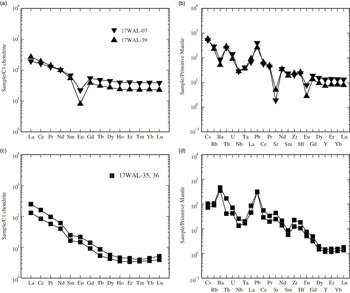
All three plutons have high SiO2 (68.49–77.01 wt%) and K2O + Na2O (8.07–8.25 wt%; Fig. 4a) and low MgO (0.17–0.82 wt%) and MnO (0.03–0.06 wt%), show peraluminous features (A/CNK = 1.04–1.13), and belong to the high-K calc-alkaline series (Fig. 4b). Alkali-feldspar granite 17WAL-07 and monzogranite 17WAL-39 display lower CaO (0.59–0.61 wt%), higher K2O (K2O/Na2O = 1.35–1.55), higher total rare earth element (REE) concentrations (257.58–275.96 ppm) and distinct negative Eu anomalies (δEu = 0.17–0.37; Fig. 5a), with enrichments in large-ion-lithophile elements (LILEs; e.g. Cs, Rb, Th and Pb) and depletions in Nb, Ta, Ba and Sr (Fig. 5b). In comparison, granodiorite 17WAL-35 displays relatively higher CaO (1.52–2.51 wt%) and lower total REE concentrations (114.30–206.16 ppm), with significantly enriched light rare earth elements (LREEs; (La/Yb)N = 35.75–56.24) and positive Eu anomalies (δEu = 1.12–1.14; Fig. 5c). Moreover, it is characterized by enriched LILEs (Cs, Rb, Ba, Th, Pb and Sr) and depleted high-field-strength elements (HFSEs; Y, Yb and Lu), with negative Nb–Ta and positive Zr–Hf anomalies, respectively (Fig. 5d).
(a) Na2O + K2O versus SiO2 and (b) K2O versus SiO2 diagrams for the early Carboniferous plutons in the Alxa Block. Data sources include Wang et al. (Reference Wang, Han, Feng and Liu2015 b), Dan et al. (Reference Dan, Li, Wang, Wang, Wyman and Liu2016), Liu et al. (Reference Liu, Zhang, Xiong, Zhao, Di, Wang and Zhou2016 a) and Xue et al. (Reference Xue, Ling, Liu, Zhang and Sun2017).

(a, c) Chondrite-normalized REE patterns and (b, d) primitive mantle-normalized trace-element diagrams for the late early Carboniferous plutons in the southwestern Alxa Block. Compositions of C1 chondrite and primitive mantle after Sun & McDonough (Reference Sun and McDonough1989).

5.b. Zircon U–Pb ages
Zircon grains from the studied samples are transparent, euhedral and short columnar or prismatic in shape. They exhibit well preserved concentric magmatic oscillatory zoning, with a few inherited zircon cores appearing occasionally in samples 17WAL-35 and 39 (Fig. 6). For alkali-feldspar granite 17WAL-07, all 24 spots are concordant and cluster together (Fig. 7a). Their Th/U ratios are 0.33–0.51 and they yield a concordia age of 331.6 ± 1.6 Ma (mean square weighted deviation (MSWD) = 4.2; 2σ, decay-constant errors included), which is consistent with the weighted mean 206Pb/238U age (331.7 ± 1.5 Ma; MSWD = 1.01; 2σ). With the exception of four discordant spots (16, 17, 18 and 22), concordant analyses of the other 21 granodiorite 17WAL-35 spots have Th/U ratios of 0.36–0.83 but form two age clusters (Fig. 7b). The older population includes 17 spots with a weighted mean 206Pb/238U age of 344.1 ± 2.2 Ma (MSWD = 1.40; 2σ; Fig. 7b1) and the younger population includes 4 spots with a weighted mean 206Pb/238U age of 326.2 ± 6.6 Ma (MSWD = 1.50; 2σ; Fig. 7b2). Furthermore, monzogranite 17WAL-39 has six discordant spots (1, 8, 11, 16, 17 and 21) and one concordant age cluster (Fig. 7c), which yields a consistent concordia age of 331.8 ± 1.7 Ma (MSWD = 4.8; 2σ, decay-constant errors included) and weighted mean 206Pb/238U age of 331.9 ± 1.7 Ma (MSWD = 0.88; n = 17; 2σ), with Th/U ratios of 0.43–1.03.
Cathodoluminescence (CL) images of representative zircon grains from the studied late early Carboniferous plutons in the southwestern Alxa Block.

(a–c) Concordia diagrams showing LA-ICP-MS zircon U–Pb data of the studied late early Carboniferous plutons in the southwestern Alxa Block (all the diagrams and calculations are at the 2σ level).

5.c. Whole-rock Sr–Nd isotopes
The 87Rb/86Sr and 147Sm/144Nd ratios of three granitic samples were calculated using the measured whole-rock Rb, Sr, Sm and Nd concentrations. The alkali-feldspar granite (17WAL-07; t = 332 Ma) has the lowest initial 87Sr/86Sr (0.700128) and highest initial 143Nd/144Nd (0.512219) ratios among the three plutons, with positive ϵNd(t) value (0.16) and Mesoproterozoic Nd model age (T DM = 1207 Ma; Fig. 8). The initial 87Sr/86Sr ratio of the granodiorite (17WAL-35; t = 326 Ma) is low (0.705102), and its initial 143Nd/144Nd ratio and ϵNd(t) value are 0.511358 and −16.80, respectively (Fig. 8). As its ƒSm/Nd (−0.59) significantly deviates from that of the average crust (−0.40; DePaolo et al. Reference Depaolo, Linn and Schubert1991), both T DM (1847 Ma) and T DM2 (2446 Ma) were calculated. For the monzogranite (17WAL-39; t = 332 Ma), its initial 87Sr/86Sr and 143Nd/144Nd ratios are 0.717670 and 0.511706, respectively, with negative ϵNd(t) value (−9.85) and Palaeoproterozoic T DM2 (1889 Ma; Fig. 8).
Sr–Nd isotopic features of early Carboniferous plutons in the Alxa Block. Symbols and data sources as for Figure 4.

6. Discussion
The well preserved concentric magmatic oscillatory zoning (Fig. 6) and high Th/U ratios (0.33–1.03) of dated zircon grains indicate their magmatic origin (Corfu et al. Reference Corfu, Hanchar, Hoskin and Kinny2003); the concordia and weighted mean 206Pb/238U ages are therefore interpreted as crystallization ages (Fig. 7). Because several spots from the older age cluster of granodiorite (17WAL-35) are located within the inherited zircon cores (e.g. spot 24 in Fig. 6b), the younger age cluster is employed. The three granitic plutons in the southwestern Alxa Block were therefore formed during late early Carboniferous time (c. 332–326 Ma).
6.a. Petrogenesis of the studied late early Carboniferous granitic plutons
The alkali-feldspar granite (17WAL-07) and monzogranite (17WAL-39) have similar geochemical features, such as high K2O + Na2O (8.10–8.25 wt%), FeOT (1.49–1.51 wt%) and FeOT/MgO (4.38–8.87), low CaO (0.59–0.61 wt%), MgO (0.17–0.43 wt%) and P2O5 (< 0.06 wt%), high total REE concentrations (257.58–275.96 ppm) with V-type REE patterns (Fig. 5a), and strongly depleted Ba and Sr (Fig. 5b). These characteristics indicate A-type granite nature, which can be clearly identified on the discrimination diagrams (e.g. Fig. 9b, c; Whalen et al. Reference Whalen, Currie and Chappell1987; King et al. Reference King, White, Chappell and Allen1997). A-type granites may originate from the fractionation of mantle-derived basaltic magmas (Eby, Reference Eby1990, Reference Eby1992; Bonin, Reference Bonin2007), the mixing of mantle- and crust-derived magmas (Yang et al. Reference Yang, Wu, Chung, Wilde and Chu2006), or the partial melting of crust at high temperatures (Whalen et al. Reference Whalen, Currie and Chappell1987; King et al. Reference King, White, Chappell and Allen1997; Wu et al. Reference Wu, Sun, Li, Jahn and Wilde2002). If rhyolitic magmas were derived from fractional crystallization of coeval basaltic magmas, the two components would commonly be spatially and temporally associated (Whitaker et al. Reference Whitaker, Nekvasil, Lindsley and McCurry2008). If the plutons had their origin by magma mixing, then they would have intermediate compositions with the presence of profuse mafic microgranular enclaves (MMEs; Yang et al. Reference Yang, Wu, Chung, Wilde and Chu2006, Reference Yang, Wu, Wilde, Xie, Yang and Liu2007; Zhang et al. Reference Zhang, Wang, Castro, Zhang, Shi, Tong, Zhang, Guo, Yang and Iaccheri2016 b), although the MMEs may be also cogenetic with their host granitoids (Zhang & Zhao, Reference Zhang and Zhao2017). The two A-type granites in the southwestern Alxa Block are rhyolitic in composition (Fig. 4a), but no MMEs were observed (Fig. 3a, e) and their coeval mafic intrusions crop out far away in the northeastern Alxa Block (Wang et al. Reference Wang, Han, Feng and Liu2015 b; Liu et al. Reference Liu, Zhang, Xiong, Zhao, Di, Wang and Zhou2016 a). They are also characterized by high SiO2 (73.89–77.01 wt%) and K2O/Na2O (1.35–1.55) and are peraluminous (A/CNK = 1.04–1.13), similar to aluminous A-type granites with continental crustal sources (King et al. Reference King, White, Chappell and Allen1997). Moreover, the alkali-feldspar granite has low positive ϵNd(t) value (0.16) and Mesoproterozoic Nd model age (1207 Ma; Fig. 8b), which is close to the protolith crystallization age of a granitic gneiss in the Helishan (c. 1200 Ma; Song et al. Reference Song, Xiao, Collins, Glorie, Han and Li2017). Its unusually low initial 87Sr/86Sr value (0.700128; Fig. 8a) may be caused by the strong depletion of Sr (Fig. 5b), as the initial 87Sr/86Sr value was calculated based on the measured whole-rock Sr concentration. The monzogranite has radiogenic Sr–Nd isotopes (Fig. 8a) and a Palaeoproterozoic Nd model age (1889 Ma; Fig. 8b). The Palaeoproterozoic basement rocks are commonly observed in Longshoushan (Tung et al. Reference Tung, Yang, Liu, Zhang, Tseng and Wan2007; Gong et al. Reference Gong, Zhang and Yu2011), in addition to a c. 1872 Ma syenite in Helishan (Wang et al. Reference Wang, Chen, Li, Zhang and Xu2019 b). The two aluminous A-type granites were therefore most probably the high-temperature partial melts of Palaeo- and Mesoproterozoic crustal materials.
(a) Tectonic discrimination diagrams of Rb versus (Y + Nb) for the early Carboniferous felsic plutons in the Alxa Block (Pearce, Reference Pearce1996). (b) Plot of (K2O + Na2O)/CaO versus Zr + Nb + Ce + Y and (c) plot of Ce versus 10 000×Ga/Al for A-type granites (Whalen et al. Reference Whalen, Currie and Chappell1987). (d) Nb–Y–Ce diagram for distinguishing between A1 and A2 granites (Eby, Reference Eby1992). Symbols and data sources as for Figure 4.

The granodiorite (17WAL-35) is also high-K calc-alkaline (Fig. 4b) and weakly peraluminous (A/CNK = 1.07–1.08) and has depleted HREEs and HFSEs (Fig. 5c, d). It is chemically characterized by high Sr (522.0–918.0 ppm) and low Y (5.36–6.56 ppm) and Yb (0.62–0.75 ppm) concentrations, with high Sr/Y ratios (97.4–139.9). Although high Sr/Y ratio (> 40) usually occurs in adakitic rocks, the high K2O contents (3.59–4.12 wt%) and K2O/Na2O ratios (0.80–1.03) of this granodiorite are more ‘continental’ than typical adakites (Defant & Drummond, Reference Defant and Drummond1990; Martin et al. Reference Martin, Smithies, Rapp, Moyen and Champion2005; Moyen, Reference Moyen2009). The coexistence of negative Nb–Ta and positive Zr–Hf anomalies (Fig. 5d) and highly radiogenic Sr–Nd isotopes (Fig. 8a) also suggest a continental crustal source (Rudnick & Gao, Reference Rudnick, Gao, Holland and Turekian2003). The enrichments of Eu, Ba and Sr are attributed to the large proportion of plagioclase (c. 40%), whereas the low Y concentration may suggest the presence of garnet in the residue, so that the high Sr/Y ratios indicate a deeper crustal level of magma source (Ducea et al. Reference Ducea, Saleeby and Bergantz2015). In addition, c. 2.5 Ga basement rocks and magmatic activity are commonly observed in the southwestern Alxa Block (Zhang et al. Reference Zhang, Gong, Yu, Li and Hou2013 a; Zhang & Gong, Reference Zhang and Gong2018; Wang et al. Reference Wang, Chen, Li, Zhang and Xu2019 b), which is coeval with the two-stage Nd model age of this granodiorite (c. 2446 Ma; Fig. 8b). This granodiorite of high Sr/Y ratio may therefore have its origin in the partial melting of upper Neoarchean lower crust.
6.b. Tectonic setting of the early Carboniferous magmatism in the Alxa Block
Two different tectonic processes accounting for the early Carboniferous magmatism within the Alxa Block were proposed previously: continental arc magmatism induced by the S-wards subduction of the PAO (Liu et al. Reference Liu, Zhang, Xiong, Zhao, Di, Wang and Zhou2016 a; Xue et al. Reference Xue, Ling, Liu, Zhang and Sun2017; Gong et al. Reference Gong, Zhang, Wang, Yu and Wang2018 a), or the collision and amalgamation between the Alxa Block and the NCC (Zhang et al. Reference Zhang, Li, Xiao, Wang and Qi2013 b; Dan et al. Reference Dan, Li, Wang, Wang, Wyman and Liu2016). Noticeably, whether a Palaeozoic suture between the Alxa Block and the NCC existed or not is still in debate, especially with no associated ophiolitic mélanges observed (e.g. Dan et al. Reference Dan, Li, Wang, Wang, Wyman and Liu2016; Zhang & Gong, Reference Zhang and Gong2018; Wang et al. Reference Wang, Chen, Li, Zhang and Xu2019 b), and the early Carboniferous magmatic rocks are widely distributed, rather than along a linear trend in the eastern margin of the Alxa Block (Fig. 1b), so they are less likely attributed to such an amalgamation process. Furthermore, the argument of continental arc magmatism is mainly based on their arc-like geochemical signatures, such as calc–alkaline characteristics (Fig. 4b), negative Nb–Ta anomalies and high Sr/Y ratios (e.g. Liu et al. Reference Liu, Zhang, Xiong, Zhao, Di, Wang and Zhou2016 a; Xue et al. Reference Xue, Ling, Liu, Zhang and Sun2017). However, these signatures can also be inherited from magma sources (Wang et al. Reference Wang, Wilde, Xu and Pang2016 a), and most granites of high Sr/Y ratio in this area exhibit high K2O/Na2O ratios (0.92–3.70), positive Zr–Hf anomalies and radiogenic Nd–Hf isotopes, indicating derivation by the partial melting of lower continental crust (Fig. 8a; Dan et al. Reference Dan, Li, Wang, Wang, Wyman and Liu2016; Xue et al. Reference Xue, Ling, Liu, Zhang and Sun2017); this can occur not only in continental arc belts but also in lithospheric extensional environments.
It is noteworthy that the early Carboniferous plutons within the Alxa Block are mostly basic or acidic in silica content (Fig. 4), resembling bimodal associations. The felsic plutons plot not only in volcanic arc but also in within-plate and post-collision granite fields (Fig. 9a), with most of them exhibiting radiogenic Sr–Nd isotopes (Fig. 8a). They are characterized by the coexistence of A-type granites, peraluminous granites and calc-alkaline I-type granitoids (Dan et al. Reference Dan, Li, Wang, Wang, Wyman and Liu2016; Liu et al. Reference Liu, Zhang, Xiong, Zhao, Di, Wang and Zhou2016 a; Xue et al. Reference Xue, Ling, Liu, Zhang and Sun2017; Zheng et al. Reference Zheng, Li, Zhang, Xiao and Li2019), which mostly occur in extensional settings (Maniar & Piccoli, Reference Maniar and Piccoli1989). A-type granites usually indicate high-temperature anatectic conditions related to asthenospheric upwelling in a lithospheric extensional setting (Whalen et al. Reference Whalen, Currie and Chappell1987; Eby, Reference Eby1992). The mafic plutons plot mostly in the MORB and within-plate basalt fields, similar to the rift-related Basin-and-Range basalts (Fig. 10), and display juvenile or weakly radiogenic Sr–Nd isotopes (Fig. 8a). It is noteworthy that several of the mafic plutons in the northeastern Alxa Block have hornblende as the dominant mafic mineral and resemble appinitic intrusions in geochemistry (Wang et al. Reference Wang, Han, Feng and Liu2015 b). Generally, mafic appinitic melts were most likely produced by the partial melting of subduction-modified sub-continental lithospheric mantle (Fig. 10c) and the melting may be triggered by asthenospheric upwelling following slab break-off or delamination after a subduction event (Murphy, Reference Murphy2013). The generation of both the mafic and felsic early Carboniferous plutons within the Alxa Block therefore most likely resulted from the asthenospheric upwelling at that time. Although an upwelling asthenosphere may also occur in a continental arc setting, continental arc magmatism is typically characterized by linear tracks within a specific tectonic unit and dominated by andesitic rocks, with continued major elemental compositions from basalts to rhyolites but without compositional gaps (Ducea et al. Reference Ducea, Saleeby and Bergantz2015). Evidently, this is not the case for the early Carboniferous plutons within the Alxa Block (Figs 1b, 4a), meaning that their formation in a continental arc is less likely, but rather more likely in a lithospheric extensional setting.
Petrogenetic discrimination diagrams of (a) V–(Ti/1000) (Shervais, Reference Shervais1982), (b) (Zr/Y)–Zr (Pearce & Norry, Reference Pearce and Norry1979), (c) (La/Ba)–(La/Nb) (Saunders et al. Reference Saunders, Storey, Kent and Norry1992), and (d) (Zr/Sm)–(Sr/Nd)–(Ti/V) (Wang et al. Reference Wang, Wilde, Xu and Pang2016 a) for the early Carboniferous mafic rocks in the Alxa Block. The Basin-and-Range rift-related basalt field refers to Wang et al. (Reference Wang, Wilde, Xu and Pang2016 a). Symbols and data sources as for Figure 4.

Furthermore, A-type granites are a good indicator of lithospheric extension, but the specific extensional setting could be varied (Sain et al. Reference Sain, Saha, Joy, Jelsma and Armstrong2017), including not only rift-related (intraplate) extension (Whalen et al. Reference Whalen, Currie and Chappell1987; Eby, Reference Eby1992) but also back-arc extension (Karsli et al. Reference Karsli, Caran, Dokuz, Çoban, Chen and Kandemir2012; Bickford et al. Reference Bickford, Schmus, Karlstrom, Mueller and Kamenov2015). The two early Carboniferous aluminous A-type granites in the southwestern Alxa Block are A2 type (Fig. 9d) and therefore represent magmas derived from continental crust that has been through an orogenic cycle of arc magmatism and collision (Eby, Reference Eby1992). The geochemical similarities between early Carboniferous mafic plutons in the Alxa Block and Basin-and-Range basalts (Fig. 10), which were generated in back-arc extensional setting to the Sierra Nevada arc (Cousens et al. Reference Cousens, Henry, Stevens, Varve, John and Wetmore2019), also suggest a subduction-related tectonic setting. In back-arc extensional setting, the asthenospheric upwelling could be induced by the foundering of arc root during the roll-back process of subducting slab (DeCelles et al. Reference DeCelles, Ducea, Kapp and Zandt2009; DeCelles & Graham, Reference DeCelles and Graham2015). Another possibility is the intra-continental extensional setting, because the sub-continental lithospheric mantle and lower continental crust of the Alxa Block had been modified by subduction during Middle Ordovician–Early Devonian time (Liu et al. Reference Liu, Zhao, Sun, Han, Eizenhöfer, Hou, Zhang, Zhu, Wang, Liu and Xu2016 b; Zhou et al. Reference Zhou, Zhang, Luo, Pan, Zhang and Guo2016), and the subduction-related geochemical signatures of later magmas may be inherited from the subduction-modified magma sources (Wang et al. Reference Wang, Wilde, Xu and Pang2016 a). Moreover, the extension-related rock associations of calc-alkaline I-type granites, aluminous A2-type granites and peralkaline granites were present in the southwestern Alxa Block from late Silurian–Early Devonian time, following earlier arc magmatism and implying post-collisional setting (Wang et al. Reference Wang, Chen, Shao, Li, Ding, Zhang, Wang, Zhang, Xu and Qin2020). In addition, the cyclical magmatic flare-ups and lulls within each Palaeozoic magmatic stage of the Alxa Block (Fig. 2a) are quite similar to those of Cordilleran arcs in terms of time span and frequency (DeCelles et al. Reference DeCelles, Ducea, Kapp and Zandt2009), but the magmatic hiatus between the two magmatic stages is relatively too long for one single subduction event. The two magmatic stages of the Alxa Block may therefore represent two orogenic cycles and the early Carboniferous extension, as the initiation of the second orogenic cycle, may suggest intra-continental extensional setting. Although more geological evidence is urgently needed to discriminate between the two kinds of extensional settings, a simple continental arc model is less likely for the early Carboniferous magmatism within the Alxa Block.
Additionally, continental arc magmatism is usually accompanied by syn-arc sedimentation in fore-arc or back-arc basins (Ducea et al. Reference Ducea, Saleeby and Bergantz2015), but lower Carboniferous strata are absent from the Alxa Block based on available geological reports. Although a few outcrops in the northern Alxa Block were previously identified as lower Carboniferous deposits, they were recently reassigned as lower–middle Permian strata (Zhang et al. Reference Zhang, Niu, Wei, Shi and Song2018c ). By contrast, the upper Carboniferous–middle Permian strata are widely distributed. The sedimentary facies show a distinct change from terrestrial alluvial fan and delta in the lower stratigraphic sections to platform, littoral and shallow-marine in the upper stratigraphic sections, with abundant fossils (e.g. plants, fusulinids, brachiopods, corals) and volcanic interlayers (Bu et al. Reference Bu, Niu, Wu and Duan2012; Han et al. Reference Han, Liu, Li and Shi2012; Yin et al. Reference Yin, Zhou, Zhang, Zheng and Wang2016; Song et al. Reference Song, Xiao, Collins, Glorie, Han and Li2018). Such a transgression sequence is consistent with the further development of the lithospheric extension.
6.c. Tectonic implications for the development of southeastern CAOB
Even if the Alxa Block was separated from the NCC during the Precambrian Eon, sedimentologic, magmatic and structural evidences (Li et al. Reference Li, Zhang and Qu2012 a; Dan et al. Reference Dan, Li, Wang, Wang, Wyman and Liu2016; Zhang et al. Reference Zhang, Li, Xiao, Wang and Qi2013 b, Reference Zhang, Zhang and Zhao2016 c) all suggest that their amalgamation occurred before early Carboniferous time. Palaeomagnetic studies also suggest that the Precambrian micro-continental blocks within the southeastern CAOB (e.g. Mongolia, Songliao and Hunshandake blocks) may have already accreted to the northern NCC by early Carboniferous time (Pruner, Reference Pruner1992; Li et al. Reference Li, Zhang, Gao, Li, Zhao, Li and Guan2012 b; Zhao et al. Reference Zhao, Chen, Xu, Faure, Shi and Choulet2013; Zhang et al. Reference Zhang, Huang, Zhao and Zhang2018 a). Furthermore, the Palaeozoic magmatic episodes of the Alxa Block and the southeastern CAOB (including the northern margin of the NCC) are very similar (Fig. 2), indicating comparable tectonic processes. Consequently, the whole region had been experiencing a uniform tectonic regime since early Carboniferous time and, if there was on-going S-wards subduction of the large-scale PAO at that time, the arc-trench system was most likely located to the north of these micro-continental blocks.
Regionally, the early Carboniferous is the initial period of the second magmatic stage (Fig. 2), and magmatic rocks during this period are characterized by the mafic–ultramafic complexes in northern Inner Mongolia (Jian et al. Reference Jian, Kröner, Windley, Shi, Zhang, Zhang and Yang2012; Zhang et al. Reference Zhang, Li, Li, Tang, Chen and Luo2015c ; Li et al. Reference Li, Wang, Santosh, Wang, Dong and Li2018), the appinitic intrusions in the northern NCC (Zhou et al. Reference Zhou, Zhang, Liu, Liu and Liu2009; Zhang et al. Reference Zhang, Gao, Wang, Liu and Ma2012 a; Wang et al. Reference Wang, Han, Feng and Liu2015 b), the calc-alkaline I-type and peraluminous granites with crustal origins throughout the southeastern CAOB (Bao et al. Reference Bao, Zhang, Wu, Wang, Li, Sang and Liu2007; Zhang et al. Reference Zhang, Zhao, Song, Yang, Hu and Wu2007, Reference Zhang, Liu, Chai, Xu, Zhao and Xu2011; Liu et al. Reference Liu, Chi, Zhang, Ma, Zhao, Wang, Hu and Zhao2009, Reference Liu, Zhang, Xiong, Zhao, Di, Wang and Zhou2016 a; Blight et al. Reference Blight, Crowley, Petterson and Cunningham2010; Dan et al. Reference Dan, Li, Guo, Liu and Wang2012; Xue et al. Reference Xue, Ling, Liu, Zhang and Sun2017), and the A-type granites newly identified in the southwestern Alxa Block (this study). Such rock associations are commonly associated with asthenospheric upwelling in lithospheric extensional setting. Although some of the basaltic rocks from the mafic–ultramafic complexes exhibit subduction-related geochemical features (Jian et al. Reference Jian, Kröner, Windley, Shi, Zhang, Zhang and Yang2012; Zhang et al. Reference Zhang, Li, Li, Tang, Chen and Luo2015c ; Li et al. Reference Li, Wang, Santosh, Wang, Dong and Li2018), these features can also be imprinted by crustal contamination (Xia, Reference Xia2014) or inherited from magma sources that have been modified by earlier subduction fluids or melts (Wang et al. Reference Wang, Wilde, Xu and Pang2016 a). Further, the coeval intrusions are widely distributed (Xu et al. Reference Xu, Zhao, Bao, Zhou, Wang and Luo2014) rather than along one or two specific ribbons as would be expected for a magmatic arc, supporting their formation in an extensional tectonic setting. Moreover, if this lithospheric extension occurred in back-arc, then the remnants of the large-scale PAO may be represented by the early Carboniferous Erenhot–Hegenshan ophiolitic mélanges to the north of the micro-continental blocks (Zhang et al. Reference Zhang, Li, Li, Tang, Chen and Luo2015c ; Li et al. Reference Li, Wang, Santosh, Wang, Dong and Li2018). Otherwise, the early Carboniferous extension of the southeastern CAOB was probably developed in an intra-continent environment and may represent the initiation of the second orogenic cycle (Xu et al. Reference Xu, Wang, Zhang, Wang, Yang and He2018).
In addition to the intrusions, the early Carboniferous sedimentary rocks are mostly absent from the southeastern CAOB, indicating regional uplift related to asthenospheric upwelling during the initial stage of the lithospheric extension. The Carboniferous metamorphic rocks are high-temperature–low-pressure and show a clockwise P–T path, involving pre-peak heating with slight decompression, peak and post-peak cooling stages, also suggesting an extension process (Zhang et al. Reference Zhang, Wei and Chu2018 b).
Subsequently, the late Carboniferous–Permian magmatism in the southeastern CAOB became intense (Fig. 2) with the formation of the widespread bimodal volcanic rocks, continental basaltic intrusions, calc-alkaline I-type granites, peraluminous S-type granites, A-type granites and several peralkaline magmatic belts (e.g. Jahn et al. Reference Jahn, Litvinovsky, Zanvilevich and Reichow2009; Zhang et al. Reference Zhang, Xue, Yuan, Ma and Wilde2012 b, Reference Zhang, Yuan, Xue, Yan and Mao2015 b, Reference Zhang, Zhao, Liu and Hu2016 d, Reference Zhang, Chen, Li, Li, Yang and Qian2017 b; Pang et al. Reference Pang, Wang, Xu, Zhao, Feng, Wang, Luo and Liao2016, Reference Pang, Wang, Xu, Luo and Liu2017; Zhao et al. Reference Zhao, Jahn, Xu, Liao and Wang2016 a; Ji et al. Reference Ji, Ge, Yang, Tian, Chen and Zhang2018; Wang et al. Reference Wang, Han, Feng, Liu, Zheng, Kong and Qi2021 b), implying further development of the early Carboniferous extension. This is also consistent with the occurrence of many late Carboniferous–Permian mafic dykes (Fig. 3a) with MORB or within-plate basalt geochemical signatures in this region (Lin et al. Reference Lin, Xiao, Wan, Windley, Ao, Han, Feng, Zhang and Zhang2014). Accordingly, the late Carboniferous–Permian Solonker, Enger Us and Quagan Qulu ophiolitic mélanges (Jian et al. Reference Jian, Liu, Kröner, Windley, Shi, Zhang, Zhang, Miao, Zhang and Tomurhuu2010; Zheng et al. Reference Zheng, Wu, Zhang, Xu, Meng and Zhang2014), which contain MORB-type intrusions, continental basalts and terrigenous sediments (Luo et al. Reference Luo, Xu, Shi, Zhao, Faure and Chen2016; Shi et al. Reference Shi, Song, Wang, Huang, Zhang and Tang2016), may represent the newly opened limited ocean basins and mark the strongest extension (Xu et al. Reference Xu, Zhao, Bao, Zhou, Wang and Luo2014, Reference Xu, Wang, Zhang, Wang, Yang and He2018). The late Carboniferous–Permian sedimentary sequences are also widely exposed throughout the southeastern CAOB. They vary from plant fossil-bearing terrigenous clastic rocks to shallow-marine clastic and carbonate depositions, with basal conglomerates, and are transgression sequences related to regional extension (Zhao et al. Reference Zhao, Xu, Tong, Chen and Faure2016 b; Ji et al. Reference Ji, Zhang, Yang, Chen and Tang2020; Wang et al. Reference Wang, Xu, Song, Zhao, Zhang and Yan2021 a).
To summarize, we propose a lithospheric extensional process rather than a simple continental arc for the tectono-magmatic development of the southeastern CAOB during early Carboniferous time (Fig. 11). The early Carboniferous extension-related magmatism and the absence of coeval sedimentary successions may reflect the onset of asthenospheric upwelling and regional uplift, and therefore mark the initiation of the lithospheric extension. Nevertheless, the asthenospheric upwelling could be induced by either slab roll-back or slab break-off of the subducted PAO; more geological, geochemical, geophysical and palaeontological evidence is therefore needed to further constrain the specific tectonic setting of this extension, either back-arc or intra-continental.
Extensional tectonics of the Alxa Block and the southeastern CAOB during early Carboniferous time. (a) Micro-continental blocks within the southeastern CAOB had already been accreted to the northern NCC (Alxa Block) before early Carboniferous time. (b) During early Carboniferous time, the asthenospheric upwelling induced by either the roll-back or the break-off of the subducted PAO slab heated both the subduction-modified lithospheric mantle and the overlying crust, leading to the generation of the mafic and felsic plutons, respectively.

7. Conclusions
The early Carboniferous (c. 332–326 Ma) granodiorite with high Sr/Y ratio, A-type monzogranite and A-type alkali-feldspar granite in the southwestern Alxa Block were most likely formed by partial melting of Neoarchean, Palaeoproterozoic and Mesoproterozoic crustal sources heated by upwelling asthenosphere in an lithospheric extensional setting. According to regional geological correlations, a uniform lithospheric extensional setting, either back-arc or intra-continental, but not a simple continental arc, is suggested for both the Alxa Block and the southeastern CAOB during early Carboniferous time, with the development of extension-related magmatism and the absence of coeval sedimentary rocks.
Supplementary material
To view supplementary material for this article, please visit https://doi.org/10.1017/S0016756821000984
Acknowledgements
We are grateful to Yurong Cui (Tianjin Institute of Geology and Mineral Resources) and Suohan Tang (Institute of Geology, Chinese Academy of Geological Sciences) for their help with zircon U–Pb dating and isotopic analyses, respectively. Special thanks are extended to Professor Peter Clift and anonymous reviewers for their constructive comments. This work was financially supported by China Geological Survey (grant number DD20190011), Chinese Academy of Geological Sciences (grant number JKY202011) and National Key Research and Development Program of China (grant number 2018YFC0603701).
Declaration of interest
The authors declare that they have no known conflicts of interests or personal relationships that could have appeared to influence the work reported in this paper.




 Open access

