





Introduction
Kawasaki disease is an acute vasculitis of childhood and the leading cause of paediatric acquired heart disease in developed countries.Reference Newburger, Takahashi and Burns1,Reference McCrindle, Rowley and Newburger2 Structural damage to the coronary arteries resulting in coronary artery aneurysms in 20–25% of untreated children can lead to thrombosis, stenosis, and myocardial infarction. Giant coronary artery aneurysms have been associated with poor long-term outcomes.Reference McCrindle, Rowley and Newburger2 In a study of 34 Japanese adults with giant coronary artery aneurysms followed for up to 39 years, 6% died, 23% suffered a myocardial infarction, and 37% underwent coronary artery bypass surgery with an event-free survival rate of only 36%.Reference Tsuda, Hamaoka and Suzuki3 Most recently, the event-free survival among 273 Japanese patients with giant coronary artery aneurysms at 10 years was 52% for males and 75% for females.Reference Miura, Kobayashi and Kaneko4
While vascular remodelling with normalisation of the luminal diameter is a well-recognised phenomenon, giant coronary artery aneurysms are less likely to regress. One-year follow-up of giant coronary artery aneurysms in 34 Japanese children showed no regression of coronary artery aneurysms.Reference Tsuda and Hashimoto5 Medium-term outcomes have been described in a North American cohort of 440 patients with giant coronary artery aneurysms.Reference McCrindle, Manlhiot and Newburger6 Of the 93 patients followed for 10 years, 57% had normalisation of luminal diameter. Even though giant coronary artery aneurysm can regress, the extent of residual damage to the arterial wall has not been well characterised.
It is well documented that myocarditis is a universal feature of acute Kawasaki disease with endomyocardial biopsies showing histologic evidence of myocardial inflammation.Reference Yonesaka, Takahashi and Matubara7,Reference Yonesaka, Takahashi and Eto8 Autopsy studies of young adults who died of myocardial infarction due to thrombosis of large aneurysms have shown bridging fibrosis in the myocardium.Reference Shimizu, Sood and Lau9,Reference Orenstein, Shulman and Fox10 Cardiac MRI and speckle tracking echocardiogram studies found decreased left ventricular strain in Kawasaki disease patients without myocardial infarction, and reduced myocardial perfusion reserve even in patients with remodelled coronary artery aneurysms.Reference Dedeoglu, Barut and Oztunc11–Reference Bratis, Chiribiri and Hussain13 The long-term effects of inflammation from Kawasaki disease on myocardial structure and function have yet to be fully characterised. Thus, detailed assessment in patients who have developed giant coronary artery aneurysm is critically important.
We selected five patients for in-depth study who had documented giant coronary artery aneurysms during their acute Kawasaki disease in early childhood with subsequent normalisation of the internal diameter by transthoracic echocardiogram. All patients were initially diagnosed and treated at our centre, which permitted a complete assessment of the coronary artery remodelling over time. We characterised the structure of the arterial wall by coronary computed tomography angiography and calcium volume scoring and assessed myocardial function by endocardial strain analysis. Biomarkers assessed ongoing chronic inflammation and fibrosis long after Kawasaki disease.
Methods
Study population
From a longitudinal cohort of Kawasaki disease patients at Rady Children’s Hospital San Diego and the San Diego Cardiac Center, the study included patients who met the following criteria: a) patients had giant coronary artery aneurysm in the acute phase with maximal coronary artery Z scores ≥ 10 (Z score defined as internal diameter of the left anterior descending coronary artery or right coronary artery normalised for body surface area and expressed as standard deviation units)Reference McCrindle, Rowley and Newburger2, b) had sequential imaging studies over time demonstrating complete normalisation of the coronary artery internal diameter. The study was approved by the University of California San Diego’s Institutional Review Board. All subjects or their parents gave signed consent or assent for the study as appropriate.
Sample collection and biomarker measurement
Plasma samples were collected at the time of the coronary computed tomography angiography and stored at -80°C. We measured plasma levels of calprotectin and galectin-3 (gal-3) by enzyme-linked immunosorbent assay according to the manufacturer’s instructions (R & D Systems, Minneapolis, MN, USA). For comparison, we measured biomarker levels in 88 healthy young adults (median age 22.2 years, interquartile range 20.8–24.3, 48% male) as previously described. Reference Hoshino, Jain and Shimizu14
Coronary computed tomography angiography and coronary artery calcium score
Gated coronary computed tomography angiography was performed using a 256-slice GE Healthcare (Chicago, IL) Revolution CT scanner and iodinated contrast (Omnipaque 350). After localisation, a prospectively gated, non-contrast coronary artery calcium scan was obtained. Approximately 75 ml of contrast was administered intravenously at 5 mL/sec followed by a 90 ml saline flush, and 0.625 mm images were obtained through the heart using padded prospective gating during diastole, combined with additional imaging using lower tube current throughout the cardiac cycle. Total radiation doses were 1.5–4.4 mSv (median 2.7 mSv) (using a conversion factor of 0.014 mSv/mGy·cm), including the 0.5–1.0 mSv of additional radiation given to permit time-resolved imaging throughout the cardiac cycle for CT strain analysis.
Cardiac CT functional analysis
To measure regional endocardial strain from the 4-dimensional CT images, the left ventricular blood pool was first segmented in 3D in ITK-snap (ver. 3.6.2). Reference Yushkevich, Piven and Hazlett15 Then, point-cloud registration and calculation of the fractional area change on the endocardial surface occurred in MATLAB (2018b, Mathworks, Natick, MA) as previously published.Reference Pourmorteza, Schuleri, Herzka, Lardo and McVeigh16–Reference Colvert, Manohar and Contijoch18 Regional endocardial shortening from CT (RSCT) was defined as fractional area change -1. High-resolution dynamic maps of RSCT visualised the endocardial surface, and bullseye plots were generated to illustrate cardiac function during one heartbeat. RSCT vs. time plots were constructed for 16 American Heart Association segments (excluding the apical cap, #17), and peak strain and diastolic relaxation rate were computed.Reference Cerqueira, Weissman and Dilsizian19 Peak strain was the minimum point on the RSCT vs. time curve. Diastolic relaxation rate was defined as the slope of the curve within a 100-millisecond window after peak strain occurred. Averaging peak strain and diastolic relaxation rate over all segments yielded global peak strain and global diastolic relaxation rate, respectively. Global longitudinal strain was also computed from the CT images. Endocardial contours from the valve plane through the apex and back up to the valve plane were drawn through the left ventricular myocardium in Osirix in 2- and 4-chamber views at end-diastole and end-systole. Global longitudinal strain was defined as GLS = (L ES−L ED)/L ED
where LES and LED are the length of the contour at end-systole and end-diastole, respectively. An average global longitudinal strain was computed from the two orthogonal views. CT functional analyses were compared to values generated from 15 healthy adults (8 males, 7 females), mean age 58 ± 11 years, and left ventricular ejection fraction from 4D CT of 69% ± 5%.
Exercise stress echocardiography
Patients had exercise stress test by standard Bruce protocol treadmill or bicycle ergometer. Transthoracic echocardiography was performed at rest before exercise and immediately after exercise.
Statistics
Mean and standard deviation were calculated for global and segmental peak strain and diastolic relaxation rate and global longitudinal strain. Biomarker concentrations for patients and healthy controls were expressed as median and interquartile range and compared by Wilcoxon rank sum test. Peak strain, global longitudinal strain, and biomarker values > 2 SD above the mean and diastolic relaxation rates > 2 SD below the mean for healthy control groups were considered abnormal.
Results
From a longitudinal cohort of 1,780 Kawasaki disease patients, there were 45 (2.5%) giant coronary artery aneurysm patients with maximal right coronary artery and/or left anterior descending coronary artery coronary artery Z scores ≥ 10. From these 45 patients, we selected five Kawasaki disease patients who met the inclusion criteria with normalisation of the internal diameter by transthoracic echocardiogram (Table 1). Among the 40 giant coronary artery aneurysm patients with only partial or no remodelling, 16/40 (40%) patients had their onset at ≤ 1 yr. as compared to 4/5 (80%) of the completely remodelled patients.
Demographic and clinical characteristics of the study population
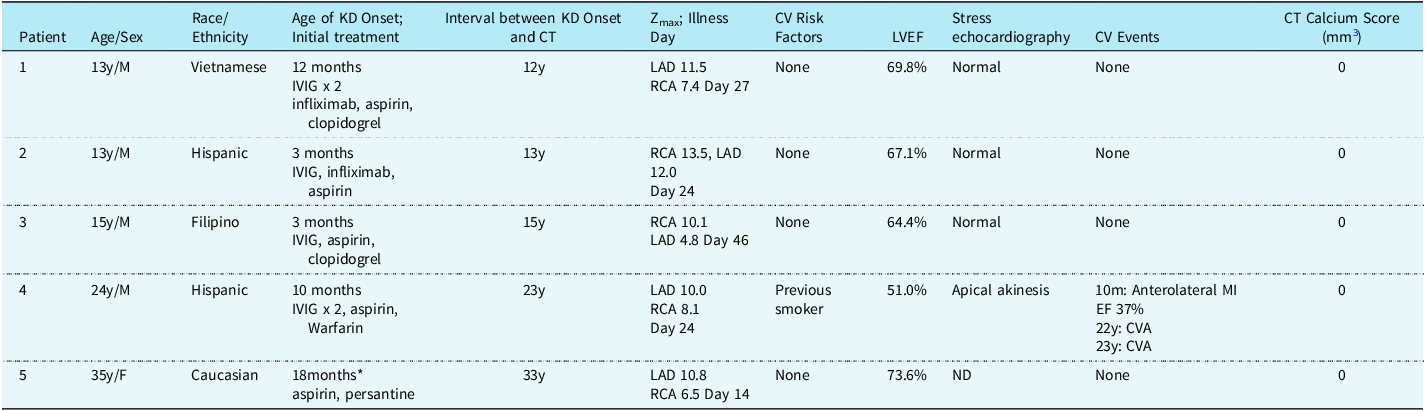
Zmax is defined as the maximum Z score (internal dimension of coronary artery normalised for body surface area) by echocardiogram within one year after KD onset. Illness day: first day of fever is defined as illness day 1. *This patient was diagnosed prior to the approval of IVIG as standard treatment for KD. Abbreviations: y = years; mos = months; KD = Kawasaki disease; IVIG = intravenous immunoglobulin; LAD= left anterior descending artery; RCA = right coronary artery; MI = myocardial infarction; CVA = cerebrovascular accident; CV = cardiovascular; LVEF = left ventricular ejection fraction; CT = computed tomography; ND = no data.
Four patients (#1–3, #5) with normalised giant coronary artery aneurysms by transthoracic echocardiogram and no prior history of myocardial infarction at the time of CT imaging had normal coronary arteries, zero coronary artery calcium, normal left ventricular ejection fraction, and RSCT with normal global peak strain and diastolic relaxation patterns (Table 2, Figure 1). Plasma levels of calprotectin and gal-3 did not differ from healthy young adult controls (Table 3). Stress echocardiography with a standard Bruce protocol was also normal in patients #1–3, but data were not available for patient #5 (Table 1).
Imaging of the coronary artery aneurysms by echocardiography during acute KD with paired CCTA images performed 13 years later. Echocardiography was performed during the acute phase of KD in patient #2 (age 3 months). These images were obtained in a parasternal short-axis view. Patient #2 had (a) dilatation of the proximal right coronary artery (5.5 mm, Z-score + 13.5), (b) dilatation of the left main coronary artery (3.1 mm, Z-score + 3.5), and an aneurysm of the left anterior descending coronary artery (4.1 mm, Z-score + 12) that then tapered to a diffusely dilated LAD (2.9 mm, Z-score + 6.6). (c and d) CCTA images show complete regression of his right CAA (C) and LAD CAA (D) 13 years later.

CT regional shortening (RSCT) parameters in KD patients compared to healthy controls

Values for healthy controls expressed as mean (± SD). Abbreviation: CAAs, coronary artery aneurysms.
Biomarker concentrations in KD patients and controls

Values for healthy controls expressed as mean (± SD).
One patient (#4) was a 24-year-old Hispanic male who was diagnosed on day 24 of fever at age 10 months. He presented with an anterolateral myocardial infarction and had one giant coronary artery aneurysm (left anterior descending coronary artery Zmax 10.0) and one large coronary artery aneurysm (right coronary artery Zmax 8.1) with a left ventricular ejection fraction of 37% at the time of Kawasaki disease diagnosis. Transthoracic echocardiogram demonstrated septal and posterolateral left ventricular wall dyskinesis. He was treated with intravenous immunoglobulin, aspirin, and warfarin, which the family subsequently discontinued. Although his aneurysms remodelled, he later developed an apical thrombus that resulted in two cardioembolic strokes during early adulthood. Coronary computed tomography angiography 23 years after Kawasaki disease onset demonstrated normal coronary arteries, a left ventricular ejection fraction of 51%, and a coronary artery calcium score of zero. RSCT detected left ventricular apical thinning and hypokinetic apical segments, consistent with his prior anterolateral MI (Figure 2, Supplemental Table 1). Regional diastolic relaxation rate was reduced in the apical anterior and apical septal segments (AHA segments 13 and 14, respectively) (Figure 3, Supplemental Table 2). Stress echocardiography demonstrated apical akinesis. Plasma concentrations of calprotectin and gal-3 were similar to those of healthy young adult controls.
AHA CT strain plots for KD patient with prior MI. Myocardial regional strain (RSCT) versus time for one cardiac cycle across 16 LV segments for patient #4 (in red). Mean RSCT values for healthy adults (bold, black) ± two standard deviations (thin, black).

Bullseye diagram for KD patient with prior MI. (a) Bullseye diagram for a normal subject. Each plot represents a single point in time of one cardiac cycle (% cardiac cycle noted above each plot). First plot (upper left corner) is end diastole, where RSCT is 0 (orange) in all AHA segments. Blue represents areas of regional shortening. Uniform color changes in all regions throughout cardiac cycle reflect normal contraction and relaxation. White areas represent the LV outflow tract. (b) Bullseye diagram for patient #4. Abnormal strain in several apical segments during end systole consistent with prior anterolateral MI.

Discussion
We report a rare outcome in five selected individuals with a history of giant coronary artery aneurysm due to Kawasaki disease and subsequent normalisation by echocardiography. We examined coronary artery structure, myocardial strain, diastolic function, and biomarkers of inflammation and myocardial fibrosis. All five patients had complete regression of giant coronary artery aneurysms and no detectable coronary artery calcium. Four patients with no previous history of myocardial infarction had normal global systolic and diastolic myocardial function. One patient with a myocardial infarction at the time of diagnosis in infancy had impaired regional systolic and diastolic strain abnormalities. No patient had elevated levels of biomarkers for inflammation and fibrosis.
Since giant coronary artery aneurysms can lead to devastating cardiovascular outcomes and only half will regress to a normal luminal diameter, a remarkable finding of our study was complete remodelling of the giant coronary artery aneurysms with no coronary calcification, normal biomarkers, and normal left ventricular strain. In a 10 to 21-year follow-up study of patients with Kawasaki disease and coronary artery aneurysms from the pre-IVIG era in Japan, none of the giant aneurysms showed regression (n = 26).Reference Kato, Sugimura and Akagi20 One-year follow-up of giant coronary artery aneurysms in 34 Japanese children during the intravenous immunoglobulin era also showed no regression.Reference Tsuda and Hashimoto5 The most recent report from Japan described that only 36% of 221 patients with giant right coronary artery aneurysms and 29% of 98 patients with left anterior descending coronary artery giant aneurysms had regression at 10 years.Reference Kato, Miura and Kobayashi21 In a Boston and San Diego cohort of 36 patients with giant coronary artery aneurysms, only 19% had regression at two years.Reference Friedman, Gauvreau and Hamaoka-Okamoto22 A more favourable experience was reported for a combined North American and Taiwanese cohort of 440 patients with giant coronary artery aneurysms showed that 57% had normalisation of luminal diameter at 10 years.Reference McCrindle, Manlhiot and Newburger6 All study patients had the onset of their initial illness at the age of 18 months or younger. This young age of onset may account for the more favourable outcome compared to previous reports.Reference McCrindle, Manlhiot and Newburger6,Reference Kato, Miura and Kobayashi21
In late convalescent paediatric and adult Kawasaki disease patients with persistent giant coronary artery aneurysms or a history of low ejection fraction during the acute illness (Kawasaki disease shock syndrome), elevated plasma levels of calprotectin and gal-3, and elevated serum levels of C-terminal propeptide of procollagen type I, proteins involved in inflammation and myocardial fibrosis, suggest underlying chronic inflammation and fibrosis long after acute Kawasaki disease resolution.Reference Hoshino, Jain and Shimizu14,Reference Lech, Guess and Duffner23,Reference Numano, Shimizu and Jimenez-Fernandez24 In addition, endomyocardial biopsies and autopsies performed on Kawasaki disease patients months to decades after the acute illness have demonstrated varying degrees of myocardial fibrosis, hypertrophy, degeneration, and disarray, particularly among those with coronary artery aneurysms.Reference Yonesaka, Takahashi and Matubara7,Reference Yonesaka, Takahashi and Eto8,Reference Liu, Ghazizadeh, Onouchi and Asano25
While the histologic studies have been consistent, imaging studies have produced conflicting results. Some CMRI studies have detected fibrosis and wall motion abnormalities only in Kawasaki disease patients with coronary artery aneurysm and prior MIs.Reference Tacke, Romeih, Kuipers, Spijkerboer, Groenink and Kuijpers26,Reference Mavrogeni, Papadopoulos and Douskou27 However, other cardiac magnetic resonance imaging and speckle tracking echocardiogram studies found decreased strain in several left ventricular segments in Kawasaki disease patients even without myocardial infarction, and diastolic dysfunction in Kawasaki disease patients with a history of coronary artery dilation.Reference Dedeoglu, Barut and Oztunc11,Reference Yu, Wong and Cheung12,Reference Selamet Tierney, Newburger, Graham, Baker, Fulton and Colan28 Cardiac magnetic resonance imaging studies conducted five years post-Kawasaki disease onset documented reduced mean and segmental myocardial perfusion reserve indices even in Kawasaki disease patients with remodelled coronary artery aneurysms.Reference Bratis, Chiribiri and Hussain13 Average left ventricular circumferential and longitudinal strain tended to be lower compared to healthy controls.Reference Bratis, Hachmann and Child29 In this study, CT strain analysis revealed normal global systolic and diastolic myocardial function in patients with no previous history of myocardial infarction up to three decades after Kawasaki disease onset. CT strain is an image analysis technique that can be easily added to coronary computed tomography angiography, which is routinely performed in these patients to monitor coronary artery aneurysms. Low-dose radiation images are obtained throughout the cardiac cycle, which requires only a small amount of radiation (0.5–1.0 mSv, or roughly equivalent to 5–10 chest X-rays).
While coronary computed tomography angiography can evaluate arterial wall characteristics in regions where there was previously an aneurysm, invasive angiography only defines the lumen diameter unless intravascular ultrasound is also performed. A normal lumen diameter may be associated with myointimal proliferation and calcification in the arterial wall that essentially fills in the aneurysm. Such an artery, however, is clearly abnormal and may undergo further remodelling leading to stenosis. Endothelial cell dysfunction leading to vasodilatory and vasoconstrictive abnormalities at the site of regressed coronary artery aneurysms has been reported.Reference Iemura, Ishii, Sugimura, Akagi and Kato30 Acute coronary syndrome has also been documented in patients with remodelled coronary artery aneurysms.Reference Gordon, Daniels and Kahn31,Reference Tsuda, Abe and Tamaki32 Thus, long-term follow up for this patient population is warranted.
We recognise limitations to our study including the small number of selected patients, which precludes an assessment of factors that contributed to their favourable outcome. In addition, the healthy adult CT strain values and biomarker control values were derived from healthy control subjects who were slightly older than the Kawasaki disease patients. Additional imaging including cardiac magnetic resonance imaging with T1-weighted mapping and late gadolinium enhancement may have uncovered additional myocardial changes in this patient population. In the absence of endomyocardial biopsies, we could not assess the possibility of sub-clinical myocardial fibrosis. Without histology, the architecture of the arteries with normal appearance by CT imaging could not be evaluated. The absence of coronary artery calcium could be due to the short interval between Kawasaki disease onset and evaluation as coronary artery calcium is known to increase over time. However, in our previous reports of coronary artery calcium complicating coronary artery aneurysm after Kawasaki disease, all patients with giant aneurysms had detectable coronary artery calcium after 10 years.Reference Kahn, Budoff and Daniels33,Reference Kahn, Budoff, Daniels, Oyamada, Gordon and Burns34
In conclusion, a detailed study of five selected patients with giant coronary artery aneurysms following Kawasaki disease in early childhood demonstrated normal coronary artery anatomy with no detectable calcium and normal levels of biomarkers for inflammation and fibrosis. In the four patients with no previous history of myocardial infarction, CT strain, a cine CT-based imaging technique, demonstrated normal function with no diastolic or systolic regional wall motion abnormalities. The genetic or environmental determinants of coronary artery aneurysm resolution in these five individuals remain unknown and are fertile ground for future enquiry. While the results of this study are encouraging for this small subset of patients, further longitudinal evaluation will be needed to determine the durability of these favourable outcomes.
Supplementary material
The supplementary material for this article can be found at https://doi.org/10.1017/S104795112403614X.
Acknowledgements
We thank Joan Pancheri, RN, BSN and Jill Gleason, NP, for their assistance with patient enrollment and sample collection. We thank Nipha Sivilay and Elizabeth Moreno for their help with sample processing.
Author contributions
All authors contributed to the study conception and design. Material preparation, data collection, and analysis were performed by Gabrielle Colvert, Andrew Kahn, Lori Daniels, Shinsuke Hoshino, Kirsten Dummer, Ian Fraser Golding, Samantha Roberts, Chisato Shimizu, Adriana Tremoulet, Elliot McVeigh, and John Gordon. The draft of the manuscript was written by Samuel Kung, Koichi Miyata, and Jane Burns, and all authors commented on previous versions of the manuscript. All authors read and approved the final manuscript.
Financial support
This work was supported in part by a charitable donation to JCB from the KD Foundation, Boston, MA.
Competing interests
Financial interests: SCK was supported through a training grant from the NIH TL1TR001443. JCB and AHT were supported in part by NIH, NHLBI R01HL140898. GMC was supported through a training grant from the NIH T32HL105373, F31HL151183. ERM and GMC were supported by a grant from the NIH, NHLBI HL144678. Dr McVeigh holds founder shares in Clearpoint Neuro Inc. and receives research funding from GE Healthcare, Tendyne Holdings Inc., and Pacesetter Inc.


 Open access

