


Introduction
Blood cultures play a critical role in the diagnosis and management of bloodstream infections, guiding appropriate antimicrobial therapy and improving patient outcomes. The reliability of blood cultures is essential in patients with suspected sepsis, where early identification of pathogens can be lifesaving. However, overutilization of blood cultures has been recognized as a contributor to misdiagnoses, increased costs, and unnecessary antimicrobial usage.Reference Fabre, Carroll and Cosgrove1
Becton Dickinson notified system users of BACTECTM blood culture bottles of a shortage in both pediatric and adult aerobic and anaerobic bottles due to supply chain disruptions on June 11, 2024.Reference Beddard2 The Food and Drug Administration released a letter on July 10 advising laboratories and healthcare providers to consider conservation strategies to preserve the supply for patients at high risk.3 On July 23, a Health Alert Network Health Advisory was issued by the Centers for Disease Control and Prevention, urging health departments, healthcare facility administrators, laboratory professionals, and healthcare providers affected by this shortage to immediately develop plans to mitigate the impact of this shortage on patient care.4
This supply chain disruption created a sudden disruption of clinical practices nationwide. Patient diagnosis, follow-up management, and antimicrobial stewardship efforts were expected to be affected.3 Immediate action was required to preserve the availability of blood culture bottles for patients at highest risk. Guthrie is a rural healthcare system that includes 6 hospital locations. Our institution’s allocation was reduced by approximately 50% compared to historic supply levels, creating the need for rapid restriction of unnecessary blood culture orders while maintaining patient safety.
In response to this shortage, a multidisciplinary team was formed including members from administration, laboratory, microbiology, pharmacy, purchasing, along with physicians representing emergency medicine, infectious disease, and hospitalists, to create and implement a series of mitigation strategies.
The impact of the mitigation strategies on clinical outcomes is not well established, and the method by which shortage mitigation is implemented has not been concurrently assessed. Thus, this study was conducted to evaluate the effect of these mitigation efforts on clinical outcomes including mortality, return to the emergency department (ED) or readmission, length of stay, and antibiotic utilization, and to describe the perspective of the clinicians as they navigated patient care during the shortage.
Methods
Study design and population
This retrospective, quasi-experimental, pre- versus post-shortage mitigation, noninferiority study was conducted at 6 hospital locations of a rural healthcare system. Baseline data from January 2022 to May 2024 were used for sample size statistics and effect size determination. The premitigation study group was discharged between June 16, 2024, and July 10, 2024, while the post-mitigation study group was discharged between July 11, 2024, and October 16, 2024. Eligible patients were those who had any culture ordered within the specified dates. Patients who were less than 18 years of age or discharged to hospice were excluded.
Ethics
This study was approved and overseen by the Institutional Review Board (IRB) at the Guthrie Clinic (IRB #2501-01). This study was conducted in accordance with the relevant guidelines and regulations of the IRB. A letter of invitation to participate in the survey was attached to the electronic survey. This clearly stated the purpose and anonymity of survey participation. Therefore, participants who agreed to complete the survey also agreed to participate in the study.
Interventions
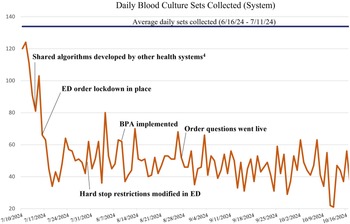
The first mitigation strategy implemented at the start of the shortage was a restriction to aerobic bottle usage only (July 10). An algorithm was created using existing guidance from other healthcare systems, which was distributed throughout the hospital with in-person, face-to-face and word-of-mouth education provided about the shortage (July 15). Our electronic health record locked down ED ordering (July 17) through a best practice advisory (BPA) when blood cultures were ordered in patients who were not hypotensive or febrile (defined as a temperature >100.4 °F). This lockdown required a clinical administrator (Chief or Chair) of the department to sign off on blood culture orders that did not meet criteria. Following this, although the number of orders placed dropped, many days to 0%–25% of historic daily orders, the rates of positive culture were low. The aim was to reduce the number of cultures that were low probability positive, to reduce cultures with no growth. Unsure if positive cultures were being missed, clinicians were encouraged to order blood cultures in high probably patients (July 26–29). The hard stop restriction mandating second signature for ED ordering was loosened to allow ordering for any of hypotension (systolic blood pressure <90 mmHg or mean arterial pressure <65 mmHg) or temperature <96.8 °F or >101 °F, or white blood cell count >12,000/mm3 or <4,000/mm3 (August 1). Next, blood culture orders for inpatients were still trending high, near baseline numbers, leading to the implementation of an inpatient BPA (August 8). Cascade questions were added to blood culture orders to help ordering users determine the probability of a positive result, and second signature BPAs in the ED were removed (September 3). The blood culture sets collected in relation to when these mitigation strategies were implemented can be seen in Figure 1. During the month of August, an increase in fallouts in Severe Sepsis and Septic Shock Management Bundle (SEP-1) measures was reported.5 SEP-1 is a Centers for Medicare and Medicaid measure that focuses on patients 18 years of age and older with a diagnosis of severe sepsis or septic shock, promoting timely recognition and early intervention with therapy per the Surviving Sepsis Campaign guidelines.Reference Evans, Rhodes and Alhazzani6 In response, starting in mid-October, committees met to revise order questions to allow ordering for risk of severe sepsis or shock, with change in place on November 12.
Timeline of mitigation strategies implemented at Guthrie Health System during the blood culture bottle shortage with daily number of blood culture sets collected systemwide.

Outcomes were analyzed for patients before and after mitigation strategies were implemented during the blood culture bottle shortage. Mitigation strategies were designed to prioritize blood culture utilization for patients at high risk and included:
Clinical decision support tools:
-
• Best practice advisories (BPAs): tool integrated within the electronic health record that provided real-time guidance during the ordering process
-
• Clinical algorithms: created using existing guidance from other health systems4
-
• Cascade questions: follow-up questions triggered based on initial responses during the order entry process
-
• Hard stops: prevented users from proceeding with the order unless predefined criteria were met or required information was entered
-
• Education and communication
Outcome measures
The primary outcome of this study was a composite of death during hospitalization, death within 14 days after discharge, return to the ED within 14 days after discharge, or readmission within 14 days after discharge. The secondary outcomes included length of stay, return to the ED within 30 days after discharge, readmission within 30 days after discharge, and antibiotic utilization measured by Standardized Antimicrobial Administration Ratios (SAARs) for all antimicrobials. To enable feasible, validated metrics, SAARs were measured using data uploaded to and reported from Centers for Disease Control and Prevention Antibiotic Use. Because SAARs were available as monthly data, the analysis compared monthly data from June 2024 through October 2024. Due to the increased rate of SEP-1 fallouts that led to loosening of mitigation criteria, a subgroup analysis focused on both primary and secondary outcomes for patients who qualified for severe sepsis or septic shock per SEP-1 criteria.
Statistical analysis
We calculated that a target sample size of 1,048 (n = 524 in each group), which was based on the anticipated baseline rate of the composite outcome of 16.8% in the premitigation period and 16.1% in the post-mitigation period and a noninferiority margin of 5 percentage points, would give the trial 80% power at a one-sided alpha level of 0.05. The analysis employed IPTW to improve comparability of patients between time periods, which may have the effect of increasing the variance of the test statistic. To mitigate this increased variation, the required sample size was increased by 10% over the unweighted result, yielding 577 in each group (n = 1,154 total). Propensity scores were converted to weights and estimated using a boosted model with exposure period as the outcome and patient characteristics included as features. The tests for the patient characteristics demonstrated that IPTW removes significant differences between the groups. The differences in outcome proportions and corresponding 90% confidence intervals calculated to incorporate the weights were analyzed graphically.
Descriptive statistics were provided for the whole sample and separately by exposure period. Means and standard deviations, medians and interquartile ranges, or frequencies and percentages were presented depending on the variable type and distribution. Unadjusted differences were assessed using t tests, Mann-Whitney tests, or χ2 tests, as appropriate. The descriptive statistics were reported first for patient characteristics (site of treatment, age, gender, race, smoking status, diabetes mellitus, and body mass index (BMI)).
The outcomes were evaluated against a noninferiority margin of 0.05 on a proportion scale. Differences in proportions were calculated as the event rate in the latter period minus the event rate in the earlier period, meaning positive values indicated an increase in occurrences. The 90% confidence intervals were calculated for the difference in proportions and graphed. Confidence intervals that were bounded below the noninferiority margin indicate that the null hypothesis of inferiority was rejected in favor of noninferiority.
Survey tool
To assess knowledge and attitudes regarding blood culture ordering practices during the shortage, an anonymous electronic survey was distributed to providers and nurses. The survey aimed to measure demographic data, as well as knowledge, attitudes, and perceptions regarding the implemented mitigation strategies. The knowledge survey questions included clinical cases developed by the study authors. A patient presenting with symptoms consistent with pyelonephritis would fall into the “intermediate” group per the algorithm (Table S2). A blood culture would not be indicated unless the primary site of infection could not be cultured. This principle can also be applied to a patient with a chief complaint of dysuria, where a urine culture would be recommended over a blood culture (Table S3). If they present with a gram-negative bacteremia, such as K. pneumoniae, repeat blood cultures would not be necessary (Table S4). Open-ended response questions were used to identify additional answers that were not included in the multiple-choice answers. The survey also included Likert-scale items on the perceived usefulness of each intervention strategy that was implemented.
Survey administration
Providers and nurses were asked to complete an anonymous survey via Microsoft Forms. The survey link was emailed to physicians and nurse managers to disperse to the nurses on each unit. Additionally, the survey was posted around the hospitals in breakrooms, bulletin boards, and medication rooms.
Results
Patients
A total of 11,406 patients met inclusion criteria across 6 hospital locations. Of these, 3,174 patients were in the premitigation group, and 8,232 were in the post-mitigation group (Figure 2). Table 1 displays descriptive statistics for patient characteristics. Most patients (45.3%) were seen at Hospital 1. The mean age was 63.5 (SD = 18.7) years, and there were slightly fewer males than females (46% vs 54%), with comparisons being non-significant. Most patients were white (95.2%). The only traits that differed significantly between the 2 groups were the site of treatment (p < 0.001) and BMI (p = 0.001). The significance for BMI is driven in part by an increase in reporting, with “unknown” decreasing from 11.5% to 9% pre- to post-implementation. Following IPTW, site and BMI did not differ between the cohorts.
Patient disposition.

Descriptive statistics for patient characteristics before and after applying IPTW

†n (%) unless noted otherwise.
IPT, inverse probability treatment; SD, standard deviation; BMI, body mass index.
Primary outcome
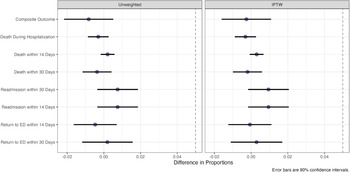
There were 2,099 patients (18.4%) who experienced one of the events included in the primary composite outcome. The rates between time periods were similar, with 19% experiencing an event premitigation versus 18.2% post-mitigation (Table 2). The individual components of the primary outcome also rejected the null hypothesis of inferiority in the mitigation period in favor of noninferiority (Figure 3).
Descriptive statistics for study outcomes before and after applying IPTW

†n (%) unless noted otherwise.
IPT, inverse probability treatment; ED, emergency department; IQR, interquartile range.
Difference in proportions and 90% confidence intervals. Vertical dashed line indicates the noninferiority margin. All outcomes are bounded well below the margin, rejecting inferior rates in the mitigation period.

Secondary outcomes
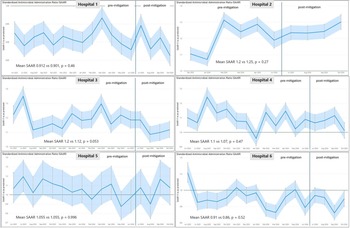
Rates of return to the ED or readmission within 30 days were similar between the pre- and post-mitigation groups (20.0% vs 20.2% and 11.5% vs 12.3%). Figure 3 shows that the confidence interval for both of these outcomes does not include the noninferiority margin. The median length of stay between the 2 groups remained the same at 3 days (p = 0.496). Antibiotic utilization was no different pre- and post-mitigation at all 6 system hospitals (p > 0.05 for all pre- post- comparisons) (Figure 4).
Antibiotic utilization at all 6 hospital locations pre- and post-mitigation using the Standardized Antimicrobial Administration Ratios (SAARs) data.

Subgroup analysis
Outcomes within the prespecified subgroup including patients who met criteria for severe sepsis or septic shock were consistent with those observed in the overall study population (Table 3). Implementation of mitigation strategies did not result in an increase in the composite primary outcome or secondary endpoints, indicating that the interventions were not associated with an increase in adverse outcomes in this higher-risk patient population.
Descriptive statistics for severe sepsis/septic shock subgroup analysis study outcomes

†n (%) unless noted otherwise.
ED, emergency department; IQR, interquartile range.
Survey
Forty-one survey responses were assessed. Demographic data of respondents who completed the survey are shown in Table S1. The knowledge questions focused on the appropriate application of the disseminated algorithm (Tables S1–S3). Most respondents (66%) answered an intermediate group pyelonephritis patient case question correctly. Similarly, 69% of respondents answered a case about a low-risk patient with dysuria correctly, with 24% answering “unsure.” More than two-thirds of respondents (73%) answered a question about repeat gram-negative bacteremia correctly.
Infectious disease specialists were identified as the most influential source of guidance when deciding whether to order or request blood cultures in patients (Table S5). In-person communication, clinical algorithms, and cascade questions were more helpful than emails, daily huddles, or hard stops requiring second signatures (Table S6). Of note, non-trainees ranked BPA influence higher than trainees (p = 0.005). The frequency at which the mitigation strategies were found to be most useful was at the beginning of the shortage and periodically thereafter (Table S7). Non-trainees supported “every time a blood culture is ordered” compared to trainees (p = 0.003). Regulatory pressure and a change in patient status (eg, 2+ SIRS criteria) were found to be major drivers of ordering blood cultures (Table S8 and S9). When blood cultures could not be collected, a majority of respondents indicated that their antibiotic prescribing patterns, such as duration and spectrum of activity, would remain unchanged (Table S10).
Discussion
In our tertiary, rural healthcare system, implementation of shortage mitigation via in-person communication, algorithms, and cascade questions led to a successful reduction in blood culture ordering without any effect on important patient outcomes. Although fallouts for SEP-1 measure increased due to missing blood cultures, outcomes in these patients were not statistically different after implementation of restricted ordering. There was, however, an almost two-fold increase in absolute rate of returns to the ED at 14 and 30 days. Future studies should be designed and adequately powered to study causes for readmission and to determine if the regulations that mandate blood cultures in patients who may be septic should be modified to allow optimized use of diagnostic tools without a negative change in patient outcomes.
Postmitigation strategies, the primary composite outcome, which included death during hospitalization, death within 14 days after discharge, return to the ED within 14 days after discharge or readmission within 14 days after discharge, was statistically non-inferior to the primary outcome rate before mitigation. The finding of noninferiority suggests that mitigation strategies were successful in guiding the appropriate ordering of blood cultures without adversely affecting patient outcomes. The absence of negative findings suggests that even when blood culture ordering is restricted, clinical outcomes may not be compromised.
Mitigation tactics to preserve blood culture bottles did not lead to significant differences in clinical outcomes, including antibiotic utilization. The monthly analysis of SAARs extended a year before mitigation but only 4 months post initiation of mitigation efforts. Although not powered nor designed to assess, no balancing rise in antibiotic ordering was detected during the studied period of mitigation, despite reduced blood culture ordering. Additionally, for the primary outcome, the premitigation period was shorter than the post-mitigation period, which may limit comparability between the groups. We did not risk-stratify patients by illness severity in this study and cannot comment if the illness phenotype of patients may have differed over time. For example, Hospital 1 is the tertiary care center for a region of approximately 10,000 square miles.
The survey results of clinicians’ perspectives of the various mitigation strategies implemented during the shortage suggest that although most clinicians responded correctly to knowledge questions and patient status appropriately drove their ordering, regulatory pressure is a strong driver of blood culture ordering. Further, respondents favored support via in-person communication, algorithms, and order question cascades over emails, daily huddles, and best practice alert hard stops/second signatures.
Several limitations exist within this study. First, the retrospective design limits control over variables and increases the potential for confounding. Although IPTW was used to adjust for confounders, there could be unmeasured confounding variables within the study, such as severity of illness. There is also the potential for variable implementation of the mitigation strategies across the 6 hospital sites. Although an extended amount of data was available preimplementation, a limited number of months were available post-implementation, and the statistical comparison included months outside of the studied pre- and post-mitigation periods. Another limitation is the limited number of patient characteristics used in IPTW. To maintain the feasibility of research, more detailed patient-level data was not utilized in treatment weighting (eg, use of illness severity scores). For the survey results, respondents are mostly ED physicians from one hospital location (Hospital 1), which limits the external validity of the results. Lastly, although the study was conducted at 6 hospital locations within one health system, the generalizability of the findings to other larger, non-rural healthcare systems may be limited.
Supplementary material
The supplementary material for this article can be found at https://doi.org/10.1017/ash.2025.10173.
Data availability statement
The datasets generated during the current study are not publicly available as they contain health-related data. Limited dataset (without any identifiable, person-related data) requests may be directed to the Donald Guthrie Foundation. Address: One Guthrie Square, Sayre, PA 18840. Phone: 570-887-4882. Email: Vicky.Hickey@guthrie.org.
Acknowledgments
The authors thank Jeffrey Dorman for his assistance on extracting all necessary data points for analysis from the electronic health records; Mikki Smith, MLS, PhD, for assistance with procuring relevant research articles for the literature search; Vicky Hickey, BS, CCRP, for guidance with the development of the research protocol for submission to the IRB and coordination through the Donald Guthrie Foundation; Jeremy Albright for guidance on study design and statistical analysis for this project; and Philip Heavner, MD, for his guidance around the survey build.
Author contributions
Kristen Sevilla: Formal analysis, Project administration, Validation, Visualization, Writing—original draft. Karen S. Williams: Conceptualization, Data curation, Investigation, Methodology, Project administration, Supervision, Validation, Visualization, Writing—reviewing and editing. Jon C. Rittenberger: Conceptualization, Formal analysis, Investigation, Methodology, Supervision, Validation, Writing—reviewing and editing. Orest Konyk: Investigation, Writing—reviewing and editing.
Financial support
Financial support for statistical analysis and publication processing fees was provided by the Donald Guthrie Foundation.
Competing interests
The authors have no conflicts of interest to disclose.
Ethical standard
This study received ethical approval from the IRB of the Guthrie Clinic (approval #2501-01) on January 7, 2025. The IRB granted a waiver of consent for the retrospective review. Patient data will not be shared with third parties.
Consent to participate
The IRB granted a waiver of consent for the retrospective review (approval #2501-01) on January 7, 2025. Patient data will not be shared with third parties.




 Open access

