

1. Introduction
The Mayombe chain, located in the southwest of the Republic of Congo forms the central part of the West Congo Belt (Dévigne, Reference Dévigne1959; Dadet, Reference Dadet1969; Schermerhorn, Reference Schermerhorn1981; Boudzoumou & Trompette, Reference Boudzoumou and Trompette1988; Maurin et al. Reference Maurin, Boudzoumou, Djama, Gioan, Michard, Mpemba Boni, Peucat, Pin and Vicat1991; Vicat & Pouclet, Reference Vicat and Pouclet2000; Fullgraf et al. Reference Fullgraf, Callec, Thiéblemont, Gloaguen, Charles, Le Metour, Prian, Boudzoumou, Delhaye-Prat, Moreau, Kebi-Tsoumou and Ndiele2015b). It is traditionally recognized as one of the orogenic belts of the Pan-African system (Kröner & Stern, Reference Kröner, Stern, Selley, Cocks and Plimer2005) resulting from the collision of São Francisco and Congo cratons (Fig. 1a-b) during the assembly of the western Gondwana in the late Neoproterozoic-early Cambrian times (Rapela et al. Reference Rapela, Pankhurst, Casquet, Fanning, Baldo, González-Casado, Galindo and Dahlquist2007; Gray et al. Reference Gray, Foster, Meert, Goscombe, Armstrong, Trouw and Passchier2008; Heilbron et al. Reference Heilbron, Valeriano, Tassinari, Almeida, Tupinambá, Siga and Trouw2008; Gaucher et al. Reference Gaucher, Frimmel, Germs, Gaucher, Sial, Frimmel and Halverson2009; Chemale et al. Reference Chemale, Mallmann, Bitencourt and Kawashita2012; Schmitt et al. Reference Schmitt, Fragoso, Collins, Siegesmund, Basei, Oyhantçabal and Oriolo2018). This part of the West Congo Belt encloses precious geological information, which constitutes the witnesses of Proterozoic evolution of the Earth. Rocks in this area recorded at a time geodynamic and paleoclimatic processes. It is argued that the West Congo Belt (Fig. 1c), including its Brazilian counterpart, the Araçuaí Belt, has played a crucial role in the development of the São Francisco-Congo paleocontinent from Proterozoic to early Paleozoic (Kuchenbecker & Barbuena, Reference Kuchenbecker and Barbuena2023). Understanding its geological record is a crucial task to those seeking to reconstruct the tectonic history of West Gondwana.
The Araçuaí-West Congo orogenic system. (a) and (b) Location of the Araçuaí-West Congo orogen in relation to the Sao Francisco and Congo cratons (Pedrosa-Soares et al. Reference Pedrosa-Soares, Alkmim, Tack, Noce, Babinski, Silva and Martins-Neto2008). (c) Geological map of the West Congo belt (modified after Maurin, Reference Maurin1993 and Thiéblemont et al. Reference Thiéblemont2016) and his location in Africa. (d) Geologic map of the southwestern part of Republic of Congo showing the main structural units of the Mayombe chain (Callec et al. Reference Callec, Lasseur, Gouin, Paquet, Le Bayon, Thiéblemont, Fullgraf, Le Metour, Delhaye-Prat, Giresse, Malounguila and Boudzoumou2015a).

Geologically, the Mayombe chain is divisible into three distinct tectono-stratigraphic domains according to the recent mapping (Callec et al. Reference Callec, Lasseur, Gouin, Paquet, Le Bayon, Thiéblemont, Fullgraf, Le Metour, Delhaye-Prat, Giresse, Malounguila and Boudzoumou2015a; Callec et al. Reference Callec, Lasseur, Le Bayon, Thiéblemont, Fullgraf, Gouin, Paquet, Le Metour, Delhaye-Prat, Giresse, Malounguila and Boudzoumou2015b; Fullgraf et al. Reference Fullgraf, Callec, Gloaguen, Thiéblemont, Le Metour, Boudzoumou, Delhaye-Prat, Kebi-Tsoumou and Ndiele2015a; Fullgraf et al. Reference Fullgraf, Callec, Thiéblemont, Gloaguen, Charles, Le Metour, Prian, Boudzoumou, Delhaye-Prat, Moreau, Kebi-Tsoumou and Ndiele2015b; Le Bayon et al. Reference Le Bayon, Callec, Lasseur, Thiéblemont, Paquet, Gouin, Giresse, Makolobongo, Obambi, Moulounda Niangui and Miassouka Mpika2015a; Le Bayon et al. Reference Le Bayon, Callec, Fullgraf, Lasseur, Thiéblemont, Charles, Gloaguen, Paquet, Gouin, Giresse, Makolobongo, Obambi, Moulounda Niangui and Miassouka Mpika2015b), known as, from west to east, the Western, Central and Eastern domains (Fig. 1d), which have different rock associations and very different intensity of deformation and metamorphic grade. The Central and Eastern domains are made up of the relatively well-known Neoproterozoic low-grade metamorphic rocks of the West Congolian Supergroup, deformed during the Pan-African orogeny (Hossie, Reference Hossié1980; Boudzoumou, Reference Boudzoumou1986; Maurin et al. Reference Maurin, Boudzoumou, Djama, Gioan, Michard, Mpemba Boni, Peucat, Pin and Vicat1991; Fullgraf et al. Reference Fullgraf, Callec, Gloaguen, Thiéblemont, Le Metour, Boudzoumou, Delhaye-Prat, Kebi-Tsoumou and Ndiele2015a; Fullgraf et al. Reference Fullgraf, Callec, Thiéblemont, Gloaguen, Charles, Le Metour, Prian, Boudzoumou, Delhaye-Prat, Moreau, Kebi-Tsoumou and Ndiele2015b). In contrast, the Western Domain mainly consists of Paleoproterozoic tectono-stratigraphic terranes assigned to the Loémé Supergroup, commonly thought to represent an Eburnean-aged basement inlier in the Mayombe chain, that are conventionally correlated with the Paleoproterozoic Kimezian basement rocks in Democratic republic of Congo (Hossié, Reference Hossié1980; Djama, Reference Djama1988; Tack et al. Reference Tack, Wingate, Liégeois, Fernandez-Alonso and Deblond2001) and with the Transamazonian-aged basement inliers of the Araçuaí Belt in eastern Brazil (Ledru et al. Reference Ledru, Johan, Milési and Tegyey1994; Toteu et al. Reference Toteu, Van Schmus, Penaye and Nyobé1994; Trompette, Reference Trompette1997; Feybesse et al. Reference Feybesse, Johan, Triboulet, Guerrot, Mayaga-Mikolo, Bouchot and Eko N’dong1998; Barbosa & Sabaté, Reference Barbosa and Sabaté2004; Lerouge et al. Reference Lerouge, Cocherie, Toteu, Penaye, Milési, Tchameni, Nsifa, Mark Fanning and Deloule2006). It is widely acknowledged that these Paleoproterozoic basement inliers are the product of a complex geological evolution. In fact, different geological studies done on the Mayombe chain indicated that the Paleoproterozoic metamorphic basement rocks of the Loémé Supergroup are affected by a poly-phase deformation and metamorphosed to a high grade (Hossié, Reference Hossié1980; Djama, Reference Djama1988; Fullgraf et al. Reference Fullgraf, Callec, Thiéblemont, Gloaguen, Charles, Le Metour, Prian, Boudzoumou, Delhaye-Prat, Moreau, Kebi-Tsoumou and Ndiele2015b). Consequently, they can provide precious information on the P–T conditions that characterized the petrological assemblages related to the Eburnean and Pan-African orogenies. Moreover, there is evidence to show that the Paleoproterozoic metamorphic basement rocks of the Loémé Supergroup were experienced at least two significant metamorphic events through the Proterozoic Era, linked to the Eburnean and/or Pan-African orogenies, which are relatively little documented and poorly constrained by metamorphic petrology or geochronology. Yet, there are still unanswered questions regarding (i) the preservation and P–T conditions of the Eburnean record and (ii) evaluation of the Pan-African overprint.
The goal of the present study is to address these questions by focusing on the metamorphic petrology of garnet, which is a common mineral in the metamorphic rocks that composed the Loemé Supergroup. The composition and texture of this mineral will give clues to the metamorphic P–T conditions and the deformation to which the rocks were exposed (Tracy et al. Reference Tracy, Robinson and Thompson1976; Du Bray, Reference Du Bray1988; Skrzypek et al. Reference Skrzypek, Schulmann, Štípská, Chopin, Lehmann, Lexa and Haloda2011; Enami et al. Reference Enami, Nagaya and Win2017). Chemical zoning can be used to reconstruct the P–T path of the rocks during prograde metamorphism (Atherton & Edmunds, Reference Atherton and Edmunds1966; Hollister, Reference Hollister1966; Brown, Reference Brown1969; Anderson & Buckley, Reference Anderson and Buckley1973; Kerr, Reference Kerr1981; Cygan & Lasaga, Reference Cygan and Lasaga1982; Dempster, Reference Dempster1985; Tropper & Recheis, Reference Tropper and Recheis2003) and compositional zoning in garnet is a common feature in numerous metamorphic environments (Cygan & Lasaga, Reference Cygan and Lasaga1982; Tracy, Reference Tracy and Ferry1982; Kohn, Reference Kohn2005; Baxter et al. Reference Baxter, Caddick and Dragovic2017). Our results and interpretations are utilized to better reconstruct the poorly known tectono-metamorphic context of the Western Domain of the Mayombe chain.
2. Geological setting
2.a. Structural context
The tectono-metamorphic architecture of the West Congo Belt in the Mayombe chain has been established by geological mapping and structural analysis supported by remote sensing of Landsat 7T imagery, petrography and geochronology (Hossie, Reference Hossié1980; Maurin et al. Reference Maurin, Boudzoumou, Djama, Gioan, Michard, Mpemba Boni, Peucat, Pin and Vicat1991; Fullgraf et al. Reference Fullgraf, Callec, Gloaguen, Thiéblemont, Le Metour, Boudzoumou, Delhaye-Prat, Kebi-Tsoumou and Ndiele2015a, Fullgraf et al. Reference Fullgraf, Callec, Thiéblemont, Gloaguen, Charles, Le Metour, Prian, Boudzoumou, Delhaye-Prat, Moreau, Kebi-Tsoumou and Ndiele2015b). It allows subdivision into three western, central and eastern domains bound by crustal-scale thrusts and characterized by distinct structural elements (Fig 1d).
The Western Domain corresponds to the internal domain of Hossié (Reference Hossié1980). It is covered to the south by Mesozoic to Quaternary beds of the Congolese passive margin and limited to the north by Mandzi–Loukénéné shear zone. This domain mainly comprises the Paleoproterozoic rocks of the Loemé Supergroup, which were strongly deformed and locally intruded by early Neoproterozoic plutons (Djama, Reference Djama1988; Maurin et al. Reference Maurin, Mpemba Boni, Pin and Vicat1990; Mpemba Boni, Reference Mpemba Boni1990; Djama et al. Reference Djama, Leterrier and Michard1992; Fullgraf et al. Reference Fullgraf, Callec, Gloaguen, Thiéblemont, Le Metour, Boudzoumou, Delhaye-Prat, Kebi-Tsoumou and Ndiele2015a; Fullgraf et al. Reference Fullgraf, Callec, Thiéblemont, Gloaguen, Charles, Le Metour, Prian, Boudzoumou, Delhaye-Prat, Moreau, Kebi-Tsoumou and Ndiele2015b; Affaton et al. Reference Affaton, Kalsbeek, Boudzoumou, Trompette, Thrane and Frei2016). The interpretation of the structures of this Western Domain is complex due to the polyphase deformation and the variability of lithologies. Accordingly, the structural patterns and spatial distribution, internal stratigraphy and geochronology of rock units across the Western Domain are still largely unknown (Djama et al. Reference Djama, Leterrier and Michard1992; Fullgraf et al. Reference Fullgraf, Callec, Thiéblemont, Gloaguen, Charles, Le Metour, Prian, Boudzoumou, Delhaye-Prat, Moreau, Kebi-Tsoumou and Ndiele2015b). Some authors have recognized two main phases of folding marked by NNW–SSE and NW–SE trending attributed to the Pan-African orogeny (Hossié, Reference Hossié1980; Boudzoumou, Reference Boudzoumou1986; Djama, Reference Djama1988; Maurin et al. Reference Maurin, Boudzoumou, Djama, Gioan, Michard, Mpemba Boni, Peucat, Pin and Vicat1991). Vellutini et al. (Reference Vellutini, Rocci and Vicat1983) suggesting a Kibarian and Pan-African evolution of these structures. Maurin et al. (Reference Maurin, Mpemba Boni, Pin and Vicat1990; Reference Maurin, Boudzoumou, Djama, Gioan, Michard, Mpemba Boni, Peucat, Pin and Vicat1991) have recognized traces of the Eburnean orogeny overprinted by the Pan-African orogeny.
Recently, based on an integration of outcrop observation, structural and geochronological data, Fullgraf et al. (Reference Fullgraf, Callec, Thiéblemont, Gloaguen, Charles, Le Metour, Prian, Boudzoumou, Delhaye-Prat, Moreau, Kebi-Tsoumou and Ndiele2015b) have recognized at least three major structural events affecting the Paleoproterozoic basement terranes in the Western Domain, which were attributed to the enigmatic pre-Eburnean deformation, the Eburnean orogeny marked by NNW–SSE shortening and to the Pan-African orogeny marked by weakly penetrative ductile deformations.
The Central Domain (the ‘intermediate domain’ of Hossié, Reference Hossié1980) is located to the north-east of the Western Domain and extends from the Mandzi–Loukénéné shear zone to the Moukondo back-thrust. From south to north, this heterogenous domain mainly comprises early Neoproterozoic metavolcanic and metasedimentary assemblages of the West Congolian Supergroup (Fullgraf et al. Reference Fullgraf, Callec, Thiéblemont, Gloaguen, Charles, Le Metour, Prian, Boudzoumou, Delhaye-Prat, Moreau, Kebi-Tsoumou and Ndiele2015b). Structurally, the unit is characterized by open to closed, upright to NE-verging folds attributed to the Pan-African orogeny (Hossié, Reference Hossié1980; Maurin, Reference Maurin1993; Fullgraf et al. Reference Fullgraf, Callec, Thiéblemont, Gloaguen, Charles, Le Metour, Prian, Boudzoumou, Delhaye-Prat, Moreau, Kebi-Tsoumou and Ndiele2015b).
The Eastern Domain (the ‘external domain’ of Hossié, Reference Hossié1980) is limited by the eastern Moukondo thrust/backthrust system and the western Mt Belo shear zone, which is considered as the terminal thrust system of the West Congo Belt (Fullgraf et al. Reference Fullgraf, Callec, Thiéblemont, Gloaguen, Charles, Le Metour, Prian, Boudzoumou, Delhaye-Prat, Moreau, Kebi-Tsoumou and Ndiele2015b). It is made entirely of Neoproterozoic metasediments, including two key marker horizons; namely, the Lower and Upper Tillite (Fullgraf et al. Reference Fullgraf, Callec, Thiéblemont, Gloaguen, Charles, Le Metour, Prian, Boudzoumou, Delhaye-Prat, Moreau, Kebi-Tsoumou and Ndiele2015b; Affaton et al. Reference Affaton, Kalsbeek, Boudzoumou, Trompette, Thrane and Frei2016). The structural style is characterized by open, upright folds whose NW–SE trending axes can be followed along the strike for more than 100 km and together with several discrete NE-verging thrusts define the frontal fold-and-thrust belt of the West Congo Belt (Hossié, Reference Hossié1980; Boudzoumou & Trompette, Reference Boudzoumou and Trompette1988). In the more internal parts of the Eastern Domain, a penetrative schistosity (axial-planar to the large-scale folds) is observed in less competent layers. More competent layers, such as the quartzites, are characterized by flexural slip folding and are devoid of penetrative schistosity. The metamorphic grade is always very low (lower than the chlorite zone), grading to anchizonal in the adjacent Niari–Nyanga basin (Fullgraf et al. Reference Fullgraf, Callec, Thiéblemont, Gloaguen, Charles, Le Metour, Prian, Boudzoumou, Delhaye-Prat, Moreau, Kebi-Tsoumou and Ndiele2015b; Mfere et al. Reference Mfere, Delpomdor, Proust, Boudzoumou, Callec and Préat2020).
2.b. Paleoproterozoic lithostratigraphic setting
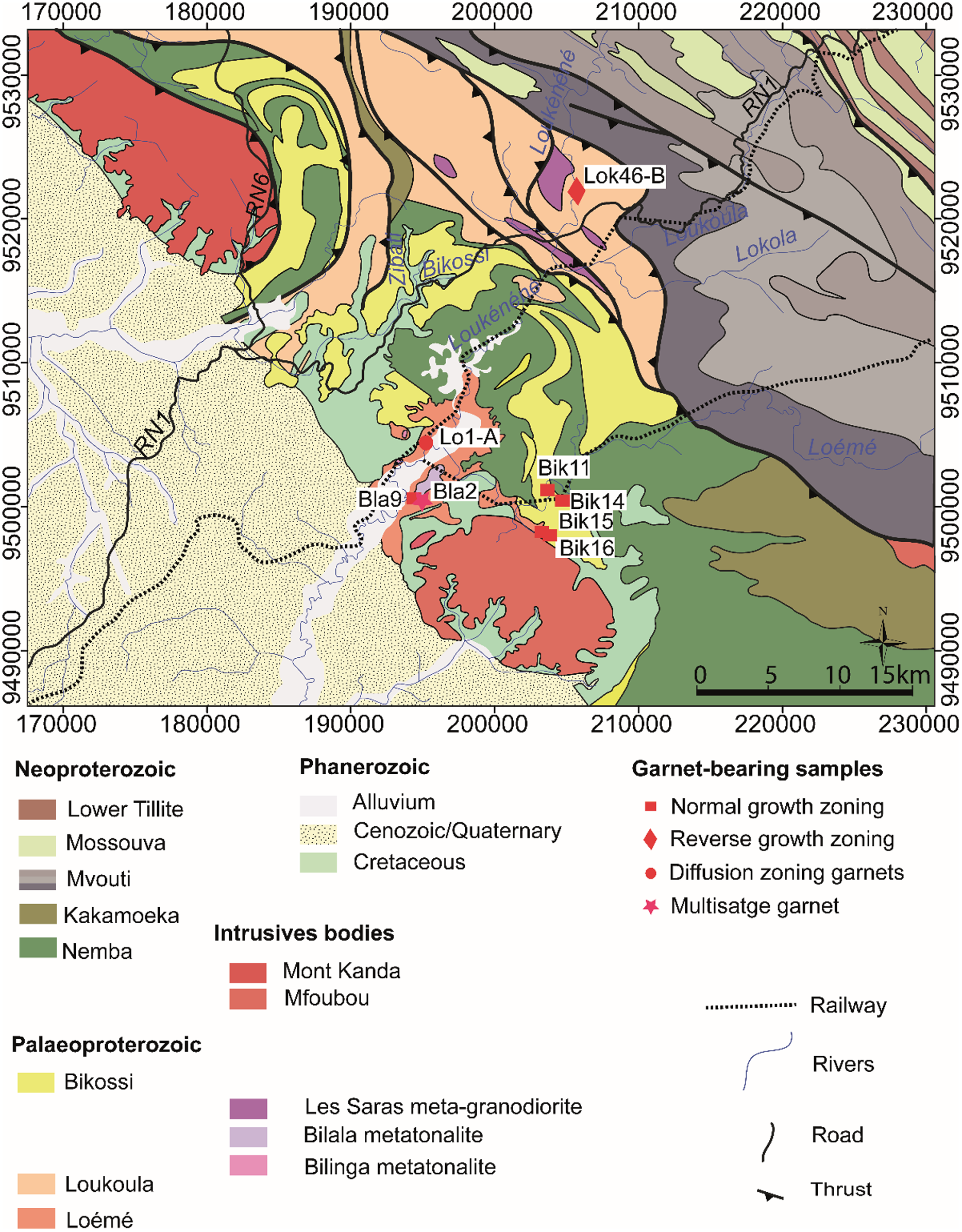
The study area is in the Western Domain of the Mayombe mountain which contains Paleoproterozoic polycyclic high-grade metamorphic rocks of the Loémé Supergroup overlain by a series of weakly metamorphosed igneous and volcano-sedimentary rocks linked to the West Congolian Supergroup (Fig. 2).
Geological map of the studied area in the Mayombe chain (Republic of Congo), modified after Fullgraf et al. (Reference Fullgraf, Callec, Gloaguen, Thiéblemont, Le Metour, Boudzoumou, Delhaye-Prat, Kebi-Tsoumou and Ndiele2015a), showing sample location.
2.b.1. The Loémé Supergroup
At regional scale, the Loémé Supergroup has been correlated with the Kimezian Supergroup in the Democratic Republic of Congo (Tack et al. Reference Tack, Wingate, Liégeois, Fernandez-Alonso and Deblond2001), the Ogooué Complex in Gabon (Thiéblemont et al. Reference Thiéblemont, Astaing, Billa, Bouton and Préat2009; Weber et al. Reference Weber, Gauthier-Lafaye, Whitechurch, Ulrich and El Albani2016) and, across the south Atlantic, with the Mantiqueira and Juiz de Fora Complexes in the Brazilian Ribeira and Araçuaí Orogens (Noce et al. Reference Noce, Pedrosa-Soares, Da Silva, Armstrong and Piuzana2007). This Supergroup consists of supracrustal rocks assigned to the Loukoula and Bikossi Groups. To better constrain metamorphic evolution in Loémé Supergroup, this study splits into two Groups the Loukoula Group of Fullgraf et al. (Reference Fullgraf, Callec, Thiéblemont, Gloaguen, Charles, Le Metour, Prian, Boudzoumou, Delhaye-Prat, Moreau, Kebi-Tsoumou and Ndiele2015b). We distinguish Loémé Group in south area from Loukoula Group in north.
-
(i) Loémé and Loukoula Groups
Loémé and Loukoula Groups are made of paragneiss, schists, amphibolite and quartzite that were intruded by the calc-alkaline granitoids of the Bilala, Bilinga and Les Saras plutons dated between 2060 and 2040 Ma (Djama, Reference Djama1988; Djama et al. Reference Djama, Leterrier and Michard1992; Fullgraf et al. Reference Fullgraf, Callec, Thiéblemont, Gloaguen, Charles, Le Metour, Prian, Boudzoumou, Delhaye-Prat, Moreau, Kebi-Tsoumou and Ndiele2015b; Affaton et al. Reference Affaton, Kalsbeek, Boudzoumou, Trompette, Thrane and Frei2016; Bouenitela, Reference Bouenitela2019) and by early Neoproterozoic alkaline to peralkaline granitic bodies, locally known as the Mfoubou and Mont Kanda granite, dated between 1050 and 925 Ma (Djama, Reference Djama1988; Djama et al. Reference Djama, Leterrier and Michard1992; Fullgraf et al. Reference Fullgraf, Callec, Thiéblemont, Gloaguen, Charles, Le Metour, Prian, Boudzoumou, Delhaye-Prat, Moreau, Kebi-Tsoumou and Ndiele2015b; Bouenitela, Reference Bouenitela2019).
-
(ii) Bikossi Group
The Bikossi Group is a metasedimentary sequence, characterized by thick quarzitic layers sometimes associated with meta-conglomerates, and fine-grained graphite-bearing schists deriving from anoxic pelitic sediments. Detrital zircon geochronology in the quartzite yields age of sources between 3.08 and 2.04 Ga (Fullgraf et al. Reference Fullgraf, Callec, Thiéblemont, Gloaguen, Charles, Le Metour, Prian, Boudzoumou, Delhaye-Prat, Moreau, Kebi-Tsoumou and Ndiele2015b) and 2.20 and 2.00 Ga (Affaton et al. Reference Affaton, Kalsbeek, Boudzoumou, Trompette, Thrane and Frei2016), indicating maximum age deposition at about 2.00 Ga. The Bikossi Group has been correlated with the Paleoproterozoic Francevillian Group in Gabon (Le Bayon et al. Reference Le Bayon, Callec, Fullgraf, Lasseur, Thiéblemont, Charles, Gloaguen, Paquet, Gouin, Giresse, Makolobongo, Obambi, Moulounda Niangui and Miassouka Mpika2015b).
2.b.2. West Congolian Supergroup
In the Western Domain of the Mayombe chain, the West Congolian Supergroup is represented by the early Neoproterozoic volcanic rocks of Nemba Complex which is essentially made of fine-grained amphibolites deriving from basalts, dolerites and a few gabbro. Geochemical analyses indicate that the amphibolites have a tholeiitic composition (Vellutini, Rocci & Vicat, Reference Vellutini, Rocci and Vicat1983; Vicat & Vellutini, Reference Vicat and Vellutini1987; Vicat & Vellutini, Reference Vicat and Vellutini1988; Djama et al. Reference Djama, Matiaba Bazika, Boudzoumou and Mouzeo2018; Bazika et al. Reference Bazika, Bouénitéla, Lekeba and Boudzoumou2022; Matiaba-Bazika et al. Reference Matiaba-Bazika, Makamba, Bouénitéla, Tchiguina, Miyouna and Boudzoumou2024). A metagabbro attributed to the Nemba Complex has provided a Neoproterozoic age (U–Pb data on zircon at 915 ± 8 Ma: Fullgraf et al. Reference Fullgraf, Callec, Thiéblemont, Gloaguen, Charles, Le Metour, Prian, Boudzoumou, Delhaye-Prat, Moreau, Kebi-Tsoumou and Ndiele2015b). The interpretation of the origin of Nemba rocks is a matter of debate. According to a first hypothesis, the Nemba Complex is an ophiolitic complex (Vellutini, Rocci & Vicat, Reference Vellutini, Rocci and Vicat1983; Vicat & Vellutini, Reference Vicat and Vellutini1987; Vicat & Vellutini, Reference Vicat and Vellutini1988), implying that the Mayombe chain results from the collision of two continental domains after oceanic subduction. However, in other hand, the metavolcanic rocks from the Nemba Complex are considered as the equivalent, in composition and age, of the Gangila meta-basalts from the Zadinian Group in the DRC, and were linked to the early Neoproterozoic rifting phase (Tack et al. Reference Tack, Wingate, Liégeois, Fernandez-Alonso and Deblond2001; Fullgraf et al. Reference Fullgraf, Callec, Thiéblemont, Gloaguen, Charles, Le Metour, Prian, Boudzoumou, Delhaye-Prat, Moreau, Kebi-Tsoumou and Ndiele2015b; Bazika et al. Reference Bazika, Bouénitéla, Lekeba and Boudzoumou2022; Matiaba-Bazika et al. Reference Matiaba-Bazika, Makamba, Bouénitéla, Tchiguina, Miyouna and Boudzoumou2024).
2.c. Tectono-metamorphic history
The metamorphic history of the Mayombe chain has not been properly characterized, particularly within the polycyclic Paleoproterozoic basement rocks of the Loémé Supergroup.
The Neoproterozoic rocks of the West Congolian Supergroup in the Mayombe chain and their equivalents in other parts of the West Congo Belt and in Brazil were subjected to at least one tectono-metamorphic event marked by prograde and retrograde P–T paths linked to the Pan-African/Brasiliano orogenic events between 580 and 500 Ma (Hossié, Reference Hossié1980; Cahen, Reference Cahen1982; Boudzoumou & Trompette, Reference Boudzoumou and Trompette1988; Porada, Reference Porada1989; Maurin, Reference Maurin1993; Alkmim et al. Reference Alkmim, Marshak, Pedrosa-Soares, Peres, Cruz and Whittington2006; De Waele et al. Reference De Waele, Johnson and Pisarevsky2008; Pedrosa-Soares et al. Reference Pedrosa-Soares, Alkmim, Tack, Noce, Babinski, Silva and Martins-Neto2008; Thiéblemont et al. Reference Thiéblemont, Astaing, Billa, Bouton and Préat2009; Monie et al. Reference Monié, Bosch, Bruguier, Vauchez, Rolland, Nsungani and Buta Neto2012; Fullgraf et al. Reference Fullgraf, Callec, Thiéblemont, Gloaguen, Charles, Le Metour, Prian, Boudzoumou, Delhaye-Prat, Moreau, Kebi-Tsoumou and Ndiele2015b; Fossen et al. Reference Fossen, Cavalcante, Konopásek, Meira, De Almeida, Hollanda and Trompette2020; Schannor et al. Reference Schannor, Lana, Nicoli, Cutts, Buick, Gerdes and Hecht2021).
Metamorphic and geochronological studies of the Mayombe chain (Hossié, Reference Hossié1980; Boudzoumou & Trompette, Reference Boudzoumou and Trompette1988; Djama, Reference Djama1988; Djama et al. Reference Djama, Leterrier and Michard1992; Maurin, Reference Maurin1993; Fullgraf et al. Reference Fullgraf, Callec, Thiéblemont, Gloaguen, Charles, Le Metour, Prian, Boudzoumou, Delhaye-Prat, Moreau, Kebi-Tsoumou and Ndiele2015b) show that Pan-African metamorphism decreased from amphibolite facies in the Western Domain to greenschist facies in the Eastern Domain.
Disagreement exists in the interpretation of the metamorphism of the polycyclic Paleoproterozoic basement rocks assigned to the Loémé Supergroup. Some authors hypothesized that the multiphase deformation and high-grade metamorphism in the remaining Paleoproterozoic basement rocks across the West Congo Belt may be attributed to Pan-African orogenic episodes, except in the former Loémé Supergroup for which they postulated a metamorphism of Eburnean age (Hossié, Reference Hossié1980; Boudzoumou & Trompette, Reference Boudzoumou and Trompette1988; Maurin, Reference Maurin1993). In contrast to this traditional interpretation, the recent work (Fullgraf et al. Reference Fullgraf, Callec, Thiéblemont, Gloaguen, Charles, Le Metour, Prian, Boudzoumou, Delhaye-Prat, Moreau, Kebi-Tsoumou and Ndiele2015b) has revealed that the Paleoproterozoic basement of the Mayombe chain has been subjected to high-grade pre-Eburnean metamorphism (M1) and Eburnean metamorphism (M2, ca. 2056–2050 Ma) as shown in Oogoué complex in Gabon (Thiéblemont et al. Reference Thiéblemont, Astaing, Billa, Bouton and Préat2009). However, the reworking of Paleoproterozoic basement by Pan-African orogeny remains less clear.
3. Materials and methods
3.a. Sampling
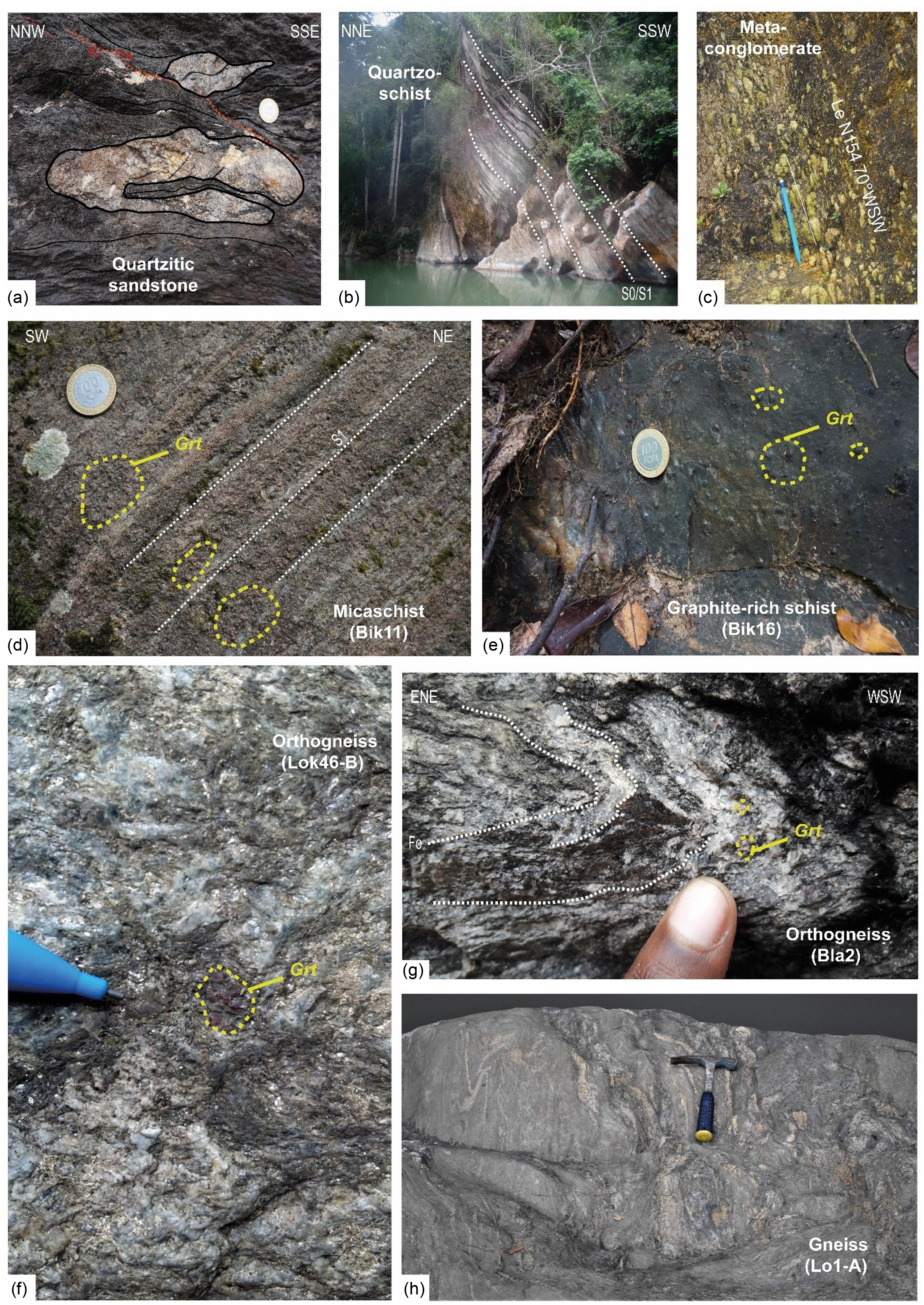
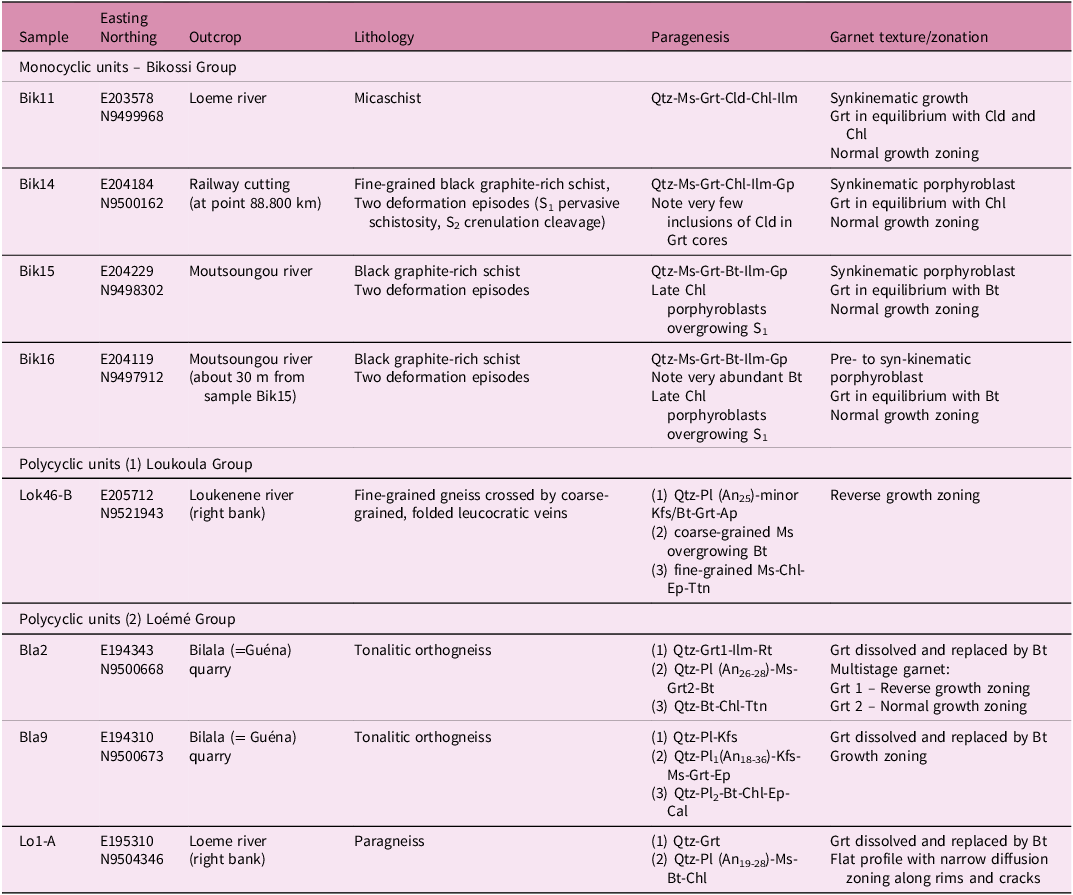
Rock description, structural measurements and sampling were done in the western Mayombe (Fig. 2) area during two field campaigns. Samples were collected in active or disused quarries, along the railway talus from the CFCO (Chemin de Fer Congo-Océan), and along river beds. The previous studies reported only few garnet and chloritoid-bearing rocks, in most cases without precise location (e.g. Dadet, Reference Dadet1969). Staurolite has never been reported, and alumino-silicates are lacking. Therefore, particular attention has been paid to collect garnet-bearing samples for the purpose of the study. This included four gneiss samples from the Loémé (Bla2, Bla9 and Lo1-A) and Loukoula (Lok46-B) Groups, and four micaschists from the Bikossi Group (Bik11, Bik14, Bik15 and Bik16) (Fig. 3, Table 1 ).
Field photographs of rocks from the western domain of the Mayombe chain. From Bikossi Group (a) quartzitic sandstone with isoclinal folded quartz-calcite vein, (b) quartzo-schist with a straighten schistosity, (c) metaconglomerate with stretched pebbles, (d) garnet bearing micaschist with straighten schistosity, (e) graphite-rich schist with garnets porphyroblasts. From Loukoula Group (f) Pegmatitic gneiss. From Loémé Group (g) folded orthogneiss, (h) fine-grained gneiss.
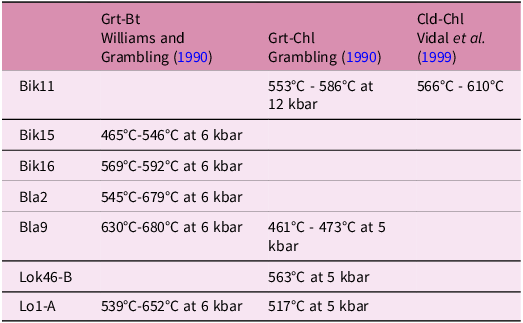
Location, petrography, mineralogy, paragenesis and texture of the eight studied samples
3.b. Mineral chemistry
Mineral chemical composition was determined on polished thin sections through Electron Probe Micro Analyzer (EPMA) Cameca SX 100 (Microsonde Ouest, Plouzané) using a wavelength dispersive mode. Operating conditions for spot analyses were set to 15 keV for accelerating voltage, 20 nA for beam current and 10 s counting time (spot size = 1 µm). The standards used are natural albite (Si and Na), orthoclase (K), corundum (Al), wollastonite (Ca), forsterite (Mg), MnTiO3 (Ti and Mn) and andradite (Fe). Mineral mapping and element profiles of selected garnets were performed for Fe, Mn, Mg and Ca. BSE and X-ray element maps were produced by applying SX100 software.
3.c. Whole-rock chemistry
Samples were crushed and powdered using agate mortar. Analysis of whole-rock chemistry was done at the Geochemical and Petrographical Research Center of Nancy (CRPG, CNRS-SARM Laboratory). Major and trace elements analyses were measured using Inductively Coupled Plasma Atomic Emission Spectrometry (ICP-AES) and Inductively Coupled Plasma Mass Spectrometer (ICP-MS). Detailed analytical procedures are described in Carignan et al. (Reference Carignan, Hild, Mevelle, Morel and Yeghicheyan2001).
3.d. P–T estimations
In a first step, P–T conditions were estimated using conventional methods for geothermobarometry. The garnet–biotite Fe–Mg exchange is used as a geothermometer for the metapelitic rocks after the calibration of Williams & Grambling (Reference Williams and Grambling1990). We used their preferred model 3 (Table 2), which involves non-ideal Fe–Mg mixing in garnet, and for which uncertainties range from 25°C in low-Mn samples to 45°C for high-Mn samples. The garnet–chlorite Fe–Mg exchange was used to estimate temperature in metapelitic rocks. Three calibrations have been used, namely those of Dickenson & Hewitt (Reference Dickenson and Hewitt1986), as modified in Laird (Reference Laird1988), Grambling (Reference Grambling1990) and Perchuk (Reference Perchuk and Perchuk1991). The chloritoid–chlorite Fe–Mg exchange use the P-insensitive empirical calibration of Vidal et al. (Reference Vidal, GoffÉ, Bousquet and Parra1999). In all these approaches, all Fe was considered to be ferrous. The Ti-in-biotite geothermometer is empirically established for a pressure range of 4–6 kbar (Henry, Guidotti & Thomson, Reference Henry, Guidotti and Thomson2005). Ti saturation is reached when biotite coexists with an aluminous phase (chlorite, staurolite or sillimanite) and a Ti-bearing phase (ilmenite or rutile), and in the presence of graphite (to reduce the amount of Fe3+). Precision of the Ti-in-biotite geothermometer is estimated to be ±24°C in the low temperature range (<600°C) and decreases to ±12°C at high temperature (>700°C).
P–T estimations using conventional methods for geothermobarometry
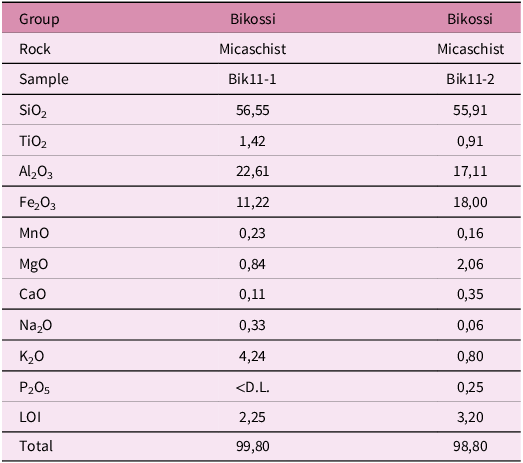
Further refinement of the P–T conditions was achieved through pseudosection approach (Hensen, Reference Hensen1971; Powell & Holland, Reference Powell and Holland1990; Tinkham et al. Reference Tinkham, Zuluaga and Stowell2001) using the Theriak/Domino software version 10.0 (De Capitani & Petrakakis, Reference De Capitani and Petrakakis2010) with the bulk composition of sample Bik11 as determined by XRF (Table 3). The thermodynamic data set of Holland and Powell (ds5.5, 1988) converted to Theriak–Domino format by Tinkham (tcds55_p07, march 2012) was applied for calculations on MnO-Na2O-CaO-K2O-FeO-MgO-Al2O3-SiO2-H2O-TiO2 (MnNCKFMASHT) chemical system.
Bulk-rock chemical analysis of the sample Bik11 used for phase diagram calculations; sample Bik11 was selected for numerical modelling but due to its heterogeneous composition, it was split in Bik11-1 and Bik11-2. The model has been calculated for Bik11-1, a muscovite-bearing part of the sample. Total Fe is measured as Fe2O3
4. Results
4.a. Petrography and mineral chemistry
4.a.1. Bikossi Group
The Bikossi Group is chiefly made of mica-, graphite- and quartz-schists, as well as quartzites with locally intercalations of metaconglomerate (Fig. 3a–e). Four samples from garnet–chlorite schist (Bik11 and Bik14), and garnet–biotite schist (Bik 15 and Bik 16) were selected for the metamorphic study (Fig. 4a–d).
Microphotographs of the garnet-bearing rocks and traverses across garnet from the western domain of the Mayombe chain. showing variations in almandine (Alm, in blue), spessartine (Sps, in green), pyrope (Prp, in red) and grossular (Grs, in violet). a–d: micaschists of the Bikossi Group (Bik11, Bik14, Bik15, Bik16).

Sample Bik11 displays compositional layering of cm-scale, with darker domains consisting of quartz–garnet–chloritoid–chlorite and lighter domains having additional abundant muscovite (3.1 ≤ Si ≤3.2 pfu). The microstructure is characterized by a faint S1 cleavage and a penetrative crenulation cleavage (S2). Garnet is generally idioblastic and contains quartz, ilmenite and chloritoid inclusions (Fig. 4a). Transect of garnet reveals regular zoning with Fe and Ca contents decreasing from core (XSps = 0.12 and XGrs = 0.05) to rim (XSps = 0.04 and XGrs = 0.01), whereas Fe and Mg show sharp increases from core (XAlm = 0.8 and XPrp = 0.04) to rim (XAlm = 0.9 and XPrp = 0.05) (Fig. 4a, Fig. 5a–d).
X-ray maps showing Fe, Mn, Mg and Ca distribution in garnets from the micaschists of the Bikossi Group (from top to bottom: Bik11, Bik14, Bik15, Bik16).

Sample Bik14, a micaschist in close contact with mafic rocks (Nemba Group), displays a well-developed crenulation cleavage (S2) refolding the S1 schistosity. Subhedral garnets contain quartz inclusion trails defining a sigmoidal internal schistosity indicating syn-D1 growth (Fig. 4b). In addition, rare inclusions of chloritoid (XMg = 0.09–0.10) were identified. The matrix contains quartz, muscovite (3.08 ≤ Si ≤ 3.18), graphite and chlorite defining the schistosity (S1) and crenulation cleavage (S2). Ilmenite is found in the matrix and as inclusions in some garnet crystals. The latter display a regular zoning profile, characterized by a bell-shaped curve for spessartine (XMn varies from 0.16 in the core to 0.01 at the rim), and a correlative increase in almandine content from core to rim (67 to 85%). The pyrope content increases very slightly from core (3 mole %) to rim (5 mole %), and the grossular content is almost stable (10–14 mole %) ((Fig. 4b, Fig. 5e–h). Overall, the XMg ratio slightly increases from 0.04 in the core to 0.05 in the rim.
Sample Bik15, a graphite-rich schist (Fig. 4c), exhibits an early pervasive schistosity (S1) and a crenulation cleavage (S2). Graphite, muscovite, biotite, and ilmenite are major components with minor secondary chlorite replacing biotite. Garnet crystals (c. 2 mm in diameter) display sigmoidal inclusion trails, indicating syn-kinematic growth. Garnet zoning is characterized by a decrease in Sps content (from 0.14 to 0.01 from core to rim, respectively), an increase in Alm (from 59 to 75%) and Prp (from 1 to 8%) content. The Grs content is stable at around 24 moles % in the core, then decreases to 16% in the rim (Fig. 4c, Fig. 5i–l). The XMg ratio varies from 0.04 to 0.10.
Sample Bik16 is a graphite-rich schist with a larger amount of biotite compared to sample Bik15. Garnet crystals are around 4 mm in diameter and display euhedral shapes. The largest garnet grains display two growth stages (Fig. 4d). In the inner part, inclusions display a star-like arrangement, as already reported in several examples of garnet grains from graphite schists (e.g. Andersen, Reference Andersen1984; Burton, Reference Burton1986; Rice & Mitchell, Reference Rice and Mitchell1991; Castellanos et al. Reference Castellanos, Rios and Takasu2004; Kleinschmidt et al. Reference Kleinschmidt, Heberer and Läufer2008; Castellanos et al. Reference Castellanos Alarcón, Ríos Reyes and Chacón Avila2016). The outer part of garnet porphyroblasts comprises numerous minute graphite inclusions, defining an internal schistosity (S1) that continues into the schistosity of the matrix. Some cracks crosscut grains perpendicular to the cleavage crenulation S2. Garnet X-ray maps and profiles display a smooth zoning, with decreasing Sps (14–3 mole %) and Grs (15–20 mole %) and increasing Alm (64–72 mole %) and Prp (4–8 mole %) from core to rim. Its XMg ratio varies from 0.06 to 0.10. There is no chemical discontinuity along the interface between the inner and outer parts of the porphyroblasts (Fig. 4d, Fig. 5m–p).
In summary, the samples from the Bikossi Group contain garnets that have been variously formed in paragenesis with i) chloritoid and chlorite (Bik11), ii) chlorite (Bik14) or iii) biotite (sample Bik15 and Bik16). The crystals in these samples have euhedral or subhedral shapes and contain sigmoidal inclusions trails that indicate syn-kinematic growth.
4.a.2. Loukoula Group
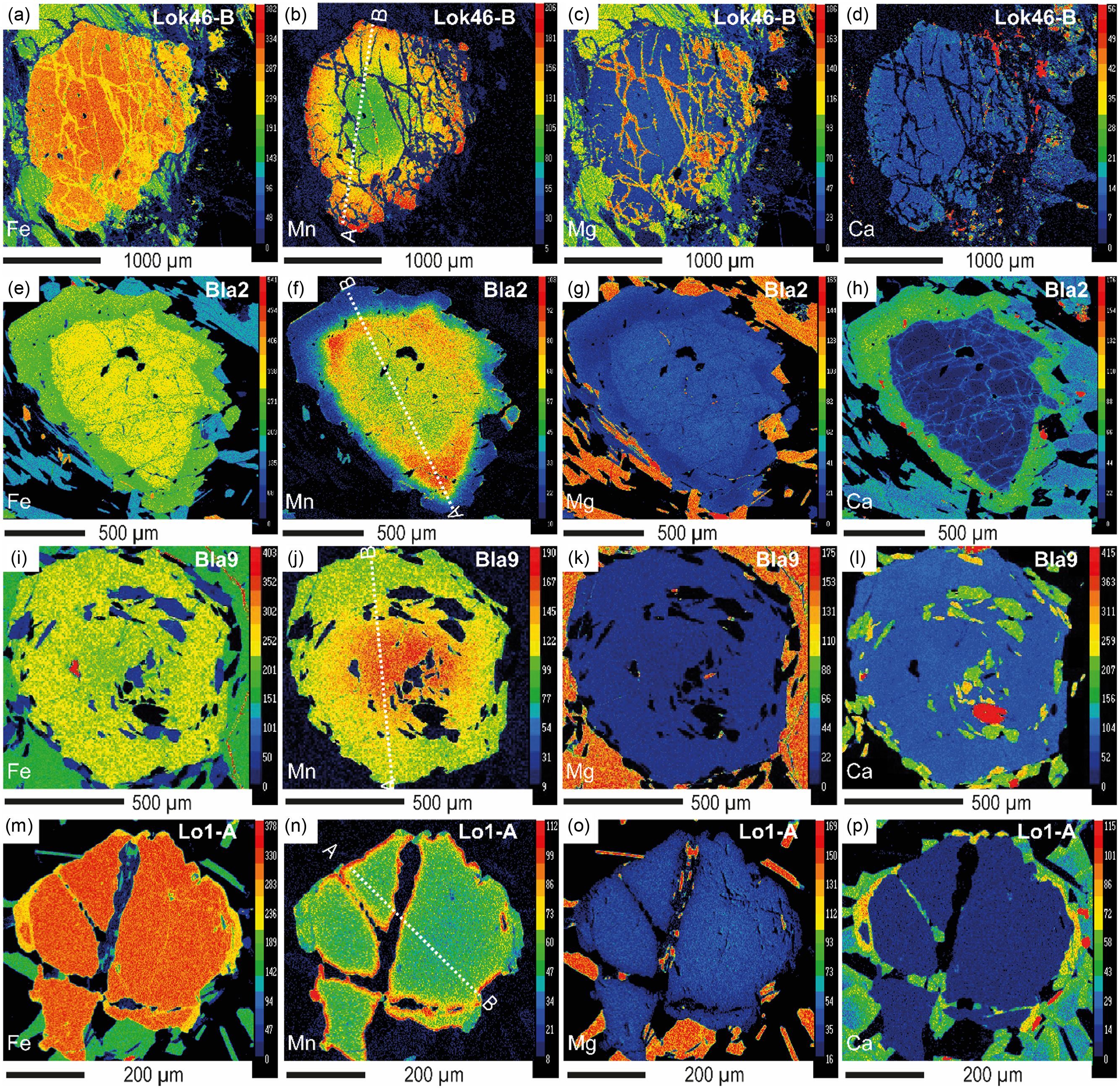
The Loukoula Group is composed of paragneiss, and amphibolite intruded by orthogneiss; the rocks display generally planar folded foliation and/or straighten foliation. Sample Lok46-B is a coarse-grained leucocratic gneiss most probably derived from a pegmatite vein (Fig. 3f) in fine-grained paragneiss and strongly deformed. It contains coarse-grained minerals, represented by quartz, abundant plagioclase and rare K-feldspar. Muscovite occurs either as large grains (100 to 200 µm) (3.12 ≤ Si ≤ 3.20 pfu) or as minute flakes disseminated in the matrix (3.01 ≤ Si ≤ 3.08 pfu). Biotite is partially replaced by chlorite. Garnet is locally present in biotite-rich domains (Fig. 6a) showing cracks filled by chlorite. Garnet from sample Lok46-B (Fig. 6a and Fig. 7a–d) displays a very gentle zoning marked by increasing spessartine from 8% in core to 19% in rim and decreasing almandine and pyrope (from 78% to 70% and 12% to 6%, respectively). The amount of grossular is nearly constant and very low (2–4%). The garnet zoning is characterized by reverse zoning with a slight enrichment in Mn from core to rim, with distinct peaks in Mn inside the grains along fractures.
Microphotographs of the garnet-bearing rocks and traverses across garnet from the western domain of the Mayombe chain. showing variations in almandine (Alm, in blue), spessartine (Sps, in green), pyrope (Prp, in red) and grossular (Grs, in violet). a–d: gneiss of the Loémé (Bla2, Bla9, Lo1-A) and Loukoula (Lok46-B) Groups.

X-ray maps showing Fe, Mn, Mg and Ca distribution in garnets from the gneisses of the Loukoula Group (Lok46-B) and Loémé Groups (Bla2, Bla9 and Lo1-A); see text for details.
4.a.3. Loémé Group
The Loémé Group consists of isoclinally folded paragneisses and orthogneiss (Fig. 3g–h), both cut by mafic dykes. Sample Bla2 is a strongly foliated biotite-garnet gneiss (Fig. 3g). The matrix is made of quartz, plagioclase, muscovite and biotite. Partial retrograde metamorphism is recorded by the crystallization of chlorite, epidote and ilmenite. Disseminated anhedral garnet shows evidence of rim dissolution against biotite (Fig. 6b). The central part of the zoned crystals is rich in quartz inclusions (Fig. 6b) and shows a nearly constant composition with Alm79-81 Sps04-08 Prp09-12 Grs03-06. It is in sharp contact with the outer zone that is marked by significantly lower almandine, spessartine and pyrope and a higher grossular contents (Fig.7e–h).
Sample Bla9 (Fig. 6c) comprises in decreasing proportion, quartz, plagioclase, biotite, epidote, titanite, and calcite. The latter is also present as inclusion in garnet where it is associated with apatite, clinozoisite and quartz. Garnet from sample Bla9 (Fig. 6c and Fig. 7i–l) is zoned, with a slight decrease of Mn (from 14% to 9% mole) and Ca from core to rim corresponding to slight increase in Fe and Mg. The XMg ratio varies from 0.09 to 0.11.
Sample Lo1-A , a fine-grained gneiss (Fig. 3h) is composed of quartz, plagioclase, muscovite, biotite, chlorite and garnet which are xenoblastic with less than 1 mm in diameter (Fig. 6d), with a homogeneous composition Alm80 Sps05 Prp15 Grs05. Along the cracks that affect the grains or at the contact with the matrix, garnets are characterized by a decrease in Alm and Prp (respectively, down to 0.78 and 0.09) and an increase in Sps (up to 0.10) (Fig. 6d and Fig. 7m–p). Accordingly, the XMg ratio varies from 0.16 in garnet core to 0.10 along garnet rims.
In these samples, garnets co-exist with brown biotite defining the main foliation and/or the crenulation schistosity (S2).
4.b. P–T estimations by conventional methods for geothermobarometry
The garnet–biotite Fe–Mg exchange geothermometer has been applied on samples Bik15, Bik16, Bla2, Bla9, and Lo1-A following the calibration of Williams & Grambling (Reference Williams and Grambling1990, corrected in 1992). A nominal pressure of 6 kbar is used for most samples, based on the mineralogical assemblage and structure of the concerned samples. We assumed that these samples did not experience high pressure due to the lack of HP-index minerals. For sample Bik 11 we used 12 kbar taking into account the range of pressure provides by the pseudo-section calculations. The results from this geothermometer (Table 2) yields temperature ranges of 465–546°C for sample Bik15, 569–592°C for sample Bik16, 545–679°C for sample Bla2, 630–680°C for sample Bla9, and 539–652°C for sample Lo1-A.
According to petrographic observations, chlorite is assumed to be part of the peak assemblage in sample Bik11 whereas in the other samples of the Loukoula group (Lok46-B, Lo1-A) and the orthogneisses (Bla9) it is a late (retrograde) phase. Therefore, the garnet–chlorite Fe–Mg exchange has been used to estimate temperature only in sample Bik11. Three calibrations have been used to estimate temperature in this sample (Table 2). The pressure has been estimated between 10 and 14.5 kbar using pseudo-section method. This constrains temperatures (i) from 564°C–617°C at 10 kbar, 570°C–600°C at 12 kbar and 577°C–631°C at 14.5 kbar in Laird’s (Reference Laird1988) model, (ii) from 548°C–581°C at 10 kbar, 553°C–586°C at 12 kbar and 560°C–593°C at 14.5 kbar using Grambling (Reference Grambling1990) and (iii) from 566°C to 591°C at 10 to 14.5 kbar using the calibration of Perchuk (Reference Perchuk and Perchuk1991).
The chloritoid–chlorite Fe–Mg exchange may be used in sample Bik11, where estimated temperature (T) ranges from 566°C to 610°C, using the P-insensitive empirical calibration of Vidal et al. (Reference Vidal, GoffÉ, Bousquet and Parra1999).
The Ti-in biotite geothermometer (Henry et al. Reference Henry, Guidotti and Thomson2005) has been used on samples Bik15 and Bik16 (Fig. 8), where a biotite XMg value varies, respectively, from 0.45 to 0.47 and 0.46 to 0.48. The concentration of Ti is measured at 0.17–0.23 apfu in sample Bik15 and 0.14–0.20 apfu in sample Bik16. In sample Bik15, temperature is estimated from 546°C to 590°C for the biotite in the matrix and from 582°C to 608°C for the biotite in contact with garnet. In sample Bik16, temperature is in the range from 498°C to 585°C regardless whether biotite is in the matrix or in contact with garnet.
Biotite chemistry as a function of Mg/(Mg+Fe) and Ti content in the studied samples from the Bikossi (Bik15 and Bik 16), Loémé (Bla2, Bla9 and Lo1-A), and Loukoula Groups (Lok46-B). The isotherms for the Ti-in-biotite geothermometer are shown after Henry et al. (Reference Henry, Guidotti and Thomson2005).

4.c. P–T estimations using calculated isochemical phase diagrams
In a first step, the calculations have been made considering all Fe as Fe2+ (Fig. 9a). The phase diagram displays the classical sequence of assemblages for aluminous pelitic bulk-rock chemistries (e.g. Harte & Hudson, Reference Harte and Hudson1979; Powell & Holland, Reference Powell and Holland1990; Tinkham et al. Reference Tinkham, Zuluaga and Stowell2001), with garnet–chloritoid, garnet–staurolite and garnet–aluminosilicate (kyanite/sillimanite) assemblages at low, medium and high temperatures, respectively. The assemblage in sample Bik11 consists of garnet–chloritoid–chlorite–ilmenite with quartz and muscovite constraining metamorphic conditions between 510°C–568°C and 5.5–12.5 kbar. A critical point is the lack of rutile and biotite during the entire history of the sample.
a, b. Calculated isochemical phase diagrams (pseudosections) for sample Bik11 using the Theriak/Domino software, considering all Fe as ferrous (A) or converting 3% of the total Fe into ferric iron. Mineral abbreviations are from Kretz (Reference Kretz1983). The box in yellow shows the restricted stability domain for the observed mineral assemblage.
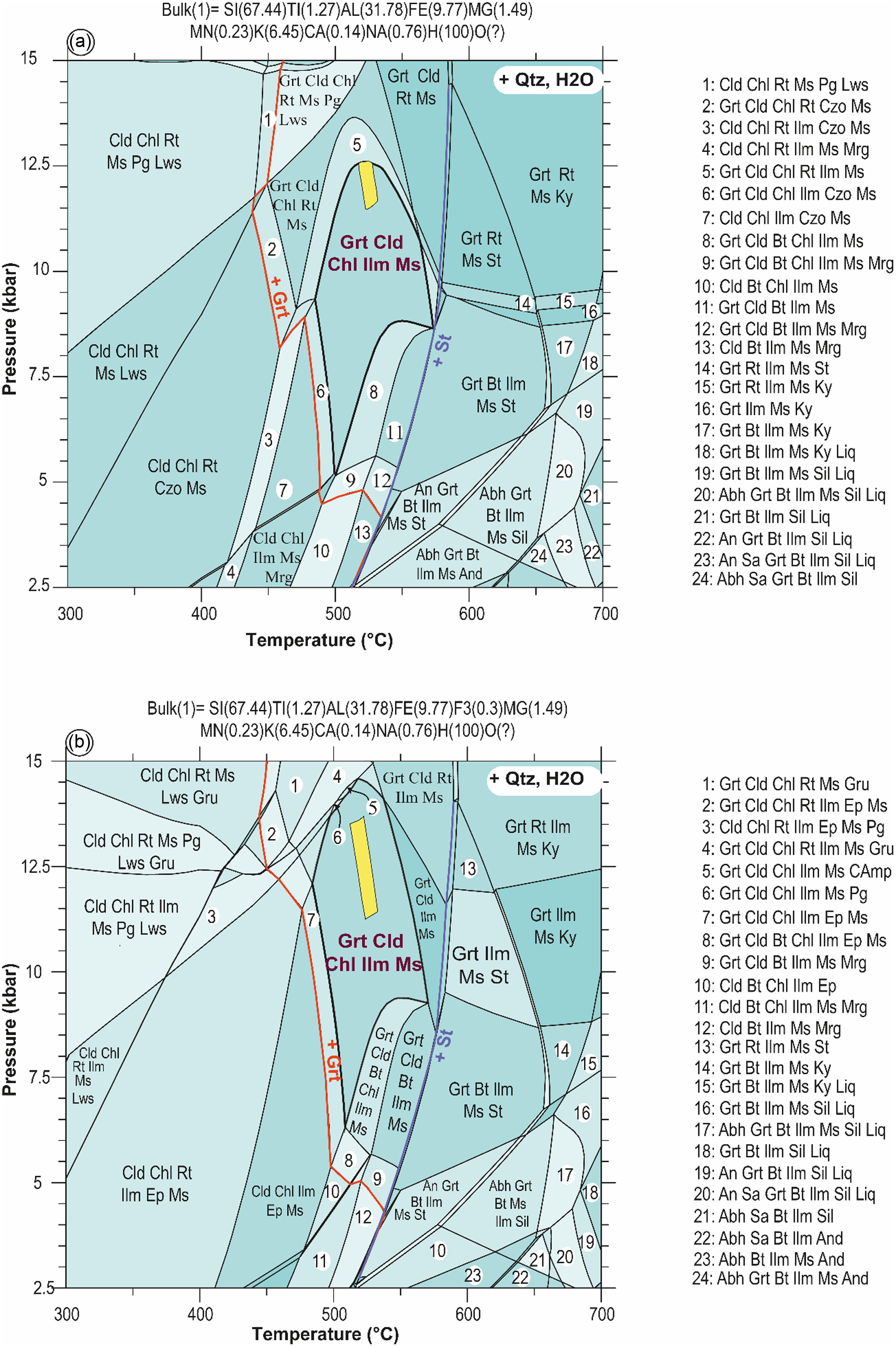
In a second step, the effect of Fe2O3 was taken into account by transforming 3% of the total FeO content into Fe2O3 (Table 3). This stabilizes epidote rather than clinozoisite, and enlarges the stability field of ilmenite respective to rutile (Fig. 9b). As a result, the observed assemblage garnet–chloritoid–chlorite–ilmenite is stable at pressures between 6.5 and 14.5 kbar, in a temperature range from 500°C–575°C that is not significantly different from the model in the Fe3+-absent system.
To model the P–T path of the sample, the isopleths for garnet (XMg, XMn and XCa) and muscovite (XSi in cations pfu) are calculated in the Fe3+-bearing system (Fig. 9c). The isopleths for Mn are nearly vertical (isothermal), indicating that garnet growth took place at increasing T, a feature which is consistent with the slight increase in pyrope content. During the early stage of its growth, the grossular content in garnet is buffered by the presence of clinozoisite. Once this phase is consumed, garnet is the only Ca-bearing phase, and the grossular decreases to almost zero close to the rim. These observations are consistent with the prograde sequence Cld-Chl-Ilm-Czo (with excess Qtz, Ms and H2O), to Grt-Cld-Chl-Czo and finally Grt-Cld-Chl. Estimation of the peak pressure relies largely on the muscovite composition. The measured values of Si (3.13–3.15 pfu) indicate a relatively high P of 11.5 kbar–12.5 kbar (Fig. 9c).
Isopleths of spessartine, pyrope, and grossular (in mole per cent) in garnet and Si (in cations pfu, on the basis of 11 oxygens) in muscovite.

5. Discussion
5.a. Distinguishing poly- and monocyclic rocks in the Mayombe chain
The present study has shown that the Paleoproterozoic metamorphic rocks outcropping in the Western Domain of the Mayombe chain present compositional zoning in garnet. The rationale behind the interpretation of garnet zonation may be summarized as follows:
Consider first the simple case where the studied rocks have been submitted to a single tectonothermal cycle. During growth at increasing T, garnet partitions Fe, Mn, Mg and Ca with the coexisting phases, and records the changing P–T conditions through its growth zoning, a process for which different numerical models have been performed (e.g. Hollister, Reference Hollister1966). In calculated pseudosections displaying the isopleths for almandine, spessartine, pyrope and grossular, growth zoning may be used to depict graphically the changing P–T conditions during garnet growth. However, with increasing T, intracrystalline (volume) diffusion becomes more efficient, and will progressively relax, and finally erase, the growth zoning (Caddick et al. Reference Caddick, Konopásek and Thompson2010; Ague & Carlson, Reference Ague and Carlson2013). As a consequence, garnet grains tend to be homogeneous at high T (i.e. from and above the sillimanite–muscovite zone), as shown by several studies across metamorphic field gradients (Woodsworth, Reference Woodsworth1977; Yardley, Reference Yardley1977; Azor & Ballèvre, Reference Azor and Ballèvre1997).
A complex case is found when the studied rocks contain multistage garnet, i.e. grains whose texture and composition show abrupt changes due to at least two episodes of growth. In this case, the first garnet generation may have different origin. They may have crystallized during cooling of a magma or more frequently, during a previous metamorphic cycle (e.g. Tropper & Recheis, Reference Tropper and Recheis2003; Gaidies et al. Reference Gaidies, Abart, De Capitani, Schuster, Connolly and Reusser2006; Le Bayon et al. Reference Le Bayon, Pitra, Ballevre and Bohn2006). In exceptional cases, it has been proposed that the first garnet ‘generation’ results from the presence of detrital garnet grains in the sedimentary protolith of the studied rock (Yardley et al. Reference Yardley, Condliffe, Lloyd and Harris1996; Manzotti & Ballèvre, Reference Manzotti and Ballèvre2013). Careful examination of the garnet chemistry provides valuable information on the P-T conditions associated to the growth of both garnet generations.
In the basement units, where the Paleoproterozoic rocks have been geochronologically characterized, garnet grains show two types of responses. In the more external area (the Loukoula Group), an early garnet generation is identified, which is partly replaced by chlorite along fractures and rims during a second metamorphic episode, taking place in the chlorite stability field. In the more internal Loémé Group, a second generation of garnet was able to grow during the Pan-African orogeny, which took place in the biotite stability field.
Unlike garnets from the basement units, garnets in the metamorphic rocks of the Bikossi Group only exhibit normal growth zoning. The interpretation of these garnets can be challenging because this type of garnet zoning can be found in metamorphic, plutonic and volcanic rocks (Ruiz, 1976). However, the syn-kinematic features of garnets from the Bikossi Group confirm their formation in metamorphic setting. The absence of change in zoning suggests that these minerals nevertheless undergo some significant change in the P-T conditions since their crystallization as evoked by Riuz (Reference Ruiz1976). According to this evidence of a single tectonometamorphic cycle, we believe that the metasedimentary rocks of Bikossi Group underwent one of the most recent tectonothermal cycles known in Mayombe chain, which is associated with its tectono-thermal evolution during the Pan-African event (Fullgraf et al. Reference Fullgraf, Callec, Thiéblemont, Gloaguen, Charles, Le Metour, Prian, Boudzoumou, Delhaye-Prat, Moreau, Kebi-Tsoumou and Ndiele2015b, Bouénitéla, Reference Bouenitela2019). This interpretation is supported by 40Ar/39Ar dating of biotite and muscovite from Bilala othogneiss and Bikossi Group rocks that have yielded exclusively Neoproterozoic to Cambrian ages 615-496 Ma (Bouénitéla, Reference Bouenitela2019). However, some complementary geochronological analyses (e.g. in situ U–Pb or Lu–Hf garnet dating) are required to better constrain the timing of garnet growth during this metamorphic event.
Based on our textural and chemical observations, garnet-bearing rocks of the Mayombe chain allow to distinguish two tectono-metamorphic events. The first one, observed in both the Loémé and Lokoula Groups, is related to a high T event, able to homogenize through volume diffusion garnets grains up to a few mm in diameter. This high T event may be associated to the Eburnean orogeny. The imprint of the second tectono-metamorphic event, of probable Pan-African age, depends on the T gradient that was established at the scale of the belt. In the Loemé and Loukoula Groups (i.e. in the Paleoproterozoic basement), the second episode occurred at slightly higher T in the Loémé Groups (allowing the garnet overgrowth in the Bilala orthogneiss than in the Loukoula Group, characterized by chlorite growth at the expense of garnet, with some Mn back-diffusion. In the Bikossi Group, garnet grains display evidence for a single tectonometamorphic cycle related to the Pan-African metamorphic event.
5.b. P–T history of metamorphic rocks of the Western Domain of the Mayombe chain
A compilation of our results indicates that the Loémé Group presents metamorphic conditions reached at 6 kbar and 539°C–680°C suggesting an evolution in amphibolite facies (Fig. 10). The prograde metamorphic path is reflected in the multistage zoning of the garnet, indicating at least two stages of metamorphism. In contrast, the Loukoula Group shows retrograde stage characterized by lower grade overprinting in greenschist facies marked by the fracturing and reverse zoning of garnet.
P–T history of the studied samples showing the difference of metamorphic grade across the Mayombe chain (Loémé, Loukoula, Bikossi Groups) during the Eburnean and Pan-African tectono-metamorphic events.

The Bikossi Group presents mainly garnet with normal growth zoning showing a single tectono-thermal cycle. However, significant differences in P–T estimates have been noted. Conventional geothermobarometry has shown that the peak metamorphic conditions reached by the rocks of the of the Bikossi Group vary from 6 kbar for 465°C–592°C and 10–14.5 kb for 548°C–631°C. HP values were used in the conventional model in relation to the pseudo-section estimation model. Then, the sample Bik 11 shows an assemblage equilibrium with relative HP (11.5–12.5 kbar). This range of pressure is also found on the Brazilian side of the orogenic system (Faleiros et al. Reference Faleiros, Campanha, Martins, Vlach and Vasconcelos2011), where it can be associated with high temperatures that give rise to high-pressure granulites that are interpreted as rocks formed as a result of short-lived tectonic events that led to crustal thickening or subduction of the crust into the mantle (O’Brien & Rötzler, Reference O’Brien and Rötzler2003). The very well-preserved prograde zoning patterns in garnet may also be a feature of the short-lived tectonics (O’Brien & Rötzler, Reference O’Brien and Rötzler2003). Monié et al (Reference Monié, Bosch, Bruguier, Vauchez, Rolland, Nsungani and Buta Neto2012) have provided evidence for partial melting in northwestern Angola and Nsungani (Reference Nsungani2012) obtained P–T conditions ranging between 7–12 kbar and 620°C–780°C from garnet–kyanite–biotite–plagioclase–quartz–rutile bearing gneiss. The presence of kyanite even if rutile, indicates a relatively high-pressure environment. In all these cases there is the connexion with subduction.
In our area, P estimation is more difficult, as usual, and relies on the presence of ilmenite and lack of rutile in the sample, and on the composition of muscovite, suggesting relatively high values (c. 12 kbar). Following peak P–T conditions, the decompression occurred without significant T increase, allowing the preservation of the syn-kinematic assemblages developed at the end of garnet growth. For example, exhumation of sample Bik11 has taken place in the Grt-Cld-Chl stability field, defining clockwise P–T loop. The absence of some minerals index of high P/T environment, such as carpholite and paragonite leads to the consideration of the epidote amphibolite facies that gives the medium P/T environment which is likely compatible with the collisional setting in the West Congo Belt during the Pan-African orogeny. However, we point out that the tectonic setting for reaching these P–T conditions is still not well understood. We also acknowledge that these data raise the question of how the metamorphic grade evolved in the West Congo Belt from the south to the north.
5.c. Large-scale zonation of the metamorphism in the West Congo Belt
The Pan-African West Congo Belt displays consistent metamorphic zonation perpendicular to the axis of the orogen, if Eburnean parageneses are identified correctly and subtracted from the Pan-African event.
In the Congo-Brazzaville (this study), the above distinction of polycyclic and monocyclic units and their attribution to Eburnean and Pan-African events is consistent with the available U–Pb dating of zircon (Djama, Reference Djama1988; Djama et al. Reference Djama, Leterrier and Michard1992; Maurin et al. Reference Maurin, Boudzoumou, Djama, Gioan, Michard, Mpemba Boni, Peucat, Pin and Vicat1991; Fullgraf et al. Reference Fullgraf, Callec, Thiéblemont, Gloaguen, Charles, Le Metour, Prian, Boudzoumou, Delhaye-Prat, Moreau, Kebi-Tsoumou and Ndiele2015b; Affaton et al. Reference Affaton, Kalsbeek, Boudzoumou, Trompette, Thrane and Frei2016; Bouenitela, Reference Bouenitela2019) and 40Ar/39Ar dating of micas and amphibole, revealing the existence of Paleoproterozoic (2000 Ma) and late Neoproterozoic (540 Ma) tectono-metamorphic events. According to the structural analyses in the Mayombe chain, most authors concluded that the Eburnean basement was reworked during the Pan-African episode (Hossié, Reference Hossié1980; Boudzoumou & Trompette, Reference Boudzoumou and Trompette1988; Djama, Reference Djama1988; Maurin et al. Reference Maurin, Boudzoumou, Djama, Gioan, Michard, Mpemba Boni, Peucat, Pin and Vicat1991; Djama et al. Reference Djama, Leterrier and Michard1992; Affaton et al. Reference Affaton, Kalsbeek, Boudzoumou, Trompette, Thrane and Frei2016). However, Fullgraf et al. (Reference Fullgraf, Callec, Thiéblemont, Gloaguen, Charles, Le Metour, Prian, Boudzoumou, Delhaye-Prat, Moreau, Kebi-Tsoumou and Ndiele2015b) highlighted pre-Eburnean and syn-Eburnean metamorphic episodes in the Loémé Supergroup.
In Gabon Thiéblemont et al. (Reference Thiéblemont, Astaing, Billa, Bouton and Préat2009) show a polyphase evolution of the Ogooué complex marked by two Paleoproterozoic metamorphic events related to the pre- and syn-Eburnean orogeny setting and displays respectively, meso- to catazonal grade and epi- to anchizonal grade. Thus, the polycyclic garnet observed in the Loémé Group can be limited just to the Eburnean context. However, the geochemical characteristics of the metatonalites of the Bilinga suite (Fullgraf et al. Reference Fullgraf, Callec, Thiéblemont, Gloaguen, Charles, Le Metour, Prian, Boudzoumou, Delhaye-Prat, Moreau, Kebi-Tsoumou and Ndiele2015b) establish their emplacement in a syn to post-orogenic setting, which therefore constrain them to a single pre-Pan-African metamorphic event. The absence of xenocrysts features on these garnets supports this assertion.
In NW and SW Angola, syn and post-Eburnean metamorphic crust has been later reworked during the Pan-African orogeny (Pereira et al. Reference Pereira, Tassinari, Rodrigues and Van-Dúnem2011; Monié et al. Reference Monié, Bosch, Bruguier, Vauchez, Rolland, Nsungani and Buta Neto2012). The NW domain as southern part of West Congo Belt displays upper amphibolites facies with evidence of migmatization dated by U–Pb on zircon method at 544 ± 14 Ma (Monié et al. Reference Monié, Bosch, Bruguier, Vauchez, Rolland, Nsungani and Buta Neto2012). These data suggest that Pan-African orogeny occurs with high-intensity induced overgrowth of zircon in NW Angola and garnet in Mayombe chain.
In Brazil, the counterpart of the West congo belt is the Araçuaí fold belt which contains the Espinhaço Supergroup consisting of Palaeo- and Mesoproterozoic formations (Alkmim et al. Reference Alkmim, Marshak, Pedrosa-Soares, Peres, Cruz and Whittington2006). In Brazil, all units older than 1.8 Ga are considered basement of the Araçuaí orogen (de Almeida et al. Reference de Almeida, Hasui, de Brito Neves and Fuck1981). These units are similar of those of Loukoula, Loémé and Bikossi in Mayombe chain. Alkmim & Marshak (Reference Alkmim and Marshak1998) mentioned severe overprint of Brasiliano tectonism on Transamazonian terranes of southeast São Francisco craton. Based on the U–Pb SHRIMP dating, da Silva et al. (Reference da Silva, Hartmann, McNaughton and Fletcher2000) suggest a Neoproterozoic overprint in Paleoproterozoic orthogneiss in southern Brazil related to the Brasiliano orogeny.
Our petrological data indicates that the Loémé Group displays evidence of multistage garnet, clear evidence in favour of a Pan-African reworking of the Eburnean basement (Fig. 11-12).
Schematic evolution of garnet crystals during Eburnean and Pan-African orogeny. Eburnean context: (a) and (b) represent the first setting of garnet Grt1 with (a) which correspond to the nucleation of garnet and (b) the relic texture of garnet marked by fracturation and partial dissolution during Eburnean event affecting rocks from Mayombe chain basement, including Loémé and Loukoula groups. Pan-African context: Eburnean porphyroclastic garnet obtain on stage (b) are partly replaced by chlorite in the Loukoula Group located to the north-east (c) and have been overprinted by newly formed garnet Grt2 in the Loémé Group located to the south-west (e). Neoblasts of garnet Grt2 (d) are generated during the Pan-African event in the Bikossi Schist (d-1) and in the Bilala Gneiss (d-2).

Schematic evolution of garnet crystals during Eburnean and Pan-African orogenies with P–T path in Loémé, Loukoula and Bikossi Groups. Evidence of growth zoning, diffusion zoning (homogenization, reverse zoning) and multistage growth.

5.d. Implications for tectono-stratigraphic reconstruction
Examination of garnet texture and chemical zoning has led to generate new knowledge on the metamorphic evolution of the Paleoproterozoic basement rocks in the Mayombe chain. This can be used as a tool to improve existing geological model of the Mayombe chain (Fig.13) and permits a re-evaluation of the tectono-stratigraphic relationship between these Paleoproterozoic basement rocks and the overlying early Neoproterozoic units cross the Western Domain that remains a matter of interpretation. It is argued that Paleoproterozoic high-grade gneisses of Loémé and Loukoula groups represent the remnant of Eburnean terranes and experienced at least two distinct metamorphic events which are response of the Eburnean and Pan-African collisional orogenies as previously recognized (Fullgraf et al. Reference Fullgraf, Callec, Thiéblemont, Gloaguen, Charles, Le Metour, Prian, Boudzoumou, Delhaye-Prat, Moreau, Kebi-Tsoumou and Ndiele2015b). However, the present study shows that the metamorphic rocks of the Bikossi Group underwent a quite distinct metamorphic evolution of the rest of the Paleoproterozoic basement units. In contrast to the Loémé and Loukoula groups, the metasedimentary rocks from Bikossi Group record a single amphibolite to transitional metamorphic event of Pan-African age implying that it does not record Eburnean metamorphism. In the light of these new petrological data, the authors’ previous interpretations regarding tectono-metamorphic history of the Bikossi Group (Fullgraf et al. Reference Fullgraf, Callec, Thiéblemont, Gloaguen, Charles, Le Metour, Prian, Boudzoumou, Delhaye-Prat, Moreau, Kebi-Tsoumou and Ndiele2015b) can be reviewed. Thus, the Bikossi Group is more correctly interpreted as a cover sequence to older gneisses of the Loémé Supergroup metamorphosed to amphibolite facies during the Pan-African orogeny. These contradictory interpretations have significant implications for defining the structural and stratigraphic relationships between the metasedimentary rocks of the Bikossi Group with the overlying metabasites of the Nemba Complex (Fig.13) which stills poorly documented and a matter of debate due to limited detailed field investigations and petrochronologic studies. Until recently both of metasedimentary rocks of Bikossi and metabasites of the Nemba Complex have been identified as one single lithological unit of upper-Precambrian age (Dadet, Reference Dadet1969; Vellutini et al. Reference Vellutini, Rocci and Vicat1983) that unconformably overlies the Paleoproterozoic polycyclic basement rocks (i.e. the Loukoula and Loémé Groups). On the other hand, a recent proposal would be to dissociate the Bikossi Group from the Nemba Complex (Fullgraf et al, Reference Fullgraf, Callec, Thiéblemont, Gloaguen, Charles, Le Metour, Prian, Boudzoumou, Delhaye-Prat, Moreau, Kebi-Tsoumou and Ndiele2015b), considering the former as Paleoproterozoic in age, and the latter as the lower part of the Neoproterozoic Sounda Group. In this hypothesis, the metavolcanic rocks from the Nemba Complex may be the equivalent, in composition and age, of the Gangila meta-basalts from the Zadinian Group in the DRC (Tack et al. Reference Tack, Wingate, Liégeois, Fernandez-Alonso and Deblond2001; Fullgraf et al. Reference Fullgraf, Callec, Thiéblemont, Gloaguen, Charles, Le Metour, Prian, Boudzoumou, Delhaye-Prat, Moreau, Kebi-Tsoumou and Ndiele2015b). Arising from this study, evidence of one episode of metamorphism in Bikossi Group and Nemba Complex cannot agree with their dissociation as previously thought. In spite of the substantive progress made in reconstructing the metamorphic evolution of lithological units within the Western Domain of the Mayombe chain, the geological setting of the Bikossi Group, as well as its tectonic and stratigraphic interpretations, remains uncertain (Fullgraf et al. Reference Fullgraf, Callec, Thiéblemont, Gloaguen, Charles, Le Metour, Prian, Boudzoumou, Delhaye-Prat, Moreau, Kebi-Tsoumou and Ndiele2015b). Therefore, more detailed mapping, structural analysis, and petrochronologic studies are needed to unravel the stratigraphic complexity in Western Domain of the Mayombe chain.
Simplified cross-section of the studied area. The insets on top of the cross-section show the mineral assemblages observed both in the polycyclic (Loémé and Loukoula) and monocyclic units (Bikossi, Nemba); see text for further details on garnet texture and chemistry.

6. Conclusions
Within the Western Domain of the Mayombe chain, geochronological data have unambiguously confirmed the occurrence of the Paleoproterozoic polycyclic basement. This study has used garnet texture and chemistry as a proxy to characterize ancient Eburnean assemblages and to evaluate their Pan-African overprint.
The main conclusions are as follows:
-
1. Normal growth zoning of garnets in rocks of the Bikossi Group indicates only one metamorphic event with peak P–T conditions reaching epidote-amphibolite facies (garnet–chloritoid–chlorite or garnet–biotite assemblages).
-
2. Some of Paleoproterozoic rocks from the Loukoula Group display an early garnet-bearing paragenesis, which is largely overprinted during a greenschist-facies episode. Given the homogeneous composition of the first garnet generation, indicative of a high-T event, these are interpreted as Eburnean relics overprinted at relatively low-T during the Pan-African event
-
3. In contrast, the Paleoproterozoic basement of the Loémé Group displays evidence for a multistage history, with a first (Eburnean) garnet generation overgrown during a second (Pan-African) metamorphic episode, at a higher T than in the Loukoula Group (i.e. in the garnet–biotite stability field).
These observations are consistent with an overall SW-ward increase in metamorphic grade during the Pan-African orogeny, whether it reworked the Paleoproterozoic basement (which is therefore polycyclic) or rocks that have never seen before any metamorphism (like the monocyclic Bikossi Group). This pattern of metamorphism is similar to what has been described in other segments of the West Congo-Araçuaí Belt.
Acknowledgements
This work was completed as part of a Ph. D. project supported by a research funding from Total E&P Congo. For their assistance with the logistics, we are grateful to Jacques Durand, Pierre Jessua, Gastard Ondongo, Sonia Nzimbou, Laurent Schulbum, Cedric Mabille, and Didier Mbemba. Special thanks to Yannick Callec, Benjamin Le Bayon and Eric Gloaguen from BRGM for their talks, logistical support (maps, thin sections), and assistance when starting this project. We warmly thank Thomas Fullgraf for the important contribution to the improvement of this work. We also acknowledge Jessica Langlade at Ifremer for her assistance with the electron probe microanalysis, which made a significant contribution to this investigation. Stéphane Koffi and Pavel Pitra helped with the pseudosection approach. Many thanks to Jean Mouanda for his fieldwork assistance, Xavier Le Coz at Geosciences Rennes for preparing samples and thin sections. We are thankful to Jon Pownall and Bruno Ribeiro for reviewing this paper. Many thanks to Susie Cox as Associate Editor.


 Open access

