


Lefkowitz et al. (Reference Lefkowitz, Zickar, Cascio and Kochan2026) urge I-O psychology to engage more directly with labor unions and collective action, and we echo this call. In response, this commentary provides a process-oriented framework that outlines the core phases of worker organizing and maps I-O constructs and research questions onto each step. By organizing existing theory around the practical realities of building organizing committees, engaging coworkers, mobilizing collective action, and securing contracts, we illustrate how I-O psychology can generate relevant research that directly connects to union practices. Organizing campaigns thus provide fertile ground for applying I-O psychological science to real-world challenges and for extending theory. At a time when regulatory protections and organizational commitments to fairness are increasingly fragile (Katz & Rauvola, Reference Katz and Rauvola2025; Keith et al., Reference Keith, Strah and Sorensen2025; Legal Defense Fund, 2025), engaging with the development of worker collective power offers I-O psychology a concrete and timely pathway to translate evidence-based principles into sustainable, collective workplace change.
Research opportunities in worker organizing
Labor unions exist to address a structural power imbalance inherent in the employment relationship. Most workers are economically dependent on their jobs, whereas employers can often replace individual labor. As a result, individual advocacy is often insufficient to secure improvements in wages, scheduling, workload, or safety. Collective action alters this imbalance by formalizing collective voice and coordination, enabling workers to pursue changes that organizations may publicly endorse but fail to implement consistently in practice (de Marco, Reference de Marco2025; Johnson, Reference Johnson2025).
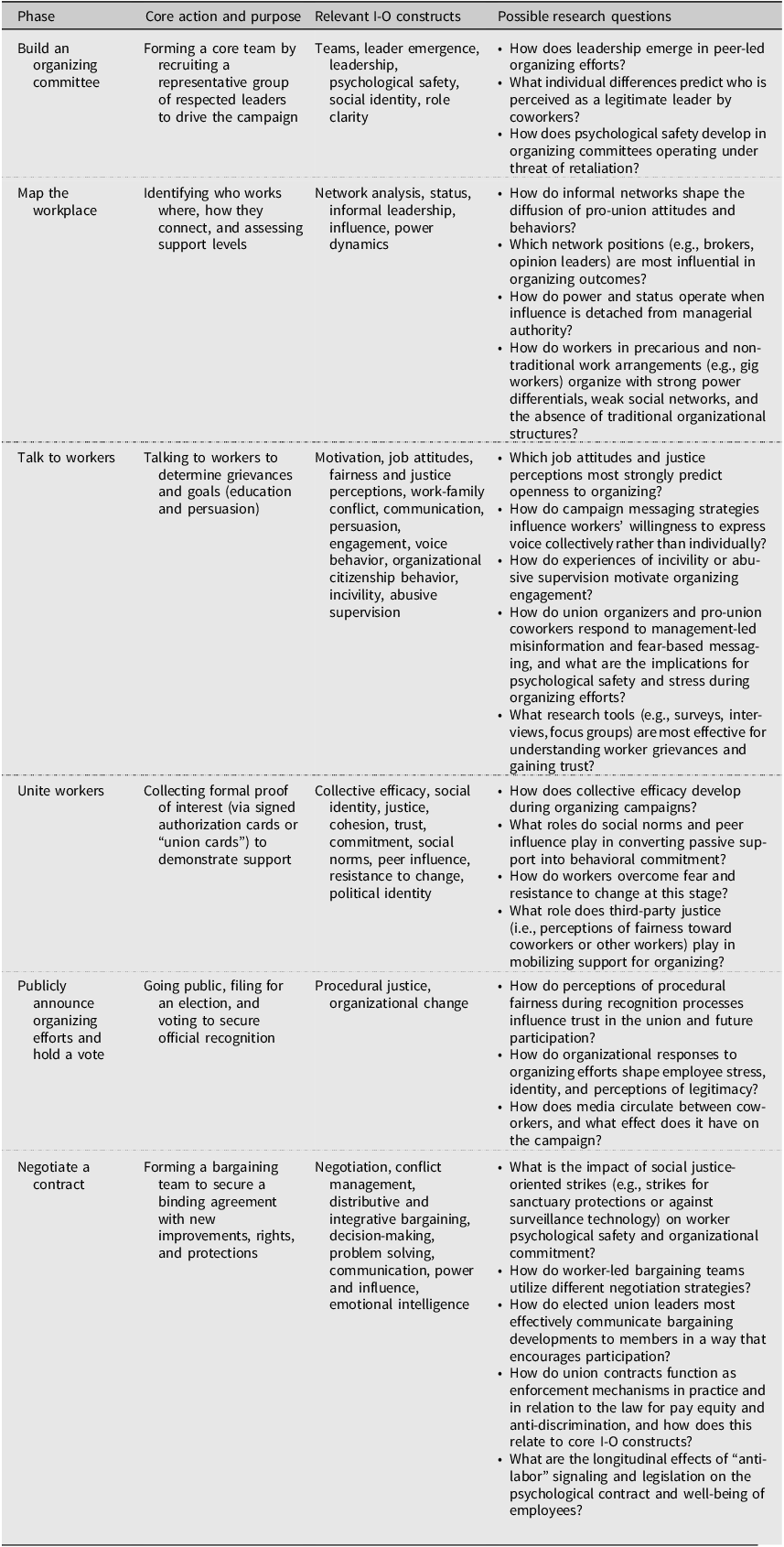
The process of forming new unions, engaging coworkers, and taking collective action is referred to with the catch-all term “organizing.” For readers who may be unfamiliar with the typical steps involved, Table 1 provides a high-level overview (Giaimo & Lawson, Reference Giaimo, Lawson and Kahihikolo2024; Kimbrell, Reference Kimbrell2024; Solidarity Tech, 2025; UAW, n.d.). Following the table, we discuss how I-O psychologists can contribute existing knowledge and future research that supports and strengthens these efforts, ultimately advancing worker power.
Phases of Organizing and Relevant Research Areas

Table 1 Long description
The table outlines the phases of organizing and relevant research areas for forming new unions and engaging coworkers. It details the core actions and purposes, relevant I-O constructs, and possible research questions for each phase. The phases include building an organizing committee, mapping the workplace, talking to workers, uniting workers, publicly announcing organizing efforts and holding a vote, and negotiating a contract. Each phase is described with specific actions, constructs, and research questions to support and strengthen organizing efforts, ultimately advancing worker power.
The phases in Table 1 are not meant to imply a rigid or linear sequence. Rather, they reflect common steps in organizing efforts and illustrate how different aspects of the process correspond with well-established areas of I-O theory and method. Because organizing is iterative and relational, studying these phases may benefit from multimethod and qualitative approaches that emphasize close engagement with workers’ experiences and organizing practices, consistent with the spirit of ethnography (Zickar & Carter, Reference Zickar and Carter2010). By pairing each phase with relevant constructs and possible research questions, the table highlights the many entry points where I-O psychologists can meaningfully contribute research, measurement, and theory.
Early stages of organizing require the formation of an organizing committee and mapping workplace relationships. These steps involve identifying respected leaders, building a representative core team, and understanding how workers are socially connected. Such activities share commonalities with research on teams, leadership emergence, psychological safety, social identity, and social network analysis. Organizing contexts offer an opportunity to study these constructs in environments where leadership is not officially assigned by the employer and where influence, trust, and credibility are earned through peer relationships rather than organizational hierarchy. For example, research can examine how leadership and legitimacy emerge in peer-led organizing efforts, how psychological safety develops under threat of retaliation, and how informal networks shape the diffusion of pro-union attitudes and behaviors. Together, these questions position organizing as a context for extending I-O theory on leadership, influence, and interpersonal dynamics in consequential, real-world settings.
Later phases center on engagement, persuasion, and collective action. Talking with coworkers to identify shared concerns and goals draws on motivation, job attitudes, fairness perceptions, communication, and employee voice. Efforts to unite workers and demonstrate majority support rely on social norms, collective efficacy, cohesion, and commitment. These stages create natural opportunities to examine how attitudes translate into behavior, how social influence operates in peer-driven settings, and how resistance to change emerges and is addressed.
The final phases of organizing involve public recognition and negotiation. Going public and participating in formal voting processes highlights the role of procedural fairness, legitimacy, and perceptions of organizational change. Contract negotiation brings conflict management, decision-making, power, and communication that reflect emotional intelligence to the forefront. These are areas where I-O psychology has deep theoretical foundations but has rarely examined these dynamics in worker-led and democratic organizational contexts.
Taken together, the table is intended to demonstrate that organizing is not peripheral to I-O psychology but instead intersects with many of its core themes. The broad steps outlined here provide a framework for identifying additional research questions, designing studies, and applying I-O methods in ways that support worker power while advancing scientific understanding. Organizing contexts allow I-O psychologists to study leadership, motivation, conflict, and collective behavior in settings that are consequential, dynamic, and deeply connected to employees’ lived experiences at work.

 Open access

