





Impact statement
Counts of birds and mammals killed along 142,338 km of roads through the arid Karoo shrublands collected opportunistically over 22 years suggest that some species may be more vulnerable to traffic accidents than others. Nocturnal species, particularly owls and insectivorous foxes, and small diurnal antelope that graze the greener plants on roadsides appear to suffer a disproportionate risk of road mortality. Conversely, the Pied Crow, which is invading the Karoo from adjacent mesic regions, appears to benefit from roads by scavenging for roadkill during the breeding season. Given that the Karoo region is the focus of sustainable energy developments in South Africa, traffic is likely to increase. Our article stresses the need for research on differential mortality risks among wildlife and ways to mitigate the negative effects of roads on vulnerable species.
Introduction
Roads and roadsides provide habitat for many species of animals and plants (Forman and Alexander, Reference Forman and Alexander1998; Coffin, Reference Coffin2007) and have the potential to both benefit wildlife with corridors of habitat in degraded ecosystems, and impact wildlife through roadkill and traffic noise (van der et al., Reference van der, Smith and Grilo2015). Roads draw many species of animals. In arid areas, road verges may be greener because of runoff, and verges fenced off from grazing land may provide more forage than adjacent rangelands, making these productive habitat strips attractive to herbivores and granivores (Lee et al., Reference Lee, Croft, Achiron-Frumkin, van der, Smith and Grilo2015).
Predators, insectivores and scavengers may be attracted to roads for the food benefits offered by roadkill or the small mammals and reptiles on the verges that are potential prey (Dean and Milton, Reference Dean and Milton2003). Animals killed on the roads are available as food for a wide range of avian, reptilian and mammalian facultative scavengers (DeVault et al., Reference DeVault, Olson, Beasley and Rhodes2011; Peisley et al., Reference Peisley, Saunders, Robinson and Luck2017). Risks associated with scavenging for roadkill include becoming another roadkill (Lambertucci et al., Reference Lambertucci, Speziale, Rogers and Morales2009; Dean et al., Reference Dean, Seymour, Joseph and Foord2019; Medano-Vizcaino et al., Reference Medano-Vizcaino, Grilo, Pinto, Carvalho, Melinski, Schultz and Gonzalez-Suarez2022) and eating decaying items that may be toxic (Janzen, Reference Janzen1977).
Although arid areas such as the Karoo Desert, which covers one third of South Africa, have low productivity, many species of animals are killed on roads in this region (Dean et al., Reference Dean, Milton and Anderson2006; Bullock et al., Reference Bullock, Malan and Pretorius2011; Dean et al., Reference Dean, Seymour, Joseph and Foord2019). Animals are killed crossing the road, foraging on verges, feeding on other road-killed animals or spilled grain (Collinson and Patterson-Abrolat, Reference Collinson and Patterson-Abrolat2016), thermoregulating on warm road surfaces (Andrews et al., Reference Andrews, Langen, Struijk, van der, Smith and Grilo2015), when blinded by headlights and making the wrong decision about an escape path. Joseph et al. (Reference Joseph, Seymour and Foord2017) suggest that the ample availability of roadkill, combined with the availability of poles and wind pumps that offer suitable nest sites for crows in a treeless landscape (Underhill, Reference Underhill2025), has facilitated the range expansion of the Pied Crow, a facultative scavenger, from mesic habitats into the arid Karoo shrublands over the past century.
Some bird and mammal species appear to benefit from roadkill, while others are more frequently victims than beneficiaries (Collinson and Patterson-Abrolat, Reference Collinson and Patterson-Abrolat2016; Medano-Vizcaino et al., Reference Medano-Vizcaino, Grilo, Pinto, Carvalho, Melinski, Schultz and Gonzalez-Suarez2022). Here we use an extensive roadkill database for Karoo mammals and birds to examine roadkill patterns in relation to activity patterns and diet, and to investigate seasonal patterns in roadkill and in scavenging by Pied Crows.
Methods
The Karoo Desert covers 358,284 km2 or 35% of South Africa (Mucina and Rutherford, Reference Mucina, Rutherford, Mucina and Rutherford2006). Rainfall varies from <100 mm in the western winter-rainfall region to 400 mm in the eastern summer rainfall region and vegetation is low in stature (0.1–1 m in height), sparse (25–75% canopy cover) and lacks trees except along drainage lines (Mucina and Rutherford, Reference Mucina, Rutherford, Mucina and Rutherford2006). Despite its low productivity and boom and bust dynamics, the Karoo is biodiverse with 83 mammal and 400 bird species (Vernon, Reference Vernon, WRJ and Milton1999). Many of the mammals are nocturnal or crepuscular and avoid the heat of the day by retreating into burrows (Lovegrove, Reference Lovegrove, WRJ and Milton1999). Among carnivores, most species are small, opportunistic and largely insectivorous or omnivorous (Dean and Milton, Reference Dean, Milton, WRJ and Milton1999).
During frequent trips across the Karoo during all months of the year, from 1986 to 2008, we recorded road-killed mammals and birds (mainly larger species visible from a moving vehicle) during 335 trips over a total distance of 142,338 km. We also recorded live mammals on the road verges, birds and mammals seen scavenging on roadkill and the presence of occupied nests of Pied Crows on roadside infrastructure. All recordings were made during daylight hours, from sunrise to sunset, from a vehicle moving at ca. 80 km/h. The data were recorded on a handheld micro tape recorder and transcribed later. The method used meant that additional data, such as activity or interactions between species, could easily be included in the taped data and later transcribed. Only “fresh” roadkill, i.e. those that showed blood, were recorded, although many old, dried out carcasses were seen and included in our database even if being eaten. All mammal and bird species were classified by activity pattern as being predominantly diurnal or nocturnal, and allocated to a dietary group (granivore, herbivore, insectivore, omnivore or predator) based on the dominant components of their diets. Dietary information was obtained from Skinner and Chimimba (Reference Skinner and Chimimba2005) for mammals and from Hockey et al. (Reference Hockey, Dean and Ryan2005) for birds.
To establish whether road deaths were proportional to the density of the species in the landscape, we obtained median estimated density data for each observed mammal species from the Endangered Wildlife Trust Red Mammal Data List (https://ewt.org/2025-red-mammal-list/). As an index of bird species abundance, we used data from Lee (Reference Lee2019) who recorded the number of groups of each species encountered in 2,854 point counts in 150 pentads (9 x 9 ha blocks) in the Karoo region during their study of Karoo bird species abundance (Lee and Wright, Reference Lee and Wright2024).
Statistical analyses were performed using XLSTAT (Lumivero, 2025) and PAST v5.3 (Hammer et al., Reference Hammer, Harper and Ryan2001). Contingency tables and the χ 2 statistic (calculated in PAST v 5.3) were used to compare proportional road mortality with that expected from density indices for nocturnal versus diurnal species and among dietary guilds for both mammals and birds.
The distance travelled in each month of the year varied from 6,241 to 19,238 km. To make total roadkill figures comparable between months, the animals recorded as dead on the road (DOR) were converted to number per 1,000 km. These density data were normally distributed, and we used t-tests to compare densities of bird versus mammal mortality, and ANOVA to test for seasonal differences in roadkill density. Spearman’s rank coefficients were used to test for correlations between densities of Pied Crow nests and densities of scavenging Pied Crows for all months and during the breeding period (August to January).
Results
Densities of road-killed mammals and birds
For each month of the year, we recorded more road-killed mammals than birds (t = 9.734, df = 22, p < 0.0001). Densities of road-killed mammals ranged from 6.10/1,000 km in autumn to 4.46/1,000 km in spring, and bird roadkill densities varied from 0.76/1,000 km in spring to 1.01/1,000 km in summer (Table 1). However, there were no significant seasonal differences in roadkill densities for mammals (ANOVA F (3,11) = 0.534, p = 0.672) or birds (ANOVA F (3,11) = 0.343, p = 0.795).
Numbers and densities of dead on the road (DOR) mammals and birds recorded during 335 Karoo road-trips covering 142,338 km

Vulnerability to being killed on the road
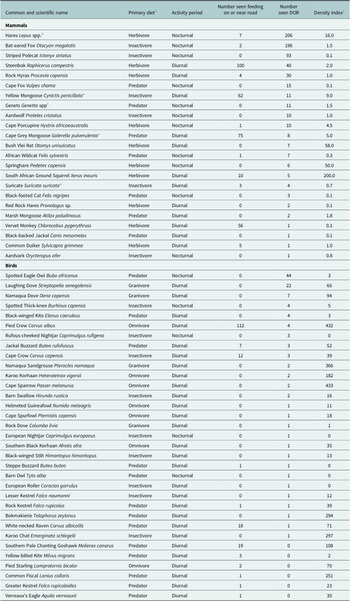
We made 1,125 observations of mammals on or near roads (Table 2). Of these, 326 individuals across 12 species were live and foraging on the road or in the road verge, and 799 were roadkill (670 identified wild mammals of 23 species, 122 unidentified wild mammals and 7 domestic mammals). We recorded 178 live birds across 12 species foraging on the road and 116 road-killed birds of 27 species (Table 2).
Mammals and birds observed feeding on or near the road, dead on the road (DOR) and an index of species density

1 Viverridae: small-spotted Genet, Genetta genetta and large-spotted Genet, Genetta tigrina
2 The density index for mammals is the median density/km2 for arid and semi-arid South Africa from the Endangered Wildlife Trust 2025 Red Mammal List https://ewt.org/2025-red-mammal-list/. The density index for birds is the number of groups of the species observed in 2,854 point counts in the Karoo by Lee (Reference Lee2019). The table excludes domestic animals including 1 goat, 4 dogs and 2 cats
3 Leporidae: cape hare, Lepus capensis, scrub hare, L. saxatilis
* Herpestinae: The three small mongooses are opportunistic foragers, feeding mainly on insects but also fruit, live prey and carrion.
“Nocturnal” includes crepuscular activity.
We recorded 112 roadkill incidents among 12 diurnal mammal species and 558 among 11 nocturnal mammals. Among 28 diurnal bird species, there were 63 roadkill incidents, whereas among 5 nocturnal bird species, there were 53. There was no association between the proportion of nocturnal mammals in our roadkill records and their proportional abundance in the Karoo (χ 2 with Yates correction = 662.39, df = 1, p < 0.0001). Likewise, for birds, there was no association between the proportion of nocturnal species in our roadkill records and their index of abundance in the Karoo (χ 2 with Yates correction = 133,290, df = 1, p < 0.0001). The nocturnal Spotted Eagle Owl was most frequently among avian roadkill (44 individuals) and occurs at a relatively low density in the Karoo (Table 2).
Herbivores contributed 308, insectivores 315 and carnivores 47 of the 670 mammalian roadkill incidents. There was no association between proportional densities of these diet groups in the Karoo landscape and their occurrence as roadkill (χ 2 = 322.29, df = 2, p < 0.0001). Mortality among insectivorous mammals was dominated by Bat-eared Foxes (196 individuals, 62%), a species occurring at a low density of 1.5 km−2 (Table 2). Among birds, predators and granivores dominated roadkill, but omnivores had a higher density index in the region (Table 2). Consequently, there was no association between the occurrence of avian dietary groups as roadkill and abundance in the Karoo (χ 2 = 47.997, df = 3, p < 0.0001).
Among the 12 species of diurnal mammals for which we recorded both live and dead sightings, there was no significant correlation between foraging on or next to the road and incidence of roadkill (n = 12, Spearman’s rho =0.235, p = 0.114). The five most frequently road-killed mammals were hares (206), Steenbok (40) and Rock Hyrax (30), all three being diurnal herbivores, and Bat-eared Fox (196) and Striped Polecat (93), both nocturnal insectivores. Arboreal herbivorous diurnal Vervet Monkeys (56 live, 1 DOR), Yellow (62 live, 11 DOR) and Cape Grey Mongoose (75 live, 8 DOR) frequently foraged near the road but were rarely seen dead on the road (Table 2). Among birds, the Spotted Eagle Owl, a nocturnal predator (44 DOR) and the Laughing Dove, a diurnal granivore (22 DOR) were frequently observed as roadkill, whereas diurnal omnivorous Pied Crows, commonly seen scavenging on the road (112 live, 4 DOR), were seldom observed dead (Table 2).
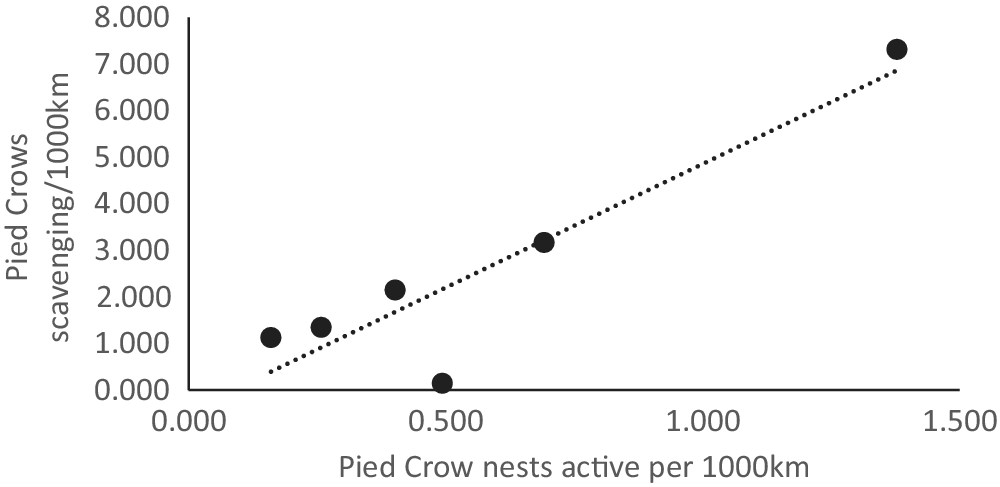
Pied Crows scavenged roadkill in all months of the year; however, during the early spring to mid-summer breeding season (August to January), the density of scavenging crows was linearly and positively correlated with the density of active nests on poles adjacent to the roads (Spearman’s rho = 0.657, df = 5, p = 0.002, Figure 1).
The density of Pied Crows scavenging along roads and the density of active Pied Crow nests per 1,000 km during the August to January breeding season in the Karoo.

Discussion
Our major conclusions are that road mortality was not proportional to population density among birds or mammals. We present some evidence that nocturnal or crepuscular birds and mammals have a greater probability of being killed. However, mortality risks appear to be species-specific and related to animal behaviour.
Roadside attractions
Many small herbivores appear to graze on road verges. For most of their distance, Karoo roads pass through natural rangelands. There are very few croplands, towns or other transformed areas in this arid landscape (Mucina and Rutherford, Reference Mucina, Rutherford, Mucina and Rutherford2006). Despite the natural appearance of Karoo rangelands, productivity has been reduced and the composition of the vegetation altered by past or current overgrazing by domestic livestock (Milton and Dean, Reference Milton and Dean2021). Apart from the green fringe along the edges of roads caused by runoff (Collinson and Patterson-Abrolat, Reference Collinson and Patterson-Abrolat2016), livestock exclusion combined with mowing and road maintenance on some road verges leads to increased herbaceous plant cover (O’Farrell and Milton, Reference O’Farrell and Milton2006), which may attract small herbivores such as hares, Steenbok, Rock Hyrax, Spring Hare and Ground Squirrel. Seeds of herbaceous plants probably also explain the presence of doves on road verges. Arboreal Vervet Monkeys were seen where roads intersected wooded drainage lines but also at roadside pull-offs where food scraps were an attraction.
Mongooses, foxes and other largely insectivorous or generalist small carnivores, as well as corvids seen on roads and verges, were apparently drawn to road-killed insects or carrion. Grain spills from trucks are known to attract rodents and doves to roads (Collinson and Patterson-Abrolat, Reference Collinson and Patterson-Abrolat2016), and the increase in these prey species near roads may have been the main attraction for owls and raptors that hunt live prey.
Roadkill predictability
We found no seasonal patterns in bird or mammal roadkill densities, confirming the findings of Dean and Milton (Reference Dean and Milton2003). Our records suggest that nocturnal animals are more vulnerable to being killed on roads than diurnal animals; however, the risk appears species-specific. Although roadkill density differed among dietary groups for both birds and mammals, the results appeared to be skewed by disproportionate mortality among certain species. Among diurnal mammal species recorded using road verges, the risk of road mortality was unrelated to the frequency of road or roadside use.
Collinson and Patterson-Abrolat (Reference Collinson and Patterson-Abrolat2016) suggest that wildlife responses to traffic can be grouped as “non-responders, pausers, speeders or avoiders.” The behaviour of the African Porcupine, a typical “pauser,” makes it vulnerable to being killed on roads because it stops, erects its quills and attempts to defend itself against an oncoming vehicle. “Speeders” on Karoo roads include herbivores and insectivores that attempt to escape predators by zigzagging or speeding away. This may explain the high mortality of hares and small antelope and possibly also nocturnal carnivores and insectivores. However, animals adapted for night vision may be additionally disadvantaged by being blinded by the lights of oncoming traffic at night (Coetzee et al., Reference Coetzee, Smit, Ackermann and Gaston2023). Larger carnivores such as the Black-backed Jackal tend to be wary “avoiders” of activity on roads and therefore are seldom killed, although they are widespread and likely to scavenge on roadkill.
A meta-analysis of roadkill for birds and mammals across arid and mesic habitats in Latin America (Medano-Vizcaino et al., Reference Medano-Vizcaino, Grilo, Pinto, Carvalho, Melinski, Schultz and Gonzalez-Suarez2022) found that the probability of roadkill was partly explained by geographical position and land use and was positively correlated with population density, short lifespans, high reproductive rate and generalist or invertebrate-based diets. In contrast, our data suggest that the most vulnerable species (Steenbok, Bat-eared Foxes and owls) are neither abundant nor short-lived and r-selected.
Roadkill may have cascading effects
While exposure to roads puts additional pressure on the population of vulnerable species such as the Black Footed Cat, species that avoid vehicles and scavenge can benefit from roads and may, in turn, adversely affect their competitors or prey. The expansion of the Pied Crow population into the largely treeless Karoo shrublands (Fincham et al., Reference Fincham, Visagie, Underhill, Brooks and Markus2015) appears to be related to the availability of telephone and electricity poles and windpumps preferentially used by the crows as nest sites (Joseph et al., Reference Joseph, Seymour and Foord2017). Since the main diet of Pied Crows is small animals such as mice and reptiles, including young tortoises, they probably compete with predators naturally occurring in Karoo areas (Underhill, Reference Underhill2025). Pied Crows scavenge on roadkill more frequently than the more insectivorous Cape Crow (Dean et al., Reference Dean, Milton and Anderson2006) and our observations suggest that scavenging activity by Pied Crows peaks in the August–January breeding season when they are feeding their young (Jenkins and Underhill, Reference Jenkins, Underhill, Harrison, Allan, Underhill, Herremans, Tree, Parker and Brown1997). Roadkill constitutes a “cheap” source of food which, in combination with infrastructure use as nest sites and other anthropogenic changes in the environment, may be improving Pied Crow breeding success and increasing their impact on endemic Karoo prey such as tortoises (Fincham and Lambrechts, Reference Fincham and Lambrechts2014).
Limitations of this study
Our roadkill records were collected opportunistically rather than as part of a planned investigation. Roadkill counts generally under-estimate densities of small species killed because of their rapid removal by scavengers. In the south-eastern USA, 60–97% of bird and reptile roadkill was removed by scavengers within 36 hours of their placement along roads (Antworth et al., Reference Antworth, Pike and Stevens2005). All our recordings were during daylight hours, increasing the likelihood that we underestimated roadkill because of their removal by nocturnal scavengers. The disadvantage of recording roadkill from a moving vehicle was that small carcasses that might have been knocked into the road verge were not observed and therefore probably under-reported. Many road-killed carcasses could not be identified beyond “hare-sized mammal” or similar, the exception being the distinctive remains of Bat-eared Foxes, and for this reason, this species may be over-represented in our records.
The lack of reliable and region-specific data on the densities of birds, particularly nocturnal birds, such as nightjars and owls, reduces the credibility of our conclusions. Some species appeared to be overrepresented among roadkill, but we cannot state this with any certainty. We collected no information on habitats or land use associated with the roadkill, so we were unable to include this variable in our analyses.
Conclusions
A clear pattern that emerged from our documentation of roadkill was the apparent vulnerability of nocturnal birds and mammals. It is likely that many are dazzled by vehicle lights and fail to flee, but there appears to have been very little research on this topic. We have speculated as to the reasons why some species may be disadvantaged and others benefit from roads. Roads and other infrastructure are increasing in what was, until recently, a region little impacted by people. Research specifically planned to gain a better understanding of roadkill impacts, to test the validity of our preliminary findings, to establish spatial patterns in roadkill and to recommend practical approaches to mitigation is urgently needed.
Open peer review
For open peer review materials, please visit http://doi.org/10.1017/dry.2026.10037.
Data availability statement
The data are available from SJ Milton as an Excel spreadsheet.
Acknowledgements
This research was conducted during the years in which WRJ Dean and SJ Milton were employed as researchers by the FitzPatrick Institute for African Ornithology, University of Cape Town. During our visits to Jornada, Walt inspired us with his interests in disturbance ecology, soil–plant–animal interactions and arid ecology in general.
Author contribution
Conceptualization and data collection: WRJD, Writing—original draft: WRJD and SJM, Data analysis: SJM, Review, editing, submission and accountability: SJM.
Competing interests
None declared.


 Open access


Comments
Roadkill in arid Karoo landscapes: winners and losers
This article deals with roadkill of birds and mammals in the arid Karoo region of South Africa and speculates about why some species are more numerous as roadkill than other species. The data were collected opportunistically over two decades of road trips by W Richard J Dean and myself while we were employed as researchers in the Karoo by the FitzPatrick Institute of African Ornithology. Dr Dean started to write this article in 2021 but died in 2022 before completing it. We were both hosted by Prof Walt Whitford in the USA in the 1990s and I feel that I should contribute this short article to the special issue celebrating his work as he was interested in plants, animals and landuse impacts in the arid areas.
The article has not been published previously and is based on original data collection. I have no conflicts of interest to declare.
Sincerely
Sue Milton