

The study of domestic activities provides us with ways to understand daily life in ancient societies. Characterizing domestic activities in precontact sites of southern Central America (Nicaragua, Costa Rica, and Panama) has been limited by the poor preservation of macro-organic archaeological remains in tropical settings and the lack of systematic methods of recovery. Moreover, material assemblages found within domestic structures may reflect life-history stages of the structures and archaeological sites, including the processes of habitation, abandonment, and post-abandonment (LaMotta and Schiffer Reference LaMotta, Schiffer and Allison1999). Methods analyzing the distribution of micro-remains, chemical residues, and microbotanicals enable researchers to investigate and compare domestic activities in areas with poor preservation by obtaining data related to economic and domestic activities, the spatial distribution of those activities within sites and structures, and the use and consumption of plants and fauna. These data, supplemented with information on the distribution and classification of macro-remains, enable an integrated approach to the assessment of ancient people's daily lives.
Small-sized remains have advantages for enhancing our understanding of domestic activities within structures. The larger artifacts left on the surface of floors are not likely to be found where they were actually used during the life cycles of the structures. Thus, long-term patterns in the use of space can be better examined through small things that remain after cleaning activities or site abandonment (De Lucia Reference De Lucia2013; Rainville Reference Rainville, Parker and Foster2012; Robin Reference Robin2013; Tringham Reference Tringham, Parker and Foster2012; Ullah Reference Ullah, Parker and Foster2012).
Households are essential to understanding the rise of complex societies, the organization of societies, the nature of sociopolitical change, and the bases of political economy. Shifts in those larger relations lead to the transformation of household structures and vice versa: changes in households’ structures can alter the larger sets of relations (Masson and Freidel Reference Masson and Freidel2012; Sweitz Reference Sweitz2012; Wesson Reference Wesson2008). As such, households and their material expression in domestic contexts are fields of the expression and negotiation of powerFootnote 1 and social differences (Janusek Reference Janusek and Silverman2004; Pérez Rodríguez Reference Pérez Rodríguez2006). The study of households brings agency to actors in all levels of the social hierarchy while recognizing broader social, economic, political, or environmental constraints (Hendon Reference Hendon and Meskell2004; Pluckhahn Reference Pluckhahn2010; Robin Reference Robin2003, Reference Robin2013). Expressions of differences and the negotiation of power can result from interactions and relations among individuals, members of the household, groups of households, and communities (Robin Reference Robin2013).
The study of material remains associated with domestic contexts in different socioeconomic sectors allows for the comparison of social differences, including those related to culinary and economic activities. Wealth-related dietary differences can be expressed in the quality of food consumed, the types of foods chosen for consumption, the relative proportions of such different food types, and the containers in which they are served (Curet and Pestle Reference Curet and Pestle2010; Rosenswig, Reference Rosenswig2007; Turkon, Reference Turkon2004). Wealth can also be manifested through large and diverse material inventories (Hirth Reference Hirth, Santley and Hirth1993), which could be indicators of the diversity of economic activities developed by the occupants of different sectors or structures. Moreover, occupational differentiation could be defined by a high degree of artifact diversity and heterogeneity, with sectors having different types and quantities of byproducts (Martín and Murillo Reference Martín and Murillo2014:61).
This article addresses manifestations of social differentiation through culinary practices and other domestic activities at the Lomas Entierros site. We present results from micro-artifacts, chemical residue, and starch grain analysis from two cobblestone structures located in the elite and intermediate-status sectors of the site. The architecture and materials recovered suggest differences both in status and functional variability.
Ancient Costa Rican Societies
Evidence of ancient human occupation in southern Central America (Nicaragua, Costa Rica, and Panama) extends from the Paleoindian period to the time of European contact (Cooke Reference Cooke, McEwan and Hoopes2021; Hoopes et al. Reference Hoopes, McEwan, Cockrell, McEwan and Hoopes2021). Archaeological data, historical linguistics, and population genetics indicate that southern Central America was occupied by people who developed and thrived in situ after centuries of fissioning and fusing (Barrantes et al. Reference Barrantes, Smouse, Mohrenweiser, Gershowitz, Azofeifa, Arias and Neel1990; Constenla Umaña Reference Constenla Umaña1991; Cooke Reference Cooke, McEwan and Hoopes2021; Perego et al. Reference Perego, Lancioni, Tribaldos, Angerhofer, Ekins, Olivieri and Woodward2012). The variable geography of the landscape favored both endemism and diversity in societies; at the end of the sixteenth century, their members spoke diverse, yet related, Chibchan and Chocoan languages. At the time of European arrival, ethnohistorical accounts and historical linguistics indicate that northwestern Costa Rica and southeastern Nicaragua were occupied by migrants who spoke the Mesoamerican languages Chorotega (Mangue), Subtiaba (Tlapanec), and Nicarao (Nahua) (Constenla Umaña Reference Constenla Umaña1991, Reference Constenla Umaña1994; Salgado González and Fernández-León Reference Salgado González and Fernández-León2011).
Processes of diversification led to the formation of distinct cultural regions with fluctuating boundaries. Social complexity and political hierarchies developed at various centers of modern-day Costa Rica, including Lomas Entierros, and flourished between AD 800 and 1500 (Corrales Reference Corrales2011). A multitiered settlement system, mortuary differentiation, and monumental architecture at political centers reflected those centers’ social complexity (Corrales Reference Corrales2001). Moreover, social hierarchies were suggested by the presence of elaborate ceremonial metates, anthropomorphic sculpture, and a proliferation of trade of metallurgical items and polychrome ceramics (Frost and Quilter Reference Frost, Quilter, Burger and Rosenswig2012; Hoopes Reference Hoopes, Ericson and Baugh1993; Hoopes et al. Reference Hoopes, McEwan, Cockrell, McEwan and Hoopes2021; Snarskis Reference Snarskis, Quilter and Hoopes2003). However, when comparing different regions of modern-day Costa Rica, it is clear that such development was not equal or unilineal throughout the territory (Murillo Reference Murillo2010) and that there was great variability in the forms and development of social organization during precontact times. Although significant work has been done in the region, questions remain regarding everyday life at such centers and the social and economic differentiation within and between households; we address some of these questions in this article.
Status Differences in Lomas Entierros
Lomas Entierros, located in Central Pacific Costa Rica (Figure 1), was occupied from 300 BC to AD 1185. It became a primary center during its last period of occupation, which was characterized by the construction of cobblestone structures adapted to the natural topography of the hill on which they were built. Such structures were radiocarbon dated to cal AD 646–1185 (Núñez Reference Núñez-Cortés2020a; Núñez-Cortés and Ruiz-Cubillo Reference Núñez-Cortés and Ruiz-Cubillo2022). During that time, Lomas Entierros became the largest center and most heavily built site in the lower Tárcoles River drainage.
Location of the Lomas Entierros archaeological site. (Color online)

The Tárcoles River (along with its affluents) was considered a major trade route during late precontact times for transporting valuable exchanged goods produced in southwestern Nicaragua and northwestern Costa Rica (known as the Greater Nicoya region) to the central archaeological region: that region includes the Caribbean watershed, the Central Highlands, and the Central Pacific, all of which were a focus of occupation and the development of complex societies during late precontact times. Exchanged objects have been found in many of the principal centers of Central Costa Rica (Corrales Reference Corrales1994). Imported objects from the Greater Nicoya found at Lomas Entierros include polychrome and incised ceramics, groundstone, either raw or finished products of red and green jasper, and bifacially flaked axes and projectile points or the knowledge of this technology (Núñez Reference Núñez-Cortés2020b). More than 15% of these objects were imported ceramics (Núñez Reference Núñez-Cortés2020a; Solís and Herrera Reference Solís and Herrera1992): they were valued by elites and other members of the Lomas Entierros community, as we emphasize later. The location of the settlement between the coastal plain and the piedmont likely allowed inhabitants access to a wide variety of resources.
Previous work at Lomas Entierros (Núñez Reference Núñez-Cortés2020a, Reference Núñez-Cortés2020b; Núñez and Barba Reference Núñez-Cortés and Pingarrón2023) indicated that status differentiations were manifested in the architecture; the location of individual structures within the site; the possession of valuable goods, both local and imported; and access to protein resources. In general terms, the distribution of wealth at Lomas Entierros community was expressed along a continuum, with the highest-status residents located at the highest elevation (145–153 m asl) in the northwestern sector at the apex, and with status diminishing down to the lowest elevation (115–130 m asl) in the southern sector of the site.
We categorized goods within a range of value (low, medium, and high) based on Feinman and colleagues’ (Reference Feinman, Upham and Lightfoot1981) production step measure that allowed us to assign a labor or craftmanship value according to the material quality of the object. We also considered the labor required to move imported objects or the knowledge associated with foreign technologies. High-value goods at Lomas Entierros included incised and polychrome imported ceramics (including the types Papagayo Polychrome, Mora Polychrome, Altiplano Polychrome, Birmania Polychrome, Jicote Polychrome, and incised ceramics of an unidentified type); incised local ceramics (of the Tayutic Incised ceramic group), decorated metates with feline and avian imagery; polished stone tools (chisels and celts); and bifacially flaked axes and projectile points. Other plasticly decorated monochrome and bichrome ceramics, less decorated and simple metates, and expedited lithic tools were part of the mid- and low-value categories of objects (see more details in Núñez Reference Núñez-Cortés2020a).
We can identify at least three socioeconomic groups distributed throughout the settlement based on the site-wide distribution of structures and material assemblages, most of which were derived from midden deposits. Elites, located on the highest elevation sectors of the settlement, had access to many and varied exchange goods, along with locally produced valuables, such as carved and decorated metates and decorated serving bowls and jars. Service ware was also highly concentrated in elite sectors, including in Structure 13 that we discuss in detail later; some of these items also corresponded to imported and high-valued bowls. The serving ware included vases, small jars and tecomates, plates, and bowls. Small jars, tecomates, and bowls with incurving and straight rims could have also been used for short-term storage and occasional food preparation.
Moreover, the concentration of fancy serving vessels in the northern sector indicates that the people using them in such locations valued the visual presentation of food and may have engaged in visible food consumption in the form of feasts. As proposed by other scholars (Hastorf Reference Hastorf2016:194–197; Hendon Reference Hendon and Ardren2020; Lamoureux-St-Hilaire Reference Lamoureux-St-Hilaire and Ardren2020), feasting events can achieve various goals, including demarcating social differences and creating a sense of community. At Lomas Entierros, feasting elite sectors may have consumed carbohydrate-, protein-, and fat-rich foods, with protein and fats being more restricted at the site (Núñez and Barba Reference Núñez-Cortés and Pingarrón2023). Because elite residences were located at the highest vantage point of the site (Núñez-Cortés and Ruiz-Cubillo Reference Núñez-Cortés and Ruiz-Cubillo2022:10), it is likely that the events that took place there were very visible to the rest of the community and may have served as status-enhancing occasions that emphasized hierarchical relationships.
Most of the spindle whorls, remains from surplus lithic production, and flaked lithic tools that could have served for other crafting or everyday endeavors were reported from elite contexts. Surplus lithic production (following Masson et al. Reference Masson, Hare, Lope, Escamilla Ojeda, Paris, Kohut, Russell and Alvarado2016) was indicated by the presence of flake stone tool debris, including non-used flakes, primary flakes, debitage, and cores, in a density above one standard deviation from the mean (see more details in Núñez Reference Núñez-Cortés2020a). These areas partially map with the wealthier assemblages, suggesting a linkage between contexts of lithic surplus production and the acquisition of valuable objects. Lithic surplus production also may have been overseen or performed by the wealthiest sectors of the community.
Flaked tools included scrapers, perforators, and knives made from a variety of rocks, of which basalt and andesite were the preferred raw materials (Núñez Reference Núñez-Cortés2020a:Table 6.2). Such tools may have involved the processing of hide, fibers, and wood; working over shell, bone, or stone; and butchering or cutting (Aoyama Reference Aoyama2009:Table 3.8; Herrera and Solís Reference Herrera and Solís1988; Lemorini et al. Reference Lemorini, Bourguignon, Zupancich, Gopher and Barkai2015). The association of lithic production remains and finished tools with elite contexts suggests that elites may have controlled not only chipped stone production but also crafting activities in which these objects were used. Textiles, hide, and worked bone and shell could have been valuable products for both internal and external exchange.
Intermediate-status members, located on mid-elevation areas of the site, also had access to objects of exchange but to a lesser extent; diverse household sets reflected varied occupational activities. Service and culinary vessels from intermediate-status contexts were found in similar proportions, suggesting a similar distribution of cooking and serving activities. Culinary ware included medium and large jars with everted and outflaring rims. The jars within this group seemed to be designed for cooking, food processing without fire, and storage.
In contrast, low-status members, located at the periphery of the settlement in the lowest-elevation sectors, had access to trade goods of lower value and in smaller quantities; inconspicuous ceramic assemblages were found in this sector. The proportion of service to culinary ware suggest that, in this area of the settlement, there was the highest proportion of cooking and storing activities.
Intermediate- and low-status sectors also contained a large number of domestic metates, especially abundant in border areas between the elite and intermediate-status groups. Such spatial distribution along with their respective equal and greater proportions of culinary vessels in the same sectors suggest that food-processing activities were commonly performed by intermediate- and low-status members of the community. It also suggests that elite groups may have been able to partially disengage from food-processing activities, for which they may have established service relationships with other members of the community.
Objects such as stone celts and axes were found in association with intermediate and intermediate/low economic groups, especially in Structure 45 as we discuss later. Woodworking and other activities such as cutting, digging, slitting, sculpting, and butchering could be associated with the presence of stone celts and axes (Bernstein Reference Bernstein1980; Herrera and Solís Reference Herrera and Solís1988; Vega Reference Vega1970). Chisels, which could have been used for finer sculpting or woodcarving, were exclusively recovered from intermediate-status contexts. The lack of spatial correlation between these intermediate crafting and productive contexts and elite areas suggests that these activities were not overseen by elites and could have been performed relatively independently (e.g., Costin Reference Costin2000; Masson et al. Reference Masson, Hare, Lope, Escamilla Ojeda, Paris, Kohut, Russell and Alvarado2016). Internal and external exchange may have created opportunities for members of these social stratus, particularly those specializing in crafts that were not dominated or controlled by elites, to gain wealth.
Two Excavated Structures
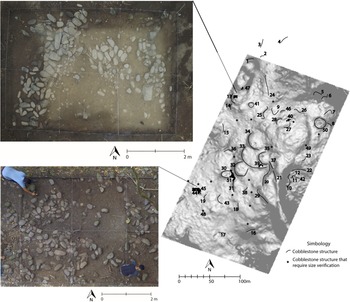
Two structures located in different sectors of the settlement were horizontally exposed to characterize the architecture and material remains associated with them (Figure 2). Excavations were conducted following 5 cm arbitrary levels until reaching occupational floors marked by clay-floor fragments or the level at which the cobblestones were placed. Their assemblages and location suggest that they were occupied by different socioeconomic groups. The distribution of material remains as indications of socioeconomic status is presented in detail elsewhere (Núñez Reference Núñez-Cortés2020a), and we summarize it here.
Distribution of documented structures at Lomas Entierros and location of horizontally exposed structures on the hillshade lidar map. (Color online)

Structure 13
Structure 13 is located in the northwestern sector of the site. It corresponds to a smaller terrace with a cobblestone retaining wall. An internal cobblestone structure was partially exposed to obtain data from segments that had not been affected by looting. We recovered segments of a clay floor of light coloration and fine texture in the interior, along with horizontally placed ceramic fragments near the last row of the terrace retaining wall and next to the rocks forming the retaining wall. Material remains associated with this structure indicate a higher degree of wealth, as represented by larger amounts of high-value ceramics, both exchanged goods and those that were locally made. Densities of serving ware notably surpassed the amount of cooking vessels recovered (Núñez Reference Núñez-Cortés2020a:272), suggesting that food preparation activities were not as prominent in this sector. Metate fragments seem to have been reused as construction material, because most were found upside down and in association with the cobblestones delineating the wall of the structure. Structure 13 contained exclusively flaked stone tools, including scrapers, cutting, and puncturing tools; end-notched scrapers; and a combination of end and notched scrapers with a puncturing section in them.
A test pit located at the base of Structure 13 provides further evidence for service activities in this sector. This test pit contained one of the densest amounts of foreign and high-value serving containers. The general distribution of service pots throughout Lomas Entierros suggests that service activities involving fancy and imported vessels took place at a higher rate in the northern (and elite) sector (Núñez Reference Núñez-Cortés2020a:223–224).
Structure 44
In the southern sector we excavated two smaller cobblestone structures and a clay feature, likely parts of a clay floor and daub. Cobblestone structures 44 and 45 were adjacent to each other, and although they could have been used by the same household group, they seemed to have served different functions. Celts and chisels associated with Structure 45 suggests that its occupants may have performed activities such as woodworking, cutting, digging, slitting, sculpting, and butchering (Núñez Reference Núñez-Cortés2020a:267). We focused on the analysis of Structure 44, which has a quadrangular (almost L-shape) foundation. The floor of occupation was defined by the level at which the cobblestones were placed, on top of soil that combined brown loam with light-brown clay inclusions.
Ceramic materials were found in greater abundance in the external spaces of Structure 44 (see Núñez Reference Núñez-Cortés2020a:Figure 4.25). The ceramic fragments found in the interior were mostly culinary (including cooking and storage) vessels; in contrast, serving vessels were more abundant in the exterior. There was very low diversity in its material assemblage, which mostly comprised pecking stones, flaked tools (including end scrapers, puncturing tools, and tools combining end scrapers with puncturing and knife sections), low-value jars, and imported bowls. The redundancy of the assemblage suggests that a small number of activities took place at this location (Núñez Reference Núñez-Cortés2020a).Footnote 2
Methods
Micro-artifact Analysis
During the excavation of the occupational floor of each structure, we collected soil samples (1 kg each) on a 1 m grid for micro-artifact analysis. Micro-artifacts are human-produced debris smaller than 1.5 cm2 that became embedded in floors and occupational surfaces. These types of debris are collected in the heavy residue byproduct of flotation samples and can include microfauna, shell, insects, eggshell, micro-debitage of lithics, figurines, beads, dung, plant materials, and coprolite fragments (Özbal Reference Özbal, Parker and Foster2012; Tringham Reference Tringham, Parker and Foster2012; Ullah Reference Ullah, Parker and Foster2012).
We weighed and floated the Lomas Entierros samples to separate the heavy and light fractions. The heavy fraction was first separated through three sizes of geological sieves (4,000, 2,000, and 500 microns) to aid with the observation, separation, and preliminary identification of micro-artifacts. Each subset was observed under a 10× magnifying glass lamp followed by a definitive separation, identification, and photography under a stereoscope (Olympus SZX16).
Because micro-artifact analysis is an experimental procedure in Costa Rica, reference debris samples derived from larger bone and shell were observed and photographed to aid with identification with the Lomas Entierros collection. In addition, the criteria to identify microlithics were based on the raw materials already reported in the lithic tools and debitage collection of Lomas Entierros. Each one of the identified micro-artifacts identified was counted, and densities were generated based on these counts divided by the weight of the sediment sample (#/kg).
Chemical Residue Analysis
At the same level of the occupational floor, we collected 100 g samples every 50 cm for both chemical residue and starch grain analysis. The samples were analyzed at the Laboratorio de Prospección Arqueológica of the Instituto de Investigaciones Antropológicas, UNAM. The procedures followed protocols established by Barba and colleagues (Barba Reference Barba2007; Barba et al. Reference Barba, Rodríguez and Córdoba1991, Reference Luis, Ortiz and Pecci2014) for a semiquantitative spot test. Our analyses included tests for both inorganic (pH, carbonates, phosphates) and organic (carbohydrates, protein, and fatty acids) residues (Supplemental Protocol 1).
Because phosphates are generally associated with the presence of organic matter, phosphorus accumulates in areas occupied by human settlements (Barba et al. Reference Barba, Rodríguez and Córdoba1991, Reference Luis, Ortiz and Pecci2014). The pH level reflects the acidity or alkalinity levels as a result of human activities. One of the most productive uses of this marker is locating ash deposits resulting from combustion in hearths and cooking areas (Barba and Ortiz Reference Barba and Ortiz1992). Carbonates can be indicators of anthropogenic activities, especially in areas where limestones are not geologically available (Zipoli Reference Zipoli2015:108). In Mesoamerica analysis of carbonates has been used to identify nixtamalization and the processing of limestone and stucco floors (Barba and Ortiz Reference Barba and Ortiz1992). Carbonates can also indicate the presence of shell remains and shell cooking or crafting.
Carbohydrates can be associated with the presence of sugar-rich foods, which are mostly found in tubers and seeds, as well as in fermented beverages (Barba et al. Reference Barba, Rodríguez and Córdoba1991, Reference Luis, Ortiz and Pecci2014; Jiménez et al. Reference Jiménez, Berenice, Acosta-Ochoa, Cervantes-Rosado, Ortiz-Butrón and Cruz-Palma2021; Ortiz Reference Ortiz Butrón2021; Pecci et al. Reference Pecci, Ortiz and Barba2017). Protein residues can reflect the presence of animal tissues, blood, insects, and meat broths (Barba et al. Reference Luis, Ortiz and Pecci2014; Ortiz et al. Reference Ortiz, Barba, Terreros, Jiménez, Vallin, Barrera and Aguayo2019). Fatty acids can be associated with both animal fats and vegetable oils and sometimes with resins (Barba et al. Reference Barba, Rodríguez and Córdoba1991, Reference Luis, Luján, Ortiz, Link and Lazos1996). These organic residues are very useful in the interpretation of activity areas in structures and in ceramic containers (Barba et al. Reference Luis, Ortiz and Pecci2014).
Starch Grain Analysis
Samples for starch grain analysis were selected from those areas that presented the highest carbohydrate values in the chemical analysis, for a total of 108 samples. Sediment samples were processed at the Laboratorio de Prehistoria y Evolución Humana at UNAM, following the protocols established by Pagán-Jiménez (Reference Pagán-Jiménez2005) and Cruz (Reference Cruz2022). Sterile micro-centrifuge tubes were filled with approximately 0.05 g of sediment and 1 mL of cesium chloride (CsCl) and centrifuged at 3,000 rpm (revolutions/minute) for 15 minuntes to separate starch grains. The supernatant (the liquid lying above the solid residue) was then decanted into a new sterile tube that was filled with distilled water and centrifuged at 4,000 rpm for 15 minutes. To reduce the CsCl solution's specific gravity, 1 mL of supernatant was decanted and replaced by 1 mL of distilled water and then centrifuged at 4,000 rpm for 15 minutes (this step was repeated). The remaining residue was mounted in slides with a drop of glycerin and covered with coverslips.
The starches were observed, measured, and photographed using an Olympus BX53 polarizing-light microscope with birefringence in dark and light fields. All starch grains recovered were photographed in multiple positions by rotating them in both dark and light fields. Identifications were based on the Laboratorio de Prehistoria y Evolución Humana at UNAM's starch reference collection and published material by Pagán-Jiménez (Reference Pagán-Jiménez2015; Pagán-Jiménez and Mickleburgh Reference Pagán-Jiménez and Mickleburgh2022), Piperno and Holst (Reference Piperno and Holst1998), Dickau (Reference Dickau, VanDerwarker and Peres2010; Dickau et al. Reference Dickau, Ranere and Cooke2007), and Chinique de Armas and colleagues (Reference Chinique de Armas, Buhay, Suárez, Bestel, Smith, Mowat and Roksandic2015). Alterations of the morphology of the granules resulting from plant processing were compared with examples from the literature based on experimental and archaeological studies (Babot Reference Torrence and Barton2006; Henry et al. Reference Henry, Hudson and Piperno2009; Liu et al. Reference Liu, Wang, Rosenberg, Zhao, Lengyel and Nadel2018; Mickleburgh and Pagán-Jiménez Reference Mickleburgh and Pagán-Jiménez2012; Pagán-Jiménez et al. Reference Pagán Jiménez, Guachamín-Tello, Romero-Bastidas and Vásquez-Ponce2017; Rodríguez et al. Reference Rodríguez, Cruz, Acosta and Roksandic2016). Those starches that presented some but not all the diagnostic characteristics observed in the reference collection or the literature were given tentative identifications and labeled as “cf.” (closest tentative classification). Starches that did not have any traits documented in our reference collection or the literature reviewed were labeled as “unidentified.”
Distribution of Activities
Elite Sector: Structure 13
The set of analyses for Structure 13 allowed us to identify evidence of cooking activities in internal spaces and possible areas of stone tool manufacture in both internal and external spaces. The limited excavation of this area did not permit a full characterization of the activity areas in and around this structure, but it did enable us to locate areas of human activity.
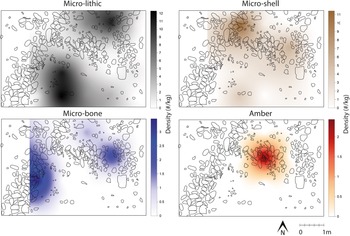
The micro-remains found in Structure 13 (Figure 3) provide an indication of activities that were not evident solely from the artifact sample. Abundant micro-lithics, bone, and shell were identified in both the exterior and interior spaces of the structure. A small resin fragment was found in a sample collected near the wall of the structure. Lithic debitage, flakes, cores, and pecking tools formed part of this structure's artifact assemblage, which had the greatest number of lithic debris of all the structures excavated (Núñez Reference Núñez-Cortés2020a:256–257). The highest densities of micro-lithics were found in the sectors where evidence for lithic production was detected through macro-remains, suggesting that these spaces may have been production areas.
Distribution of micro-artifacts in Structure 13. (Color online)

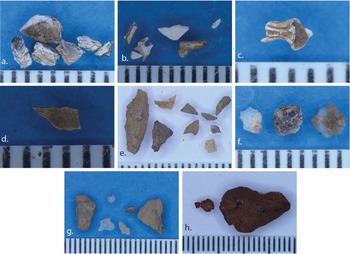
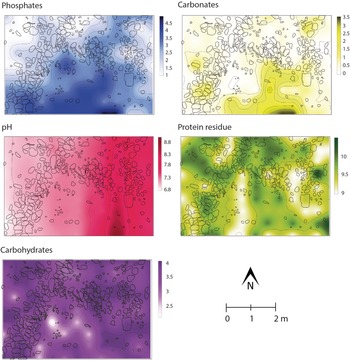
Micro-remains of burned shell were obtained from samples near the terrace wall (Figure 4); they were probably removed from cooking spaces in the interior of the structure. Chemical residue analysis indicated the presence of high levels of carbonate residues, which spatially correlated with phosphates at the interior of this structure (Figure 5). These high values of phosphates and carbonates were found in the same location as high pH values that differed from the rest of the excavated area. High values of pH indicate the presence of ash that could have been derived from a hearth.Footnote 3 The combination of these signatures suggest that shell resources may have been processed with fire, and the high values of phosphates suggest disposal of the remaining parts of the mollusks.
Micro-artifacts from Structure 13: (a) burned shell; (b) shell and bone; (c–d) bone; (e–g) lithics; (h) amber. Scale is in millimeters. (Color online)

Distribution of chemical residues in Structure 13. (Color online)

High values of protein residue and carbohydrates were also found in the interior of the structure, which suggest foodstuff processing and cooking. Remains of micro-bone were detected in both internal and external spaces but were concentrated near the retaining wall of the terrace. High values of protein and carbohydrate outside the structure did not map with other signatures. However, food consumption and preparation trash disposed of in external spaces could explain these high values. Structure 13 and its surroundings contained a higher proportion of serving vessels. suggesting that serving activities took place at a greater rate in this area (Núñez Reference Núñez-Cortés2020a; Núñez and Barba Reference Núñez-Cortés and Pingarrón2023).
High carbohydrate values, which resulted in the identification of starch grains, were mostly found in the internal spaces of Structure 13 (Figure 6). Starches with secure identifications (Table 1) to the species level included maize (Zea mays) and chili pepper (Capsicum sp.). Of these, maize was the most abundant starch grain. Four grains suggest their correspondence with tubers, but they could not be securely identified at the moment. Granules with tentative identifications include possibly maize (cf. Zea mays).Footnote 4
Location and examples of starch grain found at Structure 13. Light background color pictures are starches under a bright-field view; black background images are the same starches under polarized light and a dark-field view: (a) and (a1) Capsicum sp.; (b) and (b1) cf. Zea mays; (c) and (c1) Zea mays; (d) and (d1) cf. Zea mays; (e) and (e1) unidentified tuber; (f) conglomerate; (g) conglomerate; (h) and (h1) Zea mays; (i) and (i1) unidentified; (j) and (j1) cf. Zea mays; (k) and (k1) unidentified tuber; (l) and (l1) unidentified tuber; (m) and (m1) Zea mays; (n) conglomerate; (o) and (o1) unidentified; (p) and (p1) Zea mays. Abbreviations: H = hilum, F = fissure, L= lamellae, RS = radial striation. (Color online)

Starch Grain Identifications in Structure 13.

Note: Abbreviations: cl = starch clusters, P = pressure damage, H = heat damage. Counts of individual starchers in clusters are not given because they could not always be counted.
Samples found near where high pH values were concentrated contained several starch grains conglomerates that were gelatinized and lacked recognizable features; this indicated that they were subjected to high temperatures in a liquid medium for a long time (Henry et al. Reference Henry, Hudson and Piperno2009:916). Two maize granules, a possible maize, and an unidentified starch grain presented alterations of the extinction cross and loss of birefringence, which are signs of damage consistently associated with heat treatments (Henry et al. Reference Henry, Hudson and Piperno2009). A maize grain also showed radial striations (Figure 6m) extending from the hilum to the border of the granule, which suggest the application of pressure as a result of grinding (Mickleburgh and Pagán-Jiménez Reference Mickleburgh and Pagán-Jiménez2012). However, such features have been observed in grains from reference collections wihtout any processing. The presence of gelatinized and heat-damaged granules in the interior of the structure reinforces the interpretation that it was a food preparation and cooking area and confirms the relationship between high pH and carbohydrate values and starch grain concentration.
Intermediate Sector: Structure 44
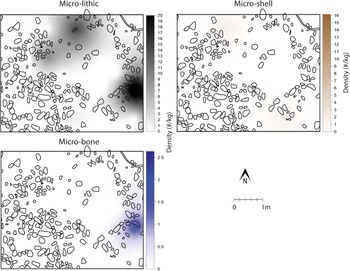
The same analyses performed at Structure 44 yielded less diverse and enriched results than from Structure 13, suggesting that this space was used for different type of activities or over a shorter period of time. The only micro-remains detected in relative abundance were lithics and bone, located at the edge of the structure. Micro-shell was found in very small densities in the exterior (Figure 7). Macro-lithic debris were found in both external and internal spaces, along with two pecking stones recovered from the internal area. The presence of both macro- and micro-lithics suggests the production or resharpening of flaked lithic stone tools; however, they were found in lesser quantities and densities than at Structure 13 (Núñez Reference Núñez-Cortés2020a).
Distribution of micro-artifacts at Structure 44. (Color online)

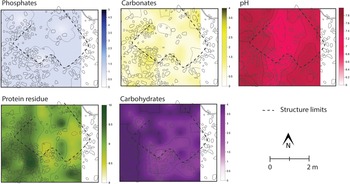
Chemical residue analyses yielded low values for phosphates and carbonates (Figure 8), whereas protein residue, carbohydrates, and pH tests produced higher values. That carbohydrate values were high in this sector may have been due to the superficiality of the structure and the abundance of cellulose from the current forest vegetation. However, proteins, carbohydrates, and pH presented higher signatures in external spaces, suggesting that most activities took place in this area. Lower signatures in the interior of the structure may suggest that it either was an area with heavy transit or very little use.
Distribution of chemical residues at Structure 44. (Color online)

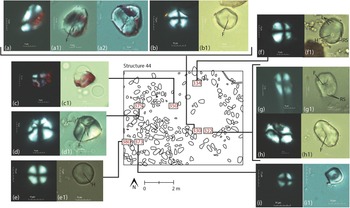
Samples from both the interior and exterior of structure 44 yielded evidence for starch grains (Figure 9), suggesting that plant tissues were used, processed, or discarded in both areas. No examples of conglomerates of gelatinized granules were recovered in this sector. As in Structure 13, maize (Zea mays) was the most abundant microbotanical recovered (Table 2). Tentative identifications included a possible granule of Cucurbitaceae. Granules with alterations on the extinction cross and loss of birefringence included a maize granule and two unidentified grains. Radial striations that may indicate pressure damage or grinding (Mickleburgh and Pagán-Jiménez Reference Mickleburgh and Pagán-Jiménez2012) were detected in a maize and a possible Cucurbitaceae granule (Figure 9f1, g1).
Location and examples of starch grain found at Structure 44. Black background images are starches under polarized light and a dark-field view, and light background color pictures are the same starches under a bright-field view: (a), (a1), and (a2) unidentified; (b) and (b1) Zea mays; (c) and (c1) unidentified; (d) and (d1) Zea mays; (e) and (e1) Zea Mays; (f) and (f1) cf. Cucurbitaceae; (g) and (g1) Zea mays; (h) and (h1) unidentified; (i) and (i1) unidentified. Abbreviations: H = hilum, F = fissure, L = lamellae, RS = radial striation. (Color online)

Starch Grain Identifications in Structure 44.

Note: Abbreviations: P = pressure damage, H = heat damage.
Discussion and Conclusions
The results obtained through chemical residue, micro-artifacts, and starch grain analyses provide information about past human activities at two structures at Lomas Entierros; these findings are not possible to obtain through the analysis of macro-remains. These traces of human activities allow us to interpret their nature and purposes. Structure 13 presents a richer dataset that suggests cooking in its interior. Burned shell and heat-damaged starch grains near the concentration of high pH values at the southern edge of the excavation are further evidence for this interpretation.
Lithic production is evident through micro- and macro-remains in both Structure 13 and 44, with Structure 13 having the highest concentration of lithic debris and raw materials of restricted access for the community, such as red jasper (Núñez Reference Núñez-Cortés2020a). Although no interior cooking space was identified at Structure 44, starch grains indicate that food plants were deposited inside the structure. Although starch grains can be deposited by a variety of activities (agriculture, cooking, refuse, etc.), areas with the highest potential for their preservation include those where plants were transformed by human activity (Pearsall Reference Pearsall2016:346). Micro-traces and chemical residue at Structure 44, along with the low level of diversity in artifact remains, suggest slight human activity, which could be due to the function or the time of use of the structure. A similar small, square structure was excavated at the site of Jesús María in Central Pacific Costa Rica, which was interpreted as a storage area due to the low densities of materials remains and low chemical signatures for phosphates, carbonates, and pH (Solís Reference Solís1992). Structure 44 at Lomas Entierros is comparable in the sense that jars suitable for storage or cooking were mostly found in its interior, micro-artifacts were lacking in the same area, and chemical values were low. Moreover, we were able to identify starch grains from plants that could be stored in their dry form, such as maize.
The starch grains we analyzed indicate that plants processed at Structure 13 and 44 at Lomas Entierros included a combination of tubers and seeds. A greater number of starch granules were identified in Structure 13, perhaps because of the type of activities taking place there. Previous analyses based on chemical residues deposited on ceramic containers suggest differential access to foods in high-, intermediate-, and low-status contexts. Samples from elite- and intermediate-status sectors present greater and more restricted access to proteins and fats, whereas carbohydrates were widely consumed by all members of the community (Núñez and Barba Reference Núñez-Cortés and Pingarrón2023). More access to meat (rich in protein and fats) in elite sectors may have been the cause of this differential enrichment in ceramic vessels from the distinct sectors of the site.
The starch grains found in occupational floors do not suggest that elite members had a greater or more diverse access to plant foods. In both structures maize was securely identified, and the presence of some plants was detected in only one of the two structures. Chili peppers were only identified at Structure 13, and possibly squash only at Structure 44. Such differences do not provide enough evidence to argue for differential access to plant resources. Other factors may affect disparities in access to food, including those regarding the preparation and serving of such resources (Twiss Reference Twiss2019:85) or postdepositional disturbances.
A larger number of elaborate serving vessels were excavated at Structure 13, indicating a higher rate of service activities than culinary ones. Moreover, the distribution of ceramic remains throughout the site suggests food consumption in the form of feasts that took place at elite contexts in the northern sector of the site, where Structure 13 is located. Markers of feasts include a greater proportion of serving vessels in elite contexts, some of which contained more restricted substances containing protein and fats. The areas where large numbers of serving vessels were found are surrounded by areas with greater number of metates, suggesting a degree of spatial separation between food processing and food service (see details in Núñez Reference Núñez-Cortés2020a; Núñez and Barba Reference Núñez-Cortés and Pingarrón2023). If feasts were taking place at Structure 13 and in the surrounding spaces of the terrace where it is located, they may have included the plant foods reported here, as well as protein derived from mollusk and other meat sources not yet identified. The distribution of fancy service assemblages in elite contexts and the visibility of its hilltop setting (Núñez-Cortés and Ruiz-Cubillo Reference Núñez-Cortés and Ruiz-Cubillo2022) suggest that feasting activities may have served as political statements to enhance status differences.
Material evidence for intermediate-status sectors, where Structure 44 is located, indicates that such groups were able to amass material wealth, likely from independent crafting activities. They were able to gain access to valuable objects, including elaborate local and imported ceramic vessels (Núñez Reference Núñez-Cortés2020a). Chemical residue data from such containers provide evidence for access to a variety of foodstuffs that included resources with protein, carbohydrate, and fat content (Núñez and Barba Reference Núñez-Cortés and Pingarrón2023). Although chemical residue analysis and micro-remains from Structure 44 indicate slight activity, starch grain analysis indicates a diverse content but lower amounts of food plants. The procurement of possibly squash, not found in Structure 13, may further support that intermediate-status members had the ability to gain access to a variety of resources. We propose that Structure 44 corresponds to a storage structure used by intermediate-status community members residing in the southern sectors of the site. However, we cannot discard the possibility that stored foods in this space may have moved up the hierarchy by processes such as taxes, tribute, or staple finance systems (Brumfiel and Earle Reference Brumfiel, Earle, Brumfiel and Earle1987; Earle Reference Earle1997; McAnany et al. Reference McAnany, Thomas, Morandi, Peterson, Harrison, Masson and Freidel2002).
Our work at Lomas Entierros represents one of the first integrated attempts to reconstruct economic and culinary practices of everyday life in Costa Rica by considering many sources of information, including chemical residues, micro-debitage, starch grains, architecture, and material distribution. These analyses provide data that will help us understand the complex social relationships in the Lomas Entierros community during its late phase of occupation. It also provides a way to investigate daily life in archaeological sites that have limited conservation of organic remains.
Acknowledgments
This article was written as part of a postdoctoral fellowship with UNAM under the mentorship of Dr. Ernesto Vargas Pacheco (Y.N.C). We are grateful to the Laboratorio de Prospección Arqueológica and the Laboratorio de Prehistoria y Evolución Humana where the chemical residues and starch grain analyses were conducted. We are also grateful to the National Museum of Costa Rica for the laboratory space supplied and to Comisión Arqueológica Nacional and Sistema Nacional de Áreas de Conservación for providing the excavation permits.
Funding Statement
Fieldwork and laboratory work were supported by a National Science Foundation Doctoral Dissertation Improvement Grant (BCS-1821725), a National Geographic Society Early Career Grant # HJ-068ER-17, and a National Geographic Support for Women and Dependent Care-1338. Starch grain analysis were funded through a postdoctoral fellowship at UNAM.
Data Availability Statement
The materials analyzed in this article remain at the National Museum of Costa Rica in San José.
Competing Interests
The authors declare none.
Supplemental Material
For supplemental material accompanying this article, visit https://doi.org/10.1017/laq.2023.65
Supplemental Protocol 1. Summary of the protocol for the analytical techniques of chemical residues on archaeological floors and ceramics.





 Open access

