

Introduction
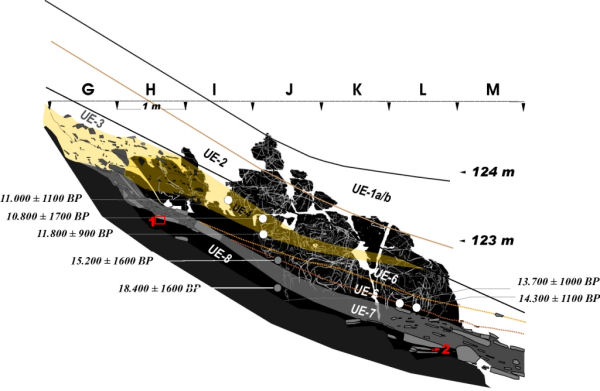
The discovery at Fariseu of a rock face buried by deposits which contained remains of human occupation has confirmed that the open-air art of the Côa valley originated indeed in the Palaeolithic (Aubry & Baptista 2000; Mercier et al. 2006). The dates obtained show that certain engravings (rock panel 1) were contemporary with or earlier than the deposition of layer 6, OSL-dated to c. 15 000 years ago (Reference AubryAubry et al. 2006; Reference MercierMercier et al. 2006; Figure 1). This terminus ante quem refers to all of the figures superimposed on this panel.
Fariseu, limits of the layers sealing rock panel 1, location of the dated samples and of the two engraved panel fragments found during excavation.

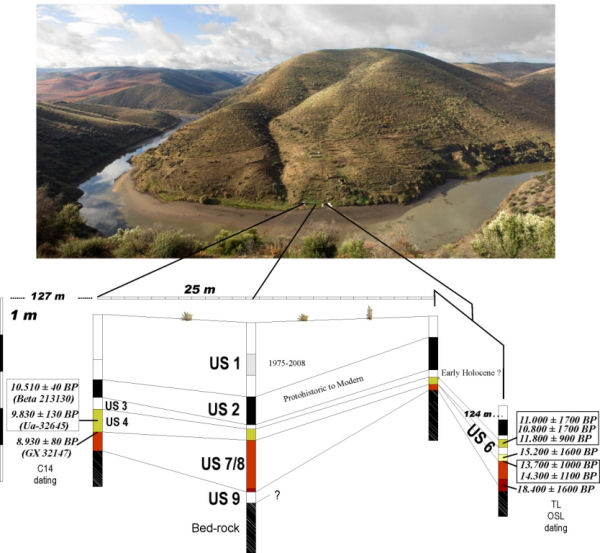
The first faunal remains and elements of portable art in occupation deposits dating to the end of the Upper Palaeolithic, already encountered in 1999 in front of rock panel 1 (Reference García DiezGarcia Diez & Aubry 2003), have appeared over the site as a whole in 2005 (Reference AubryAubry 2006). Three 14C dates have been obtained for two bone fragments from layer 4 and from a tooth discovered at its base (Figure 2). The two dates for the bone fragments are in good agreement with the TL dates and statistically consistent with the results obtained at Quinta Barca (Reference MercierMercier et al. 2001; Reference ValladasValladas et al. 2001; Figure 2).
Fariseu, view of the site (photograph J.P. Ruas) and stratigraphic correlation with the dates obtained through 14C (ASM) dating on bone, TL and OSL dating (Mercier et al. 2006).

New evidence from 2007
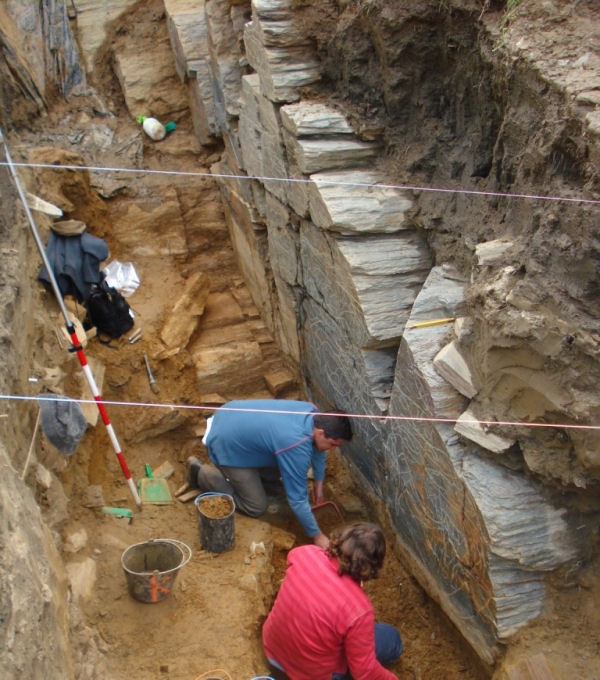
Portable art One of the objectives of the 2007 campaign of excavation was to uncover rock panel 1 in its entirety in order to record it by laser photogrammetry and make a copy for the Côa Valley Museum (Figure 3).
Rock panel 3 entirely uncovered during the 2007 excavation campaign.

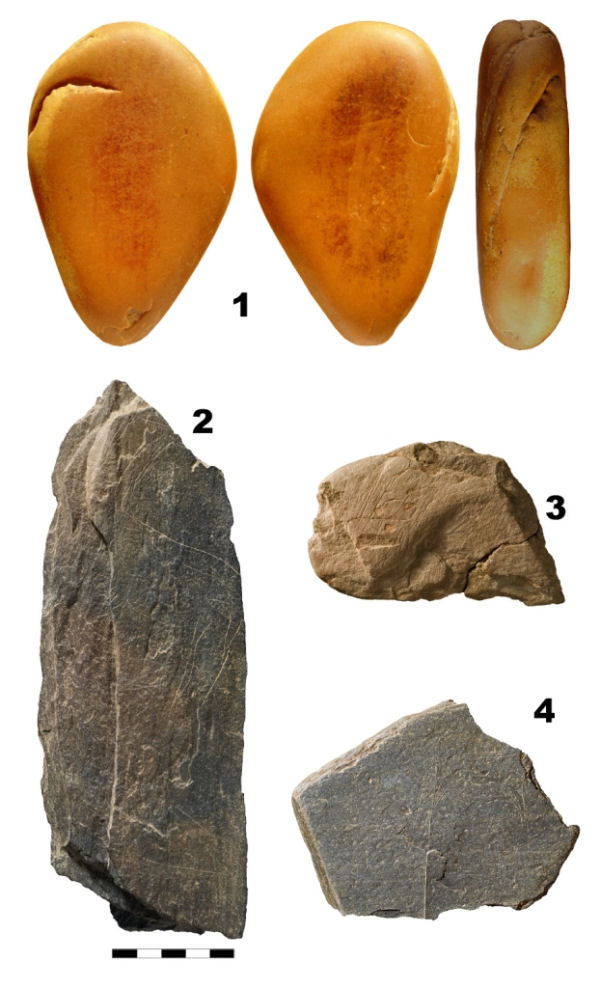
During 1999, 2005 and 2007 excavation campaigns, more than 70 engraved schist plaquettes were recovered from an area measuring 30m2. A quartzite pebble, bearing on both faces parallel traces of mineral pigments (Figure 4), further adds to the diversity of forms of graphical expression on portable supports of the end of the Dryas III period.
Image showing the diverse supports for portable art during the recent Dryas period in the Côa valley. 1, 2 & 4: layer 4 from Fariseu ; 3: layer 3 from Quinta da Barca Sul (photographs J.P. Ruas & T. Aubry).

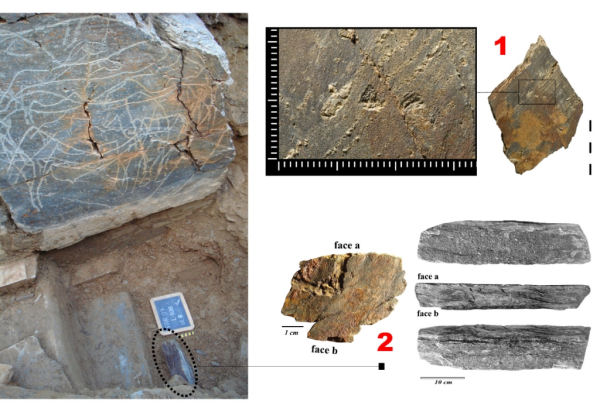
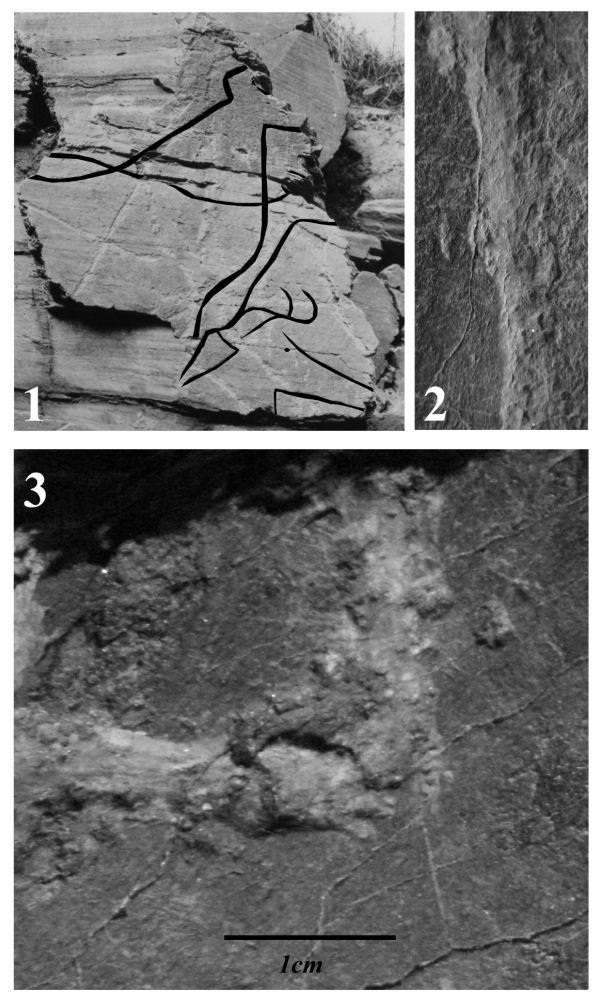
Rock art It has not been possible to establish a direct relationship between a block found in 2005 which shows isolated traces of impact and the engravings displayed on rock panel 1 (Figure 5, 1). But another fragment of rock panel was recovered in 2007 in layer 8. Although it does not connect directly with the incomplete figures on rock panel 1, the position of the engravings and the resemblance between these and those on rock panel 1 (Figure 6) allow us to propose that rock panel 1 was engraved before this layer formed. The date of 18 300 BP obtained by TL dating provides a minimum age for the engravings and indicates when episodes of cryoclasty most affected the rocky outcrops on the site; these correspond to the cold phases of the 'Heinrich event 1' of the Younger Dryas (Reference LebreiroLebreiro et al. 1996, c. 15 000 and 10 000 BP uncalibrated dating).
Two fragments of engraved rock panels and position of the second one when discovered at the base of the stratigraphic sequence near the rock panel 1.

Incomplete figures of aurochs at the top of rock panel 1 (1), detail of an engraving (2), and comparison with the fragment of rock panel uncovered in 2007 (3).

Chronology of the older graphic phase in the Côa Valley
What remains to be achieved is to establish how much time elapsed between this (or these) older graphic phase(s) in the Côa Valley (Reference BaptistaBaptista et al. 2006) and the phase in which the rock panels suffered degradation and layers 7 and 8 were deposited.
The excavation of the central part of the site has shown that an alluvial deposit underlies layer 8 (Figure 2). Its excavation, over an area measuring less than 1m2, indicates that the site was occupied during the Upper Palaeolithic, but so far no diagnostic typological element has been recovered. Continuing this excavation should enable us to ascertain whether this occupation is contemporary with the engraving of the rock panels.
Acknowledgements
We would like to thank EDP for permission to lower the level of the dam of Pocinho from 15 November to 7 December 2007 and IGESPAR-IP for financing this operation.