




Introduction
As researchers, our individual and collective work contributes, either consciously or un/sub-consciously, to the maintenance of governance systems, whether that be through influencing decision making in organisations or shaping policy and education. These are widely seen as important skills to also consider in environmental education and critical urban forest studies; fields which are typically dominated by technocratic solutions and governance processes that tend to marginalise some important forms of knowledge (co-)production. In this paper, we provide examples of how researchers and educators can improve their skills in critical self-reflexivity to help ensure they are not reproducing the same onto-political harms their research claims to address.
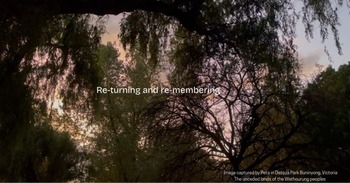
Photovoice example 1. On Re-turning, I am Re-membering (Peta Jeffries, 29 th April 2024).

Photovoice example 2. Re-membering Ana Mendieta and Sarah Baartman (Peta Jeffries, 29 th April 2025).

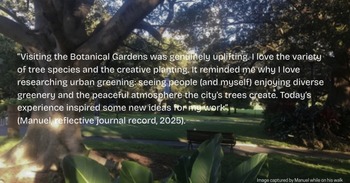
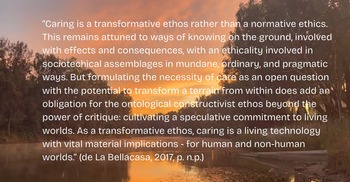
Image still from video essay (1).

Image still from video essay (2).

Image still from video essay (3).

Image still from video essay (4).

Image still from video essay (5).

Image still from video essay (6).

Image still from video essay (7).

Image still from video essay (8).

Researchers, as individuals and as a collective, are shaped by various social – cultural, institutional and historical factors, such as race, ethnicity, class, gender, and community perspectives, which guide how they/we approach the world (Denzin & Lincoln, Reference Denzin, Lincoln and Lincoln2003; Phillips, Reference Phillips2011). One such harm may be the dominant subjective and objective binary approach to communicating and sharing research findings that is typically situated within a positivist realist ontology, and which usually contends with the world as separate or independent of humans. In contrast, an interpretivist nominalist ontology seeks to understand human experiences, their individual and collective actions, and associated inter/intra-subjectivities (Denzin et al., Reference Denzin, Lincoln and Lincoln2003). Although theories of subjectivity, which believe that individual perspectives, experiences, and beliefs shape how we understand the world and act within it, are often positioned in contrast to objectivity’s focus on independence from such perspectives; we open space to engage with, rather than reduce, complexity (Phillips et al., Reference Phillips, Whatman, Hart and Winslett2005; Phillips, Reference Phillips2012, Reference Phillips2019). We instead aim for drawing out multidimensional understandings and knowledge sharing to illustrate the potential of arts-based approaches as an EcoSocial work intervention at the macro level and how this contributes to the theorising in critical urban forest studies.
EcoSocial work is a transformative field of social work practice that involves adopting a holistic worldview, adopting ecological values, fostering global (ecological) citizenship, reconceptualising wellbeing, and expanding social workers roles and activities (Boetto, Reference Boetto2016). This intentionally transformative approach is carried out in a manner that is “congruent across the ontological (being), epistemological (thinking) and methodological (doing)” dimensions of social work practice (Boetto, Reference Boetto2016, p. 2). This EcoSocial work is strengthened by an Indigenist conceptual and methodological framework that supports complexity and multidimensionality.
Working with complexity and multidimensionality is a challenging practice because of various perceived risks and contestations. In this paper, we refer to risks as the subjective and assumptive unknowns of working collaboratively across disciplines and domains in the field of critical urban forest studies. In this case, the unknowns of climate change, challenges surrounding maintaining species biodiversity, the role of human and multispecies relationality with urban forests, people’s inability to act on climate change, and our co-becoming futures literate (Mangnus et al., Reference Mangnus, Oomen, Vervoort and Hajer2021). In these contexts, our work is supported by the practice and praxis of Professor Jay Phillips (Wakka Wakka Goreng Goreng) Indigenist Standpoint Pedagogy (ISP), which offers a framework for Indigenist and Indigenous futures that goes beyond the colonial subjective – objective binary to create space for complexity and multidimensionality (Phillips, Reference Phillips2019, Reference Phillips, Shay and Oliver2023). During and through the practice of ISP, we consider the social – cultural, institutional and historical factors shaping inter/intra-subjectivities. We do this in and through what I (Peta) – drawing on Jasbir Puar’s explanation of becoming-intersectional in assemblage (Reference Puar2020) – understand as the co-created, relational and nurturing space within which we begin to identify and understand our response-abilities towards self and multispecies others. It is within this space of intersectional assemblage that we begin to see with improved clarity and reflexivity, beyond interfaces and rigid or fixed standpoints.
In this way, it becomes possible to begin to see how the past-present-future are interconnected and where or how we might begin to imagine a desirable future – a future of justice, safety and care – that rightfully recentres Indigenous knowledge perspectives. This is a global Indigenous approach, also recognised and advocated for in the Kimberly cultural landscapes as kincentric ecologies and as something we can all adopt (Poelina et al., Reference Poelina, Perdrisat, Wooltorton and Mulligan2023; Milgin et al., Reference Milgin, Nardea, Grey, Laborde and Jackson2020; Salmón, Reference Salmón2000). Phillips’ ISP is about centring Indigenous knowledge perspectives, and it teaches us that these inter/intra-subjectivities and the challenges presented by the associated onto-political dilemmas of separation and disconnection, as is considered in this paper, are the key areas where improved focus is required, especially in urban forest management, planning, stewardship, care-taking, and governance.
A note on our positionality and standpoint
Despite its benefits of generating knowledge, it is well known that research has contributed to the oppression and marginalisation of Indigenous peoples worldwide, as it is often used as a form of colonial and imperial expansion (Watson, Reference Watson2014). Therefore, working within these unceded places and spaces of knowledge production and transmission, such as universities and research institutes, we need to be aware and responsible for how we act within these sometimes harmful and oppressive systems. We acknowledge that neither of us (Peta and Manuel) are originally from where we live and work, and yet we maintain a sense of care and connection.
We both have expressed our discomfort with claiming to be experts in and of these unceded spaces and places where we live and work. For example, my (Peta) work is transdisciplinary, working in a very privileged and influential role in academia as a practising visual artist, qualified (Eco-) social worker, historian, and lecturer in Indigenous studies. I (Peta) acknowledge my (her) own family history and heritage, which family oral histories recognise and some proudly respect as being of either Indigenous, Islander and/or Māori descent – but it is unknown for certain, as there are only traces of evidence. This lack of certainty is most likely due to colonial practices and policies, because the documented hegemonic and meticulously constructed facts of this heritage and history and therefore identity have been intentionally erased, burnt, and as such cannot be proven and legitimately claimed; that is, according to the standards set by the same (colonial) system. Either way, I (Peta) commit to this ongoing critically self-reflexive inquiry into Australia’s shared and contested history from this somewhat grey positionality.
We also acknowledge that all research is carried out on Indigenous peoples’ lands and waters, specifically, that all research is “on Country” even in built-up urban places. I (Peta) live and work in Wiradjuri Country, and Manuel in Gadigal Country, which is part of the larger Eora Nation. My (Manuel) academic journey began in Mexico, where I (Manuel) always felt a deep connection to nature. While not Indigenous to these lands, I (Manuel) seek to maintain a sense of care, humility, and connection to place, and try to cultivate a relational and ethical connection to Country, acknowledging the deep histories, sovereignties, and custodianships that infuse these landscapes beyond what is visible or documented. Since moving to Australia in 2015, I (Manuel) recognise that it is not always evident how researchers can work directly with Traditional Owners or rightful knowledge holders, yet I (Manuel) consider it essential to explore respectful, reciprocal, and creative approaches in their absence.
Manuel and I (Peta) have critically reflected (via online communication) on how engaging meaningfully with Traditional Owners (or Aboriginal individuals and/or communities) and knowledge holders remains both a priority and a challenge, particularly where direct collaboration is not always feasible. We recognise it is not always evident how researchers can work directly with traditional owners and or the rightful knowledge holders, and if this is not possible what other options exist. It is for each of these reasons listed above, that I (Peta), have been working with Phillips’s ISP for over ten years within academic learning and teaching, and research, all as my EcoSocial work critical field of practice. As will be described further in the section below, EcoSocial work is a multidimensional systems and futures-focused field of social work practice that is distinctly political and transformative.
Indigenist Standpoint Pedagogy (ISP)
Phillips’s ISP was originally developed as a critical approach to teaching and learning that supports education of Indigenous and non-Indigenous peoples, but it has since evolved into a practice framework that supports curriculum and course design and transformative research for all. ISP is a critical approach to teaching and learning that is somewhat influenced by the “writings of Frantz Fanon’s (Reference Fanon1970) text ‘White Skin, Black Mask’, Whiteness theory, and bell hooks’ (1994) ‘Teaching to Transgress’”(Phillips, Reference Phillips2011, p. 2). Phillips was drawn to these works because they validated her discomfort with teaching about Indigenous peoples, which, when placed in or assuming this position, made her “feel like an apparition, performing a supposedly ‘lost’ culture (Langton, Reference Langton1996), yet remaining invisible in the process” (Phillips, Reference Phillips2011, p. 2). Indigenous cultures are not lost. In addition, other Indigenous scholars have reflected on their discomfort with what they have explained as a performative Indigeneity (Harris, Reference Harris2013) under the colonial gaze (Paradies, Reference Paradies2020). Based on these sorts of experiences, Phillips’ research helps to identify the problems with teaching and learning that focuses on learning about Indigenous peoples, cultures and knowledges as the reproduction of deficit discourse, and harmful Othering, without minimising the very real experiences of racism and marginalisation.
Harmful Othering often occurs where the representation of Indigenous peoples’ cultures and histories are positioned through narrow, descriptive and circumscribed cultural identities, usually of the past, minimal inclusion in the present and subsequently erased from the future. For example, through the process of developing curriculum and teaching that educates about Indigenous peoples and cultures, identities and cultures are often homogenised, essentialised and historicised. These acts of homogenisation and essentialism may create a greater distance between the stereotyped image or identity of Indigenous peoples and the non-Indigenous (and sometimes even Indigenous) students who maintain, from their own privileged positions, the “uncritical consumption” of the information (Phillips, Reference Phillips2011, p. 196). Further, the historisation of Indigenous peoples, cultures and knowledges can relegate important ideas and insights to the past.
Usually, this form of teaching and learning about Indigenous peoples and cultures is an attempt to fit Indigenous knowledges into dominant colonial systems and paradigms, an extractive approach, having the effect of reproducing what Professor Larrissa Behrendt termed, psychological terra nullius (Reference Behrendt1998). Subsequently, ISP was developed to address the need for education to:
-
“[P]rovoke a shift that makes a difference to how individuals relate to knowledge about Indigenous issues, and their relationships with Indigenous peoples beyond the classroom” (Phillips, Reference Phillips2011, p. 2), and
-
“[E]nable students to become critical readers in both public and private domains and across these spaces by drawing distinct connections between abstracted theory and the chaotic, yet powerful, spheres of our social existence that organise our world” (Phillips, Reference Phillips2011, p. 2).
Therefore, here, we come from the standpoint that representation has a very real, if somewhat symbolic, individual and therefore political impact. Aligning with ISP instead of representing Indigenous peoples and knowledges as homogenised, essentialised and historicised fixed identities, we focus on centring Indigenist and Indigenous knowledge perspectives as gained from published and publicly available records (Phillips, Reference Phillips2012; Wilson, Reference Wilson2007). We choose this approach to examine our positionalities and standpoints, and to imagine new socially and ecologically just systems and futures (Phillips, Reference Phillips2012, Reference Phillips2019). Here, the metaphor of becoming-intersectional in assemblage (Puar, Reference Puar2020) provides a way to visualise not only the importance of centring Indigenous and Indigenist knowledge perspectives but also what this may involve. At the same time, it draws attention to the varied positionalities of researchers and decision makers, which are shaped by social – cultural, institutional, and historical factors such as race, ethnicity, class, gender, and community.
Becoming-intersectional in assemblage
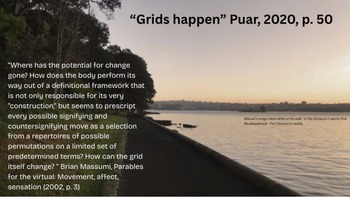
Drawing from Gilles Deleuze and Felix Guattari, Jasbir Puar describes assemblage as the design, layout, organisation, arrangement, and relations – the focus being not on content but on relations – relations of patterns and intersections – drawing from Brian Massumi, who said “grids happen”, which can mean rigid boundaries and thresholds, of often fixed binary identities. Instead, Massumi and Puar are concerned with co-becomings of movement, flux, and potential (Puar, Reference Puar2020, p. 50; Massumi, Reference Massumi2002, Reference Massumi2021). Puar states, “subject positioning on a grid is never self-coinciding; positioning does not precede movement but rather it is induced by it: epistemological correctives cannot apprehend ontological becomings; the complexity of process is continually mistaken for a resultant product” (Puar, Reference Puar2020, p. 50). The merging of these two concepts, which are somewhat oppositional (Puar, Reference Puar2020), shifts beyond binary othering to instead create the required friction and dynamism needed for thinking through and with the complexity of Indigenous and Indigenist knowledge perspectives in relation to and with dominant colonial systems, such as those currently governing urban forest management, planning and governance.
The colonial load
Returning to the idea of identity where we see attempts to “fit” Indigenous knowledges into dominant colonial systems and structures such as universities, institutes and organisations, we usually see identities that are homogenised, essentialised, and historicised. Fixed identities, those that align with binary definitions, align with dominant colonial systems and understandings, and are therefore supported and nurtured because they reproduce knowledge that is comfortable and familiar to the dominant culture, repositioning some in positions of power over Indigenous “others” (Phillips, Reference Phillips2011). To gain and or maintain any sense of power, dualistic identity constructions are reinforced as a form of legitimacy – whether that be Indigenous or non-Indigenous.
This creates a culture where specific “authentic” identities – usually defined by the same colonial systems – are celebrated and welcomed, often resulting in Indigenous peoples carrying a colonial load. This colonial load usually involves Indigenous peoples teaching non-Indigenous about their experiences, history and culture, rather than the institution celebrating and genuinely embracing Indigenous knowledge, ideas, and innovation. This colonial load has the effect of maintaining settler colonial power, dominance and knowledge systems (Lowe & Manjapra, Reference Lowe and Manjapra2019). But, as some Indigenous scholars who research in Indigenous identity politics explain, “there are very real material and non-material rewards for those [who closely align with what is perceived as authentic Indigeneity] and who can perform this [I]ndigenous ‘otherness’ in visible ways” (Harris, Reference Harris2013, p. 6). This often occurs at the expense of those very real others, those others who challenge the dominant norms and stereotypes.
The celebration of a singular or essentialised Indigenous identity can inadvertently erase the true diversity of Indigenous cultures and identities, often reinforcing settler-colonial narratives. What we aim to highlight here is that Indigenous identities and positionalities are inherently political, particularly within colonial contexts like Australia, where clear distinctions exist between Indigenous and non-Indigenous populations (Lowe & Manjapra, Reference Lowe and Manjapra2019). We also aim to stress the importance of respecting Indigenous sovereignty and rights, acknowledging the racism Indigenous peoples face, and we are calling for a move beyond simply fitting Indigenous knowledges (and identities) into colonial frameworks. Instead, we advocate for transforming existing systems and schemas that are failing, which requires understanding the relationality between different approaches to knowledge, crucial for this change. We argue for new systems that genuinely accommodate diverse Indigenous realities rather than maintaining dualistic colonial dynamics, which is where and how the becoming intersectional assemblage becomes a useful metaphor.
Becoming-intersectional in assemblage supports individuals and collectives to map their inter/intra-connected social – cultural, institutional and historical factors (Jeffries, Reference Jeffries and Hytten2025). For example, the historical interconnectedness of settler colonialism with the positivist and interpretivist dualism, originated during the Enlightenment era, industrialisation, and modernity (Mathews, 2020, 2022; Rigby, Reference Rigby2022; Rose, Reference Rose1996), has contributed to the siloing of professions and disciplines. This historical context has significant implications for how research is today designed, carried out, and communicated for educational purposes.
As an example, the interpretivist ontology views reality as socially-culturally-historically embedded, where knowledge is jointly understood, interpreted, and co-constructed by the researcher and researched, identifying patterns and meanings by giving voice to the subject matter. In contrast, the positivist approach typically analyses data from an allegedly distant or neutral position. The harmful colonial logic of believing detached objectivity leads to facts and greater truths is problematic (Mathews, Reference Mathews, Bartel, Branagan, Utley and Harris2020, Reference Mathews2022; Rigby, Reference Rigby2022), as it can reproduce unconscious bias and the very issues research claims to address. This is particularly relevant in areas like climate change and social and ecological injustice. For example, and as it is illustrated in teaching and learning environments, students may deny non-Indigenous responsibility by expecting Indigenous peoples to carry the load (both colonial and cultural) and to teach them, thereby legitimising their (non-Indigenous) innocence or ignorance.
Beginning to practice Indigenous Standpoint Pedagogy (ISP)
To counter these harmful colonial logics, we advocate for the practice of ISP, which is our chosen methodology, because it supports the critical self-reflexivity required for us to disrupt or transform the colonial logics outlined above, and to begin imagining Indigenous and Indigenist knowledges and futures. Rather than placing the (colonial) load on Indigenous peoples, ISP involves learning about oneself, including examining the origins of one’s knowledge, why it is believed to be true, and who benefits from inherited knowledge systems (Phillips, Reference Phillips2011). Drawing from various sociological theories and terms or concepts, a core part of beginning and maintaining a practice of ISP involves identifying, considering and understanding ones:
-
Position which is recognising one’s role and identity - one‘s position - within social or cultural structures
-
Positionality which is being able to identify, understand and describe how one’s intersecting social identities shape their worldview – including recognising and understanding personal bias’, how they are formed and how this shapes one‘s interpretation of the world. It also includes understanding how one’s past influences and shapes one’s present.
-
Standpoint is one‘s viewpoint, or knowledge, as derived from one’s lived experience
through proccesses or methods that support:
-
Reflexivity which involves critically and responsively analsying each of the above aspects of the self, including examining intersecting identities, assumptions, norms, values, actions and beliefs to gain greater insight and awareness into how one’s presence and perspectives affects others, and
-
Critical self-reflexivity which is all of the above combined, but importantly, it is a deeper and more relational process that involves transformation or change. In the practice of ISP, this process is informed and guided by Indigenous knowledge perspectives.
In the practice of ISP, all of this critical self-reflexivity is in relation to what (and how) knowledge is known, constructed/created and unknown (erased/forgotten), about Indigenous peoples, cultures, and any identified challenges, barriers, and opportunities. The transformation that becomes possible through the practice of ISP must be informed by Indigenous knowledge perspectives. For this reason ISP is different to standpoint theory. Grasping these terms or concepts is a crucial yet initial step in teaching, learning, education, and research that aims to move beyond merely exploring and describing identities, experiences and realities. This encourages taking responsibility for how these processes reconstitute identities, experiences, and realities. The goal is to avoid reproducing the same problematic realities that teaching, learning, education, and research claim to address. Through the critically self-reflexive practice of ISP, we aim to share insights on how and why Indigenous and Indigenist knowledge perspectives should be centred in critical urban forest studies and environmental education, particularly in addressing the onto-political dilemmas of urban forest management, planning, and governance by working across disciplinary differences. However, simply using or citing these terms is not sufficient. This relational and responsive work is much deeper.
Onto-political dilemmas in urban forest management, planning and governance
The way in which Indigenous peoples, cultures, knowledges and values are represented shape our reality and lived experiences of and with each other, whether we are Indigenous or non-Indigenous. Phillips’ ISP teaches us that institutional, historical, and social – cultural factors determine what is known and unknown through representations (Phillips, Reference Phillips2011). This is relevant, for example, in urban forest management, planning and governance where Indigenous knowledge perspectives are often excluded for various historical, social – cultural, and or institutional reasons, usually based on binary distinctions and representations around identity, temporality, and value. Explicit examples of potentially violent and racist onto-political dilemmas we are referring to here, many of which are grounded in essentialised and homogenous representations, are temporalities of Indigenous and settler colonial identities, relationality, and values that inform current urban forest management, planning and governance. These include:
-
1. What we today call urban forests are in fact the unceded lands and waters of Indigenous peoples that are controlled and managed through settler colonial (Wolfe, Reference Wolfe2006) logics and psychological, utilitarian, and aesthetic or symbolic (Bonyhady, Reference Bonyhady2003) desire for:
-
a. A Romantic reclamation and conservation (Mathews, 2014, 2020; Rigby, Reference Rigby2004, Reference Rigby2022) of wilderness (Mathews, Reference Mathews, Bartel, Branagan, Utley and Harris2020; Langton, Reference Langton1996), in the hope of reconnecting with some form of wildness (Rigby, Reference Rigby2022), soul healing (Prechtel, Reference Prechtel2001) and, or
-
b. an imperial pastoral [and or cropping] economy (Rose, Reference Rose, Rose and Clarke1997; Griffith, Reference Griffiths2002)
-
-
2. Forests are often assumed to be a group of trees; however, history reveals they are multispecies kin (Poelina et al., Reference Poelina, Perdrisat, Wooltorton and Mulligan2023; Milgin et al., Reference Milgin, Nardea, Grey, Laborde and Jackson2020; Salmón, Reference Salmón2000), inclusive of grasses, understory, shrubs, water, and all the more-than-human inhabitants (Poelina et al., Reference Poelina, Perdrisat, Wooltorton and Mulligan2023; Griffith, Reference Griffiths2002), although often framed through or as:
-
a. Spaces and even shadow places (Plumwood, Reference Plumwood2008) of white possession (Moreton-Robinson, Reference Moreton-Robinson2018), a “gentleman’s park” (Griffith, Reference Griffiths2002, p. 380), or even the “biggest estate” (Gammage, Reference Gammage2011; Pascoe, Reference Pascoe2014), and, or
-
b. The view of nature as a resource (Mathews, Reference Mathews, Bartel, Branagan, Utley and Harris2020; Rose, Reference Rose, Rose and Clarke1997), where the utility value of plants is prioritised (Rousell & Tran, Reference Rousell and Tran2024) and, or
-
c. Conservation, where anthropocentric bias and methodological solipsism is reinforced (Mathews, Reference Mathews2022), leading to marginalisation of local values and realities (Vaccoro, et al., Reference Vaccaro, Beltran and Paquet2013), problematic models (van Beek, Reference van Beek2025; Alba et al., Reference Alba, Krueger, Melsen and Venot2025), exclusion (Vaccaro et al., Reference Vaccaro, Beltran and Paquet2013), and even where Indigenous knowledge is referenced or included, it is assimilated into dominant western mindset (Mathews, Reference Mathews2022; Griffiths, Reference Griffiths2002), and Indigenous peoples are often excluded from decision making (Alba et al., Reference Alba, Krueger, Melsen and Venot2025).
-
Although ISP asks us to consider the historical, institutional and social – cultural domains within which our knowledge about Indigenous knowledge perspectives exist and or emerge, it is not suggesting that we can predict the future from the past. It is, however, asking us to consider – in this case – how urban forests have been socially and culturally constructed to maintain settler colonial desires, while embracing Indigenous knowledges on one hand, and erasing them with the other, through binary assumptions and perceived knowledge hierarchy. This requires listening to understand how the past is still present today and how this can inform or shape our futures.
As a colonised continent, Australia is uniquely positioned to understand and learn how to adapt to the impacts of climate change. With the raft of introduced species, and diverse ideas about land use and practices (Rigby, Reference Rigby2022), rapid extinction over a 250 year span (Paradies, Reference Paradies2020), and our uniquely shared (and often silenced) histories (Phillips, Reference Phillips2019; Jeffries, Reference Jeffries2023), by acting responsively, we can learn from Indigenous knowledge perspectives about managing disaster and rapid climate change, plus, and how to co-develop new systems in place of those that are failing us (Mathews, Reference Mathews, Bartel, Branagan, Utley and Harris2020; Poelina et al., Reference Poelina, Perdrisat, Wooltorton and Mulligan2023). As already mentioned, ISP highlights that harmful binary assumptions exist within historical, institutional, and social – cultural domains. In urban forest studies, these binary distinctions may be witnessed in (1) positivist scientific sense-making through ecological and biophysical sciences, such as through techniques or methods of data modelling and sampling, and (2) interpretivist sense-making, such as what is typically evidenced in the social sciences and humanities, including through methods from the more creative processes of art practice, narrative or story, poetry, and fictional writing (Mathews, Reference Mathews, Oppy and Trakakis2014, Reference Mathews, Bartel, Branagan, Utley and Harris2020; Rigby, Reference Rigby2022). What ISP offers, is an emergent and generative way of, that supports the individual and collective practice for the kind of future that is just and fair. ISP offers a methodology to identify the dilemma or problem and respond accordingly, in a manner that aligns Indigenous knowledge perspectives. However, this paper does not and cannot explain the whole process and method of ISP. This is just a small sample of our experience of a much larger and life-long process of and commitment to learning and critical self-reflexivity.
The significance of Indigenist Standpoint Pedagogy (ISP) as a conceptual and theoretical framework that supports the chosen methods
ISP is a methodology that supports Indigenous and non-Indigenous peoples in engaging with Indigenous knowledge through critical and reflexive self-inquiry, centring Indigenous perspectives and aspirations (Phillips, Reference Phillips2019). It requires commitment and work, prompting researchers and environmental educators to re-consider professional responsibilities. ISP as a methodology shows that the ability to do this work stems from one’s chosen standpoint, rather than identity, as sometimes positionalities can shift. As this paper aims to illustrate, researchers can better position themselves within settler colonial systems and unceded Indigenous spaces. ISP’s critical reflection on positionality is not about self-centring or legitimising settler colonial logics, but rather about recognising and decontaminating spaces where these logics are reproduced while cultivating attentiveness and responsivity.
EcoSocial work – practising care and social justice
As an EcoSocial worker and researcher, I (Peta) draw upon my transdisciplinary (an inclusive approach that iteratively interweaves knowledge systems, skills and methodologies for transformation) insights and approaches to inform and complement my practice of ISP and vice versa. Importantly, practising ISP improves my EcoSocial work professional practice. EcoSocial work is transformative and political because it highlights the way in which “oppressive social structures such as those associated with neoliberal discourse, colonisation, and patriarchy have contributed to social and ecological injustice” and applies practices for change (Bell et al., Reference Bell, Dennis and Krings2019; Dominelli, Reference Dominelli2012; Gray et al., Reference Gray, Coates and Hetherington2013 in Healy, Reference Healy2022, p. 145). Founded on principles of ecological justice (Ramsay & Boddy, Reference Ramsay and Boddy2017), EcoSocial work is transformative (Boetto, Reference Boetto2016) because it aims to challenge established norms and structures by expanding traditional social work understandings of “person-in-environment,” where the environment may be considered a backdrop to the human endeavour.
EcoSocial work, however, encompasses the natural environment and climate change in its professional practice. For example, disaster social work practice adopts EcoSocial work approaches (ACOSS, 2015; Alston et al., Reference Alston, Hargreaves and Hazeleger2018). EcoSocial work practice considers how the social, economic and physical living environment is inter/intra-connected and inter/intra-dependent with the human (Healy, Reference Healy2022, p. 145). This involves placing the “natural living environment, not the person, as the centre of the model” (Ramsey & Boddy, Reference Ramsay and Boddy2017; in Healy, Reference Healy2022, p. 145) (emphasis placed). What is significant, although not regularly or openly acknowledged, is that EcoSocial work is built explicitly on Indigenous knowledge and anti-colonial practice (Bell et al., Reference Bell, Dennis and Krings2019, p. 279). Therefore, EcoSocial workers need to be aware of how their individual and collective practice may reproduce the colonial logics and desire for extraction, protection, and possession.
The weaknesses and limitations of the social work profession is the dominance of modernist epistemologies and ontologies, which is why, and as Heather Boetto explains, a paradigmatic shift is required (Reference Boetto2016, Reference Boetto2019; Boetto et al., Reference Boetto, Bell and Kime2018; Boetto et al., Reference Boetto, Bowles, Närhi and Powers2020). This shift could emerge, for example, by following Indigenous social workers request that non-Indigenous social workers to address the whiteness of the profession (Walter, Reference Walter and Bennett2019). Therefore, my (Peta) collaborating with Manuel is the EcoSocial work of contributing to and advocating for the “critical” in urban forest governance, as part of the response to that call. Although not perfect, as a profession, social work is guided by a code of ethics and professional values that are focussed on care and justice, and therefore, a major aspect of EcoSocial work is advocacy, and in this case, this practice is occurring through EcoSocial work as collaborative research. The social work code of ethics (AASW, 2020; Bowles et al., Reference Bowles, Boetto, Jones and McKinnon2018) sets a framework and standard within which we can work, especially in the context that social justice is inseparable from environmental or ecological justice. Therefore, the case for EcoSocial work in urban forest governance is to contribute to this critical (social and ecological) work of challenging the onto-political dilemma of modernist epistemologies and ontologies through critical and creative reflexivity.
Finding our [reflective and creative] voices to promote reflexivity in critical urban forest studies
To promote and support our motivation to approach urban forest studies with a critical lens, I (Peta) invited Manuel to develop a reflexive (inter/intra-subjective) and interpretivist approach to our work together. In this instance, it involved a method of photovoice where I invited Manuel to walk in his local urban forest each day and take photos and journal his feelings and emotions associated with being in these urban forest places. A practice, I (Peta) adopt (Mulligan, Reference Mulligan2012). Photovoice is a method that supports a reflective practice of witnessing and better understanding one’s relationship with place and others and various phenomena (Wang & Burris, Reference Wang and Burris1997). In some instances, it supports identity mapping (Meenar & Mandarano, Reference Meenar and Mandarano2021; Jacobson & Mustafa, Reference Jacobson and Mustafa2019), but we have not yet extended our inquiry to this aspect at the time of this publication. Photovoice also aligns with arts-based and practice-led approaches. Figures 1 and 2 are examples of my (Peta) images taken when I revisited my “hometown,” considering these as shadow places (Plumwood, Reference Plumwood2008) and the memory reconsolidation and reclaiming that emerged through the process of walking with attentiveness.
Arts-based methods
As a practising visual artist, I (Peta) am drawn to creative ways of thinking with complexity and the dilemmas of our (Peta and Manuel) work in critical urban forest studies and climate change. Arts practice as research is an approach to learning that I have been practising since my undergraduate and honours study in visual arts (Sullivan, Reference Sullivan2010). “Arts practice as research” is a creative and critical form of human engagement that is reflexive, relational, embodied and conceptualised (Sullivan, Reference Sullivan2010). Embodied is to give a tangible or visible form to an idea, quality, feeling or emotion, which means art practice as research is also affective pedagogy (Hickey-Moody, Reference Hickey-Moody2013), and can be applied to communicate and/or visualise science (Holmes, Reference Holmes2007). However, art practice is more than just visualising and communicating data in different formats.
Art practice as research goes beyond the qualitative/quantitative notion of simple data production, analysis, and communication of ideas, because the process and practice in and of itself affects more-than-human becomings – it is the practitioners embodied [inter/intra-] subjectivity[/ies] (Hickey-Moody, Reference Hickey-Moody2013, p. 79). Arts-based approaches support reflexivity by requiring ongoing vigilance and critical self-reflection on processes, plans, and projects. This reflexivity is central to EcoSocial work practice, as it deepens our understanding of being and becoming within our environment (Huss & Bos, Reference Huss and Bos2022). It is about relationality and reciprocity. Further, “affect is what moves us,” and “affect is a starting place from which we can develop methods that have an awareness of the politics of aesthetics” (Hickey-Moody, Reference Hickey-Moody2013, p. 79). Arts-based approaches are also participatory and are often used in situations where voices are or have been marginalised, such as action research and community-based projects (Huss & Bos, Reference Huss and Bos2022). Together with photovoice, arts-based approaches or methods are empowering and offer significant (self)insight that can then be shared to better understand phenomena. This is especially useful in the practice of ISP in the context of critical urban forest studies.
Video essay and multimodality
The creation of the video essay, although not a typical representation of video essay, was a chosen method for two reasons. Firstly, the creation of the video essay requires the producer (for example, the environmental educator) who are generally subject matter experts, to consider carefully media and communication literacies and multimodal composition. Although those producing the video essay usually need to consider the video essay as a “self-contained performative act […] that make a direct and original research contribution” (Grant, Reference Grant2016, p. 4), this approach can support transformative learning (West et al., Reference West, Caldwell, Tiplady and Whewell2025). Secondly, the creation of the video essay is another level of embodied practice where art can be used rather than text, not only as a way of communicating findings but also “where the viewer completes the formation of meaning through their act of viewing” (Gough-Brady, Reference Gough-Brady2020, p. 97). The video essay creates space to share key quotes, insights, questions, ideas and visual images such as the art works created through the data collection and analysis process.
Approach
I (Peta) am always practising ISP, for this reason, I consider that our (Manuel and I) approach began some years ago, when we first met. It began with introducing ourselves and identifying relevant positions, positionalities and standpoints in relation to various knowledges and practices. This is a relational approach to learning about each other and our work. To do this, we shared some brief stories of place, and our profession, particularly the discomfort felt with urban forest studies seemingly marginalising Indigenous knowledge perspectives, which is the reason why we began working together (Esperon-Rodriguez et al., Reference Esperon-Rodriguez, Bond, Rodriguez, Jeffries, Van Ermel Scherer and Tjoelker2025). However, this later and more focused research, what is explained in this paper, was occured over a short period of time and involved taking photographs of our workday, including before and after work and what activities we usually carry out. For me (Peta), this involved daily walks alongside the river, through urban forests of the Murray-Darling Basin, before and after work and regular art practices including (amateur) filmmaking, photography, painting, and drawing. For Manuel, this involved daily walks along urban green spaces where he lives or around his university campus in Sydney. We each observed our thinking, feelings and insights gained from intentional attentiveness to place and our topic of focus. To focus, I (Peta) provided key themes to contemplate over one week of focused intentional mindful and embodied attentiveness. These themes were posed as questions or prompts to help promote attentiveness and self-in-environment-awareness. They included:
-
What do you see?
-
What do you hear?
-
What do you feel?
-
Take photos and or journal as documentation
-
What insights emerge from a daily practice of intentional attentiveness in urban forests?
Intentional and affective attentiveness
Drawing on writings from multispecies studies, feminist posthumanism and Indigenous epistemologies, attentiveness is the meaningful, deliberate, intentional and multifaceted practice of paying close attention to others to develop understanding for how to interact with the world ethically and effectively (Van Dooran et al., Reference Van Dooren, Kirksey and Münster2016; Van Dooran & Rose, Reference Van Dooren and Rose2012, Reference Van Dooren and Rose2016). It is concerned with the epistemological, political and ethical stakes in learning to engage with diverse forms of life (Van Dooren et al., Reference Van Dooren and Rose2016), especially in relationship to the politics of Indigenous sovereignty and Indigenous embodiment (Russ-Smith, Reference Russ-Smith2023). The embodied, therefore, affective and intentional attentiveness we are referring to here, is also about challenging anthropocentrism and issues associated with presumed detached observation (Mathews, Reference Mathews2022; Poelina et al., Reference Poelina, Perdrisat, Wooltorton and Mulligan2023). This is a process and method of feeling and hearing Country (Poelina et al., Reference Poelina, Perdrisat, Wooltorton and Mulligan2023). Finally, although these methods are learning from Indigenous epistemologies, it (practising ISP) is also about reconnecting with our own deeper ancestral knowing from wherever that may emerge pre-Enlightenment.
With this knowledge around the importance of pre-Enlightenment ways of knowing (Mathews, Reference Mathews2022) in mind, I (Peta) then reflected on the journal entries, the photos, and the artwork in relation to what is known of these spaces and places, the theory and the history of these regions. I (Peta) created a video essay, bringing together all the data collected in relation to the theory. Some of the findings, discussed below and in the video essay, are key and new insights drawn from the process. However, it is beyond the scope of this paper to include all our findings.
What does it mean to share our stories of place and professions
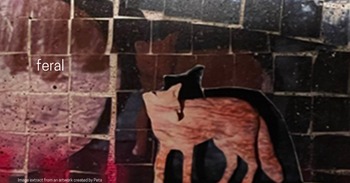
We do not have the cultural authority to speak for the unceded Countries (which includes people) where we are both situated; however, we can and do speak for our relationships with these peoples and places and Indigenous knowledges. Inspired and guided by my (Peta) ongoing learnings from and commitment to my workplace ethos based on Wiradjuri philosophies of yindyamarra winhanganha (brief meaning is “to live with kindness, strength, respect and to go and be in the right way and/or at the right time, to create a world worth living in”) and gulbali ngurambang (brief meaning is “to understand Country”), this aspect of our research is documentation of our learning process (Grant, Reference Grant2024; Orchard, Reference Orchard2025). Therefore, the video essay we created is a form of storytelling about the embodied practice of ISP. See Figures 3–10 which are stills from the video essay and the full video essay link is provided in the supplementary material section below.
This process involved critically reflecting on where we live and our work while centring these above-mentioned Indigenous knowledge perspectives. These are two distinctly different locations, Dubbo (meaning “red dirt”) in Wiradjuri peoples’ unceded Country, of western New South Wales where the language spoken is Wiradjuri, the unceded land of Wathaurong peoples of the Kulin Nation, Victoria; and the place now called Sydney in Gadigal peoples’ unceded Country, specifically the Sydney Botanical Gardens, where the language spoken is Dhurug. In Dhurug language, Gadi means forest grass tree (Dictionary of Sydney, 2021). For this research, most of the Indigenous knowledge perspectives are drawn from multiple publicly available sources and are referenced accordingly. We actively sought this information because the practice of ISP also involves critically reflecting and expanding on where our knowledge (of these places) comes from and why or what we believe to be true – it is about challenging our thinking and the way in which colonialism inhabits our minds.
This section is focused on outlining our experiences of doing this research while also highlighting or representing some key insights and new ideas. Although our initial idea for this research was to consider what insights can be draw from combining scientific experiences from earlier research with arts-based approaches. What has emerged as a result, is a form of worldmaking or worlding that is creative (Haraway, Reference Haraway2008). It has encouraged us to slow down. To enjoy our time in these spaces and our work as researchers. The outcome to arts-based these approaches are multimodal and multivocal storytelling. For this reason, and for the purpose of this paper, it was decided that the creative or arts-based multimodal and multivocal insights are worthy of greater focus here and we are therefore sharing our insights, especially regarding how this kind of approach might be applied to urban forest research, management, planning, care-taking, stewardship and governance, and the field of critical urban forest studies.
The ISP process is not linear, it is iterative. However, stories are often told in a linear fashion. Key snapshots from the video essay with some minor explanations are included below, in four parts:
Part 1
Manuel, based in Sydney, chose the Botanical Gardens for his place-based and embodied practice, and I (Peta) chose two places I was moving back and forth between at the time. We both took photos, and I (Peta) also took video footage, while walking and we noted our feelings, thoughts and emotions. When I (Peta) reflected on the data Manuel collected, applying ISP, I considered the history of this place, including my own history of this same place, and considered other peoples and more-than-human relations with this area. ISP asks us to consider our individual and collective ways of being (ontology), doing and knowing (epistemology) in the unceded lands of Aboriginal people, whether we are Indigenous or non-Indigenous (Phillips, Reference Phillips2019). This first part of the video essay invites us to reflect on our abilities as researchers to question and shift our positionality (Massumi, Reference Massumi2021; Manning, Reference Manning2023). For example, as someone who adopts scientific modelling as a process of inquiry and decision making, your ontological positioning may be that of realism (reality exists independently). Whereas if your ontological assumptions align with interpretivist epistemology, you may believe that knowledge is socially and culturally constructed. These ideas are related to the binary distinctions outlined in the beginning of the paper.
Part 2
Part 2 invites the viewer to contemplate the way in which urban forest science is built on colonial foundations, and the way in which colonial foundations have served, and in many ways continue to reinforce these same foundations today through neoliberal approaches to conservation (Apostolopoulou et al., Reference Apostolopoulou, Chatzimentor, Maestre-Andrés, Requena-i-Mora, Pizarro and Bormpoudakis2021; Milgin et al., Reference Milgin, Nardea, Grey, Laborde and Jackson2020; Vaccaro et al., Reference Vaccaro, Beltran and Paquet2013), maintaining the attempted erasure and elimination of Indigenous ways of knowing, being and doing (Moreton-Robinson, Reference Moreton-Robinson2018; Mathews, Reference Mathews, Oppy and Trakakis2014, Reference Mathews, Bartel, Branagan, Utley and Harris2020, Reference Mathews2022; Wolfe, Reference Wolfe2006). Included in this part is also some prompted reflection on how decision making and governance has been constructed and has been imagined (Vervoort et al., Reference Vervoort, Bendor, Kelliher, Strik and Helfgott2015). The process of ISP and art making, especially that of photovoice for those who do not feel comfortable with reflexive processes, could be termed as “feral.” Feral, although often entitled to stray or non-native other-than-human species, or as Anna Tsing (Reference Tsing2015) who attributes the term to the Anthropocene, in this instance it refers to making wild or wilding rather visiting the wild (McDonald, Reference MacDonald2024). In this sense, feral is what we become when we choose to sit with and in the discomfort of recognising our significant part in contributing to ongoing disasters of settler colonialism, climate change, and extinction.
Part 3
Just as Indigenous and Indigenist worldviews do not easily separate ontology and epistemology (Salmón, Reference Salmón2000), re-membering and re-turning to these knowledge perspectives through art practice, including the making of the video essay, welcomes approaches for feeling and hearing Country (Poelina et al., Reference Poelina, Perdrisat, Wooltorton and Mulligan2023; Orchard, Reference Orchard2025; Orchard et al., Reference Orchard, Crutchett and Moloney2025). When practising ISP, ways of doing and knowing are being – they are inter/intra-connected and inter/intra-dependent. ISP as a methodology and art practice as method is an approach to critical urban forest studies that supports a form of truth-telling, a worldmaking or worlding that considers the truths of the past in the present.
Part 4
Sitting in and with the discomfort (Phillips, Reference Phillips2019; Haraway, Reference Haraway2010), and re-membering and re-turning (Barad, Reference Barad2017) to ways of being and doing pre-Enlightenment (Rigby, Reference Rigby2022; Prechtel, Reference Prechtel2004, Reference Prechtel2001) offers a way to co-create new and alternative futures that embrace Indigenous and Indigenist knowledge systems (Magnus et al., Reference Mangnus, Oomen, Vervoort and Hajer2021; Rousell & Tran, Reference Rousell and Tran2024; Vervoort et al., Reference Vervoort, Smeenk, Zamuruieva, Reichelt, van Veldhoven, Rutting, Light, Houston, Wolstenholme, Dolejšová, Jain, Ardern, Catlow, Vaajakallio, Falay von Flittner, Putrle-Srdić, Lohmann, Moossdorff, Mattelmäki and Mangnus2024; Vervoort et al., Reference Vervoort, Bendor, Kelliher, Strik and Helfgott2015) based on matters of care (de La Bellacasa, Reference de La Bellacasa2011, Reference de La Bellacasa2012, Reference de La Bellacasa2017). What we have found, aligning with other research, is that “art is as effective as science when it comes to worldmaking” (Vervoort et al., Reference Vervoort, Bendor, Kelliher, Strik and Helfgott2015, p. 64). The process of photovoice and for Peta, the art practice, and the creation a video essay offers new multimodal and multivocal stories of these urban forests and our relationships with these places. These material artefacts also invite the viewer to interpret these representations.
A limitation
We focussed on this research over a very short amount of time, and it was just the two of us contributing to the data collection, ISP practice and analysis. Future research can apply this approach to a larger group of researchers and examine more closely the key insights and relationships emerging from this practice.
To conclude this aspect of our work together
Our work together exists by becoming-intersectional in assemblage through the practice of ISP. We have both been influenced and changed through this critical self-reflection and the learning that becomes possible through creative and embodied methods. As we have explained, the historical links between settler colonialism, the Enlightenment, industrialisation, and modernity have created a research and educational landscape marked by disciplinary siloing and the persistence of problematic colonial logics. The positivist approach, with its claim of detached objectivity, was critiqued for potentially reproducing harm associated with unconscious bias and the very issues it seeks to address, such as those related to climate change and social injustice. We note that an idea further exacerbated in teaching and learning environments is where and when non-Indigenous individuals may inadvertently shift the responsibility for addressing colonial and cultural burdens onto Indigenous peoples, perpetuating ignorance rather than fostering understanding. However, we recognise that such engagement requires continual self-reflection on one’s own positionality, privileges and responsibilities in contexts shaped by ongoing settler colonialism. This process has created a shift. For example, it has contributed to my (Manuel) increased understanding that my standpoint is shaped by an ongoing commitment to question the colonial legacies embedded in science, to amplify diverse forms of knowledge, and to contribute to co-creative and decolonial opportunities in urban forest governance. We (Peta and Manuel) are both committed to applying this criticality to urban forest governance.
To counteract the harmful dynamics of colonial logics, ISP is presented as a vital practice. ISP along with the chosen methods promote critical self-reflexivity, enabling individuals to disrupt colonial thinking and envision Indigenous and Indigenist futures. It encourages a deep examination of one’s own knowledge systems, including their origins, perceived truths, and beneficiaries. By integrating ISP, EcoSocial work, arts-based methods and approaches, and intentional attentiveness, we critically examined our positionality within settler colonial systems and unceded Indigenous spaces and places. This work is humbling and ongoing, a continuous landscape of learning and accountability within which I (Manuel), for example, situate myself not as an authority, but as a participant in collective care and stewardship. As explained, a central aspect of ISP involves understanding one’s position, positionality, and standpoint not only in relation to Indigenous communities and challenges but also in relation to the professional roles and response-abilities. As such, we continue our macro level transdiciplinary and critical practice that combines scientific knowledge with storytelling and relational care, seeking to honour diverse ways of knowing and being. This framework moves beyond mere description of identities and experiences; it demands taking responsibility for how teaching, learning, education, and research processes actively (re)shape these realities.
Ultimately, ISP, as a research methodology, to support EcoSocial work practice, aims to prevent the reproduction of existing problematic realities by centring Indigenous and Indigenist knowledge perspectives. Through embodied practices like photovoice, journaling, art practice as research, and video essays, the methodology offers multimodal and multivocal storytelling that fosters deep reflexivity and attentiveness to the more-than-human world, leading to profound personal insights into relationality, reciprocity, and a reconnection with ancestral knowing. For me (Peta), our work together is a form critical and radical EcoSocial work at the micro and macro in urban forest studies. Ultimately, this collaborative work seeks to decontaminate research spaces, support transformative learning, and advocate for justice in environmental education and critical urban forest studies. Our work together in this space is ongoing, because we recognise it is crucial for addressing complex challenges, such as the onto-political dilemmas of separation and siloing in urban forest management, planning, and governance, to foster interdisciplinary collaboration and ensure that research and education contribute to more just and equitable outcomes.
Supplementary material
The supplementary material for this article can be found at https://youtu.be/OD_a4KUHDaI
Acknowledgements
We acknowledge the intellectual and cultural property of Professor Jay Phillips, whose life work provides inspiration and critical grounding. We also acknowledge the unceded places where we currently live and work. As Professor Phillips says, these places have always been spaces of learning.
Financial support
Peta’s research is currently partly funded by the One Basin Collaborative Research Centre and Charles Sturt University, RM104385. MER received funding from Western Sydney University’s Research Theme Program.
Ethical standard
This research has ethics approval, Protocol number: H24397, from Charles Sturt University under the project title Living and working in the Murray-Darling Basin as an EcoSocial worker: an autoethnography. The research discussed in the paper is part of larger project titled “Stories of One Basin.” This paper provides methods of storytelling as examples that support the practice of Professor Jay Phillips’ Indigenist Standpoint Pedagogy.
Author Biographies
Peta Jeffries research is influenced by lived experience enacted and embodied at the disciplinary intersection of visual arts, history, EcoSocial work and environmental education. Peta adopts Indigenist approaches with a commitment to anti-colonial, Indigenous self-determination, and healing practices. Guided by notions relational accountability, Peta’s work is grounded in values of care and response-ability.
Manuel Esperon-Rodriguez is interested in species responses to climatic and environmental changes, and his current areas of research mainly focus on urban ecology, landscape ecology, vulnerability and climate change. The main goals of his current research are to assess the factors that contribute to the success or failure of urban plantings and the additional benefits that urban greening brings to the cities, such as greater biodiversity, cleaner air and cooler temperatures, and associated benefits to human health and well-being.





 Open access


.jpg#/media/File:Belah_(15734166800).jpg)
