




Introduction
Brazil is the world’s largest soybean producer, with 298.4 million tonnes in the 2023/2024 harvest (CONAB, 2024). The expansion of the soybean area has resulted in pressure on surrounding ecosystems and changes in land use (Pollak, Reference Pollak2020). The Mato Grosso state is the largest soybean producer in Brazil, with 45.6 million tons of soybeans in the 2022/2023 season (CONAB, 2023). However, the production model of soybean in Brazil and other countries has been criticised, particularly by North-hemisphere countries, due to its potential association with deforestation, use of genetically modified varieties (cultivars), intensive use of pesticides and mineral fertilisers. This type of criticism is highly debatable and goes beyond environmental issues, influencing commercial relationships among countries (Hinkes and Peter, Reference Hinkes and Peter2020).
Soil conservation is one of the fundamental pillars of agricultural sustainability, as it directly impacts productivity, carbon retention, and biodiversity. In the Cerrado, intensive monoculture practices and excessive use of chemical inputs have been associated with soil degradation, making it essential to adopt mechanisms that encourage good agricultural practices (Salton et al., Reference Salton, Mielniczuk, Bayer, Boeni, Conceição, Fabrício and Broch2008).
Nevertheless, there is a growing movement towards the use of more sustainable management practices in soybean production. Regenerative agriculture techniques have been promoted by public and private initiatives to improve and sustain soil health, benefiting carbon sequestration, biodiversity, and crop yields (Schreefel et al., Reference Schreefel, Schulte, De Boer, Schrijver and Van Zanten2020; Cherubin et al., Reference Cherubin, Junior, Alves, Bayer, Cerri, Barioni and Anselmi2024). To support this transition, several standards – such as Regenagri, Regenerative Organic Certification, and Certified Regenerative by AGW – have been developed to define principles and encourage the adoption of best practices. In Brazil, several regenerative agricultural practices have been adopted on large scale, such as no-tillage system, integrated systems, organic amendment, and cover crops, among others (e.g., Maia et al., Reference Maia, de Souza Medeiros, dos Santos, Lyra, Lal, Assad and Cerri2022; Oliveira et al., Reference Oliveira, Tavares, Loss, Madari, Cerri, Alves and Cherubin2023; Nwaogu and Cherubin, Reference Nwaogu and Cherubin2024; Oliveira et al., Reference Oliveira, Santos, Chizzotti, Bretas, Franco, Lima and Cerri2024; Souza et al., Reference Souza, Santos, Ferreira, de Souza, Gonçalo, de Sousa and Cherubin2024).
In response to the negative externalities of a globalised soybean sector, a variety of governance arrangements, mainly private, have emerged (Martins et al., Reference Martins, Denny, Cechin, Bispo, Nonnenberg and Carneiro2023). These followed a broader governance response to global agri-food systems, which fostered voluntary market-based instruments to address negative social and ecological impacts (Lambin, Reference Lambin2014). The main private governance instruments currently governing Brazil’s soybean supply chain are the Soy Moratorium, zero-deforestation commitments by multinational corporations, and private and multi-sector certification standards such as ProTerra and the Roundtable on Responsible Soy (RTRS). Among these initiatives, only the certification standards go beyond combating deforestation and seek to safeguard local communities’ access to land and water (Schilling-Vacaflor et al., Reference Schilling-Vacaflor, Lenschow, Challies, Cotta and Newig2021).
ProTerra and RTRS are examples of voluntary sustainability standards (VSS), which are part of a new set of trade conditions that are generally created by private entities, independent of the government, and do not require accreditation by a regulatory body. VSSs have often been used to coordinate global value chains (GVCs), demonstrating that even when they operate globally, where there are not the same requirements, they still meet the socio-environmental and governance standards expected by consumers and society (Marx et al., Reference Marx, Depoorter, Fernandez de Cordoba, Verma, Araoz, Auld and van der Ven2024). In this way, they end up creating requirements that are in fact indispensable for those wishing to export to more regulated markets and that can be recognised by the public administration to attest that the activities are aligned with best practice and consistent with sustainable development objectives.
Furthermore, VSS have emerged as a mechanism to promote the adoption of more sustainable agricultural practices, including those aimed at soil conservation. Both standards require that production not be associated with deforestation of native areas and recognise practices such as no-till farming, crop rotation and cover cropping as means of conserving soil.
Thus, VSS have proliferated and have been used to differentiate products, mainly by qualifying agricultural products according to socio-environmental criteria, and Brazil has been one of the countries where VSS have been most widely adopted (ITC, 2021). The practical effects of this new type of private regulation on international trade are still little known and are very hard to measure because it is outside official reports and public measurements. Normally, the initiative forms a group of stakeholders that is involved in the governance of these chains, specifically to deal with the socio-environmental and economic sustainability challenges of these interconnections.
In this sense, VSS have also become a predominant part of multilevel and multistakeholder governance (Dietz et al., Reference Dietz, Auffenberg, Estrella Chong, Grabs and Kilian2018), especially in the agri-food and timber sectors in recent years. It has assumed a key role in orchestrating the responsibilities (Abbott, Reference Abbott2017). To develop and establish VSS, certifications from independent companies ensure compliance with the standards. The assessment and monitoring of production systems are carried out by the certifying bodies themselves, which develop rigorous systems to provide guarantees that the products comply with the sustainability commitments in their production chain. Once the required adequacy is established, the products receive seals, sustainability certificates or eco-labels (Marx et al., Reference Marx, Depoorter and Vanhaecht2022).
In general, all VSS require farmers to comply with environmental and labour legislation, protect basic labour rights, and adopt more sustainable agricultural practices aimed at promoting sustainable land management, improving soil health, and preserving biodiversity. It is worth mentioning that in this type of polycentric governance, the importance of government cannot be downgraded. The reinforcement of legal rules and coercive power is very important, and VSS are not created to substitute laws, on the contrary, to work together with them.
Because ProTerra and RTRS are among the most important VSSs in the market certifying soybean, and there is a lack of information about empirical data on VSS in situ, the present study aimed to evaluate the sustainability of soybean production certified by VSS ProTerra and RTRS in the Brazilian Savannah (Cerrado biome) through a case study on 35 farms. We hypothesise that certified farms demonstrate superior performance in sustainability indicators compared to non-certified farms.
Material and methods
Design and limitations of the case study
There are multiple methodologies to evaluate the effectiveness of VSS. Here, we have chosen the case study approach, as it is especially useful for description, mapping and building relationships and can be used for three purposes – exploratory, descriptive and explanatory studies (Yin, Reference Yin2009).
A case study is an empirical investigation that investigates a phenomenon in depth and in its context, especially when the boundaries between the phenomenon and the context are not evident (Yin, Reference Yin2009) exactly what can be perceived between the VSS and the private and public regulatory environment built to implement and ensure socio-environmental and governance commitments. This type of approach is the one that best addresses a technically differentiated situation in which there will be many more variables of interest than data control points, so a comprehensive statistical survey is unfeasible, and, as a result, it can articulate multiple sources of evidence, converging data. In this way, quantitative and qualitative data were gathered on a series of dimensions of the value chain characteristics that enable or limit the potential of VSS to support sustainable and fair production.
Despite the structured rationale and modelling used to design the form and semi-structured interviews, this research, like all case studies, has inherent limitations. It is context-specific – restricted to a particular region, time period, and a limited number of actors – which limits the generalizability of the findings. The study focused on two VSS, ProTerra and RTRS, within the soybean production context of Mato Grosso, Brazil. As such, the results may not be applicable to other certification schemes or regions with different socio-environmental conditions or regulatory frameworks.
Data collection was conducted from February to September 2019, through two field campaigns carried out in collaboration with researchers from the Bern University of Applied Sciences (BFH) and the University of São Paulo (USP). Thirty-five certified soybean farms were visited, ranging in size from 252 ha to 39 650 ha, totalling approximately 200 000 ha. Information was gathered primarily through interviews with farm managers, without on-site audits, and therefore reflects self-reported practices and perceptions. These factors reinforce the need for cautious interpretation of the findings. The certified farms to be visited were randomly selected by the main soybean crushers. Contacting non-certified companies proved difficult. Therefore, the sample had to be adapted to reality. Since a statistically relevant comparison between certified and non-certified farms proved impossible, the questionnaire was more focused on finding changes in soybean production and operations as a result of certification.
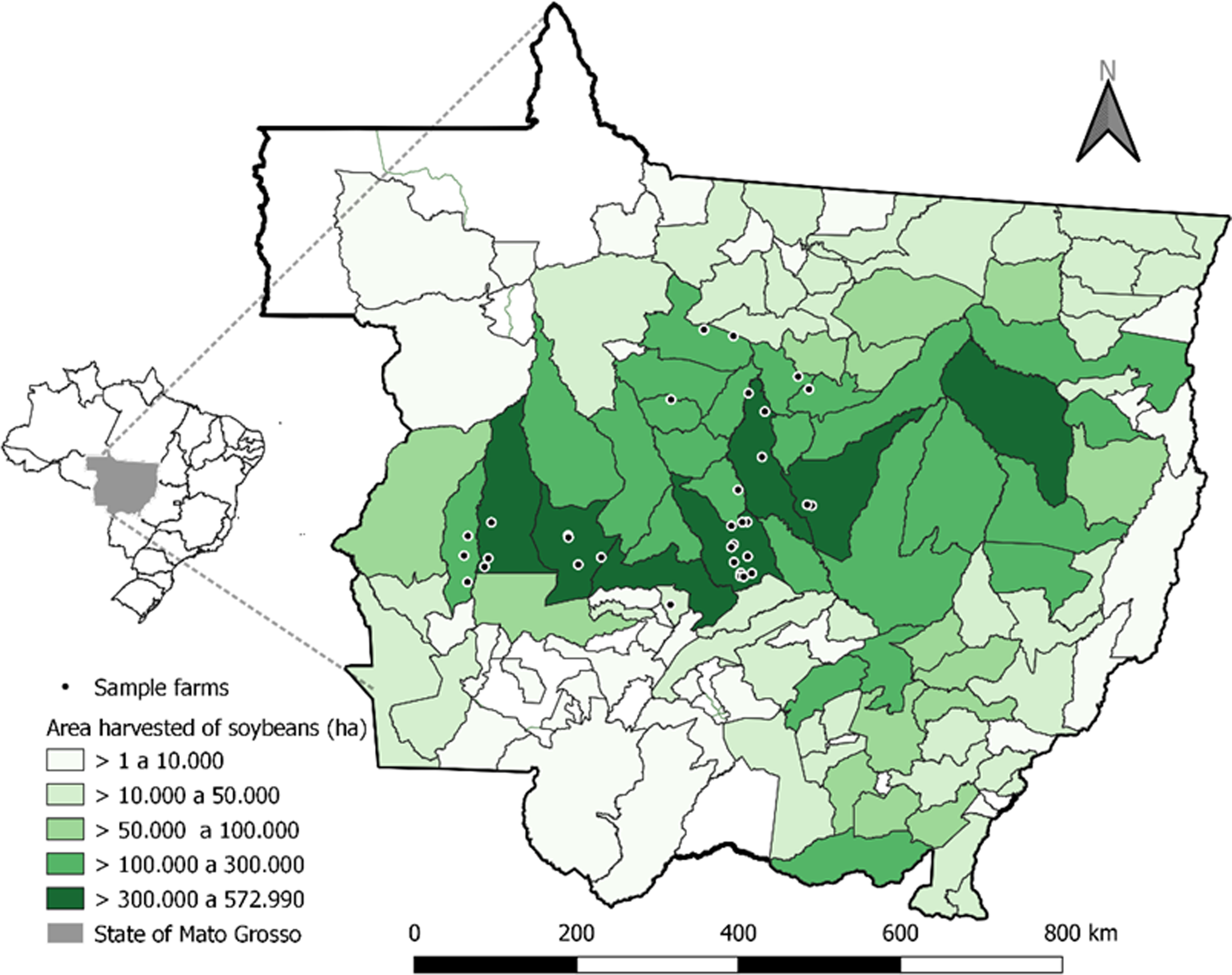
The visited farms are located in ten municipalities of Campo Novo do Parecis, Campos de Julio, Itanhanga, Lucas do Rio Verde, Nortelândia, Nova Mutum, Nova Ubiratã, Sapezal, Sinop, and Sorriso (Figure 1). This region represents the main soybean-producing areas of the state. All these areas have a tropical rainy summer climate (Aw in the Koeppen-Geiger system), with a well-defined dry season in winter (Alvares et al., Reference Alvares, Stape, Sentelhas, Gonçalves and Sparovek2013).
Location of the visited farms and area harvested of soybeans (ha).
This was followed by an interview with the structured questionnaire (Table S1), either with the farm owner or with a farm manager. Then two locations on the farm were visited, one in the middle of arable land and the other close to a (near) natural habitat, usually a forest. At both sites, mixed samples of the topsoil (0–15 cm depth) were taken from five to ten points each, at least ten metres apart. The soil samples were stored without cooling in sealed plastic bags in the dark.
On some farms, especially those belonging to large companies, it was not possible to collect soil samples. Therefore, a total of 40 soil samples were collected and sent to Switzerland for analysis by the company Interlabor Belp AG. Of these, all 40 were subjected to a crop protection product screening for 500 pesticide agents, and 20 samples were additionally tested for glyphosate and its main metabolite, amino-methyl-phosphonic acid (AMPA).
Potential biases in data collection could influence the study’s findings and interpretations, particularly regarding farm manager responses and sampling decisions. Farm managers may have provided socially desirable answers during interviews, especially concerning sensitive topics like pesticide usage or adherence to sustainability standards, potentially leading to an overestimation of compliance or best practices because they knew they were supposed to be in compliance. Similarly, the sampling strategy, which involves only one VSS and selecting farms certified by major sustainability standards and limited non-certified farms, may not provide a fully representative comparison across all soybean producers in the region. This sampling limitation restricts the ability to generalise findings beyond the studied farms and may skew results towards the practices of larger, better-resourced operations.
Satellite image analysis
Remote sensing techniques are essential for assessing land use changes over time, particularly in verifying habitat conservation and detecting land cover transitions.
While both RTRS and ProTerra currently emphasise the use of satellite imagery to demonstrate compliance with their environmental criteria, especially regarding the conversion of natural ecosystems to agricultural areas, in this study, we combined Rural Environmental Registry (CAR) data provided by the farms visited with satellite imagery to verify adherence to these criteria.
In order to review the managers’ statements about habitat areas – areas with protected (semi) natural vegetation – and their evolution over the last decades, publicly available satellite images were combined with data (polygons) from the SICAR database. In order to review the managers’ statements about habitat areas – areas with protected (semi) natural vegetation – and their evolution over the last decades, publicly available satellite images were combined with data (polygons) from the SICAR database.
The coordinates of the farms were recorded during the field visits. Then, for each farm, its registration was downloaded from the CAR database. This entry shows the location, shape and land use of the farm, under the designation of habitat areas. It also indicates whether an area has been blocked by the environmental agency IBAMA (‘blacklist’). Landsat images from 1985, 1995, 2005, 2015 and 2019 were then searched on all surfaces using the Google Engine Platform Service (PaaS). For each year, images were taken from the period from July to November with the lowest possible cloud cover, in which the appearance of forest or savannah on the one hand and of arable crops on the other could be distinguished as best as possible. For the years 1985, 1995 and 2005, Landsat-5 images with 8-bit radiometric resolution (256 shades of grey) were used, comprising the VIS (3) and IVP (4) bands. For 2015 and 2019, Landsat 8 images with 12-bit radiometric resolution were captured, comprising the VIS (4) and IVP (5) bands. To distinguish between (semi-)natural habitat and agricultural areas, the Normalized Difference Vegetation Index (NDVI) was calculated, and a threshold of 0.5 was chosen (Victoria et al., Reference Victoria, Paz, Coutinho, Kastens and Brown2012); (Martins et al., Reference Martins, Cunha, Pereira, Danelichen, Machado, Lobo, Musis and Biudes2015). The calculations were performed using the R programme. The NDVI was calculated according to the formula by Rouse et al. (Reference Rouse, Haas, Schell and Deering1973).
Analysis of data
The data obtained from the interviews with agricultural managers were analysed mainly descriptively, and mean and dispersion values were calculated and visualised. The participations were grouped according to the pattern and partially by geographic region. Statistical comparisons were not made in view of the uneven sampling – 4 non-certified companies, 8 RTRS certified companies and 23 ProTerra certified companies.
Results and discussion
Image analysis to identify deforestation
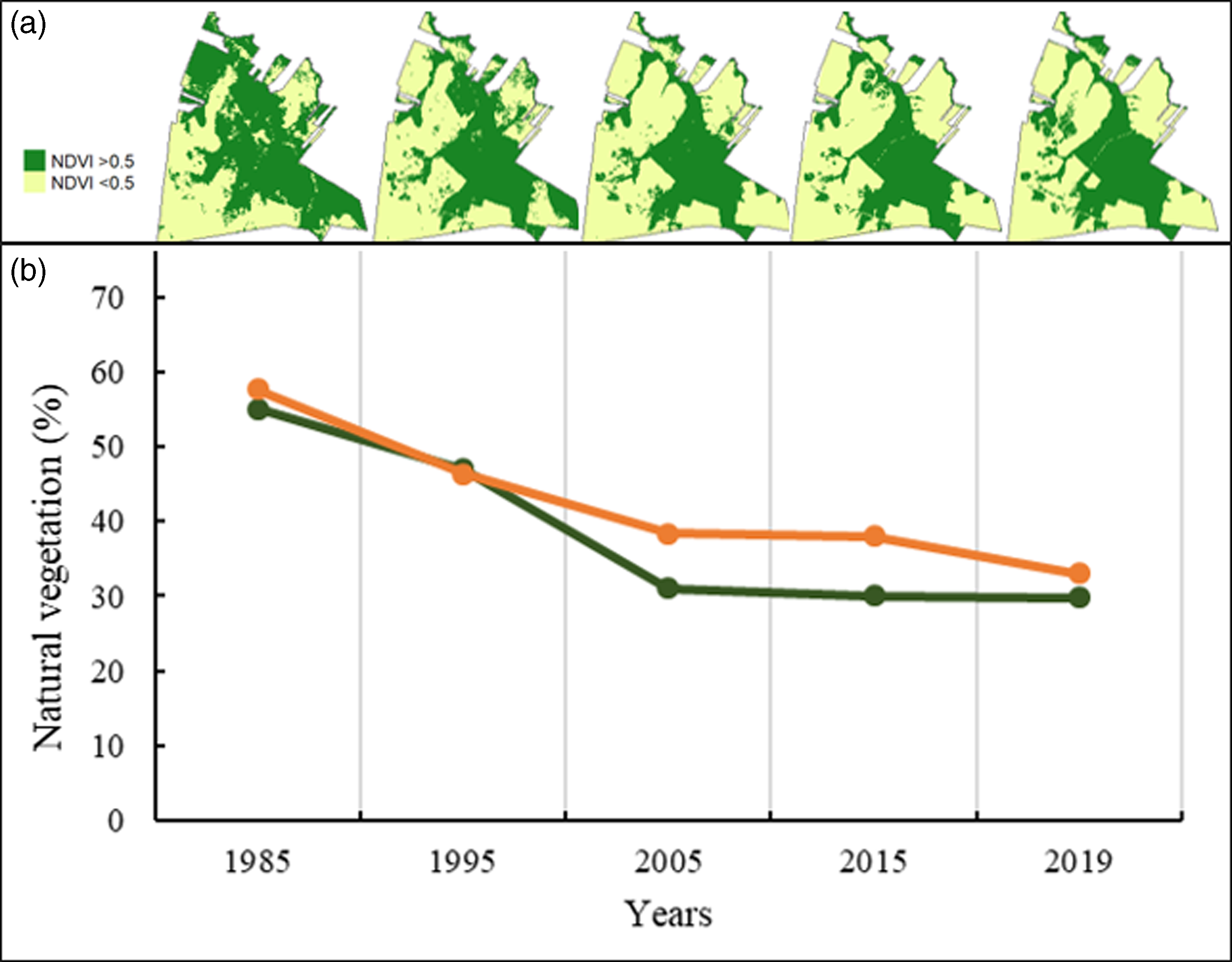
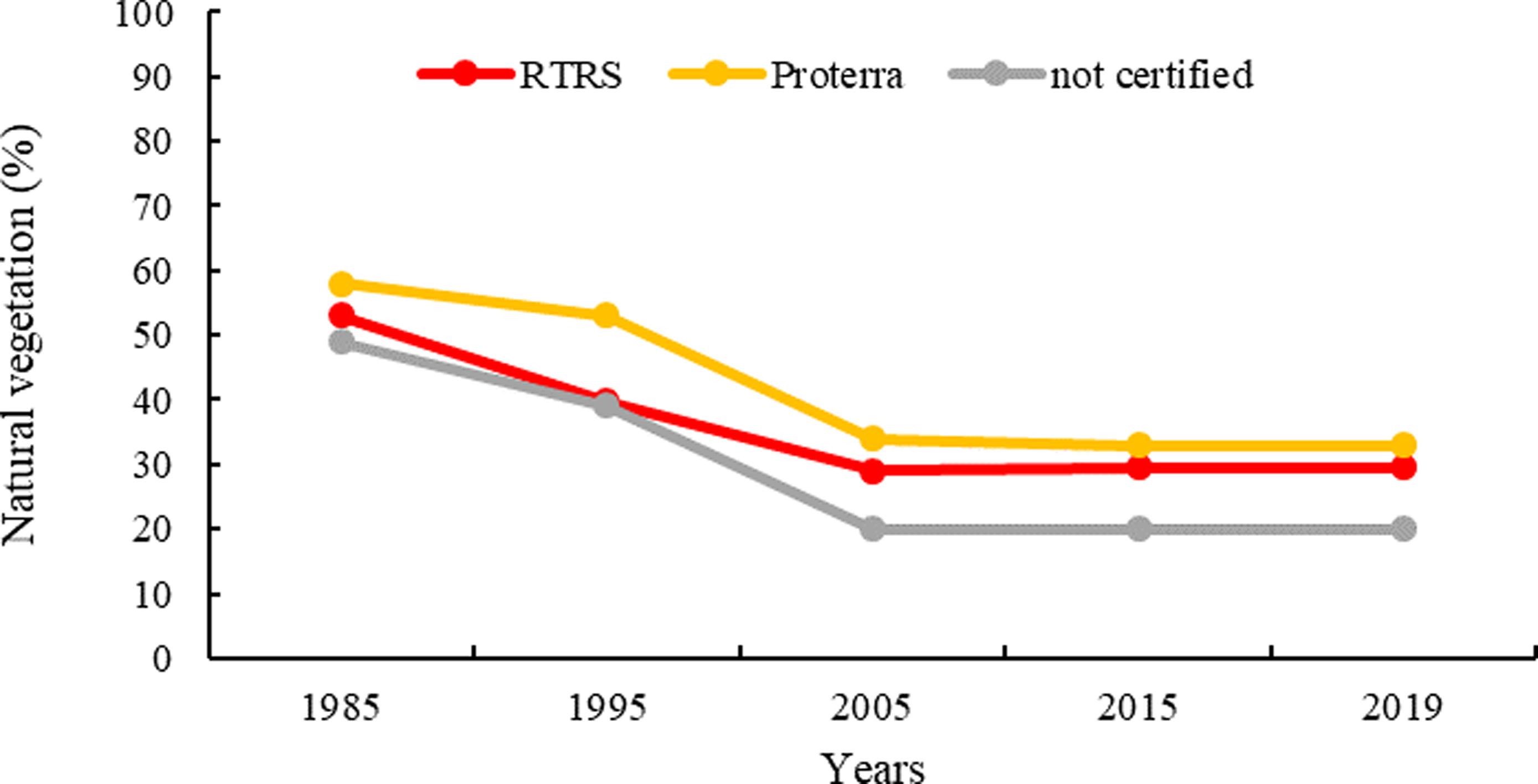
Analysis of satellite imagery showed that the average area classified as natural vegetation decreased from 55% to 30% of the agricultural area from 1985 to 2005 and then remained at this level (Figure 2). This trend was similar for all groups except for the non-certified farms (Figure 3). A comparison by geographic region showed differences, with the northernmost farms (in the Amazon) being 74–98% covered by forest in 1985 and 31–36% in 2019. After 2005, there was no deforestation on any of the 35 farms.
Proportion of area covered by natural vegetation. (a) Dynamics of vegetation cover change on a certified farm from 1985 to 2019. (b) Average area covered by natural vegetation in the total area of the farms for which complete satellite images and CAR polygons were available, from 1985 to 2019, in green line and orange line cover change on a certified farm.
Proportion of average area covered by natural vegetation in the total area of non-certified, ProTerra and Roundtable on Responsible Soy certified farms, from 1985 to 2019.
The reduction of deforestation is intrinsically linked to the conservation of native vegetation, which plays a crucial role in maintaining soil quality. Preserved vegetation contributes to soil protection by preventing erosion, enhancing water infiltration, and stabilising microclimatic conditions that influence nutrient cycling. Thus, the enforcement of deforestation-free requirements by certification schemes not only contributes to biodiversity conservation but also supports key ecosystem functions that sustain soil health and productivity (Garcia et al., Reference Garcia, Andrade, Ribeiro and Oliveira-Filho2017).
No expansion of consolidated planting areas was observed on the farms visited after certification. Only one certified farm showed a slight change in crop area between 2005 and 2010. This farm, certified in 2007, had converted what appeared to be dense pasture into arable land. By 2010, 40% of its surface remained covered by forests, indicating no apparent violation of laws or standards. Most of the farms visited obtained certification after 2014.
The soy moratorium has had a significant impact on reducing deforestation associated with soy production in the Amazon (Gibbs et al., Reference Gibbs, Rausch, Munger, Schelly, Morton, Noojipady, Soares-Filho, Barreto, Micol and Walker2015). To promote truly sustainable soy, it would be crucial to transform the Cerrado Manifesto (https://ipam.org.br/bibliotecas/manifesto-cerrado/) into a commitment as specific as a soy moratorium, or alternatively, to expand a soy moratorium to encompass the Cerrado region. This approach would broaden environmental protection and ensure responsible agricultural practices in ecologically sensitive areas.
Methods of cultivation
The cultivation methods on the 35 farms differed little from one another. On all farms, soybeans were the main crop grown, but a second crop was grown in the same year throughout the area. The fallow period was respected. On 33 of the 35 farms, the second crop was corn. One farm grew cotton, another grew sunflowers.
On 21 farms, between three and five crops were grown in total, including beans, millet, rice and sugarcane, as well as cover crops such as Urochloa, Stylosanthes and Crotalaria sp. It indicates a slight increment of crop diversification, although corn is the most commonly cultivated second crop in the dry season. This is reflected in the preference for medium to early maturing soybean varieties that allow harvesting to occur earlier and clear the field earlier.
All 35 farms used no-till farming system, with crop residues left on soil surface. Prior to soybean planting, weeds were eliminated with herbicides.
The adoption of no-till systems represents a significant contribution to soil conservation. No-till practices are well-documented to reduce erosion, improve soil structure, and enhance water retention. Furthermore, the presence of crop rotation and diversification in some farms can help maintain soil organic matter and reduce degradation risks associated with intensive monoculture systems.
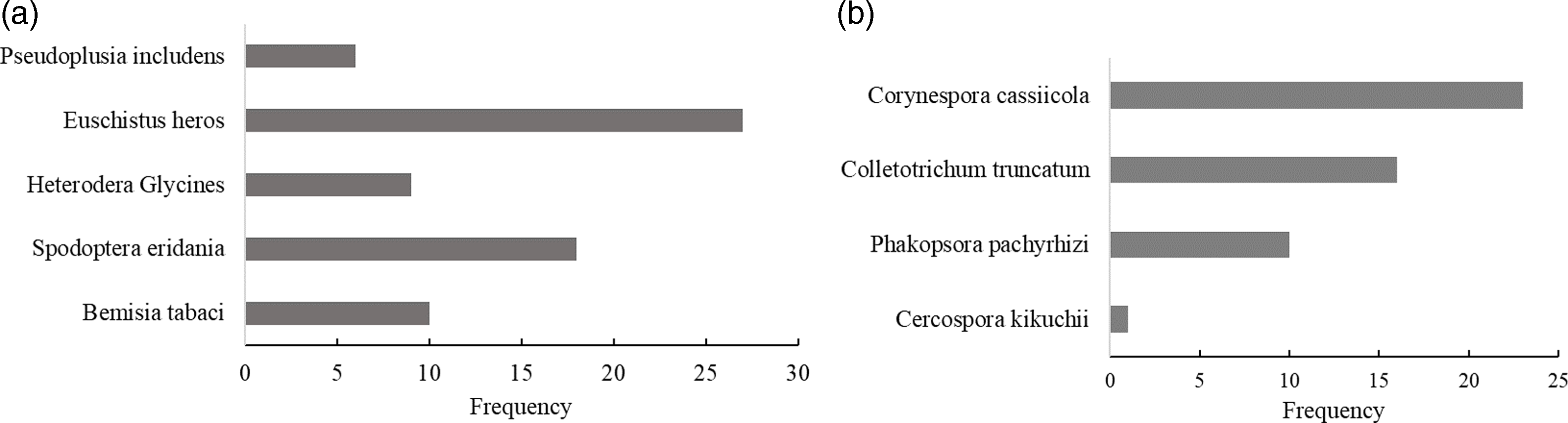
All farms also fertilised the soybean crop with mineral phosphorus, limestone, potassium, and micronutrient fertilisers. As a result of these cultivation practices, grain yields of 2880 to 4500 kg ha–1 were achieved in the 2018–2019 season. The average soybean yield thus was 3.65 Mg ha–1 of grains. This resulted in a total production of 535 000 Mg for the 35 farms in the 2018–2019 season. Phytosanitary protection is a challenge in soybean cultivation due to slow juvenile development and poor growth; soybean plants are weak in competition with weeds and are attacked by a variety of diseases and pests (Godoy et al., Reference Godoy, Bueno and Gazziero2015) (Figure 4). The main pathogens and pests mentioned during interviews by farm managers in soybean cultivation in the five years preceding the interviews were fungal diseases, four of the pests were insects, and one (Heterodera glycines) was a nematode (Figure 4).
The pathogens (a) and pests (b) were most mentioned by the 35 agricultural managers in soybean cultivation that occurred in the 5 years prior to the interviews. All diseases are fungal diseases. Of the pests, four are insects, one (Heterodera glycines) is a nematode.
A correspondingly high level of effort is invested in plant protection, in preventive measures such as selection of resistant varieties, in biological measures such as the use of baculoviruses, nematodes and Bt (Bacillus thuringiensis) products, and in permanent monitoring of fields for pest and disease infestation, and frequent treatments with synthetic plant protection products (PPP). Most operations managers reported a decline in the effectiveness of these products over the past five years. Increasing disease pressure was also reported.
On the 35 farms, soybean plants were treated with 148 different crop protection products. Of the products mentioned, 11 could not be identified, and seven were biological control agents, e.g., Bacillus thuringiensis and Baculovirus anticarsia. Of the 148 products, 130 were synthetic pesticides whose active ingredients, formulation and manufacturer were identified. These included 62 insecticides, 45 herbicides, 30 fungicides and two nematicides. Seven of the insecticides also have acaricidal effects.
Most of the PPPs were sprayed on the crop or pre-emergence. All soybean seeds were treated, mainly with active ingredients against diseases and insect pests. Of the 137 PPPs (including biologicals), 100 contained a single active ingredient, 34 contained two active ingredients, and three contained three active ingredients. These agricultural pesticides were manufactured by 35 different companies. The largest number of active ingredients used on soybeans, i.e. 23, comes from Syngenta. Second and third places also go to foreign manufacturers, i.e. BASF and Corteva.
All active ingredients used were tested to determine whether they (1) are classified as highly toxic to humans (World Health Organization – WHO lists Ia and Ib), (2) are persistent in the environment and highly toxic to several groups of organisms (University of Hertfordshire/IUPAC Pesticide Properties Database), (3) are approved in one or more EU states.
It was noted that there was no WHO assessment until 2020 for about 1/3 of the active ingredients – all of which were ‘newer.’ This is relevant because classification on the WHO list is considered a criterion of the ProTerra standard. This criterion could therefore not be applied to all active ingredients. In contrast, ecotoxicological assessments were available for virtually all active ingredients.
The interviews revealed that three active ingredients from WHO List Ib were used: Beta-Cyfluthrin, Methomyl, and Zeta-Cypermethrin. It should also be noted that the WHO list in question dates back to 2009, and several active ingredients used today are not classified on it. Of the agricultural pesticides cited by the interviewees, 13 active ingredients were classified as potentially very harmful to the environment. These are mainly insecticides and fungicides, but also the herbicides diquat and paraquat. Diquat, in particular, is very frequently used in the Reglone product to desiccate soybean plants before harvest. The use of paraquat had already been banned by the Brazilian National Health Surveillance Agency (Anvisa) in 2017, with resolution RDC No. 177/2017, which determined the gradual banning of the product. In September 2020, a total ban on the use, production, distribution and sale of paraquat came into force, due to concerns about its risks to human health. As the interviews were conducted between June and August 2019, their use was still permitted (Table S2).
No farm managers mentioned active ingredients banned by the Rotterdam and Stockholm Conventions, nor were any residues of such substances found in soil samples. The average number of chemical treatments per soybean crop (including multiple applications of the same products) was 17.5 for non-certified farms, 15.2 for certified farms. Herbicides and insecticides were used most frequently, and fungicides less frequently. The herbicide glyphosate was the most frequently used active ingredient on 23 farms.
Soil analysis
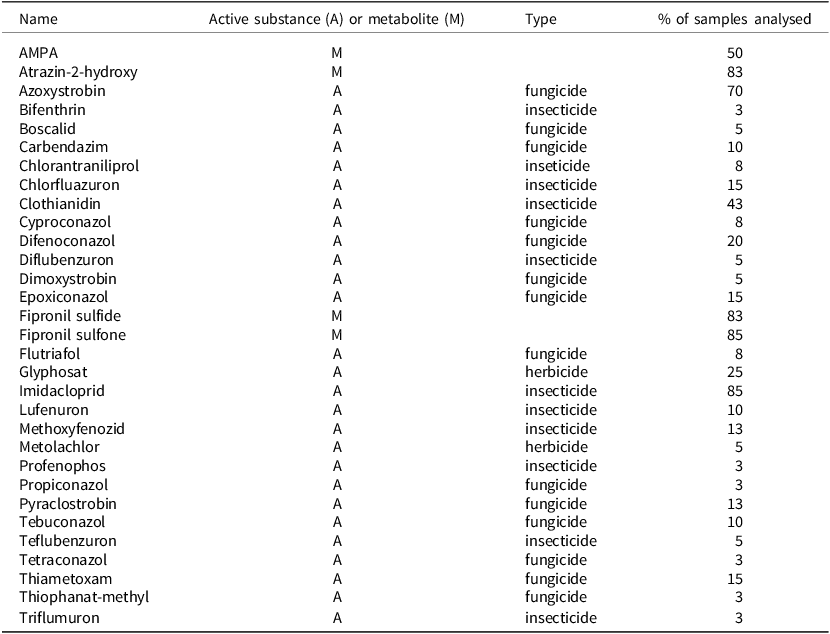
Active ingredients of pesticides or their metabolites were detectable in all the soil samples examined. Between two and twelve substances were detected per sample. Out of a total of 31 substances found, 27 were active ingredients – two herbicides, thirteen fungicides, and twelve insecticides – and four were metabolites (of atrazine, fipronil, and glyphosate) (Table 1). It is worth remembering that the soil samples were taken after the corn harvest. The most frequently found substances were imidacloprid and the metabolites of fipronil and atrazine. Total levels without glyphosate and its metabolite AMPA71 ranged from 0.05 ppm to 0.74 ppm, an average of 0.23 ppm (based on soil dry matter). In the 20 samples analysed for glyphosate and AMPA, an average of 0.23 ppm was found, which more than doubled the total average residue level measured in these samples to 0.43 ppm. There are no legal limits for pesticide levels in the soil of the study region. For Silva et al. (Reference Silva, Mol, Zomer, Tienstra, Ritsema and Geissen2019), from two to five different substances were primarily found in 317 surface soil samples from eleven EU countries. A total of 83% of the soils contained one or more residues, and 58% contained mixtures. However, significantly less extensive screening was carried out than in our study, so the comparison is limited to a certain extent. The total content of the substances described by Silva et al. (Reference Silva, Mol, Zomer, Tienstra, Ritsema and Geissen2019) considered the active ingredients to be a maximum of 2.87 ppm. In an Australian study, maximum values of around 2.1 ppm were found. Chiaia-Hernández et al. (Reference Chiaia-Hernandez, Keller, Wächter, Steinlin, Camenzuli, Hollender and Krauss2017) found ten to fifteen substances at concentrations (of the individual substances) of 0.001 to 0.33 ppm in 29 samples of topsoil from Swiss agricultural areas. In this context, it seems that the soil samples from the farms visited in Mato Grosso were contaminated with PSM residues in a similar way to farmland soils in other regions of the world. The samples collected in the middle of the field had a slightly higher total residue content of 0.25 ppm (without glyphosate and AMPA) than those collected near the preservation areas, where this value totalled 0.21 ppm. Of these 27 active ingredients found, 22 may have (also) been used on soybeans. All the active ingredients found in the soil samples are approved in Brazil. Among the substances found in the soil, chlorantraniliprole, epoxiconazole, fipronil, and imidacloprid have at least a medium persistence (several months) in the environment and are highly toxic to various groups of organisms. No substances listed under the Rotterdam or Stockholm Conventions were found.
Principal active ingredients of plant protection products and their metabolites found with more frequency in the soil samples (0–15 cm depth) from the visited farms. Samples were collected in late June to mid-August 2019, i.e. three to five months after soybean harvest and immediately after corn harvest. Analysis by Interlabor Belp AG according to DIN-15662-EA1-001 (GC-MS/MS, LC-MS/MS). Glyphosate and its degradation product amino-methyl-phosphonic acid (AMPA) were measured separately
As our results were from a single sampling event carried out in 2019, the conclusions drawn from these results should be interpreted with care. However, it should be noted that the use of agrochemicals has become a major threat to the soil (Stolte et al., Reference Stolte, Tesfai, Oygarden, Kvaerno, Keizer, Verheijen, Panagos, Ballabio and Hessel2016), and as such may affect several of the United Nations Sustainable Development Goals related to the soil environment (Keesstra et al., Reference Keesstra, Bouma, Wallinga, Tittonell, Smith, Cerdà, Montanarella, Quinton, Pachepsky, van der Putten, Bardgett, Moolenaar, Mol, Jansen and Fresco2016; Pérez and Eugenio, Reference Pérez and Eugenio2018; Smith et al., Reference Smith, Poch, Lobb, Bhattacharyya, Alloush, Eudoxie and Hallett2024). Although the research carried out here has been limited to the topsoil and without long-term follow-up, it should be noted that sustainable agricultural practices are vital to reducing soil contamination and should be a relevant aspect of the Sustainable Development Goals (SDGs).
Considerations on voluntary standards
The triple crisis of climate change, pollution, and biodiversity loss, including degradation, poses an existential threat to society, but it also boosts business competitiveness and opens up new opportunities: the green business that values sustainability, the price of sustainability certificates, and the development of a fair-trade market. It can therefore catalyse innovation and create unique business models that have an impact on economic, social and environmental capital, or highlight new uses and practices that are out there, sometimes underreported and undervalued.
The challenge is to find a way to make the economy good for planet and people also good for business, and for this bold goal it is imperative to keep in mind the diverse needs of different stakeholders to enable a just transition and build extreme competitiveness even as we increase environmental resources and take proactive climate action. Large-scale sustainability programmes focus on addressing climate change, replenishing natural resources, ensuring water security, promoting circularity, developing a resilient supply chain, driving product sustainability and brands with purpose, and strengthening livelihoods. Without VSS and the technology to report, monitor, evaluate, and assess, and later verify compliance, this complex web of global governance is difficult to implement, trust, and enforce.
The VSS emerged mostly to address the need to attest that the agriculture business is not deforesting or polluting, but in this path, other private initiatives were developed with sustainability concerns relating to the GVC production so the market of VSS exploded to the 353 standards reported presently now by the Standards Map. (ITC, 2021). They specify requirements to producers, traders, manufacturers, retailers, or service providers and demand compliance with a wide range of sustainability metrics, including respect for basic human rights, worker health and safety, the environmental impacts of production, community relations, land use planning, and others (United Nations Forum on Sustainability Standards, 2017).
In export-oriented tropical agricultural sectors, the VSS assumed a very important role. Some standards, as they are purely private, could eventually even be used as protectionism disguised as environmentalism. Against this background of uncertainties, many countries, and developed countries in particular, have begun adopting mandatory due diligence regulatory initiatives to tackle the adverse sustainability impacts of business operations along GVCs. And the standards assume a central role in attesting conformity.
Especially in cases of mandatory due diligence as required by the European Union’s Deforestation-free Products Regulation (2023), the USA’s Uyghur Forced Labor Prevention Act (2021), the European Union’s new Batteries Regulation (2023), the UK’s Environment Act4 (2021), the German Supply Chain Due Diligence Act (2021), and the French Duty of Vigilance Law (2017), the voluntary standards are a fundamental tool for more balanced production. Although the use of voluntary standards has become more frequent and the diversity of existing standards has increased in recent years, numerous challenges remain, which is why there has been a constant search for improvements and discussion of these standards.
However, given that economic, ecological and social conditions vary between farms, the criteria are sometimes formulated in a very broad way. A more precise formulation would require more resources in terms of monitoring and implementing the standards. The standards, therefore, constitute an important and useful tool, even if they are not sufficient on their own to make agriculture more sustainable. To achieve this, it is also necessary to adopt effective environmental laws and develop sustainable cultivation methods. Sustainability standards are an important element of sustainable agriculture and food. However, they are only part of the set of measures that make agriculture and food consumption compatible with the principles of sustainable development.
To improve VSS effectiveness, frameworks should incorporate more comprehensive soil health monitoring protocols, emphasising long-term tracking of indicators such as organic matter content, microbial diversity, and erosion rates. Regular soil testing and the integration of advanced tools, such as remote sensing and artificial intelligence, can provide more reliable data and identify areas needing intervention.
Promote biodiversity through more agroecological practices, to enhance biodiversity, so VSS guidelines should encourage the widespread adoption of agroecological practices like crop rotation, intercropping, and the use of cover crops. These practices are not easy to implement on large scale and not only protect soil health but also create habitats for beneficial organisms, contributing to ecosystem resilience.
Mandate clear limits on pesticide use, and establish stricter regulations within VSS frameworks regarding the use of pesticides, particularly those with high environmental toxicity or persistence to minimise chemical dependency, VSS should encourage using integrated pest management (IPM) strategies, biological control agents, and resistant crop varieties, and the use of high technological alternatives that are commercially costly.
Incentivise carbon sequestration practices that include explicit incentives for practices like no-till farming, cover cropping, and agroforestry, which enhance soil carbon sequestration. These actions align with climate change mitigation efforts and should be tied to certification benefits or premium pricing in markets. And can nowadays result in projects of carbon credits, payments of environmental services or special credits that are win-win situation certifications and also remuneration for sustainability.
Increase transparency and accountability that VSS organisations can provide by implementing transparent auditing processes and publicly accessible reports on compliance and outcomes. Independent third-party audits and satellite-based land use monitoring can reduce bias and improve credibility. Expand farmer support programmes to provide technical training and financial assistance to help farmers transition to sustainable practices. This could include subsidies for adopting soil-friendly techniques, grants for purchasing eco-friendly inputs, or knowledge-sharing platforms for best practices.
Enhance stakeholder collaboration, fostering partnerships between certification bodies, governments, and academic institutions to align VSS with broader policy goals and research advancements. Collaborations can ensure that VSS guidelines are evidence-based and regionally relevant. Tailor guidelines to local conditions, adapting VSS criteria to account for regional and farm-level differences in soil types, climatic conditions, and socioeconomic contexts. Customised guidelines will make the standards more practical and effective across diverse settings.
Encourage long-term commitments requiring certified farms to commit to multi-year sustainability goals rather than one-time compliance checks. This ensures sustained improvements in soil health and biodiversity over time.
By integrating these recommendations, VSS frameworks can significantly enhance their effectiveness in promoting sustainable agricultural practices, fostering healthier soils, and preserving biodiversity, ultimately advancing both environmental and economic goals. Examining the role of VSS in promoting sustainable agricultural practices, this research underscores their contribution to protecting and restoring terrestrial ecosystems, specifically the adherence to certification criteria such as zero deforestation and soil health improvement, directly supporting SDG 15 by preserving biodiversity and enhancing soil fertility, both of which are crucial for maintaining ecosystem balance.
Furthermore, this study highlights the adoption of practices such as no-till farming, crop diversification, and the use of cover crops, which not only enhance carbon sequestration but also mitigate greenhouse gas emissions, thereby advancing SDG 13. These practices exemplify how sustainable agriculture can act as a nature-based solution for addressing climate change while simultaneously ensuring productive land use, demonstrating a synergistic approach to achieving global sustainability goals.
Last but not least, the findings of this study also align with the objectives of the Paris Agreement and Brazil’s updated nationally determined contribution (NDC), which commits to achieving net-zero greenhouse gas emissions by 2050 and sets more ambitious interim targets for reducing emissions by 2030. The promotion of sustainable agricultural practices through VSS directly supports Brazil’s climate goals by mitigating deforestation – a key driver of emissions – and enhancing carbon sequestration through soil-friendly practices such as no-till farming, cover cropping, and crop diversification. These practices also contribute to preserving Brazil’s natural ecosystems, a priority under the country’s NDC, which emphasises protecting biodiversity and maintaining carbon sinks in regions like the Cerrado. By incorporating these sustainable approaches into soybean production, VSS can play a critical role in reducing agricultural emissions and strengthening climate resilience, reinforcing Brazil’s commitment to global climate action and the goals of the Paris Agreement.
Final remarks
VSSs are quasi-laws for those wishing to export to good importers, because they coordinate GVCs around requirements that are essential for those wishing to export to more regulated markets. Public administrations may also recognise these standards as evidence of compliance with best practices and alignment with sustainable development goals. However, assessing the empirical impacts of VSS is challenging, as they function outside government oversight, and companies are not obliged to report implementation data. This case study contributes to filling this gap by providing insights into the application of VSS in soybean production. ProTerra and RTRS were the two standards observed in this study. Nevertheless, due to the limited sample size, the potential for systematic comparison between certified and non-certified farms remains constrained.
Crop diversification and the use of cover crops such as Urochloa, Stylosanthes, and Crotalaria sp. observed on some farms contribute to soil health by increasing organic matter, enhancing nitrogen fixation, and reducing erosion. The adoption of early-maturing soybean varieties also helps extend the fallow period, allowing for improved soil structure and long-term productivity. Despite these positive practices, the detection of multiple pesticide residues and metabolites in soil samples suggests potential long-term risks to soil biodiversity and key ecosystem functions. Since our data are based on a single sampling event conducted in 2019, these findings should be interpreted with caution.
Nevertheless, the study shows that certified farms generally comply with sustainability standards, particularly with regard to avoiding deforestation. This supports the assumption that certified soy is produced in a more sustainable manner than non-certified soy. VSS frameworks allow for incremental improvements within the broader context of large-scale conventional agriculture. Moreover, certification plays an important role in demonstrating that companies are going beyond legal requirements and reinforcing their voluntary commitments to socio-environmental governance. Future studies should consider more VSS and employ anonymous surveys, expand sample sizes, and incorporate random sampling to mitigate these biases and enhance the robustness of conclusions.
Supplementary material
The supplementary material for this article can be found at https://doi.org/10.1017/S0014479725000110
Author contribution
Conceptualisation, all authors; methodology, G.R and J.G; validation, all authors; investigation, G.R. and J.G; resources, J.G.; writing – review and editing, all authors. All authors have read and agreed to the published version of the manuscript.
Funding statement
We thank the Swiss Federal Office for the Environment for funding part of this research, as well as the Center for Carbon Research in Tropical Agriculture (CCARBON) at the University of São Paulo, sponsored by the São Paulo Research Foundation (FAPESP) under grant 21/10573-4. We also thank the support of the RCGI – Research Centre for Greenhouse Gas Innovation, hosted by the University of São Paulo (USP) and sponsored by FAPESP – São Paulo Research Foundation (2014/50279-4 and 2020/15230-5) and Shell Brazil, and the strategic importance of the support given by ANP (Brazil’s National Oil, Natural Gas and Biofuels Agency) through the R&D levy regulation.
Competing interests
The authors declare no conflict of interest.


 Open access

