


There is national concern about the shortage of human resources in the National Health Service (NHS) (Secretary of State for Health, 2000). Psychiatry has been seeking to address problems of inadequate consultant staffing, insufficient rates of recruitment and early retirement (Royal College of Psychiatrists, 1983, 1992, 1997; Reference HillHill, 1990; Storer, Reference Storer1997a , Reference Storer1997b , Reference Storer1998; Reference Kendell and PearceKendell & Pearce, 1997; Department of Health, 1999). Reports have indicated excessive workload with high levels of dissatisfaction, stress and burnout among psychiatrists (Reference Benbow and JolleyBenbow & Jolley, 1998; Reference Guthrie, Tattan and WilliamsGuthrie et al, 1999; Reference Rathod, Roy and RamsayRathod et al, 2000; Reference BrandonBrandon, 1997; Reference Guthrie and BlackGuthrie & Black, 1997; Reference HaleHale, 1997; Reference HolmesHolmes, 1997; Reference Kesteven, Mann and SimsKesteven et al, 1997; Reference MyersMyers, 1997; Reference RobertsRoberts, 1997; Reference Wilhelm, Diamond and WilliamsWilhelm et al, 1997 Reference Wrate and BaldwinWrate & Baldwin, 1997). A survey of child mental health professionals in the north west of England found high rates of anxiety, worry and time off due to work-stress, and levels of stress that affected the ability of staff to work with disordered families (Reference Case and LittlewoodCase & Littlewood, 1999). To investigate these issues further, the Executive Committee and Regional Representatives Group of the Faculty of Child and Adolescent Psychiatry supported this survey of recruitment, retention, job satisfaction, stress, psychological distress and burnout among all consultant child and adolescent psychiatrists (CCAPs) in the United Kingdom and Eire.
Method
All CCAPs practising in the UK and Eire were identified from the regional representatives' mailing lists. Each was sent two postal questionnaires, together with an explanatory letter and a guarantee of anonymity. Announcements at regional and national faculty meetings encouraged them to complete and return the questionnaires.
The ‘Recruitment and Retention Questionnaire’ included 49 occupationally-specific questions with structured and open-text responses. These questions covered resources, recruitment, regional trends, training, management arrangements and workload. The ‘Job Satisfaction and Job Stress Questionnaire’ was a structured questionnaire incorporating demographic and employment details, items from the Job Diagnostic Survey (Reference Hackman and OldhamHackman & Oldham, 1975), occupationally specific items on coping and stress, the Maslach Burnout Inventory (Reference Maslach and JacksonMaslach & Jackson, 1986), and the 28-item version of the General Health Questionnaire (GHQ—28) (Reference Goldberg and WilliamsGoldberg & Williams, 1988). The 22-item Maslach Burnout Inventory produces three sub-scales with standardised threshold scores that identify subjects with burnout in occupational subgroups, including mental health staff. These are: emotional exhaustion (feeling emotionally overextended by one's work, threshold=21/22); depersonalisation (holding cynical and negative attitudes and feelings towards recipients of care, threshold=7/8); and low personal accomplishment (holding negative beliefs about one's ability and competence, particularly in relation to work with clients, threshold=28/29). The GHQ—28 is a widely used screening test for common mental disorder which has been used in previous UK studies of health personnel, using a threshold of either 4/5 (Reference CoffeyCoffey, 1999; Reference Alexander and KleinAlexander & Klein, 2001) or 5/6 (Reference CaplanCaplan, 1994; Reference Blenkin, Deary and SadlerBlenkin et al, 1995). The two questionnaires were returned to the authors in separate envelopes to preserve the anonymity of the information in the Job Satisfaction and Job Stress Questionnaire.
Results
Six hundred and twenty-three questionnaires were sent out in November 2000. This exceeded the number of current CCAPs (approximately 550) because it included non-consultant grades and CCAPs who had recently stopped practising. The 323 eligible Job Satisfaction and Job Stress Questionnaires, and the 333 Recruitment and Retention Questionnaires returned represent 59% and 61%, respectively, of the CCAPs currently practising.
For some or all of their time, 83% of respondents worked in district child and adolescent mental health services (CAMHS) (tiers 2 and 3). Ten per cent had responsibilities for in-patient children's units and 17% for in-patient services for adolescents (tier 4); 9% had academic responsibilities; 74% were full time, 23% part time and 3% maximum part time. Fifty-three per cent of respondents were female.
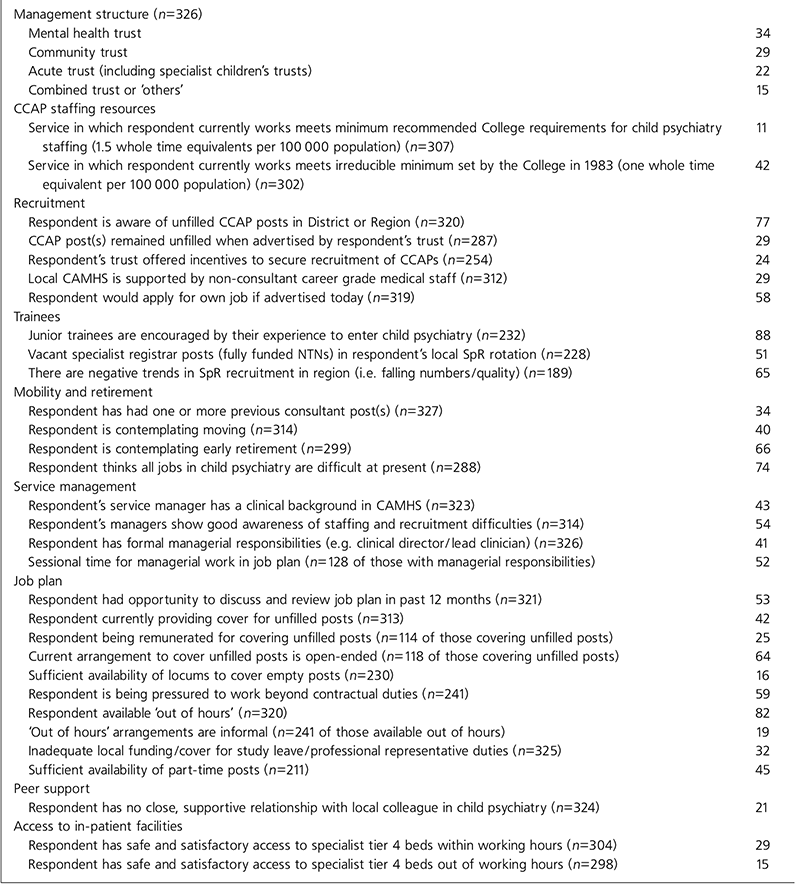
Of the responding CCAPs, 74% had been in their current post for less than 10 years; 23% had been in post for between 10 and 20 years and 3% for more than 20 years. It was felt by 50% that the job of a CCAP has changed for the worse over the years, while 14% felt it has changed for the better and 36% had mixed views. Throughout the UK and Eire, 130 separate, unfilled CCAP posts were identified (some continued to be advertised and some were no longer advertised). In all regions, a large majority of CCAPs indicated that their CAMHS fell short of the College's minimum recommended staffing requirements. The responses to the items in the two questionnaires are summarised in Tables 1 and 2.
Recruitment and Retention Questionnaire: percentage indicating each response
| Management structure (n=326) | |
| Mental health trust | 34 |
| Community trust | 29 |
| Acute trust (including specialist children's trusts) | 22 |
| Combined trust or ‘others’ | 15 |
| CCAP staffing resources | |
| Service in which respondent currently works meets minimum recommended College requirements for child psychiatry staffing (1.5 whole time equivalents per 100 000 population) (n=307) | 11 |
| Service in which respondent currently works meets irreducible minimum set by the College in 1983 (one whole time equivalent per 100 000 population) (n=302) | 42 |
| Recruitment | |
| Respondent is aware of unfilled CCAP posts in District or Region (n=320) | 77 |
| CCAP post(s) remained unfilled when advertised by respondent's trust (n=287) | 29 |
| Respondent's trust offered incentives to secure recruitment of CCAPs (n=254) | 24 |
| Local CAMHS is supported by non-consultant career grade medical staff (n=312) | 29 |
| Respondent would apply for own job if advertised today (n=319) | 58 |
| Trainees | |
| Junior trainees are encouraged by their experience to enter child psychiatry (n=232) | 88 |
| Vacant specialist registrar posts (fully funded NTNs) in respondent's local SpR rotation (n=228) | 51 |
| There are negative trends in SpR recruitment in region (i.e. falling numbers/quality) (n=189) | 65 |
| Mobility and retirement | |
| Respondent has had one or more previous consultant post(s) (n=327) | 34 |
| Respondent is contemplating moving (n=314) | 40 |
| Respondent is contemplating early retirement (n=299) | 66 |
| Respondent thinks all jobs in child psychiatry are difficult at present (n=288) | 74 |
| Service management | |
| Respondent's service manager has a clinical background in CAMHS (n=323) | 43 |
| Respondent's managers show good awareness of staffing and recruitment difficulties (n=314) | 54 |
| Respondent has formal managerial responsibilities (e.g. clinical director/lead clinician) (n=326) | 41 |
| Sessional time for managerial work in job plan (n=128 of those with managerial responsibilities) | 52 |
| Job plan | |
| Respondent had opportunity to discuss and review job plan in past 12 months (n=321) | 53 |
| Respondent currently providing cover for unfilled posts (n=313) | 42 |
| Respondent being remunerated for covering unfilled posts (n=114 of those covering unfilled posts) | 25 |
| Current arrangement to cover unfilled posts is open-ended (n=118 of those covering unfilled posts) | 64 |
| Sufficient availability of locums to cover empty posts (n=230) | 16 |
| Respondent is being pressured to work beyond contractual duties (n=241) | 59 |
| Respondent available ‘out of hours’ (n=320) | 82 |
| ‘Out of hours’ arrangements are informal (n=241 of those available out of hours) | 19 |
| Inadequate local funding/cover for study leave/professional representative duties (n=325) | 32 |
| Sufficient availability of part-time posts (n=211) | 45 |
| Peer support | |
| Respondent has no close, supportive relationship with local colleague in child psychiatry (n=324) | 21 |
| Access to in-patient facilities | |
| Respondent has safe and satisfactory access to specialist tier 4 beds within working hours (n=304) | 29 |
| Respondent has safe and satisfactory access to specialist tier 4 beds out of working hours (n=298) | 15 |
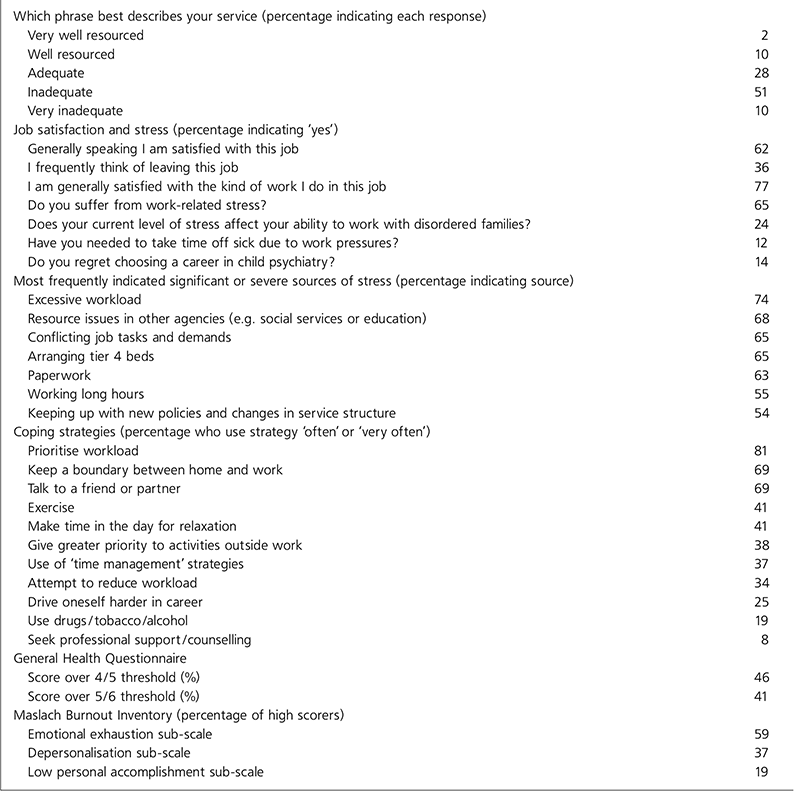
Responses to the Job Satisfaction and Job Stress Questionnaire (n=323)
| Which phrase best describes your service (percentage indicating each response) | |
| Very well resourced | 2 |
| Well resourced | 10 |
| Adequate | 28 |
| Inadequate | 51 |
| Very inadequate | 10 |
| Job satisfaction and stress (percentage indicating ‘yes’) | |
| Generally speaking I am satisfied with this job | 62 |
| I frequently think of leaving this job | 36 |
| I am generally satisfied with the kind of work I do in this job | 77 |
| Do you suffer from work-related stress? | 65 |
| Does your current level of stress affect your ability to work with disordered families? | 24 |
| Have you needed to take time off sick due to work pressures? | 12 |
| Do you regret choosing a career in child psychiatry? | 14 |
| Most frequently indicated significant or severe sources of stress (percentage indicating source) | |
| Excessive workload | 74 |
| Resource issues in other agencies (e.g. social services or education) | 68 |
| Conflicting job tasks and demands | 65 |
| Arranging tier 4 beds | 65 |
| Paperwork | 63 |
| Working long hours | 55 |
| Keeping up with new policies and changes in service structure | 54 |
| Coping strategies (percentage who use strategy ‘often’ or ‘very often’) | |
| Prioritise workload | 81 |
| Keep a boundary between home and work | 69 |
| Talk to a friend or partner | 69 |
| Exercise | 41 |
| Make time in the day for relaxation | 41 |
| Give greater priority to activities outside work | 38 |
| Use of ‘time management’ strategies | 37 |
| Attempt to reduce workload | 34 |
| Drive oneself harder in career | 25 |
| Use drugs/tobacco/alcohol | 19 |
| Seek professional support/counselling | 8 |
| General Health Questionnaire | |
| Score over 4/5 threshold (%) | 46 |
| Score over 5/6 threshold (%) | 41 |
| Maslach Burnout Inventory (percentage of high scorers) | |
| Emotional exhaustion sub-scale | 59 |
| Depersonalisation sub-scale | 37 |
| Low personal accomplishment sub-scale | 19 |
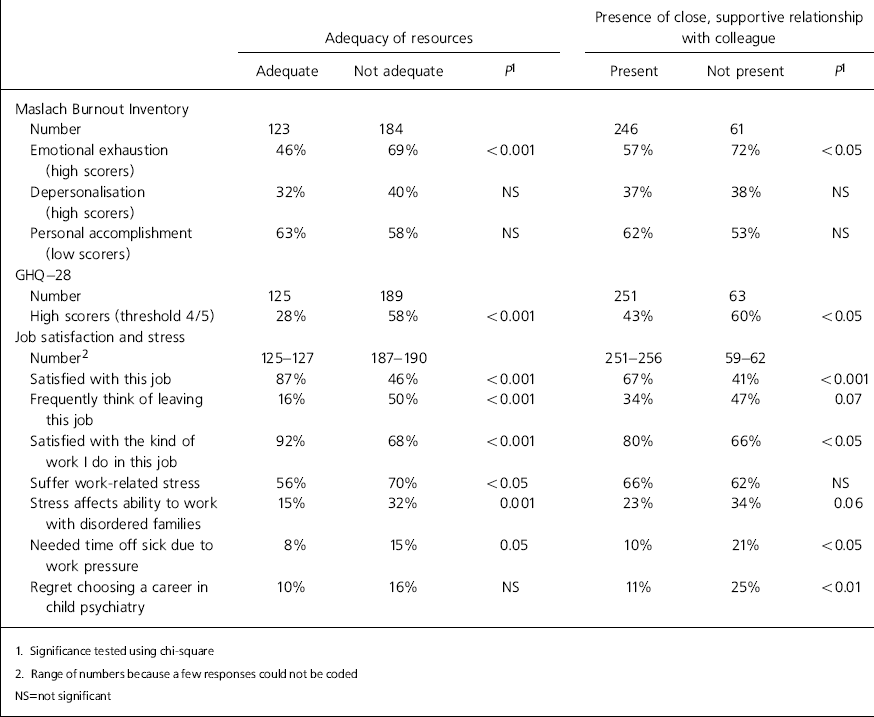
Inadequacy of resources and the absence of a close, supportive relationship with colleagues were significantly associated with emotional exhaustion, high GHQ—28 score, and most items of job satisfaction and stress (see Table 3). CCAPs with a managerial role were more likely to be satisfied with their current job (70% v. 57%, P=0.02) and were less likely to be thinking of leaving (29% v. 41%, P=0.03). Part-time CCAPs had lower rates of work stress than those working full-time (55% v. 68%, P<0.05). There were lower rates of satisfaction with employment among female CCAPs (54% v. 70%, P<0.01).
Percentages of CCAPs indicating burnout, psychological distress, job satisfaction and stress comparing those with and without adequate resources and close supportive relationships with colleagues
| Adequacy of resources | Presence of close, supportive relationship with colleague | |||||
|---|---|---|---|---|---|---|
| Adequate | Not adequate | P 1 | Present | Not present | P 1 | |
| Maslach Burnout Inventory | ||||||
| Number | 123 | 184 | 246 | 61 | ||
| Emotional exhaustion (high scorers) | 46% | 69% | <0.001 | 57% | 72% | <0.05 |
| Depersonalisation (high scorers) | 32% | 40% | NS | 37% | 38% | NS |
| Personal accomplishment (low scorers) | 63% | 58% | NS | 62% | 53% | NS |
| GHQ-28 | ||||||
| Number | 125 | 189 | 251 | 63 | ||
| High scorers (threshold 4/5) | 28% | 58% | <0.001 | 43% | 60% | <0.05 |
| Job satisfaction and stress Number2 | 125-127 | 187-190 | 251-256 | 59-62 | ||
| Satisfied with this job | 87% | 46% | <0.001 | 67% | 41% | <0.001 |
| Frequently think of leaving this job | 16% | 50% | <0.001 | 34% | 47% | 0.07 |
| Satisfied with the kind of work I do in this job | 92% | 68% | <0.001 | 80% | 66% | <0.05 |
| Suffer work-related stress | 56% | 70% | <0.05 | 66% | 62% | NS |
| Stress affects ability to work with disordered families | 15% | 32% | 0.001 | 23% | 34% | 0.06 |
| Needed time off sick due to work pressure | 8% | 15% | 0.05 | 10% | 21% | <0.05 |
| Regret choosing a career in child psychiatry | 10% | 16% | NS | 11% | 25% | <0.01 |
Discussion
This is the first survey of all CCAPs practising in the United Kingdom and Eire that has systematically gathered information on recruitment, retention, job satisfaction and stress in the workforce. The enthusiasm of CCAPs to contribute their views was demonstrated in the response rate of over 60%, including many who supplemented their answers with descriptions of their individual experiences (see Appendix). The survey relied on self-reporting on all measures, although the assessments of psychological distress and burnout used well-established, validated instruments. The opportunity to determine whether those who participated differed from those who did not was sacrificed by giving a commitment to anonymity. Since the returned questionnaires included a breadth of responses on most items, it is likely that a full range of views was sampled.
The inadequate numbers of CCAPs in-post is a substantial deficit in the CAMHS workforce. Only one in ten respondents indicated that their service met the minimum recommended CCAP staffing requirement, with 60% failing to meet the irreducible minimum staffing level set by the College. These shortfalls were apparent in every NHS region. The survey identified 130 separate vacant posts, representing a vacancy factor of 20%. Almost one-third of advertised jobs remained unfilled after advertisement. In many cases, existing CCAPs attempted to meet this shortfall: 42% were providing cover for unfilled posts, often on an open-ended basis and without remuneration. Responses suggest that future recruitment into the speciality will not be sufficient to fill these posts. Many felt that the experience of young psychiatrists encouraged them to enter the speciality, but half indicated that their higher training rotations had vacancies and two-thirds of CCAPs indicated that the quantity and quality of specialist registrar recruitment is falling. In the face of this evidence, it is alarming that more than half the CCAPs who responded did not consider that their managers had a good awareness of staffing and recruitment difficulties.
The shortfall in resources is not confined to consultant staffing (see Tables 1 and 2). Only 29% of CCAPs have safe access to in-patient beds in working hours and this falls to 15% overnight and at weekends, confirming that lack of beds is of principal concern (Worrall & O'Herlihy, 2001). Inadequate resourcing was indicated by 60% of respondents. Only half the respondents had reviewed their job plan in the previous year and almost one-third indicated inadequate funding for personal professional development. Eighty-two per cent of CCAPs said they were available out of hours: one in five of these arrangements were informal, which may expose them to the risks of practising outside their contract.
It is not surprising that these working conditions take their toll. Work-related stress was reported by 65% of CCAPs and they identified excessive workload, lack of resources in other agencies, conflicting demands and difficulties in arranging beds as the main sources of this stress. Forty-six per cent scored over the GHQ—28 threshold of 4/5, suggesting a higher rate of mental disorder that that found in other health professionals, such as ambulance personnel and forensic community mental health nurses (32% and 31% high scorers, respectively) (Reference Alexander and KleinAlexander & Klein, 2001; Reference CoffeyCoffey, 1999). Forty-one per cent scored over the GHQ—28 threshold of 5/6, which is lower than general practitioners (48% reported by Reference CaplanCaplan, 1994) but considerably higher than NHS consultants (21% reported by Reference Blenkin, Deary and SadlerBlenkin et al, 1995). Likewise, scores on the Maslach Burnout Inventory showed high levels of emotional exhaustion and depersonalisation, although they recorded relative preservation of personal accomplishment. These high rates of emotional exhaustion and depersonalisation are in excess of rates reported in senior psychiatrists (Reference Guthrie, Tattan and WilliamsGuthrie et al, 1999), oncologists (Reference Ramirez, Graham and RichardsRamirez et al, 1995), hospital consultants (Reference Ramirez, Graham and RichardsRamirez et al, 1996), forensic community mental health nurses (Reference CoffeyCoffey, 1999) and traumatised ambulance personnel (Reference Alexander and KleinAlexander & Klein, 2001). It is of concern that over one-third of CCAPs scored highly on depersonalisation, which involves emotional distancing from patients and cynicism about their care being used as mechanisms for emotional self-preservation. Cross-tabulation of the survey data confirmed that there was a significant relationship between the perceived adequacy of service resources and job satisfaction, job stress, psychological distress and emotional exhaustion. The survey provided evidence of demoralisation among CCAPs: 50% felt the job was getting worse; 34% had moved; 40% were contemplating moving; 42% would not apply for their own job again; 66% planned to retire early; and 74% thought all jobs in child psychiatry were difficult.
One striking finding of this survey is the importance of having a close, supportive relationship with a colleague in child psychiatry. CCAPs without such a colleague were more likely to be dissatisfied with their job and the kind of work they do; to need to take time off due to work pressure; to regret choosing a career in child psychiatry; and to suffer emotional exhaustion and psychological distress. These findings concur with those of others who have suggested that supportive relationships with work colleagues increase work satisfaction and reduce perceived job stress (Reference LazarusLazarus, 1966; Reference Schulz and SchulzSchulz & Schulz, 1988). CCAPs frequently use adaptive strategies to cope with work stress, such as prioritising workload, keeping a boundary between home and work and using friends and family for personal support. Twenty-five per cent cope by driving themselves harder, and perhaps this mechanism accounts for the high level of psychological distress and burnout. Almost one in 12 CCAPs has sought professional support or counselling. The regular use of mood-altering substances by one-fifth of CCAPs gives cause for concern.
Recommendations
Recommendations that emerge from the survey can be addressed under four headings:
Self-management
CCAPs can cultivate mutually-supportive relationships with their colleagues. Newly established continuing professional development (CPD) peer groups and the mentoring system for recently appointed consultants will provide useful mechanisms for this. CCAPs could also stop supporting weak services by limiting their willingness to cover otherwise-unfilled posts, hence bringing deficits into the open so they have to be addressed properly. In this and other ways, CCAPs could stop acquiescing to take responsibility for services where resources are not available to manage patients safely or to a good standard of care. The introduction of job plans and their regular review provides a forum for individuals to discuss their work and to ensure a manageable workload and satisfactory arrangements for professional development.
Training
CCAPs should continue to train, encourage and inspire their trainees to pursue a career in child and adolescent psychiatry. The sector needs to give a vibrant input into undergraduate and postgraduate training to attract medical students and young doctors into the sub-speciality.
Recruitment of CCAPs
Inadequate numbers of CCAPs may prove to be the rate-limiting factor in CAMHS development until a national critical mass of CCAPs is achieved. The Royal College of Psychiatrists published minimum staffing requirements in 1983. However, after almost 20 years, only a minority of CAMHs meet these recommendations. Faculty regional representatives who advise on the approval of job descriptions can ensure that each new post meets acceptable standards, supported by the model job description (Reference Littlewood and DwivediLittlewood & Dwivedi, 1999). The Faculty's joint working party with the Faculty of General and Community Psychiatry and its working party on Roles and Responsibilities have the opportunity to provide clear leadership on standards and expectations. The Government is attempting to find short-term solutions; for example, the new NHS International Fellowship Scheme is said to promise additional specialist manpower support to child psychiatry. Efforts could also be made to encourage CCAPs to work beyond the age for early retirement.
Commissioning of CAMHS
NHS management has been changing, with more responsibility for commissioning being taken at the locality level. That CAMHS are found in fairly equal measure in mental health, community, acute and other configurations of trusts, suggests that they are not strongly identified with any one of these management structures. Further, the lack of confidence expressed by CCAPs in their service manager's experience of child psychiatry and awareness of recruitment difficulties suggests that it may be advantageous for CAMHS to have a consistent location within the NHS management structure. Commissioners and managers need to ensure that they understand current concerns in child psychiatry, particularly relating to recruitment and retention, and to demonstrate their understanding in the way they address problem areas such as inter-agency collaboration and access to tier 4 beds. The ‘five star’ commissioning model is an established template to help commissioners understand how their investment in CAMHS relates to the scope and capacity of the service which can be delivered (Reference Davey and LittlewoodDavey & Littlewood, 1996). Finally, if the aspirations of the NHS Plan (Department of Health, 2000) and the anticipated National Service Framework for Children (http://www.doh.gov.uk/nsf/children.htm) are to be realised, the Department of Health must ensure that it provides the means and support to achieve them. the Women & Children's Directorate of the Countess of Chester NHS Trust for supporting postage costs.
Appendix
The following is a sample of comments made on the returned questionnaires. Most illustrate themes which occurred frequently in the free text. Others give voice to aspects that might otherwise be lost in the quantitative analysis: that despite the difficulties, CCAPs strive to provide high quality care for their patients; and that there are some CCAPs who are highly satisfied and optimistic about their work.
Recruitment and retention
-
• There is a lack of medical school exposure to child psychiatry.
-
• There are too few child psychiatry senior house officer (SHO) placements.
-
• Heavy investment has solved our local problems — people are now approaching us for jobs!
-
• A consultant post needs to seem enviable; part of this is visible influence.
-
• I stay because I have made years of personal investment in the service.
-
• I stay because I work with a good, multi-disciplinary team.
-
• I am too tired to think innovatively about this.
-
• Better job plans and pay scales would encourage people to work on to the age of 60.
-
• I am only too glad to be taking early retirement.
-
• Everyone I know wants to retire as soon as possible.
Workload
-
• The College should enforce minimum staffing levels and the model job description should be made mandatory.
-
• In a recent review in this area, the College recommendations were ‘rubbished’ by the reviewers.
-
• More money will solve the problems — everything else is just rearranging the deckchairs.
-
• Health Advisory Service models are starting to lead to reduced direct demand on CAMHS.
-
• The modernisation agenda is improving profile.
-
• No one cares about job plans or workload.
-
• I do not want to work at this rate.
-
• The job is simply ‘undoable’.
Job satisfaction
-
• I cannot do the job in the way I was trained to. There is little job satisfaction and a lot of anxiety.
-
• Personally, what I most miss is the time to practise talking therapies (family and individual) which is why I chose child psychiatry in the first place — a real sadness and perhaps a good reason for not recommending it to others.
-
• I suffer from overload of work, isolation and, as I see it, I am undervalued by managers on whom service development depends. I feel this has cost me greatly in terms of professional self-esteem and I find myself often exhausted and lacking in energy. I feel I have been unable to carry out development of the service in the way I feel could be of most use to patients and referrers and, at times, feel an all-pervading sense of desperation about the future.
-
• My job is great, and I cannot believe they pay me to do it! I have always felt this.
-
• Things are changing for the better because practise is more evidence-based.
-
• At times, I deeply regret my choice of career.
-
• I regret choosing a medical career in the current NHS rather than choosing child psychiatry.
Sources of stress
-
• Stress… is related to not being able to do the job well and frustration in trying to bring about change.
-
• It is not necessarily stress from clinical duties, but resources, reconfiguration, short-term funding and inability to influence purchasing decisions.
-
• One has no power to achieve change and one's voice has no authority.
-
• Child psychiatrists have responsibility without authority, then get ‘scapegoated’.
-
• Relationships between consultant colleagues are competitive and unsupportive and a major stress factor.
-
• I have extremely supportive colleagues.
-
• There is no understanding of, or support for, work-related stress.
Effects of stress
-
• I am exhausted and burnt out by clinical demands.
-
• I used to feel much worse… I have had to detach.
-
• My experience helps fend off nonsensical pressure; I do pity my younger colleagues. I practically ended it after years of very severe stress.
-
• I did not realise how bad it was until I sat down and completed this.
-
• Just filling in this form has made me feel tearful as work is so bad. I left my previous job because of stress.
-
• The job is hugely more stressful. I am considering retiring earlier than originally planned.
-
• I have seen colleagues' health deteriorate over time due to work stress.
-
• I am mindful of my own health as two former colleagues died in their 50s.
Declaration of interest
None.
Acknowledgements
We wish to thank the child and adolescent psychiatrists who responded to the surveys, the Executive Committee of the Faculty and regional representatives for their assistance. We are especially grateful to Dr Sue Bailey for her support and encouragement, Dr Ashley Weinberg for his advice on occupational psychology instruments, Mrs Vivienne Martindale for administrative support and


 Open access


eLetters
No eLetters have been published for this article.