

Introduction
The traditional narrative of first-wave democratization, based on the early twentieth-century episodes of democratization in Western European countries, is that economic elites expanded the franchise under threat of revolution from the working class (e.g., Boix Reference Boix2003; Acemoglu and Robinson Reference Acemoglu and Robinson2005) and reformed the electoral system—the formula translating votes into legislative seats—strategically replacing majoritarian systems to limit the potential seat share of emerging parties (e.g., Rokkan Reference Rokkan1970; Boix Reference Boix1999). Reforming majoritarian electoral systems is depicted as an elite safeguard “aimed to reduce the uncertainty of democratic competition for nondemocratic elites so their power and influence would not be threatened” (Ziblatt Reference Ziblatt2006, 313). However, early twentieth-century episodes of democratization in South American countries like Argentina, Chile, and Colombia deviate from this traditional narrative; their democratizations originated from political competition between elite factions (e.g., Madrid Reference Madrid2019a, Reference Madrid2019b). Why did reformers without electorally strong working-class parties to contain replace majoritarian electoral systems?
This article addresses this question through the case study of Argentina’s first democratization during 1912–16. Reformers introduced secret and mandatory voting and also replaced multi-member plurality rules for legislative elections with an electoral system that provided representation to minority parties: the limited vote. This electoral system gave voters fewer votes than there were seats, limiting the number of seats that dominant parties could obtain. Although uncommon today, the limited vote was incredibly common in twentieth-century Latin America—9 out of 18 Latin American countries that adopted proportional representation (PR) in the twentieth century used the limited vote immediately before adopting PR (Negretto and Visconti Reference Negretto and Visconti2018, 31)—and was also used in the late nineteenth century in parts of Europe, including Spain (Presno-Linera Reference Presno-Linera2018) and the United Kingdom (McMillan Reference McMillan1995). Through a mixed-method approach, I show that the 1912 Argentine reformers did not conceive of the limited vote as a containment device, but rather as a way of deepening the liberalizing effects of compulsory and secret voting. That is, the electoral system reform was not devised to decrease opposition parties’ seat share after democratization; rather, it was a core component of a democratizing package that sought to facilitate the entry of previously excluded groups into the political system.
This article departs from existing work on the historical origins of electoral systems by shifting the analytical focus away from the adoption of PR. Much like the literature on electoral system change in Europe (e.g., Rokkan Reference Rokkan1970; Boix Reference Boix1999; Leeman and Mares Reference Leeman and Mares2014; Kreuzer and Neely Reference Kreuzer and Neely2024), research on twentieth-century Latin America has primarily focused on the adoption of PR, which often occurred long after working-class enfranchisement (Wills-Otero Reference Wills-Otero2009; Negretto and Visconti Reference Negretto and Visconti2018). In contrast, I explore the political dynamics behind an earlier transition away from a multi-member plurality system during an episode of democratization.
This shift in focus has two advantages. First, it sheds light on a class of earlier electoral system reforms that has been insufficiently studied in political science (cf. Ahmed Reference Ahmed2013b; Mazzuca and Robinson Reference Mazzuca and Robinson2009). Second, it allows examination of the interplay between electoral system change and democratization, which is relevant beyond the Argentine case since other episodes of democratization also included simultaneous electoral system changes (e.g., Chile’s 1890 reform that simultaneously introduced secret and cumulative voting; and the UK’s 1867 Second Reform Act that simultaneously extended the franchise and introduced the limited vote in multi-member constituencies).
This article’s main finding is that electoral system change can be viewed by reformers as a way of promoting the entry of new parties into the political system, rather than a strategy to protect conservative seat share. As Mazzuca and Robinson (Reference Mazzuca and Robinson2009) argued for the 1905 Colombian case, this article argues that the Argentine limited vote was a power-sharing institution, rather than a power-preserving institution.
Empirical Approach and Main Findings
To study the motivations behind the electoral system reform that accompanied Argentina’s introduction of secret and mandatory voting, I take a historical approach (Capoccia and Ziblatt Reference Capoccia and Ziblatt2010), following Ahmed’s (Reference Ahmed2010, Reference Ahmed2013a, Reference Ahmed2013b) recommendation to read history forward and consider the options and information available to political actors at the time, as well as their beliefs about the effects of different electoral systems. Why did political actors think that the electoral system needed reform? What electoral systems did they consider? What effects did reformers expect each electoral system to have on the party system? Because our current understanding of historical electoral reforms is contaminated by our knowledge of what happened post-reforms (Ahmed Reference Ahmed2010), answering these seemingly simple questions is not so straightforward.
I study a unique collection of documents that approximates an expert survey before Argentina’s 1912 electoral reform. Between August and September 1911, when politicians were debating an electoral reform package proposed by President Roque Sáenz Peña, the newspaper La Nación commissioned a set of op-eds from prominent political experts on the ideal electoral system for Argentina given its political culture, geography, and constitution. These documents have not previously been systematically analyzed; the closest exception is Cantón (Reference Cantón1967), which counted the number of intellectuals in favor of different electoral systems. Through archival research, I obtained 37 published opinions, providing insight into the spectrum of diagnoses, beliefs, and information available at the time. This original qualitative data provides insight into the contemporaneous interpretation of the electoral reform, unadulterated by the knowledge of what happened after.
Many historical analyses of the 1912 political moment focus on the Unión Cívica Radical (UCR) party because it was the main beneficiary of this democratization and dominated elections for decades after. However, intellectuals at the time largely disregarded the UCR in their analyses. In fact, many highlighted the absence of political parties in Argentina. The consensus was that political apathy reigned and that the political system was illegitimate—political elites were not representative of society. No one mentioned an electoral threat, let alone a revolutionary threat, from rising opposition parties.
Pundits attributed the reigning political apathy and low participation rates to the widespread belief that voting was ineffective. To counter apathy and increase participation, intellectuals proposed enhancing the participatory effects of compulsory voting with a new electoral formula that encouraged the formation of minority parties and, consequently, an opposition party in Congress. No pundits at the time considered that conservatives could become an electoral minority. Thus, the goal of the electoral system reform was not to design electoral rules to prevent new parties from obtaining a majority of seats, but rather to distribute power away from the dominant conservative faction—the opposite of containment.
Although reformers ultimately adopted the limited vote, intellectuals and politicians also considered other electoral systems. Many advocated for single-member districts (SMDs), cumulative voting (CV), PR, and others. As Ahmed (Reference Ahmed2013b) noted in the European context, all the considered systems were viewed as ways of giving representation to minority parties. Intellectuals believed that each of these alternative electoral systems would affect the political landscape in different ways: SMDs would transfer power from provincial governors to local elites; CV and PR would encourage the formation of a multiparty system; and the limited vote would foster an opposition party while limiting further fragmentation. Unlike PR, the limited vote and SMDs were considered consistent with the constitutional requirement that legislators be elected by a simple plurality.
An analysis of legislative debates during the electoral reform confirms the insights gleaned from the expert survey. Although legislators only considered SMDs and the limited vote as alternatives to multi-member plurality, their arguments echoed those of intellectuals. The limited vote was discussed as a way of distributing power away from the government and towards an opposition party. Legislators also expected the opposition to benefit from limited voting and rarely mentioned the UCR or the Socialist Party.
After synthesizing the qualitative data, I conduct two quantitative tests to adjudicate between two competing hypotheses: (1) the characterization of electoral system change as a strategy of electoral containment, and (2) electoral system change as a complement to the other liberalizing reforms. First, I analyze the legislative roll-call votes on the 1912 electoral reform package, which included secret voting, compulsory voting, and the electoral system change from multi-member plurality to the limited vote. I show that support for the reform overall (as measured by López Reference López2005) and compulsory voting in particular (using a Senate roll-call vote) overlap almost perfectly with support for the limited vote (which was voted on separately from the rest of the reform measures). Fisher’s exact test for contingency tables rejects the null hypothesis that support for democratization and limited voting are unrelated, which suggests that the reform measures were part of the same legislative bundle.
Second, I analyze an unusual 1911 public opinion survey fielded by Rodolfo Rivarola, the founder of the Revista Argentina de Ciencias Políticas. Using Cantón’s (Reference Cantón1967) cross-tabulations of the survey results, I show that socialist survey respondents (a proxy for working-class respondents) were 29 percentage points more likely than non-socialists to prefer PR or limited voting. This result is the opposite of what one would expect if the reform was intended to contain working-class parties.
Finally, this article examines how Sáenz Peña obtained legislative support for a bill that was expected to hurt incumbent conservatives. Why would conservative legislators change the electoral system to promote the rise of opposition parties? Castro (Reference Castro2012) and Madrid (Reference Madrid2019a) have shown that the reform was supported by a progressive faction of the conservative party. This article complements these previous analyses by showing that the limited vote enabled the formation of a reformist coalition composed of two different groups: (1) a small set of legislators from conservative parties which were weak in their districts and expected to benefit from minority representation, and (2) a larger group of legislators from conservative parties which were hegemonic in their districts and could evade the reform’s intended mechanical effects by strategically splintering into two candidate lists during elections to obtain the seats for both the majority and the minority. The subset of legislators who were adversely affected by the new electoral system opposed the reform. This analysis suggests that legislators supporting the reform did so not because they were altruistic, but because the power they were distributing to opposition parties was not their own.
Electoral System Change during Democratization
In both Western Europe and Latin America, electoral systems in the nineteenth century typically featured multi-member districts, open lists, and plurality rules (Colomer Reference Colomer2007; Ahmed Reference Ahmed2010). As the franchise expanded to include the middle and working classes and new parties began to form and grow, electoral systems came under increased scrutiny from politicians and jurists. Initially branching out into a variety of electoral systems, many countries adopted PR, SMDs, cumulative voting, the limited vote, or combinations of these systems. Eventually, most converged into either PR or SMDs.
An influential literature in political science offers explanations for why some countries adopted PR and others not. The traditional explanation for the adoption of PR in Western Europe is that conservative parties sought a mechanism to limit the electoral advancement of working-class parties (e.g., Rokkan Reference Rokkan1970; Boix Reference Boix1999). In this account, electoral system change pursued “containment”; the expectation was that rising opposition parties would obtain fewer seats under the new electoral formula than under the old majoritarian system.
A subsequent strand of revisionist research proposed alternative explanations for PR reforms. Calvo (Reference Calvo2009), for example, argues that the adoption of PR was the response of seat-maximizing incumbent parties to disproportionalities caused by the entry of new parties. Cusack et al. (Reference Cusack, Iversen and Soskice2007) posited an economic explanation for the adoption of PR, arguing that it resulted from an agreement between labor and capital in countries with powerful employer associations and a skilled workforce. Finally, Cox et al. (Reference Cox, Fiva and Smith2019) argue that party leaders promoted PR because it increased the importance of candidate nomination, thus increasing their ability to discipline party members and create more cohesive parties.
Meanwhile, the adoption of PR in Latin America has also garnered attention from political scientists. Echoing the prior literature on Western Europe, Wills-Otero (Reference Wills-Otero2009) argues that Latin American countries adopted PR as a containment mechanism when the influx of new voters, the entry of new parties, and shifting voter preferences threatened the majority status of conservative parties. Subsequent research has disputed this interpretation. Gamboa and Morales (Reference Gamboa and Morales2015) studies Chile’s transition from cumulative voting to PR and shows that the electoral reform was regarded as a solution to the strategic coordination problems that parties faced under cumulative voting. Finally, Negretto and Visconti’s (Reference Negretto and Visconti2018) comprehensive qualitative analysis of all twentieth-century PR reforms in Latin America finds that they were initiated by authoritarian elites pursuing controlled political liberalization.
Although the literature has focused on the origins of PR, many countries in Western Europe (e.g., Ahmed Reference Ahmed2010, Reference Ahmed2013a, Reference Ahmed2013b) and Latin America (e.g., Negretto and Visconti Reference Negretto and Visconti2018) adopted other intermediate electoral systems like cumulative voting and the limited vote before adopting PR. The motivations behind the transitions to these intermediate electoral systems have received comparatively little attention. Additionally, and more importantly, the timing of PR reforms—often occurring long after extension of the franchise (e.g., Negretto and Visconti Reference Negretto and Visconti2018)—has led some strands of the literature on PR’s origins to become increasingly disconnected from the literature on first-wave democratization (cf. Ahmed Reference Ahmed2010, Reference Ahmed2013a, Reference Ahmed2013b).
This article contributes to the literature with a case study of Argentina’s transition from multi-member district plurality to the limited vote during its first democratization in 1912–16. Upon exploring the motivations behind the electoral system reform, I find no support for any existing theories developed to explain the adoption of PR. Specifically, Argentine reformers saw the limited vote neither as a way of protecting conservative parties against new entrants (Rokkan Reference Rokkan1970; Boix Reference Boix1999; Wills-Otero Reference Wills-Otero2009), nor as a way of correcting disproportionalities introduced by the entry of new parties (Calvo Reference Calvo2009), nor as an instrument of alliance between employer associations and worker unions (Cusack et al. Reference Cusack, Iversen and Soskice2007), nor as a strategic move by party elites to discipline the rank-and-file (Cox et al. Reference Cox, Fiva and Smith2019), nor as a solution to strategic coordination problems (Gamboa and Morales Reference Gamboa and Morales2015), nor as a strategy of controlled political liberalization (Negretto and Visconti Reference Negretto and Visconti2018).
The 1912 Argentine reformers considered the limited vote a core component of the democratizing package. If “containment” is a way for conservative elites to increase their expected seat share amid growing electoral support for opposition parties, then conservative elites in Argentina sought almost the opposite. The evidence in this article suggests that with the simultaneous introduction of limited, compulsory, and secret voting, reformers sought to encourage the entry of new parties into the political system and increase electoral competition.
Argentina’s 1912 Democratization
Between 1880 and 1916, the hegemonic conservative party known as Partido Autonomista Nacional (PAN) dominated elections in Argentina (Alonso Reference Alonso2010). PAN was not a cohesive national party but a loose confederation of autonomous provincial conservative groups. Elections for congressmen and presidential electors took place at regular intervals with universal male suffrage in 15 districts (the 14 provinces and the city of Buenos Aires). Yet non-secret and voluntary voting allowed political machines to manipulate elections via vote buying, intimidation, and fraud (Botana Reference Botana1977). Moreover, political machines mobilized low-income voters to the polls while high-income voters typically abstained (Sabato Reference Sabato1998). Exacerbating the situation, the electoral system featured multi-member plurality districts, which produced single-party sweeps in each province, even when a party won by a narrow margin. This disproportionality further dissuaded opposition parties from participating (Heaps-Nelson Reference Heaps-Nelson1978).
By the end of the nineteenth century, the oligarchic political order was increasingly perceived as illegitimate (Botana Reference Botana1977). Urbanization and the massive influx of European immigrants seeking economic opportunities in South America altered Argentina’s social fabric. In 1914, the urbanization rate was 57.3 percent (more than ten percentage points higher than in the United States) and almost a third of the population was foreign-born (Zimmermann Reference Zimmermann1996).
The façade of elections did not produce governments that were representative of society. The seeds of a modern party, the UCR, eventually began to form. However, due to fraudulent elections, the UCR abstained from competing in many of them (Alonso Reference Alonso2000)—a case of the more general phenomenon of election boycotts (Beaulieu Reference Beaulieu2014). Instead, the UCR conspired against the regime, and violent UCR uprisings took place in 1890, 1893, and 1905.
Amid economic modernization, political illegitimacy, and social unrest, a modernist faction of PAN managed to elect Roque Sáenz Peña as president in 1910. Sáenz Peña promoted an ambitious package of liberalizing reforms that was passed in 1912. These reforms eroded the power of the traditional faction of PAN associated with Julio A. Roca. The 1912 elections were the first step towards fair and competitive elections in Argentina. By 1916, the country had undergone its first democratization.
Historians have proposed different explanations for political liberalization under Sáenz Peña. One strand of the literature argues that Argentina’s economic growth following its integration into international markets as an agricultural exporter led to the emergence of a middle class that demanded democratization (e.g., Germani Reference Germani1965; Collier Reference Collier1999) under threat of revolution (e.g., Acemoglu and Robinson Reference Acemoglu and Robinson2005; Rock Reference Rock1975). Democratization is characterized as a strategic move by the ruling elite to defuse the revolutionary potential of the UCR. Contrasting with this traditional view, the currently dominant interpretation among political historians is that democratization was primarily driven by factional struggles within the conservative party itself (e.g., Castro Reference Castro2012; Madrid Reference Madrid2019a).
Studies of Argentina’s 1912 reform have mainly focused on the introduction of secret and compulsory voting—“the single most important aspect of the 1912 reform … was the establishment of the secret ballot” (Madrid Reference Madrid2019a, 1541)—but it also changed the electoral system. The electoral reform introduced limited voting, which forced voters to cast two-thirds as many votes as there were seats. The system was known at the time of the reform as the “incomplete list” system, reflecting the fact that parties used to distribute ballots with predefined lists of candidates, but with limited voting, those lists could not be the same length as the district magnitude (they had to be incomplete). In practice, this new electoral system limited the prize that dominant parties could obtain, granting legislative representation to the largest minority party.
This article focuses on how, in the broader context of democratization, reformers viewed the establishment of the limited vote. This article does not aim to explain Argentina’s transition to democracy, which other studies have done; rather, it aims to explore the role that the electoral system change played in this transition from the perspective of reformers.
A Contemporaneous Expert Survey
To study the reformers’ motivations, beliefs, and variety of considered electoral systems, I utilize a very unique contemporaneous expert survey. While politicians were debating the possibility of an electoral reform, the newspaper La Nación invited prominent jurists, judges, and politicians to publish their opinions. These political pundits and intellectuals represented the full range of the political spectrum—from conservatives who wanted no reforms to liberals who proposed major reforms—but mostly lacked a vested interest in preserving the existent regime (Cantón Reference Cantón1968, 33). The invitation included the following open-ended question:
Which electoral system would be the most appropriate for the realization of the democratic ideal, given our political culture, geography, and our constitution?
Through archival research at the Biblioteca Nacional Mariano Moreno in the city of Buenos Aires, I obtained the text of the 37 op-eds answering this question, published between August 16 and September 14, 1911. The content of these expert opinions reveals the beliefs, diagnoses, and information available at the time of the reform. Footnote 1
How useful are expert opinions for understanding the reformers’ perspectives? To assess, let us evaluate some alternatives. Compared to relying on politicians’ personal correspondence or speeches around the time of the reform, the expert survey offers three distinct advantages. First, the expert survey published in La Nación has the advantage of existing—not a small feat in historical research, where access to reliable sources often poses major challenges. Second, all the experts responded to the same open-ended question, which facilitates direct comparisons across their answers. This standardization allows for a clearer understanding of the range of opinions and proposals tendered by intellectuals and political pundits at the time. Finally, because politicians often distort or downplay certain aspects of their motivations and, especially when speaking in public, tailor their statements to serve strategic or image-related purposes, potentially obscuring the true reasons behind their actions (see, e.g., Milligan Reference Milligan1979; Broockman Reference Broockman2012), expert surveys permit a more impartial analysis of reformers’ motivations, based on external perspectives rather than relying on the reformers’ own potentially self-serving accounts.
Consensus on the Need for Change
Why did intellectuals think electoral reform was necessary? The primary concern was low political participation. Because non-secret and voluntary voting enabled elections to be manipulated by political machines controlled by provincial governors, elections were widely perceived as neither free nor fair, thus discouraging political participation. A secondary concern for some was the absence of organized political parties representing society. Moreover, opposition parties did not emerge because they could not compete against the political machines controlled by incumbents, especially since they were punished by block voting rules. Instead of stable parties, loose networks of political committees formed shortly before elections to mobilize voters, only to dissolve immediately afterward. An electoral system reform was deemed necessary to increase political participation and foster the development of organized political parties.
An interesting but easily missed aspect of the op-eds is what they did not mention. None of the published opinions mentioned an electoral or existential risk posed by non-conservative or working-class parties (socialists and the UCR). Indeed, some pundits thought that Argentina lacked parties that represented excluded groups (e.g., Carlos Becú) while others questioned the existence of the excluded groups that reformers sought to represent with a new electoral system (e.g., A. Lucero). Some proponents of changing the electoral system had the explicit goal of promoting the creation of such parties (e.g., J. J. Díaz Arana and Octavio S. Pico).
In contrast to European politicians who sought to contain working-class groups (Ahmed Reference Ahmed2010), Argentine reformers sought to distribute power to parties that would otherwise not obtain it. Lamenting the problems of the political system, Enrique B. Prack asked, “What is the difference between an oligarchy based on class or caste … and this new oligarchy of a dominant party, with an absolute exclusion of minorities?” Yet simultaneously, reformers wanted to preserve a conservative majority. Eduardo Prayones described the problem of electoral system choice as searching for an answer to the question of “how to find a way for [all] parties to have representation without eliminating the indispensable and necessary majority.”
Disagreement on the Solution
While the consensus about the problems of the existing system was broad, experts disagreed significantly about potential solutions. Four camps emerged: (1) a minority who wanted to preserve the existing block voting rules in multi-member districts but restrict the franchise; (2) those who proposed SMDs; (3) those who proposed some type of proportional representation; and (4) those who proposed the limited vote reform that was eventually adopted.
The Conservative Solution: Block Voting with Restricted Franchise
Not all pundits wanted to give representation to electoral minorities. A group of experts, including Adolfo Saldías, Hilarión Larguía, Carlos Urien, and Osvaldo Magnasco, believed that the existing multi-member plurality system should be preserved. However, they disagreed on the specifics, with some arguing, for example, that voting should be compulsory (e.g., Arturo Reynal O’Connor) and others that it should not (e.g., Vicente C. Gallo).
A conservative solution for the country’s political ills was proposed by Carlos Urien, A. L. Lucero, Carlos A. Becú, and Enrique García Meróu. According to these experts, the problem with Argentina’s political system was not its electoral system but the universal male franchise, which had been in place since 1857. Rather than reforming the electoral system to increase competition, these intellectuals advocated increasing the quality of participation by restricting the franchise. Carlos Urien, for instance, believed that only literate citizens should be allowed to vote. Carlos A. Becú lamented that “a known thief or an idiot vote with the same efficacy as a university graduate or honorable man” and argued that Argentina was the ideal place for voting rights to be restricted because of its lack of significant religious or class cleavages (by which he meant the absence of a strong working-class party). Likewise, Enrique García Meróu advocated limiting the franchise to literate citizens but also wanted to expand it to women.
Representing Minorities I: SMDs
Contemporary studies on electoral systems usually consider PR and SMDs as polar opposites in a majoritarian-proportional continuum; yet both systems were considered ways of representing minorities when the status quo was multi-member plurality (Ahmed Reference Ahmed2010). Argentina briefly used SMDs in 1904, after an electoral reform in 1902 that was reversed in 1906. In practice, this electoral system involved dividing the country into 120 SMDs—subject to the constraint that each district be contained within the boundaries of one province and all provinces have the same number of SMDs as their district magnitude with multi-member plurality rules. Unlike multi-member plurality, SMDs allowed groups that were majoritarian at the local but not provincial level to obtain representation (e.g., Alfredo Palacios). Defending SMDs as a way of giving representation to minorities, D. M. Torino argued that, with this electoral system:
All parties and groups would have representation in parliament. Who would defeat the Socialist Party in the district of La Boca? Who would successfully compete with the Unión Cívica Radical in Catedral Norte, Socorro, Montserrat, and Balvanera? Would Rosario not elect its representatives with independence from the politicians from Santa Fe? Is it not true that, in the district with sugar mills, only people from the sector would be elected? … Let’s establish SMDs [and] through them we will obtain the representation of minorities … more truthfully than with the fictions of the limited vote, cumulative voting, and PR.
SMDs were supported by Juan Agustín García, José Ceppi, Augusto Elias, R. Wilmart, M. Gorostiaga, A. Palacios, B. Llerena, Jesus H. Paz, Santiago G. O’Farrell, D. M. Torino, and Ricardo Rojas. In addition to representing minorities, intellectuals supporting SMDs argued that SMDs would also contribute to democratization by transferring some control from provincial governors to local actors. M. Gorostiaga, for example, claimed that SMDs reduced political centralism. Similarly, Juan Agustín García asserted that SMDs would “make men independent of the tyranny of the [provincial and national] government or party bosses.”
Opponents of SMDs had two concerns. First, because the constitution established provinces as electoral districts, constitutional lawyers disagreed regarding whether provincial districts could be subdivided into SMDs (e.g., Luis V. Varela). Second, SMDs could disperse political forces across territory (e.g., Norberto Piñeiro and Carlos Rodríguez Larreta) and hinder the formation of disciplined national parties.
Representing Minorities II: Proportional Representation
In the late nineteenth and early twentieth centuries, the Western world considered PR to be an innovative and sophisticated electoral system. Santiago O’Farrell argued that with PR, “minorities are represented proportionally to their importance”; and Octavio S. Pico declared this system as “the most logical, the most perfect, and the fairest electoral system.”
During discussions of the electoral system reform, intellectuals proposed different variants of PR: a cumulative voting system like that of Illinois (Alfredo Palacios); a combination of cumulative and block voting to limit growth of the number of parties (Emilio Gouchon); a system where 50 percent of the seats are given to the majority and the rest distributed proportionally among minority parties with a 10 percent threshold (Eduardo Prayones); and a PR system that limited the number of parties to three or four (J. J. Díaz Arana).
Opponents of PR had three concerns. First, PR presented the same problems associated with cumulative voting: Santiago O’Farrell claimed that Argentine voters lacked the education and political sophistication to understand and use the system thoughtfully; and Octavio S. Pico argued that PR would create intra-party competition and reduce party discipline.
The second and more common concern of these intellectuals was that PR would produce an excessively fragmented party system (e.g., J. J. Díaz Arana, Emilio Gouchon, and Carlos Rodríguez Larreta). They disliked fragmentation mainly because they believed a legislative majority was important for political order. They also disliked that small minorities would obtain representation, making it harder for the dominant party to pursue its agenda.
The third, most popular, and perhaps most persuasive argument against PR was that it was unconstitutional. Article 37 of Argentina’s constitution required that legislators be elected “by a simple plurality of votes” (e.g., Octavio S. Pico, Santiago O’Farrell, Hilarión Larguía, Leopoldo Melo, and Norberto Piñeiro). Even those advocating PR as the ideal electoral system for a democracy mentioned the constitutional constraint (e.g., Norberto Piñeiro and Leopoldo Melo).
Representing Minorities III: The Limited Vote
An intermediate solution—between the existing block voting and proportional representation—was the limited vote. It had the advantage of being unquestionably constitutional and was supported, for example, by J. J. Díaz Arana and Leopoldo Melo. This electoral system gave voters in multi-member districts two-thirds as many votes as there were contested seats ( ${2}\over{3}$
M=V). Thus, voters in districts electing three legislators could only cast two votes; districts electing six seats, only four votes; districts electing nine seats, only six votes; and so forth. Because parties in Argentina distributed predefined lists of candidates before elections, Argentine intellectuals referred to limited voting as the “incomplete list” system. In practice, limited voting reduced the seat share that majoritarian parties could obtain by mobilizing voters, and consequently allowed the representation of minority parties.
${2}\over{3}$
M=V). Thus, voters in districts electing three legislators could only cast two votes; districts electing six seats, only four votes; districts electing nine seats, only six votes; and so forth. Because parties in Argentina distributed predefined lists of candidates before elections, Argentine intellectuals referred to limited voting as the “incomplete list” system. In practice, limited voting reduced the seat share that majoritarian parties could obtain by mobilizing voters, and consequently allowed the representation of minority parties.
Limited voting was the electoral system that President Sáenz Peña proposed to Congress and the one that was ultimately passed. The presidential message attached to the electoral reform bill described the limited vote as a “rehearsal for a definitive [PR] reform” (see HCDN 47-PE-1911). In their op-eds, J. J. Díaz Arana and Juan Carlos Cruz also described this system as a transitory regime until the passage of a constitutional reform allowing PR.
In addition to being unquestionably constitutional, the limited vote was seen as having two advantages. First, by increasing the probability that campaign efforts translate into legislative seats, the limited vote was expected to not only encourage the formation of opposition parties but also precipitate more cohesive parties versus under alternative systems like cumulative voting (e.g., Octavio S. Pico and Juan Carlos Cruz).
Second, and more importantly, pundits believed that the limited vote would allow the entry of minority parties without jeopardizing a government majority in Congress (e.g., Carlos Rodríguez Larreta). While many intellectuals worried that PR might generate an undesirably fragmented party system, Juan B. Justo claimed that the limited vote would produce a reasonable number of parties: “By granting representation to only the biggest minority, [limited voting] would encourage greater coordination of effort among similar factions” than other electoral systems that also represent minorities.
Notably, no intellectuals considered that the ruling (conservative) party would be the minority that benefited from minority representation. Indeed, some were so confident that conservatives would dominate elections that they were concerned that conservative parties could strategically splinter into two candidate lists during elections to also win the seats reserved for minority parties, as occurred in Spain (e.g., Raymundo Wilmart and Norberto Piñeiro). The sole pundit (Eduardo Prayones) who explicitly mentioned an expected distribution of seats after an electoral reform (using a slightly more proportional system than the limited vote) calculated a 13.3 percent seat share for the UCR and the Socialist Party combined. Footnote 2
In sum, rather than containing working-class or opposition parties, the limited vote was considered a way to promote the entry of new parties into Congress. It was part of a broader package of democratic reforms aimed at increasing both the extent and quality of political participation.
Including, not Containing
The expert survey reveals an important difference between electoral system reform in Argentina and the dominant narrative of reforms in Western Europe. In the “containment hypothesis,” conservative parties in Europe changed the electoral system to maximize their own seat share under increasing electoral pressure from new parties during the first democratization (e.g., Rokkan Reference Rokkan1970; Boix Reference Boix1999; Ahmed Reference Ahmed2010; Leeman and Mares Reference Leeman and Mares2014). Argentine reformers did not expect limited voting to electorally benefit or protect established parties; rather, they expected newer parties to benefit. Changing the electoral system was viewed as a way of containing the ruling party and as complementary to other simultaneous liberalizing reforms (compulsory and secret voting).
An influential interpretation of Argentina’s 1912 democratizing reforms is that conservative elites liberalized the political system to placate the rebellious UCR, which, in 1905, had demonstrated its ability to mobilize both social groups and segments of the military against the regime (e.g., Rock Reference Rock1975; Collier Reference Collier1999; Mazzuca and Robinson Reference Mazzuca and Robinson2009). Other historians have contradicted this view, arguing that while reformers occasionally framed the electoral reforms as a means of appeasing the revolutionary impulses of an excluded opposition, this perspective was more of a theoretical construct than a diagnosis of their immediate political reality (Devoto Reference Devoto1996, 96). The currently dominant view of Argentina’s 1912–16 democratization is that it was the result of internal conflict within the ruling PAN and not the result of pressure from the UCR (Castro Reference Castro2012; Madrid Reference Madrid2019a). Nevertheless, one may argue that democratization sought to “contain” this increasingly violent opposition group and prevent a revolution. Footnote 3 Testing the threat-of-revolution hypothesis of democratization (e.g., Rock Reference Rock1975; Acemoglu and Robinson Reference Acemoglu and Robinson2005) falls outside the scope of this article. While the ultimate goal of reformers may or may not have been to avert revolution, the qualitative evidence presented here suggests that the electoral system reform was not intended to suppress the opposition electorally.
Legislative Debates
The expert survey is an unparalleled source of information on the contemporaneous interpretations of the political reform. However, previous works have examined the 1911–12 legislative debates on the reform. Footnote 4 As previously noted, politicians’ stated views do not necessarily reflect their true views. Legislators, particularly those who opposed the electoral reform, had strong incentives to misrepresent their views. First, President Sáenz Peña introduced the reform package and leveraged his political power to induce legislators to support the initiative. Second, public opinion overwhelmingly favored the reform, discouraging legislators from openly opposing it for fear of electoral backlash (Devoto Reference Devoto1996). With those caveats, this section complements the expert survey with a study of legislative speeches on the reform.
The arguments made by legislators for and against each system largely mirrored those in the expert survey. In his November 6, 1911 opening statement advocating the limited vote, José Fonrouge criticized SMDs for failing to represent minority parties, precipitating party dissolution, and prioritizing local over national interests. Emphasizing the need for minority representation, Fonrouge noted that multi-member plurality only ensures the election of representatives from the same party as the provincial governors, whereas limited voting would preserve a two-thirds majority while allowing a significant minority (“opposition”) to enter the legislature. Fonrouge spoke of opposition parties in general terms, not referencing any specific parties, and highlighted Argentine society’s lack of religious or economic cleavages and the irrelevance of “parties of principles.” Throughout the debates, other legislators also noted Argentina’s lack of parties representing specific economic interests or religious views (e.g., M. Carles on November 15, 1911).
On November 8, 1911, Julio A. Roca, Jr. defended SMDs, arguing that they would guarantee “the most perfect form of representation” by allowing each community to choose a local representative. Roca opposed the limited vote on the grounds that it could grant a disproportionately high seat share to small parties with less than a third of the votes—suggesting that Roca expected his group to be in the adversely affected majority and not the overrepresented minority post-reform.
Other legislators defended the status quo, such as Marco A. Avellaneda on November 6, 1911. But the idea that minorities deserved representation was so broadly accepted that his defense of multi-member plurality rules asserted that minorities could also achieve representation under the majoritarian system. Avellaneda argued that a party could be a majority at the provincial level and win all provincial seats while being a minority nationally. Criticizing the limited vote, Avellaneda asserted that Argentina did not need antagonistic parties, as minorities could undermine majorities and weaken provincial governments. This reasoning confirms that conservative politicians viewed minority representation as a concession to emerging groups rather than a safeguard against new parties.
Like the experts who published their opinions in La Nación, legislators never referred to the UCR, let alone the Socialist Party, as serious electoral threats. Indeed, the expectation that conservative parties would dominate elections after the reform was so strong that some legislators opposed the limited vote on the grounds that it could be ineffective, noting that conservatives could strategically splinter into two factions to obtain the seats for the majority and the minority (e.g., Julio A. Costa on November 17, 1911). Other legislators even argued that such splinters would be desirable, as they would prevent very small minorities from receiving a disproportionate seat share (e.g., Manuel Peña on November 15, 1911).
In sum, the analysis of legislative debates confirms the conclusions from the expert survey. The limited vote was one among many alternative electoral systems considered; legislators expected the opposition to benefit from the reform; and the electoral system change was viewed as a way of promoting the entry of new parties into the legislature—not a way of protecting conservatives against rising opposition parties.
Complementary Evidence
The qualitative analysis of opinions about the electoral reform suggests that intellectuals and legislators at the time considered the limited vote (and other electoral systems that represented minorities) to be a progressive measure that would increase electoral competition. That is, electoral reform was not a conservative safeguard but a democratizing tool. This section presents two complementary pieces of quantitative evidence that confirm these qualitative insights.
Electoral System Change Was Central to the Reform Package
I begin by examining whether the same individuals who supported the electoral system reform also supported other liberalizing measures included in the reform package: compulsory and secret voting. I use individual-level data on the 117 deputies and 28 senators in Argentina during the congressional treatment of Sáenz Peña’s reform in 1911–12. The limited vote reform was voted on independently from the other reform measures in the Chamber of Deputies on November 24, 1911 and in the Senate on February 3, 1912. These roll-call votes allow me to measure support for electoral system change.
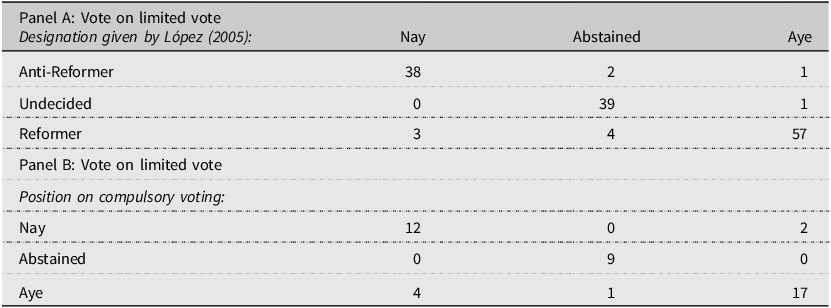
Because the establishment of compulsory and secret voting was not decided through a nominal vote, I use López’s (Reference López2005) classifications of legislators’ positions on Sáenz Peña’s reforms based on their speeches. However, if López (Reference López2005) designated legislators as “reformers” or “non-reformers” based on their limited voting roll-call votes, the two variables would be mechanically correlated regardless of whether any linkage actually exists. Thus, as a complementary approach, I focus on positions on compulsory voting in a sub-sample of legislators. Compulsory voting was decided with a Senate roll-call vote, allowing me to classify the positions of all 28 senators on this reform measure. I complement this roll-call data with the positions on compulsory voting inferred from the legislative speeches of 17 deputies.
Table 1 displays the cross-tabulation between support for the limited vote and for the overall reform package. There is an almost perfect overlap between legislators’ positions on different components of the reform package. Fisher’s exact test for contingency tables confirms that we can statistically reject the null hypothesis that positions on democratization and the electoral system reform are unrelated. This suggests that the limited vote was a core component of the democratizing reform package.
Overlap between “reformer” designation and support for the incomplete list

Notes: Cross-tabulation of Lopez’s (Reference López2005) designation of legislator positions on the reform in the lower chamber and the legislators’ roll-call votes on the incomplete list (Panel A); and positions on compulsory voting and the incomplete list (Panel B). Fisher’s exact p-value < 0.001.
Working-class Voters Supported Electoral System Change
Although the 1912 reform was a top-down process initiated by President Sáenz Peña, studying popular support for the reform provides insight into how different groups predicted its electoral impact. One way to adjudicate between an explanation based on containment and another on purposeful liberalization is to examine whether working-class voters supported the reform. If electoral system change was expected to benefit conservatives—as one would expect if the goal was containment—then we should observe that working-class voters opposed the reform. Instead, if electoral system change was expected to open the electoral game—as one would expect if the reformers’ intent was not to contain the rise of new parties—then we should observe that working-class voters supported the reform.
Despite the extreme difficulty of measuring voter views on different electoral systems in the early twentieth century, it can be done for the 1911 Argentine case with surprising accuracy. That year, the scholar Rodolfo Rivarola founded Argentina’s first political science journal—the Revista Argentina de Ciencias Políticas (RACP)—with the goal of promoting the study of politics with the positivist methods of the natural sciences. As part of this initiative, Rivarola conducted the first survey on political views in Argentina. However, the survey has an important drawback: the sample was not probabilistic. The questionnaire was published in a volume of RACP sent to public libraries, social clubs, and educational institutions, and reproduced in several newspapers.
The survey included questions about respondents’ preferences regarding three types of electoral systems: (1) the existing multi-member plurality rules; (2) SMDs; and (3) multi-member districts providing representation to minority groups, including cumulative voting and the limited vote. A total of 1,580 respondents answered the survey. Supporters of the Socialist Party are overrepresented in the sample, with 532 respondents. I use support for socialism as a proxy for working-class status. Using Cantón’s (Reference Cantón1967) cross-tabulations of the data, I reconstruct parts of the individual-level database.
This survey, which is unusually rich considering it was undertaken in 1911, allows me to estimate the overall support for electoral system change, and more importantly, to study differences in support for minority representation between socialists and non-socialists in the sample.
Table 2 displays the proportion of survey respondents supporting each electoral system, distinguishing between socialists and non-socialists. Overall, only 5 percent of the respondents supported the existing electoral system: 2 percent of socialists and 7 percent of non-socialists. This extremely low level of support for the status quo confirms the unpopularity of the existing system.
Public support for different electoral systems in 1911 Argentina

Notes: Survey data reported by Cantón (Reference Cantón1967). ** Significant at the 99 percent level
Notably, socialists were significantly less likely to support multi-member plurality and SMDs, and more likely to support PR or limited voting (p<0.01; using a simple t-test). This result is the opposite of what one would expect if voters believed that the limited voting reform’s intent was to impair the electoral rise of working-class parties.
Explaining Legislative Support for the Reform
This article has provided evidence that the introduction of the limited vote in Argentina in 1912 was part of a reform package promoted by President Sáenz Peña to promote the entry of more parties into the political system and not a mechanism to decrease the seat share of new parties after democratization. However, this finding begs the question of how Sáenz Peña managed to get Congress to pass his progressive reform package.
In this section, I offer suggestive evidence that patterns of legislative support for limited voting align with individual seat-maximization. An analysis of roll-call data suggests that Sáenz Peña assembled a coalition of two groups of legislators: those who expected to benefit from the limited vote and those who expected to be unaffected. Opposition to the reform came from the subset of legislators who had to pay the cost of political liberalization—those who expected to lose their seats under the limited vote.
Theorizing about Electoral Incentives
All the legislators who debated the electoral reform in 1912 were from provincial conservative parties. There was no such thing as a nationalized conservative party—each provincial delegation was autonomous and responded to local electoral incentives. The main opposition party was the UCR, which had no representatives in Congress but became more competitive after 1912 and won the presidency in 1916. Therefore, the electoral incentives that legislators had to support the limited vote must have depended to a large extent on the strength of the UCR in their districts.
For simplicity, consider a hypothetical district that elects three seats. There are two political groups: conservatives and the UCR opposition. Legislators, who belong to the conservative group, must decide whether to support the president’s proposal to change the electoral system from multi-member plurality to the limited voting system in which voters can only cast ${2}/{3}$
votes. Table 3 summarizes the number of seats that conservatives parties could obtain using the existing multi-member plurality rules and limited voting, depending on the strength of the UCR in their districts.
${2}/{3}$
votes. Table 3 summarizes the number of seats that conservatives parties could obtain using the existing multi-member plurality rules and limited voting, depending on the strength of the UCR in their districts.
Stylized example: expected outcomes by strength of the UCR

Assuming that no one expected the UCR to obtain more than 66 percent of the votes (a reasonable assumption given this article’s previous findings), one can distinguish three groups of conservative legislators. In the first group, conservatives are hegemonic in their districts (the UCR is expected to obtain less than 33 percent of the votes after democratization). In this case, conservatives are indifferent between block voting rules and limited voting because they can split into two factions during elections and still obtain all the seats. By presenting two separate candidate lists, hegemonic parties could win the seats for both the majority and the minority. This electoral strategy was anticipated by political pundits (e.g., Raymundo Wilmart and Norberto Piñeiro) and by legislators during the congressional debates on the electoral system reform (e.g., Julio A. Costa), Footnote 5 and practiced post-reform (see, e.g., Solís Carnicer Reference Carnicer and del Mar2001; Figueroa Reference Figueroa2024). Strategic splinters thus shielded some hegemonic conservative groups from the reform’s intended effects and enabled them to support the reform and gain the president’s favor without facing electoral costs.
At the opposite end of the spectrum were conservative legislators from districts where the UCR was expected to become majoritarian post-reform (obtaining between 50 and 66 percent of the votes). These vulnerable legislators faced a similar conundrum as the legislators in the traditional Western European narrative, and limited voting would be a safeguard guaranteeing them a third of the legislative seats, thus incentivizing their support for the reform.
Under the seat-maximization hypothesis, an intermediate group of legislators whose conservative parties were majoritarian but not hegemonic in their districts should oppose the reform. With the UCR expected to obtain between 33 and 50 percent of the votes, limited voting would make these conservatives lose a third of their legislative seats.
If legislative support for the electoral system reform is consistent with seat-maximization, the UCR’s vote share in a district and the district’s legislative support for the limited vote should have a U-shaped association. This reflects that hegemonic conservative groups are unaffected by the limited vote because they can strategically splinter; the limited vote costs majoritarian conservative groups a third of their seats; and the limited vote reserves a third of the seats for vulnerable conservative groups.
Data
Testing the U-shaped hypothesis requires measuring the UCR’s expected post-reform vote share. Ideally, one would use district-level voting intention polls, or, the next best option, the UCR’s immediate pre-reform electoral performance. Unfortunately, electoral polls did not exist in early twentieth-century Argentina, and the UCR frequently abstained from competing in elections before 1912. As a rough proxy for each legislator’s expected electoral threat, I use data from Cantón (Reference Cantón1968) to measure the UCR’s average vote share in the first three post-reform elections (in 1912, 1914, and 1916). Footnote 6 Because there is considerable error in this measure, one should think of it as a rough scale that approximates expected levels of electoral support—low, medium, and high.
Hypothesis Testing
Pooling deputies and senators, I obtain a sample of 100 legislators who did not abstain in the limited vote roll-call. Figure 1 shows the proportion of legislators in each province who supported the limited vote (y-axis) and the UCR’s electoral strength in the province (x-axis). The radius of each circle is proportional to the size of the congressional delegation. The curve on the scatter plot shows the support for limited voting predicted by the following OLS regression:
 $$L{V_i} = \;{\beta _0}\; + \;{\beta _1}\;UC{R_i} + \;{\beta _2}UCR_i^2 + {u_i}$$
Electoral threat and support for limited voting.

where $L{V_i}$
indicates that legislator i voted in favor of the limited vote, and
$L{V_i}$
indicates that legislator i voted in favor of the limited vote, and $UC{R_i}$
is the UCR’s average post-reform vote share in legislator i’s province. The seat-maximization hypothesis predicts a U-shaped relationship, which requires that
$UC{R_i}$
is the UCR’s average post-reform vote share in legislator i’s province. The seat-maximization hypothesis predicts a U-shaped relationship, which requires that ${\beta _2}$
>0.
${\beta _2}$
>0.
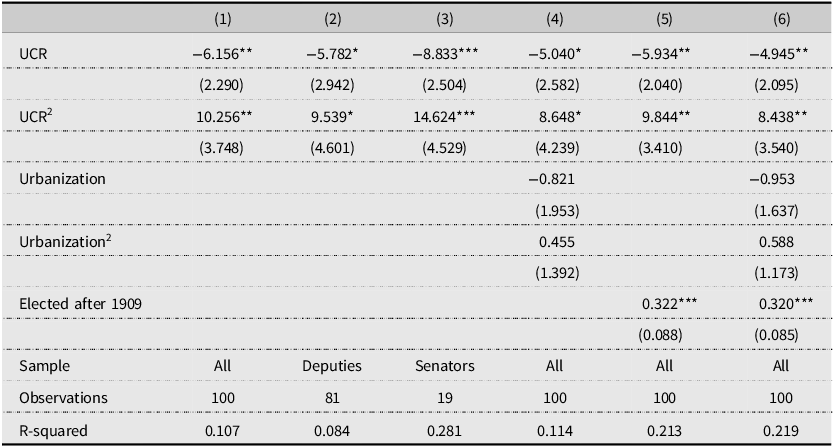
Figure 1 shows a clear U-shaped association between electoral vulnerability and support for the electoral reform. The quadratic term of the regression is positive and statistically significant ( ${\beta _2}$
= 10.2, p = 0.016), reflecting that the sign of the association between the UCR’s electoral strength and legislators’ support for limited voting flips from negative to positive. The sign of the association flips at intermediate levels of support for the UCR
${\beta _2}$
= 10.2, p = 0.016), reflecting that the sign of the association between the UCR’s electoral strength and legislators’ support for limited voting flips from negative to positive. The sign of the association flips at intermediate levels of support for the UCR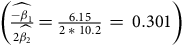 $\left({{{\widehat { - {\beta _1}}}}\over{{2\widehat {{\beta _2}}}}} = {{{6.15}}\over{{2\;*\;10.2}}}\,=\,0.301\right)$
.
$\left({{{\widehat { - {\beta _1}}}}\over{{2\widehat {{\beta _2}}}}} = {{{6.15}}\over{{2\;*\;10.2}}}\,=\,0.301\right)$
.
Table A1 in the Appendix displays the regression results, which show that the U-shaped association between support for the limited vote and the UCR’s expected electoral strength holds separately for deputies and senators and persists after controlling for urbanization and its squared term, and for an indicator that the legislator was elected in 1910 or after—which Madrid (Reference Madrid2019a) shows to be the strongest predictor of support for Sáenz Peña’s reform package.
Discussion
These results should be interpreted as exploratory. Their aim is not to explain Argentina’s electoral reform, as other works have already done (e.g., Castro Reference Castro2012; Madrid Reference Madrid2019a), but to show that legislators’ support for the progressive electoral system change accompanying other liberalizing reforms was not irrational. By changing the electoral system, conservative elites were not selflessly giving power to opposition parties. This section has shown that those legislators from conservative groups that expected to lose the most from the reform (e.g., those from Capital Federal and Buenos Aires) were much more likely to vote against it. Previous works have shown that legislators allied with President Sáenz Peña (i.e., elected after 1909) were more likely to support his reformist agenda (Heaps-Nelson Reference Heaps-Nelson1978; Madrid Reference Madrid2019a). This section complements these previous studies of the 1912 reform by showing that a significant portion of support for Sáenz Peña’s reform likely came from legislators who expected not to be adversely affected. Legislators supported the reform because the power they were transferring to opposition parties was not their own.
Conclusion
Through a case study of Argentina’s first democratization, this article offers an alternative characterization of the relationship between democratization and electoral system change. As summarized in Table 4, the traditional narrative of transitions from majoritarian rule in Western Europe (e.g., Rokkan Reference Rokkan1970; Boix Reference Boix1999) entails a strong working-class party threatening the electoral dominance of a fragmented conservative elite and motivating an electoral system reform as a safeguard to protect conservative seat share. In contrast, in 1912 Argentina, working-class and other opposition parties were electorally weak. Factional strife within the fragmented conservative elite, not coordination to resist the growth of the left, motivated an electoral reform that included secret voting, mandatory voting, and the limited vote (Castro Reference Castro2012; Madrid Reference Madrid2019a). By changing the electoral system, reformers sought to facilitate, not hinder, the entry of new parties. In other words, the 1912 Argentine electoral system change was not seen by reformers as an electoral safeguard to preserve the power of old elites after democratization, but rather as a progressive component of the democratizing package.
Difference between traditional narrative and 1912 Argentina

In exploring this case study, this article sheds light on a class of early electoral reforms that have not been sufficiently explored. The literature on historical electoral system change in Latin America has focused mostly on the introduction of PR (Wills-Otero Reference Wills-Otero2009; Gamboa and Morales Reference Gamboa and Morales2015; Negretto and Visconti Reference Negretto and Visconti2018). Yet Latin American countries also adopted other electoral systems like cumulative voting and the limited vote (of which the incomplete list is a subtype) before adopting PR, and the origins and motivations of these transitions remain underexplored. This article contributes one case study on these transitions.
To what extent do the motivations behind the electoral system change during Argentina’s 1912 democratization apply to other cases? Conclusively answering this question requires additional case studies. Electoral system changes during democratization have often been characterized as authoritarian safeguards (Ziblatt Reference Ziblatt2006) or elite-biased institutions (Albertus and Menaldo Reference Albertus and Menaldo2018). Yet Madrid (Reference Madrid2019a) describes episodes of democratization in South America that, similarly to Argentina, were the result of splits within a conservative party and not a response to working-class pressure. In some cases, reformers also modified a majoritarian electoral system as part of the democratizing package. The 1890 Chilean reform package established the secret vote, took measures to combat fraudulent vote counting, and eliminated the voter registration cards that enabled vote suppression. In addition, this reform included the replacement of multi-member plurality rules with cumulative voting. Meanwhile, Mazzuca and Robinson (Reference Mazzuca and Robinson2009) argue that Colombia’s 1905 adoption of the limited vote was intended to avoid violent confrontation and share power with the opposition, instead of electorally containing a rising opposition party.
Argentina’s 1912 electoral system reform was part of an international wave of reforms. Around the globe, jurists, political philosophers, and mathematicians debated how to define an electoral formula that represented the plurality of societal interests in parliament. An early twentieth-century Argentine authority on this subject was jurist Luis V. Varela. His 1876 book La democracia práctica with the subtitle “A study of all the electoral systems proposed to grant proportional representation to majorities and minorities” referenced European intellectuals’ work on similar topics and discussed electoral reforms in Western Europe. Likewise, both the La Nación op-eds as well as the legislative speeches during the treatment of the 1912 electoral system reform frequently mentioned European nations’ electoral system experiences (e.g., SMDs in the UK). The international diffusion of electoral systems is a promising area for future research.
Acknowledgements
This article is dedicated to the memory of Marcelo Leiras. I am grateful to Sebastián Navajas and Bernardo Pérez for research assistance and Evelyn Kim for copy editing.
Competing interests
Valentín Figueroa declares none.
Appendix
U-shaped Relationship between UCR Vote Share and Legislator Support for Limited Vote
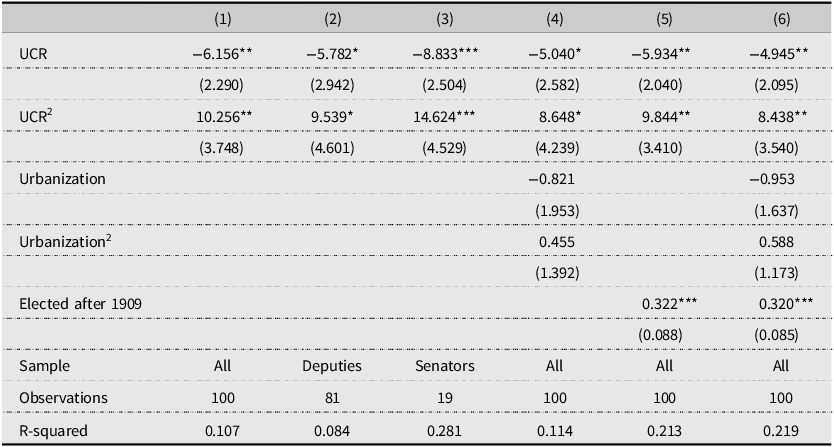
Notes: the dependent variable is an indicator that a legislator supported the limited vote (abstentions are excluded). Regressions estimated with OLS, standard errors clustered by province. *Significant at the 10 percent level; ** Significant at the 5 percent level; *** Significant at the 99 percent level.





 Open access

