


Introduction
Radiocarbon dating of organic materials, based on measuring the activity of the carbon isotope 14C, has played a key role in establishing the chronology of natural and cultural phenomena for over seven decades. Since the method was introduced by W. F. Libby et al. (Reference Libby, Anderson and Arnold1949), it has been applied by many disciplines, including archaeology (Bayliss Reference Bayliss2009; Kuzmin Reference Kuzmin2009; Taylor and Bar-Yosef Reference Taylor and Bar-Yosef2014), geology and geomorphology (Kertész et al. Reference Kertész, Hubay, Buró, Jull, Mindszenty, Sipos, Bartyik and Molnár2025; Ninard et al. Reference Ninard, Łapcik and Uchman2023; Pánek Reference Pánek2015; Starkel et al. Reference Starkel, Michczyńska, Krąpiec, Margielewski, Nalepka and Pazdur2013), palaeoclimatology and palaeoecology (Dantas et al. Reference Dantas, Dutra, Cherkinsky, Fortier, Kamino, Cozzuol, Ribeiro and Vieira2013; Gradziński et al. Reference Gradziński, Hercman, Peresviet-Soltan, Zelinka and Jelonek2016; Pietruczuk et al. Reference Pietruczuk, Dobrowolski, Suchora, Apolinarska, Bieganowski, Trembaczowski, Polakowski and Bober2022), art research (Hendriks et al. Reference Hendriks, Hajdas, Ferreira, Scherrer, Zumbühl, Smith, Welte, Wacker, Synal and Günther2019) and monument conservation (Michalska et al. Reference Michalska, Czernik and Goslar2017; Ringbom et al. Reference Ringbom, Lindroos, Heinemeier and Sonck-Koota2014) as well as forensics (Ubelaker Reference Ubelaker2014). By allowing the dating of materials up to approximately 50,000 years BP, 14C has become one of the most widely used chronometric tools in Earth and human sciences.
Contemporary applications of the method are based almost entirely on accelerator mass spectrometry (AMS), which allows for the direct counting of 14C isotope atoms (Kutschera et al. Reference Kutschera, Jull, Paul and Wallner2023). However, this technique requires exceptionally pure, well-prepared material, as even minor contamination can significantly affect the dating result, especially when analysing very old samples containing negligible amounts of original 14C. The quality of the sample is therefore a critical factor that determines the accuracy, precision, and interpretative usefulness of the radiocarbon age obtained (Hajdas et al. Reference Hajdas, Guidobaldi, Haghipour and Wyss2024).
The procedures for preparing samples for 14C dating have been thoroughly developed and optimized at many research centers worldwide. For plant materials, the most commonly used method is the ABA (acid-base-acid) protocol, which aims to remove carbonates, humic acids, and environmental contaminants. For animal or human bone samples, the key objective is to isolate collagen, the only stable protein component that can retain the original isotopic signal (Longin Reference Longin1971). Contemporary methods also use ultrafiltration, which allows the selection of high-molecular-weight collagen, characterized by greater structural stability and a lower degree of degradation (Brock et al. Reference Brock, Geoghegan, Thomas, Jurkschat and Higham2013; Brown et al. Reference Brown, Nelson, Vogel and Southon1988; Ramsey et al. Reference Ramsey, Higham, Bowles and Hedges2004).
In bones exposed to high temperatures, collagen is completely degraded, rendering standard protein extraction procedures ineffective. The only component possible for dating in this case remains the mineral fraction. The mineral fraction of bone, used in the dating of cremated material, consists mainly of hydroxyapatite - a crystalline form of calcium phosphate with the general chemical formula Ca10(PO4)6(OH)2. Under biological conditions, this mineral contains small amounts of carbonate (usually 0.5–1% by weight), which is a substitute for phosphate (PO43–) or hydroxyl (OH–) groups. This structural carbonate is the source of carbon analyzed by the 14C method in cremated bones, where the organic fraction has not been preserved (Major et al. Reference Major, Dani, Kiss, Melis, Patay, Szabó, Hubay, Túri, Futó, Huszánk, Jull and Molnár2019). In the case of cremated bones, preliminary sample selection is very important. It is crucial to distinguish between cremated material and merely charred material, as only fully cremated bones are suitable for radiocarbon dating based on the mineral fraction. Charred bones, exposed to temperatures of 200–300°C, retain traces of organic matter, including partially degraded collagen, and are grey or black in colour. The presence of these charred components indicates incomplete combustion and precludes their use in apatite fraction analysis. In contrast, cremated bones are formed at temperatures exceeding 600°C, at which organic matter is completely oxidized and a characteristic colour change to white occurs (Lanting et al. Reference Lanting, Aerts-Bijma and van der Plicht2001). High temperatures lead to the recrystallization of bioapatite, resulting in larger, better-structured crystals (Shipman et al. Reference Shipman, Foster and Schoeninger1984). However, only bones that show signs of complete cremation can be qualified for further preparation. Partially burnt samples or those containing charred material are rejected due to the risk of isotopic heterogeneity and potential contamination with modern carbon.
In practice, however, preparation begins even earlier—with the careful inspection of the material before chemical treatment. Visual examination of organic samples under a stereoscopic (binocular) microscope is a standard and key step. Charcoal, wood, peat, and organic sediments are routinely evaluated for their state of preservation and the presence of visible contaminants before further chemical treatment. One of the most common causes of dating errors is the presence of modern plant root fragments. The carbon they contain can significantly underestimate the age of the sample. With microscopic observation, it is possible to mechanically remove contaminants. This step increases the reliability of radiocarbon dating results, reducing the risk of errors due to admixtures that do not belong to the original context of the sample. However, there are cases in which complete removal of impurities is not possible. This is especially true of wood or charcoal heavily overgrown by root systems. Even with careful work under magnification, it is not always possible to isolate clean material. According to the accepted quality standards, many laboratories reject such samples at the selection stage and do not refer them for further preparation or dating. Microscopic observation is therefore not just a preliminary step but also an important quality filter that allows only samples with high dating potential to be admitted for analysis.
Regardless of the type of sample, the material preparation process serves as an essential quality control step. As demonstrated in numerous studies, the key factor affecting the reliability of radiocarbon dating results is the condition of the original material and the effectiveness of contaminant removal (Brock et al. Reference Brock, Dee, Hughes, Snoeck, Staff and Bronk Ramsey2018; Caforio et al. Reference Caforio, Fedi, Liccioli and Salvini2013; Fewlass et al. Reference Fewlass, Tuna, Fagault, Hublin, Kromer, Bard and Talamo2019; Hajdas et al. Reference Hajdas, Guidobaldi, Haghipour and Wyss2024; Steier et al. Reference Steier, Liebl, Kutschera, Wild and Golser2017; Taylor and Bar-Yosef Reference Taylor and Bar-Yosef2014; Wood et al. Reference Wood, Duval, Huong, Tuan, Bacon, Demeter, Duringer, Oxenham and Piper2016). What is more, advances in sample preparation now make it possible to date increasingly challenging materials, such as cremated bones, which until a few decades ago could not be analyzed with sufficient precision.
The modern precision of the 14C method, along with advanced calibration and statistical tools, enables increasingly complex chronological analyses. At the same time, there is a growing demand for specialized sample preparation laboratories. These centers perform several parallel functions. Firstly, they provide high-quality materials for AMS measurements, thereby enhancing the reliability of published data. In this way, they facilitate the work of the AMS laboratories, reducing turnaround times for AMS measurements. Secondly, they provide an educational and training base where future geochronologists, archaeologists, and paleoecologists can gain experience in working with dated material. Thirdly, they play an important role in integrating research communities by building local and international scientific cooperation networks.
In response to the growing needs of the scientific community, the Laboratory of Preparation for Radiocarbon Dating (LBC14) was established at the Maria Curie-Skłodowska University in Lublin in 2025 (Figure 1). The main purpose of this laboratory is to prepare macroscopic organic samples—such as charcoal, wood, peat, organic sediments, macrofossils, and bones (unburned and cremated)—for AMS dating performed at external centers.
Laboratory of Preparation for Radiocarbon Dating (LBC14) at Maria Curie-Skłodowska University in Lublin (Photo by M. Zembrzycki).

This paper presents the scope of LBC14 activities, a description of the protocols used for chemical sample preparation, and the first results of sample analyses conducted in collaboration with the Laboratory of Ion Beam Physics at ETH Zurich, Switzerland. The initiative represents an important step in expanding modern university radiocarbon infrastructure in Poland and supports the development of research and teaching competencies in geochronology.
Material
Materials chosen for the quality check of sample preparation at our laboratory include a ready-for-combustion blank PHA, standard OXAII, and wood IAEA C5 (Rozanski et al. Reference Rozanski, Stichler, Gonfiantini, Scott, Beukens, Kromer and Van Der Plicht1992). Old wood and coal were tested as preparation blanks. Modern sample prepared for cross-check was a bone from a hare found in the fields of Boppelsen (CH) on Feb. 24, 2021, had been previously analyzed at the ETH laboratory together with a piece of fur. Moreover, the atmospheric 14C content observed in the region this year is well documented (Hajdas et al. Reference Hajdas, Albrecht, Michalska, Mikosch, Ramsperger and Wasowicz2025).
The old wood from the Palaeolithic site Schöningen (district Helmstedt, Lower-Saxony, Germany) has been dated to the Marine Isotope Stage MIS 9, Interglacial (312–335 ka) (Conard et al. Reference Conard, Serangeli, Böhner, Starkovich, Miller, Urban and Van Kolfschoten2015; Tucci et al. Reference Tucci, Krahn, Richter, van Kolfschoten, Álvarez, Verheijen, Serangeli, Lehmann, Degering, Schwalb and Urban2021). Also, this sample was previously prepared and analyzed at ETH.
A sample of coal (anthracite) used in as a source of heat in private houses was collected in year 1990 with the original goal of testing the 14C content.
Methods
Preparation of the samples presented at the laboratory LBC14 (coal, wood, bone)
Sample preparation was carried out at the LBC14—Laboratory of Preparation for Radiocarbon Dating in Lublin, Poland.
The samples of charcoal and wood were treated with an ABA (acid-base-acid) chemical purification protocol. A 0.5 M HCl solution was added to the samples and heated at 60°C for 1 hr to remove carbonates. After this step, the samples were rinsed with distilled water to neutral pH, then treated with a 0.1 M NaOH solution and again heated at 60°C for 1 hr. This step removed humic acids. The samples were rinsed with distilled water and then subjected to a final treatment with 0.5 M HCl at 60°C for 1 hr to eliminate potential contamination by modern carbon. After a final rinse with distilled water, the samples were frozen and lyophilized (Alpha 1-2 LSC basic, Martin Christ) at –60°C for 24 hr.
The bone sample of the hare (Lepus europaeus) found in the field in February 2021 (labelled “Zając 2021”) was prepared using modified Longin (Longin Reference Longin1971) and ultrafiltration (Brown et al. Reference Brown, Nelson, Vogel and Southon1988) procedures for collagen extraction and purification (Hajdas et al. Reference Hajdas, Guidobaldi, Haghipour and Wyss2024).
Before chemical preparation, the bone sample was analyzed by FTIR spectroscopy to confirm the presence of collagen. The FTIR spectrum of the bone sample was obtained using the Agilent Cary 630 ATR FT-IR spectrometer with the attenuated total reflectance mode (Agilent Technologies, Inc., USA). Measurements were performed across the 4000–650 cm–1 range with a spectral resolution of 4 cm–1. Spectral data were acquired using the MicroLab software (version B.04) and subsequently processed with Agilent Resolutions Pro software (version 5.2.0.861).
The sample was pre-cleaned in an ultrasonic bath, replacing distilled water twice. Then, for demineralization, the bone was placed in 1 M HCl at 4°C for several days. Afterward, the sample was rinsed with distilled water and treated with 0.5 M NaOH solution for 30 minutes at room temperature to remove humic acids. Following another rinse with distilled water, 0.25 M HCl was added and left for 1 hr at room temperature. The sample was again rinsed with distilled water. Gelatinization was carried out in a slightly acidic environment at 65°C for 24 hr. The extracted collagen was filtered using a syringe filter (Millex Prefilter, pore size 2.0 μm) and subjected to ultrafiltration (Millipore Amicon Ultra Centrifugal Filter, 30 kDa MWCO; 4400 rpm, 5-20 min). The >30 kDa collagen fraction was transferred to a Falcon tube, frozen, and lyophilized at –60°C for 24 hr. Collagen quality was evaluated using the atomic C/N ratio. All samples yielded C/N values within the accepted range for well-preserved collagen (approximately 3.0–3.5), consistent with long-term observations from the ETH laboratory (Hajdas et al. Reference Hajdas, Guidobaldi, Haghipour and Wyss2024).
The lyophilized samples were weighed into aluminium boats, with weights ranging from 3.00 to 3.25 mg. Wood and bone samples were also analyzed using a gas ion source (GIS) (Ruff et al. Reference Ruff, Fahrni, Gäggeler, Hajdas, Suter, Synal, Szidat and Wacker2010). In these cases, the sample weights ranged from 0.34 to 0.60 mg. All samples, packed in Eppendorf-type tubes, were sent to the AMS Laboratory at ETH Zurich.
Additional preparation protocols available in LBC14
In addition to the samples presented in this study, LBC14 routinely prepares other types of organic materials for radiocarbon dating. Although results for these materials are not presented here, the relevant preparation procedures are described below to document the broader methodological scope of the laboratory.
Binocular microscope inspection
All macroscopic organic samples delivered to the LBC14 laboratory undergo preliminary inspection under a stereoscopic (binocular) microscope (magnification 10×–50×). This step is used to evaluate the preservation state of the material and to detect contaminants such as roots, insect remains, or external fibres. These contaminants are removed mechanically using precision tweezers whenever possible. In cases where root penetration is observed, the sample is excluded from further preparation to avoid underestimating its age (Hajdas et al. Reference Hajdas, Albrecht, Michalska, Mikosch, Ramsperger and Wasowicz2025). The binocular is also applied to confirm the taxonomic identification of macrofossils.
Sieving
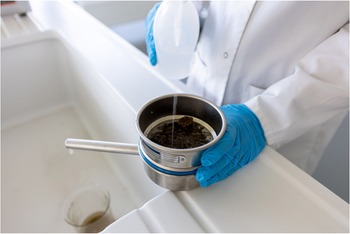
For peat and organic sediment samples, an important step in the initial preparation is sieving, which allows mechanical separation of undesirable impurities, such as modern plant root fragments. In the LBC14, sieving is performed using a 125 μm mesh, 100 mm diameter stainless steel sieve (Retsch) complete with a pan with a funnel to collect water and a fine fraction (Figure 2).
Sediment, peat and soil samples are sieved using the 125 μm mesh sieve on the top of a collecting pan. The fine fraction (<125 μm) is collected in a glass beaker.

The sieved material is separated into two granulometric fractions: the fine fraction (<125 μm) and the coarser fraction (>125 μm). The fine fraction, as well as humic acids contained within it, after proper separation and treatment, can provide valuable material for dating. The >125 μm fraction, on the other hand, is examined under a stereomicroscope to identify macrofossils such as leaves, seeds, wood, or charcoal fragments. The selected remains are often the preferred material for radiocarbon dating due to their unambiguous origin. The sieving process is therefore not only a purification tool but also an effective method for selecting high-quality dated material.
Cremated bones
The LBC14 laboratory also conducts specialized preparation of cremated bones, which is based on a modified protocol developed by (Lanting et al. Reference Lanting, Aerts-Bijma and van der Plicht2001), taking into account the material’s state of preservation.
Samples of cremated bones, selected for radiocarbon analysis, are first subjected to preliminary cleaning in the ultrasonic bath (2 × 15 min) to remove loose surface contaminants. The samples are then dried and treated with a 1.5% NaOCl solution at room temperature for 48 hr. The purpose of this stage is to remove any remaining organic matter completely. After this time, the samples are rinsed several times with distilled water and treated with a 1M CH3COOH solution at room temperature for 24 hr to remove exogenous carbonates and less-crystallized apatite crystals. After the final rinsing, the material is dried at 60°C and ground in a porcelain mortar to a fine powder. From each sample, around 2000 mg of material is weighed and sent to the AMS laboratory where the material can be treated with concentrated H3PO4, resulting in the release of structural carbonate in the form of CO2, which is then further analyzed in an AMS spectrometer.
Samples preparation at ETH Zurich
Preparation of various macroscopic samples performed at the ETH laboratory is described by Hajdas et al. (Reference Hajdas, Guidobaldi, Haghipour and Wyss2024). Cellulose was separated from the Schöningen wood to test potential of the material as the preparation blank (Němec et al. Reference Němec, Wacker, Hajdas and Gäggeler2010). In addition, before transfer to LBC14, one fragment of wood was charred at 300°C for 1 hr. The bone and the fur of the hare (Zając 2021) were prepared in 2021 by ultrafiltration and ABA 60°C, respectively.
AMS analysis
Accelerator mass spectrometry (AMS) radiocarbon measurements were conducted using the Mini Carbon Dating System MICADAS system (Synal et al. Reference Synal, Stocker and Suter2007) and LEA (Ramsperger et al. Reference Ramsperger, De Maria, Gautschi, Maxeiner, Müller, Synal and Wacker2024) at the Laboratory of Ion Beam Physics, ETH Zurich, Switzerland. Analysis of samples with masses smaller than 100 μg was completed using a gas ion source (GIS) (Haghipour et al. Reference Haghipour, Ausin, Usman, Ishikawa, Wacker, Welte, Ueda and Eglinton2019; Ruff et al. Reference Ruff, Wacker, Gäggeler, Suter, Synal and Szidat2007). Normalization and correction for isotopic fractionation were performed using the Phthalic Anhydride and Oxalic Acid II standard.
Results and discussion
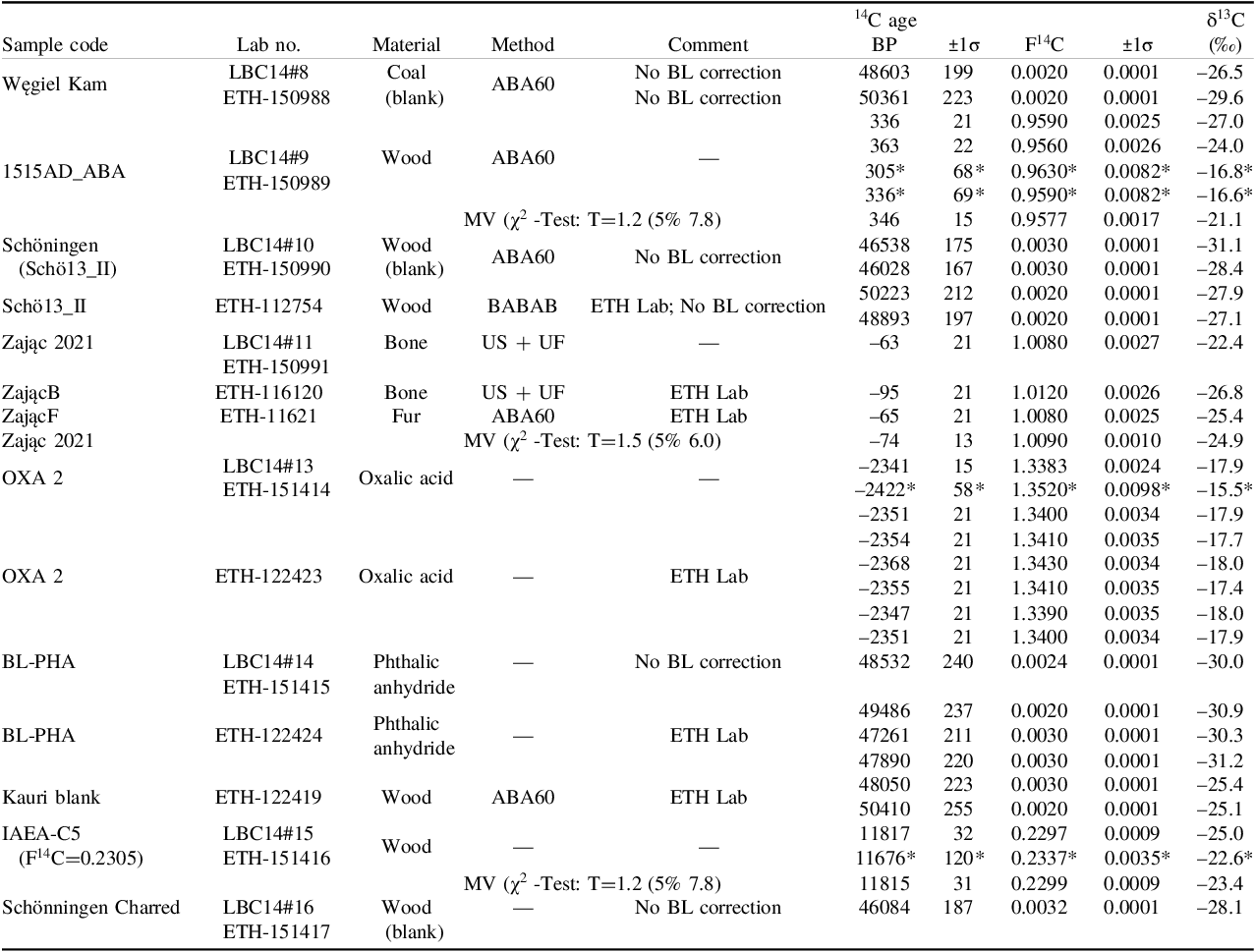
Results of the AMS analysis are summarized in Table 1. The values obtained for the combustion blank and for the preparation BL are comparable to the values measured for the samples prepared at the ETH laboratory. Results reported as “No BL correction” in Table 1 represent raw, uncorrected values, intentionally shown to facilitate direct comparison of preparation backgrounds and laboratory performance. The agreement between the results obtained for graphite and GIS samples is satisfactory. To further quantify the interlaboratory comparison, numerical differences were calculated for directly comparable sample pairs prepared at LBC14 and at the ETH laboratory. For the modern hare bone, the difference between LBC14 and ETH Zurich results equals 32 BP and –0.0040 F14C, which is well within analytical uncertainty. For the Oxalic Acid II standard, the difference between the mean values obtained at LBC14 and ETH Zurich equals 13 BP and –0.0024 F14C, which indicates excellent agreement. The phthalic anhydride samples also show good agreement, with differences consistent with analytical uncertainties at very low 14C levels (∆14C age = 287 BP and ∆F14C = –0.0002). The sample of the modern bone is in very good agreement with the results obtained on the sample prepared at the ETH laboratory, with C/Nat ratios of 3.2 and 3.4, respectively. Moreover, the combined 14C age of the bone and fur (Figure 3) is in excellent agreement with the values of 14C content measured in the leaves collected in Boppelsen in year 2020 (F14C = 1.0082 ± 0.0012 [mean value of 5 measurements; SM Table 1; Hajdas et al. Reference Hajdas, Albrecht, Michalska, Mikosch, Ramsperger and Wasowicz2025]).
Results of 14C analysis (results marked with an asterisk [*] were obtained using a gas ion source [GIS]).

ABA60—ABA 60ºC, 1 hr/step; US—ultrasonic; UF—ultrafiltration; BABAB—base-acid-base-acid-bleaching.
Combined results of 14C analysis on bone and fur of a hare (Zając) found in the fields in February 2021.

Conclusions
The sample preparation process is a crucial stage in radiocarbon dating, as it determines the accuracy, precision, and reliability of the results. Effective treatment of the material and appropriate selection of chemical procedures are key factors influencing data quality, underscoring the fundamental role of preparation laboratories in geochronological, paleoenvironmental, and archaeological research.
The presented results prove that the recently established Laboratory of Preparation for Radiocarbon Dating (LBC14) at Maria Curie-Skłodowska University in Lublin (Poland) meets high-quality standards in the preparation of materials for radiocarbon analysis. An interlaboratory comparison, conducted in collaboration with the Laboratory of Ion Beam Physics at ETH Zurich (Switzerland), showed satisfactory agreement of results in all analyzed samples, including blank samples, standards, and samples of unknown 14C age, confirming the validity of the implemented procedures. The LBC14 laboratory ensures the reliable, accurate, and internationally compliant preparation of organic samples, including wood, charcoal, peat, organic sediments, macrofossils, and bones, both unburnt and cremated. As a result, LBC14 is a modern and forward-looking research facility that supports the development of radiocarbon analysis and provides a solid foundation for further scientific cooperation in this field.
Acknowledgments
We are thanking Prof. Nicolas Conard, University of Tübingen, for providing samples of the old wood from Schöningen, Germany.