










1 Introduction
Let G be a complex semi-simple group, equipped with the standard multiplicative Poisson structure. Let
$\mathrm {U}=U_q\mathfrak {g}$
 be the Drinfeld–Jimbo quantum group, which is a Hopf algebra over the base field
$\mathbb {C}(q^{1/2})$
be the Drinfeld–Jimbo quantum group, which is a Hopf algebra over the base field
$\mathbb {C}(q^{1/2})$
 . When viewed as the quantized universal enveloping algebra of
$\mathfrak {g}$
. When viewed as the quantized universal enveloping algebra of
$\mathfrak {g}$
 , the algebra
$\mathrm {U}$
, the algebra
$\mathrm {U}$
 is a central object in representation theory.
One can also view
$\mathrm {U}$
 as the quantized coordinate algebra on the dual Poisson group
$G^*$
as the quantized coordinate algebra on the dual Poisson group
$G^*$
 as follows. Let
$\mathcal {A}=\mathbb {C}[q^{1/2},q^{-1/2}]$
as follows. Let
$\mathcal {A}=\mathbb {C}[q^{1/2},q^{-1/2}]$
 be the subring of the base field
$\mathbb {C}(q^{1/2})$
be the subring of the base field
$\mathbb {C}(q^{1/2})$
 . In comparison with Lusztig’s integral form [Reference Lusztig21, 3.1.13], one can construct a non-standard
$\mathcal {A}$
. In comparison with Lusztig’s integral form [Reference Lusztig21, 3.1.13], one can construct a non-standard
$\mathcal {A}$
 -form
$_{\mathcal {A}}\mathrm {U}$
-form
$_{\mathcal {A}}\mathrm {U}$
 of
$\mathrm {U}$
of
$\mathrm {U}$
 (see §2.1), where the base change
$_{\mathbb {C}}\mathrm {U}=\mathbb {C}\otimes _{\mathcal {A}}{}_{\mathcal {A}}\mathrm {U}$
(see §2.1), where the base change
$_{\mathbb {C}}\mathrm {U}=\mathbb {C}\otimes _{\mathcal {A}}{}_{\mathcal {A}}\mathrm {U}$
 becomes a commutative algebra. Moreover
$_{\mathbb {C}}\mathrm {U}$
becomes a commutative algebra. Moreover
$_{\mathbb {C}}\mathrm {U}$
 carries a Poisson algebra structure where the Poisson brackets are induced by taking the commutators in
$_{\mathcal {A}}\mathrm {U}$
carries a Poisson algebra structure where the Poisson brackets are induced by taking the commutators in
$_{\mathcal {A}}\mathrm {U}$
 (see (2.6)).
The work of De Concini–Procesi [Reference De Concini and Procesi14, Theorem 12.1] gives an explicit Poisson algebra isomorphism

We recall the map
$\varphi $
 in §2.5. Let us mention that although the QDP suggests that
$\mathrm {U}$
in §2.5. Let us mention that although the QDP suggests that
$\mathrm {U}$
 shall provide a quantization of
$\mathcal {O}(G^*)$
shall provide a quantization of
$\mathcal {O}(G^*)$
 , it takes much more effort to explicitly establish the isomorphism (1.1).
Let
$\theta $
 be a complex group involution on G, and
$K=G^\theta $
be a complex group involution on G, and
$K=G^\theta $
 be the
$\theta $
be the
$\theta $
 -fixed point subgroup. Let
$\mathfrak {g}$
-fixed point subgroup. Let
$\mathfrak {g}$
 and
$\mathfrak {k}$
and
$\mathfrak {k}$
 be the Lie algebras of G and K, respectively. Associated with the symmetric pair
$(\mathfrak {g},\mathfrak {k})$
be the Lie algebras of G and K, respectively. Associated with the symmetric pair
$(\mathfrak {g},\mathfrak {k})$
 , the quantum symmetric pair
$(\mathrm {U},\mathrm {U}^\imath )$
, the quantum symmetric pair
$(\mathrm {U},\mathrm {U}^\imath )$
 is the pair which consists of the quantum group
$\mathrm {U}$
is the pair which consists of the quantum group
$\mathrm {U}$
 , and a coideal subalgebra
$\mathrm {U}^\imath $
, and a coideal subalgebra
$\mathrm {U}^\imath $
 , called an
$\imath $
, called an
$\imath $
 quantum group [Reference Letzter20, Reference Bao and Wang8]. As a quantization of the universal enveloping algebra of
$\mathfrak {k}$
quantum group [Reference Letzter20, Reference Bao and Wang8]. As a quantization of the universal enveloping algebra of
$\mathfrak {k}$
 inside
$\mathrm {U}$
inside
$\mathrm {U}$
 , the algebra
$\mathrm {U}^\imath $
, the algebra
$\mathrm {U}^\imath $
 has found important applications in representation theory and algebraic geometry [Reference Bao and Song6, Reference Bao and Song7, Reference Bao and Wang9].
This paper studies the
$\imath $
 quantum group
$\mathrm {U}^\imath $
quantum group
$\mathrm {U}^\imath $
 from another point of view of quantized coordinate algebras. Let
$_{\mathcal {A}}\mathrm {U}^\imath =\mathrm {U}^\imath \cap {}_{\mathcal {A}}\mathrm {U}$
from another point of view of quantized coordinate algebras. Let
$_{\mathcal {A}}\mathrm {U}^\imath =\mathrm {U}^\imath \cap {}_{\mathcal {A}}\mathrm {U}$
 be the
$\mathcal {A}$
be the
$\mathcal {A}$
 -form of
$\mathrm {U}^\imath $
-form of
$\mathrm {U}^\imath $
 induced from the non-standard integral form on
$\mathrm {U}$
induced from the non-standard integral form on
$\mathrm {U}$
 . This integral form is essentially different from the one studied by Bao and Wang [Reference Bao and Wang8]. Let
$_{\mathbb {C}}\mathrm {U}^\imath =\mathbb {C}\otimes _{\mathcal {A}}{}_{\mathcal {A}}\mathrm {U}^\imath $
. This integral form is essentially different from the one studied by Bao and Wang [Reference Bao and Wang8]. Let
$_{\mathbb {C}}\mathrm {U}^\imath =\mathbb {C}\otimes _{\mathcal {A}}{}_{\mathcal {A}}\mathrm {U}^\imath $
 be the commutative Poisson algebra obtained by the specialization
$q^{1/2}\mapsto 1$
be the commutative Poisson algebra obtained by the specialization
$q^{1/2}\mapsto 1$
 , and let
$_{\mathbb {C}}\iota :{}_{\mathbb {C}}\mathrm {U}^\imath \rightarrow {}_{\mathbb {C}}\mathrm {U}$
, and let
$_{\mathbb {C}}\iota :{}_{\mathbb {C}}\mathrm {U}^\imath \rightarrow {}_{\mathbb {C}}\mathrm {U}$
 be the Poisson algebra homomorphism obtained by the base change of the natural embedding
$\iota :{}_{\mathcal {A}}\mathrm {U}^\imath \rightarrow {}_{\mathcal {A}}\mathrm {U}$
be the Poisson algebra homomorphism obtained by the base change of the natural embedding
$\iota :{}_{\mathcal {A}}\mathrm {U}^\imath \rightarrow {}_{\mathcal {A}}\mathrm {U}$
 .
.
Let
$\mathfrak {k}^\perp $
 be the space of linear forms on
$\mathfrak {g}$
be the space of linear forms on
$\mathfrak {g}$
 which vanish on
$\mathfrak {k}$
which vanish on
$\mathfrak {k}$
 . We show (Proposition 3.1) that
$\mathfrak {k}^\perp $
. We show (Proposition 3.1) that
$\mathfrak {k}^\perp $
 is moreover a Lie subalgebra of
$\mathfrak {g}^*$
is moreover a Lie subalgebra of
$\mathfrak {g}^*$
 . Let
$K^\perp $
. Let
$K^\perp $
 be the connected closed subgroup of
$G^*$
be the connected closed subgroup of
$G^*$
 associated with
$\mathfrak {k}^\perp $
associated with
$\mathfrak {k}^\perp $
 . The affine quotient
$K^\perp \backslash G^*$
. The affine quotient
$K^\perp \backslash G^*$
 is automatically a
$G^*$
is automatically a
$G^*$
 -Poisson homogeneous space, whose coordinate algebra is isomorphic to the Poisson subalgebra of
$K^\perp $
-Poisson homogeneous space, whose coordinate algebra is isomorphic to the Poisson subalgebra of
$K^\perp $
 -invariant functions on
$G^*$
-invariant functions on
$G^*$
 .
.
The main theorem of the paper is as follows.
Theorem 1. There is a unique Poisson algebra isomorphism

such that the diagram

commutes.
Our construction of
$\varphi ^\imath $
 is explicit, and hence it is suitable for applications.
The Poisson structures
$K^\perp \backslash G^*$
 occur in many fields of mathematics and physics [Reference Boalch1, Reference Bondal3, Reference Ballesteros, Gutierrez-Sagredo and Mercati5]. Therefore our result provides a bridge to utilize the theory of quantum symmetric pairs to study such Poisson structures. As an example, the Dubrovin–Ugaglia Poisson structures on the space of
$(n\times n)$
occur in many fields of mathematics and physics [Reference Boalch1, Reference Bondal3, Reference Ballesteros, Gutierrez-Sagredo and Mercati5]. Therefore our result provides a bridge to utilize the theory of quantum symmetric pairs to study such Poisson structures. As an example, the Dubrovin–Ugaglia Poisson structures on the space of
$(n\times n)$
 -upper triangular matrices with 1 on the diagonal appear in the study of Frobenius manifolds [Reference Dubrovin13, Reference Ugaglia27], and are related to the connections on the Riemann surfaces as well as Poisson–Lie groups by the work of Boalch [Reference Boalch1, Reference Boalch2]. In §4 we see that the
$\imath $
-upper triangular matrices with 1 on the diagonal appear in the study of Frobenius manifolds [Reference Dubrovin13, Reference Ugaglia27], and are related to the connections on the Riemann surfaces as well as Poisson–Lie groups by the work of Boalch [Reference Boalch1, Reference Boalch2]. In §4 we see that the
$\imath $
 quantum group associated to the symmetric pair
$(\mathfrak {sl}_n,\mathfrak {so}_n)$
quantum group associated to the symmetric pair
$(\mathfrak {sl}_n,\mathfrak {so}_n)$
 is a quantization of the Dubrovin–Ugaglia Poisson structure, and the well-known braid group symmetries on such Poisson structures can be obtained from the braid group symmetries on the corresponding
$\imath $
is a quantization of the Dubrovin–Ugaglia Poisson structure, and the well-known braid group symmetries on such Poisson structures can be obtained from the braid group symmetries on the corresponding
$\imath $
 quantum group via specialization.
Viewing
$\mathrm {U}$
 as the quantized coordinate algebra is the fundamental philosophy to relate cluster algebras with quantum groups [26, Reference Shen22]. Based on the same point of view, in the work [Reference Song23] the author gave a cluster algebra realization of the
$\imath $
as the quantized coordinate algebra is the fundamental philosophy to relate cluster algebras with quantum groups [26, Reference Shen22]. Based on the same point of view, in the work [Reference Song23] the author gave a cluster algebra realization of the
$\imath $
 quantum group associated to
$(\mathfrak {sl}_n,\mathfrak {so}_n)$
quantum group associated to
$(\mathfrak {sl}_n,\mathfrak {so}_n)$
 . It is desirable to generalize the construction to other types. Our result provides the geometric foundation in this direction.
In [Reference Ciccoli and Gavarini11], Ciccoli and Gavarini generalized Drinfeld’s QDP to the setting of subgroups and homogeneous spaces. However, like the work of Drinfeld [Reference Drinfeld16], the construction in [Reference Ciccoli and Gavarini11] is based on the formal power series setting and hence cannot be applied to our situation. In their subsequent paper [Reference Ciccoli and Gavarini12], by imposing various technical assumptions, the authors deal with the quantum algebras over the ordinary fractional field, which they call the global version of the QDP. Their results are general but abstract, and it is difficult to check those assumptions for explicit examples. Our result fits into the general philosophy of their QDP, but our proof is independent of theirs.
2 Preliminaries
In this section, we recall basic constructions on quantum groups, quantum symmetric pairs, (dual) Poisson groups and the specializations of quantum algebras.
2.1 Quantum groups
Fix a finite index set
$\mathrm {I}$
 , and a Cartan matrix
$A=(a_{ij})_{i,j\in \mathrm {I}}$
, and a Cartan matrix
$A=(a_{ij})_{i,j\in \mathrm {I}}$
 . Let
$D=diag(\epsilon _i)_{i\in \mathrm {I}}$
. Let
$D=diag(\epsilon _i)_{i\in \mathrm {I}}$
 be the diagonal matrix such that
$DA$
be the diagonal matrix such that
$DA$
 is symmetric positive definite, with
$\epsilon _i\in \mathbb {Z}_{>0}$
is symmetric positive definite, with
$\epsilon _i\in \mathbb {Z}_{>0}$
 and
$\{\epsilon _i\mid i\in \mathrm {I}\}$
and
$\{\epsilon _i\mid i\in \mathrm {I}\}$
 relatively prime.
Let
$\mathfrak {g}$
 be the complex semi-simple Lie algebra associated with the Cartan matrix A, and
$\mathfrak {h}$
be the complex semi-simple Lie algebra associated with the Cartan matrix A, and
$\mathfrak {h}$
 be a Cartan subalgebra of
$\mathfrak {g}$
be a Cartan subalgebra of
$\mathfrak {g}$
 . Take Borel subalgebras
$\mathfrak {b}^+$
. Take Borel subalgebras
$\mathfrak {b}^+$
 and
$\mathfrak {b}^-$
and
$\mathfrak {b}^-$
 of
$\mathfrak {g}$
of
$\mathfrak {g}$
 , such that
$\mathfrak {b}^+\cap \mathfrak {b}^-=\mathfrak {h}$
, such that
$\mathfrak {b}^+\cap \mathfrak {b}^-=\mathfrak {h}$
 . Denote by
$\Phi \subset \mathfrak {h}^*$
. Denote by
$\Phi \subset \mathfrak {h}^*$
 the root system of
$\mathfrak {g}$
the root system of
$\mathfrak {g}$
 relative to
$\mathfrak {h}$
relative to
$\mathfrak {h}$
 . Let
$\mathcal {R}^+\subset \Phi $
. Let
$\mathcal {R}^+\subset \Phi $
 be the set of positive roots associated with
$\mathfrak {b}^+$
be the set of positive roots associated with
$\mathfrak {b}^+$
 , and
$\Delta =\{\alpha _i\mid i\in \mathrm {I}\}$
, and
$\Delta =\{\alpha _i\mid i\in \mathrm {I}\}$
 be the subset of simple roots. Set
$\mathcal {R}^-=-\mathcal {R}^+$
be the subset of simple roots. Set
$\mathcal {R}^-=-\mathcal {R}^+$
 . Let
. Let

be the root space decomposition. Set
$\mathfrak {u}^+=\oplus _{\alpha \in \mathcal {R}^+}\mathfrak {g}_\alpha $
 and
$\mathfrak {u}^-=\oplus _{\alpha \in \mathcal {R}^-}\mathfrak {g}_{\alpha }$
and
$\mathfrak {u}^-=\oplus _{\alpha \in \mathcal {R}^-}\mathfrak {g}_{\alpha }$
 . Let Q be the root lattice, and W be the Weyl group of
$\mathfrak {g}$
. Let Q be the root lattice, and W be the Weyl group of
$\mathfrak {g}$
 with generators
$\{s_i\mid i\in \mathrm {I}\}$
with generators
$\{s_i\mid i\in \mathrm {I}\}$
 . The group W acts on Q in a natural way. For an element w in W, let
$|w|$
. The group W acts on Q in a natural way. For an element w in W, let
$|w|$
 be the length of w. Let
$w_0$
be the length of w. Let
$w_0$
 be the longest element in W, and write
$n=|w_0|$
be the longest element in W, and write
$n=|w_0|$
 .
.
Let q be an indeterminate, and
$q^{1/2}\in \overline {\mathbb {Q}(q)}$
 be a fixed square root of q. Let
$q_i=q^{\epsilon _i}$
be a fixed square root of q. Let
$q_i=q^{\epsilon _i}$
 , for
$i\in \mathrm {I}$
, for
$i\in \mathrm {I}$
 . Let
$\mathrm {U}$
. Let
$\mathrm {U}$
 be the Drinfeld–Jimbo quantum group associated with
$\mathfrak {g}$
be the Drinfeld–Jimbo quantum group associated with
$\mathfrak {g}$
 over the base field
$\mathbb {C}(q^{1/2})$
over the base field
$\mathbb {C}(q^{1/2})$
 (cf. [Reference Jantzen18, 4.3]). Let
$\varepsilon :\mathrm {U}\rightarrow \mathbb {C}(q^{1/2})$
(cf. [Reference Jantzen18, 4.3]). Let
$\varepsilon :\mathrm {U}\rightarrow \mathbb {C}(q^{1/2})$
 be the counit. For
$i\in \mathrm {I}$
be the counit. For
$i\in \mathrm {I}$
 , let
$\mathbf {E}_i$
, let
$\mathbf {E}_i$
 ,
$\mathbf {F}_i$
,
$\mathbf {F}_i$
 and
$\mathbf {K}_i$
and
$\mathbf {K}_i$
 be the generators as in loc. cit. For our purpose, we consider the rescaled generators

Let
$\mathrm {U}^-$
 (resp.,
$\mathrm {U}^+$
(resp.,
$\mathrm {U}^+$
 ) be the unital
$\mathbb {C}(q^{1/2})$
) be the unital
$\mathbb {C}(q^{1/2})$
 -subalgebra of
$\mathrm {U}$
-subalgebra of
$\mathrm {U}$
 generated by
$F_i$
generated by
$F_i$
 (resp.,
$E_i$
(resp.,
$E_i$
 ), for various
$i\in \mathrm {I}$
), for various
$i\in \mathrm {I}$
 . Let
$\mathrm {U}^0$
. Let
$\mathrm {U}^0$
 be the unital
$\mathbb {C}(q^{1/2})$
be the unital
$\mathbb {C}(q^{1/2})$
 -subalgebra of
$\mathrm {U}$
-subalgebra of
$\mathrm {U}$
 generated by
$K_i^{\pm 1}$
generated by
$K_i^{\pm 1}$
 , for
$i\in \mathrm {I}$
, for
$i\in \mathrm {I}$
 . For any
$\mu =\sum _{i\in \mathrm {I}}a_i\alpha _i\in Q$
. For any
$\mu =\sum _{i\in \mathrm {I}}a_i\alpha _i\in Q$
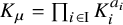
 , we write
$K_\mu =\prod _{i\in \mathrm {I}}K_i^{a_i}$
, we write
$K_\mu =\prod _{i\in \mathrm {I}}K_i^{a_i}$
 .
.
For
$i\in \mathrm {I}$
 , let
$\mathrm {T}_i$
, let
$\mathrm {T}_i$
 be the
$\mathbb {C}(q^{1/2})$
be the
$\mathbb {C}(q^{1/2})$
 -algebra automorphism of
$\mathrm {U}$
-algebra automorphism of
$\mathrm {U}$
 , denoted by
$T_{i,-1}''$
, denoted by
$T_{i,-1}''$
 in [Reference Lusztig21, 37.1.3]. It is known that automorphisms
$\{\mathrm {T}_i\mid i\in \mathrm {I}\}$
in [Reference Lusztig21, 37.1.3]. It is known that automorphisms
$\{\mathrm {T}_i\mid i\in \mathrm {I}\}$
 satisfy the braid group relations. For
$w\in W$
satisfy the braid group relations. For
$w\in W$
 , we write
$\mathrm {T}_w=\mathrm {T}_{i_1}\mathrm {T}_{i_2}\cdots \mathrm {T}_{i_r}$
, we write
$\mathrm {T}_w=\mathrm {T}_{i_1}\mathrm {T}_{i_2}\cdots \mathrm {T}_{i_r}$
 , where
$w=s_{i_1}s_{i_2}\cdots s_{i_r}$
, where
$w=s_{i_1}s_{i_2}\cdots s_{i_r}$
 and
$r=|w|$
and
$r=|w|$
 .
.
Let
$\mathbf {i}=(i_1,i_2,\cdots ,i_n)\in \mathrm {I}^n$
 be a reduced expression of
$w_0$
be a reduced expression of
$w_0$
 . For
$\mathbf {a}=(a_1,\cdots ,a_n)\in \mathbb {N}^n$
. For
$\mathbf {a}=(a_1,\cdots ,a_n)\in \mathbb {N}^n$
 , set
, set

For
$1\leq k\leq n$
 , we write
$F_{\mathbf {i},k}=F_{\mathbf {i}}(\mathbf {e}_k)$
, we write
$F_{\mathbf {i},k}=F_{\mathbf {i}}(\mathbf {e}_k)$
 and
$E_{\mathbf {i},k}=E_{\mathbf {i}}(\mathbf {e}_k)$
and
$E_{\mathbf {i},k}=E_{\mathbf {i}}(\mathbf {e}_k)$
 , where
$\mathbf {e}_k=(\delta _{kj})_{j=1}^n\in \mathbb {N}^n$
, where
$\mathbf {e}_k=(\delta _{kj})_{j=1}^n\in \mathbb {N}^n$
 .
.
Set
$\mathcal {A}=\mathbb {C}[q^{1/2},q^{-1/2}]$
 to be the subring of
$\mathbb {C}(q^{1/2})$
to be the subring of
$\mathbb {C}(q^{1/2})$
 . Let
$_{\mathcal {A}}\mathrm {U}^-$
. Let
$_{\mathcal {A}}\mathrm {U}^-$
 (resp.,
$_{\mathcal {A}}\mathrm {U}^+$
(resp.,
$_{\mathcal {A}}\mathrm {U}^+$
 ) be the
$\mathcal {A}$
) be the
$\mathcal {A}$
 -submodule of
$\mathrm {U}^-$
-submodule of
$\mathrm {U}^-$
 (resp.,
$\mathrm {U}^+$
(resp.,
$\mathrm {U}^+$
 ), spanned by
$F_{\mathbf {i}}(\mathbf {a})$
), spanned by
$F_{\mathbf {i}}(\mathbf {a})$
 (resp.,
$E_{\mathbf {i}}(\mathbf {a})$
(resp.,
$E_{\mathbf {i}}(\mathbf {a})$
 ), for various
$\mathbf {a}\in \mathbb {N}^n$
), for various
$\mathbf {a}\in \mathbb {N}^n$
 . It is known that
$_{\mathcal {A}}\mathrm {U}^-$
. It is known that
$_{\mathcal {A}}\mathrm {U}^-$
 and
$_{\mathcal {A}}\mathrm {U}^+$
and
$_{\mathcal {A}}\mathrm {U}^+$
 are independent of the choice of
$\mathbf {i}$
are independent of the choice of
$\mathbf {i}$
 , and are closed under multiplications. Let
$_{\mathcal {A}}\mathrm {U}^0$
, and are closed under multiplications. Let
$_{\mathcal {A}}\mathrm {U}^0$
 be the unital
$\mathcal {A}$
be the unital
$\mathcal {A}$
 -subalgebra of
$\mathrm {U}^0$
-subalgebra of
$\mathrm {U}^0$
 , generated by
$K_i^{\pm 1}$
, generated by
$K_i^{\pm 1}$
 , for
$i\in \mathrm {I}$
, for
$i\in \mathrm {I}$
 . Let
$_{\mathcal {A}}\mathrm {U}$
. Let
$_{\mathcal {A}}\mathrm {U}$
 be the
$\mathcal {A}$
be the
$\mathcal {A}$
 -subalgebra of
$\mathrm {U}$
-subalgebra of
$\mathrm {U}$
 , generated by
$_{\mathcal {A}}\mathrm {U}^-$
, generated by
$_{\mathcal {A}}\mathrm {U}^-$
 ,
$_{\mathcal {A}}\mathrm {U}^0$
,
$_{\mathcal {A}}\mathrm {U}^0$
 and
$_{\mathcal {A}}\mathrm {U}^+$
and
$_{\mathcal {A}}\mathrm {U}^+$
 . It is different from the integral form defined by Lusztig [Reference Lusztig21, 3.1.13], and is the same as the one studied by Berenstein–Greenstein [Reference Berenstein and Greenstein4]. By [Reference Berenstein and Greenstein4, Corollary 3.13 & Theorem 3.11], the multiplication gives an isomorphism as
$\mathcal {A}$
. It is different from the integral form defined by Lusztig [Reference Lusztig21, 3.1.13], and is the same as the one studied by Berenstein–Greenstein [Reference Berenstein and Greenstein4]. By [Reference Berenstein and Greenstein4, Corollary 3.13 & Theorem 3.11], the multiplication gives an isomorphism as
$\mathcal {A}$
 -modules

Here the tensor products are over
$\mathcal {A}$
 . It is easy to see that the
$\mathcal {A}$
. It is easy to see that the
$\mathcal {A}$
 -subalgebra
$_{\mathcal {A}}\mathrm {U}$
-subalgebra
$_{\mathcal {A}}\mathrm {U}$
 is invariant under the braid group action
$\mathrm {T}_i$
is invariant under the braid group action
$\mathrm {T}_i$
 , for
$i\in \mathrm {I}$
, for
$i\in \mathrm {I}$
 .
.
2.2 Quantum symmetric pairs
Let
$(\mathrm {I}=\mathrm {I}_{\circ }\sqcup \mathrm {I}_{\bullet },\tau )$
 be a Satake diagram (cf. [Reference Bao and Wang8]). Recall that
$\tau $
be a Satake diagram (cf. [Reference Bao and Wang8]). Recall that
$\tau $
 is a graph involution on
$\mathrm {I}$
is a graph involution on
$\mathrm {I}$
 , which leaves
$\mathrm {I}_\circ $
, which leaves
$\mathrm {I}_\circ $
 and
$\mathrm {I}_{\bullet }$
and
$\mathrm {I}_{\bullet }$
 invariant. We fix once for all a subset
$\mathrm {I}^{\prime }_\circ \subset \mathrm {I}_\circ $
invariant. We fix once for all a subset
$\mathrm {I}^{\prime }_\circ \subset \mathrm {I}_\circ $
 , consisting of exactly one element in each
$\tau $
, consisting of exactly one element in each
$\tau $
 -orbits of
$\mathrm {I}_\circ $
-orbits of
$\mathrm {I}_\circ $
 . Let
$\Phi _{\bullet }\subset \Phi $
. Let
$\Phi _{\bullet }\subset \Phi $
 be the sub-root system with simple roots
$\{\alpha _i\mid i\in \mathrm {I}_{\bullet }\}$
be the sub-root system with simple roots
$\{\alpha _i\mid i\in \mathrm {I}_{\bullet }\}$
 , and
$W_{\bullet }=\langle s_i\mid i\in \mathrm {I}_{\bullet }\rangle $
, and
$W_{\bullet }=\langle s_i\mid i\in \mathrm {I}_{\bullet }\rangle $
 be the parabolic subgroup. Let
$w_{\bullet }$
be the parabolic subgroup. Let
$w_{\bullet }$
 be the longest element in
$W_{\bullet }$
be the longest element in
$W_{\bullet }$
 . Let
$\mathcal {R}_{\bullet }^+=\mathcal {R}^+\cap \Phi _{\bullet }$
. Let
$\mathcal {R}_{\bullet }^+=\mathcal {R}^+\cap \Phi _{\bullet }$
 and
$\mathcal {R}_{\bullet }^-=\mathcal {R}^-\cap \Phi _{\bullet }$
and
$\mathcal {R}_{\bullet }^-=\mathcal {R}^-\cap \Phi _{\bullet }$
 . Let
$\theta =-w_{\bullet }\tau :Q\rightarrow Q$
. Let
$\theta =-w_{\bullet }\tau :Q\rightarrow Q$
 be the group involution on Q, and
$Q^\theta =\{\mu \in Q\mid \theta (\mu )=\mu \}$
be the group involution on Q, and
$Q^\theta =\{\mu \in Q\mid \theta (\mu )=\mu \}$
 .
.
We fix parameters
$\varsigma _i\in \pm q^{\mathbb {Z}}$
 , for
$i\in \mathrm {I}_\circ $
, for
$i\in \mathrm {I}_\circ $
 , which satisfy the conditions in [Reference Bao and Wang8, Definition 3.5]. The associated
$\imath $
, which satisfy the conditions in [Reference Bao and Wang8, Definition 3.5]. The associated
$\imath $
 quantum group
$\mathrm {U}^\imath $
quantum group
$\mathrm {U}^\imath $
 is the unital
$\mathbb {C}(q^{1/2})$
is the unital
$\mathbb {C}(q^{1/2})$
 -subalgebra of
$\mathrm {U}$
-subalgebra of
$\mathrm {U}$
 , generated by the following elements,

We write
$B_i=F_i$
 , for
$i\in \mathrm {I}_{\bullet }$
, for
$i\in \mathrm {I}_{\bullet }$
 . The pair
$(\mathrm {U},\mathrm {U}^\imath )$
. The pair
$(\mathrm {U},\mathrm {U}^\imath )$
 is called a quantum symmetric pair.
2.3 Poisson structures
For any complex affine algebraic variety V, we write
$\mathcal {O}(V)$
 to denote the
$\mathbb {C}$
to denote the
$\mathbb {C}$
 -algebra of regular functions on V.
Let G be the complex semi-simple adjoint group with the Lie algebra
$\mathfrak {g}$
 . Let
$B^+$
. Let
$B^+$
 ,
$B^-$
,
$B^-$
 and H be the connected closed subgroups of G, whose Lie algebras are
$\mathfrak {b}^+$
and H be the connected closed subgroups of G, whose Lie algebras are
$\mathfrak {b}^+$
 ,
$\mathfrak {b}^-$
,
$\mathfrak {b}^-$
 and
$\mathfrak {h}$
and
$\mathfrak {h}$
 , respectively. Let
$U^+$
, respectively. Let
$U^+$
 (resp.,
$U^-$
(resp.,
$U^-$
 ) be the unipotent radical of
$B^+$
) be the unipotent radical of
$B^+$
 (resp.,
$B^-$
(resp.,
$B^-$
 ). For
$\alpha \in \Phi $
). For
$\alpha \in \Phi $
 , let
$U_\alpha $
, let
$U_\alpha $
 be the root subgroup of G associated with
$\alpha $
be the root subgroup of G associated with
$\alpha $
 .
.
Let us briefly recall the standard Poisson structure associated with G, and the dual Poisson group
$G^*$
 . We refer to [Reference Chari and Pressley10, §1] for a detailed exposition. Let
$\langle \,,\,\rangle $
. We refer to [Reference Chari and Pressley10, §1] for a detailed exposition. Let
$\langle \,,\,\rangle $
 be the Killing form of
$\mathfrak {g}$
be the Killing form of
$\mathfrak {g}$
 , and
$\mathfrak {g}^*$
, and
$\mathfrak {g}^*$
 be the space of
$\mathbb {C}$
be the space of
$\mathbb {C}$
 -linear forms on
$\mathfrak {g}$
-linear forms on
$\mathfrak {g}$
 . The Drinfeld double
$\mathfrak {d}=\mathfrak {g}\oplus \mathfrak {g}$
. The Drinfeld double
$\mathfrak {d}=\mathfrak {g}\oplus \mathfrak {g}$
 admits a non-degenerate invariant bilinear form
$\langle \langle \,,\,\rangle \rangle $
admits a non-degenerate invariant bilinear form
$\langle \langle \,,\,\rangle \rangle $
 , given by

Let us identify
$\mathfrak {g}$
 with the diagonal Lie subalgebra of
$\mathfrak {d}$
with the diagonal Lie subalgebra of
$\mathfrak {d}$
 , and identify
$\mathfrak {g}^*$
, and identify
$\mathfrak {g}^*$
 with another Lie subalgebra,

via the bilinear form
$\langle \langle \,,\,\rangle \rangle $
 . Under these identifications the triple
$(\mathfrak {d},\mathfrak {g},\mathfrak {g}^*)$
. Under these identifications the triple
$(\mathfrak {d},\mathfrak {g},\mathfrak {g}^*)$
 forms a Manin triple, which determines a Lie bialgebra structure on
$\mathfrak {g}$
forms a Manin triple, which determines a Lie bialgebra structure on
$\mathfrak {g}$
 , and determines the standard Poisson structure on G.
By a dual construction, one gets a Lie bialgebra structure on
$\mathfrak {g}^*$
 , which determines a Poisson structure on the dual Poisson group
$G^*$
, which determines a Poisson structure on the dual Poisson group
$G^*$
 , where

is the connected closed subgroup of
$B^+\times B^-$
 with the Lie algebra
$\mathfrak {g}^*$
with the Lie algebra
$\mathfrak {g}^*$
 .
.
We have an isomorphism as varieties

which determines an isomorphism as
$\mathbb {C}$
 -algebras

2.4 Specialization of quantum algebras
Let
$R_q$
 be a non-commutative unital
$\mathcal {A}$
be a non-commutative unital
$\mathcal {A}$
 -algebra, which satisfies the condition

Let
$R=\mathbb {C}\otimes _{\mathcal {A}}R_q$
 where the tensor product is given by
$q^{1/2}\mapsto 1$
where the tensor product is given by
$q^{1/2}\mapsto 1$
 . The condition (2.5) is equivalent to saying that the
$\mathbb {C}$
. The condition (2.5) is equivalent to saying that the
$\mathbb {C}$
 -algebra R is commutative. Denote by
$f\mapsto \overline {f}$
-algebra R is commutative. Denote by
$f\mapsto \overline {f}$
 the canonical map
$R_q\rightarrow R$
the canonical map
$R_q\rightarrow R$
 . Then R carries a Poisson bracket
$\{\,,\,\}:R\times R\rightarrow R$
. Then R carries a Poisson bracket
$\{\,,\,\}:R\times R\rightarrow R$
 , defined by

2.5 Specialization of
$_{\mathcal {A}}\mathrm {U}$


Let us fix a pinning
$\{x_i,y_i\mid i\in \mathrm {I}\}$
 of the group G, where
$x_i:\mathbb {C}\rightarrow U_{\alpha _i}$
of the group G, where
$x_i:\mathbb {C}\rightarrow U_{\alpha _i}$
 and
$y_i:\mathbb {C}\rightarrow U_{-\alpha _i}$
and
$y_i:\mathbb {C}\rightarrow U_{-\alpha _i}$
 are one-parameter subgroups.
For
$i\in \mathrm {I}$
 , set
, set

It is well-known that elements
$\{\dot {s}_i\mid i\in \mathrm {I}\}$
 satisfy the braid group relations. For
$w\in W$
satisfy the braid group relations. For
$w\in W$
 , denote by
$\dot {w}=\dot {s}_{i_1}\cdot \dot {s}_{i_2}\cdots \dot {s}_{i_k}$
, denote by
$\dot {w}=\dot {s}_{i_1}\cdot \dot {s}_{i_2}\cdots \dot {s}_{i_k}$
 , for one (and hence for all) reduced expression
$w=s_{i_1}s_{i_2}\cdots s_{i_k}$
, for one (and hence for all) reduced expression
$w=s_{i_1}s_{i_2}\cdots s_{i_k}$
 .
.
Take a reduced expression
$\mathbf {i}=(i_1,\cdots , i_n)$
 of the longest
$w_0$
of the longest
$w_0$
 of W. For
$1\leq k\leq n$
of W. For
$1\leq k\leq n$
 , set
${\beta _{\mathbf {i},k}=s_{i_1}\cdots s_{i_{k-1}}(\alpha _{i_k})\in \mathcal {R}^+}$
, set
${\beta _{\mathbf {i},k}=s_{i_1}\cdots s_{i_{k-1}}(\alpha _{i_k})\in \mathcal {R}^+}$
 . Set
$x_{\mathbf {i},k}=\text {Ad}_{\dot {s}_{i_1}\cdots \dot {s}_{i_{k-1}}}\circ x_{i_k}:\mathbb {C}\rightarrow U_{\beta _{\mathbf {i},k}}$
. Set
$x_{\mathbf {i},k}=\text {Ad}_{\dot {s}_{i_1}\cdots \dot {s}_{i_{k-1}}}\circ x_{i_k}:\mathbb {C}\rightarrow U_{\beta _{\mathbf {i},k}}$
 , and
$y_{\mathbf {i},k}=\text {Ad}_{\dot {s}_{i_1}\cdots \dot {s}_{i_{k-1}}}\circ y_{i_k}:\mathbb {C}\rightarrow U_{-\beta _{\mathbf {i},k}}$
, and
$y_{\mathbf {i},k}=\text {Ad}_{\dot {s}_{i_1}\cdots \dot {s}_{i_{k-1}}}\circ y_{i_k}:\mathbb {C}\rightarrow U_{-\beta _{\mathbf {i},k}}$
 . We have
$x_{\mathbf {i},k}=x_j$
. We have
$x_{\mathbf {i},k}=x_j$
 and
$y_{\mathbf {i},k}=y_j$
and
$y_{\mathbf {i},k}=y_j$
 , if
$\beta _{\mathbf {i},k}=\alpha _j$
, if
$\beta _{\mathbf {i},k}=\alpha _j$
 , for some
$j\in \mathrm {I}$
, for some
$j\in \mathrm {I}$
 .
.
By [Reference Springer25, Lemma 8.3.5], elements
$a\in U^+$
 ,
$b\in U^-$
,
$b\in U^-$
 can be factored as

for unique tuples
$(a_1,\cdots ,a_n)\in \mathbb {C}^n$
 and
$(b_1,\cdots ,b_n)\in \mathbb {C}^n$
and
$(b_1,\cdots ,b_n)\in \mathbb {C}^n$
 . We define
$\chi _{\mathbf {i},k}^+\in \mathcal {O}(U^+)$
. We define
$\chi _{\mathbf {i},k}^+\in \mathcal {O}(U^+)$
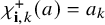
 by
$\chi _{\mathbf {i},k}^+(a)=a_k$
by
$\chi _{\mathbf {i},k}^+(a)=a_k$
 , and define
$\chi _{\mathbf {i},k}^-\in \mathcal {O}(U^-)$
, and define
$\chi _{\mathbf {i},k}^-\in \mathcal {O}(U^-)$
 by
$\chi _{\mathbf {i},k}(b)=b_k$
by
$\chi _{\mathbf {i},k}(b)=b_k$
 . If
$\beta _{\mathbf {i},k}=\alpha _j$
. If
$\beta _{\mathbf {i},k}=\alpha _j$
 is a simple root, elements
$\chi ^+_{\mathrm {i},k}$
is a simple root, elements
$\chi ^+_{\mathrm {i},k}$
 and
$\chi _{\mathrm {i},k}^-$
and
$\chi _{\mathrm {i},k}^-$
 are independent of the reduced expression, in which case we denote by
$\chi ^+_j=\chi ^+_{\mathrm {i},k}$
are independent of the reduced expression, in which case we denote by
$\chi ^+_j=\chi ^+_{\mathrm {i},k}$
 and
$\chi _j^-=\chi _{\mathrm {i},k}^-$
and
$\chi _j^-=\chi _{\mathrm {i},k}^-$
 .
.
Recall the
$\mathcal {A}$
 -algebras
$_{\mathcal {A}}\mathrm {U}$
-algebras
$_{\mathcal {A}}\mathrm {U}$
 ,
$_{\mathcal {A}}\mathrm {U}^+$
,
$_{\mathcal {A}}\mathrm {U}^+$
 ,
$_{\mathcal {A}}\mathrm {U}^-$
,
$_{\mathcal {A}}\mathrm {U}^-$
 and
$_{\mathcal {A}}\mathrm {U}^0$
and
$_{\mathcal {A}}\mathrm {U}^0$
 in §2.1. Let
$_{\mathbb {C}}\mathrm {U}$
in §2.1. Let
$_{\mathbb {C}}\mathrm {U}$
 ,
$_{\mathbb {C}}\mathrm {U}^+$
,
$_{\mathbb {C}}\mathrm {U}^+$
 ,
$_{\mathbb {C}}\mathrm {U}^-$
,
$_{\mathbb {C}}\mathrm {U}^-$
 and
$_{\mathbb {C}}\mathrm {U}^0$
and
$_{\mathbb {C}}\mathrm {U}^0$
 be the
$\mathbb {C}$
be the
$\mathbb {C}$
 -algebras obtained by the base change
$q^{1/2}\mapsto 1$
-algebras obtained by the base change
$q^{1/2}\mapsto 1$
 of the corresponding
$\mathcal {A}$
of the corresponding
$\mathcal {A}$
 -algebras, which are known to be commutative [Reference Berenstein and Greenstein4, Corollary 3.15]. Moreover the isomorphism (2.1) induces the isomorphism
$_{\mathbb {C}}\mathrm {U}\cong {}_{\mathbb {C}}\mathrm {U}^+\otimes {}_{\mathbb {C}}\mathrm {U}^0\otimes {}_{\mathbb {C}}\mathrm {U}^-$
-algebras, which are known to be commutative [Reference Berenstein and Greenstein4, Corollary 3.15]. Moreover the isomorphism (2.1) induces the isomorphism
$_{\mathbb {C}}\mathrm {U}\cong {}_{\mathbb {C}}\mathrm {U}^+\otimes {}_{\mathbb {C}}\mathrm {U}^0\otimes {}_{\mathbb {C}}\mathrm {U}^-$
 as
$\mathbb {C}$
as
$\mathbb {C}$
 -algebras. Here tensor products are over
$\mathbb {C}$
-algebras. Here tensor products are over
$\mathbb {C}$
 .
.
Take a reduced expression
$\mathbf {i}$
 of
$w_0$
of
$w_0$
 . One has
$\mathbb {C}$
. One has
$\mathbb {C}$
 -algebra isomorphisms

given by
$\varphi ^+(\overline {E_{\mathbf {i},k}})=\chi _{\mathbf {i},k}^+$
 and
$\varphi ^-(\overline {F_{\mathbf {i},k}})=\chi _{\mathbf {i},k}^-$
and
$\varphi ^-(\overline {F_{\mathbf {i},k}})=\chi _{\mathbf {i},k}^-$
 , for
$1\leq k\leq n$
, for
$1\leq k\leq n$
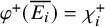
 . In particular
$\varphi ^+(\overline {E_i})=\chi _i^+$
. In particular
$\varphi ^+(\overline {E_i})=\chi _i^+$
 and
$\varphi ^-(\overline {F_i})=\chi _i^-$
and
$\varphi ^-(\overline {F_i})=\chi _i^-$
 , for
$i\in \mathrm {I}$
, for
$i\in \mathrm {I}$
 . The maps
$\varphi ^\pm $
. The maps
$\varphi ^\pm $
 are independent of the choice of
$\mathbf {i}$
are independent of the choice of
$\mathbf {i}$
 .
.
Since G has trivial center, one has the canonical
$\mathbb {C}$
 -algebra isomorphism
$\mathcal {O}(H)\cong \mathbb {C}[Q]$
-algebra isomorphism
$\mathcal {O}(H)\cong \mathbb {C}[Q]$
 , which induces the
$\mathbb {C}$
, which induces the
$\mathbb {C}$
 -algebra isomorphism
$\varphi ^0:{}_{\mathbb {C}}\mathrm {U}^0\overset {\sim }{\longrightarrow }\mathcal {O}(H)$
-algebra isomorphism
$\varphi ^0:{}_{\mathbb {C}}\mathrm {U}^0\overset {\sim }{\longrightarrow }\mathcal {O}(H)$
 , given by
$\varphi ^0(\overline {K_\mu })=\mu $
, given by
$\varphi ^0(\overline {K_\mu })=\mu $
 , for
$\mu \in Q$
, for
$\mu \in Q$
 .
.
The following theorem asserts that
$_{\mathcal {A}}\mathrm {U}$
 specializes to the coordinate algebra
$\mathcal {O}(G^*)$
specializes to the coordinate algebra
$\mathcal {O}(G^*)$
 . The proof essentially follows from the work of De Concini–Kac–Procesi.
Theorem 2.1 [Reference De Concini, Kac and Procesi15, Theorem 7.6].
The map

is an isomorphism as Poisson algebras.
Since
$_{\mathcal {A}}\mathrm {U}$
 is invariant under the action
$\mathrm {T}_i$
is invariant under the action
$\mathrm {T}_i$
 , for
$i\in \mathrm {I}$
, for
$i\in \mathrm {I}$
 , each
$\mathrm {T}_i$
, each
$\mathrm {T}_i$
 descends to a Poisson algebra automorphism on
$_{\mathbb {C}}\mathrm {U}\cong \mathcal {O}(G^*)$
descends to a Poisson algebra automorphism on
$_{\mathbb {C}}\mathrm {U}\cong \mathcal {O}(G^*)$
 . We use the same notation
$\mathrm {T}_i$
. We use the same notation
$\mathrm {T}_i$
 to denote the induced action.
3 Proof of the main theorem
We give the proof of Theorem 1 in this section. We need some preparation before the final proof. Retain the notations in the previous section.
3.1 Geometric preparations
For
$i\in \mathrm {I}_\circ $
 , recall the parameter
$\varsigma _i$
, recall the parameter
$\varsigma _i$
 in §2.2. Set
$c_i=\overline {\varsigma _i}\in \{\pm 1\}$
in §2.2. Set
$c_i=\overline {\varsigma _i}\in \{\pm 1\}$
 . By [Reference Springer24], there is a unique complex group involution
$\theta :G\rightarrow G$
. By [Reference Springer24], there is a unique complex group involution
$\theta :G\rightarrow G$
 , such that,

Let
$K=G^\theta $
 be the fixed-point subgroup, and
$\mathfrak {k}$
be the fixed-point subgroup, and
$\mathfrak {k}$
 be the Lie algebra of K. We use the same notation
$\theta $
be the Lie algebra of K. We use the same notation
$\theta $
 to denote the induced Lie algebra involution on
$\mathfrak {g}$
to denote the induced Lie algebra involution on
$\mathfrak {g}$
 .
.
Proposition 3.1. The closed subgroup K is coisotropic, that is, the complementary dual

is a Lie subalgebra of
$\mathfrak {g}^*$
 .
.
Proof. We identify
$\mathfrak {g}^*$
 with the subalgebra of the double
$\mathfrak {d}$
with the subalgebra of the double
$\mathfrak {d}$
 as in (2.2). We claim that under the identification one has

Let
$\mathfrak {p}=\{X\in \mathfrak {g}\mid \theta (X)=-X\}$
 . Then
$\mathfrak {g}=\mathfrak {k}\oplus \mathfrak {p}$
. Then
$\mathfrak {g}=\mathfrak {k}\oplus \mathfrak {p}$
 as vector spaces. Since the involution
$\theta :\mathfrak {g}\rightarrow \mathfrak {g}$
as vector spaces. Since the involution
$\theta :\mathfrak {g}\rightarrow \mathfrak {g}$
 preserves the Killing form, we have
$\mathfrak {p}=\{X\in \mathfrak {g}\mid \langle X,Y\rangle =0,\;\forall \;Y\in \mathfrak {k}\}$
preserves the Killing form, we have
$\mathfrak {p}=\{X\in \mathfrak {g}\mid \langle X,Y\rangle =0,\;\forall \;Y\in \mathfrak {k}\}$
 .
.
Take any
$x=(X_1,X_2)\in \mathfrak {g}^*$
 . We have

Let us write
$X_1=X_1'+h$
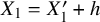 and
$X_2=X_2'-h$
and
$X_2=X_2'-h$
 , where
$X_1'\in \mathfrak {u}^+$
, where
$X_1'\in \mathfrak {u}^+$
 ,
$X_2'\in \mathfrak {u}^-$
,
$X_2'\in \mathfrak {u}^-$
 and
$h\in \mathfrak {h}$
and
$h\in \mathfrak {h}$
 . Then the condition (3.2) holds if and only if
$\theta (X_1')-X_2'=\theta (X_2')-X_1'$
. Then the condition (3.2) holds if and only if
$\theta (X_1')-X_2'=\theta (X_2')-X_1'$
 and
$\theta (h)=-h$
and
$\theta (h)=-h$
 . Therefore
$\theta (X_1')-X_2'\in \mathfrak {p}$
. Therefore
$\theta (X_1')-X_2'\in \mathfrak {p}$
 . On the other hand, by the construction of
$\theta $
. On the other hand, by the construction of
$\theta $
 , we have

Note that
$\mathfrak {g}_\alpha \subset \mathfrak {k}$
 , for
$\alpha \in \Phi _{\bullet }$
, for
$\alpha \in \Phi _{\bullet }$
 , and
$\theta (\mathcal {R}^--\Phi _{\bullet })\cap \mathcal {R}^-=\emptyset $
, and
$\theta (\mathcal {R}^--\Phi _{\bullet })\cap \mathcal {R}^-=\emptyset $
 . We conclude that
$\theta (X_1')-X_2'=0$
. We conclude that
$\theta (X_1')-X_2'=0$
 . Therefore we have
$\theta (X_1)=X_2$
. Therefore we have
$\theta (X_1)=X_2$
 . This proves the claim.
The proposition follows immediately.
Let
$K^\perp $
 be the connected closed subgroup of
$G^*$
be the connected closed subgroup of
$G^*$
 with the Lie algebra
$\mathfrak {k}^\perp $
with the Lie algebra
$\mathfrak {k}^\perp $
 . It is also a coisotropic subgroup. Hence the quotient
$K^\perp \backslash G^*$
. It is also a coisotropic subgroup. Hence the quotient
$K^\perp \backslash G^*$
 is automatically a Poisson homogeneous space of
$G^*$
is automatically a Poisson homogeneous space of
$G^*$
 [Reference Drinfeld17].
In order to study the geometry of
$K^\perp \backslash G^*$
 , let us introduce another closed subgroup

where
$U_{w_{\bullet }}^+$
 is the closed subgroup of
$U^+$
is the closed subgroup of
$U^+$
 with the Lie algebra
$\oplus _{\alpha \in \mathcal {R}_{\bullet }^+}\mathfrak {g}_\alpha $
with the Lie algebra
$\oplus _{\alpha \in \mathcal {R}_{\bullet }^+}\mathfrak {g}_\alpha $
 , and
, and

It follows immediately from the definition that the map

defines an isomorphism as varieties.
Proposition 3.2. The map

is an isomorphism as varieties. Therefore we have
$K^\perp \backslash G^*\cong P$
 as varieties.
Proof. Let
$U_{w_0w_{\bullet }}^+$
 be the closed subgroups of
$U^+$
be the closed subgroups of
$U^+$
 , with the Lie algebra
$\oplus _{\alpha \in \mathcal {R}^+-\mathcal {R}_{\bullet }^+}\mathfrak {g}_\alpha $
, with the Lie algebra
$\oplus _{\alpha \in \mathcal {R}^+-\mathcal {R}_{\bullet }^+}\mathfrak {g}_\alpha $
 . Let
$H_1$
. Let
$H_1$
 be the closed connected subgroup of H, with the Lie algebra
$\{X\in \mathfrak {h}\mid \theta (X)=-X\}$
be the closed connected subgroup of H, with the Lie algebra
$\{X\in \mathfrak {h}\mid \theta (X)=-X\}$
 . By the proof of Proposition 3.1, the subgroup
$K^\perp $
. By the proof of Proposition 3.1, the subgroup
$K^\perp $
 is the identity component of the subgroup

Also note that
$U^+_{w_\circ w_{\bullet }}=U^+\cap \theta (U^-).$
 Therefore the map

defines an isomorphism as varieties.
By [Reference Springer25, Lemma 8.3.5] the group multiplication
$U^+_{w_0w_{\bullet }}\times U^+_{w_{\bullet }}\rightarrow U^+$
 is an isomorphism as varieties. Since G is of adjoint type, the multiplication
$H_{1}\times H'\rightarrow H$
is an isomorphism as varieties. Since G is of adjoint type, the multiplication
$H_{1}\times H'\rightarrow H$
 also defines an isomorphism as varieties.
Since the adjoint action of H preserves the subgroups
$U^+_{w_0w_{\bullet }}$
 and
$U^+_{w_{\bullet }}$
and
$U^+_{w_{\bullet }}$
 , the proposition then follows from the isomorphism (2.3).
By Proposition 3.2, the quotient variety
$K^\perp \backslash G^*$
 is actually affine. Therefore, by [Reference Springer25, Exercise 5.5.9 (8)], the coordinate ring
$\mathcal {O}(K^\perp \backslash G^*)$
is actually affine. Therefore, by [Reference Springer25, Exercise 5.5.9 (8)], the coordinate ring
$\mathcal {O}(K^\perp \backslash G^*)$
 is isomorphic to the subalgebra

of
$K^\perp $
 -invariant functions in
$\mathcal {O}(G^*)$
-invariant functions in
$\mathcal {O}(G^*)$
 . We shall make this identification throughout the paper.
Let
$\iota ^*:\mathcal {O}(G^*)\rightarrow \mathcal {O}(P)$
 be the comorphism of the embedding
$\iota :P\hookrightarrow G^*$
be the comorphism of the embedding
$\iota :P\hookrightarrow G^*$
 . Thanks to Proposition 3.2, we conclude that the restriction map

defines an isomorphism as
$\mathbb {C}$
 -algebras.
In light of the isomorphism (3.6), the map
$\iota ^*$
 provides a tool to control the size of the algebra
$\mathcal {O}(K^\perp \backslash G^*)$
provides a tool to control the size of the algebra
$\mathcal {O}(K^\perp \backslash G^*)$
 . We also need a similar map on the quantum level.
3.2 Quantization of the group P
We firstly describe a quantization of the algebra
$\mathcal {O}(P)$
 . Following [Reference Kolb and Yakimov19, 2.3], define the partial parabolic subalgebra
$\mathrm {U}_P$
. Following [Reference Kolb and Yakimov19, 2.3], define the partial parabolic subalgebra
$\mathrm {U}_P$
 to be the unital
$\mathbb {C}(q^{1/2})$
to be the unital
$\mathbb {C}(q^{1/2})$
 -subalgebra of
$\mathrm {U}$
-subalgebra of
$\mathrm {U}$
 , generated by
$F_i$
, generated by
$F_i$
 (
$i\in \mathrm {I}$
(
$i\in \mathrm {I}$
 ),
$E_i$
),
$E_i$
 (
$i\in \mathrm {I}_{\bullet }$
(
$i\in \mathrm {I}_{\bullet }$
 ) and
$K_\mu $
) and
$K_\mu $
 (
$\mu \in Q^\theta $
(
$\mu \in Q^\theta $
 ). Let
$\mathrm {U}^+_{w_{\bullet }}$
). Let
$\mathrm {U}^+_{w_{\bullet }}$
 be the unital subalgebra of
$\mathrm {U}^+$
be the unital subalgebra of
$\mathrm {U}^+$
 generated by
$E_i$
generated by
$E_i$
 , for various
$i\in \mathrm {I}_{\bullet }$
, for various
$i\in \mathrm {I}_{\bullet }$
 . Let
$\mathrm {U}^{0\theta }$
. Let
$\mathrm {U}^{0\theta }$
 be the unital subalgebra of
$\mathrm {U}^0$
be the unital subalgebra of
$\mathrm {U}^0$
 generated by
$K_\mu $
generated by
$K_\mu $
 , for
$\mu \in Q^\theta $
, for
$\mu \in Q^\theta $
 . Then the multiplication gives an isomorphism as
$\mathbb {C}(q^{1/2})$
. Then the multiplication gives an isomorphism as
$\mathbb {C}(q^{1/2})$
 -vector spaces

Recall the
$\mathcal {A}$
 -subalgebra
$_{\mathcal {A}}\mathrm {U}$
-subalgebra
$_{\mathcal {A}}\mathrm {U}$
 in §2.1. Set
$_{\mathcal {A}}\mathrm {U}_P=\mathrm {U}_P\cap {}_{\mathcal {A}}\mathrm {U}$
in §2.1. Set
$_{\mathcal {A}}\mathrm {U}_P=\mathrm {U}_P\cap {}_{\mathcal {A}}\mathrm {U}$
 . Similarly define
$_{\mathcal {A}}\mathrm {U}^{0\theta }$
. Similarly define
$_{\mathcal {A}}\mathrm {U}^{0\theta }$
 and
$_{\mathcal {A}}\mathrm {U}_{w_{\bullet }}^+$
and
$_{\mathcal {A}}\mathrm {U}_{w_{\bullet }}^+$
 . By the PBW-bases, the multiplication gives an isomorphism as
$\mathcal {A}$
. By the PBW-bases, the multiplication gives an isomorphism as
$\mathcal {A}$
 -modules

where the tensor products are over
$\mathcal {A}$
 .
.
Let
$_{\mathbb {C}}\mathrm {U}_P=\mathbb {C}\otimes {}_{\mathcal {A}}\mathrm {U}_P$
 be the commutative
$\mathbb {C}$
be the commutative
$\mathbb {C}$
 -algebra obtained by the base change
$q^{1/2}\mapsto 1$
-algebra obtained by the base change
$q^{1/2}\mapsto 1$
 . Similarly define the
$\mathbb {C}$
. Similarly define the
$\mathbb {C}$
 -algebras
$_{\mathbb {C}}\mathrm {U}^+_{w_{\bullet }}$
-algebras
$_{\mathbb {C}}\mathrm {U}^+_{w_{\bullet }}$
 ,
$_{\mathbb {C}}\mathrm {U}^{0\theta }$
,
$_{\mathbb {C}}\mathrm {U}^{0\theta }$
 and
$_{\mathbb {C}}\mathrm {U}^-$
and
$_{\mathbb {C}}\mathrm {U}^-$
 . Thanks to (3.8), we have the isomorphism as
$\mathbb {C}$
. Thanks to (3.8), we have the isomorphism as
$\mathbb {C}$
 -algebras

Recall the
$\mathbb {C}$
 -algebra isomorphisms
$\varphi ^\pm :{}_{\mathbb {C}}\mathrm {U}^\pm \overset {\sim }{\rightarrow }\mathcal {O}(U^\pm )$
-algebra isomorphisms
$\varphi ^\pm :{}_{\mathbb {C}}\mathrm {U}^\pm \overset {\sim }{\rightarrow }\mathcal {O}(U^\pm )$
 in (2.8). The map
$\varphi ^+$
in (2.8). The map
$\varphi ^+$
 induces an isomorphism
$ \varphi ^+_{w_{\bullet }}:{}_{\mathbb {C}}\mathrm {U}_{w_{\bullet }}^+\overset {\sim }{\rightarrow }\mathcal {O}(U_{w_{\bullet }}^+). $
induces an isomorphism
$ \varphi ^+_{w_{\bullet }}:{}_{\mathbb {C}}\mathrm {U}_{w_{\bullet }}^+\overset {\sim }{\rightarrow }\mathcal {O}(U_{w_{\bullet }}^+). $
 Let
$ \varphi ^0: {}_{\mathbb {C}}\mathrm {U}^{0\theta }\overset {\sim }{\rightarrow }\mathcal {O}(H') $
Let
$ \varphi ^0: {}_{\mathbb {C}}\mathrm {U}^{0\theta }\overset {\sim }{\rightarrow }\mathcal {O}(H') $
 be the
$\mathbb {C}$
be the
$\mathbb {C}$
 -algebra isomorphism given by
$\overline {k_i}\mapsto \alpha _i\mid _{H'}$
-algebra isomorphism given by
$\overline {k_i}\mapsto \alpha _i\mid _{H'}$
 , for
$i\in \mathrm {I}_\circ -\mathrm {I}_\circ '$
, for
$i\in \mathrm {I}_\circ -\mathrm {I}_\circ '$
 , and
$\overline {K_i}\mapsto \alpha _i\mid _{H'}$
, and
$\overline {K_i}\mapsto \alpha _i\mid _{H'}$
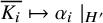 , for
$i\in \mathrm {I}_{\bullet }$
, for
$i\in \mathrm {I}_{\bullet }$
 .
.
By (3.3), we have the natural isomorphism
$\mathcal {O}(P)\cong \mathcal {O}(U^+_{w_{\bullet }})\otimes \mathcal {O}(H')\otimes \mathcal {O}(U^-)$
 as
$\mathbb {C}$
as
$\mathbb {C}$
 -algebras. Under this isomorphism, one gets the
$\mathbb {C}$
-algebras. Under this isomorphism, one gets the
$\mathbb {C}$
 -algebra isomorphism

Therefore the algebra
$\mathrm {U}_P$
 provides a quantization of
$\mathcal {O}(P)$
provides a quantization of
$\mathcal {O}(P)$
 .
.
3.3 Quantization of the map
$\iota ^*$

We next describe a quantization of the map
$\iota ^*:\mathcal {O}(G^*)\rightarrow \mathcal {O}(P)$
 . Note that
$\mathrm {U}_{w_{\bullet }}^+=\mathrm {U}^+\cap \mathrm {T}_{w_{\bullet }}(\mathrm {U}^-)$
. Note that
$\mathrm {U}_{w_{\bullet }}^+=\mathrm {U}^+\cap \mathrm {T}_{w_{\bullet }}(\mathrm {U}^-)$
 . Set
$\mathrm {U}^{+\prime }_{w_{\bullet }}=\mathrm {U}^+\cap \mathrm {T}_{w_{\bullet }}(\mathrm {U}^+)$
. Set
$\mathrm {U}^{+\prime }_{w_{\bullet }}=\mathrm {U}^+\cap \mathrm {T}_{w_{\bullet }}(\mathrm {U}^+)$
 to be another subalgebra of
$\mathrm {U}^+$
to be another subalgebra of
$\mathrm {U}^+$
 . By the PBW-bases we have the tensor product decomposition
$\mathrm {U}^+\cong \mathrm {U}_{w_{\bullet }}^+\otimes {\mathrm {U}_{w_{\bullet }} ^{+\prime }}$
. By the PBW-bases we have the tensor product decomposition
$\mathrm {U}^+\cong \mathrm {U}_{w_{\bullet }}^+\otimes {\mathrm {U}_{w_{\bullet }} ^{+\prime }}$
 . Under this isomorphism, set

Set
$Q'=\mathbb {Z}[\alpha _i\mid i\in \mathrm {I}_\circ ']$
 to be the sublattice of Q. Let
$\mathrm {U}^{0}{'}$
to be the sublattice of Q. Let
$\mathrm {U}^{0}{'}$
 be the unital subalgebra of
$\mathrm {U}^0$
be the unital subalgebra of
$\mathrm {U}^0$
 , generated by
$K_i^{\pm 1}$
, generated by
$K_i^{\pm 1}$
 , for
$i\in \mathrm {I}_\circ '$
, for
$i\in \mathrm {I}_\circ '$
 . Then we have the natural isomorphism
$\mathrm {U}^0\cong \mathrm {U}^{0\theta }\otimes \mathrm {U}^{0}{}'$
. Then we have the natural isomorphism
$\mathrm {U}^0\cong \mathrm {U}^{0\theta }\otimes \mathrm {U}^{0}{}'$
 . Under this isomorphism, set

Finally, under the isomorphisms (3.7), set

The map
$\pi $
 restricts to integral forms
$_{\mathcal {A}}\pi :{}_{\mathcal {A}}\mathrm {U}\rightarrow {}_{\mathcal {A}}\mathrm {U}_P$
restricts to integral forms
$_{\mathcal {A}}\pi :{}_{\mathcal {A}}\mathrm {U}\rightarrow {}_{\mathcal {A}}\mathrm {U}_P$
 .
.
The following proposition asserts that the map
$_{\mathcal {A}}\pi $
 quantize the map
$\iota ^*$
quantize the map
$\iota ^*$
 .
.
Proposition 3.3. Let
$_{\mathbb {C}}\pi :{}_{\mathbb {C}}\mathrm {U}\rightarrow {}_{\mathbb {C}}\mathrm {U}_P$
 be the base change of the map
$_{\mathcal {A}}\pi $
be the base change of the map
$_{\mathcal {A}}\pi $
 . Then the diagram

commutes.
Proof. The maps
$\varphi $
 ,
$\iota ^*$
,
$\iota ^*$
 and
$\varphi _P$
and
$\varphi _P$
 are clearly algebra homomorphisms. Since
$_{\mathbb {C}}\mathrm {U}$
are clearly algebra homomorphisms. Since
$_{\mathbb {C}}\mathrm {U}$
 is commutative, the map
$_{\mathbb {C}}\pi $
is commutative, the map
$_{\mathbb {C}}\pi $
 is also an algebra homomorphism. Therefore it will suffice to check the diagram for generators of
$_{\mathbb {C}}\mathrm {U}$
is also an algebra homomorphism. Therefore it will suffice to check the diagram for generators of
$_{\mathbb {C}}\mathrm {U}$
 .
.
Take a reduced expression
$\mathbf {i}=(i_1,i_2,\cdots , i_n)$
 of
$w_0$
of
$w_0$
 , such that
$(i_1,i_2,\cdots , i_{n'})$
, such that
$(i_1,i_2,\cdots , i_{n'})$
 is a reduced expression of
$w_{\bullet }$
is a reduced expression of
$w_{\bullet }$
 . The elements
$\overline {E_{\mathbf {i},k}}$
. The elements
$\overline {E_{\mathbf {i},k}}$
 ,
$\overline {F_{\mathbf {i},k}}$
,
$\overline {F_{\mathbf {i},k}}$
 , and
$\overline {K_i}$
, and
$\overline {K_i}$
 , for
$1\leq k\leq n$
, for
$1\leq k\leq n$
 and
$i\in \mathrm {I}$
and
$i\in \mathrm {I}$
 , generate the
$\mathbb {C}$
, generate the
$\mathbb {C}$
 -algebra
$_{\mathbb {C}}\mathrm {U}$
-algebra
$_{\mathbb {C}}\mathrm {U}$
 . It will suffice to check the diagram when acting on these generators, which is direct and will be omitted.
3.4 Poisson generators
The last ingredient that is needed for the proof is a set of Poisson generators for the algebra
$\mathcal {O}(K^\perp \backslash G^*)$
 .
.
Let us consider the following elements in
$\mathcal {O}(G^*)$
 :
:
-
(i) $\chi _i^+$
,
$\chi _i^-$
, for
$i\in \mathrm {I}_{\bullet }$
; -
(ii) $\chi _i^--c_i\mathrm {T}_{w_{\bullet }}(\chi _{\tau i}^+)\alpha _i^{-1}$
, for
$i\in \mathrm {I}_\circ $
; -
(iii) $\alpha _i^{\pm 1}$
, for
$i\in \mathrm {I}_{\bullet }$
; -
(iv) $(\alpha _i\alpha _{\tau i}^{-1})^{\pm 1}$
, for
$i\in \mathrm {I}_\circ -\mathrm {I}_\circ '$
.


Lemma 3.1. The elements in (i)–(iv) belong to
$\mathcal {O}(K^\perp \backslash G^*)$
 . Moreover they form a set of Poisson generators of
$\mathcal {O}(K^\perp \backslash G^*)$
. Moreover they form a set of Poisson generators of
$\mathcal {O}(K^\perp \backslash G^*)$
 .
.
Proof. Let
$\pi _2:G^*\rightarrow P$
 be the projection map onto P under the isomorphism (3.4). By Proposition 3.2, the image of the comorphism
$\pi _2^*:\mathcal {O}(P)\rightarrow \mathcal {O}(G^*)$
be the projection map onto P under the isomorphism (3.4). By Proposition 3.2, the image of the comorphism
$\pi _2^*:\mathcal {O}(P)\rightarrow \mathcal {O}(G^*)$
 is exactly
$\mathcal {O}(K^\perp \backslash G^*)$
is exactly
$\mathcal {O}(K^\perp \backslash G^*)$
 .
.
In order to compute images of various functions under
$\pi _2^*$
 , we give a precise description on the map
$\pi _2$
, we give a precise description on the map
$\pi _2$
 . Take any element
$(u_+t,t^{-1}u_-)$
. Take any element
$(u_+t,t^{-1}u_-)$
 in
$G^*$
in
$G^*$
 . Decompose
$u_+=u_+'u_+''$
. Decompose
$u_+=u_+'u_+''$
 , with
$u_+'\in U^+_{w_0w_{\bullet }}$
, with
$u_+'\in U^+_{w_0w_{\bullet }}$
 and
$u_+''\in U^+_{w_{\bullet }}$
and
$u_+''\in U^+_{w_{\bullet }}$
 . Decompose
$t=t't''$
. Decompose
$t=t't''$
 , with
$t'\in H_0$
, with
$t'\in H_0$
 and
$t''\in H'$
and
$t''\in H'$
 . It is direct to verify that

Let us identify regular functions on
$U^+$
 ,
$U_{w_{\bullet }}^-$
,
$U_{w_{\bullet }}^-$
 and
$H'$
and
$H'$
 as regular functions on P, via the isomorphism
$P\cong U^+_{w_{\bullet }}\times H'\times U^-$
as regular functions on P, via the isomorphism
$P\cong U^+_{w_{\bullet }}\times H'\times U^-$
 (3.3).
-
(a) For $i\in \mathrm {I}_{\bullet }$
, we have
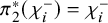
$\pi _2^*(\chi _{i}^+\mid _{U_{w_{\bullet }}^+})=\chi _i^{+}$
and
$\pi _2^*(\chi _{i}^-)=\chi _i^{-}$
.Take $i\in \mathrm {I}_{\bullet }$
, and
$(u_+t,t^{-1}u_-)\in G^*$
. By (3.12), we have $$\begin{align*}\pi_2^*(\chi_{i}^+\mid_{U_{w_{\bullet}}^+})\big((u_+t,t^{-1}u_-)\big)=\chi_{i}^+\big(\text{Ad}_{t^{\prime-1}}(u_+")\big)=\alpha_i(t^{\prime-1})\chi_i^+(u_+). \end{align*}$$
Note that $\alpha _i(t')=1$
, because
$\theta (\alpha _i)=\alpha _i$
and
$\theta (t')=t^{\prime -1}$
. Therefore we have
$\pi _2^*(\chi _{P,i}^+\mid _{U_{w_{\bullet }}^+})=\chi _i^+$
.Since $\theta (U_{w_0w_{\bullet }}^+)\cap U^-_{w_{\bullet }}=\{e\}$
, we deduce that $$\begin{align*}\pi_2^*(\chi_{i}^-)\big((u_+t,t^{-1}u_-)\big)=\chi_{i}^-\big(\text{Ad}_t(\theta(u_+'))^{-1}u_-\big)=\chi_i^{-}(u_-). \end{align*}$$
This implies $\pi _2^*(\chi _{i}^-)=\chi _i^-$
. -
(b) For $i\in \mathrm {I}_\circ $
, we have
$\pi _2^*(\chi _{P,i}^-)=\chi _i^--c_i\mathrm {T}_{w_{\bullet }}(\chi _{\tau i}^+)\alpha _i^{-1}$
.Take $i\in \mathrm {I}_\circ $
, and
$(u_+t,t^{-1}u_-)\in G^*$
. Then by (3.12) one has $$\begin{align*}\pi_2^*(\chi_{i}^-)\big((u_+t,t^{-1}u_-)\big)=\chi_{i}^-\big(\text{Ad}_t(\theta(u_+'))^{-1}u_-\big)=\chi_i^-(u_-)+\chi_i^-(\text{Ad}_t(\theta(u_+^{\prime-1}))). \end{align*}$$
Take a reduced expression $\mathbf {i}=(i_1,i_2,\cdots , i_n)$
of
$w_0$
, such that
$(i_1,i_2,\cdots , i_{n'})$
is a reduced expression of
$w_{\bullet }$
, and
$i_{n'+1}=\tau i$
. Write
$u_+'=x_{\mathbf {i},n}(a_n)x_{\mathbf {i},n-1}(a_{n-1})\cdots x_{\mathbf {i},1}(a_1)$
, for
$a_k\in \mathbb {C}$
. Then
$u_+'\in U_{w_0w_{\bullet }}^+$
. Hence we have
$a_k=0$
for
$1\leq k\leq n'$
. Therefore $$ \begin{align*} \theta(u_+^{\prime-1})&=\theta(x_{\mathbf{i},n'+1}(a_{n'+1}))\theta(x_{\mathbf{i},n'+2}(a_{n'+2}))\cdots \theta(x_{\mathbf{i},n}(a_n))\\ &=y_i(c_ia_{n'+1})\theta(x_{\mathbf{i},n'+2}(a_{n'+2}))\cdots \theta(x_{\mathbf{i},n}(a_n)) \end{align*} $$
is a factorisation as in (2.7). Hence
$$\begin{align*}\chi_i^-(\text{Ad}_t(\theta(u_+^{\prime-1})))=\chi_i^-(y_i(\alpha_i^{-1}(t)c_ia_{n'+1}))=c_i\alpha_i^{-1}(t)a_{n'+1}=c_i\alpha_i^{-1}(t)\mathrm{T}_{w_{\bullet}}(\chi_{\tau i}^+)(u_+). \end{align*}$$
This implies that $\pi _2^*(\chi _{P,i}^-)=\chi _i^--c_i\mathrm {T}_{w_{\bullet }}(\chi ^+_{\tau i})\alpha _i^{-1}$
. -
(c) For $i\in \mathrm {I}_{\bullet }$
, we have
$\pi _2^*(\alpha _{i}\mid _{H'})=\alpha _i$
. For
$i\in \mathrm {I}_\circ -\mathrm {I}_\circ '$
, we have
$\pi _2^*(\alpha _{i}\mid _{H'})=\alpha _i\alpha _{\tau i}^{-1}A_i$
, where
$A_i$
is a monomial of the form
$\prod _{i\in \mathrm {I}_{\bullet }}\alpha _i^{n_i}$
with
$n_i\in \mathbb {Z}$
.















It follows from the similar argument. Statement (c) is actually easier to prove since we only need to consider elements in the torus. We skip the details.
Thanks to the statements (a)–(c), we conclude that elements in (i)–(iv) belong to the image of
$\pi _2^*$
 and hence belong to
$\mathcal {O}(K^\perp \backslash G^*)$
and hence belong to
$\mathcal {O}(K^\perp \backslash G^*)$
 .
.
Next we show that these elements form a set of Poisson generators.
Let
$\mathcal {O}'$
 be the Poisson subalgebra of
$\mathcal {O}(G^*)$
be the Poisson subalgebra of
$\mathcal {O}(G^*)$
 generated by elements in (i)–(iv). By the previous argument we have
$\mathcal {O}'\subset \mathcal {O}(K^\perp \backslash G^*)$
generated by elements in (i)–(iv). By the previous argument we have
$\mathcal {O}'\subset \mathcal {O}(K^\perp \backslash G^*)$
 . Recall that the restriction of the map
$\iota ^*:\mathcal {O}(G^*)\rightarrow \mathcal {O}(P)$
. Recall that the restriction of the map
$\iota ^*:\mathcal {O}(G^*)\rightarrow \mathcal {O}(P)$
 to
$\mathcal {O}(K^\perp \backslash G^*)$
to
$\mathcal {O}(K^\perp \backslash G^*)$
 is an isomorphism. In order to show
$\mathcal {O}'=\mathcal {O}(K^\perp \backslash G^*)$
is an isomorphism. In order to show
$\mathcal {O}'=\mathcal {O}(K^\perp \backslash G^*)$
 , it suffices to show that
$\iota ^*(\mathcal {O}')=\mathcal {O}(P)$
, it suffices to show that
$\iota ^*(\mathcal {O}')=\mathcal {O}(P)$
 . Still let us identify
$\mathcal {O}(U_{w_{\bullet }}^+)$
. Still let us identify
$\mathcal {O}(U_{w_{\bullet }}^+)$
 ,
$\mathcal {O}(H')$
,
$\mathcal {O}(H')$
 and
$\mathcal {O}(U^-)$
and
$\mathcal {O}(U^-)$
 as the subalgebras of
$\mathcal {O}(P)$
as the subalgebras of
$\mathcal {O}(P)$
 . It suffices to show that
$\iota ^*(\mathcal {O}')$
. It suffices to show that
$\iota ^*(\mathcal {O}')$
 contains these subalgebras.
Firstly, by the proof of [Reference De Concini, Kac and Procesi15, Theorem 7.6], the algebra
$\mathcal {O}(U_{w_{\bullet }}^+)$
 is generated by functions
$\chi _{i}^+\mid _{U_{w_{\bullet }}^+}$
is generated by functions
$\chi _{i}^+\mid _{U_{w_{\bullet }}^+}$
 , for
$i\in \mathrm {I}_{\bullet }$
, for
$i\in \mathrm {I}_{\bullet }$
 , as a Poisson algebra. Therefore as subalgebras of
$\mathcal {O}(G^*)$
, as a Poisson algebra. Therefore as subalgebras of
$\mathcal {O}(G^*)$
 , we have
$\mathcal {O}'\supset \mathcal {O}(U_{w_{\bullet }}^+)$
, we have
$\mathcal {O}'\supset \mathcal {O}(U_{w_{\bullet }}^+)$
 , thanks to (a). This implies
$\iota ^*(\mathcal {O}')\supset \mathcal {O}(U_{w_{\bullet }})$
, thanks to (a). This implies
$\iota ^*(\mathcal {O}')\supset \mathcal {O}(U_{w_{\bullet }})$
 , where
$\mathcal {O}(U_{w_{\bullet }})$
, where
$\mathcal {O}(U_{w_{\bullet }})$
 on the right hand side is viewed as a subalgebra of
$\mathcal {O}(P)$
on the right hand side is viewed as a subalgebra of
$\mathcal {O}(P)$
 .
.
Next, the algebra
$\mathcal {O}(H')$
 is generated by
$(\alpha _{i}\mid _{H'})^{\pm 1}$
is generated by
$(\alpha _{i}\mid _{H'})^{\pm 1}$
 , for
$i\in \mathrm {I}-\mathrm {I}_\circ '$
, for
$i\in \mathrm {I}-\mathrm {I}_\circ '$
 . Thanks to (c) we conclude that
$\iota ^*(\mathcal {O}')$
. Thanks to (c) we conclude that
$\iota ^*(\mathcal {O}')$
 contains
$\mathcal {O}(H')$
contains
$\mathcal {O}(H')$
 .
.
Lastly, still by the proof of [Reference De Concini, Kac and Procesi15, Theorem 7.6], as a Poisson algebra
$\mathcal {O}(U^-)$
 is generated by
$\chi _i^-$
is generated by
$\chi _i^-$
 , for
$i\in \mathrm {I}$
, for
$i\in \mathrm {I}$
 . Write
$b_i=\chi _i^-$
. Write
$b_i=\chi _i^-$
 , for
$i\in \mathrm {I}_{\bullet }$
, for
$i\in \mathrm {I}_{\bullet }$
 , and
$b_i=\chi _i^--c_i\mathrm {T}_{w_{\bullet }}(\chi _{\tau i}^+)\alpha _i^{-1}$
, and
$b_i=\chi _i^--c_i\mathrm {T}_{w_{\bullet }}(\chi _{\tau i}^+)\alpha _i^{-1}$
 , for
$i\in \mathrm {I}_\circ $
, for
$i\in \mathrm {I}_\circ $
 , to be elements in
$\mathcal {O}(G^*)$
, to be elements in
$\mathcal {O}(G^*)$
 . Let
$f(x_1,x_2,\cdots ,x_k)$
. Let
$f(x_1,x_2,\cdots ,x_k)$
 be a Poisson polynomial, that is, a polynomial possibly with Poisson brackets. Note that there is a
$\mathbb {Z}[\mathrm {I}]$
be a Poisson polynomial, that is, a polynomial possibly with Poisson brackets. Note that there is a
$\mathbb {Z}[\mathrm {I}]$
 -grading on the algebra
$\mathcal {O}(G^*)$
-grading on the algebra
$\mathcal {O}(G^*)$
 respecting the Poisson brackets, where
$\text {deg}(\chi _i^-)=i$
respecting the Poisson brackets, where
$\text {deg}(\chi _i^-)=i$
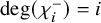 ,
$\text {deg}(\chi _i^+)=-i$
,
$\text {deg}(\chi _i^+)=-i$
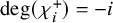 and
$\text {deg}(\mu )=0$
and
$\text {deg}(\mu )=0$
 , for
$i\in \mathrm {I}$
, for
$i\in \mathrm {I}$
 and
$\mu \in Q$
and
$\mu \in Q$
 . We define a partial order on
$\mathbb {Z}[\mathrm {I}]$
. We define a partial order on
$\mathbb {Z}[\mathrm {I}]$
 by setting
$\mu \leq \mu '$
by setting
$\mu \leq \mu '$
 if
$\mu '-\mu $
if
$\mu '-\mu $
 is a non-negative combination of various
$i\in \mathrm {I}$
is a non-negative combination of various
$i\in \mathrm {I}$
 . Then for any
$i_1,i_2,\cdots ,i_k$
. Then for any
$i_1,i_2,\cdots ,i_k$
 in
$ \mathrm {I}$
in
$ \mathrm {I}$
 , we have

in
$\mathcal {O}(G^*).$
 Therefore we deduce that
$\iota ^*(\widetilde {\mathcal {O}})$
Therefore we deduce that
$\iota ^*(\widetilde {\mathcal {O}})$
 contains
$\mathcal {O}(U^-)\subset \mathcal {O}(P)$
contains
$\mathcal {O}(U^-)\subset \mathcal {O}(P)$
 by induction on the degree.
We complete the proof of the lemma.
3.5 The final proof
We are now ready to prove the main theorem of the paper.
Proof of Theorem 1.
The uniqueness of
$\varphi ^\imath $
 is clear. We show the existence. Consider the following diagram

Let
$\widetilde {\mathcal {O}}\subset \mathcal {O}(G^*)$
 be the image of the map
$\varphi \circ {}_{\mathbb {C}}\iota :{}_{\mathbb {C}}\mathrm {U}^\imath \rightarrow \mathcal {O}(G^*)$
be the image of the map
$\varphi \circ {}_{\mathbb {C}}\iota :{}_{\mathbb {C}}\mathrm {U}^\imath \rightarrow \mathcal {O}(G^*)$
 .
.
-
(a) We have $\widetilde {\mathcal {O}}\supset {}\mathcal {O}(K^\perp \backslash G^*)$
.Recall the generators $B_i$
(
$i\in \mathrm {I}$
),
$E_i$
(
$i\in \mathrm {I}_{\bullet }$
),
$K_i^{\pm 1}$
(
$i\in \mathrm {I}_{\bullet }$
) and
$k_i$
(
$i\in \mathrm {I}_{\bullet }$
) of the subalgebra
$\mathrm {U}^\imath $
in §2.2. It is clear that these elements belong to the integral form
$_{\mathcal {A}}\mathrm {U}^\imath $
. Moreover these elements specialize exactly to the elements (i)–(iv) in §3.4. Since the maps
$_{\mathbb {C}}\iota $
and
$\varphi $
are Poisson,
$\widetilde {\mathcal {O}}$
is a Poisson subalgebra of
$\mathcal {O}(G^*)$
. Then (a) follows from Lemma 3.1. -
(b) The map $_{\mathbb {C}}\pi \circ {}_{\mathbb {C}}\iota :{}_{\mathbb {C}}\mathrm {U}\rightarrow {}_{\mathbb {C}}\mathrm {U}_P$
is surjective.Recall that $\varphi _P$
is an isomorphism. Therefore it suffices to show that
$\varphi _P\circ {}_{\mathbb {C}}\pi \circ {}_{\mathbb {C}}\iota $
is surjective. By Proposition 3.3, we have
$\varphi _P\circ {}_{\mathbb {C}}\pi \circ {}_{\mathbb {C}}\iota =\iota ^*\circ \varphi \circ {}_{\mathbb {C}}\iota $
. Recall that
$\iota ^*({}\mathcal {O}(K^\perp \backslash G^*))=\mathcal {O}(P)$
. Then (b) follows from (a). -
(c) The map $_{\mathbb {C}}\pi \circ {}_{\mathbb {C}}\iota :{}_{\mathbb {C}}\mathrm {U}\rightarrow {}_{\mathbb {C}}\mathrm {U}_P$
is an isomorphism.Since $_{\mathcal {A}}\mathrm {U}_P$
is a free
$\mathcal {A}$
-module, we take an
$\mathcal {A}$
-basis
$\mathrm {B_P}$
of
$_{\mathcal {A}}\mathrm {U}_P$
. Then
$\mathrm {B}_P$
is a
$\mathbb {C}(q^{1/2})$
-basis of
$\mathrm {U}_P$
. Thanks to [Reference Kolb and Yakimov19, Lemma 2.10], the Letzter’s map
$\pi ^\imath =\pi \mid _{\mathrm {U}^\imath }:\mathrm {U}^\imath \rightarrow \mathrm {U}_P$
is an isomorphism as vector spaces. Therefore, the set
$(\pi ^\imath )^{-1}(\mathrm {B}_P)\subset \mathrm {U}^\imath $
gives a
$\mathbb {C}(q^{1/2})$
-basis of
$\mathrm {U}^\imath $
. For
$b\in \mathrm {B}_P$
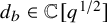
, let
$d_b\in \mathbb {C}[q^{1/2}]$
be the monic polynomial with the lowest degree, such that
$d_b(\pi ^\imath )^{-1}(b)\in {}_{\mathcal {A}}\mathrm {U}^\imath $
. Then
$\{d_b(\pi ^\imath )^{-1}(b)\mid b\in \mathrm {B}\}$
is an
$\mathcal {A}$
-basis of
$_{\mathcal {A}}\mathrm {U}^\imath $
. Hence the map
$_{\mathbb {C}}\pi ^\imath ={}_{\mathbb {C}}\pi \circ {}_{\mathbb {C}}\iota :{}_{\mathbb {C}}\mathrm {U}^\imath \rightarrow {}_{\mathbb {C}}\mathrm {U}_P$
, obtained by the base change of the map
$\pi ^\imath \mid _{{}_{\mathcal {A}}\mathrm {U}^\imath }:{}_{\mathcal {A}}\mathrm {U}^\imath \rightarrow {}_{\mathcal {A}}\mathrm {U}_P$
, is an isomorphism if
$d_b(1)\neq 0$
, for any
$b\in \mathrm {B}$
. Suppose otherwise
$d_b(1)=0$
for some
$b\in \mathrm {B}$
. Then
$\overline {b}\in {}_{\mathbb {C}}\mathrm {U}_P$
does not belong to the image of
$_{\mathbb {C}}\pi ^\imath $
, which contradicts with the surjectivity established in (b). This completes the proof of (c). -
(d) We have $\widetilde {\mathcal {O}}={}\mathcal {O}(K^\perp \backslash G^*)$
. Hence there exists
$\varphi ^\imath $
which makes the diagram (3.13) commute.By (c) and the Proposition 3.3, we deduce that $\iota ^*\circ \varphi \circ {}_{\mathbb {C}}\iota =\varphi _P\circ {}_{\mathbb {C}}\pi \circ {}_{\mathbb {C}}\iota $
is an isomorphism. In particular
$\iota ^*\mid _{\widetilde {\mathcal {O}}}$
is injective. Since
$\iota ^*\mid _{{}^K\mathcal {O}(G^*)}$
is an isomorphism, (d) follows from (a). -
(e) The map $\varphi ^\imath $
is an isomorphism as Poisson algebras.

















By the commuting diagram (3.13), we have
$\varphi ^\imath =\pi _2^*\circ \varphi _P\circ {}_{\mathbb {C}}\pi \circ {}_{\mathbb {C}}\iota $
 . Since the maps
$\pi _2^*$
. Since the maps
$\pi _2^*$
 ,
$\varphi _P$
,
$\varphi _P$
 and
$_{\mathbb {C}}\pi \circ {}_{\mathbb {C}}\iota $
and
$_{\mathbb {C}}\pi \circ {}_{\mathbb {C}}\iota $
 are isomorphisms, we deduce
$\varphi ^\imath $
are isomorphisms, we deduce
$\varphi ^\imath $
 is an isomorphism. It is moreover Poisson since
$_{\mathbb {C}}\iota $
is an isomorphism. It is moreover Poisson since
$_{\mathbb {C}}\iota $
 and
$\varphi $
and
$\varphi $
 are Poisson.
We complete the proof of the theorem.
4 Example: Dubrovin–Ugaglia Poisson structures
Let
$G=\text {PSL}_n(\mathbb {C})$
 and
$\theta :G\rightarrow G$
and
$\theta :G\rightarrow G$
 be the map given by
$g\mapsto {}^Tg^{-1}$
be the map given by
$g\mapsto {}^Tg^{-1}$
 . Then
$K=\text {PSO}_n(\mathbb {C})$
. Then
$K=\text {PSO}_n(\mathbb {C})$
 , and
, and

One has an isomorphism as varieties

The unipotent subgroup
$U^+$
 consists of
$(n\times n)$
consists of
$(n\times n)$
 -upper triangular matrices with 1 on the diagonal. When viewing
$U^+$
-upper triangular matrices with 1 on the diagonal. When viewing
$U^+$
 as the space of Stokes matrices in the study of Frobenius manifolds, it is naturally equipped with a Poisson structure, called the Dubrovin–Ugaglia Poisson structure [Reference Dubrovin13, Reference Ugaglia27]. Boalch [Reference Boalch1] relates such Poisson structure with the stable locus Poisson structure of
$G^*$
as the space of Stokes matrices in the study of Frobenius manifolds, it is naturally equipped with a Poisson structure, called the Dubrovin–Ugaglia Poisson structure [Reference Dubrovin13, Reference Ugaglia27]. Boalch [Reference Boalch1] relates such Poisson structure with the stable locus Poisson structure of
$G^*$
 , and then Xu [Reference Xu29] interprets the Poisson structure as a Poisson homogeneous space of
$G^*$
, and then Xu [Reference Xu29] interprets the Poisson structure as a Poisson homogeneous space of
$G^*$
 . By [Reference Xu29, Theorem 5.12], up to rescaling of Poisson brackets, (4.1) is an isomorphism as Poisson manifolds .
Let
$\mathrm {U}^\imath $
 be the
$\imath $
be the
$\imath $
 quantum group associated to the symmetric pair
$(\mathfrak {sl}_n,\mathfrak {so}_n)$
quantum group associated to the symmetric pair
$(\mathfrak {sl}_n,\mathfrak {so}_n)$
 and let
$_{\mathbb {C}}\mathrm {U}^\imath $
and let
$_{\mathbb {C}}\mathrm {U}^\imath $
 be the
$\mathbb {C}$
be the
$\mathbb {C}$
 -algebra obtained by the base change as before. By Theorem 1 and the isomorphism (4.1), we get the Poisson algebra isomorphism

It is also known that the braid group acts naturally on the space
$U^+$
 via Poisson automorphisms [Reference Dubrovin13, Reference Ugaglia27]. On the other hand, by the work [Reference Wang and Zhang28] the
$\imath $
via Poisson automorphisms [Reference Dubrovin13, Reference Ugaglia27]. On the other hand, by the work [Reference Wang and Zhang28] the
$\imath $
 quantum groups also admit braid group actions, generalising Lusztig’s braid group actions on the quantum groups. Thanks to [Reference Song23, Proposition 3.6], for the
$\imath $
quantum groups also admit braid group actions, generalising Lusztig’s braid group actions on the quantum groups. Thanks to [Reference Song23, Proposition 3.6], for the
$\imath $
 quantum group associated to
$(\mathfrak {sl}_n,\mathfrak {so}_n)$
quantum group associated to
$(\mathfrak {sl}_n,\mathfrak {so}_n)$
 , the braid group action actually preserves the integral form
$_{\mathcal {A}}\mathrm {U}^\imath $
, the braid group action actually preserves the integral form
$_{\mathcal {A}}\mathrm {U}^\imath $
 . Therefore it induces the action on
$_{\mathbb {C}}\mathrm {U}$
. Therefore it induces the action on
$_{\mathbb {C}}\mathrm {U}$
 . It is then direct to verify that the isomorphism (4.2) is moreover equivariant with respect to the braid group actions. Therefore the braid group symmetries on the Dubrovin–Ugaglia Poisson structure can be understood from the theory of quantum symmetric pairs.
Competing interest
The author has no competing interest to declare.
Funding statement
The author is supported by Huanchen Bao’s MOE grant A-0004586-00-00 and A-0004586-01-00, and by the Glorious Sun Charity Fund.


 Open access

