

Introduction
Grazing cattle are frequently infected with gastrointestinal nematodes (GIN), with young animals being the most susceptible to these infections, which can lead to reduced growth or even clinical problems such as diarrhoea and weight loss (Charlier et al Reference Charlier, Höglund, Morgan, Geldhof, Vercruysse and Claerebout2020). For several decades, control of these infections has relied almost exclusively on the frequent administration of three anthelmintic classes (benzimidazoles – BZ, levamisole – LV, and macrocyclic lactones – ML, i.e. avermectins – AVM and moxidectin – MOX) (Kaplan Reference Kaplan2020), particularly ML, which are persistent molecules. This has exerted strong selection pressure on parasite populations, leading to the development of anthelmintic resistance (AR). AR is a heritable trait (Prichard et al Reference Prichard, Hall, Kelly, Martin and Donald1980), defined as occurring ‘when a greater frequency of individuals in a parasite population, usually affected by a dose or concentration of a compound, are no longer affected, or a greater concentration of drug is required to reach a certain level of efficacy’ (Wolstenholme et al Reference Wolstenholme, Fairweather, Prichard, von Samson-Himmelstjerna and Sangster2004). Today, AR levels are high worldwide (Kaplan et al Reference Kaplan, Denwood, Nielsen, Thamsborg, Torgerson, Gilleard, Dobson, Vercruysse and Levecke2023). Consequently, monitoring the efficacy of the anthelmintics used has become an important component of livestock health and performance management, and should be carried out in all herds (Kaplan Reference Kaplan2020; Kaplan et al Reference Kaplan, Denwood, Nielsen, Thamsborg, Torgerson, Gilleard, Dobson, Vercruysse and Levecke2023). The faecal egg count reduction test (FECRT) remains the method of choice to assess drug efficacy and is therefore the most commonly used test to diagnose AR (Kaplan and Vidyashankar Reference Kaplan and Vidyashankar2012).
According to the meta-analysis by Rose Vineer et al (Reference Rose Vineer, Morgan, Hertzberg, Bartley, Bosco, Charlier, Chartier, Claerebout, de Waal, Hendrickx, Hinney, Höglund, Ježek, Kasny, Keane, Martinez-Valladares, Mateus, McIntyre, Mickiewicz, Munoz, Phythian, Ploeger, Vergles Rataj, Skuce, Simin, Sotiraki, Spinu, Stuen, Thamsborg, Vadlejch, Varady, von Samson-Himmelstjerna and Rinaldi2020), AR is prevalent in ruminants across Europe. In cattle, the prevalence of AR varies between different anthelmintic classes, ranging from 0% to 100% (BZ and AVM), 0% to 17% (LV), and 0% to 73% (MOX), with both Cooperia and Ostertagia (the most common GIN in cattle in temperate regions of Europe) surviving treatment. However, AR in sheep has been reported most frequently, while AR in cattle (and goats) has been poorly studied in many regions, as shown by the number of countries for which no data are available (Rose Vineer et al Reference Rose Vineer, Morgan, Hertzberg, Bartley, Bosco, Charlier, Chartier, Claerebout, de Waal, Hendrickx, Hinney, Höglund, Ježek, Kasny, Keane, Martinez-Valladares, Mateus, McIntyre, Mickiewicz, Munoz, Phythian, Ploeger, Vergles Rataj, Skuce, Simin, Sotiraki, Spinu, Stuen, Thamsborg, Vadlejch, Varady, von Samson-Himmelstjerna and Rinaldi2020). In France in particular, only three studies in cattle have been published, reporting: no BZ resistance (17 farms) (Chartier et al Reference Chartier, Ravinet, Bertocchi, Hirschauer, Waap and von Samson-Himmelstjerna2019), no BZ resistance (5 farms) and AVM resistance in 2 out of 4 farms (Chartier et al Reference Chartier, Ravinet, Bosco, Dufourd, Gadanho, Chauvin, Charlier, Maurelli, Gringoli and Rinaldi2020), MOX resistance in 3 farms, and MOX plus AVM resistance in 1 out of 8 farms tested (Geurden et al Reference Geurden, Chartier, Fanke, di Regalbono, Traversa, von Samson Himmelstjerna, Demeler, Vanimisetti, Bartram and Denwood2015). These three studies were conducted with relatively small sample sizes and in a geographically limited area in the north-west of France. As Rose Vineer et al (Reference Rose Vineer, Morgan, Hertzberg, Bartley, Bosco, Charlier, Chartier, Claerebout, de Waal, Hendrickx, Hinney, Höglund, Ježek, Kasny, Keane, Martinez-Valladares, Mateus, McIntyre, Mickiewicz, Munoz, Phythian, Ploeger, Vergles Rataj, Skuce, Simin, Sotiraki, Spinu, Stuen, Thamsborg, Vadlejch, Varady, von Samson-Himmelstjerna and Rinaldi2020) have shown that regional/national AR prevalence tends to increase with research efforts in the country, with a tendency for AR to increase over time, it can be suspected that AR is more widespread and significant in France today.
Studies on the prevalence of AR are particularly informative on a smaller scale, such as within the client base of a veterinary clinic. It is known that the development of resistant worms occurs under drug selection on every farm, but the rate at which resistance develops varies between farms. This variation depends on the frequency of anthelmintic administration and the proportion of parasites in refugia at the time of drug administration (Kaplan et al Reference Kaplan2020). As these treatment habits are influenced by local parasite risk and veterinary advice, we can expect relative homogeneity of treatment practices among herds within the same veterinary clientele, due to similar weather conditions and farming practices in a geographically limited area. Farmers sharing the same veterinarian will receive similar treatment advice, sometimes for many years. Therefore, local knowledge of AR can help farmers and veterinarians to raise awareness and initiate the necessary changes in treatment practices.
The objective of this study was to evaluate the efficacy of two main classes of anthelmintics (BZ and AVM) used primarily on first-season grazing heifer groups within the client base of a French veterinary clinic in a mid-mountain area in central France (Massif Central, Cantal department), where grazing is extensive, and the climate is cold.
Materials and methods
At the beginning of the 2021 grazing season, 20 cattle farms (beef or dairy herds) were selected among the clients of a veterinary clinic in central France (Cantal department, Auvergne-Rhône-Alpes region). The recruitment criteria were their routine practice of deworming young cattle on pasture with ivermectin (IVM) or oxfendazole (OFZ) (once or twice a year), their agreement not to treat the animals at turn-out, and their access to animal handling facilities. The breeders did not report poor efficacy of their anthelmintic treatments. Only herds with at least 10 calves were considered for the Faecal Egg Count Reduction Test (FECRT) in accordance with the recommendations of Kaplan (Reference Kaplan2020) and the COMBAR COST project (https://www.combar-ca.eu/media; FECRT protocols cattle), which were the most recent and available references at the time our protocol was implemented.
All selected groups (10–25 calves) were initially monitored weekly from the second month of grazing with a pooled FEC until a sufficient FEC was reached to perform the FECRT, that is, until 200 strongyle eggs per treatment group of calves were counted, or at least more than 100 (Kaplan Reference Kaplan2020). Consequently, we had to read every individual faecal sample twice for some groups. The FECRT was ultimately performed in 22 calf groups from 16 farms. Both beef and dairy cattle were included in the study: suckling calves aged between 5 and 7 months of the Limousine, Salers, Aubrac or Charolais breeds for beef cattle, and first grazing season heifers aged between 7 and 15 months of the Holstein, Montbéliarde or Abondance breeds for dairy cattle (age given at the time of treatment).
One of the three following anthelmintic treatments was administered after weighing each animal (or estimating weight using a tape measure around the chest circumference): subcutaneous IVM (VIRBAMEC®, VIRBAC, at a dosage of 200 μg/kg), oral OFZ (OXFENIL 2.265%®, VIRBAC, at a rate of 4.5 mg/kg) or a pulse release system delivering 1250 mg OFZ six times in succession at 3-week intervals (REPIDOSE 6-1250 ® for cattle weighing 200 to 400 kg at administration, MSD Animal Health), with the first release occurring a few hours after application. Individual faecal samples were collected directly from the rectum of each calf before anthelmintic treatment (D0) and 10–14 days or 14–17 days after treatment with OFZ or IVM, respectively (COMBAR COST project) (Table 1).
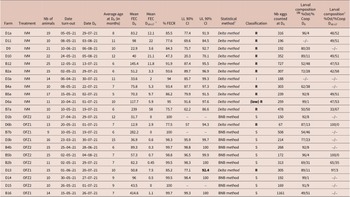
Results of the FECRT conducted in 22 groups of 16 dairy (D) or beef (B) cattle farms with either ivermectin (IVM) or oxfendazole (OFZ): Mean faecal egg counts at D0 and D10-17 after anthelmintic treatment, % of faecal egg count reduction and lower (LL) and upper (UL) limits of the 90% confidence intervals, efficacy classification as Resistant (R), Inconclusive (I), or Susceptible (S), number of eggs counted at D0 and larval composition results (%Ostertagia / %Cooperia) before and after treatment

Table 1. Long description
The table contains 16 columns: Farm, Treatment, Nb of animals, Date turn-out, Date D sub 0, Average age at D sub 0, Mean F E C D sub 0, Mean F E C D sub 10-17, percent F E C R, L L 90 percent C I, U L 90 percent C I, Statistical method, Classification, Nb eggs counted at D sub 0, and Larval composition (percent Ost/percent Coop) at D sub 0 and D sub 10-17.
Ivermectin (I V M) Treatment Group:
* Farms D 1 a, D 11, D 9, D 10, B 12, B 2 a, B 4 a, B 5 a, D 6 a, and B 7 a are all classified as Resistant (R). Percent F E C R values range from 47.3 percent (Farm D 10) to 95 percent (Farm D 6 a).
* Farm D 3 a is classified as Inconclusive (I) with 94 percent reduction.
* Larval composition at D sub 0 is predominantly Ostertagia (e.g., 96 percent for D 1 a), but shifts toward a higher percentage of Cooperia post-treatment (e.g., 52 percent for D 1 a).
Oxfendazole (O F Z 1 or O F Z 2) Treatment Group:
* Farms D 1 b, B 7 b, D 3 b, B 4 b, B 5 b, B 2 b, D 14, D 15, and B 16 are all classified as Susceptible (S) with percent F E C R values between 98.3 percent and 100 percent.
* Farm D 6 b and D 13 are classified as Resistant (R) with reductions of 77.5 percent and 85.2 percent respectively.
* Statistical methods used include the Delta method for resistant cases and the B N B method for susceptible cases where post-treatment counts were near zero.
D: Dairy cattle, B: Beef cattle; 1 to 16: number of farms; a, b: if several groups of calves within a farm; IVM: ivermectin, OFZ1: oxfendazole oral drench, OFZ2: oxfendazole bolus; R (bold): resistant, S: susceptible, I: inconclusive.
a D 10-17 : number of days after treatment at D0: D10-14 for OFZ treatment and D14-17 for IVM treatment.
b Statistical method automatically chosen by the web application http://www.fecrt.com for the pre- and post-epg dataset of each group: The delta method is preferred when the sample size is greater than or equal to 5, and at least 3 post-treatment observations are non-zero. The BNB method (version B) is preferred when the sample size is greater than or equal to 5, and fewer than 3 post-treatment observations are non-zero. When both the BNB method and the delta method were applicable for the same group, the 90%CI limits shown are those estimated by the delta method.
c Results of larval composition expressed as: %Ostertagia/%Cooperia: –/– indicates absence of DNA (failed coproculture or failed DNA extraction).
FECs were determined for strongyle eggs using the Mini-FLOTAC technique with a detection limit of 5 eggs per gram (epg) of faeces, using a sodium chloride flotation solution (specific gravity = 1.2) (Cringoli et al Reference Cringoli, Maurelli, Levecke, Bosco, Vercruysse, Utzinger and Rinaldi2017). When two measurements were required for each FEC at D0 for a given group, two measurements were also taken for the post-treatment FECs. For each group of calves, a pooled faecal culture was performed with vermiculite for 14 days at room temperature before and after treatment (MAFF 1986), and third-stage larvae were then collected by Baermann. After DNA extraction from the L3 using the NucleoSpin Tissue kit (MACHEREY-NAGEL) according to the manufacturer’s instructions, droplet digital PCR (ddPCR) was performed as described by Baltrušis et al (Reference Baltrušis, Halvarsson and Höglund2019). In brief, the absolute number of DNA copies of the internal transcribed spacer region 2 (ITS2) of Ostertagia or Cooperia was quantified by a discrimination assay using the same primers but two different probes for each parasite (for more information see 10.1186/s13071-023-05756-7, Baltrušis and Höglund Reference Baltrušis and Höglund2023). Results of ddPCR amplifications were generated using the Droplet Digital PCR XQ200 System (Bio-Rad Laboratories Inc.), and data were analysed using QuantaSoft™ Analysis Pro (version 1.7.4.0917). Thresholds were set by the software and adjusted manually. This was done to estimate in each group the proportions of the two main GINs typically found in cattle in temperate regions of Europe: Ostertagia ostertagi and Cooperia oncophora.
After collecting these field and laboratory data, the new World Association for the Advancement of Veterinary Parasitology (WAAVP) guidelines for diagnosing AR were published (Kaplan et al Reference Kaplan, Denwood, Nielsen, Thamsborg, Torgerson, Gilleard, Dobson, Vercruysse and Levecke2023). Consequently, our data were re-analysed according to the approach recommended in these guidelines. Individual pre- and post-treatment faecal egg counts (FECs) from the paired study design were entered into the fecrt.com web application (http://www.fecrt.com) (Denwood et al Reference Denwood, Kaplan, McKendrick, Thamsborg, Nielsen and Levecke2023), following the application instructions for each group of heifers and selecting the ‘clinical protocol’ scenario in the parameters, corresponding to a grey zone of 90–99% for interpretation (Kaplan et al Reference Kaplan, Denwood, Nielsen, Thamsborg, Torgerson, Gilleard, Dobson, Vercruysse and Levecke2023). The following outputs from fecrt.com, provided in the final full report generated by the app, were used and are reported in Table 1: the statistical method automatically selected by the application as the most appropriate for each dataset (the delta method or the beta-binomial model, version B (BNB-B)); the lower and upper limits (LL, UL) of the 90% confidence interval (90%CI) for the percentage of faecal egg count reduction (%FECR) estimated using the delta method (except when FECR was 100%); and the efficacy classification (Resistant, Susceptible, or Inconclusive).
Results and discussion
The mean FECs before and after AH treatment, FECR with 90% CI, the corresponding AH efficacy classification, and the species composition of the L3 are presented in Table 1. The mean FECs at D0 ranged from 12.9 to 414.6 eggs per gram (epg) of faeces, with higher values observed in beef cattle. The total number of eggs counted at D0 per group ranged from 67 to 1161, exceeding 200 eggs in 14 groups, between 150 and 200 in 7 groups, and fewer than 100 eggs in only one group (D6b). The number of animals in each tested group ranged from 9 to 25, with 10 groups having at least 15 animals, 21 groups having at least 10 animals, and only one group with 9 animals (B7b). In terms of the number of eggs counted and group sizes, the recommendations of Kaplan (Reference Kaplan2020) – ideally 200 eggs counted with 15 animals (minimum 10) per group, but as long as 100 eggs are counted, results are generally reliable for conducting a FECRT in cattle – were essentially followed except in two groups (D6b and B7b). However, the size of our groups relative to the number of eggs counted, when considered in light of the latest recommendations by the WAAVP (Kaplan et al Reference Kaplan, Denwood, Nielsen, Thamsborg, Torgerson, Gilleard, Dobson, Vercruysse and Levecke2023), published after the implementation of our protocol and superseding Kaplan (Reference Kaplan2020), are consistent with the FECRT guidelines for a ‘clinical protocol’ (as opposed to ‘research protocol’). Kaplan et al (Reference Kaplan, Denwood, Nielsen, Thamsborg, Torgerson, Gilleard, Dobson, Vercruysse and Levecke2023) noted that these two approaches can be considered equivalent from a statistical and scientific perspective. However, the clinical protocol (in which fewer animals and fewer eggs need to be counted) has a larger ‘grey zone’ and more often leads to inconclusive results compared to the research protocol.
Resistance to IVM was found in 10 out of 11 farms (FECR ranging from 47.3% to 95%, with the UL of the 90% CI < UL of the grey zone (99%)): 5 out of 6 dairy farms (including one farm in the sub-classification ‘low resistant’), and 5 out of 5 beef farms. In the remaining dairy farm, the results were inconclusive. For BZ, the situation was slightly different: resistance to OFZ was found in 2 dairy farms (FECR of 77.5% and 85.2%, with UL of the 90%CI < 99%) (farms D6b and D13). The remaining 9 farms (5 beef, 4 dairy) were classified as susceptible, as the FECR was either 100% or with an UL of its 90%IC > 99%.
Our results regarding IVM are consistent with the high frequencies of reduced efficacy of ML reported in previous studies conducted in Europe on first season grazing cattle, based on results from FECRT: in Germany, Belgium, and Sweden (IVM, in 7 out of 10 herds, 5 out of 7, and 4 out of 5, respectively) (Demeler et al Reference Demeler, Van Zeveren, Kleinschmidt, Vercruysse, Hoglund, Koopmann, Cabaret, Claerebout, Areskog and von Samson-Himmelstjerna2009), in Scotland (IVM, in 3 out of 4 herds) (McArthur et al Reference McArthur, Bartley, Shaw and Matthews2011), in Sweden (topical AVM, in 37 out of 59 herds) (Areskog et al Reference Areskog, Ljungström and Höglund2013), in Spain (IVM or MOX, in 6 out of 10 herds) (Martínez-Valladares et al Reference Martínez-Valladares, Geurden, Bartram, Martínez-Pérez, Robles-Pérez, Bohórquez, Florez, Meana and Rojo-Vázquez2015), in Denmark (IVM, in 3 out of 6 herds) (Peña-Espinoza et al Reference Peña-Espinoza, Thamsborg, Denwood, Drag, Hansen, Jensen and Enemark2016), in Ireland (IVM, in 4 out of 4 herds) (O’Shaughnessy et al Reference O’Shaughnessy, Drought, Lynch, Denny, Hurley, Byrne, Casey, de Waal and Sheehan2019), in Ireland (IVM or MOX, in 24 out of 27 herds) (Kelleher et al Reference Kelleher, Good, de Waal and Keane2020), and in France (IVM or MOX, in 6 out of 12 herds) (Chartier et al Reference Chartier, Ravinet, Bosco, Dufourd, Gadanho, Chauvin, Charlier, Maurelli, Gringoli and Rinaldi2020; Geurden et al Reference Geurden, Chartier, Fanke, di Regalbono, Traversa, von Samson Himmelstjerna, Demeler, Vanimisetti, Bartram and Denwood2015). Studies testing BZ in cattle are fewer, but our results regarding OFZ are consistent with most of them, which report good efficacy of this class of anthelmintics in cattle: no BZ resistance in France (17 farms) (Chartier et al Reference Chartier, Ravinet, Bertocchi, Hirschauer, Waap and von Samson-Himmelstjerna2019), no BZ resistance in Italy and France (6 and 5 herds tested, respectively) (Chartier et al Reference Chartier, Ravinet, Bosco, Dufourd, Gadanho, Chauvin, Charlier, Maurelli, Gringoli and Rinaldi2020), no BZ resistance in Germany and Sweden (10 and 2 herds tested, respectively) (Demeler et al Reference Demeler, Van Zeveren, Kleinschmidt, Vercruysse, Hoglund, Koopmann, Cabaret, Claerebout, Areskog and von Samson-Himmelstjerna2009). However, a high prevalence of BZ resistance was found in Ireland (9 out of 15 herds) (Kelleher et al Reference Kelleher, Good, de Waal and Keane2020).
Identification of larvae by ddPCR at D0 showed a higher proportion of Ostertagia in almost all our samples compared to Cooperia, with Ostertagia exceeding 90% in 10 groups. The ratio of Ostertagia to Cooperia larvae became more balanced after treatment at D10-17, with a shift towards a higher proportion of Cooperia. Species compositions of the L3 at D10-17 were available for 8 of the 10 farms where resistance to IVM was confirmed: the proportion ranged from 33% to 49% for Ostertagia and 51% to 67% for Cooperia, suggesting that both species might be resistant to IVM. Notably, in the 2 groups where resistance to OFZ was confirmed (D6b and D13), all or almost all larvae (100% and 97%, respectively) were Ostertagia. This strongly suggests resistance in Ostertagia, but it is difficult to unequivocally conclude that Cooperia is susceptible. Indeed, (i) the proportion of Cooperia was already quite low prior to treatment (13% and 11%), and even if the excretion was sufficient at D10-17 to conclude resistance of GIN (all species combined), it remained low in absolute terms (2.9 and 7.5 mean FEC at D10-17), and (ii) since various factors can influence the development, mortality and recovery of larvae at the coproculture stage, we cannot exclude a problem with the culture or detection of a few Cooperia L3 after treatment.
In our study, Ostertagia was recovered after treatment in 100% of the groups with AR (BZ or IVM) where larval composition could be determined at D10-17. In contrast, in previous European studies using FECRT in more than one herd (with larval composition determined after treatment), the percentage of herds with AR where Ostertagia was recovered after treatment was much lower: e.g. for IVM, 0% in Belgium, 12% in Germany and 40% in Sweden (Demeler et al., Reference Demeler, Van Zeveren, Kleinschmidt, Vercruysse, Hoglund, Koopmann, Cabaret, Claerebout, Areskog and von Samson-Himmelstjerna2009), 0% in Germany and France and 10% in UK (Geurden et al., Reference Geurden, Chartier, Fanke, di Regalbono, Traversa, von Samson Himmelstjerna, Demeler, Vanimisetti, Bartram and Denwood2015), until 53% for BZ and 56% for IVM in Ireland (Kelleher et al., Reference Kelleher, Good, de Waal and Keane2020), with Cooperia most often involved in AR. This suggests that the involvement of Ostertagia in the phenomenon of AR may be increasing.
Our findings, particularly those related to IVM, are concerning but not unexpected given the known prevalence of AR in Europe (Rose Vineer et al Reference Rose Vineer, Morgan, Hertzberg, Bartley, Bosco, Charlier, Chartier, Claerebout, de Waal, Hendrickx, Hinney, Höglund, Ježek, Kasny, Keane, Martinez-Valladares, Mateus, McIntyre, Mickiewicz, Munoz, Phythian, Ploeger, Vergles Rataj, Skuce, Simin, Sotiraki, Spinu, Stuen, Thamsborg, Vadlejch, Varady, von Samson-Himmelstjerna and Rinaldi2020). However, on the farms included, neither the veterinarians nor the farmers had observed a lack of efficacy of the anthelmintics used. The absence of apparent treatment failure is common in cattle and is not surprising in this region of central France, where extensive grazing and a cold climate prevail: the parasite risk associated with GIN is likely to be low, and partial efficacy of anthelmintic treatments, combined with the development of immunity that allows control of the parasite load, may be sufficient to maintain infection levels compatible with optimal growth.
On the farms in our study, young cattle are usually dewormed once or twice a year (mostly 2–3 months after turn-out, and sometimes at housing in October-November), which corresponds to a treatment frequency typical in France. As a result, there was little to no selection bias in this study, which is consistent with the recommendations of Rose Vineer et al (Reference Rose Vineer, Morgan, Hertzberg, Bartley, Bosco, Charlier, Chartier, Claerebout, de Waal, Hendrickx, Hinney, Höglund, Ježek, Kasny, Keane, Martinez-Valladares, Mateus, McIntyre, Mickiewicz, Munoz, Phythian, Ploeger, Vergles Rataj, Skuce, Simin, Sotiraki, Spinu, Stuen, Thamsborg, Vadlejch, Varady, von Samson-Himmelstjerna and Rinaldi2020) in their meta-analysis.
Given the low likelihood of new anthelmintic classes entering the market, urgent efforts must be made to use those that remain effective or partially effective very judiciously, employing refugia-based strategies (Greer et al Reference Greer, Van Wyk, Hamie, Byaruhanga and Kenyon2020). Not all worms would be eliminated, but this rational approach could prevent a significant increase in resistant worms and thus maintain GIN infection control compatible with growth targets. If we wait too long to implement these changes in treatment practices, it will be too late: the number of animals that must be left untreated in refugia-based strategies increases significantly as the level of resistance rises (Kaplan Reference Kaplan2020).
Acknowledgements
The authors thank all the cattle owners who actively participated in this study by making themselves available and assisting with animal handling during the implementation of the protocol. The authors would also like to thank the Swedish technical team at the Department of Animal Biosciences at the Swedish University of Agricultural Sciences for sharing their experience and expertise in performing ddPCR analyses. Many thanks also to Anne Lehebel and Mat Denwood for their valuable advice on data analysis.
Financial support
This study was conducted within the framework of a public-private partnership between the BIOEPAR joint research unit (INRAE, Oniris VetagraoBio), MSD Animal Health, and the Haute Auvergne Veterinary Clinic (Cantal). It was thus partially funded by MSD Animal Health, particularly to compensate the veterinary students who participate in the study (P. Grelaud, L. Ledieu, and M. Lopez).
Competing interest
As mentioned above, this study was conducted as part of a public-private partnership between the BIOEPAR joint research unit (INRAE, Oniris VetagraoBio), MSD Animal Health, and the Haute Auvergne Veterinary Clinic (Cantal), under a research contract with shared ownership of the results. The research was partially funded by MSD Animal Health. All parties were involved in the design, execution, and interpretation of the study. The authors declare that they have no other competing financial interests or personal relationships that could have influenced the results or conclusions presented in this article.
Ethical standards
The study involved the use of client-owned animals and was restricted to faecal samples. As such, no permission from an ethics committee was necessary. All necessary steps have been taken to ensure high-standard animal care with informed client consent.

 Open access

