





1 Introduction
Many local-global conjectures in the representation theory of finite groups have been generalized to take Galois automorphisms into account. For example, the McKay conjecture, recently proven by Cabanes and Späth in [Reference Cabanes and Späth1], received such a generalization in [Reference Navarro16].
Another instance of this phenomenon is the Brauer Height Zero Conjecture, which was also recently proven in [Reference Malle, Navarro, Schaeffer Fry and Tiep14]. The principal block case of this conjecture asserts that if p is a prime and G is a finite group then all irreducible characters in the principal p-block of G have $p'$
-degree if and only if G has an abelian Sylow p-subgroup.
$p'$
-degree if and only if G has an abelian Sylow p-subgroup.
In [Reference Malle and Navarro13], the authors considered the action of a specific automorphism $\sigma $
on the characters of the principal
$\sigma $
on the characters of the principal $2$
-block of a finite group. In that context, they showed that it sufficed to consider the set of
$2$
-block of a finite group. In that context, they showed that it sufficed to consider the set of $\sigma $
-invariant irreducible characters in the statement of Brauer’s Height Zero Conjecture for principal blocks, for
$\sigma $
-invariant irreducible characters in the statement of Brauer’s Height Zero Conjecture for principal blocks, for $p = 2$
.
$p = 2$
.
Let p be a prime number and let $\mathbb {Q}^{\operatorname {ab}}$
be the maximal abelian extension of
$\mathbb {Q}^{\operatorname {ab}}$
be the maximal abelian extension of $\mathbb {Q}$
. Then, we write
$\mathbb {Q}$
. Then, we write $\mathcal {J}$
to denote the set of elements of order p of the group
$\mathcal {J}$
to denote the set of elements of order p of the group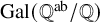 $\operatorname {Gal}(\mathbb {Q}^{\operatorname {ab}}/\mathbb {Q})$
that fix all p-power roots of unity. In [Reference Malle, Moretó, Rizo and Schaeffer Fry12], it was shown that, in fact, it sufficed to consider the set of
$\operatorname {Gal}(\mathbb {Q}^{\operatorname {ab}}/\mathbb {Q})$
that fix all p-power roots of unity. In [Reference Malle, Moretó, Rizo and Schaeffer Fry12], it was shown that, in fact, it sufficed to consider the set of $\mathcal {J}$
-invariant characters in the statement of Brauer’s Height Zero Conjecture, provided the group G does not contain a certain set of composition factors for specific primes p.
$\mathcal {J}$
-invariant characters in the statement of Brauer’s Height Zero Conjecture, provided the group G does not contain a certain set of composition factors for specific primes p.
In this paper, we remove this restriction on the composition factors and prove the theorem below, which is [Reference Malle, Moretó, Rizo and Schaeffer Fry12, Conjecture 1]. In the following, $B_0(G)$
denotes the principal p-block of G and
$B_0(G)$
denotes the principal p-block of G and ${\operatorname {Irr}}_{\mathcal {J}}(G)$
, the set of irreducible complex characters of G that are invariant under
${\operatorname {Irr}}_{\mathcal {J}}(G)$
, the set of irreducible complex characters of G that are invariant under $\mathcal {J}$
.
$\mathcal {J}$
.
Theorem A. Let G be a finite group, let p be a prime number and let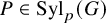 $P\in \mathrm {Syl}_p(G)$
. Suppose that the elements in
$P\in \mathrm {Syl}_p(G)$
. Suppose that the elements in $\mathrm {Irr}_{\mathcal {J}}(B_0(G))$
are all of
$\mathrm {Irr}_{\mathcal {J}}(B_0(G))$
are all of $p'$
-degree. Then P is abelian.
$p'$
-degree. Then P is abelian.
In order to do so, we use many results of [Reference Malle, Moretó, Rizo and Schaeffer Fry12], especially those relying on the Classification of Finite Simple Groups (CFSG). However we also employ substantially different techniques from those of [Reference Malle, Moretó, Rizo and Schaeffer Fry12]. In fact, the approach in [Reference Malle, Moretó, Rizo and Schaeffer Fry12], as that in [Reference Malle and Navarro13], went through a Galois version of the Itô–Michler theorem, which was known to have exceptions with our set of Galois automorphisms $\mathcal {J}$
.
$\mathcal {J}$
.
Our approach now relies more on arguments from [Reference Malle, Moretó and Rizo11]. In particular, we use deep classification theorems on the structure of primitive permutation groups. As a consequence of Theorem A, we are also able to prove the following, which is probably the closest one can get to a Galois version of Itô–Michler.
Theorem B. Let G be a finite group, with p a prime and suppose that ${\operatorname {Irr}}_{\mathcal {J}}(G) \subseteq {\operatorname {Irr}}_{p'}(G)$
. Then,
${\operatorname {Irr}}_{\mathcal {J}}(G) \subseteq {\operatorname {Irr}}_{p'}(G)$
. Then, ${\mathbf O}^{p'}(G) = {\mathbf O}_p(G) \times K$
, where
${\mathbf O}^{p'}(G) = {\mathbf O}_p(G) \times K$
, where $K \unlhd G$
,
$K \unlhd G$
, ${\mathbf O}_{p'}(K)$
is solvable and
${\mathbf O}_{p'}(K)$
is solvable and $K/{\mathbf O}_{p'}(K)$
is a direct product of non-abelian simple groups of order divisible by p, whose
$K/{\mathbf O}_{p'}(K)$
is a direct product of non-abelian simple groups of order divisible by p, whose $\mathcal {J}$
-invariant irreducible characters are all of
$\mathcal {J}$
-invariant irreducible characters are all of $p'$
-degree.
$p'$
-degree.
We remark that Theorem B generalizes the main result of [Reference Grittini5]. Unfortunately, as we discuss in Section 4, it appears that the proof in [Reference Grittini5] is not correct.
2 Preliminary results
In this section, we outline some of the main tools that will be used to prove Theorems A and B. To do so, we begin by substituting the group $\mathcal {J}$
, which is an infinite group, for a finite one that has the same action on the characters of a finite group G. Contrary to the set
$\mathcal {J}$
, which is an infinite group, for a finite one that has the same action on the characters of a finite group G. Contrary to the set $\mathcal {J}$
and the automorphism
$\mathcal {J}$
and the automorphism $\sigma $
from [Reference Malle and Navarro13], which are defined globally, this finite group will depend on G. This will, however, not be an issue in view of the lemma below.
$\sigma $
from [Reference Malle and Navarro13], which are defined globally, this finite group will depend on G. This will, however, not be an issue in view of the lemma below.
Given a natural number n, if we write $\mathbb {Q}_n = \mathbb {Q}(\xi )$
, where
$\mathbb {Q}_n = \mathbb {Q}(\xi )$
, where $\xi $
is a primitive n-root of unity, and
$\xi $
is a primitive n-root of unity, and $n_p$
for the biggest power of p that divides n, then we define
$n_p$
for the biggest power of p that divides n, then we define $\Omega (n)$
as the set of elements of order p of
$\Omega (n)$
as the set of elements of order p of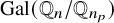 $\operatorname {Gal}(\mathbb {Q}_n/\mathbb {Q}_{n_p})$
. The interplay between
$\operatorname {Gal}(\mathbb {Q}_n/\mathbb {Q}_{n_p})$
. The interplay between $\mathcal {J}$
and
$\mathcal {J}$
and $\Omega (n)$
for the context of finite groups is given by the following result.
$\Omega (n)$
for the context of finite groups is given by the following result.
Lemma 2.1. Let G be a finite group and let $\chi \in {\operatorname {Irr}}(G)$
. Then,
$\chi \in {\operatorname {Irr}}(G)$
. Then, $\chi $
is
$\chi $
is $\Omega (|G|)$
-invariant if and only if it is
$\Omega (|G|)$
-invariant if and only if it is $\mathcal {J}$
-invariant.
$\mathcal {J}$
-invariant.
Proof. This is [Reference Malle, Moretó, Rizo and Schaeffer Fry12, Lemma 2.1].
Even though $\Omega $
depends on n, for groups we can usually get around this by using the lemma below. As such, we will work with the sets
$\Omega $
depends on n, for groups we can usually get around this by using the lemma below. As such, we will work with the sets $\Omega (|G|)$
instead of
$\Omega (|G|)$
instead of $\mathcal {J}$
for the remainder of the paper. We will write
$\mathcal {J}$
for the remainder of the paper. We will write $\Omega $
for
$\Omega $
for $\Omega (|G|)$
, if the finite group G is clear from context, and write
$\Omega (|G|)$
, if the finite group G is clear from context, and write ${\operatorname {Irr}}_{\Omega }(G)$
for the characters of G that are
${\operatorname {Irr}}_{\Omega }(G)$
for the characters of G that are $\Omega $
-invariant.
$\Omega $
-invariant.
Lemma 2.2. Let G be a finite group, let $\chi \in {\operatorname {Irr}}(G)$
and let m be a multiple of
$\chi \in {\operatorname {Irr}}(G)$
and let m be a multiple of $|G|$
. Then,
$|G|$
. Then, $\chi $
is
$\chi $
is $\Omega (|G|)$
-invariant if and only if it is
$\Omega (|G|)$
-invariant if and only if it is $\Omega (m)$
-invariant.
$\Omega (m)$
-invariant.
Proof. This is [Reference Malle, Moretó, Rizo and Schaeffer Fry12, Corollary 2.2].
The three results below, all from [Reference Giudici, Liebeck, Praeger, Saxl and Tiep3] and relying on the CFSG, are the deep classification theorems mentioned in the Introduction. A subgroup $H \leq \operatorname {GL}_n(V)$
is called p-exceptional if p divides
$H \leq \operatorname {GL}_n(V)$
is called p-exceptional if p divides $|H|$
, but none of its orbits on the vectors of V has size divisible by p. Analogously, a subgroup
$|H|$
, but none of its orbits on the vectors of V has size divisible by p. Analogously, a subgroup $H \leq \mathfrak S_{\Lambda }$
is called p-concealed if none of its orbits on the subsets of
$H \leq \mathfrak S_{\Lambda }$
is called p-concealed if none of its orbits on the subsets of $\Lambda $
has size divisible by p.
$\Lambda $
has size divisible by p.
Theorem 2.3. Let G be an irreducible p-exceptional subgroup of $\operatorname {GL}_n(p)=\operatorname {GL}(V)$
and suppose that G acts primitively on V. Then one of the following holds:
$\operatorname {GL}_n(p)=\operatorname {GL}(V)$
and suppose that G acts primitively on V. Then one of the following holds:
-
1. G is transitive on $V\setminus \{0\}$
;
$V\setminus \{0\}$
; -
2.
$G\leq \operatorname {\Gamma L}_1(p^n)$
; -
3. G is one of the following:
-
(i)
$G=\mathfrak A_c, \mathfrak S_c$
where
$c=2^r-2$
or
$2^r-1$
, with V the deleted permutation module over
${\mathbb {F}}_2$
, of dimension
$c-2$
or
$c-1$
respectively; -
(ii)
$\operatorname {SL}_2(5)\trianglelefteq G< \operatorname {\Gamma L}_2(9)<\operatorname {GL}_4(3)$
, orbit sizes
$1,40,40$
; -
(iii)
$\operatorname {PSL}_2(11)\trianglelefteq G<\operatorname {GL}_5(3)$
, orbit sizes
$1,22,110,110$
; -
(iv)
$M_{11}\trianglelefteq G<\operatorname {GL}_5(3)$
, orbit sizes
$1,22,220$
; -
(v)
$M_{23}=G<\operatorname {GL}_{11}(2)$
, orbit sizes
$1,23,253,1771$
.
-












Proof. This is [Reference Giudici, Liebeck, Praeger, Saxl and Tiep3, Theorem 1].
Theorem 2.4. Suppose $G\leq \operatorname {GL}_n(p)=\operatorname {GL}(V)$
is irreducible and p-exceptional with
$G\leq \operatorname {GL}_n(p)=\operatorname {GL}(V)$
is irreducible and p-exceptional with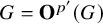 $G={\mathbf O}^{p'}(G)$
. If
$G={\mathbf O}^{p'}(G)$
. If $V=V_1\oplus \cdots \oplus V_n$
(
$V=V_1\oplus \cdots \oplus V_n$
( $n>1$
) is an imprimitivity decomposition for G, then
$n>1$
) is an imprimitivity decomposition for G, then $G_{V_1}$
is transitive on
$G_{V_1}$
is transitive on $V_1\setminus \{0\}$
and G induces a primitive p-concealed subgroup of
$V_1\setminus \{0\}$
and G induces a primitive p-concealed subgroup of $\mathfrak S_\Lambda $
, where
$\mathfrak S_\Lambda $
, where $\Lambda =\{V_1,\dots , V_n\}$
.
$\Lambda =\{V_1,\dots , V_n\}$
.
Proof. This is [Reference Giudici, Liebeck, Praeger, Saxl and Tiep3, Theorem 3].
Theorem 2.5. Let H be a primitive subgroup of $\mathfrak S_n$
of order divisible by a prime p. Then H is p-concealed if and only if one of the following holds:
$\mathfrak S_n$
of order divisible by a prime p. Then H is p-concealed if and only if one of the following holds:
-
1.
$\mathfrak A_n\trianglelefteq H\leq \mathfrak S_n$
, and
$n=ap^s-1$
with
$s\geq 1$
,
$a\leq p-1$
and
$(a,s)\neq (1,1)$
; also
$H\neq \mathfrak A_3$
if
$(n,p)=(3,2)$
; -
2.
$(n,p)=(8,3)$
, and
$H=\operatorname {AGL}_3(2)=2^3:\operatorname {SL}_3(2)$
or
$H=\operatorname {A\Gamma L}_1(8)=2^3:7:3$
; -
3.
$(n,p)=(5,2)$
and
$H=D_{10}$
.











Proof. This is [Reference Giudici, Liebeck, Praeger, Saxl and Tiep3, Theorem 2].
One consequence of this latter classification which will be of particular use to us is the following variation of [Reference Malle, Moretó and Rizo11, Lemma 3.4].
Lemma 2.6. Let p be a prime number and let H be a primitive subgroup of $\mathfrak S_n$
of order divisible by p. If H is p-concealed, then there exists
$\mathfrak S_n$
of order divisible by p. If H is p-concealed, then there exists $\chi \in {\operatorname {Irr}}_\Omega (H)$
such that
$\chi \in {\operatorname {Irr}}_\Omega (H)$
such that $\chi (1)_p>1$
.
$\chi (1)_p>1$
.
Proof. We go through the cases of Theorem 2.5. Suppose first we are in case (1). If $n\leq 4$
, we get that
$n\leq 4$
, we get that $p=2$
, as
$p=2$
, as $(a, s) \neq (1, 1)$
, and
$(a, s) \neq (1, 1)$
, and $H \neq \mathfrak A_3$
. Thus, the only possible case is
$H \neq \mathfrak A_3$
. Thus, the only possible case is $H = \mathfrak S_3$
, where we can find a rational character of degree divisible by
$H = \mathfrak S_3$
, where we can find a rational character of degree divisible by $2$
. Hence we may assume that
$2$
. Hence we may assume that $n\geq 5$
. If
$n\geq 5$
. If $H=\mathfrak S_n$
, all irreducible characters of H are rational and we are done by the Itô–Michler theorem, since
$H=\mathfrak S_n$
, all irreducible characters of H are rational and we are done by the Itô–Michler theorem, since $\mathfrak S_n$
does not have normal Sylow p-subgroups for any prime p. Finally, if
$\mathfrak S_n$
does not have normal Sylow p-subgroups for any prime p. Finally, if $H = \mathfrak A_n$
, by [Reference Malle, Moretó, Rizo and Schaeffer Fry12, Theorem 2.8], a counterexample could only happen if
$H = \mathfrak A_n$
, by [Reference Malle, Moretó, Rizo and Schaeffer Fry12, Theorem 2.8], a counterexample could only happen if $p \neq 2$
and
$p \neq 2$
and $n \in \{5, 6, 8\}$
. It is straightforward to check (for example, with GAP [2]) that the result holds in all of these cases.
$n \in \{5, 6, 8\}$
. It is straightforward to check (for example, with GAP [2]) that the result holds in all of these cases.
Now suppose we are in case (2). Then, we may compute the character tables of the two groups explicitly using GAP and we see that $\mathrm{AGL}_3$
(2) possesses a rational (hence
$\mathrm{AGL}_3$
(2) possesses a rational (hence $\Omega$
-invariant) character of degree divisible by 3 and that
$\Omega$
-invariant) character of degree divisible by 3 and that $\mathrm{A}\Gamma\mathrm{L}_1$
(8) has two characters of degree 3; since
$\mathrm{A}\Gamma\mathrm{L}_1$
(8) has two characters of degree 3; since $\Omega$
is a 3-group in this case, both must be
$\Omega$
is a 3-group in this case, both must be $\Omega$
-invariant. Finally, for case (3),
$\Omega$
-invariant. Finally, for case (3), $p=2$
and
$p=2$
and $\Omega$
is the set of 2-elements of
$\Omega$
is the set of 2-elements of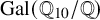 $\mathrm{Gal}(\mathbb{Q}_{10}/\mathbb{Q})$
. There is exactly one such element besides the identity, which is complex conjugation. Since all characters of
$\mathrm{Gal}(\mathbb{Q}_{10}/\mathbb{Q})$
. There is exactly one such element besides the identity, which is complex conjugation. Since all characters of $D_{10}$
are real, its characters of degree 2 are
$D_{10}$
are real, its characters of degree 2 are $\Omega$
-invariant.
$\Omega$
-invariant.
Next, we state one property of simple groups which will be of fundamental importance to us. Notice that the case $p = 3$
is, in fact, independent of the CFSG.
$p = 3$
is, in fact, independent of the CFSG.
Lemma 2.7. Let S be a non-abelian finite simple group and let p be an odd prime dividing $|S|$
. Then, there exists
$|S|$
. Then, there exists $1_S \neq \alpha \in {\operatorname {Irr}}_\Omega (B_0(S))$
of
$1_S \neq \alpha \in {\operatorname {Irr}}_\Omega (B_0(S))$
of $p'$
-degree.
$p'$
-degree.
Proof. Suppose first that $p = 3$
. By [Reference Landrock9, Corollary 1.6],
$p = 3$
. By [Reference Landrock9, Corollary 1.6], $3 \mid |{\operatorname {Irr}}_{p'}(B_0(S))|$
. Since
$3 \mid |{\operatorname {Irr}}_{p'}(B_0(S))|$
. Since $\Omega $
is a
$\Omega $
is a $3$
-group, we have
$3$
-group, we have $|{\operatorname {Irr}}_{p', \Omega }(B_0(S))| \equiv |{\operatorname {Irr}}_{p'}(B_0(S))|\ \pmod {3}$
, meaning (since
$|{\operatorname {Irr}}_{p', \Omega }(B_0(S))| \equiv |{\operatorname {Irr}}_{p'}(B_0(S))|\ \pmod {3}$
, meaning (since $1_S$
is of
$1_S$
is of $3'$
-degree and
$3'$
-degree and $\Omega $
-invariant) there are at least two non-trivial characters in
$\Omega $
-invariant) there are at least two non-trivial characters in ${\operatorname {Irr}}_{p', \Omega }(B_0(S))$
. We may thus assume
${\operatorname {Irr}}_{p', \Omega }(B_0(S))$
. We may thus assume $p> 3$
.
$p> 3$
.
For alternating groups, there is nothing to prove, since every irreducible character is $\Omega $
-invariant (as
$\Omega $
-invariant (as $\Omega $
is a p-group,
$\Omega $
is a p-group, $p> 2$
and characters of
$p> 2$
and characters of $\mathfrak A_n$
have at most
$\mathfrak A_n$
have at most $2$
Galois conjugates).
$2$
Galois conjugates).
For sporadic groups (and the Tits simple group $^2F_4(2)'$
), we may check with GAP [2] that, if
$^2F_4(2)'$
), we may check with GAP [2] that, if $p \mid |S|$
, then there exists a rational character of
$p \mid |S|$
, then there exists a rational character of $p'$
-degree in the principal p-block of S. Finally, if S is a simple group of Lie type, the result follows by [Reference Navarro, Tiep and Vallejo20, Theorems 5.4, 5.5].
$p'$
-degree in the principal p-block of S. Finally, if S is a simple group of Lie type, the result follows by [Reference Navarro, Tiep and Vallejo20, Theorems 5.4, 5.5].
We also need a couple of results that allow us to deal with normal subgroups and certain characters thereof.
Lemma 2.8. Suppose that N is a normal subgroup of G, with $G/N$
a
$G/N$
a $p'$
-group. Let
$p'$
-group. Let $\Omega = \Omega (|G|)$
. If
$\Omega = \Omega (|G|)$
. If $\theta \in {\operatorname {Irr}}_{\Omega }(N)$
, then there exists
$\theta \in {\operatorname {Irr}}_{\Omega }(N)$
, then there exists $\chi \in {\operatorname {Irr}}_{\Omega }(G)$
over
$\chi \in {\operatorname {Irr}}_{\Omega }(G)$
over $\theta $
. Furthermore, if
$\theta $
. Furthermore, if $\theta \in {\operatorname {Irr}}_{\Omega }(B_0(N))$
, then there exists
$\theta \in {\operatorname {Irr}}_{\Omega }(B_0(N))$
, then there exists $\chi \in {\operatorname {Irr}}_{\Omega }(B_0(G))$
over
$\chi \in {\operatorname {Irr}}_{\Omega }(B_0(G))$
over $\theta $
.
$\theta $
.
Proof. This is [Reference Malle, Moretó, Rizo and Schaeffer Fry12, Lemma 3.2].
Lemma 2.9. Let $N\lhd G$
and let
$N\lhd G$
and let $\theta \in \mathrm {Irr}_{p',\Omega }(B_0(N))$
. Suppose that
$\theta \in \mathrm {Irr}_{p',\Omega }(B_0(N))$
. Suppose that $\theta $
is G-invariant and that p does not divide
$\theta $
is G-invariant and that p does not divide $o(\theta )$
. Then there exists
$o(\theta )$
. Then there exists $\chi \in \mathrm {Irr}_{p',\Omega }(B_0(G)|\theta ).$
Proof. Let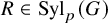 $R\in \mathrm {Syl}_p(G)$
. Since
$R\in \mathrm {Syl}_p(G)$
. Since $\theta $
is G-invariant and
$\theta $
is G-invariant and $(\theta (1)o(\theta ),|RN/N|)=1$
,
$(\theta (1)o(\theta ),|RN/N|)=1$
, $\theta $
has a canonical extension
$\theta $
has a canonical extension $\psi \in \mathrm { Irr}_{p',\Omega }(RN)$
and since
$\psi \in \mathrm { Irr}_{p',\Omega }(RN)$
and since $RN/N$
is a p-group,
$RN/N$
is a p-group, $\psi $
lies in
$\psi $
lies in $B_0(RN)$
. Now by the Alperin–Dade correspondence (see [Reference Malle, Moretó, Rizo and Schaeffer Fry12, Lemma 3.1], for instance), we have that
$B_0(RN)$
. Now by the Alperin–Dade correspondence (see [Reference Malle, Moretó, Rizo and Schaeffer Fry12, Lemma 3.1], for instance), we have that $\psi $
has an extension
$\psi $
has an extension $\hat \psi \in \mathrm {Irr}_{p',\Omega }(B_0(RN\mathbf {C}_{G}(R)))$
.
$\hat \psi \in \mathrm {Irr}_{p',\Omega }(B_0(RN\mathbf {C}_{G}(R)))$
.
Now $\Delta =\hat \psi ^G$
is
$\Delta =\hat \psi ^G$
is $\Omega $
-invariant and has degree coprime to p. We consider
$\Omega $
-invariant and has degree coprime to p. We consider $\Delta _{B_0(G)}$
, the sum of the irreducible constituents of
$\Delta _{B_0(G)}$
, the sum of the irreducible constituents of $\Delta $
that belong to
$\Delta $
that belong to $B_0(G)$
, including multiplicities. Now write
$B_0(G)$
, including multiplicities. Now write $X=RN\mathbf {C}_{G}(R)$
. By the argument in [Reference Navarro17, page 213], we have that
$X=RN\mathbf {C}_{G}(R)$
. By the argument in [Reference Navarro17, page 213], we have that $B_0(X)^G$
is defined. By Brauer’s Third Main Theorem, we have that
$B_0(X)^G$
is defined. By Brauer’s Third Main Theorem, we have that $B_0(X)^G=B_0(G)$
. Now by [Reference Navarro17, Corollary 6.4], we have that
$B_0(X)^G=B_0(G)$
. Now by [Reference Navarro17, Corollary 6.4], we have that
 $$ \begin{align*}\Delta_{B_0(G)}(1)_p=((\hat{\psi}^G)_{B_0(G)})(1)_p=\hat{\psi}^G(1)_p=1.\end{align*} $$
Notice that $\Delta _{B_0(G)}$
is
$\Delta _{B_0(G)}$
is $\Omega $
-invariant. Indeed, if
$\Omega $
-invariant. Indeed, if $\chi \in \mathrm {Irr}(\Delta )$
lies in the principal block, then, since
$\chi \in \mathrm {Irr}(\Delta )$
lies in the principal block, then, since $\Delta $
is
$\Delta $
is $\Omega $
-invariant, if
$\Omega $
-invariant, if $\sigma \in \Omega $
, we have that
$\sigma \in \Omega $
, we have that $\chi ^\sigma \in \mathrm {Irr}(\Delta ^\sigma )=\mathrm {Irr}(\Delta )$
and
$\chi ^\sigma \in \mathrm {Irr}(\Delta ^\sigma )=\mathrm {Irr}(\Delta )$
and $\chi ^\sigma $
lies in the principal block, hence
$\chi ^\sigma $
lies in the principal block, hence $\chi ^\sigma \in \mathrm {Irr}(\Delta _{B_0(G)})$
. Now we apply [Reference Navarro and Tiep18, Lemma 2.1 (ii)] to
$\chi ^\sigma \in \mathrm {Irr}(\Delta _{B_0(G)})$
. Now we apply [Reference Navarro and Tiep18, Lemma 2.1 (ii)] to $\Delta _{B_0(G)}$
to conclude that there exists
$\Delta _{B_0(G)}$
to conclude that there exists $\chi \in \mathrm {Irr}_{p'}(\Delta _{B_0(G)})$
,
$\chi \in \mathrm {Irr}_{p'}(\Delta _{B_0(G)})$
, $\Omega $
-invariant. Then
$\Omega $
-invariant. Then $\chi \in \mathrm {Irr}_{p',\Omega }(B_0(G)|\theta )$
, as desired.
$\chi \in \mathrm {Irr}_{p',\Omega }(B_0(G)|\theta )$
, as desired.
To finish off this section, the following allows us to deal with the case of groups with a semisimple minimal normal subgroup which is not simple.
Lemma 2.10. Let G be a finite group and let p be a prime such that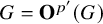 $G = {\mathbf O}^{p'}(G)$
. Assume G contains a minimal normal subgroup N which is isomorphic to
$G = {\mathbf O}^{p'}(G)$
. Assume G contains a minimal normal subgroup N which is isomorphic to $S_1 \times \cdots \times S_k$
, for isomorphic non-abelian finite simple groups
$S_1 \times \cdots \times S_k$
, for isomorphic non-abelian finite simple groups $S_i$
, with
$S_i$
, with $k> 1$
. Then, there exists
$k> 1$
. Then, there exists $\chi \in {\operatorname {Irr}}_{\Omega }(G)$
such that
$\chi \in {\operatorname {Irr}}_{\Omega }(G)$
such that $\chi (1)_p> 1$
. Furthermore, if p is odd and divides
$\chi (1)_p> 1$
. Furthermore, if p is odd and divides $|S_1|$
, such a
$|S_1|$
, such a $\chi $
can be taken in the principal block.
$\chi $
can be taken in the principal block.
Proof. We will tackle both the general case and the case where p is odd and divides $|S_1|$
at the same time, making the necessary modifications as we go. Let
$|S_1|$
at the same time, making the necessary modifications as we go. Let $H = \bigcap _{i=1}^k \mathbf N_{G}(S_i)$
and let
$H = \bigcap _{i=1}^k \mathbf N_{G}(S_i)$
and let $\overline {G} = G/H$
, which acts transitively on the set
$\overline {G} = G/H$
, which acts transitively on the set $\Lambda = \{S_1, \ldots , S_k\}$
by conjugation. Notice how
$\Lambda = \{S_1, \ldots , S_k\}$
by conjugation. Notice how $H \neq G$
, as
$H \neq G$
, as $k> 1$
.
$k> 1$
.
Suppose, first, that this action is not p-concealed, meaning there exists a subset $\Gamma $
of
$\Gamma $
of $\Lambda $
such that p divides
$\Lambda $
such that p divides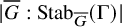 $|\overline {G}:{\operatorname {Stab}}_{\overline {G}}(\Gamma )|$
. Write
$|\overline {G}:{\operatorname {Stab}}_{\overline {G}}(\Gamma )|$
. Write $S = S_1$
. In the general case, let
$S = S_1$
. In the general case, let $1_S \neq \phi \in {\operatorname {Irr}}(S)$
be an irreducible character that extends rationally to
$1_S \neq \phi \in {\operatorname {Irr}}(S)$
be an irreducible character that extends rationally to ${\operatorname {Aut}}(S)$
(such a character exists by [Reference Hung, Schaeffer Fry, Tong-Viet and Ryan Vinroot7, Lemma 4.1]). If p is odd and divides
${\operatorname {Aut}}(S)$
(such a character exists by [Reference Hung, Schaeffer Fry, Tong-Viet and Ryan Vinroot7, Lemma 4.1]). If p is odd and divides $|S|$
, let instead
$|S|$
, let instead $1_S \neq \phi \in {\operatorname {Irr}}_{p', \Omega }(B_0(S))$
be a character as in Lemma 2.7. In any case, let
$1_S \neq \phi \in {\operatorname {Irr}}_{p', \Omega }(B_0(S))$
be a character as in Lemma 2.7. In any case, let $\theta $
be the character of N obtained by placing
$\theta $
be the character of N obtained by placing $\phi $
in the positions corresponding to
$\phi $
in the positions corresponding to $\Gamma $
and
$\Gamma $
and $1_S$
in the remaining positions.
$1_S$
in the remaining positions.
Then, in the first case, $\theta $
is an
$\theta $
is an $\Omega $
-invariant character of N which extends to
$\Omega $
-invariant character of N which extends to $\psi \in {\operatorname {Irr}}(G_\theta )$
. Furthermore, by [Reference Moretó15, Theorem 7.3], for instance, we can take
$\psi \in {\operatorname {Irr}}(G_\theta )$
. Furthermore, by [Reference Moretó15, Theorem 7.3], for instance, we can take $\psi $
to be rational-valued. In the second case, by Lemma 2.9, there exists an irreducible character
$\psi $
to be rational-valued. In the second case, by Lemma 2.9, there exists an irreducible character $\psi \in {\operatorname {Irr}}_{p', \Omega }(B_0(G_\theta ){\mid }\theta )$
.
$\psi \in {\operatorname {Irr}}_{p', \Omega }(B_0(G_\theta ){\mid }\theta )$
.
Notice that, if $g \in G_\theta $
, then g stabilizes
$g \in G_\theta $
, then g stabilizes $\Gamma $
and hence
$\Gamma $
and hence $gH \in {\operatorname {Stab}}_{\overline {G}}(\Gamma )$
. Thus,
$gH \in {\operatorname {Stab}}_{\overline {G}}(\Gamma )$
. Thus, $G_\theta H/H\subseteq \mathrm {Stab}_{\overline {G}}(\Gamma )$
and therefore
$G_\theta H/H\subseteq \mathrm {Stab}_{\overline {G}}(\Gamma )$
and therefore $p \mid |G : G_\theta |$
. Then, in both cases,
$p \mid |G : G_\theta |$
. Then, in both cases, $\psi ^{G}$
is irreducible,
$\psi ^{G}$
is irreducible, $\Omega $
-invariant, and has degree divisible by p. In the second case, by [Reference Navarro17, Corollary 6.2] and Brauer’s Third Main Theorem, it also lies in the principal block of G.
$\Omega $
-invariant, and has degree divisible by p. In the second case, by [Reference Navarro17, Corollary 6.2] and Brauer’s Third Main Theorem, it also lies in the principal block of G.
Now, we may assume the action is p-concealed. Take the blocks of maximal order $\Delta _i$
that partition
$\Delta _i$
that partition $\Lambda $
, in the sense of [Reference Malle, Moretó and Rizo11, Lemma 2.4]. Then, by that lemma, there exists
$\Lambda $
, in the sense of [Reference Malle, Moretó and Rizo11, Lemma 2.4]. Then, by that lemma, there exists $H \leq L \lhd G$
such that
$H \leq L \lhd G$
such that $G/L$
acts primitively on
$G/L$
acts primitively on $\{\Delta _1, \ldots , \Delta _r\}$
, and this action is p-concealed. Also, as
$\{\Delta _1, \ldots , \Delta _r\}$
, and this action is p-concealed. Also, as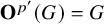 ${\mathbf O}^{p'}(G) = G$
, p divides
${\mathbf O}^{p'}(G) = G$
, p divides $|G/L|$
. By Lemma 2.6, there exists an
$|G/L|$
. By Lemma 2.6, there exists an $\Omega $
-invariant character of G with degree divisible by p, which finishes off the first case.
$\Omega $
-invariant character of G with degree divisible by p, which finishes off the first case.
For the second one, let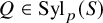 $Q \in {\operatorname {Syl}}_p(S)$
and let
$Q \in {\operatorname {Syl}}_p(S)$
and let $R = Q \times \cdots \times Q \in {\operatorname {Syl}}_p(N)$
. Let
$R = Q \times \cdots \times Q \in {\operatorname {Syl}}_p(N)$
. Let $g \in G \setminus H$
. Then, g moves at least one of the
$g \in G \setminus H$
. Then, g moves at least one of the $S_i$
through its action on
$S_i$
through its action on $\Lambda $
by conjugation, say
$\Lambda $
by conjugation, say $S_1$
. Then, if
$S_1$
. Then, if $1 \neq x \in Q$
,
$1 \neq x \in Q$
, $(x, 1, \ldots , 1)^g \neq (x, 1, \ldots , 1)$
, and so,
$(x, 1, \ldots , 1)^g \neq (x, 1, \ldots , 1)$
, and so, $g \not \in \mathbf C_G(R)$
. Consequently,
$g \not \in \mathbf C_G(R)$
. Consequently, $\mathbf C_G(R) \subseteq H$
. Let
$\mathbf C_G(R) \subseteq H$
. Let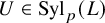 $U \in {\operatorname {Syl}}_p(L)$
contain R (notice how
$U \in {\operatorname {Syl}}_p(L)$
contain R (notice how $N \subseteq H \subseteq L$
). Then,
$N \subseteq H \subseteq L$
). Then, $\mathbf C_G(U) \subseteq \mathbf C_G(R) \subseteq H \subseteq L$
. By [Reference Malle, Moretó and Rizo11, Lemma 4.2],
$\mathbf C_G(U) \subseteq \mathbf C_G(R) \subseteq H \subseteq L$
. By [Reference Malle, Moretó and Rizo11, Lemma 4.2], ${\operatorname {Irr}}(G/L) \subseteq {\operatorname {Irr}}(B_0(G))$
. Finally, by Lemma 2.6, there exists
${\operatorname {Irr}}(G/L) \subseteq {\operatorname {Irr}}(B_0(G))$
. Finally, by Lemma 2.6, there exists $\chi \in {\operatorname {Irr}}_\Omega (G/L)$
with
$\chi \in {\operatorname {Irr}}_\Omega (G/L)$
with $p \mid \chi (1)$
, as desired.
$p \mid \chi (1)$
, as desired.
3 Proof of Theorem A
We are now ready to prove Theorem A, which we restate for convenience.
Theorem A. Let G be a finite group, let p be a prime number and let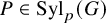 $P\in \mathrm {Syl}_p(G)$
. Suppose that the elements in
$P\in \mathrm {Syl}_p(G)$
. Suppose that the elements in $\mathrm {Irr}_{\Omega }(B_0(G))$
are all of
$\mathrm {Irr}_{\Omega }(B_0(G))$
are all of $p'$
-degree. Then P is abelian.
$p'$
-degree. Then P is abelian.
Proof. We break the proof down into a series of steps.
Step 0. We may assume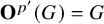 ${\mathbf O}^{p'}(G)=G$
and
${\mathbf O}^{p'}(G)=G$
and ${\mathbf O}_{p'}(G)=1$
. Moreover, if
${\mathbf O}_{p'}(G)=1$
. Moreover, if $1<N\lhd G$
,
$1<N\lhd G$
, $G/N$
has abelian Sylow p-subgroups. Also, G has a unique minimal normal subgroup N and
$G/N$
has abelian Sylow p-subgroups. Also, G has a unique minimal normal subgroup N and $p\neq 2$
.
$p\neq 2$
.
First, suppose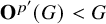 ${\mathbf O}^{p'}(G) < G$
. If there exists
${\mathbf O}^{p'}(G) < G$
. If there exists $\theta \in {\operatorname {Irr}}_{\Omega }(B_0({\mathbf O}^{p'}(G)))$
of degree divisible by p, then, by Lemma 2.8, we could find
$\theta \in {\operatorname {Irr}}_{\Omega }(B_0({\mathbf O}^{p'}(G)))$
of degree divisible by p, then, by Lemma 2.8, we could find $\chi \in {\operatorname {Irr}}_{\Omega }(B_0(G)\mid \theta )$
. Since
$\chi \in {\operatorname {Irr}}_{\Omega }(B_0(G)\mid \theta )$
. Since $\theta (1)$
divides
$\theta (1)$
divides $\chi (1)$
,
$\chi (1)$
, $\chi (1)_p> 1$
, which goes against our hypothesis. Thus,
$\chi (1)_p> 1$
, which goes against our hypothesis. Thus, ${\mathbf O}^{p'}(G)$
also fulfills our hypothesis, meaning it has abelian Sylow p-subgroups by induction. As
${\mathbf O}^{p'}(G)$
also fulfills our hypothesis, meaning it has abelian Sylow p-subgroups by induction. As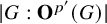 $|G:{\mathbf O}^{p'}(G)|$
is not divisible by p, this implies G has abelian Sylow p-subgroups and we are done.
$|G:{\mathbf O}^{p'}(G)|$
is not divisible by p, this implies G has abelian Sylow p-subgroups and we are done.
Now, let $1 \neq N \lhd G$
. Then,
$1 \neq N \lhd G$
. Then, ${\operatorname {Irr}}_{\Omega }(B_0(G/N)) \subseteq {\operatorname {Irr}}_{\Omega }(B_0(G))$
, meaning
${\operatorname {Irr}}_{\Omega }(B_0(G/N)) \subseteq {\operatorname {Irr}}_{\Omega }(B_0(G))$
, meaning $G/N$
also satisfies the hypothesis. By induction, it has abelian Sylow p-subgroups. In particular, assume
$G/N$
also satisfies the hypothesis. By induction, it has abelian Sylow p-subgroups. In particular, assume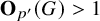 ${\mathbf O}_{p'}(G)> 1$
. Then,
${\mathbf O}_{p'}(G)> 1$
. Then, $G/{\mathbf O}_{p'}(G)$
has abelian Sylow p-subgroups and if
$G/{\mathbf O}_{p'}(G)$
has abelian Sylow p-subgroups and if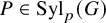 $P \in {\operatorname {Syl}}_p(G)$
, then
$P \in {\operatorname {Syl}}_p(G)$
, then $P \cong P{\mathbf O}_{p'}(G)/{\mathbf O}_{p'}(G) \in {\operatorname {Syl}}_p(G/{\mathbf O}_{p'}(G))$
, meaning P is also abelian, as we wanted to prove.
$P \cong P{\mathbf O}_{p'}(G)/{\mathbf O}_{p'}(G) \in {\operatorname {Syl}}_p(G/{\mathbf O}_{p'}(G))$
, meaning P is also abelian, as we wanted to prove.
Finally, let $M, N$
be distinct minimal normal subgroups of G. Then, the diagonal map composed with the canonical projections gives an embedding of G into
$M, N$
be distinct minimal normal subgroups of G. Then, the diagonal map composed with the canonical projections gives an embedding of G into $G/N \times G/M$
. By our previous paragraph, both of these have abelian Sylow p-subgroups. Since the Sylow p-subgroups of G embed into those of
$G/N \times G/M$
. By our previous paragraph, both of these have abelian Sylow p-subgroups. Since the Sylow p-subgroups of G embed into those of $G/N \times G/M$
, they are abelian as well. The fact that we can assume
$G/N \times G/M$
, they are abelian as well. The fact that we can assume $p \neq 2$
follows from [Reference Malle, Moretó, Rizo and Schaeffer Fry12, Theorem 2].
$p \neq 2$
follows from [Reference Malle, Moretó, Rizo and Schaeffer Fry12, Theorem 2].
Step 1. Let N be the unique minimal normal subgroup of G. We may assume that N is not semisimple; in particular, ${\mathbf O}_p(G)> 1$
.
${\mathbf O}_p(G)> 1$
.
Suppose $N = S_1 \times \cdots \times S_t$
is a product of isomorphic non-abelian simple groups of order divisible by p, which are transitively permuted by G-conjugation. If
$N = S_1 \times \cdots \times S_t$
is a product of isomorphic non-abelian simple groups of order divisible by p, which are transitively permuted by G-conjugation. If $t> 1$
, then the result follows by Step 0 and Lemma 2.10. Now, if
$t> 1$
, then the result follows by Step 0 and Lemma 2.10. Now, if $t = 1$
, by the uniqueness of
$t = 1$
, by the uniqueness of $N = S$
,
$N = S$
, $\mathbf C_G(S) = 1$
and G is an almost simple group with socle S, without proper normal subgroups of
$\mathbf C_G(S) = 1$
and G is an almost simple group with socle S, without proper normal subgroups of $p'$
-index. Then, the result holds by [Reference Malle, Moretó, Rizo and Schaeffer Fry12, Theorem 2.17].
$p'$
-index. Then, the result holds by [Reference Malle, Moretó, Rizo and Schaeffer Fry12, Theorem 2.17].
Step 2. If $N\subseteq \mathbf Z(G)$
, then we are done.
$N\subseteq \mathbf Z(G)$
, then we are done.
Suppose that $N\subseteq \mathbf Z(G)$
(so
$N\subseteq \mathbf Z(G)$
(so $|N|=p$
). Then,
$|N|=p$
). Then, ${\mathbf O}_{p'}(G/N) = N/N$
. Otherwise, if
${\mathbf O}_{p'}(G/N) = N/N$
. Otherwise, if $N \subsetneqq K$
is such that
$N \subsetneqq K$
is such that $K/N = {\mathbf O}_{p'}(G/N)$
, then
$K/N = {\mathbf O}_{p'}(G/N)$
, then $K = XN$
, by the Schur–Zassenhaus Theorem. But the centrality of N implies
$K = XN$
, by the Schur–Zassenhaus Theorem. But the centrality of N implies $X \unlhd K$
, and thus X is characteristic in K, hence normal in G, contradicting N being the unique minimal normal subgroup of G.
$X \unlhd K$
, and thus X is characteristic in K, hence normal in G, contradicting N being the unique minimal normal subgroup of G.
Since $G/N$
has abelian Sylow p-subgroups, by [Reference Malle, Moretó and Rizo11, Theorem 4.1], we have that G is the central product of some normal subgroups X,
$G/N$
has abelian Sylow p-subgroups, by [Reference Malle, Moretó and Rizo11, Theorem 4.1], we have that G is the central product of some normal subgroups X, $S_1,\ldots , S_t$
, where
$S_1,\ldots , S_t$
, where $X/N$
is an abelian p-group and, for each i,
$X/N$
is an abelian p-group and, for each i, $S_i/N$
is a non-abelian simple group with abelian Sylow p-subgroups. Since N is the unique minimal normal subgroup of G,
$S_i/N$
is a non-abelian simple group with abelian Sylow p-subgroups. Since N is the unique minimal normal subgroup of G, $N\subseteq S_i'$
. Then, as
$N\subseteq S_i'$
. Then, as $S_i/N$
is non-abelian simple, we have that
$S_i/N$
is non-abelian simple, we have that $S_i$
is perfect, hence
$S_i$
is perfect, hence $S_i$
is a quasi-simple group with center N, for every i.
$S_i$
is a quasi-simple group with center N, for every i.
Let $1_N\neq \lambda \in {\operatorname {Irr}}(N)$
. By [Reference Malle, Moretó, Rizo and Schaeffer Fry12, Theorem 2.9] there exists
$1_N\neq \lambda \in {\operatorname {Irr}}(N)$
. By [Reference Malle, Moretó, Rizo and Schaeffer Fry12, Theorem 2.9] there exists $\psi _i \in {\operatorname {Irr}}_\Omega (B_0(S_i))$
of degree divisible by p lying over
$\psi _i \in {\operatorname {Irr}}_\Omega (B_0(S_i))$
of degree divisible by p lying over $\lambda $
(if necessary, replacing
$\lambda $
(if necessary, replacing $\psi _i$
by a Galois conjugate). Now, letting
$\psi _i$
by a Galois conjugate). Now, letting $\xi \in \mathrm {Irr}(X|\lambda )$
, then
$\xi \in \mathrm {Irr}(X|\lambda )$
, then $\xi \in \mathrm {Irr}_\Omega (B_0(X)|\lambda )$
. By [Reference Malle and Navarro13, Lemma 4.1] we have that the central product of characters
$\xi \in \mathrm {Irr}_\Omega (B_0(X)|\lambda )$
. By [Reference Malle and Navarro13, Lemma 4.1] we have that the central product of characters
 $$ \begin{align*}\chi=\xi\star \psi_1\star\psi_2\star \cdots\star \psi_t\end{align*} $$
lies in the principal block of G. Hence $\chi \in \mathrm { Irr}_\Omega (B_0(G))$
has degree divisible by p, a contradiction.
$\chi \in \mathrm { Irr}_\Omega (B_0(G))$
has degree divisible by p, a contradiction.
Step 3. We may assume that $\mathbf F(G)=\mathbf F^*(G)$
.
$\mathbf F(G)=\mathbf F^*(G)$
.
Since ${\mathbf O}_{p'}(G)=1$
we have that
${\mathbf O}_{p'}(G)=1$
we have that $F=\mathbf F(G)={\mathbf O}_p(G)>1$
. Suppose that
$F=\mathbf F(G)={\mathbf O}_p(G)>1$
. Suppose that $E=\mathbf E(G)>1$
and let
$E=\mathbf E(G)>1$
and let $Z=\mathbf Z(E)$
. Since N is the unique minimal normal subgroup of G,
$Z=\mathbf Z(E)$
. Since N is the unique minimal normal subgroup of G, $N\subseteq Z$
(notice that
$N\subseteq Z$
(notice that $Z>1$
since otherwise
$Z>1$
since otherwise $\mathbf F^*(G)=\mathbf F(G)\times E$
in contradiction with the fact that
$\mathbf F^*(G)=\mathbf F(G)\times E$
in contradiction with the fact that $N\subseteq E$
). We claim that
$N\subseteq E$
). We claim that $E/Z=S_1/Z\times \cdots \times S_n/Z$
, where
$E/Z=S_1/Z\times \cdots \times S_n/Z$
, where $S_i\trianglelefteq G$
for every i. Let
$S_i\trianglelefteq G$
for every i. Let $W/Z$
be a (non-abelian) minimal normal subgroup of
$W/Z$
be a (non-abelian) minimal normal subgroup of $G/Z$
contained in
$G/Z$
contained in $E/Z$
. By the Schur–Zassenhaus Theorem and Step 0, we know that
$E/Z$
. By the Schur–Zassenhaus Theorem and Step 0, we know that $|W/Z|$
is divisible by p. Now, since
$|W/Z|$
is divisible by p. Now, since $G/Z$
has abelian Sylow subgroups, we can once again use [Reference Malle, Moretó and Rizo11, Theorem 4.1]. Then, if
$G/Z$
has abelian Sylow subgroups, we can once again use [Reference Malle, Moretó and Rizo11, Theorem 4.1]. Then, if $K/Z = {\mathbf O}_{p'}(G/Z)$
,
$K/Z = {\mathbf O}_{p'}(G/Z)$
, $K \cap W = Z$
and
$K \cap W = Z$
and $WK/K$
is a minimal normal subgroup of
$WK/K$
is a minimal normal subgroup of $G/K$
, which is the direct product of an abelian p-group and non-abelian simple groups of order divisible by p. Since
$G/K$
, which is the direct product of an abelian p-group and non-abelian simple groups of order divisible by p. Since $WK/K \cong W/Z$
, we have that
$WK/K \cong W/Z$
, we have that $W/Z$
is simple and the claim follows.
$W/Z$
is simple and the claim follows.
Write $S=S_1$
, so that
$S=S_1$
, so that $S'$
is a quasi-simple normal subgroup of G. Using again that N is the unique minimal normal subgroup of G, we have that
$S'$
is a quasi-simple normal subgroup of G. Using again that N is the unique minimal normal subgroup of G, we have that $N\subseteq \mathbf Z(S)\cap S'\subseteq \mathbf Z(S')$
. Looking at the Schur multipliers of the simple groups [Reference Gorenstein, Lyons and Solomon4], if
$N\subseteq \mathbf Z(S)\cap S'\subseteq \mathbf Z(S')$
. Looking at the Schur multipliers of the simple groups [Reference Gorenstein, Lyons and Solomon4], if $p\geq 5$
, we deduce that
$p\geq 5$
, we deduce that $\mathbf Z(S')$
has cyclic Sylow p-subgroups. We claim that
$\mathbf Z(S')$
has cyclic Sylow p-subgroups. We claim that $\mathbf Z(S')$
has cyclic Sylow p-subgroups for
$\mathbf Z(S')$
has cyclic Sylow p-subgroups for $p=3$
as well.
$p=3$
as well.
Indeed, it can be checked in [2] that the unique simple group S whose Schur multiplier has a non-cyclic Sylow $3$
-subgroup is
$3$
-subgroup is $\operatorname {PSU}_4(3)$
, but this group does not have abelian Sylow
$\operatorname {PSU}_4(3)$
, but this group does not have abelian Sylow $3$
-subgroups.
$3$
-subgroups.
In all cases, we conclude that N is cyclic and hence $|N|=p$
. Now, the order of
$|N|=p$
. Now, the order of $G/\mathbf C_G(N)$
divides
$G/\mathbf C_G(N)$
divides $p-1$
. Using Step 0 we conclude that N is central in G and we are done by Step 2. Therefore, we may assume that
$p-1$
. Using Step 0 we conclude that N is central in G and we are done by Step 2. Therefore, we may assume that $E=1$
, so that
$E=1$
, so that $\mathbf F(G)=\mathbf F^*(G)$
, as desired.
$\mathbf F(G)=\mathbf F^*(G)$
, as desired.
Step 4. We may assume that G has a unique p-block.
Since ${\mathbf O}_{p'}(G)=1$
and we have that
${\mathbf O}_{p'}(G)=1$
and we have that ${\mathbf O}_p(G)=\mathbf F(G)=\mathbf F^*(G)$
by Step 3, then
${\mathbf O}_p(G)=\mathbf F(G)=\mathbf F^*(G)$
by Step 3, then $\mathbf {C}_{G}(\mathbf{O}_p(G))\subseteq {\mathbf O}_p(G)$
, by Hall–Higman’s Lemma 1.2.3 ([Reference Isaacs8, Theorem 3.21], for instance). In this situation, G has a unique p-block, since, by [Reference Navarro17, Theorems 4.8, 4.14], each p-block of G is induced from a p-block of
$\mathbf {C}_{G}(\mathbf{O}_p(G))\subseteq {\mathbf O}_p(G)$
, by Hall–Higman’s Lemma 1.2.3 ([Reference Isaacs8, Theorem 3.21], for instance). In this situation, G has a unique p-block, since, by [Reference Navarro17, Theorems 4.8, 4.14], each p-block of G is induced from a p-block of ${\mathbf O}_p(G)$
, and there is only one such block.
${\mathbf O}_p(G)$
, and there is only one such block.
Step 5. We may assume that if $\lambda \in \mathrm {Irr}(N)$
, then p does not divide
$\lambda \in \mathrm {Irr}(N)$
, then p does not divide $|G:G_\lambda |$
.
$|G:G_\lambda |$
.
We first prove that there exists an $\Omega $
-invariant
$\Omega $
-invariant $\chi \in \mathrm {Irr}(G_\lambda )$
. Let
$\chi \in \mathrm {Irr}(G_\lambda )$
. Let $R\in \mathrm {Syl}_p(G_\lambda )$
and let
$R\in \mathrm {Syl}_p(G_\lambda )$
and let $\psi \in \mathrm { Irr}(R|\lambda )$
of minimum degree among the characters in
$\psi \in \mathrm { Irr}(R|\lambda )$
of minimum degree among the characters in $\mathrm {Irr}(R|\lambda )$
. Let
$\mathrm {Irr}(R|\lambda )$
. Let $\Delta =\psi ^{G_\lambda }$
, so
$\Delta =\psi ^{G_\lambda }$
, so $\Delta $
is an
$\Delta $
is an $\Omega $
-invariant character (notice that
$\Omega $
-invariant character (notice that $\psi $
is
$\psi $
is $\Omega $
-invariant because R is a p-group). Now notice that if
$\Omega $
-invariant because R is a p-group). Now notice that if $\chi \in \mathrm {Irr}(\Delta )$
, then
$\chi \in \mathrm {Irr}(\Delta )$
, then $\chi $
lies over
$\chi $
lies over $\psi $
and hence over
$\psi $
and hence over $\lambda $
. Since
$\lambda $
. Since $\lambda $
is
$\lambda $
is $G_\lambda $
-invariant, if
$G_\lambda $
-invariant, if $\xi \in \mathrm {Irr}(R)$
is a constituent of
$\xi \in \mathrm {Irr}(R)$
is a constituent of $\chi _R$
, then
$\chi _R$
, then $\xi $
lies necessarily over
$\xi $
lies necessarily over $\lambda $
and then
$\lambda $
and then $\xi (1)\geq \psi (1)$
, and since they are p-powers,
$\xi (1)\geq \psi (1)$
, and since they are p-powers, $\psi (1)\mid \xi (1)$
. Hence, if
$\psi (1)\mid \xi (1)$
. Hence, if $\xi $
is an irreducible constituent of
$\xi $
is an irreducible constituent of $\Delta _R$
, we have that
$\Delta _R$
, we have that $\psi (1)\mid \xi (1)$
. Write
$\psi (1)\mid \xi (1)$
. Write $\Delta _R=a_1\xi _1+\ldots + a_k\xi _k$
, with
$\Delta _R=a_1\xi _1+\ldots + a_k\xi _k$
, with $\xi _i\in \mathrm {Irr}(R)$
.
$\xi _i\in \mathrm {Irr}(R)$
.
Then
 $$ \begin{align*}|G_\lambda:R|\psi(1)=\Delta(1)=a_1\xi_1(1)+\ldots +a_k\xi_k(1)=\psi(1)\left(a_1\frac{\xi_1(1)}{\psi(1)}+\ldots + a_k\frac{\xi_k(1)}{\psi(1)}\right),\end{align*} $$
and hence
 $$ \begin{align*}|G_\lambda:R|=a_1\frac{\xi_1(1)}{\psi(1)}+\ldots + a_k\frac{\xi_k(1)}{\psi(1)},\end{align*} $$
and, since $|G_\lambda :R|$
is a
$|G_\lambda :R|$
is a $p'$
-number, we conclude that there exists i such that
$p'$
-number, we conclude that there exists i such that $a_i$
is not divisible by p. Now by [Reference Navarro and Tiep18, Lemma 2.1 (i)] applied to
$a_i$
is not divisible by p. Now by [Reference Navarro and Tiep18, Lemma 2.1 (i)] applied to $G_\lambda $
, R,
$G_\lambda $
, R, $A=\Omega $
and
$A=\Omega $
and $\Delta $
, we conclude that there exists an
$\Delta $
, we conclude that there exists an $\Omega $
-invariant
$\Omega $
-invariant $\tau \in \mathrm {Irr}(G_\lambda )$
with
$\tau \in \mathrm {Irr}(G_\lambda )$
with $[\Delta ,\tau ]\neq 0$
. In particular,
$[\Delta ,\tau ]\neq 0$
. In particular, $\tau $
lies over
$\tau $
lies over $\lambda $
and is
$\lambda $
and is $\Omega $
-invariant. Then
$\Omega $
-invariant. Then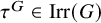 $\tau ^G\in \mathrm {Irr}(G)$
is
$\tau ^G\in \mathrm {Irr}(G)$
is $\Omega $
-invariant and by our hypothesis, combined with Step
$\Omega $
-invariant and by our hypothesis, combined with Step $4$
,
$4$
, $p\nmid \tau ^G(1)$
. Then
$p\nmid \tau ^G(1)$
. Then $|G:G_\lambda |$
is a
$|G:G_\lambda |$
is a $p'$
-number, as wanted.
$p'$
-number, as wanted.
Step 6. We may assume that ${\mathbf O}_{p'}(G/N)>1$
.
${\mathbf O}_{p'}(G/N)>1$
.
Recall that by Step 0, $G/N$
has abelian Sylow p-subgroups. Suppose
$G/N$
has abelian Sylow p-subgroups. Suppose ${\mathbf O}_{p'}(G/N)=1$
. Then, since
${\mathbf O}_{p'}(G/N)=1$
. Then, since $G/N$
has abelian Sylow p-subgroups, using [Reference Malle, Moretó and Rizo11, Theorem 4.1], there exist
$G/N$
has abelian Sylow p-subgroups, using [Reference Malle, Moretó and Rizo11, Theorem 4.1], there exist $X,Y\trianglelefteq G$
containing N such that
$X,Y\trianglelefteq G$
containing N such that $X/N$
is an abelian p-group,
$X/N$
is an abelian p-group, $Y/N$
is a direct product of non-abelian simple groups
$Y/N$
is a direct product of non-abelian simple groups $V_i/N$
of order divisible by p and
$V_i/N$
of order divisible by p and $G/N=X/N\times Y/N$
. Furthermore
$G/N=X/N\times Y/N$
. Furthermore $V_i/N$
is normal in
$V_i/N$
is normal in $G/N$
, since it is normal in
$G/N$
, since it is normal in $Y/N$
and commutes with all elements of
$Y/N$
and commutes with all elements of $X/N$
. Notice that X is a p-group, so
$X/N$
. Notice that X is a p-group, so $1<\mathbf Z(X)\lhd G$
. Therefore,
$1<\mathbf Z(X)\lhd G$
. Therefore, $N\subseteq \mathbf Z(X)$
. Then
$N\subseteq \mathbf Z(X)$
. Then $X\subseteq \mathbf C_G(N)$
. Moreover, since
$X\subseteq \mathbf C_G(N)$
. Moreover, since $V_i/N$
is simple,
$V_i/N$
is simple, $\mathbf C_{V_i}(N)=V_i$
or
$\mathbf C_{V_i}(N)=V_i$
or $\mathbf C_{V_i}(N)=N$
. If the former happens for some i, then
$\mathbf C_{V_i}(N)=N$
. If the former happens for some i, then $N\subseteq \mathbf Z(V_i)$
and hence, as in Step 3, it is cyclic. Then
$N\subseteq \mathbf Z(V_i)$
and hence, as in Step 3, it is cyclic. Then $|N|=p$
, and
$|N|=p$
, and $|G:\mathbf {C}_{G}(N)|$
divides
$|G:\mathbf {C}_{G}(N)|$
divides $p-1$
. By Step 0 we conclude that
$p-1$
. By Step 0 we conclude that $N\subseteq \mathrm {\textbf {Z}}(G)$
and hence we are done by Step 2. Therefore
$N\subseteq \mathrm {\textbf {Z}}(G)$
and hence we are done by Step 2. Therefore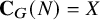 $\mathbf C_{G}(N)=X$
.
$\mathbf C_{G}(N)=X$
.
Using Step 5, we now apply Theorem 2.3 and Theorem 2.4 to the action of $G/X\cong Y/N$
on
$G/X\cong Y/N$
on ${\operatorname {Irr}}(N)$
. Suppose first that this action is primitive, so that Theorem 2.3 applies. Since
${\operatorname {Irr}}(N)$
. Suppose first that this action is primitive, so that Theorem 2.3 applies. Since $G/X$
is not solvable, we are not in case (2). Suppose now that we are in case (3). In subcases (i) and (v),
$G/X$
is not solvable, we are not in case (2). Suppose now that we are in case (3). In subcases (i) and (v), $p=2$
in contradiction with Step 0. Since
$p=2$
in contradiction with Step 0. Since $G/X\cong Y/N$
is a direct product of simple groups, subcase (ii) does not occur. In subcases (iii) and (iv), we may assume that
$G/X\cong Y/N$
is a direct product of simple groups, subcase (ii) does not occur. In subcases (iii) and (iv), we may assume that $G/X=\operatorname {PSL}_2(11)$
or
$G/X=\operatorname {PSL}_2(11)$
or $G/X=M_{11}$
and that
$G/X=M_{11}$
and that $p=3$
, respectively. In subcase (iii), there exists
$p=3$
, respectively. In subcase (iii), there exists $\chi \in {\operatorname {Irr}}_\Omega (G/X)$
such that
$\chi \in {\operatorname {Irr}}_\Omega (G/X)$
such that $\chi (1)=12$
, a contradiction. Suppose that
$\chi (1)=12$
, a contradiction. Suppose that $G/X\cong Y/N=M_{11}$
and
$G/X\cong Y/N=M_{11}$
and $p=3$
. Then there is a rational character of degree 45 in
$p=3$
. Then there is a rational character of degree 45 in $\mathrm {Irr}(G/X)$
, another contradiction.
$\mathrm {Irr}(G/X)$
, another contradiction.
Finally, assuming we are in case (1), we may argue as in Step 8 of the proof of [Reference Malle, Moretó and Rizo11, Theorem 4.6]. Doing so, we see that all of the cases we need to consider – namely, the simple groups with abelian Sylow p-subgroup that appear in [Reference Liebeck10, Appendix 1] – require $p = 2$
, and this goes against Step 0.
$p = 2$
, and this goes against Step 0.
Now, we may assume that the action of $L=Y/N$
on N is imprimitive. We apply Theorem 2.4 (recall that
$L=Y/N$
on N is imprimitive. We apply Theorem 2.4 (recall that $L={\mathbf O}^{p'}(L)$
by Step 0). Let
$L={\mathbf O}^{p'}(L)$
by Step 0). Let $N=N_1\oplus \cdots \oplus N_n$
be an imprimitivity decomposition for N. Therefore,
$N=N_1\oplus \cdots \oplus N_n$
be an imprimitivity decomposition for N. Therefore, $\mathbf N_L(N_i)$
is transitive on
$\mathbf N_L(N_i)$
is transitive on $N_i\setminus \{0\}$
and
$N_i\setminus \{0\}$
and $M:=L/\bigcap \mathbf N_L(N_i)$
induces a primitive p-concealed subgroup of
$M:=L/\bigcap \mathbf N_L(N_i)$
induces a primitive p-concealed subgroup of $\mathfrak S_n$
. Note that M is a factor group of G. By Lemma 2.6, this group has an
$\mathfrak S_n$
. Note that M is a factor group of G. By Lemma 2.6, this group has an $\Omega $
-invariant irreducible character
$\Omega $
-invariant irreducible character $\chi $
such that
$\chi $
such that $\chi (1)_p>1$
and the result follows in this case.
$\chi (1)_p>1$
and the result follows in this case.
Step 7. We may assume that $N=\mathbf F(G)$
; in particular,
$N=\mathbf F(G)$
; in particular, $\mathbf C_G(N)=N$
.
$\mathbf C_G(N)=N$
.
Let $K/N={\mathbf O}_{p'}(G/N)$
. By Step 6, we may assume that
$K/N={\mathbf O}_{p'}(G/N)$
. By Step 6, we may assume that $K>N$
. By the Schur–Zassenhaus Theorem, there exists a p-complement H of K, so
$K>N$
. By the Schur–Zassenhaus Theorem, there exists a p-complement H of K, so $K=HN$
and
$K=HN$
and $H\cap N=1$
. Then by the Frattini argument we have
$H\cap N=1$
. Then by the Frattini argument we have $G=N\mathbf N_G(H)$
. Write
$G=N\mathbf N_G(H)$
. Write $L=\mathbf N_G(H)$
. Now, since N is abelian and normal in G,
$L=\mathbf N_G(H)$
. Now, since N is abelian and normal in G, $\mathbf N_N(H)$
is also normal in
$\mathbf N_N(H)$
is also normal in $G=N\mathbf N_G(H)=NL$
, and so either
$G=N\mathbf N_G(H)=NL$
, and so either $\mathbf N_N(H) =1$
or
$\mathbf N_N(H) =1$
or $\mathbf N_N(H) = N$
. If
$\mathbf N_N(H) = N$
. If $\mathbf N_N(H)=N$
, then
$\mathbf N_N(H)=N$
, then $H\lhd G$
, and we get a contradiction since
$H\lhd G$
, and we get a contradiction since ${\mathbf O}_{p'}(G)=1$
by Step 0. Thus,
${\mathbf O}_{p'}(G)=1$
by Step 0. Thus, $L\cap N=\mathbf N_N(H) =1$
and L is a complement of N in G.
$L\cap N=\mathbf N_N(H) =1$
and L is a complement of N in G.
Let $F=\mathbf F(G)={\mathbf O}_p(G)$
. We claim that
$F=\mathbf F(G)={\mathbf O}_p(G)$
. We claim that $F=N$
. Notice that
$F=N$
. Notice that $N\subseteq \mathbf Z(F)$
since
$N\subseteq \mathbf Z(F)$
since $\mathbf Z(F)>1$
. Let
$\mathbf Z(F)>1$
. Let $F_1=F\cap L$
. Then
$F_1=F\cap L$
. Then $F_1\lhd L$
and since
$F_1\lhd L$
and since $G=NL$
, we have that
$G=NL$
, we have that $F_1\lhd G$
. Since N is the unique minimal normal subgroup of G, this forces
$F_1\lhd G$
. Since N is the unique minimal normal subgroup of G, this forces $F_1=1$
, so
$F_1=1$
, so $F=N$
as claimed. Also, since
$F=N$
as claimed. Also, since $N=\mathbf F(G)=\mathbf F^*(G)$
by Step 3, we have
$N=\mathbf F(G)=\mathbf F^*(G)$
by Step 3, we have $\mathbf C_G(N)\subseteq N$
, as wanted.
$\mathbf C_G(N)\subseteq N$
, as wanted.
Step 8. Completion of the proof.
Let $K/N={\mathbf O}_{p'}(G/N)$
. By Step 6, we may assume that
$K/N={\mathbf O}_{p'}(G/N)$
. By Step 6, we may assume that $K>N$
. Again, by Step 0 we have that there exist
$K>N$
. Again, by Step 0 we have that there exist $X,Y\trianglelefteq G$
containing N such that
$X,Y\trianglelefteq G$
containing N such that $X/K$
is an abelian p-group,
$X/K$
is an abelian p-group, $Y/K$
is a direct product of non-abelian simple groups
$Y/K$
is a direct product of non-abelian simple groups $V_i/K\trianglelefteq G/K$
of order divisible by p and
$V_i/K\trianglelefteq G/K$
of order divisible by p and $G/K=X/K\times Y/K$
.
$G/K=X/K\times Y/K$
.
As in Step 7, let H be a p-complement of K and let $L=\mathbf N_G(H)$
. Then
$L=\mathbf N_G(H)$
. Then $G=NL$
and
$G=NL$
and $N\cap L=1$
. By Step 7, we may assume that L acts faithfully and irreducibly on
$N\cap L=1$
. By Step 7, we may assume that L acts faithfully and irreducibly on ${\operatorname {Irr}}(N)$
. By Step 5, this action can be assumed to be p-exceptional.
${\operatorname {Irr}}(N)$
. By Step 5, this action can be assumed to be p-exceptional.
Suppose first that the action of L on ${\operatorname {Irr}}(N)$
is primitive. We apply Theorem 2.3. In case (2), G is solvable and we are done by [Reference Malle, Moretó, Rizo and Schaeffer Fry12, Theorem 3]. Assume that we are in case (3). In subcases (i) and (v) have that
${\operatorname {Irr}}(N)$
is primitive. We apply Theorem 2.3. In case (2), G is solvable and we are done by [Reference Malle, Moretó, Rizo and Schaeffer Fry12, Theorem 3]. Assume that we are in case (3). In subcases (i) and (v) have that $p=2$
, in contradiction with Step 0. In subcases (ii), (iii) and (iv)
$p=2$
, in contradiction with Step 0. In subcases (ii), (iii) and (iv) $G/N$
has a normal subgroup
$G/N$
has a normal subgroup $V/N=\operatorname {SL}_2(5), \operatorname {PSL}_2(11)$
or
$V/N=\operatorname {SL}_2(5), \operatorname {PSL}_2(11)$
or $M_{11}$
respectively and in all cases
$M_{11}$
respectively and in all cases $p=3$
. Note that one of the simple direct factors of
$p=3$
. Note that one of the simple direct factors of $Y/K$
is then
$Y/K$
is then $\mathfrak A_5,\operatorname {PSL}_2(11)$
or
$\mathfrak A_5,\operatorname {PSL}_2(11)$
or $M_{11}$
, respectively. Since they all have
$M_{11}$
, respectively. Since they all have $\Omega $
-invariant irreducible characters of degree divisible by
$\Omega $
-invariant irreducible characters of degree divisible by $3$
, the result follows in these cases.
$3$
, the result follows in these cases.
Now, we may assume that we are in case (1). So L is transitive on ${\operatorname {Irr}}(N)\setminus \{1_N\}$
and L is one of the groups from Hering’s theorem. Again, we use the description in [Reference Liebeck10, Appendix 1]. We start with the infinite classes described in (A). Since
${\operatorname {Irr}}(N)\setminus \{1_N\}$
and L is one of the groups from Hering’s theorem. Again, we use the description in [Reference Liebeck10, Appendix 1]. We start with the infinite classes described in (A). Since $G/N$
is not solvable and has abelian Sylow p-subgroups, it follows that
$G/N$
is not solvable and has abelian Sylow p-subgroups, it follows that $G/N$
has a normal subgroup
$G/N$
has a normal subgroup $V/N\cong \operatorname {SL}_2(p^n)$
, where
$V/N\cong \operatorname {SL}_2(p^n)$
, where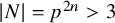 $|N|=p^{2n}>3$
. Now, write
$|N|=p^{2n}>3$
. Now, write $G/K=X/K\times Y/K=X/K\times Y_1/K\times \cdots \times Y_t/K$
. Since
$G/K=X/K\times Y/K=X/K\times Y_1/K\times \cdots \times Y_t/K$
. Since $\operatorname {PSL}_2(p^n)$
is a non-abelian composition factor of G of order divisible by p, it is a composition factor of
$\operatorname {PSL}_2(p^n)$
is a non-abelian composition factor of G of order divisible by p, it is a composition factor of $G/K$
. Hence, there must be some i such that
$G/K$
. Hence, there must be some i such that $Y_i/K\cong \operatorname {PSL}_2(p^n)$
. Write
$Y_i/K\cong \operatorname {PSL}_2(p^n)$
. Write $M/K=Y_i/K$
and let
$M/K=Y_i/K$
and let $\varphi \in \mathrm {Irr}_\Omega (M/K)$
of degree divisible by p (using [Reference Malle, Moretó, Rizo and Schaeffer Fry12, Theorem 2.8], for instance). Then
$\varphi \in \mathrm {Irr}_\Omega (M/K)$
of degree divisible by p (using [Reference Malle, Moretó, Rizo and Schaeffer Fry12, Theorem 2.8], for instance). Then $\chi =1\times \cdots \times 1\times \varphi \times 1\times \cdots \times 1\in \mathrm { Irr}(G/K)\subseteq \mathrm {Irr}(G)$
is
$\chi =1\times \cdots \times 1\times \varphi \times 1\times \cdots \times 1\in \mathrm { Irr}(G/K)\subseteq \mathrm {Irr}(G)$
is $\Omega $
-invariant and of degree divisible by p.
$\Omega $
-invariant and of degree divisible by p.
Next, we consider the extra-special classes described in (B). The first four groups in [Reference Liebeck10, Table 10] are solvable, so they do not occur. The last case of this table (where $|N|=3^4)$
can be handled with [2]. In this case we have that L (
$|N|=3^4)$
can be handled with [2]. In this case we have that L ( $G_0$
in the notation of Liebeck) has a normal
$G_0$
in the notation of Liebeck) has a normal $2$
-subgroup R such that
$2$
-subgroup R such that $L/R$
is isomorphic to a subgroup of
$L/R$
is isomorphic to a subgroup of $\mathfrak S_5$
. Since G is not solvable,
$\mathfrak S_5$
. Since G is not solvable, $L/R$
cannot be solvable and hence
$L/R$
cannot be solvable and hence $L/R\cong \mathfrak A_5$
or
$L/R\cong \mathfrak A_5$
or $L/R\cong \mathfrak S_5$
. As before, this means that one of the simple direct factors of
$L/R\cong \mathfrak S_5$
. As before, this means that one of the simple direct factors of $Y/K$
is isomorphic to
$Y/K$
is isomorphic to $\mathfrak A_5$
and we know it possesses an
$\mathfrak A_5$
and we know it possesses an $\Omega $
-invariant character of degree divisible by
$\Omega $
-invariant character of degree divisible by $3$
.
$3$
.
Finally, we consider the exceptional classes described in (C). In the cases where $p^d\in \{11^2,19^2,29^2,59^2\}$
in [Reference Liebeck10, Table 11], we have that
$p^d\in \{11^2,19^2,29^2,59^2\}$
in [Reference Liebeck10, Table 11], we have that $G/N$
(and hence, G) is p-solvable, so we are done by [Reference Malle, Moretó, Rizo and Schaeffer Fry12, Theorem 3]. Since
$G/N$
(and hence, G) is p-solvable, so we are done by [Reference Malle, Moretó, Rizo and Schaeffer Fry12, Theorem 3]. Since $G/N$
has abelian Sylow p-subgroups, we are left with the first and the last cases of Table 11. In the last case,
$G/N$
has abelian Sylow p-subgroups, we are left with the first and the last cases of Table 11. In the last case, $p=3$
and
$p=3$
and $G/N\cong \operatorname {SL}_2(13)$
. Here, there is
$G/N\cong \operatorname {SL}_2(13)$
. Here, there is $\chi \in {\operatorname {Irr}}(G/N)$
of degree 6 which is
$\chi \in {\operatorname {Irr}}(G/N)$
of degree 6 which is $\Omega $
-invariant. The first case can be handled as above, since we again have
$\Omega $
-invariant. The first case can be handled as above, since we again have $\mathfrak A_5$
as a simple direct factor of
$\mathfrak A_5$
as a simple direct factor of $Y/K$
.
$Y/K$
.
Now, assume that the action of L on N is imprimitive. Arguing as in the last paragraph of Step 6, we find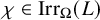 $\chi \in {\operatorname {Irr}}_\Omega (L)$
such that
$\chi \in {\operatorname {Irr}}_\Omega (L)$
such that $\chi (1)_p>1$
. This final contradiction completes the proof.
$\chi (1)_p>1$
. This final contradiction completes the proof.
The following will be used in the proof of Theorem B.
Corollary 3.1. Let G be a finite group, with p a prime and suppose that ${\operatorname {Irr}}_{\Omega }(B_0(G)) \subseteq {\operatorname {Irr}}_{p'}(G)$
. Then, if
${\operatorname {Irr}}_{\Omega }(B_0(G)) \subseteq {\operatorname {Irr}}_{p'}(G)$
. Then, if $N = {\mathbf O}_{p'}({\mathbf O}^{p'}(G))$
,
$N = {\mathbf O}_{p'}({\mathbf O}^{p'}(G))$
, ${\mathbf O}^{p'}(G)/N \cong X/N \times Y/N$
, where
${\mathbf O}^{p'}(G)/N \cong X/N \times Y/N$
, where $X/N$
is an abelian p-group and
$X/N$
is an abelian p-group and $Y/N$
is either trivial or a direct product of non-abelian finite simple groups of order divisible by p without
$Y/N$
is either trivial or a direct product of non-abelian finite simple groups of order divisible by p without $\Omega $
-invariant characters of degree divisible by p in the principal block.
$\Omega $
-invariant characters of degree divisible by p in the principal block.
Proof. By Theorem A, G has abelian Sylow p-subgroups. The result then follows by [Reference Malle, Moretó and Rizo11, Theorem 4.1]. The fact that the simple direct factors of $Y/N$
do not possess any
$Y/N$
do not possess any $\Omega $
-invariant characters of degree divisible by p in the principal block follows from Lemma 2.8 and the fact that
$\Omega $
-invariant characters of degree divisible by p in the principal block follows from Lemma 2.8 and the fact that $Y/N \cong {\mathbf O}^{p'}(G)/X$
.
$Y/N \cong {\mathbf O}^{p'}(G)/X$
.
4 Proof of Theorem B
We may now use the results of the previous section to obtain a stronger version of the main theorem of [Reference Grittini5]. We remark that there seems to be an unfortunate mistake in the 7th paragraph of the proof of that result. There, the author claims that, embedding a group G into a group $\Gamma $
, such that
$\Gamma $
, such that ${\mathbf O}_p(G) \subseteq {\mathbf O}_p(\Gamma )$
and the latter has a normal complement in
${\mathbf O}_p(G) \subseteq {\mathbf O}_p(\Gamma )$
and the latter has a normal complement in $\Gamma $
, then there is a normal complement of
$\Gamma $
, then there is a normal complement of ${\mathbf O}_p(G)$
in G. A counterexample is given by
${\mathbf O}_p(G)$
in G. A counterexample is given by $\Gamma = C_4 \times S_3$
and
$\Gamma = C_4 \times S_3$
and $G = C_3 \rtimes C_4$
for
$G = C_3 \rtimes C_4$
for $p = 2$
.
$p = 2$
.
In order to do this, we need to cite some slight modifications of results of [Reference Grittini6]. As the proofs are very similar to those of [Reference Grittini6], we omit them.
Lemma 4.1. Let $q \neq p$
be a prime, let P be a p-group and let V be an irreducible, finite dimensional
$q \neq p$
be a prime, let P be a p-group and let V be an irreducible, finite dimensional $KP$
-module, where K is a finite splitting field for P of characteristic
$KP$
-module, where K is a finite splitting field for P of characteristic $q \neq p$
, such that
$q \neq p$
, such that $\mathbf C_V(P) = 0$
. Let
$\mathbf C_V(P) = 0$
. Let $\Omega $
be a set of automorphisms of V of order p and which commute with the action of P. Then, for each
$\Omega $
be a set of automorphisms of V of order p and which commute with the action of P. Then, for each $\sigma \in \Omega $
, there exists
$\sigma \in \Omega $
, there exists $g_\sigma \in P$
such that
$g_\sigma \in P$
such that $\sigma v = g_\sigma v$
, for all
$\sigma v = g_\sigma v$
, for all $v \in V$
.
$v \in V$
.
Lemma 4.2. Let $q \neq p$
be a prime, let P be a p-group and let V be a finite dimensional
$q \neq p$
be a prime, let P be a p-group and let V be a finite dimensional ${\mathbb {F}}_qP$
-module, and assume
${\mathbb {F}}_qP$
-module, and assume $\mathbf C_V(P) = 0$
. Let
$\mathbf C_V(P) = 0$
. Let $\Omega $
be a set of automorphisms of V of order p and which commute with the action of P. Assume also that
$\Omega $
be a set of automorphisms of V of order p and which commute with the action of P. Assume also that $\sigma v \in \operatorname {span}_{{\mathbb {F}}_q} \langle v \rangle $
, for all
$\sigma v \in \operatorname {span}_{{\mathbb {F}}_q} \langle v \rangle $
, for all $v \in V, \sigma \in \Omega $
. Then, there exists
$v \in V, \sigma \in \Omega $
. Then, there exists $0 \neq v \in V$
such that
$0 \neq v \in V$
such that $|P:\mathbf C_P(v)| = \min \{|P:\mathbf C_P(w)| \mid 0 \neq w \in V\}$
and, for each
$|P:\mathbf C_P(v)| = \min \{|P:\mathbf C_P(w)| \mid 0 \neq w \in V\}$
and, for each $\sigma \in \Omega $
, there exists some
$\sigma \in \Omega $
, there exists some $g_\sigma \in P$
with
$g_\sigma \in P$
with $\sigma v = g_\sigma v$
.
$\sigma v = g_\sigma v$
.
The following is a version of [Reference Grittini6, Theorem B] adapted to use $\Omega $
instead of an automorphism
$\Omega $
instead of an automorphism $\sigma \in \Omega $
. The proof is not fundamentally different from the one in [Reference Grittini6], and so we omit it.
$\sigma \in \Omega $
. The proof is not fundamentally different from the one in [Reference Grittini6], and so we omit it.
Theorem 4.3. Let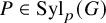 $P \in {\operatorname {Syl}}_p(G)$
and suppose
$P \in {\operatorname {Syl}}_p(G)$
and suppose ${\operatorname {Irr}}_\Omega (G) \subseteq {\operatorname {Irr}}_{p'}(G)$
. Then,
${\operatorname {Irr}}_\Omega (G) \subseteq {\operatorname {Irr}}_{p'}(G)$
. Then, $\mathbf N_G(P)$
intersects every minimal normal subgroup of G non-trivially.
$\mathbf N_G(P)$
intersects every minimal normal subgroup of G non-trivially.
We are now ready to prove Theorem B. We do this by breaking it down into three separate parts, which we prove individually.
Lemma 4.4. Let G be a finite group with p a prime and suppose that ${\operatorname {Irr}}_{\Omega }(G) \subseteq {\operatorname {Irr}}_{p'}(G)$
. Then,
${\operatorname {Irr}}_{\Omega }(G) \subseteq {\operatorname {Irr}}_{p'}(G)$
. Then, ${\mathbf O}^{p'}(G) = {\mathbf O}_p(G) \times K$
, where
${\mathbf O}^{p'}(G) = {\mathbf O}_p(G) \times K$
, where $K \unlhd G$
is such that
$K \unlhd G$
is such that $K/{\mathbf O}_{p'}(K)$
is a (possibly empty) direct product of non-abelian finite simple groups of order divisible by p.
$K/{\mathbf O}_{p'}(K)$
is a (possibly empty) direct product of non-abelian finite simple groups of order divisible by p.
Proof. Let G be a minimal counterexample to the assertion in the theorem. Write, as in Corollary 3.1, ${\mathbf O}^{p'}(G)/N = X/N \times Y/N$
, where
${\mathbf O}^{p'}(G)/N = X/N \times Y/N$
, where $N = {\mathbf O}_{p'}({\mathbf O}^{p'}(G))$
. Notice that
$N = {\mathbf O}_{p'}({\mathbf O}^{p'}(G))$
. Notice that $X = HN$
, where H is an abelian p-group; from this, it follows that
$X = HN$
, where H is an abelian p-group; from this, it follows that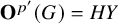 ${\mathbf O}^{p'}(G) = HY$
. Notice also that
${\mathbf O}^{p'}(G) = HY$
. Notice also that ${\mathbf O}_p(G)\subseteq {\mathbf O}^{p'}(G)$
and hence
${\mathbf O}_p(G)\subseteq {\mathbf O}^{p'}(G)$
and hence ${\mathbf O}_p(G)N/N\subseteq X/N={\mathbf O}_p({\mathbf O}^{p'}(G)/N)$
. It follows that
${\mathbf O}_p(G)N/N\subseteq X/N={\mathbf O}_p({\mathbf O}^{p'}(G)/N)$
. It follows that ${\mathbf O}_p(G) \subseteq X$
; in particular, it is contained in H.
${\mathbf O}_p(G) \subseteq X$
; in particular, it is contained in H.
Step 1.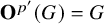 ${\mathbf O}^{p'}(G) = G$
.
${\mathbf O}^{p'}(G) = G$
.
Assume otherwise. By Lemma 2.8, ${\mathbf O}^{p'}(G)$
also satisfies our hypothesis, since each of its
${\mathbf O}^{p'}(G)$
also satisfies our hypothesis, since each of its $\Omega $
-invariant irreducible characters lies under some
$\Omega $
-invariant irreducible characters lies under some $\Omega $
-invariant irreducible character of G. Then, by the minimality of G, we have
$\Omega $
-invariant irreducible character of G. Then, by the minimality of G, we have ${\mathbf O}^{p'}(G) = {\mathbf O}_p({\mathbf O}^{p'}(G)) \times K$
, for some
${\mathbf O}^{p'}(G) = {\mathbf O}_p({\mathbf O}^{p'}(G)) \times K$
, for some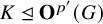 $K \unlhd {\mathbf O}^{p'}(G)$
in the conditions of the statement of the lemma, as
$K \unlhd {\mathbf O}^{p'}(G)$
in the conditions of the statement of the lemma, as ${\mathbf O}^{p'}({\mathbf O}^{p'}(G)) = {\mathbf O}^{p'}(G)$
. But also
${\mathbf O}^{p'}({\mathbf O}^{p'}(G)) = {\mathbf O}^{p'}(G)$
. But also ${\mathbf O}_p(G) \subseteq {\mathbf O}^{p'}(G)$
. Thus
${\mathbf O}_p(G) \subseteq {\mathbf O}^{p'}(G)$
. Thus ${\mathbf O}^{p'}(G) = {\mathbf O}_p(G) \times K$
. Finally, since
${\mathbf O}^{p'}(G) = {\mathbf O}_p(G) \times K$
. Finally, since $K/{\mathbf O}_{p'}(K)$
is a (possibly empty) direct product of non-abelian finite simple groups of order divisible by p,
$K/{\mathbf O}_{p'}(K)$
is a (possibly empty) direct product of non-abelian finite simple groups of order divisible by p,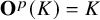 ${\mathbf O}^p(K) = K$
and thus
${\mathbf O}^p(K) = K$
and thus $K = {\mathbf O}^p({\mathbf O}^{p'}(G))$
, meaning K is normal in G. This violates G being a counterexample.
$K = {\mathbf O}^p({\mathbf O}^{p'}(G))$
, meaning K is normal in G. This violates G being a counterexample.
Step 2. ${\mathbf O}_p(G) = 1$
.
${\mathbf O}_p(G) = 1$
.
If $M={\mathbf O}_p(G)>1$
, write
$M={\mathbf O}_p(G)>1$
, write $\bar {G}=G/M$
. Since
$\bar {G}=G/M$
. Since $\bar {G}$
satisfies our hypothesis, we have, by the minimality of G, that
$\bar {G}$
satisfies our hypothesis, we have, by the minimality of G, that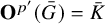 ${\mathbf O}^{p'}(\bar {G})=\bar {K}$
, where
${\mathbf O}^{p'}(\bar {G})=\bar {K}$
, where $\bar {K}/{\mathbf O}_{p'}(\bar {K})$
is a (possibly empty) direct product of non-abelian simple groups of order divisible by p. Notice that
$\bar {K}/{\mathbf O}_{p'}(\bar {K})$
is a (possibly empty) direct product of non-abelian simple groups of order divisible by p. Notice that ${\mathbf O}^{p'}(\bar {G})={\mathbf O}^{p'}(G)/M = G/M$
. Since
${\mathbf O}^{p'}(\bar {G})={\mathbf O}^{p'}(G)/M = G/M$
. Since $X/N = {\mathbf O}_p(G/N)$
and
$X/N = {\mathbf O}_p(G/N)$
and $MN/N$
is a normal p-subgroup of G,
$MN/N$
is a normal p-subgroup of G, $MN \subseteq X$
. But also
$MN \subseteq X$
. But also $|X:MN|$
is a power of p and
$|X:MN|$
is a power of p and $G/X$
is a direct product of non-abelian simple groups of order divisible by p, meaning
$G/X$
is a direct product of non-abelian simple groups of order divisible by p, meaning $G/NM$
has no proper normal subgroups of
$G/NM$
has no proper normal subgroups of $p'$
-order. Consequently,
$p'$
-order. Consequently, $MN/M = {\mathbf O}_{p'}(G/M)$
. We conclude that
$MN/M = {\mathbf O}_{p'}(G/M)$
. We conclude that $G/MN$
is the direct product of non-abelian simple groups and therefore,
$G/MN$
is the direct product of non-abelian simple groups and therefore, $X=MN$
which implies that
$X=MN$
which implies that $H=M$
, from which
$H=M$
, from which $G = M \times Y$
, which violates it being a counterexample.
$G = M \times Y$
, which violates it being a counterexample.
Step 3. If $M \subseteq N$
is a minimal normal subgroup of G, then M is not abelian.
$M \subseteq N$
is a minimal normal subgroup of G, then M is not abelian.
First, notice that if $N=1$
we have the desired result, so we can exclude this case. Now, suppose that M is abelian. Let P be a Sylow p-subgroup of G containing H. Then, by Theorem 4.3, we have that
$N=1$
we have the desired result, so we can exclude this case. Now, suppose that M is abelian. Let P be a Sylow p-subgroup of G containing H. Then, by Theorem 4.3, we have that
 $$ \begin{align*} 1<\mathbf N_G(P)\cap M=\mathbf C_M(P)\leq \mathbf C_M(HM)=M\cap \mathbf Z(HM). \end{align*} $$
We claim that $\mathbf Z(HM)$
is normal in G. Indeed, by induction
$\mathbf Z(HM)$
is normal in G. Indeed, by induction $G/M={\mathbf O}^{p'}(G/M)={\mathbf O}_p(G/M)\times K_1/M$
. Notice that
$G/M={\mathbf O}^{p'}(G/M)={\mathbf O}_p(G/M)\times K_1/M$
. Notice that ${\mathbf O}_p(G/M)\subseteq X/M$
and therefore
${\mathbf O}_p(G/M)\subseteq X/M$
and therefore ${\mathbf O}_p(G/M)\subseteq HM/M$
.
${\mathbf O}_p(G/M)\subseteq HM/M$
.
Notice that $N \subseteq K_1$
, and hence
$N \subseteq K_1$
, and hence ${\mathbf O}_{p'}(K_1) = N$
. Then
${\mathbf O}_{p'}(K_1) = N$
. Then $K_1/N$
is a (possibly empty) direct product of non-abelian simple groups of order divisible by p. Also notice that
$K_1/N$
is a (possibly empty) direct product of non-abelian simple groups of order divisible by p. Also notice that $K_1 = {\mathbf O}^p(G)$
, as
$K_1 = {\mathbf O}^p(G)$
, as $K_1 = {\mathbf O}^p(K_1)$
and
$K_1 = {\mathbf O}^p(K_1)$
and $|G:K_1|$
is a power of p. Since the same is true of Y, it follows that
$|G:K_1|$
is a power of p. Since the same is true of Y, it follows that $Y = K_1$
.
$Y = K_1$
.
Therefore, we conclude that $HM/M={\mathbf O}_p(G/M)$
, by comparing orders. Hence
$HM/M={\mathbf O}_p(G/M)$
, by comparing orders. Hence $HM$
is normal in G, and so is
$HM$
is normal in G, and so is $\mathbf Z(HM)$
, as wanted. Since
$\mathbf Z(HM)$
, as wanted. Since $M\cap \mathbf Z(HM)>1$
, we conclude that
$M\cap \mathbf Z(HM)>1$
, we conclude that $M\subseteq \mathbf Z(HM)$
. Hence H is normal in
$M\subseteq \mathbf Z(HM)$
. Hence H is normal in $HM$
and therefore characteristic, so it is normal in G. As
$HM$
and therefore characteristic, so it is normal in G. As ${\mathbf O}_p(G) = 1$
,
${\mathbf O}_p(G) = 1$
, $H = 1$
and
$H = 1$
and $G = Y$
, a contradiction to G being a counterexample.
$G = Y$
, a contradiction to G being a counterexample.
Step 4. Final contradiction.
By Steps 2 and 3, M is the product of non-abelian simple groups of order not divisible by p, transitively permuted by G-conjugation. Write $M = S_1 \times \cdots \times S_k$
. By Lemma 2.10,
$M = S_1 \times \cdots \times S_k$
. By Lemma 2.10, $k = 1$
, meaning
$k = 1$
, meaning $M = S$
, a non-abelian simple group of
$M = S$
, a non-abelian simple group of $p'$
-order. In particular,
$p'$
-order. In particular, $G/\mathbf C_G(S)$
is an almost simple group with socle
$G/\mathbf C_G(S)$
is an almost simple group with socle $S\mathbf C_G(S)/\mathbf C_G(S)\cong S$
.
$S\mathbf C_G(S)/\mathbf C_G(S)\cong S$
.
Now, $G/S\mathbf C_G(S)\cong \frac {G/\mathbf C_G(S)}{S\mathbf C_G(S)/\mathbf C_G(S)}$
is solvable by Schreier’s conjecture. Write
$G/S\mathbf C_G(S)\cong \frac {G/\mathbf C_G(S)}{S\mathbf C_G(S)/\mathbf C_G(S)}$
is solvable by Schreier’s conjecture. Write $W/S={\mathbf O}_p(G/S)$
, and notice that, by induction
$W/S={\mathbf O}_p(G/S)$
, and notice that, by induction $G/S=W/S\times K_1/S$
for some
$G/S=W/S\times K_1/S$
for some $K_1$
such that
$K_1$
such that $\frac {K_1/S}{{\mathbf O}_{p'}(K_1/S)}$
is a product of non-abelian simple groups. Let
$\frac {K_1/S}{{\mathbf O}_{p'}(K_1/S)}$
is a product of non-abelian simple groups. Let $L=W\mathbf C_G(S)$
. Then,
$L=W\mathbf C_G(S)$
. Then, $G/L$
is solvable and hence
$G/L$
is solvable and hence $K_1/(K_1\cap L)$
is solvable. Thus,
$K_1/(K_1\cap L)$
is solvable. Thus, $K_1=(K_1\cap L)N$
and we have that
$K_1=(K_1\cap L)N$
and we have that $K_1/(K_1\cap L)$
is a
$K_1/(K_1\cap L)$
is a $p'$
-group. But since
$p'$
-group. But since $G=WK_1$
, we have that
$G=WK_1$
, we have that $G=LK_1$
and hence
$G=LK_1$
and hence $G/L\cong K_1/(K_1\cap L)$
is a
$G/L\cong K_1/(K_1\cap L)$
is a $p'$
-group. As
$p'$
-group. As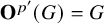 ${\mathbf O}^{p'}(G)=G$
, we obtain that
${\mathbf O}^{p'}(G)=G$
, we obtain that $G=L$
and hence
$G=L$
and hence $G/S\mathbf C_G(S)\cong W/(W\cap S\mathbf C_G(S))$
is a p-group.
$G/S\mathbf C_G(S)\cong W/(W\cap S\mathbf C_G(S))$
is a p-group.
By the proof of [Reference Malle, Moretó, Rizo and Schaeffer Fry12, Theorem 2.8], if $G \neq S\mathbf C_G(S)$
, since p does not divide
$G \neq S\mathbf C_G(S)$
, since p does not divide $|S|$
, there exists
$|S|$
, there exists $\chi \in {\operatorname {Irr}}_{\Omega }(G/\mathbf C_G(S))$
of degree divisible by p, which goes against our hypothesis. Thus,
$\chi \in {\operatorname {Irr}}_{\Omega }(G/\mathbf C_G(S))$
of degree divisible by p, which goes against our hypothesis. Thus, $G = S\mathbf C_G(S)$
. But this is a contradiction, as
$G = S\mathbf C_G(S)$
. But this is a contradiction, as $S \cap \mathbf C_G(S) = 1$
and
$S \cap \mathbf C_G(S) = 1$
and $|S|$
is not divisible by p.
$|S|$
is not divisible by p.
Lemma 4.5. Let G be a finite group with p a prime and suppose that ${\operatorname {Irr}}_{\Omega }(G) \subseteq {\operatorname {Irr}}_{p'}(G)$
. Then,
${\operatorname {Irr}}_{\Omega }(G) \subseteq {\operatorname {Irr}}_{p'}(G)$
. Then, ${\mathbf O}^{p'}(G) = {\mathbf O}_p(G) \times K$
, where
${\mathbf O}^{p'}(G) = {\mathbf O}_p(G) \times K$
, where $K \unlhd G$
is such that
$K \unlhd G$
is such that $K/{\mathbf O}_{p'}(K)$
is a (possibly empty) direct product of non-abelian finite simple groups of order divisible by p without
$K/{\mathbf O}_{p'}(K)$
is a (possibly empty) direct product of non-abelian finite simple groups of order divisible by p without $\Omega $
-invariant characters of degree divisible by p.
$\Omega $
-invariant characters of degree divisible by p.
Proof. By Lemma 4.4, we may write ${\mathbf O}^{p'}(G) = {\mathbf O}_p(G) \times K$
where
${\mathbf O}^{p'}(G) = {\mathbf O}_p(G) \times K$
where $K/{\mathbf O}_{p'}(K)$
is a direct product of non-abelian finite simple groups of order divisible by p. If these groups have an
$K/{\mathbf O}_{p'}(K)$
is a direct product of non-abelian finite simple groups of order divisible by p. If these groups have an $\Omega $
-invariant character of degree divisible by p, then so does
$\Omega $
-invariant character of degree divisible by p, then so does $K/{\mathbf O}_{p'}(K)$
, and hence, so does
$K/{\mathbf O}_{p'}(K)$
, and hence, so does ${\mathbf O}^{p'}(G)/{\mathbf O}_p(G)$
. This means that
${\mathbf O}^{p'}(G)/{\mathbf O}_p(G)$
. This means that ${\mathbf O}^{p'}(G)$
has an
${\mathbf O}^{p'}(G)$
has an $\Omega $
-invariant character of degree divisible by p and, by Lemma 2.8, so does G, a contradiction.
$\Omega $
-invariant character of degree divisible by p and, by Lemma 2.8, so does G, a contradiction.
Finally, we get the complete proof of Theorem B, which we restate below.
Theorem B. Let G be a finite group, with p a prime and suppose that ${\operatorname {Irr}}_{\Omega }(G) \subseteq {\operatorname {Irr}}_{p'}(G)$
. Then,
${\operatorname {Irr}}_{\Omega }(G) \subseteq {\operatorname {Irr}}_{p'}(G)$
. Then, ${\mathbf O}^{p'}(G) = {\mathbf O}_p(G) \times K$
, where
${\mathbf O}^{p'}(G) = {\mathbf O}_p(G) \times K$
, where $K \unlhd G$
,
$K \unlhd G$
, ${\mathbf O}_{p'}(K)$
is solvable and
${\mathbf O}_{p'}(K)$
is solvable and $K/{\mathbf O}_{p'}(K)$
is a (possibly empty) direct product of non-abelian simple groups of order divisible by p without
$K/{\mathbf O}_{p'}(K)$
is a (possibly empty) direct product of non-abelian simple groups of order divisible by p without $\Omega $
-invariant characters of degree divisible by p.
$\Omega $
-invariant characters of degree divisible by p.
Proof. By what we did before in Lemma 4.4 and Lemma 4.5, ${\mathbf O}^{p'}(G) = {\mathbf O}_p(G) \times Y$
,
${\mathbf O}^{p'}(G) = {\mathbf O}_p(G) \times Y$
, $Y/N$
is a direct product of non-abelian finite simple groups of order divisible by p without
$Y/N$
is a direct product of non-abelian finite simple groups of order divisible by p without $\Omega $
-invariant characters of degree divisible by p, where
$\Omega $
-invariant characters of degree divisible by p, where $N = {\mathbf O}_{p'}({\mathbf O}^{p'}(G))$
, and
$N = {\mathbf O}_{p'}({\mathbf O}^{p'}(G))$
, and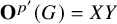 ${\mathbf O}^{p'}(G) = XY$
, where
${\mathbf O}^{p'}(G) = XY$
, where $X = {\mathbf O}_p(G)N$
. Also,
$X = {\mathbf O}_p(G)N$
. Also, $Y/N = {\mathbf O}^p({\mathbf O}^{p'}(G)/N)$
, meaning
$Y/N = {\mathbf O}^p({\mathbf O}^{p'}(G)/N)$
, meaning $Y/N$
is normal in
$Y/N$
is normal in $G/N$
; hence, Y is normal in G.
$G/N$
; hence, Y is normal in G.
All that is left is to show that ${\mathbf O}_{p'}(Y)$
is solvable. In view of that, we may assume
${\mathbf O}_{p'}(Y)$
is solvable. In view of that, we may assume $p \neq 2$
by the Feit–Thompson theorem. If
$p \neq 2$
by the Feit–Thompson theorem. If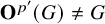 ${\mathbf O}^{p'}(G) \neq G$
, then, by Lemma 2.8, we get the desired result by induction. Hence, we may assume
${\mathbf O}^{p'}(G) \neq G$
, then, by Lemma 2.8, we get the desired result by induction. Hence, we may assume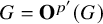 $G = {\mathbf O}^{p'}(G)$
. Along the same lines, as
$G = {\mathbf O}^{p'}(G)$
. Along the same lines, as $G/{\mathbf O}_p(G) \cong Y$
, if Y had an
$G/{\mathbf O}_p(G) \cong Y$
, if Y had an $\Omega $
-invariant character of degree divisible by p, so would G. Thus, Y also satisfies our hypothesis.
$\Omega $
-invariant character of degree divisible by p, so would G. Thus, Y also satisfies our hypothesis.
Notice that ${\mathbf O}^{p'}(Y) = Y$
, since
${\mathbf O}^{p'}(Y) = Y$
, since $Y \cong G/{\mathbf O}_p(G)$
and
$Y \cong G/{\mathbf O}_p(G)$
and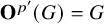 ${\mathbf O}^{p'}(G) = G$
. Consequently, if
${\mathbf O}^{p'}(G) = G$
. Consequently, if $Y \neq G$
, by induction, we get that
$Y \neq G$
, by induction, we get that ${\mathbf O}_{p'}(Y)$
is solvable, which is our desired result. So we may assume
${\mathbf O}_{p'}(Y)$
is solvable, which is our desired result. So we may assume $Y = G$
. In this situation,
$Y = G$
. In this situation, ${\mathbf O}_p(G) = 1$
,
${\mathbf O}_p(G) = 1$
,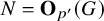 $N = {\mathbf O}_{p'}(G)$
and
$N = {\mathbf O}_{p'}(G)$
and $G/N$
is a direct product of non-abelian simple groups of order divisible by p whose
$G/N$
is a direct product of non-abelian simple groups of order divisible by p whose $\Omega $
-invariant characters are of
$\Omega $
-invariant characters are of $p'$
-degree. Let
$p'$
-degree. Let $R = \mathbf {R}(N)$
be the solvable radical of N and suppose
$R = \mathbf {R}(N)$
be the solvable radical of N and suppose $R \neq 1$
. Then, by induction on
$R \neq 1$
. Then, by induction on $G/R$
, we get that
$G/R$
, we get that ${\mathbf O}_{p'}(G/R) = N/R$
is solvable, meaning so, too, is N. Thus, we may assume
${\mathbf O}_{p'}(G/R) = N/R$
is solvable, meaning so, too, is N. Thus, we may assume $R = 1$
.
$R = 1$
.
Let M be a minimal normal subgroup of G contained in N. By the previous paragraph, $M = S_1 \times \cdots \times S_k$
, a product of non-abelian simple groups transitively permuted by G-conjugation and of order not divisible by p. If
$M = S_1 \times \cdots \times S_k$
, a product of non-abelian simple groups transitively permuted by G-conjugation and of order not divisible by p. If $k> 1$
, then the result follows by Lemma 2.10. Thus, we may assume
$k> 1$
, then the result follows by Lemma 2.10. Thus, we may assume $k = 1$
. Then,
$k = 1$
. Then, $M = S$
is a non-abelian simple group and
$M = S$
is a non-abelian simple group and $G/\mathbf C_G(S)$
is an almost simple group with socle isomorphic to S. By the Schreier Conjecture,
$G/\mathbf C_G(S)$
is an almost simple group with socle isomorphic to S. By the Schreier Conjecture, $G/S\mathbf C_G(S)$
is solvable. In particular, due to the structure of G,
$G/S\mathbf C_G(S)$
is solvable. In particular, due to the structure of G, $|G:S\mathbf C_G(S)|_p = 1$
. Consequently,
$|G:S\mathbf C_G(S)|_p = 1$
. Consequently, $G = S\mathbf C_G(S)$
as
$G = S\mathbf C_G(S)$
as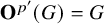 ${\mathbf O}^{p'}(G) = G$
. But this is impossible, as
${\mathbf O}^{p'}(G) = G$
. But this is impossible, as $p \nmid |S|$
and S is a quotient of G.
$p \nmid |S|$
and S is a quotient of G.
Notice how the conclusion of Theorem B fails if one considers only the $\Omega $
-invariant characters in the principal block of G. A small counterexample is
$\Omega $
-invariant characters in the principal block of G. A small counterexample is $\mathfrak S_3$
, whose characters in the principal
$\mathfrak S_3$
, whose characters in the principal $2$
-block are rational and linear, and also
$2$
-block are rational and linear, and also ${\mathbf O}_2(\mathfrak S_3) = 1, {\mathbf O}^{2'}(\mathfrak S_3) = \mathfrak S_3$
; nevertheless, it is not a
${\mathbf O}_2(\mathfrak S_3) = 1, {\mathbf O}^{2'}(\mathfrak S_3) = \mathfrak S_3$
; nevertheless, it is not a $2'$
-group, as would be implied by the theorem.
$2'$
-group, as would be implied by the theorem.
Acknowledgments
We would like to thank Gunter Malle and Mandi Schaeffer Fry for kindly sharing their thoughts and comments on the manuscript. We would also like to thank the anonymous referee for their careful proofreading and insightful suggestions. The article was certainly improved as a result.
Funding statement
The authors are supported by Ministerio de Ciencia e Innovación (project PID2022-137612NB-I00 funded by MCIN/AEI/10.13039/501100011033 and “ERDF A way of making Europe”). The third author is supported by grant PREP2022-000021 tied to said project. The second author is also supported by grant CIDEIG/2022/29 funded by Generalitat Valenciana.


 Open access

