
Skip to main content Accessibility help
×
  • Cited by 31
    • Show more authors
    • Open Access
      You have digital access to this book
    • Select format
    • Publisher:
      Cambridge University Press
      Publication date:
      16 February 2024
      15 February 2024
      ISBN:
      9781009298537
      9781009298520
      9781009298513
      Creative Commons:
      Creative Common License - CC Creative Common License - BY Creative Common License - NC
      This content is Open Access and distributed under the terms of the Creative Commons Attribution licence CC-BY-NC 4.0.
      https://creativecommons.org/creativelicenses
      Dimensions:
      (229 x 152 mm)
      Weight & Pages:
      0.48kg, 232 Pages
      Dimensions:
      (229 x 152 mm)
      Weight & Pages:
      0.342kg, 230 Pages
    Open Access
    You have digital access to this book
    Selected: Digital
    View content
    Add to cart View cart Buy from Cambridge.org

    Book description

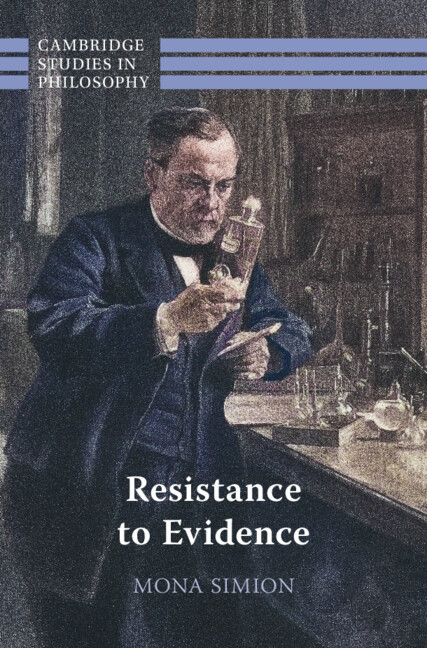
    We have increasingly sophisticated ways of acquiring and communicating knowledge, but efforts to spread this knowledge often encounter resistance to evidence. The phenomenon of resistance to evidence, while subject to thorough investigation in social psychology, is acutely under-theorised in the philosophical literature. Mona Simion's book is concerned with positive epistemology: it argues that we have epistemic obligations to update and form beliefs on available and undefeated evidence. In turn, our resistance to easily available evidence is unpacked as an instance of epistemic malfunctioning. Simion develops a full positive, integrated epistemological picture in conjunction with novel accounts of evidence, defeat, norms of inquiry, permissible suspension, and disinformation. Her book is relevant for anyone with an interest in the nature of evidence and justified belief and in the best ways to avoid the high-stakes practical consequences of evidence resistance in policy and practice. This title is also available as Open Access on Cambridge Core.

    Reviews

    ‘People who deny well established truths are an obtrusive feature of the contemporary world. Mona Simion argues that such denial manifests a breach of our epistemic obligation to respond to easily available evidence. As well as shedding light on an important phenomenon, she develops new accounts of evidence, defeat, disinformation and our obligations as inquirers. This rich and wide-ranging book will be essential reading for all epistemologists, as well as anyone interested in the root causes of so much contemporary political dysfunction.'

    Neil Levy - University of Oxford

    Refine List

    Actions for selected content:

    Select all | Deselect all
    • View selected items
    • Export citations
    • Download PDF (zip)
    • Save to Kindle
    • Save to Dropbox
    • Save to Google Drive

    Save Search

    You can save your searches here and later view and run them again in "My saved searches".

    Please provide a title, maximum of 40 characters.
    ×

    Contents

    Full book PDF
    • Resistance to Evidence
      pp i-i
    • Cambridge Studies in Philosophy - Series page
      pp ii-iv
    • Resistance to Evidence - Title page
      pp v-v
    • Copyright page
      pp vi-vi
    • Dedication
      pp vii-viii
    • Contents
      pp ix-xi
    • Acknowledgements
      pp xii-xiv
    • Introduction
      pp 1-6
    • Part I - The Epistemology and Psychology of Resistance to Evidence
      pp 7-92
    • Chapter 1 - Resistance to Evidence
      pp 9-22
    • Triggers and Epistemic Status
    • Chapter 2 - Evidence One Has and the Impermissibility of Resistance
      pp 23-35
    • Chapter 3 - Evidence You Should Have Had and Resistance
      pp 36-47
    • Chapter 4 - Permissible Suspension and Evidence Resistance
      pp 48-67
    • Chapter 5 - Resistance to Evidence, Epistemic Responsibility, and Epistemic Vice
      pp 68-92
    • Part II - Resistance to Evidence and Epistemic Proper Function
      pp 93-148
    • Chapter 6 - Resistance to Evidence as Epistemic Malfunction
      pp 95-110
    • Chapter 7 - Evidence as Knowledge Indicators
      pp 111-123
    • Chapter 8 - Defeaters as Ignorance Indicators
      pp 124-137
    • Chapter 9 - Inquiry and Permissible Suspension
      pp 138-148
    • Part III - Theoretical Upshots
      pp 149-191
    • Chapter 10 - Epistemic Oughts and Epistemic Dilemmas
      pp 151-164
    • Chapter 11 - Scepticism as Resistance to Evidence
      pp 165-177
    • Chapter 12 - Knowledge and Disinformation
      pp 178-191
    • Concluding Remarks
      pp 192-196
    • The Way Forward in Policy and Practice*
    • Bibliography
      pp 197-214
    • Index
      pp 215-216

    Metrics

    Altmetric attention score

    Full text views

    Total number of HTML views: 0
    Total number of PDF views: 0 *
    Loading metrics...

    Book summary page views

    Total views: 0 *
    Loading metrics...

    * Views captured on Cambridge Core between #date#. This data will be updated every 24 hours.

    Usage data cannot currently be displayed.

    Accessibility standard: Unknown

    Why this information is here

    This section outlines the accessibility features of this content - including support for screen readers, full keyboard navigation and high-contrast display options. This may not be relevant for you.

    Accessibility Information

    Accessibility compliance for the HTML of this book is currently unknown and may be updated in the future.
