

2 Republican war memories: The Reichsbanner Black–Red–Gold
On 22 February 1924, a group of Social Democrats gathered in Magdeburg, capital of the Prussian province of Saxony, together with some representatives of the other two parties in the ‘Weimar coalition’ – not any longer active at the Reich level at this time, but still working in Prussia – the Catholic Centre Party and the left-liberal German Democratic Party (DDP). The meeting discussed plans for a republican defence league called the ‘Reichsbanner Black–Red–Gold’, which was formally established as a result. A number of Social Democratic functionaries were the driving force behind this venture. They included Otto Hörsing, the Oberpräsident (provincial governor), who also served as the chairman of the new association; Karl Höltermann, editor of the local Social Democratic newspaper Madgeburger Volksstimme, as Hörsing’s deputy; and Dr Horst Bärensprung, who later held the office of police president in Magdeburg, and took the role of a secretary and keeper of the minutes in the new league. Walter Röber, who worked full-time as the regional head (Gauleiter) of the Reichsbund of war victims, served as Bärensprung’s deputy, indicating that both organisations intended to cooperate closely.1
Highly industrialised and with a strong working-class presence, the Prussian province of Saxony was a stronghold of the reformist wing of the Social Democratic Party (SPD), but also the scene of deep political antagonisms between the nationalist right and the Communist left since 1919, culminating in bloody battles during the Kapp putsch in March 1920, and again during the Communist ‘March Action’ a year later. Since 1921, the situation had calmed, and the number of collective outbursts of political violence had dropped. But the Stahlhelm, the right-wing ‘league of front line soldiers’ founded in 1918, had its headquarters in Magdeburg, and it intensified efforts to occupy public space through flag consecrations and marches, to intimidate the political left. Already by 1922, the local SPD branch in Magdeburg had started to build up a Social Democratic defence league called the Republikanische Notwehr. As fears of a right-wing putsch loomed large from the beginning of 1923, the local Social Democrats decided to demonstrate their strength in public. On 15 April 1923, the ‘Republican Self-Defence’ had its first outing on the streets of Magdeburg, when 1,500 men paraded in a marching column through the streets of the city. They then gathered on the square in front of the cathedral, and Hörsing addressed them in a brief speech.2 Across the province, the Notwehr had up to 25,000 members, who were registered as a possible auxiliary police force and called to service by Prussian Minister of the Interior Carl Severing on 7 November 1923.3
In other regions of Germany, Social Democrats and devoted republicans had also joined ranks and established associations that aimed to defend the Republic against political violence from the right. As the timing suggests, with most initiatives gathering pace since 1921/2, the experience of the Kapp putsch both prompted and encouraged these efforts. Supported by Free Corps units and parts of the Reichswehr, Wolfgang Kapp – during the war a cofounder of the extreme nationalist German Fatherland Party – had declared himself chancellor on 13 March 1920. But on the same day, Reich President Ebert and the Social Democrat government ministers called on the working class to support the constitutional order by means of a general strike. On the next day, the German Communist Party (KPD) supported this course of action, despite some reservations. On 17 March, the putschists gave up. Concerted efforts by trade unions and both leftist parties had thus demonstrated in 1920 that unified working-class action could indeed avert attempts to overthrow the Republic.4 This success spurred many initiatives to establish defence leagues. Yet the names of these associations also hint at the cultural contexts in which they were situated, and at the symbolic aims they represented. In the town of Liegnitz, for instance, local trade union activists founded a group called Der Neue Stahlhelm: Bund republikanischer Frontkämpfer (‘The New Steel Helmet: League of Republican Front-Line Fighters’) in 1923. Thus, they responded to growing pressure from local branches of the Stahlhelm, which had proliferated rapidly in Silesia since 1922. It found substantial support from both industrial and agricultural employers, and members of the right-wing veterans’ league broke up trade union meetings of rural labourers. When news circulated that the nationalists planned to disrupt an event with the liberal pacifist Ludwig Quidde in Liegnitz, the defence league was established. The name indicated that the founders meant to counter the political and symbolic power of the Stahlhelm.5 In the town of Cottbus, Social Democrats founded a ‘League of Republican Front Fighters’ (Republikanischer Frontkämpferbund) in 1922, also in an attempt to safeguard meetings from violent disruption. The same name was chosen when representatives of the Weimar coalition in East Prussia met in Königsberg on 25 November 1923 in a response to the Hitler putsch.6
Both the names and the historical contexts of these regional predecessors of the Reichsbanner emphasised their opposition to the Stahlhelm and the need to compete with its symbolic claim to represent the legacy of the war experience. In other regions, the immediate aim of safeguarding republican forces against violent attacks was paramount. In Munich, Social Democrats had founded a ‘Security Section’ (‘Sicherheitsabteilung’, or SA) by November 1921, which should not be confused with the ‘Sturmabteilung’, or SA of the Nazi Party, the infamous ‘Brownshirts’, to whose existence it clearly responded. In public, this defence formation was also known as the ‘Auer Guard’, named after the equally authoritarian and energetic head of the Bavarian SPD and member of the Bavarian diet, Erhard Auer.7 Under the motto ‘No power to despotism, all power to the law, all justice to the people’, the new formation protected Social Democratic gatherings in the Bavarian capital.8 In Saxony, the Proletarian Hundreds (Proletarische Hundertschaften) were the predecessors of the Reichsbanner. These proletarian self-defence formations were jointly established by Social Democrats and Communists in 1923 and served as auxiliary police forces for the short-lived coalition government formed by the two parties in March of that year.9 As these local and regional initiatives indicate, many Social Democrats across the country were very aware of the need to pursue two aims: to shield their party members from right-wing attacks on the one hand, and on the other to demonstrate to a wider public that a large number of war veterans stood in the republican camp. These two aims were inherently linked, forming two sides of the same coin – especially but not only in the regions in which Social Democrats had to face a strong Stahlhelm presence.
A republican veterans’ league
The founding of the Reichsbanner in February 1924 incorporated these earlier initiatives in two ways. First, the regional defence leagues were incorporated into the Reichsbanner, which now represented dedicated republicans across the Reich. And the twin objectives of defending the Republic and representing war veterans were inextricably entwined in the new organisation, as Otto Krille – Reichsbanner founding member in Munich and, from 1925, its Gau secretary in the city – stressed in a post-war testimony.10 The founding appeal, published in the first issue of the league’s journal, also drew attention to these connections. It introduced the organisation by its full name, Reichsbanner Black–Red–Gold: League of Republican Ex-Servicemen (Reichsbanner Schwarz–Rot–Gold: Bund der republikanischen Kriegsteilnehmer). Harking back to the founding of the Republic, the appeal described it as the work of ‘men who did not lose their head amidst the collapse of imperial Germany’. In an attack on the ‘unleashing of civil war’ by those who claimed to pursue the best interests of the nation, the Reichsbanner described the young men in anti-republican paramilitary units as ‘victims of wild demagogy’ who abused concepts such as ‘fatherland’ or ‘nation’. Turning against those circles that aimed to hide ‘their own guilt’ behind ‘shameful Jew-baiting’, the appeal made a direct reference to the war experience:
We republicans will never forget that shoulder to shoulder with Catholics, Protestants and Free-Thinkers, Jewish soldiers fought and shed their blood. The number of dead and heavily wounded Jews is proof of that. This stupid anti-Semitism, which is even poisoning the souls of our children, is not only exposing Germany to ridicule in the world, but is also a danger in both domestic and foreign politics.11
The by-laws of the Reichsbanner made it equally clear that it had to be understood as a pro-republican veterans’ association. The very first paragraph stated that the ‘aim of the league’ was the ‘integration of all those Reich-German ex-servicemen of the World War and of men with military training who support the republican constitution without reservation’. The following paragraph highlighted the cultivation of ‘comradeship and of a republican mindset’ together with a defence of the republican constitutions in Reich and Länder as the key aims of the league. In addition, the organisation committed itself to supporting the interests of ex-servicemen, and disabled war veterans in particular.12 A brief précis of the main nationalist combat leagues – including Stahlhelm and Jungdeutscher Orden or ‘Jungdo’ (Young German Order) – in the same issue outlined the political terrain in which the Reichsbanner situated itself.13
Mobilisation for the new league was initially stalled, as electioneering for the Reichstag elections in May 1924 absorbed the energies of the pro-republican forces in the early months of that year. With the elections out of the way, however, the founding of local branches gathered pace over the summer of 1924.14 In many local branches, veterans of the Great War initially provided the overwhelming majority of all rank-and-file members.15 That proportion was bound to decrease, as younger men without any experience of the draft joined the ranks over the years. From the beginning, the Reichsbanner also included male youths from the age of fourteen, who often socialised in separate youth groups within local branches, much to the chagrin of the Sozialistische Arbeiterjugend (SAJ), the official youth organisation of the SPD. In an attempt to boost the recruitment of young members and to cater for their needs, a separate Jungbanner was finally founded in 1926.16 Yet the percentage of war veterans in the Reichsbanner remained high. Based on the details in application forms, the local branch in Munich estimated in autumn 1925 that about two-thirds of the members, or exactly 2,145 out of 3,000, had served in the army during the war. These men had been active for an average of 34.5 months, and 918 of them had been wounded.17 In Barmen, slightly more than two-thirds of the members were war veterans in 1925, and, perhaps more importantly, this figure remained high at 60 per cent in 1930.18 These figures may not appear particularly impressive for a self-declared veterans’ association. But by its own admission, the percentage of former front-line soldiers in the Stahlhelm was even lower, at least from the mid 1920s onwards. From 1924, members of a core group within the Stahlhelm named ‘Kernstahlhelm’ had to have served in the war for at least six months, while youths and men without wartime service were listed in separate branches. Only about half of the members were listed in the core, from a total that varied from 300,000 to 350,000 throughout the 1920s. Thus, the Stahlhelm hardly ever organised more than 175,000 war veterans.19
These figures were dwarfed by the huge organisational success that the Reichsbanner achieved within only a year of its foundation. By August 1924, the head office in Magdeburg reported that the league comprised 5,618 local branches, and boasted 1.26 million members. In the autumn of 1924, these figures were updated, with the organisation claiming that membership was as high as 2.2 million, even reaching 2.75 million members in early 1925.20 During internal meetings, functionaries of the league also referred to the ‘more than 2 million’ members of the organisation.21 These figures were obviously grossly exaggerated, at least as far as the number of individual members is concerned. This was part of a tactical ‘numbers game’, in which all combat leagues took part in the Weimar period, though they publicly condemned such actions. In May 1928, the Stahlhelm head office asked regional headquarters to gather and report data on the membership of the Reichsbanner. As the republican league still claimed to represent ‘millions’, this had to be ‘proved’ wrong.22 It is thus quite difficult to arrive at conclusive estimates: even more so as a detailed breakdown of membership figures for the whole country was never published.23 A somewhat plausible calculation was made by Franz Osterroth in his memoirs. Coming from the Hofgeismar Circle of Young Socialists, a group of Social Democrats who were influenced by the values of the youth movement, Osterroth had joined the head office of the Reichsbanner in Magdeburg in 1928 as one of the editors of the fortnightly membership journal of the league. He states that accurate membership statistics were never kept, and confirms that the published data were ‘literally invented figures’. Osterroth estimated that the Reichsbanner had ‘hardly more than a nominal 1 million members’, based on the observation that he had never seen membership cards with a seven-digit number.24
It thus appears that the best available estimate for the overall strength of the Reichsbanner is just fewer than one million members. Less convincing, though, is Osterroth’s guess that the membership of the league dropped towards the final years of the Republic to a maximum of 500,000 men.25 One important indication that this estimate is most probably too pessimistic comes from Saxony, admittedly an important stronghold of the socialist labour movement. The number of Reichsbanner members in the various Gaue in Saxony was rising in 1929, and such a rise was described as ‘like an explosion’ in 1930. Many local branches in the LeipzigGau tripled or even quadrupled their size by 1933, as did others in the Dresden and Chemnitz areas. Even then, the Reichsbanner had fewer members than the SPD in the region. It has to be noted, however, that the branches of the veterans’ league in small provincial towns were larger than those of the local SPD, a finding that is matched in Bavaria and other states.26 This is an indication that devoted supporters of Weimar democracy were more likely to rally and socialise in the republican defence league in those provincial towns, in which they could not rely on the organisational edifice of the SPD.
Overall, there can be no doubt that the founding of the Reichsbanner was one of the eminent organisational success stories of the Weimar period. While the number of actual war veterans in its ranks dwindled in the late 1920s – as was the case in all the other combat leagues founded in aftermath of the war – it is fair to assume that approximately 600,000 ex-servicemen were members of the pro-republican league in the mid 1920s. At this stage, it clearly outnumbered the self-declared custodians of the war experience on the political right, the Stahlhelm and the Young German Order, founded in 1920, who could never muster a combined membership of more than 500,000. And this figure, to be sure, included youths and older men who had not been conscripted during the war.27 But it was not only the overall seize of the Reichsbanner that was impressive; its geographical range and depth across the country also stood out. The figure of more than 5,000 local branches, cited above, appears perfectly reasonable given the fact that the Reichsbanner attracted members literally ‘almost up to the last village’ and ‘even … where republican parties and trade unions had not yet had any local branches’, as Franz Osterroth confirmed from his own in-depth knowledge.28 By comparison, the Stahlhelm had only slightly more than 1,200 branches in 1923.29 And the pro-republican league was not only present in traditional strongholds of the socialist labour movement such as Saxony, Berlin, Hamburg, Nuremberg and other industrial cities in Protestant regions; local branches were also immediately founded in small provincial towns in the predominantly agrarian Prussian province of Schleswig-Holstein, such as Eutin, and in regions that had not been known for a steady support of the republican constitution, such as East Prussia or Silesia.30 In agrarian regions such as Pomerania, where the owners of large landed estates exerted political and social hegemony, Reichsbanner branches faced a constant uphill struggle. Yet here too they managed to make their presence visible.31 Even in the predominantly Catholic southern parts of Bavaria, which had functioned as a reactionary ‘cell of order’ during the revolutionary struggles in the immediate post-war period, Reichsbanner branches popped up almost everywhere, including in very small provincial towns.32 Furthermore, some unaffiliated war veterans ultimately decided that the Reichsbanner had something to offer them. In the small town of Gauting in Upper Bavaria, the twenty-three members of a local independent ‘Frontkämpfer association’ decided in May 1926 that the time had come for them to join the republican camp. Henceforth, they acted as the local branch of the Reichsbanner, with a worker as chairman.33
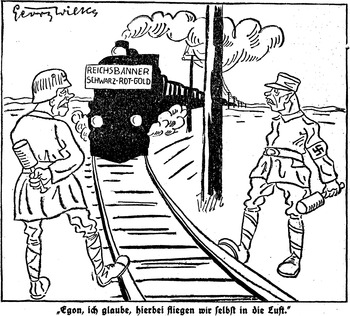
Figure 3 ‘Egon, I believe we might blow up ourselves here.’ Caricature by Georg Wilke, Vorwärts no. 426, 10 September 1924.
At least in numerical terms, there were enough reasons to claim that the Reichsbanner would act from a position of strength, as Karl Bröger, the Gauleiter in Franconia, stressed during the founding celebration of the neighbouring Gau in the Upper Palatinate in July 1924. There was no intention whatsoever to compete with the ‘patriotic associations’ in ‘fooling around like soldiers’. Instead, Bröger insisted, the main aim was to demonstrate confidently and in public ‘that the real ex-servicemen [Kriegsteilnehmer] stood in the republican camp’ and were ready to support it actively, and that their strength was more than sufficient to defend the state against its enemies on the extreme right and left.34 In September 1924, Vorwärts published a caricature that encapsulated the optimistic mood among Social Democrats. It was thought that the founding of the Reichsbanner would significantly shift the playing field between defenders and opponents of the Republic in their favour. It shows two Nazi Party members who were about to sabotage a train line with explosives. But from the background, a train with a steam locomotive labelled ‘Reichsbanner Schwarz–Rot–Gold’ approaches with high speed, forcing the two to contemplate with resignation whether ‘we might blow up ourselves here’.35 It was another question, though, whether and how the Reichsbanner was able to translate numerical strength into effective interventions in the contested field of war remembrances, and whether it could provide an integrative framework for the personal recollections of the many war veterans in its ranks. Before addressing such matters, it is necessary to discuss some political, social and cultural aspects of the republican league in more detail.
The first is its claim to Überparteilichkeit, or to a position that transcended party divisions. When the Reichsbanner was founded in 1924, it was a joint endeavour of Social Democrats, members of the left-liberal DDP and of the Catholic Centre Party, thus reflecting the republican consensus of the Weimar coalition. Among the seventy-one members of the Reichsausschuss, a kind of non-executive board, prominent members of both the DDP – such as Ludwig Haas, from Baden – and the left wing of the Centre Party – such as the former chancellor Constantin Fehrenbach – represented this coalition.36 Local and regional chapters also reserved places for members of the two bourgeois parties on their boards. But apart from some significant exceptions, members of the liberal and Catholic middle class were rather reluctant to join the league. When the number of violent clashes with the Nazi Stormtroopers increased in the late 1920s, many of the bourgeois members abandoned their seats on the executive boards of local branches.37 For these reasons, the notion of a cross-party coalition was mostly a mere façade, even though it was real enough to trigger constant criticism from the radical left of the SPD. By 1924, 85 per cent of members were Social Democrats, and this proportion increased even further to 90 per cent over the next couple of years. As a police report in May 1932 concluded, the Reichsbanner was by then an ‘almost purely SPD organisation’.38 The social composition of the rank-and-file members reflected this situation; an overwhelming majority of them were workers. This did not imply, however, that all members were also SPD members. In Elberfeld, where the local Reichsbanner branch publicised party affiliation among its ranks in 1930, 59 per cent were also SPD members, and a slightly higher percentage also held membership in the socialist Free Trade Unions.39 In what was often a rather complicated relationship with the SPD executive, the Reichsbanner could thus rightly claim that it was no direct competitor to the party, but would rather attract new supporters for the republican cause.40
A brief glance at the forms of sociability and the annual calendar of activities confirms that the Reichsbanner has to be seen as the Social Democratic veterans’ association. It was thus part and parcel of a vast array of organisations that together formed the socialist working-class milieu. From joint hiking excursions and choirs and bands to the fielding of teams in football, handball or gymnastics, Reichsbanner members pursued a number of leisure activities that were popular among socialist workers. All these activities were deeply embedded in the cultural and social values of the socialist labour movement. One example was the constant attempts to curb alcohol consumption among its members, which occasionally provoked conflicts.41 During the Kaiserreich, the SPD had been somewhat ambivalent in its support for temperance, as the pub was an important site of labour movement sociability, and many local party functionaries earned their living as publicans. These attitudes persisted in Weimar, but the Reichsbanner reinforced a trend towards greater emphasis on curbing alcohol consumption.42 Another example was the rejection of competitive elements in sports. When the Reichsbanner handball team from Hamburg was invited to play against a team from neighbouring Bremen in 1930, the Gau leadership in Hamburg would not allow this event to be flagged up as a ‘Gau championship’. As ‘a matter of principle’, they insisted, their team would never take part in ‘any competitions’.43 In their view, sports should not follow the competitive principle of winning/losing, but should rather be a means of fostering proletarian sociability and foster the bodily recreation of working-class men. The annual calendar of festivities included ceremonies for the fallen revolutionaries of March 1848; on the anniversary of Friedrich Ebert’s death on 28 February, thus celebrating the first SPD president of the Republic; and Labour Day on 1 May. On paper, Reichsbanner branches were not supposed to celebrate Labour Day in closed formation to conform to the principle of non-partisanship. But most local branches ignored this policy, indicating how self-evident their socialist identity was.44 On many occasions, local branches of the Reichsbund joined the Reichsbanner for these celebrations, and quite a number of individuals apparently held membership of both organisations.45
All in all, the Reichsbanner was clearly affiliated with the SPD, from the grass-roots level to the presence of many SPD luminaries on the non-exceutive board of the league. The close relationship between the two organisations was, however, never an easy one. Even leading SPD members in the Reichsbanner retained a distinctively sceptical attitude towards the league at least until the end of the 1920s. In their view, the Reichsbanner tended to dilute the socialist principles of the party and the notion of class struggle in particular, and the cooperation with the DDP and Centre Party made it difficult to maintain the distinctiveness of Social Democrats in the league. Yet despite all these criticisms, the SPD leadership could not fail to support the Reichsbanner at least verbally; it had simply grown too fast and become too powerful to be ignored. And even critics of the Reichsbanner were always keen to rely on its services for purposes of campaigning or mobilisation.46 Only in Saxony, in which the radical socialist wing of the party prevailed throughout the Republic, were relations with the regional Reichsbanner leadership severely strained, and the SPD left minced no words in their rejection of an alliance with liberal and Catholic democrats.47
A militarisation of the political culture?
Another important and controversial aspect of the Reichsbanner was its adoption of what appeared to be military principles in the training and organisation of its members. As historian Dirk Schumann has argued, the Reichsbanner did not differ much in this respect from other combat leagues such as the Stahlhelm, the Jungdo or the Communist Red Front Fighter’s League (Rotfrontkämpferbund). Rather it was part and parcel of a broader ‘militarization of political culture’ that transcended the cleavages between the political camps. Employing ‘similar forms of political self-representation’ – namely an aggressive form of masculinity and military symbolism, such as uniforms and marching in closed formation – its practices fostered at least a ‘partial adoption of military values’ among the members of the Reichsbanner.48 Any comprehensive investigation of the alleged militarist aspects of the political practice of the Reichsbanner must discuss both its form and, wherever possible, the meanings that were attached to it. Military categories surely played an important role in the internal organisation of the league. One of the basic distinctions many local branches applied was to keep gediente and ungediente members in separate formations, i.e. to differentiate between those who had served during the war and those who had not. Sometimes the latter category was divided further into young adults and youths. Ex-servicemen were kept together in ‘comradeships’ of 16 men each, and a ‘platoon’ of 100 men was supervised by a Zeugmeister, the equivalent of a sergeant who would oversee the provision of uniforms and handle financial transactions.49 To a large extent, these practices simply reflected the fact that the Reichsbanner was first and foremost meant to be a republican veterans’ association, and that its symbolic capital relied on the visibility and coherent representation of these ex-servicemen. As the regulations stipulated, membership was not only open to ‘front-line soldiers’. However, the application of a potential member who had not served during the war had to be supported and brought forward by two existing members, thus putting the veterans at least potentially in the position of gatekeepers.50
In the same vein, the executive board urged all members to display their military decorations in public, worn with a black–red–gold ribbon, particularly when war memorials were unveiled and during other festive occasions. Anticipating criticism from rank-and-file members who would argue that they ‘objected in principle as socialists’ to such a demand, the leadership used criticisms of nationalist combat leagues to support and provided a rationale for such measures. The nationalist camp would insist that the Reichsbanner had many ‘deserters’ and ‘jailbirds’ among its members; thus, it was necessary to demonstrate that these ‘allegations’ were not true. This was all the more urgent as many ‘in the other camp’ would wear ‘orders and distinctions, but had never seen a trench during the whole course of the war’.51 This argument brings one of the inherent ambivalences in the symbolic politics of the Reichsbanner to the fore. As the league aimed to intervene in the highly contested field of war remembrances, it had to adhere to the appropriate style of self-representation in this field, which inevitably included the adoption of military symbols. Yet for many of the socialist workers who had fought at the front, the war experience had either triggered or reinforced a strong anti-militarist and pacifist sentiment. Many Reichsbanner members wore their military decorations only with great reluctance. In the Franconian town of Hof, members of the local branch decided in October 1925 to reject any display of military decorations owing to their ‘fundamental opposition to the imperialist war’.52
Both the rationale for wearing military decorations, and the partial reluctance to do so, indicate in themselves that the Reichsbanner did not make a substantial contribution to the militarisation of Weimar’s political culture, at least not intentionally. The public display of military decorations did not necessarily imply an adoption of militarist values. A similar point can be made with regard to the wearing of uniforms and to paramilitary training. Reichsbanner members were supposed to wear a uniform – usually consisting of a windcheater and a cap, but many regional variations existed, and the uniform was thus never uniform – when they appeared in public as a group and for meetings. But during the early years of the association, many members were simply not willing or could not afford to buy a uniform. As late as 1930, the local branch in Schiltach (Baden) reckoned that uniforms were too expensive and hence not necessary for all of its seventy-three members, and decided to buy only one for each of the three flag-bearers.53 Based on intelligence provided by the many informants it had placed within the Reichsbanner, an internal report by the KPD concluded in 1926 that any plans for a thorough paramilitary training of the members had so far been a failure. A substantial majority of the men in the Reichsbanner would disapprove of any ‘Soldatenspielerei’ (fooling around like soldiers) and understood the league as a basically pacifist organisation. Only a quarter of all members actually participated in any military instructions for self-defence purposes.54 From 1925, the Reichsbanner made a sustained effort to introduce small-bore target practice for a certain number of members, leading to the introduction of the ‘Reichskartell Republic’ in 1926, a separate branch that would offer systematic training in small-calibre rifles. These initiatives were prompted by a growing number of reports from local branches, who observed that the nationalist combat leagues had started to offer comprehensive small-bore training. But the Reichskartell never really gained any traction, and was almost forgotten by the early 1930s.55 Discussions in a branch meeting in Munich in 1925, at which Dr Berthold Maurenbrecher, an academic and former Free Corps member, suggested the organisation should start small-bore practice, hint at the underlying reasons for this lack of success. He referred to the need for ‘defence’ (Abwehr), but admitted that ‘we are, I am sure, all definite pacifists and supporters of the “no more war” movement’, thus indicating why enthusiasm for any kind of weapons practice was not to be expected.56 It is hence not plausible to assume that small-calibre shooting in the Reichsbanner did make a contribution ‘to habituating people to violence as an element of political conflicts’.57
Reichsbanner formations also paraded in public and marched in closed formation, particularly during the early 1930s, when a succession of Reichstag presidential and state elections intensified the frequency of campaigning. But the key aim of these outings was not to follow any military commands or drill, but to display a disciplined behaviour in public, which was in fact a traditional value of the socialist labour movement.58 As the Gau secretary for Munich, Otto Krille, explained in 1926, the ‘quasi-military’ character of the Reichsbanner would simply require a ‘compact and ponderous, uniform appearance’ in public as the league aimed to present itself in the best light. Carrying Masskrüge (beer mugs), as members from Munich had done during a rally in Hamburg, was thus simply unacceptable.59 It was not the Reichsbanner, though, but the Communist Red Front Fighters’ League that adopted the regulations of the Reichswehr drill book.60
All in all, there was a clear understanding in the republican league that military insignia and marches in closed formation were only used as a means to an end, the effective public representation of one’s own strength, and not as an intrinsic value or an end in itself.61 Of all possible Reichsbanner leaders, it was the former Imperial Navy captain-at-sea Lothar Persius who insisted most vehemently that the organisation was anything but militaristic. A member of the non-executive board of the Reichsbanner, Persius was correctly described by police intelligence as a ‘radical pacifist’ who supported all sorts of left-leaning causes, including an obscure ‘league against colonial atrocities’.62 Writing in 1926, Persius offered a firm rebuttal of allegations that the Reichsbanner was so close in its militarist style to the nationalist combat leagues that it might even side with them at some point. Pacifist sentiments, not understood as sectarian principles such as in organised pacifism, but more broadly defined, formed for him the backbone and moral compass of the Reichsbanner. Giving a pertinent and vivid example, he pointed out that during his extensive speaking commitments at local branches across the country in the previous year, only in a single meeting had he encountered the ‘tone of a Prussian NCO’. By that, to be sure, he did not mean to question the need for discipline and clear commands where they were deemed necessary, but rather the ‘ugly dressing-down manners’ (Anschnauzermanieren) that had been so common in the Imperial Army.63
Ambivalences of Reichsbanner sociability
As a radical pacifist, Persius was certainly not someone who would have glossed over persistent militarist values in the league, had he encountered them. Nonetheless, ambivalences emanating from the military style of organisation in the Reichsbanner remained, and they were discussed both by leading functionaries of the league itself, and by external critics. Among the league officials, Franz Osterroth reflected with hindsight on the somewhat contradictory expectations that the republican mass mobilisation in the Reichsbanner had raised. On the one hand, the mobilisation of many decorated former front-line soldiers triggered hopes that this potential could be used in the field of domestic politics, and would help Social Democracy to develop a coherent and strong position with regard to defence policies in particular. The many outright pacifists in the league, on the other hand, expected that the Reichsbanner would adopt their anti-militarist principles in its propaganda.64 While this was a highly realistic assessment of the competing tendencies within the league, critics from the radical left did not mince their words. Writing in September 1924, radical pacifist Carl von Ossietzky attacked the apolitical sentiment that pervaded the Reichsbanner in his perception. ‘Defence of the republic is good’, he scorned, but it would be ‘better to go beyond that to an understanding of what in the republic is worth defending and what should not be retained’. Yet the latter aim, he argued, ‘evades the Reichsbanner’. Ossietzky took particular issue with the fortnightly membership journal Das Reichsbanner, which was edited in Magdeburg and circulated to individual subscribers, with a print-run of about 100,000 copies.65 It included sections headed ‘Shell Splinter’ and ‘In the Canteen’. ‘That, dear comrades’, Ossietzky concluded, ‘is body and soul the style of the justly slandered, old army newspaper’, and would ‘give the feeling in the republic of being in the canteen’. Instead of devoting mind and spirit to the republican cause, the Reichsbanner had turned itself into an organisation that pursued ‘unadulterated veterans’ association business’.66
In some respects, Ossietzky had identified a worthwhile point with his trenchant criticism. The Reichsbanner journal did indeed include a regular rubric headed ‘In the Canteen’. It featured mostly humorous short anecdotes from the trenches that were primarily meant to entertain, with a focus on the inherent absurdity of army life. Some of them, however, directly targeted the völkisch right and tried to ridicule Hitler in particular.67 Similar criticisms to Ossietzky’s came also from within the ranks of the league. Based on letters by rank-and-file members, an article in the Berliner Volks-Zeitung concluded already in December 1925 that an ‘intellectual will’ was largely absent from the meetings in the local branches of the Reichsbanner. A ‘refined republican intellectuality’ was missing from an already firmly established, if not ossified, routine of convivial activities and public outings in the Kameradschaften.68 To some extent, the excessive associational life in many local branches overshadowed the pursuit of the paramount political aim, the defence of the Republic. Sharing jocular and harmless army anecdotes from the Great War under the heading ‘Shell Splinter’ had, on the other hand, an important function. The exchange of such popular recollections was the glue that bound together the majority of those Reichsbanner members who had served at the front. At first glance, these patterns of sociability were similar to those of the associations of the nationalist Kyffhäuserbund, in which former conscripts and war veterans had traded in the citizenship status that had been a corollary of the draft since 1871.69 In the context of the Social Democratic veterans’ league, however, the exchange of unpolitical war recollections provided the framework for the peculiar combination of war remembrances and republican activism that characterised this league. In the city of Augsburg, some left-leaning workers left the Reichsbanner in 1926, perhaps influenced by Communist agitation. They accused the local leadership of lacking political energy, and scorned the league as a ‘red veterans’ association’.70 The upshot of this episode was, however, that the overwhelming majority of all Reichsbanner members appreciated precisely this kind of sociability.
The everyday practices of associational life in the Reichsbanner were thus characterised by a certain ambivalence. Defending and representing the Republic – the declared aim of the league – required a coherent and uniform public presence, if not some basic training with small-bore rifles. But all attempts to develop these features were hampered by the instinctive suspicion of socialist working-class veterans towards everything that resembled the military drill of the Imperial Army, and any forms of Soldatenspielerei more generally. Yet these repercussions of the war experience had to be accommodated in a framework that characterised the Reichsbanner as a pro-republican veterans’ association, where the thrust of political activism and the longing for convivial sociability among former front-line soldiers had to be balanced. These ambivalences also mark a final crucial element of the organisational framework of the Reichsbanner – its gendered nature. When the league was founded in 1924, there was apparently no discussion whatsoever as to whether women should be admitted as members. Female SPD members – providing no less than one-fifth of the overall membership in Weimar – repeatedly argued that the Reichsbanner acted like a Männerbund, an exclusively masculine form of bonding. But their complaints were brushed aside. During the annual general meeting in 1926, a motion to found a ‘Women’s League Black–Red–Gold’ was brought forward, and then withdrawn without discussion.71 As J. Kunzemann from Magdeburg had explained in Munich the year before, the federal executive board was convinced that women simply should not be admitted. ‘In the hour of danger’, the Reichsbanner had to ‘act hands-on’, and women had no business in that.72 In practice, women were only involved during family events such as excursions in the nearby countryside, or as honorary maids during flag consecrations.73 The exclusively male character of the Reichsbanner reflected and reinforced its core quality of being a veterans’ association. But it also contradicted its other core aim, namely to rally all available forces in defence of the Republic.
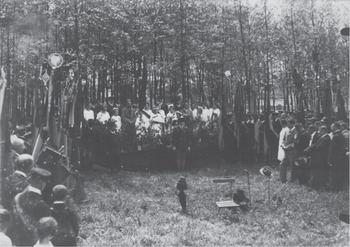
Figure 4 Reichsbanner flag consecration in Unterföhring, 6 June 1926. Female Ehrenjungfrauen stand at the back, wearing white dresses.
Recollections of war
So far we have outlined some key aspects of the organisation and public presence of the Reichsbanner – dimensions that had a bearing on its attempts to represent memories of the war experience to the general public. Now we will investigate which particular recollections of their front-line service the Reichsbanner members prioritised, mostly drawing on the membership journal. Almost every issue of the fortnightly journal contained short episodes and recollections that aimed to encapsulate crucial aspects of trench warfare. These war memories were subject to a certain editorial control and selection, as Franz Osterroth outlined in his memoirs. The editorial team in Magdeburg agreed that the journal of a veterans’ association had the duty to ‘conjure up the true face of the war incessantly, without doing that in the black-and-white manner of the radical pacifists’.74 Particularly during the economic crisis from 1929 onwards, the editors were inundated with submissions by ordinary Reichsbanner members, many of whom were now unemployed and had hence the time to write down their war memories and could also hope for a small honorarium. Recollections from all fronts and all branches of the military were selected for publication, based not on the literary quality of the pieces – which often required lengthy editing – but rather on the ‘truth value’ of their narrative. As rank-and-file members wrote the articles for their peers, these war memories were very well received by the readers of the journal.75 They were not just pieces of propaganda or articulations of a preconceived ideology; they both reflected and shaped the remembrance of war in the Reichsbanner from a bottom-up perspective.
In their war memories, Reichsbanner members did not shy away from depicting the horrors of trench warfare in sometimes quite graphic detail. In that, they were hardly different from some of the most elaborate examples of the literature of soldierly nationalism, such as Storm of Steel, the heavily edited and stylised version of Ernst Jünger’s war diaries. Differences between a nationalist and a socialist reading of the war experiences are apparent not at the level of realistic depictions of battle. Rather, what distinguishes them from each other is the use of different metaphors to endow individual episodes of destruction with meaning, and to relate particular incidents during which soldiers killed and died to the larger questions of the responsibility of certain groups for the war and its underlying causes. Ernst Jünger basically relied on two different sets of metaphors, both of which served to diffuse questions of responsibility and to evade questions of moral judgement. Describing war as a natural process in metaphors such as ‘wave’ or ‘storm’ suggested that it was, as a natural catastrophe, beyond the sphere of human agency. Metaphors of industrial production described the war as a ‘crucible’ in which large troops were reduced to melted ‘slag’ within hours. In any case, within the parameters of these metaphorical systems it was pointless to ask why the war was prolonged or how it could have been prevented.76
One typical example of war memories by Reichsbanner members described the experiences of a ‘gunner at Noyon’. When moving into a different position, his unit was shelled by French troops. In one of the gruesome scenes recalled, he watched comrades die and had to extinguish flames that surrounded soldiers who had been set on fire. Handling the corpse of a comrade in the aftermath of this attack was another horrific experience he faced, making him throw up. All this, however, was not described in metaphysical terms as the work of fate, but as a call for action. If he were to return home alive, the gunner swore to himself, he would fight against the ‘juggernaut of war, which destroys us! Fight against all who preach war as a form of salvation to the youth! Fight against those scoundrels who want to satisfy their lust for power on the death-skulls of the coming generation!’.77 The destructiveness of war was put in sharp relief, particularly through the use of the metaphor ‘juggernaut’. However, the recollections also triggered a need for reflection on the causes of war, and these causes were clearly situated in the realm of human agency. Members of the Reichsbanner, though, were not always able to identify the culprits for the disaster of war in such a straightforward fashion, and to narrate the details of fighting as if they themselves had not had a stake in it. Another recollection focused on the minutes before an attack, and on the inner transformation the soldiers lived through during these moments. Preparing oneself for the very act of aggression, the contributor wrote, ‘I was no longer a human being, I was a beast. I no longer saw friends or comrades, I only saw enemies.’78 Writing in 1931, this veteran was still clearly terrified about the aggressive instincts that the battle had unleashed in him. As many leftist anti-war novelists, he used the metaphor of the animal and brute to highlight the destruction of humanity as an inherent part of the war’s consequences for human beings.79 And like other Reichsbanner soldiers, he mourned the loss of his comrades. But he could not endow their death with any higher meaning, as nowhere was there ‘greater meaninglessness than in war.’80
The author of this recollection was not alone among the Reichsbanner veterans in his moral revulsion against the act of killing, and in his feelings of guilt about the fact that the war had so easily destroyed the inner restraints imposed by civilisation. In another episode, a Bavarian soldier told his comrades how he had been in French captivity. While he and his fellow POWs shovelled gravel into a field-railway lorry near the front line, a French NCO hurled verbal abuse at them. Apparently in an attempt to get a better view, he jumped on one of the lorries. When one of the POWs deliberately aimed a shovelful of gravel at his head, the French NCO fell unconscious to the ground. The German soldiers then continued their work in silence until the lorry was full, knowing that they had just buried the NCO alive. It was futile, the narrator summed up the upshot of this story, to speculate whether this should be classified as an act of murder or not. The bitter truth remained that all the German POWs who were working nearby this lorry had been ‘carried away’ by their collective action, and that the war had ‘turned all of them together into animals’.81 Reichsbanner veterans were thus clearly aware that the war had compromised the moral integrity of everyone who had participated in it, and they vividly remembered its brutalising effects as a very personal experience. Even a decade or more after the end of the war, Social Democrat war veterans were appalled and terrified by the ‘stigma of violence’ and their own involvement in the process of killing.82 Ultimately, though, they blamed their own roles as perpetrators on those who had forced them to serve in the army – in their view the Wilhelmine elites, and nationalist pressure groups in particular.
One example was presented in 1928 by historian Martin Hobohm, whose Reichsbanner activism we will discuss in more detail in Chapter 6. In an article he introduced the unpublished war memoirs of Willibald Seemann. A Social Democrat and carpenter journeyman from Berlin, Seemann had served as a sapper at the western front, and had used a stay in a military hospital to write down his war experiences for the year 1915. Hobohm was convinced that the ability to express the ‘terrible inner refusal against having-to-be-a-soldier, against being-obliged-to-fight-and-die’ was one of the pre-eminent and utterly political qualities of Seemann’s narrative. Such a testimony, he argued, was able to refute the claim often made that a ‘mass instinct’ had set the people of the belligerent nations on a collision course against each other during the war. And he quoted from Seemann’s own formulation of this moral dilemma:
Why, why was I forced to live in the mud, to be eaten by lice, and, among often morally and ethically dissipated human beings, to be the murderer of other human beings, whom I had never in my life seen before? I know for sure that the war is pitting nations against each other, nations that have never encountered each other, but … why were those who saw the ideal of existence in it not expected to do the looting and murdering ad nauseam when it was ordered?83
Like other recollections in the Reichsbanner press, Seemann’s war memoirs tapped into a victimisation narrative. Socialist war veterans were able to express the moral dilemmas that resulted from their own involvement in the large-scale destruction of industrial warfare. To some extent, they could do so because they were sure that the socialist labour movement had instilled a superior set of values into them, which distinguished class-conscious workers from the riff-raff that actually enjoyed life in the army. But all reflections on these dilemmas were cut short by an insistence on the key fact that working-class soldiers had been forced to serve in the military, and had thus merely been the victims of the military machinery of late imperial Germany. In this view, the subordination of ordinary soldiers and the repression of their ability to pursue legitimate aims was the key to an understanding of the war experience. Private soldiers had been ‘jammed into the hell of mud and fire’ that was the battle of Verdun, as they had been forced to serve everywhere else.84
The longing for peace
Against this backdrop, Reichsbanner activists foregrounded those rare instances where soldiers could display a certain degree of agency: mainly the Christmas truce that occurred in 1914 and on a lesser scale again in 1915, and other incidents of fraternisation with the enemy, also at the eastern front. Harking back to these moments, the veterans presented themselves as the true ‘soldiers of peace’. On account of these moments of fraternisation, the veterans claimed that the war would have ended ‘very quickly with a result that had satisfied all sides’ if ‘not the diplomats, but rather German, French and English soldiers’ had been in a position to decide about the terms of peace.85 Writing with hindsight in the 1920s, the veterans found this issue all the more pressing as they asked themselves whether their ‘sacrifices’ had had any positive results in the aftermath of the war.86 But the memory of these temporary truces not only served to reinforce the juxtaposition between the innocent ordinary soldiers and the lust for war among the power elites in all belligerent countries; it also drove home one of the key messages of Reichsbanner activism: that the socialist veterans rejected the notion of enmity and national hatred. When they looked ‘through the wire entanglements, the barrages, the clouds of gas and the uniforms’, they did not see ‘enemies’, but rather ‘the human being, the brother’. Referring to an instance of fraternisation at the Russian front during Easter 1915, this was described, in Christian terminology, as the ‘resurrection’ of the idea that a ‘brotherhood of all human beings’ existed.87 As they explicitly took the perspective of the enemy into account, these texts emphasised their criticism of the war.88 Incidents of fraternisation with the enemy were also a demonstration that socialist workers had always enjoyed those subtle acts of non-conformity that were ‘contradictory to the principle of subordination’. Yet on occasion it had turned out that company commanders had no interest in court-martialling soldiers who sought peaceful contact with the enemy, as long as the overall framework of discipline was not affected.89
Another opportunity to cherish the agency of ordinary soldiers related to what historian Tony Ashworth has called the ‘live and let live system’.90 When troops on some of the quieter stretches of the western front opposed each other at close range, they were able mutually to diminish infantry fire by mutual agreement, or to reduce it to a ritualised exchange at predictable times. They thus created a stable environment that protected their lives, and sometimes they were even able to communicate across no man’s land. Again, narrating these episodes invoked the notion of fraternity with the enemy, which was a highly delicate issue in the polarised political atmosphere of the early 1930s. When the Reichsbanner planned a meeting with French veterans at the Chemin des Dames in 1930, it had to face a flurry of aggressive attacks from the political right, including the charge of ‘high treason’. But there had been a precedent, since the Chemin des Dames was, as one veteran recalled, the place of an extended period of ‘live and let live’ during the summer of 1917, which had lasted for weeks. With the sap-heads only a few metres apart, soldiers from both sides had fired no shots and had used the opportunity to exchange cigarettes and their respective views of the war. Whenever French or German officers inspected the front line, the soldiers returned briefly to normal duty. Only when the regiment offered two weeks of extra holiday as a reward for any confirmed shooting of a French soldier, did an officer dare to leave his dug-out in the ‘hinterland’ and to kill a Frenchman like a ‘head-hunter’. The immediate effect of this ‘treacherous assassination’ (Meuchelmord) was that the French troops had to retaliate. Re-enacting this moment of friendship amidst total war in 1930, though, French and German veterans were now confident that they could put checks on the ‘warmongers of all countries’.91
As these episodes illustrate, the narrative elements of both tragedy and romance were equally relevant for the emplotment of war memories by Reichsbanner veterans. They minced no words in describing their own sacrifices as futile, and in condemning those whom they deemed responsible for the war and thus labelled as murderers. Yet the tragic aspects had a complement, and that was the equally important drama of self-discovery through war. Socialist veterans learned fully to appreciate their own peaceful aspirations through encounters with the alleged enemy. This allowed them to celebrate the victory of international brotherhood after the hardship and tribulations of military service during the Great War. As they were able to overcome national hatred and to turn their wartime suffering into evidence for the will to achieve peace, the republican veterans tapped into the socialist romance of international solidarity among working-class people.92
As such, there was an element of reconciliation and closure in the war remembrances of Reichsbanner members, which allowed them to come to terms with the difficult experiences they had had at the front. A set of other recollections, however, continued to stir up emotions and to agitate the socialist veterans, and this was an intrinsic part of their motivation to rally behind the republican cause. Most of these memories related to the injustice within the Wilhelmine military, with the privileges of the officer caste being at the top of a long list of complaints. These grievances, such as the meagre pay for private soldiers compared with the salary for a young lieutenant who had just left secondary school, were invariably described as a ‘contribution to the stab-in-the-back’.93Such a claim was not only an ironical pun on the nationalist war mythology, but also served to drive home the important point that nothing had undermined the cohesion within the German army more than its inherent, and highly dysfunctional, gross inequality between the ranks. Allowing only officers to wear a small black crape when a close comrade had died served no particular purpose, other than to foster the self-conceit of a ‘small caste’ by symbolic means. At first glance seemingly banal recollections like these also reminded the Reichsbanner members why officers had thought so differently about the war, and how these differences fed into post-war politics.94
The class structure of the Wilhelmine army
According to Reichsbanner members, the officer corps completely alienated soldiers from the Wilhelmine state, and instilled proletarians with hatred against the imperial system. To be sure, this lasting enmity against the old system was not only fuelled by memories of material inequality and injustice. In line with socialist codes of personal integrity, the perceived moral degradation of the officer caste played an equally, if not more important, role, as two examples demonstrate. Alois Dichtl had served as an NCO during the war. A founding member and – from 1924 to 1930 – head of the Reichsbanner organisation in Munich, he died in 1933 in the Dachau concentration camp. When some recollections from his war diary were published in 1930, he was explicitly labelled as a ‘worker-soldier’, thus reinforcing the message that class was the key to an understanding of the war experience. Two incidents epitomised his resentment about everything that was wrong in the Imperial Army. The first came when a major handed out decorations on the Kaiser’s birthday. Not only were most of them awarded to staff officers of the regiment, but the soldiers were also expected to shout a hooray, something Dichtl ordered his platoon not to do. The second came when the sergeant who gave out the pay during a roll call was accompanied by his French whore. Again, Dichtl insisted that he would not like to see that happening again.95 This theme of corruption and moral sleaziness was echoed in one of the living pictures many Reichsbanner branches used to stage as part of their festive social events. In line with labour movement tradition, tableaux vivants provided an opportunity to express political ideas through the symbolism of theatrical play.96 When a branch in Nuremberg staged tableaux vivants in 1925, one of them showed, under the heading Dolchstoß, a group of officers in a fancy restaurant, each of them ‘having a whore sitting on his lap’.97
In a certain sense, the alienation and deep resentment between working-class soldiers and their troop officers was presented as a tragedy, as the workers were in principle highly capable and also ready to excel in combat. But as the worker-soldier was steeped in the ‘inherited consciousness of his class’, he was not interested in status, and thus not keen to climb up the ladder of military ranks. In a story that was set in the battle of Verdun, a working-class soldier could not stop pointing out to his superiors instances of unfair treatment, and was treated with disregard. Like his comrades, he was not interested in conventional notions of heroism, but did not like to be called a coward by the company commander either. It took a joint trip through a difficult stretch of the front line to convince the lieutenant that the worker was no coward, and to promote him to lance corporal, a recognition that he finally accepted. But even this small and belated hint at a possible reconciliation between the classes came in vain, as the soldier was killed a few weeks later.98 Alois Dichtl lamented just as much the impossibility of reconciling class and military performance. While at the front, private soldiers and NCOs were equally ready to sacrifice their lives ‘for each other’, but behind the lines, the power-system of the military had forced the latter to stress their status as superiors, and compelled the soldiers to acknowledge this difference.99
Reichsbanner veterans were unequivocal in their condemnation of the caste system within the Wilhelmine military, and of the acts of injustice it had meted out to ordinary soldiers. Hence, they were also highly critical of the myth of comradeship that all veterans’ associations on the political right cultivated in equal measure. For the Stahlhelm, Jungdo and Kyffhäuserbund, the front-line community had transcended both class and military rank. Thus, it was an embryonic form of the Volksgemeinschaft that would halt the economic, power-political and moral decline in the aftermath of the war, and return the German nation to unity and strength.100 Among Social Democrat veterans, the notion of comradeship was not rejected out of hand. During the Depression of the early 1930s, members were urged to share meals with their unemployed comrades, and to reflect on how miserably the officers had failed in this respect during the war.101 But the men in the Reichsbanner were keen to stress that they had never encountered superiors as comrades, and that the very few exceptions to this, usually active officers who had already served before the war, simply proved the rule. Those who currently held the notion of comradeship dearest were precisely those who had exploited their position most aggressively during the war. In their view, the myth of comradeship was simply a means to lure people into right-wing associations. Yet the alleged front-line community was not only rejected for ideological reasons. Working-class veterans clearly remembered that the word ‘comrade’ had generally lost much of its currency during the course of the war, and had hardly been used from 1917 onwards. To be sure, examples of ‘real comrades’ who sacrificed themselves for others without expecting any gratification had existed, and were ‘gladly remembered’.102 Over the course of four years, however, a growing number of private soldiers had pursued their own selfish interests in a more and more reckless manner, and – for instance – stole from their peers on a regular basis. As memories like these kept lingering in their minds, a mere ‘fiction of comradeship’ was what Reichsbanner members most strongly associated with their personal encounters at the front.103
Yet the Reichsbanner veterans not only rejected the nationalist mythology of a front-line community between soldiers and officers that could serve as a blueprint for the resolution of political problems in the Weimar Republic; they also differed in their concept of masculinity that underpinned the understanding of the military as an exclusively male site of sociability. The proponents of soldierly nationalism promoted an aggressive, hegemonic version of masculinity, in which men were supposed to show strength, and in which the in-group of male bonding had legitimate prevalence over the individual with his preferences and emotions. Individual soldiers who offended against the collective will of the ‘we’ were to be ‘shamed and isolated’.104 Reichsbanner veterans, by contrast, were prepared to accept the more sensitive and vulnerable aspects of masculine identity under the strains of war. Martin Hobohm explicitly highlighted one chapter in the war memoirs of the carpenter Willibald Seemann in which he detailed a period of ‘inner despair’ (seelischen Verzagens). Whereas members of the middle class would shy away from mentioning these issues, Hobohm argued, bound by their rigid conventions, Seemann was able to describe without any sense of shame how the compulsion of community had weighed upon him:
Seemann is not embarrassed to indicate how military life [Kommiß] and trench warfare gradually wore him down, how this was noticed and how he was picked upon for it, how he finally lay down in a meadow pressing his face into the grass, and how he sobbed into his shaking hands. He is also not afraid to report how he made off on one occasion, running back full pelt after his first heavy barrage, until he was exhausted and out of his mind.105
Men in the Reichsbanner did admit to shedding tears during the war, and to moments of weakness. They were not necessarily proud to recall their war-weariness, but they had no problem talking about these feelings either. As the report on these episodes by Hobohm indicates, the articulation of these different forms of masculinity was closely connected to memories of cowardice.
In the pages of the Reichsbanner press, there was ample room for memories that detailed how Social Democrats had resented the war and the coercive structures of the Wilhelmine military, how they had sought to fraternise with their oppononents and had longed for peace from an early stage. Portraying the officers as a separate caste characterised by corruption and moral decay allowed them to counter the stab-in-the-back myth. The overall framework of these memories offered an explanation for the league’s republican activism. Former ex-servicemen on the right of the political spectrum tended to claim that their associations had emerged from the Fronterlebnis, although it was, as the Reichsbanner insisted, a heavily stylised and mythologised version of that experience. The republican veterans, on the other hand, had developed their commitment from the direct ‘experience of the most hideous bankruptcy in German and European history’, as the former army major Karl Mayr put it in 1929.106 It was the final collapse of the monarchical system in the autumn of 1918 that underpinned the war memories of the Reichsbanner members and fuelled their commitment to the republican polity. But the abdication of the Kaiser had also been the moment when the Imperial Army collapsed, a process that the socialist veterans had personally witnessed. How exactly had it come about that the Germans had to sign an armistice even though their troops were still well advanced into enemy territory?
The road to armistice
This was an important but also highly problematic aspect of the republican remembrance of war, as it demanded a reflection on the individual and collective agency of the soldiers in the autumn of 1918, an issue that was highly charged with political implications. Over the years from 1924 to 1933, Reichsbanner members offered different recollections and readings of the situation at the front in autumn 1918, all of which ultimately tended to downplay or deny any collective agency of the troops, and insisted that they had succumbed to the overwhelming firepower and superior resources of the Allies. In 1931, the journalist and writer Alfred Kantorowicz (1899–1979) – by then already a member of the KPD, and later famous for his diary of the Spanish Civil War – described his impressions during the final weeks of the war in September and October 1918. The scattered ‘fragments’ of his battalion, after three weeks in the front line and down to forty men only, had been shelled by their own artillery, and did not stand a chance against fresh and well-equipped British units. Even the divisional headquarters did not really expect that any German troops were still left on the front line. But the few remaining soldiers defended their untenable position ‘until the last moment’ against this ‘superior strength’.107
Already from the spring of 1918 onwards, Reichsbanner members had observed how the field army hospitals filled up with soldiers who had terrible, self-inflicted leg wounds, and how a growing percentage of transports absconded when units were shifted around at the western front. They also noticed that front-line soldiers sold their uniforms to French civilians, and tried everything to avoid rejoining their unit for one of the many offensives in the final summer of the war. Then and with hindsight, they clearly understood and respected that extreme war weariness had motivated these actions.108 Reichsbanner veterans also remembered how the news of the declaration of a German Republic had been greeted with an ‘enthusiastic’ collective ‘hoorah’ when it reached the troops in the Belgian town of Leuven on 10 November. And they recalled the concerted efforts of the revolutionary soldiers’ councils to maintain order in the field army and to facilitate a swift return of the troops back home.109 The revolutionary events of November 1918 and their connection with the unavoidable defeat of German troops thus had a clear presence in the recollection of Social Democrat veterans. But when they told the story of these momentous weeks, Reichsbanner members never used a first-person narrative to describe any revolutionary events. Thus, they carefully avoided anything that could hint at their own active contribution to the disintegration of the German field army and to the wave of politicisation that had swept the Wilhelmine system aside. Even as fierce critics of the Kaiserreich and its military, Social Democrats were bound by the ‘language of national obligation’ which was a corollary of universal conscription.110 The Reichsbanner had set out to defend the new political system which was the direct result of the revolutionary upheaval in November 1918. But in the war remembrance of these dedicated republicans there was no space for any symbols or reminiscences of their own revolutionary agency. The revolution had occurred, and for good reasons, but it had been the work of others.
It should be clear by now that the Reichsbanner differed fundamentally from the right-wing veterans’ associations in the ways in which it narrated and remembered the front-line experiences of the Great War. Instead of creating heroic war mythologies, Social Democrat veterans were keen to bring the destructive nature of war, the injustice within the Imperial Army and the victimisation of ordinary soldiers to the fore. Rather than employing a set of metaphors that characterised the war as an unavoidable and unexplainable fate, they pointed directly to the responsibility of the Wilhelmine elites and nationalist circles for the prolongation of the conflict and tried to reconstruct the hardship of front-line service in a realistic language. The discursive elements of this war remembrance were scattered across the pages of the Reichsbanner journal, provided by the many rank-and-file members who – along with some more well-known writers such as Kantorowicz – provided their own very personal recollections for publication. As these memories were one of the most popular features of the journal, there were repeated calls to publish them in more coherent form as a book. Owing to the lack of a separate Reichsbanner publishing house these plans never materialised. According to Franz Osterroth, those publishers who were affiliated with the Reichsbanner parties – and in particular, one can add, J. H. W. Dietz, the house publisher of the SPD since 1881 – would have objected to such a form of competition.111
Despite the lack of overall discursive coherence in the publication of these memories, the most important tropes of war remembrance in the Reichsbanner are clearly discernible. Their particular strength and appeal among the rank-and-file members did not rest on their specific form of presentation, but rather on the fact that they tapped into key interpretive elements of labour movement culture which had already informed and agitated male Social Democrats some time before the war. Criticising the privileges and better pay of the officer caste in some respects reiterated a commonplace Social Democrat agitation in Wilhelmine Germany, which had contrasted the poor living standards of the workers with the fact that only affluent people could indulge in nationalist thinking. Portraying ordinary soldiers as victims of a brutal military machine conjured up images of the class character of the Wilhelmine state and the ways in which it had deliberately harassed and excluded Social Democrats, particularly as conscripts in the army. Finally, the many recollections of fraternisation and the hopes for a brotherhood of soldiers from all belligerent nations tapped into the fierce anti-militarism and internationalism of the labour movement before 1914.112 As we will explore in more detail in the next chapter, the published war remembrances of the Reichsbanner offered a convincing framework through which Social Democrat veterans could rework their own memories of front-line service. One important reason for this success was the class-based nature of this discursive framework. Quite deliberately, it gathered a number of important rhetoric set pieces that had already informed the socialist labour movement before the war, and thus linked the war experience to the cultural frames of civilian working-class life. In the historical context of the embattled Weimar Republic, this linkage can be interpreted both as a strength and as a weakness. As they reinterpreted the disturbing experience of trench warfare in the time-honoured patterns of a precarious working-class culture, these memories offered an element of continuity and perhaps also stability. But as they focused on both the plight and the exemplary morality of socialist workers, it was highly unlikely that these memories could be shared beyond the Reichsbanner core constituency of Social Democrats and labour movement activists. Meant to support the new polity as republican war remembrances, they were in fact socialist remembrances, reflecting on the meaning of total war from a partisan political perspective. Thus, it could arguably be said that the Reichsbanner tried to counter the nationalist war mythologies of the political right with the class mythologies of the socialist labour movement.
Shortly after its inception in 1924, the Social Democrat war veterans of the Reichsbanner built up the impressive edifice of an organisation that was able to reach out into even the most remote corners of the Reich. In the first instance, it gathered those former soldiers of the Great War who were devoted republicans, and who supported the new state as a direct consequence of their war experiences in the Imperial Army. Writing in 1925, former Bavarian officer and Reichsbanner luminary, Hermann Schützinger – whose reasons for switching to a moderate pacifism we will analyse in Chapter 6 – could confidently compare the overall framework of veterans’ associations in France and Germany. According to his estimate, about 60 per cent of all German war veterans were, as members of Reichsbund and Reichsbanner, firmly anchored in the republican camp, and represented a ‘front of war refusal and reconciliation between the peoples’. Only 40 per cent of all German veterans were represented by the Kyffhäuserbund and the patriotic associations such as Stahlhelm and Jungdo. In France, by comparison, 70 per cent were supporters of the ‘cartel of the left’ in the Union fédérale, and just 20 per cent in the Union nationale des combattants, with only a minority supporting Communist or radical nationalist groups. But even the Union nationale – and this was the main difference – would not dare to deviate from the ‘gospel of all French war veterans’, namely support for the League of Nations in order to prevent another war.113
The institutional strength of the Reichsbanner, however, did not necessarily translate directly into a powerful position in symbolic politics, including the representation of war memories. Contrary to claims by some historians, the Reichsbanner did not contribute to an overall militarisation of Weimar’s political culture. But even though most of its members supported a moderate pacifism, they had to wear uniforms and military decorations in order to represent their claims as veterans in the public arena. Ambivalence also characterised the public narratives of war remembrance that the Reichsbanner cultivated in its membership journal. These highly popular pieces successfully tapped into key elements of socialist labour movement culture, such as anti-militarism and internationalism, or the notion of the Wilhelmine state and its military as instruments of class power. Nationalist mythologies of the war experience focused on the ‘honour’ of the veterans, understood as an equally exclusive and distinctive quality of the military that was closely associated with the principle of social stratification, and the privileges of an alleged ‘elite’ of aristocratic officers in particular. Recollections of the war experience in the Reichsbanner, on the other hand, aimed to retain the ‘dignity’ of the ordinary soldier amidst the inhumanity of the ‘social order’ that had brought the war about.114 In line with the democratic principles of the league, this was an inclusive and egalitarian form of remembrance, which even took the suffering of the enemy into account. Within the framework of Reichsbanner war memories, however, it was not possible to resolve the conflict between a principled rejection of war and its destructive power, and the basic affirmation of wartime service.115 While they were happy to describe themselves as reluctant soldiers with no interest in individual advancement, outright refusal, desertion or collective mutiny clearly had no place in the memory of Reichsbanner veterans. They recalled how the troops had greeted the armistice and the toppling of the monarchy in November 1918 with joy, but never claimed these political outcomes of the war were the result of their own collective agency.
1 ‘Kriegsteilnehmer, Republikaner!’, RB no. 1, 15 April 1924; Rohe, Reichsbanner, pp. 55–65.
2 Dirk Schumann, Political Violence in the Weimar Republic 1918–1933: Battles for the Streets and Fears of Civil War (New York: Berghahn, Reference Schumann2009), pp. 54–112, 151f.
3 Franz Osterroth, ‘Vorläufer’, n.d.: AdsD, NL Franz Osterroth, Mappe 138; see also ‘Vorläufer des Reichsbanners’, RB no. 8, 23 February 1929.
4 For a brief summary of events, see Mommsen, The Rise and Fall of Weimar, pp. 81–5.
5 Franz Osterroth, ‘Der schlesische “Neue Stahlhelm”’, n.d.: AdsD, NL Franz Osterroth, Mappe 138.
6 Osterroth, ‘Vorläufer’.
7 Gerstenberg, Freiheit, Vol. I, pp. 75ff., 87–97.
8 See the undated poster [1922]: StAM, Pol. Dir. 6886.
9 Voigt, Kampfbünde, pp. 83–95.
10 Otto Krille, ‘Reichsbanner Schwarz–Rot–Gold’, n.d. [1950?]: IfZ, F 86; on Krille see Gerstenberg, Freiheit, Vol. II, p. 275.
11 ‘Kriegsteilnehmer, Republikaner!’ On Jewish support for the founding of the Reichsbanner see Jacob Toury, ‘Die Judenfrage in der Entstehungsphase des Reichsbanners Schwarz–Rot–Gold’, in Ludger Heid and Arnold Paucker (eds.), Juden und deutsche Arbeiterbewegung bis 1933 (Tübingen: Mohr, Reference Toury, Heid and Paucker1992), pp. 215–35.
12 ‘Die Bundessatzungen’, RB no. 1, 15 April 1924. New by-laws, passed in May 1926, changed the aim to the integration of all ‘Reich German men’, thus dropping the exclusive focus on war veterans. See PND, 7 July 1926: StAM, Pol. Dir. 6889. See also ‘Reichsbanner Schwarz–Rot–Gold’, Fränkische Tagespost no. 87, 11 April 1924: StAM, Pol. Dir. 6890.
13 ‘Die Sturmhaufen gegen die Republik’, RB no. 1, 15 April 1924.
14 Voigt, Kampfbünde, pp. 98–114.
15 See PND report, 14 August 1924; and a report on Würzburg, 10 July 1924: StAM, Pol. Dir. 6888; Dieter Gündisch, Arbeiterbewegung und Bürgertum in Wetzlar 1918–1933 (Wetzlar: Geschichtsverein, Reference Gündisch1992), p. 256; Rudolf Macht, Niederlage: Geschichte der Hofer Arbeiterbewegung, Vol. III.2: 1924–1945 (Hof: Selbstverlag, Reference Macht1996), p. 102.
16 Voigt, Kampfbünde, pp. 153–60.
17 ‘Der Dank des Vaterlandes und die Hetze gegen das Reichsbanner’, Münchener Post no. 238, 15 October 1925: StAM, Pol. Dir. 6890; see Hans Harter, ‘“Das Bürgertum fehlt und überläßt dem Arbeiter den Schutz der Republik”: Die Ortsgruppe Schiltach des Reichsbanners Schwarz–Rot–Gold’, Die Ortenau 72 (Reference Harter1992), 271–302 (p. 277).
18 Mintert, Sturmtrupp, p. 29.
19 James M. Diehl, Paramilitary Politics in Weimar Germany (Bloomington; London: Indiana University Press, Reference Diehl1977), p. 294; Alois Klotzbücher, Der politische Weg des Stahlhelm, Bund der Frontsoldaten, in der Weimarer Republik, Ph.D. dissertation (University of Erlangen-Nuremberg, Reference Klotzbücher1964), p. 42; reports by various mayors from cities in the Rhineland in 1929 to the Regierungspräsident in Düsseldorf: GStA, I. HA, Rep. 77, Tit. 4043, no. 351, fos. 19–22, 27.
20 Helga Gotschlich, Zwischen Kampf und Kapitulation: Zur Geschichte des Reichsbanners Schwarz–Rot–Gold (Berlin: Dietz Verlag, Reference Gotschlich1987), pp. 32f.
21 See PND report no. 489, ‘Kameradschaftsabend des Reichsbanners’, 20 December 1924: StAM, Pol. Dir. 6887.
22 Stahlhelm Bundesleitung, 15 May 1928: BArch, R 72, 289, fo. 168; see ‘Abstieg des Reichsbanners’, Welt am Abend, 2 February 1925: LAB, A Pr. Br. Rep. 030, 7562, fo. 13.
23 Rohe, Reichsbanner, pp. 72–4.
24 Franz Osterroth, ‘Erinnerungen 1900–1934’, AdsD, NL Franz Osterroth, 1/FOAC000001, p. 187. On Osterroth see , Nationaler Sozialismus und Soziale Demokratie: Die sozialdemokratische Junge Rechte, 1918–1945 (Bonn: J. H. W. Dietz, 2006), pp. 83, 87, 98.
25 Franz Osterroth, ‘Erinnerungen 1900–1934’, p. 187.
26 Voigt, Kampfbünde, pp. 129–31, 446–50; see Rohe, Reichsbanner, p. 74; for Hanover see Harsch, Social Democracy, pp. 104, 285; for Bavaria: Anton Großmann, ‘Milieubedingungen von Verfolgung und Widerstand am Beispiel ausgewählter Ortsvereine der SPD’, in Martin Broszat and Hartmut Mehringer (eds.), Bayern in der NS-Zeit, 6 vols., Vol. V: Die Parteien KPD, SPD, BVP in Verfolgung und Widerstand (Munich; Vienna: Oldenbourg, Reference Großmann, Broszat and Mehringer1983), pp. 433–540 (pp. 497, 499).
27 On the membership figures of the Jungdo dropping to 100,000 from 1924, see Dieter Fricke (ed.), Lexikon zur Parteiengeschichte: Die bürgerlichen und kleinbürgerlichen Parteien und Verbände in Deutschland (1789–1945), 4 vols. (Cologne: Pahl-Rugenstein, Reference Fricke1983–6), Vol. II, p. 138.
28 Osterroth, ‘Erinnerungen 1900–1934’, p. 182. In the Franconian district of Hof, thirty-five local branches already existed by 1924. See Macht, Niederlage, p. 104.
29 Schumann, Political Violence, p. 117.
30 See Lawrence D. Stokes, ‘Die Anfänge des Eutiner Reichsbanners (1924–1929/30)’, Demokratische Geschichte 3 (Reference Stokes1988), 335–43; Landespolizeistelle Wilhelmshaven, 20 June 1924: StA Bremen, 4, 65, 1026, fo. 80; ‘Republikanischer Frontkämpfertag: Ein Kongress in Königsberg’, Berliner Tageblatt, 17 April 1924: StA Bremen, 4, 65, 1026.
31 ‘Aus dem finsteren Pommern’, RB no. 14, 2 April 1932, Beilage; ‘Ein Notruf aus dem Lande: Die Lage der ländlichen Ortsvereine’, RB no. 2, 15 January 1928, Gaubeilage Berlin-Brandenburg.
32 See the various examples in StAM, Pol. Dir. 6888. For the founding of new branches in later years, for instance in the small towns of Schliersee and Hausham: ‘Halbmonatsbericht BA Miesbach’, 15 January 1931: ibid., Pol. Dir. 6892.
33 PND report no. 48, 20 May 1926: ibid., Pol. Dir. 6888.
34 Police report, 25 July 1924: ibid.
35 Vorwärts no. 426, 10 September 1924: ibid., Pol. Dir. 6889.
36 Rohe, Reichsbanner, pp. 69–72.
37 Jürgen Weber, ‘Das Reichsbanner im Norden: Ein Bollwerk der Demokratie?’, Demokratische Geschichte 20 (Reference Weber2009), 127–46 (p. 130).
38 Detlef Schmiechen-Ackermann, Nationalsozialismus und Arbeitermilieus: Der nationalsozialistische Angriff auf die proletarischen Wohnquartiere und die Reaktion in den sozialistischen Vereinen (Bonn: J. H. W. Dietz, Reference Schmiechen-Ackermann1998), quote on p. 400; for the figures see Gotschlich, Kampf, p. 33.
39 Mintert, Sturmtrupp, pp. 29–31; see Voigt, Kampfbünde, p. 137.
40 See PND no. 726, 21 February 1931: StAM, Pol. Dir. 6887; Rohe, Reichsbanner, pp. 314–20.
41 ‘Auszug aus N-Bericht’, 31 October 1924: StAM, Pol. Dir. 6891; letter to the head of the local Reichsbanner branch in Hanover, 16 August 1925: NHStAH, Hann. 310 II C, no. 16, fos. 233–5; ‘2. Gaukonferenz am 21. und 22. September in München’ (1929): BArch, SAPMO, Ry 12/II, 113, no. 2, fos. 8f.
42 See Eve Rosenhaft, ‘Working-Class Life and Working-Class Politics: Communists, Nazis and the State in the Battle for the Streets. Berlin, 1928–1932’, in Richard Bessel and E. J. Feuchtwanger (eds.), Social Change and Political Development in Weimar Germany (London: Croom Helm, Reference Rosenhaft, Bessel and Feuchtwanger1981), pp. 207–40 (pp. 211f.).
43 Reichsbanner Gau, Hamburg, to Willy Dehnkamp, 17 April 1930: StA Bremen, 7, 88 (NL Willy Dehnkamp), 50/6.
44 Mintert, Sturmtrupp, pp. 34–9; Voigt, Kampfbünde, pp. 303f.
45 PND no. 466, 7 August 1924: StAM, Pol. Dir. 6887; Reichsbund, Beilage Heim und Garten, no. 16, 25 August 1929.
46 Rohe, Reichsbanner, pp. 314–21.
47 Voigt, Kampfbünde, pp. 201–19.
48 Schumann, Political Violence, pp. 186–206 (quotes on pp. 186, 191). For a similar argument, without any references, see Gerstenberg, Freiheit, Vol. I, p. 216.
49 Quotes: Pol. Dir. Nürnberg-Fürth, 9 July 1924: StAM, Pol. Dir. 6888; Macht, Niederlage, p. 104.
50 Pol. Dir. Nürnberg-Fürth, 9 July 1924: StAM, Pol. Dir. 6888.
51 PND no. 470, 5 September 1924: ibid., Pol. Dir. 6887.
52 Cited in Macht, Niederlage, p. 107. See PND no. 461, 18 July 1924; and PND no. 472, 5 September 1924, both in StAM, Pol. Dir. 6887.
53 See Gerstenberg, Freiheit, Vol. I, pp. 172f., 561; Harter, ‘Bürgertum’, p. 287; Macht, Niederlage, p. 107; PND no. 508, 18 May 1925: StAM, Pol. Dir. 6887; Polizeisekretär Hofmann to Pol. Dir. Munich, 14 June 1930: StAM, Pol. Dir. 6886.
54 ‘Reichsbanner Schwarz–Rot–Gold: Entwicklung im Jahre 1925’, 1 February 1926: BArch, SAPMO, Ry 12/II, 113, no. 1, fos. 7f.
55 Rohe, Reichsbanner, pp. 166–8; Voigt, Kampfbünde, pp. 281f.
56 PND no. 508, 18 May 1925: StAM, Pol. Dir. 6887; on Maurenbrecher see Gerstenberg, Freiheit, Vol. II, p. 280.
57 As claimed without any evidence by Schumann, Political Violence, p. 161.
58 See for instance Generalmajor a.D. von Bresler, ‘Der Geist im Reichsbanner’, Berliner Tageblatt, 14 August 1927: StA Bremen, 4, 65, 1032.
59 PND no. 535, 30 March 1926: StAM, Pol. Dir. 6886.
60 Kurt G. P. Schuster, Der Rote Frontkämpferbund 1924–1929 (Düsseldorf: Droste, Reference Schuster1975), p. 67.
61 See also Voigt, Kampfbünde, pp. 266–9.
62 ‘Der Reichsausschuß des Reichsbanners SRG: Anlage zu Pol. Dir. Nürnberg’, 24 October 1929: StA Bremen, 4, 65, 1034; the biographical essay by Peter Steinkamp does not mention his Reichsbanner activism; see his ‘Kapitän zur See a.D. Lothar Persius (1864–1944): Ein Seeoffizier als Kritiker der deutschen Flottenpolitik’, in Wette and Donat (eds.), Pazifistische Offiziere, pp. 99–109.
63 Lothar Persius, ‘Reichsbanner und Pazifismus’, RB no. 1, 1 May 1926.
64 Franz Osterroth, ‘Erinnerungen 1900–1934’, AdsD, NL Franz Osterroth, 1/FOAC000001, p. 182.
65 , ‘Defending the Republic: The Great Fashion’, in , and (eds.), The Weimar Republic Sourcebook (Berkeley: University of California Press, 1994), pp. 110–12; translation amended from the German original: , ‘Schutz der Republik: Die große Mode’, in Sämtliche Schriften, 8 vols., Vol. II: 1922–1924 (Reinbek: Rowohlt, 1994), pp. 364–6. For a similar criiticism see , ‘Der Sieg des republikanischen Gedankens’ (1926), in Gesammelte Werke, 10 vols., ed. and (Reinbek:Rowohlt, 1975), Vol. IV, pp. 495–9; the print-run is according to Osterroth, ‘Erinnerungen 1900–1934’, p. 188.
66 Ossietzky, ‘Schutz der Republik’, pp. 365f.
67 ‘In der Kantine’, RB no. 3, 1 June 1924; no. 5, 15 July 1924.
68 Clipping from the Berliner Volks-Zeitung, 18 December 1925: BArch, R 1501, 113501, fo. 200.
69 For this interpretation see Robert von Friedeburg, ‘Klassen-, Geschlechter- oder Nationalidentität? Handwerker und Tagelöhner in den Kriegervereinen der neupreußischen Provinz Hessen-Nassau 1890–1914’, in Ute Frevert (ed.), Militär und Gesellschaft im 19. und 20. Jahrhundert (Stuttgart: Klett–Cotta, Reference Friedeburg and Frevert1997), pp. 229–44; on the Kyffhäuserbund in the Weimar Republic see Christopher James Elliott, ‘The Kriegervereine in the Weimar Republic’, JCH 10 (Reference Elliott1975), 109–29.
70 Pol. Dir. Munich, 15 November 1926: StAM, Pol. Dir. 6888.
71 Gerstenberg, Freiheit, Vol. I, pp. 225–32 (quote on p. 267).
72 Münchener neueste Nachrichten no. 276, 6 January 1925: BArch, R 1501, 113501, fo. 145; see Wegweiser für Funktionäre, Führer und alle Bundeskameraden des Reichsbanners Schwarz–Rot–Gold, 3rd edn (Magdeburg:Verlag des Bundesvorstandes, 1929), pp. 67f. J. Kunzemann was a county executive (Landrat) in the Magdeburg region, confidant to Otto Hörsing and an associate member of the Reichsbanner executive board; Schumann, Political Violence, pp. 58, 60.
73 ‘Protokollbuch Ortsgruppe Schiltach’, 15 January 1927, 8 June 1929: StA Schiltach, AS-2055a.
74 Franz Osterroth, ‘Erinnerungen 1900–1934’, p. 192.
75 Ibid.
76 Helmuth Kiesel, Ernst Jünger: Eine Biographie (Munich: Pantheon, Reference Kiesel2009), pp. 180–2.
77 ‘Kanonier bei Noyon’, RB no. 17, 25 April 1931, Beilage.
78 ‘Der Angriff’, ibid. no. 13, 28 March 1931, Beilage.
79 See Vollmer, ‘Imaginäre Schlachtfelder’, pp. 158f.
80 ‘Der Angriff’, RB no. 13, 28 March 1931, Beilage.
81 ‘Das Tier im Menschen’, ibid. no. 14, 2 April 1932, Beilage.
82 See Michael Geyer, ‘The Stigma of Violence: Nationalism and War in Twentieth-Century Germany’, German Studies Review 15 (Reference Geyer1992), 75–110.
83 Martin Hobohm, ‘Soldat aus Berlin-Ost’, RB no. 25, 5 August 1928. Ellipsis in the original.
84 ‘Das Kreuz vom Bois Hassoule’, ibid. no. 10, 1 October 1924.
85 ‘Soldaten des Friedens’, ibid. See ‘Weihnachten draussen’, ibid. no. 51, 21 December 1929, Beilage; ‘Zwischen den Gräben: Eine Kriegserinnerung’, ibid. no. 49, 8 November 1930, Beilage; ‘Heiliger Abend im Niemandsland’, ibid. no. 52, 24 December 1932.
86 ‘Soldaten des Friedens’.
87 ‘Auferstanden: Ein Ostererlebnis im Kriege’, RB no. 13, 30 March 1929.
88 For Vollmer, ‘Imaginäre Schlachtfelder’, p. 161, this is one of the hard criteria that distinguish anti-war novels.
89 ‘Hallo Kamerad! Gazette des Ardennes!’, RB no. 19, 18 July 1931.
90 , Trench Warfare 1914–1918: The Live and Let Live System (London: Macmillan, 1980).
91 ‘Reicht euch die Bruderhand! Das Treffen am Chemin des Dames’, RB no. 4, 25 January 1930.
92 On the forms of emplotment see Benjamin Ziemann and Miriam Dobson, ‘Introduction’, in Miriam Dobson and Benjamin Ziemann (eds.), Reading Primary Sources: The Interpretation of Texts from Nineteenth- and Twentieth-Century History (London: Routledge, Reference Ziemann, Dobson, Dobson and Ziemann2008), pp. 1–18 (pp. 10f.).
93 ‘Beitrag zum Dolchstoß’, RB no. 2, 15 January 1926; see ‘Wirkliche Dolchstöße’, ibid. no. 4, 2 December 1928.
94 ‘Der Trauerflor’, ibid. no. 2, 15 May 1924.
95 ‘Ein Arbeiter-Soldat im Weltkrieg’, ibid. no. 8, 20 February 1932; on Dichtl see Gerstenberg, Freiheit, Vol. II, p. 260.
96 See Gerstenberg, Freiheit, Vol. II, pp. 146f.
97 Newspaper clipping, 24 March 1925: BArch, R 8034 II, 2870, fo. 25.
98 ‘Der Kompanieführer’, RB no. 18, 3 May 1930, Beilage.
99 ‘Ein Arbeiter-Soldat im Weltkrieg’.
100 See , Die Frontgemeinschaft: Das Gemeinschaftserlebnis in der Kriegsliteratur, Ph.D. dissertation (University of Greifswald, 1936); Ann P. Linder, Princes of the Trenches: Narrating the German Experience of the First World War (Columbia: Camden House, Reference Linder1996), pp. 74–85; Thomas Kühne, Belonging and Genocide: Hitler’s Community, 1918–1945 (New Haven; London: Yale University Press, Reference Kühne2010), pp. 21–6.
101 ‘Kameradschaft: Helft den notleidenden Kameraden!’, RB no. 39, 26 September 1931.
102 ‘Kameradschaft’, ibid. no. 11, 1 June 1926, Gaubeilage Berlin-Brandenburg.
103 ‘Das gestohlene Brot: Eine Kriegserinnerung’, ibid. no. 41, 10 October 1931.
104 Kühne, Belonging, p. 27; see Daniel Morat, ‘Kalte Männlichkeit? Weimarer Verhaltenslehren im Spannungsfeld von Emotionen- und Geschlechtergeschichte’, in Manuel Borutta and Nina Verheyen (eds.), Die Präsenz der Gefühle: Männlichkeit und Emotion in der Moderne (Bielefeld: Transkript, Reference Morat, Borutta and Verheyen2010), pp. 153–77.
105 Hobohm, ‘Soldat aus Berlin-Ost’.
106 Karl Mayr, ‘Reichsbanner vor die Front’, RB no. 14, 6 April 1929.
107 Alfred Kantorowicz, ‘Die letzten Wochen’, ibid. no. 45, 7 November 1931; see Wolfgang Gruner, Ein Schicksal, das ich mit sehr vielen geteilt habe. Alfred Kantorowicz: Sein Leben und seine Zeit von 1899 bis 1935 (Kassel University Press, Reference Gruner2007), pp. 58–70 on his front service in 1918.
108 ‘Dolchstoß-Erinnerungen’, RB no. 37, 14 September 1929.
109 ‘Erinnerungen eines Soldaten’, ibid. no. 40, 18 November 1928; ‘Der Umsturz bei der 6. Armee: Erinnerungen eines Soldatenrats’ (quotes); ibid. no. 53, 21 December 1932.
110 Michael Geyer, ‘Eine Kriegsgeschichte, die vom Tod spricht’, in Thomas Lindenberger and Alf Lüdtke (eds.), Physische Gewalt: Studien zur Geschichte der Neuzeit (Frankfurt am Main: Suhrkamp, Reference Geyer, Lindenberger and Lüdtke1995), pp. 136–61 (p. 148).
111 Osterroth, ‘Erinnerungen 1900–1934’, pp. 192f.
112 On these interpretive elements of labour movement culture before 1914 see and , ‘Vaterlandslose Gesellen’: Sozialdemokratie und Nation 1860–1990 (Munich: C. H. Beck, 1992), pp. 54–141; Alex Hall, Scandal, Sensation and Social Democracy: The SPD Press and Wilhelmine Germany 1890–1914 (Cambridge University Press, Reference Hall1977), pp. 116–42; Hartmut Wiedner, ‘Soldatenmißhandlungen im Wilhelminischen Kaiserreich (1890–1914)’, AfS 22 (Reference Wiedner1982), 159–99; and Nicholas Stargardt, The German Idea of Militarism: Radical and Socialist Critics, 1866–1914 (Cambridge University Press, Reference Stargardt1994), pp. 49–70, 127–41.
113 Hermann Schützinger, ‘Frankreichs Frontsoldaten’, Vorwärts no. 258, 3 June 1925: BArch, R 8034 III, 432, fo. 167; and ‘Das Friedenswerk der Frontsoldaten’, Die Glocke10 (1924), 1100–2. For the mid 1920s, this was a fair assessment of the French veterans’ movement. In the early 1930s, however, the Union fédérale was only slightly stronger than the Union nationale. See Prost, In the Wake of War, pp. 35–41.
114 See Vollmer, ‘Imaginäre Schlachtfelder’, p. 128.
115 On the representation of this conflict in anti-war novels by Remarque and Johannsen see ibid., pp. 165f.
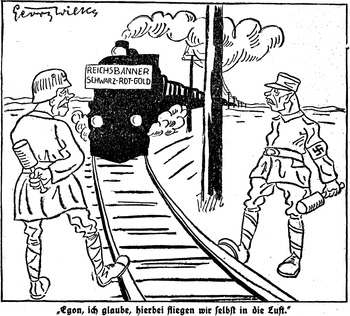
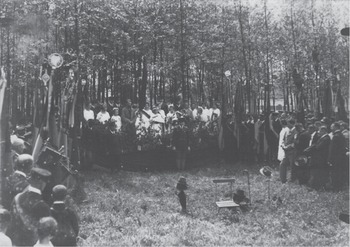

 Open access