




Introduction
The eighteenth century saw the rise of powerful women as regents, advisers, and independent power brokers across North India and the Deccan. Highlighting figures such as Lal Kunwar, Qudsiya Begum, and Mah Laqa Ba’i ‘Chanda’ among others, Urvashi Dalal argues that this era uniquely foregrounded a femininity less bound by patriarchal constraints than ever before in South Asia.Footnote 1 Recent work, notably Jennifer Howes’ study of Roshni Begum and Tipu Sultan’s harem, also foregrounds the political agency of performing women.Footnote 2 This ascendancy and stark visibility of young, sexually powerful (as opposed to older, desexualised) performing women in the public realm endured into the early nineteenth century, albeit with regional variations.
Scholars have covered Delhi, Awadh, Lucknow, Kanpur, and Hyderabad: heartlands of the high Indo-Muslim literary and cultural traditions inhabited by elite courtesans or tawa’if.Footnote 3 Beyond these, Richard Williams has analysed the nineteenth-century worlds of courtesans at Wajid Ali Shah’s ‘scattered court’ in Matiyaburj in Bengal, while Radha Kapuria has demonstrated the power of elite tawa’ifs at Sikh ruler Ranjit Singh’s early nineteenth-century Lahore durbar, especially Bibi Moran and Gul Begam, his two Muslim courtesan wives.Footnote 4 For the same period, Anshu Malhotra has explored the sacred and sensual life-worlds of the common kañjrī (prostitute) Piro, whose eloquent poetry reflects her life and her devotion for her guru, Gulab Das.Footnote 5
However, in the context of Punjab, studies on courtesans have exclusively focused on Lahore and Amritsar: cities deemed cultural centres of the region. Equally important cities in western Punjab and beyond—like Multan, Bahawalpur, and Dera Ghazi Khan—have received short shrift in the region’s cultural histories and in histories of South Asian performing women. This is surprising for a cultural centre like Multan, west Punjab’s oldest city, with origins in the ancient period. While in this article we focus on the case study of Murad Bakhsh, a powerful courtesan from the late eighteenth–early nineteenth centuries, the record reveals a more deeply embedded courtesan tradition in south-west Punjab.Footnote 6 Multan’s Bazar-e-Husn or courtesan’s quarters—also termed the ‘Haram Gate’ of the walled city—rivals old Lahore’s better-known Hira Mandi and purportedly goes back several centuries.Footnote 7 Even today, an all-female assembly accompanies the ʿAbdullahwala taʿziya of Haram Gate during Muharram.Footnote 8
Given this continuing impress of Multan’s courtesan past on its present, the scarcity of historical research on the theme is noteworthy but perhaps unsurprising on account of the centuries-old moral censure reserved for this group. The Persian text Jaur-o-Jafā (Cruelty and spite in love, 1806)Footnote 9 offers a unique window into the world of female performers in prominent south-western Punjabi cities like Multan, Dera Ghazi Khan, and Bahawalpur.Footnote 10 Primarily a love–hate story between a Durrani aristocrat from Dera Ghazi Khan called Muhammad Raza Khan, and the Multan-based courtesan Murad Bakhsh, Jaur-o-Jafā also reveals regional specificities of cultural and gendered codes that marked the social lives of nobility and elite performers in south-western Punjab in the late eighteenth and early nineteenth centuries. Before we turn to the text, a brief account of the region’s political history is in order.
South-west Punjab in the late eighteenth and early nineteenth century
Jaur-o-Jafā brings to the fore notable aspects of the social and local histories of south-west Punjab and illustrates Neelam Khoja’s wider point about resituating the history of eighteenth-century Punjab from the lens of ‘Iranian and Afghan intermittent power’, by including ‘legitimate Afghan claims to Punjab’ in our accounts.Footnote 11 Drawing on Khoja’s insights, we emphasise the importance of the Afghan presence to Punjab’s cultural memory and its gender and social histories. What makes Jaur-o-Jafā novel is how a love–hate story also becomes the site for displaying the shifting legal and social dynamics in the turbulent political milieu of late eighteenth-/early nineteenth-century Multan.
Durrani rule in this region is best captured by an Afghan legend: before founding his empire, Ahmed Shah Durrani (1722–1773) borrowed bags of wheat from Jahan Khan Pupalza’i (d.1776), a prominent Durrani chief, joking that he would repay a thousand bags for each one. When Ahmed Shah founded his empire in 1747, he promptly repaid Jahan Khan, making the ‘loan anecdote’ legendary among Pashtuns. Jahan Khan later led key campaigns, including the 1761 Battle of Panipat, and was given honorific titles including Mīr Bizan (the gallant lord) and Khān-e-Khanāñ (the Khan of Khans).Footnote 12 At the time, Dera Ghazi Khan was ruled by Nadir Shah’s governor Ghulam Shah Şamşām-ud-Daulah, who was later deposed by the Durranis. Ahmed Shah Durrani then appointed Jahan Khan as governor of Sindh, Multan, and Dera Ghazi Khan.Footnote 13 Jahan Khan’s tribe helped build the Durrani empire, securing future privilege—especially for his brother Zaman Khan Pupalza’i (d. 1776), who became governor of Dera Ghazi Khan when Ahmed Shah’s son Timur Shah (1772–1793) took the Kabul throne in 1772.Footnote 14 The author of Jaur-o-Jafā, Raza Khan, identifies himself as Zaman Khan Pupalza’i’s son.Footnote 15
Ahmed Shah Durrani’s empire (1747–1772) was rooted in the ethnic supremacy of his own tribal confederation, and his rule was known for its heavy reliance on tributes and bounty from conquered areas. While some aristocratic women were allowed to participate in political affairs, this era is largely remembered for its regressive gender policies, including denying women property inheritance, allowing blood money for their killing, and using them as objects to broker peace between rival groupsFootnote 16—themes also reflected in Jaur-o-Jafā. This broader context helps lay the foundation for our feminist re-reading of this hybrid biographical-cum-literary narrative which echoes the enduring literary bias against women in the Persianate literature of the period. In offering such an interpretation of qissas in Punjab from this time period, our methodological stance also borrows from the re-readings of Punjabi and Persian qissas employed by scholars like Christopher Shackle, Anne Murphy, and Jeevan Deol, and their modern contextualisation of these texts within larger historical imaginaries of representation and negotiation.Footnote 17
Contextualising Jaur-o-Jafā
The story of Murad Bakhsh reaches us through the 1806–1807 Persian manuscript Jaur-o-Jafā, written in Nasta’liq and set in Dera Ghazi Khan and Multan (southern Punjab, modern-day Pakistan). In 1850, an Amritsar shopkeeper sold it for wheat and cash to a buyer in Hargobindpura. It was later acquired by Colonel George William Hamilton (1807–1868), a British administrator in Delhi and Multan, known for commissioning works like Hālāt-e-Multān (a history of Multan) and Risālah dar ‘Ilm-e-Mausīqī (a copy of an Indic musical text).Footnote 18 Hamilton’s interest in history and music aligned with his acquisition of Jaur-o-Jafā in the mid–late nineteenth century. Posted to Multan in 1849, he became commissioner in 1851. After his death, his collection was sold to various buyers, including the British Museum. The manuscript is now housed in the British Library.
Comprising 80 folios, the text is written in continuous prose, interspersed with excerpts from popular Persian poetry classics, contemporary poets, and possibly some original compositions. The quoted poetry likely reflects oral renditions drawn from musical and poetic gatherings, since it differs from more authoritative published versions.Footnote 19 The story is set during the period spanning the reigns of Timur Shah Durrani (1772–1793) and his son Shah Shuja’ Durrani (1803–1809). Although constrained by Raza Khan’s one-sided perspective and offering only minimal detail on individuals like Murad’s servants and fellow musicians, Jaur-o-Jafā realistically portrays more notable mid eighteenth-century figures like Nawab Muzaffar Khan Saddoza’i, the ruler of Multan (1775–1818); Nawab Bahawal Khan II, the ruler of Bahawalpur (1772–1809); ‘Alam Khan, the dissident governor of Dera Ghazi Khan (ousted 1803); and ‘Ata Muhammad Nurza’i, the Durrani governor of Dera Ghazi Khan (ascended 1803). Lesser-known individuals such as Munshi Suba Rai and Amin Khan Saddoza’i—figuring in the text as either allies or adversaries of Raza Khan—were also recognised by contemporary historians.Footnote 20
Although secondary sources confirm the many people and events featured in the story, Raza Khan’s own historical existence remains uncertain. Raza Khan refers to the poet Mir Hotak Khan Afghan, one of the leading literary and intellectual figures of the late eighteenth century during Timur Shah’s reign, as his brother.Footnote 21 According to the twentieth-century Durrani historian Aziz-ud-Din Vakili Pupalza’i (henceforth Vakili), Hotak had three brothers: Allahyar, Ibrahim, and Amin.Footnote 22 Raza Khan also referred to Saifullah Khan of Multan as his elder brother, whose word outweighed his own in the conflict with Murad Bakhsh.Footnote 23 Were Raza and Saifullah actually Hotak Khan’s stepbrothers, living at a distance from Kandahar and Kabul? This could explain why a credible source like Vakili omits their names when listing Zaman Khan’s children. Some of Hotak’s couplets are also quoted in Jaur-o-Jafā, and this family context of literary production could be one of Raza Khan’s motivations for composing a text as ambitious as this in style, form, and content.
Overall, we posit that Jaur-o-Jafā is a conflated biography, since, quite apart from recounting the love–hate story at its core, it offers an unparalleled glimpse into the quotidian and political life of late eighteenth-century south-west Punjab. As a memoir focused on specific locales such as Multan, Dera Ghazi Khan, and Bahawalpur, Jaur-o-Jafā also embodies what Zahra Shah calls the ‘literary-topographical writing’ that served as a key mode for self-fashioning in the Persian literary culture of the Punjab at this time.Footnote 24 It combines the classical Persian qissa narrative style with the straightforward prose of wāqi’āt court chronicles: the qissa style of writing interacting with the more banal description of actual historical events. The literary style of Jaur-o-Jafā differs from that of fictional narratives known to its own time. Instead, its features align more with common eighteenth-century Persian historiography, exemplifying what Christine Noelle-Karimi has described as ‘the dramaturgy created by the combination of prose, rhymed prose and poetry’.Footnote 25 In this, it also resembles another important contemporaneous eighteenth-century composition in Persian, Hasan Shah’s 1790 manuscript Afsanā-e-Rañgīn or Qissa-e-Rañgīn (The multicoloured story), which is set in Kanpur in the Indo-Gangetic plains, and recounts his love story with the Kashmiri courtesan Khanum Jan.Footnote 26
Equally, though, the essential arc of the plot in Jaur-o-Jafā relies on older Persianate tropes: whether the cautionary ‘courtesan tale’ found in the Mughal historical chronicles explored by Katherine Schofield,Footnote 27 or a range of text-genres featuring the recalcitrant, wily, cunning, and deceitful woman who must be subdued by a man, as studied by Pegah Shahbaz.Footnote 28 The negativity and suspicion heaped on the courtesan in these genres also acts as a framing device for Jaur-o-Jafā, with Raza Khan remarking early on: ‘I named this text Jaur-e-Jafā as a caution to those who follow the path of virtue: never trust the words of the ill-born, even if they swear by their firmest faith.’Footnote 29 Here, the ascription of the courtesan Murad Bakhsh as ‘ill-born’ recalls the usual censure reserved towards communities of hereditary performers in South Asia.Footnote 30
Jaur-o-Jafā also exemplifies the abiding trope of what Margaret Mills terms ‘Afghano-Persian trickster women’ abundant in the kayd-un-nisā (Arabic: ‘deceit/trickery of women’)/makr-e-zan (Persian: ‘wiles of women’) folk-tales.Footnote 31 Traditionally, this genre has been established through the story of the Prophet Yusuf and Zulaikha, prevalent across various Islamic texts and traditions, most popular in Persia and also in Punjab.Footnote 32 The 28th verse of Sūrah Yūsuf, chapter 12 of the Qur’an, encapsulates these words uttered by Yusuf to Zulaikha, which are also quoted early on by Raza Khan: ‘Inna Kayd-e-Kunna ‘Az̦īmun’ (your trickery is great indeed).Footnote 33 Though not as straightforward as the Yusuf–Zulaikha story or the Afghan folk-tales studied by Mills, Jaur-o-Jafā follows the arc of seduction–temptation–resistance–rejection–vengeance, which Afsaneh Najmabadi has identified as the core plot of these ‘wiles-of-women’ tales.Footnote 34
Finally, in recounting the relationship between an Afghan nobleman and a Multani courtesan, Jaur-o-Jafā also recalls the mapping of geographical boundaries onto gendered relations in early modern Persianate literature studied by Sunil Sharma, especially the threat posed by the ‘temptress’ Indian woman in Persian Safavid accounts. As he notes, in early modern Safavid literature, ‘the Hindu [or Hindustani] woman symbolized the love–hate relationship of the Safavids with India: for an extended period of time she was the faithful beloved, then oftentimes she showed a more alluring and dangerous side’.Footnote 35 Therefore, in our analytical reading, Jaur-o-Jafā emerges as both a conflated biography packed with details of historical events and figures, and a qissa narrative in the typology of the trickster lover/gold-digger/‘wiles of women’ paradigm—plotted upon the social divide between a Durrani nobleman and a local Multani courtesan.
Beyond the textual, Jaur-o-Jafā also contains 36 lavishly illustrated miniature paintings of events narrated in the story. Bearing inimitable compositions of the elements, colours, perspectives, and figurative treatments, these paintings reveal a confluence of Pahari style and sub-Mughal miniature styles.Footnote 36 In this regard, it temporally coincides with, and most closely resembles, the Punjab plains miniature painting style that developed during Sikh rule (1799–1849), which R. P. Srivastava has described as ‘an eclectic style standing in its own right characterising its own Punjabi manifestations’, shaped by ‘external influences from Himachal Pradesh’, yet ‘neither the prototype of pure Pahari, nor perfect Mughal … nor properly Awadhi’.Footnote 37 The paintings include numerous details and figures absent from the text, lending weight to two competing assumptions: first, that the paintings—although produced before 1850—represent a later recension shaped through oral retelling; or second, that they were made contemporaneously with the events they depict, while the text—likely composed later—allowed its author to omit certain characters from the narrative.
Visual clues provided in these paintings, among other things, help us read between the lines of this fraught love–hate story. By doing so, we can gain an insight into the life of a remarkably resilient and mobile courtesan from eighteenth-century Multan, and her negotiation and exercise of power within local, regional, and tribal limits of patriarchal honour. At its core, Jaur-o-Jafā is equally an illustration of the power, autonomy, and the frequency of travel and mobility in the life of a well-regarded courtesan; and of attempts to curb that mobility by a local chief motivated by patriarchal notions of honour. In the recurrence of the travel motif attached to Murad’s story, Jaur-o-Jafā fits in particularly well with the larger themes of this special issue on the ‘travelling female performer’ in South Asia.
Within the field of courtesan studies in South Asia, the distinctive format of Jaur-o-Jafā also helps us make a methodological intervention, that, though similar to the feminist thrust of the research by Anshu Malhotra on Piro, and Scott Kugle and Shweta Sachdeva Jha on Mah Laqa Ba’i ‘Chañdā’ (among others), differs from this scholarship in an important respect. This scholarship is predominantly focused on the recovery and/or analysis of courtesans’ agency and voice during this period. In a slightly different but related vein, Abhishek Kaicker’s work on eighteenth-century Mughal courtesans like Nur Ba’i and Bihna’i has emphasised these courtesans’ relative insouciance and their autonomous self-expression.Footnote 38 In contrast, Jaur-o-Jafā, although focused intensely on a single courtesan, is penned by a scorned lover–patron trying to reclaim her—making our feminist ‘reading against the grain’ and attempt at recovering her voice all the more complex.
We now relate the bare bones of this story, including several of its complex turns and allegorical framings with as much sequential fidelity as possible, through four broad thematic rubrics: (1) the role of music, dance, and performance in defining the initial romance; (2) the significance of wealth, property, and negotiations around material belongings in the establishment of relationships; (3) most importantly, the centrality of Murad Bakhsh’s travels (and the curbs on them) in propelling the story forward; and finally, (4) notions of patriarchal honour in shaping local adjudication against Murad, in Raza’s favour.
The four sections unfold a tale suffused with literary metaphors and allegories drawn from the standard framing devices of Indo-Persianate writing but equally saturated in an excess of emotion. The story oscillates between love and its many cognates (loss of control over mind and body; enchantment, infatuation, and stupefaction) on the one hand, and hate and its associated emotions (betrayal, theft, deceit) on the other. Being so foundationally concerned with emotional states, Jaur-o-Jafā can also open a potentially new chapter on the history of emotions in early modern South Asia.Footnote 39
Musical enchantment, lovers’ pursuit
Jaur-o-Jafā opens on a fine day when Raza Khan was engaged in reciting the poetry of the bygone masters with his friends on his terrace. Mullah Ghani, Raza’s friend, apprised him of the arrival of the courtesan Murad Bakhsh in Dera Ghazi Khan from Multan.Footnote 40 Although initially reluctant, Raza acknowledged Mullah Ghani’s eagerness and invited the new courtesan to his home.
Murad Bakhsh then arrived at Raza’s with her band of musicians to present a sublime performance. Raza describes every instrument, lyric, and dance gesture as being perfectly tuned to the moment. Below, he emphasises the spell cast by Murad’s physical presence alone, and her use of silence to entice the audience into requesting a performance:
When that Venus-faced beauty arrived at the mehfil [assembly/gathering], she did not utter a single word. As she robbed the hearts and souls and no one in the mehfil remained in senses … as a master says:
She stole patience from heart, and the crazy heart too,
My thief snatched the home along with the things at home
When she came to steal the heart, first she stole the mind,
A wise thief turns the light off before he steals.
…When the mehfil came back to its senses, I was wondering in what words should I have spoken to this cataclysmic beauty … all the harness of my control on myself was in her hands. Neither was I left with a word to say nor could I dare to bid farewell to her. With intense desperation, I sat bewildered, and my condition was as the poet has said:
O Jāmi, at last you turned into a toddler’s toy in the hand of that young beauty,
Now you tell, what it brings to fall in love in this old age.Footnote 41
Through the repetition of Persian poetic tropes implying loss of control over mind and the senses, and by casting Murad Bakhsh as a thief who steals the heart or transforms a grown man into her ‘toddler’s toy’ (bāzīchah-e-ţiflān), Raza assigns incontrovertible power to the courtesan in the lines above. By referring to her beauty as ‘Venus-faced’ (Zuhrāh Jabīn; in other instances, Zuhrāh Sīmā, Zuhrāh Āsā) and ‘cataclysmic’ (ghārat-e-dil-hā, Khanomān soz), the author relies on time-worn similes about the celestial power of music.Footnote 42 Time and again, Raza notes that he was not alone in being bewitched by Murad; indeed, her control extended over the entire mehfil, over the musical instruments themselves, as evident below:
Sārang with a thousand shades became a drunken eccentric. Nafīr took the sphere of the sky into its grip. Ţāl player Ustad Muhammad Panah was so into the ups and downs that he had lost himself. Suddenly that moon-like beauty began to sing … [and] finished this Ghazal, the participants of the mehfil … uttered a cry that reached from the world to the sky, as a master has said:
The clamour of bemoaning reached the seventh sky
…After a moment she … asked for leave to get back to her home. My rationality was gone away from my head, I was out of my senses, I held myself together and asked, O, the paramount of the guild of hearts … tell me if I should hope to see you again. Whatever is your will, she replied. I replied:
Before this I had some power over my will,
But as I saw you, I lost control over the reins
With a heartthrob’s glance she promised to see me in the evening, and with a gesture of the eyebrow she departed to her place.Footnote 43
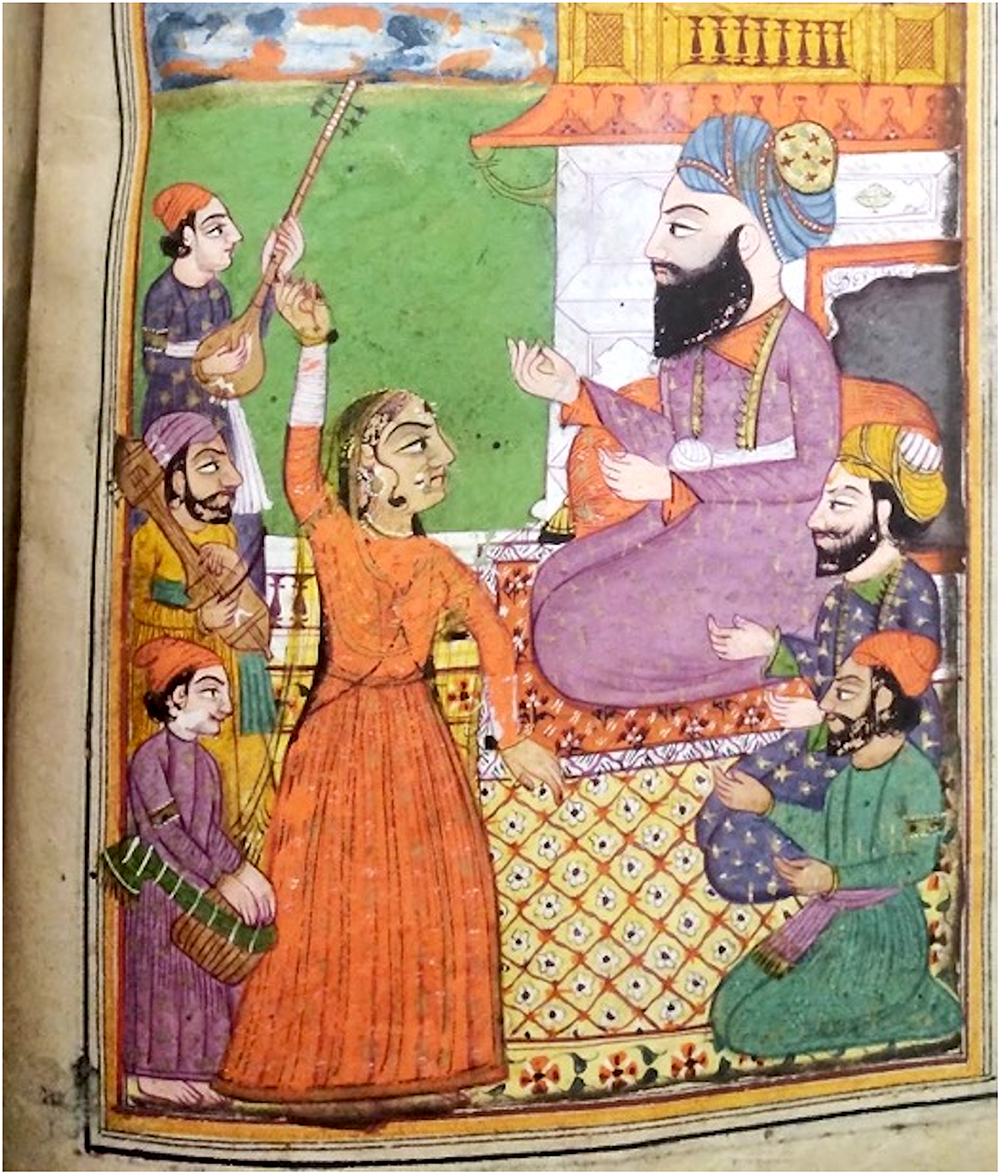
At the conclusion of the above passage, we note Murad Bakhsh parting from Raza with a ‘heartthrob’s glance’ (nigāh-e-maḩbūbānah) and a ‘gesture of the eyebrow’ (wā’dāh bah goshāh-e-abrū); drawing on a familiar skill from the South Asian courtesan’s repertoire. As the remaining story reveals, Murad was entirely unprepared for the intensity of Raza’s response. After this first performance (Figure 1), Raza Khan fell irreversibly in love with Murad Bakhsh, who apparently left him with no power over his prudence and reason. Murad then appeared in many group performances and private meetings at Raza’s residence. For one such performance, Raza uses religious metaphors to describe the impact of Murad’s arrival, and the tactile, embodied response it precipitated among both human and non-human (musical instruments) witnesses:
…she dismounted the horse and stepped in the gathering. I greeted her, as a master has said:
He bowed his back, and his head lowered in Sajda
The soul had left the body … That charmer magician ordered the music maestros who stood humble and respectful as her disciples, to start playing the instruments … Her anklet-bells, in the ecstasy of kissing her feet, rang so loudly that the thunder of the Day of Resurrection was ascribed to this clan. Meanwhile, that crowned queen of temperament … remained unaware that a whole world of spectators in the mehfil had lost itself.Footnote 44
Murad Bakhsh and her troupe of musicians at their very first performance before Raza Khan. Source: From the British Library Collection: MSS Or. 199, Jaur-o-Jafā, fol. 12v.

Figure 1 Long description
Murad Bakhsh is depicted performing with her troupe of musicians before Raza Khan. She stands in the center, raising her arm, surrounded by five men. One man is seated on a platform, likely Raza Khan, gesturing with his hand. Two musicians are playing stringed instruments, while another holds a percussion instrument. The setting includes a decorative backdrop with architectural elements, suggesting an indoor performance space.
Above, Raza describes Murad’s arrival in spiritual terms, with his own response invoking the sajda or prostration in Islamic prayer before a superior power. Further, Raza paints the impact of Murad’s performances in cataclysmic, profoundly world-altering terms. For instance, referring to the Day of Judgement, Raza recalls that after Murad finished singing a ghazal,
The soul fled the body. It was like a Day of Judgement, and bewildered people were wailing. She adorned the mehfil in a manner that rendered all other equipage of the performance useless.Footnote 45
The transformational impact of musical performers is a feature of Persian and Urdu writing on musical mehfils and dance performances in Punjab,Footnote 46 and more generally too,Footnote 47 but it acquires greater and specific relevance for later developments in the story.
These many ‘performance visits’ by Murad are punctuated by a series of messages exchanged between her and Raza. During these exchanges, Murad (albeit refracted through Raza) clearly reveals an initial reluctance to accept Raza’s invitation to stay with him permanently. She also exhibits a level of ethnic difference with and defiance towards the Afghans in general. For example, given below is an interaction with one of Raza’s messengers, where Murad articulates her reservation against maintaining relations with an Afghan on ethnic grounds:
She became angry and said: go and say that this clan is like a peacock, not like a pigeon that may get down at every terrace:
The heart is not a pigeon that it may alight at every terrace,
Once we fly away from a terrace, we fly once and for all.
What love and link of relation may we have with the tribe of Afghans, a relation that will end in downright regret. By the will of God and the fate, I had two or three sittings with you, yet:
We are the nightingales of a heavenly nest,
It is not that we will stay in a cage.Footnote 48
Here, Murad makes an interesting poetic choice in comparing her clan to the peacock, a bird signifying pride, royalty, graceful movement, and dignity, unlike the humbler and more fickle pigeon that is keen to alight at ‘every terrace’. In using metaphors drawn from the avian world, Murad Bakhsh subtly but unambiguously refers to the distinction between an elite tawa’if and a common kañjrī. Continuing with the avian metaphor, in highlighting the reluctance of the ‘nightingale to be caged’, Murad further conjugates the purity and exalted nature of the artist (a nightingale belonging to a ‘heavenly nest’) with the independence of a skilled performer such as herself. In instances like these, we can postulate how class gradations within performer communities and ethnic differences between Afghan chiefs and local Multanis are alluded to in the flowery idiom of Persian poetry.
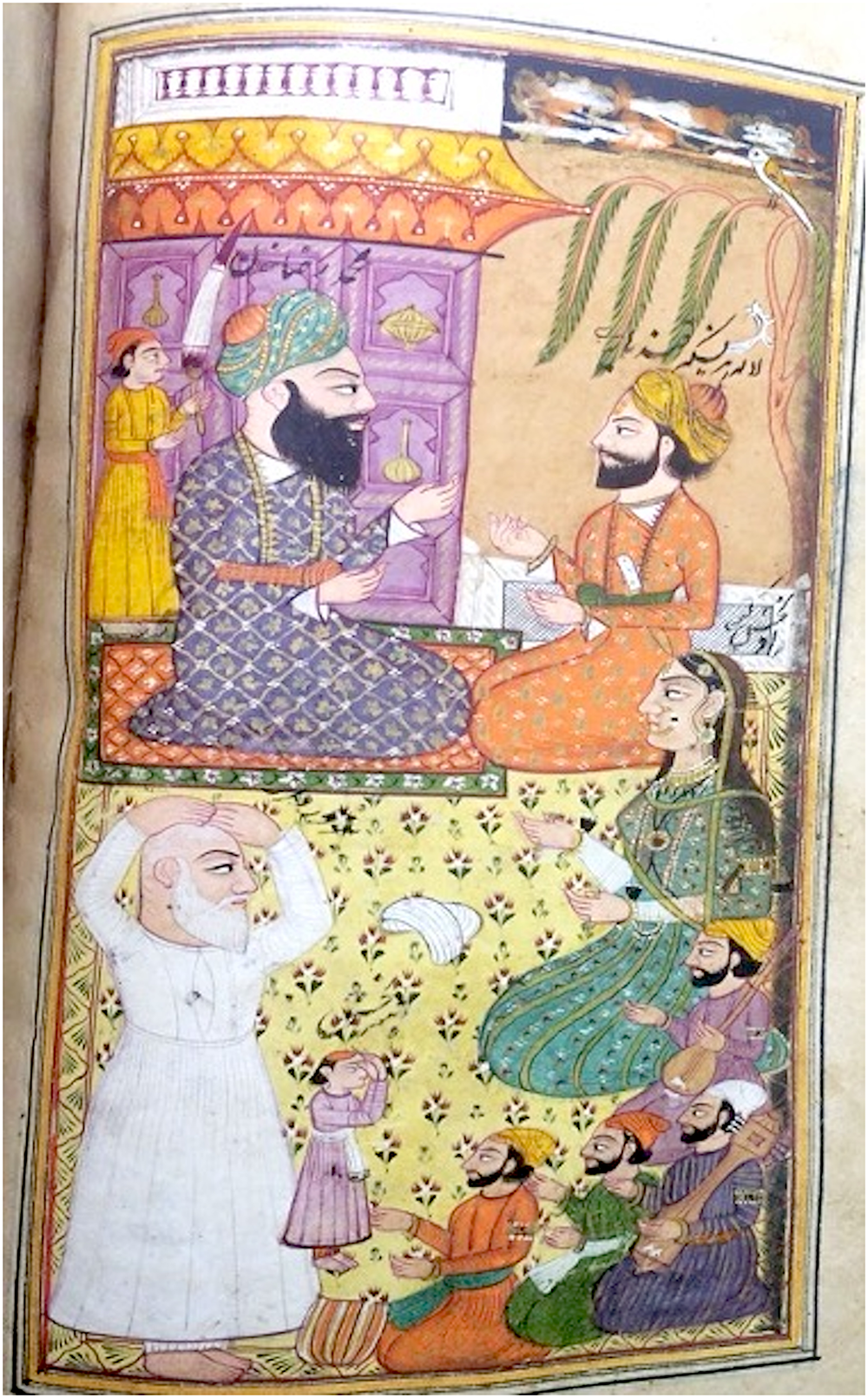
Throughout these intervals of the abovementioned ‘message exchange’, when Raza was away from Murad, he would find solace in the company of one Lala Hari Singh Kandhari, one of his close friends, clearly depicted in the paintings as a Hindu with the sacred mark on his forehead (Figure 2). After consulting with Hari Singh, Raza invites Murad Bakhsh to stay with him at his residence, since their love had been already declared through the message exchange. Murad took an oath of loyalty by the Holy Book, after which Raza Khan offered Murad valuable gifts and built a house for her nearby.Footnote 49 Perhaps Murad obliged Raza with this initial oath of loyalty on the Qur’an as routine in the course of her professional duties, expecting him to be a temporary patron, never anticipating the harder curbs on her movement and autonomy that were to follow.Footnote 50
Left to right: Barkhurdar with fallen turban, Muhammad Raza Khan, Hari Singh Kandhari, and Murad Bakhsh, with musicians in the foreground. Source: From the British Library Collection: MSS Or. 199, Jaur-o-Jafā, fol. 29v.
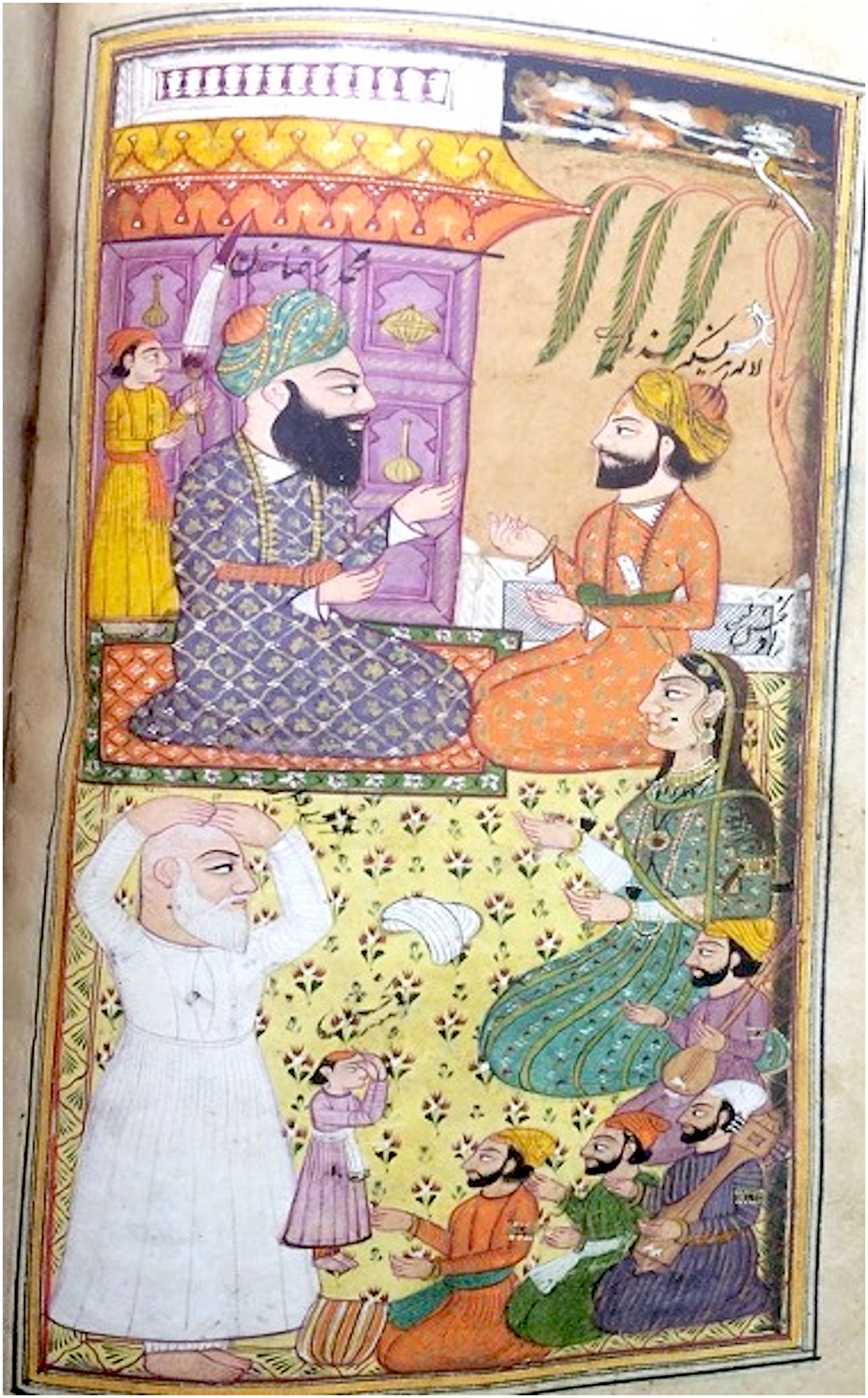
Figure 2 Long description
The image contains two distinct scenes. The top scene shows two men seated on a carpet, facing each other. The man on the left wears a patterned robe and a turban, while the man on the right wears a turban with a feather. They appear to be engaged in conversation. Behind them, a woman stands near a doorway. The bottom scene depicts a man in a white robe standing with arms raised, surrounded by seated figures. Among them is a woman in a green dress and several men, some of whom are playing musical instruments. The background features floral patterns and decorative elements.machine-generated
Wealth and valuables: ownership and negotiation
As the story progresses, Murad’s hold over Raza is revealed beyond the intangible force of her musical and dance performance. Soon after the oath on the Qur’an and the exchange of gifts, she apparently gained full control over his business, wealth, and everyday affairs. So entranced was Raza that he surrendered all sense and reason, handing over to Murad the reins to his entire estate.Footnote 51 To what extent this was actually the case is another matter since there is an element of exaggeration here. However, the text also frequently mentions the exchange of material possessions between them: whether wealth, gifts, property estates, etc. Raza details this in unequivocal terms:
The management of all affairs, even those of life and wealth came at the disposal of that chief of all beauties. Since I … was too content by the promise on the words of God made by that wreath-wearer on a head full of deceit and artifice, I resigned all my affairs and bestowed them upon that Venus-like beauty. I was left bewildered in her love and gave absolutely no attention to my business. And that ruthless friend kept devastating my home behind the curtain.Footnote 52
During this initial exchange of gifts, Raza mentions that a man named Barkhurdar (Murad’s then guardian/husband) apparently asked for his jewellery, valuables, wealth, and belongings to be returned to him in exchange for ‘releasing’ Murad to Raza’s guardianship.Footnote 53 It was after this ‘release’ that Raza bestowed Murad with gifts and also built her a house. There is a sartorial representation of the insult this implied for Barkhurdar, evident in his turban (a symbol of masculine honour in the region) having fallen on the ground (Figure 2).
In this first, love-struck half of the tale, by framing the impact of Murad’s musical expertise and her resulting hold over listeners/spectators in such absolute terms, Raza attributes immense, even ‘cataclysmic’ power to her. In contrast, the developments in the second half of the story can be seen as Raza’s attempts to regain this lost power, by controlling what we term the specific, ‘courtesanly mobility’ enjoyed by Murad on account of her status as an elite tawa’if. The next subsection discusses this mobility from the lens of physical travel.
Murad’s travels: between Multan and Dera Ghazi Khan
The fact that Murad travelled to Dera Ghazi Khan from Multan accompanied by her troupe of musicians and dancers reveals the routine nature of travel for a professional courtesan of her stature. As the main employer of a large cohort of musicians and performers, she was expected to be mobile and itinerant in search of patronage. The story thus opens with Murad travelling independently and of her own accord to Dera Ghazi Khan; but as it progresses, her movement is policed with greater control by Raza Khan. In an early part of the story, while awaiting Murad’s arrival for one of her performances, Raza writes:
…the sweepers would clean the avenue next to the Kasturi canal … Since the arrival of that sun-like beauty was delayed, I sent a messenger of yearning … to that dame of beauties with this chant:
Pass, O breeze, through the land of Multan
From me, who has fallen on earth on the way to Multan
To Multan, take my life and go offer as a gift
Not one life but a sacrifice of a thousand lives for Multan… Footnote 54
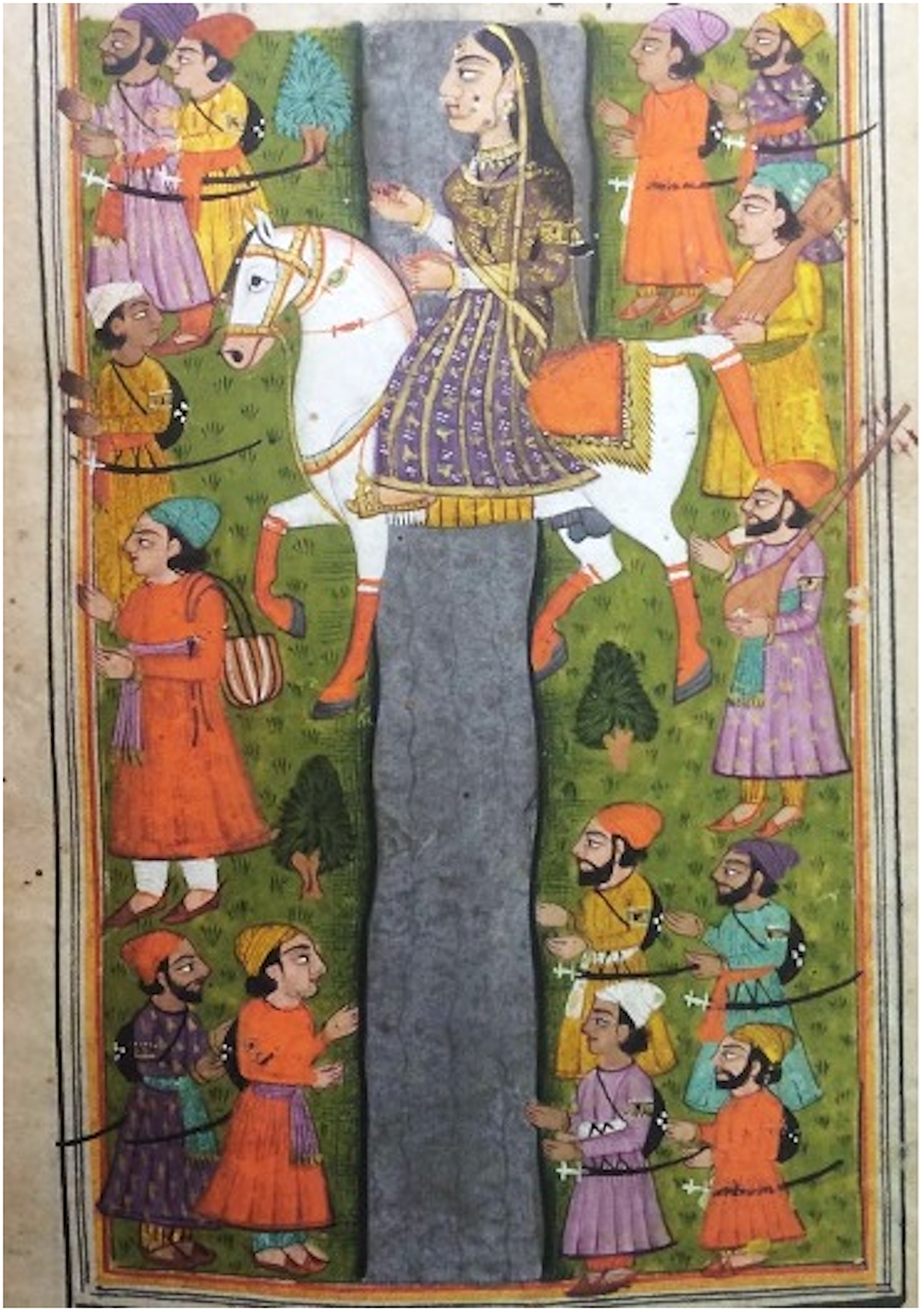
In the above rubā’ī (verse form in Persian and Arabic poetry comprising four-line stanzas), the land of Multan stands as a substitute for Murad herself, and the ecological landscape is effectively used when describing the courtesan’s comings and goings. A visual depiction of this is evident in Figure 3, where we see Murad Bakhsh crossing the Kasturi canal wearing an indigo robe, riding on a white horse surrounded by her servants and fellow musicians.Footnote 55 Murad is accused of funnelling Raza’s wealth from Dera Ghazi Khan to her home in Multan, across the eastern side of the river Indus.
Murad Bakhsh crossing the Kasturi canal on horseback. Source: From the British Library Collection: MSS Or. 199, Jaur-o-Jafā, fol. 6v.

Figure 3 Long description
Murad Bakhsh is depicted riding a white horse, crossing a canal. She is wearing an indigo robe and is positioned centrally. Surrounding her are ten people, including men and women, dressed in traditional attire. Some are holding musical instruments, while others appear to be conversing or gesturing. The background features trees and a decorative border, creating a vibrant scene.
The couple’s time together was first disrupted by news of Mir ‘Alam Khan Nurza’i’s arrival from Kabul as the new administrator of Dera Ghazi Khan. Soon at odds with the rulers of Multan and Bahawalpur—Raza’s allies—Mir ‘Alam’s presence sparked a series of battles.Footnote 56 As a result, Raza sent Murad Bakhsh away and sat alone, mourning the peace shattered by the arrival of the belligerent Kabul patriarch. Murad was summoned back to Dera Ghazi Khan within three days. Later in the story, her final departure from Dera Ghazi Khan came with the arrival of the Durrani king, Timur Shah, whom Raza, as a Durrani chief, was duty-bound to escort through his territory.Footnote 57
Though this second travel decision also appears to rest with Raza Khan, Murad Bakhsh’s autonomy remains evident, since her demeanour precipitates an intensely angry response in the former. Within two pages, Raza Khan unleashes a torrent of negative labels—‘apostate of conduct’ (kāfar-kesh), ‘deceitful’ (fareb bāz), and more—while casting himself as the suffering victim through phrases like ‘humble folk’ (faqīr, khāksār) and ‘desolate dweller of the desert of melancholy’ (zāwiyah nashīn-e-bādiyah-e-ḩirmāñ). These contrasting portrayals reinforce our reading of the text as a love–hate narrative, marked by oppression and the anguish of a ‘deceitful’ beloved. The moment below is written to capture the intense anguish Raza felt at Murad Bakhsh’s second departure from Dera Ghazi Khan to her hometown near Multan:
At last, the glorious flags of the … all-majestic king approached, I feared that that apostate of conduct might be summoned. Therefore, relying on her, I asked now what was to be done. She said, quite pompously, that grant me leave for a month so that I may go and enjoy some good moments with my children and then I will come back. I made an oath on the Qur’an, and I was ignorant of what the poet had said (couplet):
Do not have high hopes from a low-born menial,
That the rust could not be whitened by washing.
…with the supply of gold objects, grandiose jewellery, carpets, pottery, woollen dresses, and cash expenses … all that could have been needed…, I—the humble person—gave to her, collecting it to the point that she asked me to stop, adding more than was needed. I—the desolate dweller of the desert of melancholy—was bothered by people’s taunts that Murad Bakhsh was in the service of Raza Muhammad, and he sent her to her hometown not covered and dressed in a proper manner. With so many efforts, I made her accept the luggage and bid her farewell … And I addressed the cameleer who held the rein of the carriage of that deceitful beloved, and expressed through my visible conditions (couplet):
O Cameleer, go slow, that the comfort of my heart is leaving
And the heart that once I had with me, is going along with the heartthrob. Footnote 58
Above, Raza is stupefied by Murad’s assertiveness in carving out some autonomy and wresting physical mobility back for herself when she suggests returning to Multan. In response, Raza describes Murad as ‘low-born’ (nā-pāk-zādah), terminology he also assigns to her at other places in the text, affirming his hierarchical stance as a high-born Durrani noble.Footnote 59 Raza’s insistence that Murad accept his gifts before she leaves Dera Ghazi Khan for Multan stems from a need to signal to the world that she belongs to him, and travels upon his favour, not as an autonomous tawa’if. Her reluctance to receive so many gifts is equally telling—signalling her defiance and attempt at reasserting her status as an independent and autonomous performer. Further, Murad’s interest in leaving to meet her children was also mirrored elsewhere in a later part of the nineteenth century in Nawab Wajid Ali Shah’s exchanges with some courtesans in his PariKhana.Footnote 60 This also reveals the different roles and aspects of female performers, where one of their primary reasons for travel was on account of familial responsibilities. Unlike Raza’s desperation to stay together, Murad is portrayed throughout this half of the story as eager to leave, prompting Raza’s usual barrage of negative epithets, as seen in the rest of the passage:
And that adversary said, seated for departure (couplet):
You are my lord, you are my master,
Thus, I leave, would you spare any words.
And when I—this humble person—heard this couplet from that corrupt-minded figure of the time, I burst into tears and replied (couplet):
Be blessed with the journey you set for,
Go safe and sound, and do come back.
Later, that guildmistress of artifice stepped foot into the howdah of vanity and departed to the destination.Footnote 61
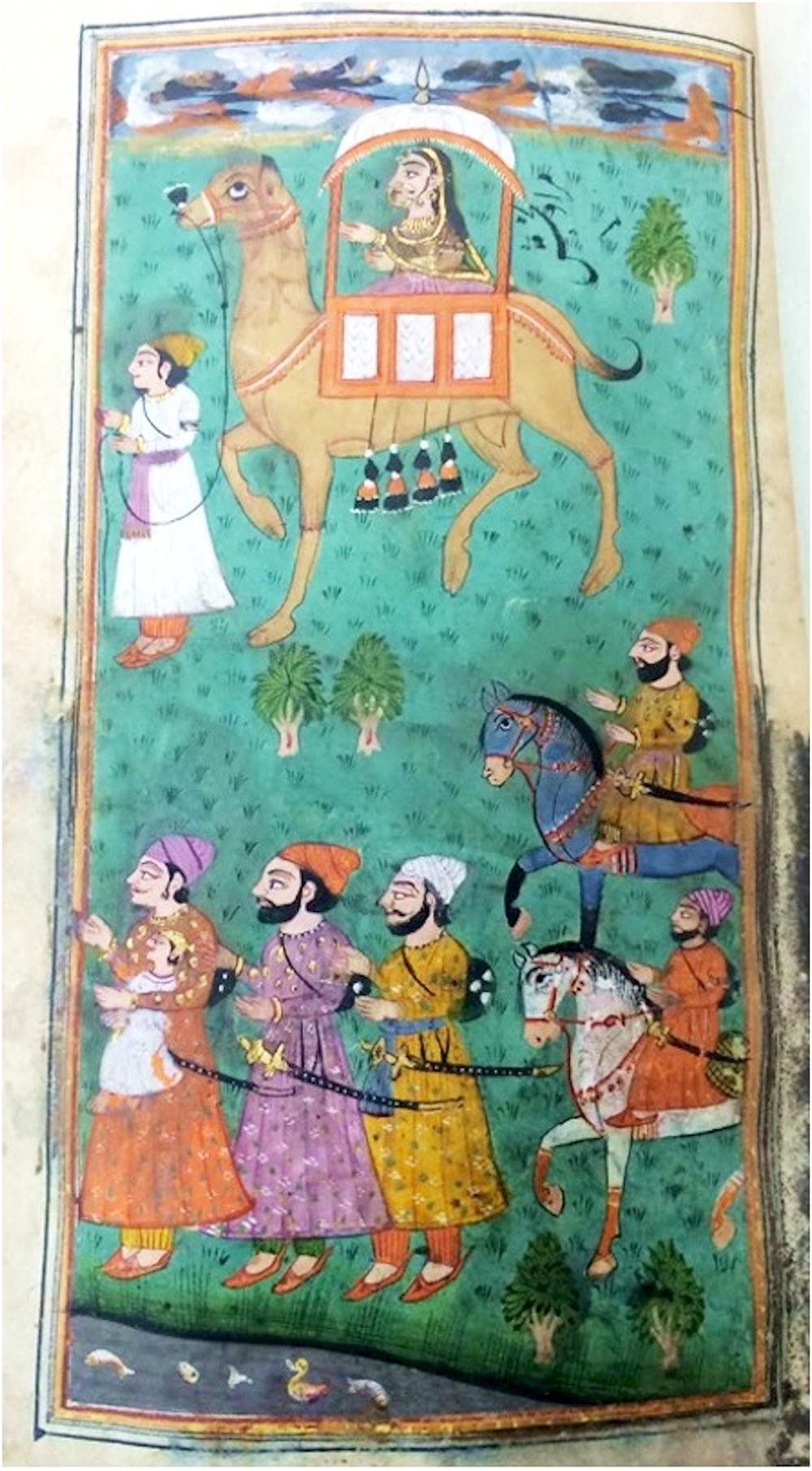
Again, the poetry-filled passage above ensures that only the most negative labels are reserved for Murad: ‘corrupt-minded figure of the time’ (fasād andīsh-e-daurāñ), she is the ‘guildmistress of artifice’ (anjuman ārā-e-majlis-e-ḩīlah-warī) who steps into her ‘howdah of vanity’ (haudah-e-nāz). After her departure on camelback (Figure 4), Raza Khan sent her a heartfelt letter, expressing his anguish at their separation. Her affectionate reply, delivered by a swift messenger, prompted Raza to send ten crates of Kabul grapes and other gifts. But as his men lingered at Murad’s home for two days, doubt set in—her response, he felt, was deceitful. He sent another letter, now filled with complaint and longing, though the servants carrying it spoke to her in ways he disapproved of. The story’s final turn sees Raza, aided by local forms of patriarchal justice, attempting to restrict Murad’s physical mobility.
Murad Bakhsh departing in a howdah on a camel. Source: From the British Library Collection: MSS Or. 199, Jaur-o-Jafā, fol. 41r.

Figure 4 Long description
Murad Bakhsh is seated in a howdah on a camel, positioned centrally in the image. The camel is adorned with decorative elements. Below, six men and one woman are depicted. Two men are riding horses, while the others, including the woman, are walking. The men are dressed in traditional attire, with turbans and robes. The woman is wearing a long dress. The background features trees and a decorative border at the bottom with small animal motifs.
Patriarchal honour, violent justice
Interpreting Murad’s defiance as betrayal, Raza issued a verbal order for her arrest. She declined to return to Dera Ghazi Khan, her refusal unequivocal. Confrontation became inevitable; swords were drawn as persuasion gave way to force. A subsequent attempt framed the dispute as a matter of restitution – Murad was asked to surrender the wealth allegedly owed. She consented to repay a sum that apparently amounted to a scarce tenth of Raza’s claim. In response, she turned to Haji Murtaza Khan, a local chieftain from her native town, whose refusal to support Raza—despite their shared Afghan lineage—cast him as a tacit adversary in Jaur-o-Jafā.
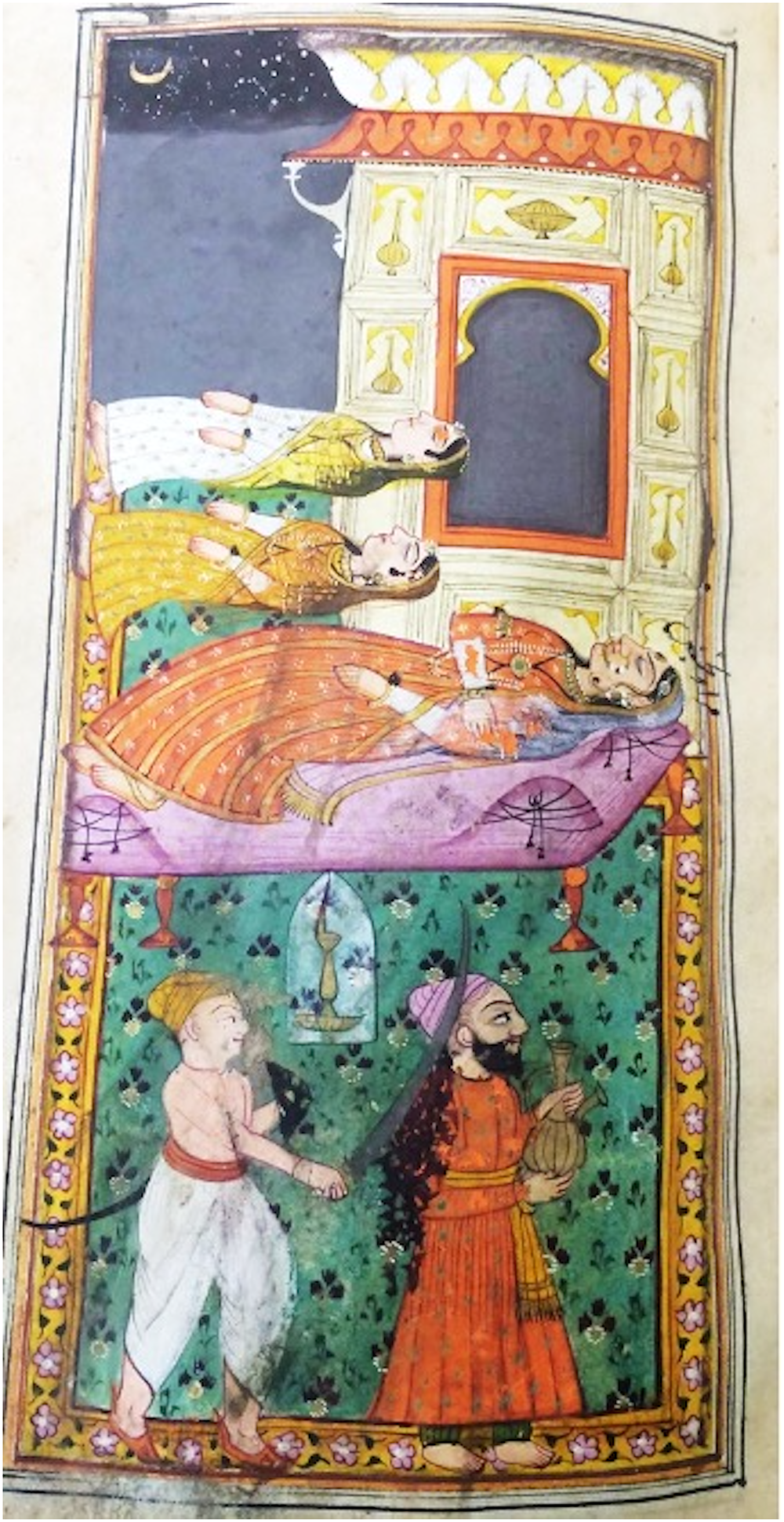
The conflict escalated into violence. One of Murad’s musicians, emerging at midnight for prayer, was assaulted by a member of Raza’s retinue (Figure 5). Forewarned of the impending attack, Murad had already positioned armed guards at her Multan residence, a quiet act of resistance cloaked in foresight.
Murad Bakhsh and her handmaidens sleeping at night, with armed guards stationed outside her Multan home for protection. Source: From the British Library Collection: MSS Or. 199, Jaur-o-Jafā, fol. 52r.

Figure 5 Long description
Murad Bakhsh is depicted sleeping inside a room alongside her handmaidens. The room features ornate decorations and a large window. Outside, two armed guards are stationed for protection. One guard is holding a sword, while the other carries a shield and a musical instrument. The scene is set at night, indicated by the dark sky visible through the window.
Though Nawab Bahawal Khan II (r. 1772–1809) navigated the uneasy line between war and peace with Kabul, even Durrani historians commend his governance.Footnote 62 Raza Khan sought his support, yet after three arduous months, Bahawalpur officials failed to trace Murad Bakhsh. Aided by a courtier, Raza secured a letter of appeal to Nawab Muzaffar Khan of Multan, invoking shared Durrani lineage. While the letter made its way through official channels, Raza sent Murad a stern summons to return to him before returning himself to Dera Ghazi Khan. In Multan, Nawab Muzaffar Khan, advised by his nobles, called upon Haji Murtaza Khan to bring Murad to court. A private hearing was granted, though Raza dismissed Murad’s words as delirium. He claimed the Multani nobles acted out of self-interest. Lacking consensus, the nawab proposed escalation to Bahawalpur, but the courtiers opposed it and ruled in Raza’s favour after he paid a 400-rupee bond. Thereafter, Murad was expelled from Multan. More consequentially, she was barred from contact with her community of performers. Now deeply vulnerable, she lived in flight, seeking distant assurances of safety from Raza. The financial dispute fades from record after this failed mediation by Haji Murtaza.
Was the nawab of Multan’s ruling a denial of justice? Was the referral to Bahawalpur abandoned because Nawab Bahawal Khan had already failed to resolve the matter? More crucially, where was Murad Bakhsh’s agency in navigating this legal terrain? The account suggests that either nawab could have potentially ruled in her favour. Though rare, such outcomes were not unprecedented—Fayz Muhammad recounts a late nineteenth-century case with a different ending from the reign of Barakza’i Emir Abdur Rahman Khan (d. 1901).Footnote 63 Apparently one Colonel Babu Jan Khan, stationed at Shinwar, once extorted money from and proposed to a widow under duress, threatening her father when she refused. The widow was afraid that the colonel would make her his concubine, especially fearful of the label ‘slave girl’ (kanīz) or ‘mistress’ (surriyat) being attached to her name.
Dissimilar to the Murad Bakhsh story, this case from nearly a century earlier ends with the king Abdur Rahman Khan issuing a scathing rebuke, warning the colonel against abuse of power and vowing harsh punishment.Footnote 64 Like the much later example of the Shinwari widow, it is likely that Murad’s refusal to be subdued by Raza was made on the grounds of her fear at having the label of ‘concubine’ or ‘mistress’ attached to her name. Unlike the Shinwari widow though, Murad’s fate was shaped by the more regressive outlook of Durrani polity in late eighteenth-century south-west Punjab. The disdain reserved for Murad could also stem from her status as a kanchnī, or courtesan, as opposed to the widow who conformed to the heteronormative marriage ideal.
Lacking a secular legal system, Durrani justice rarely extended beyond tribal codes and Sharia courts. Murad Bakhsh’s rare case became a stage for Multani nobles to pursue personal gain, deepening Raza Khan’s disillusionment with the fracturing of so-called superior Afghan identity. In these local adjudication battles, Murad refers to herself as a common kañjrī, shedding her stature as an elite tawa’if. Footnote 65 As noted, the ruling barred Murad from contact with her performers, secured by Raza Khan’s payment of 400 rupees:
Nawab Muhammad Muzaffar Khan had sanctioned the disloyal Murad Bakhsh not to go near any musician and singer by any means. If she would go, that would be held against her … She would say to her friends that what was she to do now, when it had become hard to earn a livelihood and she had been impoverished. Footnote 66
The ban on the ‘disloyal’ (be-wafā) Murad Bakhsh from associating with her troupe of musicians and dancers reiterates that her power and autonomy accrued to her skills as a performer. After losing her case, she reluctantly returned to Dera Ghazi Khan under the nawab of Multan’s order, sending envoys ahead to seek assurances of safety from Raza. She then travelled to Multan to visit a revered Sufi saint—whom Raza had urged to rebuke Murad for her alleged betrayal. In Multan, penniless and fearing assassination by Raza’s men, she requested and received 60 rupees from Raza via a messenger. She conditioned her final return to Dera Ghazi Khan with a written promise of assurance for her life. This insistence on the written assurance of her life reveals her awareness of the very real possibility of honour-killing at Raza’s hands.
Since the text is authored by Raza, his mention of sparing Murad’s life serves to highlight that killing her was culturally acceptable—yet he portrays his restraint as magnanimity. Within the broader narrative, he casts Murad as a powerful, autonomous woman who ultimately must be subdued, echoing literary tropes where defiant women and women of autonomous sexuality are brought under male control and are eventually suppressed.Footnote 67
After ten days of hesitation, Murad eventually returned to Raza in Dera Ghazi Khan. Though Raza Khan claimed joy at her return, his tone remained cold until the end of his tale. Murad Bakhsh’s final act of physical mobility was to travel to Multan, but this too was only permitted so the Sufi saint she revered could reprimand her for what Raza saw as betrayal. She was never able to move without fear, Raza writes, whether in Multan or Dera Ghazi Khan, as she knew that Raza’s concealed armed men might be around. After visiting the Sufi saint, she was never permitted to leave again—not even to attend her son’s wedding across the river. At the tale’s conclusion, Murad Bakhsh seems to remain in Dera Ghazi Khan ever after.
The anti-climax of Jaur-o-Jafā exposes its moralist core: women, especially the clan of performers to which Raza’s former beloved Murad belonged, are portrayed as inherently disloyal.Footnote 68 While the story begins in a rich Persian-inspired romantic tone, slowed by ornate poetry, emotional language, and letter exchanges, it eventually shifts to the mode of patriarchal critique. The second half trades intimacy for ideological condemnation, using proverbs and intertextual quotes to generalise women as deceitful and morally flawed:
What a pearl has been harvested by another master, Ruba’i:
If you want to see what is inside a woman’s heart
Eat a handful of rubbish grass and drop it on a stone
There are three things you can never straighten
The tail of a dog, the corner of a doormat, and the heart of a woman
No, I am wrong. Firdausi has said even better than this (Quatrain):
If a woman and her view were virtuous,
The (Persian) word for a woman should have been ‘don’t hit (her)’ (‘Mazan’) instead of ‘hit (her)’ (‘Zan’)
A woman and a dragon are better only if they’re underneath the earth
The world is better if it is clean of these two unclean.Footnote 69
Through the comparison of women to dangerous animal like dragons, to the unruliness embodied in the tail of a dog, and to cultural symbols signifying roughness or coarseness like the corner of a doormat, the allusion is to their intrinsic, even enigmatic, violence.Footnote 70 Coupled with the iteration of the phrase ‘unclean’—each of these terminologies serve to paint women as inherently impure and untrustworthy. Despite Murad’s defeat at the close of Jaur-o-Jafā, though, we can glean her agency through other clues, provided most clearly in the lavish miniature paintings.
A brief note on the miniatures
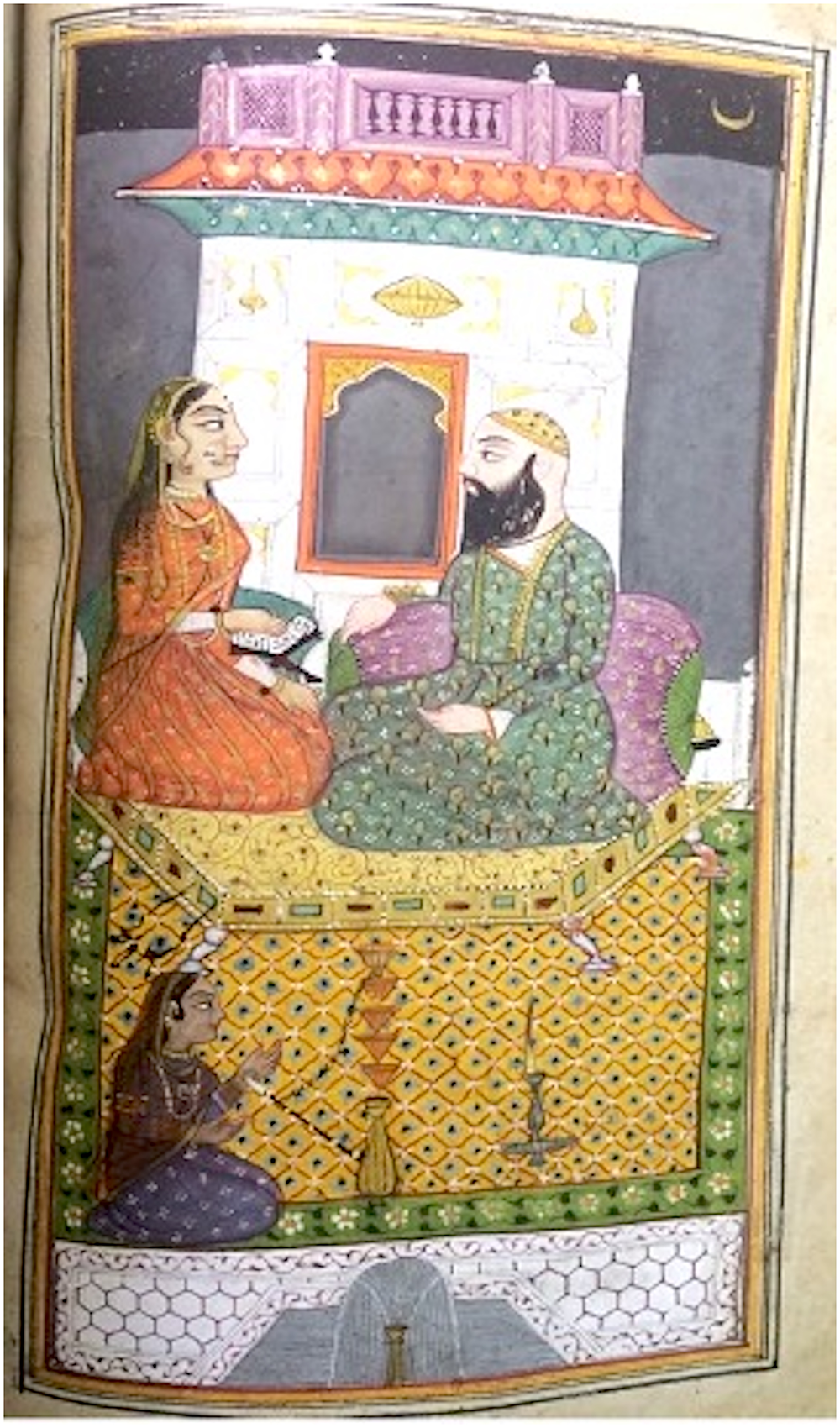
Visual elements reflecting emotional and existential states of the characters in the paintings further contribute to the narrative economy of Jaur-o-Jafā. Some illustrations feature characters that are not mentioned in the text itself, likely from either an earlier depiction, a later recension, or an oral retelling of Jaur-o-Jafā, pointing to the perhaps wider circulation of the Raza–Murad love–hate story. Most prominent are two women who each show up twice in the miniature paintings. The first is a darker-skinned female attendant labelled ‘Kando Kanchni’ (Figure 6), with the epithet ‘Kanchni’, the term for elite skilled and elite female performers in Mughal chronicles; also used in many paintings to label Murad herself as ‘Murad Bakhsh Kanchni’.Footnote 71 Kando Kanchni was likely one of Murad’s employees and accompanies her in the early stages of the story, when she first arrives at Dera Ghazi Khan.Footnote 72 She is also present when Murad Bakhsh takes her oath of loyalty to Raza (Figure 6): we can therefore surmise that Kando Kanchni was possibly one of Murad’s closest female confidantes.
Murad taking an oath of loyalty to Raza on the Qur’an, with Kando Kanchni in the foreground. Source: From the British Library Collection: MSS Or. 199, Jaur-o-Jafā, fol. 13v.

Figure 6 Long description
The illustration depicts Murad and Raza seated on a decorated platform. Murad is holding the Qur’an, symbolizing an oath of loyalty to Raza. Murad is wearing a patterned outfit and a headpiece, while Raza is dressed in a vibrant garment. Kando Kanchni is positioned in the foreground, seated on the floor, holding a musical instrument. The setting includes an ornate backdrop with architectural elements and a crescent moon visible in the sky.
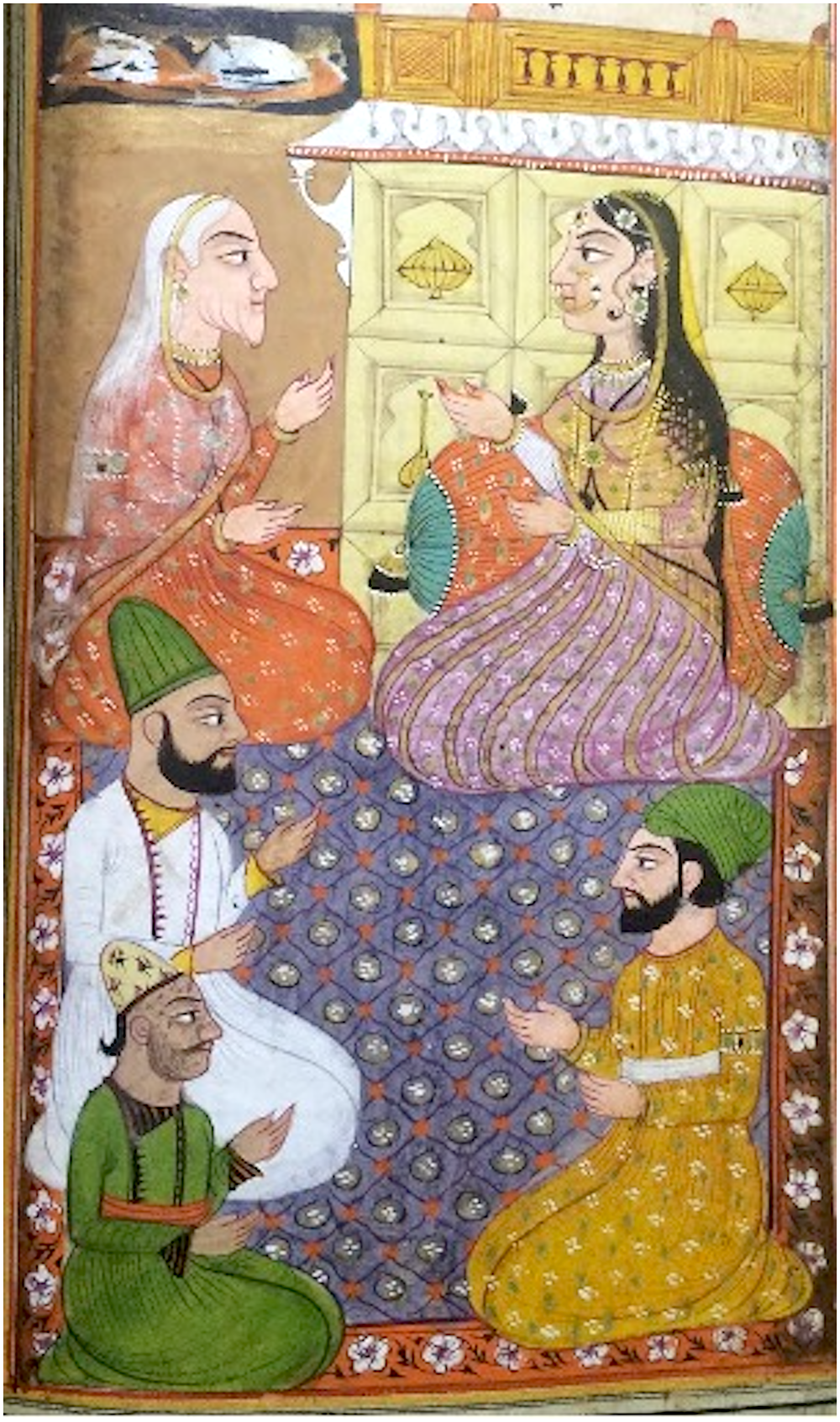
The other figure who appears in two paintings towards the end of the story, when Murad finds herself irrevocably in Dera Ghazi Khan, is an elite older woman dressed not dissimilarly to Murad in terms of her jewellery and lavish clothes (Figure 7). Unlike Kando Kanchni, this woman is depicted as being an equal size and stature to Murad Bakhsh and seen to be offering her some counsel. Was she a retired courtesan, formerly powerful, offering Murad sympathy and wisdom? Or was she an elite woman from a non-courtesan background presenting Raza’s case? We can only speculate.
Murad Bakhsh speaking to an elderly woman in the presence of other men. Source: From the British Library Collection: MSS Or. 199, Jaur-o-Jafā, fol. 70v.

Figure 7 Long description
Murad Bakhsh is seated on a patterned carpet, facing an elderly woman. Both are dressed in elaborate clothing with jewelry. The elderly woman is positioned to the left, wearing a veil and gesturing with her hands. Murad Bakhsh is seated on a raised platform, wearing a richly adorned dress. Two men are present; one is seated on the carpet wearing a turban and white attire, while the other is seated in a green outfit with a turban. The room is decorated with intricate patterns and a backdrop featuring architectural elements.
Either way, the presence of figures like Kando Kanchni and the unnamed older woman could mirror the centrality of the cunning female friend, and especially the ‘older woman’ as a stock character in the ‘wiles of women’ tales. The presence of these women, Mills notes, inevitably signals ‘the onset of a set of deceits, stealthy invasions, and evasions of normal social boundaries, especially relating to gender’.Footnote 73 The obverse interpretation would be to see an assertion of autonomy, especially in the counsel Murad sought from other women in a world defined and controlled by men. Our feminist re-reading for the field of critical courtesan studies would posit the presence of these figures in the paintings alone as recognition of the support available to Murad from elderly (and likely autonomous and powerful, given her clothes and jewels were similar to those worn by Murad) courtesans from her own community. That at least three other unnamed women are featured in the paintings—but not the text—also points to an acknowledgement by the artist of the female assistance Murad likely enjoyed across age groups.
Reading the paintings can equally yield clues that amplify Raza’s apparent victimhood at Murad’s hands. To specify a few, the red stains on Murad’s hands while sleeping on the night of the violence (Figure 5; fol. 52r) and while sitting with Murtaza (whose robes are also stained red; fol. 63v) can be interpreted as an attempt to shift the blame for the violence. Further, the sartorial style of the dress collars across the paintings differentiates Afghan characters from local Multanis. Most significantly, the black stains on Raza’s face when he encountered the nawab of Bahawalpur (fol. 54v) could represent the shame he felt at the public nature of the tussle with Murad. This matches the larger thrust of Jaur-o-Jafā which depicts Raza Khan as a weakening aristocrat trying to save his reputation amidst political isolation and social backlash in the face of such a public scandal.
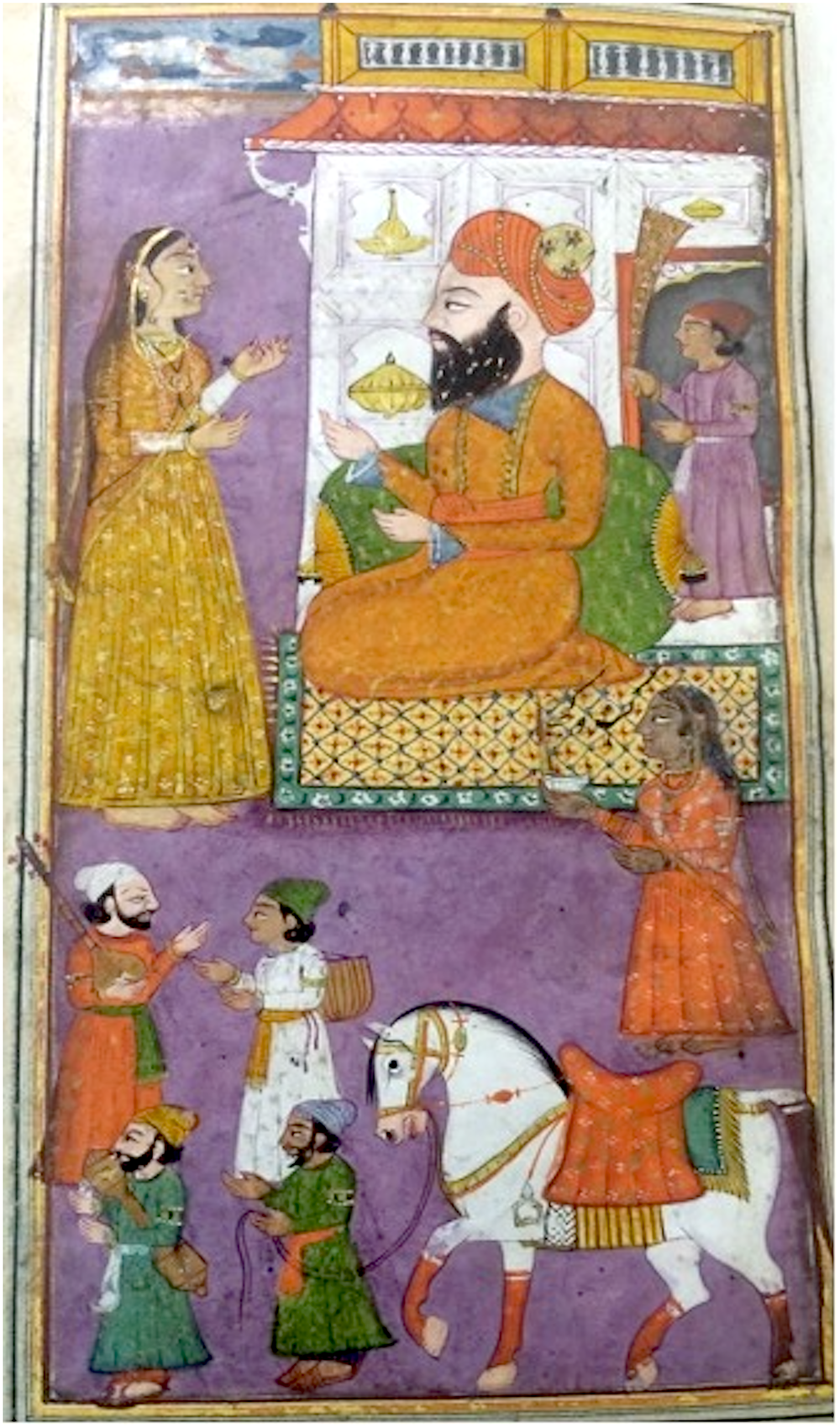
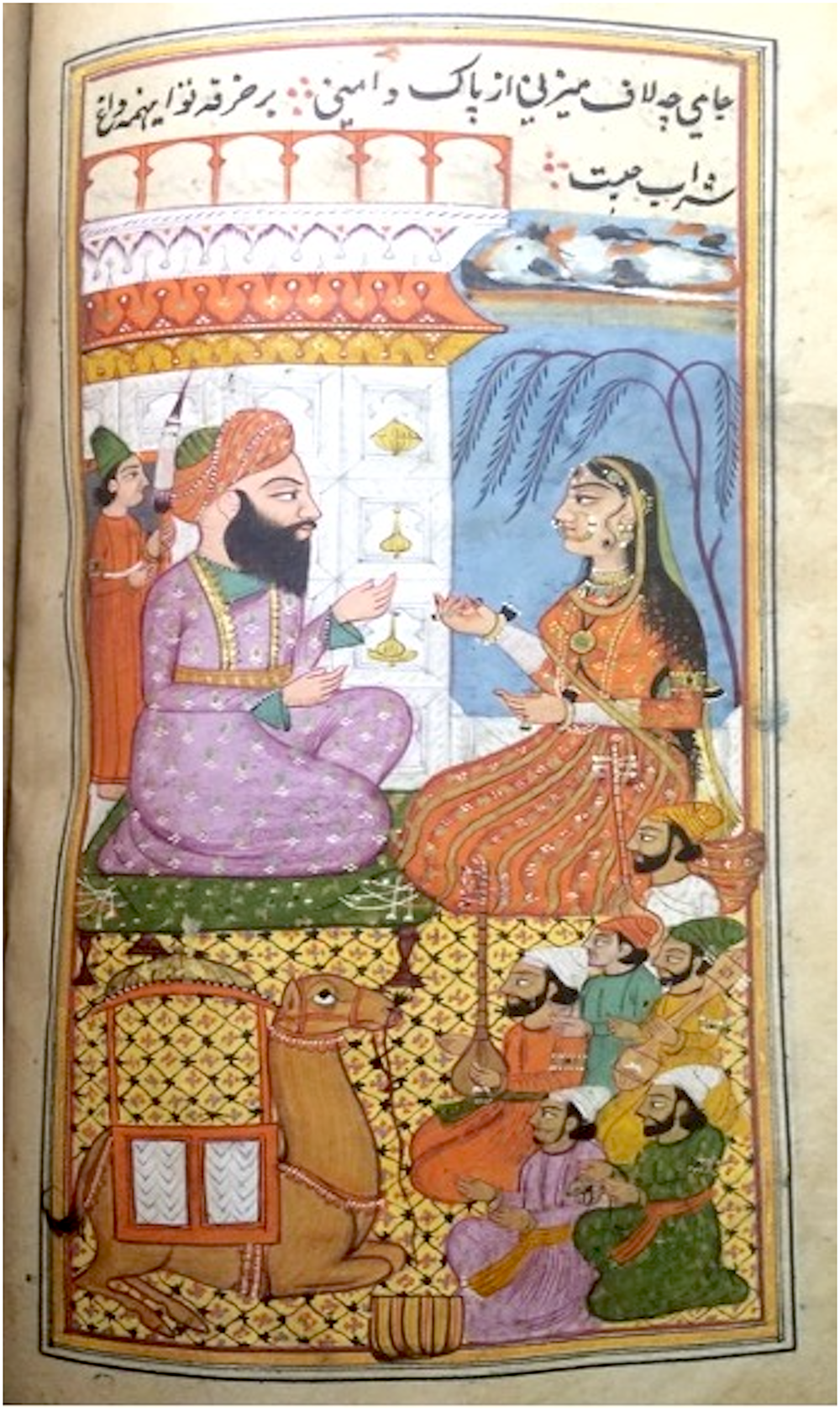
Ultimately, Jaur-o-Jafā reveals the imbrications between travel, mobility, and autonomy for a courtesan during this period. While we have only featured a few miniature paintings here, many other paintings are replete with images of the modes of transport used by Murad: whether horse or camel, depending on the ecological context of her travels. Animal-powered transport was an abiding feature of what we have termed Murad’s ‘courtesanly mobility’, with transport animals framing many paintings of her ‘negotiations’ or ‘discussions’ with Raza. In both Figure 8 and Figure 9, a horse and a seated or resting camel, with saddle and howdah respectively intact, wait patiently for the Raza–Murad interchange to end, so that they can help Murad travel back to her home. Indeed, the anonymous but skilled painter has depicted them as one of the many key members of Murad’s entourage, keeping a friendly eye of concern over her exchange with Raza.Footnote 74
Murad Bakhsh and Raza Khan, with Murad’s musicians, Kando Kanchni, and a travelling horse in the foreground. Source: From the British Library Collection: MSS Or. 199, Jaur-o-Jafā, fol. 9r.

Figure 8 Long description
Murad Bakhsh is seated on a throne, wearing a turban and holding a small object. Raza Khan stands to his left, dressed in a long robe. A woman, Kando Kanchni, stands to the left of Murad, wearing a detailed dress. Two musicians are positioned in the foreground, one playing an instrument. A horse is also present, adorned with decorative elements. The background features architectural details, including a curtain and a window. The scene is set in a historical context, with intricate patterns and designs visible on clothing and objects.
Murad Bakhsh and Raza Khan with Murad’s musicians and a seated travelling camel in the foreground. Source: From the British Library Collection: MSS Or. 199, Jaur-o-Jafā, fol. 36v.

Figure 9 Long description
Murad Bakhsh and Raza Khan are seated facing each other in a detailed painting. Murad Bakhsh is wearing a turban and holding a cup, while Raza Khan is dressed in a patterned outfit, also holding a cup. They are surrounded by musicians, who are playing instruments and seated on the ground. In the foreground, a camel is seated with a decorative saddle. The background features architectural elements and a flowing water design. The painting includes text at the top in a script style.
Conclusion: gender, mobility and resistance
From the perspective of South Asian literary genres in Persian and Urdu, Jaur-o-Jafā fits into the tradition of contemporaneous eighteenth-century male authors writing in a feminine voice. A contrasting example is the early eighteenth-century poet Valih Daghistani (1712–1756), whose famous tale of true romantic fidelity to his lover Khadija Sultan was composed in 1747 by his friend Faqir Dihlavi, as discussed by Mana Kia.Footnote 75 A similar example comes from the rekhti poetry of Raza’s near contemporary Sa’adat Yar Khan Rangin (1757–1835) as analysed by Carla Petievich and Ruth Vanita, among others.Footnote 76 Raza Khan’s text, though different in tone from both Dihlavi’s sympathetic version of Valih’s love story and Rangin’s more colourful and decadent verses, matches that of his contemporaries in its mediation of women’s experiences and voices through their writing, an example of ‘male ventriloquism’, to quote Butler Schofield.Footnote 77 In this, it is similar to Allison Busch’s insights on riti poetry compositions that ‘may often have a female voice’ but with ‘a male gaze’.Footnote 78 This context of male authorship remains important even if our larger argument is about the mobility of courtesans through our feminist methodological re-reading of the text at the intersections of critical courtesan studies, qissa, and literary studies of Punjab, and biographies from, and historiographies of, eighteenth-century North India.
A mere one-sided account of the rift between two individuals across social class and ethnic divides, the primary themes permeating Jaur-o-Jafā are those of justice and morality. For Raza Khan, the main rationale behind writing the text seems to be an outpouring of emotion against the injustices wreaked upon him by the ‘cruel’ courtesan Murad, who apparently ruined his estate due to her negligence, since he had relegated all administrative decisions to her. This is contrasted, by the end of the story, with the regaining of control and righting of such wrongs in Raza’s favour through the legal systems of the time. Ironically, of course, the cruellest outcome at the tale’s conclusion is reserved for the formerly autonomous, mobile, and powerful courtesan Murad.
Despite the abundance of detail, Jaur-o-Jafā leaves intriguing gaps in its narrative. Hence Raza Khan has not only made a delicate effort of self-preservation before his ‘astute readers’ but also provided a candid record of his friends and foes and his criteria for trust and distrust in his servants, perhaps in an attempt to guide his heirs in the larger chaotic and fragile political world of the late eighteenth century, where both power and servitude were hereditary.
The distinctive fusion of autobiographical reflection, depiction of aristocratic pleasures, and cautionary narratives on feminine wiles in Jaur-o-Jafā resonates with the broader aesthetic and moral preoccupations of Persian literary genres in this period. The primary reason to deem the story true is the presence of contemporary historical actors and the author’s apparent intent in writing it, even if the question of Murad Bakhsh’s identity, motivations, and ultimate fate requires further research.
To conclude, the agency exercised by Murad Bakhsh, a travelling courtesan navigating the shifting topographies of power in south-west Punjab, may be delineated across four distinct yet interwoven modalities. First, she emerges as an aspirant figure, departing Multan for Dera Ghazi Khan in pursuit of economic opportunity and social ascendancy—emblematic of the itinerant courtesan’s pursuit of self-fashioning within regional circuits of prestige. Second, she appears as a beloved in retreat, withdrawing from Dera Ghazi Khan amidst mounting political instability, marked simultaneously by a growing scepticism towards her erstwhile patron, Raza Khan, and by resistance against his encroachment upon her personal autonomy. Third, her identity shifts once more, this time into the figure of the fugitive—pursued by legal and extra-legal forces, her movement refracted through the lens of criminality and moral transgression. Lastly, she is rendered a figure of existential vulnerability: no longer the self-assured performer but a frightened woman, diminished and imploring, desperately seeking credible assurances that her life may yet be spared. Through these stages, her subjectivity is constantly reframed by external pressures and internal recalibrations, illuminating the complex interplay between gendered agency, mobility, and state power in late eighteenth-century Punjab. In the ultimate analysis, Murad Bakhsh’s story deserves to remain open as a generative site of inquiry within the intersecting histories of gender, affect, and cultural practice, which resonates across the broader geographies of northern India and the entangled worlds of South and Central Asia during this period.
Supplementary material
The supplementary material for this article can be found at https://doi.org/10.1017/S1356186325101326
Acknowledgements
The authors wish to thank their mutual friend, Zahra Nouman, without whom this collaborative research article would not have been possible. We are grateful to Shweta Sachdeva Jha, Jennifer Howes, Sonia Wigh, and the two anonymous peer-reviewers for their close reading and excellent feedback on earlier drafts of the article. We also acknowledge the British Library Board for their permission to reproduce images from the Jaur-o-Jafā manuscript here. All translations from the original Persian are by Asad Fatemi.
Conflicts of interest
None.


 Open access

