


Introduction
The question regarding the role of technocrats and independent experts in political systems has firmly entered the public debate in democracies around the world. The prominence of technocratic executive appointments at the height of the European financial crisis in Italy and Greece, or as a response to domestic crises in the case of Romania, gave flesh and bones to the theoretical tension between technocracy and democracy and brought it at the forefront of political attention (Pastorella 2015). In the past years, environmental crises are also playing out on the world stage and, more recently, the public health crisis caused by the COVID‐19 pandemic catapulted scientific and technical expertise to the forefront of political decision making with polarizing reactions (Van der Linden et al. Reference Van der Linden, Leiserowitz, Rosenthal and Maibach2017; Financial Times 2020).
Existing research in political science has shown that experts can contribute to better political outcomes and that the need for technical experts grows when complex social problems arise (Alexiadou & Gunaydin Reference Alexiadou and Gunaydin2019; Pastorella & Wratil Reference Pastorella and Wratil2018). However, we know little about what citizens think of expert involvement in politics, whether they consider political power in the hands of independent experts to be legitimate and whether they prefer political processes that delegate more power to experts.
This research note contributes to this discussion and tests whether citizens welcome a greater role for experts in political processes depending on the specific role and issue at hand. As a first step, it pits elected representative actors against unelected experts for various political roles, including the design of a policy, the final decision, the implementation and oversight. Second, drawing on the classical distinction between ‘hard’ and ‘easy’ issues, it investigates whether preferences for more expert governance depend upon issue complexity and the underlying public perceptions of authoritative expertise across different political issue areas. Evidence from a conjoint experiment run in seven European countries suggest that there is support for political processes that delegate power to independent experts over the policy design stage and the implementation of a political decision, with some variations between political issue areas. Assigning decision‐making power to independent experts does not make processes any more or any less appealing to respondents, the only exception being the issue of the environment where experts are preferred over elected representatives. Overall, this study opens up the discussion regarding citizen preferences for independent expertise in politics and how incorporating expertise in political processes can help boost public trust and support for outcomes.
Public preferences for independent experts
Democratic theory and empirical political science strive to determine what constitutes a legitimate use of political power and what renders the function of a political system legitimate in the eyes of its citizens, so that they will give their support and accept its decisions (Warren Reference Warren and Uslaner2017). So far, weight has mainly been thrown behind the idea of democracy as ‘self‐governance’ and of legitimate power as that which is sanctioned by the people (Williams Reference Williams1998). Elected representatives and party governments derive their legitimacy from the people who select them and remain accountable to them throughout their governing function. However, there is another source of legitimacy and system stability that is found in the quality and epistemological robustness of political decisions (Estlund Reference Estlund2008).Technocratic legitimacy, therefore, can be derived from scientific knowledge, sector expertise and the unattached interests of its members, which allow experts to govern independently, efficiently and effectively (Bertsou & Caramani Reference Bertsou and Caramani2020).
When it comes to citizen preferences and legitimacy perceptions, dilemmas regarding the role of independent experts in political decision‐making processes persist. People may welcome and trust technocratic expertise in politics because they expect it to promote efficient governance with the production of better outcomes for the entire society. Survey evidence on technocratic and stealth democratic attitudes show that citizens often prefer to passively observe political decisions made by impartial experts rather than be actively involved in politics or let politicians decide (Hibbing & Theiss‐Morse Reference Hibbing and Theiss‐Morse2002; Bertsou & Pastorella Reference Bertsou and Pastorella2017). At the same time, however, people may oppose the involvement of independent experts in politics based on principles of transparency and accountability, since an increased role of such actors in political processes reduces transparency and lengthens – or even breaks – the accountability chain (Marien & Werner Reference Marien and Werner2019). Furthermore, public mistrust towards experts and the denigration of expertise also appears to be on the rise across democracies (Norris & Inglehart Reference Norris and Inglehart2019).
I expect that citizens' preferences for independent experts in politics will reflect their legitimacy perception of expert‐based governance. Governance refers to a broad range of political processes through which public policies are shaped, decided and enacted. In this research note, I investigate whether citizens would evaluate the role of independent experts in political processes differently depending on the specific stage of the process and political issue at hand. By breaking down the set‐up of a political process and separating the design of a policy from the decision‐making stage and the responsibility for implementation, it is possible to specify distinct roles for independent experts and see which of those roles citizens would rather assign to experts than to elected representatives.
Existing scholarship points to a number of reasons why citizens may support more power assigned to experts, depending on the political role at hand. First, the impartiality of independent experts is a particularly welcome influence on policy making (Lavezzolo et al. Reference Lavezzolo, Ramiro and Fernández‐Vázquez2020). Although the act of framing and designing a policy entails political power, public policy with its emphasis on evidence‐based criteria for policy making, has provided the basis for public acceptance of such power in the hands of unaccountable experts (Schudson Reference Schudson2006). Second, views of democracy as an organizing principle of collective action where ‘getting things done’ is an integral part of governing (Mansbridge Reference Mansbridge2012) would support the inclusion of technocratic expertise to achieve effective implementation of political decisions. Preferences for experts over elected representatives, in this case, are particularly motivated by a wish for efficiency and speedy action. Based on the above, the first two hypotheses follow:
H1a: Citizens will prefer processes where policy design is carried out by independent experts over elected representatives.
H1b: Citizens will prefer processes where implementation is assigned to independent experts over elected representatives.
Finally, while for many citizens, support for expert involvement does not come at the expense of democratic legitimacy (Dommett & Temple Reference Dommett and Temple2019), giving decision‐making power to experts, as opposed to elected representatives, poses a direct challenge to the democratic ideas of self‐governance and accountability (Caramani Reference Caramani2017, Sánchez‐Cuenca Reference Sánchez‐Cuenca, Bertsou and Caramani2020). The crucial political moment of decision making is where democratic and technocratic legitimacy clash. I expect that citizens in democratic countries will be reluctant to delegate this part of the political process to independent experts and would prefer processes where the final decision rests with their elected, sanctionable representatives.
H2: Citizens will prefer processes where decisions are made by elected representatives over independent experts.
In addition to the specific stages of political processes, I propose that citizens' preferences for expert governance may also vary across political areas depending on the type and complexity of an issue. Borrowing arguments from the fields of public opinion and public understanding of science, I expect that demands for technocratic expertise will be more pronounced in technically complex issues. I rely on the established distinction between ‘hard’ issues, those that are technically complex and require strategic planning, and ‘easy’ issues, political issues that are typically symbolic and rooted in cultural or moral values (Carmines & Stimson Reference Carmines and Stimson1980). The mechanism at play here is that as issues come closer to core values they lend themselves to conflict expansion and have a high number of social agents offering opinions, making it harder to establish authoritative independent expertise. Issues that are further away from morality policies require larger inputs from elites with expertise in that domain (Pollock et al. Reference Pollock, Lilie and Vittes1993). This distinction concurs with studies of public perceptions of scientific expertise showing that the relative credibility of expertise varies among scientific fields. The public rates experts and their fields according to scientific prestige (higher for the hard sciences and lower for the social sciences) and according to proximity to power structures, thus making it more likely to welcome political power in the hands of those experts with stronger scientific credibility and independence (Scheitle Reference Scheitle2018).
The political issues chosen in this study are (i) carbon emissions and climate change, (ii) civil partnership and same‐sex marriage, (iii) immigration and refugee settlement, (iv) security and counter‐terrorism and (v) taxation, wages and pensions. The areas of the environment and security represent examples of technically complex issues, while the area of the economy represents a core political dimension rooted firmly in the domain of political parties and representative actors (Gauchat et al. Reference Gauchat, Brien and Mirosa2017). The issues of immigration and LGBTQ rights represent examples of ‘easy’ issues closer to individual moral values (Hawley Reference Hawley2013; Krimmel et al. Reference Krimmel, Lax and Phillips2016). Accordingly, the third hypothesis as follows:
H3: Citizens will prefer involvement of independent experts over elected representatives in political processes dealing with more technically complex issues.
The hypotheses above are phrased around the main comparison of interest, which is public preference for greater political power in the hands of independent experts as opposed to elected representatives at the national level. While elected representatives can be specified easily, the label of ‘independent experts’ may signify different groups to different people. For some, independent bureaucracies staffed with experts in their field may be closer to a citizen's idea of independent expertise, while for others it can be closer to scientific institutions or agencies. I return to this debate in the conclusion of this research note. For the purposes of this study, the two aspects of ‘independence’ and ‘expertise’ are the crucial signifiers. They are used to describe actors that are not elected by the people and are expected to act responsibly (not responsive to popular majorities), as well as actors that possess superior knowledge, skill and experience in dealing with political questions.
Data and experimental design
The data for this study come from a survey administered online by the professional company Dalia Research in 2017 and provides nationally representative samples, mirroring census quotas for gender, age, location of residence (rural/urban) in seven European democracies. They include three Western (Germany, France and the Netherlands), two Eastern (Poland and Romania) and two Southern European countries (Italy and Greece). Sample sizes for each country are between N = 1,008 and 1,096, adding to a total pool of N = 7,357 respondents. Evidence from multiple European countries with diverse experiences of technocratic politics is expected to boost the generalizability of findings beyond a single country context. Three of the countries under study have experienced technocratic cabinets in the past decade. Further, coordinated market economies such as the Netherlands and Germany have stronger traditions of incorporating technical expertise through institutionalized practices (Maasen & Weingart Reference Maasen and Weingart2005). More information on respondent recruitment, samples and weights are available in the online appendix (Appendix A).
A conjoint experiment was used in order to assess citizen preferences for delegating power to independent experts. Conjoint experiments can help analyse citizen preferences to different attributes that vary simultaneously and entail a comparison between the available options (Hainmueller et al. Reference Hainmueller, Hopkins and Yamamoto2014). In this study, respondents were asked to select one of two political processes for a single political issue in which the actors responsible for each stage of the process varied. The three attributes of the political process (the design, decision making and implementation stages) are introduced in the regression equation as factor independent variables, meaning that I can use one of the levels (group of actors) as a baseline. I estimate average marginal component effects (AMCE) that capture the effect of an individual component averaged over the joint distribution of the remaining attributes. In this experiment, the estimate can be interpreted as the percentage point change in the probability of choosing one political process over another when a certain attribute changes from the baseline category to another level of interest.
The main comparison of interest is between preferences for processes that involve independent experts compared to elected representative actors. To stay as close as possible to real political processes across European democracies, elected representative actors are described as ‘the national government’ (policy design), ‘vote in national parliament’ (decision making) and ‘parliamentary committee from all political parties’ (implementation). Expert actors are referred to as a ‘committee of independent experts’ that is appointed and needs to make decisions by agreement. To provide a realistic alternative regarding the origin, decision making and implementation of a number of policies in the countries under study, a third set of actors at the European Union (EU) level is included in the set‐up of the experiment. Support for processes that involve EU actors would capture preferences for more international and coordinated governance and provide an alternative option for respondents motivated primarily by mistrust of national politicians (Costa Lobo & McManus Reference Costa Lobo, McManus, Bertsou and Caramani2020). Finally, direct democracy, in the form of a national referendum, is also included as an option in the decision‐making stage of processes. We include this option to stay in line with research in citizen process preferences (Coffé & Michels Reference Coffé and Michels2014; Font et al Reference Font, Wojcieszak and Navarro2015) and to ensure that ‘independent experts’ are not the only non‐partisan option available to respondents who might be driven by diffuse distrust of politics at the national and EU levels.
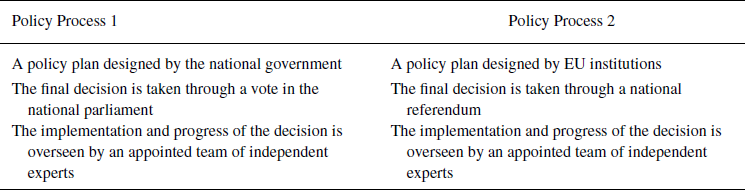
The precise wording for the experimental design is presented in the online appendix. Table 1 shows an example of a choice task. Respondents were asked once to select their preferred process that would determine policy in one of the five political issues. In total, 36 profiles were generated between the three attributes; policy design (three levels), decision making (four levels), implementation (three levels), without constraints. Balance tests to ensure randomization was successful, as well as robustness checks against order effects are presented in the online appendix (Appendix A3, E1).Footnote 1
Example of choice task

QUESTION: On the issue of carbon emissions and climate change, which of the two political processes of decision making would you prefer between the two outlined below? Please select one.
In the analyses that follow, I have opted to use elected representatives as the reference category when calculating AMCEs, as this reflects the ‘status quo’ in most of the countries under study. Results calculated using ‘independent experts’ as the reference category are presented in the online appendix (Appendix D). Furthermore, because AMCEs are sensitive to the selected baseline category and can be misleading when comparing subgroups of respondents (Leeper et al. 2018), unadjusted marginal means are also presented in the online appendix (Appendix C, F).
Results
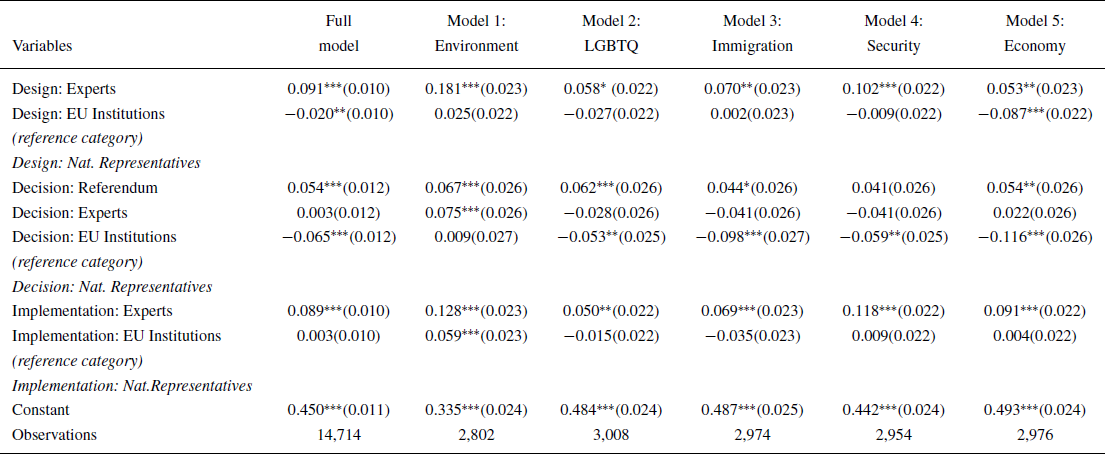
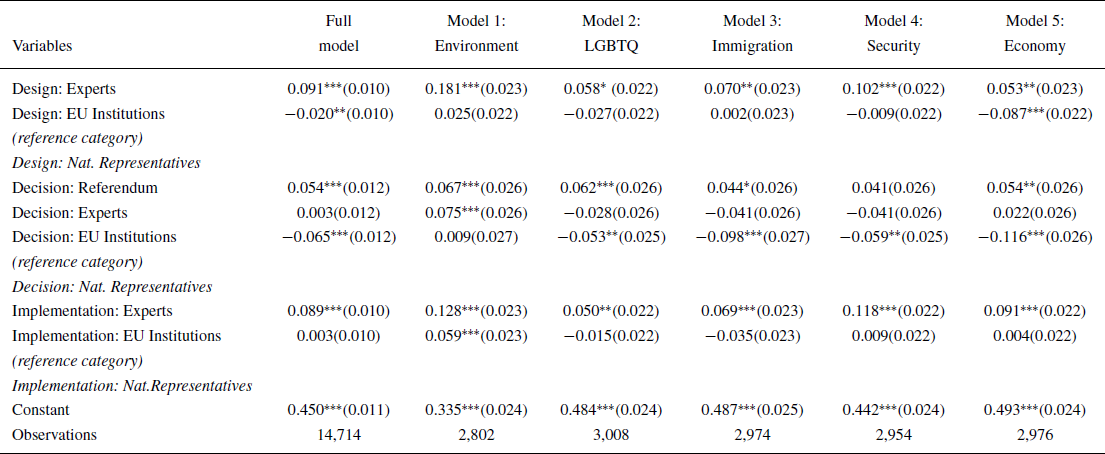
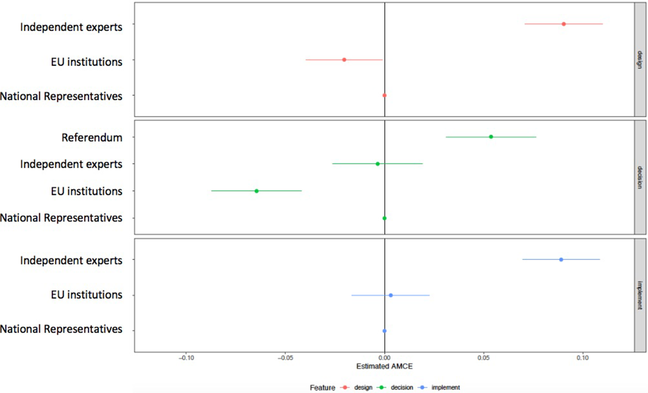
Figure 1 presents the results of the conjoint experiment for the full sample, including all policy areas and countries.Footnote 2 The AMCE estimates show that delegating power to independent experts, as opposed to elected representatives at the national level, over the designing of policy plans and the implementation of solutions increases preferences for such processes. This is evidence in favour of hypotheses H1a and H1b. Processes where independent experts are in charge of the design of a policy are 9 percentage points more likely to be chosen compared to processes where this responsibility rests with the national government. A similar effect of 9 percentage points is found for the task of implementing policy programmes. Regression results for the full model can be seen in Table 2.
Regression results: Full model and models per policy area
Robust standard errors in parentheses.
*** p <0.01, ** p <0.05, * p <0.1.
Average marginal component effect estimates across pooled sample from OLS regression. The dependent variable is a dummy with value 1 if the process was selected and 0 otherwise. Independent variables are all levels of actors in each process stage. [Colour figure can be viewed at wileyonlinelibrary.com]

Moving to the key moment of political decision making and the hardest test for public support for expert political power, results show no significant differences in the probability of selecting processes where decisions are taken by independent experts over decisions taken by elected representatives in national parliament. While processes where the decision is taken via a national referendum are approximately 5 percentage points more likely to be chosen over the baseline category, there is not enough evidence in favour of hypothesis 2, which maintained that, ultimately, democratic power for decision making should stay with elected representatives and therefore not delegated to unaccountable, independent elites.
The involvement of EU actors is evaluated negatively by the respondents at the policy design and decision‐making stage, both relative to national representatives and independent experts and negatively compared to experts at the implementation stage. This suggests that EU institutions are not perceived the same as technocratic, independent and expert‐based governance arrangements. Results are robust to the inclusion of country fixed effects (Appendix B1) and controlling for respondent characteristics (Appendix B2). Subgroup analysis by gender, age groups, education levels and left‐right ideology shows that respondents register similar preferences when it comes to expert involvement in political processes (Appendix F). Sub‐group analysis by levels of political trust shows, as would be expected, that the positive effects are present among respondents with medium and low levels of trust in politics. These results are in line with existing research into technocratic preferences among citizens and provide further evidence for the possibility of boosting public support for political processes by incorporating independent expertise.
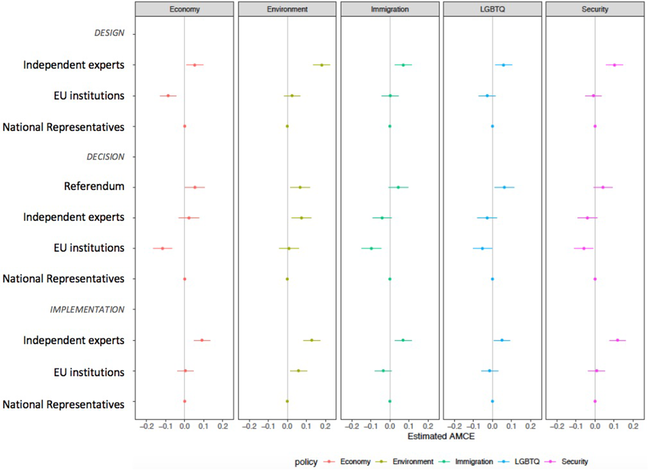
Turning to hypothesis 3 and looking at results across the five different issues, Figure 2 shows some evidence in favour of the hypothesis, but results are mixed. Processes on environmental policy conform to expectations for technically complex and scientific issues, with stronger positive effects for the involvement of independent experts across all stages of the political process. When asked about climate change, the probability that respondents choose processes where a policy is designed by independent experts, as opposed to elected representatives, increases by 18 percentage points, an effect that is significantly higher than effects for immigration, LGBTQ rights and the economy (7, 6 and 5 percentage points respectively). Similar significant differences can be seen in the results of delegating power to experts over elected representatives at the implementation stage of a process (18 percentage points for the environment compared to 5 for LGBTQ rights and 7 for immigration). Interestingly, for the environment we find a significant positive effect of 7.5 percentage points for decisions taken by independent experts, over elected representatives. Decision making by experts increases the likelihood respondents will choose this process, at par with decision making via a referendum. Again this is significantly different from effects at the decision‐making stage for the ‘easy’ issues of immigration and LGBTQ rights. Regression results are presented in Table 2; Models 1–5 and significance test comparing coefficients are available in Appendix G.
Average marginal component effect estimates from separate OLS regressions by issue area. [Colour figure can be viewed at wileyonlinelibrary.com]

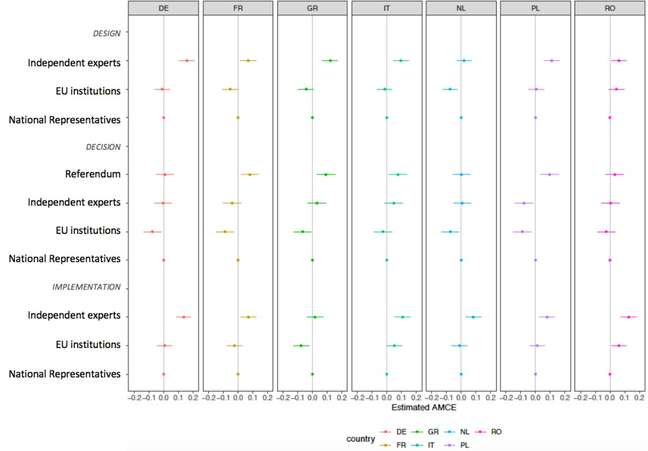
Average marginal component effect estimates from separate OLS regressions by country. [Colour figure can be viewed at wileyonlinelibrary.com]

However, for the second ‘hard’ issue of security, results are less conclusive. Effects are in the expected direction: there is a 10‐point increase in preferences for processes involving experts in policy design and 12 point increase in implementation, but these are not significantly different from effects in economic, immigration and LGBTQ rights areas. Delegating decision making to independent experts as opposed to representatives has no significant effect in the area of security, as in the three remaining issue areas. Overall, we can interpret results as confirming theoretical expectations about ‘hard’ issues in the case of the environment, though further research is needed to determine whether there is a special status for expertise in the area of environmental protection. Finally, the fact that we do not observe a backlash against expert involvement across ‘easy’ issues is worth noting and points to the potential of increasing citizen trust and satisfaction with political processes by incorporating independent experts across a variety of policy areas.
Separate analysis for each of the seven European countries in this study shows no important differences in respondent preferences for independent experts over elected representatives (Figure 3, full regression results available in Appendix B4 in the online appendix). While effect sizes vary across the seven countries under study, results show an increase in preferences for processes when these include independent experts at the policy design stage (between 6 and 16 percentage points increase, except in the case of the Netherlands where results are not significant) or at the implementation stage (between 7 and 14 percentage points increase, except in the case of Greece where results are not significant). There are also no differences in respondent preferences between decision making by experts and elected representatives. The only exception is Poland, where respondents prefer processes where decisions are taken by parliamentarians as opposed to independent experts by 8 percentage points. This is the only finding in support of the original second hypothesis. It merits a closer look in future research, given the prevalence of technocratic attitudes among Polish citizens and recent moves by the Law and Order party to limit judicial and bureaucratic independence (Fijalkowski Reference Fijalkowski2017; Bertsou and Pastorella Reference Bertsou and Pastorella2017).
Conclusion
Do citizens welcome technocratic expertise in politics, or are they wary of delegating political power to independent experts? This research note provides a first test of citizen preferences for independent experts in political processes, arguing that citizens may support or oppose delegating power to experts depending on the specific task and issue area at hand. It therefore contributes to the aforementioned debate by pitting unelected, independent experts against national elected representatives while separating three key stages in political processes and differentiating between ‘hard’ and ‘easy’ political issues.
Respondents in this study consistently preferred processes where independent experts had responsibility over the design of policy and the implementation phase across the five issue areas tested, highlighting a potential avenue for democratic politics to incorporate independent expertise in a way that can boost citizen approval for political decisions. Preferences for processes that gave power to independent experts were stronger among the ‘harder’ issue of the environment (for the issue of security, effects were in the right direction but not significant). In the case of the environment, there is even a positive effect for assigning decision‐making power to experts over elected representatives.
These results have implications for existing research and highlight two important opportunities for further study. First, survey data showing citizens who support having ‘experts, not governments, making decisions’ overestimate considerably the amount of public support for out‐right technocratic decision making. This could be a result of obfuscating levels of support for different potential roles independent experts can have in political processes. Alternatively, such indicators may be simply capturing dissatisfaction with the state of national and European politics, rather than a candid preference for more political power in the hands of independent experts.
Second, the positive result of expert decision making on the issue of climate change suggests that public acceptance of a less responsive and accountable (but more responsible) decision maker may indeed be conditional upon the urgency, technical nature and the perceived scientific independence of experts in a political issue area. Further research is necessary to establish the criteria needed to qualify as an ‘independent expert’ and whether they vary across social‐scientific fields that have been politicized. While citizens appear to be positive towards delegating more political responsibility in the hands of independent experts in abstract terms, it is not clear whether all will agree on the criteria for assigning ‘expert’ and ‘independent’ labels.
Here it is also important to note that existing research on process preferences has shown that, while process characteristics matter, outcome effects are usually stronger in predicting willingness to agree with a decision and can even colour citizens' evaluations of process legitimacy (Esaisson et al. 2019; Werner Reference Werner2020). The theoretical premise of this study has been that citizen preferences will reflect their legitimacy perceptions of processes that incorporate independent experts; therefore, outcomes were purposefully not mentioned. Removing the explicitly instrumental element for supporting a specific political process should redirect respondents' attention to the actors with the power of shaping each stage of the process and allow us to study legitimacy perceptions of specific governance set‐ups. Nevertheless, it is possible that some respondents make assumptions regarding the outcome of processes involving experts.
Finally, while I have argued that there is a legitimacy basis for technocratic expertise in the impartial scientific knowledge it provides, I found that when it comes to making a political decision respondents did not prefer processes where that power was given to experts. Instead citizen decision making via referendums had a positive effect. Therefore, it would be misleading to ignore the overall support given to processes that allow self‐governance. The findings suggest future research should explore possibilities for innovating democratic processes to incorporate citizens and experts. They also highlight the difficult position that representative political actors find themselves in across many European democracies. Party governments and elected representatives may need to reconsider their role in democratic governance and think of ways of sharing some of their political power.
Acknowledgements
I would like to thank colleagues at the Department of Political Science, University of Zurich and beyond for their comments on earlier versions of the manuscript. In particular, Clau Dermont, Katja Michaelowa, Daniele Caramani, Jelle Koedam, Denise Traber and Macarena Ares, Hannah Werner, Sofie Marien and participants at the SPSA (2020) and EPSA (2020) Political Methodology panel who provided suggestions on how to improve the manuscript.
Online Appendix
Additional supporting information may be found in the Online Appendix section at the end of the article:
Data S1
Data S2
Data S3
Data S4
Appendix A: Survey and Experiment Information
Appendix B: Regression Results
Appendix C: Marginal Means Results
Appendix D: Alternative Visualizations of AMCEs
Appendix E: Other Robustness Checks
Appendix F: Robustness Checks with Subgroup Analysis
Appendix G: Policy Area Results and Significance Tests


 Open access

