





Introduction
Hospice and palliative care teams pay particular attention to spirituality at the end of life. Numerous consensus statements establish the importance of spiritual care in palliative care (Ferrell et al. Reference Ferrell, Twaddle and Melnick2018; Puchalski et al. Reference Puchalski, Ferrell and Virani2009, Reference Puchalski, Vitillo and Hull2014). A recent article in the Journal of the American Medical Association confirmed the importance of spirituality for people with serious illness (Balboni et al. Reference Balboni, VanderWeele and Doan-Soares2022). Chaplains are the members of palliative care teams who most consistently offer spiritual care (Cadge et al. Reference Cadge, Fitchett and Lyndes2011; Steinhauser et al. Reference Steinhauser, Beliveau and Hendricks2020). Some hospices also employ chaplains who also frequently work as bereavement coordinators supporting family members in the months after a death.
Chaplains serve everyone, including those who are not religiously affiliated, as well as caregivers and staff of organizations (Antoine et al. Reference Antoine, Savage and Cadge2021; Cadge and Rambo Reference Cadge and Rambo2022). Recent surveys suggest that between 18% and 44% of the American public has had contact with a chaplain, numbers that vary based on how members of the public interpret the term chaplain (Lawton et al., Reference Lawton, Cadge and Hamar Martinezn.d.). The largest number of people in the United States interact with chaplains in health-care organizations, including hospice and palliative care (Cadge et al. Reference Cadge, Winfield and Skaggs2020). This is in part because the Joint Commission, which regulates health-care organizations, requires health-care organizations to attend to people’s spiritual and religious needs.
A growing body of research demonstrates how chaplains impact the effectiveness of care (Marin et al. Reference Marin, Sharma and Sosunov2015) and suggests that unmet spiritual care needs decrease patient satisfaction (Williams et al. Reference Williams, Meltzer and Arora2011). In a study of cancer patients, patients gave lower ratings to the quality of their medical care if they felt that their spiritual needs were not being met (Astrow et al. Reference Astrow, Wexler and Texeira2007). Another study of advanced cancer patients found that 35% felt attention to their spirituality and spiritual needs would improve satisfaction with their care (Pearce et al. Reference Pearce, Coan and Herndon2012). Spiritual concerns have also been associated with poor quality of life for advanced cancer patients (Winkelman et al. Reference Winkelman, Lauderdale and Balboni2011). Yet little is known about how recipients of spiritual care – in palliative care and other settings – experience the care.
This article explores whether most people who have contact with a chaplain are primary recipients of the chaplain’s care or the caregivers of a person who is ill, what the content is of the contact, and how recipients remember and experience it. While a 2019 survey reported that 80% of recipients found their interactions with chaplains to be moderately or very valuable (Cadge et al. Reference Cadge, Winfield and Skaggs2020), little is known about the people who interacted with the chaplain and the content of these interactions. This study is the first to show the groups of people – primary recipients and visitors/caregivers – who receive care from chaplains. It demonstrates how care recipients experience care from chaplains differently based on their position, which has important implications for practice.
Methods
Survey
This study draws on data gathered in a nationally representative survey conducted for the Chaplaincy Innovation Lab at Brandeis University in March 2022. The survey, conducted in partnership with the Gallup Organization, was completed by a sample of US adults aged 18 years and older. The respondents were selected from the Gallup Panel, a probability-based panel recruited by random digit-dialing and address-based sampling. Gallup purposively recruits to maintain a demographically balanced sample. For this survey, Gallup drew a stratified sample of 3,400 adults with demographic distribution matching US population targets from the 2017 Current Population Survey. The survey was administered online in English and Spanish in March 2022. Up to 5 reminder emails were sent as needed, and respondents received $2 upon survey competition. The survey was completed by 1,096 respondents.
The survey defined a chaplain as follows:
The next few questions ask about chaplains. By “chaplains,” we mean clergy or other religious guides or spiritual caregivers who serve people outside of churches or other houses of worship, in settings such as hospitals, the military, prisons, or institutions of higher education, to name a few examples.
Between 18% and 44% of respondents answered this question in the affirmative based on how they interpreted the word chaplain, with the higher end of the range including congregational leaders who may or may not have been fulfilling the role of chaplain as defined in the survey. The estimate that 18% of Americans have interacted with a chaplain is based strictly on the Gallup definition, which emphasized formal spiritual caregiving in secular settings and did not count other religious experiences.
Respondents who interacted with a chaplain were also asked, “In what context did your interaction with a chaplain take place?” This was a multiple-choice question with 11 possible responses: in a hospital or other health-care setting; in a palliative care facility or hospice (either in a facility or in a residence); through military service; through the Department of Veterans Affairs; in a correctional facility (prison, jail, etc.); at a college/university; in a K-12 school setting; in a situation involving the police or fire department; in a church or other place of worship; in the context of disaster relief efforts; and “other (please specify).” The current analysis excluded the 275 respondents who reported interacting with a chaplain in a church or “other” setting based on analyses which found that these interactions were not with chaplains as defined in the survey (Lawton et al., Reference Lawton, Cadge and Hamar Martinezn.d.). An additional 4 cases were dropped due to missing data in the key variables, and the analysis was performed on the remaining 202 cases.
Respondents were asked, “In this interaction with a chaplain, were you…,” and were given 5 choices to describe the role they may have occupied: “A primary recipient of the chaplain’s care or support;” “Visiting a friend, relative, or loved one;” “Acting as a caregiver to a friend, relative, or loved one;” “An employee interacting with a chaplain through the course of your job;” or “A participant in a religious ceremony (such as a memorial or a wedding).” Respondents were allowed to select multiple roles. There was large overlap between the roles of visitor and caregiver, so those responses were combined into one category (visitor/caregiver).
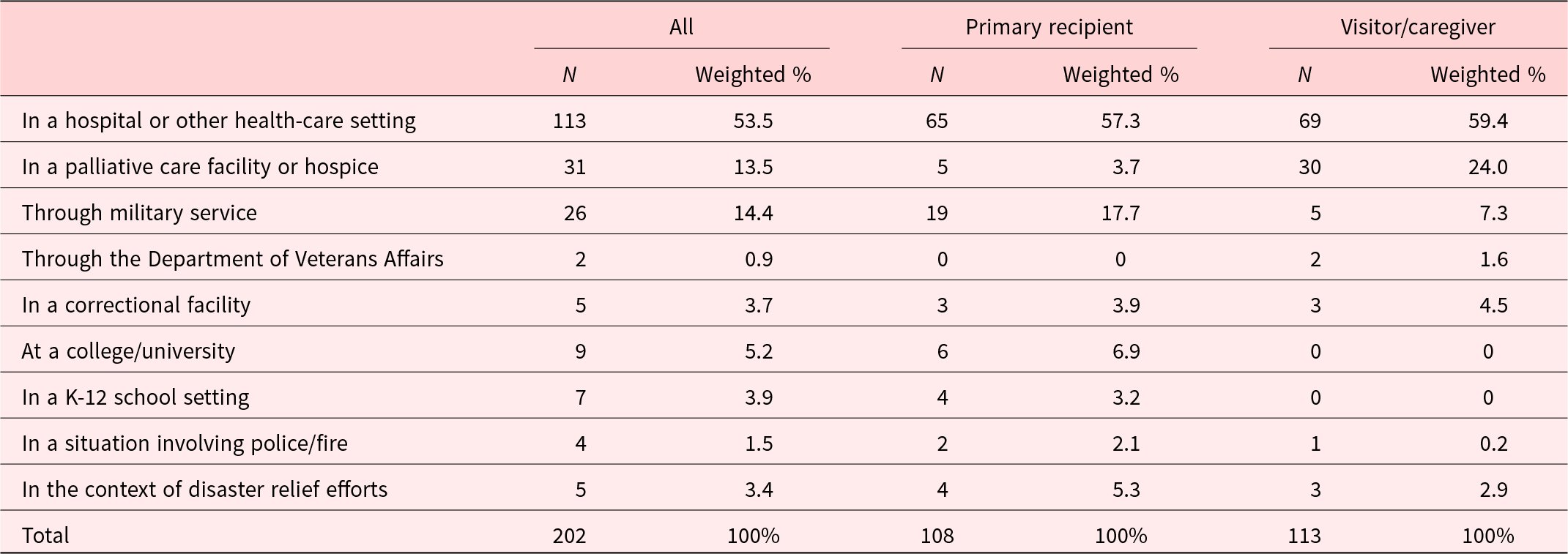
Table 1 includes the descriptive statistics for the entire sample of 202 respondents, as well as broken down to show the descriptive statistics for the primary recipients (N = 108) and for the visitors/caregivers (N = 113) Primary recipients made up 108 cases and visitors/caregivers constituted 113 cases. The sum of these two groups is greater than the total number of cases because of a small number of people who were included in both categories – visitors or caregivers who also saw themselves as a primary recipient of the chaplain’s care. Omitting the cases where a visitor/caregiver was also a primary recipient had little effect on the outcomes of the analysis. Table 2 shows the setting where the interaction took place for the entire sample, for primary recipients and for visitors/caregivers (the following analysis is not done by location, as cell sizes were too small).
Demographic descriptive statistics

Setting of interaction

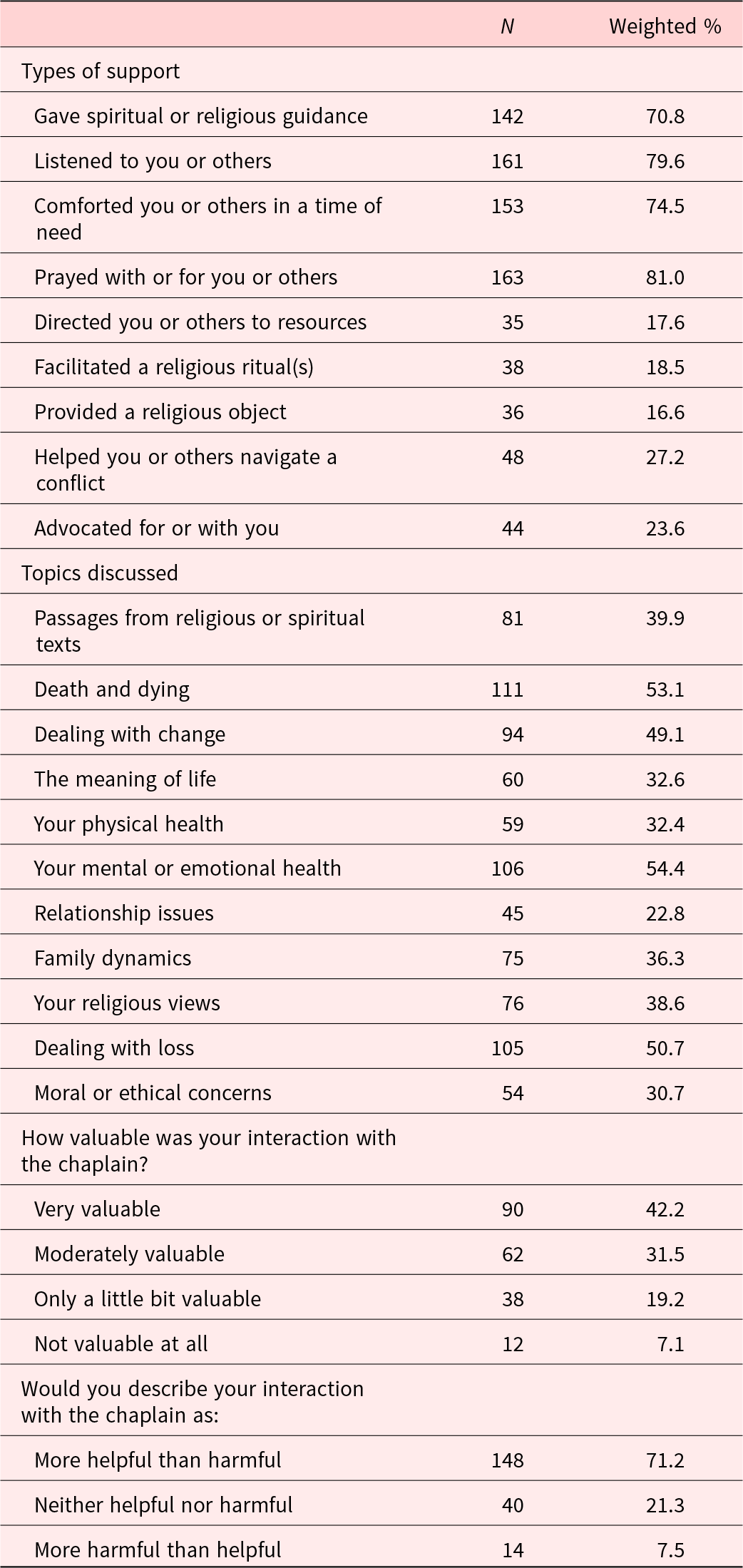
Key variables reflected how the respondent described their interaction with a chaplain. The summary statistics for these variables are presented in Table 3, and the questions are described below.
Key variable descriptive statistics (N = 202)

To learn about the content of the interaction with chaplains, responses given in 2 question blocks were analyzed. In the first block, respondents were shown 9 types of support and asked if “the chaplain provided you or another person present during this interaction with support in any of the following ways.” The response options were: “Yes, I received this kind of support;” “Yes, another person present received this kind of support;” “Yes, BOTH I and another person present received this kind of support;” or “No.” The 9 types of support included on the survey were as follows:
• Gave spiritual or religious guidance
• Listened to you or others
• Comforted you or others in a time of need
• Prayed with or for you or others
• Directed you or others to resources (for example, financial or legal assistance)
• Facilitated a religious ritual(s) (for example, performed a marriage, gave communion)
• Provided a religious object (such as a religious text, candle, and prayer rug)
• Helped you or others navigate a conflict
• Advocated for or with you
Those who said they personally received the support or that they and another person present both received the support were included in this analysis. Because the survey design sampled the general population, types of support specific to a single sector of chaplaincy were not included in the survey. Future research should include advance care planning and goals of care conversations in order to have greater applicability to the hospice and palliative care settings.
In the second question block, respondents were given 12 topics and asked, “Did you discuss any of the following topics with the chaplain?” The response options were “yes” and “no.” The 12 topics of discussion were as follows:
• Passages from religious or spiritual texts
• Death and dying
• Dealing with change
• The meaning of life
• Your physical health
• Your mental or emotional health
• Coronavirus/pandemic
• Relationship issues
• Family dynamics
• Your religious views
• Dealing with loss
• Moral or ethical concerns
Analysis was not performed on discussions about the COVID-19 coronavirus pandemic, as many of the interactions described by respondents happened before the onset of the pandemic in the United States in 2020.
Additional key variables included how primary recipients and visitors/caregivers experienced the interaction with a chaplain. Two survey questions directly addressed how respondents experienced the interaction. A question about the value of the interaction asked, “How valuable was your interaction with the chaplain?” The response options were: “Not valuable at all;” “Only a little bit valuable;” “Moderately valuable;” or “Very valuable.” Another question asked the respondent to describe the interaction as “Neither helpful nor harmful;” “More harmful than helpful;” or “More helpful than harmful.”
Data analysis
Using key variables in Table 3 – types of support, topics of discussion, if the interaction was valuable, and if the interaction was helpful or harmful – this study investigated how respondents who identified themselves as the primary recipients of a chaplain’s care experienced their interaction with a chaplain differently than those who interacted with a chaplain but did not identify as the primary recipients of a chaplain’s care. The study also investigates how respondents who interacted with a chaplain while in the capacity of a visitor or caregiver had different experiences compared to those who were not a visitor/caregiver.
Bivariate analyses were performed on unweighted data. The responses of primary recipients were compared to the responses of all others on questions about what type of support was received, what topics were discussed, how valuable the chaplain interaction was, and whether the interaction was helpful or harmful. Bivariate analyses also compared the responses of visitor/caregivers to the responses of all others for the same 4 measures. Chi-squared tests of independence were used to determine if there was a statistically significant relationship between the role of the respondent and the responses given. Because the chi-squared test does not reveal the direction of the relationship, the group which was more likely to report an outcome was determined by calculating the expected values in a contingency table and calculating odds ratios with logistic regression.
Results
Chaplain interactions are generally highly valued. Primary recipients of spiritual care are more likely to have helpful and valuable interactions than are people in other roles – such as caregivers of those who are ill – who interact with chaplains. The content of interactions with chaplains differs depending on whether those who interact with a chaplain were a primary recipient of care or present in another role.
Role of care recipient: primary recipient versus visitor/caregiver
Table 1 shows that 55.5% of the sample were the primary recipients of the chaplain’s care (N = 108) and 54.5% met the chaplain while they were a visitor/caregiver (N = 113). There were few significant differences between the demographics of primary recipients and all others. A chi-squared test of independence showed that primary recipients were different when compared to all others, on the basis of region, χ 2 (3, N = 202) = 10.89, p = 0.012, with contingency tables showing more primary recipients than expected were located in the Northeast and South. A chi-squared test also showed that primary recipients were different from all others on the basis of religious tradition, χ 2 (6, N = 202) = 12.60, p = 0.050. Because expected cell counts were small, Fisher’s exact was used to confirm significance. More primary recipients were Born-again/Evangelical than expected, fewer were Catholic than expected, and fewer were religiously unaffiliated than expected according to the contingency table. There were no differences between visitor/caregivers and all others on any demographic variable.
Content of interactions with chaplains
Respondents were asked about 9 types of support they may have received from a chaplain, as well as about 12 possible topics of discussion. One of the topics – the COVID-19 pandemic – was excluded from this analysis because many reported interactions took place before the onset of the pandemic in the US in March 2020. The number of people who reported receiving each type of support or discussing each topic is detailed in Table 3.
Four types of support were widespread among the entire sample, with respondents reporting that the chaplain: “gave spiritual or religious guidance” (70.8%); “listened to you or others” (79.6%); “comforted you or others in a time of need” (74.5%); and “prayed with or for you or others” (81.0%). The remaining 5 types of support ranged from being experienced by 16.6% of the sample (“provided a religious object”) to 27.2% of the sample (“helped you or others navigate a conflict”).
Only 3 of 11 topics were discussed by more than half of the sample: “Death and dying” (53.1%); “your mental or emotional health” (54.4%); and “dealing with loss” (50.7%). More overtly religious topics of discussion were reported less often. “Passages from religious or spiritual text” were only discussed in 39.9% of reported interactions, and “your religious views” were discussed in only 38.6% of interactions.
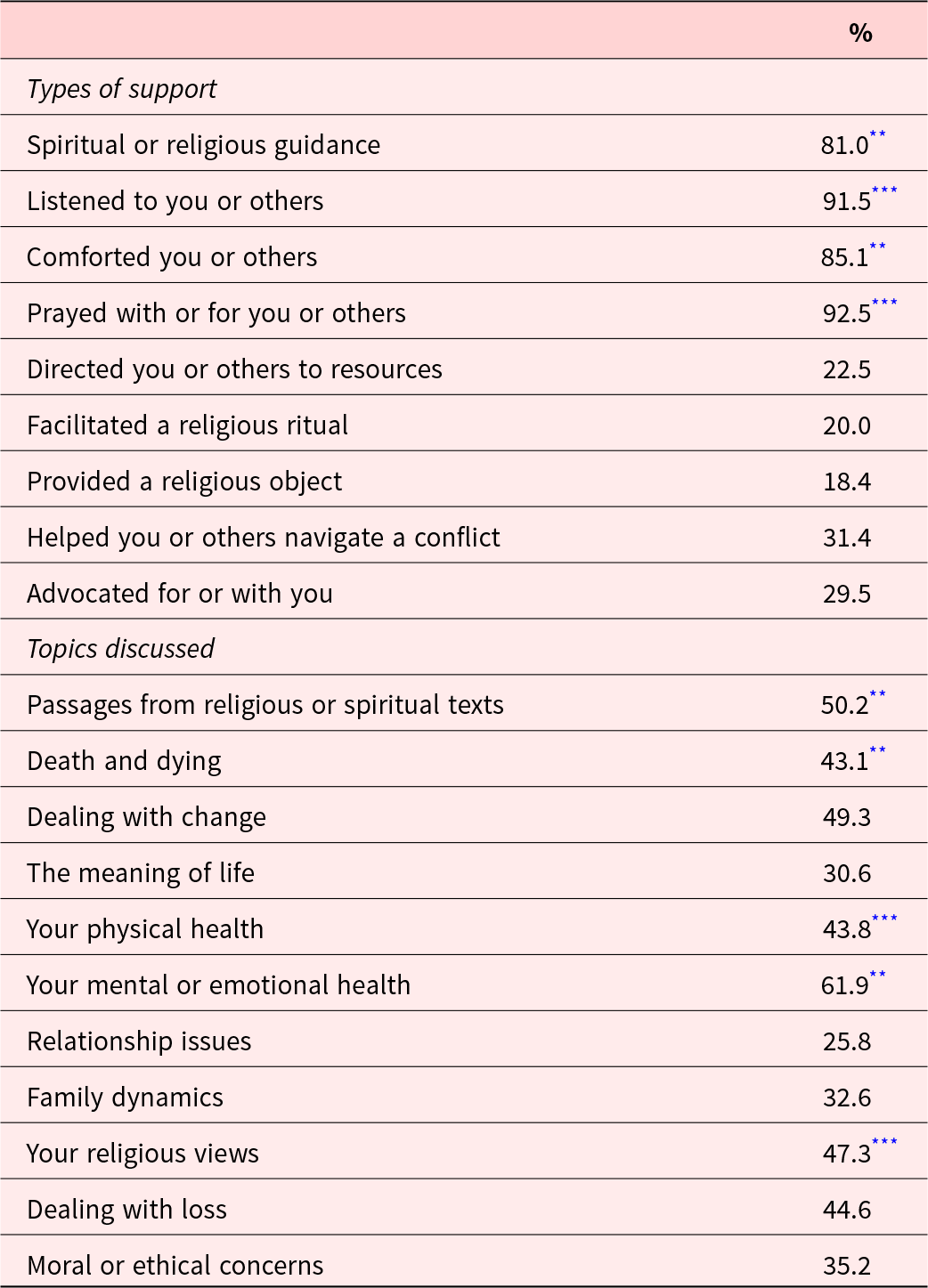
Table 4 shows the weighted percentage of primary recipients who reported receiving each type of support and discussing each topic during their interaction with a chaplain. Asterisks indicate the level of significance of the chi-squared test, which was performed on unweighted data.
Types of support received and topics discussed among primary recipients

* p < 0.05; **p < 0.01; ***p < 0.001.
Primary recipients were more likely than others to receive the following types of support: to receive spiritual or religious guidance from the chaplain, χ 2 (1, N = 199) = 9.21, p = 0.002; to be listened to by the chaplain, χ 2 (1, N = 201) = 18.95, p < 0.001; to be comforted by the chaplain, χ 2 (1, N = 202) = 11.26, p = 0.001; and to pray with the chaplain, χ 2 (1, N = 202) = 15.04, p < 0.001. Primary recipients were not less likely than others to receive any type of support.
There were 4 topics that primary recipients of the chaplain’s care were more likely than others to discuss with the chaplain during the interaction. Primary recipients were more likely than others to discuss passages from religious or spiritual texts, χ 2 (1, N = 200) = 7.79, p = 0.005; their physical health, χ 2 (1, N = 202) = 17.42, p < 0.001; their mental or emotional health, χ 2 (1, N = 202) = 6.94, p = 0.008; and their religious views, χ 2 (1, N = 202) = 13.00, p < 0.001. Primary recipients of the chaplain’s care were less likely than others to discuss death and dying, χ 2 (1, N = 202) = 8.60, p = 0.003.
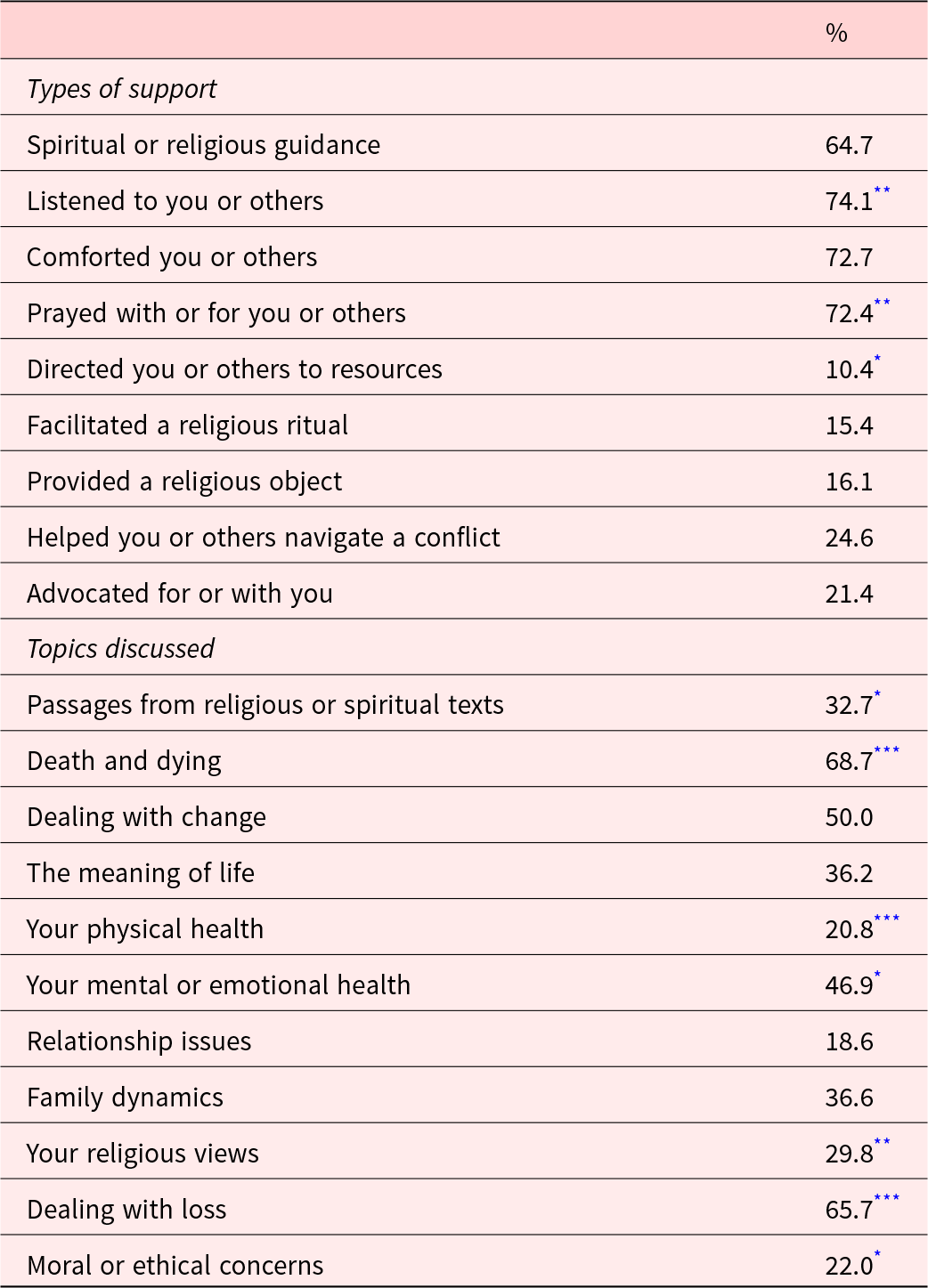
Table 5 shows the weighted percentage of primary recipients who reported receiving each type of support and discussing each topic during their interaction with a chaplain. Asterisks indicate the level of significance of the chi-squared test, which was performed on unweighted data.
Types of support received and topics discussed among visitors/caregivers

* p < 0.05; **p < 0.01; ***p < 0.001.
In contrast to primary recipients of the chaplain’s care, visitors/caregivers were less likely than others to report that the chaplain listened to them, χ 2 (1, N = 201) = 7.16, p = 0.007; that the chaplain prayed with them, χ 2 (1, N = 202) = 8.63, p = 0.003; or that the chaplain directed them to resources, χ 2 (1, N = 202) = 4.36, p = 0.037. Visitors/caregivers were not more likely than others to receive any type of support.
Visitors/caregivers were more likely than others to discuss 2 topics during their interaction with a chaplain: death and dying, χ 2 (1, N = 202) = 29.00, p < 0.001, and dealing with loss, χ 2 (1, N = 202) = 15.04, p < 0.001. Visitors/caregivers, however, were less likely than others to discuss 5 topics: passages from religious or spiritual texts, χ 2 (1, N = 200) = 5.32, p = 0.021; their physical health, χ 2 (1, N = 202) = 21.87, p < 0.001; their mental or emotional health, χ 2 (1, N = 202) = 5.54, p = 0.019; their religious views, χ 2 (1, N = 202) = 9.46, p = 0.002; and moral or ethical concerns, χ 2 (1, N = 202) = 5.33, p = 0.021.
View of the chaplaincy interaction
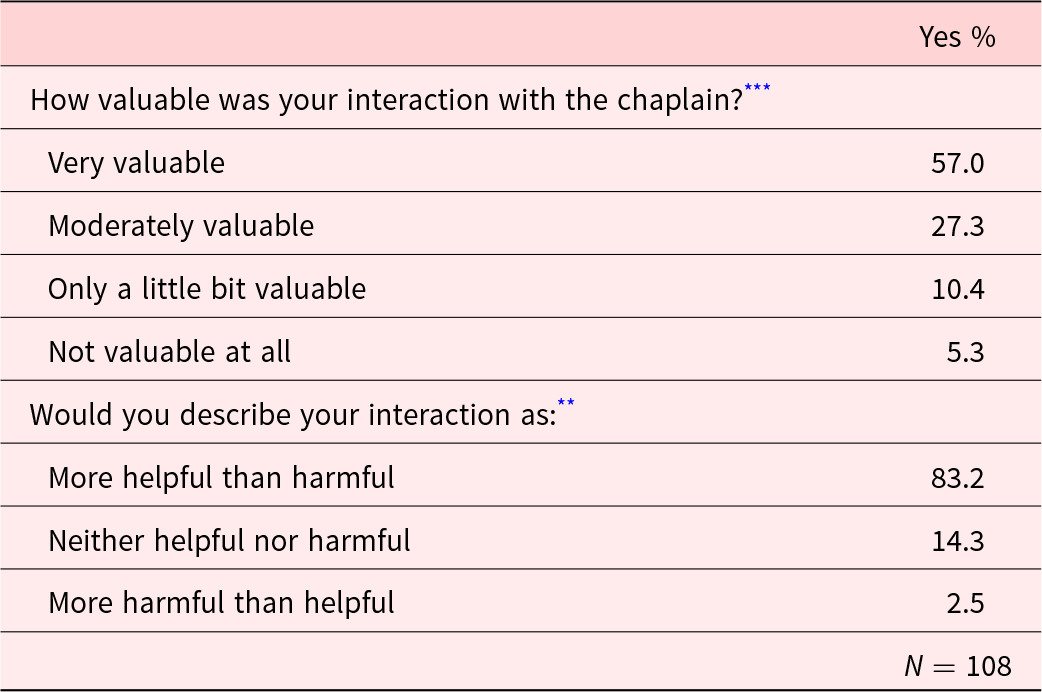
Most respondents found the interaction with the chaplain to be either “very valuable” (42.2%) or “moderately valuable” (31.5%), a combined 73.7% of all respondents as described in Table 3. A similar percentage described their interaction with the chaplain as “more helpful than harmful” (71.2%). The primary recipients of care in a chaplain interaction were more likely than people in all other roles to describe the interaction as “very valuable,” χ 2 (3, N = 202) = 19.60, p < 0.001. The primary recipients of care in a chaplain interaction were also more likely than people in all other roles to describe the interaction as “more helpful than harmful,” χ 2 (3, N = 202) = 15.08, p = 0.001. The weighted rates at which primary recipients found the interaction with a chaplain to be valuable and helpful are reported in Table 6.
View of interaction among primary recipients

* p < 0.05; **p < 0.01; ***p < 0.001.
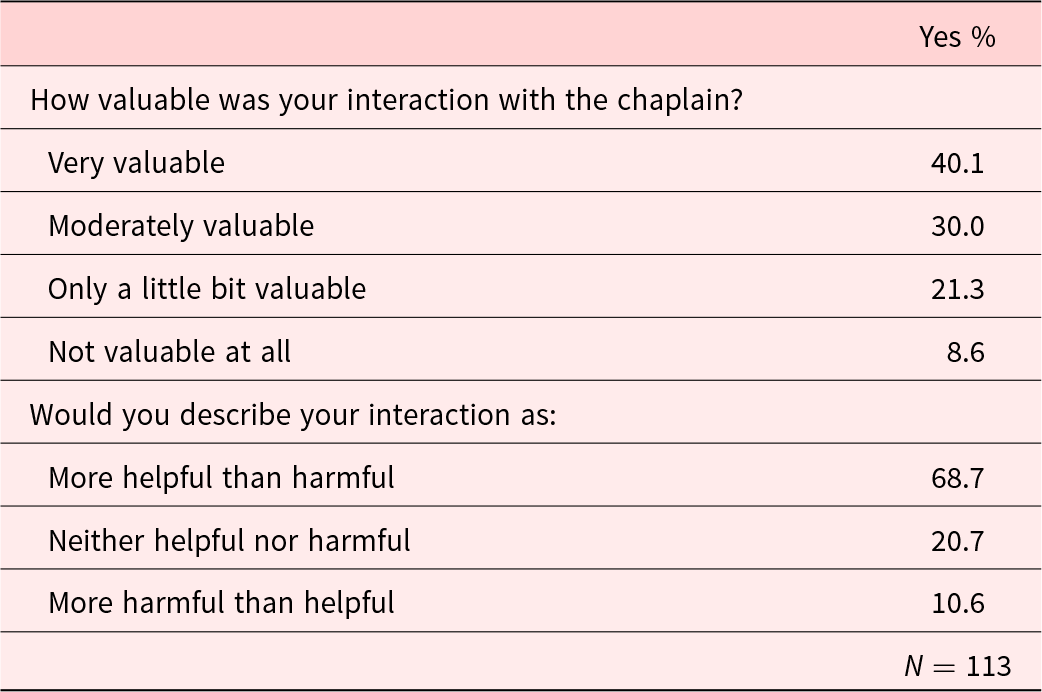
Visitors/caregivers did not significantly differ from others in how valuable they found the interaction, χ 2 (3, N = 202) = 1.15, p = 0.765. Likewise, visitor/caregivers did not significantly differ from others in how helpful they found the interaction, χ 2 (3, N = 202) = 3.14, p = 0.208. The weighted rates at which primary recipients and visitors/caregivers found the interaction with a chaplain to be helpful are reported in Table 7.
View of interaction among visitors/caregivers

*p < 0.05; **p < 0.01; ***p < 0.001.
Discussion
Typologies that describe the work of chaplains are traditionally based on how chaplains report their activities and describe their experiences. Kevin Massey developed one hundred item taxonomy designed to inventory chaplaincy activities and outcomes in health care (Massey et al. Reference Massey, Barnes and Villines2015). Vanesh Sharma and colleagues applied this taxonomy in different health-care settings and to various types of visits and discharge statuses (Sharma et al. Reference Sharma, Marin and Sosunov2016, Reference Sharma, Marin and Zhong2021). Branches of the military have developed separate descriptive schemas for describing the content and effects of chaplains’ work (Kazman et al. Reference Kazman, Gutierrez and Schuler2020; Layson et al. Reference Layson, Tunks Leach and Carey2022; Otis Reference Otis2009; Stahl Reference Stahl2017). These efforts have been critical to establishing an evidence-based field (Fitchett et al. Reference Fitchett, White and Lyndes2018). By focusing on the experiences of care recipients, this study continues to build an evidence-based field by adding a new perspective to the accounts of chaplain activities.
This study shows that what chaplains are understood to do and how those actions are perceived by care-seekers differ depending on the position occupied by the recipient. Chaplains have different repertoires they draw upon for different spiritual care encounters, but this is primarily understood from the perspective of chaplains and has rarely been described from the perspective of care recipients. More research is needed on how chaplaincy is understood by all recipients of care in order to fully and accurately describe the work of chaplains and develop typologies that both describe the professional field of chaplaincy and reflect the needs of a wide-array of care-seekers.
This study finds that the content of an interaction varies based on the role of the person interacting with the chaplain. Primary recipients were most likely to report overtly religious interactions with chaplains. Primary recipients were more likely than others to say that a chaplain prayed with them, discussed religious texts, and discussed their religious views. Visitors/caregivers were less likely than others to experience religious content. More research is needed to determine if these groups ask chaplains for different types of support or are offered different types of support by the chaplain.
The inverse pattern was true in discussions of death and dying: Visitors/caregivers were more likely to discuss death and dying with the chaplain, and primary recipients were less likely to talk about death and dying. There is a chance that this finding reflects survivorship bias (i.e. the experiences of primary recipients who died are not reflected in the survey). Visitor/caregivers were more likely to discuss dealing with loss than others, but primary recipients were not more or less likely to discuss dealing with loss. The discrepancy in discussions of loss seems less likely to reflect survivorship bias, as loss could incorporate a wide range of non-terminal medical conditions or other life events. For visitors/caregivers, there is strong statistical evidence in support of stereotype of chaplains who work around death and loss, pointing to the importance of this constituency for hospice and palliative care chaplains.
The effects of an interaction with a chaplain vary based on the role of the person interacting with the chaplain. Primary recipients find the support of a chaplain to be very valuable and helpful, more so than other groups. The data does not reveal why primary recipients report these higher levels of satisfaction with chaplain interactions. It could be that chaplains focus more time and attention on primary recipients, which results in primary recipients being more likely than others to find the support valuable and helpful. It could also be the case that visitors/caregivers see chaplains not as people who could provide them with spiritual care but almost as fellow workers – someone else who is focused on caring for a loved one but is not a resource for the visitors/caregivers themselves. From the perspective of the visitor/caregiver, conversations with chaplains might resemble “handoffs” of care, a dimension of interaction that the current survey did not investigate. Future research should ask visitors/caregiver if they discussed their caregiving role with the chaplain.
Future research should also investigate who in the room is initiating the conversations about the topics of discussion and types of support measured in the survey. For example, there are different implications for a prayer initiated by the chaplain or by a care recipient. Future investigation may reveal if there is any difference between types of support offered and types of support requested, and how this may inform the kind and quality of care.
Chaplains interact with different recipients of care in patterned ways. While primary recipients of care are more likely than others to have a religious interaction with a chaplain, visitors/caregivers are more likely to discuss death and dying. Primary recipients of care are more likely than other groups to describe the chaplain as valuable and helpful. Whether the discrepancy in helpfulness exists because chaplains offer different care-seekers different experiences or because different groups of care-seekers request different things from chaplains is unknown. Research into the content of interactions with chaplains provides evidence for chaplains’ contributions to patient outcomes. As the field of spiritual care in health-care increasingly focuses on the outcomes of chaplain interactions, the perspective of care recipients will be of critical importance to the continued development and inclusion of spiritual care as an essential part of the care team.
Funding
This work was supported by the Templeton Religion Trust (TRT0380).
Competing interests
The authors declare none.


 Open access

