

Introduction
American federal and sub-national governments strategically interact with one another in the public policy process, in order to enhance their political and policy benefits. For example, the federal government delegates a significant portion of its policy implementation to sub-national governments, necessitating the president and federal agencies to seek support from state and local governments for successful policy enforcement (McCann Reference McCann2016). Policy outcomes are significantly influenced by executive partisanship, making party alignment among different government levels vital in an increasingly polarized era. Although the president, governors, and mayors each have their distinct interests and strategies in the public policy process, previous research has focused primarily on either the federal–state or state–local relationship.
Scholars of distributive politics suggest that both the president and Congress pursue their electoral and policy benefits by selectively distributing federal funds to co-partisan jurisdictions (Berry, Burden, and Howell Reference Berry, Burden and Howell2010; Dynes and Huber Reference Dynes and Huber2015; Ha and Jenkins Reference Ha and Jenkins2024b; Kriner and Reeves Reference Kriner and Reeves2015a). Research on the presidency has focused mainly on the president’s particularistic behavior to core-support and swing jurisdictions, during both federal election and non-election years. This work, however, has not extensively examined the complexities of the president’s electoral particularism, such as the impact of party alignment between the president and subnational government executives, particularly the relationship between the president and mayors.
Although local politics and policies are more distant from federal issues and influenced more by state governments than the federal government, the federal–local relationship has become increasingly important to local politicians. Local politics and elections have traditionally been seen as somewhat removed from national and state issues, accompanied by low voter turnout (de Benedictis-Kessner et al. Reference de Benedictis-Kessner, Lee, Velez and Warshaw2023; Warshaw Reference Warshaw2019). However, recent studies suggest that local elections have become increasingly nationalized, with a greater emphasis on partisanship and ideology (Amlani and Algara Reference Amlani and Algara2021; Warshaw Reference Warshaw2019). While Hudak (Reference Hudak2014) examined the president’s particularism vis-à-vis gubernatorial elections, studies making a similar connection to local elections have not emerged.
To fill this gap, we examine how the president allocates federal funds to local governments during mayoral election years, employing two-way fixed effects models and data from 1,124 mayoral elections across 399 cities from 2005 to 2020. We investigate the president’s electoral particularism – specifically, the distribution of federal block and project grants – toward co-partisan mayors in cities with highly contested elections.Footnote 1 Brollo and Nannicini (Reference Brollo and Nannicini2012) show how the president strategically aids swing cities with co-partisan mayors to enhance their election prospects in Brazil. We apply this same logic to the US case.
Case
Federal politicians have increasingly engaged in local elections, propelled by the escalating nationalization and polarization of politics, in both direct and indirect ways. For example, the president has strategically employed federal funds to assist co-partisan mayoral candidates, providing selective spending benefits to swing cities. In 2014, the city of Lexington (KY) procured a $15 million federal grant for the Taxiway Safety Enhancement Program from the Federal Aviation Administration, shortly before a competitive mayoral election.Footnote 2 In 2016, Maricopa County’s (AZ) public transit project received a $75 million grant from the Federal Transit Administration, with a substantial portion of this fund allocated to the city of Tempe, which was in the throes of a mayoral election.Footnote 3 In 2019, just a few months before the 2020 mayoral election, a politically contentious city, Fresno (CA), received a $10.5 million BUILD grant from the Department of Transportation.Footnote 4
These examples provide some face validity for our general research inquiry – that the president and federal agencies strategically allocate federal funds not just to co-partisan incumbents in congressional elections but also to co-partisan mayors in electorally contested (“swing”) cities during mayoral election years.
Background
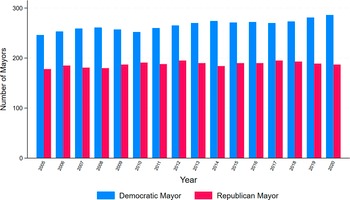
In the US, local elections are held throughout the year under various rules and systems. Elected officials might also be partisan or nonpartisan. Within the de Benedictis-Kessner et al. (Reference de Benedictis-Kessner, Lee, Velez and Warshaw2023) dataset of 549 large and medium-sized cities (populations exceeding 50,000), around 270 Democratic mayors and 200 Republican mayors are represented, as shown in Figure 1.Footnote 5 The remainder hold no party affiliation. This variation in mayoral partisanship has ramifications for local policy outcomes and fiscal priorities. Additionally, party alignment with the president can affect federal policy implementation at the local level.
Mayor’s Partisanship by Year (2005–2020).
Source: de Benedictis-Kessne et al. (Reference de Benedictis-Kessner, Lee, Velez and Warshaw2023) dataset.

Local elections
Numerous local elections, particularly mayoral elections, are conducted every four years in sync with presidential election years. However, mayoral term lengths and term limits vary according to local election rules: 45% of local governments stipulate a four-year mayoral term, and 85% of cities enforce either two or three mayoral term limits (Moulder Reference Moulder2008).Footnote 6 Among our sample of 549 cities, over 100 mayoral elections occur annually, with more taking place during non-presidential election years, as shown in Figure 2.
Mayoral Elections by Year (2005–2020).
Source: de Benedictis-Kessner et al. (Reference de Benedictis-Kessner, Lee, Velez and Warshaw2023) dataset.

Between 20 and 40 “swing mayoral elections” occur annually (Moulder Reference Moulder2008), representing approximately 22% of all mayoral elections, as illustrated in Figure 3. In the analysis, we follow Kriner and Reeves’s (Reference Kriner and Reeves2015a) criteria for defining a swing election: those with a vote margin of less than 10 percentage points between the top two candidates in the last mayoral election.
Swing Mayoral Elections and Ratio by Year.
Source: de Benedictis-Kessner et al. (Reference de Benedictis-Kessner, Lee, Velez and Warshaw2023) dataset.

Federal grant allocation to cities
While a considerable proportion of federal grants to local governments are funneled through state governments, many are allocated directly to local governments. Additionally, the federal government retains substantial discretion over the allocation of block and project grants. However, no prior research has delved into the timing of the federal grant allocation.
As shown in Figure 4a, there is a significant increase in the allocation of federal block and project grants during mayoral election years, with the upswing led by transportation and education grants (see Figure A.2 in the Appendix). Figure 4b provides a breakdown by year and shows that cities hosting mayoral elections almost always receive a greater amount of federal block and project grants per capita compared to cities without such elections.
Federal Grants to Cities by Election Years (FY2006–2021).
Source: de Benedictis-Kessner et al. (Reference de Benedictis-Kessner, Lee, Velez and Warshaw2023) dataset.

Related literature
Nationalization
US politics have become increasingly polarized and nationalized in recent years. Scholars have found that subnational elections are significantly influenced by national issues and partisanship, with national partisanship increasingly playing a role in both voters’ choices on local issues and candidates’ campaign statements and platforms (Carson, Sievert, and Williamson Reference Carson, Sievert and Williamson2023).Footnote 7 For example, Rogers (Reference Rogers2016) demonstrates that both elites and voters consider the president’s party affiliation when voting for state legislators. Similarly, Knotts and Ragusa (Reference Knotts and Ragusa2016) argue that, along with candidate and district characteristics, presidential approval is a predictive factor in special elections for the US House of Representatives. Hopkins (Reference Hopkins2018) and Sievert and McKee (Reference Sievert and McKee2019) show that since 1970, presidential election outcomes have significantly influenced state-level elections, including senatorial and gubernatorial contests. Melusky and Richman (Reference Melusky and Richman2020) highlight the increasing trend of nationalization in state legislative elections, particularly evident in 2018, and show that voter decisions are largely influenced by support for or opposition to national political parties. Similar increasing nationalization results have also been found with regard to other state-level elections, such as state supreme court and state school superintendent elections (Weinschenk et al. Reference Weinschenk, Baker, Betancourt, Depies, Erck, Herolt, Loehrke, Makurat, Malmberg and Martell2021; Weinschenk Reference Weinschenk2022).
There is considerably less scholarly work investigating nationalization and elections below the state level. The most prominent studies focus on school board elections, where scholars find that large national donors from 2008 to 2013 played a significant role in determining school board elections in Los Angeles (CA), New Orleans (LA), Denver (CO), and Bridgeport (CT) (Reckhow et al. Reference Reckhow, Henig, Jacobsen and Litt2017) and recent national forces (like Critical Race Theory and COVID response) impacted school board elections in heavily Republican (Trump) areas in Wisconsin (Shah, Weinschenk, and Yiannias Reference Shah, Weinschenk and Yiannias2024). Research on nationalization and mayoral elections, by comparison, has been nonexistent. The closest study is by Das et al. (Reference Das, Sinclair, Webster and Yan2022), which examines political rhetoric used by mayors (via Twitter) and finds local rather than national politics to be the primary focus.
Distributive politics
Federal funds represent a critical distributive resource for political actors, with both the president and members of Congress (MCs) strategically allocating federal grants to subnational governments to procure political advantages. With respect to the president, scholars find that the chief executive acts as party leader, by providing selective benefits to same-party MCs or governors to enhance their electoral advantages (Berry, Burden, and Howell Reference Berry, Burden and Howell2010; Hudak Reference Hudak2014; Kriner and Reeves Reference Kriner and Reeves2015a; Lowande, Jenkins, and Clarke Reference Lowande, Jenkins and Clarke2018). The allocation of these selective benefits is also often strategic. For example, Kriner and Reeves (Reference Kriner and Reeves2015a) and Lowande, Jenkins, and Clarke (Reference Lowande, Jenkins and Clarke2018) show that the president allocates more federal funds and trade protections, respectively, during presidential election years, displaying an amplified electoral particularism towards swing jurisdictions. Duchin and Hackney (Reference Duchin and Hackney2021) and Ha (Reference Ha2023) also uncover evidence of presidential favoritism towards swing states in the allocation of Paycheck Protection Program (PPP) loans during election and nonelection years.
Previous research, however, has focused almost exclusively on federal relationships with states or congressional districts, overlooking federal-local dynamics on the distribution of federal selective benefits. Only Brollo and Nannicini (Reference Brollo and Nannicini2012) – in a study of Brazil – examine the effects of federal–local relationships on federal fund allocation to municipalities. They find that the Brazilian president supports same-party mayors by selectively allocating federal funds, with this favoritism peaking during the first two years following mayoral elections. Whether this finding might extend to the United States is unclear, as the US president’s electoral motivations in local elections remain an open question.
Theoretical expectations
To summarize, we focus on the president’s electoral particularism, specifically whether the president targets with increased grant funding co-partisan mayors in swing cities during local election years. Building on recent work, we expect the president to act as a party leader and thus pursue electoral particularism vis-a-vis co-partisan mayors during election years. Unpacking this, we believe the president’s electoral particularism – in the form of increased grant funding during election years with respect to timing – is strategic; it is deployed where it will have maximum effect. During mayoral election years, the president will target co-partisan mayors in elections expected to be close – and thus could swing either way – so as to increase the probability of keeping that city in the president’s party column. In non-mayoral election years, these strategic considerations are considerably weaker, as there are strong incentives to reward jurisdictions irrespective of their electoral value (Kriner and Reeves Reference Kriner and Reeves2015a, Reference Kriner and Reeves2015b; Lowande, Jenkins, and Clarke Reference Lowande, Jenkins and Clarke2018).
We thus propose two hypotheses:
Hypothesis 1: During mayoral election years, the president allocates more grant funds to highly-contested (i.e., swing) cities governed by co-partisan mayors relative to non-highly-contested (i.e., non-swing) cities governed by co-partisan mayors.
Hypothesis 2: During non-mayoral election years, the president does not allocate more grant funds to highly-contested (i.e., swing) cities governed by co-partisan mayors relative to non-highly-contested (i.e., non-swing) cities governed by co-partisan mayors.
Data, variables, and estimation
We employ two main datasets in our analysis. The first was created by de Benedictis-Kessner et al. (Reference de Benedictis-Kessner, Lee, Velez and Warshaw2023) and provides extensive information for various local elections between 2005 and 2020. Of the 549 cities with populations over 50,000, we include only 465 cities in the analysis that have financial information from USAspending.gov and other socioeconomic data. Additionally, cities with elections in which both candidates were from the same party are excluded from the analysis. As a result, we examine 1,124 mayoral elections in 399 cities over a 16-year period.
The second is the federal grants data from the Federal Assistance Awards Data System (FAADS), which has been the standard in previous grants research (Berry, Burden, and Howell Reference Berry, Burden and Howell2010; Dynes and Huber Reference Dynes and Huber2015; Kriner and Reeves Reference Kriner and Reeves2015a; Larcinese, Rizzo, and Testa Reference Larcinese, Rizzo and Testa2006). As the federal government wields discretionary authority in allocating block and project grants, we only consider these two types of federal grants distributed directly (exclusively) to cities.
Our dependent variable captures federal-to-city block and project grants from 2005 through 2020. We employ per-capita federal grants by city, using 2012 real dollar valuesFootnote 8; this stratification eliminates data skewness resulting from cities that did not receive any grants.
Our independent variables probe the president’s election strategy to support co-partisan candidates in swing cities during mayoral election years.Footnote 9 To identify a swing city, we focus on the vote total in the last mayoral election:
Swing city: Coded 1 if the margin in the previous mayoral election is less than 10 percentage points – per Kriner and Reeves (Reference Kriner and Reeves2015a) – and 0 otherwise.Footnote 10
Previous research has employed the average of the past three election outcomes to define swing. However, given irregular mayoral election cycles and the trend toward electoral polarization, we only consider the most recent election.
We measure party alignment in two ways:
Pres-mayor party: Coded 1 if the president and mayor are from the same party, and 0 otherwise.
Pres-gov-mayor party: Coded 1 if the president, governor, and mayor are from the same party, and 0 otherwise.
The two co-partisan variables tap related things. The first focuses simply on the partisan relationship between the president and mayor. The second focuses on the partisan relationship between the president, governor, and mayor. Keeping a co-partisan city in the president’s column is important; keeping a co-partisan city in a co-partisan state in the president’s column may be even more important. We use partisan and electoral information from the previous mayoral election during the current election because the president considers particularistic allocations based on the prior election’s results.
Following Kriner and Reeves (Reference Kriner and Reeves2015a), we also incorporate three socioeconomic variables as controls. These variables, which tap forces that also affect federal grant allocation, include Tot pop (logged), the logged value of a city’s total population; Income PC (logged), the logged amount of income per capita by city; and Pov rate, the city’s poverty rate.Footnote 11
We employ ordinary least squares (OLS) regression with two-way fixed effects (city and year) to estimate first the president’s electoral particularism in the distribution of federal grant funds to swing election cities during mayoral election years.
 $$ {\displaystyle \begin{array}{l} Fed\_ Grant{\left( per\_ cap\right)}_{c,t}={\beta}_0+{\alpha}_c+{\delta}_t+{\beta}_1{PartyAlign}_{c,t}+{\beta}_2{SwingCity}_{c,t}\\ {}\hskip10em +{\beta}_3{PartyAlign}_{c,t}\ast {SwingCity}_{c,t}+\mathbf{X}{\Psi}_{c,t}+{\unicode{x025B}}_{c,t},\end{array}} $$
We examine the president’s strategic allocation of federal funds to cities, with a focus on (1) the simple alignment of the president and mayor’s party (2) and the party alignment among the president, governor, and mayor. We interact each type of party alignment with the swing city variable to identify the president’s electoral particularism vis-à-vis co-partisan candidates in swing versus non-swing cities during mayoral and non-mayoral election years.
We employ city and year-fixed effects with city-level clustered standard errors, to control for city-specific and time-invariant factors.
Results
We perform analyses separately for mayoral election years and non-mayoral election years, as presented in Tables 1 and 2.
Federal grants to swing cities during mayoral election years

Robust standard errors in parentheses.
* p < 0.1
** p < 0.05
*** p < 0.01
Note. Clustered standard errors at city level.
Federal grants to swing cities during non-mayoral election years

Robust standard errors in parentheses.
* p < 0.1
** p < 0.05
*** p < 0.01
Note. Clustered standard errors at the city level.
As Table 1 illustrates, we find support for Hypothesis 1: There is significant evidence that the president disproportionately allocates grants to co-partisan mayors in swing cities during mayoral election years. As the interaction terms in columns 1 and 2 suggest, co-partisan mayors from swing cities receive $9.913 (per capita) more in federal grants than co-partisan mayors from non-swing cities. And the effect size becomes even more pronounced when the governor also belongs to the president’s party, as co-partisan mayors from swing cities receive $14.83 (per capita) more in federal grants than their non-swing counterparts. These are considerable amounts: an additional $9.913 and $14.83 (per capita) more in grant funds represents a 0.262 and 0.392 standard deviation increase, respectively.Footnote 12
As noted, we define a city as a swing city based on the vote margin from the previous election: less than 10 percentage points. Following Berry, Burden, and Howell (Reference Berry, Burden and Howell2010), we also use a 5 percentage point threshold to define a close election; the results are presented in Table B.3 in the Appendix. Although the effect size is larger when using a 5 percentage point threshold, it is not statistically significant, possibly due to the smaller sample size for alignment between the president, (governor), and mayor across party lines.
Finally, as Table 2 illustrates, we also find support for Hypothesis 2: There is no evidence that the president disproportionately allocates grants to co-partisan mayors in swing cities during non-mayoral election years. The coefficients on the interaction terms (in columns 1 and 2) are positive but are nominally small and ultimately not significantly different from zero.
Conclusion
As politics in the US have polarized and nationalized in recent years, the partisanship of executives at each level of government has mattered for policy. To this point, scholars have mostly examined the partisan effects of the president or governors on policy outcomes at the federal or state level. The importance of the federal–local relationship, by comparison, has not received much attention.
We explore this federal–local relationship by investigating the president’s particularism in targeting swing cities to support co-partisan mayoral candidates during election years. We find that the president distributes a significantly larger amount of block and project grants to swing cities with co-partisan mayors during mayoral election years. The same is not true during non-mayoral-election years when the president allocates block and project grants more evenly across jurisdictions (irrespective of their electoral value).
Although local elections have traditionally received less attention than federal or state elections due to low voter turnout – a potential limitation of this study – this research makes several significant contributions within the context of the increasing nationalization and polarization of US local politics. We contribute to the study of distributive politics and US elections by providing evidence for the president’s electoral particularism vis-à-vis co-partisan candidates in local elections. As our work focuses specifically on mayors, future research can extend these findings by using de Benedictis-Kessner et al. (Reference de Benedictis-Kessner, Lee, Velez and Warshaw2023) dataset, which includes extensive information on other local elections, like city council, county executive, county legislature, sheriff, prosecutor, and school board. Finally, our findings deal only with federal spending (grant) allocation and thus do not consider other policy areas. Scholars thus might examine, for examine, regulatory policy, which often requires strong federal and local relationships for successful policy design and implementation.Footnote 13
Supplementary material
The supplementary material for this article can be found at http://doi.org/10.1017/spq.2024.32.
Data availability statement
Replication materials are available on SPPQ Dataverse at https://doi.org/10.15139/S3/TIEMMG (Ha and Jenkins Reference Ha and Jenkins2024a).
Funding statement
The authors received no financial support for the research, authorship, and/or publication of this article.
Competing interest
The authors declared no potential conflicts of interest with respect to the research, authorship, and/or publication of this article.
Author biographies
Heonuk Ha is a Postdoctoral Research Fellow at the Institute for Social Research at the University of Michigan.
Jeffery A. Jenkins is Provost Professor of Public Policy, Political Science, and Law; Maria B. Crutcher Professor of Citizenship and Democratic Values; and Director of the Political Institutions and Political Economy (PIPE) Collaborative at the Sol Price School of Public Policy, University of Southern California.


 Open access

