

Introduction
Longevity or productive lifespan of dairy cows is crucial for the sustainability of dairy farming. The rearing of female calves until their first lactation is a financial investment and a greenhouse gas emission source, which for impact assessment purposes is usually distributed over the number of days in milk from the first lactation onwards (Grandl et al., Reference Grandl, Furger, Kreuzer and Zehetmeier2019; De Vries and Marcondes, Reference De Vries and Marcondes2020; Dallago et al., Reference Dallago, Wade, Roger, McClure, Lacroix, Pellerin and Vasseur2021). The more days a cow gives milk, the stronger the dilution effect on the environmental debts, demonstrating the ecological relevance of longevity for the environmental sustainability of dairy production. The economic break-even point for rearing costs depends on the relative costs of the rearing system and system intensity (Dallago et al., Reference Dallago, Wade, Roger, McClure, Lacroix, Pellerin and Vasseur2021). Additionally, longevity is also linked to societal and ethic sustainability of dairy production (Schuster et al., Reference Schuster, Barkema, De Vries, Kelton and Orsel2020) and has even been claimed to be a constitutive element of animal welfare (Bruijnis et al., Reference Bruijnis, Meijboom and Stassen2013).
While milk production of dairy cows has considerably increased over the past decades (e.g. Knaus, Reference Knaus2009), their productive lifespan has decreased in many of the main dairy producing countries (Olechnowicz et al., Reference Olechnowicz, Kneblewski, Jaśkowski and Włodarek2016; De Vries, Reference De Vries2020; Schuster et al., Reference Schuster, Barkema, De Vries, Kelton and Orsel2020; Dallago et al., Reference Dallago, Wade, Roger, McClure, Lacroix, Pellerin and Vasseur2021). Most of the involuntary culling reasons in the dairy sector are disease related, with fertility problems, udder health problems and lameness being the most important ones (Fetrow et al., Reference Fetrow, Nordlund and Norman2006; Schuster et al., Reference Schuster, Barkema, De Vries, Kelton and Orsel2020). While a vast number of scientific papers report on risk factors for culling at cow level, publications at herd level are limited and the effects of farm characteristics and management practices on longevity in dairy cows are not yet fully established (Owusu-Sekyere et al., Reference Owusu-Sekyere, Nyman, Lindberg, Adamie, Agenäs and Hansson2023). Scientific publications for Swiss dairy production conditions are lacking, apart from one paper investigating the effect of the transition from tie-stall to loose housing systems in Brown Swiss cows on culling risk ratios (Bielfeldt et al., Reference Bielfeldt, Tölle, Badertscher and Krieter2006).
For this study we selected Swiss dairy farms which contrasted with regard to their length of productive lifespan, but were otherwise representative of the Swiss dairy production in terms of herd size, predominant breed, production zone (valley/hill or mountain), milk yield and production system (organic or conventional production). The aim of this study was to compare fertility, health indicators and health management routines of Swiss dairy farms with long vs. short productive lifespan profiles, and to find out whether a longer productive lifespan results in poorer cow health or a higher use of medication.
Material and methods
The selection of dairy farms required two main steps: (a) the definition of study regions representative of Swiss dairy production conditions and (b) the selection of dairy farms for each of these study regions, which contrasted in terms of productive lifespan profile, but otherwise corresponded to the average of the respective study region in terms of herd size, predominant breed, production zone, milk yield and production system. These two main steps are presented below and in more detail in the online Supplementary File.
Definition of study regions
For the present study, Switzerland was divided into 15 study regions by cantons or administrative districts, so that each region included around 7% (1/15) of the total Swiss dairy farms from the 2019 Swiss agricultural census (n = 25 007 farms with 554 588 cows; BfS, 2020). Due to its size, the canton of Berne was subdivided along its administrative districts and allocated to five different regions. Based on the census data and the annual statistics of the three main Swiss herdbooks (Braunvieh Schweiz, 2020; Holstein Switzerland, 2020; Swissherdbook, 2020), we determined the following characteristics for each canton and each Bernese district: average dairy herd size, predominant production zone (levels: valley/hilly zone or mountainous zone), prevalence of organic dairy farms (in %), and predominant dairy cow breed (levels: Brown Swiss, Swiss Fleckvieh, Holstein, Simmental or Original Braunvieh; online Supplementary Fig. S1 and Table S1). The final characteristics per study region were determined based on (a) the predominant production system of the study region and (b) the average distribution of systems in Switzerland.
Data origin and data selection
For this study we received an anonymized data set of 16 532 dairy farms which were members of one of the two herdbooks Braunvieh Schweiz or Swissherdbook. The data set was limited to dairy farms that were active members of the breeding association between July 2015 and June 2020. The data set included information on milk production, herd size and culling events during these five years for all of the 16 532 farms and a total of 292 891 cows. This primary data set was later reduced based on different selection criteria to a subset of 142 farms (details in online Supplementary File ‘Methodology description’). The 142 final farms were deemed to be representative of the Swiss dairy sector and contrasted by their productive lifespan profiles (online Supplementary Table S2). The selection criteria were as follows:
In the first selection round we excluded farms with less than 10 cows, farms that had restocked less than 50% of their cows from their own herd (as these are likely not breeders) and farms whose average age of the culled cows was lower than the average age of the animals alive. In total 9309 farms with 222 102 cows remained.
In a second selection round, we sorted all remaining farms according to their location, and assigned them to the previously defined 15 study regions. Farms whose production system, production zone and predominant breed (at least 75% of the dairy herd) did not match the predefined characteristics of the respective study region were excluded. Additionally, to ensure herd stability and to avoid having herds that are growing or shrinking, we selected farms with a culling rate between the 25th and 75th quantile. Furthermore, we calculated median milk yield and herd size for each study region, and excluded extreme outliers by selecting farms that had both characteristics between the 10th and 90th-percentile. In total, 904 farms with 21 509 cows were kept for a final selection round (online Supplementary Table S3).
In a third selection round, the remaining farms were sorted per study region by the average lactation number of their cows culled during the five observation years. This trait was defined as an indicator of longevity. To create the longevity (production lifespan) comparison data, we selected, for each region, the five farms with the longest and the five farms with the shortest average number of lactations over the five observation years. Additionally, the difference in production lifespan between the short and long productive lifespan profiles for each region had to be at least one lactation. In this final selection round, we excluded 761 farms and 18 284 cows and retained a total of 142 farms and 3210 cows distributed over the 15 study regions. For each of these 142 farms, we received test day records data from the breeders associations Braunvieh Schweiz (Zug, Switzerland) and Swissherdbook (Zollikofen, Switzerland) for the five previously defined years.
A questionnaire that aimed to assess the management practices within each of the 142 farms was distributed via their respective breeders association in February 2021. The questionnaire contained 158 questions structured in the following nine sections: 1: basic information on the farm manager, 2: sources of income, 3: barn system and husbandry, 4: feeding, 5: milking routine and milking hygiene, 6: breeding and fertility aims, 7: animal health, 8: rearing of replacement animals for the dairy herd and 9: calf fattening. The complete questionnaire is provided in the online Supplementary File ‘Complete questionnaire’.
A total of fourteen traits associated with health management routine, obtained through this questionnaire, were integrated into the study (details on these traits are given below in the section on trait definitions). Out of the 142 farms, 67 dairy farms (31 with short and 36 with long productive lifespan profile) responded to the questionnaire by May 2021, and 64 (30 dairy farms with short and 34 with long productive lifespan profile) of these additionally provided copies of their veterinary treatment journals for the two-year period January 2019 to December 2020, inclusive. Finally, we visited two farms with contrasting productive lifespan profiles per study region from May to July 2021. This resulted in 30 farm visits of 15 farm pairs.
An overview of mean values (± standard deviations) regarding average lactation number at culling, average daily milk yield during productive lifespan and average daily lifetime production by data sets can be found in Table S7 of the online Supplementary File, while details on the single data sets are presented from Tables S4 to Table S6.
Trait definitions
Traits included in this study were pre-selected at two expert workshops held during July and October 2020 with representatives of the dairy sector. The selection of traits to analyse and their way of recording (by herdbook, questionnaire, veterinary treatment documentation or farm visit) was finalized in further correspondence between the experts. All of the traits described in this section from here on are reported at farm level.
Fertility traits
Based on the yearly averages of test day records from the 142 dairy farms over a period of five years (2015–2022), the following fertility related traits were investigated: average number of inseminations of heifers, average number of inseminations of cows, average number of days open and average calving interval in days. Additionally, based on the 67 farms that answered the questionnaire, presence or absence of regular advice by a veterinarian regarding fertility management was analysed.
Udder health-related traits
Average somatic cell score at lactation level (SCS), proportion of test day records with over 100,000 cells/ml milk (SCC100) and proportion of test day records with over 350,000 cells/ml milk (SCC350, threshold value according to the Swiss milk hygiene regulation, VHyMP, 2005) were used as indicators for udder health. These traits were calculated as averages of test day record data over the period 2015–2020 for 142 dairy farms. From the questionnaire data set (n = 67), the following management routines related to udder health were analysed: milking order adapted to udder health, intermediate cleaning of milking aggregate, abrupt drying off, and routine use of teat sealer.
Lameness indicator
The management routines, number of claw trimming events per year, claw trimming done by external person, and performance of claw trimming before dry-off were analysed from the questionnare data set (n = 67). Moreover, mobility was assessed in the 30 herds visited from May to July 2021 using the mobility score of the AssureWel assessment tool for Welfare in Dairy Cattle (http://www.assurewel.org/dairycows.html). Mobility score levels were as follows: 0 = good, 1 = imperfect, 2 = impaired, and 3 = severely impaired. The four observers involved in the study passed an exam of AssureWell to ensure good inter- and intra-observer reliability prior to the farm visits. A cow was defined to have an abnormal locomotion when scored ≥ 1 and to be lame when scored ≥2.
Veterinary medical treatments
Data on veterinary medical treatments for dairy cows were obtained from veterinary mandatory documentation covering the period from January 2019 to December 2020. Data was available for 64 of the 67 farms that replied to the questionnaire.
Veterinary medical treatment records of dairy cows were compared between 34 farms with long productive lifespan profile and 30 farms with short productive lifespan profile. Treatments were defined as total number of cases per 100 cows and year for each farm. A veterinary medical treatment related to the same diagnosis was considered one case if it was not interrupted for more than seven days (Ivemeyer et al., Reference Ivemeyer, Smolders, Brinkmann, Gratzer, Hansen, Henriksen, Huber, Leeb, March, Mejdell, Nicholas, Roderick, Stöger, Vaarst, Whistance, Winckler and Walkenhorst2012). The comparison focused on the following traits: total number of antibiotic treatments and total number of allopathic treatments which were not antibiotic and not antiparasitic. Treatments were further grouped by treatment reason for number of (a) total treatments due to metabolic problems, (b) antiparasitic treatments, (c) antibiotic mastitis treatments (nMastAB), (d) non-antibiotic mastitis treatments and (e) antibiotic treatments during drying off (nDryAB). Additionally, (f) total number of antibiotic treatments due to udder problems (nMastAB + nDryAB), number of (g) antibiotic and (h) non-antibiotic treatments due to fertility problems, number of (i) antibiotic and (j) non-antibiotics treatments due to leg or claw problems, and (k) number of antibiotic treatments due to other health problems were distinguished. Based on data obtained by the questionnaire, we also compared the use of alternative medical treatments between farms of contrasting productive lifespan profiles by analysing use of homeopathy, use of herbal home remedies, and use of other home remedies.
Additonal cow health management routines
Application of prophylaxis against milk fever in cows from 3rd lactation onwards, number of sick boxes in loose housing systems and mixed systems, and number of sick boxes in tied barns were analysed from the questionnaire data set.
Data analysis
Health-related traits from the test day records from the 142 dairy farms, all traits from the 64 farms that provided their medical treatment journals, and the continuous variable obtained from the questionnaire data set (n = 67) did not fulfil the assumption of normal distribution according to the Shapiro–Wilk test and visual inspection. Therefore, we used Wilcoxon–Mann–Whitney tests to compare these variables between the long and short productive lifespan profiles.
For the categorical variables obtained from the 67 farms that answered the questionnaire, the differences between productive lifespan profiles were assessed by Chi-square tests if at least five observations per productive lifespan profile were available (n = 13 variables).
All analyses were performed in R (version 4.2.1 for data set on 142 farms and version 4.2.2 for data set 64 and 67, R Core Team, 2022) using RStudio (version 2022.07.0 + 548 and 2022.7.2.576, RStudio Team, 2022). P < 0.05 was interpreted as threshold for significance.
Results
Short and long productive lifespan profile
The average lactation number of cows culled between 2015 and 2020 in the final 142 farm data set was 3.1 ± 0.4 for 70 farms assigned to the short productive lifespan profile and 5.3 ± 0.8 lactations for 72 farms assigned to the long productive lifespan profile (online Supplementary Table S4). For farms participating in the questionnaire the average lactation number of cows culled between 2015 and 2020 was 3.3 ± 0.5 for 31 farms assigned to the short productive lifespan profile and 5.5 ± 0.6 lactations for 36 farms assigned to the long productive lifespan profile (online Supplementary Table S5).
Fertility-related traits and management routines
Although the average number of inseminations per cows did not significantly differ by productive lifespan profile, the average number of inseminations per heifer was significantly higher on farms categorized as having a short productive lifespan (Table 1). Average number of days open was significantly shorter by 6 d in cows from farms characterized by having a long productive lifespan compared to cows living on farms with short productive lifespan (Table 1). In accordance with this, calving interval was significantly shorter (by 8 d) on farms with long productive lifespan compared to farms with a short longevity profile (Table 1). The proportion of farms using regular advice by a veterinarian regarding fertility management did not differ by productive lifespan profile (Table 2).
Comparison of health- and fertility-related traits between Swiss dairy farms with short and long productive lifespan
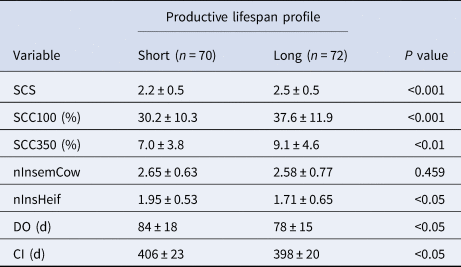
SCS, average somatic cell score at lactation level; SCC100, proportion of test day records above the threshold of 100.000 cells/ml milk; SCC350, proportion of test day records above the threshold of 350.000 cells/ml milk; nInsemCow, number of inseminations of cows; nInsHeif, number of inseminations of heifers; DO, days open; CI, calving interval in days.
Values are mean ± standard deviation and are derived from herdbook data from 2015 to 2020.
P values are derived from the Wilcoxon–Mann–Whitney test.
Relative percentage of Swiss dairy farms applying different management routines by productive lifespan profile
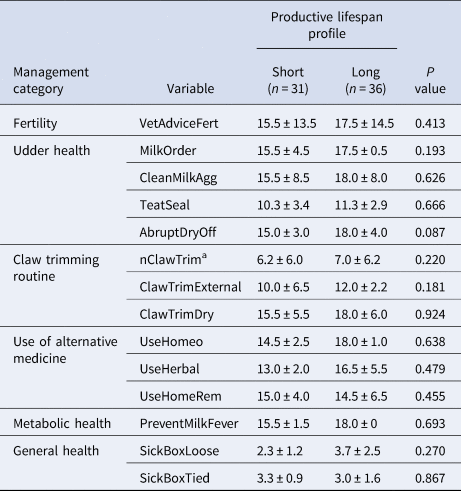
VetAdviceFert, regular advice by a veterinarian regarding fertility management; MilkOrder, milking order adapted to udder health; CleanMilkAgg, intermediate cleaning of milking aggregate; AbruptDryOff, abrupt drying off; TeatSeal, routine use of teat sealer when drying off; nClawTrim, claw trimming events per year; ClawTrimExternal, claw trimming done by external person; ClawTrimDry, claw trimming before dry-off; UseHomeo, use of homeopathy; UseHerbal, use of herbal home remedies; UseHomeRem, use of other home remedies; PreventMilkFever, application of prophylaxis against milk fever in cows from 3rd lactation onwards; SickBoxLoose, number of sick boxes (loose housing systems and mixed systems); SickBoxTied, number of sick boxes (tied barns).
Values are mean ± standard deviation and are derived from a questionnaire in 2021.
a All variables are categorical apart from nClawTrim, a continuous variable. P values for categorical variables derived from χ2 tests and for the continuous variable from Wilcoxon–Mann–Whitney test.
Udder health-related traits and management routines
All three udder health indicators (average SCS, SCC100 and SCC350) were significantly higher on farms with long productive lifespan profile (Table 1). When calculating SCS back to somatic cell count level, farms with a shorter productive lifespan profile had around 15,400 cells/ml less than farms with a longer productive lifespan. The standard deviation for both productive lifespan profiles was around 17,700 cells/ml. No differences between farms of contrasting productive lifespan profiles could be found regarding udder health-related management routines like adaptation of milking order based on udder health, intermediate cleaning of milking aggregates and routine use of teat sealers. However, abrupt drying off was numerically (non-significantly) practiced more often on farms with long productive lifespan (Table 2).
Lameness indicator and claw trimming traits
There was no significant difference between longevity groups. Abnormal locomotion was detected in 15.7 ± 15.4 and 15.4 ± 7.9% and lameness was observed in 5.3 ± 5.2 and 6.7 ± 5.0% of the farms with short and long productive lifespans, respectively. Management traits related to claw trimming routine (number of claw trimming events per year, claw trimming done by an external person and claw trimming before dry-off) did not differ significantly between productive lifespan profiles (Table 2).
Veterinary medical treatments and use of alternative medicine
None of the traits reflecting medical treatments of dairy cows differed significantly between farms of different productive lifespan profiles (Table 3), although farms characterized by short productive lifespan profile showed a numerically (non-significantly) higher number of antibiotic treatments per 100 cows and year due to fertility problems and treatments due to other problems compared to farms with a long productive lifespan profile. These observations were accompanied by high standard deviations around the mean values for both traits (Table 3). Similarly, the declared use of alternative medicine did not show significant variations between the farms with contrasting productive lifespan profiles (Table 2). Medical treatments showed high variation between farms with different productive lifespan profiles, as reflected by high standard deviation values (Table 3).
Comparison of number of medical veterinary treatments per 100 cows and year between Swiss dairy farms with short and long productive lifetime
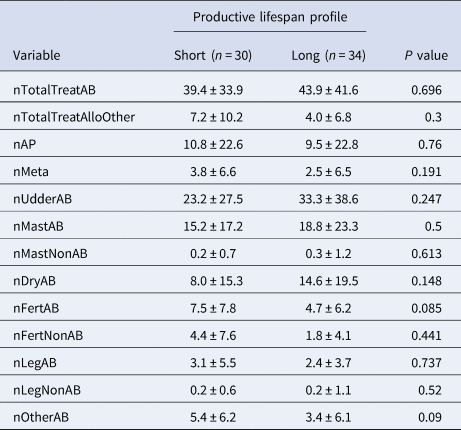
nTotalTreatAB, total number of antibiotic medical treatments; nTotalTreatAlloOther, total number of allopathic medical treatments without antibiotic or antiparasitic treatments; nAP, number of antiparasitic treatments; nMeta, number of treatments due to metabolic problems; nUdderAB, number of antibiotic treatments due to udder problems; nMastAB, number of antibiotic treatments due to mastitis; nMastNonAB, number of non-antibiotic treatments due to mastitis; nDryAB, number of antibiotic treatments during drying off; nFertAB, number of antibiotic treatments due to fertility problems; nFertNonAB, number of non-antibiotic treatments due to fertility problems; nLegAB, number of antibiotic treatments due to leg or claw problems; nLegNonAB, number of non-antibiotics treatments due to leg or claw problems; nOtherAB, number of antibiotic treatments due to other health problems.
Values are mean ± standard deviation and are derived from veterinary journals from January 2019 to December 2020. P values derived from the Wilcoxon–Mann–Whitney test.
Other health management routines
Neither the existence of sick boxes nor the application of prophylaxis against milk fever in cows from 3rd lactation onwards differed significantly between the farms with short and long productive lifespan profiles (Table 2).
Discussion
Fertility-related traits and management routines
Our finding of a higher number of inseminations per heifer found on farms characterized by a short productive lifespan is in line with findings by Bisshop et al. (Reference Bisshop, Santman-Berends, Nijhoving, Muskens and van Schaik2023) on Dutch dairy farms with shorter longevity. While these authors found a higher number of inseminations per cow in herds with high longevity (two more per 100 cows), we cannot confirm a statistically relevant difference between the contrasting productive lifespan profiles we investigated. Whilst we found that the calving interval was 8 d shorter on farms with long productive lifespan, some studies found a positive association between calving interval and higher age of culled dairy cows. Han et al. (Reference Han, Mourits, Steeneveld and Hogeveen2022) reported that + 26 d calving interval resulted in 10 d higher age at culling on Dutch dairy farms and Owusu-Sekyere et al. (Reference Owusu-Sekyere, Nyman, Lindberg, Adamie, Agenäs and Hansson2023) reported + 1 months calving interval to extend productive lifespan by 37 d on Swedish dairy farms. One reason for these contrasting findings might be that these authors studied dairy herds which were not preselected for having extreme productive lifespans, while we selected the representative extremes. As production level was 600–1000 kg higher in both of these studies the longer calving intervals might not necessarily reflect fertility problems, but could be, in part, a result of a voluntary prolongation of the lactation period. This is a management measure which has been promoted for high producing dairy cows in recent years as it reduces the frequency of critical transitions such as dry-off, calving and start of a new lactation (reviewed by van Knegsel et al., Reference van Knegsel, Burgers, Ma, Goselink and Kok2022).
The fertility traits that differed in our study were moderately better on farms with a long productive lifespan profile. This indicates that there could be potential for increasing productive lifespan by focusing on fertility management. However, we cannot associate this improvement with provision of veterinary advice, which did not differ according to productive lifespan profile. One limitation of our study was that only a few farms used veterinary advisory services on herd fertility. Regular overall health herd advisory use was associated with a shorter productive lifespan in a Swedish study (Alvåsen et al., Reference Alvåsen, Dohoo, Roth and Emanuelson2018).
Udder health-related traits and management routines
Average somatic cell score values found on farms with contrasting productive lifespan profiles were both below 3, and hence below the threshold of <100,000 cells/ml milk, which is suggested as a physiological norm for dairy milk by Hamann (Reference Hamann and Hogeveen2005). Moreover, the variability within farms of the same productive lifespan category was higher than the absolute difference between farms from contrasting productive lifespan profiles. This indicates that the studied farms had no severe udder health problems at herd level regardless of their productive lifespan profile and that the variability was more strongly associated with individual farm factors than with the productive lifespan profile. Higher average somatic cell count (SCC) and a higher percentage of new high SCC (over 150 000 and 250 000 cells/ml in primiparous and multiparous dairy cows, which are thresholds used in the Netherlands) have been asscociated with higher culling rates in a study involving 1903 Dutch dairy herds (Nor et al., Reference Nor, Steeneveld and Hogeveen2014). Nevertheless, we found some studies supporting our findings of higher SCC/SCS levels in herds with longer longevity. A Swedish study found that dairy herds with prolonged lifespan (two upper quartiles of the data split by productive lifespan) kept cows with higher SCC (Owusu-Sekyere et al., Reference Owusu-Sekyere, Nyman, Lindberg, Adamie, Agenäs and Hansson2023). Similar results were reported of 7789 Holstein herds in North America sorted by annual cull rates, where herds with the longest productive lifespan also had the highest herd SCC level (De Vries and Marcondes, Reference De Vries and Marcondes2020). Additionally, a study on 16 200 Dutch dairy herds found herds with a high longevity to be associated with higher proportions of cows with high SCC (Bisshop et al., Reference Bisshop, Santman-Berends, Nijhoving, Muskens and van Schaik2023). The authors attribute this phenomenon to ‘a larger number of cows rather than poorer udder health for cows of a certain age’. We align with authors who emphasize in their discussion that higher SCC levels are associated with the older age of cows. However, no conclusion can be drawn regarding higher SCC being a driver for a longer productive lifespan (Owusu-Sekyere et al., Reference Owusu-Sekyere, Nyman, Lindberg, Adamie, Agenäs and Hansson2023). In this context it must be carefully considered that the age-related increase in SCC might be of infectious origin (Reneau, Reference Reneau1987; Bielfeldt et al., Reference Bielfeldt, Badertscher, Tölle and Krieter2004). As ageing increases the number of days at risk, older cows experience a greater risk of exposure to mastitis pathogens, resulting in a gradual increase in infections (Reneau, Reference Reneau1987; Bielfeldt et al., Reference Bielfeldt, Badertscher, Tölle and Krieter2004). A Swiss study reported an average increase of somatic cell count by around 27 000 cells from the first to the second lactation, by around 19 000 cells from the second to the third lactation and by around 26 000 cells from the third to the fourth lactation onwards (based on SCS data backtransformed to SCC level and averaged over age classes: Bielfeldt et al., Reference Bielfeldt, Badertscher, Tölle and Krieter2004). For our study this implies that farms with a longer productive lifespan profile, in which cows had on average an extra 2.2 lactations, show a lower difference in cell count (15 400 cells) than would have been expected on the basis of the age difference.
Although the difference was not significant, abrupt drying off was practiced numerically more often on farms with longer productive lifespan. Drying off is a sensitive period in the production cycle of dairy cows. A recent review on the effects of dry–off practices on cow udder health and welfare suggests that, although abrupt milk cessation is practiced in many countries due to ease of application, it poses increased risks to animal welfare. These risks include (a) mammary infections (both during dry-off and in the subsequent lactation), (b) milk yield loss in the subsequent lactation, and (c) pain induction, especially in high milk yielding cows (Vilar and Rajala-Schultz, Reference Vilar and Rajala-Schultz2020). Dry-off can be accompanied by other management practices such as diet changes towards a less energy rich feeding or application of remedies to reduce milk production (Vilar and Rajala-Schultz, Reference Vilar and Rajala-Schultz2020). However, these practices have not been investigated in the present study and the differences we found between farms with contrasting productive lifespan profiles were small. We conclude, therefore that further in-depth investigation would be needed to establish any link between dry-off practices and longevity traits, especially as abrupt dry-off has been reviewed as quite critical (Vilar and Rajala-Schultz, Reference Vilar and Rajala-Schultz2020).
Lameness indicator and claw trimming traits
We found no studies relating claw health/lameness to longevity at herd level, although it is clear that claw and leg problems are relevant factors in this context, as lameness ranks among the most frequent culling reasons (Fetrow et al., Reference Fetrow, Nordlund and Norman2006; Schuster et al., Reference Schuster, Barkema, De Vries, Kelton and Orsel2020). This lack of information was also noted in a review by De Vries and Marcondes (Reference De Vries and Marcondes2020), who associated lamness with negative impacts on reproductive performance and milk production level. The lack of studies might be due to the fact that udder and fertility indicators/traits are part of the common herdbook data, while claw health data are not. Furthermore, the direct observation of lameness requires trained observers and is time intensive. In our study, neither the frequency of abnormal locomotion, frequency of lame cows nor claw trimming routine traits differed by productive lifespan profiles. Further studies at herd level are needed.
Veterinary medical treatments and use of alternative medicine
Health problems are closely linked to the length of productive lifespan, as culling reasons are often health-related. The literature reports different results in this regard. A Swedish study found no association between the proportion of dairy cows receiving veterinary treatment and the average length of productive lifespan (Owusu-Sekyere et al., Reference Owusu-Sekyere, Nyman, Lindberg, Adamie, Agenäs and Hansson2023). In contrast, another Swedish study reported that the use of health advisory services during the last year of the study period shortened herd longevity by 124 d, but that farmers who were more likely to contact veterinarians when detecting an ill cow had cows living 23 d longer (Alvåsen et al., Reference Alvåsen, Dohoo, Roth and Emanuelson2018).
Contrary to the Dutch study by Bisshop et al. (Reference Bisshop, Santman-Berends, Nijhoving, Muskens and van Schaik2023), who found higher antibiotic use in adult cows on farms with long longevity, we only found slightly higher (non significant) proportions of antibiotic treatment due to fertility problems and other problems on farms with short longevity. We also found no significant difference in either the proportion of overall medical veterinary treatments or antibiotic treatments. Bisshop et al. (Reference Bisshop, Santman-Berends, Nijhoving, Muskens and van Schaik2023) discuss that the increased use of antibiotics found in their study on farms with longer longevity could be related to the poorer udder health situation on these farms. In contrast to our study, Bisshop et al. (Reference Bisshop, Santman-Berends, Nijhoving, Muskens and van Schaik2023) did not differentiate between the causes of antibiotic use. We did not find any significant difference in antibiotic use for mastitis treatment despite higher SCS and SCC values on farms with longer productive lifespan profile. On average, farms with long productive lifespan profile used 10 antibiotic udder treatments per 100 cows more than farms with short productive lifespan profile. However, the high standard deviation in this parameter shows the large individual differences between single farms in both productive lifespan profiles. Antibiotic fertility treatments were slightly higher on farms with short productive lifespan. This can indicate that fertility problems could be a relevant problem on these farms.
The use of alternative medicine did not differ significantly between farms with contrasting productive lifespan profiles. However, we did not find other studies investigating this trait in relation to longevity.
Other health management routines
To our knowledge, neither the use of prophylactic treatments against milk fever nor the presence of isolation boxes for sick animals has been investigated with regard to longevity at herd level by other scientific studies. We found no differences.
In conclusion, farms with long productive lifespan profiles had a better fertility performance as indicated by a lower number of inseminations per heifer, a shorter average number of days open and shorter calving intervals. Consistent with this, the proportion of antibiotic veterinary medical treatments due to fertility problems was numerically (but non-significantly) higher on farms with short productive lifespan compared to farms with long productive lifespan. Although somatic cell count levels were higher on farms with long productive lifespan profile, this difference was less than the age-related increase of somatic cell count we would have expected. Additionally, the higher somatic cell count levels were still within a healthy range, and were not significantly associated with increased intramammary antibiotic use. There were no other longevity-associated differences in any health-related parameter. We conclude that longer productive lifespan is not necessarily at the expense of health. Given the few differences in management factors we found between contrasting productive lifespan profiles, our results also indicate that other herd-level factors not addressed in this study may be crucial determinants of longevity on dairy farms.
Supplementary material
The supplementary material for this article can be found at https://doi.org/10.1017/S0022029925000032
Acknowledgements
We thankfully acknowledge financial support by the Federal Office for Agriculture (OFAG, contract number: 627001582, Berne, Switzerland) for the project ‘Increasing the productive lifespan of Swiss dairy cows: influencing factors, future scenarios and strategy development’. The project received additional financial support of the Association of Swiss Cattle Breeders (ASR, Zollikofen, Switzerland), Bio Suisse (Basel, Switzerland), Fondation Sur-la-Croix (Basel, Switzerland), IP-Suisse (Zollikofen, Switzerland), Migros (Zürich, Switzerland), and Schweizer Milchproduzenten Swissmilk (SMP, Berne, Switzerland). We also greatfully thank Braunvieh Schweiz (Zug, Switzerland), Swissherdbook (Zollikofen, Switzerland), Holstein Switzerland (Posieux, Switzerland),the Federal Food Safety and Veterinary Office (FSVO, Berne, Switzerland), Rindergesundheit Schweiz (RGS, Zurich, Switzerland), Schweizer Tierschutz (STS, Basel, Switzerland), Schweizerische Vereinigung für Wiederkäuergesundheit (SVW, Berne, Switzerland), and Agroscope (Switzerland) for their support during workshops and following discussions in defining the final dataset for the questionnaire and the farm visits. We thank Qualitas AG (Zug, Switzerland) for preparing and providing herdbook data and our colleague Patrick Baumann for the professional graphic editing of Figure S1. We warmly thank all farmers participating in this study either by filling in the questionnaire, providing access to their veterinary treatment documents and/or allowing us a farm visit.


 Open access

