




Background
Common fetal exposures include substance use, medication exposures, pregnancy related health conditions, and lifestyle factors such as lack of physical activity or poor nutrition, with many of these regarded as potentially teratogenic.Reference Lewis, Galbally, Gannon and Symeonides1 Much of the research in this area considers only single exposures, or a single cluster of similar exposures (i.e., substance use), and frequently at a single timepoint in pregnancy. The aim of this study is to consider fetal exposures as a dynamic network of many different types of factors in order to examine whether exposures might be better conceptualized as a correlated network, rather than in isolation of one another. Such a shift in thinking is critical to designing effective interventions in pregnancy, which can target not only maternal mental health or substance use, but also consider how a range of key deleterious exposures can be reduced.
Maternal mental health can be theorized to compromise the quality of the fetal environment in several different ways. The first is an indirect pathway where stress or distressing mental states induce physiological reactions such as endocrine, metabolic or immune responses, which in turn are directly transmitted across the placenta to the fetus. This first pathway is likely to be within the normal range of biological conditions for which humans have evolved, so it is reasonable to assume that the fetus will have adaptive responses to such changes in maternal physiology. The second pathway is where a woman’s mental state influences her engagement in healthy behaviors during pregnancy. For instance, depression and anxiety during pregnancy appears to be related to levels of physical activity.Reference Watson, Lewis, Boyce and Galbally2 Similarly, mental health concerns commonly co-occur alongside substance use.Reference Shen, Lo-Ciganic, Segal and Goodin3 In the context of pregnancy, substances can directly cross the placenta and may impair placental function, restricting oxygen or nutrient transport to the fetus via oxidative stress inducing vasoconstriction, increased maternal blood pressure and reductions in the blood flow to the fetus.Reference Pollock and Pollock4 A third pathway is the association between mental health and pregnancy related medical complications such as hypertension, Gestational Diabetes Mellitus (GDM), fetal growth restriction or viral infection. Here, causal pathways are more difficult to determine but literature supports these associations.Reference Armengaud, Yzydorczyk, Siddeek, Peyter and Simeoni5,Reference Fitzgerald, Hor and Drake6
There are relatively few studies that have examined the likely interactions between psychological distress and each of the above areas of fetal exposure. To date, there have been no previous studies of the network relationship between different classes of exposures. Here, we focus on six different classes: maternal characteristics such as age and pregnancy planning; and exposures including maternal mental health; medication and illicit substances; maternal health conditions; lifestyle factors and dietary supplements.Reference Lewis, Galbally, Gannon and Symeonides1
Network analysis is applicable when one is seeking to produce an illustration and analysis of the dynamic interaction of complex patterns of relationships.Reference Costantini, Richetin, Preti, Casini, Epskamp and Perugini7 Network analysis allows analyzing the structural organization of a group of phenomena and to discern, through their topological relations, the role that each specific phenomena plays in that network. Here we make use of network modeling based on the calculation of partial correlations across a set of variables, presented graphically as a network of nodes and edges. Nodes can be characterized as central or peripheral elements of the structure and are connected via edges that can be positive or negative, and their weight indicated by thickness/saturation. Such networks can be considered exploratory but are also valuable in generating hypotheses of potentially causal pathways. The presentation of the flow of information in the form of a network can point towards the underlying process and dynamics animating a wide set of seemingly heterogeneous variables.Reference Costantini, Richetin, Preti, Casini, Epskamp and Perugini7
The current research question around fetal exposure lends itself to network analysis in that numerous studies identify individual exposures and their correlations, but few, if any, studies have examined how a wide range of maternal factors, behaviors and symptoms, known to be either deleterious or protective of fetal development, interact as a complex network. Another key feature of network analysis is the ability to identify exposures that act as central or peripheral points in the network, and nodes that operate as central points through which other exposures converge or which mediate numerous other exposures. The use of the network approach allows us to examine which variables in the network operate as the central variables (nodes).
There are several aims for the current study, and these represent unique opportunities to generate novel evidence to inform our understanding of pregnancy health. Firstly, from an epidemiological and public health point of view, it is valuable to report prevalence rates of exposures for pregnant women diagnosed with a mental disorder compared to those who have no mental health diagnosis. Such analyses take advantage of the use of our diagnostic assessment of prenatal mental health for the entire sample. The second aim is to examine associations between prenatal mental health symptoms and exposures, which may differ or converge with the categorical approach used in the first aim, but also allows us to focus on the role of common mental health symptoms of anxiety and depression. Finally, we will make use of network analysis to examine the network of associations across all available exposures for early and late pregnancy and determine the clustering of variables and features of centrality in the derived network.
Materials and methods
Design
The MPEWS Study uses a selected prospective longitudinal cohort design. Criteria for recruitment of the two clinical groups were: women formally diagnosed with depression (past and current), using the Structured Clinical Interview for the DSM IV (SCID), and then those on antidepressant medication in pregnancy. In addition, a non-depressed pregnant group was also recruited from the general hospital population. All participants followed the same protocol and procedures with regards to data collection. A flow chart regarding participation can be viewed in the published study protocol.Reference Galbally, van IJzendoorn and Permezel8 Data reported in this study was collected at recruitment at less than 20 weeks gestation of pregnancy (Wave 1), Wave 2 in third trimester of pregnancy and Wave 3 at delivery. Currently there are two cohorts who follow the same protocol. Cohort 1 recruitment commenced during September 2012 and was completed in October 2014 with the last participant delivering in late May 2015. Cohort 2 recruitment commenced in July 2016 and was completed in May 2017, with the last participant delivering in November 2017.
Ethics, inclusion and exclusion criteria
The Mercy Health Human Research Ethics Committee approved this study. A written informed consent statement was obtained from each adult participant. Inclusion criteria and recruitment procedure are described in the published study protocol.Reference Galbally, van IJzendoorn and Permezel8
Measures
Maternal characteristics
Maternal age was collected at baseline in self-report format. Planning of pregnancy was determined by including a single self-report item in the Wave 1 questionnaire.
Maternal mental health
Maternal Anxiety: Maternal rating on the State Trait Anxiety Inventory (STAI) is undertaken at Waves 1 and 2 in pregnancy.Reference Spielberger9 Anxiety was measured using the state anxiety subscale from the State-Trait Anxiety Inventory (STAI, Y-form; 1).Reference Spielberger, Goruch, Lushene, Vagg and Jacobs10 The inventory measures situational anxiety symptoms using 20 items. Each item is measured using a 1 (Not at all) to 4 (Very much so) Likert scale. The sum of the items, ranging 20 through 80, indicates the magnitude of situational anxiety, with higher scores indicating more state anxiety. Australian norms are available for a general Australian adult population, suggesting a normative mean of approximately 34 (SD ∼ 12), with women scoring slightly higher than men on average.Reference Crawford, Cayley, Lovibond, Wilson and Hartley11 In our sample, the internal consistency of the STAI state scale was strong at each measurement, with Cronbach’s alphas ranging 0.93 to .94.
Maternal Depression: Modules A and D of the Structured Clinical Interview for DSM-IV-TR Axis I Disorders, Clinician Version were administered to all participants at Wave 1 (early pregnancy) to evaluate current and past maternal history of major depressive disorder and dysthymic disorder, as well as to screen for bipolar disorder. This diagnostic interview schedule has been validated for use in the perinatal period.
Self-report on depressive symptoms is obtained at Waves 1 (early pregnancy), and 2 (third trimester) via the Edinburgh Postnatal Depression Scale (EPDS). The EPDS comprises ten items measuring depressive symptom severity on a 4-point (0–3) scale, producing a total score ranging between 0 and 30, where higher scores indicate higher levels of depressive symptoms. Although several cut-off scores have been used to screen for postpartum depression,Reference Thombs, Benedetti and Kloda12 the most common being 12 or 13,Reference Milgrom, Mendelsohn and Gemmill13 in this study we treat depression symptoms as continuous data. The EPDS has been shown to be a valid scale for use with Australian women during the perinatal period.Reference Boyce, Stubbs and Todd14 In our sample, the EPDS scale at each measurement demonstrated strong internal consistency, with Cronbach’s alphas ranging 0.85 to 0.86.
Medication and illicit substances
Antidepressant use: Antidepressant type, usage, dosage and timing were assessed by a self–report questionnaire. Antidepressant use was measured at recruitment (Wave 1), the third trimester (Wave 2), and from hospital records at delivery (Wave 3). Antidepressant use reported in third trimester is used for this analysis. The third trimester measure of antidepressant use was chosen because it captured both retrospective and current use of antidepressants (i.e., it measures any exposure to antidepressants throughout the entire duration of pregnancy). To assess medication use as prescribed for medical conditions we asked participants “Are you taking any prescribed medications for a medical condition,” asking for the name of the medication, the condition it was prescribed for and date of commencement. These self-reports of prescribed medications were cross-checked against medical records for validation. Substance use, both frequency and quantity for alcohol and smoking, was self-reported from both early and late pregnancy. Participants were asked “Over the last month, on average, how many cigarettes have you smoked per day?” and “Over the last month how often have you had a drink containing alcohol?” Illicit substance use including marijuana, Heroine/Opiates, Ecstasy and “Other” for both current and past use was also self-reported.
Pregnancy health conditions
Body Mass Index (BMI) was calculated based on weighing all mothers at Wave 1 recruitment and measuring their height with a wall mounted stadiometer and weight was measured using clinical scales. Medical complications of pregnancy were assessed via both participant self-report and verified against medical records. Deficiency in Vitamin D status was obtained from hospital records and was based on blood assays. Gestational Diabetes Mellitus (GDM) diagnosed through routine pregnancy screening with a Glucose Tolerance Test (GTT) at 28 weeks was obtained from medical records. GDM is diagnosed at 28 weeks gestation using the full 75g two-hour glucose tolerance test (GTT) as part of universal screening policy for pregnant women. Criteria for GDM in Australia changed during this study period. Prior to September 2015, a positive GTT was recorded if fasting glucose≥5.5 mmol/L, and the two-hour value≥8 mmol/L. After this time period, GDM was diagnosed if fasting glucose ≥5.1 mmol/L, one-hour glucose≥10 mmol/L or two-hour glucose ≥8.5 mmol/L.15 Pregnancy Induced Hypertension was collected from medical records at delivery. In Australia this is defined as a systolic blood pressure greater than or equal to 140 mmHg and/or diastolic blood pressure greater than or equal to 90 mmHg in pregnancy. In addition, to assess pre-existing medical conditions, at baseline, participants were also asked “Do you currently have any of the following medical conditions? High blood pressure, Diabetes requiring insulin, Diabetes not requiring insulin, Polycystic ovarian syndrome” and they were asked to “Please list any other medical conditions you have (including asthma, eczema, allergies etc.?)
Lifestyle factors
Nutrition: To assess attitudes to diet and nutrition we used a single item from the Maternal Antenatal Attachment Scale: item 14 “Over the past two weeks I have taken care with what I eat to make sure the baby gets a good diet…” to assess attitudes related to diet.Reference Condon16 We also used questions on fruit and vegetable intake aligned with items collected in both the 1995 Australian National Nutrition Survey and re-administered in the 2001 National Health Survey. These items include estimates of weekly intake of fruit, vegetable, cereal, bread, chips, pasta, sugary beverages, and takeaway fast-food consumption over the past month.Reference McLennan and Podger17 Food frequency questionnaires have been established as a reliable and efficient method of estimating intake of specific foods and food groups.Reference Cade, Burley, Warm, Thompson and Margetts18,Reference Haftenberger, Heuer, Heidemann, Kube, Krems and Mensink19,Reference Collins, Boggess and Watson20 The nutrition items used in this study were measured in in third trimester (Wave 2).
Physical Exercise: In this study, we use data regarding exercise frequency from the third trimester (Wave 2). Specifically, women were asked to self-report the number of days per week they exercised in response to the question: “Over the last month, how many days per week would you do at least 30 minutes of vigorous physical activity (including activities such as walking briskly, riding a bike, gardening, tennis, swimming, running, etc.?)” Possible responses range between 0 and 7 days per week of at least moderate exercise. Data from MPEWS have been reported in more detail (see Watson and colleagues).Reference Watson, Lewis, Boyce and Galbally2
Dietary supplements
Folate use pre-conception and during pregnancy and are measured at Wave 1 and 2 in pregnancy by asking women to self-report to two survey questions: “Did you take folate or folic acid tablets for at least 1 month during the 3 months before you fell pregnant?” followed by “If you have taken folate, are you still taking it?”.
Statistical analysis
To address the study aims, we analyzed descriptive and group comparisons, and bivariate correlations within SPSS, Version 24. We then undertook Network Analysis using the qgraph package in R, Version 3.5.1.Reference Friedman, Hastie and Tibshirani21 Partial correlation network analysis is an exploratory modeling technique that estimates the direct interactions between pairs of observed variables, after adjusting for all other pairwise interactions included in a network. A network can comprise many observed variables (i.e., nodes), with partial correlation estimates linking any two nodes (i.e., edges). The edges between nodes denotes the direction and degree of pairwise interaction between the two nodes.Reference Costantini, Richetin, Preti, Casini, Epskamp and Perugini7
The qgraph package applies graphical LASSO (Least Absolute Shrinkage and Selection Operator) regularization of the partial correlation network to determine the best fitting of 100 estimated graphs that range from a network with no edges through to a network with all edges included. Using a tuning parameter, where higher values result in selection of more parsimonious models, the best-fitting EBIC (Extended Bayesian Information Criterion) graph is selected. We have presented this network in the results. We followed recommendations by Epskamp for our analysis and set this parameter to 0.25.Reference Epskamp and Fried22 The glasso package in R computes a graphical model based on Fruchterman-Reingold’s algorithmReference Fruchterman and Reingold23, which places nodes in proximity to one another on the basis of their degree of connection.
We also made use of centrality analysis to determine the relative function and importance of observed variables within the selected network. Centrality refers to the relative importance of each node within its network. Three centrality indices are typically reported for a network analysis. The first, node strength, is the sum of all edge weights that connect to any given node, where higher strength scores indicate nodes with greater direct connectedness in the network. Closeness centrality is the sum of the inverse of all edges from one node to all other nodes in the network, where higher closeness scores indicate nodes with greater indirect connectedness to other nodes within the network. The final centrality index, betweenness centrality, can be intuitively discerned upon inspection of a network graph, in that some nodes appear to have a central importance in the network since edges associated with a node with high betweenness centrality have the shortest path between many other nodes. The betweenness statistic generated in R is a measure of how often one node is in the shortest paths between the network’s other nodes, or in other words, the degree to which a given node occupies a position between all other nodes.
Missing data was handled in line with recommendations from Constantini et al.Reference Costantini, Richetin, Preti, Casini, Epskamp and Perugini7 who advise using pairwise deletion to address missing values prior to the calculation of the correlation matrix used for analysis. Since data in this study was generally collected in the first (or very early) waves of data collection, the study missing values on all study variables are very low (typically 1–2% and never greater than 5%).
Results
Participant characteristics
Women in this sample (N = 485) were, on average, 31.95 years of age (SD = 4.78 years) with a range between 19 and 48 years of age. Of the 485 women in the sample, the majority of women identified as Oceanic/European ethnicities (n = 423, 87.2%), followed by Asian (n = 47, 9.7%), Middle Eastern (n = 8, 1.6%), four women who identified specifically as Australian Aboriginal and/or Torres Strait Islander (0.8%) (3 cases were missing ethnicity data). Compared to all other ethnicities, significantly fewer women who identified as Asian were diagnosed via the SCID as having any mental disorder in early pregnancy (53.1% versus 29.8%; OR = 0.41, p = .007). More than two-thirds of the sample had completed a university degree (n = 330, 68.0%), and when compared to those who had not completed a degree, university-educated women were significantly less likely to have been diagnosed with a mental disorder in early pregnancy (58.7% versus 43.6%; OR = 0.55, p = .002). Three-hundred women (61.9%) indicated that they were employed in full-time positions at Wave 1 (early pregnancy), followed by part-time and casually employed (n = 124, 25.6%), unemployed (n = 18, 3.7%), full-time home duties (n = 16, 3.3%), and studying (n = 11, 2.3%). When compared to all other employment types, women who reported part-time or casual employment were more than twice as likely to have been diagnosed with a mental disorder early in pregnancy (42.9% versus 34.5%; OR = 2.26, p < .001). Women almost exclusively reported being in a married, de facto, or otherwise stable relationship (n = 460, 94.8%).
Mental disorder and exposures
There were 237 women who met criteria for some DSM diagnosis in the study based on assessment in early pregnancy using the SCID. The breakdown of these disorders were: Major Depressive disorder, current (n = 22); MDD, past (n = 191); Dysthymia (n = 8); Anxiety Disorders (n = 7); Bipolar (n = 3); Eating Disorder (n = 1); and simple bereavement (n = 4).
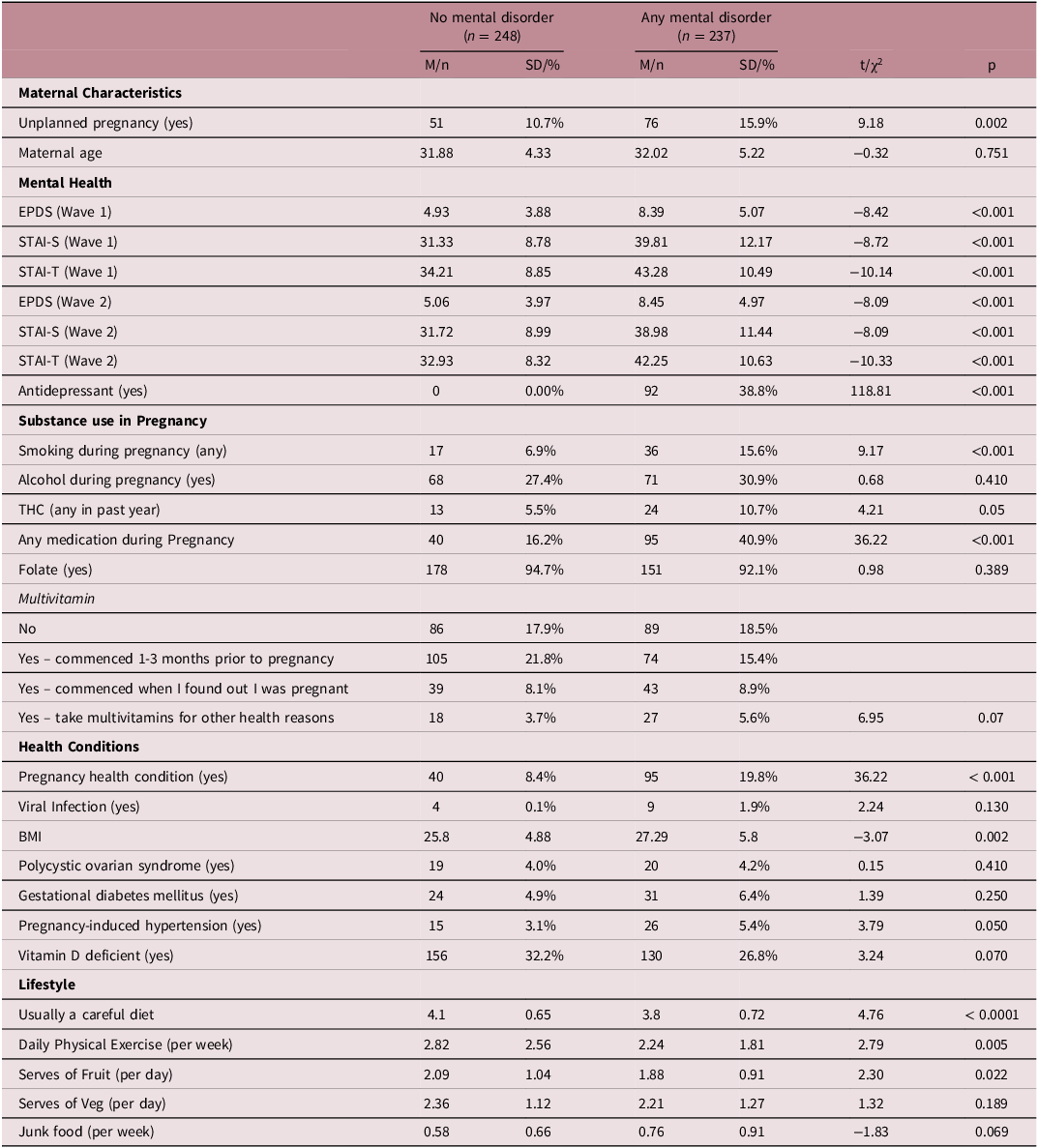
As presented in Table 1, the baseline comparison of women diagnosed on the SCID as having “any mental disorder” to the rest of the cohort without a mental disorder diagnosis showed many significant between group differences. For example, women with mental disorders were more likely to have an unplanned pregnancy. Diagnosed women were generally around a full standard deviation higher in their scores on measures of depressive and anxious symptoms and unsurprisingly showed higher rates of taking antidepressants. However, women with mental disorders were also more likely to smoke in pregnancy and to have used marijuana in the last year. For the disorder group there was also a much higher rate of “any medication use” (41% vs 16%), which is consistent with their reporting of a higher incidence of pregnancy related health conditions. This appears to be derived from higher rates of pregnancy hypertension. The rate of GDM was also elevated, while not significant. BMI scores were also higher in the mental disorder group. In terms of reported lifestyle differences, the mental disorders groups were more likely to report they were less careful in diet choice, exercised less and ate fewer serves of fruit per day.
Group differences for fetal exposures by mental disorder vs control (N = 485)

*Note: Mental disorder (yes/no) was measured in Wave 1 (early pregnancy).
Antidepressant and other psychotropic medications: There were 92 active participants taking an antidepressant during pregnancy, which is 38.8% of the sample, with only the loss of 1 participant by delivery due to a late miscarriage. Selective Serotonin Reuptake Inhibitors (SSRI) were the most frequently used (n = 39) and 29 used a Serotonin and Noradrenergic Reuptake Inhibitor. One participant changed from one SSRI to another during pregnancy and no women reported taking an anti-psychotic medication during pregnancy.
Psychological symptoms and exposures
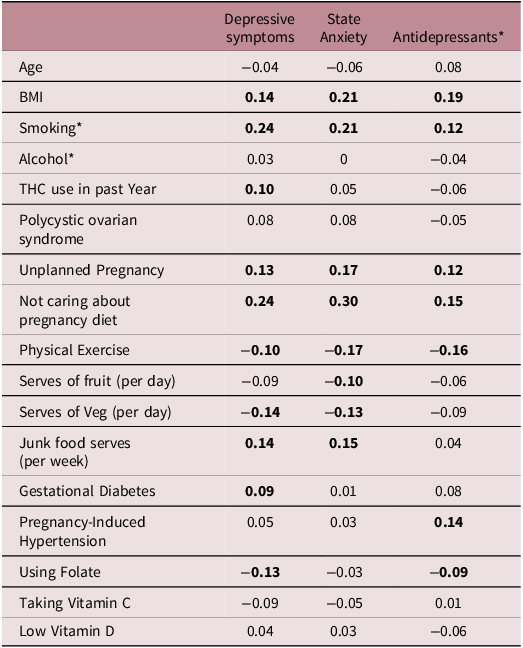
We also examined bivariate associations between mental health variables and possible exposures. As presented in Table 2, we used the continuous measures of depression (EPDS) and anxiety (STAI) and focused on reporting state anxiety, which was very similar to trait anxiety in these findings. A similar pattern of findings emerged as to the between group comparisons presented in Table 1. Small but statistically significant bivariate associations were found between mental health symptoms and smoking in pregnancy, maternal BMI, marijuana use, having an unplanned pregnancy, fruit intake, physical activity, junk food intake and some mixed findings for Gestational Diabetes and Hypertension. Notably the strongest association with mental health symptoms emerges as the variable in which mothers rated their interest in a careful diet during pregnancy.
Pearson’s bivariate correlations of mental health symptoms in early pregnancy (Wave 1) and pregnancy exposures
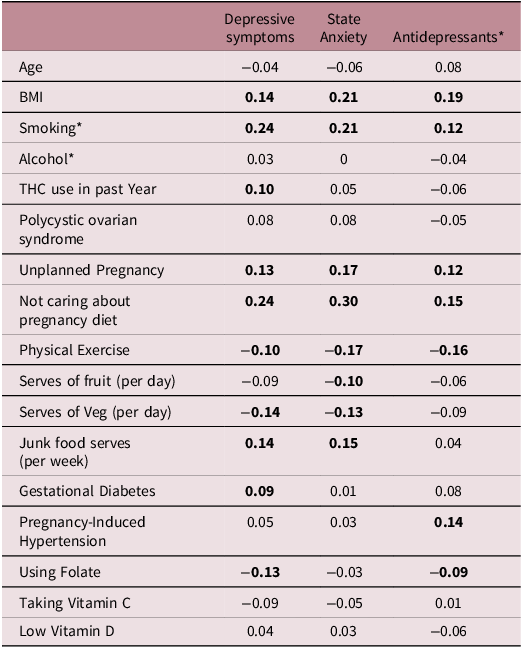
* Point-biserial correlations; Bolded = p < .05.
Network analysis of exposures
As described in the methods, the data was then entered into Network Analysis using R.Reference Condon16 We estimated a partial correlation network using LASSO regularization with the tuning argument setting the EBIC hyperparameter to 0.25. The network consists of a set of 24 nodes with a total combination of 276 edges (i.e., unique links between a pair of nodes) and is shown in Fig. 1. The figure represents the strength of association via the thickness of the line and draws nodes that are closely related into proximity with one another showing they form a cluster within the network.
Partial correlation network of fetal exposures in pregnancy with glasso regularization. Note: Only statistically significant associations shown (Red= negative association and green= positive) age= maternal age, pln= planned pregnancy, dx= any mental disorder diagnosis (Wave 1), AD = antidepressant use, DEP = depression symptoms, ANS = state anxiety, ANT = trait anxiety (Wave 1), smk= smoking in pregnancy, alc= alcohol use in pregnancy, thc= marijuana use, BMI = body mass index, pol= polycystic ovarian syndrome, vt_D= low vitamin D, GDM = gestational diabetes, PIH = pregnancy-induced hypertension, vir= viral infection, car= care about diet, ex= exercise, frt= fruit intake, veg= vegetable intake, jnk= junk food serves per week, mV= multivitamin, fol= folate, V_C= vitamin C.

The network presented in Fig. 1 suggests that fetal exposures in pregnancy occur in several distinct clusters. For instance, mental health symptoms of depression and anxiety cluster to the bottom left (in blue). Antidepressants and mental health diagnosis; however, are quite distal and instead proximate to smoking, alcohol use and marijuana use. The other distinct cluster is supplementary use of Vitamin C and Multi-vitamin (in purple) which is closely associated with pregnancy planning (green) on the left hand side of the network. There was also an interesting clustering of nodes linked to care about diet in the bottom right of the network. This node connected to GDM, fruit and vegetable intake, mental health symptoms and BMI. Notably, diagnosed maternal health disorders appear to have a central position in the network, which suggests these are significant mediators of many different fetal exposures.
Conversely, the absence of an edge or a node with few edges in the network can be interpreted as implying that two nodes are conditionally independent within the given network. In this case, the network showed no nodes that were fully independent, which suggests the complex and interconnected nature of fetal exposures in pregnancy.
Centrality plots for our network analysis are presented in Fig. 2. These show that anxiety variables, state and trait anxiety, had the highest strength in the network, also being high in closeness.
Centrality plots for partial correlation network of fetal exposures presented in Figure 1. Note: Z scores of centrality indices are on the x-axis.

Discussion
The current study findings in 485 pregnant women indicates that there may be systematic differences in the course and exposures in pregnancy reported women with mental health disorders. Our findings demonstrate that unsurprisingly, women with a mental health disorder reported higher rates of exposure to mental health symptoms and were also likely to be taking antidepressants. However, what is less obvious is that women with a mental health diagnosis are more likely to report an unplanned pregnancy, report a much higher rate of any medication use during pregnancy, and are more likely to report smoking and use of marijuana during the prenatal period. Pregnant women with a mental health disorder also report poorer outcomes related to health, including a higher incidence of pregnancy related health conditions, particularly hypertension. BMI scores were also elevated in the mental disorder group which is consistent with the finding of reporting less optimal pregnancy dietary choices, undertaking less exercise and eating fewer serves of fruit per day. When we examined associations of depression and anxiety symptoms with this same set of variables, these findings were largely consistent although serves of vegetables per day and junk food intake also reached significance in what is perhaps the more sensitive analysis of continuous ratings. These correlations were generally small in magnitude but statistically significant. It was also notable in this analysis that anxiety symptoms appeared to consistently have stronger correlations with exposures than did depressive symptoms.
Our network analysis showed that smoking, vegetable intake and particularly anxiety were central variables in the network. The prominent place of BMI in the network is important and interesting since it appears to be a node which links maternal health conditions such as diabetes and hypertension to mental health symptoms and medication exposures. The item for care about diet in pregnancy appears to be one of the most central nodes in the network, suggesting it may be a meditational pathway between poor lifestyle, BMI, and mental health symptoms, as well as smoking in pregnancy. Interestingly this is an attitudinal variable and is derived from a wider measure of Maternal-Fetal attachment. The centrality of care about diet in pregnancy to other fetal exposures suggests that targeting attitudes towards diet may be a potential avenue for future interventions for women experiencing mental health concerns during pregnancy.
In terms of mental health, the prominence of anxiety in both the network analysis and the bivariate correlation should also be noted. A number of previous findings suggest that maternal anxiety in particular seems to have relatively stronger programing effects for some child outcomes such as behavioral and cognitive development.Reference O’Connor, Heron, Golding and Glover24 Two large studies have shown prenatal state anxiety to be associated with an increased likelihood of attention and hyperactivity problems, and the effect has emerged as significantly stronger for boys in some studies.Reference O’Connor, Heron, Golding and Glover24,Reference O’Connor, Heron, Golding, Beveridge and Glover25 However, such findings many not fully consider the current findings that maternal anxiety in pregnancy may be an indicator of other exposures such as smoking, lifestyle and pregnancy health conditions.
The importance of pregnancy planning is also highlighted by the network analysis. Unplanned pregnancy emerges as directly related to substance use, and the lack of use of recommended dietary supplements such as folate which ideally should commence pre-conception. This is most likely due to the data being collected in early pregnancy and that unplanned pregnancy does not allow women the opportunity to cease substance use, and to make changes in their diet. Notably mental health symptoms are associated with having an unplanned pregnancy, and in particular anxiety symptoms. Similarly, maternal age was negatively correlated with unplanned pregnancy.
These findings are important to consider in relation to the Developmental Origins of Health and Disease (DOHaD) model which suggests that endocrine and nutritional factors influencing the intrauterine environment are major factors driving these later health and disease outcomes.Reference Gluckman, Hanson and Bateson26 Mental health is a major factor in itself in pregnancy but the current analysis shows that its impact may also be far wider and it influences a wide range of other teratogenic exposures.
Limitations
Ideally, consideration of the impact of fetal exposures needs to consider the timing, type, dose and duration of various environmental exposures across the fetal period.Reference Kieling, Baker-Henningham and Belfer27 In many instances here we have simplified the current analysis to binary indicators of whether a certain exposure took place or not, in order to demonstrate the inter-related matrix of associations and draw attention to possible mediational pathways or longitudinal designs which future studies could examine.
There are a number of important exposures, which are not covered in our available dataset. For example, the current analysis does not include exposure to second-hand smoke or assessment of environmental smoke exposure, which are associated with adverse behavioral outcomes.Reference Hsieh, Jeng and Su28,Reference Liu, Leung, McCauley, Ai and Pinto-Martin29,Reference Twardella, Bolte, Fromme, Wildner and von Kries30 Equally, we also do not include exposures to heavy metals, or endocrine altering plastics.
Further to this, some variables in our analysis were measured via self-report (e.g., illicit substance use, prescription medications). While prescription medication use was able to be verified against participant medical records, substance use was measured by self-report only. Given the stigmatized nature of substance use during pregnancy, it is possible that participants may have underreported their true use.
We also note that the “care about diet” variable in our analysis was based on a single item from a larger scale of antenatal attachment, however, this measure did appear to correspond to similar variables related to nutrition during pregnancy (e.g., Gestational Diabetes, and dietary choices). Finally, our measure of BMI did not account gestational age and parity. Given the relatively small amount of weight gain in the first trimester and impacts of obesity on outcomes in pregnancy, this data point was intended to measure early pregnancy where obesity was already present (rather than relative to parity or gestation).
There are also important methodological limitations to consider. Network estimation is an exploratory technique and generates many different measures (e.g., edge weights, network structures, centrality indices). The replication of such findings and ability to generalize across samples needs to be considered. Determining the replicability of an estimated network requires consideration of the sample size, the true network structure and other characteristics of the quality of the data entered. In the current study, we have made use of quite a large sample size, carefully recruited and drawn on measures which are high quality which suggests a stronger possibility of future replication.
Conclusions
The exposures examined in this study constitute important areas for prevention efforts and to improve pregnancy health. Amongst the exposures examined, some risk factors like substance use, diet, and health behaviors are modifiable. Although, lifestyle change and ceasing substances may prove challenging for some parents experiencing psychological distress, there is evidence supporting the effectiveness of dietary behavior change interventions during pregnancy.Reference O’Connor, Meloncelli and Wilkinson31 Future research would benefit from exploring the suitability of these interventions for populations experiencing psychological distress.Reference Lewis, Galbally and Bailey32,Reference Lewis, Galbally, Gannon and Symeonides1,Reference Pritchard33 Possible interactions across these exposures and over time are also important considerations for future studies examining child outcomes.
The interrelated nature of fetal exposures suggests that public health interventions may benefit from a broader approach promoting healthy pregnancy, as opposed to targeting individual risk factors. If successful, such interventions are likely to have lifelong effects on a child’s future health and development.
Acknowledgements
The authors would like to thank those who have both supported the development of MPEWS including: Marinus van IJzendoorn and Michael Permezel. The authors would also like to thank the staff and students including research co-ordinators Tina Vaiano and Nicole Brooks, and Stuart Watson for their contribution to MPEWS. We are also sincerely grateful to the study participants who have contributed a substantial amount of time to participating in this study.
Funding statement
This study was funded by a National Priority Research Grant, Beyond Blue and NHMRC project grant (APP1106823).
Competing interests
The authors declare that they have no competing interests.
Ethical statement
This study did not involve human or animal experimentation; however, reference to ethics approval for the cohort study is included in study manuscript.


 Open access

