


1. Introduction
Medlicott (Reference Medlicott1864) coined the term “Blaini Formation” for the conglomerate beds exposed in the Baliana River, Himachal Pradesh. Subsequently, the term Blaini Formation was extended to all such pebbly lithounits that are sandwiched between the Nagthat Formation at the bottom and the Infra-Krol Formation at the top. Used extensively as a marker horizon, the Blaini Formation has long been correlated with the Late Carboniferous-Early Permian Talchir Boulder beds occurring at the base of the Gondwana Group in the Peninsular India (Oldham, Reference Oldham1888). A major revision in this view occurred with the discovery of Proterozoic-Eocambrian fossils in the upper Krol and Tal Formations (Azmi, Reference Azmi1983; Azmi and Pancholi, Reference Azmi and Pancholi1983; Singh and Rai, Reference Singh and Rai1983; Bhatt, Reference Bhatt1991; Maithy et al. Reference Maithy, Babu, Kumar and Mathur1995 and others). The Neoproterozoic age of the Blaini Formation is now well established.
Existing opinions on the origin of Blaini diamictite fall in three main groups: (i) glacial and glacio-marine (Oldham, Reference Oldham1887, Reference Oldham1888; Holland, Reference Holland1908; Pilgrim and West, Reference Pilgrim and West1928; Auden, Reference Auden1934; Saxena and Pande, Reference Saxena and Pande1969; Gaur and Dave, Reference Gaur and Dave1971; Bhargava and Bhattacharya, Reference Bhargava and Bhattacharya1975; Bhatia and Prasad, Reference Bhatia and Prasad1975, Reference Bhatia and Prasad1981; Jain and Varadarajan, Reference Jain and Varadarajan1978; Jain, Reference Jain1981; Shanker et al. Reference Shanker, Kumar, Mathur and Joshi1993; Hoffman and Schrag, Reference Hoffman and Schrag2000; Evans, Reference Evans2000; Jiang et al. Reference Jiang, Christie-Blick, Kaufman, Banerjee and Rai2002, Reference Jiang, Sohl and Christie-Blick2003; Kaufman et al. Reference Kaufman, Jiang, Christie-Blick, Banerjee and Rai2006; Hoffman and Li, Reference Hoffman and Li2009; Etienne et al. Reference Etienne, Allen, Guerroue, Heaman, Ghosh, Islam, Arnaud, Halverson and Shields-Zhou2011; Hoffman et al. Reference Hoffman, Linnemann, Rai, Becker, Gärtner and Sagawe2011; Tewari, Reference Tewari2012; Hoffman et al. Reference Hoffman, Abbot, Ashkenazy, Benn, Brocks, Cohen, Cox, Creveling, Donnadieu, Erwin, Fairchild, Ferreira, Goodman, Halverson, Jansen, Hir, Love, Macdonald, Maloof and Warren2017; Rai et al. Reference Rai, Shukla, Singh and Yadav2021), (ii) turbidity current deposits, submarine slump, or subaqueous debris flow (Rupke, Reference Rupke1968; Valdiya, Reference Valdiya1970; Niyogi and Bhattacharya, Reference Niyogi and Bhattacharya1971; Dey et al. Reference Dey, Dasgupta, Das and Matin2020) and (iii) terrestrial-shallow marine (Tangri and Singh, Reference Tangri and Singh1982). Although the origin of the Blaini Formation remains debated (Dey et al. Reference Dey, Dasgupta, Das and Matin2020), existing opinions are strongly skewed in favour of its glaciogenic origin, and we have followed this model in our study. Despite an extensive body of published literature on the origin of the Blaini Formation, little is known about its syn-sedimentary and tectonic deformation structures. Rather than revisiting the origin of the Blaini Formation, this study focuses on the syn-sedimentary deformation and the post-lithification tectonic deformation in this formation.
2. Geological setting
The continent–continent collision between the Indian Plate and the Eurasian Plate at c. 59–61 Ma resulted into the emergence of the Himalayan orogen (Hu et al. Reference Hu, Garzanti, Moore and Raffi2015, Hu et al. Reference Hu, Garzanti, Wang, Huang, An and Webb2016; An et al. Reference An, Hu, Garzanti, Wang and Liu2021). Four faults, namely, the Main Frontal Thrust (MFT), Main Boundary Thrust (MBT), Main Central Thrust (MCT) and Southern Tibetan Detachment System (STDS), partition the entire Himalayan orogen into the following four discrete lithotectonic terrains (Heim and Gansser, Reference Heim and Gansser1939; Rupke, Reference Rupke1974; Valdiya, Reference Valdiya1979, Reference Valdiya1980, Reference Valdiya2010):
-
i. The Sub-Himalayan terrain comprising the Cenozoic marine and fluvial successions between the MFT in the south and the MBT in the north.
-
ii. The Lesser Himalayan terrain of low- to medium-grade metamorphic rocks of the Proterozoic age and the Paleozoic–Eocene succession occurring between the MBT in the south and the MCT in the north.
-
iii. The Greater Himalayan terrain, comprising the Neoproterozoic–Ordovician high-grade metamorphic rocks and Paleozoic to Cenozoic granitoids between the MCT in the south and the STDS in the north.
-
iv. The Tethyan Himalaya, which contains a characteristic Eocambrian to Early Eocene fossiliferous marine succession between the STDS in the south and the Indus–Tsangpo Suture Zone in the north.
In the northwest Himalaya, the MBT juxtaposes a series of Krol synclines in the hanging wall against the Cenozoic foreland sedimentary succession in the footwall (Figure 1a). This study is based on observations in one such Krol syncline, namely, the Garhwal Syncline. The outer part of the Garhwal Syncline comprises the Chandpur, Nagthat, Baliana (Blaini and Infra-Krol), Krol and Tal Formations of Proterozoic–Eocambrian age, whereas its inner part is occupied by the older thrust sheets belonging to the Almora Group and the Ramgarh Group (Figure 1a, b). The study area exposes the Blaini Formation and the lower part of the Infra-Krol Formation occurring on the southwestern limb of the Garhwal syncline. It extends from Ramjhula (30°7′21.02″N; 78°18′54.09″E) to Bhagirathi Ashram (30°7′26.70″N; 78°19′29.10″E) and further northwards along the Ganga River and includes other accessible sections around Rishikesh town, 30°7′21.02″N; 78°18′54.09″E (Figure 1b).
(a) Six major Krol synclines (Krol Syncline, Pachmuda Syncline, Nigalidhar Syncline, Mussoorie Syncline, Garhwal Syncline and Nainital Syncline) in the Lesser Himalaya (after Auden, Reference Auden1934; Shanker et al. Reference Shanker, Kumar, Mathur and Joshi1993; Rai et al. Reference Rai, Shukla, Singh and Yadav2021). The Main Boundary Thrust separates the Krol synclines in the hanging wall from the Sub-Himalayan successions in the footwall. Black outlined rectangle marks the area shown in Figure 1b. (b) Location of study area with respect to the Main Boundary Thrust in the northwestern part of the Garhwal syncline (after Valdiya, Reference Valdiya1980 and traced from Dubey, Reference Dubey1997). The study area exposes the Baliana Group rocks.

3. Lithological units
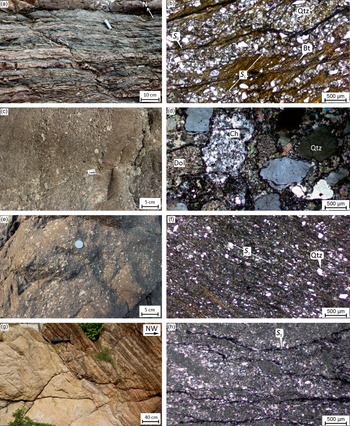
Downdip from Ramjhula, the Ganga River exposes five different lithounits in the study area. The first lithounit is essentially a siliciclastic unit that consists of an amalgamated package of dark slate, phyllite with interbeds of cm-m-thick quartzite bands (Figure 2a). This lithounit lacks any apparent depositional structure except the bedding surface marked by compositional contrast between the quartz-rich and biotite-rich layers (Figure 2b). The exposed cumulative thickness of this unit, including an increase in thickness due to the folding and thrusting, is of the order of 600 m.
Lithounits. Left column – field photographs; right column – corresponding photomicrographs. (a) Interlayered slate/phyllite and thin sandstone/quartzite beds in the siliciclastic unit. A shear zone cuts through the beds dextrally in the middle of the photograph. Plan view. GPS Loc. (30°7′30.20″N; 78°19′10.50″E). (b) Photomicrograph shows alternate quartz-rich and mica/clay-rich bedding surfaces (S 0) in the siliciclastic unit. Biotite (Bt)-rich slaty axial plane cleavage (S 1) cuts across bedding surface (S 0). PPL. c. Sandy diamictite showing graded bedding structure, fining towards the left. (d) Photomicrograph of sandy diamictite shows angular and unsorted clasts of quartz (Qtz), chert (Ch), and dolomite (Dol) in a carbonate-rich matrix. XPL e. Muddy diamictite containing angular and unsorted clasts of varied size and composition. (f) Photomicrograph of muddy diamictite. Fine-grained clasts of varied composition and clay-rich layers define F 1-axial plane cleavage (S 1) in muddy diamictite. PPL. g. Cap rock. Crinkly laminated algal dolostone (right) overlies the pale yellow and massive dolostone (left). (h) Photomicrograph shows alternate micritic (grey) and clay-rich (dark) beds (S 0) in crinkly-laminated algal dolostone. PPL.
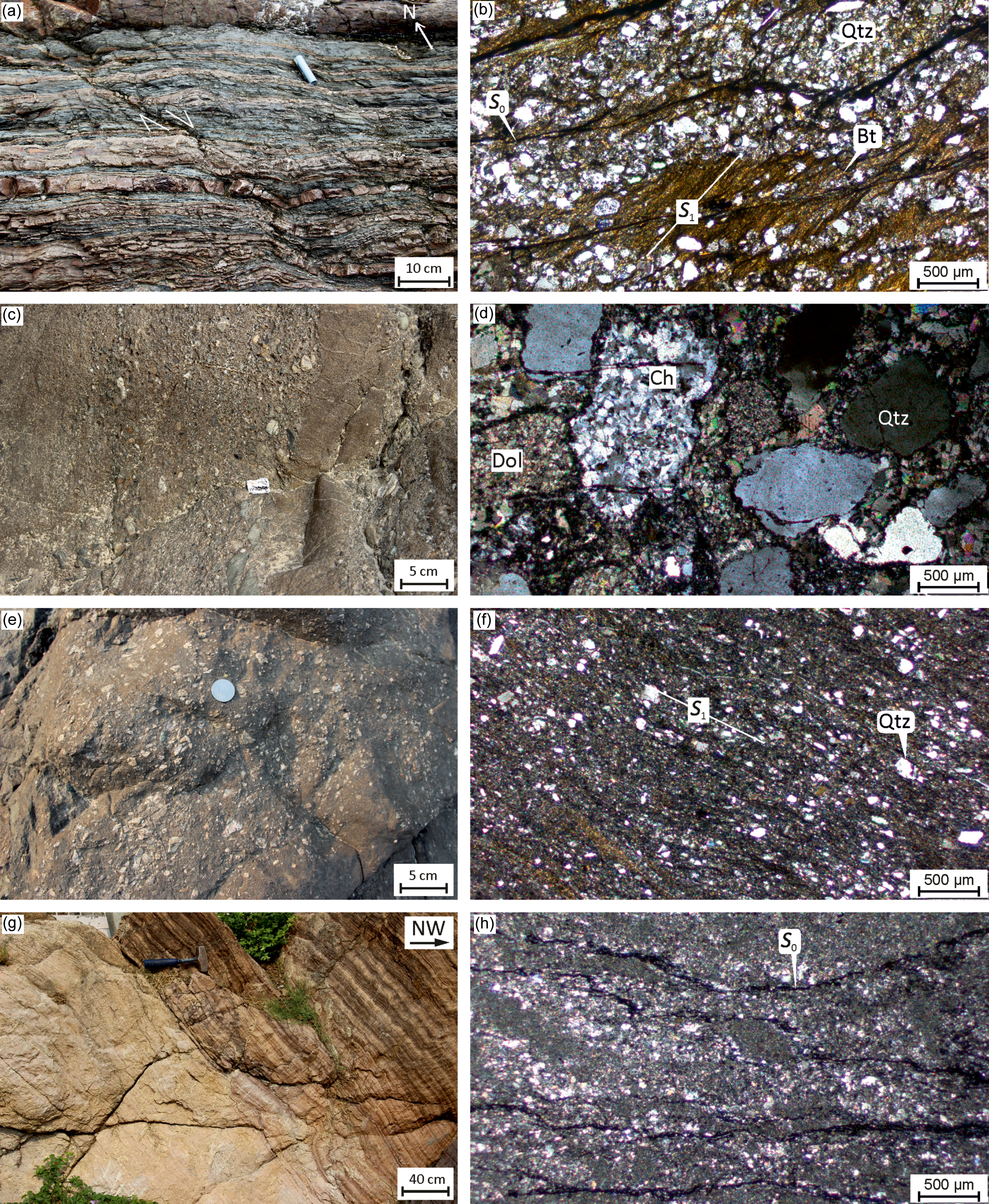
Conformably overlying the siliciclastic unit are the dark grey sandy diamictite beds, the second lithounit (Figure 2c). This lithounit consists of poorly sorted and randomly distributed granule to pebble-sized subangular to angular chert, dolomite, quartzite and shale clasts set in carbonate-cemented sandy matrix (Figure 2d). The clast: matrix ratio varies from 70:30 or higher to the extent that the sandy diamictite assumes the character of clast-supported gritty sandstone. Discontinuous, cm-m thick lenses of medium- to coarse-grained sandstone beds are interlayered with the sandy diamictite unit. The maximum cumulative thickness of this lithounit is ∼10 m.
The sandy diamictite is overlain by a well-bedded muddy diamictite, the third lithounit. The muddy diamictite consists of poorly-sorted granule to boulder size clasts of limestone, siltstone and quartzite set in an argillaceous matrix, a dark grey mud (Figure 2e). The granule and pebble size clasts are stretched along the cleavage surface (S 1 in Figure 2f). The transition from sandy diamictite to the muddy diamictite is gradational, and the cumulative thickness of this lithounit is of the order of 35 m.
The muddy diamictite unit is overlain by a calcareous unit that comprises massive pale-yellow dolostone beds and the overlying crinkly-laminated pink dolostone beds, the fourth lithounit (Figure 2g). Internally, the crinkly dolostone is made up of alternate layers of micrite and clay and hence, identified as algal laminate (Figure 2g, h). Considering the stratigraphic position of the calcareous unit immediately above the diamictite unit, we identify it as cap carbonate. Hereafter, both the massive and crinkly dolostone beds are referred to as the cap dolostone.
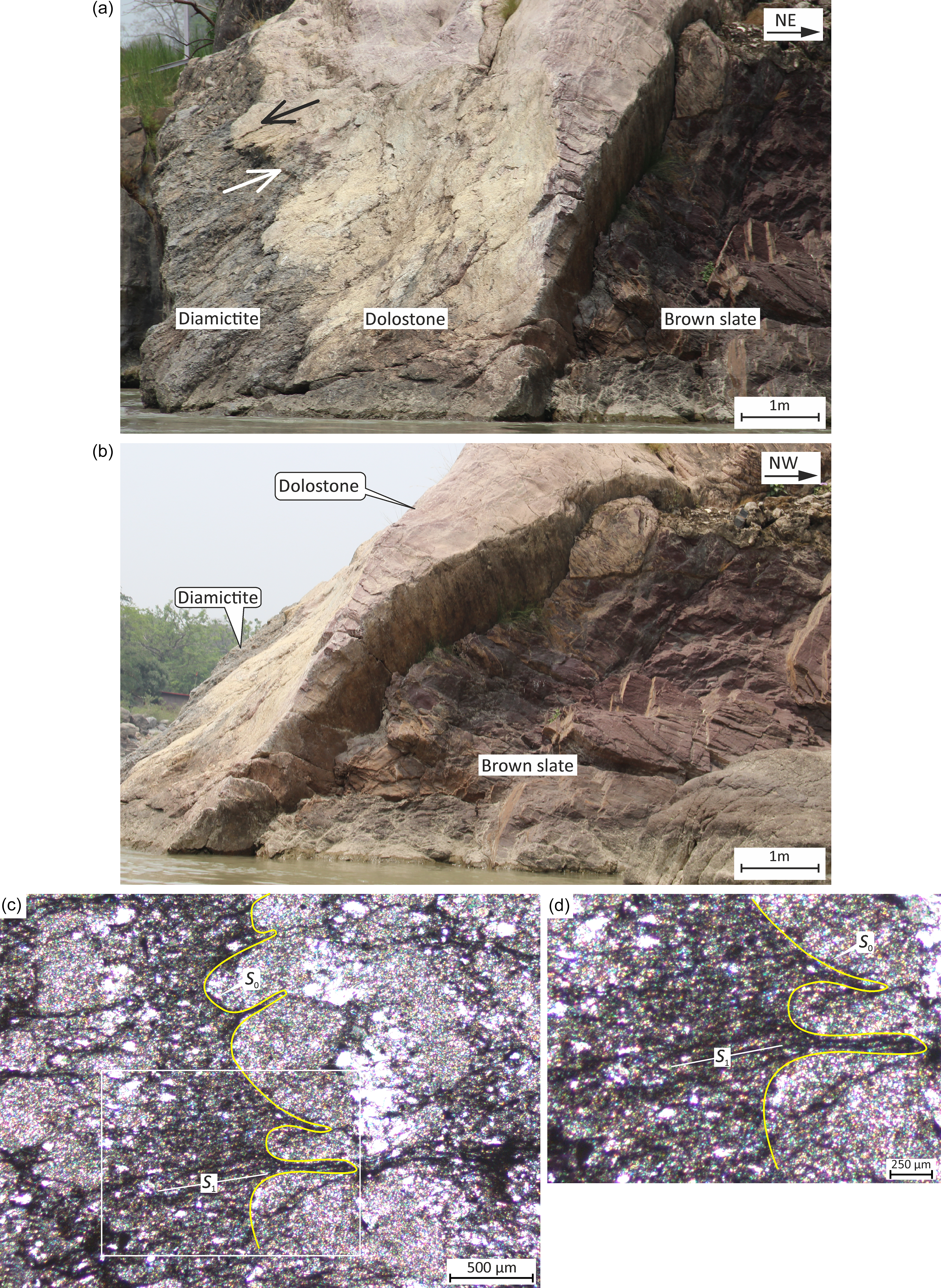
In the study area, there are two dolostone bands, each overlying a muddy diamictite unit (e.g. Figure 3a). The thicknesses of the lower and upper dolostone bands are approximately 6 m and 9 m, respectively. The upper cap dolostone beds are succeeded by the Infra-Krol Formation, which constitutes the fifth lithounit. Here, the Infra-Krol Formation is represented by the variegated shale, slate and phyllite interbanded with cm–m thick fine sandstone/siltstone beds. A brown-coloured calcareous slate of Infra-Krol Formation directly overlies the upper dolostone bed along a sheared and thrusted contact (Figure 3b). The brown slate, composed of alternate micrite and mm-thin clay-rich laminae, is deformed into the cuspate-lobate folds associated characteristically with a clay-rich axial plane cleavage (Figure 3c, d; cf. Figs. 19.15, 19.16 19.17 in Ramsay and Huber, Reference Ramsay and Huber1987; Figure 3b in Srivastava, Reference Srivastava2011).
(a) Highly irregular contact between the muddy diamictite and upper cap dolostone represents load (black arrow) and flame (white arrow) structure. Brown slate of the Infra-Krol Formation overlies the dolostone along faulted contact. (b) Faulted contact between the cap dolostone of the Blaini Formation and the brown slate of the Infra-Krol Formation. (c) Photomicrograph of brown slate. Alternate micritic and clay-rich compositional banding (S 0). S 1-cleavage is axial planar to cuspate-lobate F 1-folds traced by the bedding surface, S 0 (yellow line). PPL. (d) Enlarged view of the area in white rectangle in ‘c’ shows well-developed cuspate and lobate folds and S 1-axial plane cleavage. PPL.
4. Map pattern
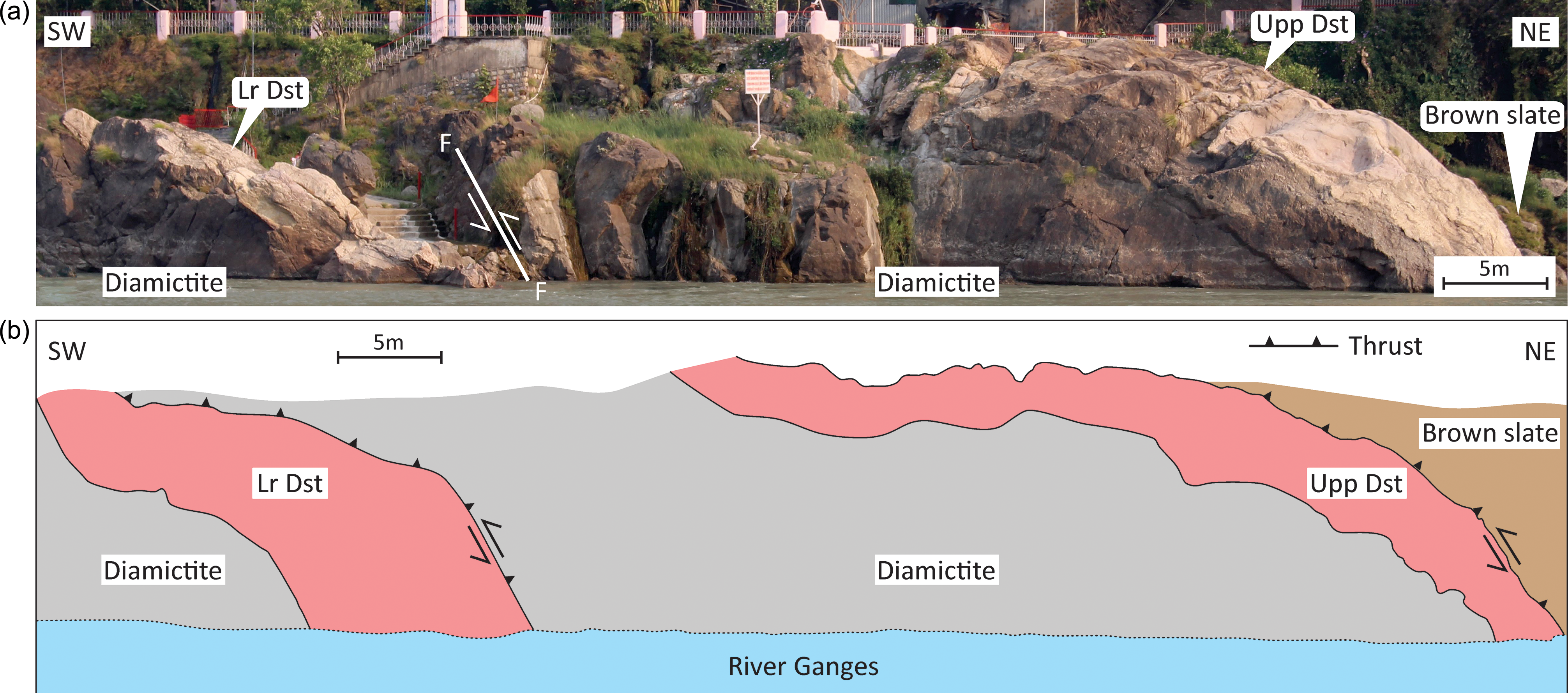
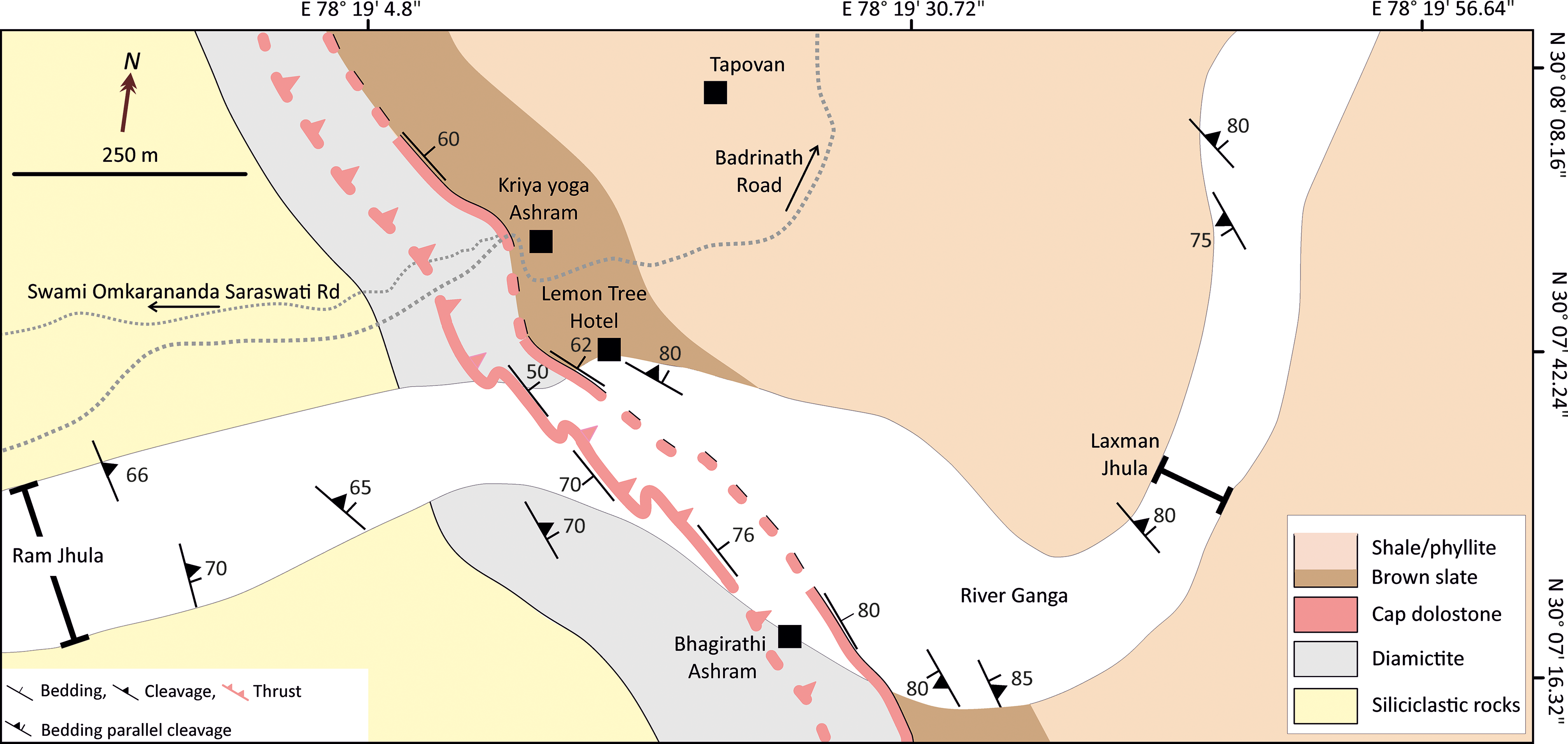
The siliciclastic beds outcrop consistently for ~ 600 m from Ramjhula (30°7′21.02″N; 78°18′54.09″E) in the dip direction towards NE. By contrast, the outcrops of all other lithounits are sparse and discontinuous. Running parallel to each other, the bedding surfaces in different units correspond to the limbs of very tight to isoclinal folds. The two cap dolostone bands, namely, the upper and lower bands, serve as the marker beds for mapping (Figures 4a, b and 5). The upper cap dolostone band is overlain by a brown-coloured calcareous slate of the Infra-Krol Formation, whereas the lower cap dolostone band is sandwiched between the two muddy diamictite beds (Figures 4a, b and 5). Each diamictite–dolostone pair defines a couplet. The contact between the lower dolostone band and the overlying muddy diamictite is cut by a thrust that dips at a steep angle, 75°/NE (F-F in Figure 4a, b). No map-scale fold hinge zone is traceable in the study area.
(a) Outcrop of two juxtaposed cap dolostone–diamictite couplets, stacked one over other, in a NE-SW section along the Ganga River. The beds dip 60/010°. F-F – thrust contact. Photograph clicked from GPS location; 30°7′34.72″N; 78°19′14.91″E on the opposite bank (eastern) of the Ganga River. Camera facing NW. (b) Sketch marks the nature of contact between different lithounits in Figure 4a. Lr Dst and Upp Dst – lower and upper dolostone bands, respectively.
Geological map of the Baliana Group in the study area. The outcrop pattern shows rhythmic repetition of the diamitctite–dolostone beds in the two juxtaposed couplets.
5. Neoproterozoic syn-sedimentary deformation structures
The following types of syn-sedimentary deformation structures are observed in the diamictite and cap dolostone beds:
5.a. Load and flame structure
The highly irregular contact between muddy diamictite and cap carbonate represents this structure (Figure 3a). Syn-depositional liquefaction in both diamictite and carbonate beds resulted into formation of the load and flame structure in the Blaini Formation. The bulbous protrusions of dolostone into the diamictite are interpreted as load structures. These structures are formed due to the sinking of higher-density micritic carbonate (2.6–2.9 g/cm3; Moshier, Reference Moshier1989; Berger, Reference Berger1992) into the underlying lower-density muddy diamictite (∼2 g/cm3; Pudsey et al. Reference Pudsey, Barker and Camerlenghi1999). The upward forcing of lower density diamictite into the higher density carbonate is interpreted as flame structure (Collinson et al. Reference Collinson, Mountney and Thompson2006). These structures are typically interpreted as products of gravitationally forced reverse density deformation in pre-consolidated granular sediment at higher fluid pressure (Owen, Reference Owen2003; Gao et al. Reference Gao, Ou, Guo, Ji, Li, Deng, Hao and Guo2020). Loads are characteristically concave-up, internally massive and their maximum height and width are 60 cm and 110 cm, respectively.
5.b. Clastic vein
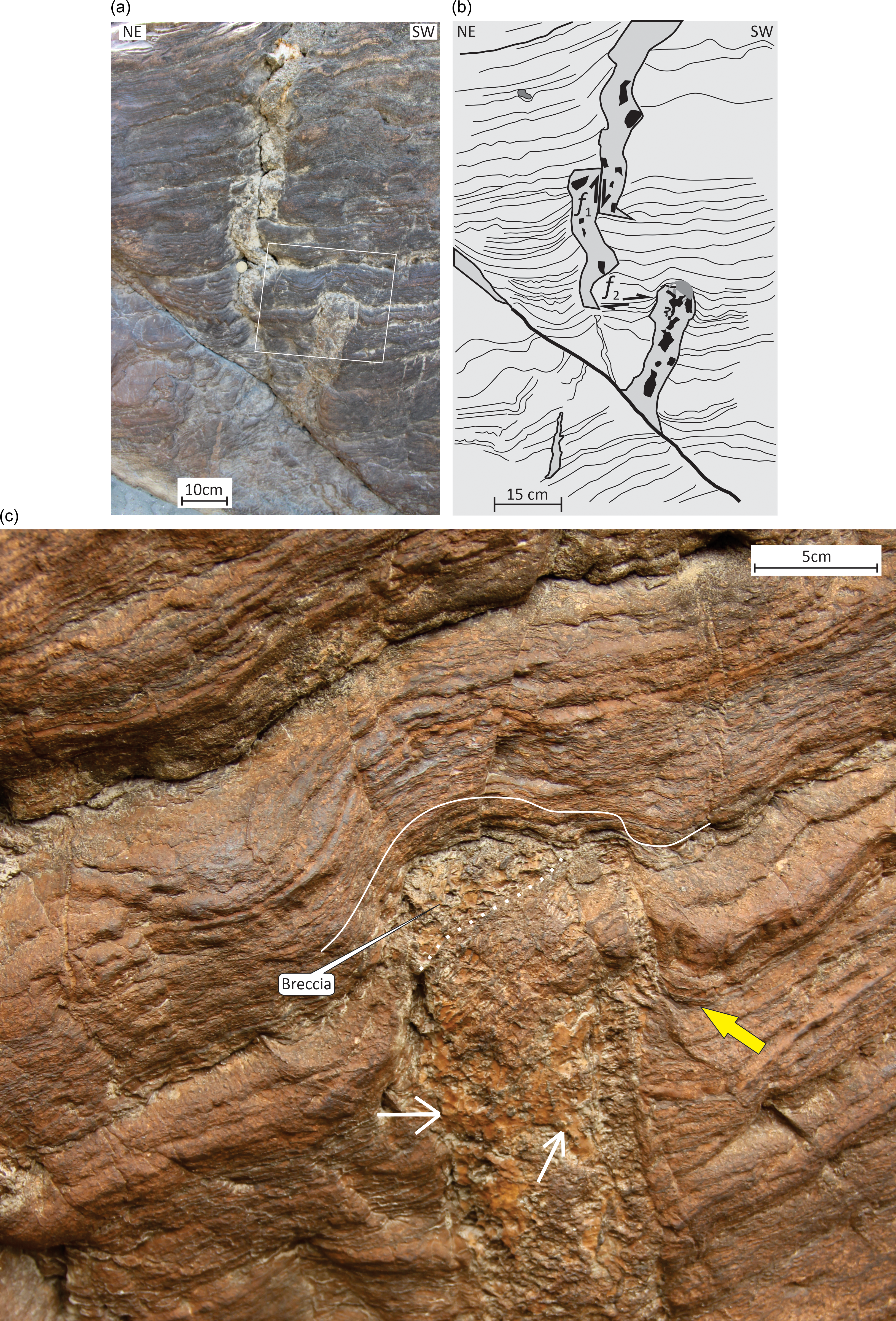
Characteristically brown coloured, irregular, cm-thick and m-scale long granular clastic vein cuts through the laminations in the cap dolostone at a high angle (Figure 6a). Two successively developed faults offset the vein across and along the bedding surfaces, respectively (f 1 and f 2 in Figure 6b). The vein infilling dominantly contains shattered fragments of the host dolostone in a carbonate matrix (Figure 6b, c). The maximum recorded diameter of the dolostone fragment within the vein is of the order of 2 cm. A mm-thick zone of brecciation and granulation can be seen all around the vein boundary, in particular, at the vein-tip. Host dolostone laminations at the boundary of vein are upturned and disrupted at places due to liquefaction. The disruption can also be seen at the protruding vein tip, indicating that the vein may have propagated upwards by ripping through the dolostone layers (Figure 6c). Several lines of evidence, such as the distortion of bedding surfaces at the protruding vein tip, the brecciated vein front, and the upward drag of host rock lamination along the vein boundaries (Figure 6c), imply formation of the clastic veins by a forceful injection of the calcium-rich fluid within pre-lithified dolostone (Figure 6c). As the host rock is crinkly dolostone, it is likely that the fluids were derived from the host rock.
(a) A clastic vein cuts through the crinkly laminated cap dolostone beds at a high angle to bedding surfaces. GPS location; 30°7′27.20″N; 78°19′27.80″E (b) Tracing of ‘a’. Two successively developed faults, f 1 and f 2, offset the vein across and along the bedding surfaces, respectively. Shattered host rock (dolostone) pieces (black) occur in the vein-infilling. (c) Enlarged view of the white rectangle around vein tip in ‘a’. White arrows point to shattered dolostone pieces. Yellow arrow points upward drag of lamination. White line traces distortion of bedding surface around the brecciated vein tip protrusion.
5.c. Sand dyke and syn-sedimentary fault
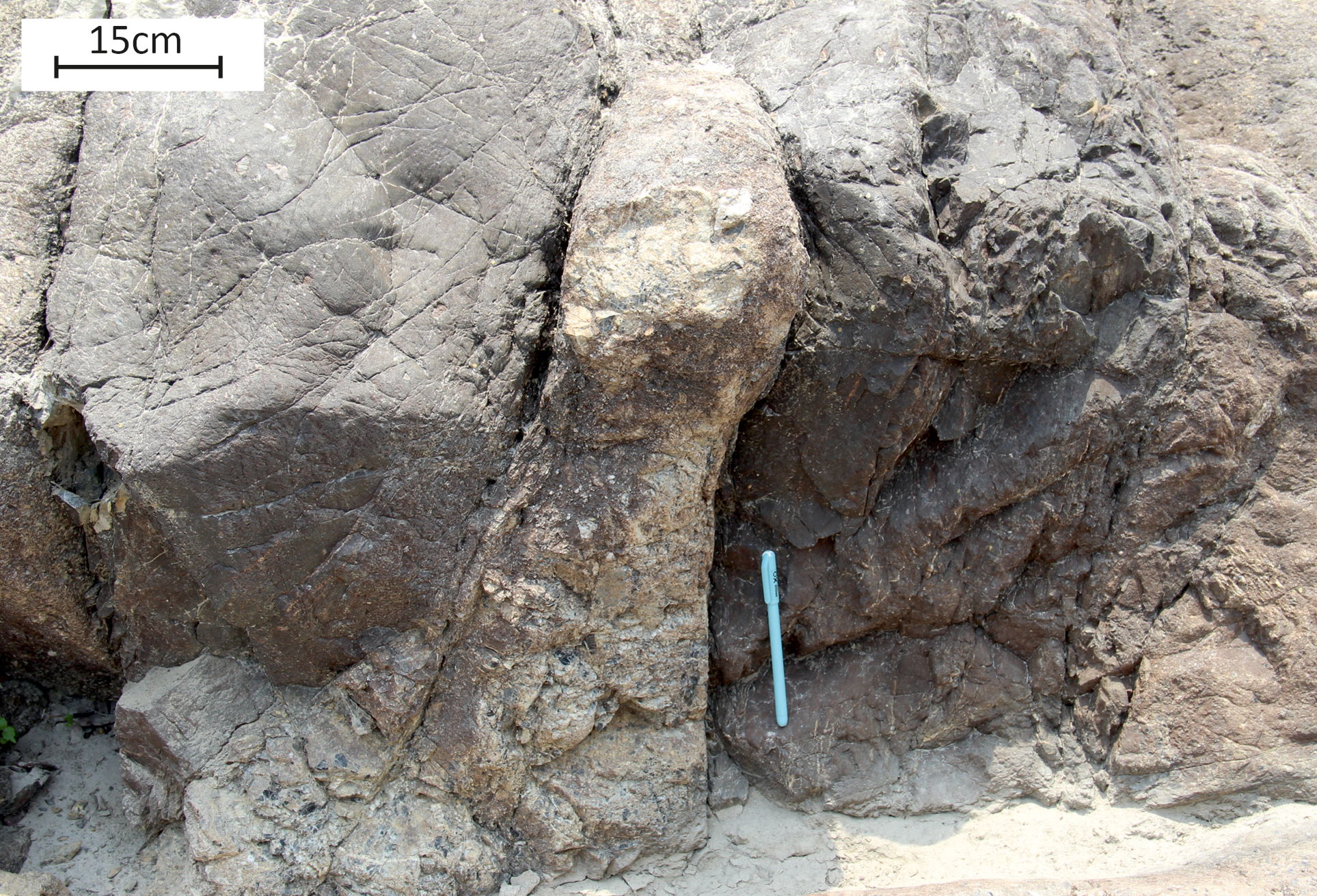
The sand dyke occurs as an intrusive structure into the overlying muddy diamictite (Figure 7). The intrusion of the dyke, from bottom to top, is due to fluidization and high-pressure injection of sand-entrained fluids into the muddy beds (Obermeier, Reference Obermeier1996; Hibsch et al. Reference Hibsch, Alvarado, Yepes, Perez and Sebrier1997; Jolly and Lonergan, Reference Jolly and Lonergan2002; Singh et al. Reference Singh, Mondal, Singh, Mittal, Singh and Kanhaiya2020). Because of high pressure in fluidized mass, the fracture in the overlying strata dilate and the sand-fluid mixture flows through it. With dissipation of excess pressure, fracture propagation terminates and the intrusion freezes. Such sandy-dykes point to the syn-depositional fluidization in the Blaini Formation (Figure 7).
The sand dyke occurs as an intrusive body into the overlying muddy diamictite bed. GPS location; 30°7′31.16″N; 78°19′21.78″E.
Bounded by undeformed beds on the top and bottom, the decimeter-scale faults cut through the diamictite beds at a high angle (Figure 8a). The offset of successive beds progressively increases downwards in the hanging wall (Figure 8b). Based on these characteristics, we infer that these faults are syn-depositional and soft-sediment deformation structures.
(a) A syn-sedimentary fault cuts through the sandy diamictite beds. (b) Tracing of ‘a’ showing offset of the beds, A through E. The offset increases progressively from A to E in the hanging wall. GPS Loc. 30°7′31.16″N; 78°19′21.78″E.

6. Other sedimentary structures
6.a. Dropstone
The dropstone occurs as a large, outsized quartzite clast, with a maximum visible width of 18.2 cm and maximum height of 23.8 cm, set within sandy diamictite (Figure 9a). The clast is sub-equant in shape with one side a little longer than the other side, aspect ratio = 1.3. From the dimensions, it is ascertained that the clast was deposited with it’s a/b plane inclined at ∼ 500 to the sedimentary surface, as may be expected from the dropstones penetrating the sedimentary surface. It is noteworthy that the laminations below the clast are typically bent downwards due to piercing of the protrusion of the clast (Figure 9a).
(a) A dark grey quartzite dropstone in the sandy diamictite. Thin yellow lines trace the contortion of the bedding surfaces due to piercing of the dropstone. A small fault cuts through the laminations in the right part of the figure. GPS Loc. 30°7′30.27″N; 78°19′22.37″E. (b) Mud balls (open black arrow) exposed on a sub-vertical fault surface in the dolostone. Filled white arrow-fault-striae. The fault cuts through the folded bedding surface (dashed line). GPS Loc. 30°7′26.70″N; 78°19′29.10″E.

The lone outsized clast is identified as dropstone, dropped from ice-rafts floating over the sandy diamictite bed during an ice-melting event. An alternate explanation for such outsized clast, set within sandy/muddy matrix, may also be sought from cohesive debris flow, whereby thixotropic matrix strength can entrain outsized clasts in flow (Chakraborty et al. Reference Chakraborty, Das, Sarkar and Das2009). In the present study, the dropstone interpretation is favoured in view of: (i) its association with undoubted diamictite and cap carbonate, (ii) downward bending and piercing of underlying laminae (Bhattacharya, Reference Bhattacharya2024; Shao et al. Reference Shao, Han, Li, Lu, Ju, Cao, Hu, He and Zhao2025) and (iii) absence of any signature, in association, that may indicate laminar flow shearing.
6.b. Mud balls
In the cap algal dolostone, large, well-rounded elliptical fragments (> 2 cm) of argillitic and carbonate mud, along with angular, sharply edged chert fragments (< 1 cm) occur as floating clasts (open arrow in Figure 9b). The large elliptical carbonate clasts (> 2 cm) are oriented sub-parallel to algal laminations. A thin, crenulated network of secondary carbonate veins transects both the clast and the host dolostone, thereby obliterating the clast’s internal structure. However, on a close look, it appears that internal laminations in the clasts are inclined at a high angle to algal laminations. The angular, sharp edged small clasts (< 1 cm) are dominantly siliceous in composition. From the color, the overall outer shape and scattered occurrence within the dolostone, we infer these clasts as mud balls. Repeated movement of the fragments on the sediment surface, as rolling balls or fragments might have imparted the roundness to some of the relatively incompetent clasts. In a shallow marine setting, a possible reason for the entrapment of such mud balls into the cap dolostone may be due to the tidal currents. In Proterozoic time, formation of algal limestone is tied up with activities of cyanobacteria, microbes and other photoautotrophic organisms (Grotzinger and James, Reference Grotzinger, James, Grotzinger and James2000; Van Loon and Mazumder, Reference Van Loon and Mazumder2013). Because of the presence of slimy material, extracellular polymeric substance (Noffke, Reference Noffke2008; Sarkar et al. Reference Sarkar, Choudhuri, Mandal and Bose2018) on the sediment surface, the mud balls possibly got attached and embedded within the algal dolostone.
7. Cenozoic tectonic deformation structures
7.a. Folds
Two distinct fold groups, F 1 and F 2, can be distinguished based on outcrop-scale overprinting relationships and style grouping. The early folds, F 1, are characterized by very tight to isoclinal geometry and a slaty axial plane cleavage that is particularly well developed in the siliciclastic and muddy diamictite beds (Figure 10a). The rootless F 1 hinge zones are preserved along the sheared contact between the cap dolostone of the Blaini Formation and brown slate of the Infra-Krol Formation (Figure 10b).
F 1 folds in different lithounits. (a) An isoclinal fold hinge zone in the siliciclastic beds. S 0-bedding surface, S 1-axial plane cleavage dips 70/030° and fold hinge line plunges downdip on the axial plane. Plan view. GPS Loc. 30°7′29.74″N; 78°19′8.39″E. (b) Rootless F 1 hinge zone formed due to transposition F 1 folds along the sheared contact between cap dolostone and brown slate. White line – S 1-axial plane cleavage. Camera facing NE. GPS Loc. 30°7′35.32″N; 78°19′16.10″E. (c) Cuspate-lobate folds along the contact between the muddy-diamictite (dark)-cap dolostone (light). Top-to-the-SW shear zones along the cuspate contact. Curved white lines – clockwise rotated S-surfaces in shear zone. White half-arrows, aligned parallel to the C-surface, mark shear sense. Stretched small clasts, pointed by yellow arrow, are aligned along the cleavage. GPS Loc. 30°7′28.60″N; 78°19′26.90″E.

The muddy diamictite–dolostone contact surface traces cuspate-lobate shaped F 1 folds (Figure 10c). At the mesoscopic scale, the F 1 axial plane cleavage, S 1, is defined by the preferred orientation of flattened pebbles along the clay-rich layers in the muddy diamictite (Figure 10c). Under the microscope, the S 1 cleavage occurs as mica and clay-rich layers that anastomose or cut across the clasts of varied composition (Figure 2b, f). Several lines of geometrical evidence, such as the occurrence of M- or W-shaped parasitic folds at the hinge zones of larger folds, the cuspate-lobate and Class 1B and 1C fold shapes point to the development of F 1 folds by the buckling and flattening mechanism. That the dolostone responded as a more competent unit than the muddy diamictite during the buckling is evident from the muddy diamictite cusps pointing towards the overlying dolostone bed (Figure 10c).
Associated characteristically with the axial plane crenulation cleavage (S 2), the F 2 folds occur as close to open kink folds in the argillaceous beds (Figure 11a). In the cap dolostone beds, F 2 folds are characterized by the rounded or box-shaped hinge zones and the lack of any axial plane cleavage (Figure 11b). The Type-3 interference patterns (Ramsay, Reference Ramsay1967), preserved on a few outcrops of the siliciclastic and dolostone beds, reveal the coaxial refolding of the isoclinal F 1 folds by open to gentle F 2 folds (Figure 12a–c).
F 2 folds. (a) Kink folds and associated axial plane crenulation cleavage, S 2, in the Blaini phyllite exposed on a vertical section. GPS Loc. 30°7′30.20″N; 78°19′12.50″E. (b) Open to close F 2 folds in cap dolostone. GPS Loc. (30°7′26.70″N; 78°19′29.10″E).

(a) Type-3 interference pattern in the Blaini phyllite. Yellow line traces the bedding surface. Pink line – S 1 axial plane cleavage. Plan view. GPS Loc. 30°7′30.20″N; 78°19′10.50″E. (b) Type-3 interference pattern in cap carbonate. GPS Loc. 30°7′26.70″N; 78°19′29.10″E. (c) Enlarged view of yellow rectangle in ‘b‘ shows isoclinal F 1 fold hinge zone.

7.b. Structural analysis
Direct observations on F 1 or F 2 fold orientations are limited due to a lack of 3D-outcrops of these folds. A few measurements that are possible reveal that both F 1 and F 2 folds plunge at variable angles, ∼20–85° dominantly towards NNW and rarely towards SSE (Figure 13a, b). The bedding surface, S 0, runs parallel to the slaty cleavage, S 1, throughout the study area, except at cm-scale F 1 hinge zones where these two S-surfaces assume an orthogonal relationship (Figs 3c and 10a). The most dominant structural fabric in the Blaini Formation is the bedding-parallel cleavage, S 0// S 1, which dips at a sub-vertical angle, ≥ 75°/NE or SW, and parallels the limbs of F 1-isoclinal folds (Figure 13c). The variation in F 1 axial plane orientation due to F 2 folding is, however, not evident from the direct observations on F 1 axial planes (Figure 13a). This is due to the limitation that only a few F 1 axial plane orientations are available for direct observations in the study area. The compelling lines of evidence favouring the F 1 axial-plane folding are (i) the outcrop scale interference patterns (Figure 12a–c) and (ii) the synoptic stereo-plot showing the great circle distribution of poles to of F 1 axial plane cleavage, S 1 (Figure 13c). In summary, the deformation style in the Blaini Formation is characterized by two successively developed coaxial fold groups (Figure 14a, b).
(a, b) Lower hemisphere equal area projection of directly measured of F 1- and F 2-hinge line orientations and poles to the respective axial planes. Both F 1 and F 2 folds are characteristically non-cylindrical. (c) Contoured poles to bedding// cleavage (S 0// S 1) in the entire area. The regional scale F 2 hinge line plunges 32/322°.

The schematic diagram shows progressive development of non-cylindrical F 1 and F 2 folds in the Blaini Formation. (a) Early isoclinal F 1 fold. (b) Coaxial refolding of F 1 fold by F 2 fold. (c) Modification of F 1 and F 2 folds into non-cylindrical folds due to shearing. See text for details.

Subsequently, ductile shearing imparted a non-cylindricity to the refolded folds (Figure 14c). The coaxial refolding and modification of the folds into sheath geometry are common during progressive ductile shearing (Cobbold and Quinquis, Reference Cobbold and Quinquis1980; Ghosh and Sengupta, Reference Ghosh and Sengupta1987; Srivastava, Reference Srivastava2011; Carreras and Druguet, Reference Carreras and Druguet2018; Alsop and Condon, Reference Alsop and Condon2025). We rule out a slump-related origin for the coaxially refolded non-cylindrical folds in the Blaini Formation based on two key observations (Alsop et al. Reference Alsop, Weinberger, Marcos, Levi, Bond and Lebit2019). First, these folds are not confined to any specific stratigraphic horizon; rather, they occur across multiple lithounits, ranging from argillite to dolostone (Figs. 10a–c, 11a, b). Second, the F 1 and F2 folds are associated with well-developed, axial-plane cleavages, namely, the slaty cleavage and the crenulation cleavage, respectively (Figures 10a, b, 11a).
7.c. Ductile- and brittle-ductile shear zones
The ductile shear zone along the muddy diamictite and dolostone contact, SZ 1 in Figure 15, presents a demonstrative example of domainal strain distribution (Figure 15, domains A to D). The maximum strain occurs in the immediate vicinity of the diamictite–dolostone contact. Here, the cleavage is very finely spaced, and the clasts are reduced to mm-size due to grain size reduction dominantly due to pressure-solution and comminution through microfracturing (domain A in Figure 15). With the decrease in strain away from the diamictite–dolostone contact, the cleavage assumes moderate spacing, and the cm-scale lenticular clasts align along the cleavage surface (domain B in Figure 15). With further decrease in the strain intensity, the clasts assume decimeter-size but retain the preferred orientation along the cleavage surface (domain C in Figure 15). As the strain diminishes in the host muddy diamictite, the cleavage becomes obscure, and the clasts assume a larger size (>15 cm), varied shape, and random orientation (domain D in Figure 15). The systematic variation in grain size and fabric from domain A to D is also substantiated by microscopic observations (Figure 16a to d). It is evident that the amount of strain decreases systematically from domains A to D.
The sheared contact, Sz 1, between the muddy diamictite (dark) and cap dolostone (pink) beds. S-C fabric implies a top-to-the-SW thrust shear zone. Sz 1 is cut by a top-to-the-WNW thrust brittle-ductile shear zone, SZ 2, dipping 33/105°. Sz 2 offsets the Sz 1, causing displacement of diamictite-dolostone contact surface by ∼50 cm on the exposed surface. A through D-domains of different strain intensity. Camera facing SE.

Photomicrographs showing fabric in domains A to D in muddy diamictite (marked in Figure 15). PPL. (a) Gradual reduction in grain size from domain B to domain A. (b) Domain B shows coarser grain size than in domain A. (c) Asymmetric porphyroclasts suggest a thrust type, top-to-the-SW, shear sense in domain C. (d) Coarse grained and randomly distributed clasts in the in domain D.

The ductile shearing along the contact between the diamictite and dolostone beds is further substantiated by the presence of incipient S–C fabric along the folded diamictite–dolostone contact (Figure 10c). Entrained within the ductile shear zones running parallel to the axial plane cleavage, the coaxially refolded folds assumed a non-cylindrical geometry during the ductile shearing. The occurrence of top-to-the-WNW brittle-ductile shear zones, cutting across the ductilely sheared contact between the diamictite and dolostone beds, implies that the ductile shearing event was subsequently overprinted by a later event of brittle-ductile shearing in the Blaini Formation (SZ 2 in Figure 15).
7.d. Breccia
The crackle-to-mosaic breccia occurs along the strike-parallel thrust that stacks the two diamictite-cap dolostone couplets one over the other in the cross-section (Figure 4a, b). The breccia consists of a dense network of randomly oriented and irregular carbonate and quartz veins cutting through the crinkly laminated dolostone in cm-scale blocks of different shapes (Figure 17).
Fault-breccia. Crackle-to-mosaic breccia in a fault zone that cuts through the bedding surfaces (S 0) at a high angle in the lower dolostone band. White line traces bedding surface (S 0) on the exposed surface. GPS Loc. 30°7′26.70″N; 78°19′29.10″E.

8. Discussion
The presence of muddy matrix containing angular and poorly-sorted floating clasts in diamictite and the occurrence of dropstones imply a glaciogenic environment during the deposition of the Neoproterozoic Blaini Formation in the study area. We present a schematic diagram that depicts the deposition of the diamictite and cap dolostone during the glaciation and deglaciation, respectively, and the development of syn-sedimentary deformation structures in the Blaini Formation (Figure 18).
Schematic diagrams show deposition of siliciclastic unit, diamictite and cap-dolostone successively over the Chandpur and Nagthat Formations and the development of syn-sedimentary deformation structures in diamictite and cap-dolostone beds. The model is not to the scale and based on Figure 7 in Shao et al. Reference Shao, Han, Li, Lu, Ju, Cao, Hu, He and Zhao2025. The age ca. 692 Ma in stage-I is after Etienne et al., Reference Etienne, Allen, Guerroue, Heaman, Ghosh, Islam, Arnaud, Halverson and Shields-Zhou2011.

Based on a comprehensive study across the Himachal, Garhwal and Kumaun Lesser Himalaya, Etienne et al. (Reference Etienne, Allen, Guerroue, Heaman, Ghosh, Islam, Arnaud, Halverson and Shields-Zhou2011) give a type litholog of the Blaini Formation that is broadly consistent with Jain (Reference Jain1981), Brookfield (Reference Brookfield1987) and others (Figure 19a). A comparison of published lithologs of the Blaini Formation in different Krol synclines across the Lesser Himalaya highlights three consistent observations. First, the Blaini Formation consists of two diamictite units that are separated by an intervening arenaceous-argillaceous sequence (Bhargava and Bhattacharya, Reference Bhargava and Bhattacharya1975; Jain and Varadarajan, Reference Jain and Varadarajan1978; Jain, Reference Jain1981; Tangri and Singh, Reference Tangri and Singh1982; Dey et al. Reference Dey, Dasgupta, Das and Matin2020). Second, throughout the Lesser Himalaya, the upper diamictite is commonly capped by a dolostone unit, whereas the lower diamictite unit lacks any carbonate capping (Jain, Reference Jain1981; Etienne et al. Reference Etienne, Allen, Guerroue, Heaman, Ghosh, Islam, Arnaud, Halverson and Shields-Zhou2011; Dey et al. Reference Dey, Dasgupta, Das and Matin2020). Third, in some sections, the cap dolostone directly overlies the diamictite beds, whereas in others the arenaceous–argillaceous beds intervene between the diamictite and the overlying cap dolostone (Jain, Reference Jain1981; Brookfield Reference Brookfield1987; Etienne et al. Reference Etienne, Allen, Guerroue, Heaman, Ghosh, Islam, Arnaud, Halverson and Shields-Zhou2011). This variation is noted in different sections of the same Krol syncline and also across different Krol synclines in the Lesser Himalaya.
Lithologs showing different lithounits in the Blaini and Infra-Krol Formations. (a) After Etienne et al. (Reference Etienne, Allen, Guerroue, Heaman, Ghosh, Islam, Arnaud, Halverson and Shields-Zhou2011). (b) This study.

Prima facie, the two diamictite-cap dolostone couplets, documented in this study (Figure 19b), appear to represent two discrete cold-warm climate cycles (Hoffman and Schrag, Reference Hoffman and Schrag2002; Condon et al. Reference Condon, Zhu, Bowring, Wang, Yang and Jin2005; Shao et al. Reference Shao, Han, Li, Lu, Ju, Cao, Hu, He and Zhao2025; Zhang et al. Reference Zhang, Jiang, Zhang, Song, Kennedy and Christie-Blick2005; Kendall et al. Reference Kendall, Creaser and Selby2006; Fanning and Link, Reference Fanning and Link2008). However, the occurrence of a strike-parallel thrust cutting through these rocks implies that the repetition of the couplets is due to tectonic imbrication (Figure 4). The rhythmic, rather than symmetric repetition of the diamictite-cap dolostone beds rules out the possibility of repetition of the diamictite–dolostone couplet due to folding. We, therefore, infer that the lower and upper diamictite–dolostone couplets belong to the same stratigraphic level (Figure 20). Dey et al. (Reference Dey, Dasgupta, Das and Matin2020) reached a comparable conclusion based on observations from the Himachal Himalaya, suggesting that the diamictite occurring at two apparently different levels represents a single stratigraphic horizon that is repeated due to the thrusting.
Schematic cross-section shows the Main Boundary Thrust (MBT) imbricate structure (not to scale). Repetition of the diamictite-cap dolostone couplet due to thrust. The Chandpur and Nagthat Formations, underlying the Blaini Formation and Siwalik Group rocks in the footwall of the MBT are not exposed in the study area.

Without accounting for folding and thrust-related imbrication, any estimate of the stratigraphic thickness of the Blaini Formation would be a significant overestimate. Accordingly, thicknesses of different lithounits reported under Section 3 on lithological units represent cumulative thickness that include both primary sedimentary thickness and tectonically enhanced thickness due to folding and imbrication.
A wide range of radiometric ages, mostly the maximum age limit obtained from U-Pb dating of detrital zircon, are estimated for the Blaini Formation in different Krol synclines: 850–950 Ma in the Garhwal syncline and 750–950 Ma in the Mussoorie syncline (Hoffman et al. Reference Hoffman, Linnemann, Rai, Becker, Gärtner and Sagawe2011); 692 ± 18 Ma for the lower diamictite in the Mussoorie syncline (Etienne et al. Reference Etienne, Allen, Guerroue, Heaman, Ghosh, Islam, Arnaud, Halverson and Shields-Zhou2011); 800 and 1800 Ma in the Mussoorie syncline (Colleps et al. Reference Colleps, Stockli, McKenzie, Webb and Horton2019) and 656 ± 21 Ma in the Pachmunda syncline (Dey et al. Reference Dey, Dasgupta, Das and Matin2020). According to Etienne et al. (Reference Etienne, Allen, Guerroue, Heaman, Ghosh, Islam, Arnaud, Halverson and Shields-Zhou2011), the age estimates of the diamictite and the similarities between in carbon and oxygen isotopic signatures in the cap dolostone in the Blaini Formation and the post-glacial cap carbonate elsewhere suggest that the Blaini diamictite in the Lesser Himalaya is associated with the Late Proterozoic Marinoan snowball earth event. This contention is also supported by the paleomagnetic reconstructions placing the Blaini diamictite at mid-high latitude position, 46.5°N; 109°E and the cap dolostone at the tropic, 3°N; 98.5°E (Klootwijk, Reference Klootwijk, Farah and De Long1979; Evans, Reference Evans2000; Hoffman et al. Reference Hoffman, Abbot, Ashkenazy, Benn, Brocks, Cohen, Cox, Creveling, Donnadieu, Erwin, Fairchild, Ferreira, Goodman, Halverson, Jansen, Hir, Love, Macdonald, Maloof and Warren2017 and others).
A large variety of syn-sedimentary deformation structures have been described under the section 5. Some of these syn-sedimentary deformation structures, such as the flame structures, clastic veins and sand dykes, point towards a possible basinal instability during deposition. Isostatic stress changes around retreating ice margins may lead to a basinal instability that induces liquefaction and fluidization in glacial clay, silt and dolostone beds (cf. Van Loon, Reference Van Loon2009; Pisarska-Jamroży et al. Reference Pisarska-Jamroży, Woronko, Woźniak, Rosentau, Steffen and Steffen2024). Glaciolacustrine or glaciomarine successions record syn-sedimentary deformation structures formed by deglacial readjustment triggered liquefaction/fluidization. If future studies in different Krol synclines reveal similar syn-sedimentary deformation structures at correlatable stratigraphic levels, a Cryogenian paleoseismic interpretation could be invoked in the Lesser Himalaya.
Two principal lines of evidence support the interpretation that the post-lithification tectonic structures – folds, faults, shear zones and imbricate thrusts – are related to the Himalayan orogeny beginning c. 61 ± 0.3 Ma (An et al. Reference An, Hu, Garzanti, Wang and Liu2021). First, the observed top-to-the-SW and -SSW shear sense on the shear zones and thrusts in the Blaini Formation is consistent with the vergence of the Himalayan thrust systems. Second, the sub-horizontal NE-SW directed maximum compression, a typical characteristic of the Himalayan orogeny, is consistent with the strong NW-SE directed sub-vertical axial plane cleavage, the most pervasive tectonic fabric in the Blaini Formation (Figure 13c).
9. Conclusions
This study documents, for the first time, a suite of syn-sedimentary deformation structures in the Neoproterozoic Blaini Formation, Lesser Himalaya. Subsequent to the Proterozoic syn-sedimentary deformation, the Blaini Formation was subjected to post-lithification deformation during the Cenozoic Himalayan orogeny. The latter is expressed by a suite of structures containing two groups of folds, coaxially refolded interference patterns and brittle to brittle-to-ductile shear zones. The two diamictite–dolostone couplets, stacked one over the other, are the tectonically imbricated horses, a part of the MBT imbricate system. We infer that the diamictite and the dolostone beds, occurring in the two couplets, belong to the same stratigraphic levels, respectively. The top-to-the-SSW-directed thrust along the contact of the Blaini and Infra-Krol Formation is a splay in the MBT imbricate system. In summary, the Blaini Formation preserves a composite deformation history, recording the Neoproterozoic syn-sedimentary deformation and the Cenozoic Himalayan tectonic deformation.
Acknowledgements
This study was supported by the INSA Honorary Scientist Scheme (AI/INSA/GEN/003/2024/3) and the NASI Senior Scientist Scheme awarded to DCS during 2024 and 2025, respectively, and by the MHRD Fellowship awarded to BP at IIT Roorkee. DCS gratefully acknowledges Prof. Pradeep Kumar, Director, and Prof. D. P. Kanungo, Chief Scientist, CSIR-CBRI Roorkee, for providing the necessary facilities and consistent encouragement. We are thankful to U. K. Shukla (Banaras Hindu University), Pradeep Srivastava (IIT Roorkee), Vibhuti Rai (University of Lucknow), and Rafiqul Islam (WIHG, Dehradun) for the discussions, and to Prof. Prabir Dasgupta for promptly sharing the coloured versions of the field photographs published in Dey et al. (Reference Dey, Dasgupta, Das and Matin2020). We sincerely thank the two anonymous reviewers, and the editor Prof. Olivier Lacombe for their constructive and insightful comments, which greatly improved the manuscript.
Competing interests
None.



 Open access

