


What happens when authoritarian regimes violate protesters’ human rights by arresting, jailing or attacking them in the streets? Why are some people willing to initiate protest despite the threat of imprisonment and bodily harm? How does repression affect activists protesting authoritarian regimes?
The 2011 Arab Spring illustrates the variable effects of repression on protest. Tunisian dictator Ben Ali’s rapid overthrow is widely attributed to the military’s refusal to use force against protesters.Footnote 1 In Egypt, military defection was also the regime’s undoing. Egyptian police had used force to defuse street action for a decade. In 2011, they attempted to block protesters headed to Tahrir Square, but as the number of protesters swelled, the army refused to attack and Mubarak fell.Footnote 2 In Bahrain, the military stood by the monarchy and brutally repressed peaceful protesters, crushing the movement.Footnote 3 These cases point to the utility of coercive power for suppressing threats from the street: without it, regimes fall; with it, they hold onto power.
Yet the conclusions that can be drawn from Syria and Morocco are precisely the opposite. In Syria, the arrest and torture of graffiti-writing schoolchildren triggered protests in March 2011. Security forces cracked down, shooting and killing several unarmed demonstrators, and unleashing an escalating cycle of resistance and repression.Footnote 4 In Morocco, the king was praised for eschewing severe repression; he rode out the protests by offering swift but minimal concessions, coupled with mild, selective repression. Syria and Morocco suggest that the use of force against unarmed citizens may be counterproductive for regime stability.
It is widely acknowledged in the scholarly literature that repression can deter or encourage protest, but there is no consensus on how to correctly specify the relationship between the two.Footnote 5 Attention to the type, targeting and timing of repression, as well as the organizational structure of state opponents, has added to our knowledge of the conditions under which repression inhibits or promotes protest. Yet further progress has been stalled by two challenges: difficulties in isolating the causal effect of repression, and insufficient attention to how different actors within a population respond to repression.Footnote 6
This article uses three strategies to address these challenges. First, it examines repression that occurred in the distant past (and thus cannot have been caused by contemporary protest activity). Secondly, it draws on a survey experiment conducted on Facebook. Thirdly, building on the insight that repression can affect individuals within a population in different ways, this study disaggregates by targeting a critical subset of the population: first movers – those who organize and attend the initial protests – and their social networks.
By focusing on first movers, I depart from the existing literature, which mainly studies the conditions under which protests expand or contract. Yet the availability of first movers cannot be taken for granted. They are crucial to the success of mass protest because of the role they play in organizing and initiating it. Their behavior is puzzling because they act when the risks are high and the prospect of success is low. Since first movers are particularly likely to be repressed, it is important to understand how repression conditions their actions. If they are deterred from acting, mass protest is unlikely to occur.
My analysis draws on survey data and ethnographic fieldwork conducted during and after Morocco’s Arab Spring. I suggest that regime repression in Morocco – specifically, the arrest or beating of political dissidents – encouraged first movers and their friends to participate in or support anti-regime protest. I argue first that activism is passed down from one generation to the next: the 2011 first movers often came from families that had suffered at the hands of the regime. Specifically, many first movers had family members who had previously been imprisoned for political activities. The effect of a family history of political imprisonment is mediated through prior mobilization into social movement organizations. Those whose families were repressed and who subsequently joined an organization had both the will and the ability to initiate protest when the Arab Spring began in the region. Secondly, I propose that the repression of protesters during the Arab Spring altered attitudes toward protest. Information about the regime’s efforts to brutally police protests produced support for new protests among those with social ties to first movers.
These findings have important implications for understanding collective action. They help to link past, current and future episodes of protest. They suggest that repression can be consequential over both the long and short term. Decades-old human rights violations can motivate later generations to confront a regime even when most people are unwilling to do so. Repressing first movers can then increase support for protest among their friends and colleagues. Their support matters because those with social ties to first movers are likely to mobilize next; they are potential ‘second movers’ whose participation may induce others to join.
The rest of the article proceeds as follows. The next section discusses existing work on repression and first movers. Then the case selection and sampling procedure are described. After the empirical evidence is presented, the conclusion considers the broader empirical and theoretical implications.
LITERATURE AND THEORY
This section discusses the challenges facing existing work on the relationship between repression and dissent. It then addresses the literature’s insights about first movers. Despite their importance for collective action, there is little systematic consideration of what motivates first movers, and even less examination of the effects of repression on their willingness to act.
Repression and Dissent
Identifying the impact of repression on protest presents a thorny problem.Footnote 7 Both the policing of protest and protest itself are endogenous processes; it can be difficult to assess whether brutal police action is a cause or consequence of protest.Footnote 8 A research design that compares cases with and without repression is vulnerable to omitted variable bias: unobserved factors may cause both protest and repression. At the individual level (the focus here), an ideal research design would compare those who were repressed with those who were not but who differed in no other relevant way, and examine downstream political behavior. Yet there are good reasons to expect that individuals who are targeted for repression differ systematically from those who are not. They may, for instance, be repressed because of their group membership or prior activities, factors that are also likely to affect their political behavior. Experimental approaches are difficult to employ because there are few examples of repression occurring in an as-if random fashion, and directly manipulating repression is both impractical and unethical.Footnote 9
In addition to the general problem of identifying causal effects, the consequences of repression may vary across individuals living in the same country, spurring some to opposition and cowing others into submission.Footnote 10 Thus researchers examining the overall response of a population may arrive at erroneous conclusions about the consequences of coercion. Attention to interaction effects is vital because some categories of actors play particularly important roles in generating collective action. Following Davenport and Moore’s call to disaggregate actors,Footnote 11 this study narrows the scope to a particular subset of individuals: first movers and their social networks.
First Movers
First movers are people who plan, publicize and initiate anti-regime protest. They are, by definition, crucial for starting street protests in authoritarian regimes, but there are few systematic explanations for their behavior. Inattention to first movers can be attributed to the turn toward analyzing the structural factors instead of individual decision making.Footnote 12 Structural changes are important because they provide opportunities for protest. Yet opportunities cannot be seized unless someone is waiting to seize them. Prior studies note the importance of first movers, but tend to study how they recruit others, not why they themselves mobilize.Footnote 13
The assumption that first movers are readily available may stem from the observation that they are often already mobilized before a protest cycle begins. McAdam argues that social movement leaders are typically well integrated into their communities and involved in existing organizations before the onset of mass protest.Footnote 14 They do not move from inaction to high-risk contention, but build on prior activism. Yet the question of why they mobilized in the first place remains puzzling, particularly in authoritarian regimes, which discourage and restrict political opposition.
Some theories imply that first movers constitute a personality type: a small percentage of courageous or altruistic people may simply be extraordinarily willing to take risks for a worthy political cause.Footnote 15 Kuran posits a range of preferences among individuals in authoritarian states. He argues that early movers find it more difficult psychologically to hide their opposition to the regime than most people do. Thus they are willing to protest even when there are few other participants.Footnote 16
The reasons why first-mover preferences differ remain opaque. Assuming that they have an unusually strong aversion to inaction or a courageous personality type is not theoretically satisfying.Footnote 17 After all, while some individuals are naturally daring, there are many ways to take risks without participating in politics. Their behavior is difficult to explain; they engage in contentious action before most people are willing to do so, accepting the risks of collective action before any pay-offs can be anticipated.
The following empirical section uses qualitative field research to develop hypotheses about first-mover motivations. It considers three non-mutually exclusive hypotheses:
Hypothesis 1: First movers have a stronger desire for regime change than others.
Hypothesis 2: First movers come from a different demographic.
Hypothesis 3: First movers have different prior political experiences.
Consistent with Hypothesis 3, I suggest that first movers are shaped by their prior experiences of repression and activism.
CASE SELECTION AND SAMPLING PROCEDURE
On 20 February 2011, Moroccans took to the streets in over fifty towns. The protests grew for several months, peaking in April 2011 when 110 towns experienced mass protests.Footnote 18 These were among the largest Arab Spring protests in the places where the ruler held onto power. The monarchy responded in three stages. At first, protests were tolerated; the regime attempted to minimize participation by denouncing the organizers on state media and refusing to authorize demonstrations. Secondly, the king signaled his willingness to meet the protesters’ demands, announcing plans for constitutional reforms shortly after the protests began. The third strategy was targeted repression: in May, riot police beat protesters with truncheons; in subsequent months, pro-regime thugs harassed protesters. Over the course of the year, the regime detained and arrested protest leaders; some received prison sentences for criticizing the police and state.Footnote 19
The Moroccan case is useful for exploring the question of first-mover motivations in several respects. First, there is variation in the independent variable of interest; repression was applied to some protesters as part of the regime’s mixed strategy, and its use varied over time. Repression took the form of arrests and police brutality, exceedingly common responses to protest in authoritarian regimes.Footnote 20
Secondly, the absence of regime change makes it easier to identify and study first movers. In cases where mass mobilization overthrew the regime, it can be challenging to differentiate between first movers, late movers and non-participants because of the incentive to over-report participation. The Arab Spring cases pose an additional difficulty because protest groups deliberately sought to remain leaderless. Across cases, some first movers were well known; others became media figures during the protests, while yet others kept a low public profile. Even when first movers are identifiable, however, it remains difficult to discern their initial motives because their accounts may be affected by their later success. In Morocco, there is no heroic revolutionary discourse to guide a first mover’s story. Both participants and non-participants are willing to be identified and to discuss their decision-making process. Moroccan first movers are also identifiable because they were not brutally wiped out; despite arrests and harassment, many remain active.Footnote 21 Research on first movers is facilitated by the absence of either spectacular success or failure.
Prior studies of social movements have been criticized for studying only participants, but selecting non-participants is difficult. Identifying an appropriate counterfactual group for first movers requires careful consideration; it cannot easily be achieved through random sampling. Even the most successful social movements typically mobilize only a small fraction of the underlying population, meaning that a random sample would likely contain few protesters and even fewer first movers, who are an unusual group. A random sample of Moroccans, for instance, would likely include a large number of respondents who neither participated in 2011 nor had the opportunity to do so.Footnote 22 These non-participants do not provide a useful counterfactual; they differ from first movers along multiple dimensions, such as age, location and education.
A more theoretically useful comparison is between first movers and those with a high potential to mobilize. Interviews and a survey instrument were designed to compare the first movers who initiated the 2011 protests to ‘likely participants’ who were as similar as possible to first movers, apart from their decision not to initiate protests. By identifying and sampling a counterfactual population, this research design follows the logic of a case-control design, which is widely used in epidemiology to compare groups with different outcomes on the basis of a hypothesized causal variable. This design is used when the outcome is rare or it is impossible or unethical to randomize the treatment variable. For this study, both conditions hold: first movers are scarce, and individuals cannot be randomly assigned to experience repression. Doll and Hill’s study of the link between smoking and lung cancer is a prominent example of a case-control design; it was criticized because of the absence of random assignment to treatment and control groups.Footnote 23 The limitations of case-control studies (as well as other types of observational studies) for demonstrating causality are well known,Footnote 24 but they are useful when little is known about the relationship between a risk factor and a particular disease, as the cancer study suggests. In social science terms, this design focuses on the ‘causes of effects’ over the ‘effects of causes’, and has the virtue of identifying previously unexplored explanatory factors that can be included in future research designs.Footnote 25
To create a counterfactual group, I sampled activists’ social networks. From prior scholarship, we know that networks are crucial for mobilization; most people join a political movement via their networks.Footnote 26 Yet not everyone in a network participates. I interviewed and surveyed first movers from the February 20th Movement (M20), along with their friends, classmates and colleagues. These respondents were aware of the movement, they heard appeals to mobilize and they had personal connections to activists. They shared similar backgrounds. Using activists’ social networks produced three kinds of actors: first movers, participants who attended a few protests and non-participants. The next section presents the empirical evidence.
EMPIRICAL EVIDENCE
This section describes the qualitative data used to generate and refine my hypotheses, draws on survey data, and reports on a survey experiment designed to evaluate how repression affects the occasional participants and non-participants who are linked to first movers on Facebook.
Qualitative Evidence
I conducted field research in Morocco from September 2011 to March 2012, primarily in Rabat. I participated in the activities of the M20, the primary protest organization, conducted fifty interviews, and engaged in online discussions with activists and non-participants.
Nabil, a blogger and member of the M20, helped organize the initial protest. His description of the atmosphere on the eve of the first demonstration illustrates the risks first movers face:
About twenty of us spent the night before the march downtown, at the headquarters of the l’Association Marocaine des Droits Humains (AMDH). We went over logistics. And we wondered what would happen the next day. The state had announced on television that the march was canceled, and had attempted to discredit those of us organizing it […] I had no idea what the morning would bring. Would anyone show up? Would we arrive only to be immediately arrested? I tell you, we did not sleep. In the morning, it was raining, and we all said, there it goes, no one will show up now. But it cleared up at 10am, and little by little, the crowd grew […] I never thought that we’d get Moroccans out in 60 towns. 60 towns! The next day, we went back to the AMDH headquarters and convened our first General Assembly to plan our strategy.Footnote 27
As Nabil’s account suggests, there was no way to predict participation in advance; the protest could have been limited to the small network of activists, leaving them vulnerable to arrest. It took courage to plan and attend. Even if they were not repressed, Nabil and his companions had other ways to spend their time; they did not need to personally absorb the costs of collective action. Their behavior is puzzling: they not only organized the 2011 demonstrations, but also continued to mobilize after the protest wave had crested. What led them to act?
The protests that erupted on February 20th built on prior activism. After King Hassan II died in 1999, his son, King Mohammed VI, declared the ‘years of lead’ over and created the ‘Equity and Reconciliation Commission’ to look into the abuses of his father’s regime.Footnote 28 He dismissed his father’s minister of the interior, Driss Basri, who was responsible for imprisoning, torturing and even disappearing dissidents, and promised a more tolerant political environment. Political freedoms such as the right to free speech were not guaranteed, however, and the regime used a variety of tools to harass the emerging independent press and civil society associations. Still, a budding civil society sector began to emerge. Small street protests, which occurred rarely during the Hassan II era, were visible on a regular basis. Unemployed university graduates have demonstrated in the capital every Friday since 2005, for instance.
When protests began in Tunisia, many Moroccan first movers had already been discussing economic problems and the regime’s exercise of power on a Facebook page, ‘Young Moroccans debate with the King’.Footnote 29 These participants, along with a number of organizations, staged a sit-in to express solidarity with the Tunisian people.Footnote 30 Then one organizer said, ‘we started to ask ourselves, if it happened in Tunisia, why not here?’Footnote 31 They moved to organize a nationwide protest, mobilizing in person and online. In a recruitment video, Moroccans from a variety of backgrounds looked into the camera and explained why they would take action on February 20th. The video went viral on YouTube.Footnote 32
Organizers came from groups with distinct agendas: human rights organizations, leftists, Islamists from the banned Justice and Charity group, committed secularists like the members of MALI (Mouvement Alternatif pour les Libertés Individuelles), the Amazigh (Berber) movement and some unemployed graduates.Footnote 33 Given that the causes these groups espoused were so diverse, demands were kept simple: organizers called for a democratic constitution and a new parliament.
Most first movers came from these nascent social movement organizations, which coalesced into the M20 following the success of the first protest.Footnote 34 They were already challenging the authoritarian status quo before events in Tunisia and Egypt provided a propitious opportunity for mass protest. How, then, did they begin their involvement in contentious politics? Why were they ready and willing to seize the moment when most Moroccans regarded politics with apathy?
As the interviews progressed, an apparent pattern emerged: many first movers came from families that had previously suffered at the hands of the regime for their political activities. Imane, for instance, is the daughter of a political prisoner who was arrested in the mid-2000s on bogus anti-terrorism charges. She was, as she put it, ‘a direct victim of despotism’.Footnote 35 She joined a human rights organization to secure her father’s release; through the organization she met others who would later form the M20. For others, the abuse came during the Hassan II era. Meriam’s father was a trade unionist who was arrested in the early 1970s. When her father died four years ago, ‘it was my turn to take up the fight’, she said. She joined MALI, a group seeking rights for women and homosexuals, and later became a core member of the M20.Footnote 36 Nabil’s father was a political prisoner for five years during the 1970s; he became involved in politics via Facebook, joining the youth discussion group and then mobilizing with the AMDH youth. Younes’ family has fought for Amazigh rights since a 1967 revolt that Hassan II brutally put down; during the revolt, his relatives were repressed. Younes joined a group for Amazigh rights in middle school. When the Arab Spring began, the M20 and its pro-democracy platform became his primary focus.Footnote 37
A family history of repression did not mean that families pushed these youth into activism. In fact, they were often warned away. One activist whose father had been punished said that his mother pleaded with him, stating that ‘politics leads only to prison.’Footnote 38 Nabil initially lied to his parents about his participation because he knew they would be afraid for him. Moroccan political prisoners suffer torture and poor living conditions; the experience of repression did not send the message that it was easy to endure.Footnote 39
The path these respondents took to becoming first movers during the Arab Spring began with their families’ experiences of repression. The punishment their family members suffered gave them an acute awareness of the regime’s injustices. They described a sense of obligation to ‘do something’ and so they joined organizations that advocated for specific causes, such as Amazigh, women’s and prisoner’s rights. Membership in these organizations generated ties to other activists and an organizational basis from which to plan and initiate mass protest when the Tunisian Revolution provided an opportunity. They moved from a less risky to a riskier type of collective action, a shift that may be easier than moving from inaction to action.
First movers whose family members were not repressed also shifted from lower-risk participation in civil society groups to risky protest leadership; but for them, this shift provided their first personal experience of the regime’s coercive apparatus. Mounia, a university student in Rabat, was a member of a women’s rights organization in her hometown. She joined her college friends, who were helping organize the initial protest. She reported, ‘The first time I realized that two mukhabarat [secret police] were following me, I went cold. They would watch me come out of my house and try to intimidate me. But you get used to it.’Footnote 40 Moving from low- to high-risk activism can thus occur without a family history of repression.
The occasional participants and non-participants I spoke with typically agreed with the overall objectives of the M20, but they did not have political prisoners in their families and were not already members of organizations. Kamal, age 24, participated with friends a few times in 2011, but does not belong to an organization. He supports democratization and sees protest as a potentially effective tool, but says, ‘I go when I can. I have other things I need to do.’Footnote 41 Similarly, Mohammed is a self-described secular leftist who attended three protests. He agrees with the M20’s goals, but doubts they can achieve real change. Hussein agreed, saying, ‘Probably nothing will come of these protests. Besides, I’m lazy.’Footnote 42
These examples suggest that it is not divergent views that separate first movers from others in their networks. This is surprising, because when asked why they participate, first movers emphasized their commitment to democracy and their opposition to despotism, not their family history. Yet occasional participants and non-participants in their networks shared their political beliefs. It was not disagreement about political ends that separated first movers from others in their networks.
Interviews and participant observation served a theory-building role. A family history of imprisonment was not initially posited as a motivation for first movers, but it is relevant to the hypotheses outlined above. First movers did not favor regime change more than others (Hypothesis 1), but they were more willing to work for it because of their prior political experiences (Hypothesis 3). Specifically, a family history of repression encouraged some to join civil society organizations before the Arab Spring began; these organizations produced the first movers who would initiate the 2011 protests. The interviews did not support the claim that first movers came from a different demographic (Hypothesis 2) because they were compared to others with similar backgrounds. Survey data provide further evidence that a family history of repression is associated with protest leadership.
Facebook Survey of Activist Networks
I distributed an online survey to a non-probability sample via Facebook. Facebook has not yet been widely used by political scientists, but for this study it provided a way to target activist networks. The drawbacks of relying on survey data are well known; survey questions presuppose a particular way of thinking about events, and surveys do not facilitate trust building among investigators and respondents.Footnote 43 This latter issue is particularly problematic for studies of authoritarian states. In Morocco, where protests are illegal, respondents need to trust that the state will not be able to obtain their responses and identify them. Fieldwork was crucial for mitigating these disadvantages; interviewees assisted with the survey’s design and distribution. While in the field, interview subjects frequently ‘friended’ me on Facebook. We remained in contact online, and several provided feedback on the survey design. My contacts then publicized it by posting the survey link on Facebook, ‘liking’ the link and joining an ‘event’ that provided the link.Footnote 44 These actions increased the visibility and trustworthiness of the survey: because a friend endorsed the link, it appeared less suspicious than if it had come via advertising.Footnote 45
The link was available between June and September 2012 and yielded 160 completed surveys. The number was limited by the absence of an incentive, lack of interest or time, and concerns about answering sensitive questions online.Footnote 46 Like protesters in Egypt and Tunisia, respondents were young, well educated and mostly male.Footnote 47 As expected with a sample drawn from first-mover networks, respondents tended to be critical of the government; 84 per cent reported dissatisfaction with the government’s performance.
Like the qualitative interviews, the purpose of the survey was to compare first movers to others who closely resemble them – not to sample randomly across the population. Protest participants are likely to be over-represented since they may be more motivated to take a survey about activism. Still, 55 per cent of the sample did not participate in the 2011 protests.Footnote 48 I compared first movers to their friends who were occasional participants or non-participants. Comparisons across available covariates (age, gender, class and occupation) suggested that the participants were slightly older than non-participants, but were otherwise similar.
The survey included open-ended questions that asked respondents why they did or did not protest in 2011. Participants described their commitment to the movement’s objectives. Non-participants’ responses (n=41) were more diverse; a few examples include:
‘Lack of strong motivation.’
‘I believe in peaceful change.’
‘Violence against demonstrators and it won’t serve any purpose anyway… there was no support from political parties and other movements as there was in Tunisia and Egypt.’
‘I don’t like to march, I like to write!’
‘I don’t believe it has any utility.’
‘No security, fear of repression.’
‘I have my future to build.’
‘I don’t live in the cities where protests take place.’
‘Change will come from organizations, not from the street.’
‘It doesn’t really interest me.’
‘I’m an artist and I express myself in my own way.’
‘I settled for observing and noting what was happening.’
‘Because of obligations and restrictions imposed by my career.’
These rationales mirror insights from the social movement literature on the factors that limit collective action: the costs of participating relative to other activities that one could engage in, the belief that protest is futile and a lack of opportunity.
First movers differed in two ways. First, they had prior experience with collective action: 83 per cent of those with the highest level of participation (attended more than five protests in 2011) had prior protest experience.Footnote 49 They also tended to belong to organizations such as the M20, unions and other NGOs.
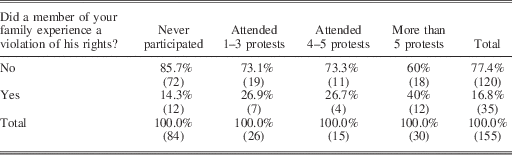
Secondly, first movers were more likely to have a family history of repression. Respondents were asked whether a family member had experienced a past violation of his/her rights. Forty-five (29 per cent) out of 155 responded affirmatively. This high percentage reflects a difference between the sample and the general population. The incidence of repression in Morocco is unknown, but the regime, even in the 1970s, did not widely abuse human rights. If we were to randomly sample the population, we would probably find that the number of respondents with a family member who had been repressed for political activities is quite low. A few affirmative answers were due to an idiosyncratic interpretation of the question. Respondents who answered yes were invited to explain; nine had interpreted the question to include an instance of petty corruption. I discounted those answers and kept only those that described a past experience of police brutality or imprisonment for political activity.Footnote 50 Of those, the modal answer was that a relative had been arrested and imprisoned during the Hassan II era.
The survey data support the hypothesis that first movers came from families with a history of repression. Table 1 presents a cross-tabulation of participation in protest and family experiences of human rights abuse. The first movers are represented in the group that participates at the highest level; they organized the initial protests and continued to protest after participation started declining. The middle categories represent the occasional participants, who attended the first big protests in early 2011. A full 40 per cent of those who participated in more than five protests had a family history of repression, compared to 14 per cent of those who did not participate.Footnote 51
Violation of Family Member’s Human Rights, by Participation
Note: Chi-squared p<.05.
The survey data suggest that it is specifically a history of repression that matters, not a family history of activism in general. Those with activist parents were no more likely to participate than those whose parents were not activists.Footnote 52 Activism did not appear to be a family trait; only those whose parents suffered for their political acts are over-represented among the protesters.
These results include members of activist networks; others outside these networks may respond differently to the same family history. Addressing this possibility requires a research design that begins from the independent variable, sampling those whose families were repressed and examining the conditions under which they do or do not join activist networks. The data suggest two factors that may mediate the impact of family repression on protest initiation. The survey included twelve respondents whose family members had been repressed, but who nevertheless chose not to mobilize during the Arab Spring. None of them belonged to social movement organizations before the Arab Spring. In contrast, those whose families were repressed and who belonged to an organization protested at the highest rates during the 2011 wave. As posited, the effect of family repression may depend on whether it leads to organizational participation before high-risk demonstrations begin.
Secondly, eight of the twelve were either government employees or their fathers were. Dependence on the state for a family’s livelihood is a plausible reason to eschew protesting.Footnote 53 This pattern did not hold for the dataset as a whole, however. Father’s government employment was associated with non-participation only among those whose families were repressed. Post-repression, families who are offered employment may refrain from protesting, but given the small sample size, further testing is required to evaluate this claim.
The data provide initial support for the argument that past repression matters. The difference in the family histories of participants and non-participants is striking because these groups are otherwise quite similar. The survey sampled members of the same social networks. They shared a general dissatisfaction with political life, but first movers were already mobilized into organizations, and many of their families had been victimized by the regime in the past. A family history of repression is not the sole pathway to activism, but those with this history formed a substantial subset of the M20’s first movers. Prior repression may generate a cadre of already-mobilized activists who are prepared to organize protests when an opportunity presents itself.
Facebook Survey Experiment
The previous sections argued that a family history of repression motivated a portion of Moroccan first movers, but they did not address how repression affects occasional participants or non-participants. The Facebook survey provided a platform to supplement observational data with an experimental manipulation designed to consider the effects of repression carried out during the Arab Spring on people who were networked to first movers.
Hypotheses and experimental design
Some non-participants I interviewed cited fear of repression as their main reason for non-involvement. Repression can also signal that success is unlikely, further dampening the desirability of taking to the streets. Yet repression may encourage protest by angering observers and heightening the perceived worthiness of the cause. My survey experiment aimed to evaluate how first movers’ social contacts were affected by repression – did it make them more sympathetic to the cause, or further distance them from committed activists?
Other regime actions can likewise affect potential protesters in either positive or negative ways. The Moroccan regime used two strategies in addition to repression: it tolerated mass protest more than other Arab states, and it offered some concessions. Tolerance could encourage protest by lowering costs, or deter it by reducing grievances. Concessions included jobs for some unemployed youth; these could dampen protest by reducing grievances, or increase it by inducing others to seek similar concessions.
To test the effects of regime behavior on the demand for protest, respondents were randomly assigned to one of three treatment groups or a control group. Treatments included factual questions that informed respondents about the regime’s use of repression, its relative tolerance compared to Syria and Libya, and its concessions to the unemployed (see Table 2).Footnote 54 The control group did not see any cues.
Experimental Questions

After exposure to the treatment, subjects were asked whether they would favor new demonstrations for democratic reform. They indicated their level of support by dragging a slider between ‘oppose’ to ‘support’, with ‘indifferent’ marked in the center.
Results
Subjects in the repression treatment expressed significantly greater support for future protests than the control group. Figure 1 plots the difference of means between the treatment groups and the control group. The point values mark the difference in means between each treatment group and the control group; the bars represent confidence intervals. Although the mean level of support for future protests was higher in the three treatment groups than it was in the control group, the difference was statistically significant only for the repression condition.Footnote 55
Effects of cues on support for protestNote: Difference of means between treatment groups and control group; lines represent 95 percent confidence intervals.

By chance, men were slightly over-represented in the repression treatment. I therefore compared the mean responses for each assignment group by gender; the means for men and women were nearly identical.
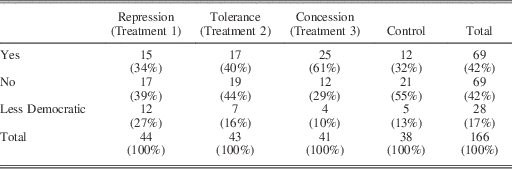
A secondary result helps explain why the repression treatment increased respondents’ support for protest. Respondents were asked about the status of democracy in Morocco over the previous two years. Table 3 presents a cross-tabulation of their responses by treatment group. The majority of the control group reported no change in the level of democracy, as did 40 per cent of those reminded of the regime’s relative tolerance of protest; 61 per cent of respondents in the concession treatment said that democracy had increased. More respondents in the repression treatment estimated that democracy had decreased than in any of the other groups.
Question Response: Do You Think Democracy in Morocco Has Increased over the Last Two Years?
Note: Chi-squared p=0.043.
This result suggests that the experimental manipulation succeeded in affecting respondents’ assessments of the regime. Qualitative interviews and open-ended survey questions indicated that respondents generally believe that protest is a right to be protected, regardless of their own participation. When reminded of repression, 27 per cent of subjects in the treatment group reported a decrease in democracy. Their support for protest may reflect a sense that action is imperative because political conditions have worsened.Footnote 56 Fewer respondents in the other assignment conditions said that democracy had declined; this may explain why they did not report a vital need for new protests.
Discussion
The finding that reminders of repression produced greater support for protest is surprising for three reasons. First, the N is small; for an effect to be significant, it has to be substantively large. Subjects in the repression treatment reported very high levels of support for protest; the median response of treated subjects was maximum support for renewed protest (n=26). Secondly, a non-random sample of activists and their friends (who chose to take a survey on political activism) are likely to already have strong opinions about popular protest, making them difficult to manipulate. Thirdly, it is likely that activists and their friends had already heard about repression and were therefore less susceptible to the treatment.
First movers comprise 29 per cent of the sample and they strongly support future protest, regardless of treatment assignment.Footnote 57 The observed change occurs among respondents who did not already support future protests before taking the survey: it was the non-participants and occasional participants whose support shifted upward.Footnote 58 This study may thus underestimate the effects of repression on those networked with activists; a sample excluding first movers might show a larger change in support.
These findings contribute to understanding the effects of repression on protest, but several caveats must be kept in mind. First, this study examined responses only within activist networks, but repression may affect others differently. Siegel posits that the effects of repression depend on networks; backlash occurs among those connected to people directly affected by repression.Footnote 59 Outside those ties, repression may not generate support for protest.
Secondly, the small sample size and use of a convenience sample limit this study’s external validity. Other studies, however, lend support to the plausibility of the findings. Using both representative and convenience samples, Aytaç et al. find similarly that repression provoked backlash among those who shared the political affiliations of protesters in Turkey, Brazil and Ukraine.Footnote 60
Thirdly, this experiment tested the effects of repression on attitudes, not behavior. This is an intractable problem, given that attempting to manipulate participation would put subjects in danger at a time when protesters in Morocco faced arrests and beatings. Evaluating changes in support for protest remains important, however, because such changes can alter the perceived costs and benefits of opposing the regime. Further, the experience of first movers suggests a way in which support may be channeled into action. Above, I argued that past repression induced future first movers to join social movement organizations; this experience prepared them to take a leading role in 2011. The implication is that attitude change may translate into action only if organizations are able to take advantage of increased support by targeting sympathizers for recruitment. Repression may not induce non-participants to take to the streets, but it may increase their willingness to become politically active in less contentious ways, paving the way for future protest participation. Social movement organizations are aware that repression can generate sympathy and frequently publicize regime repression. Moroccan first movers post photos of activists who have been beaten or tortured on Facebook. My analysis suggests that there is utility in doing so.
CONCLUSION
This article identified one path to first-mover activism: a substantial number of Moroccan first movers’ immediate relatives were political prisoners. This experience prompted them to engage in politics before the Arab Spring; when it arrived, they were ready to lead. The explanatory potential of this argument is broad. Prominent Arab Spring activists in other countries also came from families with a history of imprisonment for political activism – for example, Egypt’s Alaa Abd El Fatah, Tunisia’s Lina Ben Mhenni and Bahrain’s Zainab Al-Khawaja. Alaa Abd El Fatah, writing on first movers in Egypt, describes multiple personal histories that can lead to activism, including ‘witnessing injustice and being motivated either by its memory or by family lore on attempts to resist it.’Footnote 61 Members of the committees that formed to organize the rebellion in Dar’a, Syria often had a history of imprisonment.Footnote 62 In Turkey, Kurdish children attribute their engagement in contentious acts to their parents’ past experience of state violence.Footnote 63 More broadly, this argument contributes to new research that suggests that personal experiences of victimization increase political participation.Footnote 64
A cadre of motivated first movers is crucial for successful mobilization. Despite their importance, we know little about why they act. Their disregard for personal risk and willingness to bear high costs is far more difficult to explain than the behavior of followers who find safety in numbers. This article has sought to initiate theorizing about the factors that encourage the few who are willing to organize and instigate collective action in its early stages. It provides a testable causal logic for a phenomenon that may have multiple causes. Further research is required to assess the argument’s applicability in other settings and to identify other pathways that produce first movers.
This article also identified a second effect of repressing activists: when told about police repression, first movers’ friends increase their support for contentious acts. This finding is important because of the role that social networks play in mass protest. People who are networked to participants are particularly susceptible to mobilization. If repression generates support among first movers’ friends, all else equal, their probability of mobilizing is likely to increase. Once they join, the movement is one step closer to triggering cascades of participation.
Several characteristics of this study suggest both its limitations and its promise for future research. First, Moroccan activists were often beaten or imprisoned. This type of repression is extremely common, but other types may have different effects. The term ‘repression’ groups together vastly different regime tactics, from limits on free speech to violent collective punishment. There is little reason to expect these tactics to generate similar effects.
Secondly, the case-control design, with its focus on the ‘causes of effects’, compares similar participants and non-participants; it does not assess ‘effects of causes’, which would require starting with variation in family repression and following its consequences. The obstacles to such an approach are immense, but if it were feasible, it could provide an estimate of how often prior family repression leads to first-mover activism.Footnote 65 My research does not estimate the effect of family repression in the general population; it focuses on an atypical subgroup. Heterogeneous effects are possible; repression could interact with other factors and deter rather than encourage those outside the networks sampled here from engaging in collective action. Future work to assess how and whether the effects of personal experiences of repression vary across population subgroups is a useful next step. Attention to how groups in different networks, locations and social classes respond to repression can help address unresolved theoretical and empirical questions.



