Impact statement
To improve the future life chances of young people from economically deprived backgrounds, we need policies and interventions which target key mechanisms underlying the pathways between poverty and future life chances – in particular, ones which consider youth mental health, which plays a key role in this relationship. Mental health is inextricably linked to both poverty and future life chances, in a vicious cycle. Poverty can lead to poorer mental health, which reduces opportunities and increases the risk of lifetime poverty. Cash transfer programmes are one of the most common strategies to reduce poverty reaching substantial proportions of populations living in low- and middle-income countries. Because of their rapid expansion in response to the COVID-19 pandemic, they have recently gained even more importance. More recently, there have been suggestions that these cash transfers might improve youth mental health, disrupting the cycle of disadvantage at a critical period of life. Here, we present a conceptual framework describing potential mechanisms by which cash transfer programmes could improve the mental health and life chances of young people. Furthermore, we explore how theories from behavioural economics and cognitive psychology could be used to more specifically target these mechanisms and optimise the impact of cash transfers on youth mental health and life chances. Based on this, we identify several lines of enquiry and action for future research and policy.
Introduction
The majority (61%) of the world’s poor are under 24 years of age (Robles Aguilar and Sumner, Reference Robles Aguilar and Sumner2020). Young people living in poverty are disadvantaged across a range of both short- and long-term outcomes (National Academies of Sciences, Engineering, and Medicine, Reference Bonnie and Backes2019), including decreased future life chances in relation to health, education, relationships and employment, and increased risk of criminal activity. With an additional 97 million people living in poverty in 2020 as a consequence of the COVID-19 pandemic (Gerszon Mahler et al., Reference Gerszon Mahler, Yonzan, Lakner, Castaneda Aguilar and Wu2021), a new youth cohort is at increased risk of damaged future life chances.
Mental health is an influential factor intertwined with both poverty (Lund et al., Reference Lund, Brooke-Sumner, Baingana, Baron, Breuer, Chandra, Haushofer, Herrman, Jordans, Kieling, Medina-Mora, Morgan, Omigbodun, Tol, Patel and Saxena2018) and future life chances such as education, skills, labour market attachment and social function (Richards et al., Reference Richards, Abbott, Collis, Hackett, Hotopf, Kuh, Jones, Maughan and Parsonage2009). Mental health is defined not only as an absence of mental disorders, but as an asset or a resource that enables positive states of well-being and provides the capability to achieve one’s full potential (Patel et al., Reference Patel, Saxena, Lund, Thornicroft, Baingana, Bolton, Chisholm, Collins, Cooper, Eaton, Herrman, Herzallah, Huang, Jordans, Kleinman, Medina-Mora, Morgan, Niaz, Omigbodun and UnÜtzer2018). Improving young people’s mental health can facilitate future life chances and decrease the risk of continuing to live in poverty (Richards et al., Reference Richards, Abbott, Collis, Hackett, Hotopf, Kuh, Jones, Maughan and Parsonage2009; Killackey et al., Reference Killackey, Hodges, Browne, Gow, Varnum, McGorry and Purcell2020). Conversely, depression in young people increases likelihood of school failure and reduces chances of future employment and earnings (Clayborne et al., Reference Clayborne, Varin and Colman2019), while youth with conduct problems can cost 10 times more than those without conduct problems because of higher violent offending, drug use, teenage pregnancy and school dropout (Scott, Reference Scott, Thapar, Pine, Leckman, Scott, Snowling and Taylor2015). At the same time, poverty also leads to poor mental health. Young people from economically deprived backgrounds face multiple forms of cumulative disadvantage which significantly limit their life chances and put them at higher risk of mental disorders (Duncan et al., Reference Duncan, Yeung, Brooks-Gunn and Smith1998; Ludwig and Miller, Reference Ludwig and Miller2007; Lund et al., Reference Lund, de Silva, Plagerson, Cooper, Chisholm, Das, Knapp and Patel2011).
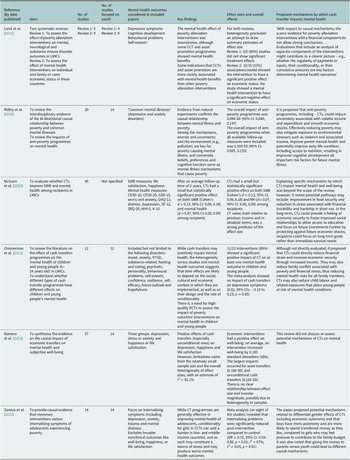
Since the 1990s, cash transfer programmes have been widely adopted as a strategy to reduce poverty in low- and middle-income countries (LMICs) (The World Bank, 2018; International Labour Organisation, 2021). Since then, growing research has explored whether these cash transfers might improve youth mental health, disrupting the cycle of disadvantage at a critical period of life (Paxson and Schady, Reference Paxson and Schady2010; Lund et al., Reference Lund, de Silva, Plagerson, Cooper, Chisholm, Das, Knapp and Patel2011; Ridley et al., Reference Ridley, Rao, Schilbach and Patel2020). Some evidence suggests there may be a positive, albeit modest, relationship between cash transfer receipt and improved mental health (see Table 1). Nonetheless, giving money alone does not necessarily lead to better mental health or improved life chances (McGuire et al., Reference McGuire, Kaiser and Bach-Mortensen2020; Ziebold et al., Reference Ziebold, Paula, Santos, Barros, Munhoz, Lund, McDaid, Araya, Bauer, Garman, Park, Zimmerman, Hessel, Avendaño, Evans-Lacko and Matijasevich2021; Garman et al., Reference Garman, Eyal, Avendano, Evans-Lacko and Lund2022) and some data suggest there can be unintended effects (Fisher et al., Reference Fisher, Attah, Barca, O’Brien, Brook, Holland, Kardan, Pavanello and Pozarny2017) leading to changes in social relations (MacAuslan and Riemenschneider, Reference MacAuslan and Riemenschneider2011) and feelings of unfairness which could worsen mental health (Pavanello et al., Reference Pavanello, Watson, Onyango-Ouma and Bukuluki2016).
Table 1.
Summary of key systematic reviews and meta-analyses linking cash transfer impacts on mental health
Some of the heterogeneity in findings may be related to the diverse mechanisms by which cash transfers work. Understanding how cash transfer programme characteristics relate to youth mental health, either directly, or indirectly through, for example, changes in parental or youth behaviour, could help us understand how we might better optimise the design and implementation of cash transfer programmes to improve mental health and thus youth life chances – with the potential for wider social and economic benefits (McDaid and Evans-Lacko, Reference McDaid and Evans-Lacko2021).
Here, we present a conceptual framework and discuss potential mediating factors by which cash transfer programmes could improve the mental health and life chances of young people. Poverty and mental health are intertwined in a complex bidirectional relationship and indeed, some authors have argued that there is a bi-directional causal relationship between poverty and mental health (Ridley et al., Reference Ridley, Rao, Schilbach and Patel2020). Although the field is still in its infancy, there is growing evidence that at least some thresholds for causality have been crossed. Here, we focus on one piece of the puzzle: the potential for anti-poverty interventions to improve youth mental health. Furthermore, we explore how theories from behavioural economics and cognitive psychology could be used to more specifically target these mediators and optimise the impact of cash transfers on youth mental health and life chances. Our conceptual framework builds on seven existing reviews which examine the impact of cash transfers on mental health (see Table 1). We use the framework described by Ridley et al. (Reference Ridley, Rao, Schilbach and Patel2020) as a starting point. Their paper provides a useful discussion of the individual-level pathways by which anti-poverty programmes affect mental health and some discussion about how contextual factors also have an impact and may therefore moderate the influence of cash transfers on mental health. For example, they highlight worries and uncertainty, environmental factors, physical health, early-life conditions, trauma, violence and crime, and social status, shame and isolation. Building on this, we take into account other recent related reviews and frameworks which discuss the social determinants of mental health, and which highlight additional societal-level mechanisms which may mediate or moderate the relationship between cash transfers, youth mental health and future life chances. For example, we know macro-level factors such as social capital, social cohesion, income inequality and macro-economic shocks can influence mental health (Stuckler et al., Reference Stuckler, Basu, Suhrcke, Coutts and McKee2009; Ehsan and de Silva, Reference Ehsan and de Silva2015; Ribeiro et al., Reference Ribeiro, Bauer, Andrade, York-Smith, Pan, Pingani, Knapp, Coutinho and Evans-Lacko2017; Lund et al., Reference Lund, Brooke-Sumner, Baingana, Baron, Breuer, Chandra, Haushofer, Herrman, Jordans, Kieling, Medina-Mora, Morgan, Omigbodun, Tol, Patel and Saxena2018; Patel et al., Reference Patel, Burns, Dhingra, Tarver, Kohrt and Lund2018) and research also suggests that cash transfer programmes also influence these societal level outcomes (Veras Soares et al., Reference Veras Soares, Soares, Medeiros and Guerreiro Osório2006; Bastagli, Reference Bastagli2010; Loureiro, Reference Loureiro2012; McKnight, Reference McKnight2015; Drucza, Reference Drucza2016; Machado et al., Reference Machado, Rodrigues, Rasella, Lima Barreto and Araya2018; Breckin, Reference Breckin2019). Based on this, we identify several lines of enquiry and action for future research and policy.
How might cash transfers influence youth mental health and life chances?
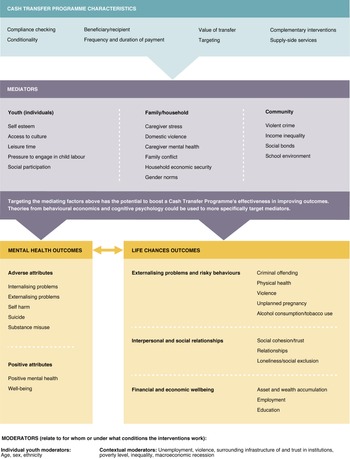
Figure 1 depicts the hypothesised relationships between cash transfer programmes, youth mental health and life chances outcomes. It identifies potential mediators which could optimise the impact of cash transfer programmes for youth mental health and in turn lead to improved life chances. For this paper, we conceptualise life chances as social and economic opportunities available to someone depending on their circumstances or context (Roth, Reference Roth1981; Evans et al., Reference vans, Behrens and Kaluza2000) and which are shaped by structural factors. Based on previous work of Richards et al. (Reference Richards, Abbott, Collis, Hackett, Hotopf, Kuh, Jones, Maughan and Parsonage2009) on youth mental health and life chances, we focus on life chances related to education, skills and labour market attachment and social function. The framework is relevant for young people aged 10 to 24 years. We select this age group and exclude very young children so that we can focus more on targeted mechanisms present in young people and adolescents. This is in line with more recent definitions of adolescence and young people which extend to a slightly older age as this reflects better current understanding of patterns of adolescent development (Patton et al., Reference Patton, Sawyer, Santelli, Ross, Afifi, Allen, Arora, Azzopardi, Baldwin, Bonell, Kakuma, Kennedy, Mahon, McGovern, Mokdad, Patel, Petroni, Reavley, Taiwo, Waldfogel, Wickremarathne, Barroso, Bhutta, Fatusi, Matto, Diers, Fang, Ferguson, Ssewamala and Viner2016). Furthermore, this also represents the age group for which mental disorders represent the primary cause of disability worldwide (Armocida et al., Reference Armocida, Monasta, Sawyer, Bustreo, Segafredo, Castelpietra, Ronfani, Pasovic and Hay2022).
Figure 1.
The influence of cash transfer programmes on youth mental health and life chances and potential mechanisms for optimising youth outcomes.
Cash transfer programme characteristics
Cash transfer programmes vary in relation to a number of characteristics including the transfer value, frequency and duration of money provided; presence and rigidity of conditionalities; compliance checking (including benefit restrictions); targeting (who receives the money in the household and eligibility restrictions); payment mechanisms for how the cash is accessed and supply-side services. All of these characteristics may affect whether or not, and to what degree, cash transfers affect youth mental health. For example, a recent meta-analysis suggests that the value of the cash transfer, both in relation to previous income and in absolute terms, is a strong predictor of the size of the effect on recipient’s mental health (McGuire et al., Reference McGuire, Kaiser and Bach-Mortensen2022).
Youth mediators
There are a number of potential youth mediators through which cash transfers could indirectly influence youth mental health. In Malawi, young people reported being ashamed to go out in old, tattered clothing and the increased expenditure enabled by cash transfers allowed them to buy clothing and thereby improve self-esteem (Baird et al., Reference Baird, Ferreira, Özler and Woolcock2013). Reduced shame and increased self-esteem may also lead to increased participation in social (MacPhail et al., Reference MacPhail, Khoza, Selin, Julien, Twine, Wagner, Goméz-Olivé, Kahn, Wang and Pettifor2018; Bastagli et al., Reference Bastagli, Hagen-Zanker, Harman, Barca, Sturge and Schmidt2019; Pozuelo et al., Reference Pozuelo, Stein, S-J, Kahn, Dercon and Pettifor2020) and cultural activities and improved confidence and status in peer networks, which hence impact on mental health. Cash transfers are also associated with a reduction in forced child labour (Bastagli et al., Reference Bastagli, Hagen-Zanker, Harman, Barca, Sturge and Schmidt2019), particularly with reduced intensity of labour and/or number of hours worked, which may previously have provided an economic cushion for households.
Family/household mediators
At the family/household level, cash transfers, particularly when given to the female head of the household, can lead to improvements in well-being of its members and reductions in household stress and conflict (Bardasi and Garcia, Reference Bardasi and Garcia2015). Lower caregiver stress resulting from cash transfer receipt may decrease the need to call upon negative coping strategies, such as alcohol consumption, and reduce domestic violence (Borraz and Munyo, Reference Borraz and Munyo2020; Ohrnberger et al., Reference Ohrnberger, Anselmi, Fichera and Sutton2020), thereby improving youth mental health (Costello et al., Reference Costello, Erkanli, Copeland and Angold2010). Increased household economic security and emotional well-being directly resulting from the infusion of cash can also lead to improved youth mental health (Buller et al., Reference Buller, Peterman, Ranganathan, Bleile, Hidrobo and Heise2018; Eyal and Burns, Reference Eyal and Burns2019). Cash transfer programmes can also reduce financial arguments between parents and improve financial coping strategies. Targeting cash transfer programmes at mothers may also increase their self-esteem and perceived value in the household. There is, however, some evidence of unintended consequences for the last two pathways suggesting that gender norms and dynamics in the community or household should be taken into account in relation to how the cash transfer is framed, particularly so that the male head of household does not feel that their role or control of finances is threatened (Buller et al., Reference Buller, Peterman, Ranganathan, Bleile, Hidrobo and Heise2018). For example, a randomised controlled trial (RCT) of a cash and in-kind food transfer programme in Ecuador reduced physical and sexual violence by 30%. It was suggested that linking the transfer to child nutrition was important as this was perceived to be the mothers’ responsibility and men did not feel challenged (Hidrobo et al., Reference Hidrobo, Peterman and Heise2016).
Community mediators
Although cash transfer programmes are targeted at individuals or households, impacts on youth and families can aggregate into macro level effects on communities. Cash transfer programmes provide an income boost to the poorest individuals and can thus reduce poverty and narrow income inequality (Veras Soares et al., Reference Veras Soares, Soares, Medeiros and Guerreiro Osório2006; Bastagli, Reference Bastagli2010; McKnight, Reference McKnight2015). Cash transfer programmes may also lead to reductions in community violence and social exclusion (Drucza, Reference Drucza2016), partly through increased social trust and strengthening social bonds. Reduced poverty and income-inequality (Loureiro, Reference Loureiro2012) and stronger social bonds (Breckin, Reference Breckin2019) have all been posed as pathways whereby cash transfers can reduce community violence (Machado et al., Reference Machado, Rodrigues, Rasella, Lima Barreto and Araya2018). Given the importance of poverty, income inequality and community violence as social determinants of mental health (Lund et al., Reference Lund, Brooke-Sumner, Baingana, Baron, Breuer, Chandra, Haushofer, Herrman, Jordans, Kieling, Medina-Mora, Morgan, Omigbodun, Tol, Patel and Saxena2018), these represent other potentially important pathways by which cash transfers could impact youth mental health and life chances.
Many of these potential mediators at the community level also represent contextual factors, which could act as effect modifiers. For example, homicide rates and income inequality which are linked with mental health are also reduced by cash transfer programmes (Machado et al., Reference Machado, Rodrigues, Rasella, Lima Barreto and Araya2018). Thus, the effects of cash transfers may also vary according to the presence of contextual factors including relative poverty and disadvantage, levels of income inequality, violence and unemployment (Owusu-Addo et al., Reference Owusu-Addo, Renzaho and Smith2018). Moreover, where conditionalities are included, for example, based on school attendance (one of the most common conditionalities), effects on youth mental health may depend on a range of contextual variables including school quality, costs of attending school, presence of bullying and academic performance.
Mental health and consequences for life chances
There is a good deal of evidence that improved youth mental health is associated with more positive life chances outcomes, including for physical health (Thompson et al., Reference Thompson, Richards, Ploubidis, Fonagy and Patalay2021), education (Dalsgaard et al., Reference Dalsgaard, McGrath, Østergaard, Wray, Pedersen, Mortensen and Petersen2020; Hoffmann et al., Reference Hoffmann, McDaid, Salum, Silva-Ribeiro, Ziebold, King, Gadelha, Miguel, JdeJ, Rohde, Pan, Bressan, Mojtabai and Evans-Lacko2021) and employment (Thompson et al., Reference Thompson, Richards, Ploubidis, Fonagy and Patalay2021), in the short-term and through to mid-life. The potential for cash transfers to influence mental health and life chances could thus facilitate a virtuous cycle. Youth emotional and behavioural problems independently predict outcomes in adult life, such as social class and social adjustment (Caspi et al., Reference Caspi, Houts, Ambler, Danese, Elliott, Hariri, Harrington, Hogan, Poulton, Ramrakha, Rasmussen, Reuben, Richmond-Rakerd, Sugden, Wertz, Williams and Moffitt2020; Laceulle et al., Reference Laceulle, Chung, Vollebergh and Ormel2020; Thompson et al., Reference Thompson, Richards, Ploubidis, Fonagy and Patalay2021). In particular, youth externalising problems such as conduct problems are more strongly associated with poor life chances over the lifetime in comparison with internalising problems (Richards et al., Reference Richards, Abbott, Collis, Hackett, Hotopf, Kuh, Jones, Maughan and Parsonage2009; Knapp and Evans-Lacko, Reference Knapp, Evans-Lacko, Thapar, Pine, Leckman, Scott, Snowling and Taylor2015; Hammerton et al., Reference Hammerton, Murray, Maughan, Barros, Gonçalves, Menezes, Wehrmeister, Hickman and Heron2019). Finally, analysis across the 1946, 1958 and 1970 British birth cohorts (Colman et al., Reference Colman, Murray, Abbott, Maughan, Kuh, Croudace and Jones2009; Richards et al., Reference Richards, Abbott, Collis, Hackett, Hotopf, Kuh, Jones, Maughan and Parsonage2009; Caspi et al., Reference Caspi, Houts, Ambler, Danese, Elliott, Hariri, Harrington, Hogan, Poulton, Ramrakha, Rasmussen, Reuben, Richmond-Rakerd, Sugden, Wertz, Williams and Moffitt2020; Gronholm et al., Reference Gronholm, Knapp, Brimblecombe, Maughan, Richards, Bonin, Hoffmann, Kadel, King, Hoomans, O’Shea and Evans-Lacko2022) found that childhood conduct problems were associated with lower educational qualifications, persistent economic inactivity, lower earnings and increased criminal convictions and arrests.
Could more attention to mechanisms in the design and implementation of cash transfer programmes improve youth mental health outcomes?
Although evidence suggests there is potential for cash transfer programmes to improve youth mental health (Zimmerman et al., Reference Zimmerman, Garman, Avendano-Pabon, Araya, Evans-Lacko, McDaid, Park, Hessel, Diaz, Matijasevich, Ziebold, Bauer, Paula and Lund2021), cash transfers are not a panacea and on their own tend to be a relatively ‘blunt’ instrument, which, while providing additional financial resources to the household, were never designed to improve youth mental health. Because cash transfer programmes do not necessarily address the mechanisms by which poverty undermines mental health, we may not fully realise the potential of these programmes to impact youth mental health. More attention to the cognitive, affective, behavioural and contextual barriers at the youth, family and community levels in the design and implementation of cash transfers could potentiate their benefits for youth mental health and life chances.
Theories from behavioural economics and cognitive psychology can offer some useful insights about behaviour change which could inform the operation of cash transfer programme policies to improve youth mental health and life chances (Gennetian et al., Reference Gennetian, Shafi, Aber and de Hoop2021). Behavioural economics would suggest that we use positive reinforcement to incentivise desired behaviours rather than punishments or mandates (or rigid conditionalities) which penalise individuals who do not comply with specified conditions or policies and may undermine youth mental health (Thaler and Sunstein, Reference Thaler and Sunstein2008). Nudge theory, fresh start effects and thinking slow, for example, have been explored in other studies and may offer potentially useful ideas about how cash transfer programmes could facilitate youth mental health and life chances. We summarise the considerations for potential design and implementation strategies here.
Nudge theory posits that the choice architecture shaping one’s environment and the framing of decisions can positively influence decision-making, allowing individuals to make better decisions in line with their goals (Thaler and Sunstein, Reference Thaler and Sunstein2008). A key facet of this theory is that individuals need to maintain some feeling of control or autonomy in their decision and that the desired behaviour is positively incentivised rather than mandated or enforced. Some of the cognitive and affective consequences of poverty may make it difficult for people to be intentional with their spending and align it with future goals and aspirations and hence limit life chances. Poverty, for instance, is hypothesised to reduce executive functioning, thus increasing future discounting, impairing decision-making, and inducing negative affective states such as anxiety and depression (Haushofer and Fehr, Reference Haushofer and Fehr2014). Given the cognitive burden that individuals living in poverty already face, complex administrative procedures and rigid conditionalities which penalise individuals for not meeting required conditions may also lead to increased household stress and reduce feelings of self-efficacy, subsequently negatively impacting on caregiver and youth mental health and life chances (Baird et al., Reference Baird, de Hoop and Özler2013). During the COVID-19 pandemic, many programmes have become more flexible with administrative procedures and also relaxed conditionalities providing a template for testing alternatives (Bauer et al., Reference Bauer, Garman, McDaid, Avendano, Hessel, Díaz, Araya, Lund, Malvasi, Matijasevich, Park, Paula, Ziebold, Zimmerman and Evans-Lacko2021).
Spending decisions could also be aided by framing messages about what the cash is for and what could be done with it. For example, a labelled cash transfer programme in Morocco which was framed as an education support programme, improved parents’ beliefs about the value of education and greatly increased school participation (Benhassine et al., Reference Benhassine, Devoto, Duflo, Dupas and Pouliquen2015). Messaging around how the cash could be used to target mediating factors important for youth mental health such as social participation or access to culture could lead to greater impacts on youth mental health.
Fresh start effects and temporal landmarks can also be used to motivate aspirational behaviour (Dai et al., Reference Dai, Milkman and Riis2014). In line with this theory, days or events can be identified or framed as a fresh start moment – a period when individuals tend to be more open and interested in striving to achieve goals or ambitions. Research suggests that identifying set days such as birthdays or a new year could act as a fresh start; cash transfer programmes could recognise the timing of the cash transfer delivery as a window by which individuals may be more open to long-term planning and thus potentially more successful at overcoming the various barriers that they face. One cash transfer programme from Madagascar, for example, supports mothers who are the recipients of the cash transfer to consider longer-term planning around expenses and provides positive incentives around investment just before they receive the monthly payments (Vermehren et al., Reference Vermehren, Ravelosoa and Rawlings2019). This type of timed nudging may break the cycle whereby individuals tend to consider immediate expenses and could also engender a feeling of self-efficacy and self-control.
Finding ways to incorporate thinking slow and deliberately rather than thinking fast and automatically (Kahneman, Reference Kahneman2011; Heller et al., Reference Heller, Shah, Guryan, Ludwig, Mullainathan and Pollack2017), could reduce impulsivity and allow individuals to be more considered in their reactions to various situations and events, particularly challenging ones which could lead to conflict and harm youth mental health and life chances. We know that youth living in poverty face several environmental and contextual challenges including high levels of violence, family instability, high levels of unemployment and poor quality schools. These factors are associated with increased mental health problems and likely reduce the potential for cash transfer programmes to improve mental health and life chances. In particular, ‘cash plus’ programmes might offer cognitive behavioural therapy (CBT) or other types of psychological support which could help youth and parents of youth to learn strategies for thinking more slowly and deliberately. For example, combining cash transfers with CBT reduced disruptive behaviour problems among young men involved in criminal activities in Liberia (Blattman et al., Reference Blattman, Jamison and Sheridan2017) more effectively than either intervention on its own.
While integrating theories from economics and cognitive psychology represents a promising approach, more research is needed to better understand cash transfer design and implementation factors in relation to youth mental health and how the contextual characteristics of population and setting may mediate and/or moderate outcomes (Skivington et al., Reference Skivington, Matthews, Simpson, Craig, Baird, Blazeby, Boyd, Craig, French, McIntosh, Petticrew, Rycroft-Malone, White and Moore2021). For example, a recent trial in Kenya did not find an interaction between psychotherapy (in this case, problem management plus [PM+]) and cash transfer receipt. Moreover, at 12 months follow-up, when looking at each intervention on its own, only those receiving the cash transfer had positive impacts on mental health. Given the large amount of evidence demonstrating positive impacts of psychosocial interventions in low resource settings (Barbui et al., Reference Barbui, Purgato, Abdulmalik, Acarturk, Eaton, Gastaldon, Gureje, Hanlon, Jordans, Lund, Nosè, Ostuzzi, Papola, Tedeschi, Tol, Turrini, Patel and Thornicroft2020), this suggests that we need a better understanding of how these complex combined interventions work together and how they interact with those who are receiving the intervention, the context in which it is delivered and what interventions might be needed to potentiate positive impacts.
Future directions for research and policy
The impacts of cash transfer programmes can go beyond those of their specific objectives. Providing cash transfers to a household as a means of reducing poverty could also improve youth mental health through a range of individual youth, family/caregiver and community mediators. Nonetheless, cash transfer programmes alone are likely to be insufficient to improve youth mental health and life chances (Dai et al., Reference Dai, Milkman and Riis2014; Zimmerman et al., Reference Zimmerman, Garman, Avendano-Pabon, Araya, Evans-Lacko, McDaid, Park, Hessel, Diaz, Matijasevich, Ziebold, Bauer, Paula and Lund2021). To more effectively improve youth mental health and life chances outcomes, more specific targeting of youth mental health and associated mechanisms need to be incorporated into programme design and implementation. This requires better understanding of the potential mechanisms along the pathway to improved youth mental health and life chances and consideration of behavioural economics and cognitive theories.
To address these questions, future research could consider three avenues of enquiry: (I) Greater attention could be given to conducting mediation and moderation analysis to examine the mechanisms by which cash transfer programmes improve youth mental health, in particular considering how these interventions may interact with individual youth, household and community contextual characteristics. Thus, evaluations should also acknowledge the complexity in the relationship between poverty and mental health, which may vary substantially depending on the mental health condition and the specific contextual characteristics of poverty (Dandona et al., Reference Dandona, Kumar, Dhaliwal, Naghavi, Vos, Shukla, Vijayakumar, Gururaj, Thakur, Ambekar, Sagar, Arora, Bhardwaj, Chakma, Dutta, Furtado, Glenn, Hawley, Johnson, Khanna, Kutz, Mountjoy-Venning, Muraleedharan, Rangaswamy, Varghese, Varghese, Reddy, CJL, Swaminathan and Dandona2018; Mor et al., Reference Mor, Ahluwalia and Atmavilas2018; Juárez et al., Reference Juárez, Honkaniemi, Dunlavy, Aldridge, Barreto, Katikireddi and Rostila2019). Some contextual factors such as urbanicity may act as both risk and protective factors for mental health conditions (Solmi et al., Reference Solmi, Dykxhoorn, Kirkbride, Okkels, Kristiansen and Munk-Jørgensen2017) and the nuances of these potential moderators could help us better understand the role of cash transfers to improve youth mental health. This requires using large longitudinal cohorts which assess youth and parent factors, linked with other contextual community data. (II) Consideration could be given to a wider range of mental health outcomes which may be impacted by cash transfers. Existing evaluations which have considered mental health tend to focus on depressive symptoms or psychological distress with less investigation of impacts on externalising problems such as conduct disorder. Moreover, in addition to pathological aspects of mental health problems, mental health should be considered as a continuum, including measurement of functioning, self-efficacy and well-being (Westerhof and Keyes, Reference Westerhof and Keyes2010; Patel et al., Reference Patel, Burns, Dhingra, Tarver, Kohrt and Lund2018) which can be important for capabilities (Sen, Reference Sen2009). (III) Strategic multidisciplinary collaborations are needed to facilitate understanding of the complex pathways by which cash transfers interact to influence youth mental health and life chances. Bringing together researchers from economics, social science, anthropology, psychology and neuroscience can facilitate data collection, analysis and interpretation of the social, economic and neurobiological determinants of mental health and associated life chances.
In relation to policy: (I) Further work should be done to design cash transfer programmes that target mechanisms which specifically support youth mental health and well-being or an evaluation which also considers broader social and mental health impacts on youth (MacAuslan and Riemenschneider, Reference MacAuslan and Riemenschneider2011; Fisher et al., Reference Fisher, Attah, Barca, O’Brien, Brook, Holland, Kardan, Pavanello and Pozarny2017). (II) To be most effective, cash transfer programmes should consider the underlying sociocultural, economic and political context and framing conditionalities which are sensitive to that context; for example, by relaxing restrictions and conditionalities during the COVID-19 pandemic (Bauer et al., Reference Bauer, Garman, McDaid, Avendano, Hessel, Díaz, Araya, Lund, Malvasi, Matijasevich, Park, Paula, Ziebold, Zimmerman and Evans-Lacko2021). (III) ‘Cash transfer plus’ programmes should be considered by policy makers, incorporating evidence-based youth mental health treatment or prevention interventions into cash transfer programmes. These types of programme developments may require piloting to reduce any unintended effects (e.g., so as not to highlight the connection between poverty and mental health problems in a way that could increase prejudice or internalised stigma of beneficiaries in a cash ‘plus’ programme). Moreover, additional costs and benefits should be weighed carefully given the reality of constrained resources. For example, we acknowledge that there is a risk to investing in cash transfer ‘plus’ programmes without essential complementary services such as free basic healthcare, education and social services, especially in LMICs where these are typically under-resourced and this should be further considered when piloting and evaluating new strategies.
Cash transfer programmes are likely to continue to be used in many countries for the foreseeable future, regardless of how effective they are for mental health. Thus, it is important to try to understand how to potentiate their benefits for youth mental health alongside other actions to improve mental health. In this vein, it is important to consider how we might incorporate youth mental health promotion, prevention (World Health Organization, 2020) and treatment interventions to complement cash transfer programmes and more specifically target youth mental health and associated mechanisms (Dai et al., Reference Dai, Milkman and Riis2014).






 Open access


Impact statement
To improve the future life chances of young people from economically deprived backgrounds, we need policies and interventions which target key mechanisms underlying the pathways between poverty and future life chances – in particular, ones which consider youth mental health, which plays a key role in this relationship. Mental health is inextricably linked to both poverty and future life chances, in a vicious cycle. Poverty can lead to poorer mental health, which reduces opportunities and increases the risk of lifetime poverty. Cash transfer programmes are one of the most common strategies to reduce poverty reaching substantial proportions of populations living in low- and middle-income countries. Because of their rapid expansion in response to the COVID-19 pandemic, they have recently gained even more importance. More recently, there have been suggestions that these cash transfers might improve youth mental health, disrupting the cycle of disadvantage at a critical period of life. Here, we present a conceptual framework describing potential mechanisms by which cash transfer programmes could improve the mental health and life chances of young people. Furthermore, we explore how theories from behavioural economics and cognitive psychology could be used to more specifically target these mechanisms and optimise the impact of cash transfers on youth mental health and life chances. Based on this, we identify several lines of enquiry and action for future research and policy.
Introduction
The majority (61%) of the world’s poor are under 24 years of age (Robles Aguilar and Sumner, Reference Robles Aguilar and Sumner2020). Young people living in poverty are disadvantaged across a range of both short- and long-term outcomes (National Academies of Sciences, Engineering, and Medicine, Reference Bonnie and Backes2019), including decreased future life chances in relation to health, education, relationships and employment, and increased risk of criminal activity. With an additional 97 million people living in poverty in 2020 as a consequence of the COVID-19 pandemic (Gerszon Mahler et al., Reference Gerszon Mahler, Yonzan, Lakner, Castaneda Aguilar and Wu2021), a new youth cohort is at increased risk of damaged future life chances.
Mental health is an influential factor intertwined with both poverty (Lund et al., Reference Lund, Brooke-Sumner, Baingana, Baron, Breuer, Chandra, Haushofer, Herrman, Jordans, Kieling, Medina-Mora, Morgan, Omigbodun, Tol, Patel and Saxena2018) and future life chances such as education, skills, labour market attachment and social function (Richards et al., Reference Richards, Abbott, Collis, Hackett, Hotopf, Kuh, Jones, Maughan and Parsonage2009). Mental health is defined not only as an absence of mental disorders, but as an asset or a resource that enables positive states of well-being and provides the capability to achieve one’s full potential (Patel et al., Reference Patel, Saxena, Lund, Thornicroft, Baingana, Bolton, Chisholm, Collins, Cooper, Eaton, Herrman, Herzallah, Huang, Jordans, Kleinman, Medina-Mora, Morgan, Niaz, Omigbodun and UnÜtzer2018). Improving young people’s mental health can facilitate future life chances and decrease the risk of continuing to live in poverty (Richards et al., Reference Richards, Abbott, Collis, Hackett, Hotopf, Kuh, Jones, Maughan and Parsonage2009; Killackey et al., Reference Killackey, Hodges, Browne, Gow, Varnum, McGorry and Purcell2020). Conversely, depression in young people increases likelihood of school failure and reduces chances of future employment and earnings (Clayborne et al., Reference Clayborne, Varin and Colman2019), while youth with conduct problems can cost 10 times more than those without conduct problems because of higher violent offending, drug use, teenage pregnancy and school dropout (Scott, Reference Scott, Thapar, Pine, Leckman, Scott, Snowling and Taylor2015). At the same time, poverty also leads to poor mental health. Young people from economically deprived backgrounds face multiple forms of cumulative disadvantage which significantly limit their life chances and put them at higher risk of mental disorders (Duncan et al., Reference Duncan, Yeung, Brooks-Gunn and Smith1998; Ludwig and Miller, Reference Ludwig and Miller2007; Lund et al., Reference Lund, de Silva, Plagerson, Cooper, Chisholm, Das, Knapp and Patel2011).
Since the 1990s, cash transfer programmes have been widely adopted as a strategy to reduce poverty in low- and middle-income countries (LMICs) (The World Bank, 2018; International Labour Organisation, 2021). Since then, growing research has explored whether these cash transfers might improve youth mental health, disrupting the cycle of disadvantage at a critical period of life (Paxson and Schady, Reference Paxson and Schady2010; Lund et al., Reference Lund, de Silva, Plagerson, Cooper, Chisholm, Das, Knapp and Patel2011; Ridley et al., Reference Ridley, Rao, Schilbach and Patel2020). Some evidence suggests there may be a positive, albeit modest, relationship between cash transfer receipt and improved mental health (see Table 1). Nonetheless, giving money alone does not necessarily lead to better mental health or improved life chances (McGuire et al., Reference McGuire, Kaiser and Bach-Mortensen2020; Ziebold et al., Reference Ziebold, Paula, Santos, Barros, Munhoz, Lund, McDaid, Araya, Bauer, Garman, Park, Zimmerman, Hessel, Avendaño, Evans-Lacko and Matijasevich2021; Garman et al., Reference Garman, Eyal, Avendano, Evans-Lacko and Lund2022) and some data suggest there can be unintended effects (Fisher et al., Reference Fisher, Attah, Barca, O’Brien, Brook, Holland, Kardan, Pavanello and Pozarny2017) leading to changes in social relations (MacAuslan and Riemenschneider, Reference MacAuslan and Riemenschneider2011) and feelings of unfairness which could worsen mental health (Pavanello et al., Reference Pavanello, Watson, Onyango-Ouma and Bukuluki2016).
Summary of key systematic reviews and meta-analyses linking cash transfer impacts on mental health
Abbreviations: CCT, conditional cash transfer; CESD, Centre for Epidemiologic Studies Depression Scale; CI, confidence interval; CT, cash transfer; CTP, cash transfer programme; GDS, Geriatric Depression Scale; GHQ, General Health Questionnaire; I 2, statistic describing the percentage of variation across studies that is due to heterogeneity rather than chance; K-10, Kessler Psychological Distress Scale; LMICs, low- and middle-income countries; MHI-5, 5-Question Mental Health Inventory; PPP, purchasing power parity; PTSD, post-traumatic stress disorder; RCT, randomised controlled trial; SF-12, 12-Item Short Form Survey; SRQ-20, 20-Item Self Reporting Questionnaire; SWB, subjective wellbeing.
* Mental health outcome assessed among youth participants (aged 10–24)
Some of the heterogeneity in findings may be related to the diverse mechanisms by which cash transfers work. Understanding how cash transfer programme characteristics relate to youth mental health, either directly, or indirectly through, for example, changes in parental or youth behaviour, could help us understand how we might better optimise the design and implementation of cash transfer programmes to improve mental health and thus youth life chances – with the potential for wider social and economic benefits (McDaid and Evans-Lacko, Reference McDaid and Evans-Lacko2021).
Here, we present a conceptual framework and discuss potential mediating factors by which cash transfer programmes could improve the mental health and life chances of young people. Poverty and mental health are intertwined in a complex bidirectional relationship and indeed, some authors have argued that there is a bi-directional causal relationship between poverty and mental health (Ridley et al., Reference Ridley, Rao, Schilbach and Patel2020). Although the field is still in its infancy, there is growing evidence that at least some thresholds for causality have been crossed. Here, we focus on one piece of the puzzle: the potential for anti-poverty interventions to improve youth mental health. Furthermore, we explore how theories from behavioural economics and cognitive psychology could be used to more specifically target these mediators and optimise the impact of cash transfers on youth mental health and life chances. Our conceptual framework builds on seven existing reviews which examine the impact of cash transfers on mental health (see Table 1). We use the framework described by Ridley et al. (Reference Ridley, Rao, Schilbach and Patel2020) as a starting point. Their paper provides a useful discussion of the individual-level pathways by which anti-poverty programmes affect mental health and some discussion about how contextual factors also have an impact and may therefore moderate the influence of cash transfers on mental health. For example, they highlight worries and uncertainty, environmental factors, physical health, early-life conditions, trauma, violence and crime, and social status, shame and isolation. Building on this, we take into account other recent related reviews and frameworks which discuss the social determinants of mental health, and which highlight additional societal-level mechanisms which may mediate or moderate the relationship between cash transfers, youth mental health and future life chances. For example, we know macro-level factors such as social capital, social cohesion, income inequality and macro-economic shocks can influence mental health (Stuckler et al., Reference Stuckler, Basu, Suhrcke, Coutts and McKee2009; Ehsan and de Silva, Reference Ehsan and de Silva2015; Ribeiro et al., Reference Ribeiro, Bauer, Andrade, York-Smith, Pan, Pingani, Knapp, Coutinho and Evans-Lacko2017; Lund et al., Reference Lund, Brooke-Sumner, Baingana, Baron, Breuer, Chandra, Haushofer, Herrman, Jordans, Kieling, Medina-Mora, Morgan, Omigbodun, Tol, Patel and Saxena2018; Patel et al., Reference Patel, Burns, Dhingra, Tarver, Kohrt and Lund2018) and research also suggests that cash transfer programmes also influence these societal level outcomes (Veras Soares et al., Reference Veras Soares, Soares, Medeiros and Guerreiro Osório2006; Bastagli, Reference Bastagli2010; Loureiro, Reference Loureiro2012; McKnight, Reference McKnight2015; Drucza, Reference Drucza2016; Machado et al., Reference Machado, Rodrigues, Rasella, Lima Barreto and Araya2018; Breckin, Reference Breckin2019). Based on this, we identify several lines of enquiry and action for future research and policy.
How might cash transfers influence youth mental health and life chances?
Figure 1 depicts the hypothesised relationships between cash transfer programmes, youth mental health and life chances outcomes. It identifies potential mediators which could optimise the impact of cash transfer programmes for youth mental health and in turn lead to improved life chances. For this paper, we conceptualise life chances as social and economic opportunities available to someone depending on their circumstances or context (Roth, Reference Roth1981; Evans et al., Reference vans, Behrens and Kaluza2000) and which are shaped by structural factors. Based on previous work of Richards et al. (Reference Richards, Abbott, Collis, Hackett, Hotopf, Kuh, Jones, Maughan and Parsonage2009) on youth mental health and life chances, we focus on life chances related to education, skills and labour market attachment and social function. The framework is relevant for young people aged 10 to 24 years. We select this age group and exclude very young children so that we can focus more on targeted mechanisms present in young people and adolescents. This is in line with more recent definitions of adolescence and young people which extend to a slightly older age as this reflects better current understanding of patterns of adolescent development (Patton et al., Reference Patton, Sawyer, Santelli, Ross, Afifi, Allen, Arora, Azzopardi, Baldwin, Bonell, Kakuma, Kennedy, Mahon, McGovern, Mokdad, Patel, Petroni, Reavley, Taiwo, Waldfogel, Wickremarathne, Barroso, Bhutta, Fatusi, Matto, Diers, Fang, Ferguson, Ssewamala and Viner2016). Furthermore, this also represents the age group for which mental disorders represent the primary cause of disability worldwide (Armocida et al., Reference Armocida, Monasta, Sawyer, Bustreo, Segafredo, Castelpietra, Ronfani, Pasovic and Hay2022).
The influence of cash transfer programmes on youth mental health and life chances and potential mechanisms for optimising youth outcomes.
Cash transfer programme characteristics
Cash transfer programmes vary in relation to a number of characteristics including the transfer value, frequency and duration of money provided; presence and rigidity of conditionalities; compliance checking (including benefit restrictions); targeting (who receives the money in the household and eligibility restrictions); payment mechanisms for how the cash is accessed and supply-side services. All of these characteristics may affect whether or not, and to what degree, cash transfers affect youth mental health. For example, a recent meta-analysis suggests that the value of the cash transfer, both in relation to previous income and in absolute terms, is a strong predictor of the size of the effect on recipient’s mental health (McGuire et al., Reference McGuire, Kaiser and Bach-Mortensen2022).
Youth mediators
There are a number of potential youth mediators through which cash transfers could indirectly influence youth mental health. In Malawi, young people reported being ashamed to go out in old, tattered clothing and the increased expenditure enabled by cash transfers allowed them to buy clothing and thereby improve self-esteem (Baird et al., Reference Baird, Ferreira, Özler and Woolcock2013). Reduced shame and increased self-esteem may also lead to increased participation in social (MacPhail et al., Reference MacPhail, Khoza, Selin, Julien, Twine, Wagner, Goméz-Olivé, Kahn, Wang and Pettifor2018; Bastagli et al., Reference Bastagli, Hagen-Zanker, Harman, Barca, Sturge and Schmidt2019; Pozuelo et al., Reference Pozuelo, Stein, S-J, Kahn, Dercon and Pettifor2020) and cultural activities and improved confidence and status in peer networks, which hence impact on mental health. Cash transfers are also associated with a reduction in forced child labour (Bastagli et al., Reference Bastagli, Hagen-Zanker, Harman, Barca, Sturge and Schmidt2019), particularly with reduced intensity of labour and/or number of hours worked, which may previously have provided an economic cushion for households.
Family/household mediators
At the family/household level, cash transfers, particularly when given to the female head of the household, can lead to improvements in well-being of its members and reductions in household stress and conflict (Bardasi and Garcia, Reference Bardasi and Garcia2015). Lower caregiver stress resulting from cash transfer receipt may decrease the need to call upon negative coping strategies, such as alcohol consumption, and reduce domestic violence (Borraz and Munyo, Reference Borraz and Munyo2020; Ohrnberger et al., Reference Ohrnberger, Anselmi, Fichera and Sutton2020), thereby improving youth mental health (Costello et al., Reference Costello, Erkanli, Copeland and Angold2010). Increased household economic security and emotional well-being directly resulting from the infusion of cash can also lead to improved youth mental health (Buller et al., Reference Buller, Peterman, Ranganathan, Bleile, Hidrobo and Heise2018; Eyal and Burns, Reference Eyal and Burns2019). Cash transfer programmes can also reduce financial arguments between parents and improve financial coping strategies. Targeting cash transfer programmes at mothers may also increase their self-esteem and perceived value in the household. There is, however, some evidence of unintended consequences for the last two pathways suggesting that gender norms and dynamics in the community or household should be taken into account in relation to how the cash transfer is framed, particularly so that the male head of household does not feel that their role or control of finances is threatened (Buller et al., Reference Buller, Peterman, Ranganathan, Bleile, Hidrobo and Heise2018). For example, a randomised controlled trial (RCT) of a cash and in-kind food transfer programme in Ecuador reduced physical and sexual violence by 30%. It was suggested that linking the transfer to child nutrition was important as this was perceived to be the mothers’ responsibility and men did not feel challenged (Hidrobo et al., Reference Hidrobo, Peterman and Heise2016).
Community mediators
Although cash transfer programmes are targeted at individuals or households, impacts on youth and families can aggregate into macro level effects on communities. Cash transfer programmes provide an income boost to the poorest individuals and can thus reduce poverty and narrow income inequality (Veras Soares et al., Reference Veras Soares, Soares, Medeiros and Guerreiro Osório2006; Bastagli, Reference Bastagli2010; McKnight, Reference McKnight2015). Cash transfer programmes may also lead to reductions in community violence and social exclusion (Drucza, Reference Drucza2016), partly through increased social trust and strengthening social bonds. Reduced poverty and income-inequality (Loureiro, Reference Loureiro2012) and stronger social bonds (Breckin, Reference Breckin2019) have all been posed as pathways whereby cash transfers can reduce community violence (Machado et al., Reference Machado, Rodrigues, Rasella, Lima Barreto and Araya2018). Given the importance of poverty, income inequality and community violence as social determinants of mental health (Lund et al., Reference Lund, Brooke-Sumner, Baingana, Baron, Breuer, Chandra, Haushofer, Herrman, Jordans, Kieling, Medina-Mora, Morgan, Omigbodun, Tol, Patel and Saxena2018), these represent other potentially important pathways by which cash transfers could impact youth mental health and life chances.
Many of these potential mediators at the community level also represent contextual factors, which could act as effect modifiers. For example, homicide rates and income inequality which are linked with mental health are also reduced by cash transfer programmes (Machado et al., Reference Machado, Rodrigues, Rasella, Lima Barreto and Araya2018). Thus, the effects of cash transfers may also vary according to the presence of contextual factors including relative poverty and disadvantage, levels of income inequality, violence and unemployment (Owusu-Addo et al., Reference Owusu-Addo, Renzaho and Smith2018). Moreover, where conditionalities are included, for example, based on school attendance (one of the most common conditionalities), effects on youth mental health may depend on a range of contextual variables including school quality, costs of attending school, presence of bullying and academic performance.
Mental health and consequences for life chances
There is a good deal of evidence that improved youth mental health is associated with more positive life chances outcomes, including for physical health (Thompson et al., Reference Thompson, Richards, Ploubidis, Fonagy and Patalay2021), education (Dalsgaard et al., Reference Dalsgaard, McGrath, Østergaard, Wray, Pedersen, Mortensen and Petersen2020; Hoffmann et al., Reference Hoffmann, McDaid, Salum, Silva-Ribeiro, Ziebold, King, Gadelha, Miguel, JdeJ, Rohde, Pan, Bressan, Mojtabai and Evans-Lacko2021) and employment (Thompson et al., Reference Thompson, Richards, Ploubidis, Fonagy and Patalay2021), in the short-term and through to mid-life. The potential for cash transfers to influence mental health and life chances could thus facilitate a virtuous cycle. Youth emotional and behavioural problems independently predict outcomes in adult life, such as social class and social adjustment (Caspi et al., Reference Caspi, Houts, Ambler, Danese, Elliott, Hariri, Harrington, Hogan, Poulton, Ramrakha, Rasmussen, Reuben, Richmond-Rakerd, Sugden, Wertz, Williams and Moffitt2020; Laceulle et al., Reference Laceulle, Chung, Vollebergh and Ormel2020; Thompson et al., Reference Thompson, Richards, Ploubidis, Fonagy and Patalay2021). In particular, youth externalising problems such as conduct problems are more strongly associated with poor life chances over the lifetime in comparison with internalising problems (Richards et al., Reference Richards, Abbott, Collis, Hackett, Hotopf, Kuh, Jones, Maughan and Parsonage2009; Knapp and Evans-Lacko, Reference Knapp, Evans-Lacko, Thapar, Pine, Leckman, Scott, Snowling and Taylor2015; Hammerton et al., Reference Hammerton, Murray, Maughan, Barros, Gonçalves, Menezes, Wehrmeister, Hickman and Heron2019). Finally, analysis across the 1946, 1958 and 1970 British birth cohorts (Colman et al., Reference Colman, Murray, Abbott, Maughan, Kuh, Croudace and Jones2009; Richards et al., Reference Richards, Abbott, Collis, Hackett, Hotopf, Kuh, Jones, Maughan and Parsonage2009; Caspi et al., Reference Caspi, Houts, Ambler, Danese, Elliott, Hariri, Harrington, Hogan, Poulton, Ramrakha, Rasmussen, Reuben, Richmond-Rakerd, Sugden, Wertz, Williams and Moffitt2020; Gronholm et al., Reference Gronholm, Knapp, Brimblecombe, Maughan, Richards, Bonin, Hoffmann, Kadel, King, Hoomans, O’Shea and Evans-Lacko2022) found that childhood conduct problems were associated with lower educational qualifications, persistent economic inactivity, lower earnings and increased criminal convictions and arrests.
Could more attention to mechanisms in the design and implementation of cash transfer programmes improve youth mental health outcomes?
Although evidence suggests there is potential for cash transfer programmes to improve youth mental health (Zimmerman et al., Reference Zimmerman, Garman, Avendano-Pabon, Araya, Evans-Lacko, McDaid, Park, Hessel, Diaz, Matijasevich, Ziebold, Bauer, Paula and Lund2021), cash transfers are not a panacea and on their own tend to be a relatively ‘blunt’ instrument, which, while providing additional financial resources to the household, were never designed to improve youth mental health. Because cash transfer programmes do not necessarily address the mechanisms by which poverty undermines mental health, we may not fully realise the potential of these programmes to impact youth mental health. More attention to the cognitive, affective, behavioural and contextual barriers at the youth, family and community levels in the design and implementation of cash transfers could potentiate their benefits for youth mental health and life chances.
Theories from behavioural economics and cognitive psychology can offer some useful insights about behaviour change which could inform the operation of cash transfer programme policies to improve youth mental health and life chances (Gennetian et al., Reference Gennetian, Shafi, Aber and de Hoop2021). Behavioural economics would suggest that we use positive reinforcement to incentivise desired behaviours rather than punishments or mandates (or rigid conditionalities) which penalise individuals who do not comply with specified conditions or policies and may undermine youth mental health (Thaler and Sunstein, Reference Thaler and Sunstein2008). Nudge theory, fresh start effects and thinking slow, for example, have been explored in other studies and may offer potentially useful ideas about how cash transfer programmes could facilitate youth mental health and life chances. We summarise the considerations for potential design and implementation strategies here.
Nudge theory posits that the choice architecture shaping one’s environment and the framing of decisions can positively influence decision-making, allowing individuals to make better decisions in line with their goals (Thaler and Sunstein, Reference Thaler and Sunstein2008). A key facet of this theory is that individuals need to maintain some feeling of control or autonomy in their decision and that the desired behaviour is positively incentivised rather than mandated or enforced. Some of the cognitive and affective consequences of poverty may make it difficult for people to be intentional with their spending and align it with future goals and aspirations and hence limit life chances. Poverty, for instance, is hypothesised to reduce executive functioning, thus increasing future discounting, impairing decision-making, and inducing negative affective states such as anxiety and depression (Haushofer and Fehr, Reference Haushofer and Fehr2014). Given the cognitive burden that individuals living in poverty already face, complex administrative procedures and rigid conditionalities which penalise individuals for not meeting required conditions may also lead to increased household stress and reduce feelings of self-efficacy, subsequently negatively impacting on caregiver and youth mental health and life chances (Baird et al., Reference Baird, de Hoop and Özler2013). During the COVID-19 pandemic, many programmes have become more flexible with administrative procedures and also relaxed conditionalities providing a template for testing alternatives (Bauer et al., Reference Bauer, Garman, McDaid, Avendano, Hessel, Díaz, Araya, Lund, Malvasi, Matijasevich, Park, Paula, Ziebold, Zimmerman and Evans-Lacko2021).
Spending decisions could also be aided by framing messages about what the cash is for and what could be done with it. For example, a labelled cash transfer programme in Morocco which was framed as an education support programme, improved parents’ beliefs about the value of education and greatly increased school participation (Benhassine et al., Reference Benhassine, Devoto, Duflo, Dupas and Pouliquen2015). Messaging around how the cash could be used to target mediating factors important for youth mental health such as social participation or access to culture could lead to greater impacts on youth mental health.
Fresh start effects and temporal landmarks can also be used to motivate aspirational behaviour (Dai et al., Reference Dai, Milkman and Riis2014). In line with this theory, days or events can be identified or framed as a fresh start moment – a period when individuals tend to be more open and interested in striving to achieve goals or ambitions. Research suggests that identifying set days such as birthdays or a new year could act as a fresh start; cash transfer programmes could recognise the timing of the cash transfer delivery as a window by which individuals may be more open to long-term planning and thus potentially more successful at overcoming the various barriers that they face. One cash transfer programme from Madagascar, for example, supports mothers who are the recipients of the cash transfer to consider longer-term planning around expenses and provides positive incentives around investment just before they receive the monthly payments (Vermehren et al., Reference Vermehren, Ravelosoa and Rawlings2019). This type of timed nudging may break the cycle whereby individuals tend to consider immediate expenses and could also engender a feeling of self-efficacy and self-control.
Finding ways to incorporate thinking slow and deliberately rather than thinking fast and automatically (Kahneman, Reference Kahneman2011; Heller et al., Reference Heller, Shah, Guryan, Ludwig, Mullainathan and Pollack2017), could reduce impulsivity and allow individuals to be more considered in their reactions to various situations and events, particularly challenging ones which could lead to conflict and harm youth mental health and life chances. We know that youth living in poverty face several environmental and contextual challenges including high levels of violence, family instability, high levels of unemployment and poor quality schools. These factors are associated with increased mental health problems and likely reduce the potential for cash transfer programmes to improve mental health and life chances. In particular, ‘cash plus’ programmes might offer cognitive behavioural therapy (CBT) or other types of psychological support which could help youth and parents of youth to learn strategies for thinking more slowly and deliberately. For example, combining cash transfers with CBT reduced disruptive behaviour problems among young men involved in criminal activities in Liberia (Blattman et al., Reference Blattman, Jamison and Sheridan2017) more effectively than either intervention on its own.
While integrating theories from economics and cognitive psychology represents a promising approach, more research is needed to better understand cash transfer design and implementation factors in relation to youth mental health and how the contextual characteristics of population and setting may mediate and/or moderate outcomes (Skivington et al., Reference Skivington, Matthews, Simpson, Craig, Baird, Blazeby, Boyd, Craig, French, McIntosh, Petticrew, Rycroft-Malone, White and Moore2021). For example, a recent trial in Kenya did not find an interaction between psychotherapy (in this case, problem management plus [PM+]) and cash transfer receipt. Moreover, at 12 months follow-up, when looking at each intervention on its own, only those receiving the cash transfer had positive impacts on mental health. Given the large amount of evidence demonstrating positive impacts of psychosocial interventions in low resource settings (Barbui et al., Reference Barbui, Purgato, Abdulmalik, Acarturk, Eaton, Gastaldon, Gureje, Hanlon, Jordans, Lund, Nosè, Ostuzzi, Papola, Tedeschi, Tol, Turrini, Patel and Thornicroft2020), this suggests that we need a better understanding of how these complex combined interventions work together and how they interact with those who are receiving the intervention, the context in which it is delivered and what interventions might be needed to potentiate positive impacts.
Future directions for research and policy
The impacts of cash transfer programmes can go beyond those of their specific objectives. Providing cash transfers to a household as a means of reducing poverty could also improve youth mental health through a range of individual youth, family/caregiver and community mediators. Nonetheless, cash transfer programmes alone are likely to be insufficient to improve youth mental health and life chances (Dai et al., Reference Dai, Milkman and Riis2014; Zimmerman et al., Reference Zimmerman, Garman, Avendano-Pabon, Araya, Evans-Lacko, McDaid, Park, Hessel, Diaz, Matijasevich, Ziebold, Bauer, Paula and Lund2021). To more effectively improve youth mental health and life chances outcomes, more specific targeting of youth mental health and associated mechanisms need to be incorporated into programme design and implementation. This requires better understanding of the potential mechanisms along the pathway to improved youth mental health and life chances and consideration of behavioural economics and cognitive theories.
To address these questions, future research could consider three avenues of enquiry: (I) Greater attention could be given to conducting mediation and moderation analysis to examine the mechanisms by which cash transfer programmes improve youth mental health, in particular considering how these interventions may interact with individual youth, household and community contextual characteristics. Thus, evaluations should also acknowledge the complexity in the relationship between poverty and mental health, which may vary substantially depending on the mental health condition and the specific contextual characteristics of poverty (Dandona et al., Reference Dandona, Kumar, Dhaliwal, Naghavi, Vos, Shukla, Vijayakumar, Gururaj, Thakur, Ambekar, Sagar, Arora, Bhardwaj, Chakma, Dutta, Furtado, Glenn, Hawley, Johnson, Khanna, Kutz, Mountjoy-Venning, Muraleedharan, Rangaswamy, Varghese, Varghese, Reddy, CJL, Swaminathan and Dandona2018; Mor et al., Reference Mor, Ahluwalia and Atmavilas2018; Juárez et al., Reference Juárez, Honkaniemi, Dunlavy, Aldridge, Barreto, Katikireddi and Rostila2019). Some contextual factors such as urbanicity may act as both risk and protective factors for mental health conditions (Solmi et al., Reference Solmi, Dykxhoorn, Kirkbride, Okkels, Kristiansen and Munk-Jørgensen2017) and the nuances of these potential moderators could help us better understand the role of cash transfers to improve youth mental health. This requires using large longitudinal cohorts which assess youth and parent factors, linked with other contextual community data. (II) Consideration could be given to a wider range of mental health outcomes which may be impacted by cash transfers. Existing evaluations which have considered mental health tend to focus on depressive symptoms or psychological distress with less investigation of impacts on externalising problems such as conduct disorder. Moreover, in addition to pathological aspects of mental health problems, mental health should be considered as a continuum, including measurement of functioning, self-efficacy and well-being (Westerhof and Keyes, Reference Westerhof and Keyes2010; Patel et al., Reference Patel, Burns, Dhingra, Tarver, Kohrt and Lund2018) which can be important for capabilities (Sen, Reference Sen2009). (III) Strategic multidisciplinary collaborations are needed to facilitate understanding of the complex pathways by which cash transfers interact to influence youth mental health and life chances. Bringing together researchers from economics, social science, anthropology, psychology and neuroscience can facilitate data collection, analysis and interpretation of the social, economic and neurobiological determinants of mental health and associated life chances.
In relation to policy: (I) Further work should be done to design cash transfer programmes that target mechanisms which specifically support youth mental health and well-being or an evaluation which also considers broader social and mental health impacts on youth (MacAuslan and Riemenschneider, Reference MacAuslan and Riemenschneider2011; Fisher et al., Reference Fisher, Attah, Barca, O’Brien, Brook, Holland, Kardan, Pavanello and Pozarny2017). (II) To be most effective, cash transfer programmes should consider the underlying sociocultural, economic and political context and framing conditionalities which are sensitive to that context; for example, by relaxing restrictions and conditionalities during the COVID-19 pandemic (Bauer et al., Reference Bauer, Garman, McDaid, Avendano, Hessel, Díaz, Araya, Lund, Malvasi, Matijasevich, Park, Paula, Ziebold, Zimmerman and Evans-Lacko2021). (III) ‘Cash transfer plus’ programmes should be considered by policy makers, incorporating evidence-based youth mental health treatment or prevention interventions into cash transfer programmes. These types of programme developments may require piloting to reduce any unintended effects (e.g., so as not to highlight the connection between poverty and mental health problems in a way that could increase prejudice or internalised stigma of beneficiaries in a cash ‘plus’ programme). Moreover, additional costs and benefits should be weighed carefully given the reality of constrained resources. For example, we acknowledge that there is a risk to investing in cash transfer ‘plus’ programmes without essential complementary services such as free basic healthcare, education and social services, especially in LMICs where these are typically under-resourced and this should be further considered when piloting and evaluating new strategies.
Cash transfer programmes are likely to continue to be used in many countries for the foreseeable future, regardless of how effective they are for mental health. Thus, it is important to try to understand how to potentiate their benefits for youth mental health alongside other actions to improve mental health. In this vein, it is important to consider how we might incorporate youth mental health promotion, prevention (World Health Organization, 2020) and treatment interventions to complement cash transfer programmes and more specifically target youth mental health and associated mechanisms (Dai et al., Reference Dai, Milkman and Riis2014).
Open peer review
To view the open peer review materials for this article, please visit http://doi.org/10.1017/gmh.2023.4.
Acknowledgements
CHANCES-6 is a study of the effect of cash transfers on youth mental health and life chances in Brazil, Colombia, Liberia, Malawi, Mexico and South Africa (2018–2022). This paper reflects on empirical findings from analysis of youth cohorts in the six countries, qualitative research in Brazil, Colombia and South Africa; and engagement with local and international stakeholders in youth mental health and poverty.
Author contributions
S.E.-L. and C.L. conceptualised the manuscript. R.A.B., A.B., E.G., A.A.-I., D.M., P.H., A.M., C.S.P. and A.P. contributed to the drafting and editing of the manuscript.
Financial support
This work was supported by the UKRI’s Global Challenges Research Fund (ES/S001050/1). The support of the Economic and Social Research Council (ESRC) is gratefully acknowledged.
Competing interest
We declare no competing interests.