

1. Introduction
Determining the Mordell–Weil rank of an elliptic curve is a notoriously difficult task. As such, the parity conjecture serves as a powerful tool for predicting rank behaviour. Associated to an elliptic curve E over a number field L is its global root number $w(E / L) \in \{\pm1\}$
. The parity conjecture states that this root number determines the parity of the rank of
$w(E / L) \in \{\pm1\}$
. The parity conjecture states that this root number determines the parity of the rank of $E / L$
:
$E / L$
:
 \begin{equation*} w(E / L) = ({-}1)^{\mathrm{rk} E / L}. \end{equation*}
Since root numbers can be computed explicitly from local arithmetic data (see [ Reference Cowland Kellock and Dokchitser7 , section 2]), they offer a practical method for analysing rank behaviour. The use of root number computations and parity conjectures to predict positive rank is often referred to as a parity test.
For example, if $E / L$
has semistable reduction, then by [
Reference Cowland Kellock and Dokchitser7
, corollary 2·5],
$E / L$
has semistable reduction, then by [
Reference Cowland Kellock and Dokchitser7
, corollary 2·5],
 \begin{equation*} w(E / L) = ({-}1)^{m + s},\end{equation*}
where m is the number of places of L at which E has split multiplicative reduction, and s is the number of infinite places of L. Thus the parity conjecture predicts that any semistable rational elliptic curve $E / \mathbb{Q}$
with an even number of places of split multiplicative reduction must have positive (odd) rank. No other approach obtains this result as effortlessly.
$E / \mathbb{Q}$
with an even number of places of split multiplicative reduction must have positive (odd) rank. No other approach obtains this result as effortlessly.
In [
Reference Dokchitser, Evans and Wiersema12
], Dokchitser, Evans and Wiersema introduce a novel method for deducing that a rational elliptic curve $E / \mathbb{Q}$
has positive rank over a Galois extension
$E / \mathbb{Q}$
has positive rank over a Galois extension $F / \mathbb{Q}$
, based on expected properties of L-functions. This is reminiscent of using root number computations to predict positive rank, as their method also involves local arithmetic data. To use this method, one computes a product of local data consisting of Tamagawa numbers and other local factors, and checks whether it is a norm from a specified quadratic field. If it is not, then E must have positive rank over F. For the purpose of comparison, we call using this method to test for positive rank a norm relations test.
$F / \mathbb{Q}$
, based on expected properties of L-functions. This is reminiscent of using root number computations to predict positive rank, as their method also involves local arithmetic data. To use this method, one computes a product of local data consisting of Tamagawa numbers and other local factors, and checks whether it is a norm from a specified quadratic field. If it is not, then E must have positive rank over F. For the purpose of comparison, we call using this method to test for positive rank a norm relations test.
A precise formulation of the norm relations test is given below in Conjecture 1·3. We first give an example of its use.
Example 1·1. Consider a Galois extension $F / \mathbb{Q}$
with
$F / \mathbb{Q}$
with $\mathrm{Gal}(F / \mathbb{Q}) = D_{21}$
(the dihedral group of order 42). Let
$\mathrm{Gal}(F / \mathbb{Q}) = D_{21}$
(the dihedral group of order 42). Let $E / \mathbb{Q}$
be a semistable elliptic curve. For
$E / \mathbb{Q}$
be a semistable elliptic curve. For $H \leq G$
, let
$H \leq G$
, let $c(E / F^{H}) = \prod_v c_v(E / F^{H})$
be the product of local Tamagawa numbers of
$c(E / F^{H}) = \prod_v c_v(E / F^{H})$
be the product of local Tamagawa numbers of $E / F^{H}$
at all finite places. According to the norm relations test, if
$E / F^{H}$
at all finite places. According to the norm relations test, if
 \begin{equation*} \frac{c(E / F^{C_2}) \cdot c(E / \mathbb{Q})}{c(E / F^{D_7}) \cdot c(E / F^{S_3})} \end{equation*}
is not the norm of an element of $\mathbb{Q}(\sqrt{21})$
, then
$\mathbb{Q}(\sqrt{21})$
, then $\mathrm{rk} E / F \gt 0$
. For instance, let p be a prime with residue degree 2 and ramification degree 3 in F. If
$\mathrm{rk} E / F \gt 0$
. For instance, let p be a prime with residue degree 2 and ramification degree 3 in F. If $E / \mathbb{Q}$
is a semistable elliptic curve with split multiplicative reduction at p and good reduction at all other ramified primes in F, then the product of Tamagawa numbers is not a norm and so the test predicts that
$E / \mathbb{Q}$
is a semistable elliptic curve with split multiplicative reduction at p and good reduction at all other ramified primes in F, then the product of Tamagawa numbers is not a norm and so the test predicts that $\mathrm{rk} E / F \gt 0$
.
$\mathrm{rk} E / F \gt 0$
.
A natural question concerns the precise relationship between the norm relations test and parity tests. One might ask, for instance, whether there exists an example in which the norm relations test predicts positive rank while root number computations fail to do so. In [ Reference Dokchitser, Evans and Wiersema12 , remark 11], the authors reported that they were unable to identify such an example. The principal result of this paper establishes that no such example can exist: whenever the norm relations test predicts positive rank, parity tests necessarily yield the same prediction. This confirms the empirical observation in [ Reference Dokchitser, Evans and Wiersema12 ] and demonstrates that the scope of the norm relations test does not extend beyond that of parity-based methods.
To make this precise, we require twisted root numbers. If $F / L$
is a Galois extension and
$F / L$
is a Galois extension and $E / L$
an elliptic curve, then
$E / L$
an elliptic curve, then $E(F)_{\mathbb{C}} \,:\!=\, E(F) \otimes_{\mathbb{Z}} \mathbb{C}$
is a complex representation of
$E(F)_{\mathbb{C}} \,:\!=\, E(F) \otimes_{\mathbb{Z}} \mathbb{C}$
is a complex representation of $G = \mathrm{Gal}(F / L)$
. For a self-dual representation
$G = \mathrm{Gal}(F / L)$
. For a self-dual representation $\rho$
of G, there is an associated twisted root number
$\rho$
of G, there is an associated twisted root number $w(E / L, \rho) \in \{ \pm 1 \}$
, whose construction is given in [
Reference Rohrlich17
, section 3 - section 4]. Basic properties of twisted root numbers can be found in [
Reference Dokchitser and Dokchitser10
, appendix A], and are also recalled in Section 4 of this paper (see Remark 4·2). In particular, these satisfy multiplicativity:
$w(E / L, \rho) \in \{ \pm 1 \}$
, whose construction is given in [
Reference Rohrlich17
, section 3 - section 4]. Basic properties of twisted root numbers can be found in [
Reference Dokchitser and Dokchitser10
, appendix A], and are also recalled in Section 4 of this paper (see Remark 4·2). In particular, these satisfy multiplicativity: $w(E / L, \rho \oplus \rho') = w(E / L, \rho)w(E / L, \rho')$
for self-dual representations
$w(E / L, \rho \oplus \rho') = w(E / L, \rho)w(E / L, \rho')$
for self-dual representations $\rho$
,
$\rho$
, $\rho'$
, and
$\rho'$
, and $w(E / L, \mathrm{Ind}_H^G \unicode{x1D7D9}) = w(E / F^{H})$
for any subgroup
$w(E / L, \mathrm{Ind}_H^G \unicode{x1D7D9}) = w(E / F^{H})$
for any subgroup $H \leq G$
. The parity conjecture for twists relates this root number to the multiplicity of
$H \leq G$
. The parity conjecture for twists relates this root number to the multiplicity of $\rho$
as a sub-representation of
$\rho$
as a sub-representation of $E(F)_{\mathbb{C}}$
, stating that
$E(F)_{\mathbb{C}}$
, stating that
 \begin{equation*} w(E / L, \rho) = ({-}1)^{\langle \rho, E(F)_{\mathbb{C}} \rangle},\end{equation*}
where $\langle \cdot , \cdot \rangle$
denotes the usual inner-product of representations. In particular, if
$\langle \cdot , \cdot \rangle$
denotes the usual inner-product of representations. In particular, if $w(E / L, \rho) = -1$
then
$w(E / L, \rho) = -1$
then $\rho$
appears as a subrepresentation of
$\rho$
appears as a subrepresentation of $E(F)_{\mathbb{C}}$
and so
$E(F)_{\mathbb{C}}$
and so $\mathrm{rk} E / F \gt 0$
.
$\mathrm{rk} E / F \gt 0$
.
The relation we establish between the norm relations test and root number computations is as follows:
Theorem 1·2 (Theorem 4·4). Let $E / \mathbb{Q}$
be an elliptic curve with semistable reduction at 2 and 3,
$E / \mathbb{Q}$
be an elliptic curve with semistable reduction at 2 and 3, $F / \mathbb{Q}$
a Galois extension. Suppose that the norm relations test predicts that
$F / \mathbb{Q}$
a Galois extension. Suppose that the norm relations test predicts that $\mathrm{rk} E / F \gt 0$
. Then there exists an irreducible orthogonal representation
$\mathrm{rk} E / F \gt 0$
. Then there exists an irreducible orthogonal representation $\rho$
of
$\rho$
of $\mathrm{Gal}(F / \mathbb{Q})$
such that
$\mathrm{Gal}(F / \mathbb{Q})$
such that $w(E / \mathbb{Q}, \rho) = -1$
.
$w(E / \mathbb{Q}, \rho) = -1$
.
For example, consider an odd-order Galois extension $F / \mathbb{Q}$
, and an elliptic curve
$F / \mathbb{Q}$
, and an elliptic curve $E / \mathbb{Q}$
satisfying the conditions of the theorem. Since the trivial representation is the only self-dual irreducible representation of
$E / \mathbb{Q}$
satisfying the conditions of the theorem. Since the trivial representation is the only self-dual irreducible representation of $\mathrm{Gal}(F / \mathbb{Q})$
, one has
$\mathrm{Gal}(F / \mathbb{Q})$
, one has $w(E / \mathbb{Q}) = w(E / F)$
(cf. [
Reference Dokchitser and Dokchitser10
, proposition A·2]). Thus parity tests cannot predict rank growth, and accordingly, the norm relations test cannot predict that
$w(E / \mathbb{Q}) = w(E / F)$
(cf. [
Reference Dokchitser and Dokchitser10
, proposition A·2]). Thus parity tests cannot predict rank growth, and accordingly, the norm relations test cannot predict that $\mathrm{rk} E / F \gt 0$
(Corollary 4·6).
$\mathrm{rk} E / F \gt 0$
(Corollary 4·6).
1·1. Norm relations test
The norm relations test, introduced in [ Reference Dokchitser, Evans and Wiersema12 , section 3], is based on the conjectural properties of the Birch–Swinnerton-Dyer quotient (BSD) associated to an elliptic curve E over a number field F:
 \begin{equation*} \mathrm{BSD}(E / F) \,:\!=\, \frac{\mathrm{Reg}_{E / F} |\unicode{x0428}_{E / F}| C_{E / F}}{|E(F)_{\mathrm{tors}}|^2},\end{equation*}
where it is assumed that the Tate-Shafarevich group $\unicode{x0428}_{E / F}$
has finite order. This quotient appears as a factor in the conjectural formula for the leading coefficient of the Taylor expansion of the L-function
$\unicode{x0428}_{E / F}$
has finite order. This quotient appears as a factor in the conjectural formula for the leading coefficient of the Taylor expansion of the L-function $L(E / F, s)$
at
$L(E / F, s)$
at $s = 1$
(the missing terms being the periods and
$s = 1$
(the missing terms being the periods and $\sqrt{\Delta_F}$
). Here,
$\sqrt{\Delta_F}$
). Here, $C_{E / F}$
denotes the product of Tamagawa numbers and other local fudge factors at finite places of additive reduction (defined in Section 1·5). Given an elliptic curve, these are relatively straight-forward to compute, and are the terms one computes in the norm relations test.
$C_{E / F}$
denotes the product of Tamagawa numbers and other local fudge factors at finite places of additive reduction (defined in Section 1·5). Given an elliptic curve, these are relatively straight-forward to compute, and are the terms one computes in the norm relations test.
Let $F / \mathbb{Q}$
be a Galois extension with
$F / \mathbb{Q}$
be a Galois extension with $G = \mathrm{Gal}(F / \mathbb{Q})$
, and
$G = \mathrm{Gal}(F / \mathbb{Q})$
, and $\rho$
an irreducible representation of G. Write
$\rho$
an irreducible representation of G. Write $\mathbb{Q}(\rho)$
for the field generated by the values of the character of
$\mathbb{Q}(\rho)$
for the field generated by the values of the character of $\rho$
. For
$\rho$
. For $\sigma \in \mathrm{Gal}(\mathbb{Q}(\rho) / \mathbb{Q})$
, let
$\sigma \in \mathrm{Gal}(\mathbb{Q}(\rho) / \mathbb{Q})$
, let $\rho^{\sigma}$
be the representation of G with
$\rho^{\sigma}$
be the representation of G with $\mathrm{Tr} \rho^{\sigma} (g) = \sigma(\mathrm{Tr} \rho(g))$
for all
$\mathrm{Tr} \rho^{\sigma} (g) = \sigma(\mathrm{Tr} \rho(g))$
for all $g \in G$
. The norm relations test is as follows:
$g \in G$
. The norm relations test is as follows:
Conjecture 1·3 (Norm relations test, [
Reference Dokchitser, Evans and Wiersema12
, conjecture 4, theorem 33]). Let E be an elliptic curve over $\mathbb{Q}$
,
$\mathbb{Q}$
, $F / \mathbb{Q}$
a finite Galois extension with
$F / \mathbb{Q}$
a finite Galois extension with $G = \mathrm{Gal}(F / \mathbb{Q})$
, and
$G = \mathrm{Gal}(F / \mathbb{Q})$
, and $\rho$
an irreducible representation of G. Let
$\rho$
an irreducible representation of G. Let
 \begin{equation*} {} \bigg{(} \bigoplus_{\sigma \in \mathrm{Gal}(\mathbb{Q}(\rho) / \mathbb{Q})} \rho^{\sigma} \bigg{)}^{\oplus m} {} = \bigg{(} \bigoplus_i \mathbb{C}[G / H_i] \bigg{)} \ominus \bigg{(} \bigoplus_j \mathbb{C}[G / H_j'] \bigg{)}\end{equation*}
for some $m \geq 1$
and
$m \geq 1$
and $H_i$
,
$H_i$
, $H_j' \leq G$
. If either
$H_j' \leq G$
. If either $ \prod_i C_{E / F^{H_i}} \big{/} \prod_j C_{E / F^{H_j'}} $
is not a norm from a quadratic field
$ \prod_i C_{E / F^{H_i}} \big{/} \prod_j C_{E / F^{H_j'}} $
is not a norm from a quadratic field $\mathbb{Q}(\sqrt{D}) \subset \mathbb{Q}(\rho)$
(when such a subfield exists), or is not a rational square when m is even, then E has a point of infinite order over F.
$\mathbb{Q}(\sqrt{D}) \subset \mathbb{Q}(\rho)$
(when such a subfield exists), or is not a rational square when m is even, then E has a point of infinite order over F.
By [
Reference Dokchitser, Evans and Wiersema12
, theorem 5], Conjecture 1·3 is true assuming the analytic continuation of the L-functions $L(E, \tau, s)$
for every representation
$L(E, \tau, s)$
for every representation $\tau$
of G, their functional equation, the Birch–Swinnerton-Dyer conjecture, and Deligne’s period conjecture. We show that it also follows from the parity conjecture for twists, removing the dependence of the result on L-functions.
$\tau$
of G, their functional equation, the Birch–Swinnerton-Dyer conjecture, and Deligne’s period conjecture. We show that it also follows from the parity conjecture for twists, removing the dependence of the result on L-functions.
Theorem 1·4 (Corollary 4·5). Conjecture 1·3 holds with $\mathbb{Q}$
replaced by an arbitrary number field L for all elliptic curves
$\mathbb{Q}$
replaced by an arbitrary number field L for all elliptic curves $E / L$
with semi-stable reduction at primes above 2 and 3 and all Galois extensions
$E / L$
with semi-stable reduction at primes above 2 and 3 and all Galois extensions $F / L$
, assuming the parity conjecture for twists holds for all self-dual representations of
$F / L$
, assuming the parity conjecture for twists holds for all self-dual representations of $\mathrm{Gal}(F / L)$
.
$\mathrm{Gal}(F / L)$
.
Example 1·5. We revisit Example 1·1, where $G = \mathrm{Gal}(F / \mathbb{Q}) = D_{21}$
. Let
$G = \mathrm{Gal}(F / \mathbb{Q}) = D_{21}$
. Let $\rho_{21}$
be a faithful irreducible representation of G. Then
$\rho_{21}$
be a faithful irreducible representation of G. Then $\mathbb{Q}(\rho_{21}) = \mathbb{Q}(\zeta_{21} + \zeta_{21}^{-1})$
with a unique quadratic subfield
$\mathbb{Q}(\rho_{21}) = \mathbb{Q}(\zeta_{21} + \zeta_{21}^{-1})$
with a unique quadratic subfield $\mathbb{Q}(\sqrt{21}) \subset \mathbb{Q}(\rho_{21})$
. The sum of
$\mathbb{Q}(\sqrt{21}) \subset \mathbb{Q}(\rho_{21})$
. The sum of $\rho_{21}$
and its Galois conjugates forms a rational irreducible representation
$\rho_{21}$
and its Galois conjugates forms a rational irreducible representation $\sigma_{21}$
, which
$\sigma_{21}$
, which $\sigma_{21}$
, which satisfies
$\sigma_{21}$
, which satisfies
 \begin{equation*} \sigma_{21} = \mathbb{C}[G / C_2] \ominus \mathbb{C}[G / D_{7}] \ominus \mathbb{C}[G /S_3 ] \oplus \mathbb{C}[G / G].\end{equation*}
Therefore the norm relations test predicts that if
 \begin{equation*} \frac{C_{E / F^{C_2}}\cdot C_{E / \mathbb{Q}}}{C_{E / F^{D_7}}\cdot C_{E / F^{S_3}}}\end{equation*}
is not the norm of an element in $\mathbb{Q}(\sqrt{21})$
, then E has positive rank over F.
$\mathbb{Q}(\sqrt{21})$
, then E has positive rank over F.
1·2. Tamagawa numbers as regulator constants
Using the notation of Conjecture 1·3, the primary focus of this paper is in expressing
 \begin{equation*} \prod_i C_{E / F^{H_i}}\Big{/}\prod_j C_{E / F^{H_j'}} \mod N_{\mathbb{Q}(\sqrt{D})/\mathbb{Q}}(\mathbb{Q}(\sqrt{D})^{\times})\end{equation*}
as a product of group-theoretic invariants known as regulator constants, with exponents determined by twisted root numbers. When this product fails to be a norm from $\mathbb{Q}(\sqrt{D})$
, this implies that there is a twisted root number equal to
$\mathbb{Q}(\sqrt{D})$
, this implies that there is a twisted root number equal to $-1$
, yielding Theorem 1·2. This provides a stronger conclusion than Conjecture 1·3, which only conjectures that
$-1$
, yielding Theorem 1·2. This provides a stronger conclusion than Conjecture 1·3, which only conjectures that $\mathrm{rk} E/ F$
should be positive.
$\mathrm{rk} E/ F$
should be positive.
Let G be a finite group and consider the formal sum of subgroups $\Theta = \sum_i n_i H_i$
with
$\Theta = \sum_i n_i H_i$
with $n_i \in \mathbb{Z}$
. Suppose that
$n_i \in \mathbb{Z}$
. Suppose that
 \begin{equation} {}\bigoplus_i \mathbb{C}[G / H_i]^{\oplus n_i} = \rho \oplus \rho^{\sigma}\end{equation}
where $\rho$
is a representation of G with
$\rho$
is a representation of G with $\mathbb{Q}(\rho) / \mathbb{Q}$
quadratic and
$\mathbb{Q}(\rho) / \mathbb{Q}$
quadratic and $\langle \sigma \rangle = \mathrm{Gal}(\mathbb{Q}(\rho) / \mathbb{Q})$
. To each rational representation
$\langle \sigma \rangle = \mathrm{Gal}(\mathbb{Q}(\rho) / \mathbb{Q})$
. To each rational representation $\tau$
of G one can associate the regulator the regulator constant
$\tau$
of G one can associate the regulator the regulator constant $\mathcal{C}_{\Theta}(\tau) \in \mathbb{Q}^{\times}$
, see Definition 2·31 below. This is the determinant of a rational pairing with respect to a rational basis of
$\mathcal{C}_{\Theta}(\tau) \in \mathbb{Q}^{\times}$
, see Definition 2·31 below. This is the determinant of a rational pairing with respect to a rational basis of $\tau$
, and the value of
$\tau$
, and the value of $\mathcal{C}_{\Theta}(\tau) \mod N_{\mathbb{Q}(\rho) / \mathbb{Q}}(\mathbb{Q}(\rho)^{\times})$
is independent of all choices (these choices and further details on regulator constants are discussed in Section 1·3·2).
$\mathcal{C}_{\Theta}(\tau) \mod N_{\mathbb{Q}(\rho) / \mathbb{Q}}(\mathbb{Q}(\rho)^{\times})$
is independent of all choices (these choices and further details on regulator constants are discussed in Section 1·3·2).
The following theorem establishes the use of regulator constants in relating Tamagawa numbers and local fudge factors to root numbers.
Theorem 1·6 (Theorem 3·1). Let E be an elliptic curve over a number field L, with semistable reduction at the primes above 2 and 3 in L. Let $F / L$
be a finite Galois extension with
$F / L$
be a finite Galois extension with $G = \mathrm{Gal}(F / L)$
. Suppose that
$G = \mathrm{Gal}(F / L)$
. Suppose that $\Theta = \sum_i n_i H_i$
satisfies (†) for some representation
$\Theta = \sum_i n_i H_i$
satisfies (†) for some representation $\rho$
of G with
$\rho$
of G with $\mathbb{Q}(\rho)$
quadratic. Then
$\mathbb{Q}(\rho)$
quadratic. Then
 \begin{equation*}\prod_i (C_{E / F^{H_i}})^{n_i} \equiv \prod_{\tau \in \mathrm{Irr}_{\mathbb{Q}}(G)} \mathcal{C}_{\Theta}(\tau)^{u(E / L, \chi_{\tau})}\mod N_{\mathbb{Q}(\rho) / \mathbb{Q}}(\mathbb{Q}(\rho)^{\times}),\end{equation*}
where $\mathrm{Irr}_{\mathbb{Q}}(G)$
is the set of irreducible rational representations of G,
$\mathrm{Irr}_{\mathbb{Q}}(G)$
is the set of irreducible rational representations of G, $\chi_{\tau}$
is a complex irreducible constituent of
$\chi_{\tau}$
is a complex irreducible constituent of $\tau$
, and
$\tau$
, and $u(E / L, \chi_{\tau}) \in \{0,1\}$
satisfies
$u(E / L, \chi_{\tau}) \in \{0,1\}$
satisfies $w(E / L, \chi_{\tau}) = ({-}1)^{u(E / L, \chi_{\tau})}$
if
$w(E / L, \chi_{\tau}) = ({-}1)^{u(E / L, \chi_{\tau})}$
if $\chi_\tau$
is self-dual and
$\chi_\tau$
is self-dual and $u(E / L, \chi_\tau) = 0$
otherwise.
$u(E / L, \chi_\tau) = 0$
otherwise.
Note that we prove this where the base field is an arbitrary number field. To prove this result, we break up $\prod_i ( C_{E / F^{H_i}})^{n_i}$
into a product of local factors for each prime
$\prod_i ( C_{E / F^{H_i}})^{n_i}$
into a product of local factors for each prime $\mathfrak{p}$
in L, and prove that these local terms are given by the regulator constants of certain rational representations. These representations appear in local root number formulae given by Rohrlich [
Reference Rohrlich17
], and taking the product over all primes of L gives Theorem 1·6. If
$\mathfrak{p}$
in L, and prove that these local terms are given by the regulator constants of certain rational representations. These representations appear in local root number formulae given by Rohrlich [
Reference Rohrlich17
], and taking the product over all primes of L gives Theorem 1·6. If $\Theta$
satisfies (†) with
$\Theta$
satisfies (†) with $\rho = 0$
(in this case
$\rho = 0$
(in this case $\Theta$
is called a Brauer relation), then the congruence in Theorem 1·6 holds up to rational squares, as proved in [
Reference Dokchitser and Dokchitser10
], and our local compatibility statement is the same as [
Reference Dokchitser and Dokchitser10
, theorem 3·2], but extended beyond Brauer relations.
$\Theta$
is called a Brauer relation), then the congruence in Theorem 1·6 holds up to rational squares, as proved in [
Reference Dokchitser and Dokchitser10
], and our local compatibility statement is the same as [
Reference Dokchitser and Dokchitser10
, theorem 3·2], but extended beyond Brauer relations.
Example 1·7. Consider Example 1·1 again. The group $G = D_{21}$
has five rational representations
$G = D_{21}$
has five rational representations $\{ \unicode{x1D7D9}, \epsilon, \sigma_3, \sigma_7, \sigma_{21} \}$
, where
$\{ \unicode{x1D7D9}, \epsilon, \sigma_3, \sigma_7, \sigma_{21} \}$
, where $\unicode{x1D7D9}$
is the trivial representation,
$\unicode{x1D7D9}$
is the trivial representation, $\epsilon$
the sign representation,
$\epsilon$
the sign representation, $\sigma_3$
,
$\sigma_3$
, $\sigma_7$
project to faithful irreducible rational representations of the
$\sigma_7$
project to faithful irreducible rational representations of the $S_3$
and
$S_3$
and $D_{7}$
-quotients respectively, and
$D_{7}$
-quotients respectively, and $\sigma_{21}$
is faithful. Note that
$\sigma_{21}$
is faithful. Note that $\sigma_{21}$
can be written as
$\sigma_{21}$
can be written as $\sigma_{21} = \rho \oplus \rho^{\sigma}$
where
$\sigma_{21} = \rho \oplus \rho^{\sigma}$
where $\mathbb{Q}(\rho) = \mathbb{Q}(\sqrt{21})$
. From the relation of permutation representations in Example 1·7, we can compute regulator constants with respect to
$\mathbb{Q}(\rho) = \mathbb{Q}(\sqrt{21})$
. From the relation of permutation representations in Example 1·7, we can compute regulator constants with respect to $\Theta = C_2 - S_3 - D_7 + G$
. On the rational irreducible representations these are
$\Theta = C_2 - S_3 - D_7 + G$
. On the rational irreducible representations these are
 \begin{equation*} \mathcal{C}_{\Theta}(\unicode{x1D7D9})\equiv \mathcal{C}_{\Theta}(\epsilon)\equiv \mathcal{C}_{\Theta}(\sigma_3) \equiv 1, \quad \mathcal{C}_{\Theta}(\sigma_7)\equiv \mathcal{C}_{\Theta} (\sigma_{21}) \equiv 3 \mod N_{\mathbb{Q}(\rho) / \mathbb{Q}}(\mathbb{Q}(\rho)^{\times}),\end{equation*}
where 3 is not a norm from $\mathbb{Q}(\rho) $
(see Example 4·7). Thus
$\mathbb{Q}(\rho) $
(see Example 4·7). Thus
 \begin{equation*} \frac{C_{E / F^{C_2}}\cdot C_{E / \mathbb{Q}}}{C_{E / F^{D_{7}}} \cdot C_{E / F^{S_3}}} \equiv 3^{u(E / \mathbb{Q}, \chi_7) + u(E / \mathbb{Q}, \chi_{21})} \mod N_{\mathbb{Q}(\rho) / \mathbb{Q}}(\mathbb{Q}(\rho) ^{\times}),\end{equation*}
where $\chi_7$
,
$\chi_7$
, $\chi_{21}$
are complex irreducible constituents of
$\chi_{21}$
are complex irreducible constituents of $\sigma_{7}$
,
$\sigma_{7}$
, $\sigma_{21}$
, respectively, and
$\sigma_{21}$
, respectively, and $w(E / \mathbb{Q}, \chi_7) = ({-}1)^{u(E / \mathbb{Q}, \chi_7)}$
,
$w(E / \mathbb{Q}, \chi_7) = ({-}1)^{u(E / \mathbb{Q}, \chi_7)}$
, $w(E / \mathbb{Q}, \chi_{21}) = ({-}1)^{u(E / \mathbb{Q}, \chi_{21})}$
. It follows that if the norm relations test predicts that
$w(E / \mathbb{Q}, \chi_{21}) = ({-}1)^{u(E / \mathbb{Q}, \chi_{21})}$
. It follows that if the norm relations test predicts that $\mathrm{rk} E / F \gt 0$
using the the relation
$\mathrm{rk} E / F \gt 0$
using the the relation $\Theta$
, then
$\Theta$
, then $w(E / \mathbb{Q}, \chi_7) = -1$
, or
$w(E / \mathbb{Q}, \chi_7) = -1$
, or $w(E / \mathbb{Q}, \chi_{21}) = -1$
, but not both.
$w(E / \mathbb{Q}, \chi_{21}) = -1$
, but not both.
Remark 1·8. To prove Theorem 1·6, we need to be able to compute the $C_{E / F^{H_i}}$
, and so be able to compute Tamagawa numbers and understand how they vary in field extensions. Since these are much more difficult to compute at primes of additive reduction above 2 and 3, we assume that E is semistable at these primes.
$C_{E / F^{H_i}}$
, and so be able to compute Tamagawa numbers and understand how they vary in field extensions. Since these are much more difficult to compute at primes of additive reduction above 2 and 3, we assume that E is semistable at these primes.
The naming of regulator constants comes from the fact that they can be used to compute products of regulators of elliptic curves. Let $F / L$
be a Galois extension with
$F / L$
be a Galois extension with $G = \mathrm{Gal}(F / L)$
, and let
$G = \mathrm{Gal}(F / L)$
, and let $E / L$
be an elliptic curve. Let
$E / L$
be an elliptic curve. Let $\Theta = \sum_i n_i H_i$
be a formal sum of subgroups of G satisfying (†) for some representation
$\Theta = \sum_i n_i H_i$
be a formal sum of subgroups of G satisfying (†) for some representation $\rho$
with
$\rho$
with $\mathbb{Q}(\rho) / \mathbb{Q}$
quadratic. If
$\mathbb{Q}(\rho) / \mathbb{Q}$
quadratic. If $\langle E(F) \otimes_{\mathbb{Z}} \mathbb{Q}, \rho \rangle = 0$
, then
$\langle E(F) \otimes_{\mathbb{Z}} \mathbb{Q}, \rho \rangle = 0$
, then
 \begin{equation*} \mathcal{C}_{\Theta}(E(F) \otimes_{\mathbb{Z}} \mathbb{Q}) \equiv \prod_i (\mathrm{Reg}_{E / F^{H_i}})^{n_i} \mod N_{\mathbb{Q}(\rho) / \mathbb{Q}}(\mathbb{Q}(\rho)^{\times}).\end{equation*}
If we additionally assume that E has semistable reduction at the primes above 2 and 3, and that the parity conjecture for twists of E by self-dual representations of G holds, then Theorem 1·6 and properties of regulator constants imply that
 \begin{equation} {}\prod_i (C_{E / F^{H_i}})^{n_i} \equiv \prod_i (\mathrm{Reg}_{E / F^{H_i}})^{n_i} \mod N_{\mathbb{Q}(\rho) / \mathbb{Q}}(\mathbb{Q}(\rho)^{\times})\end{equation}
(see Corollary 4·9). In the context of the norm relations test, where $L = \mathbb{Q}$
, this shows that if the test predicts positive rank, then the regulator of E over some intermediate subfield of
$L = \mathbb{Q}$
, this shows that if the test predicts positive rank, then the regulator of E over some intermediate subfield of $F / \mathbb{Q}$
is non-trivial, and so E must have positive rank over this subfield.
$F / \mathbb{Q}$
is non-trivial, and so E must have positive rank over this subfield.
Establishing the congruence (††) is closely related to [
Reference Dokchitser, Evans and Wiersema12
, proposition 27], where a similar result is proved under the assumption that the base field is $\mathbb{Q}$
. However, in that setting, the result extends to more general abelian extensions, rather than being restricted to quadratic extensions. Proposition [
Reference Dokchitser, Evans and Wiersema12
, proposition 27] follows from the same conjectural properties of twisted L-functions necessary for Conjecture 1·3 to hold. On the other hand, by relating the Tamagawa numbers and local fudge factors to root numbers, our result follows from the parity conjecture for twists and is independent of properties of L-functions.
$\mathbb{Q}$
. However, in that setting, the result extends to more general abelian extensions, rather than being restricted to quadratic extensions. Proposition [
Reference Dokchitser, Evans and Wiersema12
, proposition 27] follows from the same conjectural properties of twisted L-functions necessary for Conjecture 1·3 to hold. On the other hand, by relating the Tamagawa numbers and local fudge factors to root numbers, our result follows from the parity conjecture for twists and is independent of properties of L-functions.
1·3. K-relations and regulator constants
To conclude the introduction, we highlight the representation-theoretic structures that underpin our work.
1·3·1. K-relations and functions on subgroups
Let G be a finite group, and let $K / \mathbb{Q}$
be a finite Galois extension. A formal sum
$K / \mathbb{Q}$
be a finite Galois extension. A formal sum $\Theta = \sum_i n_i H_i$
of subgroups
$\Theta = \sum_i n_i H_i$
of subgroups $H_i \leq G$
with
$H_i \leq G$
with $n_i \in \mathbb{Z}$
is called a K-relation for G if there exists a representation
$n_i \in \mathbb{Z}$
is called a K-relation for G if there exists a representation $\rho$
of G with
$\rho$
of G with $\mathbb{Q}(\rho) \subset K$
and an isomorphism
$\mathbb{Q}(\rho) \subset K$
and an isomorphism
 \begin{equation*} \bigoplus_i \mathbb{C}\,[G /H_i]^{\oplus n_i} = \bigoplus_{\sigma \in \mathrm{Gal}(K / \mathbb{Q})} \rho^{\sigma},\end{equation*}
as virtual representations. Note that the isomorphism still holds if any $H_i$
is replaced by a conjugate subgroup. By Lemma 2·5, if
$H_i$
is replaced by a conjugate subgroup. By Lemma 2·5, if $\Theta$
is a K-relation for G, it is also a K
′-relation for all subfields
$\Theta$
is a K-relation for G, it is also a K
′-relation for all subfields $K' \subset K$
with
$K' \subset K$
with $K ' / \mathbb{Q}$
Galois. The combination of subgroups appearing in the norm relations test is a
$K ' / \mathbb{Q}$
Galois. The combination of subgroups appearing in the norm relations test is a $\mathbb{Q}(\rho)$
-relation for G where
$\mathbb{Q}(\rho)$
-relation for G where $\rho$
is some irreducible representation of G, as well as a
$\rho$
is some irreducible representation of G, as well as a $\mathbb{Q}(\sqrt{D})$
-relation for every quadratic subfield
$\mathbb{Q}(\sqrt{D})$
-relation for every quadratic subfield $\mathbb{Q}(\sqrt{D}) \subset \mathbb{Q}(\rho)$
(when such a subfield exists).
$\mathbb{Q}(\sqrt{D}) \subset \mathbb{Q}(\rho)$
(when such a subfield exists).
In the case where $\rho = 0$
, the relation reduces to
$\rho = 0$
, the relation reduces to
 \begin{equation*}\bigoplus_i \mathbb{C}[G / H_i]^{\oplus n_i} = 0,\end{equation*}
which is known as a Brauer relation. Identifying subgroups of G (up to conjugacy) with finite transitive G-sets, Brauer relations can be considered as differences $X - Y$
of non-isomorphic G-sets X, Y with
$X - Y$
of non-isomorphic G-sets X, Y with $\mathbb{C}[X] = \mathbb{C}[Y]$
. Brauer relations have many uses in number theory. For instance, they have been used to study class numbers and unit groups [
Reference Brauer6
,
Reference de Smit8
]. In the context of elliptic curves, they have been used by the Dokchitser brothers [
Reference Dokchitser and Dokchitser9
,
Reference Dokchitser and Dokchitser11
] to deduce the parity conjecture for elliptic curves
$\mathbb{C}[X] = \mathbb{C}[Y]$
. Brauer relations have many uses in number theory. For instance, they have been used to study class numbers and unit groups [
Reference Brauer6
,
Reference de Smit8
]. In the context of elliptic curves, they have been used by the Dokchitser brothers [
Reference Dokchitser and Dokchitser9
,
Reference Dokchitser and Dokchitser11
] to deduce the parity conjecture for elliptic curves $E / L$
, assuming finiteness of the 2- and 3-primary parts of
$E / L$
, assuming finiteness of the 2- and 3-primary parts of $\unicode{x0428}_{E / L(E[2])}$
. In [
Reference Dokchitser and Dokchitser10
], similar ideas are used to deduce the p-parity conjecture for twists of certain representations. We will adopt a very similar approach to [
Reference Dokchitser and Dokchitser10
] in applying K-relations to study rank predictions via the norm relations test.
$\unicode{x0428}_{E / L(E[2])}$
. In [
Reference Dokchitser and Dokchitser10
], similar ideas are used to deduce the p-parity conjecture for twists of certain representations. We will adopt a very similar approach to [
Reference Dokchitser and Dokchitser10
] in applying K-relations to study rank predictions via the norm relations test.
To reinterpret the computation of invariants over products of subfields associated with a given relation, we study functions defined on subgroups of G. Consider a function $\phi$
defined on subgroups
$\phi$
defined on subgroups $H \leq G$
that maps to some abelian group
$H \leq G$
that maps to some abelian group $\mathcal{A}$
(written multiplicatively) and satisfies
$\mathcal{A}$
(written multiplicatively) and satisfies $\phi(H) = \phi(H')$
for conjugate subgroups H, H
′. Then
$\phi(H) = \phi(H')$
for conjugate subgroups H, H
′. Then $\phi$
may also be viewed as a function on finite G-sets. If
$\phi$
may also be viewed as a function on finite G-sets. If $ \prod_i \phi(H_i)^{n_i} = 1$
whenever
$ \prod_i \phi(H_i)^{n_i} = 1$
whenever $\Theta = \sum_i n_i H_i$
is a Brauer relation, we say
$\Theta = \sum_i n_i H_i$
is a Brauer relation, we say $\phi$
is representation theoretic. This means that the value of
$\phi$
is representation theoretic. This means that the value of $\phi$
on a G-set X only depends on
$\phi$
on a G-set X only depends on $\mathbb{C}[X]$
. In the case where
$\mathbb{C}[X]$
. In the case where $\mathcal{A} = \mathbb{Q}^{\times}$
, we say that
$\mathcal{A} = \mathbb{Q}^{\times}$
, we say that $\phi$
is trivial on K-relations for G if
$\phi$
is trivial on K-relations for G if $\phi(\Theta) \in N_{K / \mathbb{Q}}(K^{\times})$
whenever
$\phi(\Theta) \in N_{K / \mathbb{Q}}(K^{\times})$
whenever $\Theta$
is a K-relation for G. Such functions are representation theoretic when considered as functions to
$\Theta$
is a K-relation for G. Such functions are representation theoretic when considered as functions to $\mathbb{Q}^{\times} / N_{K / \mathbb{Q}}(K^{\times})$
.
$\mathbb{Q}^{\times} / N_{K / \mathbb{Q}}(K^{\times})$
.
Functions on subgroups that arise from Galois-equivariant functions on representations of G provide natural examples of functions that are trivial on K-relations for G. Let G be of exponent n, and consider any $\mathbb{Q}(\zeta_n)$
-valued function g on complex representations of G that satisfies
$\mathbb{Q}(\zeta_n)$
-valued function g on complex representations of G that satisfies
 \begin{equation*} g(\chi \oplus \psi) = g(\chi)g(\psi), \quad g(\chi^{\sigma}) = g(\chi)^{\sigma},\end{equation*}
for all representations $\chi, \psi$
of G and all
$\chi, \psi$
of G and all $\sigma \in \mathrm{Gal}(\mathbb{Q}(\zeta_n) / \mathbb{Q})$
. Then the function on subgroups of G given by
$\sigma \in \mathrm{Gal}(\mathbb{Q}(\zeta_n) / \mathbb{Q})$
. Then the function on subgroups of G given by $\phi(H) = g(\mathbb{C}[G / H])$
is both representation-theoretic and trivial on on K-relations for G.
$\phi(H) = g(\mathbb{C}[G / H])$
is both representation-theoretic and trivial on on K-relations for G.
If $G = \mathrm{Gal}(F / \mathbb{Q})$
, and
$G = \mathrm{Gal}(F / \mathbb{Q})$
, and $E / \mathbb{Q}$
is an elliptic curve, the map
$E / \mathbb{Q}$
is an elliptic curve, the map
 \begin{equation*} H \leq G \mapsto C_{E / F^{H}} \end{equation*}
is constant on conjugate subgroups. The norm relations test takes a particular $\mathbb{Q}(\sqrt{D})$
-relation
$\mathbb{Q}(\sqrt{D})$
-relation $\Theta = \sum_i n_i H_i$
, and tests whether
$\Theta = \sum_i n_i H_i$
, and tests whether
 \begin{equation*} \prod_i (C_{E / F^{H_i}})^{n_i} = 1 \in \mathbb{Q}^{\times} / N_{\mathbb{Q}(\sqrt{D}) / \mathbb{Q}}(\mathbb{Q}(\sqrt{D})^{\times}). \end{equation*}
If the map $H \mapsto C_{E / F^{H}}$
is trivial on
$H \mapsto C_{E / F^{H}}$
is trivial on $\mathbb{Q}(\sqrt{D})$
-relations for G, then the norm relations test cannot be used to predict positive rank for this choice of elliptic curve and Galois extension. In Section 2, we analyse in detail when functions (or ratios of functions) are trivial on K-relations.
$\mathbb{Q}(\sqrt{D})$
-relations for G, then the norm relations test cannot be used to predict positive rank for this choice of elliptic curve and Galois extension. In Section 2, we analyse in detail when functions (or ratios of functions) are trivial on K-relations.
1·3·2. Regulator constants
Regulator constants were first introduced in [
Reference Dokchitser and Dokchitser9
,
Reference Dokchitser and Dokchitser10
]. Let G be a finite group and $\Theta$
a Brauer relation for G. Given a rational representation
$\Theta$
a Brauer relation for G. Given a rational representation $\tau$
of G equipped with a non-degenerate G-invariant bilinear pairing, its regulator constant is a rational number
$\tau$
of G equipped with a non-degenerate G-invariant bilinear pairing, its regulator constant is a rational number $\mathcal{C}_{\Theta}(\tau) \in \mathbb{Q}^{\times} $
(defined in [
Reference Dokchitser and Dokchitser10
, section 2.ii]). This is a purely representation-theoretic object that is computed as a product of determinants of the pairing on invariant subspaces of
$\mathcal{C}_{\Theta}(\tau) \in \mathbb{Q}^{\times} $
(defined in [
Reference Dokchitser and Dokchitser10
, section 2.ii]). This is a purely representation-theoretic object that is computed as a product of determinants of the pairing on invariant subspaces of $\tau$
. The value of
$\tau$
. The value of $\mathcal{C}_{\Theta})(\tau) \mod \mathbb{Q}^{\times 2}$
is independent of the choice of pairing and bases for the invariant subspaces.
$\mathcal{C}_{\Theta})(\tau) \mod \mathbb{Q}^{\times 2}$
is independent of the choice of pairing and bases for the invariant subspaces.
We extend the definition of regulator constants to the case of K-relations. Let $\Theta = \sum_i n_i H_i$
be a K-relation for G, and let
$\Theta = \sum_i n_i H_i$
be a K-relation for G, and let $\tau$
be a
$\tau$
be a $\mathbb{Q} G$
-representation. The regulator constant
$\mathbb{Q} G$
-representation. The regulator constant $\mathcal{C}_{\Theta}(\tau)$
of
$\mathcal{C}_{\Theta}(\tau)$
of $\tau$
with respect to
$\tau$
with respect to $\Theta$
is defined in direct analogy with the case of Brauer relations (see Definition 2·4). A priori, this definition depends on the choice of non-degenerate G-invariant bilinear pairing on
$\Theta$
is defined in direct analogy with the case of Brauer relations (see Definition 2·4). A priori, this definition depends on the choice of non-degenerate G-invariant bilinear pairing on $\tau$
, but —as in the Brauer relation case— should be independent of this choice. Independence holds (up to squares in
$\tau$
, but —as in the Brauer relation case— should be independent of this choice. Independence holds (up to squares in $\mathbb{Q}^{\times}$
) whenever
$\mathbb{Q}^{\times}$
) whenever $\sum_i n_i \langle \tau, \mathbb{C}[G / H_i]\rangle = 0$
. In the general situation, some extra care is required: by restricting to rational pairings and working modulo the subgroup
$\sum_i n_i \langle \tau, \mathbb{C}[G / H_i]\rangle = 0$
. In the general situation, some extra care is required: by restricting to rational pairings and working modulo the subgroup $N_{K / \mathbb{Q}}(K^{\times})\cdot \mathbb{Q}^{\times 2}$
, one recovers independence (see Proposition 2·33). Computing with respect to some rational pairing on
$N_{K / \mathbb{Q}}(K^{\times})\cdot \mathbb{Q}^{\times 2}$
, one recovers independence (see Proposition 2·33). Computing with respect to some rational pairing on $\tau$
, the regulator constant
$\tau$
, the regulator constant $\mathcal{C}_{\Theta}(\tau)$
is a non-zero rational number whose value mod
$\mathcal{C}_{\Theta}(\tau)$
is a non-zero rational number whose value mod $N_{K / \mathbb{Q}}(K^{\times}) \cdot \mathbb{Q}^{\times 2}$
is independent of this choice of pairing.
$N_{K / \mathbb{Q}}(K^{\times}) \cdot \mathbb{Q}^{\times 2}$
is independent of this choice of pairing.
In the case of Brauer relations, regular constants have been applied to various problems in elliptic curves and number theory. They have been used to establish the p-parity conjecture for elliptic curves over $\mathbb{Q}$
[
Reference Dokchitser and Dokchitser9
], to study Selmer group growth in certain extensions [
Reference Bartel1
], and to analyse Galois module structures in the context of unit groups and higher K-groups of number fields [
Reference Bartel2
,
Reference Bartel and de Smit3
]. More recently, they have also appeared in the study of covers of curves, particularly in the context of the parity of ranks of Jacobians [
Reference Dokchitser, Green, Konstantinou and Morgan13
]. While we have not yet investigated potential applications of regulator constants for K-relations beyond this paper, this could be an interesting direction for future investigation.
$\mathbb{Q}$
[
Reference Dokchitser and Dokchitser9
], to study Selmer group growth in certain extensions [
Reference Bartel1
], and to analyse Galois module structures in the context of unit groups and higher K-groups of number fields [
Reference Bartel2
,
Reference Bartel and de Smit3
]. More recently, they have also appeared in the study of covers of curves, particularly in the context of the parity of ranks of Jacobians [
Reference Dokchitser, Green, Konstantinou and Morgan13
]. While we have not yet investigated potential applications of regulator constants for K-relations beyond this paper, this could be an interesting direction for future investigation.
1·4. Layout
This paper is structured as follows. In Section 2, we develop the theory of K-relations and regulator constants, introducing the key representation-theoretic tools needed for our main results. We also consider functions on the Burnside ring of a group, and their behaviour when evaluated at K-relations. This section is self-contained and purely representation-theoretic, making it accessible to those interested in K-relations independently of their application to elliptic curves. In Section 3, we establish the main technical results, linking regulator constants to root numbers. In Section 4, we apply these results to our study of the norm relations test. We give examples of when the norm relations test cannot predict positive rank. We also consider the ratio of BSD-quotients corresponding to a K-relation.
1·5. Notation
Given a perfect field K, let $\overline{K}$
denote its algebraic closure, and
$\overline{K}$
denote its algebraic closure, and $G_K$
the absolute Galois group
$G_K$
the absolute Galois group $\mathrm{Gal}(\overline{K} / K)$
. For a place v of K, let
$\mathrm{Gal}(\overline{K} / K)$
. For a place v of K, let $K_v$
be the completion of K with respect to v.
$K_v$
be the completion of K with respect to v.
Let $E' / \mathcal{L}$
be an elliptic curve defined over a local field
$E' / \mathcal{L}$
be an elliptic curve defined over a local field $\mathcal{L}$
, and let
$\mathcal{L}$
, and let $E / L$
be an elliptic curve defined over a number field L. We use the following notation for elliptic curves.
$E / L$
be an elliptic curve defined over a number field L. We use the following notation for elliptic curves.

Fix an invariant differential $\omega$
on E. For a finite place v of L, define
$\omega$
on E. For a finite place v of L, define
 \begin{equation*}C_v(E / L, \omega) = {} {}c(E / L_v) \cdot | \omega / \omega^0|_{L_v},\end{equation*}
where $|\cdot|_{L_v}$
denotes the normalised absolute value on
$|\cdot|_{L_v}$
denotes the normalised absolute value on $L_v$
, and
$L_v$
, and $\omega^0$
is a Néron differential for
$\omega^0$
is a Néron differential for $E / L_v$
. By
$E / L_v$
. By $\omega/ \omega^0$
we mean the unique v-adic number
$\omega/ \omega^0$
we mean the unique v-adic number $\delta$
with
$\delta$
with $\omega = \delta \omega^0$
. The term
$\omega = \delta \omega^0$
. The term $C(E' / \mathcal{L}, \omega)$
is defined in the same way, where
$C(E' / \mathcal{L}, \omega)$
is defined in the same way, where $\omega$
is a non-zero differential on
$\omega$
is a non-zero differential on $E' / \mathcal{L}$
. We define
$E' / \mathcal{L}$
. We define
 \begin{equation*} C_{E / L} = \prod_{v \lt \infty} C_v(E / L, \omega),\end{equation*}
for a choice of invariant differential $\omega$
on E, taking the product over all finite places. If
$\omega$
on E, taking the product over all finite places. If $L = \mathbb{Q}$
we choose
$L = \mathbb{Q}$
we choose $\omega$
to be a global minimal differential, so that our definition coincides with the one given in [
Reference Dokchitser, Evans and Wiersema12
, notation 17].
$\omega$
to be a global minimal differential, so that our definition coincides with the one given in [
Reference Dokchitser, Evans and Wiersema12
, notation 17].
Note that this depends on $\omega$
. Whenever we consider a product of
$\omega$
. Whenever we consider a product of $C_{E / L'}$
for fixed
$C_{E / L'}$
for fixed $E / L$
and varying field extensions
$E / L$
and varying field extensions $L'/L$
, we compute each
$L'/L$
, we compute each $C_{E / L'}$
with respect to the same differential
$C_{E / L'}$
with respect to the same differential $\omega$
on
$\omega$
on $E / L$
.
$E / L$
.
The following notation relates to the representations of a finite group G and its Burnside ring.

2. K-relations and functions on the Burnside ring
This section concerns the representation-theoretic concepts that are crucial in proving the main results of this paper in Section 3. We have kept this section self-contained, as it may be of independent interest and have applications beyond elliptic curves. The primary objective is to extend the theory introduced in [ Reference Dokchitser and Dokchitser10 , section 2] so that it can also be applied in the setting of K-relations. For ease of reference, we recall relevant definitions and results from [ Reference Dokchitser and Dokchitser10 , section 2] throughout.
We first study K-relations as introduced in the introduction, then examine functions on the Burnside ring of a finite group and their behaviour when evaluated on K-relations. Finally, we define and study regulator constants for K-relations.
Throughout this section, G is a finite group, and $K / \mathbb{Q}$
is a finite Galois extension.
$K / \mathbb{Q}$
is a finite Galois extension.
2·1. K-relations
Given a finite G-set X, let [X] denote its isomorphism class.
Definition 2·1. The Burnside ring $\mathrm{B}(G)$
is the ring of formal linear combinations of isomorphism classes of finite G-sets, modulo the relations
$\mathrm{B}(G)$
is the ring of formal linear combinations of isomorphism classes of finite G-sets, modulo the relations
 \begin{equation*}[S] + [T] = [S \sqcup T], \quad [S]\cdot[T] = [S \times T]\end{equation*}
for G-sets S, T ( $S \sqcup T$
being the disjoint union and
$S \sqcup T$
being the disjoint union and $S \times T$
the Cartesian product).
$S \times T$
the Cartesian product).
We will not need the multiplicative structure of the Burnside ring. As isomorphism classes of finite transitive G-sets are in bijection with subgroups of G up to conjugacy, we will write an element of $\mathrm{B}(G)$
as the formal sum
$\mathrm{B}(G)$
as the formal sum $\Theta = \sum_i n_i H_i$
with
$\Theta = \sum_i n_i H_i$
with $n_i \in \mathbb{Z}$
,
$n_i \in \mathbb{Z}$
, $H_i \leq G$
.
$H_i \leq G$
.
Let $\mathrm{Rep}(G)$
be the complex representation ring of G. There is a map from the Burnside ring to
$\mathrm{Rep}(G)$
be the complex representation ring of G. There is a map from the Burnside ring to $\mathrm{Rep}(G)$
given by sending a G-set X to
$\mathrm{Rep}(G)$
given by sending a G-set X to $\mathbb{C}[X]$
. Given
$\mathbb{C}[X]$
. Given $\Theta = \sum_i n_i H_i \in \mathrm{B}(G)$
, the image of
$\Theta = \sum_i n_i H_i \in \mathrm{B}(G)$
, the image of $\Theta$
under this homomorphism is a formal
$\Theta$
under this homomorphism is a formal $\mathbb{Z}$
-linear combination of isomorphism classes of representations, which we denote by
$\mathbb{Z}$
-linear combination of isomorphism classes of representations, which we denote by
 \begin{equation*}\mathbb{C}[G / \Theta] \,:\!=\, \bigoplus_i \mathbb{C}[G / H_i]^{\oplus n_i }.\end{equation*}
We define restriction and induction maps on Burnside rings corresponding to restriction and induction of the corresponding permutation representations.
Definition 2·2. For $D \leq G$
define the maps
$D \leq G$
define the maps $\mathrm{Res}_D^G \,:\, \mathrm{B}(G) \to \mathrm{B}(D)$
,
$\mathrm{Res}_D^G \,:\, \mathrm{B}(G) \to \mathrm{B}(D)$
, $\mathrm{Ind}_D^G \,:\, \mathrm{B}(D) \to \mathrm{B}(G)$
by
$\mathrm{Ind}_D^G \,:\, \mathrm{B}(D) \to \mathrm{B}(G)$
by
 \begin{equation*}\mathrm{Res}_D^G H = \sum_{x \in H \backslash G / D} D \cap H^{x^{-1}},\quad \mathrm{Ind}_D^G H' = H',\end{equation*}
for $H \leq G$
,
$H \leq G$
, $H' \leq D$
.
$H' \leq D$
.
Clearly $\mathrm{Ind}_D^G \mathbb{C}[D / H'] = \mathbb{C}[G / \mathrm{Ind}_D^G H']$
, and by Mackey’s decomposition
$\mathrm{Ind}_D^G \mathbb{C}[D / H'] = \mathbb{C}[G / \mathrm{Ind}_D^G H']$
, and by Mackey’s decomposition
 \begin{equation*}\mathrm{Res}_D^{G} \mathbb{C}[G / H] =\bigoplus_{x \in H \backslash G / D} \mathbb{C}[D / D \cap H^{x^{-1}}] = \mathbb{C}[D / \mathrm{Res}^G_D H].\end{equation*}
We also write these functions as $\mathrm{Res}_D$
,
$\mathrm{Res}_D$
, $\mathrm{Ind}_D$
when the group G is clear.
$\mathrm{Ind}_D$
when the group G is clear.
Let $\rho \in \mathrm{Rep}(G)$
a representation of G. The field generated by the character values of
$\rho \in \mathrm{Rep}(G)$
a representation of G. The field generated by the character values of $\rho$
is a finite algebraic extension of
$\rho$
is a finite algebraic extension of $\mathbb{Q}$
, which we denote by
$\mathbb{Q}$
, which we denote by $\mathbb{Q}(\rho)$
.
$\mathbb{Q}(\rho)$
.
Definition 2·3. Let $K / \mathbb{Q}$
be a finite Galois extension. For
$K / \mathbb{Q}$
be a finite Galois extension. For $\rho \in \mathrm{Rep}(G)$
with
$\rho \in \mathrm{Rep}(G)$
with $\mathbb{Q}(\rho) \subset K$
, define
$\mathbb{Q}(\rho) \subset K$
, define
 \begin{equation*}N_{K / \mathbb{Q}}(\rho) = \bigoplus_{\sigma \in \mathrm{Gal}(K / \mathbb{Q})} \rho^{\sigma}, \end{equation*}
where $\rho^{\sigma}$
is the representation of G with
$\rho^{\sigma}$
is the representation of G with $\mathrm{Tr} \rho^{\sigma}(g) = \sigma(\mathrm{Tr} \rho(g))$
for all
$\mathrm{Tr} \rho^{\sigma}(g) = \sigma(\mathrm{Tr} \rho(g))$
for all $g \in G$
.
$g \in G$
.
Note that $N_{K / \mathbb{Q}}(\rho) = \bigoplus_{\tau \in \mathrm{Gal}(K / \mathbb{Q})} \rho^{\tau} = N_{\mathbb{Q}(\rho) / \mathbb{Q}}(\rho)^{[ K \,:\, \mathbb{Q}(\rho)]}$
.
$N_{K / \mathbb{Q}}(\rho) = \bigoplus_{\tau \in \mathrm{Gal}(K / \mathbb{Q})} \rho^{\tau} = N_{\mathbb{Q}(\rho) / \mathbb{Q}}(\rho)^{[ K \,:\, \mathbb{Q}(\rho)]}$
.
Definition 2·4. Let G be a finite group, and let $K / \mathbb{Q}$
be a finite Galois extension. An element
$K / \mathbb{Q}$
be a finite Galois extension. An element $\Theta \in \mathrm{B}(G)$
is a K-relation for G, if there exists
$\Theta \in \mathrm{B}(G)$
is a K-relation for G, if there exists $\rho \in \mathrm{Rep}(G)$
with
$\rho \in \mathrm{Rep}(G)$
with $\mathbb{Q}(\rho) \subset K$
and
$\mathbb{Q}(\rho) \subset K$
and
 \begin{equation*}\mathbb{C}[G / \Theta] = N_{K / \mathbb{Q}}(\rho).\end{equation*}
We will often refer to these as K-relations if the group G involved is clear. The following are some elementary properties of K-relations.
Lemma 2·5. Let G be a finite group, K a finite Galois extension of $\mathbb{Q}$
. If
$\mathbb{Q}$
. If $\Theta \in \mathrm{B}(G)$
is a K-relation for G, then
$\Theta \in \mathrm{B}(G)$
is a K-relation for G, then $\Theta$
is also a L-relation for G for all
$\Theta$
is also a L-relation for G for all $\mathbb{Q} \subset L \subset K$
such that
$\mathbb{Q} \subset L \subset K$
such that $L / \mathbb{Q}$
is Galois.
$L / \mathbb{Q}$
is Galois.
Proof. If $\mathbb{C}[G / \Theta] = N_{K /\mathbb{Q}}(\rho)$
with
$\mathbb{C}[G / \Theta] = N_{K /\mathbb{Q}}(\rho)$
with $\mathbb{Q}(\rho) \subset K$
, then
$\mathbb{Q}(\rho) \subset K$
, then $\tau = \bigoplus_{\sigma' \in \mathrm{Gal}(K / L) } \rho^{\sigma'}$
satisfies
$\tau = \bigoplus_{\sigma' \in \mathrm{Gal}(K / L) } \rho^{\sigma'}$
satisfies $\mathbb{Q}(\tau) \subset L$
and
$\mathbb{Q}(\tau) \subset L$
and $N_{K / \mathbb{Q}}(\rho) = N_{L / \mathbb{Q}}(\tau)$
.
$N_{K / \mathbb{Q}}(\rho) = N_{L / \mathbb{Q}}(\tau)$
.
Proposition 2·6. Let $\Theta = \sum_i n_i H_i \in \mathrm{B}(G)$
be a K-relation for G. Then:
$\Theta = \sum_i n_i H_i \in \mathrm{B}(G)$
be a K-relation for G. Then:
-
(i) (sum) If $\Psi \in \mathrm{B}(G)$
is another K-relation for G, then
$\Theta \pm \Psi$
is a K-relation for G;
$\Psi \in \mathrm{B}(G)$
is another K-relation for G, then
$\Theta \pm \Psi$
is a K-relation for G; -
(ii) (Restriction) If
$H \leq G$
then
$\mathrm{Res}^{G}_{H} \Theta \in \mathrm{B}(H)$
is a K-relation for H; -
(iii) (Induction) If
$G \leq G'$
then
$\mathrm{Ind}^{G'}_{G} \Theta \in \mathrm{B}(G')$
is a K-relation for G
′; -
(iv) (Projection) If
$N \triangleleft G$
then
$N \cdot \Theta / N = \sum_i n_i H_i N / N \in \mathrm{B}(G / N)$
is a K-relation for
$G / N$
; -
(v) (Lifting) If
$N \subset H_j'$
and
$\sum_j m_j H_j' N / N \in \mathrm{B}(G / N)$
is a K-relationfor
$G / N$
, then
$\sum_j m_j H_j'$
is a K-relation for G.


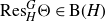

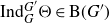







Proof. Let $\mathbb{C}[G / \Theta] = N_{K / \mathbb{Q}}(\rho)$
,
$\mathbb{C}[G / \Theta] = N_{K / \mathbb{Q}}(\rho)$
, $\mathbb{C}[G / \Psi] = N_{K / \mathbb{Q}}(\tau)$
for
$\mathbb{C}[G / \Psi] = N_{K / \mathbb{Q}}(\tau)$
for $\rho$
,
$\rho$
, $\tau \in \mathrm{Rep}(G)$
. Then
$\tau \in \mathrm{Rep}(G)$
. Then $\mathbb{C}[G / \Theta \pm \Psi] = N_{K / \mathbb{Q}}(\rho \pm \tau)$
,
$\mathbb{C}[G / \Theta \pm \Psi] = N_{K / \mathbb{Q}}(\rho \pm \tau)$
, $\mathbb{C}[H / \mathrm{Res}_{H}^G \Theta] = N_{K / \mathbb{Q}}(\mathrm{Res}_H^G \rho)$
, and
$\mathbb{C}[H / \mathrm{Res}_{H}^G \Theta] = N_{K / \mathbb{Q}}(\mathrm{Res}_H^G \rho)$
, and $\mathbb{C}[G' / \mathrm{Ind}_G^{G'}\Theta] = N_{K / \mathbb{Q}}(\mathrm{Ind}_{G}^{G'} \rho)$
, proving (i), (ii), (iii). One has
$\mathbb{C}[G' / \mathrm{Ind}_G^{G'}\Theta] = N_{K / \mathbb{Q}}(\mathrm{Ind}_{G}^{G'} \rho)$
, proving (i), (ii), (iii). One has $\mathbb{C}[G / H_i]^{N} = \mathbb{C}[G / N H_i]$
as G-representations (cf. [
Reference Dokchitser and Dokchitser10
, theorem 2·8]). Thus
$\mathbb{C}[G / H_i]^{N} = \mathbb{C}[G / N H_i]$
as G-representations (cf. [
Reference Dokchitser and Dokchitser10
, theorem 2·8]). Thus $\mathbb{C}[G / \Theta]^{N} = N_{K / \mathbb{Q}}(\rho^N) = \mathbb{C}[G / N / N\cdot \Theta / N]$
, implying (iv). For (v), it is clear that the relation can be lifted to G.
$\mathbb{C}[G / \Theta]^{N} = N_{K / \mathbb{Q}}(\rho^N) = \mathbb{C}[G / N / N\cdot \Theta / N]$
, implying (iv). For (v), it is clear that the relation can be lifted to G.
The previous proposition shows that the space of K-relations for G forms a sublattice of the Burnside ring $\mathrm{B}(G)$
. If
$\mathrm{B}(G)$
. If $n = [K : \mathbb{Q}]$
and
$n = [K : \mathbb{Q}]$
and $\Theta \in \mathrm{B}(G)$
, then
$\Theta \in \mathrm{B}(G)$
, then
 \begin{equation*} {}\mathbb{C}[G / n\Theta] = \mathbb{C}[G / \Theta]^{\oplus n} = N_{K / \mathbb{Q}}(\mathbb{C}[G / \Theta]),\end{equation*}
and hence the sublattice generated by K-relations has finite index in $\mathrm{B}(G)$
dividing
$\mathrm{B}(G)$
dividing $[K \,:\, \mathbb{Q}]$
.
$[K \,:\, \mathbb{Q}]$
.
Remark 2·7 (Brauer relations). When $\rho = 0$
,
$\rho = 0$
, $\Theta$
is called a Brauer relation (cf. [
Reference Dokchitser and Dokchitser10
, section 2·1]). Non-zero elements of
$\Theta$
is called a Brauer relation (cf. [
Reference Dokchitser and Dokchitser10
, section 2·1]). Non-zero elements of $\Theta \in \mathrm{B}(G)$
with
$\Theta \in \mathrm{B}(G)$
with $\mathbb{C}[G / \Theta] = 0$
are instances of non-isomorphic G-sets with isomorphic permutation representations. Indeed, writing
$\mathbb{C}[G / \Theta] = 0$
are instances of non-isomorphic G-sets with isomorphic permutation representations. Indeed, writing $\Theta = X - X'$
as a difference of finite G-sets, one has
$\Theta = X - X'$
as a difference of finite G-sets, one has $X \not\simeq X'$
but
$X \not\simeq X'$
but $\mathbb{C}[X] = \mathbb{C}[X']$
. The rank of the space of Brauer relations in
$\mathbb{C}[X] = \mathbb{C}[X']$
. The rank of the space of Brauer relations in $\mathrm{B}(G)$
is equal to the number of non-cyclic subgroups of G up to conjugacy [
Reference Dokchitser and Dokchitser10
, remark 2·5]. Brauer relations have been classified by Bartel and Tim Dokchitser in [
Reference Bartel and Dokchitser4
].
$\mathrm{B}(G)$
is equal to the number of non-cyclic subgroups of G up to conjugacy [
Reference Dokchitser and Dokchitser10
, remark 2·5]. Brauer relations have been classified by Bartel and Tim Dokchitser in [
Reference Bartel and Dokchitser4
].
Notation 2·8. There is an inclusion of rings
 \begin{equation*} \mathrm{Perm}(G) \subset R_{\mathbb{Q}}(G) \subset \mathrm{Char}_{\mathbb{Q}}(G), \end{equation*}
where $\mathrm{Perm}(G)$
is the ring of virtual permutation representations,
$\mathrm{Perm}(G)$
is the ring of virtual permutation representations, $R_{\mathbb{Q}}(G)$
the ring of rational representations, and
$R_{\mathbb{Q}}(G)$
the ring of rational representations, and $\mathrm{Char}_{\mathbb{Q}}(G)$
the ring of representations with
$\mathrm{Char}_{\mathbb{Q}}(G)$
the ring of representations with $\mathbb{Q}$
-valued characters. These rings have the same rank as
$\mathbb{Q}$
-valued characters. These rings have the same rank as $\mathbb{Z}$
-modules. A basis of
$\mathbb{Z}$
-modules. A basis of $\mathrm{Char}_{\mathbb{Q}}(G)$
is given by the distinct
$\mathrm{Char}_{\mathbb{Q}}(G)$
is given by the distinct $N_{\mathbb{Q}(\chi) / \mathbb{Q}}(\chi)$
as
$N_{\mathbb{Q}(\chi) / \mathbb{Q}}(\chi)$
as $\chi$
ranges over the complex irreducible representations of G.
$\chi$
ranges over the complex irreducible representations of G.
Definition 2·9. Define the group
 \begin{equation*}\hat{C}(G) = \mathrm{Char}_{\mathbb{Q}}(G) / \mathrm{Perm}(G).\end{equation*}
Remark 2·10. It follows from Artin’s induction theorem that $\hat{C}(G)$
is finite with exponent dividing
$\hat{C}(G)$
is finite with exponent dividing $|G|$
. When G is abelian or dihedral,
$|G|$
. When G is abelian or dihedral, $\hat{C}(G) = 1$
. The order of
$\hat{C}(G) = 1$
. The order of $N_{\mathbb{Q}(\chi) / \mathbb{Q}}(\chi)$
in
$N_{\mathbb{Q}(\chi) / \mathbb{Q}}(\chi)$
in $\mathrm{Char}_{\mathbb{Q}}(G) / R_{\mathbb{Q}}(G)$
is the Schur index
$\mathrm{Char}_{\mathbb{Q}}(G) / R_{\mathbb{Q}}(G)$
is the Schur index $m_{\mathbb{Q}}(\chi)$
of
$m_{\mathbb{Q}}(\chi)$
of $\chi$
. The group
$\chi$
. The group $R_{\mathbb{Q}}(G) / \mathrm{Perm}(G)$
is not trivial in general (cf. [
Reference Serre19
, exc. 13·4]). It is trivial when G is a p-group [
Reference Segal18
]. Given a finite group G, the structure of
$R_{\mathbb{Q}}(G) / \mathrm{Perm}(G)$
is not trivial in general (cf. [
Reference Serre19
, exc. 13·4]). It is trivial when G is a p-group [
Reference Segal18
]. Given a finite group G, the structure of $\hat{C}(G)$
can be computed using the results of [
Reference Bartel and Dokchitser5
].
$\hat{C}(G)$
can be computed using the results of [
Reference Bartel and Dokchitser5
].
The finiteness of $\hat{C}(G)$
implies that for any
$\hat{C}(G)$
implies that for any $\mathbb{C} G$
-representation
$\mathbb{C} G$
-representation $\rho$
, there exists an integer m and
$\rho$
, there exists an integer m and $\Theta \in \mathrm{B}(G)$
such that
$\Theta \in \mathrm{B}(G)$
such that $ \mathbb{C}[G / \Theta] = N_{\mathbb{Q}(\rho) / \mathbb{Q}}(\rho)^{\oplus m}$
. The following proposition describes the decomposition of the permutation representation associated to a K-relation into irreducible rational representations.
$ \mathbb{C}[G / \Theta] = N_{\mathbb{Q}(\rho) / \mathbb{Q}}(\rho)^{\oplus m}$
. The following proposition describes the decomposition of the permutation representation associated to a K-relation into irreducible rational representations.
Proposition 2·11. Let $\Theta \in \mathrm{B}(G)$
be a K-relation. Then
$\Theta \in \mathrm{B}(G)$
be a K-relation. Then
 \begin{equation*}\mathbb{C}[G / \Theta] = \bigoplus_{\tau \in \mathrm{Irr}_{\mathbb{Q}}(G)} N_{\mathbb{Q}(\chi_{\tau}) / \mathbb{Q}}(\chi_{\tau})^{\oplus k_{\tau}}\!,\end{equation*}
where $k_{\tau} \geq 1 $
is divisible by
$k_{\tau} \geq 1 $
is divisible by $[K \,:\, K \cap \mathbb{Q}(\chi_{\tau})]$
. The sum ranges over the rational irreducible representations of G, and
$[K \,:\, K \cap \mathbb{Q}(\chi_{\tau})]$
. The sum ranges over the rational irreducible representations of G, and $\chi_{\tau}$
denotes a complex irreducible constituent of
$\chi_{\tau}$
denotes a complex irreducible constituent of $\tau \in \mathrm{Irr}_{\mathbb{Q}}(G)$
.
$\tau \in \mathrm{Irr}_{\mathbb{Q}}(G)$
.
Proof. Suppose that $\mathbb{C}[G / \Theta] = N_{K / \mathbb{Q}}(\rho)$
for some representation
$\mathbb{C}[G / \Theta] = N_{K / \mathbb{Q}}(\rho)$
for some representation $\rho$
of G with
$\rho$
of G with $\mathbb{Q}(\rho) \subset K$
. Let
$\mathbb{Q}(\rho) \subset K$
. Let $L_{\tau} = K \cap \mathbb{Q}(\chi_{\tau})$
. A basis of representations of G with K-valued character is given by
$L_{\tau} = K \cap \mathbb{Q}(\chi_{\tau})$
. A basis of representations of G with K-valued character is given by
 \begin{equation*}\{ \varphi_{\tau} = \bigoplus_{ \sigma \in \mathrm{Gal}(\mathbb{Q}(\chi_{\tau}) / L_{\tau})} \chi_{\tau}^{\sigma} \,:\, \tau \in \mathrm{Irr}_{\mathbb{Q}}(G) \}.\end{equation*}
Thus $\rho = \bigoplus_{\tau} \varphi_{\tau}^{\oplus n_{\tau}}$
for some
$\rho = \bigoplus_{\tau} \varphi_{\tau}^{\oplus n_{\tau}}$
for some $n_{\tau} \in \mathbb{Z}$
and so
$n_{\tau} \in \mathbb{Z}$
and so
 \begin{align*}N_{K / \mathbb{Q}}(\rho) & = \bigoplus_{\tau \in \mathrm{Irr}_{\mathbb{Q}}(G)} N_{K / \mathbb{Q}}(\varphi_{\tau})^{\oplus n_{\tau}} = \bigoplus_{\tau \in \mathrm{Irr}_{\mathbb{Q}}(G)} N_{L_{\tau} / \mathbb{Q}}(\varphi_{\tau})^{\oplus n_{\tau} [K \,:\, L_{\tau}]}\nonumber\\& = \bigoplus_{\tau \in \mathrm{Irr}_{\mathbb{Q}}(G)} N_{\mathbb{Q}(\chi_{\tau}) / \mathbb{Q}}(\chi_{\tau})^{\oplus n_{\tau} [K \,:\, L_{\tau}]}.\end{align*}
Example 2·12 (Cyclic Groups). Let $G = C_n$
. For
$G = C_n$
. For $d \mid n$
, let
$d \mid n$
, let $\chi_d$
be an order d character of G with
$\chi_d$
be an order d character of G with $\mathbb{Q}(\chi_d) = \mathbb{Q}(\zeta_d)$
. Then
$\mathbb{Q}(\chi_d) = \mathbb{Q}(\zeta_d)$
. Then
 \begin{equation*}\mathbb{C}[G / \Psi_d] = N_{\mathbb{Q}(\chi_d) / \mathbb{Q}}(\chi_d), \quad \Psi_d = \sum_{d' \mid d} \mu(d/ d') C_{n / d'} \in \mathrm{B}(G),\end{equation*}
where $\mu$
is the Möbius function. Moreover
$\mu$
is the Möbius function. Moreover $\Psi_d$
is the unique element of
$\Psi_d$
is the unique element of $\mathrm{B}(G)$
with
$\mathrm{B}(G)$
with $\mathbb{C}[G / \Psi_d] = N_{\mathbb{Q}(\chi_d) / \mathbb{Q}}(\chi_d)$
. Indeed if
$\mathbb{C}[G / \Psi_d] = N_{\mathbb{Q}(\chi_d) / \mathbb{Q}}(\chi_d)$
. Indeed if $\Psi' \in \mathrm{B}(G)$
also satisfies
$\Psi' \in \mathrm{B}(G)$
also satisfies $\mathbb{C}[G / \Psi'] = N_{\mathbb{Q}(\psi_d) / \mathbb{Q}}(\psi_d)$
, then
$\mathbb{C}[G / \Psi'] = N_{\mathbb{Q}(\psi_d) / \mathbb{Q}}(\psi_d)$
, then $\Psi_d - \Psi'$
is a Brauer relation. But cyclic groups have no Brauer relations (cf. [
Reference Dokchitser and Dokchitser10
, exercise 2·2]) so
$\Psi_d - \Psi'$
is a Brauer relation. But cyclic groups have no Brauer relations (cf. [
Reference Dokchitser and Dokchitser10
, exercise 2·2]) so $\Psi_d = \Psi'$
.
$\Psi_d = \Psi'$
.
If $\Theta$
is a K-relation for G, then by Proposition 2·11
$\Theta$
is a K-relation for G, then by Proposition 2·11 $\Theta = \sum_{d \mid n} a_d \Psi_d$
where
$\Theta = \sum_{d \mid n} a_d \Psi_d$
where $a_d \in \mathbb{Z}_{\geq 1}$
is divisible by
$a_d \in \mathbb{Z}_{\geq 1}$
is divisible by $[K \,:\, K \cap \mathbb{Q}(\zeta_d)]$
.
$[K \,:\, K \cap \mathbb{Q}(\zeta_d)]$
.
2·2. Functions on the Burnside ring
This subsection concerns functions from the Burnside ring to an abelian group. The content of this section appears in [ Reference Dokchitser and Dokchitser10 , section 2.iii] and we repeat it for convenience of reference.
Let A be an abelian group. We consider linear functions $f \,:\, \mathrm{B}(G) \to A$
satisfying
$f \,:\, \mathrm{B}(G) \to A$
satisfying $f(X \sqcup Y) = f(X)f(Y)$
for finite G-sets X, Y. In applications to number theory, such functions appear naturally when G is the Galois group of an extension of number fields and one is interested in computing invariants associated to subfields.
$f(X \sqcup Y) = f(X)f(Y)$
for finite G-sets X, Y. In applications to number theory, such functions appear naturally when G is the Galois group of an extension of number fields and one is interested in computing invariants associated to subfields.
Example 2·13. Let E be an elliptic curve over a number field L, and $F / L$
a finite Galois extension with
$F / L$
a finite Galois extension with $G = \mathrm{Gal}(F / L)$
. If
$G = \mathrm{Gal}(F / L)$
. If $H , H' \leq G$
are conjugate subgroups, then
$H , H' \leq G$
are conjugate subgroups, then $F^{H} \simeq F^{H'}$
and so
$F^{H} \simeq F^{H'}$
and so $C_{E / F^{H}} = C_{E / F^{H'}}$
(
$C_{E / F^{H}} = C_{E / F^{H'}}$
( $C_{E / F^{H}}$
defined in Section 1·5). Thus the function
$C_{E / F^{H}}$
defined in Section 1·5). Thus the function $C \,:\, \mathrm{B}(G) \to \mathbb{Q}^{\times}$
sending
$C \,:\, \mathrm{B}(G) \to \mathbb{Q}^{\times}$
sending $H \leq G$
to
$H \leq G$
to $C_{E / F^{H}}$
is well-defined.
$C_{E / F^{H}}$
is well-defined.
Often such functions will depend on the decomposition group at a prime of the base field of the Galois extension, which motivates the following definition.
Definition 2·14 [
Reference Dokchitser and Dokchitser10
, definition 2·33]. For $D \leq G$
, say a function
$D \leq G$
, say a function $f \,:\, \mathrm{B}(G) \to A$
is D-local if there exists a function
$f \,:\, \mathrm{B}(G) \to A$
is D-local if there exists a function $f_D$
on
$f_D$
on $\mathrm{B}(D)$
such that
$\mathrm{B}(D)$
such that $f(H) = f_D(\mathrm{Res}_D H)$
for all
$f(H) = f_D(\mathrm{Res}_D H)$
for all $H \leq G$
. If this is the case, write
$H \leq G$
. If this is the case, write
 \begin{equation*}f = (D, f_D).\end{equation*}
Example 2·15. Let $G = \mathrm{Gal}(F / L)$
be the Galois group of an extension of number fields. Let
$G = \mathrm{Gal}(F / L)$
be the Galois group of an extension of number fields. Let $\mathfrak{p}$
be a prime of L, and
$\mathfrak{p}$
be a prime of L, and $\mathfrak{q}$
a prime of F above
$\mathfrak{q}$
a prime of F above $\mathfrak{p}$
with decomposition group
$\mathfrak{p}$
with decomposition group $D_{\mathfrak{q}}$
. For
$D_{\mathfrak{q}}$
. For $H \leq G$
, the primes above
$H \leq G$
, the primes above $\mathfrak{p}$
in
$\mathfrak{p}$
in $F^H$
are in one-to-one correspondence with elements of
$F^H$
are in one-to-one correspondence with elements of $H \backslash G / D_{\mathfrak{q}}$
. For
$H \backslash G / D_{\mathfrak{q}}$
. For $\lambda \in \mathbb{Q}^{\times}$
, the function
$\lambda \in \mathbb{Q}^{\times}$
, the function $f \,:\, \mathrm{B}(G) \to \mathbb{Q}^{\times }$
,
$f \,:\, \mathrm{B}(G) \to \mathbb{Q}^{\times }$
,
 \begin{equation*}f(H) = \lambda^{\# \{ \text{primes above $\mathfrak{p}$ in $F^{H}$} \} } = \lambda^{| H \backslash G / D_{\mathfrak{q}}|},\end{equation*}
that counts the primes above $\mathfrak{p}$
is a above
$\mathfrak{p}$
is a above $\mathfrak{p}$
is a
$\mathfrak{p}$
is a $D_{\mathfrak{q}}$
-local function with
$D_{\mathfrak{q}}$
-local function with $f = (D_{\mathfrak{q}}, \lambda)$
.
$f = (D_{\mathfrak{q}}, \lambda)$
.
Example 2·16. In Example 2·13, the function C factors as a product of local functions. Recall that $C_{E / F^{H}} = \prod_v C_v(E / F^{H}, \omega)$
(as defined in Section 1·5) for a choice of invariant differential
$C_{E / F^{H}} = \prod_v C_v(E / F^{H}, \omega)$
(as defined in Section 1·5) for a choice of invariant differential $\omega$
on
$\omega$
on $E / L$
, where v ranges over all finite places of
$E / L$
, where v ranges over all finite places of $F^{H}$
.
$F^{H}$
.
For each finite place v of L, let $D_v = \mathrm{Gal}(F_w / L_v) \leq G$
be the decomposition group at v for a choice of place w in F above v. Let
$D_v = \mathrm{Gal}(F_w / L_v) \leq G$
be the decomposition group at v for a choice of place w in F above v. Let $C_{D_v} \,:\, \mathrm{B}(D_v) \to \mathbb{Q}^{\times}$
be the function given by
$C_{D_v} \,:\, \mathrm{B}(D_v) \to \mathbb{Q}^{\times}$
be the function given by
 \begin{equation*} C_{D_v}(H') = C(E / (F_w)^{H'}, \omega),\end{equation*}
for $H' \leq D_v$
. Then
$H' \leq D_v$
. Then $ C = \prod_v (D_v, C_{D_v}),$
with the product ranging over all finite places v of L. Indeed, for
$ C = \prod_v (D_v, C_{D_v}),$
with the product ranging over all finite places v of L. Indeed, for $H \leq G$
,
$H \leq G$
,
 \begin{equation*} C(H) = \prod_v C_{D_v}(\mathrm{Res}_{D_v} H) = \prod_{v} \prod_{v' \mid v} C(E / (F^{H})_{v'}, \omega) = C_{E / F^{H}}, \end{equation*}
as the double product ranges over all finite places of $F^{H}$
.
$F^{H}$
.
Let $G = \mathrm{Gal}(F / L)$
be the Galois group of an extension of number fields and let D, I be the decomposition and inertia subgroups of G for a place v of L. If a place w in
$G = \mathrm{Gal}(F / L)$
be the Galois group of an extension of number fields and let D, I be the decomposition and inertia subgroups of G for a place v of L. If a place w in $F^{H}$
corresponds to the double coset Hx D, then its decomposition and inertia groups in
$F^{H}$
corresponds to the double coset Hx D, then its decomposition and inertia groups in $F / F^{H}$
are
$F / F^{H}$
are $H \cap D^{x}$
and
$H \cap D^{x}$
and $H \cap I^{x}$
respectively. The ramification degree and residue degree of w over L is thus given by
$H \cap I^{x}$
respectively. The ramification degree and residue degree of w over L is thus given by $e_{w} = {|I|}/{|H \cap I^{x}|}$
and
$e_{w} = {|I|}/{|H \cap I^{x}|}$
and $f_{w} = {[D \,:\, I]}/{[H \cap D^{x} \,:\, H \cap I^{x}]}$
. To describe functions that depend on the ramification and residue degrees of places in intermediate fields, we introduce the following definition.
$f_{w} = {[D \,:\, I]}/{[H \cap D^{x} \,:\, H \cap I^{x}]}$
. To describe functions that depend on the ramification and residue degrees of places in intermediate fields, we introduce the following definition.
Definition 2·17 [
Reference Dokchitser and Dokchitser10
, definition 2·35]. Consider $I \triangleleft D \leq G$
with
$I \triangleleft D \leq G$
with $D / I$
cyclic and
$D / I$
cyclic and $\psi(e, f)$
a function of e,
$\psi(e, f)$
a function of e, $f \in \mathbb{N}$
. Define a function on
$f \in \mathbb{N}$
. Define a function on $\mathrm{B}(G)$
by
$\mathrm{B}(G)$
by
 \begin{equation*}(D, I, \psi) \,:\, H \mapsto \prod_{x \in H \backslash G / D} \psi\left( \tfrac{|I|}{|H \cap I^{x}|} , \tfrac{[D \,:\, I]}{[H \cap D^{x} \,:\, H \cap I^x]} \right).\end{equation*}
This is a D-local function on $\mathrm{B}(G)$
with
$\mathrm{B}(G)$
with
 \begin{equation*}(D, I, \psi) = \left(D, U \mapsto \psi\left(\tfrac{|I|}{|U \cap I|}, \tfrac{|D|}{|UI|}\right)\right),\end{equation*}
(since $(U \cap D) / (U \cap I) \simeq UI / I$
for
$(U \cap D) / (U \cap I) \simeq UI / I$
for $U \leq D$
).
$U \leq D$
).
The following proposition follows from the definition above.
Proposition 2.18 [
Reference Dokchitser and Dokchitser10
, theorem 2·36]. Let $I \triangleleft D \leq G$
with
$I \triangleleft D \leq G$
with $D / I$
cyclic.
$D / I$
cyclic.
-
(i) If
$I_0 \lt I$
is normal in D with cyclic quotient, and
$\psi(e, f)$
is a function of the product ef, then
$(D, I, \psi) = (D, I_0, \psi)$
. -
(ii) If
$I \lt D_0 \lt D$
and
$\psi(e,f) = \psi(e, f / m)^{m} $
whenever m divides f and
$[D \,:\, D_0]$
, then
$(D, I, \psi) = (D_0, I, \psi)$
.







2·3. Functions on K-relations
We now focus on functions from the Burnside ring to $\mathbb{Q}^{\times}$
and evaluating these function on K-relations.
$\mathbb{Q}^{\times}$
and evaluating these function on K-relations.
Definition 2·19. Let $f \,:\, \mathrm{B}(G) \to \mathbb{Q}^{\times}$
be a linear function, K a number field. Say that f is trivial on K-relations for G if
$f \,:\, \mathrm{B}(G) \to \mathbb{Q}^{\times}$
be a linear function, K a number field. Say that f is trivial on K-relations for G if $f(\Theta) \equiv 1 \mod N_{K / \mathbb{Q}}(K^{\times})$
whenever
$f(\Theta) \equiv 1 \mod N_{K / \mathbb{Q}}(K^{\times})$
whenever $\Theta$
is a K-relation for G.
$\Theta$
is a K-relation for G.
If f is trivial on K-relations, we write $f \sim_{K} 1$
. If
$f \sim_{K} 1$
. If $f, g \,:\, \mathrm{B}(G) \to \mathbb{Q}^{\times} $
are functions such that
$f, g \,:\, \mathrm{B}(G) \to \mathbb{Q}^{\times} $
are functions such that $f / g \sim_K 1$
, we write
$f / g \sim_K 1$
, we write $f \sim_K g$
.
$f \sim_K g$
.
Example 2·20. Let $G = C_n$
, K a number field and
$G = C_n$
, K a number field and $\Theta$
a K-relation. Consider a function
$\Theta$
a K-relation. Consider a function $f \,:\, \mathrm{B}(G) \to \mathbb{Q}^{\times}$
. As in Example 2·12,
$f \,:\, \mathrm{B}(G) \to \mathbb{Q}^{\times}$
. As in Example 2·12, $\Theta = \sum_{d \mid n} a_d \Psi_d$
, where
$\Theta = \sum_{d \mid n} a_d \Psi_d$
, where $a_d$
is divisible by
$a_d$
is divisible by $[K \,:\, \mathbb{Q}(\zeta_d) \cap K ] $
. If
$[K \,:\, \mathbb{Q}(\zeta_d) \cap K ] $
. If $f(\Psi_d) \in N_{\mathbb{Q}(\zeta_d) / \mathbb{Q}} \in N_{\mathbb{Q}(\zeta_d) / \mathbb{Q}}(\mathbb{Q}(\zeta_d)^{\times})$
for each
$f(\Psi_d) \in N_{\mathbb{Q}(\zeta_d) / \mathbb{Q}} \in N_{\mathbb{Q}(\zeta_d) / \mathbb{Q}}(\mathbb{Q}(\zeta_d)^{\times})$
for each $d | n$
, then by Lemma 2·23
$d | n$
, then by Lemma 2·23 $f(\Theta) \in N_{K / \mathbb{Q}}(K^{\times})$
. Therefore to show that a function f on
$f(\Theta) \in N_{K / \mathbb{Q}}(K^{\times})$
. Therefore to show that a function f on $\mathrm{B}(G)$
is trivial on K-relations for any field K, it is enough to show that it is trivial on the
$\mathrm{B}(G)$
is trivial on K-relations for any field K, it is enough to show that it is trivial on the $\mathbb{Q}(\zeta_d)$
-relation
$\mathbb{Q}(\zeta_d)$
-relation $\Psi_d$
for each
$\Psi_d$
for each $d \mid n$
.
$d \mid n$
.
Proposition 2·21. Let G be a group, with $D \leq G$
,
$D \leq G$
, $N \triangleleft G$
. Let K be a number field, and let
$N \triangleleft G$
. Let K be a number field, and let $f \,:\, \mathrm{B}(G) \to \mathbb{Q}^{\times}$
be a linear function on
$f \,:\, \mathrm{B}(G) \to \mathbb{Q}^{\times}$
be a linear function on $\mathrm{B}(G)$
.
$\mathrm{B}(G)$
.
-
(i) (Restriction) If
$f = (D, f_D)$
and
$f_D$
is trivial on K-relations for D, then f is trivial on K-relations for G. -
(ii) (Quotient) Suppose f is of the form
$f(H) = f_{G / N}( NH / N)$
for some function
$f_{G / N}$
on
$\mathrm{B}(G / N)$
. If
$f_{G / N}$
is trivial on K-relations for
$G / N$
, then f is trivial on K-relations for G.





Proof. This follows from Proposition 2·6, using that if $\Theta \in \mathrm{B}(G)$
is a K-relation for G, then
$\Theta \in \mathrm{B}(G)$
is a K-relation for G, then $\mathrm{Res}_D \Theta$
is a K-relation for D and
$\mathrm{Res}_D \Theta$
is a K-relation for D and $N \cdot \Theta / N$
is a K-relation for
$N \cdot \Theta / N$
is a K-relation for $G / N$
.
$G / N$
.
The next proposition generalises Example 2·20, and describes how one can prove a function is trivial on K-relations by reducing to irreducible representations.
Proposition 2·22. Let G be a finite group with $\hat{C}(G) = 1$
, and
$\hat{C}(G) = 1$
, and $f \,:\, \mathrm{B}(G) \to \mathbb{Q}^{\times}$
a linear function. Suppose that
$f \,:\, \mathrm{B}(G) \to \mathbb{Q}^{\times}$
a linear function. Suppose that $f(\Psi) \in N_{K / \mathbb{Q}}(K^{\times})$
whenever
$f(\Psi) \in N_{K / \mathbb{Q}}(K^{\times})$
whenever $\Psi$
is a Brauer relation.
$\Psi$
is a Brauer relation.
-
(i) If for each
$\chi \in \mathrm{Irr}_{\mathbb{C}}(G)$
, there exists
$\Theta_{\chi} \in \mathrm{B}(G)$
with
$\mathbb{C}[G / \Theta_{\chi}] = N_{\mathbb{Q}(\chi) / \mathbb{Q}}(\chi)$
and
$f(\Theta_{\chi}) \in N_{\mathbb{Q}(\chi) / \mathbb{Q}}(\mathbb{Q}(\chi)^{\times})$
, then f is trivial on K-relations. -
(ii) If
$K / \mathbb{Q}$
is quadratic, to show that f is trivial on K-relations, it suffices to show that for each
$\chi \in \mathrm{Irr}_{\mathbb{C}}(G)$
with
$K \subset \mathbb{Q}(\chi)$
, there exists
$\Theta_{\chi} \in \mathrm{B}(G)$
with
$\mathbb{C}[G / \Theta_{\chi}] = N_{\mathbb{Q}(\chi) / \mathbb{Q}}(\chi)$
and
$f(\Theta_{\chi}) \in N_{K / \mathbb{Q}}(K^{\times})$
.







Proof. Let
 \begin{equation*} {}\mathbb{C}[G / \Theta] = N_{K / \mathbb{Q}}(\rho) = \bigoplus_{\tau \in \mathrm{Irr}_{\mathbb{Q}}(G)} N_{\mathbb{Q}(\chi_{\tau}) / \mathbb{Q}}(\chi_{\tau})^{\oplus k_{\tau}} {}\end{equation*}
be a K-relation, where $\chi_{\tau}$
is a complex irreducible constituent of
$\chi_{\tau}$
is a complex irreducible constituent of $\tau \in \mathrm{Irr}_{\mathbb{Q}}(G)$
and
$\tau \in \mathrm{Irr}_{\mathbb{Q}}(G)$
and $[K \,:\, K \cap \mathbb{Q}(\chi_{\tau}) ]$
divides
$[K \,:\, K \cap \mathbb{Q}(\chi_{\tau}) ]$
divides $k_{\tau}$
. Then
$k_{\tau}$
. Then $\mathbb{C}[G / \Theta] = \bigoplus_{\tau \in \mathrm{Irr}_{\mathbb{Q}}(G)} \mathbb{C}[G / \Theta_{\chi_{\tau}}]^{\oplus k_{\tau}}$
and
$\mathbb{C}[G / \Theta] = \bigoplus_{\tau \in \mathrm{Irr}_{\mathbb{Q}}(G)} \mathbb{C}[G / \Theta_{\chi_{\tau}}]^{\oplus k_{\tau}}$
and
 \begin{equation*} {}f(\Theta) = f(\Psi)\prod_{\tau \in \mathrm{Irr}_{\mathbb{Q}}(G)} f(\Theta_{\chi_{\tau}})^{k_{\tau}},\end{equation*}
where $\Psi = \Theta - \sum_{\tau \in \mathrm{Irr}_{\mathbb{Q}}(G)} k_{\tau} \Theta_{\chi_{\tau}}$
is a Brauer relation and
$\Psi = \Theta - \sum_{\tau \in \mathrm{Irr}_{\mathbb{Q}}(G)} k_{\tau} \Theta_{\chi_{\tau}}$
is a Brauer relation and $f(\Psi) \in N_{K / \mathbb{Q}}(K^{\times})$
by assumption. For (i), the result follows as
$f(\Psi) \in N_{K / \mathbb{Q}}(K^{\times})$
by assumption. For (i), the result follows as $f(\Theta_{\tau}) \in N_{\mathbb{Q}(\chi_{\tau}) / \mathbb{Q}}(\mathbb{Q}(\chi_{\tau})^{\times})$
for all
$f(\Theta_{\tau}) \in N_{\mathbb{Q}(\chi_{\tau}) / \mathbb{Q}}(\mathbb{Q}(\chi_{\tau})^{\times})$
for all $\tau \in \mathrm{Irr}_{\mathbb{Q}}(G)$
, so that
$\tau \in \mathrm{Irr}_{\mathbb{Q}}(G)$
, so that $f(\Theta_{\chi_{\tau}})^{k_{\tau}} \in N_{K / \mathbb{Q}}(K^{\times})$
by Proposition 2·11 and Lemma 2·23 below. For (ii), if
$f(\Theta_{\chi_{\tau}})^{k_{\tau}} \in N_{K / \mathbb{Q}}(K^{\times})$
by Proposition 2·11 and Lemma 2·23 below. For (ii), if $K \not\subset \mathbb{Q}(\chi_{\tau})$
then
$K \not\subset \mathbb{Q}(\chi_{\tau})$
then $k_{\tau}$
is even and so
$k_{\tau}$
is even and so $f(\Theta_{\chi_{\tau}})^{k_{\tau}} \in \mathbb{Q}^{\times 2} \subset N_{K/ \mathbb{Q}}(K^{\times})$
. Thus
$f(\Theta_{\chi_{\tau}})^{k_{\tau}} \in \mathbb{Q}^{\times 2} \subset N_{K/ \mathbb{Q}}(K^{\times})$
. Thus
 \begin{equation*} f(\Theta) \equiv \prod_{\tau\in \mathrm{Irr}_{\mathbb{Q}}(G), K \subset \mathbb{Q}(\chi_{\tau})} f(\Theta_{\chi_{\tau}}) \mod N_{K / \mathbb{Q}}(K^{\times }),\end{equation*}
and it follows that $f(\Theta) \in N_{K / \mathbb{Q}}(K^{\times})$
from the assumption that
$f(\Theta) \in N_{K / \mathbb{Q}}(K^{\times})$
from the assumption that $f(\Theta_{\chi_{\tau}}) \in N_{K / \mathbb{Q}}(K^{\times})$
.
$f(\Theta_{\chi_{\tau}}) \in N_{K / \mathbb{Q}}(K^{\times})$
.
Lemma 2·23. Let L and K be number fields. If $x = N_{L / \mathbb{Q}}(z)$
for
$x = N_{L / \mathbb{Q}}(z)$
for $z \in L$
, then
$z \in L$
, then $x^{[K \,:\, L \cap K]} \in N_{K / \mathbb{Q}}(K^{\times})$
.
$x^{[K \,:\, L \cap K]} \in N_{K / \mathbb{Q}}(K^{\times})$
.
Proof. One has $x^{[K \,:\, L \cap K]} = N_{K / \mathbb{Q}}(N_{L / L \cap K}(z))$
.
$x^{[K \,:\, L \cap K]} = N_{K / \mathbb{Q}}(N_{L / L \cap K}(z))$
.
Remark 2·24. The proof of Proposition 2·22 does not hold when $\hat{C}(G) \not= 1$
. For example, the quaternion group
$\hat{C}(G) \not= 1$
. For example, the quaternion group $G = Q_8$
has
$G = Q_8$
has $\hat{C}(G) = \mathbb{Z} / 2 \mathbb{Z}$
, generated by the 2-dimensional irreducible representation
$\hat{C}(G) = \mathbb{Z} / 2 \mathbb{Z}$
, generated by the 2-dimensional irreducible representation $\chi$
. This representation has rational character. One has
$\chi$
. This representation has rational character. One has
 \begin{equation*} \chi^{\oplus 2} = \mathbb{C}[G / C_1] \ominus \mathbb{C}[G / C_2],\end{equation*}
and so $\Theta = C_1 - C_2$
is a K-relation for all quadratic fields K. However there does not exist
$\Theta = C_1 - C_2$
is a K-relation for all quadratic fields K. However there does not exist $\Theta' \in \mathrm{B}(G)$
such that
$\Theta' \in \mathrm{B}(G)$
such that $\Theta = \Psi + 2 \Theta'$
for
$\Theta = \Psi + 2 \Theta'$
for $\Psi$
a Brauer relation.
$\Psi$
a Brauer relation.
We now give some examples of functions on the Burnside ring of a cyclic group that are trivial on K-relations. The triviality of these functions will be essential for the proofs in Section 3.
Lemma 2·25. Let $G = C_n$
be cyclic. The function
$G = C_n$
be cyclic. The function $g \,:\, H \leq G \mapsto [G \,:\, H]$
is trivial on K-relations for G, where K is any number field.
$g \,:\, H \leq G \mapsto [G \,:\, H]$
is trivial on K-relations for G, where K is any number field.
Proof. Let $\Theta$
be a K-relation for G. Then
$\Theta$
be a K-relation for G. Then $\Theta = \sum_{d | n } a_d \Psi_d$
, where
$\Theta = \sum_{d | n } a_d \Psi_d$
, where $a_d$
is divisible by
$a_d$
is divisible by $[K \,:\, \mathbb{Q}(\zeta_d) \cap K]$
and
$[K \,:\, \mathbb{Q}(\zeta_d) \cap K]$
and $\Psi_d \in \mathrm{B}(G)$
is as in Example 2·12. One has
$\Psi_d \in \mathrm{B}(G)$
is as in Example 2·12. One has
 \begin{equation*}g(\Psi_d) = \prod_{d' \mid d} (d')^{\mu(d / d')} = \Phi_d(1) = N_{\mathbb{Q}(\zeta_d) / \mathbb{Q}}(1 - \zeta_d), \end{equation*}
where $\Phi_d$
is the d-th cyclotomic polynomial. Thus
$\Phi_d$
is the d-th cyclotomic polynomial. Thus $g(\Psi_d) \in N_{\mathbb{Q}(\zeta_d) / \mathbb{Q}}(\mathbb{Q}(\zeta_d)^{\times})$
and so g is trivial on K-relations by Example 2·12.
$g(\Psi_d) \in N_{\mathbb{Q}(\zeta_d) / \mathbb{Q}}(\mathbb{Q}(\zeta_d)^{\times})$
and so g is trivial on K-relations by Example 2·12.
Lemma 2·26. Let $G = C_n$
be cyclic. The function
$G = C_n$
be cyclic. The function $c \,:\, H \leq G \mapsto \alpha$
where
$c \,:\, H \leq G \mapsto \alpha$
where $\alpha \in \mathbb{Q}^{\times}$
is trivial on K-relations for G, where K is any number field.
$\alpha \in \mathbb{Q}^{\times}$
is trivial on K-relations for G, where K is any number field.
Proof. For $d \mid n$
, one has
$d \mid n$
, one has $c(\Psi_d) = \alpha^{\sum_{d' | d} \mu(d / d')} = 1$
unless
$c(\Psi_d) = \alpha^{\sum_{d' | d} \mu(d / d')} = 1$
unless $d = 1$
in which case
$d = 1$
in which case $c(\Psi_1) = \alpha$
. Thus if
$c(\Psi_1) = \alpha$
. Thus if $\Theta$
is a K-relation then
$\Theta$
is a K-relation then $c(\Theta) = \alpha^{m [K \,:\, \mathbb{Q}]} = N_{K / \mathbb{Q}}(\alpha^{m})$
where
$c(\Theta) = \alpha^{m [K \,:\, \mathbb{Q}]} = N_{K / \mathbb{Q}}(\alpha^{m})$
where $m \geq 1$
.
$m \geq 1$
.
Lemma 2·27. Let $G = C_n$
be cyclic. Consider the function
$G = C_n$
be cyclic. Consider the function
 \begin{equation*}d_{\alpha, \beta} \,:\, H \leq G \mapsto \begin{cases} \alpha, & \text{if } k \mid [C_n \,:\, H], \\ \beta, & \text{if } k \nmid [C_n \,:\, H] , \end{cases}\end{equation*}
for $k \in \mathbb{N}$
,
$k \in \mathbb{N}$
, $\alpha, \beta \in \mathbb{Q}^{\times}$
. If
$\alpha, \beta \in \mathbb{Q}^{\times}$
. If $\alpha / \beta \in N_{\mathbb{Q}(\zeta_k) / \mathbb{Q}}(\mathbb{Q}(\zeta_k)^{\times})$
, then
$\alpha / \beta \in N_{\mathbb{Q}(\zeta_k) / \mathbb{Q}}(\mathbb{Q}(\zeta_k)^{\times})$
, then $d_{\alpha, \beta}$
is trivial on K-relations for G, where K is any number field.
$d_{\alpha, \beta}$
is trivial on K-relations for G, where K is any number field.
Proof. If $k \nmid n$
or if
$k \nmid n$
or if $k = 1$
then this is the constant function which is trivial on K-relations by Lemma 2·26, so we may assume
$k = 1$
then this is the constant function which is trivial on K-relations by Lemma 2·26, so we may assume $k \mid n$
and
$k \mid n$
and $k \gt 1$
. Let
$k \gt 1$
. Let $\chi_k$
be a character of G with
$\chi_k$
be a character of G with $\mathbb{Q}(\chi_k) = \mathbb{Q}(\zeta_k)$
. Then
$\mathbb{Q}(\chi_k) = \mathbb{Q}(\zeta_k)$
. Then
 \begin{equation*}\langle \chi_k, \mathbb{C}[C_n / H] \rangle = \begin{cases} 1, & \text{if } k \mid [C_n \,:\, H], \\ 0, & \text{if } k \nmid [C_n \,:\, H] .\end{cases} \end{equation*}
Thus $c(H) = \alpha^{\langle \chi_k , \mathbb{C}[C_n / H] \rangle }\cdot \beta^{1 - \langle \chi_k, \mathbb{C}[C_n / H] \rangle }$
. Therefore
$c(H) = \alpha^{\langle \chi_k , \mathbb{C}[C_n / H] \rangle }\cdot \beta^{1 - \langle \chi_k, \mathbb{C}[C_n / H] \rangle }$
. Therefore
 \begin{equation*}d_{\alpha, \beta}(\Psi_d) = (\alpha / \beta)^{\langle \chi_k, N_{\mathbb{Q}(\chi_d) / \mathbb{Q}} (\chi_d )\rangle } \beta^{\sum_{d' | d} \mu(d / d')} = \begin{cases} \beta, & \text{if } d = 1, \\ \alpha / \beta, & \text{if } d = k ,\\ 1, & \text{if } d \not= k, d \gt 1, \end{cases} \end{equation*}
where $\chi_d$
is a character of G of order d. If
$\chi_d$
is a character of G of order d. If $\Theta$
is a K-relation for G, then
$\Theta$
is a K-relation for G, then $d_{\alpha, \beta}(\Theta) = \beta^{x[K \,:\, \mathbb{Q}]}\cdot(\alpha / \beta)^{y [K \,:\, K \cap \mathbb{Q}(\zeta_k)]}$
for some
$d_{\alpha, \beta}(\Theta) = \beta^{x[K \,:\, \mathbb{Q}]}\cdot(\alpha / \beta)^{y [K \,:\, K \cap \mathbb{Q}(\zeta_k)]}$
for some $x, y \in \mathbb{Z}$
. One has
$x, y \in \mathbb{Z}$
. One has $\beta^{x[K \,:\, \mathbb{Q}]} = N_{K / \mathbb{Q}}(\beta^x)$
, and
$\beta^{x[K \,:\, \mathbb{Q}]} = N_{K / \mathbb{Q}}(\beta^x)$
, and $(\alpha / \beta)^{y [K \,:\, K \cap \mathbb{Q}(\zeta_k)]} \in N_{K / \mathbb{Q}}(K^{\times})$
by Lemma 2·23 and the assumption that
$(\alpha / \beta)^{y [K \,:\, K \cap \mathbb{Q}(\zeta_k)]} \in N_{K / \mathbb{Q}}(K^{\times})$
by Lemma 2·23 and the assumption that $\alpha / \beta \in N_{\mathbb{Q}(\zeta_k) / \mathbb{Q}}(\mathbb{Q}(\zeta_k)^{\times})$
. Thus
$\alpha / \beta \in N_{\mathbb{Q}(\zeta_k) / \mathbb{Q}}(\mathbb{Q}(\zeta_k)^{\times})$
. Thus $d_{\alpha, \beta}(\Theta)$
is the norm of an element of K.
$d_{\alpha, \beta}(\Theta)$
is the norm of an element of K.
Lemma 2·28. Let $G = C_n$
. The function
$G = C_n$
. The function
 \begin{equation*} {}g \,:\, H \mapsto \begin{cases} [C_n \,:\, H], & \text{if } 2 \mid [C_n \,:\, H], \\ 1, & \text{if } 2 \nmid [C_n \,:\, H], \end{cases} {}\end{equation*}
is trivial on K-relations for G, where K is any number field.
Proof. If $2 \nmid n$
, then this is always 1, so assume
$2 \nmid n$
, then this is always 1, so assume $2 \mid n$
. Let
$2 \mid n$
. Let $\chi_2$
be a character of G of order 2. Then g can be expressed as
$\chi_2$
be a character of G of order 2. Then g can be expressed as $g(H) = [C_n \,:\, H]^{\langle \chi_2 ,\ \mathbb{C}[C_n / H] \rangle}$
. For
$g(H) = [C_n \,:\, H]^{\langle \chi_2 ,\ \mathbb{C}[C_n / H] \rangle}$
. For $d \mid n$
,
$d \mid n$
,
 \begin{equation*} {}g(\Psi_d) = \prod_{d' \mid d} (d')^{\mu(d / d')\cdot \langle \chi_2, \mathbb{C}[C_n / C_{n / d'}] \rangle} = \begin{cases} {} {}2, & \text{if } d = 2, \\ p, & \text{if } d = 2 p,\ p \text{ prime,}\\ 1, & \text{otherwise}. {}\end{cases} {}\end{equation*}
In each case it is clear that $g(\Psi_d) \in N_{\mathbb{Q}(\zeta_d) / \mathbb{Q}}(\mathbb{Q}(\zeta_d)^{\times})$
and so the result follows by Example 2·12.
$g(\Psi_d) \in N_{\mathbb{Q}(\zeta_d) / \mathbb{Q}}(\mathbb{Q}(\zeta_d)^{\times})$
and so the result follows by Example 2·12.
If we have a function $(D, I, \psi(e,f))$
as in Definition 2·17 that depends only on f, then it can be expressed as a function of the quotient
$(D, I, \psi(e,f))$
as in Definition 2·17 that depends only on f, then it can be expressed as a function of the quotient $D / I$
. By Proposition 2·21, to show that
$D / I$
. By Proposition 2·21, to show that $(D,I, \psi(e,f)) \sim_K 1$
it suffices to show that the function on the cyclic quotient
$(D,I, \psi(e,f)) \sim_K 1$
it suffices to show that the function on the cyclic quotient $D / I$
is trivial on K-relations in
$D / I$
is trivial on K-relations in $\mathrm{B}(D / I)$
. Thus the previous results yield the following.
$\mathrm{B}(D / I)$
. Thus the previous results yield the following.
Corollary 2·29. Let G be a finite group. Let $D \leq G$
with
$D \leq G$
with $D / I$
cyclic. Let K be a number field.
$D / I$
cyclic. Let K be a number field.
-
(i) The function
$(D, \alpha) = (D, I ,\alpha)$
with
$\alpha \in \mathbb{Q}^{\times}$
is trivial on K-relations for G. -
(ii) The function (D, I, f) is trivial on K-relations for G.
-
(iii) The function
$\left(D, I, \left\{\begin{smallmatrix} \alpha, & & \text{if }k \mid f, \\ \beta, & & \text{if } k \nmid f. \end{smallmatrix}\right.\right)$
with
$\alpha, \beta \in \mathbb{Q}^{\times}$
is trivial on K-relations for G when
$\alpha / \beta \in N_{\mathbb{Q}(\zeta_k) / \mathbb{Q}}(\mathbb{Q}(\zeta_k)^{\times})$
. -
(iv) The function
$\left(D, I, \left\{ \begin{smallmatrix} f, & & \text{if } 2 \mid f, \\ 1, & & \text{if } 2 \nmid f. \end{smallmatrix} \right. \right)$
is trivial on K-relations for G.


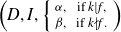


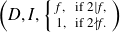
2·4. Regulator constants
We now consider regulator constants. These are discussed in detail in [
Reference Dokchitser and Dokchitser10
, section 2.ii], and we will generalise some of the results therein to apply to K-relations. Throughout, $\mathcal{K}$
is a field of characteristic zero.
$\mathcal{K}$
is a field of characteristic zero.
Notation 2·30. Let V be a vector space over $\mathcal{K}$
, with
$\mathcal{K}$
, with $\langle, \rangle$
a non-degenerate
$\langle, \rangle$
a non-degenerate $\mathcal{K}$
-bilinear
$\mathcal{K}$
-bilinear $\mathcal{L}$
-valued pairing on V, where
$\mathcal{L}$
-valued pairing on V, where $\mathcal{L}$
is some finite extension of
$\mathcal{L}$
is some finite extension of $\mathcal{K}$
. Let
$\mathcal{K}$
. Let $\det(\langle, \rangle | V) \in \mathcal{L}^{\times} / \mathcal{K}^{\times 2}$
denote
$\det(\langle, \rangle | V) \in \mathcal{L}^{\times} / \mathcal{K}^{\times 2}$
denote $\det(\langle e_i, e_j \rangle_{i, j})$
in any
$\det(\langle e_i, e_j \rangle_{i, j})$
in any $\mathcal{K}$
-basis
$\mathcal{K}$
-basis $\{e_1, \ldots e_n \}$
of V.
$\{e_1, \ldots e_n \}$
of V.
Definition 2·31 (Regulator constant). Let G be a finite group, $\tau$
a self-dual
$\tau$
a self-dual $\mathcal{K} G$
-representation. Let
$\mathcal{K} G$
-representation. Let $\langle, \rangle$
be a G-invariant, non-degenerate,
$\langle, \rangle$
be a G-invariant, non-degenerate, $\mathcal{K}$
-bilinear pairing on
$\mathcal{K}$
-bilinear pairing on $\tau$
taking values in an extension
$\tau$
taking values in an extension $\mathcal{L}$
of
$\mathcal{L}$
of $\mathcal{K}$
. Let
$\mathcal{K}$
. Let $\Theta = \sum_i n_i H_i \in \mathrm{B}(G)$
be a K-relation for G. Define the regulator constant
$\Theta = \sum_i n_i H_i \in \mathrm{B}(G)$
be a K-relation for G. Define the regulator constant
 \begin{equation*} \mathcal{C}^{\langle, \rangle}_{\Theta}(\tau) = \prod_i \det\left(\frac{1}{|H_i|} \langle, \rangle \mid \tau^{H_i} \right)^{n_i} \in \mathcal{L}^{\times} / \mathcal{K}^{\times 2}.\end{equation*}
Remark 2·32. If $\tau$
and
$\tau$
and $\langle, \rangle$
are as in the definition, then for each
$\langle, \rangle$
are as in the definition, then for each $H \leq G$
the restriction of
$H \leq G$
the restriction of $\langle, \rangle$
to
$\langle, \rangle$
to $\tau^{H}$
is non-degenerate [
Reference Dokchitser and Dokchitser10
, lemma 2·15]. Thus
$\tau^{H}$
is non-degenerate [
Reference Dokchitser and Dokchitser10
, lemma 2·15]. Thus $\det(\langle, \rangle \mid \tau^{H}) \not=0$
so
$\det(\langle, \rangle \mid \tau^{H}) \not=0$
so $\mathcal{C}_{\Theta}^{\langle, \rangle}(\tau)$
is non-zero.
$\mathcal{C}_{\Theta}^{\langle, \rangle}(\tau)$
is non-zero.
If $\langle \tau, \mathbb{C}[G / \Theta] \rangle = 0$
,
$\langle \tau, \mathbb{C}[G / \Theta] \rangle = 0$
, $\Theta$
is a pseudo Brauer relation relative to
$\Theta$
is a pseudo Brauer relation relative to $\tau$
as introduced in [
Reference Dokchitser, Green, Konstantinou and Morgan13
, definition 3·1]. As proved in [
Reference Dokchitser, Green, Konstantinou and Morgan13
, theorem 3·7] and stated in the proposition below,
$\tau$
as introduced in [
Reference Dokchitser, Green, Konstantinou and Morgan13
, definition 3·1]. As proved in [
Reference Dokchitser, Green, Konstantinou and Morgan13
, theorem 3·7] and stated in the proposition below, $\mathcal{C}_{\Theta}^{\langle, \rangle}(\tau)$
is independent of the choice of pairing in this case. We let
$\mathcal{C}_{\Theta}^{\langle, \rangle}(\tau)$
is independent of the choice of pairing in this case. We let $\mathcal{C}_{\Theta}(\tau) \in \mathcal{K}^{\times}$
be a representative of the value of
$\mathcal{C}_{\Theta}(\tau) \in \mathcal{K}^{\times}$
be a representative of the value of $\mathcal{C}^{\langle, \rangle}_{\Theta}(\tau) \in \mathcal{K}^{\times} / \mathcal{K}^{\times 2}$
(we may take the pairing to be
$\mathcal{C}^{\langle, \rangle}_{\Theta}(\tau) \in \mathcal{K}^{\times} / \mathcal{K}^{\times 2}$
(we may take the pairing to be $\mathcal{K}$
-valued).
$\mathcal{K}$
-valued).
Proposition 2·33. Let G be a finite group, $\Theta = \sum_i n_i H_i \in \mathrm{B}(G)$
a K-relation for G. Let
$\Theta = \sum_i n_i H_i \in \mathrm{B}(G)$
a K-relation for G. Let $\tau$
be a self-dual
$\tau$
be a self-dual $\mathcal{K} G$
-representation, and
$\mathcal{K} G$
-representation, and $\langle, \rangle_1$
,
$\langle, \rangle_1$
, $\langle, \rangle_2$
two non-degenerate
$\langle, \rangle_2$
two non-degenerate $\mathcal{K}$
-bilinear G-invariant pairings on
$\mathcal{K}$
-bilinear G-invariant pairings on $\tau$
. Suppose that
$\tau$
. Suppose that $\langle \tau, \mathbb{C}[G / \Theta] \rangle = 0$
. Computing the determinants with respect to the same basis of
$\langle \tau, \mathbb{C}[G / \Theta] \rangle = 0$
. Computing the determinants with respect to the same basis of $\tau^{H_i}$
on both sides, one has
$\tau^{H_i}$
on both sides, one has
 \begin{equation*}\prod_i \det\left(\frac{1}{|H_i|} \langle, \rangle_1 \mid \tau^{H_i}\right)^{n_i} = \prod_i \det\left(\frac{1}{|H_i|} \langle, \rangle_2 \mid \tau^{H_i}\right)^{n_i}.\end{equation*}
Proof. Follow proof of [
Reference Dokchitser and Dokchitser10
, theorem 2·17] where this is proved for $\mathbb{C}[G / \Theta] = 0$
.
$\mathbb{C}[G / \Theta] = 0$
.
The above proposition does not hold if $\tau$
appears as a subrepresentation of
$\tau$
appears as a subrepresentation of $\mathbb{C}[G/ \Theta]$
. If we restrict to considering
$\mathbb{C}[G/ \Theta]$
. If we restrict to considering $\mathcal{K} = \mathbb{Q}$
and
$\mathcal{K} = \mathbb{Q}$
and $\mathbb{Q}$
-valued pairings, then we get the following result on independence of pairings up to norms.
$\mathbb{Q}$
-valued pairings, then we get the following result on independence of pairings up to norms.
Proposition 2·34. Let G be a finite group, $\Theta = \sum_i n_i H_i \in \mathrm{B}(G)$
a K-relation for G. Let
$\Theta = \sum_i n_i H_i \in \mathrm{B}(G)$
a K-relation for G. Let $\tau$
be a
$\tau$
be a $\mathbb{Q} G$
-representation, and
$\mathbb{Q} G$
-representation, and $\langle, \rangle_1$
,
$\langle, \rangle_1$
, $\langle, \rangle_2$
two non-degenerate
$\langle, \rangle_2$
two non-degenerate $\mathbb{Q}$
-bilinear G-invariant pairings on
$\mathbb{Q}$
-bilinear G-invariant pairings on $\tau$
that are
$\tau$
that are $\mathbb{Q}$
-valued. Computing the determinants with respect to the same basis of
$\mathbb{Q}$
-valued. Computing the determinants with respect to the same basis of $\tau^{H_i}$
on both sides, one has
$\tau^{H_i}$
on both sides, one has
 \begin{equation*}\prod_i \det\left(\frac{1}{|H_i|} \langle, \rangle_1 \mid \tau^{H_i}\right)^{n_i} \equiv \prod_i \det\left(\frac{1}{|H_i|} \langle, \rangle_2 \mid \tau^{H_i}\right)^{n_i} \mod N_{K / \mathbb{Q}}(K^{\times}).\end{equation*}
Proof. It is enough to prove this for a particular choice of basis of each $\tau^{H_i}$
. Suppose firstly that
$\tau^{H_i}$
. Suppose firstly that $\tau = \alpha \oplus \beta$
with
$\tau = \alpha \oplus \beta$
with $\alpha, \beta$ $\mathbb{Q} G$
-representations and
$\mathbb{Q} G$
-representations and $\mathrm{Hom}_G(\alpha, \beta^{\vee}) = 0$
, where
$\mathrm{Hom}_G(\alpha, \beta^{\vee}) = 0$
, where $\beta^{\vee}$
denotes the dual representation of
$\beta^{\vee}$
denotes the dual representation of $\beta$
. Then
$\beta$
. Then $\alpha$
and
$\alpha$
and $\beta$
are orthogonal with respect to
$\beta$
are orthogonal with respect to $\langle, \rangle_1$
,
$\langle, \rangle_1$
, $\langle, \rangle_2$
. Since
$\langle, \rangle_2$
. Since $\tau^{H} = \alpha^H \oplus \beta^H$
for all
$\tau^{H} = \alpha^H \oplus \beta^H$
for all $H \leq G$
, choosing bases of
$H \leq G$
, choosing bases of $\tau^{H_i}$
that respects this decomposition reduces the problem to
$\tau^{H_i}$
that respects this decomposition reduces the problem to $\alpha$
and
$\alpha$
and $\beta$
separately. Thus we may assume that
$\beta$
separately. Thus we may assume that $\tau = \rho^{\oplus n}$
where
$\tau = \rho^{\oplus n}$
where $\rho$
is an irreducible
$\rho$
is an irreducible $\mathbb{Q} G$
-representation. As
$\mathbb{Q} G$
-representation. As $\rho$
is irreducible it is of the form
$\rho$
is irreducible it is of the form $\rho = N_{\mathbb{Q}(\chi) / \mathbb{Q}}(\chi)^{\oplus m_{\chi}}$
where
$\rho = N_{\mathbb{Q}(\chi) / \mathbb{Q}}(\chi)^{\oplus m_{\chi}}$
where $\chi$
is a complex irreducible representation of G and
$\chi$
is a complex irreducible representation of G and $m_{\chi}$
is the Schur index of
$m_{\chi}$
is the Schur index of $\chi$
.
$\chi$
.
Let $\langle, \rangle$
be a non-degenerate G-invariant
$\langle, \rangle$
be a non-degenerate G-invariant $\mathbb{Q}$
-valued pairing on
$\mathbb{Q}$
-valued pairing on $\rho$
. Then any other such pairing is of the form
$\rho$
. Then any other such pairing is of the form $\langle, \rangle_{\alpha}$
for
$\langle, \rangle_{\alpha}$
for $\alpha \in \mathrm{End}_G(\rho)$
with
$\alpha \in \mathrm{End}_G(\rho)$
with $\langle x, y \rangle_{\alpha} = \langle \alpha(x), y \rangle$
for x,
$\langle x, y \rangle_{\alpha} = \langle \alpha(x), y \rangle$
for x, $y \in \rho$
. Similarly the non-degenerate G-invariant
$y \in \rho$
. Similarly the non-degenerate G-invariant $\mathbb{Q}$
-valued pairings on
$\mathbb{Q}$
-valued pairings on $\tau$
are in one-to-one correspondence with
$\tau$
are in one-to-one correspondence with $\mathrm{End}_G(\tau)$
. Note that
$\mathrm{End}_G(\tau)$
. Note that
 \begin{equation*}\mathrm{End}_G(\tau) = \mathrm{End}_G(\rho^{\oplus n }) \simeq M_n(\mathrm{End}_G(\rho)) \simeq M_n(D),\end{equation*}
where $D = \mathrm{End}_G(\rho)$
is a finite-dimensional division algebra over
$D = \mathrm{End}_G(\rho)$
is a finite-dimensional division algebra over $\mathbb{Q}$
with centre
$\mathbb{Q}$
with centre $\mathbb{Q}(\chi)$
(cf. [
Reference Serre19
, section 12·2]).
$\mathbb{Q}(\chi)$
(cf. [
Reference Serre19
, section 12·2]).
Fix a subgroup $H \leq G$
. Viewing
$H \leq G$
. Viewing $\rho^H$
as a D-vector space with basis
$\rho^H$
as a D-vector space with basis $\{v_1, \ldots v_k \}$
,
$\{v_1, \ldots v_k \}$
, $k = \dim_D \rho^H$
, an endomorphism
$k = \dim_D \rho^H$
, an endomorphism $\alpha \in D$
acts by the matrix
$\alpha \in D$
acts by the matrix $\alpha I_k$
. The algebra D has dimension
$\alpha I_k$
. The algebra D has dimension $m_{\chi}^2$
over
$m_{\chi}^2$
over $\mathbb{Q}(\chi)$
, and there exists a splitting field
$\mathbb{Q}(\chi)$
, and there exists a splitting field $\mathbb{Q}(\chi) \subset L \subset D$
such that
$\mathbb{Q}(\chi) \subset L \subset D$
such that $[D \,:\, L] = \,:\, L] = m_{\chi}$
and
$[D \,:\, L] = \,:\, L] = m_{\chi}$
and $D \otimes_{\mathbb{Q}(\chi)} L \simeq M_{m_{\chi}}(L)$
. Let
$D \otimes_{\mathbb{Q}(\chi)} L \simeq M_{m_{\chi}}(L)$
. Let $\{f_1, \ldots f_{m_{\chi}} \}$
be a basis for D over L. With respect to the basis
$\{f_1, \ldots f_{m_{\chi}} \}$
be a basis for D over L. With respect to the basis $\{ f_i v_j \}$
of
$\{ f_i v_j \}$
of $\rho^H$
,
$\rho^H$
, $\alpha$
acts by a block diagonal matrix consisting of k blocks corresponding to multiplication by
$\alpha$
acts by a block diagonal matrix consisting of k blocks corresponding to multiplication by $\alpha$
on D as an L-vector space. If we further consider a basis
$\alpha$
on D as an L-vector space. If we further consider a basis $\{ e_1, \ldots e_t\}$
of L as a
$\{ e_1, \ldots e_t\}$
of L as a $\mathbb{Q}$
-vector space, then
$\mathbb{Q}$
-vector space, then $ \mathcal{B} = \{ e_i f_j v_k \}$
is a
$ \mathcal{B} = \{ e_i f_j v_k \}$
is a $\mathbb{Q}$
-basis of
$\mathbb{Q}$
-basis of $\rho^{H}$
. Induce this to a basis of
$\rho^{H}$
. Induce this to a basis of $(\rho^{H})^{\oplus n}$
, and let C be the matrix of
$(\rho^{H})^{\oplus n}$
, and let C be the matrix of $\langle, \rangle$
on
$\langle, \rangle$
on $\rho^H$
with respect to
$\rho^H$
with respect to $\mathcal{B}$
. The matrix of
$\mathcal{B}$
. The matrix of $\langle, \rangle_1$
on
$\langle, \rangle_1$
on $\tau^H$
is of the form
$\tau^H$
is of the form
 \begin{equation*}\left(\begin{smallmatrix}C &\, 0 &\, \cdots &\, 0 \\0 &\, \ddots &\, \ddots &\, \vdots \\\vdots &\, \ddots &\, \ddots &\, 0 \\0 &\, \cdots &\, 0 &\, C\end{smallmatrix}\right)\left(\begin{smallmatrix}A_{11} &\, A_{12} &\, \cdots &\, A_{1n} \\A_{21} &\, \ddots &\, \ddots &\, \vdots \\\vdots &\, \ddots &\, \ddots &\, \vdots \\A_{n1} &\, \cdots &\, \cdots &\, A_{nn}\end{smallmatrix}\right),\quad A_{ij} =\left(\begin{smallmatrix}\alpha_{ij} &\, 0 &\, \cdots &\, 0 \\0 &\, \alpha_{ij} &\, 0 &\, \vdots \\\vdots &\, \ddots &\, \ddots &\, 0 \\0 &\, \cdots &\, 0 &\, \alpha_{ij}\end{smallmatrix}\right)\end{equation*}
with each $A_{i j} \in M_{k \cdot\dim_{\mathbb{Q}}D}(\mathbb{Q})$
a block diagonal matrix consisting of k-blocks
$A_{i j} \in M_{k \cdot\dim_{\mathbb{Q}}D}(\mathbb{Q})$
a block diagonal matrix consisting of k-blocks $\alpha_{i j}$
, where
$\alpha_{i j}$
, where $\alpha_{i j}$
is the matrix of multiplication by an element of D with respect to the
$\alpha_{i j}$
is the matrix of multiplication by an element of D with respect to the $\mathbb{Q}$
-basis
$\mathbb{Q}$
-basis $\{ e_i f_j \}$
of D. In particular, the matrix of
$\{ e_i f_j \}$
of D. In particular, the matrix of $({1}/{|H|}) \langle, \rangle_1$
has determinant
$({1}/{|H|}) \langle, \rangle_1$
has determinant
 \begin{equation*}\det\left(\tfrac{1}{|H|} \langle, \rangle_1 \mid \tau^{H} \right) = \det\left(\tfrac{1}{|H|} C \right)^n \cdot \det(\Lambda_{\alpha})^{\dim_D \rho^H},\end{equation*}
where $\Lambda_{\alpha}$
is the block matrix
$\Lambda_{\alpha}$
is the block matrix $\Lambda_{\alpha} = (\alpha_{i j })_{i, j}$
which does not depend on H.
$\Lambda_{\alpha} = (\alpha_{i j })_{i, j}$
which does not depend on H.
The determinant of $\Lambda_{\alpha}$
is the norm of an element of
$\Lambda_{\alpha}$
is the norm of an element of $\mathbb{Q}(\chi)^{\times}$
. To see this, view
$\mathbb{Q}(\chi)^{\times}$
. To see this, view $\Lambda_{\alpha}$
as a block matrix
$\Lambda_{\alpha}$
as a block matrix $(m_{x_{i j }})_{i, j}$
, where
$(m_{x_{i j }})_{i, j}$
, where $m_{x_{i, j}}$
corresponds to the multiplication by
$m_{x_{i, j}}$
corresponds to the multiplication by $x_{i,j} \in L$
map on L as a
$x_{i,j} \in L$
map on L as a $\mathbb{Q}$
-vector space with basis
$\mathbb{Q}$
-vector space with basis $\{e_i\}$
. Let
$\{e_i\}$
. Let $R = \{ m_y \,:\, y \in L\}$
. This is a commutative subring of
$R = \{ m_y \,:\, y \in L\}$
. This is a commutative subring of $M_{[L \,:\, \mathbb{Q}]}(\mathbb{Q})$
. We can view
$M_{[L \,:\, \mathbb{Q}]}(\mathbb{Q})$
. We can view $\Lambda_{\alpha}$
as a matrix in
$\Lambda_{\alpha}$
as a matrix in $M_n(R)$
, and consider the determinant
$M_n(R)$
, and consider the determinant $\det_R(\Lambda_{\alpha}) \in R$
as R is commutative. By [
Reference Silvester21
, theorem 1],
$\det_R(\Lambda_{\alpha}) \in R$
as R is commutative. By [
Reference Silvester21
, theorem 1],
 \begin{equation*}\det(\Lambda_{\alpha}) = \det(\det\nolimits_R(\Lambda_{\alpha})) = \det(m_z) = N_{L / \mathbb{Q}}(z), \quad z = \det(x_{i,j})_{i,j} \in L,\end{equation*}
hence $\det(\Lambda_{\alpha}) \in N_{\mathbb{Q}(\chi) / \mathbb{Q}}(\mathbb{Q}(\chi)^{\times})$
.
$\det(\Lambda_{\alpha}) \in N_{\mathbb{Q}(\chi) / \mathbb{Q}}(\mathbb{Q}(\chi)^{\times})$
.
The matrix of $\langle , \rangle_2$
with respect to our chosen basis is of the same form and
$\langle , \rangle_2$
with respect to our chosen basis is of the same form and
 \begin{equation*}\det\left(\tfrac{1}{|H|} \langle , \rangle_2 \mid \tau^{H}\right) = \det\left(\tfrac{1}{|H|} C\right)^n \cdot \det(\Lambda_{\beta})^{\dim_D \rho^H}\end{equation*}
with $\Lambda_{\beta}$
not depending on H and
$\Lambda_{\beta}$
not depending on H and $\det(\Lambda_{\beta}) \in N_{\mathbb{Q}(\chi) / \mathbb{Q}}(\mathbb{Q}(\chi)^{\times})$
. Note that
$\det(\Lambda_{\beta}) \in N_{\mathbb{Q}(\chi) / \mathbb{Q}}(\mathbb{Q}(\chi)^{\times})$
. Note that
 \begin{align*} \sum_i n_i \dim_D \rho^{H_i} & = \tfrac{1}{[D \,:\, \mathbb{Q}]}\sum_i n_i \dim_{\mathbb{Q}} \rho^{H_i} = \tfrac{1}{[D \,:\, \mathbb{Q}]} \sum_i n_i \langle \mathrm{Ind}_{H_i}^G \unicode{x1D7D9}, \rho \rangle\\& = \tfrac{1}{[D \,:\, \mathbb{Q}]} \langle \mathbb{C}[G / \Theta] , \rho \rangle = \langle \mathbb{C}[G / \Theta], \chi \rangle.\end{align*}
Taking the product of the ratio of the determinants over all $H_i$
we have
$H_i$
we have
 \begin{equation*}\prod_i \big{(}\det(\tfrac{1}{|H_i|} \langle, \rangle_1 \mid \tau^{H_i})^{n_i} / \det(\tfrac{1}{|H_i|} \langle, \rangle_2 \mid \tau^{H_i})^{n_i}\big{)} = N_{\mathbb{Q}(\chi) / \mathbb{Q}}(s)^{\langle \mathbb{C}[G / \Theta], \chi \rangle}\end{equation*}
for some $s \in \mathbb{Q}(\chi)$
. The result follows as by Proposition 2·11,
$s \in \mathbb{Q}(\chi)$
. The result follows as by Proposition 2·11, $\langle \mathbb{C}[G / \Theta], \chi \rangle$
is divisible by
$\langle \mathbb{C}[G / \Theta], \chi \rangle$
is divisible by $[K \,:\, K \cap \mathbb{Q}(\chi)]$
, and by Lemma 2·23
$[K \,:\, K \cap \mathbb{Q}(\chi)]$
, and by Lemma 2·23 $N_{\mathbb{Q}(\chi) / \mathbb{Q}}(s)^{[K \,:\, K \cap \mathbb{Q}(\chi)]} \in N_{K / \mathbb{Q}}(K^{\times})$
.
$N_{\mathbb{Q}(\chi) / \mathbb{Q}}(s)^{[K \,:\, K \cap \mathbb{Q}(\chi)]} \in N_{K / \mathbb{Q}}(K^{\times})$
.
Changing the basis of the subspace $\tau^{H_i}$
alters the determinant computation by a rational square, and so we get the following corollary.
$\tau^{H_i}$
alters the determinant computation by a rational square, and so we get the following corollary.
Corollary 2·35. If $\Theta$
is a K-relation for G and
$\Theta$
is a K-relation for G and $\tau$
a
$\tau$
a $\mathbb{Q} G$
-representation, the value
$\mathbb{Q} G$
-representation, the value
 \begin{equation*}\mathcal{C}^{\langle, \rangle}_{\Theta}(\tau) \in \mathbb{Q}^{\times} /N_{K / \mathbb{Q}}(K^{\times})\cdot \mathbb{Q}^{\times 2}\end{equation*}
is independent of the choice of $\mathbb{Q}$
-valued pairing
$\mathbb{Q}$
-valued pairing $\langle, \rangle$
and
$\langle, \rangle$
and $\mathbb{Q}$
-bases for each invariant subspace
$\mathbb{Q}$
-bases for each invariant subspace $\tau^{H_i}$
. In this case, we let
$\tau^{H_i}$
. In this case, we let $\mathcal{C}_{\Theta}(\tau) \in \mathbb{Q}^{\times}$
be a representative for the class of
$\mathcal{C}_{\Theta}(\tau) \in \mathbb{Q}^{\times}$
be a representative for the class of $\mathcal{C}^{\langle, \rangle}_{\Theta}(\tau)$
.
$\mathcal{C}^{\langle, \rangle}_{\Theta}(\tau)$
.
Corollary 2·36 (Regulator constants are multiplicative). Let $\Theta$
,
$\Theta$
, $\Psi \in \mathrm{B}(G)$
be K-relations for G, and let
$\Psi \in \mathrm{B}(G)$
be K-relations for G, and let $\tau$
,
$\tau$
, $\rho$
be self-dual
$\rho$
be self-dual $\mathcal{K} G$
-representations.
$\mathcal{K} G$
-representations.
-
(i) If
$\langle \mathbb{C}[G / \Theta], \tau \rangle = \langle \mathbb{C}[G / \Psi] , \tau \rangle = \langle \mathbb{C}[G / \Theta], \rho \rangle = \langle \mathbb{C}[G / \Psi] , \rho \rangle = 0$
, then
\begin{equation*}\mathcal{C}_{\Theta + \Psi}(\tau) \equiv \mathcal{C}_{\Theta}(\tau) \mathcal{C}_{\Psi}(\tau),\quad \mathcal{C}_{\Theta}(\tau \oplus \rho) \equiv \mathcal{C}_{\Theta}(\tau) \mathcal{C}_{\Theta}(\rho) \quad \mod \mathcal{K}^{\times 2}.\end{equation*}
-
(ii) If
$\mathcal{K} = \mathbb{Q}$
and the regulator constants are computed with
$\mathbb{Q}$
-valued pairings, then
\begin{equation*}\mathcal{C}_{\Theta + \Psi}(\tau) \equiv \mathcal{C}_{\Theta}(\tau) \mathcal{C}_{\Psi}(\tau),\quad \mathcal{C}_{\Theta}(\tau \oplus \rho) \equiv \mathcal{C}_{\Theta}(\tau) \mathcal{C}_{\Theta}(\rho) \quad \mod N_{K / \mathbb{Q}}(K^{\times})\cdot \mathbb{Q}^{\times 2}.\end{equation*}



Example 2·37 (Permutation representations, [
Reference Dokchitser and Dokchitser10
, example 2·19]). Consider $\tau = \mathbb{Q}[G / D]$
for some subgroup
$\tau = \mathbb{Q}[G / D]$
for some subgroup $D \leq G$
. By considering the standard (
$D \leq G$
. By considering the standard ( $\mathbb{Q}$
-valued) pairing on
$\mathbb{Q}$
-valued) pairing on $\tau$
, the elements of
$\tau$
, the elements of $G /D$
become an orthonormal basis. The space of invariants
$G /D$
become an orthonormal basis. The space of invariants $\rho^H$
for
$\rho^H$
for $H \leq G$
has a basis a basis consisting of H-orbit sums of these basis vectors. Then
$H \leq G$
has a basis a basis consisting of H-orbit sums of these basis vectors. Then $\det(\langle, \rangle \mid \tau^H)$
is a product of the lengths of these orbits, and
$\det(\langle, \rangle \mid \tau^H)$
is a product of the lengths of these orbits, and
 \begin{equation*}\det\left(\tfrac{1}{|H|} \langle, \rangle \mid \tau^H \right) = \prod_{w \in H \backslash G / D} \tfrac{1}{|H|} \cdot \tfrac{|H|}{|\mathrm{Stab}_H(wD)|} = \prod_{w \in H \backslash G / D} \frac{1}{|H \cap D^{w}|}.\end{equation*}
By Corollary 2·36(2), this computation can be used to compute $\mathcal{C}_{\Theta}(\rho)$
for any rational representation
$\mathcal{C}_{\Theta}(\rho)$
for any rational representation $\rho$
that lies in the virtual permutation ring of G and any K-relation
$\rho$
that lies in the virtual permutation ring of G and any K-relation $\Theta$
for G.
$\Theta$
for G.
Proposition 2·38. Let $\tau$
be a
$\tau$
be a $\mathbb{Q} G$
-representation. Suppose that either:
$\mathbb{Q} G$
-representation. Suppose that either:
-
(i) all complex irreducible constituents of
$\tau \otimes \mathbb{C}$
are not self-dual; or -
(ii)
$\tau \otimes \mathbb{C}$
is symplectic.


Then $\mathcal{C}_{\Theta}(\tau) \in N_{K / \mathbb{Q}}(K^{\times})\cdot \mathbb{Q}^{\times 2}$
whenever
$\mathcal{C}_{\Theta}(\tau) \in N_{K / \mathbb{Q}}(K^{\times})\cdot \mathbb{Q}^{\times 2}$
whenever $\Theta$
is a K-relation for G.
$\Theta$
is a K-relation for G.
Proof. This is due to $\tau \otimes \mathbb{C}$
admitting a non-degenerate alternating G-invariant pairing, so that in an appropriate basis the relevant determinant is a square (see [
Reference Dokchitser and Dokchitser10
, theorem 2·24, Corollary 2·25]).
$\tau \otimes \mathbb{C}$
admitting a non-degenerate alternating G-invariant pairing, so that in an appropriate basis the relevant determinant is a square (see [
Reference Dokchitser and Dokchitser10
, theorem 2·24, Corollary 2·25]).
To compute regulator constants, it will be useful to view them as arising from a function on $\mathrm{B}(G)$
. With this in mind, we introduce the following definition and, from now on, restrict to the case
$\mathrm{B}(G)$
. With this in mind, we introduce the following definition and, from now on, restrict to the case $\mathcal{K} = \mathbb{Q}$
.
$\mathcal{K} = \mathbb{Q}$
.
Definition 2·39. Let $\tau$
be a
$\tau$
be a $\mathbb{Q} G$
-representation with a non-degenerate
$\mathbb{Q} G$
-representation with a non-degenerate $\mathbb{Q}$
-valued G-invariant bilinear pairing
$\mathbb{Q}$
-valued G-invariant bilinear pairing $\langle, \rangle$
. Define
$\langle, \rangle$
. Define
 \begin{equation*} \mathcal{D}_{\tau} \,:\, H \mapsto \det\left(\tfrac{1}{|H|} \langle, \rangle \mid \tau^{H} \right) \in \mathbb{Q}^{\times} / \mathbb{Q}^{\times 2},\end{equation*}
where the determinant is taken with respect to any rational basis of $\tau^{H}$
.
$\tau^{H}$
.
Note that this depends on the choice of rational pairing. This defines a function on $\mathrm{B}(G)$
since by G-invariance
$\mathrm{B}(G)$
since by G-invariance $\mathcal{D}_{\tau}(H) = \mathcal{D}_{\tau}(xHx^{-1})$
. Let
$\mathcal{D}_{\tau}(H) = \mathcal{D}_{\tau}(xHx^{-1})$
. Let $\Theta$
be a K-relation for G. If
$\Theta$
be a K-relation for G. If $\mathcal{D}'_{\tau}$
is defined as above but with respect to a different rational pairing
$\mathcal{D}'_{\tau}$
is defined as above but with respect to a different rational pairing $\langle, \rangle'$
, then by Proposition 2·34 one has
$\langle, \rangle'$
, then by Proposition 2·34 one has $\mathcal{D}_{\tau}(\Theta) \equiv \mathcal{D}'_{\tau}(\Theta) \mod N_{K / \mathbb{Q}}(K^{\times})$
when computed with respect to the same basis for each
$\mathcal{D}_{\tau}(\Theta) \equiv \mathcal{D}'_{\tau}(\Theta) \mod N_{K / \mathbb{Q}}(K^{\times})$
when computed with respect to the same basis for each $\tau^{H}$
. Thus the value of
$\tau^{H}$
. Thus the value of $\mathcal{D}_{\tau}(\Theta)$
in
$\mathcal{D}_{\tau}(\Theta)$
in $\mathbb{Q}^{\times} / N_{K / \mathbb{Q}}(K^{\times}) \cdot \mathbb{Q}^{\times 2}$
is independent of choice of basis and rational pairing, and
$\mathbb{Q}^{\times} / N_{K / \mathbb{Q}}(K^{\times}) \cdot \mathbb{Q}^{\times 2}$
is independent of choice of basis and rational pairing, and
 \begin{equation*}\mathcal{D}_{\tau}(\Theta) = \mathcal{C}_{\Theta}(\tau) \end{equation*}
by definition.
Example 2·40. Using the bases and pairings defined in Example 2·37, $\mathcal{D}_{\unicode{x1D7D9}}$
is the function
$\mathcal{D}_{\unicode{x1D7D9}}$
is the function $H \mapsto {1}/{|H|}$
and
$H \mapsto {1}/{|H|}$
and $\mathcal{D}_{\mathbb{Q}[G]}$
is the constant function
$\mathcal{D}_{\mathbb{Q}[G]}$
is the constant function $H \mapsto 1$
.
$H \mapsto 1$
.
We are interested in computing $\mathcal{D}_{\tau}$
on K-relations. If K is quadratic, then we will consider
$\mathcal{D}_{\tau}$
on K-relations. If K is quadratic, then we will consider $\mathcal{D}_{\tau}$
as a function to
$\mathcal{D}_{\tau}$
as a function to $\mathbb{Q}^{\times}$
(as opposed to
$\mathbb{Q}^{\times}$
(as opposed to $\mathbb{Q}^{\times} / \mathbb{Q}^{\times 2}$
), since
$\mathbb{Q}^{\times} / \mathbb{Q}^{\times 2}$
), since $\mathcal{D}_{\tau} \sim_K \mathcal{D}_{\tau}'$
when
$\mathcal{D}_{\tau} \sim_K \mathcal{D}_{\tau}'$
when $\mathcal{D}_{\tau}'$
is computed with respect to a different choice of basis or rational pairing. Note that in this case,
$\mathcal{D}_{\tau}'$
is computed with respect to a different choice of basis or rational pairing. Note that in this case, $\mathcal{D}_{\tau \oplus \tau'} \sim_K \mathcal{D}_{\tau} \mathcal{D}_{\tau'}$
where
$\mathcal{D}_{\tau \oplus \tau'} \sim_K \mathcal{D}_{\tau} \mathcal{D}_{\tau'}$
where $\tau'$
is another
$\tau'$
is another $\mathbb{Q} G$
-representation. The following results focus on
$\mathbb{Q} G$
-representation. The following results focus on $K / \mathbb{Q}$
quadratic.
$K / \mathbb{Q}$
quadratic.
Proposition 2·41 (Induction). If $D \leq G$
and
$D \leq G$
and $\tau$
is a
$\tau$
is a $\mathbb{Q} D$
-representation, then
$\mathbb{Q} D$
-representation, then
 \begin{equation*} \mathcal{D}_{\mathrm{Ind}_D^{G} \tau}(\Theta) \equiv (D, \mathcal{D}_{\tau})(\Theta) \mod \mathbb{Q}^{\times} / N_{K / \mathbb{Q}}(K^{\times})\cdot \mathbb{Q}^{\times 2}, \end{equation*}
for a K-relation $\Theta$
. In particular if
$\Theta$
. In particular if $K / \mathbb{Q}$
is quadratic, then
$K / \mathbb{Q}$
is quadratic, then $\mathcal{D}_{\mathrm{Ind}_D^G \tau} \sim_K (D , \mathcal{D}_{\tau})$
.
$\mathcal{D}_{\mathrm{Ind}_D^G \tau} \sim_K (D , \mathcal{D}_{\tau})$
.
Proof. The proof of the analogous statement for Brauer relations [ Reference Dokchitser and Dokchitser10 , lemma 2·43] works for K-relations also.
Proposition 2·42 (Induction and Restriction, [
Reference Dokchitser and Dokchitser10
, proposition 2·45]). Let $K / \mathbb{Q}$
be quadratic, and
$K / \mathbb{Q}$
be quadratic, and $\tau$
a
$\tau$
a $\mathbb{Q} G$
-representation.
$\mathbb{Q} G$
-representation.
-
(i) If
$G \leq G'$
and
$\Theta \in \mathrm{B}(G')$
is a K-relation, then
$\mathcal{C}_{\Theta}(\mathrm{Ind}_{G}^{G'} \tau) \sim_K \mathcal{C}_{\mathrm{Res}^{G'}_{G} \Theta}(\tau)$
. -
(ii) If
$D \leq G$
and
$\Theta \in \mathrm{B}(D)$
is a K-relation, then
$\mathcal{C}_{\Theta}(\mathrm{Res}_D \tau) \sim_K \mathcal{C}_{\mathrm{Ind}_D^G \Theta}(\tau)$
.






Proof. (i) follows from Proposition 2·41, (ii) follows from the definition and noting that for $H \leq D$
,
$H \leq D$
, $(\mathrm{Res}_D \tau)^{H} \simeq \tau^{H}$
as vector spaces.
$(\mathrm{Res}_D \tau)^{H} \simeq \tau^{H}$
as vector spaces.
Corollary 2·43 [
Reference Dokchitser and Dokchitser10
, corollary 2·44]. Let $K / \mathbb{Q}$
be quadratic. Let
$K / \mathbb{Q}$
be quadratic. Let $I \triangleleft D \leq G$
with
$I \triangleleft D \leq G$
with $D / I$
cyclic. Then
$D / I$
cyclic. Then
 \begin{equation*} \mathcal{D}_{\mathbb{Q}[G / D]} \stackrel{\text{ Prop } 2.41}{\sim_K}\left(D, \mathcal{D}_{\unicode{x1D7D9}}\right) \sim_K \left(D, H \mapsto \tfrac{1}{|H|}\right) \stackrel{\text{Cor }2.29(i)}{\sim_K} \left(D, H \mapsto \tfrac{|D|}{|H|}\right) = (D, I, ef) . \end{equation*}
Lemma 2·44. Let $K / \mathbb{Q}$
be quadratic,
$K / \mathbb{Q}$
be quadratic, $\Theta$
a K-relation.
$\Theta$
a K-relation.
-
(i) If
$D \leq G$
is cyclic,
$\mathcal{C}_{\Theta}(\mathbb{Q}[G / D]) \in N_{K / \mathbb{Q}}(K^{\times})$
. -
(ii) If G is cyclic then
$\mathcal{C}_{\Theta}(\tau) \in N_{K / \mathbb{Q}}(K^{\times})$
for all rational representations
$\tau$
of G.




Proof. By Corollary 2·43, $\mathcal{D}_{\mathbb{Q}[G / D]} \sim_K (D, H \mapsto [D \,:\, H])\stackrel{\text{Lem } 2.25}{\sim_K} 1$
, which proves (i). For (ii), since G is cyclic, every rational representation of G can be written as a combination of permutation representations. Thus
$\mathcal{D}_{\mathbb{Q}[G / D]} \sim_K (D, H \mapsto [D \,:\, H])\stackrel{\text{Lem } 2.25}{\sim_K} 1$
, which proves (i). For (ii), since G is cyclic, every rational representation of G can be written as a combination of permutation representations. Thus $\tau = \oplus_i \mathbb{Q}[G / H_i]^{\oplus n_i}$
for
$\tau = \oplus_i \mathbb{Q}[G / H_i]^{\oplus n_i}$
for $H_i \leq G$
and so
$H_i \leq G$
and so $\mathcal{C}_{\Theta}(\tau) \equiv \prod_i \mathcal{C}_{\Theta}(\mathbb{Q}[G / H_i])^{n_i} \equiv 1 \mod N_{K / \mathbb{Q}}(K^{\times})$
by (i) as each
$\mathcal{C}_{\Theta}(\tau) \equiv \prod_i \mathcal{C}_{\Theta}(\mathbb{Q}[G / H_i])^{n_i} \equiv 1 \mod N_{K / \mathbb{Q}}(K^{\times})$
by (i) as each $H_i$
is cyclic.
$H_i$
is cyclic.
Lemma 2·45. Let $K / \mathbb{Q}$
be quadratic,
$K / \mathbb{Q}$
be quadratic, $\Theta$
a K-relation, and G a group of odd order. Then
$\Theta$
a K-relation, and G a group of odd order. Then $\mathcal{C}_{\Theta}(\tau) \in N_{K / \mathbb{Q}}(K^{\times})$
for all rational representations
$\mathcal{C}_{\Theta}(\tau) \in N_{K / \mathbb{Q}}(K^{\times})$
for all rational representations $\tau$
of G.
$\tau$
of G.
Proof. By multiplicativity of regulator constants, it is enough to show this for irreducible rational representations. If $\tau \in \mathrm{Irr}_{\mathbb{Q}}(G)$
is non-trivial, then
$\tau \in \mathrm{Irr}_{\mathbb{Q}}(G)$
is non-trivial, then $\tau \otimes_{\mathbb{Q}} \mathbb{C} = \chi \oplus \overline \chi$
where
$\tau \otimes_{\mathbb{Q}} \mathbb{C} = \chi \oplus \overline \chi$
where $\chi$
is not self-dual. Thus
$\chi$
is not self-dual. Thus $\mathcal{C}_{\Theta}(\tau) \in N_{K / \mathbb{Q}}(K^{\times})$
by Proposition 2·38. Therefore it remains to show that
$\mathcal{C}_{\Theta}(\tau) \in N_{K / \mathbb{Q}}(K^{\times})$
by Proposition 2·38. Therefore it remains to show that $\mathcal{D}_{\unicode{x1D7D9}} \sim_K 1$
and one has
$\mathcal{D}_{\unicode{x1D7D9}} \sim_K 1$
and one has
 \begin{equation*} \mathcal{D}_{\unicode{x1D7D9}} \sim_K \mathcal{D}_{\mathbb{Q}[G]} \stackrel{\text{Cor 2.43}}{\sim_K} 1. \end{equation*}
3. Root numbers and Tamagawa numbers
In this section we establish the following result, which expresses the product of Tamagawa numbers and other local fudge factors associated with a K-relation in terms of regulator constants and twisted root numbers.
Theorem 3·1. Let E be an elliptic curve over a number field L, with semistable reduction at the primes above 2 and 3 in L. Let $F / L$
be a finite Galois extension with
$F / L$
be a finite Galois extension with $G = \mathrm{Gal}(F / L)$
. If
$G = \mathrm{Gal}(F / L)$
. If $\Theta = \sum_i n_i H_i$
is a K-relation for G with
$\Theta = \sum_i n_i H_i$
is a K-relation for G with $K / \mathbb{Q}$
quadratic, then
$K / \mathbb{Q}$
quadratic, then
 \begin{equation*}\prod_i (C_{E / F^{H_i}})^{n_i} \equiv \prod_{\tau \in \mathrm{Irr}_{\mathbb{Q}}(G)} \mathcal{C}_{\Theta}(\tau)^{u(E / L, \chi_{\tau})}\mod N_{K / \mathbb{Q}}(K^{\times}),\end{equation*}
where $\chi_{\tau}$
is a complex irreducible constituent of
$\chi_{\tau}$
is a complex irreducible constituent of $\tau$
, and
$\tau$
, and $u(E / L , \chi_{\tau}) \in \{0,1\}$
satisfies
$u(E / L , \chi_{\tau}) \in \{0,1\}$
satisfies $w(E / L, \chi_{\tau}) = ({-}1)^{u(E / L, \chi_{\tau})}$
if
$w(E / L, \chi_{\tau}) = ({-}1)^{u(E / L, \chi_{\tau})}$
if $\chi_\tau$
is self-dual, and
$\chi_\tau$
is self-dual, and $u(E / L, \chi_\tau) = 0$
otherwise.
$u(E / L, \chi_\tau) = 0$
otherwise.
We use this result to relate the norm relations test to twisted root numbers in Section 4. This theorem follows from the local result Theorem 3·4, whose proof will take up the majority of this section.
Let $\mathcal{F} / \mathcal{K} / \mathbb{Q}_l$
be finite extensions, with
$\mathcal{F} / \mathcal{K} / \mathbb{Q}_l$
be finite extensions, with $\mathcal{F} / \mathcal{K}$
Galois and
$\mathcal{F} / \mathcal{K}$
Galois and $D = \mathrm{Gal}(\mathcal{F} / \mathcal{K})$
. Let
$D = \mathrm{Gal}(\mathcal{F} / \mathcal{K})$
. Let $E / \mathcal{K}$
be an elliptic curve.
$E / \mathcal{K}$
be an elliptic curve.
Notation 2·32. For $H \leq \mathrm{Gal}(\mathcal{F} / \mathcal{K})$
let
$H \leq \mathrm{Gal}(\mathcal{F} / \mathcal{K})$
let
 \begin{equation*}C_D(H) = C(E / \mathcal{F}^{H}, \omega^0),\end{equation*}
as defined in Section 1·5 for $\omega^0$
a differential on
$\omega^0$
a differential on $E / \mathcal{K}$
, which we choose to be minimal. Extending
$E / \mathcal{K}$
, which we choose to be minimal. Extending $C_D$
additively defines a function on the Burnside ring of D.
$C_D$
additively defines a function on the Burnside ring of D.
We first show that for $K / \mathbb{Q}$
a finite Galois extension, the evaluation of
$K / \mathbb{Q}$
a finite Galois extension, the evaluation of $C_D$
on K-relations for D is independent of the choice of differential
$C_D$
on K-relations for D is independent of the choice of differential $\omega^0$
.
$\omega^0$
.
Lemma 3·3. Let $K / \mathbb{Q}$
be a finite Galois extension, and let
$K / \mathbb{Q}$
be a finite Galois extension, and let $\Theta = \sum_i n_i H_i$
be a K-relation for D. Then
$\Theta = \sum_i n_i H_i$
be a K-relation for D. Then
 \begin{equation*}\prod_i C(E / \mathcal{F}^{H_i}, \omega^0)^{n_i} \equiv \prod_i C(E / \mathcal{F}^{H_i}, \omega )^{n_i} \mod N_{K / \mathbb{Q}}(K^{\times})\end{equation*}
for different choices of invariant differentials $\omega^0$
,
$\omega^0$
, $\omega$
.
$\omega$
.
Proof. Let $\alpha \in \mathcal{K}^{\times}$
be such that
$\alpha \in \mathcal{K}^{\times}$
be such that $\omega = \alpha \omega^0$
. Let
$\omega = \alpha \omega^0$
. Let $C_D$
,
$C_D$
, $C_D'$
be the functions on
$C_D'$
be the functions on $\mathrm{B}(D)$
as in Notation 3·2 defined using
$\mathrm{B}(D)$
as in Notation 3·2 defined using $\omega^0$
and
$\omega^0$
and $\omega$
respectively. Then
$\omega$
respectively. Then
 \begin{equation*}C_D'(\Theta) / C_D(\Theta) =\prod_i |\alpha|_{\mathcal{F}^{H_i}} = (D, I, |\alpha|_{\mathcal{K}}^{f})(\Theta).\end{equation*}
The function $(D, I, | \alpha|_{\mathcal{K}}^{f} )$
passes to a quotient function h on the Burnside ring of
$(D, I, | \alpha|_{\mathcal{K}}^{f} )$
passes to a quotient function h on the Burnside ring of $D / I \simeq C_n$
given by
$D / I \simeq C_n$
given by $h(C_d) = |\alpha|_{\mathcal{K}}^{n / d} \in \mathbb{Q}^{\times}$
. For
$h(C_d) = |\alpha|_{\mathcal{K}}^{n / d} \in \mathbb{Q}^{\times}$
. For $d \mid n$
,
$d \mid n$
,
 \begin{equation*}h(\Psi_d) = |\alpha|_{\mathcal{K}}^{\sum_{d' | d} \mu(d / d') d } = |\alpha|_{\mathcal{K}}^{\Phi(d)} = |\alpha|_{\mathcal{K}}^{[\mathbb{Q}(\zeta_d) \,:\, \mathbb{Q}]} \in N_{\mathbb{Q}(\zeta_d) / \mathbb{Q}}(\mathbb{Q}(\zeta_d)^{\times}).\end{equation*}
Hence by Example 2·20 $h(\Theta\cdot I / I) \in N_{K / \mathbb{Q}}(K^{\times})$
and the result follows.
$h(\Theta\cdot I / I) \in N_{K / \mathbb{Q}}(K^{\times})$
and the result follows.
For the remainder of this section we restrict to K-relations with $K / \mathbb{Q}$
a quadratic extension. Then, if
$K / \mathbb{Q}$
a quadratic extension. Then, if $\Theta$
is a K-relation for D and
$\Theta$
is a K-relation for D and $\tau$
is a
$\tau$
is a $\mathbb{Q} D$
-representation,
$\mathbb{Q} D$
-representation, $\mathcal{C}_{\Theta}(\tau) \mod N_{K / \mathbb{Q}}(K^{\times})$
is independent of choice of
$\mathcal{C}_{\Theta}(\tau) \mod N_{K / \mathbb{Q}}(K^{\times})$
is independent of choice of $\mathbb{Q}$
-basis and
$\mathbb{Q}$
-basis and $\mathbb{Q}$
-valued pairing on
$\mathbb{Q}$
-valued pairing on $\tau$
. Our central result is as follows:
$\tau$
. Our central result is as follows:
Theorem 3·4. Let $\mathcal{F} / \mathcal{K} / \mathbb{Q}_l$
be finite extensions, with
$\mathcal{F} / \mathcal{K} / \mathbb{Q}_l$
be finite extensions, with $\mathcal{F} / \mathcal{K}$
Galois and
$\mathcal{F} / \mathcal{K}$
Galois and $D = \mathrm{Gal}(\mathcal{F} / \mathcal{K})$
. Let E be an elliptic curve over
$D = \mathrm{Gal}(\mathcal{F} / \mathcal{K})$
. Let E be an elliptic curve over $\mathcal{K}$
. Assume either that E has semistable reduction, or has additive reduction and
$\mathcal{K}$
. Assume either that E has semistable reduction, or has additive reduction and $l \geq 5$
. Then there exists a
$l \geq 5$
. Then there exists a $\mathbb{Q} D$
-module
$\mathbb{Q} D$
-module $\mathcal{V}$
such that:
$\mathcal{V}$
such that:
-
(i) for all self-dual representations
$\tau$
of D,
where
\begin{equation*}\frac{w(E / \mathcal{K}, \tau)}{w(\tau)^{2 }} = ({-}1)^{\langle \tau , \mathcal{V} \rangle},\end{equation*}
$w(E / \mathcal{K}, \tau)$
and
$w(\tau)$
are local root numbers;
-
(ii) if
$K / \mathbb{Q}$
is a quadratic extension and
$\Theta = \sum_i n_i H_i$
is a K-relation for D, then
where the regulator constant
\begin{equation*}\mathcal{C}_{\Theta}(\mathcal{V}) \equiv \prod_i C_D(H_i)^{n_i} \mod N_{K/\mathbb{Q}}(K^{\times}),\end{equation*}
$\mathcal{C}_{\Theta}(\mathcal{V})$
is computed on any rational basis of
$\mathcal{V}$
with respect to any non-degenerate, G-invariant,
$\mathbb{Q}$
-valued pairing on
$\mathcal{V}$
.


Remark 3·5. This theorem should be compared with [ Reference Dokchitser and Dokchitser10 , theorem 3·2]. We are proving the same compatibility result, but extending the second part of the theorem from Brauer relations to K-relations.
By taking the product over all finite places, this theorem enables the computation of the global product of fudge factors appearing in the BSD-quotient for a K-relation in terms of regulator constants, yielding Theorem 3·1:
Proof of Theorem
3·1. Let $C \,:\, \mathrm{B}(G) \to \mathbb{Q}^{\times}$
be the function given by
$C \,:\, \mathrm{B}(G) \to \mathbb{Q}^{\times}$
be the function given by $C(H) = C_{E / F^{H}}$
. Then
$C(H) = C_{E / F^{H}}$
. Then
 \begin{equation*} {}C(\Theta) = \prod_i (C_{E / F^{H_i}})^{n_i} = \prod_v C_{D_v}(\mathrm{Res}_{D_v}\Theta),\end{equation*}
with the product ranging over all finite places v of L (cf. Example 2·16). Here $D_v \simeq \mathrm{Gal}(F_w / L_v) \leq G$
is the decomposition group for a choice of prime w in L above v. By Theorem 3·4 and Proposition 2·42(i),
$D_v \simeq \mathrm{Gal}(F_w / L_v) \leq G$
is the decomposition group for a choice of prime w in L above v. By Theorem 3·4 and Proposition 2·42(i),
 \begin{equation*}C_{D_v}(\mathrm{Res}_{D_v}\Theta) \equiv \mathcal{C}_{\mathrm{Res}_{D_v}\Theta}(\mathcal{V}_v) \equiv \mathcal{C}_{\Theta}(\mathrm{Ind}_{D_v}^G \mathcal{V}_v)\mod N_{K / \mathbb{Q}}(K^{\times})\end{equation*}
for the $ \mathbb{Q} D_v$
-module
$ \mathbb{Q} D_v$
-module $\mathcal{V}_v$
satisfying Theorem 3·4. Therefore
$\mathcal{V}_v$
satisfying Theorem 3·4. Therefore
 \begin{equation*}\prod_i (C_{E / F^{H_i}})^{n_i} \equiv \prod_{\tau \in \mathrm{Irr}_{\mathbb{Q}}(G)} \prod_v \mathcal{C}_{\Theta}(\tau)^{\langle \chi_{\tau} , \mathrm{Ind}_{D_v} \mathcal{V}_v \rangle} \mod N_{K / \mathbb{Q}}(K^{\times}).\end{equation*}
By Proposition 2·38, if $\chi_{\tau}$
is not self-dual or is symplectic, then
$\chi_{\tau}$
is not self-dual or is symplectic, then $\mathcal{C}_{\Theta}(\tau) \in N_{K / \mathbb{Q}}(K^{\times})$
. Thus we only need to take the product over
$\mathcal{C}_{\Theta}(\tau) \in N_{K / \mathbb{Q}}(K^{\times})$
. Thus we only need to take the product over $\tau \in \mathrm{Irr}_{\mathbb{Q}}(G)$
with
$\tau \in \mathrm{Irr}_{\mathbb{Q}}(G)$
with $\chi_{\tau}$
orthogonal. In this case,
$\chi_{\tau}$
orthogonal. In this case,
 \begin{equation*}({-}1)^{\langle \chi_{\tau}, \mathrm{Ind}_{D_v} \mathcal{V}_v \rangle} = \frac{w(E / L_v, \mathrm{Res}_{D_v} \chi_{\tau})}{w(\mathrm{Res}_{D_v} \chi_{\tau})^2}\end{equation*}
by Frobenius reciprocity and Theorem 3·4(i). As $\chi_{\tau}$
is orthogonal,
$\chi_{\tau}$
is orthogonal, $w(\chi_{\tau})^2 = 1$
, and so
$w(\chi_{\tau})^2 = 1$
, and so
 \begin{equation*}({-}1)^{\sum_v \langle \chi_{\tau}, \mathrm{Ind}_{D_v} \mathcal{V}_v \rangle} = w(E / L, \chi_{\tau}) = ({-}1)^{u(E / L, \chi_{\tau})}.\end{equation*}
Therefore $\sum_v \langle \chi_{\tau}, \mathrm{Ind}_{D_v} \mathcal{V}_v \rangle \equiv u(E / L, \chi_{\tau}) \mod 2$
and computing mod
$\sum_v \langle \chi_{\tau}, \mathrm{Ind}_{D_v} \mathcal{V}_v \rangle \equiv u(E / L, \chi_{\tau}) \mod 2$
and computing mod $N_{K / \mathbb{Q}}(K^{\times})$
one has
$N_{K / \mathbb{Q}}(K^{\times})$
one has
 \begin{equation*}\prod_i (C_{E / F^{H_i}})^{n_i} \equiv \prod_{{\tau \in \mathrm{Irr}_{\mathbb{Q}}(G), \\ \scriptsize{\chi_{\tau} \text{ orthogonal}}}} \mathcal{C}_{\Theta}(\tau)^{\sum_v \langle \chi_{\tau}, \mathrm{Ind}_{D_v} \mathcal{V}_v \rangle} \equiv \prod_{\tau \in \mathrm{Irr}_{\mathbb{Q}}(G)} \mathcal{C}_{\Theta}(\tau)^{u(E / L, \chi_{\tau})},\end{equation*}
noting that $u(E / L, \chi_{\tau}) = 0$
when
$u(E / L, \chi_{\tau}) = 0$
when $\chi_{\tau}$
is symplectic since
$\chi_{\tau}$
is symplectic since $w(E / L, \chi_{\tau}) = 1$
(see [
Reference Dokchitser and Dokchitser10
, Lemma A·2(4)]).
$w(E / L, \chi_{\tau}) = 1$
(see [
Reference Dokchitser and Dokchitser10
, Lemma A·2(4)]).
3·1. Setup
The proof of Theorem 3·4 is set up the same way as the proof of [
Reference Dokchitser and Dokchitser10
, theorem 3·2]. We define the following extensions $\mathcal{L}$
of
$\mathcal{L}$
of $\mathcal{K}$
, depending on the reduction type of E:
$\mathcal{K}$
, depending on the reduction type of E:
Notation 2·36.
-
(1)
$E / \mathcal{K}$
has semistable reduction.-
(i)
$(\text{1G})$
, E has good reduction,
$\mathcal{L} = \mathcal{K}$
. -
(ii)
$(\text{1S})$
, E has split multiplicative reduction,
$\mathcal{L} = \mathcal{K}$
. -
(iii)
$(\text{1NS})$
, E has non-split multiplicative reduction,
$\mathcal{L}$
is quadratic unramified.
-
-
(2)
$E / \mathcal{K}$
has additive reduction. In this case assume that
$\mathcal{K}$
has residue characteristic
$l \gt 3$
. Let
$\Delta_{E}$
and
$c_6$
be the standard invariants for some model of
$E / \mathcal{K}$
and let
$\mathfrak{e} = {12}/{\mathrm{gcd}(12, \mathrm{ord} \Delta_{E})}$
.-
(i)
$(\text{2C})$
, E has potentially good reduction,
$\mu_{\mathfrak{e}} \subset \mathcal{K}$
,
$\mathcal{L} = \mathcal{K}(\sqrt[\mathfrak{e}]{\Delta_{E}}) {} {} {} {}$
is a cyclic extension of
$\mathcal{K}$
. -
(ii)
$(\text{2D})$
, E has potentially good reduction,
$\mu_{\mathfrak{e}} \not\subset \mathcal{K}$
,
$\mathcal{L} = \mathcal{K}(\mu_{\mathfrak{e}}, {} {} {} {} {} {}\sqrt[\mathfrak{e}]{\Delta_{E}})$
is a dihedral extension of
$\mathcal{K}$
. -
(iii)
$(\text{2M})$
, E has potentially multiplicative reduction,
$\mathcal{L} = \mathcal{K}(\sqrt{-c_6})$
.
-









These are the minimal Galois extensions over which E attains split semistable reduction. As in [
Reference Dokchitser and Dokchitser10
, hypothesis 3·6], we claim that we may assume that $\mathcal{L}$
is a subfield of
$\mathcal{L}$
is a subfield of $\mathcal{F}$
when proving 3·4.
$\mathcal{F}$
when proving 3·4.
Lemma 3·7. Let $\mathcal{K} \subset \mathcal{F} \subset \mathcal{M}$
with
$\mathcal{K} \subset \mathcal{F} \subset \mathcal{M}$
with $\mathcal{M} / \mathcal{K}$
and
$\mathcal{M} / \mathcal{K}$
and $\mathcal{F} / \mathcal{K}$
Galois. Let
$\mathcal{F} / \mathcal{K}$
Galois. Let $\mathcal{V}$
be a
$\mathcal{V}$
be a $\mathbb{Q} \mathrm{Gal}(\mathcal{M} / \mathcal{K})$
-module. If
$\mathbb{Q} \mathrm{Gal}(\mathcal{M} / \mathcal{K})$
-module. If $\mathcal{V}$
satisfies the conditions of Theorem 3·4 for
$\mathcal{V}$
satisfies the conditions of Theorem 3·4 for $E / \mathcal{K}$
and the extension
$E / \mathcal{K}$
and the extension $\mathcal{M} / \mathcal{K}$
, then
$\mathcal{M} / \mathcal{K}$
, then $\mathcal{W} = \mathcal{V}^{\mathrm{Gal}(\mathcal{M} / \mathcal{F})}$
satisfies the conditions of Theorem 3·4 for
$\mathcal{W} = \mathcal{V}^{\mathrm{Gal}(\mathcal{M} / \mathcal{F})}$
satisfies the conditions of Theorem 3·4 for $E / \mathcal{K}$
and the extension
$E / \mathcal{K}$
and the extension $\mathcal{F} / \mathcal{K}$
.
$\mathcal{F} / \mathcal{K}$
.
Proof. Let $G = \mathrm{Gal}(\mathcal{M} / \mathcal{K})$
,
$G = \mathrm{Gal}(\mathcal{M} / \mathcal{K})$
, $N = \mathrm{Gal}(\mathcal{M} / \mathcal{F})$
. If
$N = \mathrm{Gal}(\mathcal{M} / \mathcal{F})$
. If $\tau$
is a self-dual representation of
$\tau$
is a self-dual representation of $G / N$
then we can inflate it to a representation of G and one has
$G / N$
then we can inflate it to a representation of G and one has $({-}1)^{\langle \tau, \mathcal{W} \rangle_{G / N}} = ({-}1)^{\langle \tau, \mathcal{V} \rangle_{G}} = w(E / \mathcal{K}, \tau) / w(\tau)^2$
by assumption. Let
$({-}1)^{\langle \tau, \mathcal{W} \rangle_{G / N}} = ({-}1)^{\langle \tau, \mathcal{V} \rangle_{G}} = w(E / \mathcal{K}, \tau) / w(\tau)^2$
by assumption. Let $K / \mathbb{Q}$
be quadratic and let
$K / \mathbb{Q}$
be quadratic and let $\Theta$
be a K-relation for
$\Theta$
be a K-relation for $G / N$
. By Proposition 2·6(5), the lift
$G / N$
. By Proposition 2·6(5), the lift $\tilde{\Theta}$
of
$\tilde{\Theta}$
of $\Theta$
to
$\Theta$
to $\mathrm{B}(G)$
is a K-relation for G, and moreover
$\mathrm{B}(G)$
is a K-relation for G, and moreover $C_{G / N}(\Theta) = C_G(\tilde{\Theta})$
. The virtual representation
$C_{G / N}(\Theta) = C_G(\tilde{\Theta})$
. The virtual representation $\mathcal{V} \ominus \mathcal{W}$
has
$\mathcal{V} \ominus \mathcal{W}$
has $(\mathcal{V} \ominus \mathcal{W})^{N} = 0$
, so that
$(\mathcal{V} \ominus \mathcal{W})^{N} = 0$
, so that $\mathcal{C}_{\tilde{\Theta}}(\mathcal{V} \ominus \mathcal{W}) = 1$
. Since
$\mathcal{C}_{\tilde{\Theta}}(\mathcal{V} \ominus \mathcal{W}) = 1$
. Since $\mathcal{C}_{\tilde{\Theta}}(\mathcal{V} \ominus \mathcal{W}) = \mathcal{C}_{\tilde{\Theta}}(\mathcal{V}) / \mathcal{C}_{\tilde{\Theta}}(\mathcal{W})$
by Corollary 2·36(ii), we have
$\mathcal{C}_{\tilde{\Theta}}(\mathcal{V} \ominus \mathcal{W}) = \mathcal{C}_{\tilde{\Theta}}(\mathcal{V}) / \mathcal{C}_{\tilde{\Theta}}(\mathcal{W})$
by Corollary 2·36(ii), we have $\mathcal{C}_{\tilde{\Theta}}(\mathcal{V}) = \mathcal{C}_{\tilde{\Theta}}(\mathcal{W}) = \mathcal{C}_{\Theta}(\mathcal{W})$
. The result follows since
$\mathcal{C}_{\tilde{\Theta}}(\mathcal{V}) = \mathcal{C}_{\tilde{\Theta}}(\mathcal{W}) = \mathcal{C}_{\Theta}(\mathcal{W})$
. The result follows since $C_G(\tilde{\Theta}) \equiv \mathcal{C}_{\tilde{\Theta}}(\mathcal{V}) \mod N_{K / \mathbb{Q}}(K^{\times})$
.
$C_G(\tilde{\Theta}) \equiv \mathcal{C}_{\tilde{\Theta}}(\mathcal{V}) \mod N_{K / \mathbb{Q}}(K^{\times})$
.
It follows that if Theorem 3·4 holds for $E / \mathcal{K}$
and the extension
$E / \mathcal{K}$
and the extension $\mathcal{F} \mathcal{L} / \mathcal{K}$
, then it also holds for
$\mathcal{F} \mathcal{L} / \mathcal{K}$
, then it also holds for $E / \mathcal{K}$
and the extension
$E / \mathcal{K}$
and the extension $\mathcal{F} / \mathcal{K}$
. Thus we may assume that
$\mathcal{F} / \mathcal{K}$
. Thus we may assume that $\mathcal{F} / \mathcal{K}$
contains
$\mathcal{F} / \mathcal{K}$
contains $\mathcal{L}$
as a subfield, and we make this assumption from now on.
$\mathcal{L}$
as a subfield, and we make this assumption from now on.
Let $D' = \mathrm{Gal}(\mathcal{F} / \mathcal{L}) \triangleleft D$
. Our choice of
$D' = \mathrm{Gal}(\mathcal{F} / \mathcal{L}) \triangleleft D$
. Our choice of $\mathcal{V}$
in Theorem 3·4 is based on the following result of Rohrlich, which provides formulae for local twisted root numbers.
$\mathcal{V}$
in Theorem 3·4 is based on the following result of Rohrlich, which provides formulae for local twisted root numbers.
Lemma 3·8 [
Reference Rohrlich17
, Theorem 2]. For a self-dual representation $\tau$
of D,
$\tau$
of D,
 \begin{equation*}w(E / \mathcal{K}, \tau) = w(\tau)^2 \lambda^{\dim \tau} ({-}1)^{\langle \tau, V \rangle},\end{equation*}
where $\lambda \in \{\pm 1\}$
and V is the representation of
$\lambda \in \{\pm 1\}$
and V is the representation of $D / D'$
given in the table below. Here
$D / D'$
given in the table below. Here $\unicode{x1D7D9}$
denotes the trivial character,
$\unicode{x1D7D9}$
denotes the trivial character, $\chi$
the non-trivial character of order 2,
$\chi$
the non-trivial character of order 2, $\eta$
the unramified quadratic character, and
$\eta$
the unramified quadratic character, and $\sigma$
the unique faithful 2-dimensional representation of
$\sigma$
the unique faithful 2-dimensional representation of $D / D'$
.
$D / D'$
.
Given V as in the lemma above, define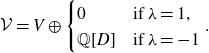 $\mathcal{V} = V \oplus \begin{cases} 0 & \text{if } \lambda = 1, \\ \mathbb{Q}[D] & \text{if }\lambda = -1 \end{cases}.$
Then
$\mathcal{V} = V \oplus \begin{cases} 0 & \text{if } \lambda = 1, \\ \mathbb{Q}[D] & \text{if }\lambda = -1 \end{cases}.$
Then
 \begin{equation*}\frac{w(E / \mathcal{K}, \tau)}{w(\tau)^2} = \lambda^{\langle \tau, \mathbb{Q}[D]\rangle} ({-}1)^{\langle \tau, V \rangle} = ({-}1)^{\langle \tau, \mathcal{V} \rangle},\end{equation*}
and so part (i) of Theorem 3·4, follows for this choice of $\mathcal{V}$
.
$\mathcal{V}$
.
Root numbers

Observe that if $K / \mathbb{Q}$
is quadratic and
$K / \mathbb{Q}$
is quadratic and $\Theta$
is a K-relation for D, then
$\Theta$
is a K-relation for D, then $\mathcal{C}_{\Theta}(\mathbb{Q}[D]) \in N_{K / \mathbb{Q}}(K^{\times})$
by Corollary 2·43 and so
$\mathcal{C}_{\Theta}(\mathbb{Q}[D]) \in N_{K / \mathbb{Q}}(K^{\times})$
by Corollary 2·43 and so $\mathcal{C}_{\Theta}(\mathcal{V}) \equiv \mathcal{C}_{\Theta}(V) \mod N_{K / \mathbb{Q}}(K^{\times})$
. Therefore to prove Theorem 3·4, it remains to prove the following.
$\mathcal{C}_{\Theta}(\mathcal{V}) \equiv \mathcal{C}_{\Theta}(V) \mod N_{K / \mathbb{Q}}(K^{\times})$
. Therefore to prove Theorem 3·4, it remains to prove the following.
Proposition 3·9. Let $\Theta = \sum_i n_i H_i \in \mathrm{B}(D)$
be a K-relation for D with
$\Theta = \sum_i n_i H_i \in \mathrm{B}(D)$
be a K-relation for D with $K / \mathbb{Q}$
a quadratic extension. Then
$K / \mathbb{Q}$
a quadratic extension. Then
 \begin{equation*}C_D(\Theta) = \prod_i C(E / \mathcal{F}^{H_i}, \omega^0)^{n_i} \equiv \mathcal{C}_{\Theta}(V) \mod N_{K / \mathbb{Q}}(K^{\times}),\end{equation*}
where V is the $\mathbb{Q} D$
-representation given in Lemma 3·8 depending on the reduction of
$\mathbb{Q} D$
-representation given in Lemma 3·8 depending on the reduction of $E / \mathcal{K}$
. In other words,
$E / \mathcal{K}$
. In other words, $\mathcal{D}_{V} \sim_K C_D$
as functions on
$\mathcal{D}_{V} \sim_K C_D$
as functions on $\mathrm{B}(D)$
.
$\mathrm{B}(D)$
.
Let I, W denote the inertia and wild inertia subgroups of D respectively. We proceed by proving Proposition 3·9 case-by-case for each possible reduction type.
3·2. Semistable reduction
Good reduction. If $E / \mathcal{K}$
has good reduction then
$E / \mathcal{K}$
has good reduction then $C(E / \mathcal{F}^{H}, \omega^0) = 1$
for all
$C(E / \mathcal{F}^{H}, \omega^0) = 1$
for all $H \leq D$
so
$H \leq D$
so $ 1 = C_D(\Theta) = \mathcal{C}_{\Theta}(V)$
for
$ 1 = C_D(\Theta) = \mathcal{C}_{\Theta}(V)$
for $V = 0$
.
$V = 0$
.
Split multiplicative reduction. Let $n = v_{\mathcal{K}}(\Delta)$
so that
$n = v_{\mathcal{K}}(\Delta)$
so that $E / \mathcal{K}$
has Type
$E / \mathcal{K}$
has Type $\mathrm{I}_n$
reduction with
$\mathrm{I}_n$
reduction with $C(E / \mathcal{K}, \omega^0) = n$
. For semistable reduction,
$C(E / \mathcal{K}, \omega^0) = n$
. For semistable reduction, $\omega^0$
remains minimal in all extensions of
$\omega^0$
remains minimal in all extensions of $\mathcal{K}$
,
$\mathcal{K}$
, $C(E / \mathcal{F}^{H}, \omega^0) = c(E / \mathcal{F}^{H})$
for all
$C(E / \mathcal{F}^{H}, \omega^0) = c(E / \mathcal{F}^{H})$
for all $H \leq D$
. Then
$H \leq D$
. Then $E / \mathcal{F}^{H}$
has split multiplicative reduction with
$E / \mathcal{F}^{H}$
has split multiplicative reduction with $C(E / \mathcal{F}^{H}, \omega) = e_{\mathcal{F}^{H} / \mathcal{K}} \cdot n$
. Thus
$C(E / \mathcal{F}^{H}, \omega) = e_{\mathcal{F}^{H} / \mathcal{K}} \cdot n$
. Thus $C_D \,:\, \mathrm{B}(D) \to \mathbb{Q}^{\times}$
is given by
$C_D \,:\, \mathrm{B}(D) \to \mathbb{Q}^{\times}$
is given by $C_D = (D, I, e n)$
. For split multiplicative reduction,
$C_D = (D, I, e n)$
. For split multiplicative reduction, $V = \unicode{x1D7D9}$
and
$V = \unicode{x1D7D9}$
and $\mathcal{C}_{\Theta}(\unicode{x1D7D9}) = \mathcal{D}_{\unicode{x1D7D9}}(\Theta)$
. Then
$\mathcal{C}_{\Theta}(\unicode{x1D7D9}) = \mathcal{D}_{\unicode{x1D7D9}}(\Theta)$
. Then
 \begin{equation*}\mathcal{D}_{\unicode{x1D7D9}} \stackrel{\text{Cor }2.43 }{\sim_K} (D, I, ef)\stackrel{{\scriptsize{Cor 2.29(ii)}}}{\sim_K} (D, I, e) \stackrel{{\scriptsize{Cor 2.29(i)}}}{\sim_K} (D, I, en) = C_D.\end{equation*}
Non-split multiplicative reduction. Once again, let $n = v_{\mathcal{K}}(\Delta)$
and assume
$n = v_{\mathcal{K}}(\Delta)$
and assume $E / \mathcal{K}$
has non-split multiplicative reduction. By Tate’s algorithm [
Reference Silverman20
, section IV·9] for
$E / \mathcal{K}$
has non-split multiplicative reduction. By Tate’s algorithm [
Reference Silverman20
, section IV·9] for $H \leq G$
,
$H \leq G$
, $e = e_{\mathcal{F}^{H} / \mathcal{K}}$
, and
$e = e_{\mathcal{F}^{H} / \mathcal{K}}$
, and $f = f_{\mathcal{F}^{H}/ \mathcal{K}}$
, we have
$f = f_{\mathcal{F}^{H}/ \mathcal{K}}$
, we have
 \begin{equation*} C(E / \mathcal{F}^{H}, \omega) = \begin{cases} {}2 & \text{if } 2 \mid en, 2 \nmid f, \\ {}en & \text{if } 2 \mid f,\\ {}1 & \text{else}.\end{cases}\end{equation*}
In this case $V = \eta$
with
$V = \eta$
with $\mathbb{Q}[D / D'] = \mathbb{Q}[D / D] \oplus \eta$
. Thus
$\mathbb{Q}[D / D'] = \mathbb{Q}[D / D] \oplus \eta$
. Thus
 \begin{equation*}\mathcal{D}_{\eta} \sim_K \mathcal{D}_{\mathbb{Q}[D / D']} / \mathcal{D}_{\unicode{x1D7D9}} \stackrel{\text{Cor } 2.43}{\sim_K} (D', I, ef) / (D, I, ef). \end{equation*}
One can show that $\mathcal{D}_{\eta} \sim_K C_D$
by following [
Reference Dokchitser and Dokchitser10
, section 3.iii·3], using Corollary 2·43 in place of [
Reference Dokchitser and Dokchitser10
, corollary 2·44], Corollary 2·29 in place of [
Reference Dokchitser and Dokchitser10
, theorem 2·36(f)], and Proposition 2·2 = [
Reference Dokchitser and Dokchitser10
, theorem 2·36(r), (d)]. We also need to show that
$\mathcal{D}_{\eta} \sim_K C_D$
by following [
Reference Dokchitser and Dokchitser10
, section 3.iii·3], using Corollary 2·43 in place of [
Reference Dokchitser and Dokchitser10
, corollary 2·44], Corollary 2·29 in place of [
Reference Dokchitser and Dokchitser10
, theorem 2·36(f)], and Proposition 2·2 = [
Reference Dokchitser and Dokchitser10
, theorem 2·36(r), (d)]. We also need to show that $\varphi_W \sim_K 1$
, where
$\varphi_W \sim_K 1$
, where
 \begin{equation*}\varphi_{W} \,:\, H \mapsto \begin{cases} {}1 & \text{if } H \not= W, \\ 2 & \text{if } H = W.\end{cases} \end{equation*}
Let $\overline{W} = W / \Phi$
be the maximal exponent 2 quotient of W. In [
Reference Dokchitser and Dokchitser10
, section 3.iii.3] it is shown that
$\overline{W} = W / \Phi$
be the maximal exponent 2 quotient of W. In [
Reference Dokchitser and Dokchitser10
, section 3.iii.3] it is shown that $\varphi_W(H) = \varphi_{\overline{W}}(\overline{H})$
and that
$\varphi_W(H) = \varphi_{\overline{W}}(\overline{H})$
and that $\varphi_{\overline{W}}(\Psi) \in \mathbb{Q}^{\times 2} \subset N_{K / \mathbb{Q}}(K^{\times})$
whenever
$\varphi_{\overline{W}}(\Psi) \in \mathbb{Q}^{\times 2} \subset N_{K / \mathbb{Q}}(K^{\times})$
whenever $\Psi \in \mathrm{B}(\overline{W})$
is a Brauer relation. For
$\Psi \in \mathrm{B}(\overline{W})$
is a Brauer relation. For $\tau \in \mathrm{Irr}_{\mathbb{C}}(\overline{W})$
,
$\tau \in \mathrm{Irr}_{\mathbb{C}}(\overline{W})$
, $\mathbb{Q}(\tau) \subset \mathbb{Q}(\zeta_{2^k})$
for some
$\mathbb{Q}(\tau) \subset \mathbb{Q}(\zeta_{2^k})$
for some $k \geq 1$
and so
$k \geq 1$
and so $\varphi_{\overline{W}}$
is trivial on
$\varphi_{\overline{W}}$
is trivial on $\mathbb{Q}(\tau)$
-relations as it takes values 1 or 2. Thus by Proposition 2·22(i),
$\mathbb{Q}(\tau)$
-relations as it takes values 1 or 2. Thus by Proposition 2·22(i), $\varphi_{\overline{W}} \sim_K 1$
so that
$\varphi_{\overline{W}} \sim_K 1$
so that $\varphi_W \sim_K 1$
also (note (note
$\varphi_W \sim_K 1$
also (note (note $\hat{C}(\overline{W}) = 1$
as it is abelian).
$\hat{C}(\overline{W}) = 1$
as it is abelian).
3·3. Additive reduction
Now suppose that $E / \mathcal{K}$
has additive reduction and that
$E / \mathcal{K}$
has additive reduction and that $\mathcal{K}$
has residue characteristic
$\mathcal{K}$
has residue characteristic $l \geq 5$
. Let
$l \geq 5$
. Let $\delta = v_{\mathcal{K}}(\Delta_E)$
be the valuation of the minimal discriminant of
$\delta = v_{\mathcal{K}}(\Delta_E)$
be the valuation of the minimal discriminant of $E / \mathcal{K}$
, and q the size of the residue field of
$E / \mathcal{K}$
, and q the size of the residue field of $\mathcal{K}$
.
$\mathcal{K}$
.
In this case, the proof of Proposition 3·9 is considerably longer. For readability, we have moved some calculations to appendices A, B.
Notation 3·10. We break up the functions
 \begin{equation*}C_D = c \cdot \omega, \quad \mathcal{D}_{V} = a \cdot d,\end{equation*}
with
 \begin{equation*}\begin{array}{l@{\quad}l} {}c(H) = c(E / \mathcal{F}^{H}), & a(H) = \det(\langle, \rangle \mid V^{H}), \\ \\ {}\omega(H) = \left|\frac{\omega_{E / \mathcal{K}}^0}{\omega_{E / \mathcal{F}^{H}}^0} \right|_{\mathcal{F}^{H}}, & d(H) = |H|^{-\dim V^{H}}.\end{array}\end{equation*}
The rational pairing on V is obtained by writing V as a combination of permutation representations and using the pairings defined in Example 2·37. These functions are well-defined on conjugacy classes and define functions on $\mathrm{B}(D)$
taking values in
$\mathrm{B}(D)$
taking values in $\mathbb{Q}^{\times} / \mathbb{Q}^{\times 2}$
.
$\mathbb{Q}^{\times} / \mathbb{Q}^{\times 2}$
.
We first note that we may reduce to the case where $f_{\mathcal{F} / \mathcal{K}}$
is a power of 2.
$f_{\mathcal{F} / \mathcal{K}}$
is a power of 2.
Proposition 3·11. For the case of additive reduction, it suffices to prove Theorem 3·4 when $f_{\mathcal{F} / \mathcal{K}}$
is a power of 2.
$f_{\mathcal{F} / \mathcal{K}}$
is a power of 2.
Proof. Follow the proof of [ Reference Dokchitser and Dokchitser10 , lemma 3·13].
3·3·1. Tamagawa term
We show that $c \sim_K a$
when
$c \sim_K a$
when $E / \mathcal{K}$
has potentially good reduction, and
$E / \mathcal{K}$
has potentially good reduction, and $c \sim_K d$
when
$c \sim_K d$
when $E / \mathcal{K}$
has potentially multiplicative reduction. We will use the corresponding result for Brauer relations from [
Reference Dokchitser and Dokchitser10
, section 3.iv], namely that if
$E / \mathcal{K}$
has potentially multiplicative reduction. We will use the corresponding result for Brauer relations from [
Reference Dokchitser and Dokchitser10
, section 3.iv], namely that if $\Psi \in \mathrm{B}(D)$
is a Brauer relation, then
$\Psi \in \mathrm{B}(D)$
is a Brauer relation, then
 \begin{equation*}\begin{array}{l@{\quad}l} {}c(\Psi) \equiv a(\Psi) \mod \mathbb{Q}^{\times 2} & \text{Case $2C / 2D$,}\\ {}c(\Psi) \equiv d(\Psi) \mod \mathbb{Q}^{\times 2} & \text{Case 2} {M}.\end{array}\end{equation*}
First suppose that $E / \mathcal{K}$
has potentially good reduction. Letting
$E / \mathcal{K}$
has potentially good reduction. Letting $\mathfrak{e} = e_{\mathcal{L} / \mathcal{K}}$
, we have
$\mathfrak{e} = e_{\mathcal{L} / \mathcal{K}}$
, we have $\delta \mathfrak{e} \equiv 0 \mod 12$
as
$\delta \mathfrak{e} \equiv 0 \mod 12$
as $E / \mathcal{L}$
has good reduction, and
$E / \mathcal{L}$
has good reduction, and $\mathfrak{e}$
is the smallest integer for which this holds. The case of potentially good reduction breaks up into the following two cases:
$\mathfrak{e}$
is the smallest integer for which this holds. The case of potentially good reduction breaks up into the following two cases:
 \begin{equation*}\begin{array}{l@{\quad}l@{\quad}l@{\quad}l@{\quad}l} {}\text{Case 2} {C}: & D / D' \simeq C_{\mathfrak{e}} & V = 0 &(\mathfrak{e} \in \{ 2,3,4,6\}, & q \equiv 1 \mod \mathfrak{e}), \\ {}\text{Case 2} {D}: & D / D' \simeq D_{2\mathfrak{e}} & V = \unicode{x1D7D9} \oplus \eta \oplus \sigma & (\mathfrak{e} \in \{ 3, 4, 6\},& q \equiv -1 \mod \mathfrak{e}),\end{array}\end{equation*}
where V is a representation of $D / D' = \mathrm{Gal}(\mathcal{L} / \mathcal{K})$
, and
$D / D' = \mathrm{Gal}(\mathcal{L} / \mathcal{K})$
, and $\eta$
and
$\eta$
and $\sigma$
are the quadratic unramified character and unique faithful representation of
$\sigma$
are the quadratic unramified character and unique faithful representation of $D / D'$
respectively. The congruence
$D / D'$
respectively. The congruence $q \equiv \pm 1 \mod \mathfrak{e}$
follows from [
Reference Rohrlich17
, theorem 2].
$q \equiv \pm 1 \mod \mathfrak{e}$
follows from [
Reference Rohrlich17
, theorem 2].
Since V is a representation of $D / D'$
, the function a is lifted from
$D / D'$
, the function a is lifted from $D / D' \simeq \mathrm{Gal}(\mathcal{L} / \mathcal{K})$
. As argued in [
Reference Dokchitser and Dokchitser10
, proposition 3·16], the function c is lifted from
$D / D' \simeq \mathrm{Gal}(\mathcal{L} / \mathcal{K})$
. As argued in [
Reference Dokchitser and Dokchitser10
, proposition 3·16], the function c is lifted from $\mathrm{Gal}(\mathcal{L}^u / \mathcal{K})$
, where
$\mathrm{Gal}(\mathcal{L}^u / \mathcal{K})$
, where $\mathcal{L}^u$
is the maximal unramified extension of
$\mathcal{L}^u$
is the maximal unramified extension of $\mathcal{L}$
contained in
$\mathcal{L}$
contained in $\mathcal{F}$
. By Proposition 2·21(ii) to show
$\mathcal{F}$
. By Proposition 2·21(ii) to show $c \sim_K a$
we may replace
$c \sim_K a$
we may replace $\mathcal{F}$
by
$\mathcal{F}$
by $\mathcal{L}^{u}$
and D by
$\mathcal{L}^{u}$
and D by $\mathrm{Gal}(\mathcal{L}^{u} / \mathcal{K})$
. Thus we have
$\mathrm{Gal}(\mathcal{L}^{u} / \mathcal{K})$
. Thus we have $e_{\mathcal{F} / \mathcal{K}} = \mathfrak{e}$
,
$e_{\mathcal{F} / \mathcal{K}} = \mathfrak{e}$
, $f_{\mathcal{F} / \mathcal{K}} = 2^k$
with
$f_{\mathcal{F} / \mathcal{K}} = 2^k$
with $k \geq 0$
, and
$k \geq 0$
, and
 \begin{equation} {}D = C_{\mathfrak{e}} \rtimes C_{2^k} = \langle x, y \mid x^{\mathfrak{e}} = y^{2^k} = 1, y x y^{-1} = x^{\pm 1}\rangle,\end{equation}
with $x^{+1}$
in Case 2C and
$x^{+1}$
in Case 2C and $x^{-1}$
in Case 2D.
$x^{-1}$
in Case 2D.
Proposition 3·12. Let $E / \mathcal{K}$
have additive reduction. If
$E / \mathcal{K}$
have additive reduction. If $E / \mathcal{K}$
has potentially good reduction, then
$E / \mathcal{K}$
has potentially good reduction, then $c \sim_K a$
. If
$c \sim_K a$
. If $E / \mathcal{K}$
has potentially multiplicative reduction, then
$E / \mathcal{K}$
has potentially multiplicative reduction, then $c \sim_K d$
.
$c \sim_K d$
.


3·3·2. Differential term
We next consider the function $\omega$
. As described in [
Reference Dokchitser and Dokchitser10
, section 3.iv] one has
$\omega$
. As described in [
Reference Dokchitser and Dokchitser10
, section 3.iv] one has
 \begin{equation*}\omega = \begin{cases} {}\left(D, I, q^{\left\lfloor \delta e / 12 \right\rfloor f}\right), & \text{if}\ {E}\ \text{has potentially good reduction,} \\ {}\left(D, I, q^{\left\lfloor e / 2 \right\rfloor f}\right), & \text{if}\ {E}\ \text{has potentially multiplicative reduction.}\end{cases}\end{equation*}
We first focus on potentially good reduction and show that $\omega \sim_K d$
. Recall that
$\omega \sim_K d$
. Recall that $q \equiv ({-}1)^{t} \mod \mathfrak{e}$
, where
$q \equiv ({-}1)^{t} \mod \mathfrak{e}$
, where $t = 0$
in Case 2C and
$t = 0$
in Case 2C and $t = 1$
in Case 2D. If q is an even power of the residue characteristic l, then
$t = 1$
in Case 2D. If q is an even power of the residue characteristic l, then $t = 0$
and
$t = 0$
and $\omega \sim_K 1 \sim_K d$
(since
$\omega \sim_K 1 \sim_K d$
(since $V = 0$
in Case 2C). Thus we may assume that q is an odd power of l and so
$V = 0$
in Case 2C). Thus we may assume that q is an odd power of l and so $q \equiv l \mod \mathfrak{e}$
.
$q \equiv l \mod \mathfrak{e}$
.
Following the proof of [ Reference Dokchitser and Dokchitser10 , proposition 3·18], we have
 \begin{equation*}\big( D, I, q^{\left\lfloor \delta e /12 \right\rfloor f} \big) = \big(I, W, l^{\left\lfloor \delta e f / 12 \right\rfloor} \big)\end{equation*}
as functions to $\mathbb{Q}^{\times} / \mathbb{Q}^{\times 2}$
. As W is an l-group, we define k such that
$\mathbb{Q}^{\times} / \mathbb{Q}^{\times 2}$
. As W is an l-group, we define k such that $e = l^k$
, and define
$e = l^k$
, and define $n \in \{ 0, 1 \}$
by
$n \in \{ 0, 1 \}$
by
 \begin{equation*}l \delta \equiv q \delta \equiv ({-}1)^t\delta + 12n \mod 24.\end{equation*}
Then
 \begin{equation*}\omega = \big(I, W, l^{\left\lfloor ({-}1)^{t k } \delta f / 12 \right\rfloor} \big)\big(I, W, e^{fn} \big)\end{equation*}
as a function to $\mathbb{Q}^{\times}/ \mathbb{Q}^{\times 2}$
. We first show the second factor is trivial.
$\mathbb{Q}^{\times}/ \mathbb{Q}^{\times 2}$
. We first show the second factor is trivial.
Lemma 3·13. One has $\left(I, W, e^{fn}\right) \sim_K 1$
.
$\left(I, W, e^{fn}\right) \sim_K 1$
.
Proof. If $n = 0$
this is trivial, so assume that
$n = 0$
this is trivial, so assume that $n = 1$
. Then
$n = 1$
. Then $(I, W, e^{f}) = (W, W, e)$
. The group W is nilpotent. Let
$(I, W, e^{f}) = (W, W, e)$
. The group W is nilpotent. Let $W_0 \triangleleft W$
be of index l. Then
$W_0 \triangleleft W$
be of index l. Then
 \begin{equation*} {}(W, W, e) = (W, W_0, ef) \stackrel{{\scriptsize{Corr\ 2.29}}}{=} (W, W_0, e) = (W_0, W_0, e). {}\end{equation*}
By repeatedly taking index l subgroups, it suffices to prove that $(C_l, C_l, e) \sim_K 1$
, which is true by Lemma 2·25.
$(C_l, C_l, e) \sim_K 1$
, which is true by Lemma 2·25.
If $t = 1$
, then by [
Reference Dokchitser and Dokchitser10
, proposition 3·18],
$t = 1$
, then by [
Reference Dokchitser and Dokchitser10
, proposition 3·18],
 \begin{equation*}\left( I, W, l^{\left\lfloor ({-}1)^{tk} \delta f / 12 \right\rfloor} \right) = \left(I, W, l^{\left\lfloor \delta f / 12 \right\rfloor} \right) \left(I, W, \left\{ \begin{smallmatrix} e, & \text{if } \mathfrak{e} \nmid f \\ 1, & \text{if }\mathfrak{e} \mid f \end{smallmatrix} \right. \right),\end{equation*}
with only the first factor when $t = 0$
.
$t = 0$
.
In Case 2C, $d \sim_K 1$
. In Case 2D, the function
$d \sim_K 1$
. In Case 2D, the function $d \,:\, H \mapsto |H|^{-\dim V^{H}}$
depends on
$d \,:\, H \mapsto |H|^{-\dim V^{H}}$
depends on $\mathcal{L} \cap \mathcal{F}^{H}$
as V is a
$\mathcal{L} \cap \mathcal{F}^{H}$
as V is a $D / D'$
-module. Following the proof of [
Reference Dokchitser and Dokchitser10
, proposition 3·19], we can rewrite d as in the following lemma.
$D / D'$
-module. Following the proof of [
Reference Dokchitser and Dokchitser10
, proposition 3·19], we can rewrite d as in the following lemma.
Lemma 3·14 [
Reference Dokchitser and Dokchitser10
, proposition 3·19]. In Case 2D, $d \sim_K \left(I, W, \left\{ \begin{smallmatrix} ef, & \text{if }\mathfrak{e} \nmid f \\ 1, & \text{if }\mathfrak{e} \mid f,\end{smallmatrix} \right. \right)$
.
$d \sim_K \left(I, W, \left\{ \begin{smallmatrix} ef, & \text{if }\mathfrak{e} \nmid f \\ 1, & \text{if }\mathfrak{e} \mid f,\end{smallmatrix} \right. \right)$
.
Thus
 \begin{equation*} d / \omega \sim_K \begin{cases} {}(I, W, l^{\left\lfloor \delta f / 12 \right\rfloor}), & \text{Case 2} {C}, \\ {}(I, W, l^{\left\lfloor \delta f /12 \right\rfloor})\cdot\left(I, W, \left\{\begin{smallmatrix} f, & \text{if }\mathfrak{e} \nmid f, \\ 1 & \text{if }\mathfrak{e} \mid f\end{smallmatrix}\right.\right), & \text{Case 2D}.\end{cases}\end{equation*}
In both cases, $d / \omega$
is a function of f and so descends to a function on the quotient
$d / \omega$
is a function of f and so descends to a function on the quotient $I / W \simeq C_r$
. In Appendix 6 we show that these functions are trivial on K-relations and so obtain the following result.
$I / W \simeq C_r$
. In Appendix 6 we show that these functions are trivial on K-relations and so obtain the following result.
Proposition 3·15. Let $E / \mathcal{K}$
have potentially good reduction. Then
$E / \mathcal{K}$
have potentially good reduction. Then $d \sim_K \omega$
.
$d \sim_K \omega$
.
In the case of potentially multiplicative reduction, we show that $\omega \sim_K a$
.
$\omega \sim_K a$
.
Proposition 3·16. Let $E / \mathcal{K}$
have potentially multiplicative reduction. Then
$E / \mathcal{K}$
have potentially multiplicative reduction. Then $\omega \sim_K a$
.
$\omega \sim_K a$
.
Proof. As a function on $\mathrm{B}(D)$
,
$\mathrm{B}(D)$
, $\omega = (D, I, q^{\left\lfloor e / 2 \right\rfloor f})$
. One has
$\omega = (D, I, q^{\left\lfloor e / 2 \right\rfloor f})$
. One has $\omega \sim_K 1$
, as follows from the case of
$\omega \sim_K 1$
, as follows from the case of $\mathfrak{e} = 2$
,
$\mathfrak{e} = 2$
, $\delta = 6$
in Proposition B·3. The function a is lifted from
$\delta = 6$
in Proposition B·3. The function a is lifted from $D / D' \simeq C_2$
. Since
$D / D' \simeq C_2$
. Since $C_2$
has only rational representations and no Brauer relations, by Proposition 2·22(ii),
$C_2$
has only rational representations and no Brauer relations, by Proposition 2·22(ii), $a \sim_K 1$
. Thus
$a \sim_K 1$
. Thus $\omega \sim_K a \sim_K 1$
.
$\omega \sim_K a \sim_K 1$
.
It follows that $\mathcal{D}_V \sim_K C_D$
when
$\mathcal{D}_V \sim_K C_D$
when $E / \mathcal{K}$
has additive reduction, completing the proof of Proposition 3·9.
$E / \mathcal{K}$
has additive reduction, completing the proof of Proposition 3·9.
4. Applications
In this section, we explore the implications of Theorem 3·1. We prove Theorem 4·4 (Theorem 1·2 from the introduction), which shows that the norm relations test is weaker than parity tests. Additionally, we show that the norm relations test follows from the parity conjecture for twists (Corollary 4·5). We deduce that, under certain assumptions, the product of BSD-quotients corresponding to a K-relation is the norm of an element in K (Corollary 4·9).
Let $F / L$
be a Galois extension of number fields with
$F / L$
be a Galois extension of number fields with $G = \mathrm{Gal}(F / L)$
and let
$G = \mathrm{Gal}(F / L)$
and let $E / L$
be an elliptic curve. Consider a K-relation
$E / L$
be an elliptic curve. Consider a K-relation $\Theta = \sum_i n_i H_i$
for G with
$\Theta = \sum_i n_i H_i$
for G with $K / \mathbb{Q}$
quadratic. Recall that Theorem 3·1 says that
$K / \mathbb{Q}$
quadratic. Recall that Theorem 3·1 says that
 \begin{equation*}\prod_i (C_{E / F^{H_i}})^{n_i} \mod N_{K / \mathbb{Q}}(K^{\times})\end{equation*}
can be computed as a product of regulator constants.
Remark 4·1. The following summarises properties of regulator constants. For an arbitrary group G and K-relation $\Theta = \sum_i n_i H_i$
, we associate to a rational representation
$\Theta = \sum_i n_i H_i$
, we associate to a rational representation $\tau$
of G its regulator constant
$\tau$
of G its regulator constant
 \begin{equation*}\mathcal{C}_{\Theta}(\tau) \in \mathbb{Q}^{\times} / N_{K / \mathbb{Q}}(K^{\times}).\end{equation*}
This is independent of the choice of rational pairing on $\tau$
. Moreover, if
$\tau$
. Moreover, if $\langle \mathbb{C}[G / \Theta], \tau \rangle = 0$
, then the regulator constant can be computed with respect to any pairing (not necessarily
$\langle \mathbb{C}[G / \Theta], \tau \rangle = 0$
, then the regulator constant can be computed with respect to any pairing (not necessarily $\mathbb{Q}$
-valued) and is still independent of the choice of pairing. Regulator constants also satisfy the following properties:
$\mathbb{Q}$
-valued) and is still independent of the choice of pairing. Regulator constants also satisfy the following properties:
-
(a)
$\mathcal{C}_{\Theta}(\tau \oplus \tau') = \mathcal{C}_{\Theta}(\tau)\cdot \mathcal{C}_{\Theta}(\tau')$
; -
(b)
$\mathcal{C}_{\Theta}(\tau) = 1$
if
$\tau = \chi \oplus \overline{\chi}$
with
$\chi \not\simeq \overline{\chi}$
; -
(c)
$\mathcal{C}_{\Theta}(\tau) = 1$
if
$\tau$
is symplectic; -
(d) If D is cyclic then
$\mathcal{C}_{\Theta}(\mathbb{Q}[G / D]) = 1$
; -
(e) Let
$G = \mathrm{Gal}(F / L)$
be the Galois group of an extensions of number fields,
$E / L$
an elliptic curve, and
$\tau = E(F) \otimes_{\mathbb{Z}} \mathbb{Q}$
. If
$\langle \tau, \mathbb{C}[G / \Theta] \rangle = 0$
, then
$\mathcal{C}_{\Theta}(\tau) \equiv \prod_i \mathrm{Reg}_{E / F^{H_i}} \mod N_{K / \mathbb{Q}}(K^{\times})$
.









Remark 4·2. For the reader’s convenience, we state some properties of twisted root numbers; proofs can be found in [ Reference Dokchitser and Dokchitser10 , proposition A·2].
Let $F / L$
be a Galois extension of number fields with
$F / L$
be a Galois extension of number fields with $G = \mathrm{Gal}(F / L)$
and let
$G = \mathrm{Gal}(F / L)$
and let $E / L$
be an elliptic curve. Let
$E / L$
be an elliptic curve. Let $\rho \,:\, G \to \mathrm{GL}_n(\mathbb{C})$
be a self-dual Artin representation. The twisted root number
$\rho \,:\, G \to \mathrm{GL}_n(\mathbb{C})$
be a self-dual Artin representation. The twisted root number $w(E / L , \rho) \in \{ \pm 1 \}$
satisfies the following properties:
$w(E / L , \rho) \in \{ \pm 1 \}$
satisfies the following properties:
-
(a) (multiplicativity) If
$\rho = \rho_1 \oplus \rho_2$
, then
$ w(E / L,\rho) = w(E / L,\rho_1) w(E / L,\rho_2)$
; -
(b) (induction) If
$\rho = \mathrm{Ind}_H^G \tau$
for a subgroup
$H \le G$
, then
$ w(E / L,\rho) = w(E/F^H, \tau) $
; -
(c) (Galois equivariance) If
$\rho'$
is a Galois conjugate of
$\rho$
, then
$ w(E / L,\rho) = w(E / L,\rho') $
; -
(d) (trivial representation) If
$\rho = \unicode{x1D7D9}$
is the trivial representation, then
$ w(E / L, \unicode{x1D7D9}) = w(E / L).$










4·1. Norm relations test
The norm relations test, as discussed in the introduction and introduced in [
Reference Dokchitser, Evans and Wiersema12
], only considers elliptic curves over $\mathbb{Q}$
. We will now consider it for an arbitrary number field L.
$\mathbb{Q}$
. We will now consider it for an arbitrary number field L.
Conjecture 4·3 [
Reference Dokchitser, Evans and Wiersema12
, cf. theorem 33]. Let $E / L$
be an elliptic curve,
$E / L$
be an elliptic curve, $F / L$
a Galois extension with Galois group G, and
$F / L$
a Galois extension with Galois group G, and $\rho$
an irreducible representation of G. Let
$\rho$
an irreducible representation of G. Let
 \begin{equation*} N_{\mathbb{Q}(\rho) / \mathbb{Q}}(\rho)^{\oplus m} = \bigg{(} \bigoplus_{\mathfrak{g} \in \mathrm{Gal}(\mathbb{Q}(\rho) / \mathbb{Q})} \rho^{\mathfrak{g}} \bigg{)}^{\oplus m} {}= \bigg{(} \bigoplus_i \mathbb{C}[G / H_i] \bigg{)} \ominus \bigg{(} \bigoplus_j \mathbb{C}[G / H_j'] \bigg{)}\end{equation*}
for some $m \in \mathbb{Z}$
and
$m \in \mathbb{Z}$
and $H_i$
,
$H_i$
, $H_j' \leq G$
. If either
$H_j' \leq G$
. If either $ \prod_i C_{E / F^{H_i}} \big{/} \prod_j C_{E / F^{H_j'}} $
is not a norm from a quadratic subfield
$ \prod_i C_{E / F^{H_i}} \big{/} \prod_j C_{E / F^{H_j'}} $
is not a norm from a quadratic subfield $\mathbb{Q}(\sqrt{D}) \subset \mathbb{Q}(\rho)$
(when such a subfield exists), or is not a rational square when m is even, then E has a point of infinite order over F.
$\mathbb{Q}(\sqrt{D}) \subset \mathbb{Q}(\rho)$
(when such a subfield exists), or is not a rational square when m is even, then E has a point of infinite order over F.
Note that the outcome of the norm relations test can change when a Brauer relation is added. In the set up of Conjecture 4·3, one has
 \begin{equation*} {}N_{\mathbb{Q}(\rho)/\mathbb{Q}}(\rho)^{\oplus m} = \mathbb{C}[G/\Theta] \oplus \mathbb{C}[G/\Psi],\end{equation*}
where $\Theta = \sum_i H_i - \sum_j H_j$
and
$\Theta = \sum_i H_i - \sum_j H_j$
and $\Psi \in \mathrm{B}(G)$
is an arbitrary Brauer relation. Thus computing
$\Psi \in \mathrm{B}(G)$
is an arbitrary Brauer relation. Thus computing $C(\Theta)$
and
$C(\Theta)$
and $C(\Theta + \Psi) = C(\Theta)C(\Psi)$
may give different outcomes.
$C(\Theta + \Psi) = C(\Theta)C(\Psi)$
may give different outcomes.
We now show that if Conjecture 4·3 predicts positive rank of $E / F$
, then
$E / F$
, then $E / L$
has a twisted root number equal to minus one.
$E / L$
has a twisted root number equal to minus one.
Theorem 4·4. Let $E / L$
be an elliptic curve with semistable reduction at the primes above 2 and 3, and let
$E / L$
be an elliptic curve with semistable reduction at the primes above 2 and 3, and let $F / L$
be a Galois extension. Suppose that Conjecture 4·3 predicts that
$F / L$
be a Galois extension. Suppose that Conjecture 4·3 predicts that $\mathrm{rk} E / F \gt 0$
. Then there exists an irreducible orthogonal representation
$\mathrm{rk} E / F \gt 0$
. Then there exists an irreducible orthogonal representation $\sigma$
of
$\sigma$
of $\mathrm{Gal}(F / L)$
such that
$\mathrm{Gal}(F / L)$
such that $w(E / L, \sigma) = -1$
.
$w(E / L, \sigma) = -1$
.
Proof. Consider any $\mathbb{Q}(\sqrt{D}) \subset \mathbb{Q}(\rho)$
. Assuming the notation of Conjecture 4·3,
$\mathbb{Q}(\sqrt{D}) \subset \mathbb{Q}(\rho)$
. Assuming the notation of Conjecture 4·3, $\Theta = \sum_i H_i - \sum_j H_j'$
is a
$\Theta = \sum_i H_i - \sum_j H_j'$
is a $\mathbb{Q}(\sqrt{D})$
-relation for
$\mathbb{Q}(\sqrt{D})$
-relation for $G = \mathrm{Gal}(F / L)$
. By Theorem 3·1
$G = \mathrm{Gal}(F / L)$
. By Theorem 3·1
 \begin{equation*}\prod_i C_{E / F^{H_i}}\Big{/}{\prod_j C_{E / F^{H_j'}}} \equiv \prod_{\tau \in \mathrm{Irr}_{\mathbb{Q}}(G)} \mathcal{C}_{\Theta}(\tau)^{u(E / L, \chi_{\tau})} \mod N_{\mathbb{Q}(\sqrt{D}) / \mathbb{Q}}(\mathbb{Q}(\sqrt{D})^{\times}),\end{equation*}
where $\chi_{\tau}$
is a complex irreducible constituent of
$\chi_{\tau}$
is a complex irreducible constituent of $\tau$
, and
$\tau$
, and $u(E / L, \chi_{\tau}) \in \{0, 1\}$
satisfies
$u(E / L, \chi_{\tau}) \in \{0, 1\}$
satisfies $w(E / L, \chi_{\tau}) = ({-}1)^{u(E / L, \chi_{\tau})}$
if
$w(E / L, \chi_{\tau}) = ({-}1)^{u(E / L, \chi_{\tau})}$
if $\chi_\tau$
is self-dual, and
$\chi_\tau$
is self-dual, and $u(E / L, \chi_\tau) = 0$
otherwise.
$u(E / L, \chi_\tau) = 0$
otherwise.
If $\prod_i C_{E / F^{H_i}} / \prod_j C_{E / F^{H_j'}}$
is not a norm in
$\prod_i C_{E / F^{H_i}} / \prod_j C_{E / F^{H_j'}}$
is not a norm in $\mathbb{Q}(\sqrt{D})$
, there exists
$\mathbb{Q}(\sqrt{D})$
, there exists $\tau \in \mathrm{Irr}_{\mathbb{Q}}(G)$
such that
$\tau \in \mathrm{Irr}_{\mathbb{Q}}(G)$
such that $\mathcal{C}_{\Theta}(\tau) \not= 1$
and
$\mathcal{C}_{\Theta}(\tau) \not= 1$
and $w(E / L, \chi_{\tau}) = -1$
. By Proposition 2·38,
$w(E / L, \chi_{\tau}) = -1$
. By Proposition 2·38, $\chi_{\tau}$
is orthogonal.
$\chi_{\tau}$
is orthogonal.
Now suppose m is even. Then $\Theta$
is a K-relation for every quadratic field K, as
$\Theta$
is a K-relation for every quadratic field K, as
 \begin{equation*} \mathbb{C}[G / \Theta] \simeq N_{K / \mathbb{Q}}(N_{\mathbb{Q}(\rho) / \mathbb{Q}}(\rho)^{\oplus m / 2}). \end{equation*}
Let n be the squarefree part of $\prod_i C_{E / F^{H_i}} / \prod_j C_{E / F^{H_j'}}$
and assume
$\prod_i C_{E / F^{H_i}} / \prod_j C_{E / F^{H_j'}}$
and assume $n \not=1$
. Write
$n \not=1$
. Write $n = p_1 \cdots p_r$
for
$n = p_1 \cdots p_r$
for $p_i$
distinct primes. Then there exists a quadratic field K
′ such that each
$p_i$
distinct primes. Then there exists a quadratic field K
′ such that each $p_i$
is inert in K
′ and so
$p_i$
is inert in K
′ and so $n \not\in N_{K' / \mathbb{Q}}(K'^{\times})$
. Thus as in the case when m is odd, there exists a rational irreducible representation
$n \not\in N_{K' / \mathbb{Q}}(K'^{\times})$
. Thus as in the case when m is odd, there exists a rational irreducible representation $\tau$
with orthogonal irreducible constituent
$\tau$
with orthogonal irreducible constituent $\chi_{\tau}$
such that
$\chi_{\tau}$
such that $w(E / L, \chi_{\tau}) = -1$
.
$w(E / L, \chi_{\tau}) = -1$
.
If one additionally assumes that the parity conjecture for twists holds, then $w(E / L, \sigma) = -1$
implies that
$w(E / L, \sigma) = -1$
implies that $\sigma$
appears as a subrepresentation of
$\sigma$
appears as a subrepresentation of $E(F)_{\mathbb{C}}$
and so
$E(F)_{\mathbb{C}}$
and so $\mathrm{rk} E / F \gt 0$
. Thus we get the following.
$\mathrm{rk} E / F \gt 0$
. Thus we get the following.
Corollary 4·5. Let $E / L$
be an elliptic curve with semistable reduction at the primes above 2 and 3, and let
$E / L$
be an elliptic curve with semistable reduction at the primes above 2 and 3, and let $F / L$
be a Galois extension. Suppose that the parity conjecture for twists holds for all self-dual representations of
$F / L$
be a Galois extension. Suppose that the parity conjecture for twists holds for all self-dual representations of $\mathrm{Gal}(F / L)$
. Then Conjecture 4·3 holds for
$\mathrm{Gal}(F / L)$
. Then Conjecture 4·3 holds for $E / L$
and
$E / L$
and $F / L$
.
$F / L$
.
From the properties of regulator constants, we deduce some cases where the norm relations test cannot predict positive rank:
Corollary 4·6. Let $E / L$
be an elliptic curve,
$E / L$
be an elliptic curve, $F / L$
a Galois extension. Assuming
$F / L$
a Galois extension. Assuming $E / L$
has semistable reduction at the primes above 2 and 3, the norm relations test cannot predict that
$E / L$
has semistable reduction at the primes above 2 and 3, the norm relations test cannot predict that $\mathrm{rk} E / F \gt 0$
in the following cases:
$\mathrm{rk} E / F \gt 0$
in the following cases:
-
(i)
$F / L$
is an odd order extension; -
(ii)
$\mathrm{Gal}(F / L)$
is cyclic; -
(iii)
$E / L$
has good reduction at the primes that ramify in F; -
(iv) each prime p at which E has bad reduction has a cyclic or odd order decomposition group in
$\mathrm{Gal}(F / L)$
.


Proof. Let $G = \mathrm{Gal}(F / L)$
. Let
$G = \mathrm{Gal}(F / L)$
. Let $\rho$
be an irreducible representation of G, and
$\rho$
be an irreducible representation of G, and $\Theta = \sum_i n_i H_i \in \mathrm{B}(G)$
such that
$\Theta = \sum_i n_i H_i \in \mathrm{B}(G)$
such that
 \begin{equation*} N_{\mathbb{Q}(\rho) / \mathbb{Q}}(\rho)^{\oplus m} = \mathbb{C}[G / \Theta].\end{equation*}
If $\prod_i (C_{E / F^{H_i}})^{n_i} \in N_{K / \mathbb{Q}}(K^{\times})$
for all quadratic subfields
$\prod_i (C_{E / F^{H_i}})^{n_i} \in N_{K / \mathbb{Q}}(K^{\times})$
for all quadratic subfields $K \subset \mathbb{Q}(\rho)$
, or is a rational square when m is even, then the norm relations test cannot predict that
$K \subset \mathbb{Q}(\rho)$
, or is a rational square when m is even, then the norm relations test cannot predict that $\mathrm{rk} E / F \gt 0$
.
$\mathrm{rk} E / F \gt 0$
.
(i), (ii): assume that G is cyclic or of odd order. By Lemma 2·44 and Lemma 2·45, $\mathcal{C}_{\Theta}(\tau) \in N_{K / \mathbb{Q}}(K^{\times})$
for all rational representations
$\mathcal{C}_{\Theta}(\tau) \in N_{K / \mathbb{Q}}(K^{\times})$
for all rational representations $\tau$
of G and quadratic extensions
$\tau$
of G and quadratic extensions $K / \mathbb{Q}$
for which
$K / \mathbb{Q}$
for which $\Theta$
is a K-relation. Thus by Theorem 3·1,
$\Theta$
is a K-relation. Thus by Theorem 3·1,
 \begin{equation*}\prod_i (C_{E / F^{H_i}})^{n_i} \in N_{K / \mathbb{Q}}(K^{\times})\end{equation*}
for all quadratic extensions $K / \mathbb{Q}$
for which
$K / \mathbb{Q}$
for which $\Theta$
is a K-relation. This includes all
$\Theta$
is a K-relation. This includes all $K \subset \mathbb{Q}(\rho)$
, and when m is even
$K \subset \mathbb{Q}(\rho)$
, and when m is even $\Theta$
is a K-relation for every quadratic extension
$\Theta$
is a K-relation for every quadratic extension $K / \mathbb{Q}$
, implying that this product is a rational square (cf. proof of Theorem 4·4).
$K / \mathbb{Q}$
, implying that this product is a rational square (cf. proof of Theorem 4·4).
(iii), (iv): recall that
 \begin{equation*} \prod_i (C_{E / F^{H_i}})^{n_i} = \prod_v C_{D_v}(\mathrm{Res}_{D_v} \Theta) \end{equation*}
is a product of local terms for each finite place v, where $D_v$
is a decomposition group at v. By Theorem 3·4, the value of
$D_v$
is a decomposition group at v. By Theorem 3·4, the value of $C_{D_v}(\mathrm{Res}_{D_v} \Theta) \mod N_{K / \mathbb{Q}}(K^{\times})$
coincides with the regulator constant of a certain rational representation of
$C_{D_v}(\mathrm{Res}_{D_v} \Theta) \mod N_{K / \mathbb{Q}}(K^{\times})$
coincides with the regulator constant of a certain rational representation of $D_v$
for all
$D_v$
for all $K / \mathbb{Q}$
quadratic with
$K / \mathbb{Q}$
quadratic with $\Theta $
a K-relation. The only contributions are at primes of bad reduction, and in both cases the primes of bad reduction have cyclic or odd order decomposition groups. The result follows by arguing as for (i), (ii).
$\Theta $
a K-relation. The only contributions are at primes of bad reduction, and in both cases the primes of bad reduction have cyclic or odd order decomposition groups. The result follows by arguing as for (i), (ii).
The previous result explains why dihedral groups are the simplest examples of when the norm relations test can be used to predict positive rank.
Example 4·7 (Dihedral group $D_{pq}$
). Let
$D_{pq}$
). Let $G = D_{pq}$
be the dihedral group of order 2pq for p, q odd primes. The irreducible rational representations are
$G = D_{pq}$
be the dihedral group of order 2pq for p, q odd primes. The irreducible rational representations are $\{\unicode{x1D7D9}$
,
$\{\unicode{x1D7D9}$
, $\varepsilon$
,
$\varepsilon$
, $\sigma_p$
,
$\sigma_p$
, $\sigma_q$
,
$\sigma_q$
, $\sigma_{pq} \}$
, where
$\sigma_{pq} \}$
, where $\unicode{x1D7D9}$
is the trivial representation,
$\unicode{x1D7D9}$
is the trivial representation, $\varepsilon$
the sign representation,
$\varepsilon$
the sign representation, $\sigma_p$
,
$\sigma_p$
, $\sigma_q$
factor through
$\sigma_q$
factor through $D_{p}$
,
$D_{p}$
, $D_q$
quotients respectively, and
$D_q$
quotients respectively, and $\sigma_{pq}$
is faithful.
$\sigma_{pq}$
is faithful.
Suppose that $p \equiv q \equiv 3 \mod 4$
. For a faithful complex irreducible representation
$p \equiv q \equiv 3 \mod 4$
. For a faithful complex irreducible representation $\chi_{pq}$
of
$\chi_{pq}$
of $D_{pq}$
,
$D_{pq}$
, $\mathbb{Q}(\chi_{pq}) = \mathbb{Q}(\zeta_{pq})^{+}$
is the maximal totally real subfield of
$\mathbb{Q}(\chi_{pq}) = \mathbb{Q}(\zeta_{pq})^{+}$
is the maximal totally real subfield of $\mathbb{Q}(\zeta_{pq})$
, and
$\mathbb{Q}(\zeta_{pq})$
, and $K = \mathbb{Q}(\sqrt{pq}) \subset \mathbb{Q}(\chi_{pq})$
. Consider the K-relation
$K = \mathbb{Q}(\sqrt{pq}) \subset \mathbb{Q}(\chi_{pq})$
. Consider the K-relation
 \begin{equation*}\Theta = C_2 - D_p - D_q + D_{pq}, \quad \mathbb{C}[G / \Theta] = \sigma_{pq}.\end{equation*}
Using Example 2·37 (=Remark 4·1(d)), one computes
 \begin{equation*}\mathcal{C}_{\Theta}(\unicode{x1D7D9}) = 1,\quad \mathcal{C}_{\Theta}(\epsilon) = 1,\quad \mathcal{C}_{\Theta}(\sigma_p) = q^{\frac{p - 1}{2}},\quad \mathcal{C}_{\Theta}(\sigma_q) = p^{\frac{q - 1}{2}},\quad \mathcal{C}_{\Theta}(\sigma_{pq}) = p^{\frac{q - 1}{2}} q^{\frac{p - 1}{2}}.\end{equation*}
Consider a Galois extension $F / L$
with
$F / L$
with $G = \mathrm{Gal}(F / L)$
and an elliptic curve
$G = \mathrm{Gal}(F / L)$
and an elliptic curve $E / L$
that has semistable reduction at the primes above 2 and 3 in L. Let
$E / L$
that has semistable reduction at the primes above 2 and 3 in L. Let $\chi_{p}$
,
$\chi_{p}$
, $\chi_{q}$
be complex irreducible constituents of
$\chi_{q}$
be complex irreducible constituents of $\sigma_{p}$
and
$\sigma_{p}$
and $\sigma_{q}$
respectively. Then by Theorem 3·1,
$\sigma_{q}$
respectively. Then by Theorem 3·1,
 \begin{equation*}C(\Theta) \,:\!=\, \frac{C_{E / F^{C_2}} \cdot C_{E / L}}{C_{E / F^{D_p}} \cdot C_{E / F^{D_q}}} \equiv p^{a + c} \cdot q^{b + c} \mod N_{K / \mathbb{Q}}(K^{\times}),\end{equation*}
where $a, b, c \in \{0,1\}$
satisfy
$a, b, c \in \{0,1\}$
satisfy $({-}1)^a = w(E / L, \chi_{q})$
,
$({-}1)^a = w(E / L, \chi_{q})$
, $({-}1)^b = w(E / L, \chi_p)$
,
$({-}1)^b = w(E / L, \chi_p)$
, $({-}1)^c = w(E / L, \chi_{pq})$
.
$({-}1)^c = w(E / L, \chi_{pq})$
.
Suppose that p is a quadratic residue mod q (then q is not a quadratic residue mod p). One has $p \in N_{K / \mathbb{Q}}(K^{\times})$
but
$p \in N_{K / \mathbb{Q}}(K^{\times})$
but $q \not\in N_{K / \mathbb{Q}}(K^{\times})$
, and so
$q \not\in N_{K / \mathbb{Q}}(K^{\times})$
, and so
 \begin{equation*} C(\Theta) \equiv q^{b + c} \mod N_{K / \mathbb{Q}}(K^{\times}).\end{equation*}
Thus if $C(\Theta) \not\in N_{K / \mathbb{Q}}(K^{\times})$
it follows that
$C(\Theta) \not\in N_{K / \mathbb{Q}}(K^{\times})$
it follows that $w(E / L, \chi_{p}) = -1$
, or
$w(E / L, \chi_{p}) = -1$
, or $w(E / L, \chi_{pq}) = -1$
, but not both.
$w(E / L, \chi_{pq}) = -1$
, but not both.
Example 4·8 (Twisted root number formula). Continuing the previous example, we can express $w(E / L, \chi_p)$
in terms of the root number of E over intermediate subfields. Indeed, since
$w(E / L, \chi_p)$
in terms of the root number of E over intermediate subfields. Indeed, since $\mathbb{C}[G / D_{q}] = \unicode{x1D7D9} \oplus \sigma_p$
, using Remark 4·2 we compute
$\mathbb{C}[G / D_{q}] = \unicode{x1D7D9} \oplus \sigma_p$
, using Remark 4·2 we compute
 \begin{equation*} {}\begin{array}{l@{\quad}l@{\quad}l} {} {}w(E / F^{D_q}) & = w(E / L, \mathrm{Ind}_{D_q}^G \unicode{x1D7D9}) & \quad \text{(Induction)}\\ {} {} {} & = w(E / L) w(E / L, \sigma_p) & \quad \text{(Multiplicativity)}\\ {} {} {} & = w(E / L)w(E/ L, \chi_p)^{\frac{p-1}{2}} & \quad \text{(Galois equivariance)}\\ {} {} {} & = w(E / L) w(E / L, \chi_p) & \quad (p \equiv 3 \mod 4). {}\end{array} {} {}\end{equation*}
The twisted root number $w(E / L, \chi_q)$
can also be similarly expressed. On the other hand, it is not difficult to see that
$w(E / L, \chi_q)$
can also be similarly expressed. On the other hand, it is not difficult to see that $w(E / L, \chi_{pq})$
cannot be computed as a product of
$w(E / L, \chi_{pq})$
cannot be computed as a product of $w(E / F^{H})$
for
$w(E / F^{H})$
for $H \leq G$
. We get a curious formula for
$H \leq G$
. We get a curious formula for $w(E / L, \chi_{pq})$
in terms of the outcome of the norm relations test and root numbers of subfields:
$w(E / L, \chi_{pq})$
in terms of the outcome of the norm relations test and root numbers of subfields:
 \begin{equation*} w(E / L, \chi_{pq}) = ({-}1)^{n} \cdot w(E / F^{D_q})\cdot w(E / L), \qquad n = \begin{cases} {}0 & \text{if } C(\Theta) \in N_{K / \mathbb{Q}}(K^{\times}), \\ 1 & \text{if }C(\Theta) \not\in N_{K / \mathbb{Q}}(K^{\times}).\end{cases}\end{equation*}
4·2. BSD-quotients
Our second application of Theorem 3·1 is in understanding the ratio of BSD-quotients corresponding to a K-relation. Recall that if $E / F$
is an elliptic curve over a number field F, its BSD-quotient is
$E / F$
is an elliptic curve over a number field F, its BSD-quotient is
 \begin{equation*} \mathrm{BSD}(E / F) = \frac{\mathrm{Reg}_{E / F} | \unicode{x0428}_{E / F}| C_{E / F}}{|E(F)_{\mathrm{tors}}|^2}, \end{equation*}
(assuming that $\unicode{x0428}_{E /F}$
is finite). Since regulators of elliptic curves can be computed via regulator constants, we get the following compatibility between regulators and Tamagawa numbers.
$\unicode{x0428}_{E /F}$
is finite). Since regulators of elliptic curves can be computed via regulator constants, we get the following compatibility between regulators and Tamagawa numbers.
Corollary 4·9. Let E be an elliptic curve over a number field L, and $F / L$
a finite Galois extension with
$F / L$
a finite Galois extension with $G = \mathrm{Gal}(F / L)$
. Suppose that the parity conjecture for twists holds for all self-dual representations
$G = \mathrm{Gal}(F / L)$
. Suppose that the parity conjecture for twists holds for all self-dual representations $\tau$
of G.
$\tau$
of G.
Let $\Theta = \sum_i n_i H_i$
be a K-relation for G with
$\Theta = \sum_i n_i H_i$
be a K-relation for G with $K / \mathbb{Q}$
quadratic. If
$K / \mathbb{Q}$
quadratic. If $\langle \mathbb{C}[G / \Theta] , E(F)_{\mathbb{C}} \rangle = 0$
, then
$\langle \mathbb{C}[G / \Theta] , E(F)_{\mathbb{C}} \rangle = 0$
, then
 \begin{equation*}\prod_i (C_{E / F^{H_i}})^{n_i} \equiv \prod_i (\mathrm{Reg}_{E / F^{H_i}})^{n_i} \mod N_{K / \mathbb{Q}}(K^{\times}). \end{equation*}
If one further assumes that $\unicode{x0428}_{E / F}$
is finite, then
$\unicode{x0428}_{E / F}$
is finite, then
 \begin{equation*} \prod_i \mathrm{BSD}(E / F^{H_i})^{n_i} \in N_{K / \mathbb{Q}}(K^{\times}). \end{equation*}
Proof. For each $\mathbb{Q} G$
-irreducible representation
$\mathbb{Q} G$
-irreducible representation $\tau$
, let
$\tau$
, let $\chi_{\tau}$
be a complex irreducible constituent. By Theorem 3·1 and parity for twists we have
$\chi_{\tau}$
be a complex irreducible constituent. By Theorem 3·1 and parity for twists we have
 \begin{equation*}\prod_i (C_{E / F^{H_i}})^{n_i} \equiv \prod_{\tau \in \mathrm{Irr}_{\mathbb{Q}}(G)} \mathcal{C}_{\Theta}(\tau)^{\langle \chi_{\tau} , E(F)_{\mathbb{C}} \rangle}\mod N_{K / \mathbb{Q}}(K^{\times}).\end{equation*}
Consider $\tau \in \mathrm{Irr}_{\mathbb{Q}}(G)$
such that
$\tau \in \mathrm{Irr}_{\mathbb{Q}}(G)$
such that $\langle \chi_{\tau}, E(F)_{\mathbb{C}} \rangle \gt 0$
. Then
$\langle \chi_{\tau}, E(F)_{\mathbb{C}} \rangle \gt 0$
. Then $\langle \tau, \mathbb{C}[G / \Theta] \rangle = 0$
by assumption, and so
$\langle \tau, \mathbb{C}[G / \Theta] \rangle = 0$
by assumption, and so $\mathcal{C}_{\Theta}(\tau)$
is independent of choice of pairing by Proposition 2·33. The product of regulators
$\mathcal{C}_{\Theta}(\tau)$
is independent of choice of pairing by Proposition 2·33. The product of regulators $\prod_i ({\mathrm{Reg}_{E / F^{H_i}}})^{n_i}$
is
$\prod_i ({\mathrm{Reg}_{E / F^{H_i}}})^{n_i}$
is $\mathcal{C}_{\Theta}(E(F) \otimes_{\mathbb{Z}} \mathbb{Q})$
computed with respect to the height pairing. But by independence of pairing it is equivalent to compute this with respect to a rationally valued pairing and so
$\mathcal{C}_{\Theta}(E(F) \otimes_{\mathbb{Z}} \mathbb{Q})$
computed with respect to the height pairing. But by independence of pairing it is equivalent to compute this with respect to a rationally valued pairing and so
 \begin{equation*}\prod_i(\mathrm{Reg}_{E / F^{H_i}})^{n_i} \equiv \prod_{\tau} \mathcal{C}_{\Theta}(\tau)^{\langle \chi_{\tau}, E(F)_{\mathbb{C}} \rangle}\equiv \prod_i (C_{E / F^{H_i}})^{n_i} \mod N_{K / \mathbb{Q}}(K^{\times}).\end{equation*}
For the second statement, note that if $\unicode{x0428}_{E / F}$
is finite, then
$\unicode{x0428}_{E / F}$
is finite, then $\unicode{x0428}_{E / F^{H}}$
is also finite for all
$\unicode{x0428}_{E / F^{H}}$
is also finite for all $H \leq G$
by [
Reference Dokchitser and Dokchitser9
, remark 2·10]. The result follows by observing that all other terms in
$H \leq G$
by [
Reference Dokchitser and Dokchitser9
, remark 2·10]. The result follows by observing that all other terms in $\mathrm{BSD}(E / F^{H})$
for
$\mathrm{BSD}(E / F^{H})$
for $H \leq G$
are squares.
$H \leq G$
are squares.
The following result was proved in [
Reference Dokchitser, Evans and Wiersema12
, theorem 35], under the assumption that $E / \mathbb{Q}$
is semistable. It provides an example of a kind of reverse implication of Corollary 4·9. Specifically, let
$E / \mathbb{Q}$
is semistable. It provides an example of a kind of reverse implication of Corollary 4·9. Specifically, let $E / L$
be an elliptic curve, and let
$E / L$
be an elliptic curve, and let $F / L$
be a Galois extension with
$F / L$
be a Galois extension with $G = \mathrm{Gal}(F / L)$
. Suppose that
$G = \mathrm{Gal}(F / L)$
. Suppose that $\Theta = \sum_i n_i H_i \in \mathrm{B}(G)$
is a K-relation for some quadratic extension
$\Theta = \sum_i n_i H_i \in \mathrm{B}(G)$
is a K-relation for some quadratic extension $K / \mathbb{Q}$
, and assume that the relation
$K / \mathbb{Q}$
, and assume that the relation
 \begin{equation*} \prod_i (C_{E / F^{H_i}})^{n_i} \equiv \prod_i (\mathrm{Reg}_{E / F^{H_i}})^{n_i} \mod N_{K / \mathbb{Q}}(K^{\times}) \end{equation*}
holds (for example this follows from [
Reference Dokchitser, Evans and Wiersema12
, conjecture 4] when $L = \mathbb{Q}$
). Then one can try use this relation to obtain information about the multiplicity of a subrepresentation of
$L = \mathbb{Q}$
). Then one can try use this relation to obtain information about the multiplicity of a subrepresentation of $E(F)_{\mathbb{C}}$
.
$E(F)_{\mathbb{C}}$
.
In particular we are able to shorten the proof of [ Reference Dokchitser, Evans and Wiersema12 , theorem 35], and to extend the result to allow E to have additive reduction away from 2 and 3.
Theorem 4·10 [
Reference Dokchitser, Evans and Wiersema12
, theorem 35]. Assume [
Reference Dokchitser, Evans and Wiersema12
, conjecture 4] holds. Let $F / \mathbb{Q}$
be a Galois extension with
$F / \mathbb{Q}$
be a Galois extension with $\mathrm{Gal}(F / \mathbb{Q}) = D_{pq}$
for p, q primes with
$\mathrm{Gal}(F / \mathbb{Q}) = D_{pq}$
for p, q primes with $p, q \equiv 3 \mod 4$
, and let
$p, q \equiv 3 \mod 4$
, and let $\rho$
be a faithful irreducible Artin representation factoring through
$\rho$
be a faithful irreducible Artin representation factoring through $\mathrm{Gal}(F / \mathbb{Q})$
.
$\mathrm{Gal}(F / \mathbb{Q})$
.
Then for every elliptic curve $E / \mathbb{Q}$
with semistable reduction at 2 and 3, if
$E / \mathbb{Q}$
with semistable reduction at 2 and 3, if $\mathrm{ord}_{s = 1} L(E, \rho, s)$
is odd, then
$\mathrm{ord}_{s = 1} L(E, \rho, s)$
is odd, then $\langle \rho, E(F)_{\mathbb{C}} \rangle \gt 0 $
.
$\langle \rho, E(F)_{\mathbb{C}} \rangle \gt 0 $
.
Proof. Suppose that $\langle \rho, E(F)_{\mathbb{C}} \rangle = 0$
. Let
$\langle \rho, E(F)_{\mathbb{C}} \rangle = 0$
. Let $\Theta$
be the K-relation given in Example 4·7, for
$\Theta$
be the K-relation given in Example 4·7, for $K = \mathbb{Q}(\sqrt{pq}) \subset \mathbb{Q}(\rho)$
. Assume that q is not a quadratic residue mod p (interchanging the role of p and q if necessary). The assumption that Conjecture [
Reference Dokchitser, Evans and Wiersema12
, conjecture 4] holds implies that
$K = \mathbb{Q}(\sqrt{pq}) \subset \mathbb{Q}(\rho)$
. Assume that q is not a quadratic residue mod p (interchanging the role of p and q if necessary). The assumption that Conjecture [
Reference Dokchitser, Evans and Wiersema12
, conjecture 4] holds implies that
 \begin{equation*} \frac{\mathrm{Reg}_{E / F^{C_2}} \cdot \mathrm{Reg}_{E / \mathbb{Q}}}{\mathrm{Reg}_{E / F^{D_p}} \cdot \mathrm{Reg}_{E / F^{D_q}}} \equiv \frac{C_{E / F^{C_2}} \cdot C_{E / \mathbb{Q}}}{C_{E / F^{D_p}} \cdot C_{E / F^{D_q}}} \equiv q^{b + c} \mod N_{K / \mathbb{Q}}(K^{\times}),\end{equation*}
where the second congruence follows from Example 4·7, with $({-}1)^b = w(E / \mathbb{Q}, \chi_p)$
,
$({-}1)^b = w(E / \mathbb{Q}, \chi_p)$
, $({-}1)^c = w(E / \mathbb{Q}, \chi_{pq}) = w(E /\mathbb{Q}, \rho)$
. On the other hand, the product of regulators can also be computed in terms of regulator constants as in the proof of Corollary 4·9, yielding
$({-}1)^c = w(E / \mathbb{Q}, \chi_{pq}) = w(E /\mathbb{Q}, \rho)$
. On the other hand, the product of regulators can also be computed in terms of regulator constants as in the proof of Corollary 4·9, yielding
 \begin{equation*} \frac{\mathrm{Reg}_{E / F^{C_2}} \cdot \mathrm{Reg}_{E / \mathbb{Q}}}{\mathrm{Reg}_{E / F^{D_p}} \cdot \mathrm{Reg}_{E / F^{D_q}}} \equiv q^{\langle \chi_p, E(F)_{\mathbb{C}} \rangle + \langle \rho, E(F)_{\mathbb{C}} \rangle} \mod N_{K / \mathbb{Q}}(K^{\times}).\end{equation*}
Conjecture [
Reference Dokchitser, Evans and Wiersema12
, conjecture 4] also assumes that $|\unicode{x0428}_{E / F^{H}}| \lt \infty$
for all
$|\unicode{x0428}_{E / F^{H}}| \lt \infty$
for all $H \leq \mathrm{Gal}(F / \mathbb{Q})$
, and so the known cases of the parity conjecture (see [
Reference Dokchitser and Dokchitser10
, theorem 1·3]) for
$H \leq \mathrm{Gal}(F / \mathbb{Q})$
, and so the known cases of the parity conjecture (see [
Reference Dokchitser and Dokchitser10
, theorem 1·3]) for $E / \mathbb{Q}$
,
$E / \mathbb{Q}$
, $E / F^{D_q}$
, imply that
$E / F^{D_q}$
, imply that $w(E / \mathbb{Q}, \chi_p) = ({-}1)^{\langle \chi_p, E(F)_{\mathbb{C}} \rangle}$
. Therefore we must have
$w(E / \mathbb{Q}, \chi_p) = ({-}1)^{\langle \chi_p, E(F)_{\mathbb{C}} \rangle}$
. Therefore we must have $c \equiv \langle \rho, E(F)_{\mathbb{C}} \rangle = 0 \mod 2$
. It follows that
$c \equiv \langle \rho, E(F)_{\mathbb{C}} \rangle = 0 \mod 2$
. It follows that $w(E / \mathbb{Q}, \rho) = 1$
. The L-function
$w(E / \mathbb{Q}, \rho) = 1$
. The L-function $L(E, \rho, s)$
admits an analytic continuation to
$L(E, \rho, s)$
admits an analytic continuation to $\mathbb{C}$
and satisfies its functional equation (see proof of [
Reference Dokchitser, Evans and Wiersema12
, theorem 35]). Thus
$\mathbb{C}$
and satisfies its functional equation (see proof of [
Reference Dokchitser, Evans and Wiersema12
, theorem 35]). Thus $w(E / \mathbb{Q}, \rho) = 1$
implies that
$w(E / \mathbb{Q}, \rho) = 1$
implies that $\mathrm{ord}_{s = 1} L(E, \rho, s)$
is even.
$\mathrm{ord}_{s = 1} L(E, \rho, s)$
is even.
Remark 4·11. In the above proof, the non-triviality of $\mathcal{C}_{\Theta}(N_{\mathbb{Q}(\rho)/ \mathbb{Q}}(\rho)) \mod N_{K / \mathbb{Q}}(K^{\times})$
is essential in relating the parity of
$\mathcal{C}_{\Theta}(N_{\mathbb{Q}(\rho)/ \mathbb{Q}}(\rho)) \mod N_{K / \mathbb{Q}}(K^{\times})$
is essential in relating the parity of $\langle \rho, E(F)_{\mathbb{C}}\rangle $
to the twisted root number. Unfortunately, this doesn’t extend to dihedral groups of more composite order. If
$\langle \rho, E(F)_{\mathbb{C}}\rangle $
to the twisted root number. Unfortunately, this doesn’t extend to dihedral groups of more composite order. If $\rho$
is a faithful irreducible representation of
$\rho$
is a faithful irreducible representation of $D_n$
with n divisible by three or more primes, then it appears that
$D_n$
with n divisible by three or more primes, then it appears that $\mathcal{C}_{\Theta}(N_{\mathbb{Q}(\rho) / \mathbb{Q}}(\rho)) \in \mathbb{Q}^{\times 2}$
for all K-relations
$\mathcal{C}_{\Theta}(N_{\mathbb{Q}(\rho) / \mathbb{Q}}(\rho)) \in \mathbb{Q}^{\times 2}$
for all K-relations $\Theta$
for
$\Theta$
for $D_n$
and quadratic extensions
$D_n$
and quadratic extensions $K / \mathbb{Q}$
.
$K / \mathbb{Q}$
.
Appendix A. Tamagawa numbers
To compute the Tamagawa number at a place of additive reduction, we use the following lemma stated in [ Reference Dokchitser and Dokchitser10 , section 3.iv.4], which is a consequence of Tate’s algorithm.
Lemma A·1. [
Reference Dokchitser and Dokchitser10
, lemma 3·22]. Let $\mathcal{K}' /\mathcal{K} / \mathbb{Q}_l$
be finite extensions and
$\mathcal{K}' /\mathcal{K} / \mathbb{Q}_l$
be finite extensions and $l \geq 5$
. Let
$l \geq 5$
. Let
 \begin{equation*}E \,:\, y^2 = x^3 + Ax + B, \qquad A, B \in \mathcal{K}\end{equation*}
be an elliptic curve over $\mathcal{K}$
with additive reduction, with
$\mathcal{K}$
with additive reduction, with $\Delta = -16(4A^3 + 27 B^2)$
. Let
$\Delta = -16(4A^3 + 27 B^2)$
. Let $\delta=v_{\mathcal{K}}(\Delta)$
be the valuation of the minimal discriminant, and e the ramification index of
$\delta=v_{\mathcal{K}}(\Delta)$
be the valuation of the minimal discriminant, and e the ramification index of $\mathcal{K}'/\mathcal{K}$
.
$\mathcal{K}'/\mathcal{K}$
.
If $E / \mathcal{K}$
has potentially good reduction, then
$E / \mathcal{K}$
has potentially good reduction, then
 \begin{equation*} \begin{array}{l@{\quad}l@{\quad}l@{\quad}l} \mathrm{gcd}(\delta e, 12) = 2 & \implies & c(E / \mathcal{K}') = 1, & \quad (\mathrm{II}, \mathrm{II}^*) \\ \mathrm{gcd}(\delta e, 12) = 3 & \implies & c(E / \mathcal{K}') = 2, & \quad (\mathrm{III}, \mathrm{III}^*) \\ {} \mathrm{gcd}(\delta e, 12) = 4 & \implies & c(E / \mathcal{K}') = \begin{cases} 1, & \text{if }\sqrt{B} \notin \mathcal{K}' {} \\ 3, & \text{if }\sqrt{B} \in \mathcal{K}' \end{cases}, & \quad (\mathrm{IV}, \mathrm{IV}^*) \\ {} {} \mathrm{gcd}(\delta e, 12) = 6 & \implies & c(E / \mathcal{K}') = \begin{cases} 2, & \text{if }\sqrt{\Delta} \notin \mathcal{K}' {} {} \\ 1 \ \text{or} \ 4, & \text{if }\sqrt{\Delta} \in \mathcal{K}' \end{cases}, & \quad (\mathrm{I}_0^*) \\ {} {} \mathrm{gcd}(\delta e, 12) = 12 & \implies & c(E / \mathcal{K}') = 1. & \quad (\mathrm{I}_0) \end{array} \end{equation*}
If $E / \mathcal{K} $
has potentially multiplicative reduction of type
$E / \mathcal{K} $
has potentially multiplicative reduction of type $\mathrm{I}_n^*$
, then
$\mathrm{I}_n^*$
, then
 \begin{equation*} \begin{array}{l@{\quad}l@{\quad}l@{\quad}l} {} {} 2 \nmid e, 2 \nmid n & \implies & c(E / \mathcal{K}') = \begin{cases} 2, & \text{if }\sqrt{B} \not\in \mathcal{K}', \\ 4, & \text{if }\sqrt{B} \in \mathcal{K}'. \end{cases} & \quad (\mathrm{I}_{en}^*) \\ {} {} 2 \nmid e, 2 \mid n & \implies & c(E / \mathcal{K}') = \begin{cases} 2 & \text{if }\sqrt{\Delta} \not\in \mathcal{K}', \\ 4 & \text{if }\sqrt{\Delta} \in \mathcal{K}' \end{cases} & \quad ({\mathrm{I}_{en}^*}) \\ 2 \mid e, \sqrt{-6 B} \not\in \mathcal{K}' & \implies & c(E / \mathcal{K}' ) = 2 & \quad (\mathrm{I}_{en}, \text{ non-split}) \\ 2 \mid e, \sqrt{-6 B} \in \mathcal{K}' & \implies & c(E / \mathcal{K}') = en. & \quad (\mathrm{I}_{en}, \text{ split}) \end{array} \end{equation*}
Lemma A·2. Let $\mathcal{K} / \mathbb{Q}_l$
be a finite extension and
$\mathcal{K} / \mathbb{Q}_l$
be a finite extension and $l \geq 5$
. Let
$l \geq 5$
. Let
 \begin{equation*}E \,:\, y^2 = x^3 + A x + B, \qquad A, B \in \mathcal{K}\end{equation*}
be an elliptic curve over $\mathcal{K}$
with Type II or Type
$\mathcal{K}$
with Type II or Type $\mathrm{II}^*$
additive reduction, i.e. the minimal discriminant has valuation
$\mathrm{II}^*$
additive reduction, i.e. the minimal discriminant has valuation $v_{\mathcal{K}}(\Delta) = 2$
or 10 respectively. If there exists a degree 3 totally tamely ramified extension of
$v_{\mathcal{K}}(\Delta) = 2$
or 10 respectively. If there exists a degree 3 totally tamely ramified extension of $\mathcal{K}$
, then
$\mathcal{K}$
, then $\sqrt{\Delta} \in \mathcal{K}$
.
$\sqrt{\Delta} \in \mathcal{K}$
.
Proof. $E / \mathcal{K}$
has j-invariant
$E / \mathcal{K}$
has j-invariant $j = A^3 / \Delta$
. As
$j = A^3 / \Delta$
. As $E / \mathcal{K}$
has potentially good reduction,
$E / \mathcal{K}$
has potentially good reduction, $v_{\mathcal{K}}(j) \geq 0$
so
$v_{\mathcal{K}}(j) \geq 0$
so $3v_{\mathcal{K}}(A) \geq v_{\mathcal{K}}(\Delta)$
. This ensures in each case that
$3v_{\mathcal{K}}(A) \geq v_{\mathcal{K}}(\Delta)$
. This ensures in each case that $v_{\mathcal{K}}(\Delta) = v_{\mathcal{K}}(4A^3 + 27 B^2) = 2 v_{\mathcal{K}}(B)$
, hence
$v_{\mathcal{K}}(\Delta) = v_{\mathcal{K}}(4A^3 + 27 B^2) = 2 v_{\mathcal{K}}(B)$
, hence $v_{\mathcal{K}}(B) \in \{1, 5\}$
. Let
$v_{\mathcal{K}}(B) \in \{1, 5\}$
. Let $\pi$
be a uniformiser of
$\pi$
be a uniformiser of $\mathcal{K}$
. One has
$\mathcal{K}$
. One has
 \begin{equation*}\frac{\Delta}{16 \pi^{v_{\mathcal{K}}(\Delta)}} = \frac{-4A^3 - 27 B^2}{\pi^{v_{\mathcal{K}}(\Delta)}} \equiv \frac{-3(3B)^2}{\pi^{2 v_{\mathcal{K}}(B)}} \mod \pi.\end{equation*}
Denote the residue field of $\mathcal{K}$
by
$\mathcal{K}$
by $\kappa$
and let q be its order. As there exists a degree 3 tamely ramified extension of
$\kappa$
and let q be its order. As there exists a degree 3 tamely ramified extension of $\mathcal{K}$
,
$\mathcal{K}$
, $q \equiv 1 \mod 3$
. If
$q \equiv 1 \mod 3$
. If $l \equiv 1 \mod 3$
then
$l \equiv 1 \mod 3$
then $-3$
is a square in
$-3$
is a square in $\mathbb{F}_l$
and hence in
$\mathbb{F}_l$
and hence in $\kappa$
also. Else
$\kappa$
also. Else $l \equiv -1 \mod 3$
, implying that
$l \equiv -1 \mod 3$
, implying that $\kappa / \mathbb{F}_l$
is an even degree extension and so
$\kappa / \mathbb{F}_l$
is an even degree extension and so $-3$
is a square in
$-3$
is a square in $\kappa$
also. It follows by Hensel’s Lemma that the unit
$\kappa$
also. It follows by Hensel’s Lemma that the unit ${\Delta}/{16 \pi^{v_{\mathcal{K}}(\Delta)}}$
is a square in
${\Delta}/{16 \pi^{v_{\mathcal{K}}(\Delta)}}$
is a square in $\mathcal{K}$
and so
$\mathcal{K}$
and so $\Delta \in \mathcal{K}^{\times 2}$
as required.
$\Delta \in \mathcal{K}^{\times 2}$
as required.
To prove Proposition 3·12 we prove that $c \sim_K a$
as functions on
$c \sim_K a$
as functions on $\mathrm{B}(D)$
where a is defined in Notation 3.3,
$\mathrm{B}(D)$
where a is defined in Notation 3.3, $I = C_{\mathfrak{e}} \leq D$
, and D is given by
$I = C_{\mathfrak{e}} \leq D$
, and D is given by
 \begin{equation*} {}D = C_{\mathfrak{e}} \rtimes C_{2^k} = \langle x, y \mid x^{\mathfrak{e}} = y^{2^k} = 1, y x y^{-1} = x^{\pm 1}\rangle,\end{equation*}
with $x^{+1}$
in Case 2C and
$x^{+1}$
in Case 2C and $x^{-1}$
in Case 2D. We will need to understand the structure of
$x^{-1}$
in Case 2D. We will need to understand the structure of $\hat{C}(D) = \mathrm{Char}_{\mathbb{Q}}(D) / \mathrm{Perm}(D)$
in the following cases.
$\hat{C}(D) = \mathrm{Char}_{\mathbb{Q}}(D) / \mathrm{Perm}(D)$
in the following cases.
Lemma A·3. The group $D = C_4 \rtimes C_{2^k} = \langle x, y \mid x^4 = y^{2^k} = 1, yxy^{-1} = x^{-1} \rangle$
for
$D = C_4 \rtimes C_{2^k} = \langle x, y \mid x^4 = y^{2^k} = 1, yxy^{-1} = x^{-1} \rangle$
for $k \geq 2$
has
$k \geq 2$
has $\hat{C}(D) = \mathbb{Z} / 2 \mathbb{Z}$
, generated by the lift of the faithful 2-dimensional irreducible representation of
$\hat{C}(D) = \mathbb{Z} / 2 \mathbb{Z}$
, generated by the lift of the faithful 2-dimensional irreducible representation of $Q_8$
(the quaternion group) to D.
$Q_8$
(the quaternion group) to D.
Proof. Since D is a 2-group, every rational representation of D lies in $\mathrm{Perm}(D)$
[
Reference Segal18
]. Thus any non-trivial generator of
$\mathrm{Perm}(D)$
[
Reference Segal18
]. Thus any non-trivial generator of $\hat{C}(D)$
comes from a irreducible representation with non-trivial Schur index. Let
$\hat{C}(D)$
comes from a irreducible representation with non-trivial Schur index. Let $X = C_4 \times C_{2^{k - 1}} \leq D$
. The irreducible representations of D are either 1 dimensional, or 2 dimensional and of the form
$X = C_4 \times C_{2^{k - 1}} \leq D$
. The irreducible representations of D are either 1 dimensional, or 2 dimensional and of the form $\mathrm{Ind}_{X} \chi$
where
$\mathrm{Ind}_{X} \chi$
where $\chi$
is a character of X whose restriction to
$\chi$
is a character of X whose restriction to $C_4$
has order 4. Following [
Reference Serre19
, section 8·3], the representations of dimension one have Schur index one. For the 2-dimensional irreducible representations, there are two with rational character, lifted from the
$C_4$
has order 4. Following [
Reference Serre19
, section 8·3], the representations of dimension one have Schur index one. For the 2-dimensional irreducible representations, there are two with rational character, lifted from the $D_{4}$
and
$D_{4}$
and $Q_8$
quotients of D. The former has order 1 in
$Q_8$
quotients of D. The former has order 1 in $\hat{C}(D)$
and the latter has order 2. The other irreducible 2-dimensional representations
$\hat{C}(D)$
and the latter has order 2. The other irreducible 2-dimensional representations $\chi$
of D have
$\chi$
of D have $\mathbb{Q}(i) \subset \mathbb{Q}(\chi)$
. Thus by a result of Roquette [
Reference Isaacs15
, corollary 10·14] these
$\mathbb{Q}(i) \subset \mathbb{Q}(\chi)$
. Thus by a result of Roquette [
Reference Isaacs15
, corollary 10·14] these $\chi$
have Schur index 1.
$\chi$
have Schur index 1.
Lemma A·4. Let $D = C_6 \rtimes C_{2^k} = \langle x, y \mid x^6 = y^{2^k} = 1, y x y^{-1} = x^{-1} \rangle$
with
$D = C_6 \rtimes C_{2^k} = \langle x, y \mid x^6 = y^{2^k} = 1, y x y^{-1} = x^{-1} \rangle$
with $k \geq 2$
. Let
$k \geq 2$
. Let $\tau_{S_3}$
,
$\tau_{S_3}$
, $\tau_{D_{6}}$
be the lift of the faithful 2-dimensional irreducible representation from the
$\tau_{D_{6}}$
be the lift of the faithful 2-dimensional irreducible representation from the $S_3$
-quotient and
$S_3$
-quotient and $D_{6}$
-quotient respectively. Then for each 2-dimensional irreducible representation
$D_{6}$
-quotient respectively. Then for each 2-dimensional irreducible representation $\tau$
of D with
$\tau$
of D with $ \tau \not= \tau_{S_3}$
,
$ \tau \not= \tau_{S_3}$
, $\tau_{D_{6}}$
,
$\tau_{D_{6}}$
, $N_{\mathbb{Q}(\tau) / \mathbb{Q}}(\tau)$
has order 2 in
$N_{\mathbb{Q}(\tau) / \mathbb{Q}}(\tau)$
has order 2 in $\hat{C}(D)$
.
$\hat{C}(D)$
.
Proof. The irreducible representations of D are of dimension 1 or 2, and the characters do not contribute to $\hat{C}(D)$
. Following [
Reference Serre19
, section 8·3], the two-dimensional irreducible representations of D are of the form
$\hat{C}(D)$
. Following [
Reference Serre19
, section 8·3], the two-dimensional irreducible representations of D are of the form $ \tau = \mathrm{Ind}_{X}^D \chi$
where
$ \tau = \mathrm{Ind}_{X}^D \chi$
where $X = C_6 \times C_{2^{k - 1}}$
and
$X = C_6 \times C_{2^{k - 1}}$
and $\chi$
is a character of X such that
$\chi$
is a character of X such that $\chi|_{C_3}$
is non-trivial. When
$\chi|_{C_3}$
is non-trivial. When $\chi$
has order 3,
$\chi$
has order 3, $\tau = \tau_{S_3}$
, and when
$\tau = \tau_{S_3}$
, and when $\chi$
has kernel
$\chi$
has kernel $C_{2^{k - 1}} = \langle y^2 \rangle$
,
$C_{2^{k - 1}} = \langle y^2 \rangle$
, $\tau = \tau_{D_{6}}$
.
$\tau = \tau_{D_{6}}$
.
It is clear that $\tau_{S_3}$
and
$\tau_{S_3}$
and $\tau_{D_{6}}$
have order 1 in
$\tau_{D_{6}}$
have order 1 in $\hat{C}(G)$
as they are lifts of irreducible representations of order 1 in
$\hat{C}(G)$
as they are lifts of irreducible representations of order 1 in $\hat{C}(S_3)$
and
$\hat{C}(S_3)$
and $\hat{C}(D_{6})$
respectively. We claim that
$\hat{C}(D_{6})$
respectively. We claim that $N_{\mathbb{Q}(\tau) / \mathbb{Q}}(\tau)$
has order 2 in
$N_{\mathbb{Q}(\tau) / \mathbb{Q}}(\tau)$
has order 2 in $\hat{C}(D)$
for all other 2-dimensional irreducible representations
$\hat{C}(D)$
for all other 2-dimensional irreducible representations $\tau$
. Up to conjugacy, the only non-normal subgroups of D are
$\tau$
. Up to conjugacy, the only non-normal subgroups of D are $C_{2^{k}}^a = \langle y \rangle$
,
$C_{2^{k}}^a = \langle y \rangle$
, $ C_{2^{k}}^b = \langle x^3 y \rangle$
, and
$ C_{2^{k}}^b = \langle x^3 y \rangle$
, and $C_2 \times C_{2^k} = \langle x^3, y \rangle$
. One has
$C_2 \times C_{2^k} = \langle x^3, y \rangle$
. One has
 \begin{equation*} \mathrm{Ind}_{C_{2^{k}}^a} \unicode{x1D7D9} = \unicode{x1D7D9} \oplus \varepsilon_1 \oplus \tau_{S_3} \oplus \tau_{D_{6}}, \ \mathrm{Ind}_{C_{2^{k}}^b} \unicode{x1D7D9} = \unicode{x1D7D9} \oplus \varepsilon_2 \oplus \tau_{S_3} \oplus \tau_{D_{6}}, \ \mathrm{Ind}_{C_2 \times C_{2^k}} \unicode{x1D7D9} = \unicode{x1D7D9} \oplus \tau_{S_3}.\end{equation*}
Any other subgroup $H \leq D$
is normal, and so if
$H \leq D$
is normal, and so if $\tau$
is a subrepresentation of
$\tau$
is a subrepresentation of $\mathrm{Ind}_H \unicode{x1D7D9}$
, it occurs with multiplicity two (equal to its dimension). This shows that
$\mathrm{Ind}_H \unicode{x1D7D9}$
, it occurs with multiplicity two (equal to its dimension). This shows that $N_{\mathbb{Q}(\tau) / \mathbb{Q}}(\tau)$
is not an element of
$N_{\mathbb{Q}(\tau) / \mathbb{Q}}(\tau)$
is not an element of $\mathrm{Perm}(D)$
and hence has order
$\mathrm{Perm}(D)$
and hence has order $\gt1$
in
$\gt1$
in $\hat{C}(D)$
. If
$\hat{C}(D)$
. If $\Theta_{\tau} \in\mathrm{B}(X)$
is such that
$\Theta_{\tau} \in\mathrm{B}(X)$
is such that $\mathbb{C}[X / \Theta_{\tau}] = N_{\mathbb{Q}(\chi) / \mathbb{Q}} (\chi)$
, then
$\mathbb{C}[X / \Theta_{\tau}] = N_{\mathbb{Q}(\chi) / \mathbb{Q}} (\chi)$
, then $\mathbb{C}[D / \Theta_{\tau}] = (N_{\mathbb{Q}(\tau) / \mathbb{Q}} (\tau) )^{\oplus 2}$
as
$\mathbb{C}[D / \Theta_{\tau}] = (N_{\mathbb{Q}(\tau) / \mathbb{Q}} (\tau) )^{\oplus 2}$
as $[\mathbb{Q}(\chi) \,:\, \mathbb{Q}(\tau)] = 2$
. As X is abelian, such
$[\mathbb{Q}(\chi) \,:\, \mathbb{Q}(\tau)] = 2$
. As X is abelian, such $\Theta_{\tau}$
exist for each
$\Theta_{\tau}$
exist for each $\tau$
, and so the order of
$\tau$
, and so the order of $\tau$
in
$\tau$
in $\hat{C}(D)$
is 2.
$\hat{C}(D)$
is 2.
Proposition A·5. In Case 2C, one has $c \sim_K a$
.
$c \sim_K a$
.
Proof. As $a = 1$
we must show that
$a = 1$
we must show that $c \sim_K 1$
. We establish this for each possible
$c \sim_K 1$
. We establish this for each possible $\mathfrak{e}$
.
$\mathfrak{e}$
.
Case $\mathfrak{e} = 2, 4$
. The exponent of
$\mathfrak{e} = 2, 4$
. The exponent of $D = C_{\mathfrak{e}} \times C_{2^k}$
is a power of 2, and
$D = C_{\mathfrak{e}} \times C_{2^k}$
is a power of 2, and $c(H) \in \{ 1, 2, 4 \}$
for
$c(H) \in \{ 1, 2, 4 \}$
for $H \leq D$
by Lemma A·1. Thus for each
$H \leq D$
by Lemma A·1. Thus for each $\chi \in \mathrm{Irr}_{\mathbb{C}}(D)$
, 2 is a norm from
$\chi \in \mathrm{Irr}_{\mathbb{C}}(D)$
, 2 is a norm from $\mathbb{Q}(\chi)$
and so c is trivial on
$\mathbb{Q}(\chi)$
and so c is trivial on $\mathbb{Q}(\chi)$
-relations. By [
Reference Dokchitser and Dokchitser10
, proposition 3·16],
$\mathbb{Q}(\chi)$
-relations. By [
Reference Dokchitser and Dokchitser10
, proposition 3·16], $c(\Psi) \in \mathbb{Q}^{\times 2} \subset N_{K / \mathbb{Q}}(K^{\times})$
whenever
$c(\Psi) \in \mathbb{Q}^{\times 2} \subset N_{K / \mathbb{Q}}(K^{\times})$
whenever $\Psi$
is a Brauer relation. Hence by Proposition 2·22(i),
$\Psi$
is a Brauer relation. Hence by Proposition 2·22(i), $c \sim_K 1$
(noting that
$c \sim_K 1$
(noting that $\hat{C}(D) = 1$
since it is abelian).
$\hat{C}(D) = 1$
since it is abelian).
Case $\mathfrak{e} = 3$
. In this case
$\mathfrak{e} = 3$
. In this case $D \simeq C_{3\cdot 2^k}$
is cyclic. Using the notation of Lemma A·1, first assume that
$D \simeq C_{3\cdot 2^k}$
is cyclic. Using the notation of Lemma A·1, first assume that $\sqrt{B} \in \mathcal{K}$
. One has
$\sqrt{B} \in \mathcal{K}$
. One has
 \begin{equation*} {}c = \left(D, H \mapsto \left\{ \begin{smallmatrix} 3 & & \text{if }3 \nmid [D \,:\, H] \\ 1 & & \text{if }3 \mid [D \,:\, H] \end{smallmatrix}\right. \right). {}\end{equation*}
By Lemma 2·27, $c \sim_K 1$
. Otherwise assume
$c \sim_K 1$
. Otherwise assume $\sqrt{B} \not\in \mathcal{K}$
. The condition
$\sqrt{B} \not\in \mathcal{K}$
. The condition $\delta = v_{\mathcal{K}}(\Delta_E) \in \{4, 8\}$
ensures that
$\delta = v_{\mathcal{K}}(\Delta_E) \in \{4, 8\}$
ensures that $v_{\mathcal{K}}(B)$
is even. Thus
$v_{\mathcal{K}}(B)$
is even. Thus $\sqrt{B} \in \mathcal{K}'$
whenever
$\sqrt{B} \in \mathcal{K}'$
whenever $f_{\mathcal{K}' / \mathcal{K}}$
is even. By Lemma A·1
$f_{\mathcal{K}' / \mathcal{K}}$
is even. By Lemma A·1
 \begin{equation*} c = \left( D, I, \left\{\begin{smallmatrix} 3 & & \text{if }e = 1, 2 \mid f \\ 1 & & \text{if } e = 1, 2 \nmid f \\ 1 & & \text{if } e = 3\phantom{, 2\mid f} \end{smallmatrix}\right.\right) \equiv \left(D, H \mapsto \left\{\begin{smallmatrix} 3 & & \text{if } 6 \mid [D : H] \\ 1 & & \text{if }6 \nmid [D : H ] \end{smallmatrix}\right.\right) \cdot \left(D, H \mapsto \left\{\begin{smallmatrix} 3 & & \text{if }2 \mid [D : H] \\ 1 & & \text{if }2 \nmid [D : H] \end{smallmatrix}\right. \right) ,\end{equation*}
as functions to $\mathbb{Q}^{\times} / \mathbb{Q}^{\times 2}$
. Again by Lemma 2·27 both functions on the right are trivial on K-relations and so
$\mathbb{Q}^{\times} / \mathbb{Q}^{\times 2}$
. Again by Lemma 2·27 both functions on the right are trivial on K-relations and so $c \sim_K 1$
.
$c \sim_K 1$
.
Case $\mathfrak{e} = 6$
. In this case there exists a degree 3 tamely ramified extension of
$\mathfrak{e} = 6$
. In this case there exists a degree 3 tamely ramified extension of $\mathcal{K}$
, and so
$\mathcal{K}$
, and so $\sqrt{\Delta} \in \mathcal{K}$
by Lemma A·2. One has
$\sqrt{\Delta} \in \mathcal{K}$
by Lemma A·2. One has
 \begin{equation*} c(H) = \begin{cases} 1 & \text{if } e = 1, 6 ,\\ \left\{\begin{smallmatrix} 1 & & \text{if } \sqrt{B} \not\in \mathcal{F}^H \\ 3 & & \text{if } \sqrt{B} \in \mathcal{F}^H \end{smallmatrix}\right. & \text{if } e = 2, \\ 1 \text{ or } 4 & \text{if }e = 3 . \end{cases} \end{equation*}
By [
Reference Dokchitser and Dokchitser10
, proposition 3·16], $c(\Psi) \in \mathbb{Q}^{\times 2}$
whenever
$c(\Psi) \in \mathbb{Q}^{\times 2}$
whenever $\Psi$
is a Brauer relation. Using Proposition 2·22(ii), to show that
$\Psi$
is a Brauer relation. Using Proposition 2·22(ii), to show that $c \sim_K 1$
it suffices to show that for each
$c \sim_K 1$
it suffices to show that for each $\chi \in \mathrm{Irr}_{\mathbb{C}}(D)$
there exists
$\chi \in \mathrm{Irr}_{\mathbb{C}}(D)$
there exists $\Theta_{\chi} \in \mathrm{B}(D)$
with
$\Theta_{\chi} \in \mathrm{B}(D)$
with $\mathbb{C}[D / \Theta_{\chi}] = N_{\mathbb{Q}(\chi) / \mathbb{Q}}(\chi)$
and such that
$\mathbb{C}[D / \Theta_{\chi}] = N_{\mathbb{Q}(\chi) / \mathbb{Q}}(\chi)$
and such that $c(\Theta_{\chi})$
is a norm from each quadratic subfield of
$c(\Theta_{\chi})$
is a norm from each quadratic subfield of $\mathbb{Q}(\chi)$
. The irreducible characters of D are of the form
$\mathbb{Q}(\chi)$
. The irreducible characters of D are of the form $\chi \psi$
where
$\chi \psi$
where $\chi$
is a character inflated from the
$\chi$
is a character inflated from the $C_6$
quotient and
$C_6$
quotient and $\psi$
is a character inflated from the
$\psi$
is a character inflated from the $C_{2^k}$
quotient. The possible quadratic subfields of any
$C_{2^k}$
quotient. The possible quadratic subfields of any $\mathbb{Q}(\chi\psi)$
are
$\mathbb{Q}(\chi\psi)$
are $\mathbb{Q}(i)$
,
$\mathbb{Q}(i)$
, $\mathbb{Q}(\sqrt{\pm 2})$
,
$\mathbb{Q}(\sqrt{\pm 2})$
, $\mathbb{Q}(\sqrt{\pm 3})$
and
$\mathbb{Q}(\sqrt{\pm 3})$
and $\mathbb{Q}(\sqrt{\pm 6})$
. If
$\mathbb{Q}(\sqrt{\pm 6})$
. If $\mathbb{Q}(\chi\psi)$
contains any of the quadratic subfields
$\mathbb{Q}(\chi\psi)$
contains any of the quadratic subfields $\mathbb{Q}(\sqrt{3})$
,
$\mathbb{Q}(\sqrt{3})$
, $\mathbb{Q}(i)$
,
$\mathbb{Q}(i)$
, $\mathbb{Q}(\sqrt{\pm 2})$
,
$\mathbb{Q}(\sqrt{\pm 2})$
, $\mathbb{Q}(\sqrt{\pm 6})$
, then
$\mathbb{Q}(\sqrt{\pm 6})$
, then $\psi$
has order
$\psi$
has order $2^l$
where
$2^l$
where $l \geq 2$
(and
$l \geq 2$
(and $k \geq 2$
). If
$k \geq 2$
). If $\chi$
has order n then
$\chi$
has order n then $\mathbb{C}[D / \Theta_{\chi \psi}] = N_{\mathbb{Q}(\chi\psi) / \mathbb{Q}}(\chi\psi)$
where
$\mathbb{C}[D / \Theta_{\chi \psi}] = N_{\mathbb{Q}(\chi\psi) / \mathbb{Q}}(\chi\psi)$
where
 \begin{equation*}\Theta_{\chi\psi} = \sum_{d | n} \mu(d) (C_{6 / d} \times C_{2^{k - l}} - C_{6 / d} \times C_{2^{k - l + 1}}) \in \mathrm{B}(D). \end{equation*}
One can check that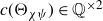 $c(\Theta_{\chi\psi}) \in \mathbb{Q}^{\times 2}$
in these cases, hence is a norm from every quadratic subfield of
$c(\Theta_{\chi\psi}) \in \mathbb{Q}^{\times 2}$
in these cases, hence is a norm from every quadratic subfield of $\mathbb{Q}(\chi\psi)$
. Otherwise if
$\mathbb{Q}(\chi\psi)$
. Otherwise if $\mathbb{Q}(\chi\psi)$
contains
$\mathbb{Q}(\chi\psi)$
contains $\mathbb{Q}(\sqrt{-3})$
then
$\mathbb{Q}(\sqrt{-3})$
then $c(H) \in \{ \square, 3 \}$
for all
$c(H) \in \{ \square, 3 \}$
for all $H \leq D$
, and so
$H \leq D$
, and so $c(\Theta') \in N_{\mathbb{Q}(\sqrt{-3} ) / \mathbb{Q}}(\mathbb{Q}(\sqrt{-3} )^{\times})$
for any
$c(\Theta') \in N_{\mathbb{Q}(\sqrt{-3} ) / \mathbb{Q}}(\mathbb{Q}(\sqrt{-3} )^{\times})$
for any $\Theta' \in \mathrm{B}(D)$
with
$\Theta' \in \mathrm{B}(D)$
with $\mathbb{C}[D / \Theta'] = N_{\mathbb{Q}(\chi\psi) / \mathbb{Q}}(\chi\psi)$
.
$\mathbb{C}[D / \Theta'] = N_{\mathbb{Q}(\chi\psi) / \mathbb{Q}}(\chi\psi)$
.
Proposition A·6. In Case 2D, one has $c \sim_K a $
.
$c \sim_K a $
.
Proof. Again we argue for each possible $\mathfrak{e}$
.
$\mathfrak{e}$
.
Case $\mathfrak{e} = 4$
. The group
$\mathfrak{e} = 4$
. The group $D = C_4 \rtimes C_{2^k}$
has
$D = C_4 \rtimes C_{2^k}$
has $\hat{C}(D) = 1$
when
$\hat{C}(D) = 1$
when $k = 0, 1$
. When
$k = 0, 1$
. When $k \geq 2$
, then by Lemma A·3
$k \geq 2$
, then by Lemma A·3 $\hat{C}(D) = \mathbb{Z} / 2\mathbb{Z}$
is generated by the lift of the faithful irreducible representation of
$\hat{C}(D) = \mathbb{Z} / 2\mathbb{Z}$
is generated by the lift of the faithful irreducible representation of $Q_8$
to D. Denote this representation by
$Q_8$
to D. Denote this representation by $\chi$
. Let
$\chi$
. Let $\Theta_{\chi}$
be the lift of
$\Theta_{\chi}$
be the lift of $C_1 - C_2 \in \mathrm{B}(Q_8)$
to
$C_1 - C_2 \in \mathrm{B}(Q_8)$
to $\mathrm{B}(D)$
. Then
$\mathrm{B}(D)$
. Then $\chi^{\oplus 2} = \mathbb{C}[D / \Theta_{\chi}]$
. By Lemma A·1,
$\chi^{\oplus 2} = \mathbb{C}[D / \Theta_{\chi}]$
. By Lemma A·1, $c(\Theta_{\chi}) \equiv 1 \text{ or } 4 \mod \mathbb{Q}^{\times 2}$
. The function a is lifted from
$c(\Theta_{\chi}) \equiv 1 \text{ or } 4 \mod \mathbb{Q}^{\times 2}$
. The function a is lifted from $D / D' \simeq D_4$
, and
$D / D' \simeq D_4$
, and $a(\Theta_{\chi}) = 1$
since
$a(\Theta_{\chi}) = 1$
since $D' \cdot \Theta_{\chi} / D' = 0 \in \mathrm{B}(D / D')$
. It follows that
$D' \cdot \Theta_{\chi} / D' = 0 \in \mathrm{B}(D / D')$
. It follows that $a / c(\Theta_{\chi}) \in \mathbb{Q}^{\times 2}$
.
$a / c(\Theta_{\chi}) \in \mathbb{Q}^{\times 2}$
.
By [
Reference Dokchitser and Dokchitser10
, proposition 3·16], $a / c (\Psi) \in \mathbb{Q}^{\times 2} \subset N_{K / \mathbb{Q}}(K^{\times})$
whenever
$a / c (\Psi) \in \mathbb{Q}^{\times 2} \subset N_{K / \mathbb{Q}}(K^{\times})$
whenever $\Psi \in \mathrm{B}(D)$
is a Brauer relation. The ratio
$\Psi \in \mathrm{B}(D)$
is a Brauer relation. The ratio $a / c(H)$
is a power of 2 for all
$a / c(H)$
is a power of 2 for all $H \leq D$
, which is a norm form any quadratic subfield of
$H \leq D$
, which is a norm form any quadratic subfield of $\mathbb{Q}(\psi)$
for every irreducible representation
$\mathbb{Q}(\psi)$
for every irreducible representation $\psi$
, as D is a 2-group.
$\psi$
, as D is a 2-group.
If $\Theta \in \mathrm{B}(D)$
is an arbitrary K-relation then
$\Theta \in \mathrm{B}(D)$
is an arbitrary K-relation then $k = \langle \mathbb{C}[D / \Theta], \chi \rangle$
is even and
$k = \langle \mathbb{C}[D / \Theta], \chi \rangle$
is even and $\Theta' = \Theta - (k / 2)\Theta_{\chi}$
has
$\Theta' = \Theta - (k / 2)\Theta_{\chi}$
has $\langle \mathbb{C}[D / \Theta'], \chi \rangle = 0$
and
$\langle \mathbb{C}[D / \Theta'], \chi \rangle = 0$
and $a / c(\Theta') \equiv a / c(\Theta) \mod \mathbb{Q}^{\times 2}$
. Following the proof of Proposition 2·22(ii), one has
$a / c(\Theta') \equiv a / c(\Theta) \mod \mathbb{Q}^{\times 2}$
. Following the proof of Proposition 2·22(ii), one has $a/ c(\Theta') \in N_{K / \mathbb{Q}}(K^{\times})$
and so
$a/ c(\Theta') \in N_{K / \mathbb{Q}}(K^{\times})$
and so $a / c \sim_K 1$
.
$a / c \sim_K 1$
.
Case $\mathfrak{e} = 3$
. One has
$\mathfrak{e} = 3$
. One has $D = C_3 \rtimes C_{2^k}$
with
$D = C_3 \rtimes C_{2^k}$
with $k \geq 1$
. If
$k \geq 1$
. If $\sqrt{B} \in \mathcal{K}$
, then
$\sqrt{B} \in \mathcal{K}$
, then
 \begin{equation*}c(H) = \left\{\begin{smallmatrix} 3 & & \text{if }3 \nmid e_{\mathcal{F}^{H} / \mathcal{K}} \\ 1 & & \text{if } 3 \mid e_{\mathcal{F}^{H} / \mathcal{K}} \end{smallmatrix}\right. = \left\{\begin{smallmatrix} 3 & & \text{if } 3 \nmid e_{\mathcal{F}^{H} \cap L / \mathcal{K}} \\ 1 & & \text{if }3 \mid e_{\mathcal{F}^{H} \cap \mathcal{L} / \mathcal{L}} \end{smallmatrix}\right. = c'(D' H / D'),\end{equation*}
where c
′ is the function on $D / D'$
given by
$D / D'$
given by $c'(H') = \left\{\begin{smallmatrix} 3 & & \text{if }3 \nmid [D / D' \,:\, H'] \\ 1 & & \text{if }3 \mid [D / D' \,:\, H'] \end{smallmatrix} \right.$
for
$c'(H') = \left\{\begin{smallmatrix} 3 & & \text{if }3 \nmid [D / D' \,:\, H'] \\ 1 & & \text{if }3 \mid [D / D' \,:\, H'] \end{smallmatrix} \right.$
for $H' \leq D / D'$
. As the function a is also lifted from
$H' \leq D / D'$
. As the function a is also lifted from $D / D' \simeq S_3$
by Proposition 2·21(ii) it suffices to prove that
$D / D' \simeq S_3$
by Proposition 2·21(ii) it suffices to prove that $a / c \sim_K 1 $
on K-relations in
$a / c \sim_K 1 $
on K-relations in $S_3$
. Up to multiples
$S_3$
. Up to multiples $S_3$
has a unique Brauer relation given by
$S_3$
has a unique Brauer relation given by $\Psi = 2S_3 + C_1 - 2C_2 - C_3$
and one computes that
$\Psi = 2S_3 + C_1 - 2C_2 - C_3$
and one computes that $a / c'(\Psi) \in \mathbb{Q}^{\times 2}$
. Thus
$a / c'(\Psi) \in \mathbb{Q}^{\times 2}$
. Thus $a / c' \sim_K 1$
by Proposition 2·22(ii) since all irreducible representations of
$a / c' \sim_K 1$
by Proposition 2·22(ii) since all irreducible representations of $S_3$
have rational character, and so
$S_3$
have rational character, and so $a \sim_K c$
as functions on
$a \sim_K c$
as functions on $\mathrm{B}(D)$
. If
$\mathrm{B}(D)$
. If $\sqrt{B} \not\in \mathcal{K}$
, then as in Case 2C we have
$\sqrt{B} \not\in \mathcal{K}$
, then as in Case 2C we have
 \begin{equation*}c(H) = \left( D, H \mapsto \left\{\begin{smallmatrix} 3 & & \text{if } 3 \nmid e_{\mathcal{F}^{H} / \mathcal{K}},\ 2\mid f_{\mathcal{F}^{H} / \mathcal{K}} \\ 1 & & \text{otherwise}\phantom{sssssssssss} \end{smallmatrix}\right.\right) = \left( D, H \mapsto \left\{\begin{smallmatrix} 3 & & \text{if } 3 \nmid e_{\mathcal{F}^{H} \cap \mathcal{L} / \mathcal{K}},\ 2\mid f_{\mathcal{F}^{H} \cap \mathcal{L} / \mathcal{K}} \\ 1 & & \text{otherwise} \phantom{ssssssssssssssss}\end{smallmatrix}\right.\right),\end{equation*}
so that $c(H) = c'(D' H / D')$
where c
′ is the function on
$c(H) = c'(D' H / D')$
where c
′ is the function on $D / D'$
given by
$D / D'$
given by
 \begin{equation*}c'(H') = \left\{ \begin{smallmatrix} 3 & & \text{if } 3 \nmid [D / D' \,:\, H'], \ 2 \mid[D / D' \,:\, H'] \\ 1 & & \text{otherwise} \phantom{ssssssssssssssssssss} \end{smallmatrix}\right..\end{equation*}
Once more $a / c'(\Psi) \in \mathbb{Q}^{\times 2}$
for
$a / c'(\Psi) \in \mathbb{Q}^{\times 2}$
for $\Psi$
the unique Brauer relation of
$\Psi$
the unique Brauer relation of $S_3 \simeq D/ D'$
and so
$S_3 \simeq D/ D'$
and so $a / c' \sim_K 1$
by Proposition 2·22(ii) and hence
$a / c' \sim_K 1$
by Proposition 2·22(ii) and hence $a \sim_K c$
on D by Proposition 2·21(ii).
$a \sim_K c$
on D by Proposition 2·21(ii).
Case $\mathfrak{e} = 6$
. Let
$\mathfrak{e} = 6$
. Let $\tau_{S_3}$
,
$\tau_{S_3}$
, $\tau_{D_{6}}$
be the 2-dimensional irreducible representations of D inflated from the
$\tau_{D_{6}}$
be the 2-dimensional irreducible representations of D inflated from the $S_3$
-quotient and
$S_3$
-quotient and $D_{6}$
-quotient respectively. Let
$D_{6}$
-quotient respectively. Let $\tau$
be a 2-dimensional irreducible representation of D with
$\tau$
be a 2-dimensional irreducible representation of D with $\tau \not= \tau_{S_3}$
,
$\tau \not= \tau_{S_3}$
, $\tau_{D_{6}}$
. Then
$\tau_{D_{6}}$
. Then $\tau$
is of the form
$\tau$
is of the form $\tau = \mathrm{Ind}_{X}^D \chi\psi$
where
$\tau = \mathrm{Ind}_{X}^D \chi\psi$
where $\chi\psi$
is a character of
$\chi\psi$
is a character of $X = C_6 \times C_{2^{k - 1}}$
with
$X = C_6 \times C_{2^{k - 1}}$
with $\chi$
of order
$\chi$
of order $n \in \{3, 6\}$
inflated from the
$n \in \{3, 6\}$
inflated from the $C_6$
-quotient and
$C_6$
-quotient and $\psi$
of order
$\psi$
of order $2^l$
,
$2^l$
, $l \geq 1$
, inflated from the
$l \geq 1$
, inflated from the $C_{2^{k - 1}}$
-quotient. The representation
$C_{2^{k - 1}}$
-quotient. The representation $N_{\mathbb{Q}(\tau) / \mathbb{Q}}(\tau)$
has order 2 in
$N_{\mathbb{Q}(\tau) / \mathbb{Q}}(\tau)$
has order 2 in $\hat{C}(D)$
by Lemma A·4 and
$\hat{C}(D)$
by Lemma A·4 and $N_{\mathbb{Q}(\tau) / \mathbb{Q}}(\tau)^{\oplus 2} = \mathbb{C}[D / {\mathbb{Q}}(\tau)]^{\oplus 2} = \mathbb{C}[D / \Theta_{\tau}]$
where
$N_{\mathbb{Q}(\tau) / \mathbb{Q}}(\tau)^{\oplus 2} = \mathbb{C}[D / {\mathbb{Q}}(\tau)]^{\oplus 2} = \mathbb{C}[D / \Theta_{\tau}]$
where
 \begin{equation*} \Theta_{\tau} = \sum_{d \mid n} \mu(d) \left( C_{6/d} \times C_{2^{k - l}} - C_{6 / d} \times C_{2^{ k - l + 1}} \right).\end{equation*}
One computes that $a / c (\Theta_{\tau}) \in \{1, 4 \} \subset \mathbb{Q}^{\times 2}$
.
$a / c (\Theta_{\tau}) \in \{1, 4 \} \subset \mathbb{Q}^{\times 2}$
.
The derived subgroup of D is $[D, D] = C_3 = \langle x^2 \rangle$
, and the one-dimensional representations are inflated from
$[D, D] = C_3 = \langle x^2 \rangle$
, and the one-dimensional representations are inflated from $D / [D, D] \simeq C_2 \times C_{2^k}$
. If
$D / [D, D] \simeq C_2 \times C_{2^k}$
. If $\varphi$
is a one-dimensional representation and
$\varphi$
is a one-dimensional representation and $\mathbb{Q}(\varphi)$
contains a quadratic subfield, then
$\mathbb{Q}(\varphi)$
contains a quadratic subfield, then $\varphi$
is of the form
$\varphi$
is of the form $\varphi = \chi\psi$
where
$\varphi = \chi\psi$
where $\chi$
is of order
$\chi$
is of order $n \in \{1, 2 \}$
inflated from the
$n \in \{1, 2 \}$
inflated from the $C_2 \simeq D / \langle x^2, y \rangle$
quotient and
$C_2 \simeq D / \langle x^2, y \rangle$
quotient and $\psi$
is of order
$\psi$
is of order $2^l$
for
$2^l$
for $l \geq 2$
inflated from the
$l \geq 2$
inflated from the $C_{2^k} \simeq D / \langle x \rangle$
quotient. One can take
$C_{2^k} \simeq D / \langle x \rangle$
quotient. One can take $\Theta_{\varphi} \in \mathrm{B}(D)$
to be the lift of
$\Theta_{\varphi} \in \mathrm{B}(D)$
to be the lift of
 \begin{equation*} \sum_{d \mid n} \mu(d) (C_{2 / d} \times C_{2^{k - l}} - C_{2 / d} \times C_{2^{k - l + 1}}) \in \mathrm{B}(D / [D, D]). \end{equation*}
In this case one computes that $a / c(\Theta_{\varphi}) = 1$
when
$a / c(\Theta_{\varphi}) = 1$
when $l \geq 2$
and hence is a norm from every quadratic subfield of
$l \geq 2$
and hence is a norm from every quadratic subfield of $\mathbb{Q}(\varphi)$
.
$\mathbb{Q}(\varphi)$
.
Since $\tau_{S_3}$
,
$\tau_{S_3}$
, $\tau_{D_6}$
are rational, they appear with even multiplicity in
$\tau_{D_6}$
are rational, they appear with even multiplicity in $\mathbb{C}[D / \Theta]$
. Moreover these have order one in
$\mathbb{C}[D / \Theta]$
. Moreover these have order one in $\hat{C}(D)$
, and so
$\hat{C}(D)$
, and so $\tau_{S_3} = \mathbb{C}[D / \Theta_{\tau_{S_3}}]$
,
$\tau_{S_3} = \mathbb{C}[D / \Theta_{\tau_{S_3}}]$
, $\tau_{D_6} = \mathbb{C}[D / \Theta_{\tau_{D_6}}]$
for some
$\tau_{D_6} = \mathbb{C}[D / \Theta_{\tau_{D_6}}]$
for some $\Theta_{\tau_{S_3}}$
,
$\Theta_{\tau_{S_3}}$
, $\Theta_{\tau_{D_6}} \in \mathrm{B}(D)$
. By [
Reference Dokchitser and Dokchitser10
, proposition 3·16],
$\Theta_{\tau_{D_6}} \in \mathrm{B}(D)$
. By [
Reference Dokchitser and Dokchitser10
, proposition 3·16], $a / c(\Psi) \in \mathbb{Q}^{\times 2}$
for any Brauer relation
$a / c(\Psi) \in \mathbb{Q}^{\times 2}$
for any Brauer relation $\Psi \subset \mathrm{B}(D)$
. Now let
$\Psi \subset \mathrm{B}(D)$
. Now let $\Theta$
be an arbitrary K-relation for D. By writing
$\Theta$
be an arbitrary K-relation for D. By writing $\Theta$
as a sum of a Brauer relation and the previously defined
$\Theta$
as a sum of a Brauer relation and the previously defined $\Theta_{\tau}$
,
$\Theta_{\tau}$
, $\Theta_{\varphi}$
,
$\Theta_{\varphi}$
, $\Theta_{\tau_{S_3}}$
,
$\Theta_{\tau_{S_3}}$
, $\Theta_{\tau_{D_{12}}}$
and arguing as in Case
$\Theta_{\tau_{D_{12}}}$
and arguing as in Case $\mathfrak{e} = 4$
, one obtains
$\mathfrak{e} = 4$
, one obtains $a / c (\Theta) \in N_{K / \mathbb{Q}}(K^{\times})$
and so
$a / c (\Theta) \in N_{K / \mathbb{Q}}(K^{\times})$
and so $a \sim_K c$
.
$a \sim_K c$
.
Proposition A·7. Let $\mathcal{F} / \mathcal{K} / \mathbb{Q}_l$
be finite extensions with
$\mathcal{F} / \mathcal{K} / \mathbb{Q}_l$
be finite extensions with $l \geq 5$
and
$l \geq 5$
and $\mathcal{F} / \mathcal{K}$
Galois with Galois group D. Let
$\mathcal{F} / \mathcal{K}$
Galois with Galois group D. Let $E / \mathcal{K}$
be an elliptic curve with potentially multiplicative reduction. Assume that
$E / \mathcal{K}$
be an elliptic curve with potentially multiplicative reduction. Assume that $f_{\mathcal{F} / \mathcal{K}}$
is a power of 2, and that the quadratic extension
$f_{\mathcal{F} / \mathcal{K}}$
is a power of 2, and that the quadratic extension $\mathcal{L}$
of
$\mathcal{L}$
of $\mathcal{K}$
over which E attains semistable reduction is a subfield of
$\mathcal{K}$
over which E attains semistable reduction is a subfield of $\mathcal{F} / \mathcal{K}$
.
$\mathcal{F} / \mathcal{K}$
.
Then $c \sim_K d$
as functions on
$c \sim_K d$
as functions on $\mathrm{B}(D)$
, where d is defined in Notation 3·10, and V is the quadratic character of the quotient
$\mathrm{B}(D)$
, where d is defined in Notation 3·10, and V is the quadratic character of the quotient $\mathrm{Gal}(\mathcal{L} / \mathcal{K})$
of D.
$\mathrm{Gal}(\mathcal{L} / \mathcal{K})$
of D.
Proof. Let $n = v_{\mathcal{K}}(\Delta)$
be the valuation of the minimal discriminant of
$n = v_{\mathcal{K}}(\Delta)$
be the valuation of the minimal discriminant of $E / \mathcal{K}$
and let
$E / \mathcal{K}$
and let $D' = \mathrm{Gal}(\mathcal{F} / \mathcal{L})$
. Letting
$D' = \mathrm{Gal}(\mathcal{F} / \mathcal{L})$
. Letting $e = e_{\mathcal{F}^{H} / \mathcal{K}}$
,
$e = e_{\mathcal{F}^{H} / \mathcal{K}}$
, $f = f_{\mathcal{F}^{H} / \mathcal{K}}$
, the values of
$f = f_{\mathcal{F}^{H} / \mathcal{K}}$
, the values of $c / d$
are computed using Lemma A·1 as follows in [
Reference Dokchitser and Dokchitser10
, proposition 3·21].
$c / d$
are computed using Lemma A·1 as follows in [
Reference Dokchitser and Dokchitser10
, proposition 3·21].
In the proof of [
Reference Dokchitser and Dokchitser10
, proposition 3·21] it is also shown that, as a function to $\mathbb{Q}^{\times} / \mathbb{Q}^{\times 2}$
,
$\mathbb{Q}^{\times} / \mathbb{Q}^{\times 2}$
, $c / d$
factors through
$c / d$
factors through
 \begin{equation*}\mathrm{Gal}(\mathcal{L}^u / \mathcal{K}) \simeq \mathrm{Gal}(\mathcal{L} / \mathcal{K}) \times \mathrm{Gal}(\mathcal{K}^u / \mathcal{K}) = C_2 \times C_{2^k} \,:\!=\, A,\end{equation*}
where $\mathcal{L}^{u}$
and
$\mathcal{L}^{u}$
and $\mathcal{K}^{u}$
denote the maximal unramified extensions of
$\mathcal{K}^{u}$
denote the maximal unramified extensions of $\mathcal{L}$
and
$\mathcal{L}$
and $\mathcal{K}$
in
$\mathcal{K}$
in $\mathcal{F}$
.
$\mathcal{F}$
.
As A is an abelian 2-group, if $K \not= \mathbb{Q}(i)$
,
$K \not= \mathbb{Q}(i)$
, $\mathbb{Q}(\sqrt{\pm 2})$
then
$\mathbb{Q}(\sqrt{\pm 2})$
then $c / d \sim_K 1$
by Proposition 2·22(ii), since
$c / d \sim_K 1$
by Proposition 2·22(ii), since $c / d(\Psi) \in \mathbb{Q}^{\times 2}$
whenever
$c / d(\Psi) \in \mathbb{Q}^{\times 2}$
whenever $\Psi$
is a Brauer relation by [
Reference Dokchitser and Dokchitser10
, proposition 3·21], and no irreducible representation of A contains K in its field of values.
$\Psi$
is a Brauer relation by [
Reference Dokchitser and Dokchitser10
, proposition 3·21], and no irreducible representation of A contains K in its field of values.
Values of $c / d$

Thus we may assume that $K \in \{ \mathbb{Q}(i), \mathbb{Q}(\sqrt{\pm 2})\}$
. Note that
$K \in \{ \mathbb{Q}(i), \mathbb{Q}(\sqrt{\pm 2})\}$
. Note that $c(E / \mathcal{K}) \in \{2, 4\}$
. Since 2 is a norm from each of these subfields, to show that
$c(E / \mathcal{K}) \in \{2, 4\}$
. Since 2 is a norm from each of these subfields, to show that $c / d \sim_K 1$
it suffices to show that the term
$c / d \sim_K 1$
it suffices to show that the term $n / |D|$
occurs evenly in
$n / |D|$
occurs evenly in $c / d(\Theta)$
whenever
$c / d(\Theta)$
whenever $\Theta$
is a K-relation for D. Let
$\Theta$
is a K-relation for D. Let $\psi$
be the order two character of D with kernel D
′. Then
$\psi$
be the order two character of D with kernel D
′. Then
 \begin{equation*}\langle \psi, \mathbb{C}[D / H] \rangle = \begin{cases} 1 & \text{if } \mathcal{L} \subset \mathcal{F}^H, \\ 0 & \text{if }\mathcal{L} \not\subset \mathcal{F}^H. \end{cases}\end{equation*}
Thus $(c / d)(\Theta) \equiv (n/|D|)^{\langle \psi, \mathbb{C}[D / \Theta]\rangle } \equiv 1 \mod N_{K / \mathbb{Q}}(K^{\times}),$
since
$(c / d)(\Theta) \equiv (n/|D|)^{\langle \psi, \mathbb{C}[D / \Theta]\rangle } \equiv 1 \mod N_{K / \mathbb{Q}}(K^{\times}),$
since $\psi$
occurs with even multiplicity in
$\psi$
occurs with even multiplicity in $\mathbb{C}[D / \Theta]$
by Proposition 2·11 as it is a rational character.
$\mathbb{C}[D / \Theta]$
by Proposition 2·11 as it is a rational character.
Appendix B. Differential term
We use the notation of Section 3. To prove Proposition 3·15, we show that $d / \omega \sim_K 1$
as functions on
$d / \omega \sim_K 1$
as functions on $\mathrm{B}(D)$
, where
$\mathrm{B}(D)$
, where
 \begin{equation*} d / \omega \sim_K \begin{cases} {}(I, W, l^{\left\lfloor \delta f / 12 \right\rfloor}), & \text{Case 2} {C}, \\ {}(I, W, l^{\left\lfloor \delta f /12 \right\rfloor})\cdot\left(I, W, \left\{\begin{smallmatrix} f, & \text{if } \mathfrak{e} \nmid f, \\ 1 & \text{if }\mathfrak{e} \mid f\end{smallmatrix}\right.\right), & \text{Case 2D}.\end{cases}\end{equation*}
Let $I / W \simeq C_r$
. For each possible
$I / W \simeq C_r$
. For each possible $\mathfrak{e}$
, let
$\mathfrak{e}$
, let $h_{\mathfrak{e}}$
,
$h_{\mathfrak{e}}$
, $g_{\mathfrak{e}}$
be the functions on
$g_{\mathfrak{e}}$
be the functions on $\mathrm{B}(C_r)$
given by
$\mathrm{B}(C_r)$
given by
 \begin{equation*} h_{\mathfrak{e}} \,:\, C_{r / n} \mapsto l^{\left\lfloor \delta n / 12 \right\rfloor}, \quad g_{\mathfrak{e}} \,:\, C_{r / n} \mapsto \left\{ \begin{smallmatrix} n, & \text{if }\mathfrak{e} \nmid n, \\ 1 & \text{if }\mathfrak{e} \mid n \end{smallmatrix} \right. .\end{equation*}
Let $\Theta \in \mathrm{B}(D)$
be a K-relation for D, so that
$\Theta \in \mathrm{B}(D)$
be a K-relation for D, so that $\mathrm{Res}_I \Theta \in \mathrm{B}(I)$
is a K-relation for I by Proposition 2·6(2). Let
$\mathrm{Res}_I \Theta \in \mathrm{B}(I)$
is a K-relation for I by Proposition 2·6(2). Let $W \cdot \mathrm{Res}_I \Theta / W = \sum_{n \mid r} a_n \Psi_n \in \mathrm{B}(C_r)$
where
$W \cdot \mathrm{Res}_I \Theta / W = \sum_{n \mid r} a_n \Psi_n \in \mathrm{B}(C_r)$
where $\Psi_n$
are given in Example 2·12. Then
$\Psi_n$
are given in Example 2·12. Then
 \begin{equation*}\mathbb{C}[I / \mathrm{Res}_I \Theta] = \bigoplus_{n \mid r} \chi_n^{\oplus a_n} \oplus A,\end{equation*}
where $\chi_n$
is the rational representation inflated from
$\chi_n$
is the rational representation inflated from $I / W$
with kernel
$I / W$
with kernel $W \rtimes C_{r / n}$
, and A is a representation of I with
$W \rtimes C_{r / n}$
, and A is a representation of I with $A^{W} = 0$
. Let
$A^{W} = 0$
. Let $\psi_n$
be a linear character of order n of I such that
$\psi_n$
be a linear character of order n of I such that $N_{\mathbb{Q}(\zeta_n) / \mathbb{Q}}(\psi_n) = \chi_n$
. Then
$N_{\mathbb{Q}(\zeta_n) / \mathbb{Q}}(\psi_n) = \chi_n$
. Then
 \begin{equation*}a_n = \langle \mathbb{C}[I / \mathrm{Res}_I \Theta] , \psi_n \rangle = \langle \mathbb{C}[D / \Theta], \mathrm{Ind}_{I}^D \psi_n \rangle,\end{equation*}
and $a_n$
is even if
$a_n$
is even if $K \not\subset \mathbb{Q}(\mathrm{Ind}_{I}^D \psi_n)$
. Therefore
$K \not\subset \mathbb{Q}(\mathrm{Ind}_{I}^D \psi_n)$
. Therefore
 \begin{equation*}d / \omega (\Theta) \equiv \begin{cases} {}\underset{n, K \subset \mathbb{Q}(\mathrm{Ind}_I^{D} \psi_n)}{\prod} h_{\mathfrak{e}}(\Psi_n)^{a_n} & \text{Case 2} {C}, \\ {}\underset{n, K \subset \mathbb{Q}(\mathrm{Ind}_I^D \psi_n)}{\prod} (h_{\mathfrak{e}}\cdot g_{\mathfrak{e}})(\Psi_n)^{a_n} & \text{Case 2} {D}\end{cases}\mod N_{K / \mathbb{Q}}(K^{\times}).\end{equation*}
To prove that $d / \omega \sim_K 1$
, we show that
$d / \omega \sim_K 1$
, we show that $h_{\mathfrak{e}}(\Psi_n)^{a_n}$
,
$h_{\mathfrak{e}}(\Psi_n)^{a_n}$
, $(h_{\mathfrak{e}}\cdot g_{\mathfrak{e}})(\Psi_n)^{a_n} \in N_{K / \mathbb{Q}}(K^{\times})$
for any quadratic subfield
$(h_{\mathfrak{e}}\cdot g_{\mathfrak{e}})(\Psi_n)^{a_n} \in N_{K / \mathbb{Q}}(K^{\times})$
for any quadratic subfield $K \subset \mathbb{Q}(\mathrm{Ind}_I^D \psi_n)$
. Note that
$K \subset \mathbb{Q}(\mathrm{Ind}_I^D \psi_n)$
. Note that $h_{\mathfrak{e}}(\Psi_n) \equiv l^a \mod \mathbb{Q}^{\times 2}$
with
$h_{\mathfrak{e}}(\Psi_n) \equiv l^a \mod \mathbb{Q}^{\times 2}$
with $a \in \{0,1\}$
. We first show that l is the norm of an ideal of K.
$a \in \{0,1\}$
. We first show that l is the norm of an ideal of K.
Proposition B·1. If $K \subset \mathbb{Q}(\mathrm{Ind}_{I}^{D} \psi_n)$
then l is the norm of an ideal of K.
$K \subset \mathbb{Q}(\mathrm{Ind}_{I}^{D} \psi_n)$
then l is the norm of an ideal of K.
Proof. We show that $\mathbb{Q}(\mathrm{Ind}_I^{D} \psi_n) \subset \mathbb{Q}(\zeta_n)^{\langle \zeta_n \mapsto \zeta_n^{q} \rangle}$
, that is that
$\mathbb{Q}(\mathrm{Ind}_I^{D} \psi_n) \subset \mathbb{Q}(\zeta_n)^{\langle \zeta_n \mapsto \zeta_n^{q} \rangle}$
, that is that $\mathbb{Q}(\mathrm{Ind}_I^D \psi_n)$
lies in the subfield of
$\mathbb{Q}(\mathrm{Ind}_I^D \psi_n)$
lies in the subfield of $\mathbb{Q}(\zeta_n)$
fixed by
$\mathbb{Q}(\zeta_n)$
fixed by $\langle q \rangle \leq (\mathbb{Z} / n \mathbb{Z})^{\times} \simeq \mathrm{Gal}(\mathbb{Q}(\zeta_n) / \mathbb{Q})$
. Let
$\langle q \rangle \leq (\mathbb{Z} / n \mathbb{Z})^{\times} \simeq \mathrm{Gal}(\mathbb{Q}(\zeta_n) / \mathbb{Q})$
. Let $H = \ker \psi_n \leq I$
. This is a characteristic subgroup of I and so normal in D also. Thus
$H = \ker \psi_n \leq I$
. This is a characteristic subgroup of I and so normal in D also. Thus $\mathrm{Ind}_I^D \psi_n$
is the lift of
$\mathrm{Ind}_I^D \psi_n$
is the lift of $\mathrm{Ind}_{I / H}^{D / H} \psi_n$
, viewing
$\mathrm{Ind}_{I / H}^{D / H} \psi_n$
, viewing $\psi_n$
as a representation of the quotient
$\psi_n$
as a representation of the quotient $I / H$
. One has
$I / H$
. One has $D / H = \mathrm{Gal}(\mathcal{K}' / \mathcal{K})$
, where
$D / H = \mathrm{Gal}(\mathcal{K}' / \mathcal{K})$
, where $\mathcal{K}' / \mathcal{K}$
is a tamely ramified extension with inertia group
$\mathcal{K}' / \mathcal{K}$
is a tamely ramified extension with inertia group $I / H$
. Let
$I / H$
. Let $\sigma \in D / H$
be a lift of Frobenius from
$\sigma \in D / H$
be a lift of Frobenius from $(D / H) / (I / H)$
. Then for
$(D / H) / (I / H)$
. Then for $\tau \in I / H$
,
$\tau \in I / H$
, $\sigma \tau \sigma^{-1} = \tau^q$
. The character of
$\sigma \tau \sigma^{-1} = \tau^q$
. The character of $\mathrm{Ind}_{I / H}^{D / H} \psi_n$
is given by
$\mathrm{Ind}_{I / H}^{D / H} \psi_n$
is given by
 \begin{equation*}(\mathrm{Ind}_{I / H}^{D / H} \psi_n) (g) = \begin{cases} 0, & \text{if }g \not\in I / H, \\ \sum_{t \in T} \psi_n (t g t^{-1}), & \text{if } g \in I / H, \end{cases}\end{equation*}
where T is a transversal for $(D / H )/ (I / H)$
, which we choose to be
$(D / H )/ (I / H)$
, which we choose to be $T = \langle \sigma \rangle$
. For
$T = \langle \sigma \rangle$
. For $\tau$
a generator the cyclic group
$\tau$
a generator the cyclic group $I / H$
with
$I / H$
with $\psi_n(\tau) = \zeta_n$
, one has
$\psi_n(\tau) = \zeta_n$
, one has $\mathbb{Q}(\mathrm{Ind}_I^D \psi_n) = \mathbb{Q}(\mathrm{Ind}_{I / H}^{D / H}$ $ \psi_n (\tau)) = \mathbb{Q}(\sum_{i = 0}^{2^k - 1} \zeta_n^{q^i}) \subset \mathbb{Q}(\zeta_n)^{\langle \zeta_n \mapsto \zeta_n^q \rangle}$
(where
$ \psi_n (\tau)) = \mathbb{Q}(\sum_{i = 0}^{2^k - 1} \zeta_n^{q^i}) \subset \mathbb{Q}(\zeta_n)^{\langle \zeta_n \mapsto \zeta_n^q \rangle}$
(where $\sigma$
has order
$\sigma$
has order $2^k = f_{\mathcal{F} / \mathcal{K}}$
and
$2^k = f_{\mathcal{F} / \mathcal{K}}$
and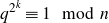 $q^{2^{k}} \equiv 1 \mod n$
as the extension
$q^{2^{k}} \equiv 1 \mod n$
as the extension $\mathcal{K}' / \mathcal{K}$
is tamely ramified).
$\mathcal{K}' / \mathcal{K}$
is tamely ramified).
Thus if $K \subset \mathbb{Q}(\mathrm{Ind}_I^D \psi_n)$
, then
$K \subset \mathbb{Q}(\mathrm{Ind}_I^D \psi_n)$
, then $K \subset \mathbb{Q}(\zeta_n)^{\langle \zeta_n \mapsto \zeta_n^{q} \rangle}$
and so the Artin symbol for q in
$K \subset \mathbb{Q}(\zeta_n)^{\langle \zeta_n \mapsto \zeta_n^{q} \rangle}$
and so the Artin symbol for q in $K / \mathbb{Q}$
, and hence also for l, is trivial. It follows that l splits in K and hence is the norm of an ideal of K.
$K / \mathbb{Q}$
, and hence also for l, is trivial. It follows that l splits in K and hence is the norm of an ideal of K.
We first consider $h_{\mathfrak{e}}(\Psi_n)$
when
$h_{\mathfrak{e}}(\Psi_n)$
when $\mathfrak{e} \nmid n$
. The following table details the n with
$\mathfrak{e} \nmid n$
. The following table details the n with $\mathfrak{e} \nmid n$
and
$\mathfrak{e} \nmid n$
and $h_{\mathfrak{e}}(\Psi_n) \equiv l \mod \mathbb{Q}^{\times 2}$
, where p is an odd prime.
$h_{\mathfrak{e}}(\Psi_n) \equiv l \mod \mathbb{Q}^{\times 2}$
, where p is an odd prime.
Values of n with $h_{\mathfrak{e}}(\Psi_n) \not\in \mathbb{Q}^{\times 2}$
and
$h_{\mathfrak{e}}(\Psi_n) \not\in \mathbb{Q}^{\times 2}$
and $\mathfrak{e} \nmid n$

Observe that the only possible quadratic subfields of $\mathbb{Q}(\zeta_n)$
for the n in the table are
$\mathbb{Q}(\zeta_n)$
for the n in the table are $\mathbb{Q}(i)$
,
$\mathbb{Q}(i)$
, $\mathbb{Q}(\sqrt{\pm 2})$
,
$\mathbb{Q}(\sqrt{\pm 2})$
, $\mathbb{Q}(\sqrt{p^*})$
. The following lemma states that l is a norm from these fields when they are contained in
$\mathbb{Q}(\sqrt{p^*})$
. The following lemma states that l is a norm from these fields when they are contained in $\mathbb{Q}(\mathrm{Ind}_I^D \psi_n)$
and so
$\mathbb{Q}(\mathrm{Ind}_I^D \psi_n)$
and so $h_{\mathfrak{e}}(\Psi_n)^{a_n}$
,
$h_{\mathfrak{e}}(\Psi_n)^{a_n}$
, $(h_{\mathfrak{e}}\cdot g_{\mathfrak{e}})(\Psi_n)^{a_n} \in N_{K / \mathbb{Q}}(K^{\times})$
.
$(h_{\mathfrak{e}}\cdot g_{\mathfrak{e}})(\Psi_n)^{a_n} \in N_{K / \mathbb{Q}}(K^{\times})$
.
Lemma B·2. If $K \in \{\mathbb{Q}(i), \mathbb{Q}(\sqrt{\pm 2}), \mathbb{Q}(\sqrt{p^*}) \}$
and l is the norm of an ideal of K, then
$K \in \{\mathbb{Q}(i), \mathbb{Q}(\sqrt{\pm 2}), \mathbb{Q}(\sqrt{p^*}) \}$
and l is the norm of an ideal of K, then $l \in N_{K / \mathbb{Q}}(K^{\times})$
.
$l \in N_{K / \mathbb{Q}}(K^{\times})$
.
Proof. Given an abelian extension K of $\mathbb{Q}$
, its genus field is the largest field L contained in the Hilbert class field of K such that
$\mathbb{Q}$
, its genus field is the largest field L contained in the Hilbert class field of K such that $L / \mathbb{Q}$
is an abelian extension. We will use the property that if a prime l in
$L / \mathbb{Q}$
is an abelian extension. We will use the property that if a prime l in $\mathbb{Q}$
has residue degree 1 in L, then it is the norm of a principal ideal of K (this follows from follows from [
Reference Janusz16
, VI. section 3, theorem 3·3]).
$\mathbb{Q}$
has residue degree 1 in L, then it is the norm of a principal ideal of K (this follows from follows from [
Reference Janusz16
, VI. section 3, theorem 3·3]).
The fields $\mathbb{Q}(i)$
,
$\mathbb{Q}(i)$
, $\mathbb{Q}(\sqrt{\pm 2})$
,
$\mathbb{Q}(\sqrt{\pm 2})$
, $\mathbb{Q}(\sqrt{p^*})$
are equal to their genus fields. As l is the norm of an ideal in these fields, it has residue degree 1 and hence is the norm of a principal ideal. Since
$\mathbb{Q}(\sqrt{p^*})$
are equal to their genus fields. As l is the norm of an ideal in these fields, it has residue degree 1 and hence is the norm of a principal ideal. Since $\mathbb{Q}(i)$
,
$\mathbb{Q}(i)$
, $\mathbb{Q}(\sqrt{-2})$
, and
$\mathbb{Q}(\sqrt{-2})$
, and $\mathbb{Q}(\sqrt{-p})$
for
$\mathbb{Q}(\sqrt{-p})$
for $p \equiv 3 \mod 4$
are imaginary, l is the norm of an element from these fields. For
$p \equiv 3 \mod 4$
are imaginary, l is the norm of an element from these fields. For $\mathbb{Q}(\sqrt{2})$
,
$\mathbb{Q}(\sqrt{2})$
, $\mathbb{Q}(\sqrt{p})$
with
$\mathbb{Q}(\sqrt{p})$
with $p\equiv 1 \mod 4$
,
$p\equiv 1 \mod 4$
, $-1$
is the norm of
$-1$
is the norm of $\mathbb{Q}(\sqrt{p})$
with
$\mathbb{Q}(\sqrt{p})$
with $p\equiv 1 \mod 4$
,
$p\equiv 1 \mod 4$
, $-1$
is the norm of an element from these fields and so l is also.
$-1$
is the norm of an element from these fields and so l is also.
We now consider n such that $\mathfrak{e} \mid n$
. The following table details the n with
$\mathfrak{e} \mid n$
. The following table details the n with $\mathfrak{e} \mid n$
and
$\mathfrak{e} \mid n$
and $h_{\mathfrak{e}}(\Psi_n) \equiv l \mod \mathbb{Q}^{\times 2}$
, where p is an odd prime.
$h_{\mathfrak{e}}(\Psi_n) \equiv l \mod \mathbb{Q}^{\times 2}$
, where p is an odd prime.
Values of n with $h_{\mathfrak{e}}(\Psi_n) \not\in \mathbb{Q}^{\times 2}$
and
$h_{\mathfrak{e}}(\Psi_n) \not\in \mathbb{Q}^{\times 2}$
and $\mathfrak{e} \mid n$

Proposition B·3. In Case 2C, $h_{\mathfrak{e}}(\Psi_n)^{a_n} \in N_{K / \mathbb{Q}}(K^{\times})$
for all n such that
$h_{\mathfrak{e}}(\Psi_n)^{a_n} \in N_{K / \mathbb{Q}}(K^{\times})$
for all n such that $\mathfrak{e} \mid n$
.
$\mathfrak{e} \mid n$
.
Proof. We check that for each n in Table 4, l is the norm of an element for all quadratic subfields of $\mathbb{Q}(\zeta_n)^{\langle \zeta_n \mapsto \zeta_n^{q} \rangle}$
. We consider each
$\mathbb{Q}(\zeta_n)^{\langle \zeta_n \mapsto \zeta_n^{q} \rangle}$
. We consider each $\mathfrak{e}$
separately.
$\mathfrak{e}$
separately.
Case $\mathfrak{e} = 2$
. This follows from Lemma B·2.
$\mathfrak{e} = 2$
. This follows from Lemma B·2.
Case $\mathfrak{e} = 3$
. The possible quadratic subfields that are not covered by Lemma B·2 are
$\mathfrak{e} = 3$
. The possible quadratic subfields that are not covered by Lemma B·2 are $\mathbb{Q}(\sqrt{3})$
,
$\mathbb{Q}(\sqrt{3})$
, $\mathbb{Q}(\sqrt{6})$
,
$\mathbb{Q}(\sqrt{6})$
, $\mathbb{Q}(\sqrt{-6})$
,
$\mathbb{Q}(\sqrt{-6})$
, $\mathbb{Q}(\sqrt{-3p^*})$
for
$\mathbb{Q}(\sqrt{-3p^*})$
for $p \equiv -1 \mod 3$
. These have genus fields
$p \equiv -1 \mod 3$
. These have genus fields $\mathbb{Q}(\sqrt{3})$
,
$\mathbb{Q}(\sqrt{3})$
, $\mathbb{Q}(\sqrt{6})$
,
$\mathbb{Q}(\sqrt{6})$
, $\mathbb{Q}(\sqrt{-6}, \sqrt{2})$
, and and
$\mathbb{Q}(\sqrt{-6}, \sqrt{2})$
, and and $\mathbb{Q}(\sqrt{3p})$
when
$\mathbb{Q}(\sqrt{3p})$
when $p \equiv 3 \mod 4$
,
$p \equiv 3 \mod 4$
, $\mathbb{Q}(\sqrt{-3}, \sqrt{p^*})$
when
$\mathbb{Q}(\sqrt{-3}, \sqrt{p^*})$
when $p \equiv 1 \mod 4$
. We know that l has residue degree 1 in the quadratic fields, and the congruence
$p \equiv 1 \mod 4$
. We know that l has residue degree 1 in the quadratic fields, and the congruence $q \equiv 1 \mod 3$
ensures that l has residue degree 1 in each genus field also. Thus
$q \equiv 1 \mod 3$
ensures that l has residue degree 1 in each genus field also. Thus $\pm l$
is a norm from each quadratic field, and again using
$\pm l$
is a norm from each quadratic field, and again using $l \equiv 1 \mod 3$
, one can show that l is a norm from each quadratic field by considering the norm equation mod 3.
$l \equiv 1 \mod 3$
, one can show that l is a norm from each quadratic field by considering the norm equation mod 3.
Case $\mathfrak{e} = 4$
. We just need to check whether l is a norm from
$\mathfrak{e} = 4$
. We just need to check whether l is a norm from $\mathbb{Q}(\sqrt{p})$
for
$\mathbb{Q}(\sqrt{p})$
for $p \equiv -1 \mod 4$
. This is its own genus field and so
$p \equiv -1 \mod 4$
. This is its own genus field and so $\pm l$
is the norm of an element from
$\pm l$
is the norm of an element from $\mathbb{Q}(\sqrt{p})$
. The congruence
$\mathbb{Q}(\sqrt{p})$
. The congruence $l \equiv 1 \mod 4$
then ensures that l is a norm.
$l \equiv 1 \mod 4$
then ensures that l is a norm.
Case $\mathfrak{e} = 6$
. This follows from the arguments for
$\mathfrak{e} = 6$
. This follows from the arguments for $\mathfrak{e} = 3$
.
$\mathfrak{e} = 3$
.
Corollary B·4. In Case 2C, $\omega \sim_K d$
.
$\omega \sim_K d$
.
We now turn to Case 2D. When $\mathfrak{e} \nmid n$
,
$\mathfrak{e} \nmid n$
, $g_{\mathfrak{e}}$
is the function on
$g_{\mathfrak{e}}$
is the function on $C_r$
sending a subgroup to its index, and so
$C_r$
sending a subgroup to its index, and so $g_{\mathfrak{e}}(\Psi_n)^{a_n} = (C_{r / k} \mapsto k)(\Psi_n)^{a_n} \in N_{K / \mathbb{Q}}(K^{\times})$
by Lemma 2·25.
$g_{\mathfrak{e}}(\Psi_n)^{a_n} = (C_{r / k} \mapsto k)(\Psi_n)^{a_n} \in N_{K / \mathbb{Q}}(K^{\times})$
by Lemma 2·25.
Proposition B·5. In Case 2D, $(h_{\mathfrak{e}} \cdot g_{\mathfrak{e}})(\Psi_n)^{a_n} \in N_{K / \mathbb{Q}}(K^{\times})$
for all n such that
$(h_{\mathfrak{e}} \cdot g_{\mathfrak{e}})(\Psi_n)^{a_n} \in N_{K / \mathbb{Q}}(K^{\times})$
for all n such that $\mathfrak{e} \mid n$
. Therefore in Case 2D,
$\mathfrak{e} \mid n$
. Therefore in Case 2D, $\omega \sim_K d$
.
$\omega \sim_K d$
.
Proof. As in the previous proof, to show $\omega \sim_K d$
it suffices to show that
$\omega \sim_K d$
it suffices to show that $(h_{\mathfrak{e}} \cdot g_{\mathfrak{e}})(\Psi_n)$
is a norm from all quadratic subfields of
$(h_{\mathfrak{e}} \cdot g_{\mathfrak{e}})(\Psi_n)$
is a norm from all quadratic subfields of $L_n \,:\!=\, \mathbb{Q}(\zeta_n)^{\langle \zeta_n \mapsto \zeta_n^{q} \rangle}$
when n is such that
$L_n \,:\!=\, \mathbb{Q}(\zeta_n)^{\langle \zeta_n \mapsto \zeta_n^{q} \rangle}$
when n is such that $(h_{\mathfrak{e}} \cdot g_{\mathfrak{e}})(\Psi_n) \not\in \mathbb{Q}^{\times 2}$
. This is true for
$(h_{\mathfrak{e}} \cdot g_{\mathfrak{e}})(\Psi_n) \not\in \mathbb{Q}^{\times 2}$
. This is true for $\mathfrak{e} \nmid n$
by previous results. It is not hard to check that
$\mathfrak{e} \nmid n$
by previous results. It is not hard to check that $g_{\mathfrak{e}}(\Psi_n) \not\in \mathbb{Q}^{\times 2}$
and
$g_{\mathfrak{e}}(\Psi_n) \not\in \mathbb{Q}^{\times 2}$
and $\mathfrak{e} \mid n$
implies that
$\mathfrak{e} \mid n$
implies that $n / \mathfrak{e}$
has at most one prime divisor.
$n / \mathfrak{e}$
has at most one prime divisor.
The congruence $q \equiv -1 \mod \mathfrak{e}$
restricts the possible quadratic subfields of
$q \equiv -1 \mod \mathfrak{e}$
restricts the possible quadratic subfields of $L_n$
. The result is summarised in the following table for each
$L_n$
. The result is summarised in the following table for each $\mathfrak{e} \in \{ 3, 4, 6\}$
. The second column gives the n such that
$\mathfrak{e} \in \{ 3, 4, 6\}$
. The second column gives the n such that $(h_{\mathfrak{e}} \cdot g_{\mathfrak{e}})(\Psi_n) \not\in \mathbb{Q}^{\times 2}$
. Depending on some congruence conditions given in the third column, the fourth column gives the quadratic subfields of
$(h_{\mathfrak{e}} \cdot g_{\mathfrak{e}})(\Psi_n) \not\in \mathbb{Q}^{\times 2}$
. Depending on some congruence conditions given in the third column, the fourth column gives the quadratic subfields of $L_n$
. Arguing similarly to Proposition B·3, one can determine that
$L_n$
. Arguing similarly to Proposition B·3, one can determine that $(h_{\mathfrak{e}} \cdot g_{\mathfrak{e}})(\Psi_n)$
is a norm from the quadratic subfields of
$(h_{\mathfrak{e}} \cdot g_{\mathfrak{e}})(\Psi_n)$
is a norm from the quadratic subfields of $L_n$
in each case. Note in each table that
$L_n$
in each case. Note in each table that $k \geq 1$
, and p is an odd prime unless stated otherwise.
$k \geq 1$
, and p is an odd prime unless stated otherwise.
Non-square values of $(h_{\mathfrak{e}} \cdot g_{\mathfrak{e}})(\Psi_n)$
for
$(h_{\mathfrak{e}} \cdot g_{\mathfrak{e}})(\Psi_n)$
for $\mathfrak{e} \mid n$

Acknowledgements
I wish to express my gratitude to Vladimir Dokchitser for his helpful discussions and guidance throughout the development of this paper. I’d also like to thank Albert Lopez-Bruch for his input during the initial stages of the work, and the anonymous referee for valuable feedback on an earlier version. This work was supported by the Engineering and Physical Sciences Research Council [EP/S021590/1], the EPSRC Centre for Doctoral Training in Geometry and Number Theory (The London School of Geometry and Number Theory) at University College London.
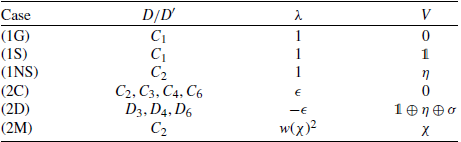
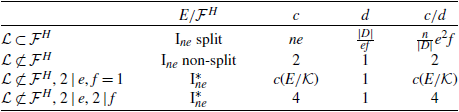

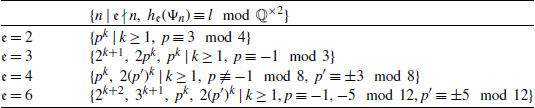


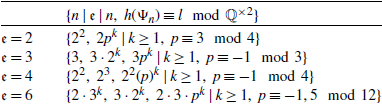




 Open access

