

The excavations at Liberty Southwark carried out by Museum of London Archaeology have yielded one of the largest assemblages of Roman wall-painted plaster in London. Most of the plasters were found in pits, which were deposited after the demolition of the walls to which they belonged. The site is also near a previously excavated mansio building close to the bridge crossing into Roman London north of the Thames,Footnote 1 although together they may have formed a larger governmental building that served a variety of purposes. In the reassembling and assessment of the plasters, the building material specialist discovered two inscriptions unique to Roman Britain and probably to the study of Roman wall-paintings in general. Pit (423) yielded what looks to be a signature by the painter while (135) produced a near complete Greek alphabet scored into the plaster. Both inscriptions were analysed in the greater context of the Roman world in which comparisons of similar inscriptions were made. The result of the analysis concluded two unique phenomena that have not been seen before in study of Roman Britain and may shed light on the function of the building. These small inscriptions on wall-paintings will be contrasted against each other as they served two completely different purposes within the space on this structure.
The Greek Alphabet (Fig. 1)
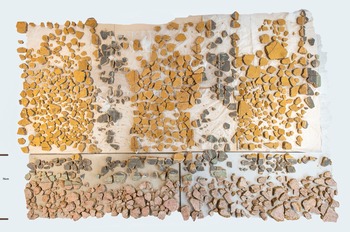
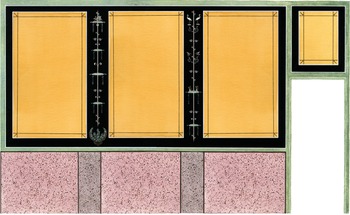
The plaster from (135) was reassembled and a yellow panel scheme with black intervals above a pink porphyry imitation dado was identified. Panels with yellow fields are uncommon in Britain, with only one high quality example in Fishbourne noted by Ling and Davey in their Reference Davey and Ling1982 corpus.Footnote 2 The pottery dated this assemblage from the first to early second century. The fragments were found within a Roman building complex but were recovered from a pit and were divorced from the walls with which they are associated. Therefore, a significant amount of time would have passed from the painting of the plaster to the demolition and eventual deposition of the material in the pit. Nevertheless, the plasters were reconstructed in such a way that most of the wall, including part of a recess, likely formed part of a doorway. A portion of the Greek alphabet, from A to T (alpha to tau) was spotted during the reconstruction process by the author (Fig. 1). It is located on the black band between two vertical white lines, possibly belonging to the edge of the room near the doorway. Green and yellow are visible beyond the white lines and it is likely that this fragment was either near the doorway (Figs 2 and 3) or at the corner of the room. The letters are difficult to see, with their height averaging around 10 mm, but become much clearer with sunlight, especially at an angle. This suggests that the letters were scored across or near the recess of a window.
Greek alphabet from (135). (Photograph: MOLA/Andy Chopping).

Fig. 1 Long description
The image shows a fragment of ancient plaster with visible Greek inscriptions. The plaster is broken into two pieces, with the inscriptions running across both. The surface appears weathered and rough. On the right side of the image, there is a measuring scale marked with numbers from 0 to 30, indicating the size of the plaster fragment. The inscriptions are faint but discernible, suggesting historical significance.
Part of the wall-plaster of [135] where the Greek alphabet was discovered. Note the doorway area and the edge of the wall is not included in this photo. (Photograph: MOLA/Andy Chopping).

Fig. 2 Long description
The image shows reassembled fragments of wall plaster arranged on a flat surface. The fragments vary in size and shape, displaying a mix of colours and textures. They are organized in a grid-like pattern, with distinct sections showing different shades and materials. The arrangement suggests an attempt to reconstruct a larger piece from these smaller fragments.
Illustration of what the wall may have looked like. (Illustration: MOLA/Faith Vardy).

Fig. 3 Long description
The illustration shows a wall design featuring large yellow panels bordered by black intervals. The panels are arranged in a horizontal sequence with decorative vertical elements in the black sections. Below the yellow panels is a pink porphyry imitation dado, divided into sections by vertical lines. A smaller yellow panel is positioned to the right, bordered similarly. The design suggests a classical architectural style.
The question as to why a Greek alphabet was scored cannot be answered due to the divorced nature of the plaster from its original wall, despite the reconstruction. We do not know whether this structure served a private or public function, or indeed a mixture of both, although a connection with the nearby mansio at 15–23 Southwark Street is a possibility. The scoring of the letters seems to be confined within the two vertical white lines that enclose the black band between the yellow and green areas. Jennifer Baird, in the interpretation of graffiti from Dura-Europos, describes the purposes of graffiti as ranging from the ‘magical or sacred, to the utilitarian, or even decorative’.Footnote 3 One could assume that it was someone practising their writing skills by attempting to write the letters in consistent size and in between the two lines, possibly the work of a trainee scribe. This is supported by the large number of writing materials such as inkwells recovered from the current excavationsFootnote 4 and the excavation of the mansio at 15–23 Southwark Street.Footnote 5 However, no other inscription was identified on plaster fragments belonging to this wall and the penmanship of the author is demonstrated from the well-written small letters. The area between white lines also makes it a memorable area to leave an inscription despite its black background. This opens the discussion to other possibilities such as both the intention of the author and possible interaction by audiences to the letters.
Greek alphabets are known to appear on numerous objects with inscriptions recorded on different material from the Roman territories in the Mediterranean and multiple provinces outside Italy. They include the alpha to omega on tesserae at Aufschrift auf Tessera in Bononia, Pannonia Inferior,Footnote 6 and a stone stele panel with inscriptions of parts of the Greek alphabet from Aphrodisias in modern-day Turkey, both different media to wall-painting, with the latter interpreted as stone masonry practice or a magical purpose.Footnote 7 The Liberty Southwark fragments, however, are unique to Roman Britain since a nearly complete Greek alphabet such as this has not been found in the province before; this find, being part of a larger excavation, offers the chance to assess the national significance of its purpose.
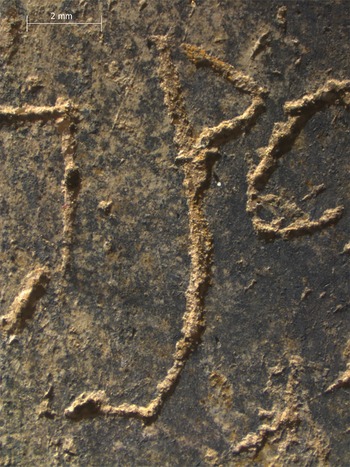
Microscopic analysis of the scored lines and indentations of this fragment to see whether the plaster was still wet when scored were inconclusive. There are multiple areas in the scored lines where the sharp tool pushes deeper into the plaster, visible as rounded holes that penetrate to the white intonaco (Fig. 4). This is likely the result of the graffito scorer pausing during the act of scratching the letters into the plaster. Some of these dotted holes may also represent where the sharp tool initially punctured into the plaster during the scoring process.
Greek alphabet from (135) under microscope. (Photograph: MOLA/Marvin Demicoli).

Fig. 4 Long description
The image shows a close-up view of a plaster surface with scored lines and indentations. The lines appear rough and uneven, with some areas showing deeper penetration into the plaster. The texture is coarse and the indentations vary in depth, suggesting irregular scoring. A scale indicating 2 millimetres is visible at the top left, providing a reference for the size of the indentations.
Whether the scored letters were keyed into the plaster while wet or dry is significant to the interpretation of the meaning behind them. Wet scoring of wall-plaster occurs usually during the planning stage of the painting. Many plasters recovered from both London and the Mediterranean show scored lines that denote where and how the designs would be painted. In fact, examples of parts of tally marks and numbers scored to possibly aid the wall decoration process are on display in the Piazza Massimo in Rome on the Myth of Actaeon wall-painting, room E10. If the alphabet was scored wet before other walls were painted, it is possible that the letters helped the painters plan the allocation of the designs in the room.
If the letters were scratched in after the plaster had already dried, which in the opinion of the author is more likely due to the jagged edges and chips of the plaster adjacent to the letters, then the interpretation becomes more complex. It is not possible to determine just how much time passed after the plaster was completed until the scoring of the wall took place. Greek alphabets that appear in well-preserved Roman sites such as Pompeii, Herculaneum and Ostia have been met with different interpretations, depending on factors such as whether the alphabets appear in public, private or in-between spaces.
Comparisons abroad
Two sets of segmented Greek alphabets are visible in Insula X – Caseggiato degli Aurighi at Ostia Antica, the port of Rome. They appear in a room that may have been a latrine, although this is not substantiated.Footnote 8 Interestingly, Greek alphabets from alpha to mu were written on the latrine in Casa dell’Albergo, Herculaneum.Footnote 9 One could easily speculate as to why latrine visitors would undertake graffiti in such an environment. It is not as easy to determine in the case of (135) why an alphabet was keyed in to the wall on what is evidently part of a client-facing room.
Rebecca Benefiel and Holly Sypniewski have also compiled a detailed distribution and quantitative analysis of Greek and Latin alphabetic graffiti in Herculaneum. The analysis of alphabet graffiti in Pompeii was compared to the findings of Herculaneum and the comparisons have been extracted from Benefiel and Sypniewski’s work below in Figure 6. Greek graffiti are not located in clusters and are spread out in Pompeii and Herculaneum,Footnote 10 while evidence of the clustering of Latin graffiti is evident, at least in the Villa of Poppaea.Footnote 11 Greek alphabets in public spaces can be associated with the teaching of children;Footnote 12 the appearance of these letters in private households could be attributed to children practising their lessons. This is largely determined by the height of the graffiti, for example 95 cm above the height of the floor in Insula Orientalis 11.9 in Herculaneum.Footnote 13 This hypothesis is especially convincing if the alphabet appears in the lower areas of the wall where the short stature of a child would explain their positioning. It should be noted that the scored graffito of a face was identified on a fragment of plaster from (135), part of the same wall. This may suggest the playful act of a child. Indeed, the commonality of writing practice by both adults and children would explain why most alphabets found in both Pompeii and Herculaneum were in domestic properties.Footnote 14 This would offer the simplest explanation as to why the alphabet was scored into the wall. However, the small size of the letters and the penmanship of the author of the graffito seems to suggest that the Greek alphabet was not the result of writing practice. The free-handed strokes, especially the smooth curves at the base of the M (mu), and the consistency in terms of the size of the letters suggest the work of a proficient writer instead.
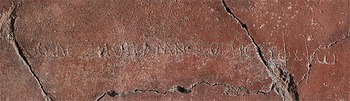
Greek alphabet from Herculaneum, Insula Orientalis II.9. (Photograph reproduced with permission of the Ancient Graffiti Project https://ancientgraffiti.org/Graffiti/graffito/AGP-EDR154595 and with permission from Ministero Della Cultura Parco Archeologico di Ercolano).

Fig. 5 Long description
The image shows an ancient inscription carved into a cracked stone surface. The text is faint and appears to be in a classical script. The stone has visible cracks running through it, adding to its aged appearance. The background is a uniform stone texture.
Distribution of alphabet and their contexts from Pompeii and Herculaneum. (Based on Garraffoni & Laurence Reference Garraffoni, Laurence, Sears, Keegan and Laurence2013, 127 and Benefiel & Sypniewski Reference Benefiel and Sypniewski2018, 218; MOLA/Juan Jose Fuldain Gonzalez).

Fig. 6 Long description
The first pie chart illustrates the location of graffiti alphabets in Pompeii, based on Garraffoni and Laurence. It shows that 41.0 percent are found in residences, 32.0 percent on building facades, 21.0 percent in pedestrian campus areas and 6.0 percent in other public buildings. The second pie chart depicts the location of graffiti alphabets in Herculaneum. It indicates that 68.2 percent are located in residences, 7.7 percent in shops, 7.7 percent in inns, 7.7 percent in other public buildings and 7.7 percent in uncertain locations.
Children or indeed adult learners would not be the only people who would have learnt or utilised the Greek alphabet. In a context where the original building has been demolished and conjecture of the intention of the inscriber lacks any concrete evidence, other more practical reasons for the alphabet should be explored. The idea of individuals working in commercial areas using the alphabets as a checklist, visual aid or a reference to identify the products (labelled with Greek letters) is another explanation. Pottery with Greek letters has been recovered in London in Trinity Square (TRN08) and Mariners House (MCF06). Greek letters on wall-plaster were identified on fragments recovered from Cave’s Inn (Tripontium) on the site of a third-century bathhouse.Footnote 15 It is not uncommon for pottery such as amphorae to be labelled with Greek letters and it would have made sense for the Greek letters to aid workers on the premises. This would have been especially useful if the workers themselves were not familiar with certain Greek letters as they read the labels and organised their products. This same hypothesis has been suggested by Benefiel and Sypniewski for the complete Greek alphabet in a Herculaneum shop, Insula Orientalis II.9 (Fig. 5). Here they suggested that the alphabet, written in a fluid letterform, likely served a practical use to help the shopkeepers identify the Greek labels inscribed on amphorae.Footnote 16 Given the import of goods from long distances and the different languages used on containers, it is logical that this would encourage individuals to employ the use of visual aids to interpret the labelled goods.
Context (135)
Although the purpose of the Liberty alphabet cannot be fully determined due to the limitations of the context of its recovery, it is still possible to explore why the letters were scored, beyond the tempting idea that it served as handwriting practice. Importantly, as stated by Baird, it may be necessary to interpret the graffiti not as debasement or the decline of a building, but as serving a function within a property.Footnote 17 As mentioned above, the Greek alphabet from (135) is cut off at tau due to the fragmented state of the plaster. It is likely that the letters continued beyond tau and included the remaining five letters. A complete alphabet supports the notion of practical use, as suggested by Benefiel and Sypniewski. It would make sense that an alphabet used for labels or symbols would have all the letters to allow for the identification of the letters on the handled goods. This is further supported by the fact that all the letters appear to be capitalised. Capitalised Greek letters are rare on Roman inscriptions and lower case is usually used for general manuscript.Footnote 18 In fact, Latin graffiti inscribed in capitalised letters were usually the work of less literate writers.Footnote 19 Given that there are instances in Vesuvian cities of alphabets scored in multiple types of buildings (Fig. 6), there may be multiple reasons behind the intentions of the authors. Furthermore, and as mentioned above, the possibility that the alphabet may be a visual aid for labels, checklist or even a tally cannot be ruled out. Tally marks are found on painted wall-plasters across the Roman empire and letters within an alphabet, with its letters in sequence, may serve a similar purpose. As Baird states, parchments and papyri were expensive, and a wall offered a surface to note utilitarian inventories in storages, debts, and the recording of shipments.Footnote 20 In short, although fragments recovered from the pit are a far cry from the buildings of Italy and Syria, the inscription on this fragment remains a likely example of the common practice of utilising large flat surfaces of a building space to serve a practical function likely connected with the purpose of the building at that time. Therefore, whether there was a practical use for the inscription of the alphabet remains an avenue for further research.
The main difficulty in analysing the fragment is that the material from (135) is far removed from its context and deposited away from where the wall could have been. The inference of whether this space belonged to a private or public space can only be aided by the finds, phasing of the site and surrounding archaeological features. However, only three sherds of pottery, two of Verulamium ware, were recovered from the context. The function of the building therefore cannot be determined beyond the speculations already mentioned. Nevertheless, the writing style of the author of the letters, as well as the capitalised letters, suggests the work of a practised or habitual writer rather than that of a child or beginner. It seems likely that the vicinity of a commercial area would yield practical inscriptions on large flat plastered walls such as visual aids, tally marks, labels or references. The location of the site close to the river, a hub of transportation in Roman London, may allow speculation within the realm of commercial use of the property and a practical use of the alphabet.
The painter’s signature
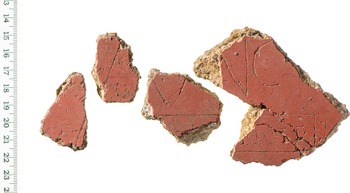
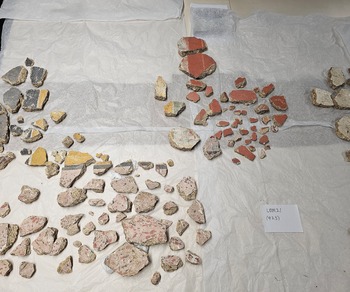
In contrast with the Greek alphabet, a more formal wall inscription in the form of a tabula ansata with ‘FECIT’, Latin for ‘has made (this)’, is visible on fragments of painted wall-plaster from context (423) that have been partially pieced together by the author (Fig. 7). The rest of the words within the borders of the tabula are missing. This is unfortunate, as the name on the inscription is missing. The handle of the tabula is visible on the right and the upper border of the length of the ansata extends well beyond the ‘FECIT’. The colour in which the tabula is scored is red, which seems to form part of a panel (Fig. 8). It is likely that the overall placement of the ansata is somewhere near the middle of the red fielded panel, a common scheme in Britain and the indeed the rest of the Roman world. The tabula and the word within the frame look to have been scored when the plaster was soft and the letters, especially the ‘T’, are very well scored by a skilled individual who probably writes often on undried plaster. The scoring is probably contemporary with the painting process, as to achieve such a detailed font on dry plaster would be extremely difficult. This would suggest a painter’s signature and would be a very rare find in both Roman Britain and the wider Roman world.
Tabula ansata of context (423). (Photograph: MOLA/Andy Chopping).

Fig. 7 Long description
The image shows four fragments of painted wall-plaster arranged horizontally. The plaster is scored with the Latin word ‘FECIT', meaning ‘has made (this)'. The scoring is detailed, suggesting it was done when the plaster was soft. A ruler is placed vertically on the left side, providing scale measurements from 13 to 24. The fragments vary in size and shape, with the largest piece on the right displaying the most complete portion of the inscription. The plaster is rough and uneven at the edges, indicating it is part of a larger piece that has been broken.
The overall panel motif where the tabula ansata was likely scored. (Photograph: MOLA/author).

Fig. 8 Long description
Numerous fragments of painted wall-plaster are arranged on a surface covered with fabric. The fragments vary in size and shape, with some showing red and yellow painted surfaces. The pieces are organized into groups, possibly for analysis or reconstruction. A label on the surface reads ‘LDM21 (423)', indicating a specific context or reference for the fragments. The arrangement suggests a methodical approach to studying or restoring the plaster pieces.
The material was recovered from a pit within the same building complex, but like the material from (135), was removed from the wall. As with the alphabet, a significant amount of time could have passed from the painting of the plaster to the demolition and eventual deposition of the material into the pit. However, the plaster is also likely from a clay-walled building as plaster does not tend to survive in large quantities when masonry building materials from walls are taken apart and recycled. Pottery from the early second century was recovered from this context with a central Gaulish colour-coated ware (CGWH) fabric lamp of c. 43–70 a.d. also identified.
Letters ‘A…V…(N) C’ are identifiable right above the tabula, with possible missing letters between, before and after what is visible. There is also the trace of two letters within the tabula, to the left of the ‘FECIT’ which is likely the painter’s name. Roger Tomlin has suggested that the second letter is probably a ‘T’.Footnote 21 Whether these letters are written contemporaneously with the tabula or at some later date cannot be confirmed. The width of the letters outside the tabula is thicker and the overall font looks different from the ‘FECIT’.
The difficulty of deciphering the scored inscription is caused by the fact that there are no obvious examples known to the author with which they can be compared. Unlike other art media, no established typology of painted wall signatures seems to exist. Even basic answers such as whether signatures of painters were applied to more elaborate paintings instead of simple monocolour-fielded panels are not certain. One would assume that, like mosaics and statues, artists would more likely mark their work on more complicated creations to advertise their skills. After all, Roman painted plaster is ubiquitous in Roman towns. However, given this example is on plain panels with simple stone imitations, this suggests that even more common wall schemes could have received the mark of the maker.
Who signed the painted wall?
Roman painters and plasterers, like mosaicists, worked together in groups. The plaster needed to be wet when the paint was applied and some fragments from another pit on the same site showed evidence of failed frescoing where the paint did not bond properly as it was applied too late during the drying process. This means the painters and plasterers belonged to the same group and a signature could represent the entire team. In the medium of mosaics, Sean Leatherbury states that only the head of the group signed their work, and this did not necessarily suggest authorship, but more commercial identity.Footnote 22 Claire Taylor suggested that a personal name is socially collective and connects the writers and readers within and outside the society in which they operate.Footnote 23 This notion could indeed apply to the identity of a workgroup, whether it was represented by the name of the lead painter or plasterer.
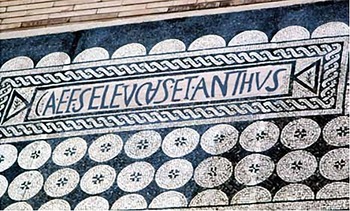
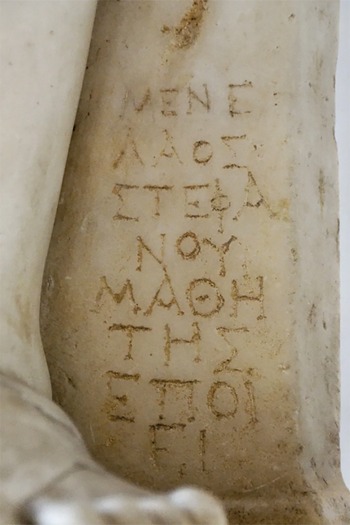
The idea of the tabula being part of a painter’s, or, according to Leatherbury, a ‘corporate’ signature would make sense in a cityscape where a building boom would have occurred, such as that which followed the Flavian stabilisation of London. Jeffrey Hurwit, when describing the signatures of Greek wall-painters, stated that artistic ego and fierce rivalries would have existed in a competitive environment.Footnote 24 Signatures would also have been a method for the artist to attribute high quality work to their skill. Signed works in other Roman media also suggest this. Examples of this phenomenon may include relief-patterned flue tiles and ‘civilian’ brick stamps in Britain, during the latter half of the first century, signed mosaics with tabula and wording likely similar to that of (423), such as the example from Mérida, Spain (Fig. 9), and signatures on statues, such as Fig. 10.Footnote 25
C(olonia) A(ugusta) E(merita) f(ecerunt) Seleucus et Anthus) roughly translates to ‘Made by Seleucus et Anthus at Colonia Augusta Emerita’ from the mosaic of Apollo and the Muses. (Picture from Archivo MNAR).

Fig. 9 Long description
The mosaic features a rectangular section with the text ‘CAES SELEVCVS ET ANTHVS' prominently displayed in the centre. This section is bordered by a decorative pattern consisting of interlocking geometric shapes. Surrounding the central text area are numerous circular patterns arranged in rows, each containing intricate designs. The mosaic is set against a brick wall, providing a contrasting background to the detailed artwork.
‘Menelaos, a student of Stephanos, made this’. (Taken from Bond Reference Bond2023; image by Marie-Lan Nguyen via Wikimedia Commons).

Fig. 10 Long description
The image shows an inscription on a marble surface. The text is in Greek, arranged in a vertical format. The letters are carved into the stone, displaying a clear and precise style. The inscription reads: ‘MENE LAOS STEFA NOY MAO THES ETO FI'.
As mentioned above, the existence of Greek fresco signatures, much like the rarity of Roman ones, was not consistent throughout any specific periodFootnote 26. Their frequency would likely have depended on how many artists worked in environments with varying demands on their work. This makes the growth periods of the first and second centuries in London, and other Roman expanding urban areas in Britain, ideal environments for artistic competition. This, of course, would be in stark contrast to the well-established and older cities, such as Pompeii, that were contemporaneous with, for example, the Flavian building booms of newer Roman settlements in Britain.
Why are other examples so rare?
The question then is: why have we not recovered any painter’s signature marks in Roman Britain? This is likely a combination of both an inconsistency in recognising the style or appearance of a painter’s signature and, most importantly, the fragmentary nature of plaster recovered from excavations in Britain. In relation to the latter point, most archaeologists who have worked with plaster from Britain, France and Germany would often describe the scattered nature of the plaster assemblages they recover. The plasters that do survive tend to be part of clay walls, in which the collapse of the structure and the deposition of the material in other features prevents most attempts at substantial reconstruction. This is especially true with the buildings of first- to second-century London and makes finding a small inscription difficult. As mentioned above, the masonry structures that do dominate later periods are largely robbed out for building materials, a process that shatters the plaster in its entirety. Therefore, although many scored inscriptions have been recovered on plasters, as visible in RIB 2447, many of them remain wholly incomplete and difficult to interpret.
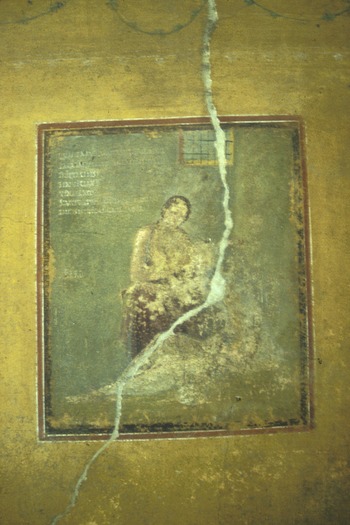
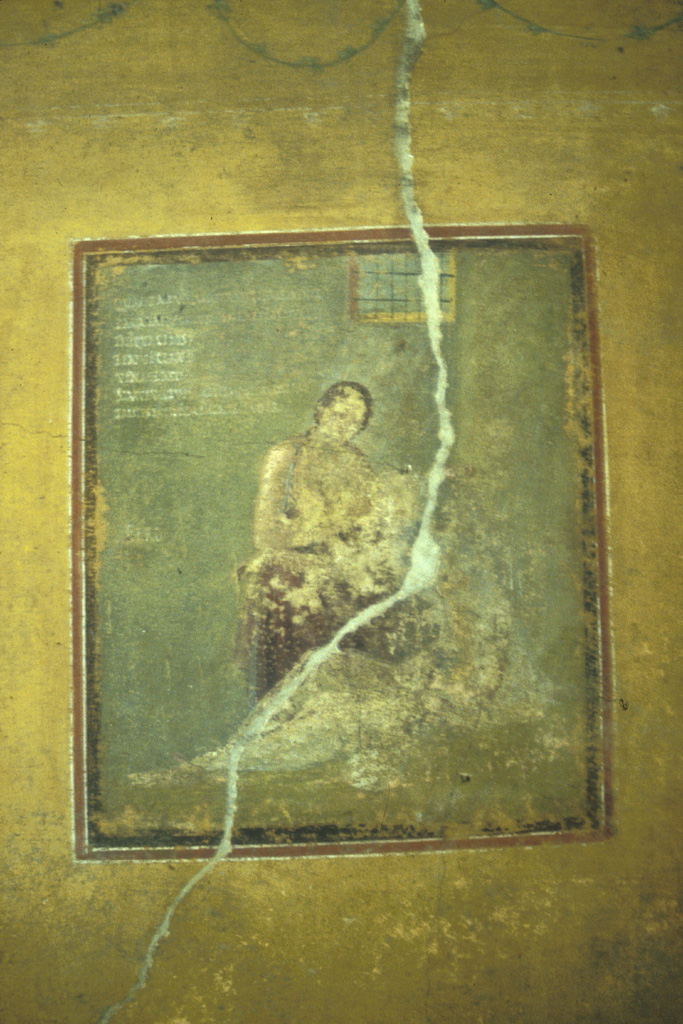
Across the former Roman world, most scored marks and even painted inscriptions have simply been recorded under the general umbrella term of graffiti and often dismissed as non-formal inscriptions. This assumption is especially problematic with the value placed on scored inscriptions on wall-paintings and will be addressed below. The interpretation and often the decipherment of these words is difficult, even in areas where many standing walls and wall writings survive. The difficulty in determining whether words on a wall were part of the original intent to accompany a wall-painting comes from a lack of clarity of the chronology of the words and painting, a subject that will be further explained below. The words and the tabula from (423) are no exception to this challenge, as stated above with the large letters outside the tabula. In fact, even when the subject of the inscription draws a direct connection with the wall-painting it complements, we cannot be sure if the words were added later. The painting of Pero and Micon at the House of M. Lucretius Fronto at Pompeii is a good example of this challenge (Fig. 11). This combination of picture and text likely attempted to promote the pietas and pudor virtues through the depiction of filial piety of a daughter through the image of Micon suckling her imprisoned father accompanied by Latin poetry which describes the scene.Footnote 27 The picture and text may have been used to support a painted electoral advertisement on the outside of the house, in what Kristina Milnor suggests is a representation of pudor in both the female and male spaces of Pompeiian society.Footnote 28 Although Milnor argues that the small font of the poem draws viewers closer to the painting,Footnote 29 the sequence of events in relation to the painting and inscriptions remains unclear. Milnor mentions three paintings and two terracotta statues of the same scene have been discovered in Pompeii, which suggests that this is not an uncommon scene for clients. Was the poetry added to the example at the House of M. Lucretius Fronto at the same time as the painting of the electoral advertisement? Likely, but we may never know for certain. Often, it is through an inference of contexts that inscriptions and artworks can be associated as the work of the same authors and the same time periods. Often the lack of evidence makes this process near impossible. This issue is exacerbated by the fragmentary nature of the wall-plasters in Britain, compared to areas like southern Italy. Letters painted on plaster such as RIB 2447.3, from Godmanchester, have only a few fragmentary letters visible and the wider context is lost. It is therefore no simple task to connect the writing on painting with the painters themselves.
Pero and Micon from Pompeii with epigraph. (Photograph taken from Warwick University’s online database https://warwick.ac.uk/fac/arts/classics/intranets/students/modules/cx254/pompeianhouses/145.jpg and used with permission from Ministero della Cultura – Parco Archeologico di Pompei).

Fig. 11 Long description
The image shows a wall painting featuring a seated figure, a woman, positioned centrally within a rectangular frame. The figure appears to be holding or interacting with another figure, possibly an elderly man or smaller person. To the left of the figure, there is an inscription consisting of several lines of text. The background is a solid color and the painting is bordered by a thin line. A visible crack runs vertically through the painting, affecting the image and text.
Furthermore, the lack of inscriptions found on wall-paintings in Roman Britain may be linked to the location of the province itself. Leatherbury’s examples of multilingual signatures in Syria during the Roman period, such as the mosaic from Mas`udiye, Euphrates River Valley, in which both Greek and Syriac are present, suggests that the artists’ intention was to connect not only to the local population with Syriac but also to demonstrate the well-established signature traditions of the Greek regions.Footnote 30 In a location where Latin, Greek, Palmyrene and Syriac existed as avenues of literate expression, the frequency of signed works would obviously outnumber the signatures in Roman Britain, where no written language existed until Roman influence spread across the south of the island. Maker’s marks during the Roman period in Britain were ubiquitous as they often took the form of non-literate marks, sometimes as basic as finger grooves made by fingers on wet clay, especially in the case of tiles. Although I do not suggest that multilingual societies prompt inscribed signatures, one can assume that a lack of a dynamic environment of multiple written languages competing, such as Roman Britain, may encourage the popularity of other forms of signatures.
Why did the author choose to key the inscription if they were painters?
The next question facing the interpretation of the tabula and letters within its frame is: why were the letter and the image keyed into the plaster rather than painted? Are these letters simply temporary expressions in the modern sense, scored with no intention of permanent recognition? Are they a phenomenon in which those without power make their mark in a public sphere,Footnote 31 or those less fortunate leave a mark in private spaces occupied by those more fortunate? As Susan Sontag wrote:
Graffiti as an assertion of disrespect, yes, but most of all simply an assertion … the powerless saying: I’m here, too.Footnote 32
This is unlikely to be the case with the tabula and the letters from (423). As with the alphabet, we must remove ourselves from the modern attitudes to scored graffiti on walls. Although graffiti of a more temporary nature on walls are doubtless a phenomenon throughout the Roman period, the act of chiselling letters, words and even literature into a solid surface with some permanency represents the acceptable practice of inscriptions. The sharp object is a deliberate tool, just like a paintbrush to a painting or a chisel inscribing a stone dedication: the wall surfaces served as a medium of permanent inscription. Good examples of this medium would be the poems of Tiburtinus in Pompeii, which were keyed into the wall-plaster. The lines of poetry are scored with good penmanship and the spaces between the lines carefully keyed in. Although names appear in many graffiti in Pompeii,Footnote 33 a signed poem suggests that the author, like the painters of the Liberty, evidently took pride in their work. Abigail Graham describes this kind of word formatting as a type of documentation icon, designed to impress both literate readers and illiterate observers.Footnote 34 The idea that the placement of words in a visually imposing way can in fact carry a degree of authority was very much in the mindset of Roman inscribers.Footnote 35 This is likely the purpose of the clear fonts and the framing of the words into a tabula ansata. Furthermore, the tabula ansata forms part of the documentation icon which as a symbol demonstrates and invokes gravitas. The tabula provides the Roman reader as an “index of text” and highlights the importance of the words within the borders with a degree of importance that drew the attention of both the literate and illiterate.Footnote 36 With Greek origins, it developed under the Roman period from a symbol for military formation, dedicatory and funerary inscriptions to votive for saints among the Christian population (Fig. 12). It also was utilised for maker’s marks for ceramics and mosaics, which was included by the Liberty Southwark painter to add a recognisable symbol to the inscription in order to catch the eye of an audience within the room. In a way, it separates the artwork from the textFootnote 37 and focuses the attention of the viewer to the message left by the author.
Invocations to Christian saints at the Catacombs of San Sebastian. Notice the uneven font of the letters and crudeness of the lines as a result of scoring into dry plaster. (Foto Pontificia Commissione di Archeologia Sacra oppure; Foto Archivio PCAS).

Fig. 12 Long description
Several fragments of red plaster are embedded in a wall, each inscribed with unevenly scored letters. The inscriptions appear to be in Latin, with visible words and phrases on each fragment. The letters are crudely carved, suggesting they were scored into the dry plaster. The fragments are irregularly shaped and vary in size, with some inscriptions more legible than others. The wall surface serves as a medium for these permanent inscriptions, reflecting a historical practice of chiselling words into solid surfaces.
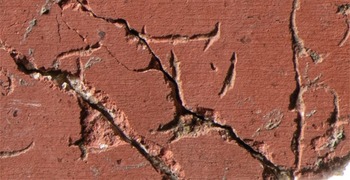
The letters were examined in detail under both a microscope at both ×10 and ×20, as seen in Fig. 13. They were then compared to other graffiti on surfaces of similar colour and intonaco. As mentioned previously, the plasters attached to the mortar backing are white, and in this area of the plaster, red is the colour of the background. Firstly, the scored lines do not seem to penetrate the red and show the white intonaco. The red paint, being thin, would easily have been punctured if the plaster was already dry as it would be difficult to apply equal force to the surface. Secondly, the letter T, and the curved line, possibly an interpunct point, a mark to show the end of a word (Fig. 13), have sharp points, which would very likely have been scored in when the plaster was soft. The ‘T’ has multiple sharp points that expand in width before narrowing again with a sharp point termination. As mentioned above, scoring on completely dry plaster in this style would be tremendously difficult. It is not clear just how dry the plaster was but the effort in writing such small letters so impressively is indication that the scorer very much intended to demonstrate their skills on writing on wall-plaster, which is vastly different to other methods of writing. Lastly, the position of the tabula is likely positioned within the red panel, and what looks to be an unburnished of part of the wall, rather than a more elaborately decorated area such as the inter-panel area. It could have served to advertise the artist’s name without taking attention away from the overall impressive wall-painting, a feature also important with mosaics. The effort in creating the inscription therefore highly suggests that the individual signed their painting with well-practised skill and had the intention to impress viewers.
Magnified image of part of the letters in the (423) tabula showing the sharp points on the letters, probably accomplished when the plaster was still soft.

Fig. 13 Long description
A close-up view of a red plaster surface showing sharp, scored lines and cracks. The lines appear to be intentionally made, possibly when the plaster was soft. The surface has visible texture and irregularities, with some areas showing deeper indentations and cracks.
How do Roman signatures on plaster from the continent compare with the Liberty Southwark example?
In short, signatures on plasterworks are very rare in the Roman world. When analysing wall-paintings, commentators have tended to assign different works to the same artist or a group of artists based on art-historical principles rather than reliance on signatures, given the rarity of such signatures. For example, identifying similar depictions of clothing, themes and characters may be a way to establish that they were painted by the same person(s). However, even in the absence of plentiful examples, this does not preclude the use of signature as a practice for artists to advertise and/or credit their work.
Although not wall-paintings, the cornices from Dura-Europos in present-day Syria, known as the Orthonobazus cornices, are an example of plaster mouldings signed by the same artist. Three examples of these plaster mouldings bear the name of Orthonobazus and the repetition of the name suggests that it is a signature. These were roughly dated to the third century.Footnote 38 In contrast, examples of signatures associated with wall-paintings remain divisive. It is challenging to associate small-sized writings with large areas of wall-paintings, as these may be inscriptions added in a later period, in absence of evidence of the signature(s) being made during the plastering or painting process. Unlike mosaics, where signatures tend to be laid out as part of the final composition, it can be difficult to establish the chronology of a wall-painting and the inscription(s) it bears. Despite the frequency of wall writings, there is a lack of typology of wall-painting signatures, with only a few debated examples available. This is complicated by how a building will contain multiple painted walls but only a single name on one painted surface. It may be challenging to argue that all such paintings were done by the same painter and that one name identifies this painter. Below are some well-documented examples of inscriptions interpreted as painter signatures which I compare against the Liberty Southwark example.
Examples presented by Kruschwitz and Campbell
Kruschwitz and Campbell suggested that are there at least four examples of possible signature marks associated with Pompeian paintings. One mentions the restoration of a tavern sign by Sittius and the advertisement of the amenities, which has been lost and therefore no further examination can be undertaken to determine the connection between Sittius and the painted elephant sign. Another inscription of names exists in house no. VII 7, 19 but has been damaged. The villa Santini at Boscotrecase has the following under a landscape painting with Sabinus (sc. pinxit?) which translates to (painted by?) Sabinus.Footnote 39
If the sc. pinxit cannot be confirmed, then it is not obvious that Sabinus is the painter as Sabinus’ relationship with the painting may be one of patronage among other possibilities. Without undertaking a detailed examination of how the writing was applied to the wall, there is sufficient evidence to confirm the identity of Sabinus and his relationship with the painting. It may be possible to strengthen this argument if the writing was keyed into the plaster during the painting process. It is not uncommon for painters to use words to name characters or provide context to the subjects in Roman paintings and therefore it is prudent to use caution when determining if this is a signature mark.
The most convincing example outlined by Kruschwitz and Campbell is the framed name of Antonius within a tabula ansata (Fig. 14). Here there exist two tabulae ansatae, one without any writing. The surface of the wall has been damaged, and the preservation of the possible signature is poor compared to the example from (423). There are holes both within the scored lines, similar to the Greek alphabet (135) and throughout the wall. The letters are not carefully scored and not as fine compared to (135). Roger Tomlin notes that the name was written first but the letters were filled in carelessly.Footnote 40 Whether this suggests that this is in fact graffito with a name (a common phenomenon, for reasons which could include votive and religious motivations) or a signature of a painter remains unclear. It is the finely scored blank tabula, which Tomlin suggests may be for the cognomen,Footnote 41 with its straight lines that support the idea that the scoring was undertaken when soft. This is a difficult fact to determine and the damage to the wall-plaster hinders the analysis of the scoring.
CIL IV.2424 (cf. tab. XXXI 37), CIL archive, inv.n. PH0018045. Example of tabula ansata bearing only a name within the frame. Roger Tomlin (pers. comm., 2024) notes that the frame was inscribed first and the name filled in afterwards and incompetently.

Fig. 14 Long description
The image shows an ancient wall with an inscription featuring a name within a tabula ansata. The surface appears weathered and damaged, with visible holes and rough scoring. The letters are not carefully scored, suggesting incomplete or hurried work. The tabula ansata is a rectangular frame with triangular extensions on either side, commonly used in ancient inscriptions.
Examples presented by Renate Thomas
Renate Thomas outlines two examples in her 2016 comments on Roman wall-plaster: (i) ‘Lucius pinxit’ is painted on a marble couch or bench situated below a wall-painting of Pyramus and Thisbe (the Lucius Bench) in the House of Octavius Quartio, Pompeii; and (ii) a Greek inscription containing the name Seleukos, with the word επόει meaning ‘made this’, is scored into a painted column in the context of a painted room in the Villa Farnesina in RomeFootnote 42.
One could argue that the scored writing in each case denotes the name of the painter of not only the object, but also the painting(s) surrounding itFootnote 43. However, this theory is complicated by the same chronological issues mentioned above. Roger Ling believed that such an argument remains dubious. Ling is not convinced that an artist would sign wall-paintings through the use of their name on a separate object situated in the room in which these wall-paintings belong.Footnote 44 Both examples show the intention of the writers to associate their names permanently with these spaces. In the Lucius Bench example, the name was made by brushstrokes, a more expensive medium than scoring letters into a flat surface. One could infer that the writer made the marks during the painting of wall. However, it is not possible to determine the exact moment that these words were written, nor how much time passed between the painting of the walls and the writing. It remains ambiguous if these words were inscribed after the completion of the painting in order to draw the attention of viewers (i) to the writing itself, or (ii) away from the paintings and instead to the objects themselves.
The local discussion
Why was the painting in Southwark signed? There are two ideas as to why the signature exists on the panel of this plaster, but both are in the context of a growing settlement with many new buildings being erected to accommodate an expanding population, both in Southwark and the city north of the river. The first is the obvious attempt to promote the artists’ work in a growing vibrant settlement. Roman elites were fond of good paintings, and like modern aesthetes, sometimes collected them.Footnote 45 Famous painters were known among art appreciators, both contemporary and as ‘old masters’.Footnote 46 Therefore, it would have been prudent for the artist to advertise their name(s) upon finished products. William Casement states that Roman art was enjoyed in public spaces and in the private home,Footnote 47 allowing the artists mixed exposure to their products. The common use of the panel scheme with decorated intervals in Roman Britain does not take away from the quality of this painted plaster. The colours of (423) are vibrant and sharp, with the dado and bands painted carefully and with skill. No area was left unpainted and therefore considerable effort was put into the product. A signature may therefore promote the artists’ capability and presence within the city.
The second theory is based on the small font used by the artists. It is possible that Roman wall-plaster signatures may simply be a random phenomenon in which each signature mark followed no established method or style and were therefore inconsistent. Although permission from the owner was likely required, a member or members of the painting and plaster group may have signed out of convention. They may have marked their name(s) at a whim and for their own satisfaction. This would explain the small size of the scored letters on a dark coloured background. In this way, the signature may have been more of a tagged name but was accepted by the owner.
The painter’s signature and Greek alphabet represent two different intentions of their authors but also demonstrates the difficulty in interpreting each author’s meaning of their respective inscription. The utilisation of a wall as a space from expression to practical use, such as the alphabet, offers many examples as to why writings appear on painted walls. Yet the use of the alphabet for practical use seems to fit into a well-established theory. This is contrasted by the painter’s signature mark, in which only a few examples can be drawn upon. The inconsistency of the interpretations of possible painter’s signature marks across the Roman Empire is only made more convoluted by our lack of knowledge of how Romans signed their painted artwork. After all, it is very likely that some of the fragmentary letters that were written in a multitude of different ways on broken pieces of plaster across the Roman landscape are indeed part of painters’ signature marks. In fact, there are likely to be multiple methods of signature which differed from artist to artist, as some may even be symbols rather than inscriptions. However, one would imagine that there was a sense of consistency among the audience of the paintings, as a signature needed to be recognisable and understood by individuals other than the artists. The tabula ansata and its inscribed words offer an excellent opportunity to add to the possible methods of artists making their marks. Both the significance of the tabula in the Roman mindset and the likelihood that the mark was made when the plaster was soft and new together strongly suggests this inscription is a maker’s signature. This could therefore be the first known and confirmed example of a fresco signature mark in Britain.
Acknowledgements
Thanks to Dr Roger Tomlin, Dr Abigail Graham, Michael Marshall and Jacqui Pearce for reviewing this article. Special thanks to the British School at Rome for sharing their resources and colleagues at MOLA for giving their time.