





Introduction
Efficient identification methods in forensic science are essential to providing appropriate humanitarian aid and support to affected communities. In countries like Mexico, where there is a forensic crisis, with thousands of non-identified persons, any information about the physical characteristics of an unidentified deceased person can help to reduce or limit the length of the process to determine their identity. The identification of human remains increasingly employs methods based on the use of stable and radioactive isotopes. Among these, radiocarbon dating allows us to estimate the year of birth or death of individuals. More specifically, the analysis of 14C content in human teeth helps establish the birth times of people who grew up after the 1950s. The technique is based on two factors. The first is the increase of 14C in the atmosphere due to nuclear bomb test detonations since 1955, and then a decrease in 14C after the nuclear test ban treaty in 1963, which produced changes in the concentration of 14C in atmospheric CO2 (the bomb-pulse) (Hua and Barbetti Reference Hua and Barbetti2004; Levin and Kromer Reference Levin and Kromer2004). The second is that the 14C incorporated in the mineralized tissues remains constant after the tooth is completely formed (Alkass et al. Reference Alkass, Buchholz, Druid and Spalding2011; Cook et al. Reference Cook, Dunbar, Black and Xu2006; Spalding et al. Reference Spalding, Buchholz, Bergman, Druid and Frisén2005). It is then possible to estimate the formation year of a dental organ or tooth using bomb-pulse dating. Many 14C studies on teeth have shown that tooth enamel has the best fraction for estimating the year of birth with very high precision (Gil-Chavarría et al. Reference Gil-Chavarría, Solis-Rosales, Rodríguez-Ceja, Chávez-Lomelí, Martínez-Carrillo, Mondragón-Sosa, Huerta-Pacheco and Quinto-Sánchez2020; Hodgins Reference Hodgins2009; Spalding et al. Reference Spalding, Buchholz, Bergman, Druid and Frisén2005). Research has indicated that age estimation can be achieved with precision using the entire dental crown, obviating the need for enamel purification (Alkass et al. Reference Alkass, Buchholz, Druid and Spalding2011, Reference Alkass, Saitoh, Buchholz, Bernard, Holmlund, Senn, Spalding and Druid2013).
Stable carbon and oxygen isotopes in human tissues have proven to be valuable in forensic investigations for determining the geographical origin of individuals (Chesson et al. Reference Chesson, Meier Augenstein, Berg, Bataille, Bartelink, Richards, Parra, Zapico and Ubelaker2020). Carbon isotopic abundance provides insights into an individual’s dietary habits, while oxygen isotopes offer information about the water they had consumed.
The stable isotopic concentrations are expressed in terms of δ:
 $${\rm{\delta _{sample}}\left( {in} \;\% \right) = \left[ {\left( {{R_{sample}}/{R_{reference}}} \right)-1} \right] \times 1000}$$
Where R is the atomic ratio between the concentration of the heavy or rare isotope with respect to the light or abundant, 13C/12C or 18O/16O, for the sample and the reference. The isotope ratios δ13C are expressed in deviations per thousand (‰) from the PDB standard (fossil Belemnite from the Pee Dee formation, and the isotope ratios δ18O are expressed in deviations per thousand (‰) from the VSMOW standard (Vienna standard ocean water).
Carbon isotopic variation in human tissues reflects the individual’s diet of plants and animals, based mainly on two groups of plants, C3 and C4: plants with a C3 photosynthetic pathway (that include trees and main crops), are characterized by δ13C values ranging from –35 to –20‰ (–26‰ in average); the C4 plants (that include maize and sugar cane) grow in warm environments and are characterized by δ13C values ranging from –14 to –10‰ (–12‰ in average) (Bartelink and Chesson Reference Bartelink and Chesson2019). A diet based mainly on C3 plants will reflect a difference in their δ13C from those whose diet is based mainly on C4 plants. Consumers of C4 plants have higher δ13C values (∼14‰) than consumers of C3 plants (0 to +2‰) (Kohn and Cerling Reference Kohn and Cerling2002)
It has been shown that the δ18O in tooth enamel reflects the isotopic fingerprint of the water consumed during tooth formation and can provide helpful information about the place of geographic provenance and residence (Ammer et al. Reference Ammer, Bartelink, Vollner, Anderson and Cunha2020; Kramer Reference Kramer2018). The geographical distribution of the 18O, the oxygen isotope with the highest mass, is mainly controlled by the environment and climate of a region. Water rich in heavy isotopes remains close to the seas and becomes poorer in 18O as it moves deeper into the continent and also with altitude, resulting in lower δ18O values (Kramer Reference Kramer2018). Therefore, variations in the 18O ratio allow isotope mapping, making it possible to compare 18O values obtained for teeth from different geographic origins of interest, and to infer whether individuals migrated from one site to another.
Most tooth studies present comparisons between very distant zones (e.g. Alkass et al. Reference Alkass, Saitoh, Buchholz, Bernard, Holmlund, Senn, Spalding and Druid2013); in this work, we explore the potential of carbon and oxygen-stable isotopes to distinguish regional differences. We present 14C, 13C, and 18O data from the dental crowns of individuals who had lived for long time in Mexico, Oaxaca, and Tepic cities, whose year of birth was known. Since different regions can show recognizable dietary isotope differences, we wanted to contrast three cities that are expected to follow different diets: Tepic near the coast in the state of Nayarit, with a seafood-based diet; Oaxaca in the state of Oaxaca, with a traditional Mexican diet, derived from local products; and Mexico City, with a globalized diet derived from a wide variety of products. For the analyses, we implemented a rapid method in the samples preparation protocol to facilitate the processing of many samples (Alkass et al Reference Alkass, Buchholz, Druid and Spalding2011). The year of formation of the dental pieces was experimentally determined from 14C-AMS analysis of the whole crown. The stable isotope analyses were carried out to use 13C and 18O stable isotopes as tracers of Mexico’s regional or geographical prints in teeth.
Methodology
The samples were obtained from donors aged 26 years or older through established informed consent in the National Odontological Collection of the National School of Forensic Sciences (ENaCiF-Escuela Nacional de Ciencias Forenses) of the National Autonomous University of Mexico (UNAM-Universidad Nacional Autónoma de México). This project was registered, evaluated, and approved with number FM-DI-045 by the Ethical Board of the School of Medicine of the UNAM. Patients with an indication of extraction necessary for dental treatments (periodontal, orthodontic, prosthesis or surgery) from the Academical Unit of Dentistry of the Autonomous University of Nayarit (UAO-Unidad Académica de Odontología de la Universidad Autónoma de Nayarit) made donation. The set included first (M1), second (M2), and third (M3) molars from individuals of known date of birth, sex, and city of residence. Enamel and dentin formation in molars follow a progressive and differentiated development depending on the tooth. In M1, enamel formation begins at birth and is completed between 2.5 and 3 years, while dentin starts between 3 and 4 months, with root formation concluding around 9 to 10 years. In M2, enamel develops between 2.5 to 3 and 7 to 8 years, with dentin and root formation finalizing between 14 and 16 years (Schour and Massler Reference Schour and Massler1940). The process is more variable in M3, with enamel forming between 7 to 10 and 12 to 16 years, and dentin along with the root completing between 18 and 25 years. Studies have identified statistically significant differences in δ13C values between permanent and deciduous teeth and between permanent teeth formed in early and later stages (Dupras Reference Dupras and Tocheri2007). Archaeological sample analyses indicate that δ13C values vary according to the dental development stage. During breastfeeding, δ13C reflects the isotopic signature of breast milk, typically showing higher values than those observed after weaning, when the introduction of solid foods leads to a new isotopic signature. The informed consent specifies that the mothers of the dental donors were originally from the studied regions and, with one exception (sample LEMA 2093 from Nayarit), resided in those areas during gestation and lactation. The donors continued living in their places of origin.
For this research, teeth from adults were chosen; extractions were performed between 2022 and 2023. The crown was separated from the root using a dental cutting tool, cut in two halves, cleaned in an ultrasonic bath, and then treated in an HCl (0.5M) solution for 10 minutes to remove the outer surface. To estimate the year of teeth formation through the 14C content, a fast preparation process was followed (Alkass et al. Reference Alkass, Saitoh, Buchholz, Bernard, Holmlund, Senn, Spalding and Druid2013). A 200 mg sample of the crown was treated at 70°C using ortho-Phosphoric acid (Merck 85%) to hydrolyze the carbonate into CO2. This gas was transferred to the carbonate handling system (CHS, Ion Plus), to convert the carbon into graphite (Wacker et al. Reference Wacker, Fülöp, Hajdas, Molnár and Rethemeyer2013) and then it was pressed in Al cathodes. The 14C content of the graphite was determined by Accelerator Mass Spectrometry (AMS) at LEMA, Institute of Physics, UNAM on a 1MV Tandetron system (HVEE). The radiocarbon measurements were corrected by fractionation, based on 13C/12C ratios (Solís et al. Reference Solís, Chávez-Lomelí, Ortiz, Huerta, Andrade and Barrios2014).
The 14C ages were calibrated using the Northern Hemisphere Zone 2 (NHZ2) bomb radiocarbon data (Hua et al. Reference Hua, Turnbull, Santos, Rakowski, Ancapichún, De Pol-Holz, Hammer, Lehman, Levin, Miller, Palmer and Turney2022) and the CaliBomb (http://calib.org) software (Reimer and Reimer Reference Reimer and Reimer2022).
The 14C-AMS content of molar enamel was used to estimate the year of formation using the method called “bomb-pulse dating” (Alkass et al. Reference Alkass, Saitoh, Buchholz, Bernard, Holmlund, Senn, Spalding and Druid2013). For stable carbon and oxygen isotopes analyses, 50 mg of crown samples were analyzed with isotopic ratio mass spectrometry (IRMS).
Isotopic ratios (δ13C and δ18O) were measured at the Center for Applied Isotope Studies (CAIS), Georgia, with an EA-IRMS 4 Carlo Erba analyzer coupled to a Thermo Delta C, Plus and a 2 Delta V IRMS systems. For 13C the standards were A1296, TSF-1, and NBS 18 with an error < 0.1‰. The analyses of δ18O were reported on the VSMOW/SLAP scale, using VSMOW2 and SLAP2 as calibration standards. The combined standard uncertainty is 0.02‰.
Results and discussion
The usefulness in forensic science of contemporary teeth (after 1950) comes from their structural and physiological characteristics: enamel and dentin are mainly composed of hydroxyapatite, whose chemical composition is Ca10(PO4)6(OH)2. De Dios et al. (Reference De Dios Teruel, Alcolea, Hernández and Ruiz2015) documented inorganic carbon concentrations of 0.76% in enamel and 0.93% in dentine for human dental specimens. In this work, carbon yield derived from the crowns exhibited a range of 0.32% to 0.57%, with a mean value of 0.50 ± 0.08% w/w. In contrast, to provide a contextual benchmark, tooth enamel extracted exclusively from the crowns of 19 teeth exhibited carbon concentrations spanning from 0.37% to 0.76%, resulting in an average of 0.59 ± 0.10%. This average slightly surpasses the carbon yield attained from the entire crown. Similar carbon yields from isolated enamel and the crown suggest no significant additional carbon contribution from sources other than bioapatite within the dentin.
The carbon yield values obtained align closely with those reported for dental specimens sourced from individuals in Japan (Kunita et al. Reference Kunita, Nakamura and Kato2017). The calculation of tooth formation ages using the rapid preparation method shows that the F14C values obtained by analyzing teeth of known age follow the general trend of the bomb-pulse reported for Northern Hemisphere Zone 2 (NHZ2) (Hua et al. Reference Hua, Turnbull, Santos, Rakowski, Ancapichún, De Pol-Holz, Hammer, Lehman, Levin, Miller, Palmer and Turney2022) (Figure 1). Calculation of the formation ages gave a difference of –3.4 to 3.0 years with an average of 1.74 ± 1.0 years from the true age. This value is like those reported for teeth from other countries and processes (Alkass et al. Reference Alkass, Saitoh, Buchholz, Bernard, Holmlund, Senn, Spalding and Druid2013; Kunita et al. Reference Kunita, Nakamura and Kato2017). The results support the decision to use dental crowns without further treatment to determine the year of tooth formation.
Fraction of modern carbon (F14C) of whole crown of dental pieces from individuals from the cities of Oaxaca, Mexico, and Tepic, plotted onto the atmosphere 14C of CO2 during the bomb-pulse curve (Hua et al. Reference Hua, Turnbull, Santos, Rakowski, Ancapichún, De Pol-Holz, Hammer, Lehman, Levin, Miller, Palmer and Turney2022).

In general, the values of the ages of Mexican teeth fit the curve of the bomb-pulse, except for some cases. A high value of 14C was obtained for an Oaxaca sample, which was from an individual born in 1949. In a previous work in which the year of formation of the same tooth was obtained from collagen and enamel, it was shown that the results for collagen show a slightly greater dispersion in relation to the results for enamel (Gil-Chavarría et al. Reference Gil-Chavarría, Solis-Rosales, Rodríguez-Ceja, Chávez-Lomelí, Martínez-Carrillo, Mondragón-Sosa, Huerta-Pacheco and Quinto-Sánchez2020). In the same study, it was shown that “14C analyses of people born around the 1950s showed 14C inconsistent values, making the estimation of birth year unreliable. This may be the reason for the Oaxaca case since the person was born in 1949.” As for the other samples that do not agree with the calibration curve, those of individuals from Mexico City, it is not because the analysis has been done in full crown, but because due to fossil fuel emissions, the air of the Mexico City presents depleted values in 14C that are reflected in the enamel (Flores et al. Reference Flores, Solís, Huerta, Ortiz, Rodríguez-Ceja, Villanueva and Chávez2017).
Since Tepic is 40 km from the coast, an impoverishment in 14C values would be expected due to a diet rich in seafood, however, this was not observed. As a matter of fact, marine diets are less likely to affect the 14C content in enamel because carbon in bioapatite is derived from the entire diet and not exclusively from proteins, as in the case of collagen. Moreover, the marine environment absorbed 14C from nuclear testing, which means that marine organisms from the bomb pulse period may not exhibit significantly older apparent ages compared to terrestrial samples. In the case of the Tepic samples, as they are young individuals, they belong to a period when the difference between atmospheric carbon and that in marine reservoirs is minimal.
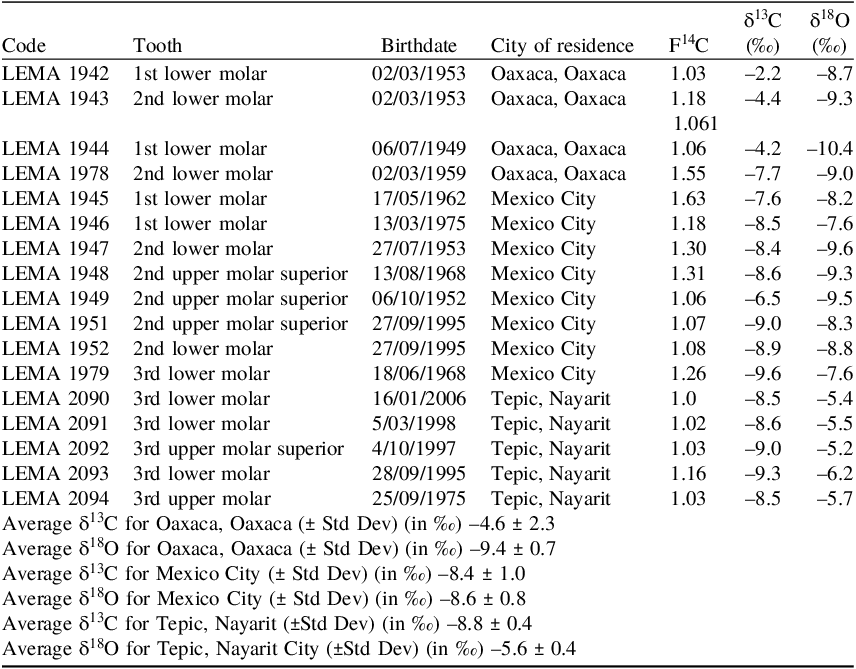
The δ13C and δ18O values of dental crowns are shown in Table 1. In the δ13C analysis of teeth, higher values were observed in the teeth of individuals from Oaxaca with average values of –4.6 ± 2‰, followed by those from Mexico City with an average of –8.4 ± 1‰, and finally Tepic with an average of –8.8 ± 0.4‰. The δ13C of a typical “Mexican supermarket” diet was –21.20 ± 0.3‰. The base material for this diet was made from the menu of the most used foods in Mexico sold in the country’s supermarkets. It contains 100 grams of solid diet and 46.8 mL of liquid diet other than water. The resulting mixture was homogenized and freeze-dried. Considering that the isotopic fractionation due to the intake of this diet is 14‰, the value of δ13C in dental enamel should be around –7‰, an approximate value to those obtained for the teeth of individuals from Mexico City and Tepic (Kohn and Cerling Reference Kohn and Cerling2002). Meanwhile, the elevated δ13C values in individuals from Oaxaca suggest a diet primarily based on C4 plants such as maize. The results of the Tepic teeth indicate a predominantly terrestrial diet and not a marine one, because if so, the δ13C values should be higher (like a diet based on C4 plants) (Bartelink and Chesson Reference Bartelink and Chesson2019; Kohn and Cerling Reference Kohn and Cerling2002). The values of Mexico and Tepic cities, both urban areas, are closer to the values of globalized diets than a city like Oaxaca, with a more Mexican traditional diet based mainly on corn.
Crown enamel samples analyzed for F14C, δ13C and δ18O with type of tooth, date of birth, and city of residence of the individuals

Oaxaca stood out as distinctly different from other sampling locations, with no overlapping values observed. A pairwise T-test was conducted to assess the differences between δ13C values in Mexico City and Tepic. The test matched data pairs by the closest dates of birth and used a 0.05 confidence level with 4 degrees of freedom. The calculated test statistic (5.013) exceeded the critical t-value, leading to the rejection of the null hypothesis and indicating that the two groups are statistically different.
The δ18O values obtained for enamel from whole molars are detailed in Table 1, while a comparative representation with tap water values from Mexico is visually conveyed in Figure 2. In this study, data on the isotopic content of drinking water were used, whose δ18O values are uniform, as this water is regularly distributed and consumed in the studied region. Isotopic variations due to factors such as evaporation in water treatment plants, boiling water, and the consumption of bottled water should have a minimal impact on the study results. For example, in the case of drinking water in Mexico City, it comes primarily from wells (about 70%) and is filtered and disinfected by chlorination.
Map showing the δ18O interpolated isoscape of Mexican tap water with the sampling locations (adapted from Ammer et al. Reference Ammer, Bartelink, Vollner, Anderson and Cunha2020). The black dots show the geographical origin of individuals living in the cities of Tepic, Mexico, and Oaxaca. (Color figure can be viewed at wileyonlinelibrary.com; see Ammer et al. Reference Ammer, Bartelink, Vollner, Anderson and Cunha2020.)

The isotopic composition of the teeth showed different ranges of variation. The teeth from Oaxaca varied from –10.4 to –8.7‰ exhibiting an average δ18O value of –9.4 ± 0.7‰, teeth from Mexico City varied from –7.6 to –9.6‰ with an average value of –8.6 ± 0.8‰, and those from Tepic varied from –5.2 to –6.2‰ with an average value of –5.6 ± 0.4‰. The average values obtained for Oaxaca and Nayarit are within the intervals of the color scale in Figure 2. The only value that does not correspond to the color scale shown in the isoscape, because it is more negative, is that of Mexico City. However, these findings suggest a discernible regional variation in the oxygen isotopic composition of dental tissues, likely reflecting variations in the local isotopic signatures of drinking water.
A biplot of δ18O vs. δ13C is shown in Figure 3 to highlight the differences between locations.
Bivariate plot of δ13C versus δ18O values for samples from three regions: Oaxaca, Oaxaca (red circles), Mexico City (green squares), and Tepic, Nayarit (blue diamonds).

In Figure 3 there is a clustering between the carbon and oxygen isotopic abundances of each zone. There is a separation between the δ18O values of Tepic and the other two zones. Meanwhile, the values of δ18O vs. δ13C allow distinguishing the Oaxaca group from the other two groups. In a well-controlled study, approximately 95% of the data are expected to match the expected result. However, outliers in forensic analyses are inevitable due to individual variations in diet, migration or other external factors. Further analysis and interpretation of these isotopic data could yield insights into factors influencing the observed variations across the studied groups.
Conclusions
The fast method of preparation of dental enamel from individuals of known age was successful because it allowed reconstruction of the age of the teeth.
With the values of δ13C of the complete crown from individuals residing in three cities in Mexico, it was possible to estimate the range of variation of these isotopes in the three regions. The corresponding statistical results indicate that the differences between the three groups were significant. As well as for δ13C, regarding δ18O values obtained for whole molars from the three cities, our findings suggest a discernible regional variation in the oxygen isotopic composition of dental tissues, representing an option to delimit the universe in identification processes.
While the current work is exploratory in nature and the sample sizes analyzed from each group are limited, the findings presented in this study are promising in the sense that carbon and oxygen stable isotopes in teeth reflect the provenance of the individuals. We are encouraged by the data and intend to expand our research to include a more substantial sample size.
Acknowledgments
The authors thank to Gaby Tiznado Orozco from UAO-UAN and Alberto García for providing teeth; Arcadio Huerta and Sergio Martínez for technical assistance. This work was partially supported by grants DGAPA-UNAM IN112023 and CONAHCYT 2023-LNC-58.



 Open access

