


Introduction
Do we backlash against representative democracy when the ‘vox populi’ is not adequately represented by institutions of political representation? Or do we backlash when we do not get personally represented? Representative institutions in a political system should be challenged when they fail systemically (Dalton & Welzel, Reference Dalton and Welzel2014; Norris, Reference Norris2011), while individuals should hold specific representatives to account for individual/local representation failures instead (Pitkin, Reference Pitkin1967). This question has important implications for how individuals assess representation quality and democratic functioning. Individuals might evaluate institutions of representative democracy (i.e., by rejecting representative democracy and supporting alternative democratic models – such as direct democracy), either sociotropically – reacting to representatives' systemic failure to represent voters – or selfishly – reacting to representatives' failure to represent them personally.
The existing literature on democratic preferences recognise ideological incongruence – that is, the distance between the policy positions of representatives and the represented, typically measured using the left–right spectrum Footnote 1 – as an important factor in explaining opposition to representative democracy (Ezrow, Reference Ezrow2010; Mayne & Hakhverdian, Reference Mayne and Hakhverdian2017). Two overarching types of ideological incongruence have been identified: (1) sociotropic incongruence (the distance between a representative institution as a whole and all voters); and (2) egocentric incongruence (the distance between political representatives and the individual voter)(Bakker et al., Reference Bakker, Jolly and Polk2020; Golder & Stramski, Reference Golder and Stramski2010; Mayne & Hakhverdian, Reference Mayne and Hakhverdian2017; Stecker & Tausendpfund, Reference Stecker and Tausendpfund2016; Sorace, Reference Sorace2023)Footnote 2. The literature, however, largely focuses on egocentric incongruence, and finds support for the egocentric hypothesis: egocentric attribution biases matter greatly in predicting support for referendums (Harms & Landwehr, Reference Harms and Landwehr2020; Landwehr & Harms, Reference Landwehr and Harms2020) and democratic norms more generally (Brandenburg & Johns, Reference Brandenburg and Johns2014; Bakker et al., Reference Bakker, Jolly and Polk2020; Graham & Svolik, Reference Graham and Svolik2020; Stecker & Tausendpfund, Reference Stecker and Tausendpfund2016). Individuals, therefore, hold democratic systems accountable for individual‐level representation failures. This has fundamental implications for how we characterise voters' capacity to hold democratic systems to account.
This study chiefly argues that voters' reactions against sociotropic incongruence have not been given a fair empirical test in the existing scholarship. Existing studies that look at the sociotropic hypothesis of democratic attitudes employ measures at the country‐election level (Mayne & Hakhverdian, Reference Mayne and Hakhverdian2017; Sorace, Reference Sorace2023), which may lack power when compared to individual‐level egocentric incongruence measures. Others have used self‐reported assessments of the current quality of representation instead (Bélanger & Nadeau, Reference Bélanger and Nadeau2005; Hooghe & Dassonneville, Reference Hooghe and Dassonneville2018), which are highly endogenous to democratic preferences. Relatedly, causation is not tackled by existing designs, which mostly rely on observational self‐reports of both representation failures and democratic preferences (Font et al., Reference Font, Wojcieszak and Navarro2015; Hooghe et al., Reference Hooghe, Marien and Oser2017). Furthermore, the literature either uses general (dis)satisfaction with democracy or items capturing attitudes towards a single model of democracy as their outcome variables.
In this study, we leverage an experimental design and abandon self‐reports of representation quality. We provide a new test of egocentric and sociotropic incongruence by experimentally varying levels of sociotropic (in)congruence between French MPs and French voters at the individual level. We also improve the measurement of the outcome variable by fielding specific survey items aimed at extracting respondents' preferences for representative as opposed to participatory decision‐making processes. This yields a more precise measure of democratic preferences, surpassing the general proxy of (dis)satisfaction with democracy.
The survey experiment was administered in September 2020 to a representative sample of 6073 French respondents. France was selected as a hard case study due to its limited history of direct democratic initiatives, making it more difficult to detect shifts in individual support for direct democracy, and implying that such shifts might be more likely in countries with greater familiarity with direct democracy. Our post‐treatment output variables measure democratic preferences by capturing: (a) preferences for more frequent involvement of ‘the people’ in policy making (support for direct democracy); (b) preferences for more frequent involvement by Members of Parliament (MPs; support for representative democracy). We also calculate a net popular involvement support (i.e., direct democracy support net of support for representative democracy).
Our experiment also tests the role of justifications in responses to representatives' breaches. Does explaining a representation failure on the basis of acquired knowledge or access to experts' evaluations help in attenuating backlash towards representative institutions? Whether incongruence actually becomes more acceptable to public opinion when justified by deferring to expertise (Pitkin, Reference Pitkin1967) is still an open research question (Wolkenstein & Wratil, Reference Wolkenstein and Wratil2021).
To our knowledge, this study represents the first experimental test and fair comparison of both egocentric and sociotropic incongruence effects on different dimensions of democratic preferences. Thanks to the experimental design, null findings on the sociotropic incongruence thesis cannot be explained by endogeneity, multi‐collinearity, ecological fallacy, or low statistical power. We indeed find that, while sociotropic incongruence can, in some instances, drive up support for direct democracy, it is egocentric incongruence that is most robustly related to democratic preferences. Sociotropic democratic attitudes may at most apply to the political sophisticates, that is, those that pay more attention/have superior awareness of the political system. We also find that expertise‐based justifications of representation failures do not have the intended effect: individuals seem to further oppose representative democracy when exposed to such narratives.
The study has significant implications for representative action and should influence policymakers' approach to democratic reform. If systemic representation failure significantly drives opposition to representative democracy (and support for direct democracy), it suggests that democratic preferences are based on a reasonable, pragmatic assessment of system‐level performance. However, in line with existing findings Landwehr and Harms (Reference Landwehr and Harms2020), Mayne and Hakhverdian (Reference Mayne and Hakhverdian2017), Bakker et al. (Reference Bakker, Jolly and Polk2020), it is individual‐level representation that primarily fuels backlash against representative democracy and support for direct democracy. Attitudes towards the democratic system are rarely sociotropic. Instead, they result from individual‐level political marginalisation. This underscores the necessity for representative democracies to prioritise the dissemination of democratic norms, and to address political alienation as a crucial step in mitigating backlash. Furthermore, this study adds to the emerging scholarship on technocracy and its consequences. As technocrats play an increasingly influential role in decision making (Bertsou & Caramani, Reference Bertsou and Caramani2020b; McDonnell & Valbruzzi, Reference McDonnell and Valbruzzi2014), we find that relying on technocratic advice to justify representation failures further erodes the legitimacy of representative democracy and fosters support for alternative democratic models, particularly among under‐represented individuals.
Political representation and democratic preferences
Representative democracy is based on a mandate, a delegation relationship between represented and the representatives premised on outputs being aligned with the preferences of the represented (Besley, Reference Besley2006; Pitkin, Reference Pitkin1967). Ideological congruence is viewed as a fundamental precondition for this mandate to be fulfilled (May, Reference May1978; Pitkin, Reference Pitkin1967; Pettit, Reference Shapiro, Stokes, Wood and Kirshner2010). Democratic theorists would expect that breaches of representation should result in holding individual representatives to account for individual/local‐level representation breaches (Pitkin, Reference Pitkin1967). However, the scholarship on system support and democratic attitudes contends that system evaluations (such as preferences towards democracy) can also be impacted by breakdowns in the representation relationship, such as ideological incongruence (Dalton & Welzel, Reference Dalton and Welzel2014; Mayne & Hakhverdian, Reference Mayne and Hakhverdian2017, Norris (Reference Norris2011), Rohrschneider (Reference Rohrschneider2002)). This scholarship expects that higher levels of ideological incongruence between voters and representatives should lead to increased dissatisfaction with current democratic institutions, and increased support for popular involvement in decision making, in an attempt by voters to regain control over political choices.
It is particularly unclear whether individuals hold a democratic system accountable for systemic or for personal representation breaches. Current findings paint democratic preferences as instrumental and self‐serving (Brandenburg & Johns, Reference Brandenburg and Johns2014; Bakker et al., Reference Bakker, Jolly and Polk2020; Graham & Svolik, Reference Graham and Svolik2020; Harms & Landwehr, Reference Harms and Landwehr2020; Landwehr & Harms, Reference Landwehr and Harms2020; Stecker & Tausendpfund, Reference Stecker and Tausendpfund2016), and this would make sense since individual‐level representation is both easier to perceive and more salient for individuals. However, normatively, representative institutions should be challenged when they fail systemically (Dalton & Welzel, Reference Dalton and Welzel2014; Mayne & Hakhverdian, Reference Mayne and Hakhverdian2017; Norris, Reference Norris2011). Are people primarily concerned with the representation of their personal preferences – that is, egocentric incongruence – or do they primarily react to systemic representative failure – that is, sociotropic incongruence (Golder & Stramski, Reference Golder and Stramski2010; Mayne & Hakhverdian, Reference Mayne and Hakhverdian2017)? Egocentric incongruence highlights the importance of personal alignment with representatives, implying that participatory democracy will be preferred if representatives do not serve the individual's interests. In contrast, an individual may view high levels of sociotropic incongruence as indicative of the inability or unwillingness of elected legislators to fulfil their mandate of representing the electorate as a whole, which will push them to favour alternative decision‐making modes. This paints support for popular democracy as a public‐spirited concern for the systemic functioning of representative democracy instead.
The sociotropic incongruence hypothesis: Individuals who are primed with system‐level representation failures (sociotropic incongruence) are more likely to oppose decision making by MPs and to support decision making by the people, as opposed to those who are primed with MPs' congruence.
The egocentric incongruence hypothesis: Individuals who are primed with MPs that are incongruent with them (egocentric incongruence) are more likely to oppose decision making by MPs and to support decision making by the people, as opposed to those who are ideologically congruent with MPs.
In addition, we examine an important factor that can moderate the role of representation failures on democratic process attitudes: that is, superior expertise/information. European governments' increased reliance on technocrats (e.g., from multiple appointments of technocratic ministers to the frequent consultation of experts in politics (Bertsou & Caramani, Reference Bertsou and Caramani2020b, Reference Bertsou and Caramani2022)) raises questions about the way expert‐based policies that may clash with the voters' preferences affect individuals' positions towards democratic models.
We present two competing interpretations and hypotheses regarding the role of expert justification on democratic preferences. On the one hand, individuals may find the leveraging of scientific knowledge, sector expertise and unattached interests that would guarantee independent, efficient and effective governance, legitimate (Bertsou & Caramani, Reference Bertsou and Caramani2020b). Technocratic attitudes – that is, preferences for delegating powers to unelected independent bodies over elected representatives – are currently strong in many European democracies (Bertsou & Pastorella, Reference Bertsou and Pastorella2017). Individuals would therefore not necessarily backlash against representative democracy when exposed to expert‐based justifications of representation failure.
The justificatory representation hypothesis: The backlash against MPs and the support for popular decision making will be attenuated if the incongruence between elites and voters is justified based on the intervention of experts.
On the other hand, the technocracy scholarship also highlights how people may punish political representatives for putting the opinions of the few over those of the many. Individuals may reject the involvement of independent experts in decision‐making processes on grounds of accountability and transparency (Bertsou & Caramani, Reference Bertsou and Caramani2020b; Strebel et al., Reference Strebel, Kübler and Marcinkowski2019). Therefore, even if MPs' expert‐based policies could yield more effective solutions, they may also appear as weakening accountability. If we follow this logic, we would assume that individuals would prefer direct democracy over representative democracy if they learn that MPs' failures of representation result from siding with the experts.
The technocracy backlash hypothesis: The backlash against MPs and the support for popular decision making will be accentuated if the incongruence between elites and voters is justified based on the intervention of experts.
Survey experiment design
To test our hypotheses, we designed an original survey experiment, run via YouGov in France between 4 and 17 September 2020. YouGov dealt with consent, anonymisation and recruitment/potential compensation of survey respondents. The experiment was pre‐registeredFootnote 3 and obtained ethical approval from our institutionFootnote 4. The total sample size for the entire survey experiment is of 6073 respondents, which translates into 750 respondents per cellFootnote 5.
We chose France as a hard test since the country has rare instances of direct democratic initiatives. While other European countries have seen the rise of referendums since the 2000s (Hobolt, Reference Hobolt2007), France remains an exception. Only nine referendums have been held since the start of the fifth constitution in 1958. French public opinion is not expected to be biased or primed by familiarity with direct democracy. Any shift in support for direct democracy will thus be particularly hard to detect in this case, and more likely to be stronger in other contexts – where direct democracy is more salient.
The survey started with two pre‐treatment questions, asking, respectively, what the respondents think is the most important problem facing France at the moment, and their attitude on either economic redistribution, immigration or EU membership (depending on whether the respondent was assigned to the economic, immigration or EU integration survey) Footnote 6. We first randomly assigned respondents to three distinct policy domains: economic (redistribution preferences); cultural (immigration policy preferences); and foreign policy (preferences towards EU integration). We used well‐known (key) policy dimensions that go beyond the general left–right differences to capture multidimensional incongruence (Bakker et al., Reference Bakker, Jolly and Polk2020). Our analyses pool all policy areas together. However, the main findings hold when splitting the sample separately for each policy area (see Tables A7 and A8 in the Appendix of the Supporting Information). We also include models that test each experimental condition's effect on the level of issue salience among respondents, but results remain robust to individual variation in the policy's salience (see last column of Tables A7 and A8 in the Appendix of the Supporting Information).
Sociotropic (in)congruence and expertise justification treatments
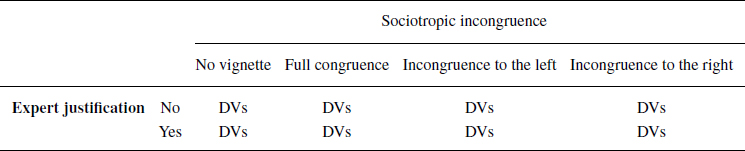
Respondents were randomly assigned to one of eight experimental groups:
-
(1) Control: No vignettes shown: respondents directly answer the post‐treatment question on attitudes towards representative and direct democracy.
-
(2) Full congruence: A hypothetical scenario where French MPs match French voters in their policy preferences – that is, the optimal scenario, and the standard against which representative democracy should be judged (May, Reference May1978; Norris, Reference Norris2011; Pitkin, Reference Pitkin1967).
-
(3) Full congruence + expertise justification: A hypothetical scenario where French MPs' and voters' policy positions match, and the respondent gets primed to consider MPs occasionally deviating from the popular will to heed expert/scientific advice.
-
(4) Sociotropic incongruence(left): A hypothetical scenario where French MPs' policy positions are to the left of French voters.
-
(5) Sociotropic incongruence(left) + expertise justification: A hypothetical scenario where French MPs' policy positions are to the left of French voters and the respondent gets primed to consider MPs occasionally deviating from the popular will to heed expert/scientific advice.
-
(6) Sociotropic incongruence(right): A hypothetical scenario where French MPs' policy positions are to the right of French voters.
(7) Sociotropic incongruence(right) + expertise justification: A hypothetical scenario where French MPs' policy positions are to the right of French voters and the respondent gets primed to consider MPs occasionally deviating from the popular will to heed expert/scientific advice.
-
(8) Expertise justification: The treatment group where respondents are only primed to consider MPs occasionally deviating from the popular will to heed expert/scientific advice.
Table 1 describes all experimental groups. The full questionnaire with all experimental vignettes is available in Section 1.1 in the Appendix of the Supporting Information. To avoid deception, we had to make explicit the hypothetical/probabilistic nature of our experimental vignettes.
Experimental design

Egocentric (in)congruence treatment
Egocentric incongruence is captured by leveraging the pre‐treatment variable that asks respondents their ideological self‐placement on the policy issue in question (designed using the same 3‐point scale used for the MPs' vignette). The self‐placements are then mapped to the randomly assigned hypothetical positions of MPs of the sociotropic (in)congruence vignette. If the respondents' ideological position and the hypothetical placement of the majority of MPs match, respondents were assigned a score of ‘0’, indicating egocentric congruence with the hypothetical MPs. If they did not, respondents were coded as egocentrically incongruent with the MPs. Because centrist respondents could only see incongruent MPs by one level (either to the right or to the left of them), while right‐wingers and left‐wing respondents could see MPs removed by two levels (e.g., a left‐wing set of MPs for right‐wingers and a right‐wing set of MPs for left‐wingers), the egocentric incongruence categories were split by centrists versus non‐centrists. This choice was also motivated by the fact that centrists appear more immune to egocentric biases in democratic norms (Graham & Svolik, Reference Graham and Svolik2020). If respondents were not assigned to the ideological (in)congruence vignette, they were coded as being part of the control group. Respondents were also put in separate groups according to whether they were assigned to the expert justification vignette or not. Therefore, the egocentric incongruence measure has comparable experimental groups as the sociotropic incongruence measure. Our research design enables us to test egocentric and sociotropic incongruence separately, as the two measures are not a conflation of one another: we have sufficient variation to observe different types of egocentric congruence and incongruence crossed with various forms of sociotropic (in)congruence (see Section 1.4 in the Appendix of the Supporting Information for proof of the orthogonality of egocentric and sociotropic incongruence and further explanation of our treatment expectations).
To measure attention specific to the treatment, a factual manipulation check (Kane & Barabas, Reference Kane and Barabas2019) was added after the vignette depicting MPs' and voters' hypothetical positions. We find that 25 per cent failed the factual manipulation checks. We first present the full sample results, but in a subsequent analysis (see below) we also show the treatment effects when only retaining respondents that properly understood the vignette (adding demographic controls).
The outcome variables
Post‐treatment, respondents were asked to answer survey items on support for representative and direct democracy, modelled after the European Election Study (EES) survey items on decision making Footnote 7. The survey question asks: ‘How often, if at all, do you think each of the below categories should be involved in making the most important policy decisions for the country?’. Respondents use a 5‐point Likert scale, ranging from ‘never’ to ‘always’. We focus on respondents' preferences for either increased involvement of ‘the people’ in policy making or increased involvement by MPs. Additionally, we calculate the difference between support for popular involvement and support for MP involvement, creating a ‘Net Popular Involvement Support’ variable that quantifies the preference for direct democracy over representative democracy (refer to Section 1.2 in the Appendix of the Supporting Information).
We leverage OLS regression with bootstrapped standard errors when modelling the Net Support outcome variable. Additionally, we test support for popular involvement and support for MP involvement separately. Given their non‐negative and left‐skewed nature, we use ordered logit models with bootstrapped standard errors for the last two outcome variables. In all models, we take the best‐case scenario (full congruence) – the theoretical ideal – as the baseline for comparison with other experimental groups and the control group (respondents with no prime). This approach enhances result interpretation and aligns empirical analysis with theoretical hypotheses. The models using the control group as the baseline category are reported in the Appendix of the Supporting Information (Table A3).
Results
We first focus on the effects of sociotropic incongruence on democratic preferences. The models in Table 2 present the results from the baseline models. The balance tests (see Section 1.3.2 in the Appendix of the Supporting Information) show that the sociotropic incongruence and expert justification experimental groups are equivalent in terms of core demographics (both central tendency and distributions are checked), so the models in Table 2 do not contain standard demographic controls. Adding controls (see Table A4 in the Appendix of the Supporting Information) did not change the inferences below.
Main models

Note: OLS and Ordered Logit Regressions. Baseline: Ideological congruence group (normative baseline). All models report bootstrapped standard errors, sampled from 1000 replications.
Exponentiated coefficients; Standard errors in parentheses. + $p<0.1$; * $p<0.05$; ** $p<0.01$; *** $p<0.001$.
Table 2 shows no statistically significant effect of sociotropic incongruence and of the expert justification vignette on preferences for different democratic models, and for the trade‐off between representative and direct democracy. The exception is the expert justification treatment, which appears to induce backlash against MPs' involvement in decision making when compared to a scenario of full congruence, but the effect is only marginally significant ( $p<0.1$). This, however, represents suggestive evidence that expert justifications might not be helpful tools when engaging in justificatory representation: France is a context where technocracy is relatively prevalent (Bourdieu, Reference Bourdieu1998; Bertsou & Caramani, Reference Bertsou and Caramani2022), and yet, even here, we see evidence that justifying deviations in representation in the name of expertise generates some backlash against representative democracy.
The results are robust when we split the model by policy area or when we look at interactions with individual‐level salience of the policy area (see Tables A7 and A8 in the Appendix of the Supporting Information). Expert justifications are somewhat ‘forgiven’ in the economic dimension, and backlashes against MPs appear mostly driven by the European integration dimension. The non‐significance of sociotropic incongruence is also robust to splitting the incongruence treatments by left and right and when looking at the left–right self‐positioning of respondents on the various issues (see Table A9 and Figure 5 in the Appendix of the Supporting Information). Interestingly, though, right‐wingers appear to statistically significantly backlash against representative democracy when the sociotropic incongruence is to the left and is combined with expert‐based justifications. By contrast, left‐wingers are statistically significantly less supportive of popular democracy when MPs are sociotropically congruent and when expert‐based justifications are leveraged. We find that technocracy arguments may, therefore, resonate more with left‐wingers than with right‐wingers.
Given the well‐powered experiment, we can safely conclude that system‐level representation failures do not appear to move democratic attitudes in public opinion. Expert justification only somewhat decreases support for representative democracy, and does neither moderate nor accentuate the effect of system‐level representation failures. That expertise‐based justification induces some backlash against representative democracy overall, and accentuates the impact of sociotropic incongruence in right‐wing respondents is, however, an important signal that such forms of justificatory representation might be broadly counter‐productive.
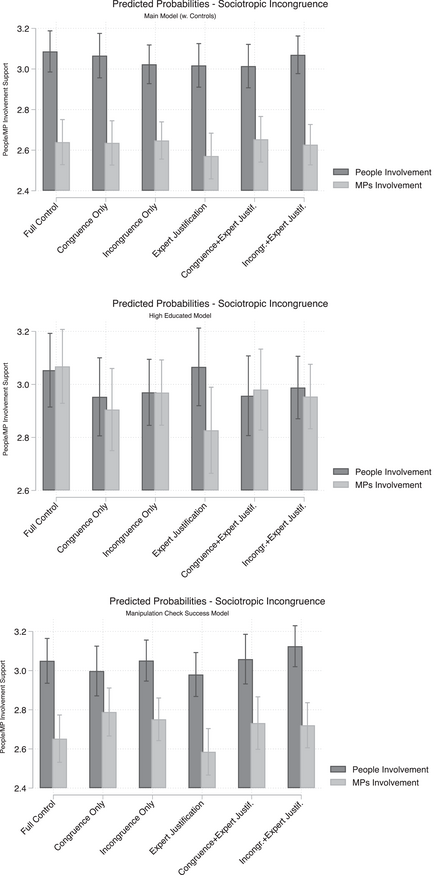
The experimental results do not support the notion that backlashes against representative democracy and support for direct democracy are due to sociotropic incongruence. Democratic attitudes are not shaped by reasonable accountability concerns that should arise from systemic representation failures (Pitkin, Reference Pitkin1967; May, Reference May1978; Golder & Stramski, Reference Golder and Stramski2010; Held, Reference Held1992; Norris, Reference Norris2011). Results from the sociotropic incongruence models are also summarised via the marginal effects plots in Figure 1.
Marginal effects plots: All respondents, University‐educated only, Manipulation check successes only. Predicted counts from the ordered logit regression models of sociotropic incongruence treatments.
Note: Control variables held constant at modal categories (Age: 50; Gender: female; Education: secondary or lower; Employed; Small‐Medium City Dwellers). Confidence intervals refer to the specific marginal effects point estimates only. Outcome variables were measured as a 5‐point Likert scale, ranging from 0 (never) to 4 (always).

We also restrict the analysis to the ‘high sophisticates’ – proxied by: (a) University education, and (b) success in the experimental manipulation check (which better approaches the political sophistication/system awareness construct). Figure 1 (see Tables A4–A6 in the Appendix of the Supporting Information for the full regression tables) provides further evidence that the more sophisticated respondents do react to sociotropic (in)congruence and to expert‐based justification by backlashing against MPs (especially when looking at those respondents that correctly understood and paid attention to the vignette). Non‐instrumental support for direct democracy – that is, support warranted by systemic failures of political representation – thus, at most exists among the sophisticated/highly informed.
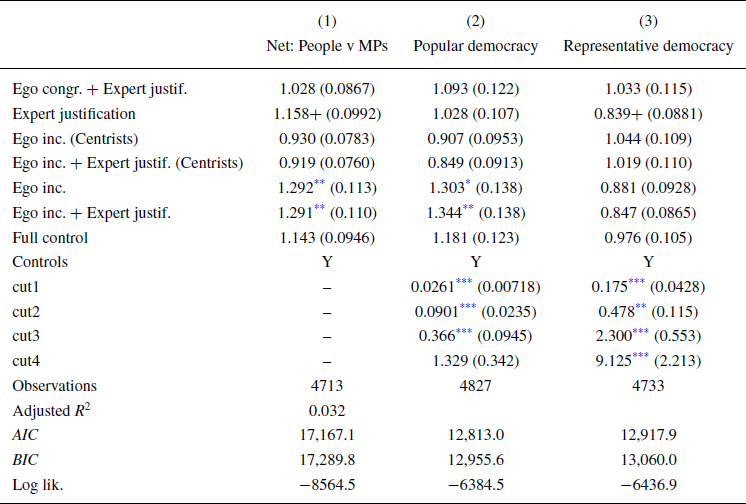
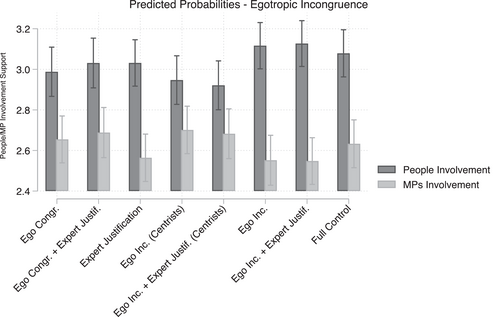
Table 3 presents the results of egocentric incongruence models. They contain standard demographic controls (education, age, gender, employment type and urban–rural), because the egocentric incongruence variable is built from the combination of an experimental vignette and a pre‐treatment survey item, which was not randomly assignedFootnote 8. Results from the egocentric incongruence models are further summarised via the marginal effects plots in Figure 2.
Egocentric incongruence models: OLS and Poisson regressions

Note: Baseline: Ideological congruence group (normative baseline). All models report bootstrapped standard errors, sampled from 1000 replications.
Exponentiated coefficients; Standard errors in parentheses. + $p<0.1$; * $p<0.05$; ** $p<0.01$; *** $p<0.001$.
Marginal effects plots. Predicted counts from Poisson regression models of egocentric incongruence.
Note: Control variables held constant at modal categories (Age: 50; Gender: female; Education: secondary or lower; Employed; Small‐Medium City Dwellers). Confidence intervals refer to the specific marginal effects point estimates only. Outcome variables were measured as a 5‐point Likert scale, ranging from 0 (never) to 4 (always).

Unlike for sociotropic incongruence, we see some attitudinal changes when looking at individual‐level representation failures (egocentric incongruence), particularly for left‐wingers and right‐wingers. We split incongruence by centrists versus non‐centrists since centrist respondents could only reach a maximum distance of 1 from the MPs' vignettes, and centrists appear more immune to partisan and instrumental backlashes against representative democracy (Graham & Svolik, Reference Graham and Svolik2020). Egocentric incongruence increases left‐wingers' and right‐wingers' preferences for popular involvement over MP involvement, by roughly 30 per cent if compared to the optimal, full congruence group. The preference for popular involvement over MP involvement is even stronger when egocentric incongruence is coupled with exposure to the expert justification vignette. In this group, respondents exhibit a 34 per cent increase in their support for popular democracy. This finding underscores that expertise‐based justifications amplify the impact of egocentric representation failures, providing further evidence that such justifications foster backlashes against representative democracy.
Conclusion
Is the backlash against representative democracy driven by the ideological mismatch between representatives and the electorate as a whole (i.e., sociotropic incongruence) or between representatives and the individual (i.e., egocentric incongruence) (Bakker et al., Reference Bakker, Jolly and Polk2020; Mayne & Hakhverdian, Reference Mayne and Hakhverdian2017; Stecker & Tausendpfund, Reference Stecker and Tausendpfund2016)? Using an original survey experiment in France, this study manipulates various representation scenarios to carefully leverage the sociotropic and egocentric incongruence constructs. Contrary to some theories (Eulau et al., Reference Eulau, Wahlke, Buchanan and Ferguson1959; May, Reference May1978; Rehfeld, Reference Rehfeld2005), our findings indicate that the effect of sociotropic incongruence on preferences for increased popular involvement in policy making is conditional and at most applies to the highly sophisticated/politically aware. Instead, support for popular democracy – and backlash against representative democracy – is consistently impacted by individual‐level misrepresentation. This aligns with recent US findings on democratic norms (Graham & Svolik, Reference Graham and Svolik2020), and the instrumental nature of support for referendums (Harms & Landwehr, Reference Harms and Landwehr2020; Landwehr & Harms, Reference Landwehr and Harms2020). Democratic preferences are not robustly influenced by systemic misrepresentation of the ‘vox populi’ (May, Reference May1978; Norris, Reference Norris2011; Pitkin, Reference Pitkin1967), but are consistently shaped by instrumental considerations, notably personal political alienation.
We thus advance the fields of democratic preferences and political representation by adjudicating between the sociotropic and egocentric models of democratic attitudes. Through our experimental design, we provide a fair empirical test of the sociotropic incongruence hypothesis, mitigating concerns of endogeneity, multicollinearity, ecological fallacy and low statistical power.
We also find that providing information/expert‐based justifications to representative failures does not mitigate the effect of bad representation performance on democratic preferences, as expected by democratic theory (Pitkin, Reference Pitkin1967). This finding has important implications for the role of technocracy in shaping democratic attitudes. It is important to note that our findings pertain to the prevalent technocratic context in France. Thus, further research should investigate these justifications in countries with differing levels of technocratic influence. Relying on experts to justify representation failures can lead to further erosion of representative democracy's legitimacy, favouring alternative models of democracy. Public opinion doesn't respond positively to such justifications, so future studies should test alternative models of representation justification beyond the expertise‐based approach (Wolkenstein & Wratil, Reference Wolkenstein and Wratil2021).
The study has significant theoretical and practical implications. It challenges the notion of attainable vox populi representation, and elucidates why politically marginalised individuals – those most prone to having their preferences unrepresented by officials – are the strongest advocates for direct democracy. This constitutes a risk to the resilience of current representative democratic institutions as it demonstrates the whimsical and self‐serving nature of democratic support. Support for representative democracies can persist despite systemic failures, even gaining majority support based on individual incongruence levels. Conversely, seemingly well‐functioning representative democracies can experience significant backlash. Therefore, advanced democracies must address the concerns of ‘political losers’ to prevent potential destabilisation: enduring marginalisation could create a void favouring more tyrannical democratic models if not authoritarianism (Graham & Svolik, Reference Graham and Svolik2020). Prioritising ideological depolarisation and cultivating consent and democratic norms among the politically marginalised becomes crucial.
Acknowledgements
The authors would like to thank Simon Hix, Chris Anderson, Lucas Leeman and Matthew Loveless for very helpful comments on earlier drafts of this paper. They would also like to thank Sara Hobolt, Aleksandra Cichocka, Robbie Sutton, Stuart Turnbull‐Dugarte, Catherine de Vries, Seth Jolly, Ruth Dassonneville, André Blais, Ed Morgan‐Jones and Ben Seyd for very helpful comments on earlier versions of this work, as well as all participants at the 2020 Early Career Researcher workshop, the University of Kent's Political Psychology Lab and Comparative Politics Group seminars, the 2021 Electoral Democracy seminar of the University of Montréal, the 2021 European Politics Online Workshop, the 2021 IPZ seminar at the University of Zurich, the 2021 Midwest Political Science Association Annual Meeting and the 2021 European Political Science Association Annual Meeting. Any errors or omissions are the responsibility of the authors. The data collection in this study would not have been possible without seed fund support from the European Institute at the LSE.
Online Appendix
Additional supporting information may be found in the Online Appendix section at the end of the article:
Table A1: Dependent variables' descriptive statistics
Figure 1: Histograms of the dependent variables: control group only.
Figure 2: Power analysis.
Figure 3: Balance tests.
Figure 4: Balance tests.
Table A2: Scenarios of sociotropic (in)congruence at different levels of egocentric (inc)congruence
Table A3: Main models
Table A4: Main model (sociotropic incongruence) with controls
Table A5: Main models: critical citizens (manipulation fails excluded)
Table A6: Main models: critical citizens (university‐educated respondents)
Table A7: Popular democracy models by policy area
Table A8: Representative democracy models by policy area
Table A9: Main models with incongruence treatments separated by left/right (with and without standard demographic controls)
Figure 5: Coefficient plots: regression models by left–right positioning.
Table A10: Egocentric incongruence models: OLS and poisson regressions
Data S1



 Open access

