

Introduction
Tail biting among pigs poses both animal welfare and economic concerns in pig production. This behaviour, in which one pig bites the tail of another, can lead to injuries ranging from mild abrasions to severe tissue damage, and even complete tail loss (Schrøder-Petersen & Simonsen Reference Schrøder-Petersen and Simonsen2001). Tail-bitten pigs can suffer from pain, infections, and decreased productivity. At the same time, farmers face elevated veterinary costs to treat injured pigs, increased labour demands to remove or manage pigs with severe tail damage, and financial losses caused by trimming of damaged tissue from carcases (Kritas & Morrison Reference Kritas and Morrison2007). In the UK, tail biting costs the pig industry an estimated £3.51 million annually (Niemi et al. Reference Niemi, Edwards, Papanastasiou, Piette and Stygar2021). In the US, while precise figures are limited, tail biting is recognised as causing significant economic losses, primarily due to decreased performance and carcase condemnation. Therefore, minimising tail-biting behaviour and its associated tail damage is crucial for both animal welfare and economic sustainability of pig farming.
Tail biting is a complex, multifactorial problem influenced both by internal and external factors, including genetics, health, and environmental stressors such as poor ventilation, overcrowding, and insufficient access to feed and water (König & Halli Reference König, Halli and Gross2024). A lack of environmental enrichment, specifically the absence of materials that allow pigs to engage in their natural rooting and exploratory behaviours, can increase tail-biting incidents (Buijs & Muns Reference Buijs and Muns2019). Tail docking is used to prevent tail biting, but it causes pain in pigs, thereby making it a significant animal welfare concern (Sutherland et al. Reference Sutherland, Bryer, Krebs and McGlone2008). Additionally, tail docking does not remove the motivation of pigs to perform tail biting (Taylor et al. Reference Taylor, Main, Mendl and Edwards2010). While tail docking is officially banned in regions such as the European Union, enforcement of the legislation is inconsistent (Council Directive 2008). In contrast, there are currently no regulations prohibiting tail docking in the US, where more than 95% of pigs are estimated to be docked after birth (USDA NASS 2022; USDA ERS 2023). Although providing enrichment, which is obligatory in the EU, such as manipulable substrates like straw or rope, can reduce the incidence of tail biting, these strategies are not always commercially viable (Schrøder-Petersen & Simonsen Reference Schrøder-Petersen and Simonsen2001; Buijs & Muns Reference Buijs and Muns2019). Practical limitations include incompatibility with slatted flooring systems, concerns over biosecurity, and that enrichment does not eliminate tail biting under all conditions (Schrøder-Petersen & Simonsen Reference Schrøder-Petersen and Simonsen2001). These limitations underscore the need to investigate alternative and complementary strategies for preventing tail biting that are both effective and feasible within commercial production systems.
One management strategy for mitigating tail biting is adjusting group size. Although few studies have evaluated the direct effects of group size on tail biting, existing literature offers mixed findings on how group size influences other welfare-related factors, such as physiological or social stress, which may indirectly affect tail-biting risk (Taylor et al. Reference Taylor, Main, Mendl and Edwards2010; Verdon & Rault Reference Verdon, J-L and Špinka2018). A study by Andersen et al. (Reference Andersen, Nævdal, Bakken and Bøe2004) reported that pigs in smaller groups experienced more intense competition during initial mixing, which elevated aggression and stress. Such social tension and physiological stress have been associated with increased risk of damaging behaviours, including tail biting (Taylor et al. Reference Taylor, Main, Mendl and Edwards2010; Verdon & Rault Reference Verdon, J-L and Špinka2018). However, once hierarchies are formed, small groups may benefit from reduced conflict and improved growth and health outcomes (Spoolder et al. Reference Spoolder, Edwards and Corning1999; Brandt et al. Reference Brandt, Hakansson, Jensen, Nielsen, Lahrmann, Hansen and Forkman2020; Camp Montoro et al. Reference Camp Montoro, Boyle, Solà-Oriol, Muns, Gasa and Garcia Manzanilla2021). Conversely, large groups may reduce repeated aggression toward specific individuals because pigs are less likely to interact with the same pen-mates repeatedly, thereby dispersing social stress across a broader social network. However, large groups may also increase competition for resources and limit individual recognition (Andersen et al. Reference Andersen, Nævdal, Bakken and Bøe2004; Turner & Edwards Reference Turner and Edwards2004). These complex effects on social dynamics suggest that group size could meaningfully influence the development and severity of tail-biting behaviour. Empirical findings on group size effects on tail biting remain inconclusive. Schmolke et al. (Reference Schmolke, Li and Gonyou2003) found that, among pigs with docked tails, tail damage and growth performance did not differ significantly across group sizes ranging from ten to 80 pigs per pen. Their findings suggest that, if adequate space and feed resources are provided, larger group sizes may not inherently increase the risk of tail biting. In contrast, Kallio et al. (Reference Kallio, Janczak, Valros, Edwards and Heinonen2018) surveyed 78 Finnish farms where tails were not docked and concluded that group sizes greater than nine pigs per pen increased the risk of tail-biting outbreaks compared to smaller groups. Larsen et al. (Reference Larsen, Andersen and Pedersen2018) reported no difference in tail biting between group sizes of eleven and 18 pigs per pen regardless of whether pigs’ tails were docked or left intact. These mixed findings highlight the need for continued investigation into the effects of group size on tail biting under varying production conditions.
Given the limitations of enrichment strategies and increasing pressure to improve animal welfare, there is a growing need to identify practical alternatives to tail docking for managing tail biting in pigs with intact tails. In addition to regulatory changes in regions such as the European Union, pork producers are also facing rising expectations from consumers regarding animal welfare standards. The European Food Safety Authority (EFSA) has recognised group size as a relevant factor in tail-biting risk and emphasised the importance of management-based solutions in systems that do not rely upon routine tail docking (EFSA AHAW Panel 2022). Therefore, the aim of this study was to evaluate whether group size influences the incidence and severity of tail damage and growth performance in growing-finishing pigs with intact tails, under controlled conditions without enrichment. We also examined whether the frequency of being tail-bitten for individual pigs was associated with injury severity. Based on the reasoning that smaller groups may allow for more stable social hierarchies and improved individual recognition, we hypothesised that small groups would be more effective at mitigating tail biting compared to larger groups. However, given the mixed evidence in the literature, we recognised that outcomes in either direction were plausible.
Materials and methods
Ethical status
This study was conducted at the University of Minnesota West Central Research and Outreach Center in Morris, Minnesota, USA between May and October 2022. The Institutional Animal Care and Use Committee of the University of Minnesota approved the experimental protocol (UMN IACUC #2109-39437A) to ensure adherence to ethical guidelines in animal research.
Study animals, housing, and management
Pigs (Topigs Norsvin Tempo × Topigs Norsvin 70) that were born and raised in the confinement swine facilities at the research centre were used for the study. Piglets were farrowed to sows in farrowing crates on plastic-coated woven wire flooring. Within 24 h of farrowing, piglets were processed, including teeth clipping, iron injection, and castrating male piglets without anaesthesia or analgesia. No tail docking was performed. Cross-fostering was conducted within 24 h of farrowing to achieve the targeted litter sizes of 12–14 piglets.
Piglets were weaned at three weeks of age and transferred to a nursery barn where they were housed for six weeks. In the nursery barn, pigs were allocated to pens with nine pigs per pen, providing a floor space allowance of 0.30 m² per pig. Litters were mixed at this stage to achieve the target group size, but pens were not intentionally balanced for sex or weight. Groups established in the nursery were not maintained when pigs were transferred to the growing-finisher barn. Each pen was equipped with a five-space feeder and one bowl drinker. All pigs were provided ad libitum access to a corn-soybean, meal-based diet formulated to meet National Research Council ([NRC] 2012) nutrient requirements and had continuous access to fresh water. While routine health checks were conducted daily, tail injuries were not systematically assessed until the end of the nursery period, at which point pigs with minimal or no tail damage were selected for inclusion in the study. Close observations on tail injuries began after pigs were moved to the growing-finishing barn.
The thermal environment in all barns (farrowing, nursery, and growing-finishing) was controlled using exhaust fans and gas heaters to maintain optimal conditions for pigs at different life stages. In the nursery barn, temperatures were maintained at 30 (± 1)°C when the pigs arrived and gradually decreased to 23 (± 1)°C over the subsequent six-week period. In the growing-finishing barn, mean (± SD) daily room temperature was 26 (± 1.6)°C, range: 22 to 30°C. When the room temperature exceeded 30.5°C, water sprinklers installed on the ceiling were triggered to help pigs dissipate heat through evaporation.
Room lighting was controlled with lights on from 0700 to 1500h daily. Routine health checks were conducted once daily and any pigs exhibiting compromised welfare or health were treated or moved to hospital pens according to the research centre’s Standard Operating Procedures.
Experimental treatments and design
Pigs without a tail injury were selected for the study and transferred to the growing-finishing barn. The study started when pigs entered the growing-finishing barn at nine weeks of age and ended when pigs reached market weight at 23 weeks of age. Pigs ([n = 432], mean [± SD] initial weight = 22 [± 3.8] kg) were allocated to one of two group size treatments (small or large), with consideration for balancing sex across pens and to ensure that average initial weight was equivalent across treatments. Pens therefore contained a heterogeneous mix of pig weights, but the mean initial weight did not differ between treatments. The small group consisted of nine pigs per pen (n = 24 pens) and the large group consisted of 18 pigs per pen (n = 12 pens). The allocation of pigs to their respective treatment groups involved mixing litters and sexes, which occurred at the time of entering the growing-finishing barn. Each large pen included nine females and nine males, and each small pen included either four females and five males or vice versa, ensuring equal sex representation across treatments.
To allow for individual tracking throughout the study, each pig was provided with a unique tag for the NUtrack Livestock Monitoring System created by the University of Nebraska-Lincoln upon entry to the growing-finishing barn (Obermier et al. Reference Obermier, Trenahile-Grannemann, Schmidt, Rathje and Mote2023). These tags featured one of 32 unique colour-coded alphanumeric combinations, enabling consistent individual identification for behavioural video-recording, weekly tail scoring, daily health observations, and performance data collection.
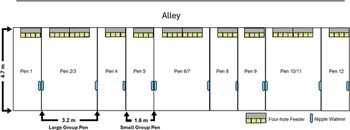
Pens in the large group were established by merging two small pens into one (see Figure 1). When pens were merged, the dividing gate was removed but the original feeders and drinkers from both pens remained in place. Thus, each small pen contained one four-hole feeder and one nipple drinker, and each large pen contained two four-hole feeders and two nipple drinkers. In the large pens, the two feeders were positioned with space between them, and the nipple drinkers were located on separate walls. All pens had concrete slatted flooring. Floor space (0.76 m² per pig), feeding space (2.25 pigs per feeder hole), and nipple drinker allowance (nine pigs per drinker) were identical between treatments. No enrichment was provided during the nursery or growing-finishing stage.
Schematic layout of one side of one room within the growing-finishing barn used in the study. Each room consisted of two identical sides separated by a central alley (only one side is shown here). Pens had concrete slatted flooring and were either small with four feeder holes (grey boxes) and one nipple drinker (blue ovals), housing nine pigs, or large (with eight feeder holes and two nipple drinkers, housing 18 pigs), the latter formed by combining two adjacent small pens. Pens of both sizes were distributed across the barn to minimise location effects. Environmental conditions, including lighting and ventilation, were consistent throughout the facility.

This study was arranged as a randomised complete block design and conducted in two blocks. The first block started in May 2022 in one room, and the second block commenced ten weeks later in a separate but structurally identical room within the same growing-finishing barn. Each room (block) was divided into two identical sides separated by a central alley, and both sides were arranged in the same layout (Figure 1). Each side contained six small pens (1.6 m wide) and three large pens (3.2 m wide), resulting in a total of 12 small pens and six large pens per block. Small and large pens were interspersed across each side to minimise location effects. All pens had similar access to resources (feeders and nipple waterers), and the housing conditions (lighting, ventilation, flooring) were consistent across the entire barn. Once pigs were assigned to their treatment pens, they remained in these pens for 14 weeks until market weight (120 [± 3.8] kg), unless removed for welfare- or health-related reasons.
Data collection
Growth performance
Pigs were weighed individually at the start of the study when entering the growing-finishing pens, every four weeks thereafter, and at the conclusion of the study. The amount of feed added to each feeder during the entire study period was weighed and recorded. Any feed remaining in feeders was weighed at the time of weighing pigs for each pen to determine average feed intake per treatment during each weight period. Average daily gain was calculated based on weight changes of individual pigs for each weigh period. Average daily feed intake and gain-to-feed ratio were calculated based on feed disappearance and weight gain for the same periods as average daily gain, but on a pen basis.
Tail injury scores
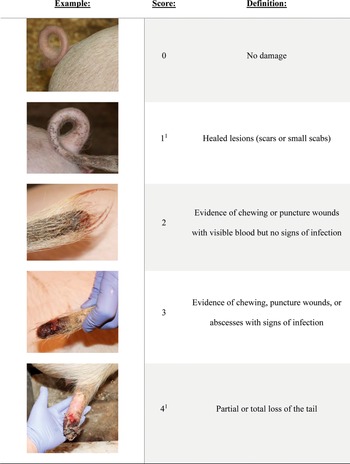
All pigs were assessed individually for tail injury when entering the growing-finishing barn, and then once a week until the conclusion of the study. Tail injuries were scored by the same trained individual throughout the study to ensure consistency. This individual entered each pen and conducted a hands-on assessment by palpating and visually inspecting every pig’s tail. Tails were gently handled to differentiate between injuries, scabs, dried faeces, and signs of infection. Signs of infection included swelling, discharge, or foul odour in or around the wound. Tail injuries were assessed using a modified scoring system based on methodology proposed by Kritas and Morrison (Reference Kritas and Morrison2004) and Li et al. (Reference Li, Zhang, Johnston and Martin2018). The devised scoring scale ranged from 0 to 4. The explicit criteria assigned to each score were: 0 = no damage; 1 = healed lesions (scars or small scabs); 2 = evidence of chewing or puncture wounds with visible blood but no signs of infection; 3 = evidence of chewing or puncture wounds or abscess with signs of infection; and 4 = partial or total loss of the tail (Figure 2). In addition to weekly scoring, pens were monitored daily by caretakers during routine health checks. If any pig showed visible blood, lameness, or other health concerns, staff alerted the researcher, who would enter the pen and reassess all pigs for tail injuries. This approach enabled recording of tail injuries caused by tail biting that occurred between scheduled tail assessments. If multiple tail scores were recorded in one week, the highest score was used as the pig’s tail injury score for that week.
Description and examples of each tail score on the 0–4 scale (adapted from Kritas & Morrison Reference Kritas and Morrison2004; Li et al. Reference Li, Zhang, Johnston and Martin2018) used to assess tail injury in pigs (n = 432) in the study.
1 Tail includes dried faeces.

Tail-biting outbreaks
Tail-biting outbreaks were defined according to the number of pigs with a tail injury and the severity of tail injury in a pen. When at least one pig in the small group pen and two pigs in a large group pen received a tail score of 2 or higher, the pen was considered to have experienced a tail-biting outbreak. To distinguish separate tail-biting outbreaks within a pen, a new outbreak was recorded only if all pigs had fully recovered from the previous injuries (tail score ≤ 1) and a minimum of two weeks had passed since the last outbreak. This criterion ensured consistency in defining a tail-biting outbreak across treatment groups with consideration of the number of pigs in each pen.
Maximal tail scores
To evaluate the tail damage that each pig experienced, a maximal tail score (MTS) was assigned to each pig every four weeks during scheduled weigh periods and during the entire study. MTS denoted the highest score that a pig received, it serves as an indicator of the most severe tail damage experienced by an individual pig over the designated duration. For example, a pig with an MTS of 0 signifies an absence of any apparent tail injuries resulting from tail-biting behaviours throughout the study. Conversely, a pig with an MTS of 4 illustrates an instance where the pig suffered partial or total loss of its tail at some point during the study period. The MTS is the highest score recorded for each individual pig throughout the defined duration of the study, not merely the tail score at the study’s conclusion. This distinction is critical to enable accurate interpretation and contextualisation of the severity of tail damage experienced by pigs during each weigh period or the entire study. In addition, pigs were classified as ‘tail-bitten’ if they received a tail score of 2 or greater at any point during the study. A tail-bitten event was defined as a discrete occurrence in which a pig reached this injury threshold. Pigs could be tail-bitten multiple times. To distinguish separate events, an outbreak period was considered resolved once all pigs in the pen had tail scores ≤ 1 for at least two consecutive weeks. A new tail-bitten event could only be recorded after the start of a subsequent outbreak period.
Mortality and morbidity
Pigs were removed from the study if they received a tail score of 3 or 4 and were not showing signs of healing, based on daily visual assessments conducted by the research team in consultation with animal care staff. Signs of poor healing included persistent swelling, discharge, or absence of scab formation. Conversely, pigs with a score of 4 were occasionally retained if clear signs of active healing were evident, such as the formation of a clean, dry scab and a reduction in inflammation. Pigs with a score of 3 were removed or retained based on the severity and the healing progression, while pigs with a score of 2 were not removed but monitored closely for worsening conditions. These decisions aimed to prioritise animal welfare while minimising variation in removal thresholds. However, removal decisions were not based on a rigid scoring timeline, and some subjectivity was involved. Once pigs were removed from their home pens, they were relocated to hospital pens and excluded from all subsequent data collection, including tail scoring and performance measurements. Minor wounds were not treated with antiseptics or topical products to avoid confounding treatment effects. In this study, morbidity was defined as removal incidence, which included pigs withdrawn due to tail injuries, lameness, or sickness; morbidity did not include tail lesions unless the lesion severity required removal.
Data analysis
Data were analysed using SAS software (v 9.4, SAS Institute Inc, Cary, NC, USA). Growth performance data, including average daily gain, average daily feed intake, and gain-to-feed ratio, were analysed using a mixed model procedure with repeated measures over time. Within the mixed model, treatment, week, and their interaction were considered fixed effects, block was the random effect, and pen was the experimental unit.
Data of MTS, mortality and morbidity, reasons for removal, and occurrence of tail-biting outbreaks were analysed using the frequency procedure. Within the frequency procedure, a Chi-squared test was used to test treatment effects on mortality and morbidity and reasons for removal due to data scarcity. A Cochran-Mantel-Haenszel (CMH) test was used to assess differences in the distribution of maximal tail scores (MTS; scored 0–4) between group size treatments while controlling for the blocking factor (room). MTS was treated as an ordinal categorical variable. Comparisons were made across the entire study period, as well as separately for each weigh period. The CMH test evaluated whether the distribution of tail scores differed by treatment within each block. Mean MTS values were calculated descriptively to summarise central tendencies.
Logistic regression analysis was conducted to evaluate the relationship between MTS and the likelihood of pigs having a below average market weight at 23 weeks of age. The dependent variable, market weight, was categorised as below (< 120.7 kg) or above (≥ 120.7 kg) the overall mean market weight of all pigs in the study population at 23 weeks of age, while MTS was used as the explanatory variable. Odds ratios were calculated for each comparison between MTS scores (e.g. MTS 4 vs MTS 0, MTS 4 vs MTS 1, etc). To evaluate the precision of the odds ratio, 95% confidence intervals were computed. For all analyses, significant differences were identified as P < 0.05, and trends as 0.05 < P < 0.10.
No formal adjustment for multiple comparisons was applied, as the analyses were focused upon testing a priori hypotheses regarding treatment effects, and results were interpreted with caution. For the logistic regression analysis of MTS and market weight, pigs were analysed at the individual level. Additional covariates (sex, initial weight, and block) were not included because sex was balanced within pens, average initial weight was balanced across treatments, and block was accounted for in other mixed models. Although pen was the experimental unit for treatment-level comparisons, pens were considered random replicates of each treatment and not included as a random effect in this regression, which was designed to specifically assess the individual-level relationship between MTS and market weight.
Results
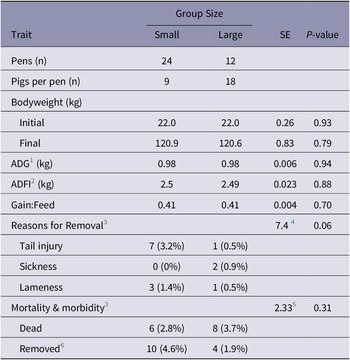
Group size did not affect growth performance of pigs (Table 1). The mortality and morbidity rates did not differ between treatment groups. However, the reasons for pig removal tended to differ (χ² = 7.4, df = 3; P = 0.06; Table 1) with a larger proportion of pigs being removed for tail injuries in the small group compared to the large group.
Growth performance and reasons for removal of undocked growing-finishing pigs in small and large groups (n = 432)

1 Average Daily Gain.
2 Average Daily Feed Intake.
3 The values in parentheses are percent of the total number of pigs (n = 216) assigned to each group.
4 Chi-squared value (df = 3).
5 Chi-squared value (df = 2).
6 Removed combines pigs withdrawn due to tail injury, sickness, and lameness.
MTS during the entire study period differed between treatment groups (CMH χ² = 10.78, df = 4; P = 0.03; Figure 3). While the CMH test does not support pairwise comparisons between individual scores, visual inspection of Figure 3 suggests that the overall difference was driven by a higher percentage of pigs in the small group receiving scores of 0 (no damage) or 4 (severe damage), whereas more pigs in the large group received intermediate scores of 1 or 2. MTS values differed between the treatment groups during specific weigh periods. During the first four weeks (0–4 weeks after entering the growing-finishing barn), the distribution of MTS differed between treatments, with large group pigs showing higher overall tail scores than small group (CMH χ² = 17.9, df = 1; P < 0.001; Figure 4). However, during the last two weeks of the study, pigs in the large group had lower MTS compared to the small group (CMH χ² = 4.8, df = 1; P = 0.03). No differences in MTS between group sizes were detected at other time-periods, including weeks 4–8 and 8–12.
Distribution of pigs receiving the maximal tail score during the entire study period (14 weeks) between the two treatment groups: small group (nine pigs per pen) and large group (18 pigs per pen) (CMH χ2 = 10.78, df = 4; P = 0.03). Tail injury scoring system was based on a 5-point tail injury scoring system from 0 = no damage to 4 = partial or total loss of the tail (Kritas & Morrison Reference Kritas and Morrison2004; Li et al. Reference Li, Zhang, Johnston and Martin2018).

Changes in mean maximal tail injury scores of pigs with intact (non-docked) tails housed in small groups (nine pigs per pen) or large groups (18 pigs per pen) across the 14-week study period. Each value represents the average of the highest injury score recorded per pig during each weigh period (every 4 weeks). Scoring system was based on a 5-point tail injury scoring system from 0 = no damage to 4 = partial or total loss of the tail (Kritas & Morrison Reference Kritas and Morrison2004; Li et al. Reference Li, Zhang, Johnston and Martin2018). Differences between treatments were detected during weeks 0–4 (large groups: 1.1 vs small groups: 0.8; χ² = 17.9, df = 1; P < 0.001) and weeks 12–14 (large groups: 0.7 vs small groups: 0.9; χ² = 4.8, df = 1; P = 0.03).

Of the 240 pigs classified as tail-bitten (MTS ≥ 2), 73% received a score of 2, 8% received a score of 3, and 19% received a score of 4. Among the tail-bitten pigs, 117 were housed in the small group and 123 in the large group. There was no difference in the number of tail-bitten pigs between the treatment groups (χ² = 0.34, df = 1; P = 0.56).
Since no treatment difference was observed, data from both groups were combined to explore how the number of tail-bitten events each pig experienced related to the severity of injury. Among the tail-bitten pigs, 38% of pigs with an MTS of 2 were tail-bitten once, 20% were tail-bitten twice, and 15% were tail-bitten more than twice (Figure 5). In contrast, 3% of pigs with an MTS of 4 were tail-bitten once, 6% were tail-bitten twice, and 13% were tail-bitten more than twice. Most pigs with an MTS of 2 were tail-bitten once or twice, whereas pigs with an MTS of 4 were more likely to have been tail-bitten repeatedly (χ² = 49.64, df = 4; P < 0.001).
Association between frequency of being tail-bitten and maximal tail injury severity in growing-finishing pigs with intact (non-docked) tails (χ² = 49.64, df = 4; P < 0.001; n = 240). Being tail-bitten was defined as the number of times a pig received a tail injury score ≥ 2 during the 14-week study. Maximal tail score (MTS) represents the highest score assigned to each pig across all observations. Tail injury scoring system was based on a 5-point tail injury scoring system from 0 = no damage to 4 = partial or total loss of the tail (Kritas & Morrison Reference Kritas and Morrison2004; Li et al. Reference Li, Zhang, Johnston and Martin2018). Bars show the percentage of tail-bitten pigs that reached an MTS of 2 (mild), 3 (moderate), or 4 (severe) depending on whether they were tail-bitten once, twice, or three or more times. Data were pooled across both group size treatments (nine pigs per pen vs 18 pigs per pen).

MTS during the entire study period had a significant impact on market weight. Pigs with an MTS of 4 were 3.2 times more likely to be of below average weight compared pigs with an MTS of 0, 1, 2, or 3 (Table 2). No differences in the likelihood of having below average market weight were detected for any other comparisons among MTS scores.
Odds ratio for the relationship between maximal tail score (MTS) and below-average market weight1 in pigs (n = 432)

1 Average weight (120.7 kg) of pigs at 23 weeks of age
* Bold represents significant values.
Discussion
The primary aim of this study was to evaluate how group size influences growth performance and tail damage caused by tail-biting behaviour in pigs with intact tails. While group size did not significantly affect growth performance, consistent with previous studies that also found no effect of group size on performance when space and resources per pig were equalised (Spoolder et al. Reference Spoolder, Edwards and Corning1999; Schmolke et al. Reference Schmolke, Li and Gonyou2003), the results related to tail damage were more nuanced. Small groups had a higher proportion of pigs with either no tail damage or severe tail damage, while large groups had more pigs with mild to moderate injuries. These findings suggest a complex relationship between group size and the severity of tail biting. Mortality and morbidity rates did not differ significantly between group sizes, but a numerically greater proportion of pig removals due to tail-biting injuries was observed in small (3.2%) compared to large groups (0.5%), representing a statistical trend (P = 0.06). While this trend suggests that pigs in small groups may have experienced more severe tail damage leading to removal, this interpretation should be made with caution because the study was not powered to detect differences in removal causes and a certain degree of subjectivity was involved in removal decisions. However, every pig was palpated and visually inspected weekly, so differences in removal rates are unlikely to be explained by detection bias. The numerically greater removals in small groups may therefore reflect true differences in injury severity rather than earlier detection. Moreover, the overall number of tail-bitten pigs (MTS ≥ 2) did not differ between treatments, though the distribution of scores varied by group size. As noted earlier, small groups tended to show more pigs at the extremes (no damage or severe damage), whereas large groups had more pigs with mild to moderate scores. Tail damage also differed by study period, with large groups showing higher proportions of pigs with severe tail scores (MTS ≥ 2) early in the trial, while small groups showed more pigs with severe scores (MTS = 4) during weeks 8–12 and higher MTS in the final two weeks. These findings suggest that tail-biting dynamics differ by group size. In small groups, severe injuries were concentrated on a smaller number of individuals, whereas in large groups injuries were distributed more broadly at mild to moderate levels.
Our initial hypothesis was that small groups would better mitigate tail damage from tail biting due to their potential for a more stable social hierarchy. However, this expectation was not supported by the results. Although pigs in large groups exhibited higher mean MTS during the early phase of the study (weeks 0–4), tail damage in small groups escalated in the later stages. This temporal shift suggests that the stability of social hierarchies in small groups may deteriorate over time, leading to concentrated severe injuries, whereas in large groups, early instability may have resulted in broader but less severe damage.
In small groups, pigs tend to form rigid social hierarchies in which dominance relationships are clearly established and rarely challenged once settled (Meese & Ewbank Reference Meese and Ewbank1972). During the initial mixing period, the process of establishing hierarchy may have involved less prolonged conflict compared to large groups, where individual recognition is more difficult and dominance is more fluid (Turner & Edwards Reference Turner and Edwards2004). As a result, pigs in large groups may have experienced more social instability and tail biting shortly after mixing. In contrast, pigs in small groups may later face chronic frustration or restricted access to resources within the rigid hierarchy, which could increase the likelihood of redirected behaviours, such as tail biting (Schrøder-Petersen & Simonsen Reference Schrøder-Petersen and Simonsen2001; Taylor et al. Reference Taylor, Main, Mendl and Edwards2010). These dynamics may explain why large groups showed higher levels of tail damage early in the study, whereas small groups exhibited more severe injuries during the later stages. Together, our findings highlight the importance of considering both group size and the timing of social stress when evaluating tail-biting risk in pigs with intact tails.
In addition to social dynamics, environmental resource allocation may also have influenced tail-biting outcomes in this study. Larger pens provided more total floor space per group, additional feeder spaces, and two drinkers at different locations, potentially allowing pigs to distance themselves from tail biters and reducing competition at resources. In contrast, small pens offered fewer opportunities for spatial avoidance or alternative access to feed and water. Since group size and pen design were confounded in the present study, the effects of social structure and environmental resource distribution cannot be separated. Previous studies have shown that pen design and resource availability can affect tail-biting risk (Spoolder et al. Reference Spoolder, Edwards and Corning1999; Brandt et al. Reference Brandt, Hakansson, Jensen, Nielsen, Lahrmann, Hansen and Forkman2020), but few have explicitly distinguished these effects from group size per se. Future research should attempt to disentangle social and environmental mechanisms to clarify their relative importance.
As noted above, pigs in small groups were more likely to experience severe tail-biting injuries during the latter part of the study. This shift toward greater severity over time may reflect the cumulative effects of social tension in more rigid hierarchies. While small groups may initially experience lower levels of tail-biting behaviour due to clearer dominance structures, this same stability may place subordinate pigs at a persistent social disadvantage, which may increase the risk of chronic stress and redirected behaviours, such as tail biting, as described in previous studies (Schrøder-Petersen & Simonsen Reference Schrøder-Petersen and Simonsen2001; Taylor et al. Reference Taylor, Main, Mendl and Edwards2010). This pattern underscores the importance of monitoring not only the frequency but also the trajectory of tail-injury severity when assessing welfare outcomes across different group sizes. While we did not directly characterise the social hierarchies in either group, it is possible that pigs in the large group benefited from a more fluid social structure, which may have allowed them to diffuse aggressive interactions across a broader social network. Andersen et al. (Reference Andersen, Nævdal, Bakken and Bøe2004) reported that pigs in larger groups are better able to avoid repeated confrontations, which can reduce overall social stress. Elevated stress, rather than aggression alone, has been more consistently associated with an increased risk of tail biting (Taylor et al. Reference Taylor, Main, Mendl and Edwards2010). This stress-related pathway could help explain why pigs in the large group were more likely to receive mild or moderate tail scores (1 or 2), while pigs in the small group had more pigs at both extremes, either no injury or severe injury. In addition to social dynamics, the provision of resources may have contributed to the observed treatment effects. Large pens contained double the total number of feeders and drinkers compared to small pens, which likely improved opportunities for physical distancing and reduced competition at resources. Greater physical space and the presence of two drinkers in separate locations may have facilitated avoidance of tail biters and alleviated stress associated with resource access. These factors could partly explain why pigs in larger groups were more likely to receive mild to moderate tail scores rather than severe injuries.
Building on this, large groups may also provide a richer and more stimulating social environment, which has been associated with reduced escalation of damaging behaviours. Verdon et al. (Reference Verdon, Hansen, Rault, Jongman, Hansen, Plush and Hemsworth2015) and Turner et al. (Reference Turner, Horgan and Edwards2001) note that pigs in larger groups engage with a wider network of peers, facilitating more balanced social interactions and less monopolisation of aggression. Ocepek and Andersen (Reference Ocepek and Andersen2022) further observed that larger groups, particularly when paired with enrichment, led to improved behavioural outcomes and reduced tail-biting incidents. In contrast, pigs in small groups may have fewer opportunities to redirect aggression or alleviate frustration through varied social contact. Scollo et al. (Reference Scollo, Di Martino, Bonfanti, Stefani, Schiavon, Marangon and Gottardo2013) suggested that limited stimulation and predictability in small-group environments may exacerbate boredom-related behaviours. These dynamics likely contributed to the more severe tail-biting injuries observed in the small group later in the study, despite their initial lower risk. Together, these findings suggest that group size could play a role in shaping not only social dynamics but also behavioural resilience and welfare.
Another important finding in our study was the relationship between being repeatedly tail-bitten and the severity of tail damage. In this study, being repeatedly tail-bitten referred to pigs that were injured again during a later outbreak after fully healing from a previous injury. Pigs with an MTS of 4 were more likely to experience this recurrence compared to those with lower MTS scores. This suggests that pigs with severe injuries may be at greater risk of being reinjured in subsequent outbreaks. For example, pigs with an MTS of 2 were most often tail-bitten once, whereas those with an MTS of 4 were more likely to be tail-bitten during multiple outbreaks. These findings highlight the need for timely intervention, as recurrence of injury over time can exacerbate both welfare and economic consequences. Similar escalation patterns have been described previously, where tail-biting behaviour intensifies within populations over time (Wallgren & Lindahl Reference Wallgren and Lindahl1996; Statham et al. Reference Statham, Green, Bichard and Mendl2009; Taylor et al. Reference Taylor, Main, Mendl and Edwards2010). Pigs with a tail score of 4 should be removed promptly, regardless of healing signs. Severe tail damage has been shown to impair growth performance and reduce market value of pigs. In the current study, pigs with an MTS of 4 were more than three times as likely to have below average market weight compared to pigs with MTS scores of 0, 1, 2, or 3. This suggests that the consequences of severe tail injuries extend beyond welfare concerns and have clear production implications. Tail damage may impair growth by increasing stress levels, reducing feed intake, or diverting energy toward healing and immune responses (Munsterhjelm et al. Reference Munsterhjelm, Brunberg, Heinonen, Keeling and Valros2013). These results are consistent with the findings of Wallgren and Lindahl (Reference Wallgren and Lindahl1996), who reported that pigs with severe tail damage exhibited reduced weight gain. Taken together, these outcomes emphasise that pigs with severe tail damage are at particular risk for poorer performance, underscoring the importance of close monitoring and timely intervention for severely affected individuals to minimise both welfare and economic losses.
In addition to reduced performance, we observed potential links between tail damage and other health outcomes, such as lameness. All pigs removed for lameness in both groups (three in small group and one in large group) had also been tail-bitten (MTS ≥ 2). Although the overall prevalence of lameness was low in this study (0.9%), this overlap raises the question of whether tail damage and lameness may be interconnected. One possibility is that lameness increases the risk of being tail bitten due to impaired mobility and an inability to avoid pen-mates engaging in damaging behaviours. Alternatively, severe tail damage may contribute to lameness or signal broader health and welfare challenges. Recent reports suggest that lameness can serve as an indicator of poor health status on farms and may be associated with a higher risk of tail-biting incidence (EURCAW-Pigs 2020). While our study was not designed to examine this relationship directly, future research is warranted to explore the mechanisms linking tail damage and other health outcomes, such as lameness, to better understand how these issues may interact in commercial settings.
Study limitations
First, this study focused on the effects of group size on tail-biting behaviours, while recognising that other factors, such as social hierarchy dynamics or genetic predispositions, may also influence these behaviours. Previous researchers have demonstrated that pen design, enrichment materials, and stockmanship practices can play crucial roles in mitigating tail-biting behaviours (Wallgren & Lindahl Reference Wallgren and Lindahl1996; Brunberg et al. Reference Brunberg, Wallenbeck and Keeling2011). In the present study, environmental enrichment and husbandry practices were standardised across group size treatments by allocating both treatments within the same barn, reducing their potential confounding effects. However, pen design differed between treatments, which may have influenced the outcomes alongside group size. This study was not structured to disentangle these effects, and future work should consider experimental designs that allow separation of pen layout from group size.
Regarding genetics, blocking and litter balancing were implemented to minimise variation, though some individual differences are expected in any behavioural study. Furthermore, this study was conducted at a university research facility, which may not be fully reflective of commercial swine production where group sizes are typically much larger in the US. Therefore, the findings of this study cannot be extrapolated to commercial farms housing pigs in substantially larger groups, as the experimental design was not intended to address those conditions.
Additionally, although tail scores were used as a basis for removal decisions, the criteria for ‘healing’ involved visual assessment and professional judgment, introducing a degree of subjectivity. Future studies should consider establishing more standardised or quantitative thresholds to guide removal decisions more uniformly across pigs and observers. Investigating the role of dynamic social structures among pigs in different group sizes would also provide valuable insights into how social dynamics may influence tail damage caused by tail-biting behaviour.
Animal welfare implications
Tail damage from tail biting is widely recognised as a welfare concern because it causes pain, increases the risk of infection, and can impair growth. In this study, pigs with intact (non-docked) tails were housed in either small groups (nine pigs per pen) or large groups (18 pigs per pen) from weaning until market weight. Small groups experienced more frequent and severe tail damage compared to large groups, although the overall number of tail-bitten pigs did not differ between treatments. These findings suggest that group size can influence the severity of tail damage in growing-finishing pigs and highlight the importance of tailored management strategies in systems that do not use tail docking.
Conclusion
Growing-finishing pigs housed in groups of nine pigs per pen experienced more severe tail injuries and a higher proportion of removals due to tail-related issues compared with pigs housed in larger groups of 18. Pigs that sustained severe tail damage also tended to have lower market weights, emphasising the production consequences of tail-biting behaviour. These findings suggest that housing pigs in larger groups may help reduce the severity of tail damage, though the overall relationship remains complex and likely influenced by social dynamics, hierarchy formation, and other environmental factors. Continued research is needed to clarify these interactions and develop practical management strategies for preventing tail biting in systems with intact tails.
Acknowledgements
We would like to thank the USDA Competitive Grants for Agricultural Animal Welfare Program for their financial support which made this project possible.
Competing interests
None.


 Open access

