A few months after his death in January 2007, Poland’s Newsweek edition revealed the world-renowned Polish writer and journalist Ryszard Kapuściński as a secret agent (spy) for communist secret services. The news quickly made its way to domestic and international media platforms. During his twenty five years of work as a foreign correspondent of the Polish State News Agency from the late 1950s onwards, Kapuściński wrote numerous reports and more than a dozen books on anticolonial struggles, revolutions, and despotic regimes in Africa, Asia, and Latin America, from Angola, Ethiopia, and Ghana to Palestine, Iran, Honduras, and Guatemala (Figure I.1). With the media “revelations” about his links with the communist secret services, Kapuściński’s intimate life, romantic and sexual relationships, and literary-journalistic accounts of the people and events he described in his books moved to the center of public discussions. Some conservative commentators called him a beneficiary and even a perpetrator of “communist crimes,” who was also complicit with non-Western “terrorism” today, while more liberal-leaning pundits saw him as a survivor and even a victim of a totalitarian communist regime and his “collaboration” as the “price” Kapuściński had to pay to write his brilliant books. Three years after the revelations, in 2010, Artur Domosławski published a detailed biography of Kapuściński to “defend him,” as he put it in an interview that appeared in the New York Times:
Kapusciński was part of the Communist establishment as a true believer – that has never been a secret … [He was] a witness to decolonization, and a tough critic of the dirty wars and businesses of the West in Africa, Asia, and Latin America – in the past and in the more recent years including the 2003–4 US war in Iraq …. Occasionally, he collaborated with the intelligence service while he was an international correspondent. He considered Communist Poland his country, his fatherland. You can’t just say he was compromised. What compromise is it for a Communist – a true believer – to collaborate closely with his state and its agencies? For him it was something obvious. [Moreover] he might have thought at the time that he was doing a good thing fighting Western imperialism in Africa, Latin America if, for example, he was writing an analysis of the dirty operations of the C.I.A. … . My book is a defense of Kapuściński against strong attacks from the anti-Communist rightwing that considers Communist Poland hell, and collaborators with that intelligence service, traitors.Footnote 1
Domosławski usefully highlighted Kapuściński’s political commitments and Western imperialism and its dirty wars and businesses to contextualize his relationship with the communist secret services. He carefully studied Kapuściński’s silences, disavowals, fears, sufferings, and gestures, including his smile, which was often noted to play a key role in his conversations with the downtrodden, revolutionaries, and militants that filled his books. What did Kapuściński hide about himself? Why did he keep silent and not tell the truth about himself? What was he afraid of? Who was the real Kapuściński? Indeed, Domosławski suggested that he could well have called his biography “the secrets of Ryszard Kapuściński,” which he aimed to unearth and examine in the book.Footnote 2
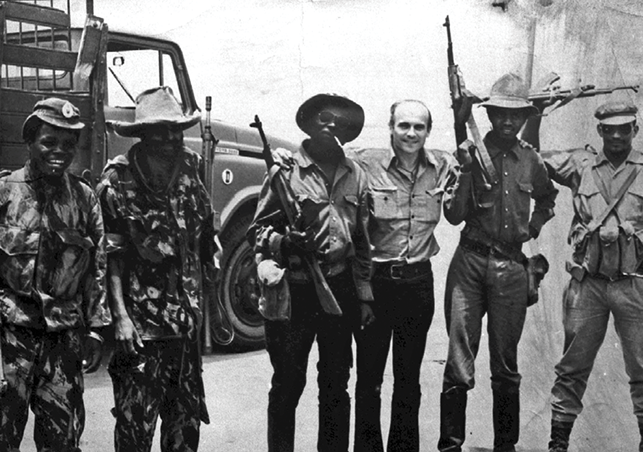
Figure I.1 Ryszard Kapuściński in Angola in 1975.
When I began my fieldwork in Poland in 2009, Kapuściński was already dead, but the discussions about him, juxtaposed with other public revelations of secrets from communist security archives, continued to prompt heated comments. What was at stake was not only the evaluation of Kapuściński’s moral person, the alleged truth of his being, but also the history of state socialism, the international communist movement, and the relations between the East and the South, which Kapuściński came to embody. Later, I realized that this approach to life, history, and politics was not exceptional in the transitional justice processes concerning secret communist agents.
I was in Poland to conduct ethnographic research on the legal procedure called lustration. Lustration involved the state-run examination, public disclosure, and in some instances banning of the people who were thought to be secret communist agents and to have lied about their past from public office or profession. But identifying and observing a lustration process was challenging, partly because the evidentiary material used in lustration might contain “sensitive information” like state secrets, which meant the court hearings would be closed to the public. Lustration was a massive legal-bureaucratic process that worked silently, invisibly, and distantly, except when it involved high-profile public figures such as politicians, which could make the media headlines and often triggered scandals.
Witold Benek (pseudonym) was not one of those high-profile figures. I did not hear about his lustration until I went to the District Court (Sąd Okręgowy) of Kraków on an early spring day in 2010 and checked with the information bureau to see if there was any lustration court proceeding that I might be able to observe around that time. In 1998, Benek, working as a judge at the time, filled out a lustration statement in which he was asked to disclose his links with the communist secret services. The legal officials checked his statement against former security archives, public access to which was highly restricted. As a rule, lustrated people like Benek had to reveal their links without knowing if there was archival evidence about their “collaboration.” The legal officials suspected that Benek “lied” in his statement by not truthfully disclosing his links. Benek contested and the court proceedings began, but not until 2006, eight years after the submission of his lustration statement.
Benek turned out to be sociable and talkative about his lustration experience.Footnote 3 Neither he nor the bench objected to my observing the hearing. Benek frequently made eye contact with me, while the three-judge panel seemed utterly skeptical of his statements, even visibly irritated, especially when Benek referred to his former dissident past. After the hearing, Benek and I had a conversation in front of the court building, where he continued to speak energetically. He was in his early eighties at the time. He was from a small town near Kraków, where “everyone knew each other.” “The security people regularly talked to us,” he said. “We had to communicate information to these people since they were part of the justice system. … I told them what was already known, repeating the gossips I picked up from the streets, coffeehouses, and the corridors of the court building.” There was nothing injurious about what he had reported, Benek claimed. Like many Polish people, he had relatives in England, whom he wanted to visit from time to time. To collect his passport from the state office, he had to “chat” with the security officers. Benek said he did not know he had been registered as a “secret agent” (Tajny Współpracownik). Reiterating his court testimony, he said he never signed a “loyalty agreement” (loyalka) with the secret service or received any money or “gift” from the security officers. He only signed some papers where he pledged to keep secret the conversation with the officers, in line with the protocol about state secrets at the time.
Benek hurriedly showed me a dossier of documents that testified to his oppositionist past including a letter from the then Polish President Lech Kaczyński who thanked him for his contribution to the “Solidarity” labor movement. As a lawyer, Benek defended several oppositionist activists who were detained by the state security forces during martial law in the 1980s. Earlier, he said, he had also taken part in 1956 anti-Stalinist protests at his university in Kraków that aimed to democratize public and political life. Benek seemed to be at a loss to prove his moral credentials, while complaining that many ex-dissidents today capitalized on their “heroic” past for professional and political career. Even more vocally, he lamented that lustration had become a big political show. It was nothing more than a political instrument of rightwing groups to discredit their opponents and claim moral authority.
One might identify a number of differences between the way the lustration of Witold Benek and the media “revelations” about Ryszard Kapuściński unfolded. Benek’s lustration did not receive a similar media attention like Kapuściński’s life did, and Kapuściński was not officially subjected to lustration and did not have to publicly explain himself during his lifetime even as he had been worried about being subjected to “public lynching” like many of his friends, (former) communists, after 1989.Footnote 4 Their profession and relationship with the communist secret services were also different. Yet, both instances showed how such public revelations and legal processes placed one’s life under intense examination, cracking it open to retrospective investigations, projections, and judgments in the real or imagined court of law. Where Kapuściński’s intimate, personal, and political life came under focus, Benek’s account of himself became an object of suspicion: did he tell the truth about himself? Had he advanced his career by betraying and secretly reporting on his colleagues? Could this “treacherous” person rightfully deserve his wage and morally qualify as a judge?
I coin the term “moral autopsy” to articulate this judicial and moralistic examination of life, which works by way of subjecting one to the questions of treachery, truth, and criminality, framed within a certain understanding of the past. Rooted in the post-Cold War vision of the “end of history,” “moral turn,” and conservative historical revisionism, moral autopsy reconstructs communism as a dead past and ideology of criminality and extreme violence, the truth of which is to be “extracted” from communist security archives and “dissected” through the persons associated with communism, especially the state security apparatus.Footnote 5 Moral autopsy foregrounds a forensic orientation to truth, conceiving communism like a “corpse buried beneath in the rubble of the Berlin Wall,” as Daniel Bensaïd and Michael Löwy observed,Footnote 6 the life of which is to be “illuminated” retrospectively, as in a police autopsy seeking evidence in the dead body. Importantly, moral autopsy mobilizes this judicialized and moralized understanding of communism to label all sorts of state socialist experiences and rules in Eastern Europe, irrespective of their political self-description. As the following pages will discuss, moral autopsy, in this sense, does not only concern communists, socialists, or Left politics in general but also has profound implications for any democratic politics worthy of the name.
This book explores how moral autopsy underpins the reckoning with the socialist past in Poland and Eastern Europe. My central focus is on the social and legal world of Polish lustration, the massive transitional justice measure that claims to create public transparency and trust and protect capitalist democratic nation-state making.Footnote 7 Polish lustration officially applies to politicians (MPs) and higher- and mid-level public employees and candidates for those positions, born before August 1, 1972, including barristers, judges, local administrators, and board members of state companies. The number of lustration positions ranges from approximately 25,000 to 150,000 depending on the specific legislation.Footnote 8 While lustration is state-centric in many ways and does not apply to the private sector and the church, lustration practices extend well beyond the formal legal-institutional domain of this transitional justice, whether through agent lists, media news, or biographical practices, what is popularly called “wild lustration” (dzika lustracja). Media “revelations” about Ryszard Kapuściński and other public figures, who are not officially subjected to lustration, are often seen as lustration.
The details of the official lustration procedure are complex but important to understand the social-political life of lustration. Polish lustration rests on a game of secrecy and a test of truth-telling (veridiction) and loyalty to the state. The lustration persons are required to declare their links with the communist security service, as Benek did, but without knowing if there is evidence about them in the security archives. Lustration involves not only the legal officials’ examination of the lustrated person’s statement but also the lustrated person’s self-examination. This statement is taken as an indication of the person’s sincerity and loyalty to the “new” state. If the lustrated person confesses, their name is published. If the legal officials determine a “lie,” the lustrated person is called a “lustration liar” and might be banned from profession or public office. The lustrated person can appeal to the court to dispute the prosecutor’s decision, but the legal proceedings tend to take a long time, among other challenges. With this game of secrecy and test of truth-telling, Polish lustration focuses attention on moral subjectivity to the questions of treachery and deception posed by moral autopsy.
Since the 1990s, Polish lustration has been a part of the political struggles between the dominant blocs of liberal and conservative nationalist groups. Initiated within the liberal democratic framework in 1997, Polish lustration in less than a decade, by the mid-2000s, became dominated by conservative nationalist groups who rallied around it as a means of “moral revolution” (rewolucja moralna)Footnote 9 and sought to expand lustration’s transparency logic. Lustration, they underscored, was indispensable for Polish state sovereignty, security, democracy, and justice. As the influential conservative journalist Bronisław Wildsten argued, one must know “who is who” (kto jest kim) in democracy and this knowledge was essential to the basic feelings of justice.Footnote 10 Many nongovernmental and human rights organizations, academics, journalists, political activists, and veteran dissidents, including those who had been personally targeted by communist secret service, vocally opposed (rightwing) lustration. The critical positions often took issue with the political instrumentalization of lustration and security archives and lustration’s violation of civil and human rights including the individual right to self-defense, a fair trial, and due process.Footnote 11
In this book, I explore the following puzzle: How has this transitional justice process, which claimed to create public transparency and trust, come to produce myriad forms of secrecy and pervasive suspicions of betrayal, criminality, and the political manipulation of law and history? How has this liberal transparency-driven transitional justice process become dominated by authoritarian nationalist populist politics of sovereignty and moral purification? What does this trajectory of lustration say about the politics of transitional justice and more generally about the relationship between law and power at this current moment?
This puzzle calls into question the fundamental assumptions of transitional justice concerning the notions of transition, time, violence, and justice. It challenges the liberal teleology of transitional justice, which takes transitional justice as leading to liberal democracy and imposes a progressive unilinear notion of time. In particular, this trajectory of Polish lustration unsettles the uncritical identification of the imaginary and practice of transparency with democracy, the assumption that more transparency would mean more democracy and justice. Instead, the trajectory of lustration highlights the importance of departing from the instrumentalist approaches that treat transitional justice as a politically neutral toolkit or a mere response to a violence that is identified with and left behind in the past. It suggests the need to focus more closely on what transitional justice does in practice, the modes of power transitional justice exercises in its own right, and the way it reconstructs history and memory, weaving together different temporalities and forms of violence.
Moral Autopsy attends to these issues of power, law, and transitional justice by tracking lustration across a variety of practices and locations, from the courts, ad hoc commissions, and memory institutions to media practices, biographies, films, and theater plays. Through an ethnographic study of the lustration of judges, academics, journalists, artists, and political activists, this book examines the ways in which lustration reconfigures the social relations of belonging and subjectivity, as it raises contentious questions about the boundaries of political community, the distribution of the visible and the knowable, and the notions of truth and responsibility. Decades after the end of state socialism, lustration has become utterly inextricable from the problems of domination, inequality, and exclusion that have arisen out of Eurocentric neoliberal nation-state making. The law was invoked to address the problems of the past and present, while being an integral part of them, reconstituting and mediating the relations of domination and inequality. Whether in court trials, rights struggles, or through the itineraries of the legal form in public performances and intimate engagements, law became a site where alternative forms of knowing and feeling and histories of friendship and solidarity could emerge to interrogate and unsettle the terms of lustration and moral autopsy.
Moral Autopsy as Transitional Justice
Transitional justice emerged in the 1980s and early 1990s as a set of legal and political responses to the violence of authoritarian and apartheid regimes and military dictatorships in the context of “transitions to democracy” in the global South and East.Footnote 12 Quasi-judicial truth commissions, memory institutions, international and domestic criminal prosecutions, institutional reforms, and administrative procedures such as vetting and lustration have been the most visible forms of transitional justice across the world. Eastern European state socialism and its end had a formidable impact on transitional justice. The Cold War division of civil, political, and social rights, and the social struggles in the East, South, and West that included labor and antiracist struggles and anticolonial movements, were central to the development of transitional justice and human rights. The deradicalization of revolutionary struggles and visions of social-structural transformation in the 1970s onwards, and later the end of Eastern European state socialism, significantly shaped the dominant understandings of violence, transition, and justice underpinning transitional justice discourse and practice.Footnote 13 Where violence and justice came to be predominantly understood in a legalistic, individual-centered manner within the criminal justice framework, isolated from the broader historical, material, and political conditions that produce violence, transition is mainly seen as leading to Western liberal democratic nation-state building, based on national reconciliation and overcoming of the conflict that is assigned to the illiberal past.Footnote 14 In this normative ordering of violence, wartime, event-based, and “extreme” violence is generally prioritized over the more everyday, structural, and “normalized” peacetime violence of, say, capitalism, racism, and patriarchy.Footnote 15 In the same vein, transitional justice institutions, especially truth commissions, have deeply invested in the redemptive meaning of public confession and transparency or exposition of the truth, taking them as leading to moral recovery and progress.Footnote 16
In spite of the historical and conceptual influences, transitional justice in Eastern Europe has received relatively little (international) scholarly attention, at least until recently. It is my contention that a socially grounded, critical analysis of transitional justice politics in Eastern Europe will offer insight into the fundamental conundrums of the global field of transitional justice. Polish lustration in particular brings into focus the themes of treason, transparency, truth, and archive. The trajectory of Polish lustration helps examine the relatively underexplored intersection between transitional justice, nationalist populism, and neoliberal (de)democratization at the eastern margins of Europe. While bringing a critical perspective to the imaginary of transparency, the Polish lustration process and the struggles around it highlight the importance of placing the nation-state, law, and capitalism at the center of the problems of transitional justice. A study of lustration has significant potential to contribute to the thriving critical scholarship on transitional justice, which problematizes, for instance, its neocolonial and Eurocentric teleological underpinnings, as well as its complicity with and even reproduction of the forms of power and violence it claims to address.Footnote 17
Transitional justice in Eastern Europe has taken different forms. These forms have included the prosecution of crimes committed during state socialism, bureaucratic screenings like lustration, the restitution of property, the rehabilitation of “victims of repression,” “decommunization” of public spaces (renaming streets and squares), and the establishment of state-run national memory institutions, museums, and truth commissions that investigate, archive, and publicize or exhibit the violence of party-state apparatuses.Footnote 18 Of these measures, lustration, as often noted, has been the one that is dominant and most controversial.Footnote 19 Lustration is widely employed in Eastern Europe including the Czech Republic, Slovakia, Hungary, Lithuania, Latvia, Bulgaria, Albania, and, more recently, North Macedonia and Ukraine.Footnote 20 A version of lustration has also been adopted in war contexts such as in Iraq during the US occupation in 2003–2004, which introduced the de-Baathification process as a measure of state security and democratization.Footnote 21 With its broad scope, lustration has affected the largest number of people, compared to other transitional justice procedures. It is a highly bureaucratic, labor-intensive, and costly process. To give a sense of it, in Poland, until the end of 2023 legal officials have received in total 484,302 lustration statements. Only in 2023, the Bureau of Lustration received 12,487. From 2006 to 2023, the courts have determined 1,849 cases of “lustration lies.”Footnote 22 Moreover, the temporal scope of this ostensibly “temporary” transitional justice measure is far from clear. In Poland and other Eastern European countries such as the Czech Republic, lustration was extended indefinitely.
Since the early 1990s, the issue of lustration has been deeply inscribed into the major conundrums of the new polity: How to remake the political community, redistribute power, and redefine the loyalties and rights of the new citizen-subject? How to reconstitute the public, understood broadly as a realm of the state, political economy, and a domain of sociability, sensibility, and knowledge?Footnote 23 What would be the limits of visibility and knowability with respect to one’s life in the emergent liberal legal order, norms of publicity, and capitalist economy? Which secrets could be publicly knowable, which forms of violence could be openly addressed, and which ones need to remain invisible or could be seen as necessary? How would guilt and responsibility be determined for socialist-era state violence and its aftermath? Fundamental as they are to the new polity, these questions have not lost their importance three decades after the end of state socialism. In Poland, they have been the key to the longstanding conflicts over the legal and constitutional order, the boundaries of political community, and the notions of justice, especially political and social justice.
The question of what to do with the former state security archives has been integral to lustration. Unlike in post-apartheid South Africa and in many post-dictatorship South American countries such as Guatemala, Chile, and Argentina, where one major problem was the lack of documentary evidence of state violence, Eastern European countries retained a massive amount of communist security archives in the 1990s, certainly not without a struggle and not in complete form.Footnote 24 In many Eastern European countries, the archives were partly destroyed and pillaged presumably by the security officers and other state authorities who had access to them. These actions and the rumors about them heightened the already existing suspicions about the archives, their political uses, and their secret content. The incompleteness of the archives raised numerous challenges for lustration in terms of its evidentiary and examination process, as well as the legal and moral judgments made on the basis of those archives. Notwithstanding these problems, the heated struggles over the archives, combined with the Cold War association of communism with the secret service and faceless state bureaucracy and files, placed the security archives at the heart of the pursuits of justice.
This preoccupation with the archives, in a sense, rehearsed the well-known positions expressed by Mikhail Bakunin and Max Weber about what to do with the state in the context of the French Revolution. Where Bakunin called for the destruction of the state with its archives and institutions as a way to unmake the power of the old regime, Weber embraced a more “conservative treatment” of the state archives and focused attention more on the normative disposition of the civil servants, who might keep their old habits even after the dissolution of the former state institutions and their “system of files.”Footnote 25 Polish lustration aligned more with the Weberian position. It jealously safeguarded former state security archives in spite of some veteran dissidents’ call for their ultimate destruction and used them to examine the moral-political orientation of the people who occupied public office. By the same token, this legal-bureaucratic process generated deep-seated tensions and criticisms about its complicity with the power of the former state, especially with its epistemology and its ways of framing the persons, events, words, and deeds figuring in the files. In brief, the afterlife of the archives turned out to be anything but calm and peaceful.Footnote 26
Moral autopsy, as a mode of knowing and judging, makes extensive use of the security archives. In The Birth of the Clinic Michel Foucault suggested that autopsy rose to prominence in eighteenth-century medical history when the body came to be seen as harboring the secret signs about the truth of illnesses and became an object of careful decipherment as to that truth. Rearranging the field of visibility and knowledge, autopsy ascribed a new significance to the dead body, considering it as providing an ample viewpoint to “see” and examine the life of the body in retrospect, make transparent the hidden causes of its demise, and construct its truth. As Foucault noted succinctly, “It is at death that disease and life speak their truth,”Footnote 27 and that truth was not a social truth that is constructed through the narrations of people and their participation in the means of producing knowledge and truth. It was rather an “objective,” forensic truth, allegedly immune to the social relations and subjectivities of the people implicated in that truth.Footnote 28 “A dead body does not lie,” as positivist forensic scientists tended to say.Footnote 29
Autopsy, as I elaborate in the next chapter, came to underpin much of the post-Cold War reassessments of communism.Footnote 30 In Complications: Communism and the Dilemmas of Democracy, Claude Lefort titled his reflection on post-Cold War revisionism as “The Illusion of Autopsy,” referring mainly to the conservative historian François Furet’s influential work, The Passing of an Illusion, where he pronounced the death of communism as both an ideology and historical reality.Footnote 31 Communism, in this view, was a past that no longer had any life or future and needed special investigation concerning its moral “deceptions” and “illusions” that had allegedly infected many minds and hearts in the past.Footnote 32 This view has enjoyed wide currency among intellectuals in postsocialist Eastern Europe.Footnote 33 Katherine Verdery in her ethnography The Political Lives of Dead Bodies captured that moment in Eastern Europe by drawing attention to the destruction and displacement of iconic socialist monuments into the trash bin of history.Footnote 34 In the liberal progressive and teleological view of history expressed by the proclamations of the “end of history,” communism appeared as something like a dead body to be buried in the past and banished from public sight. Time and space had to be reordered accordingly. The political immortality claimed by communism seemed all too mortal.Footnote 35 The relationship that linked the past and future, or to use Reinhart Koselleck’s terms, the “space of experience” and the “horizon of expectation,” seemed radically torn apart.Footnote 36
This post-Cold War view was accompanied by widespread criminalization and judicialization of communism and, with it, the socialist past in Eastern Europe. The conservative and radical-right pundits both in the West and East called for the “Nuremberg of communism.”Footnote 37 The imaginary of justice invoked here must not be taken lightly. If it is true that the Nuremberg trials placed criminal justice at the heart of reckoning with the past, those pundits also sought to criminalize communism by attempting to capitalize on the moral force of Nuremberg, and employed different sorts of legal tools including memory laws. If Nuremberg came to be known for its conceptualization of “Nazi crimes” as exceptional and “barbaric” violence outside of Western capitalist civilization and humanity, communism, in those accounts, was also treated as essentially an uncivilized, criminal past and ideology of Eastern despotism. As in the case of the Nuremberg trials, post-Cold War criminalization of communism immunized and even reproduced further nation-state ideology and its logic of sovereignty, as well as capitalist relations of inequality and property, while claiming to dispense justice and reveal historical truth.Footnote 38 The conservative pundits aspired to put communism on the dock, reducing the range of historical plurality and experience of dissents, struggles, contradictions, and conflicts that marked the movement of communism to the historical form of Soviet state socialism and in that to criminality, terror, and genocidal violence. Thereby, this anticommunism also obscured a richer understanding of the historical experience of state socialism including the forms of violence the party-state authorities exercised through their authoritarian sovereigntist and nationalist aspirations and through the mechanisms of surveillance and repression of political and social struggles including labor struggles.
The death of communism was surely not pronounced for the first time. Nor was the association of communism with crimes and extreme violence. A trenchant critic of authoritarian Soviet state power, Victor Serge had already in 1937 taken issue with the teleological accounts that reduced the October Revolution to the Stalinist purges and repression and presented those purges as the inevitable outcome of the revolution.Footnote 39 In his perceptive analysis of Arthur Koestler’s bestseller Darkness at Noon in the late 1940s, Maurice Merleau-Ponty critically interrogated the reified and moralistic understanding of communism that was devoid of historical contingency and worldly praxis.Footnote 40 Anticommunism has a long history and has taken diverse forms, as I discussed elsewhere,Footnote 41 but in the post-Cold War context, especially in Eastern Europe, anticommunist legal, history, and memory politics became particularly dominant when institutionalized as part of the new capitalist nation-state ideology. Embedded in the “post-revolutionary” age of democracy, “moral turn,” memory boom, neoliberal globalization, and the increasing legalization of history and politics, this post-Cold War anticommunism has obtained a strong judicial and moralistic orientation.Footnote 42
Moral autopsy refers to this moralized and judicialized treatment of communism as a criminal dead body, the truth of which it seeks to trace through the figures associated with it, especially the communist security apparatus. As its key source of truth and evidence, moral autopsy relies on the security archives, which offer, as is often noted, a particularly incriminating and hostile view on the subjects figuring in the archives, informed by the surveillance gaze of the state security apparatus.Footnote 43 Moral autopsy shapes the interpretation of the lives of alleged secret agents and their associates, the meaning of revealed archival information, and the parameters in which the lustrated person has to give an account of oneself. Moral autopsy is moralistic in the sense that it reformulates the social-historical problems of power, surveillance, and violence concerning state socialism as strictly a moral problem of individual subjects that demands moralizing examinations and judgments about their allegedly treacherous and criminal personalities or identities. This moralistic orientation informs the legal-moral ideology and practice of lustration.Footnote 44 Yet, as I argue in the book, moral autopsy does not just concern secret agents, communists, socialists, ex-communists, or even the Left, broadly speaking. One must not take this approach as only addressed to the socialist past or to the living and dead subjects of that past. Moral autopsy concerns no less the current and future figures and struggles, the so-called specters or “incarnations” of neo-Marxism and communism, which the transnational right today claims to fight around the world by demonizing feminist, queer, ecological, decolonial, antiracist, and anticapitalist struggles. Moral autopsy has wide importance for any democratic politics worthy of the name.
Treason, Transparency, and Truth-Telling
Moral Autopsy centers on the problem of nationalist authoritarian appropriation of transitional justice and law. Much has been written about the historical colonialist and imperialist instrumentalization of law, human rights, and democracy to dominate and exploit non-Western peoples and subaltern and working classes, as well as extract natural resources.Footnote 45 With the recent rise of authoritarian nationalist populism and, some say, “post-fascism”Footnote 46 or “autocratic legalism”Footnote 47 in many parts of the South, East, and North, the nationalist appropriation of liberal legal institutions and discourses has received renewed attention.Footnote 48 My analysis of Polish lustration attends to these discussions in the context of transitional justice. Rather than approaching the problem as the nationalist abuse, cooptation or misappropriation of otherwise well-meaning liberal legal institutions and ideas (in my case, transitional justice) by some allegedly ill-natured, vengeful, culturally deficient autocrats, I focus on the legal, social, and material conditions that make transitional justice particularly instrumental for rightwing politics in the first place. Instead of framing the problem as democratic “backsliding,” “regression” – note the liberal progressive temporality – or the dissolution of liberal democracy into authoritarianism, I argue for the need to critically interrogate the well-established binary between liberal democracy and authoritarianism and probe the ways in which rightwing authoritarian legalism and transitional justice has grown out of liberal legal forms and institutions.
In particular, I am concerned with the transparency imaginary embraced by liberal transitional justice; the question of how the quest for transparency gives way to rightwing sovereigntist politics of moral purification and security, generating and refracting myriad forms of secrecy and suspicions of political manipulation of law and history.Footnote 49 The indeterminacy or double-edged nature of transparency, as well as the dialectic of transparency and secrecy (conspiracy), have long been observed in different modern European and postcolonial contexts.Footnote 50 It is noted that while transparency was pursued as an ideal of democratic accountability and justice aspiring to make governing bodies visible and knowable, it can also function as a form of political domination and surveillance, as in state technologies that render the population and citizen-subjects legible and governable.Footnote 51 Critical studies of transitional justice have shown that public revelations or confessions of violence, as in truth commissions, do not necessarily lead to justice or moral recovery; on the contrary, they might well reproduce violence and stigmatize the testifying person.Footnote 52 Indeed, the quest for transparency is often observed to generate new opacities, secrecies, shadows, and monsters. What interests me in this book is precisely how these monsters come to life and how secrets and suspicions proliferate and become sticky, and the quest for transparency fuels “moral authoritarianism,” to borrow the words of Stuart Hall.Footnote 53 By the work of which agents? Through which bureaucratic, judicial, media, and accusatory practices? What relations of power and inequality play out in the legal and extra-legal quests for transparency? What else is done in these quests, and for whom? In other words, what interests me are the specific agents, practices, and effects of the quests for transparency, as well as the particular political and historical vision that drives these quests.
As I discuss in the book, lustration’s quest for transparency is closely articulated with the themes of treason and truth-telling. In Poland, as in other parts of Eastern Europe, the figure of the secret communist agent is mainly seen through the prism of treason.Footnote 54 At a time when communism is largely criminalized and disowned, the people who were involved in its institutions of power are also considered, especially in anticommunist nationalist discourse, as “collaborators” of a “foreign occupation” steered by Moscow. As in postcolonial nation-state making projects, the authentic boundaries of the nation and state are imagined to coincide after the fall of state socialism. In this respect, secret communist agents are seen as bringing impurity and ambiguity to postsocialist nation-state making.
As is often the case with the suspicions of treachery, the preoccupation with the possible bifurcation between appearance and reality, with impostures, conspiracies, and secret agents, also looms large in the legal-moral ideology and practice of lustration.Footnote 55 Lustration employs several publicity practices that involve the public “revelation” of secret agents and relocating and attributing new meanings to the secret. This making of the secret concerns not only socially shared secrets but also allegedly the “deep” or inner secret of one’s moral person, which is supposed to “surface” through truth-telling and make the person self-transparent. The popular depictions of lustration offer a vivid image of this transparency orientation. They play on the Polish word lustro, meaning mirror, and conjure up a scene of self-examination, where one is shown to examine oneself in the mirror – mirror being a well-known metaphor of transparency. The focus here is on the lie (“lustration lie”), the untruthful statement given to the state authorities, not the act of “collaboration” per se, which was and still is legal. This focus on lying, in turn, invites different types of judgments, placing one’s moral person on trial, whether in court trials or in public “revelations” and tribunals of judgment.Footnote 56
The themes of treason, transparency, truth, and deception have a significant bearing in the history of Polish nation and state formation and the social divisions, struggles, wars, and heated conflicts underpinning that history.Footnote 57 As in many other cases of nation and state making, the issue of treason in Poland has brought into focus the internal boundaries of political community and the fragile and conflicting relations of loyalty and inequalities of class, gender, and ethnicity that constitute the nation-state.Footnote 58 In particular, the issue of treason has raised longstanding perplexing questions about the virtues and benefits of resistance and collaboration since at least the late eighteenth century, when the Polish-Lithuanian Commonwealth was partitioned among the Austro-Hungarian Empire, the Russian Empire, and Prussia. The questions of treason and loyalty were often entangled in the problems of the great chasm that divided the gentry and landed nobility, which “felt Polish,” and the poor peasants and workers, which did not “yet” have that feeling.Footnote 59 What did it mean then to collaborate or resist in an elite-led “national” uprising? Who defined what treason was? What was a more virtuous course of action: to resist in an uprising that had no chance of winning or accommodate within the institutions of the partitioning power and work for the survival of “Polish” culture?Footnote 60 Similar questions of betrayal and resistance arose in the twentieth century and were also not settled.Footnote 61
Transparency and secrecy were crucial themes, especially during the Cold War in the Western representations of Eastern Europe as the “shadowed land of backwardness, even barbarism” lurking behind the “iron curtain.”Footnote 62 This quasi-biblical image of darkness and evil had a long historical bearing in the Western orientalist and colonial construction of the European East since at least the age of Enlightenment.Footnote 63 Not only did the representations of Eastern Europe make use of the metaphors of light and darkness, but state socialist authorities, especially the security apparatus, were also deeply invested in the secret – more precisely, in the bureaucratic organization and performative display of secrecy. Having emerged as a phantom sweeping the world and having waged long decades of underground struggle under steep political repression and state coercion in the nineteenth and twentieth centuries, the communist movement, at least in the European East, accumulated remarkable experience of conspiracy.
This conspiratorial imagination arguably never quite left the communist movement but especially remained present in the organization of the Soviet party-state, which was born out of a world war and the many wars within it, which continued well into the 1920s.Footnote 64 The use of uncertainty and ambiguity and a particular kind of interplay between light and shadow was emblematic of Soviet state power. In her study of the communist secret service files in Russia and Romania, Cristina Vatulescu offered a suggestive image of state power by drawing attention to the notorious secret service building, a Stalinist icon in Moscow: “the windows of the secret police headquarters (Lubianka), brightly lit throughout the night. … While the brightly illuminated windows exposed nothing, the terror within was not eclipsed; instead, it was carefully framed in secrecy and exhibited as the monopoly spectacle of the Stalinist night.”Footnote 65 That was to highlight the secret, menacing presence of the security apparatus, which was both apparent and unfathomable. This kind of spectacular display of secrecy and the more prosaic, infamous bureaucratic secrecies and ambiguities of the hierarchically organized party-state that ethnographies of the Eastern bloc described in detail arguably fostered a fetish of secrecy, which was based on the allure of the secret, its performative power, more than its specific content.Footnote 66
Likewise, the topic of deception and dissimulation has been prominent in the historical reflections on the social and political life in the Eastern bloc. That was particularly so in the Cold War dissident accounts, which sought to highlight the moral anxieties and erosion caused by the communist regime.Footnote 67 These accounts and the mainstream Cold War scholarship on Eastern Europe tended to place deception within the binaries largely derived from Western liberal assumptions about the individual and the state. Dividing life into public and private spheres, they produced binaries such as public lie versus private truth and public dissimulation versus privateauthentic truth of the self.Footnote 68 But deception, as is well known, was also an important preoccupation of party-state authorities, especially the secret service. Those authorities were deeply involved in unmasking the traitors and secret agents of imperialist West and in curating a mass-mediated “image” of political life, what Hannah Arendt called a “modern lie,” which produced a reality of its own and was prevalent on both sides of the Cold War political rivalry.Footnote 69
The state-run purges and collective purifications of the twentieth century brought together the themes of treason, deception, secrecy, and transparency. They underpinned the making of the modern nation-state and law in Poland and Eastern Europe.Footnote 70 In the midst of shifting borders, tragic uprisings, brutal occupations, population displacements, genocidal violence, and radical social struggles, people’s lives have often been entangled in highly contingent and conflicting political and moral allegiances. However, such entanglement is rarely acknowledged by the nation-states that seek to transform and monopolize the relations of loyalty and intimacy. In many Eastern European countries, as in Western European ones, postwar trials concerning Nazi officers and collaborators took a retributive character and aimed to punish the traitors and political enemies by using the language of national security and purification.Footnote 71 Their vision of justice was rooted in a victim–perpetrator framework, similar to that of the Nuremberg trials. Expanding on a punitive, nationalist, and state-centered understanding of justice, Stalinist political authorities across the Eastern bloc pursued policies of national purification, inflicting suffering on the masses of people who fell into the “wrong” categories, and justified their action by invoking the mechanistic and “objective laws” of history, class struggle, and “building socialism.”Footnote 72 The earlier communist proclamations of “withering away” of the state became absorbed by the logic and prerogatives of state sovereignty and endorsed a state-centric hyperpositivist law and property regime.Footnote 73 In socialist Poland, the verification of the public personnel and the purges of potential oppositionists, both within the party including the secret service and outside of it, were particularly poignant in critical political moments such as the 1968 intellectual and student protests and martial law declared against the “Solidarity” movement in the 1980s.
It might be tempting to say that a similar punitive and purificatory impulse has outlived state socialism and found expression in the decommunization imaginary and lustration practices. Indeed, de-Nazification inspired the public discussions on decommunization and lustration.Footnote 74 Moreover, the well-known postwar legal debates such as that between H. L. A. Hart and Lon Fuller on the relationship between law and morality and the guilt of Gestapo informers animated legal reflections on lustration’s moral underpinnings.Footnote 75 One might also note several links between lustration and state socialism. A part of the fetish of secrecy that characterized the party-state rule might be seen in play in lustration’s game of secrecy and its preoccupation with the secret service documents and their alleged powers. One might also note the deployment of a legal-bureaucratic form of justice such as lustration as an extension of the bureaucratic logic that marked state socialism.Footnote 76 As I argue in this book, the logic of nation-state sovereignty, with its prerogatives of secrecy and security and with its preoccupation with loyalty and purity, is indeed a major thread that has persisted throughout the lustration process. Both the procedure and normative horizon of transitional justice are mainly conceived within the political and institutional-material framework of the nation-state including its bureaucracy, archives, epistemology, and distribution of sensibilities.
However, it is crucial to underscore that the social, legal, and political economic conditions under which lustration law is envisioned and put into effect today are remarkably different from the postwar and state socialist conditions. The events of 1989–1991 and the subsequent changes had a different political horizon, which greatly shaped the course and internal organization of lustration and other transitional justice processes. The endpoint and nature of transition are seen differently than postwar visions of social-structural transformation. The fall of state socialism was generally celebrated as the triumph of Euro-American liberal democracy, capitalism, and the rule of law, especially among the dominant ex-dissident intellectuals and political elite in Eastern Europe. The celebration was accompanied by the moral autopsy approach to communism that treated it as a dead, futureless past and as “alien to European culture.”Footnote 77 It was supposed to be a “return to Europe,” to “normality,” and to the age of Enlightenment and transparency from the alleged “legal black hole” of communism.Footnote 78 The “return” also involved resurrecting the pre-socialist history of nobility and ethno-nationalism.Footnote 79 The new Third Republic was officially proclaimed as the successor of the Second Republic of the interwar era, bypassing the People’s Republic of Poland. The return reiterated the longstanding national aspiration to “catch up” with the West.Footnote 80 Eastern Europe was by no means a foreign land to capitalism, democracy, or modern legal traditions. In addition to their important position in the historical development of world capitalism for the last five centuries, Eastern European countries were arguably formative of the transnational articulation of neoliberalism in the 1970s and 1980s.Footnote 81 However, neoliberalization and liberal-democratization exerted a new hegemonic material and ideological force in the 1990s, openly promoted by international and state institutions and treated as the only real option for transition. The legal transplants from the West and the so-called Europeanization process (accession to the European Union), the legal and political elite held, were supposed to lift Eastern Europe from its location as “Europe, but not quite” and make it “properly” European.Footnote 82
The themes of treason, transparency, and secrecy or deception that are central to Polish lustration were rearticulated within this new framework of Eurocentric liberal legal and neoliberal nation-state making. By the same token, they became entangled in the contradictions of “postsocialist” transformations.
“Postsocialist” Contradictions
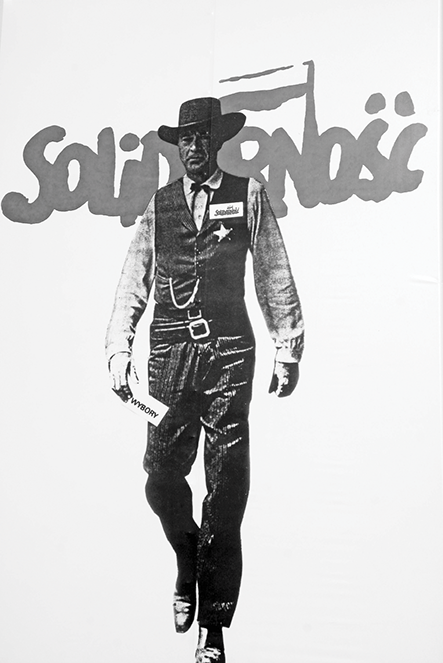
The roundtable agreements between a group of dissident intellectuals from the Solidarity labor movement and the party-state authorities, and the subsequent semi-free elections in June 4, 1989, are commonly accepted as marking the end of state socialism in Poland. The famous election poster hinted at the legal and political imaginary of the Solidarity movement at the time, at least for its leadership (Figure I.2). Featuring the image of Gary Cooper from US Western film High Noon, the poster identified “Solidarity” with the strong-willed, stoic, cool-headed sheriff who in the film strove to fight the Spanish-speaking bandits alone to defend the town and uphold law and order. This identification with a white American cowboy might be partly seen as a Cold War-induced, reactionary endearment toward the US, which involved, among other things, renaming certain public squares after Ronald Reagan in the 1990s.Footnote 83 Yet, the idealization of this “American mythology of freedom” and hypermasculinity, as Agnieszka Graff suggested, should not be underestimated.Footnote 84 The freedom imagined was white male freedom, which resonated particularly well with the postsocialist reiteration of conservative patriarchy and the reordering of geopolitical identifications.

Figure I.2 The election poster of the Solidarity movement, June 4, 1989.
The end of state socialism, as recent scholarship on Eastern Europe has shown, also brought about the devaluation of past socialist ties with the “darker” Third World.Footnote 85 This aspiration for whiteness also meant the expulsion of non-white migrant workers from non-European socialist countries such as Cuba, Vietnam, and Mozambique from Eastern bloc countries.Footnote 86 The end of state socialism, James Mark, Bogdan C. Iacob, Tobias Rupprecht, and Ljubica Spaskova observed, involved “the reconstitution of white colonial Europe” and the displacement of the Iron Curtain “southwards along the Mediterranean, dividing Europe from Africa,” which was materialized by the construction of “over a thousand kilometers of new walls and fences … to redraw the boundaries of an expanded Europe” since 1989.Footnote 87 The public discussions about the life of Ryszard Kapuściński, on which we focus our attention in Chapter 1, offer insight into this global conjuncture, in which liberal legal and neoliberal transformations from state socialism were envisioned in Eastern Europe.
Several tensions and contradictions marked those transformations in Poland. I name only a few here and will discuss them in more detail in the rest of the book. Firstly, the 1989 roundtable agreements between the dissident intellectuals from the Solidarity movement and party-state authorities failed to produce a commonly shared closure and narrative for transition for most of the people.Footnote 88 As often happens at state-level negotiations, the roundtable agreements remained exclusionary and created an aura of secrecy, especially for those groups not seated around the table. There was no political process involving effective popular participation in the discussion of the terms of transition or the justice process that might follow. The “return to Europe” vision largely determined the possible paths that transition might take and left little room for public discussion beyond Eurocentric models.Footnote 89
Secondly, the political elite’s triumphalist proclamations of regained national independence after decades of Soviet domination sat in sharp contrast with the dramatic dependence on foreign capital flows and investment, European legal regulations, and NATO. Eastern European states were made into “competitive states” craving foreign investment, which also meant lowering wages and offering financial incentives for foreign capital.Footnote 90 These uneven relations have provided ample ground for the emergence of antagonistic and reactionary nationalist identity politics seeking moral respect in international politics. Competitive nationalist memory policies and laws that we discuss in the next chapter have thrived in this context.
Thirdly, the celebrations of a radical break with the past, the “thick line” (gruba linia) policy of the first non-communist government in particular, encountered the reality of legal, institutional, and human personnel continuities. This tension between continuity and discontinuity with the party-state was never really settled and manifested itself vividly in the heated discussions, including those about the constitution-making process in the 1990s and transitional justice.Footnote 91
Last, but not least, the liberal proclamations of equal rights and freedom encountered the material reality of expanding social inequalities and vulnerabilities. The violence of neoliberal policies made a farce out of the language of “peaceful” or “velvet” democratic transition, for which 1989 was supposed to stand in contrast to the guillotine of the French Revolution. Society became sharply divided into the “winners” and “losers” of the transition, as the creation of class inequality was integral to neoliberal nation-state making.Footnote 92 The sidelining of the “social question” intensified the already existing division between social rights and civil and political rights, and undermined the collective meaning of civil and political rights, which increasingly seemed like a “privilege” or “shield” for the few members of the legal and political elite or ruling classes.Footnote 93
Altogether, these tensions and contradictions constitutive of the Third Republic have prepared a fertile ground for the emergence of explosive social antagonisms and popular disappointments, grievances, and suspicions of betrayal and conspiracy in the decades to come. Neoliberalization and liberal legal transformations brought about a new distribution of visibility and knowability, which concerned not only the individual right to privacy and reputation but also the secrets of private capital, property, and entrepreneurship – indeed, nothing short of a new distribution of responsibility along public–private lines. The “Europeanization” process was central to the legal and moral procedures and vision of transition and justice, underpinned by the necessities of the privatization of property and the development of rule-of-law institutions. This “moral geopolitical” project of Europeanization, to use the words of József Böröcz,Footnote 94 embedded moral autopsy and transitional justice processes such as lustration within the logic of security as a measure to protect liberal-democratization and neoliberalization of the state from “totalitarian” dangers.
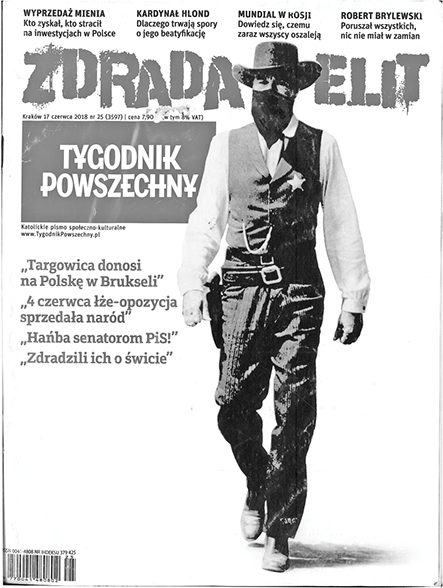
Thus, it has not taken much for rightwing groups to appropriate lustration into their sovereigntist politics of national purification. Lustration’s quest for transparency, games of secrecy, tests of truth, logic of security, and its entanglement with the secrets and ambiguities of the security archives have offered a prolific space for the accumulation, reproduction, and refraction of different forms of secrets and suspicions of betrayal about communist state violence and neoliberal nation-state making. The Solidarity sheriff, who symbolized freedom, prosperity, and progress, came to be rebranded as a bandit in rightwing nationalist discourse (Figure I.3). Rightwing groups have persistently framed the roundtable agreements and the Third Republic as a product of “elite treason” (zdrada elit) and ongoing conspiratorial alliance (układ) between liberal ex-dissident and ex-communist groups against the Polish nation. This political imaginary has been a core component of rightwing nationalist politics, promoted by the Law and Justice Party, which ruled Poland from 2015 to 2023 and claimed to revise the 1990s and establish a new, morally clean, fully sovereign Polish nation-state by using transitional justice.Footnote 95 This moral-political project could also be observed in other Eastern European countries and has had a wide impact on many issues regarding sexuality, gender, labor, housing, and environment.Footnote 96 This book, then, discusses what happened between these two Solidarity men in the context of a seemingly never-ending transitional justice imaginary.

Figure I.3 “Elite Treason,” the cover page of the weekly, Tygodnik Powszechny, June 17, 2018.
Fieldwork on Lustration
Recent research on Soviet and other Eastern European communist secret services has critically interrogated their dominant treatment as an exceptionally lawless, Eastern despotic system and instead studied them within the context of global, regional, and pan-European surveillance institutions and by attending to the social histories of the security officers who took part in those institutions.Footnote 97 The perennial problem of the modern state form, which preoccupied many Marxists in thinking about revolutionary social change, loomed large in the question of security, for instance in the reflections on what to do with the notorious Tsarist secret police (Okhrana) and its archives after the October Revolution, and how to reorganize the security apparatus.Footnote 98 After a moment of experimentation with the legal and state form, and with the onset of civil war that followed the October Revolution, Soviet socialism became increasingly absorbed by the logic of state sovereignty. The Stalinist nationalization and securitization of political, economic, and cultural life in the 1930s further sealed this logic of sovereignty, intensifying the étatization and Russianization of socialism. The bureaucratic state machinery including the secret service produced enormous number of files about almost every sphere of life and generated for itself elaborate rituals and protocols of secrecy.
The Polish communist secret service was largely inspired by the Soviet secret service, especially regarding its form of organization and surveillance techniques. As in other cases of Eastern European communist secret services, the “transfer of Soviet institutions,” of course, did not simply mean the “reproduction” or “transplantation” of those institutions but might be better seen as “imperfect translation,” as Molly Pucci suggested.Footnote 99 The surveillance work engaged by the Polish secret service, to no small degree, relied on “human information sources,” which comprised a number of categories of people beyond what is called “secret collaborator” (Tajny Współpracownik, TW) that lay at the center of lustration. Categories such as “citizen help,” “trusted citizen,” “citizen contact,” “operational contact,” and other informational practices, among them citizen denunciations, complaints, and anonymous letters, together formed the surveillance network in which the act of “collaboration” functioned.Footnote 100 Political authorities saw this informational relationship between the citizen and state institutions as the basis for and expression of popular support. While these information practices allowed state authorities to learn about and control the opinions and affective dispositions of the population, they also served to cultivate loyal and responsible citizens, who in principle, would act on the problems of corruption, exploitation, and injustice they encountered by engaging and informing about them. After the waning of Stalinist repression by the mid-1950s and with the regime’s increasing stabilization, this surveillance network became much larger; in 1988, the number of secret agents reached 98,000.Footnote 101 These information practices, especially (secret) denunciations, as often noted, offered much room for the personalization, if not the “privatization,” of state power. These practices were used by subjects to pursue personal gains, air personal grievances, denounce personal enemies, and invoke or perform the power of sovereign authority in everyday life. They, in other words, distributed power through complex circuits over the social body, including its intimate realms.Footnote 102 But those information practices had also been a site of intense political struggle within the state, as became manifest strikingly in the purges that marked Soviet socialism and in contentious political moments in the Eastern bloc such as the “anti-Zionist” purges within the communist parties and secret services around 1968.
The lustration process relies on this archive of informational practices and categories employed by the communist secret service. My research on lustration also began at the archive. While my curiosity started in 2007, during a visit to Poland when I realized the intensity of public discussions on lustration and the constant stream of media accusations of collaboration, my official rite of initiation was 2009, the moment when I started my research at the Polish Institute of National Remembrance (Instytut Pamięci Narodowej, IPN) after a strenuous application process that involved letters of recommendation. Aside from the IPN employees and authorized state officials, only journalists and scholars and “certified” victims of communism could access the IPN archives at the time. Established in 1998, this state-run memory institution was tasked with prosecuting the “crimes against the Polish nation” and managing the communist security files, which occupy sixty miles of shelf space. It also undertook educational activities including conducting and publishing historical research and organizing public events. Since 2006, the IPN has also hosted the Lustration Bureau (Biuro Lustracyjne). With eighteen branches spread across the major cities and towns of the country, the IPN was the first of this kind of massive bureaucratic institution in Eastern Europe that brought together judicial, archival, pedagogical, and memorial functions, and became a model for other such institutions in the region, as I discuss further in the next chapter.
During my fieldwork, I was mainly located at the Kraków branch of the IPN, where I conducted interviews with the IPN employees and historical research at the security archives kept in the recently renovated eighteenth-century palace in the small town of Wieliczka. I spent about a year in the reading room mostly in the company of young scholars, journalists, priests, and nuns, the most frequent visitors at the time. Since it was possible to order material from different IPN branches, I virtually had access to all the declassified IPN files across Poland. This access was useful for investigating some of the lustration cases that I studied in depth. It was those security files that were used as the main evidentiary source in the lustration examinations and court proceedings. It was also important to see what those files looked like and learn how to read them. I first wanted to gather a general sense of the range of files produced by the secret service. Aside from targeting specific individuals and groups that the secret service considered “suspect” or “ill-disposed” toward the state – thus, almost by definition, toward communism – the secret service also conducted regular checks on almost every sphere of life, from factories, hospitals, and universities to transportation and sewage systems. The files were connected to each other through a dense bureaucratic system. Across the state offices there was a considerable traffic of files partially copied and transferred to one another in accordance with the protocols of secrecy and hierarchies of access.
Since it was not possible to identify a bounded “community” of lustration or satisfactorily contain lustration within a single institution, my fieldwork was dispersed among several cities and institutions. Aside from archival work at the IPN, I conducted interviews with legal officials, lustration prosecutors, human rights lawyers, historians, journalists, and priests, and observed lustration court proceedings and analyzed national and international court verdicts, including the European Court of Human Rights. I studied cultural productions around the issues of lustration such as theater plays and films, participated in public meetings organized by the IPN, and collected life histories of persons – judges, lawyers, academics, journalists – involved in lustration. In total, I was able to observe twelve court proceedings in the cities of Warsaw, Kraków, Poznań, and Wrocław, thanks to the assistance of the lustration prosecutors and the lawyers of the Helsinki Human Rights Foundation in Warsaw, which at the time ran a special program to monitor and document the practices of the lustration law. I examined many other (past) lustration cases including public revelations of secret agents and informal accusations of betrayal by surveying media reports and through conversations with journalists and legal officials. Since my two-year intensive fieldwork from 2009 to 2011, I have organized short follow-up trips to analyze the public discussions and policies related to transitional justice in Poland as it continued to unfold.
During my fieldwork, I was often struck by this puzzle: while lustration was hardly a topic people spoke about in daily life at the time, mentioning the word prompted strong reactions in my interlocutors. Some people immediately started talking about “shameless communists” who robbed Poland; some others said lustration was mainly a topic for the political elite, especially for men craving power, not for the common people and not for women; some people said lustration was urgently needed for state security and sovereignty; some people seemed utterly disinterested and exhausted by the topic of lustration and its many controversies; some other people said they were sorry for me, as the topic of lustration was morally so heavy (ciężki temat); but the great majority of people said lustration should have been done in the early 1990s and now it was too late and complicated.Footnote 103
All these reactions have revealed important aspects of the course of Polish lustration. Lustration has indeed been a male-dominated issue. The political class and high- and mid-level public offices and the communist secret service and its information network were and are still largely populated by men, although the popular representations of secret communist agents might use the figure of the treacherous woman, something of a femme fatale obtaining secrets from men, typically for another man, the security officer.Footnote 104 This perception of lustration as a topic for men has highlighted the persistence of patriarchal power across state socialism and the neoliberalizing state. The “Solidarity” sheriff became subjected to the trenchant criticism of feminists in Poland who took issue with the masculinist portrayal of the Solidarity movement that shows it as male heroism, leaving many women who played a key role in the making of the movement in the shadows.Footnote 105 Furthermore, the emphasis on the belatedness of lustration highlights the crucial point that the pure object of lustration has been irretrievably lost. With the passage of time, lustration has become inextricably enmeshed with the questions of power, inequality, exclusion, and injustice related not only to the socialist past but also to capitalist nation-state making and citizenship. Decades after the fall of state socialism, the suspicions of betrayal, deception, and secrecy that are ingrained in and “revealed” by lustration practices concerned no less the problems of neoliberal nation-state making. The framework of linear progressive temporality, which takes the past as left behind, fails to grasp the entanglement and interpenetration of temporalities and co-articulation of those problems.
Indeed, Polish lustration, from the beginning, has been entangled in the problem of “managing” the violence of neoliberal state building and the contradictions of democratization, as well as the contending visions of political community and citizenship. The history of lustration is marked by accusations and counter-accusations of collaboration, coup d’état suspicions, political scandals, alleged agent lists circulating in the parliament and in the media, alleged leaks from the security archives, and shadowy “file wars” at the “top of the state,” all of which led Piotr Grzelak, a perceptive scholar of Polish lustration, to aptly call his study War over Lustration (Wojna o Lustrację).Footnote 106 Overall, Polish lustration can be analyzed in three phases. The first is from 1989 to the official initiation of lustration in 1997; the second from 1997 to the landmark decision of Poland’s Constitutional Tribunal in 2007 about the new lustration act drafted by rightwing nationalist parties at the time; and the third traces lustration from 2007 to today, including the current rightwing populist government’s transitional justice policies. Here, I offer a brief overview of these phases to contextualize the research, which grounds this book.
The first non-communist government led from 1989 to 1991 by the well-known ex-dissident intellectual, Tadeusz Mazowiecki, formulated a “thick-line” approach to break the present from the past and start anew. Mazowiecki embedded this policy within its liberal civic vision of law-governed, pluralist, and “inclusive” democracy. While the Mazowiecki government conducted a verification process of key state institutions such as the security and judicial apparatuses, it did not initiate decommunization or lustration, despite demands of radical anticommunist groups in parliament. The violence of neoliberal “shock therapy” policies, which included drastic public cuts and accelerated privatization and deregulation of the economy, and instigated volatile, albeit disorganized and fragmented labor protests, was such that it did not seem to allow for opening another front of struggle, this time with the ex-communist establishment.Footnote 107 The Mazowiecki government sought to ensure the relative stability and security of neoliberal state making, which it also presented as a way to rectify the socialist past.Footnote 108
This, however, did not stop the aspirations for lustration. The rightwing conservative government that followed Mazowiecki sought to initiate lustration in 1992 but this resulted in the political scandal known as “The Night of Files” or the “Macierewicz List.” The then Minister of the Interior, Antoni Macierewicz, was given the mandate to prepare a list of names of MPs linked with communist secret services. Limiting his research to the registration records of the security archives, but not checking the files indicated by the records, Macierewicz presented a list of some sixty names in closed envelopes to the MPs. While the list did not say what those names stood for, in that context the names are generally understood as agent names. Many named persons protested that they had no chance to defend their names and there was also no evidence about their alleged collaboration except the list hastily prepared by Macierewicz. They accused the government of plotting a coup d’état that threatened state security. The scandal eventually toppled the government. Since then, many rightwing proponents of lustration have seen this episode as the moment of truth that revealed the secret machinations of ex-dissident and ex-communist alliance.
In the meantime, the impact of “shock therapy” and bitter political infighting among ex-dissidents was such that the ex-communist Democratic Left Alliance (Sojusz Lewicy Demokratycznej, SLD) Party won the national parliamentary elections in 1993. This was largely due to their social-democratic rhetoric of social welfare despite their vocal opposition to anything like lustration. Like all other parties, liberal or rightwing, ex-communists continued to implement free-market reforms.Footnote 109 Yet, the accusations of collaboration directed at different politicians continued and hit the government as well (e.g., the Józef Oleksy affair). It became clear that a named person had no legal means to defend themself against the accusations, rumors, and leaks from the security archives. In 1996 a key European Resolution no. 1096, concerning transitional justice was presented to the Eastern European countries that were in the process of European integration. As I discuss in the next chapters, this document set the main liberal framework of lustration, presenting it as part of the privatization of the state, deregulation of the economy, and development of civil society, human rights, and rule-of-law institutions. Thus, partly to legally regulate the accusations of collaboration and affirm the Polish state’s international credibility, the lustration law was introduced in 1997, when a rightwing coalition government came to rule. That was also the year when the new constitution was made. The lustration law was the product of the negotiations between mainly liberal and conservative groups. Like the Constitution, it was also largely dominated by a liberal democratic orientation.Footnote 110
The second phase of lustration met the “second wave” of neoliberalization (1999–2001). It was initially introduced by the rightwing coalition government and later extended by SLD, which won the national elections once again in 2001. This second wave included a set of policies packaged as part of the European accession process, which aimed to cut jobs in the public sector and privatize such important sectors as public transportation, telecommunications, and the health sector. The early 2000s witnessed another cycle of economic crisis and austerity and by the mid-2000s the registered unemployment rate had risen to 25 percent, about 40 percent among the young. This number still did not count those people who had fled to the Western European countries for employment after the accession of Poland to the European Union in 2004. The ex-communist party faced growing social discontent and crumbled spectacularly under corruption scandals. With that, they also lost whatever influence they had on public discussions about lustration and transitional justice more generally. Until then, the ex-communist SLD Party had twice ruled the country and ex-communist Aleksander Kwaśniewski had twice served as president of Poland.
From this moment onwards, rightwing nationalist parties began substantially challenging the hegemony of ex-dissident liberal and ex-communist groups. They rallied around radical lustration and de-communization projects to rebuild a new, morally pure, and fully sovereign Polish state. From 2005 to 2007, the rightwing coalition government established a new anti-corruption watchdog, introduced amendments to the Constitution and revised laws on public media and education, attempted to screen and reorganize the military intelligence and other security forces, sought to improve relations with the US military and capital to counterbalance Brussels and Moscow, and aimed to restrict women’s reproductive rights and freedoms, insert Christian references into the Constitution, and remove the names associated with communism from public space.Footnote 111 It was in this context that the rightwing populist government amended the lustration law in 2006 to expand its transparency-driven security logic, extend its reach to previously excluded arenas such as education and media institutions, remove the courts from the lustration process, endorse online platforms to reveal the names of agents, and turn lustration into a radical and swift purification policy in the service of a “moral revolution” and new nation-state building. Lustration became the central site of this political project, which at the same time faced widespread opposition from different groups including journalists, academics, politicians, and legal officials. After the landmark decision of Poland’s Constitutional Tribunal in 2007, radical lustration became somewhat compromised, yet has continued to function to this day. During the government of the liberal-conservative Civic Platform (Platforma Obywatelska, PO) Party, from 2007 to 2015, the number and speed of lustration examinations increased. There was no substantial amendment to the lustration law, except the proposal to loosen the highly restricted public access to the security archives in 2010.
As my fieldwork was situated in this third phase of lustration, in the legal and political aftermath of the mid-2000s contentious period of lustration, I could examine closely the effects of wild and official lustrations and the battles within the courts and different social arenas, which continued well into the 2010s. At the same time, my analysis looks toward the post-2015 period when the Law and Justice Party (Prawo i Sprawiedliwość, PiS) that largely devised the radical lustration project in the mid-2000s came to rule Poland. In many ways, the mid-2000s prefigured the authoritarian policies of the rightwing populist government, especially its appropriation of a transitional justice discourse and assault on the courts, which some scholars see as political revenge.Footnote 112 This book indeed closely analyzes some of the important legal battles with the judges and the Constitutional Tribunal that arguably informed the political offensive of the recent PiS government. Moreover, one might also observe some apparent links between the mid-2000s and the political cadre of the post-2015 PiS government (e.g., the Minister of Justice at the time, Zbigniew Ziobro). My recent short-term visits to Poland made me realize that many of the people involved in lustration and the IPN that I met during fieldwork came to occupy key public offices during the rightwing populist rule between 2015 and 2023.
It is important to note that while the rightwing government did not make a new lustration law altogether, contrary to expectations, it introduced new measures to the existing lustration procedure.Footnote 113 Through a variety of tactics that made use of the already existing legal rules and institutions, the government sought to expand the scope of lustration and modify its examination process. In this sense, this rightwing appropriation of lustration helps us understand rightwing authoritarian legalism’s general approach to the liberal legal institutions. As in other legal areas, the rightwing government has sought to change the legal system through piecemeal and incremental reforms instead of iconic acts of constitution making, as in Hungary.Footnote 114 Moreover, it is striking to observe that official lustration, especially since the early 2010s, became even more systematic and swift. This might seem peculiar for a justice measure that was supposed to be temporary. Lustration officials received about 27,000 statements between 1998 and 2007, whereas in the third phase of lustration, from 2007 to 2023, they received more than 457,000 statements. From 2006 to 2023, 1,849 of the court cases initiated by lustration prosecutors who suspected a lie agreed with the lustration prosecutor’s suspicion and sentenced the lustrated person to a three- to ten-year ban from performing public functions. The court upheld the prosecutor’s decision in about every three cases out of four, especially since the rightwing Law and Justice Party came to rule in 2015.Footnote 115 Yet, the backlog of unexamined statements, which totaled about 300,000 statements in 2018, was such that it was estimated to take about thirty years for the prosecutors to finish verifying the entire pile if they worked only on those statements.Footnote 116 The lustration prosecutors apparently had to select certain statements to examine closely out of a huge number. The discretionary power exercised by the prosecutors fostered even more suspicion about political bias in this highly polarized political context.
However, the impact of lustration was not only manifest in the number of lustration examinations, the senior lustration prosecutor, now the head of the National Lustration Bureau, Jarosław Skrok, told me in conversation.Footnote 117 Lustration, he said, deterred many more people who opted not to apply for a public position in order to avoid the “risk” of lustration. The real force of lustration was its preventive power. Lustration worked silently, invisibly, and infinitely.
Overview of the Book
Moral Autopsy departs remarkably from most studies of lustration, which approach it in a macro-comparative national framework and confine their scope to lustration’s formal legal-institutional domain. These studies tend to focus their attention on party-political competitions and pragmatic and ideological motivations of political actors vis-à-vis lustration, and offer an analysis of court decisions, legislation, and parliamentary debates.Footnote 118 They rarely relate lustration to capitalist nation-state making, but when they do, this relationship is often framed as a moralistic problem of “corruption,” “pathology,” or “political capitalism,” driven by ex-communists and secret communist agents with suspect moralities and motives. Of these studies, that of Maria Łoś and Andrzej Zybertowicz has been one of the most rigorous.Footnote 119 The authors investigated the secret and illicit participation of ex-communist security officers in the privatization of what they call the “police state.” They argued that many security officers, who were laid off after 1989, began running private security companies. Drawing on their skills and insider knowledge, ex-security officers used these companies to monitor economic activities and emergent entrepreneurs and blackmail or threaten their market competitors.Footnote 120
A few critical studies placed lustration in the context of neoliberal state and class formation in Poland and the Czech Republic. In this vein, one of the most compelling studies is that of David Ost, which provided an empirically rich account of the well-known displacement thesis: the nationalization of class struggle under the hegemony of (neoliberal) “market fundamentalism.”Footnote 121 Based in Poland, his study showed how rightwing populist leaders and trade unionists gradually managed to organize the anger of the dispossessed and fragmented working class in the language of sexist, xenophobic, anti-Semitic, and anticommunist nationalism. These rightwing groups, Ost argued, diverted the workers’ “economic anger” toward exclusionary, majoritarian identity politics including lustration, invoking the figure of the “red baron” to blame and explain away the problems of neoliberalization. Capitalism was corrupt because it was “red capitalists” who ran it.Footnote 122
While studies like this are helpful, they say little about what lustration does in practice and how it affects the persons and their associates and operates as a form of power in its own right. Departing from instrumentalist approaches that treat law as a mere tool for political struggle, this book rather focuses attention on the mediatory, constitutive, and performative role of the law and explores the multifaceted effects of the judicialization of truth, history, memory, and subjectivity. In this respect, I approach law as a locus of hegemony, domination, and struggle, and a particular form of reasoning, suspicion, and examination, which travels well beyond its formal-institutional domain, as in, for instance, media, memory, and self-examination practices.Footnote 123 Questions of secrecy and transparency are integral to law. A perennial domain where clashes over secrets historically play out and visions of publicity and transparency find articulation, law is at the same time troubled by secrets, which it partly produces, for instance, through its evidentiary proceedings.Footnote 124 The book studies law as it traffics in secrets and figures as a central site of the political struggles over the boundaries of the visible and the knowable.
As is generally the case in transitional justice projects around the world, Polish lustration has woven around itself a moralistic and polarized world that makes it hard to engage without falling into one of the dominant political blocs.Footnote 125 While the critics of lustration tend to focus on the allegedly vengeful, resentful, and authoritarian personalities of nationalist groups leading the justice process, condemning them, for instance, as “rightwing Bolsheviks,” the proponents of lustration tend to take criticism as a trivialization of communist state violence, or as a sign of secret guilt or complicity with that violence. These arguments are hardly unique to Poland, Eastern Europe, or lustration. The moral-psychological personalization of authoritarian power is well known, but the argument that seeks to immunize lustration from critique also resonates well with other conservative arguments mobilized in, say, the US to support the “war on terror” or in Turkey to justify the state’s unending quest to root out “traitors” and “terrorists”: if you criticize, you support terrorism.
My fieldwork and writing have also been inscribed into this highly polarized world of lustration. Instead of claiming or pretending to “overcome” or “transcend” it, I am more concerned about the ways in which the world of lustration has been produced socially, materially, and legally, and has positioned me, often, beyond my control and beyond the particular spatiotemporality of my fieldwork.Footnote 126 Given the polarized and moralized world of lustration, I have paid special attention to the issue of naming my interlocutors. In order to avoid partaking in the practices of public naming and disclosure, which are prevalent in lustration, I have opted for using pseudonyms for my interlocutors (and their close associates) who were subjected to lustration, unless my interlocutors wanted me to use their real names, or the cases were already publicly well known and my analysis of them was limited to the usage of publicly available material such as media reports, academic publications, and information bulletins, as in the case of the journalist Ryszard Kapuściński and the former president of Poland, Lech Wałęsa.Footnote 127 In cases where my interlocutors expressed concern about their personal information, I did not include that piece of information in my description or turned them into generalized or anonymized references (e.g., the town of residence; workplace). Using pseudonyms, as is often noted, does not guarantee the full protection of the identity of the interlocutors. However, this practice might still help readers shift their attention from the names of interlocutors to what they actually said, did, and lived through.Footnote 128
Ethnography is typically marked by the disjuncture of “being there and then” (in the field) and “being here and now,” and involves a continual process of translation and analysis of research insights in the shifting contexts of writing. A way of knowing, ethnography aims to enliven and give “descriptive flesh to what might otherwise read as dry, distant, and disengaged analytic accounts.”Footnote 129 In this sense, ethnography is well positioned to critically engage the terms of moral autopsy and develop an alternative methodology to address the questions of life, truth, belonging, and responsibility beyond their judicialized and moralized formulations. The thriving field of moral anthropology is particularly promising. Anthropological reflection on moral sentiments, values, and situations is obviously not new, but this line of moral anthropological inquiry has obtained a new force and meaning, partly in response to the global “moralization of politics,” the so-called moral turn of the post-Cold War era.Footnote 130 Didier Fassin described succinctly the key concerns of moral anthropology: It “concerns the creation of moral vocabularies, the circulation of moral values, the production of moral subjects and the regulation of society through moral injunctions. The object of a moral anthropology,” wrote Fassin, “is the moral making of the world.”Footnote 131 It is important to note that this inquiry does not have a moralizing project such as the promotion or condemnation of particular moral values as good or evil. Moral anthropology intends to “analyze rather than evaluate, to understand instead of judging.”Footnote 132 A part of this endeavor involves enlivening the social and personal world of moral experiences, sentiments, and practices, and analyzing critically the conduct of moral agents including both state and non-state actors within different institutional and informal contexts.
In this sense, Moral Autopsy can be considered as a critical moral anthropology of the legal and political reckoning with the socialist past. In my analysis of lustration, I aim to situate the lives that come under moral autopsy in their social-historical milieu and attend to the desires, vulnerabilities, conflicts, and contradictions marking those lives. Together with moral anthropology research, the insights offered by the work of Karl Marx, Antonio Gramsci, Maurice Merleau-Ponty, and Gilles Deleuze suggest generative ways of conceiving the person as an “ensemble of social relations” that are at once historical, collective, and singular, and conflict-ridden and open-ended.Footnote 133 The material processes of life-making involve the contingent historical forces that constitute oneself and through which one becomes, a perspective that is engaged by recent anthropological scholarship.Footnote 134 Merleau-Ponty put it eloquently: “To understand and judge a society, one has to penetrate its basic structure to the human bond upon which it is built; this undoubtedly depends upon legal relations, but also upon forms of labor, ways of loving, living, and dying.”Footnote 135 Heeding this insight, what follows attends to the social relations and forms that unfold within and emerge alongside and, at times, outside the lustration process. It explores the ways in which the terms of moral autopsy and lustration are articulated, but also challenged, unsettled, or decentered through a variety of practices including courtroom practices, rights struggles, public performances, and cultural productions.
Moral Autopsy examines lustration in three major parts, each comprising two chapters. The first part offers a broad perspective on lustration by placing it in the post-Cold War context of the rule of law, the “moral turn,” neoliberal globalization, European enlargement, rightwing populism, and history and memory politics. Chapter 1, “Judicializing and Dissecting Communism at the ‘End of History’,” develops a genealogy of the notion of moral autopsy by tracing its historical and conceptual sources and probing its ethical-political and methodological implications for understanding the social-historical relations of power, ideology, and political subjectivity and action. The chapter situates moral autopsy and lustration within the post-Cold War conservative historical revisionism and competitive memory politics, based on national victimhood and innocence, with a focus on the notion of “communist crime,” which largely draws on the notion of “Nazi crime” and seeks to harness its transnational moral-political force. In this respect, state-run national memory institutions and commissions in Eastern Europe are one of the key agents of moral autopsy. Through a detailed analysis of the Polish Institute of National Remembrance and by continuing the discussion of Ryszard Kapuściński’s posthumous media lustration and the questions of secrecy, truth, deception, and treachery raised about him, the chapter fleshes out the highly judicialized, moral-political space of moral autopsy and lustration and interrogates critically its understanding of the state, ideology, and subjectivity, including the legacy of Cold War socialist internationalism.
Chapter 2, “Democracy Must Be Defended: Sovereignty, Property, Security,” shifts the focus to the legal formulation of Polish lustration law in the emergent national and international legal space. The chapter shows how Western capital-driven neoliberalization and the Europeanization process have informed lustration law, linking it closely to liberal legal capitalist arrangements, especially the private property regime and security mechanisms that have found expression, for instance, in the legal doctrine of “militant democracy.” To delineate the contentious legal-political space of lustration, the chapter analyzes the landmark verdicts of Poland’s Constitutional Tribunal about lustration legislation, particularly the Lustration Act drafted in 2006 and amended in 2007 by the Law and Justice-led government to radicalize and expand the scope of lustration, a version of which is still in force today. To explore in more detail the “European” context of lustration, the chapter offers a detailed analysis of a lustration case seen by the European Court of Human Rights in Strasbourg.
Part II, comprising Chapters 3 and 4, features ethnographic studies of lustration court proceedings, one of which concerns a former Constitutional Tribunal judge and the other an academic historian. These chapters focus on the trials, especially the courtroom performances, evidentiary process, and witness testimonies, as well as the entrenched suspicions about the political instrumentalization of law and history. Chapter 3, “A Biography of Law: Fear, Shame, and Responsibility,” is a study of a judge’s life history, through which I flesh out the antagonistic field of legal and moral argumentation around lustration with a focus on the notion of “communist guilt” and the subjective effects of public shaming. The chapter highlights how lustration brings into focus the entangled problems about the socialist-era state violence and neoliberal capitalist violence around which rightwing populist groups mobilize. In conversation with the work of Iris Marion Young and Hannah Arendt, among other works, I suggest an alternative mode of responsibility that addresses this entanglement and thinks past the narrowly construed, individualized, guilt-driven understanding of moral and legal responsibility.
Chapter 4, “Naming the Secret Communist Agent: Suspicion, Archive, and Ambiguity,” is an ethnographic study of the self-lustration court trial of an academic historian. By focusing its attention on the evidentiary process, court testimonies, and courtroom interactions and performances, the chapter explores the micro-practices of lustration, especially the different forms and objects of suspicion that are in play in the court proceedings, and the way these suspicions affect the social world of the lustrated persons and their close associates. It shows how lustration’s nation-state-centrism, which manifests itself in its extensive dependence on the security archives and the court’s reliance on the testimonies of former security officers, poses crucial challenges for the court in ascertaining ambiguities and settling suspicions, and makes lustration particularly instrumental by political groups. More generally, the chapter shows how law mediates and reproduces the relations of domination and inequality as it becomes an arena for critical engagement with and even deconstruction of the terms of lustration by revealing, even if sporadically, the largely overshadowed histories of friendship and solidarity.
The third and final part of the book attends closely to the relationship between hegemony, transitional justice, and media and cultural practices. By problematizing the boundaries of official lustration and tracking lustration across media practices and cultural performances, this part explores the ways in which lustration takes part in the hegemonic struggles over the making of public life after state socialism. Chapter 5, “The Right to Know: Publicity and Media Revelations from the Archives,” discusses the unofficial or “wild lustration” (dzika lustracja) including highly mediatized “agent lists,” ad hoc commissions, and the historical research about the famous worker dissident and later president of the Polish Republic, Lech Wałęsa. The chapter places lustration within postsocialist capitalist transformation of media sector and sensational modes of publicity in which “secrets” from the security archives are revealed and the right to know has come to be exercised. The chapter attends to the ways in which liberal and conservative nationalist groups mobilize legal rights against each other, especially freedom of speech and freedom of academic research and the right to a good name. Studying these legal battles illuminates the ways in which transitional justice connects to a number of struggles over the making of democratic public life.
Chapter 6, “Performing Law: Public Scenes and Contentions of Truth-Telling,” delves further into the public intimate life of transitional justice by focusing attention on questions of subjectivity, secrecy, and the desire to know and not to know. By analyzing popular cultural practices and public performances, especially theater plays and films, the chapter details the ways in which lustration reconfigures the social relations of intimacy and selfhood in the mode of moral autopsy, but at the same time meets different forms of contention and even opposition. In particular, the chapter offers an ethnographic study of the experimental play by Wojtek Ziemilski, Small Narration (Mała Narracja), which highlights the layered relationship between theater and law and shows the extent to which the judicial and moralized forms of examination and judgment might travel and be contested by alternative forms of knowing, not-knowing, and relating to life, history, and politics.
The concluding chapter, “Of Truth and Political Responsibility,” draws insights from this study of lustration to reflect on the relationship between transitional justice, power, and law at this current global conjuncture of the alleged end or “eclipse” of liberal democracy, the crisis of representative institutions, and the rise of rightwing authoritarian populism. The chapter organizes the concluding reflections by focusing on the relations of continuity and transformation between liberal legalism and rightwing authoritarian populist legalism, especially in the context of transitional justice; the problem of Eurocentrism and capitalist and nation-state centric politics of transitional justice. It revisits the notions of truth and political responsibility that the book has developed as part of its attempt to envision socially transformative justice beyond moral autopsy.
The book ends with a brief Epilogue to reflect on the current public discussions and struggles in Poland about ways to dismantle the legacy of rightwing authoritarian populist legalist rule and “restore” democracy and the rule of law. These discussions raise critical questions about how to think about political strategy and the relationship between law, authoritarianism, democracy, and transitional justice today, at the alleged ends of rightwing authoritarian rule from an international and historical perspective. In light of these discussions and the insights accumulated in this study, I suggest an alternative way of formulating the question of social transformation and justice beyond the imaginary of the “restoration” of democracy.