


Although young people are accustomed to thinking about their physical health, their attitudes towards mental health are different. One reason for this may arise from the dearth of provision for young people with mental health difficulties so that this aspect of healthcare remains shrouded in mystery. Although child and adolescent mental health disorders are present in around 10% of the population, Reference Villeneuve, Bérubé, Ouellet and Delorme1 children and their parents often fail to make use of appropriate services. Most do not seek professional help and are managed in non-psychiatric settings such as schools. A second reason is that, in society at large, there are still many negative and stereotypical views about mental illness and mental health problems. Other reasons for failure to use appropriate services include lack of identification, non-referral and low self-referral. Additionally, the low acceptance rates occur because child and adolescent mental health services (CAMHS) are often overstretched or non-existent. Through the negative attitudes about mental illnesses that pervade public thinking, children learn from a very early age that psychiatric problems are personal failures and that children who receive psychological treatment are to be despised. Reference Crisp, Gelder, Rix, Meltzer and Rowlands2–Reference Cowie, Boardman, Dawkins and Jennifer4 Stigma, with attendant feelings of guilt and shame or defensive denial, is one of the biggest challenges that young people with mental disorders face. Reference Cowie, Boardman, Dawkins and Jennifer4–Reference Kirkaldy, Eysenck and Siefen6 Research indicates that many young people possess negative attitudes towards mental health difficulties among peers. Reference Kirkaldy, Eysenck and Siefen6–Reference Hayward and Bright12 They use mockery, pejorative language and social exclusion to reduce the perceived threat posed by peers with mental health difficulties. Reference Kendell and Crisp5,Reference Kirkaldy, Eysenck and Siefen6,Reference Hayward and Bright12 Research suggests that adolescent boys, compared with girls, may be particularly likely to diminish the mental health difficulties of others because of their tendency to hold ‘macho’ or ‘laddish’ values Reference Naylor and Cowie13 and to avoid seeking help with their emotional problems. Reference Naylor and Cowie13,Reference Smith, Talamelli, Cowie, Naylor and Chauhan14 There is also a tendency for adults to trivialise the problems of young people in comparison with those of adults. The sense of embarrassment that surrounds the concept of mental health difficulty contributes to the fact that such problems are often unrecognised or even denied. Young people often deal with personal mental health problems in unsophisticated ways such as bottling them up, sleeping, drinking alcohol or simply hoping that they would go away. Reference Armstrong, Hill and Secker15
The longer-term impact of interventions designed to improve adolescents' knowledge and understanding of mental health is underexplored. Reference Armstrong, Hill and Secker15 In the present study we hypothesised that directly teaching adolescents about mental health would result in significant and lasting gains in their knowledge and understanding of what they had been taught and empathy towards people with mental health difficulties. We expected these positive effects to be greater for girls than for boys. Ethical approval was granted by H.A.C.'s university research ethics committee.
Method
A two-group pre-test–post-test control group design was used in which only one school (experimental, School E) received a teaching intervention of six 50 min lessons on mental health issues. The control group school (control, School C) was given access to the intervention teaching materials on completion of the research. These schools, in similar suburban contexts in Greater London, England, were identified using data from England's Department for Education and Skills 16 on their number of pupils on roll and on their performance profiles regarding pupil non-authorised absences, public examination results for 16-year-olds (the General Certificate of Secondary Examination (GCSE)) and other ‘hard’ data (Table 1).
Profiles of participating schools (1999–2001) 16

| School C | School E | |
|---|---|---|
| Pupils on roll in 2001, n | 1492 | 1300 |
| Ethnic minority pupils in 2001, % | 7.1 | ∼10.0 |
| GCSE examination results, %a | ||
| 1999 | 46 | 47 |
| 2000 | 52 | 57 |
| 2001 | 47 | 51 |
| Receiving free school meals in 2000, % | 0.4 | 0.2 |
| Pupil non-authorised absences in 2001, % | 0.9 | 0.3 |
| Pupils with Special Educational Needs (SEN) in 2001,b % | Unavailable but ‘… typical for a school of this size’ | 4.3 (‘… above average…’) |
| OFSTEDb inspection report overall rating in 2001 | ‘… is a good school with some significant strengths’ | ‘… is a very successful school…’ |
Participants were 14- and 15-year-olds. Parents of all pupils involved in the study received a letter outlining the teaching programme and the purposes of the research. Parents were invited to contact the school with any queries about the teaching programme or the research. Consultative meetings were held with senior teachers in both schools and with the seven group tutors (teachers responsible for the pastoral care) of the participating pupils in School E to design and agree the intervention. Six lessons on mental health issues were delivered once a week over a 6-week period by the seven tutors. The topics of these lessons were: stress; depression; suicide/self-harm; eating disorders; bullying; intellectual disability (referred to as learning disability in UK health services). Lesson plans were based on a variety of age-appropriate resources, including Royal College of Psychiatrists' booklets and factsheets 17,18 and video-films. 19,20 Teaching methods used included discussion, role-playing and internet searching.
The group tutors received a 1-day in-service training delivered by the research team consisting of two social/developmental psychologists (who are both qualified and experienced secondary school teachers), a child and adolescent psychiatrist, a service user from a mental health charity, and the school's head of year (another teacher) who had overall responsibility for the delivery of the mental health programme. This teacher also monitored the tutors' delivery of the lessons and held regular debriefing meetings with them.
The week before the intervention began (T 1) in School E, pupil participants in both schools E and C completed a Mental Health Questionnaire (MHQ) and the Strengths and Difficulties Questionnaire (SDQ). Reference Goodman21 Six months after the end of the intervention (T 2), these questionnaires were completed again as well as pupils' evaluations of the intervention. The MHQ was developed specifically for the present study by the research team for use with adolescents. It was adapted from the Royal College of Psychiatrists' Attitudes to Mental Health and Knowledge of Mental Health Issues questionnaires, 22 which were designed for use with adults using the standard methodology employed in the Office for National Statistics Omnibus Surveys in the UK, Reference Crisp, Gelder, Rix, Meltzer and Rowlands2,23 although no psychometric properties of the measure are published. The MHQ consists of 15 questions designed to elicit respondents' knowledge and understanding of the six intervention topics delivered in School E. The SDQ is a 25-item behavioural screening questionnaire that concerns children and young people's behaviours, emotions and relationships, with five items for each of the five scales: hyperactivity; emotional symptoms; conduct problems; peer problems; prosocial behaviour. The scores for the five scales range from 0 to 10 with higher scores indicating more problems/symptoms, except for the prosocial scale where the reverse is true. A total difficulties score (range 0–40) is derived by summing scores from all of the scales except the prosocial behaviour scale. The psychometric properties of the SDQ confirm: the predicted five-factor structure (emotional, conduct, hyperactivity–inattention, peer, prosocial); that the internalising and externalising scales are relatively uncontaminated by one another; that reliability is satisfactory (internal consistency by Cronbach's alpha, mean=0.73; test–retest after 4–6 months, mean=0.62). Reference Goodman24 Although SDQ scores are often used as continuous variables, ‘rough-and-ready caseness’ scores based on a community sample of adolescents are available. Reference Goodman25 However, because we have used the SDQ for non-clinical purposes, we have not identified cases or examined the effect of the intervention on them.
In the lesson immediately following the end of the intervention pupils were asked to complete a short questionnaire with sections on each of the mental health topics covered. For each topic pupils were asked two questions. One question asked ‘How much did you learn about (the topic)?’ Five response alternatives were offered ranging from ‘Nothing’ (scored 0) to ‘A lot’ (scored 4). The second question asked ‘How important do you think (each topic) is for you?’, for which the five response alternatives offered ranged from ‘Not important’ (scored 0) to ‘Very important’ (scored 4).
Sample size
For the purposes of sample size estimation the primary outcome was the mean post-test SDQ emotional symptoms score (SDQ–ES). Assuming a standard deviation of 3.0 points in SDQ–ES scores at post-test and that a mean difference of 1.0 or more points between the intervention and control groups would be regarded as practically important, then to have a 80% chance of detecting this difference as statistically significant at the 5% (two-sided) level would require 143 children per group (286 in total). With a 20% loss to follow-up at T 2 we would therefore need to recruit approximately 180 children per group (360 in total).
Statistical analysis
This study is an example of a cluster design, in which the research participants (pupils) are not sampled independently but in a group (school). Members of a cluster (and their outcomes) will be more like one another than they are like members of other clusters. We need to take this into account in data analysis. However, in this study, we had only two clusters, a control and an experimental school, with no way of estimating the within-cluster correlation, so we have had to assume that the participants are independent observations. The simple, unadjusted analysis compared mean SDQ and MHQ scores at T 2 between schools using a two independent samples t-test and a 95% confidence interval (CI) for the mean difference in scores between the groups, which we report. The adjusted analysis used multiple regressions with T 2, SDQ or MHQ score as the outcome, and baseline T 1 score and gender as covariates. The regression coefficient for the school parameter and its associated 95% CI from this regression model is reported. If a pupil in School E did not attend any of the intervention lessons, on the intention-to-treat principle, we have included his/her data as being in the intervention group. School E pupils' evaluations of the intervention have been analysed using the Mann–Whitney U-test. For all analyses, a P<0.05 is regarded as statistically significant.
Results
School and participant sample characteristics
Table 1 shows that the two schools were similar in terms of their size and educational performance. Figure 1 shows how many pupils participated in each stage of the study. Mental Health Questionnaire and SDQ data at T 1 and T 2 were available for 149 pupils in School E and 207 in School C.
Flow diagram of pupil numbers at each time point.

At T 1 (pre-intervention) in School E, 44.3% of the pupils were female (66/149) and in School C, 48.8% (102/207) (P=0.46). Table 2 shows the characteristics of the pupils in each school at T 1, before the intervention. It shows that the pupils in the two schools had similar SDQ dimension scores at T 1, except for the peer problems dimension, where children in School E had the higher mean score. The two schools also had similar mean scores on the six MHQ questions, which have been analysed for the present purpose. Additional analysis has been conducted on the total number of pejoratives used separately at T 1 and T 2 by respondents in their answers to all 15 questions in the MHQ. Examples of pejoratives used by respondents are shown in Appendix 1.
Summary of responses to Mental Health Questionnaire (MHQ) and Strengths and Difficulties Questionnaire (SDQ) at T 1 (pre-intervention) by school

| School C | School E | ||||||
|---|---|---|---|---|---|---|---|
| Measure | n | Mean | s.d. | n | Mean | s.d. | P a |
| Strengths and Difficulties Questionnaireb | |||||||
| Emotional symptoms | 207 | 3.3 | 2.1 | 149 | 3.4 | 2.4 | 0.76 |
| Conduct problems | 207 | 2.6 | 1.7 | 149 | 3.0 | 1.8 | 0.10 |
| Hyperactivity | 207 | 4.3 | 2.1 | 149 | 4.4 | 2.2 | 0.68 |
| Peer problems | 207 | 1.6 | 1.4 | 149 | 2.0 | 1.5 | 0.04 |
| Prosocial behaviour | 207 | 6.8 | 1.9 | 149 | 6.5 | 1.9 | 0.10 |
| Total difficulties | 207 | 11.9 | 5.0 | 149 | 12.7 | 5.0 | 0.10 |
| Mental Health Questionnairec | |||||||
| Number of valid mental health difficulties identified | 207 | 1.4 | 1.3 | 149 | 1.4 | 1.4 | 0.97 |
| Number of valid ideas about why people bully others | 205 | 1.8 | 0.5 | 142 | 1.4 | 0.6 | 0.71 |
| Awareness of why people are depressed | 204 | 2.1 | 1.0 | 142 | 1.9 | 1.1 | 0.11 |
| Awareness of why people feel suicidal | 201 | 1.7 | 0.6 | 139 | 1.6 | 0.7 | 0.14 |
| Number of valid ideas for why people are bullied | 202 | 1.5 | 0.7 | 145 | 1.6 | 0.7 | 0.19 |
| Number of valid ideas on the effects of bullying | 201 | 1.9 | 0.8 | 143 | 1.5 | 0.9 | 0.11 |
| Number of pejoratives used | 207 | 0.25 | 0.7 | 149 | 0.22 | 0.7 | 0.74 |
SDQ scores at T 2
Table 3 shows the mean SDQ scores at T 2. There were statistically significant differences between the schools' scores on the conduct problems (P=0.0008) and prosocial behaviour (P=0.006) scales (after adjustment for T 1 score and gender) with School E having the better outcome. There were no significant differences on peer problems, hyperactivity, emotional symptoms and total difficulties SDQ scores.
Comparison Mental Health Questionnaire (MHQ) and Strengths and Difficulties Questionnaire (SDQ) scores at T 2 (post-intervention) by school

| School C | School E | Unadjusted mean | Adjusted meana | |||||||
|---|---|---|---|---|---|---|---|---|---|---|
| Questionnaire | n | Mean(s.d.) | n | Mean (s.d.) | Difference | 95% CI | P | Difference | 95% CI | P b |
| SDQc | ||||||||||
| Emotional symptoms | 207 | 2.7 (2.1) | 149 | 2.8 (2.3) | 0.1 | -0.4 to 0.6 | 0.68 | 0.1 | -0.3 to 0.4 | 0.68 |
| Conduct problems | 207 | 2.7 (1.8) | 149 | 2.3 (1.8) | -0.3 | -0.7 to 0.0 | 0.09 | -0.5 | -0.9 to -0.2 | 0.0008 |
| Hyperactivity | 207 | 4.1 (2.1) | 149 | 4.3 (2.2) | 0.2 | -0.2 to 0.7 | 0.37 | 0.2 | -0.2 to 0.5 | 0.37 |
| Peer problems | 207 | 1.7 (1.4) | 149 | 1.9 (1.3) | 0.1 | -0.2 to 0.4 | 0.44 | 0.0 | -0.3 to 0.2 | 0.76 |
| Prosocial behaviour | 207 | 6.5 (1.9) | 149 | 6.7 (1.8) | 0.2 | -0.2 to 0.6 | 0.27 | 0.4 | 0.1 to 0.7 | 0.006 |
| Total difficulties | 207 | 11.2 (4.9) | 149 | 11.3 (4.8) | 0.1 | -0.9 to 1.1 | 0.88 | -0.4 | -1.2 to 0.3 | 0.28 |
| MHQd | ||||||||||
| Number of mental health difficulties identified | 207 | 1.6 (1.5) | 149 | 2.0 (1.6) | 0.4 | 0.0 to 0.7 | 0.02 | 0.4 | 0.1 to 0.7 | 0.01 |
| Number of valid ideas about why people bully others | 207 | 1.5 (0.6) | 145 | 1.6 (0.7) | 0.1 | -0.0 to 0.3 | 0.13 | 0.1 | 0.0 to 0.3 | 0.08 |
| Awareness of why people are depressed | 203 | 2.1 (1.0) | 138 | 2.3 (0.9) | 0.2 | -0.0 to 0.4 | 0.09 | 0.2 | 0.3 to 0.4 | 0.03 |
| Awareness of why people feel suicidal | 201 | 1.8 (0.7) | 138 | 1.8 (0.7) | 0.0 | -0.1 to 0.2 | 0.51 | 0.0 | -0.1 to 0.2 | 0.50 |
| Number of valid ideas why some people are bullied | 204 | 1.4 (0.6) | 140 | 1.6 (0.7) | 0.2 | 0.1 to 0.3 | 0.005 | 0.2 | 0.0 to 0.3 | 0.013 |
| Number of valid ideas of effects of bullying on targets | 205 | 1.5 (0.7) | 141 | 1.5 (0.6) | 0.0 | -0.1 to 0.2 | 0.83 | 0.0 | -0.1 to 0.2 | 0.77 |
| Number of pejoratives used | 207 | 0.4 (0.9) | 149 | 0.15 (0.5) | 0.3 | -0.1 to -0.4 | 0.0001 <0.001 | -0.4 | -0.1 to -0.5 | 0.0001 <0.001 |
MHQ scores at T 2
Table 3 shows the mean MHQ scores at T 2. There were statistically significant differences between the schools' scores on the number of mental health difficulties identified at T 2 (P=0.02), with pupils in School E being able to identify more difficulties than those in School C. These differences were maintained after adjustment for T 1 score and gender (P=0.01). After adjusting for T 1 score and gender there was some evidence of a difference between the schools on pupils' awareness of why people feel depressed (P=0.03) and why some people are bullied (P=0.013). There were no significant differences on the other three MHQ dimensions of number of valid ideas about why people bully others and the effects of bullying on targets, and awareness of why people feel suicidal.
Table 3 also shows the mean use of pejoratives in MHQ responses at T 2. There is a statistically significant difference between the schools' scores (0.0001<P<0.001) with pupils in School C using more pejoratives than those in School E. These differences were maintained at T 2 after adjustment for T 1 score and gender (0.0001<P<0.001) with respondents in School E using statistically significantly fewer pejoratives than did those in School C.
Pupil evaluations of the intervention (School E only)
‘How much did you learn about (each topic)?’
Response alternatives offered for these questions and their scores were: 0 ‘Nothing’; 1 ‘Very little’; 2 ‘A bit’; 3 ‘Quite a lot’; 4 ‘A lot’. Table 4 shows that the highest mean response (2.92) was for the topic of suicide/self-harm and that the lowest was for intellectual disabilities (1.81), which suggests that for the teaching intervention as a whole, on average, there was some learning. However, no significant gender differences in the reported amount of learning of each topic have been found.
Mean score for ‘How much did you learn about (each topic)?’

| ‘How much did you learn about… ?’ | n | Mean (s.d.) | Mann-Whitney U |
|---|---|---|---|
| Bullying | |||
| Girl | 36 | 2.14 (0.83) | Z=-0.12, P=0.898 |
| Boy | 56 | 2.13 (0.97) | |
| Depression | |||
| Girl | 53 | 2.26 (0.59) | Z=-1.08, P=0.282 |
| Boy | 64 | 2.05 (1.12) | |
| Stress | |||
| Girl | 49 | 2.00 (0.79) | Z=-0.40, P=0.687 |
| Boy | 57 | 2.14 (0.97) | |
| Intellectual disabilities | |||
| Girl | 37 | 2.22 (0.85) | Z=-1.94, P=0.054 |
| Boy | 47 | 1.81 (1.06) | |
| Self-harm/suicide | |||
| Girl | 48 | 2.92 (0.79) | Z=-1.86, P=0.063 |
| Boy | 53 | 2.55 (1.01) | |
| Eating disorders | |||
| Girl | 41 | 2.12 (1.16) | Z=-0.51, P=0.608 |
| Boy | 44 | 2.02 (1.02) |
‘How important do you think (each topic) is for you?’
The response alternatives offered for these questions and their scores were: 0 ‘Not at all’; 1 ‘A little important’; 2 ‘Quite important’; 3 ‘Important’; 4 ‘Very important’. The descriptive data are in Table 5 which shows that the lowest mean score was for the topic of intellectual disabilities (girls, 2.68; boys, 2.44), and that the highest was for suicide/self-harm (girls, 3.44; boys, 3.24). The only significant gender difference is for eating disorders where proportionately more girls than boys indicated that they thought this topic was important to them.
Mean score for ‘How important do you think (each topic) is?’

| ‘How important do you think (each topic) is?’ | n | Mean (s.d.) | Mann-Whitney U |
|---|---|---|---|
| Bullying | |||
| Girl | 37 | 3.08 (0.83) | Z=-1.06, P=0.29 |
| Boy | 55 | 2.87 (0.94) | |
| Depression | |||
| Girl | 53 | 2.87 (0.79) | Z=-1.50, P=0.14 |
| Boy | 64 | 2.59 (0.94) | |
| Stress | |||
| Girl | 49 | 2.76 (0.90) | Z=-1.65, P=0.10 |
| Boy | 57 | 2.51 (0.93) | |
| Intellectual disabilities | |||
| Girl | 37 | 2.68 (0.94) | Z=-0.83, P=0.41 |
| Boy | 48 | 2.44 (1.20) | |
| Self-harm/suicide | |||
| Girl | 50 | 3.44 (0.68) | Z=-0.97, P=0.34 |
| Boy | 55 | 3.24 (0.90) | |
| Eating disorders | |||
| Girl | 43 | 3.07 (0.80) | Z=-2.59, P=0.009 |
| Boy | 44 | 2.55 (0.98) |
Discussion
As we hypothesised, between T 1 and T 2 there were a number of positive effects (no negative effects were found) of the six lessons on pupils' understanding of mental health difficulties. Improvements were found in boys' and girls' knowledge as measured by their ability to name five mental health difficulties. Both boys and girls showed increased empathy in understanding: why some people become depressed; why some people think that life is not worth living; how bullied people are affected. The findings indicate that by comparison with pupils in School C those in School E became less prejudiced and were also less likely to use pejorative terms to stigmatise people with mental health difficulties as a result of the intervention. The hypothesis that the positive effects of the intervention as measured by the MHQ and SDQ would be greater for girls compared with boys is not supported, which may be because the intervention had a general softening effect on the previously observed ‘laddish’ values of boys. Reference Naylor and Cowie13,Reference Smith, Talamelli, Cowie, Naylor and Chauhan14
Pupils' evaluations of the mental health lessons reveal interesting patterns. Girls said that they learnt more about self-harm/suicide than boys did. Girls also said that the topics of self-harm/suicide, depression and eating disorders were more important for themselves and for peers generally than boys did. It may be that boys are denying the amount of their learning and the importance of these specific topics through trying to protect the ‘macho’ or ‘laddish’ self-images they wish to ‘give-off’. The findings lend support to those of Eskin Reference Eskin8 who found in his sample of Swedish students that more boys than girls expressed the ‘tough’ views that people have the right to commit suicide and that suicide can be a solution to some problems.
The conduct problems and prosocial behaviour SDQ scores suggest that the intervention had the effect of reducing School E respondents' conduct problems scores and increasing their prosocial behaviour scores. No such positive effects were found for School C respondents. Although we accept that self-report on externalising behaviour is low in comparison with teacher or parent reports, we conclude that the intervention had the effect of reducing pupils' self-reported antisocial (or externalising) behaviour, and at the same time increasing their self-reported prosocial behaviour towards others. Improvement in prosocial behaviour may have a positive impact on bullying behaviour, although this is unknown from the present study.
It has been argued that we can only start to erase the stigma that surrounds mental health issues when we know more about the origins and antecedents of mental illness and information about the help that is available and the approaches to recovery that can be accessed, whether through healthcare professionals, informal networks or, in the case of young people, through adults and peers at school. Reference Crisp, Gelder, Rix, Meltzer and Rowlands2,Reference Cowie, Hutson, Oztug and Myers26 The urgent challenge is for healthcare professionals to join with educators to provide programmes of education, if attitudes are to change. Reference Bailey7,Reference Eskin8,22,Reference Cowie, Hutson, Oztug and Myers26,27 Schools and other agencies including health services have a key role to play in the promotion of emotional health and well-being. 22,23,27 Specifically, as teachers are in contact with almost all of the children and adolescents in the country, they are in a position to collaborate with CAMHS to integrate mental health promotion into the personal, social and health education curriculum, and through such initiatives as the introduction of graduate mental health workers in primary care. Factors that protect young people with mental health difficulties work in complex ways. Interventions such as the one studied here may enhance tolerance and understanding in general, and promote positive relationships in children.
The study has a number of limitations. We only had two schools, or clusters, so we cannot estimate the within-school clustering effect. The study was a simple non-randomised pre-test–post-test control group design: a cluster randomised controlled trial (with several schools) would be a better design. Because of multiple hypothesis-testing, some caution should be applied in the interpretation of the P-values we have reported, particularly for the various secondary outcomes and end-points. For these reasons and in line with generally accepted good statistical practice, when making multiple comparisons we have reported unadjusted P-values and 95% confidence limits. Reference Perneger28,Reference Altman, Machin, Bryant and Gardner29 No formal tests of the validity and reliability of the MHQ have been made because this measure was designed for the purpose of the present study, although, as noted above, it was heavily based on a measure developed using standard procedures. Reference Crisp, Gelder, Rix, Meltzer and Rowlands2,23
We observed statistically significant differences between the schools at T 2, after adjustment for age and baseline SDQ score on two out of the five SDQ dimensions: conduct problems and prosocial behaviour. The size of these differences was small, around 0.5 points (on a 10-point scale) and the confidence limits for the difference were narrow, within plus or minus 1 point. If the minimum clinical or practically important difference for the SDQ scales is assumed to be 1.0 point, then these differences suggest that the true intervention effect, although non-zero, may be small and of limited practical importance. Ideally, the sensitivity of the results would be examined assuming particular values for the intraclass correlations. We have not done this because it is only really possible by computer simulation, which is beyond the scope of this study. Stronger positive effects of the intervention may have been observed if it was longer than six 50 min lessons one in each of 6 consecutive weeks.
Examples of pejoratives used by Mental Health Questionnaire respondents
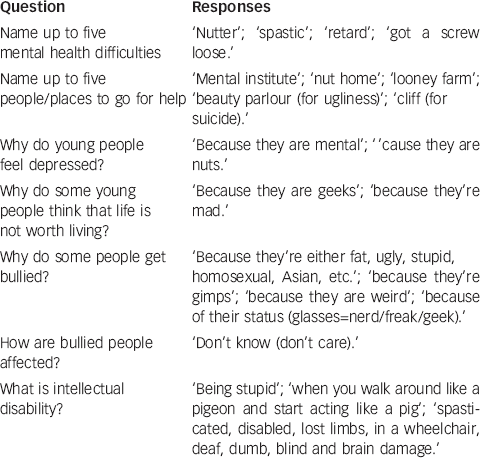
| Question | Responses |
|---|---|
| Name up to five mental health difficulties | ‘Nutter’; ‘spastic’; ‘retard’; ‘got a screw loose.’ |
| Name up to five people/places to go for help | ‘Mental institute’; ‘nut home’; ‘looney farm’; ‘beauty parlour (for ugliness)’; ‘cliff (for suicide).’ |
| Why do young people feel depressed? | ‘Because they are mental’; “cause they are nuts.' |
| Why do some young people think that life is not worth living? | ‘Because they are geeks’; ‘because they're mad.’ |
| Why do some people get bullied? | ‘Because they're either fat, ugly, stupid, homosexual, Asian, etc.’; ‘because they're gimps’; ‘because they are weird’; ‘because of their status (glasses=nerd/freak/geek).’ |
| How are bullied people affected? | ‘Don't know (don't care).’ |
| What is intellectual disability? | ‘Being stupid’; ‘when you walk around like a pigeon and start acting like a pig’; ‘spasticated, disabled, lost limbs, in a wheelchair, deaf, dumb, blind and brain damage.’ |
Acknowledgements
We thank our pupil and teacher participants and respondents, Susan Bailey and Nimmi Hutnik for help in planning, Jimmy Barton, Anthony Gould and Samar Mahmood for help in searching electronic databases, Andy Tattersall for help with document retrieval, Rita de Bettencourt, Fabienne Cossin, Paul Dickerson and Dawn Jennifer for help with data collection, and Rowan Hougham-Gough for help with data coding. Jenna Williams provided critical comment on the final draft manuscript.




eLetters
No eLetters have been published for this article.