

1. Introduction
Extensive literature on judicial independence focuses on the relationship between judicial independence and democracy. The extent of political influence over the selection of judges is frequently debated. Judicial appointment procedures shape judicial behaviour and affect the legal order (Alarie and Green, Reference Alarie and Green2017). While judicial appointments serve as a mechanism for democratic control of the judiciary, they can also be used to exert political influence, thereby undermining judicial independence (Burbank and Friedman, Reference Burbank and Friedman2002; Russell, Reference Russell, Russell and O’Brien2001; Shetreet and Turenne, Reference Shetreet and Turenne2013). Scholarly debate over appointments to the Japanese Supreme Court (Saikosaibansho), the apex of the Japanese court system with final say on matters of constitutional law, reflects fundamental disagreement over precisely this question. The Japanese case is difficult to study empirically because the process relies on informal practices that are hard to observe.
The Cabinet’s appointments of Supreme Court justices are not based solely on its preferences. Customarily, three legal professional bodies, the so-called hoso sansha – —the Supreme Court, Japan Federation of Bar Associations (JFBA), and Public Prosecutors Office (PPO) – recommend candidates for most of the Court’s vacancies. The key question is whether the Cabinet simply follows these recommendations or sometimes overrides them, politicising the process.
With a few notable exceptions, studies on the appointment of Supreme Court justices in Japan remain scarce. On the one hand, Ramseyer and his co-researchers argued that the Liberal Democratic Party (LDP), which has been in power for most years since 1955, has shaped judicial decisions in its favour by controlling judicial appointments (Ramseyer and Rosenbluth Reference Ramseyer and Rosenbluth1997; Ramseyer and Rasmusen Reference Ramseyer and Rasmusen2001, Reference Ramseyer and Rasmusen2003). While their influential research on lower court appointments has generated widespread debate and international attention (e.g. Bertoli et al., Reference Bertoli, Garcia and Garoupa2022; Fiorino et al., Reference Fiorino, Gavoille and Padovano2015; Fukumoto and Masuyama, Reference Fukumoto and Masuyama2015; Ginsburg, Reference Ginsburg2002; Hanssen, Reference Hanssen2004), they have conducted little scrutiny of Supreme Court justice appointments. On the other hand, other scholars contend that judicial appointments in Japan are largely insulated from political interference, as the Cabinet generally respects the recommendations of legal professional bodies (Haley, Reference Haley and Foote2007; Izumi et al., Reference Izumi, Watanabe, Yamamoto and Niimura2017; Miyakawa, Reference Miyakawa2014; Shindo, Reference Shindo2009). These perspectives are not necessarily contradictory. Some scholars indicated that the Cabinet tends to respect the bodies’ recommendations, as they have typically recommended candidates acceptable to the Cabinet (Foote, Reference Foote2006, Reference Foote2007; Law, Reference Law2009, Reference Law2011; Matsui, Reference Matsui2011b). However, some studies report that the Cabinet has sometimes disregarded these recommendations (JFBA, 1980; Law, Reference Law2009; Matsui, Reference Matsui2011b; Mihira, Reference Mihira, Ichikawa, Okubo, Saito and Watanabe2020; Nishikawa, Reference Nishikawa2020a; Repeta, Reference Repeta2011; Sato, Reference Sato2021, Reference Sato2022; Yamanaka, Reference Yamanaka2022). Nevertheless, they failed to discuss such cases comprehensively, providing only ad hoc or fragmentary descriptions.
Comparative studies often contrast the depoliticised models of the judiciary found in European civil law countries and countries modelled after them, including Japan, with the highly politicised model found in the U.S. (e.g. Cross, Reference Cross, Caldeira, Daniel Kelemen and Whittington2009; Foote, Reference Foote2006, Reference Foote2007; Khali, Reference Khali2022). In the U.S., justices are widely seen as political actors, and judicial appointments are highly contentious, involving ideological clashes among the president, Senators, interest groups, and the public (Abraham, Reference Abraham2008; Davis, Reference Davis2005; Epstein and Segal, Reference Epstein and Segal2005). Social polarisation has further intensified these dynamics in recent years (Davis and Baum, Reference Davis and Baum2019; Mihira, Reference Mihira, Ichikawa, Okubo, Saito and Watanabe2020). Other common law countries, such as the United Kingdom and Canada, were considered to have an apolitical judiciary. However, many studies have highlighted their political aspects (e.g., Griffith, Reference Griffith1977; Malleson, Reference Malleson2016; Russell, Reference Russell1987; Shetreet and Turenne, Reference Shetreet and Turenne2013). In contrast, continental European countries have sought to reduce political influence by implementing career systems and judicial councils (Garoupa and Ginsburg, Reference Garoupa and Ginsburg2009; Guarnieri and Pederzoli, Reference Guarnieri and Pederzoli2002). Yet, even these mechanisms have not always been successful, and in some instances, judicial councils have facilitated rather than restrained political influence (Beers, Reference Beers2012; Bobek and Kosar, Reference Bobek and Kosar2014; Castillo-Ortiz, Reference Castillo-Ortiz2017).
In the Japanese context, some practitioners have viewed the legal professional organisations as serving a role analogous to that of European judicial councils, helping to constrain executive discretion and the political nature (e.g., Izumi, Reference Izumi2013; Miyakawa, Reference Miyakawa2014; Tanaka, Reference Tanaka1981; Yaguchi, Reference Yaguchi1993). However, critics of this practice have argued that when the Cabinet respects recommendations from the legal professional bodies, it effectively transfers the power of appointment from itself to the bodies, thereby reducing transparency and the Cabinet’s accountability, as well as potentially hindering the appointment of diverse and capable candidates (e.g. Imaseki, Reference Imaseki2010; Mihira, Reference Mihira, Ichikawa, Okubo, Saito and Watanabe2020; Mizuno, Reference Mizuno, Ichikawa, Okubo, Saito and Watanabe2015; Yamaura, Reference Yamaura2020). Both advocates and critics hold the assumption that the Cabinet consistently respects the recommendations.
Despite substantial scholarship, a comprehensive empirical research on Supreme Court appointments is limited. Cases in which the Cabinet exercised discretion and overrode recommendations remain underexplored. Documenting how recommendations function clarifies the political dimensions of appointments and informs international comparisons. This study examines all 195 appointments from 1949 to 2024 (excluding the first 15, appointed under different rules), drawing on various sources, including published literature, newspaper archives, personal memoirs, and interviews with legal professionals.Footnote 1 It identifies 21 cases in which the Cabinet rejected the bodies’ recommendations and four cases in which it ignored them. Many of these cases occurred in the 1960s–70s and often reflected political manoeuvring or conflicts among recommending bodies.
This study argues that Supreme Court appointments in Japan are not fully insulated from politics. Even limited rejections reveal vulnerabilities when procedures rely on informal practices. By systematically documenting overlooked cases, this study challenges assumptions of depoliticisation and contributes to broader debates on courts and politics.
This study has certain limitations. The observed number of rejections is a conservative estimate, as unrecorded cases may exist. Moreover, if organisations proposed candidates already aligned with Cabinet preferences, political influence could be understated. Nonetheless, the identified cases suffice to show that politics has shaped appointments.
The article proceeds as follows. It outlines the appointment process, presents rejection cases, discusses trends and implications, and concludes by arguing that Cabinet discretion has sometimes politicised the appointment process.
2. Overview of the judicial appointment process of the Supreme Court of Japan
The Supreme Court consists of a Chief Justice and 14 associate justices. They deliberate on a grand bench of all 15 members and on three petty benches of five justices each. Since its creation in 1947, 193 individuals have been appointed through 211 appointments.Footnote 2 According to the Constitution and the Courts Act, the Cabinet designates the Chief Justice and appoints associate justices.Footnote 3 Justices are subject to public review at the first general election after their appointment and every ten years thereafter, and must retire at 70 years of age.Footnote 4 The Courts Act requires justices to be at least 40 years old, broadly knowledgeable in law, and stipulates that at least 10 must have prior experience as judges, attorneys, prosecutors, or legal professors.Footnote 5 Legally, this grants the Cabinet wide discretion in appointments.
However, in practice, the Cabinet does not appoint justices based solely on its discretion. Customarily, the Supreme Court, JFBA, and PPO select and recommend judicial candidates. The Chief Justice states his opinions to the Cabinet when appointing almost all justices, and the JFBA and PPO also sometimes express their opinions. The seats of the Court are informally allocated: six lower court judges, four attorneys, two public prosecutors, two bureaucrats, and one legal professor. This allocation, in place since 1972, evolved from an earlier one: five judges, five attorneys, and five others.
The statutory appointment procedure for Supreme Court justices has been changed once. Under the occupation by the Supreme Commander for the Allied Powers (SCAP), the Supreme Court was created in 1947. Initially, the Cabinet appointed the justices based on the report of the Judiciary Appointment Consultative Committee. However, the Committee was abolished after this one time.Footnote 6 Subsequently, the three legal bodies began submitting recommendations (Imaseki, Reference Imaseki2010; JFBA, 1980). By the 1960s, dissatisfaction with appointments led the legal professional groups to press the Cabinet to respect their input (Nomura, Reference Nomura1985; Sato, Reference Sato2022). Until the 1970s, the Minister of Justice sought recommendations from the Supreme Court, JFBA, and Prosecutor-General, then reviewed candidates while consulting the Chief Justice and other legal professionals. The Minister submitted a final list to the Prime Minister, who met the Chief Justice to make the appointment (JFBA, 1980; Sato, Reference Sato2022). Since the 1980s, the primary role has shifted from the Ministry of Justice to the Cabinet Secretariat. The JFBA and PPO submit recommendations via the Supreme Court, whose General Secretariat conveys the list with its own views to the Cabinet Secretariat. Coordination occurs between the Chief Cabinet Secretary and the Supreme Court’s Secretary-General, followed by a Prime Minister–Chief Justice meeting (Law, Reference Law2009; Nomura, Reference Nomura1985; Mainichi Shimbun Shakaibu, 1991).
Each legal professional body has its own internal process for selecting candidates. The General Secretariat of the Supreme Court selects candidates from lower court judges. Candidates from the bench are groomed within the judiciary over a long time, eventually reaching the position of the Supreme Court.Footnote 7 Most of them follow a specific career path. They gain experience as assistant judges and judges in district courts of major cities, in key positions within judicial administration, as presidents of district courts within the jurisdiction of the Tokyo High Court, and as presidents of the Tokyo or Osaka High Courts (Nishikawa, Reference Nishikawa2020b; O’Brien and Ohkoshi Reference O’Brien, Ohkoshi, Russell and O’Brien2001; Shindo, Reference Shindo2009).
The JFBA selects candidates from among its members, usually recommending three or four names per vacancy.Footnote 8 The Supreme Court may alter the priority of candidates or shorten the list before forwarding it to the Cabinet (Law, Reference Law2009; Mizuno, Reference Mizuno, Ichikawa, Okubo, Saito and Watanabe2015; Takii, Reference Takii2009). Until 1973, the JFBA President chose candidates from the local or block bar associations to which the predecessor had belonged, consulting former presidents. Consequently, only a few bar associations regularly produced justices.Footnote 9 This practice drew criticism because the number of attorneys both involved in selection and considered as potential candidates was limited. To address this, the JFBA gradually reformed procedures to broaden participation and enhance transparency. It created the Judicial Recommendation Consultative Committee, which established recommendation criteria and made the final selections. Under the current system, local bar associations and groups of fifty or more attorneys can recommend candidates to the committee (JFBA, 2009; Mizuno, Reference Mizuno, Ichikawa, Okubo, Saito and Watanabe2015).
The PPO selects candidates from among senior public prosecutors. The secretariat section of the Supreme PPO and the Ministry of JusticeFootnote 10 conduct the selection, and the Prosecutor-General determines the final candidates (Mizuno, Reference Mizuno, Ichikawa, Okubo, Saito and Watanabe2015). Currently, the Supreme Court rarely scrutinises its candidates before submitting them to the Cabinet (Law, Reference Law2009). Similar to justices from the judiciary, prosecutors follow a clear career path toward the Supreme Court. Appointees have almost always been either the Deputy Prosecutor-General or the Superintending Prosecutor of the Tokyo, Osaka, or Nagoya High Prosecutors Offices (Nishikawa, Reference Nishikawa2020b).
Some Supreme Court justices are appointed from administrative authorities or academia. Unlike the three legal professional bodies, these appointments are selected independently by the Cabinet. Although the Ministry of Foreign Affairs has sometimes recommended candidates in the past, such recommendations by administrative ministries have been rare and far less formalised. Moreover, no academic organisations recommend candidates (Fujita, Reference Fujita2012; Law, Reference Law2009). Appointees from bureaucracy or academia differ from those recommended by professional groups, and information about their selection process is limited. Accordingly, this article focuses on the three legal professional bodies and does not analyse appointments from other backgrounds.
3. The cases of cabinet’s rejection
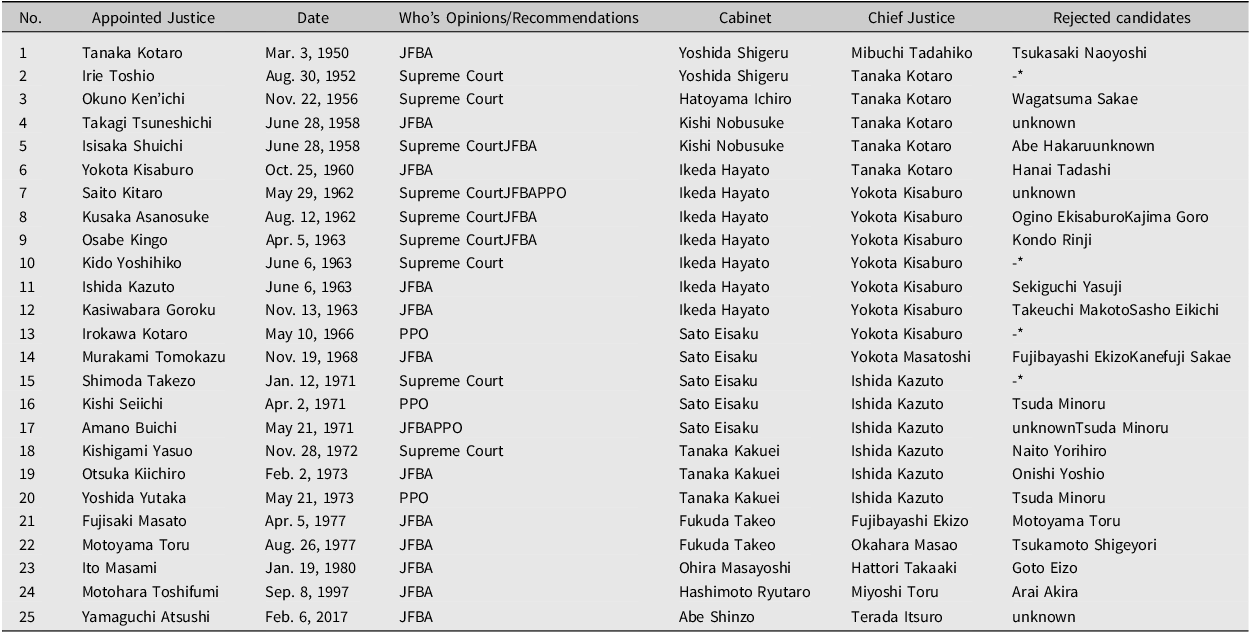
This study investigates 195 judicial appointment cases from 1949 to 2024. It observes 25 cases in which the Cabinet disregarded the recommendations or opinions of the three legal professional bodies (Table 1). In 21 cases, the Cabinet directly rejected recommended candidates. In four additional instances, it ignored objections raised by one body against candidates appointed by the Cabinet or recommended by another body. This section illustrates the Cabinet’s rejection cases, in three periods: the early years (1949–1969), the tenure of Chief Justice Ishida Kazuto (1969–1973), and the years after 1973.Footnote 11
The Cases of Cabinet’s Rejection of Candidates and Ignoring of opinions

* The cases in which the Cabinet ignored the opposing opinions of the legal professional bodies.
Source: Author compiled this list based on information provided by Attorney Tsunehiro Sasanami (October 1, 2024), and an anonymous attorney (June 19, 2024), as well as various references.
3.1. The early years
The first case was the appointment of the second Chief Justice, Tanaka Kotaro, on March 3, 1950. The Yoshida Shigeru Cabinet rejected Tsukasaki Naoyoshi, whom the JFBA had recommended. The Cabinet considered many candidates in consultation with the SCAP and Chief Justice Mibuchi Tadahiko. Mibuchi did not endorse any individual and expressed his views on the candidates named by the Cabinet (Asahi Shimbun, Feb. 24 and Mar. 1, 1950). The JFBA recommended Justice Tsukasaki Naoyoshi. However, the Cabinet finally designated Tanaka Kotaro, legal scholar and member of the House of Councillors (Tanaka Reference Tanaka1961; Mainichi Shimbun, Feb. 11 and 24, 1950; Yomiuri Shimbun, Mar. 1, 1950).
On August 30, 1952, the Yoshida Cabinet appointed Irie Toshio, Director of the Legislative Bureau of the House of Representatives, despite several justices’ objections. Before his appointment, five justices, Mano Tsuyoshi, Iwamatsu Saburo, Saito Yusuke, Inoue Nobori, and Shima Tamotsu, stated their opposition (Nomura, Reference Nomura1986). They insisted that, while speeding up the processing of caseloads was vital for the Supreme Court, it would be inappropriate to appoint someone with no experience in court practice (Yomiuri Shimbun, Aug. 26, 1952). According to Nomura (Reference Nomura1986), the actual reason was that justices from lower court judges were dissatisfied because no former judges were appointed as justices after the initial appointments.
At the appointment of Justice Okuno Ken’ichi on November 22, 1956, the Hatoyama Ichiro Cabinet ignored the Chief Justice’s recommendations and some other justices’ opinions. Chief Justice Tanaka Kotaro initially recommended Wagatsuma Sakae, professor at the University of Tokyo. Simultaneously, some members of the House of Councillors recommended Okuno Ken’ichi, Director of the Legislative Bureau of the House of Councillors (Asahi Shimbun, Nov. 12, 1956; Yomiuri Shimbun, Sep. 19, and Nov. 16, 1956). The Cabinet selected Okuno with the consent of Chief Justice Tanaka (Yomiuri Shimbun, Nov. 12 and 13, 1956). Nevertheless, some justices of the Second Petty Bench were against Okuno’s appointment. A few days before the appointment, Gokijo Kakiwa, the Secretary-General of the Supreme Court, visited Okuno on behalf of justices of the Second Petty Bench and told him: ‘You are too young to be a justice. We would ask you to decline the appointment’ (Okuno, Reference Okuno1972: 13). Okuno refused to decline, citing the strong recommendation of some Councillors. The Cabinet also ignored their opposition and appointed him.
In the appointments of two justices, Takagi Tsuneshichi and Ishisaka Shuichi, on June 28, 1958, the Kishi Nobusuke Cabinet ignored the JFBA’s opinion and rejected the candidates proposed by the JFBA and the Supreme Court. The JFBA requested that the Cabinet appoint two justices from the bar and recommended several candidates (Asahi Shimbun, June 27, 1958; Yomiuri Shimbun, June 27, 1958). However, the Supreme Court insisted that the Cabinet should appoint at least one justice from lower court judges and recommended Abe Hakaru, President of the Tokyo High Court. Regarding the Supreme Court’s opinion, the Cabinet decided to appoint one person from the judiciary and another from the bar. Nevertheless, the Cabinet rejected Abe and appointed Ishisaka Shuichi, President of the Osaka High Court (Abe, Reference Abe1963; Yomiuri Shimbun, Mar. 10, 11 and June 28, 1958). Abe had previously been recommended as a candidate but declined when it was discovered that the Tokyo High Court had lost the trial records (Yomiuri Shimbun, Nov. 13, 1956). At this point, the problem may have continued. The Cabinet also appointed Takagi Tsuneshichi, an attorney with experience as a public prosecutor and judge, who was not among the JFBA’s recommendations. While the JFBA finally agreed to appoint Takagi, it protested the Cabinet for failing to appoint two justices from the bar (Asahi Shimbun, July 9, 1958; Mainichi Shimbun, July 9, 1958). A former judge whom Law (Reference Law2009) interviewed noted that Chief Justice Tanaka planned to reduce the number of former attorneys and increase the number of former judges to purge progressives from the Court and strengthen conservatives.
The Ikeda Hayato Cabinet designated Yokota Kisaburo as the third Chief Justice on March 25, 1960. While the Cabinet respected the Chief Justice’s opinion, it disregarded the JFBA’s opinions. Various entities suggested 17 candidates, including Hanai Tadashi, former Prosecutor-General, whom the JFBA recommended. Some people argued that Hanai was inappropriate because the cases that were appealed when he was Prosecutor-General were still pending before the Court. After reviewing each candidate, Minister of Justice Kojima Tetsuzo shortlisted four candidates: Hanai, Justice Saito Yusuke, legal scholar Yokota Kisaburo, and former Prosecutor-General Sato Tosuke. Thereafter, Kojima heard Chief Justice Tanaka’s opinion, and Chief Justice Tanaka and Prime Minister Ikeda had a meeting. Tanaka did not recommend specific candidates and only expressed his opinion in principle, that is, ideologically sound individuals should be appointed without being concerned about appointments from within the Court (Nomura, Reference Nomura1985). It is assumed that he recommended Yokota implicitly (Asahi Shimbun, Oct. 9 and 18, 1960; Yomiuri Shimbun, Oct. 5 and 17, 1960). The JFBA expressed that ‘this is a challenge to us from Prime Minister Ikeda. It is disappointing that he dared to select Dr. Yokota, who lacks knowledge and experience in court practice’ (Asahi Shimbun, Oct. 19, 1960).
When the Ikeda Cabinet appointed Saito Kitaro, it refused the recommendations of three legal professional bodies. Each body recommended candidates, and Minister of Justice Ueki Koshiro considered six candidates. The PPO requested that the Cabinet appoint a former prosecutor, as the predecessor was also from the prosecution. Yet, the Cabinet dismissed appointing a former prosecutor, as the Matsukawa caseFootnote 12 was still pending before the First Petty Bench of the Supreme Court, to which the new justice would belong (Nomura, Reference Nomura1986). Moreover, the JFBA requested that the number of justices from the bar, which had been reduced to four, be restored to five. However, the Cabinet rejected the JFBA’s candidates and narrowed down the candidates to two: Saito Kitaro, Director of the House of Councillors Legislative Bureau, and one recommended by the Supreme Court (Asahi Shimbun, May 29, 1962; Yomiuri Shimbun, May 29, 1962). Finally, it appointed Saito on May 29, 1962.
The Ikeda Cabinet rejected the candidates recommended by the Supreme Court and JFBA, while it accepted the PPO’s recommendation at the appointment of Kusaka Asanosuke on August 12, 1962. As a former prosecutor was not appointed in the previous case,Footnote 13 the PPO demanded an appointment from the prosecution and recommended Kusaka Asanosuke, Murakami Tomokazu,Footnote 14 and Osabe Kingo (Asahi Shimbun, Aug. 4, 1962). The Supreme Court recommended Ogino Ekisaburo, President of the Osaka High Court; the JFBA recommended Kajima Goro (Asahi Shimbun, Aug. 7, 1962). Prime Minister Ikeda sought the opinion of Chief Justice Yokota Kisaburo. Yokota requested that a former lower court judge be appointed, as there would no longer be anyone from the judiciary on the First Petty Bench. While rejecting the candidates recommended by the Supreme Court and JFBA, the Cabinet partially considered the Supreme Court’s opinion and appointed Kusaka, who was experienced as both a prosecutor and judge and the oldest of the candidates (Nomura, Reference Nomura1986; Asahi Shimbun, Aug. 8, 1962; Yomiuri Shimbun, Aug. 9, 1962).
In appointing Justice Osabe Kingo, the Ikeda Cabinet rejected a candidate recommended by the JFBA and ignored the Supreme Court’s opinion. Minister of Justice Nakagaki Kunio asked the JFBA to recommend candidates; however, as it could not find any candidates among the attorneys, it recommended Kondo Rinji, President of the Nagoya High Court, who had transitioned from an attorney to a judge (Asahi Shimbun, Mar. 12, 1963). The Supreme Court and the Cabinet agreed to appoint him. Nevertheless, some attorneys criticised the JFBA executive for recommending an incumbent judge, and some Diet members raised similar objections. In response, the Cabinet cancelled his appointment (Yomiuri Shimbun, Mar. 12 and 14, 1963). The Supreme Court continued to request Kondo’s appointment, and Secretary-General of the Supreme Court Shimomura Kazuo visited Nakagaki to express the Court’s opinion that the Cabinet should respect the JFBA’s recommendation. However, Nakagaki, considering the opposition, did not allow an incumbent judge recommended by the JFBA to be appointed as justice, as it would set a negative precedent. As the JFBA did not name any other candidates, the Ikeda Cabinet decided to appoint a justice from a different background and appoint one from the bar on the next occasion. On April 5, 1963, the Cabinet appointed Osabe Kingo, Deputy Prosecutor-General, who had previously been recommended by the prosecution (Nomura, Reference Nomura1986; Yomiuri Shimbun, Apr. 3, 1963).
The Ikeda Cabinet appointed Kido Yoshihiko and Ishida Kazuto as justices on June 6, 1963, rejecting the candidates recommended by the JFBA and ignoring the Supreme Court’s opinion. As the Cabinet had promised that the number of former attorneys in the Court, which had been reduced by one at the previous appointment, would be restored at the next appointment, the JFBA recommended two attorneys, Kido Yoshihiko and Sekiguchi Yasuji (Kido, Reference Kido1964). However, the Supreme Court demanded that one of the two appointees come from the judiciary. Secretary-General Shimomura notified Chief Cabinet Secretary Kurogane Yasumi that the Court recommended Ishida Kazuto, President of the Tokyo High Court. Chief Justice Yokota Kisaburo then recommended him to the Minister of Justice Nakagaki (Yomiuri Shimbun, May 23, 1963). The JFBA responded by lodging a protest with the Supreme Court and the Cabinet (Asahi Shimbun, May 25, 1963; Yomiuri Shimbun, May 24, 1963). Within the Cabinet, Nakagaki, who favoured the JFBA, and Kurogane, who favoured the Supreme Court, were at odds. The Cabinet ultimately decided to hear both organisations’ opinions again and adjust (Asahi Shimbun, May 28, 1963; Yomiuri Shimbun, May 25, 1963). Following negotiations between Nakagaki and the JFBA President Maruyama Tasaku, they agreed to appoint Kido and Ishida; in return, the next appointment would be from the bar, and the Cabinet would make efforts to introduce a ‘lifetime salary system’,Footnote 15 which the JFBA had long requested (Yomiuri Shimbun, May 28 and June 2, 1963). Despite the Cabinet’s decision to appoint Kido and Ishida, Chief Justice Yokota convened an extraordinary meeting of the Judicial Assembly and claimed that ‘I found a fact that Kido is inappropriate for justice’ (Nomura, Reference Nomura1986: 113). After he obtained the approval of most justices, Yokota requested that Prime Minister Ikeda rescind Kido’s appointment. The ‘fact’ was that Kido sent a claim for the return of property by content-certified mail on a politician’s behalf. The Cabinet investigated and found that it was a justifiable task for an attorney; therefore, it did not withdraw his appointment (Nomura, Reference Nomura1986; Asahi Shimbun, June 6, 1963; Yomiuri Shimbun, June 5, 1963).
When the Sato Eisaku Cabinet appointed Kashiwabara Goroku on December 13, 1963, it rejected a candidate recommended by the JFBA. As the Cabinet had promised to appoint an attorney for the next appointment, the JFBA initially recommended Sekiguchi Yasuji, Takeuchi Makoto, and Sasho Eikichi. However, the Cabinet rejected Takeuchi because of his youth and Sasho because it did not favour him; Sekiguchi declined to be appointed. The JFBA then recommended Kashiwabara Goroku, and the Cabinet accepted and appointed him (Nomura, Reference Nomura1986; Yomiuri Shimbun, Nov. 27, 1963).
The Sato Cabinet appointed Irokawa Kotaro on May 10, 1966, ignoring the PPO’s opinion. The JFBA recommended Irokawa, as his predecessor was a former attorney. However, the PPO opposed his appointment, as he had served as counsel for workers in many labour disputes (Irokawa, Reference Irokawa1995; Asahi Shimbun, Apr. 14, 1966). The JFBA President Tsuji Makoto persuaded Minister of Justice Ishii Mitsujiro, who eventually agreed to appoint Irokawa. As the Supreme Court also assented to him, the Cabinet appointed him (Nomura, Reference Nomura1985, Reference Nomura1986).
The Sato Cabinet disregarded the JFBA’s recommendation in the appointment of Justice Murakami Tomokazu on November 19, 1968. Although his predecessor, Okuno Ken’ichi, was a former bureaucrat, the JFBA recommended Fujibayashi Ekizo and Kanefuji Sakae to the Cabinet. The JFBA insisted that the composition of the Supreme Court, which at that time had five former judges, four former attorneys, and six others, be returned to the seat allocation of five each, arguing that ‘it is desirable for the democratic operation of the Supreme Court to appoint attorneys from the field’ (Asahi Shimbun, Nov. 6, 1968). Nevertheless, the Sato Cabinet denied appointments from the bar because of the petty bench’s composition (Yomiuri Shimbun, Nov. 6, 1968), stating that, as Okuno specialised in civil affairs and the Second Petty Bench comprised a former judge, two former attorneys, and a former legal professor, his successor should also be familiar with civil affairs, and appointing a new attorney would unbalance its composition. The Supreme Court requested that appointments be made among civil judges. It recommended Murakami Tomokazu, President of the Tokyo High Court, and Sekine Kosato, President of the Osaka High Court (Asahi Shimbun, Oct. 10, 1968). The Sato Cabinet appointed the more senior Murakami (Asahi Shimbun, Nov. 6, 1968).Footnote 16
3.2. The Ishida court
The Sato Eisaku Cabinet ignored the Supreme Court’s opinion during the appointment of Shimoda Takezo on January 12, 1971. Shimoda was a former diplomat who had served as the Administrative Vice-Minister of Foreign Affairs and the Ambassador to the U.S. Prime Minister. Sato had promised to appoint Shimoda as a justice before he retired from the Ministry of Foreign Affairs (Nomura, Reference Nomura1986). Before Shimoda’s appointment, the Cabinet did not ask the Supreme Court for its opinion (Sato, Reference Sato1997). The Supreme Court was dissatisfied with this and insisted that the Cabinet hear the Court’s opinion before appointing justices (Asahi Shimbun, Jan. 12, 1971).
When the Sato Cabinet appointed Kishi Seiichi on April 2, 1971, it disregarded the PPO’s recommendation of Tsuda Minoru, the Administrative Vice-Minister of Justice. Yet, the Supreme Court opposed his appointment. The Court claimed that none of the judges who had completed their legal training in the same year as him had risen to the position of High Court president. Therefore, appointing him as a justice would disrupt the seniority system within the legal profession and ‘make judges who have worked steadily feel a contradiction’ (Nomura, Reference Nomura1986: 171). Alternatively, the opposition could be attributed to a feud between Chief Justice Ishida Kazuto and Tsuda, which is discussed further below (Asahi Shimbun, May 18, 1973). Then, the Court recommended Kishi Seiichi, President of the Tokyo High Court. The PPO demanded the appointment from the prosecution, arguing that the Supreme Court would only have one former prosecutor if Tsuda were not appointed. The Cabinet eventually conceded to the Supreme Court and appointed Kishi, as it had previously ignored the Court’s opinion when appointing Justice Shimoda (Asahi Shimbun, Apr. 2, 1971)
The Sato Cabinet disregarded both the JFBA and the PPO’s recommendations in Amano Buichi’s appointment on May 21, 1971. As his predecessor was a former attorney, the JFBA considered that his successor should be appointed from the bar and recommended four candidates. The PPO was dissatisfied with the current situation, in which the Supreme Court only had one former prosecutor, and recommended Tsuda Minoru and Amano Buichi, Superintending Prosecutor of the Tokyo High PPO. Prime Minister Sato dismissed the JFBA’s recommendation, arguing that it was unprecedented for the JFBA to have recommended so many candidates, which he said indicated a lack of confidence in the recommendation. He decided to appoint from the prosecution, as leaving the Supreme Court with only one former prosecutor would demoralise the prosecutors (Nomura, Reference Nomura1986; Asahi Shimbun, May 21, 1971; Mainichi Shimbun, May 21, 1971; Yomiuri Shimbun, May 21, 1971). As the PPO strongly recommended Tsuda, the Cabinet attempted to appoint him. However, Chief Justice Ishida objected to him and requested that Amano be appointed when he met Prime Minister Sato (Sato, Reference Sato1997). The Sato Cabinet gave up on appointing Tsuda and appointed Amano.
Kishigami Yasuo’s appointment on 28 November 1972 was the last time the Cabinet rejected the Supreme Court’s recommendation. Chief Justice Ishida recommended Naito Yorihiro, President of the Nagoya High Court. However, the Tanaka Kakuei Cabinet rejected him and appointed Kishigami Yasuo, President of the Tokyo High Court. Naito recalled that Ishida told him in fall 1972 that he wanted to recommend him for Supreme Court justice, but that did not materialise (Naito, 1981). Asahi Shimbun reported that the Tanaka Cabinet dismissed Naito, as it was customary for Supreme Court justices to be selected from the President of the Tokyo or Osaka High Court (Asahi Shimbun, Nov. 27, 1972). However, 11 high court presidents outside Tokyo and Osaka have been appointed to the Supreme Court, including the Nagoya High Court. Moreover, Yamamoto (Reference Yamamoto1997) noted that the LDP Tanaka Cabinet rejected Naito because he had served as Director of the Secretarial Section of the Supreme Court under the first Chief Justice Mibuchi Tadahiko, whom the Japan Socialist Party (JSP) Katayama Cabinet appointed. Yet, four judges who worked in the General Secretariat at the same time were later appointed as Supreme Court justices. Therefore, it is unlikely that he was rejected because of his career history. Thus, these explanations appear to be doubtful. As discussed later, the LDP Cabinet may have regarded Naito as ideologically unfavourable.
The Tanaka Cabinet disregarded the JFBA’s recommendation and appointed Otsuka Kiichiro on February 2, 1973. The Cabinet decided to appoint from the bar and asked the JFBA to recommend candidates (Yomiuri Shimbun, Jan. 30, 1973). The JFBA recommended Onishi Yoshio, an attorney and professor at Ritsumeikan University, and eight other attorneys. However, the Cabinet rejected Onishi, stating that, while he had a wealth of academic achievements, he lacked experience in court practice. It also rejected the other eight candidates, claiming that they were less competent and experienced (Asahi Shimbun, Feb. 3, 1973; Yomiuri Shinbun, Jan. 31, 1973). In practice, the Supreme Court dismissed Onishi and others and recommended another candidate. After receiving the JFBA’s candidate list, Chief Justice Ishida Kazuto consulted with a former justice. He suggested that Otsuka Kiichiro, who was not on the list, was suitable. Following his suggestion, Ishida recommended Otsuka to the Tanaka Cabinet, which decided to appoint him (Mainichi Shimbun Shakaibu, 1991). The author infers that this former justice was Matsumoto Masao, based on his term in the Court and the episode in which he mediated between Ishida and politicians when he was the Secretary-General of the Supreme Court. In response to Otsuka’s appointment, the JFBA requested that the Cabinet hear its opinions and respect its recommendations when appointing justices from the bar (Asahi Shimbun, Feb. 3, 1973; Yomiuri Shinbun, May 19 and 27, 1973).
On May 21, 1973, the Tanaka Cabinet rejected the candidate recommended by the PPO and appointed Yoshida Yutaka, whom the Supreme Court recommended. The PPO recommended Tsuda Minoru for the third time for the vacancy created by the retired Chief Justice Ishida Kazuto and the promotion of Murakami Tomokazu to the Chief Justice. The Cabinet initially intended to appoint Tsuda (Asahi Shimbun, Mar. 26, 1973; Yomiuri Shinbun, Mar. 29 and May 3, 1973). Nevertheless, Chief Justice Ishida opposed Tsuda and instead recommended Yoshida Yutaka, President of the Osaka High Court (Yomiuri Shinbun, May 10, 1973). Furthermore, when Prime Minister Tanaka asked Murakami to assume the position of Chief Justice, Murakami expressed opposition to appointing Tsuda, reserving his acceptance of the appointment to Chief Justice (Yomiuri Shinbun, May 17, 1973). Ishida argued that if a former judge was not appointed, there would be no former judge on the Second Petty Bench, and therefore, he wished to appoint a justice from the lower courts (Nomura, Reference Nomura1986; Asahi Shimbun, May 17, 1973).Footnote 17 Facing such strong opposition from the Supreme Court, the Cabinet gave up on Tsuda’s appointment and appointed Yoshida (Asahi Shimbun, May 18 and 19, 1973; Yomiuri Shimbun, May 18, 1973).Footnote 18
3.3. The years after 1973
The Fukuda Takeo Cabinet ignored the JFBA’s recommendation when it appointed Fujisaki Masato on April 5, 1977. As the predecessor, Justice Shimoda Takezo, was a former diplomat, the Cabinet considered appointing a diplomat (Asahi Shimbun, Mar. 20, 1977; Yomiuri Shimbun, Mar. 13 and 20, 1977). Nevertheless, the JFBA recommended several candidates, including Motoyama Toru and Tsukamoto Shigeyori (Tokyo Bar Association ed. 1980; Asahi Shimbun, Aug. 4, 1977). However, the Cabinet ignored them and appointed Fujisaki Masato, the former Ambassador to Thailand, as per its original policy.
The Fukuda Cabinet appointed Motoyama Toru without the recommendation of the JFBA on August 26, 1977. The JFBA recommended Tsukamoto Shigeyori and another candidate. However, the Supreme Court insisted that Tsukamoto was inappropriate for two reasons: First, he was not a ‘pure attorney’, as he used to be a judge. Second, he was too young, as judges who had finished the legal training in the same year as him were still working in lower courts (Nomura, Reference Nomura1986). The Supreme Court suggested that the Cabinet appoint Motoyama instead of the recommended candidates. It argued that he was desirable because he had experience as an attorney only, and he belonged to the Nagoya Bar Association. At that time, no justice was a former member of any bar association outside Tokyo (Asahi Shimbun, Aug. 4, 1977). Furthermore, the business community favoured Motoyama, as he had worked on the management side in many labour disputes (Yomiuri Shimbun, July 31 and Aug. 9, 1977). The JFBA demanded that the Supreme Court and the Cabinet respect its recommendation in the future (Yomiuri Shimbun, Aug. 11, 1977).
The Ohira Masayoshi Cabinet rejected Goto Eizo, the JFBA’s recommendation, when it appointed Ito Masami on January 19, 1980. His predecessor was a former bureaucrat, and the Cabinet selected candidates from among the bureaucrats or legal professors (Yomiuri Shimbun, Jan. 5, 1980). The JFBA recommended Goto, expecting to restore the allocation of justice seats to attorneys (Tokyo Bar Association ed., 1980).Footnote 19 However, the Cabinet did not intend to appoint a justice from the bar, and the Supreme Court requested appointing Ito Masami, professor at the University of Tokyo (Nomura, Reference Nomura1986; Asahi Shimbun, Jan. 5, 1980). Therefore, the Ohira Cabinet appointed Ito.
In the appointment of Motohara Toshifumi on September 8, 1997, the Supreme Court rejected the JFBA’s recommendation, and the Hashimoto Ryutaro Cabinet made an appointment according to it. The Supreme Court asked the JFBA to recommend candidates, and the JFBA recommended Arai Akira.Footnote 20 However, the Supreme Court assumed that the Cabinet would reject Arai, as he had represented the plaintiffs in the Ienaga case, in which it was disputed whether the textbook certification system amounted to censorship (Yomiuri Shimbun Shakaibu, 2002).Footnote 21 Chief Justice Miyoshi Toru recommended Motohara Toshifumi, a lower-ranking candidate on the JFBA’s list, and the Hashimoto Cabinet appointed him (Asahi Shimbun, July 29 and Sep. 2, 1997; Yomiuri Shimbun, July 29 and Sep. 2, 1997).
The most recent case in which the Cabinet disregarded the recommendation of the JFBA was the appointment of Yamaguchi Atsushi on February 6, 2017. The JFBA recommended seven candidates to succeed a justice who was from the bar. However, the Abe Shinzo Cabinet wanted to select from a broader range of candidates. In response, the Supreme Court submitted the list with several additional candidates (Asahi Shimbun, Mar. 2, 2017). Consequently, the Cabinet appointed Yamaguchi Atsushi, whom the JFBA did not recommend (Asahi Shimbun, Jan. 13, 2017; Yomiuri Shimbun, Jan. 13, 2017). He was a former legal professor at the University of Tokyo and had been registered with the bar association for six months prior to his appointment. Nevertheless, while announcing his appointment at a press conference, Chief Cabinet Secretary Suga Yoshihide emphasised that he was an attorney (Nishikawa, Reference Nishikawa2020a). At the JFBA board meeting on January 19, 2017, JFBA President Nakamoto Kazuhiro stated that it was regrettable that the Cabinet had broken a long-standing practice and rejected its recommendation (Asahi Shimbun, Mar. 2, 2017).
4. Discussion
In 21 out of 195 cases, the Cabinet rejected candidates recommended by the three legal professional organisations, and ignored their opinions in four cases. Specifically, the Cabinet disregarded the recommendations and opinions of the Supreme Court, JFBA, and PPO in 9, 17, and 5 cases, respectively.Footnote 22 Moreover, conflicts arose when the Supreme Court opposed candidates proposed by the JFBA or the PPO. In effect, when the Court objected to other bodies’ recommendations, the Cabinet also disregarded them by prioritising the Court’s position. Some of these instances suggest that political motivation played a role in rejecting candidates. This section discusses trends and transitions in the cases, as well as the political factors that influenced judicial appointments.
4.1. A tendency to rejection
The JFBA’s recommendations were more frequently disregarded than those of the other legal organisations. When disagreements arose among the organisations, the Cabinet generally sought balance but generally gave precedence to the Supreme Court’s opinions. While everybody recommended candidates acceptable to the Cabinet, the JFBA faced greater difficulty in aligning with Cabinet preferences (Sato, Reference Sato2021). Attorneys in Japan traditionally ‘have been a relatively left-leaning bunch’ (Law, Reference Law2009: 1566), and the JFBA has often been critical of the LDP’s policies. The Cabinet further gained leverage by threatening to reduce the number of seats reserved for attorneys (Sato, Reference Sato2021). For instance, Otsuka Kiichiro recalled that both he and the JFBA leadership reluctantly accepted his appointment in 1973, fearing such a reduction (Yomiuri Shimbun, Feb. 3, 1973).
By contrast, the Cabinet tends to value the recommendations and opinions of the Supreme Court. A long-standing cooperative relationship between the Court and the LDP underpinned this tendency. The Court selected and trained judges whose views generally aligned with the LDP’s preferences (Matsui, Reference Matsui2011b; Ramseyer and Rasmusen, 2001, 2003). As discussed later, in the 1960s, the Court sought to prevent Cabinet interference in the judiciary by positioning itself closer to the ruling party. Consequently, the preferences of the Cabinet and JFBA are likely to diverge more than the preferences of the Cabinet and the Supreme Court.
4.2. The political upheaval in ‘the age of judicial crisis’
Until the 1970s, Cabinet rejections of candidates were frequent. Before the 1960s, no clear norm of deference to recommendations had been established, and the appointment process was relatively open. Judicial seats were allocated flexibly across professional backgrounds, and recommendations came not only from the three principal legal bodies but also from other organisations, with both the Chief Justice and associate justices occasionally offering independent suggestions. The Minister of Justice played the central role, selecting from these options and advising the Prime Minister, who exercised wide discretion in appointments. At the time, recommendations were regarded as advisory rather than binding, and neither the Cabinet’s frequent rejections nor its discretion were seen as problematic by the legal professional groups (Sato, Reference Sato2022).
During the period known as the judicial crisis of the late 1960s to early 1970s, under the fifth Chief Justice Ishida Kazuto, fierce conflict arose between the Cabinet, Supreme Court, PPO, and JFBA over appointments. The roots of the crisis lay in the 1960s, when the fourth Chief Justice Yokota Masatoshi Court and many lower court judges, including members of the Young Jurists League (YJL), issued progressive rulings.Footnote 23 LDP politicians denounced these decisions as biased, labelling the YJL ‘pro-Communist’ (Matsui, Reference Matsui2011b; Ramseyer and Rosenbluth Reference Ramseyer and Rosenbluth1997). The Cabinet sought to intervene more directly in judicial appointments and appoint its preferred candidates to the Supreme Court. While resisting such pressures, Ishida prevented further Cabinet interference by voluntarily reshaping the Supreme Court in a more conservative direction and by tightening control over the lower courts (Matsui, Reference Matsui2011a; O’Brien and Ohkoshi Reference O’Brien, Ohkoshi, Russell and O’Brien2001).Footnote 24 The rejections that occurred under the Ishida court can broadly be divided into two types: cases in which the Cabinet sought to exclude unfavourable candidates and appoint those it preferred, and cases in which the Supreme Court, in an effort to resist Cabinet interference and pursue voluntary self-conservatisation, opposed candidates recommended by other organisations.
In the 1970s, as the Supreme Court overturned most of the progressive precedents, the ‘judicial crisis’ subsided (Matsui, Reference Matsui2011a, Reference Matsui2011b).Footnote 25 Since then, the Cabinet has rejected fewer recommendations, and the Court’s recommendations have never been ignored. The principal factor behind the subsequent decline in rejections was that, in the process of overcoming the judicial crisis, the LDP Cabinets and the Supreme Court learned to better coordinate their interests.
Furthermore, under the Ishida Court, the customary appointment process that continues today was established. Judicial seats were formally allocated by profession – six judges, four attorneys, two prosecutors, and two from other backgrounds – beginning in 1972. Recommendations thereafter followed the predecessor’s professional background, and the practice of freely submitting opinions ended. Ishida later emphasised that he had firmly opposed Cabinet interference and insisted the Minister of Justice ‘must never be allowed to intervene’ in judicial personnel matters (Sankei Shimbun, 1977). Following episodes such as the cases of Tsuda, the Minister’s role disappeared entirely. The JFBA and PPO, which had previously submitted candidates directly to the Cabinet, began routing recommendations through the Supreme Court. This procedural change allowed the Court to screen and, when necessary, reject candidates before forwarding them. Consequently, the appointment process became more closed, involving fewer actors, while reporting on appointments declined. These changes reflected both the stricter application of occupational seat allocations and the emergence of coordination mechanisms between the Supreme Court and the Cabinet.
However, even afterwards, the JFBA occasionally recommended candidates in an effort to restore seat allocation for attorneys, which had been reduced to four, but these recommendations were all rejected. In other cases, the Supreme Court, anticipating the Cabinet’s rejection of the JFBA’s recommendations, dismissed them in advance. Considering the cooperative relationship between the Supreme Court and the Cabinet, the Court’s recommendations are unlikely to be rejected; however, as indicated by the appointment of Yamaguchi in 2017, the JFBA recommendations may still be subject to rejection.
4.3. The ostensible reasons and political motivations
The reasons for rejecting candidates were ostensibly related to age, career history, and the petty bench’s composition. In some cases, these reasons can be explained as grounds for rejection; in other cases, they may be political in themselves or a pretext for hiding political intentions.
The Cabinet and Supreme Court sometimes rejected candidates recommended by the JFBA and PPO for being ‘too young’. All of them were in their early 60s, which satisfied the statutory requirement of being over 40 years old. However, the average appointment age was 63; most justices were appointed in their mid-60s, and none were appointed in their 40s. This is because the Supreme Court and the Cabinet have incentives to appoint older individuals as justices.
The Supreme Court emphasised the necessity of maintaining seniority. Seniority is as substantial in the courts as in various organisations in Japan. The notion of ‘douki (same year)’, that is, a peer group having finished their legal training in the same year, is crucial for Japanese judges. They are appointed simultaneously upon completing their legal training and advance gradually through the judicial hierarchy in parallel. They believe that attorneys and prosecutors must also have the same promotion speed as judges who are their douki (Sato, Reference Sato2021). Thus, Supreme Court justices from lower courts and the Supreme Court General Secretariat would oppose candidates younger than the lower court judges recommended by the JFBA and PPO.
Moreover, the Cabinet would want to appoint justices as old as possible and shorten their terms of office. It prefers short terms of office for justices so that they do not change their ideologies during their tenure, and it can immediately replace justices who betray its expectations (Law, Reference Law2009; Ramseyer and Rasmusen Reference Ramseyer and Rasmusen2001).Footnote 26 This strategy succeeds owing to the institutional condition of a fixed retirement age for justices and the political situation, where the government is rarely changed. As the statutory retirement age for justices is 70, the Cabinet can easily predict their years in office when it appoints them. Further, the LDP, which has built a solid long-term government, is confident that it will not lose power in the near future and will appoint replacements for justices when they retire in a few years.Footnote 27 Therefore, the Cabinet can appoint justices with short remaining terms.
The Cabinet has rejected candidates based on their career history in several cases. Specifically, it rejected candidates recommended by the JFBA because they had alternative experience or were inexperienced as attorneys. However, it has appointed such individuals in the past. For instance, Tsukamoto Shigeyori was rejected in 1977 but appointed in 1979. Therefore, his career would not have been the reason for rejection (Sato, Reference Sato2021). Furthermore, the Cabinet rejected candidates with experience as prosecutors because they should not hear the case they had appealed. However, there is no problem with former prosecutors becoming justices when the case they were involved in as prosecutors is pending in the Supreme Court, as they are disqualified from the hearing in which they were involved.Footnote 28
The Supreme Court often insisted on the composition of the petty benches in terms of court practice; the Cabinet respected it and rejected the other legal bodies’ recommendations. Justices typically remain on the same petty bench from their appointment until retirement.Footnote 29 Justices other than former lower court judges are not accustomed to writing judgments. Hence, for a smooth hearing, at least one justice from the judiciary must be on each petty bench. Moreover, in contrast to lower courts, which are divided into civil and criminal divisions and further subdivided into specialised areas such as administrative, commercial, intellectual property, or medical, the Supreme Court tries all cases in each petty bench, to which cases are assigned mechanically. Therefore, ensuring balanced expertise on each petty bench is necessary. The candidates’ civil and criminal expertise was considered in many appointments. Most of the justices in the judiciary had the same expertise as their predecessors. Prosecutors were considered experts in criminal law, and attorneys were also frequently assessed for their expertise in either field. Thus, there was a certain degree of rationality in maintaining a balanced petty bench composition. However, as the composition of the petty benches has not always been well-balanced,Footnote 30 it could have been used as a pretext to hide other reasons (Law, Reference Law2009).
Some cases cannot be explained by these reasons alone; it is suspected that such disregard may have been politically motivated. For instance, the Cabinet rejected Tsuda Minoru, whom the PPO recommended, three times owing to opposition from the Supreme Court, which asserted that his age or the petty bench composition was problematic. While these factors were likely important, the conflict between Chief Justice Ishida and Tsuda would have been a substantial reason. In 1959, Tsuda, then Director of the Judicial Legislation Research Department of the Ministry of Justice, promoted equalisation of the remuneration of prosecutors and judges. Yet, Ishida, then President of the Tokyo District Court, led the opposition movement and successfully blocked the plan (Ishida, Reference Ishida1981). Therefore, Ishida disliked Tsuda, and there was also some animosity towards him within the bench (Izumi et al., Reference Izumi, Watanabe, Yamamoto and Niimura2017; Nomura, Reference Nomura1977).
In three other cases, the candidates appear to have been rejected owing to their ideology. The Supreme Court rejected Arai Akira prophylactically, anticipating that the Cabinet would reject him. He had represented plaintiffs in the Ienaga case, a constitutional litigation concerning historical recognition that the LDP felt was sensitive, and also had been involved in several well-known constitutional litigations.Footnote 31 The rejection of Kondo Rinji is also assumed to have occurred on ideological grounds. According to several references, since he had participated in the Asian Lawyers Conference in 1955, some lawyers and politicians condemned him as a ‘leftist’, and strongly opposed his appointment (Hino, Reference Hino1970; Oda, Reference Oda, Naito and Kawashima1986; Sakurada, Reference Sakurada1971). Another case was the rejection of Naito Yorihiro, whose career could not explain his rejection, as mentioned above. Some judges stated that the LDP considered him too progressive and was uncomfortable with his tolerant attitude towards the YJL (Takano, Reference Takano2000).Footnote 32
Thus, the Cabinet or Supreme Court has rejected candidates recommended by other legal bodies for political motivations, which shows that politics influences the process of appointing Supreme Court justices and that the culture of respecting the recommendations of the legal professional groups is a fragile one that specific political interests can influence. Although it has become rare for the Cabinet to reject recommendations in recent years, it still retains the potential to be substantively involved in judicial appointments.
5. Conclusion
This study determines the extent to which the Cabinet has rejected the recommendations of the legal professional bodies in appointing Supreme Court justices. Examining the appointments for all 195 Supreme Court justices appointed under the current system revealed that the Cabinet rejected the candidates recommended by the legal professional bodies in 21 cases and ignored their opposing opinions in four cases. These instances were more frequent during earlier years, particularly ‘the age of judicial crisis’ from the 1960s to the 1970s. Ideological disagreements or conflicts among the legal professional bodies often drove them. Since the 1980s, the Cabinet has not frequently disregarded the recommendations and opinions of legal professional bodies. However, findings illustrate that the Cabinet has rejected the recommendations of the JFBA even in recent years. The Cabinet’s rejections were suspected to be for political reasons in several instances, including its dislike of the candidate’s ideology and its arbitration of conflicts within the legal profession. Thus, it cannot necessarily be asserted that the judicial appointment in Japan is isolated from politics.
It relies solely on documented cases in the available literature, leaving the possibility that some cases were not recorded. Therefore, the figure of 25 cases presented in this study represents a lower bound, with the possibility that some rejection instances were not captured. Nonetheless, this is the first comprehensive study to examine the judicial appointment history of the Supreme Court; it clarifies that the Cabinet made political appointments even in the limited cases. Despite this limitation, this research contributes to revealing the dynamics of judicial appointments in Japan, demonstrating that the presumed autonomy of the legal professions from the executive branch is not firm, and that political manoeuvring among legal professionals is occurring.
The result underscores that the Cabinet retains the discretion to reject candidates. Therefore, the author argues that the potential for political interference remains inherent in the current appointment process. Judicial appointments in Japan possess a degree of political characteristics; therefore, a straightforward comparison between Japan and the U.S., based solely on the presence or absence of political elements in their respective judicial appointments, is insufficient. While, unlike in the U.S., Japan’s judicial appointments are not marked by overt partisan conflict, this does not necessarily imply an absence of political considerations. Rather, judicial appointments in Japan are shaped by a more nuanced political dynamic involving negotiations among the Cabinet and the legal professional organisations. Occasionally, conflicts have emerged within the legal profession over specific appointments, with the Cabinet alternately aligning itself with the Supreme Court, JFBA, or PPO. These instances reveal a complex interplay of cooperation and contention. Just as some studies have cast doubt on the perception of judicial apoliticism in European countries, this study similarly challenges the notion of apolitical nature in Japan’s judicial appointment process.
This study has demonstrated that the practice of legal professional organisations issuing recommendations and opinions has not necessarily functioned as an effective means of preventing political appointments by the Cabinet, contrary to its advocates’ claims. Recommendations are informal and lack binding force. Such a fragile institution can only weakly constrain the arbitrary use of power. Although these recommendations are often respected, this is primarily the result of accumulated coordination between the Cabinet and legal professional bodies. The Cabinet has merely respected them insofar as the proposed candidates were deemed acceptable, while retaining the prerogative to reject candidates at will. Accordingly, the rationale for advocating this practice lacks empirical support and cannot be regarded as a persuasive justification.
However, the core issue is not that judicial appointments are inherently political. Appointments made by the Cabinet according to its political responsibility are consistent with the form originally envisioned in the Constitution, whereas reliance on the legal professional bodies’ recommendations constitutes a departure from it. Were the Cabinet to respect the recommendations fully, legal organisations would in effect acquire the power to appoint justices, thereby compromising transparency and undermining the Cabinet’s accountability. However, in contexts where government changes are infrequent, the Court may be dominated by justices aligned with the ruling party’s preferences, making it challenging to ensure judicial independence. In Japan’s political environment, where power transfer is rare, concerns about the Cabinet’s complete discretion in judicial appointments are understandable. Nevertheless, delegating informal authority to legal organisations is an insufficient and inappropriate solution. Instead, a judicial appointment system that departs from current practice should be established. The Cabinet should appoint justices according to its political responsibility, but a formal system is required to regulate this process appropriately.
Some scholars and legal professionals have advocated re-establishing the consultative committee or introducing Diet approval for appointments (Imaseki, Reference Imaseki2010; Izumi et al., Reference Izumi, Watanabe, Yamamoto and Niimura2017; JFBA, 1980; Nishikawa, Reference Nishikawa2020a; Takii, Reference Takii2009). Judicial system reforms in the late 1990s and 2000s revised the appointment process for lower court judges. Nevertheless, the system for appointing Supreme Court justices has remained unchanged, even though the Judicial System Reform Council suggested that ‘appropriate measures to ensure transparency and objectivity should be considered’ (Judicial System Reform Council, 2001: 99). To secure judicial independence and sustain public trust in the judiciary, it is essential to institutionalise a transparent appointment process and establish mechanisms that hold the Cabinet accountable for its choices, while recognising the inherently political nature of judicial appointments.
Acknowledgements
This study is supported by JSPS KAKENHI Grant Number JP23KJ1998. I would like to thank Attorney Tsunehiro Sasanami and an anonymous attorney for providing valuable information, and the reviewers for their valuable comments on drafts of this article.
Competing interests
None.

 Open access

