




Introduction
Climate fiction (cli-fi) is a literary genre that exposes contingent and imaginary climate scenarios, whether utopian or dystopian. The genre focuses on and discusses specific climate issues such as rising sea levels, droughts, deforestation, consequences of capitalism, climate injustice, military conflicts, pollution and global warming (DiPaolo, Reference DiPaolo2018). Teachers and researchers generally agree that cli-fi has cognitive value for teachers and students to learn about climate change. (Dillon & Craig, Reference Dillon and Craig2023; Gough, Reference Gough2024b; Yusoff & Gabrys, Reference Yusoff and Gabrys2011), that is, cli-fi engages readers, exhorting them to think and conceptualise climate change ideas abstracted from its narrative structure. The cognitive value of cli-fi arises from the interrelationship of narrative thinking and formal thinking (Canavan, Reference Canavan, Canavan and Robinson2014; DiPaolo, Reference DiPaolo2018). Narrative thinking extends the mind from the known to the unknown or little-known based on exploring the multiple versions of the narrated circumstances (Breithaupt, Reference Breithaupt2023; Canavan, Reference Canavan, Canavan and Robinson2014; Gough, Reference Gough2024a). Formal thinking orders and evaluates the intuitions and possibilities of the narrated circumstances (Canavan, Reference Canavan, Canavan and Robinson2014; Ruvalcaba Cervantes, Reference Ruvalcaba Cervantes2024).
Cli-fi often uses environmental allegories to promote learning and inspire environmental activism, enhancing its cognitive value. It is a means to learn alternative ways of thinking about the world and nature (DiPaolo, Reference DiPaolo2018; D’Orto & Tasquier, Reference D’Orto and Tasquier2025; Gough, Reference Gough2024a, Reference Gough2024b; Ruvalcaba Cervantes, Reference Ruvalcaba Cervantes2024). The cognitive value of cli-fi is often attributed to an automatic mental process based on trial-and-error (Yusoff & Gabrys, Reference Yusoff and Gabrys2011) that transforms fiction into learning content. The trial-and-error process refers to an iterative cognitive process for conceptualising climate change upon abstracting scientific ideas or problems that cli-fi encompasses. Some readers automatically engage with narrative to isolate scientific ideas through an intuitive method: extracting and interpreting ideas, identifying misinterpretations and errors, correcting and refining them based on their individual experiences and prior knowledge. The trial-and-error approach assumes that cli-fi is an efficient medium of learning because narratives are closely tied to people’s experiences. (Avraamidou & Osborne, Reference Avraamidou and Osborne2009; Breithaupt, Reference Breithaupt2023; Bruner, Reference Bruner1991, Reference Bruner1996; DiPaolo, Reference DiPaolo2018). In that sense, cli-fi deploys a narrative effect characterised by representing and engaging readers (D’Orto & Tasquier, Reference D’Orto and Tasquier2025; Soares, Gonçalves, Jerónimo & Kolinsky Reference Soares, Gonçalves, Jerónimo and Kolinsky2023).
However, using cli-fi in climate change education through trial-and-error is more prone to problematic limitations, leading to incomplete and segmented learning (Arievitch, Reference Arievitch2017; Kahneman, Reference Kahneman2011). The main problem with cli-fi from a climate change education perspective is that it turns the reading experience in climate change education into stories and episodes that illustrate climatic situations without providing in-depth knowledge about climate change content (D’Orto & Tasquier, Reference D’Orto and Tasquier2025; Soares et al., Reference Soares, Gonçalves, Jerónimo and Kolinsky2023). Cli-fi and other narrative means of scientific learning are ineffective on their own when used as mere anecdotal situations or stories without prompting deep thinking (Avraamidou & Osborne, Reference Avraamidou and Osborne2009; Breithaupt, Reference Breithaupt2023; Gough, Reference Gough2024a; Ruvalcaba Cervantes, Reference Ruvalcaba Cervantes2024). Cli-fi literature has cognitive value in learning about climate change because it is based on the potential of narrative thinking to explore the multiple representations that are possible and likely to be constructed (Gough, Reference Gough2024a, Reference Gough2024b). Exploring multiple representations in narrative worlds requires that learners transform cli-fi into an active and agentive imaginative exercise, turning aesthetic and literary experiences into learning experiences. This study aligns with those (D’Orto & Tasquier, Reference D’Orto and Tasquier2025; Gough, Reference Gough2024a, Reference Gough2024b; Soares et al., Reference Soares, Gonçalves, Jerónimo and Kolinsky2023; Ruvalcaba Cervantes, Reference Ruvalcaba Cervantes2024; Yusoff & Gabrys, Reference Yusoff and Gabrys2011) that extend beyond the use of cli-fi as mere narrative tools to represent climate change, with the effort oriented towards investigating how to improve the uses of cli-fi instruments in climate change education.
In this paper, an agentive activity approach (Arievitch, Reference Arievitch2017) is adopted. From this perspective, the cli-fi has cognitive value for learners because it prioritises the necessary condition of intentional and oriented agency. By cli-fi’s cognitive value, it will mean a more integrated and reflective learning experience about climate change, resulting from a regulated, agentive, oriented and systematic mental process of reading cli-fi as a literary genre (Arievitch, Reference Arievitch2017; Dehaene, Reference Dehaene2019; Kahneman, Reference Kahneman2011). The aim of this paper is to transcend the view of cli-fi in the trial-and-error approach, and to investigate how teachers use cli-fi literature agentively to learn and understand the content and evidence on climate change (Dillon & Craig, Reference Dillon and Craig2023; Gough, Reference Gough2024a; Ruvalcaba Cervantes, Reference Ruvalcaba Cervantes2024; Schneider-Mayerson, Reference Schneider-Mayerson2018). I do so by designing and conducting qualitative testing of a guide to orient teachers’ actions and mental processes, that is, prompting thinking, to transform cli-fi into a science problem. The designed guide proposed in this paper organises and proposes systematic mental actions that transform cli-fi into school science problems drawing on the agentive activity theory (Arievitch, Reference Arievitch2017).
Agentive activity theory and cli-fi
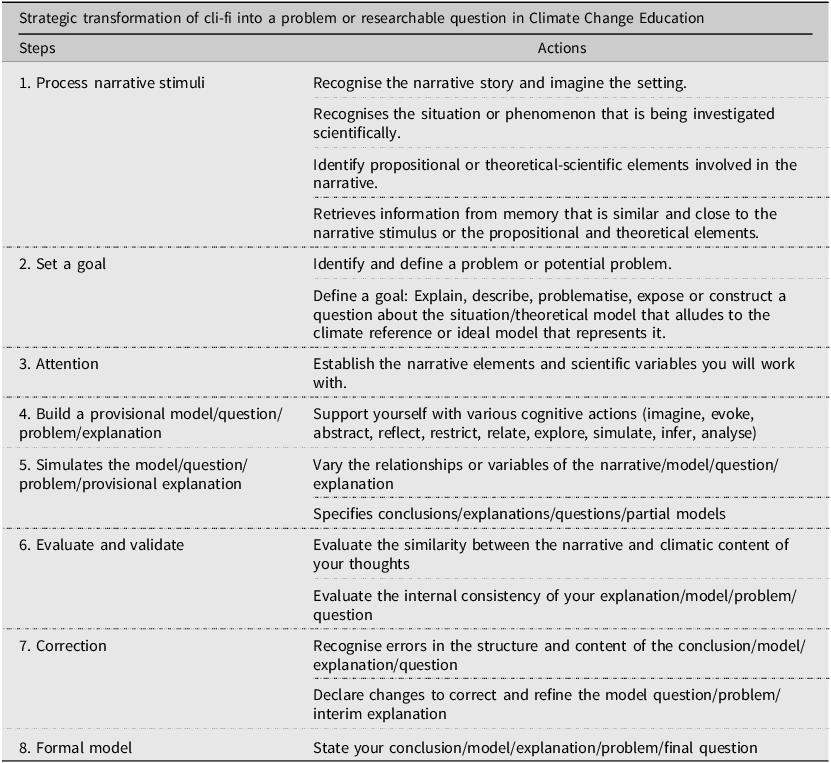
The agentive activity theory developed by Igor Arievitch (Reference Arievitch2017) is an extension of the work of Lev Vygotsky and Piotr Galperin. They conceptualised cognitive development and learning as programmed processes that require control and are the result of conscious regulation, mediated and enhanced by material and semiotic cultural tools. In the context of this study, the guide developed here (Table 1) to transform cli-fi into a school science problem serves as an example of a cultural tool that prompts scientific thinking. This cultural tool supports the process of employing cli-fi to problematise climate change issues in a conscious and regulated way.
Orientation guide used in the TA and retrospective interviews

According to Arievitch (Reference Arievitch2017), learning emerges through interaction between the individual and the external world. Interaction becomes meaningful when organised around activities consciously arranged and self-regulated by people. The theory of agentive activity maintains that psychological processes transcend the mentalist tradition that reduces learning to an abstract, intangible mental representation (Arievitch, Reference Arievitch2017). Cognitive processes are projected outward to the external world through oriented and controlled activity.
Cultural and semiotic tools mediate agentive activity. By mediation, it is understood that the tools are more than how a person carries out the activity with the said tool. Tools, such as language, symbols, graphics and study guides, enable the orientation of thought and ideas when carrying out intellectual activities, while simultaneously encapsulating socio-cultural meanings and meanings developed throughout human history. For example, cli-fi narratives have the potential to mediate understanding of socio-environmental issues; at the same time, they require knowledge of specific cultural concerns and traditions to interpret and make sense of the narratives.
From the theory of agentive activity, cli-fi requires oriented, intentional activity and agency for it to have cognitive value for educational purposes. Otherwise, it is just a story that one wanders aimlessly (Breithaupt, Reference Breithaupt2023), a story without parallel with the real natural world (DiPaolo, Reference DiPaolo2018). It is necessary to note the agentive nature of cli-fi from the renarrative method (Breithaupt, Reference Breithaupt2023), that is, when the person reduces, creates and produces the narrative. The readers reduce the narrative content to preserve the narrative core, which they consider others should understand. Then, the person creates a personally meaningful aesthetic to preserve the core and produces a course and form of the story appropriate to those whom they consider their listeners.
Although the renarrative method suggests agency, cli-fi with cognitive value in climate change education goes beyond the renarrative method. Cli-fi operates with renarrative and generates explanations or addresses school problems about climate content. Cli-fi in climate change education involves actively and systematically exploring possibilities and multiple versions of climate narratives (Breithaupt, Reference Breithaupt2023; Canavan, Reference Canavan, Canavan and Robinson2014; Ruvalcaba Cervantes, Reference Ruvalcaba Cervantes2024).
Transforming cli-fi into school science problems is an intentional and agentive mental activity that entails operating with narrative properties. The activity requires learners to deploy dynamic sequences of mental actions (Arievitch, Reference Arievitch2017; Trexler, Reference Trexler2015) and pursue the goal of transforming the narrative: the elements and content of the story, the imaginary scenarios and projecting multiple closures of the story and its consequences. Therefore, it is a deliberate activity that integrates narrative thinking with formal thinking. Based on this idea, the guide (Table 1) was designed to encourage teachers’ control over transforming cli-fi into science problems. The control of the activity to transform the cli-fi into a tool with cognitive value refers to an instrument whose function is metacognition and autoregulation through the activity.
In this study, the guide is considered a control instrument. The control design has a structure that progresses from the general and particular to the specific. The general control is the renarrative method, which means teachers will recreate the cli-fi story by focusing on what they see as the narrative core to generate narrative immersion. Particular control refers to teachers controlling the activity of translating the retelling into a deliberate and reflective discussion of climate content. Specific control refers to teachers deliberately exploring and experiencing the consequences and possibilities of organising and reorganising both the climate content and the narrative elements (Ruvalcaba Cervantes, Reference Ruvalcaba Cervantes2024). Specific control here will be named as ‘climate scientific thinking in schooling’.
Method
This study qualitatively tests a guide designed to orient teachers’ actions and mental processes in transforming cli-fi into school science problems and researchable questions. Therefore, the work employs an exploratory, qualitative-interpretive approach, which constructs meanings from the data through a coding process.
Information was collected through think-aloud (TA) and retrospective interviews with three Mexican secondary school biology teachers. The guide (Table 1) was qualitatively tested with teachers because the study is exploratory and aims to evaluate the controlled, that is, autoregulated, use of the guide. Although teachers and students have a similar level of climate change content knowledge, teachers have more familiarity with the cognitive instructions in the guide than students (Lambert et al., Reference Lambert, Lindgren and Bleicher2012; Lambert & Bleicher, Reference Lambert and Bleicher2013; Walsh & McGowan, Reference Walsh and McGowan2017).
Teachers were tasked with reading three fragments of cli-fi narratives and transforming these into school science problems. The researcher collected data via audio recording and transcribed it to obtain verbal reports. For the theory of agentive activity, the unit of analysis is each of the actions that constitute the deliberate activity of the teachers. In this study, the focus is on the mental actions participants deployed to transform the cli-fi into school science representations.
Participants
The participants are three Mexican secondary school biology teachers with teaching experience between 5 and 8 years. They are graduates with a bachelor’s degree in biology and a master’s degree in science education with an emphasis in biology. The researcher selected the participants by convenience sampling. He had been the professor of the biology teachers, who, at the time, were students in the final course of their master’s degree. The invitation was open to participation among biology teachers who were nearing the completion of their master’s degrees. The three participants are a small, heterogeneous group: they differ in initial training (biology, science education and environmental science education); they teach in divergent institutional context; vary in their pedagogical content knowledge and content knowledge about climate change; they manifest diverse ideological and political interest according to their educational context of labour; and they exteriorise divergent emotional and concerning about environment.
Materials
The teachers used the guide (Table 1) to prompt their thinking and transform two fragments adapted from a novel – “The Ministry of the Future” by Kim Stanley Robinson (Reference Robinson2021) – into school science problems, and a fictional situation adapted from the article “Scientists at odds over wild plans to slow melting glaciers” (Richter, Reference Richter2024). Interviews were conducted through TA and retrospective protocols to generate verbal reports analysed using a bottom-up qualitative approach. First, the cli-fi fragments will be presented, followed by the orientation guide.
Cli-fi narratives
“The Ministry of the Future” is a novel by Kim Stanley Robinson (Reference Robinson2021) from which two fragments are extracted due to its ease of reading, its optimism in facing climate change problems, and its concrete proposals to mitigate and confront climate change. Robinson’s novel narrates the creation of a Ministry whose purpose is to defend the climate rights of future generations. The Ministry undertakes a range of political, diplomatic, economic, including violent and clandestine strategies, to handle the climate crisis. Throughout the story, Robinson narrates how the proposals led by the Ministry, among other agents, begin to transform social and economic dynamics, such that the Ministry’s efforts manage to stabilise and compensate for the environmental crisis. The repertoire of initiatives and actions in Robinson’s narrative includes a new currency backed by carbon capture, reforestation and rewilding programs, as well as geoengineering projects, in addition to political and social actions – diplomatic and covert –, ranging from negotiations to kidnappings and assassinations of key agents. The novel demonstrates that sustainable existence and consumption are possible, although deep systemic changes, social conflicts and transformation of archetypes and idiosyncrasies are required.
The researcher extracted fragments from the Robinsons’ book and renarrated them to respect the participants’ time and avoid extending the interview. The book fragments were tested with Mexican secondary biology teachers in workshops (Ruvalcaba Cervantes, Reference Ruvalcaba Cervantes2023).
Narrative 1
A heat wave has been recorded in India. The population has lived with these climatic conditions for over a month. The social situation has begun to be desperate and worrying. The electrical system has collapsed due to the number of days under this heat wave. There is no access to cooling systems or water. The humidity is high, above 70%, and the temperature recorded is 50°C. In desperation, people think they could go to the river during the day to dip and cool off a little. Now, it is possible to see people heading towards the river.
Narrative 2
The Ministry of the Future has been created. There is finally an institution dedicated to protecting future citizens! One of the purposes of the Ministry is to negotiate a new exchange currency, the CarbonCoin. The more carbon dioxide banks can capture, the stronger the new currency. Now, businesspeople, bankers, and investors will be more concerned about capturing carbon dioxide to be rich. A climate relief!
The third narrative fragment used is a retelling of the text “Scientists at odds over wild plans to slow melting glaciers,” published by Hannah Richter (Reference Richter2024). Richter announces a research project in glacial geoengineering that aims to address the problem of melting glaciers. The proposal consists of building barriers or deep perforations around glaciers to prevent them from sliding into the ocean and warm water currents from eroding the ice layers. Richter reports complications and criticisms of the proposal, from the scientific to the economic spheres. The article was selected using the same logic as Kim Stanley’s fragments, based on its easy readability and concrete proposal to mitigate climate change.
Narrative 3
In recent years, space geoengineering has stood out. Researchers working along these lines aim to inject particles high into the atmosphere so that they reflect solar radiation. They claim that such action will favour the cooling of the Earth. However, controversy is breaking out among academic experts on climate change because there is a proposal that, according to some experts, could be more efficient. Glacial geoengineering proposes building barriers around glaciers. It involves “building floating ‘curtains,’ tied to the seafloor beyond the edge of ice shelves and glaciers, to block natural currents of warm water that erode ice sheets from below. (Especially in Antarctica, warming ocean water is a greater threat to glaciers than warming air.) Early designs called for plastic, but natural fibres such as canvas and sisal are now being considered to avoid pollution problems. Initial modelling studies show that “Sheet heights that extend only partially from the seafloor off the coast of West Antarctica could reduce glacial melting by 10 in some places. Another intervention some scientists are contemplating would be to slow the sliding of ice sheets by drilling holes in their bases and pumping in water or heat.”
These three narratives are open to the critique that they do not provide deep narrative immersion for the reader. Nevertheless, the selected fragments powerfully narrate the natural world as they contain agents, sequences, time, facts, events and other narrative properties that encourage teachers to deploy levels of narrative significance (Avraamidou & Osborne, Reference Avraamidou and Osborne2009; Breithaupt, Reference Breithaupt2023; Bruner, Reference Bruner1991, Reference Bruner1996; D’Orto & Tasquier, Reference D’Orto and Tasquier2025). There are four levels of narrative significance to evaluate the narrative tools employed in climate change education (D’Orto & Tasquier, Reference D’Orto and Tasquier2025): describing the natural world, providing narrative explanations of the world, eliciting emotional and poetic reflections triggered by the narrative, and unveiling tacit assumptions inherent in the narrative. The three fragments in this study promote, at least, a narrative immersion into the first- and second-level narrative significance.
Orientation guide
The aim was to design a guide that shows the step-by-step process to prompt teachers’ mental actions to transform the cli-fi into a school scientific problem. The step-by-step process is structured based on the theoretical approach, and the researcher translated it into guidelines that prompt the participants to control the activity. The guide is the result of a previous theoretical work (Ruvalcaba Cervantes, Reference Ruvalcaba Cervantes2024). The author structured it into eight integrated steps, each involving various intellectual actions (Table 1). The structure favours participants’ control over the activity and corresponds to the structure of control progress explained at the end of the theoretical section of this paper: (1) general control: encouraging narrative immersion in the cli-fi to be aimed at identifying climate contents; (2) particular control: reflecting on climate content deliberately and (3) specific control: encourage school scientific climate thinking.
The order of actions that constitutes the step-by-step structure of the activity was designed to prompt participants’ deliberate actions efficiently adjust and address the transformation of cli-fi into climate change problems. The design of the order of actions aims for teachers to systematically structure each operation with the cli-fi in an integrated way. The guide amplifies teachers’ self-regulation to explore and experience consequences and organising possibilities of climate content into cli-fi narratives.
The functional design, structure and actions of the step-by-step guide to the activity were built from theoretical reflections (Ruvalcaba Cervantes, Reference Ruvalcaba Cervantes2024) and empirical pilot tests (Ruvalcaba Cervantes, Reference Ruvalcaba Cervantes2023).
The guide (Table 1) and narratives align with the TA and retrospective interview protocols. Activities are neither complicated nor simple. The participants determine the scope of the activity based on their experience with it and the information that operates in working memory (Leighton, Reference Leighton2017).
Procedure
The development of the work with the teachers was systematic and organised:
-
a. Presentation and ethics statement. In each interview, the researcher explains the purpose of the study and describes the interview. Presents the ethics statement (British Educational Research Association, 2024), obtains informed consent from teachers and guarantees the confidentiality of participation.
-
b. Familiarity with the guide. Participants receive guidance to transform cli-fi into a school science problem. Teachers read aloud the steps and the corresponding actions to each step. In case of any doubt, the researcher explains the guide’s functionality, structure and order in detail.
-
c. Think Aloud Interview. The researcher explains that the TA interview is an exhibition of cognitive actions in real-time (Leighton, Reference Leighton2017). Teachers were instructed to express their thoughts aloud, regardless of the order or logical consistency of the ideas. Also, participants were encouraged to alternate between reading the guide and the narratives.
-
d. Retrospective interviews. At the end of the TA, the researcher asked retrospective questions to clarify the ideas stated and explain any doubts the researcher had about how the teachers used the guide. Each retrospective interview followed each TA.
Data analysis
The TA and retrospective interviews were audio recorded and transcribed in full. A verbal report was obtained (Leighton, Reference Leighton2017). A qualitative and inductive bottom-up analysis was carried out, from the data to the construction of categories. The analysis was carried out as follows:
-
a. Data organisation. The interview (TA and retrospective) is organised into information segments. The segments are defined according to the type of verbalisations: expressions that denote narrative immersion, narrative climate thinking and school scientific climate thinking.
-
b. Proposition. The segments are considered to extract quotes that denote propositional, narrative, climate content and cognitive actions.
-
c. Coding. The quotes are considered to assign words that define the themes or propositions they represent.
-
d. Categories. The codes are considered, and their characteristics are identified. Those that share similarities are grouped under the same term.
Ethical statement
No ethical institutional committee approved the study because the institution where the study was carried out does not have a specific ethics committee for evaluating educational research. However, the work adheres to the fifth edition of the British Educational Research Association’s (British Educational Research Association, 2024) ethical guidelines. The researcher informed participants of the research’s purposes and the uses of the collected data. Teachers voluntarily provided informed consent after being explicitly informed of their right to withdraw from the study at any time. The privacy of all participants is ensured with labels in data coding. No process represents a danger to the participant’s identity, psychological, physical, or emotional health or work life; on the contrary, the study presents potential benefits, including professional reflection on climate change content knowledge. The researcher provided all participants with contact information for addressing any ethical concerns that may arise.
Results
The study qualitatively tests a guide to orient teachers’ actions and mental processes in transforming cli-fi into a school science problem, overcoming the trial-and-error approach. The results are presented according to the guide’s design for structural progressive control, which includes narrative immersion (general control), narrative climate thinking (particular control) and school scientific climate thinking (specific control). The guide’s structure organises results to clarify how teachers use it in each activity segment.
Segment 1. Narrative immersion
All participants use the guide when operating with the three narratives. The first use is to follow steps 1 and 3, processing narrative stimuli and attention (Table 1). Teachers consider the suggestions of the two steps mentioned above to achieve narrative immersion. They read the narratives and the guidance guide alternately.
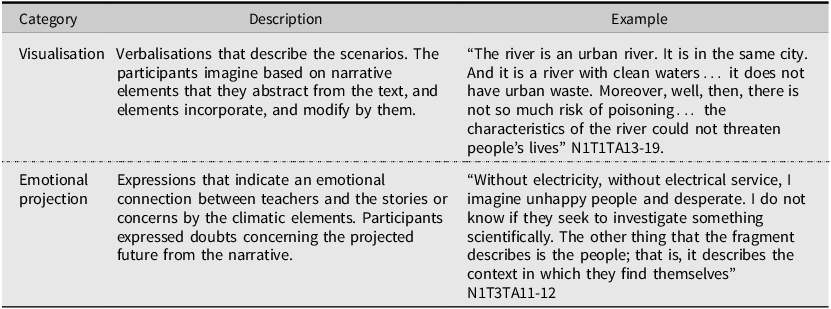
Two categories are recognised: visualisation and emotional projection (Table 2). Each example in the Table 2 is a quote with a code that allows for the identification of the quote extract. For example, the first quote has the code N1T1TA13-19, which refers to Narrative 1, Teacher 1, lines 13–19 of the verbal report of the TA interview. RI is used instead of TA when the fragment refers to the retrospective interview.
Categories of narrative immersion
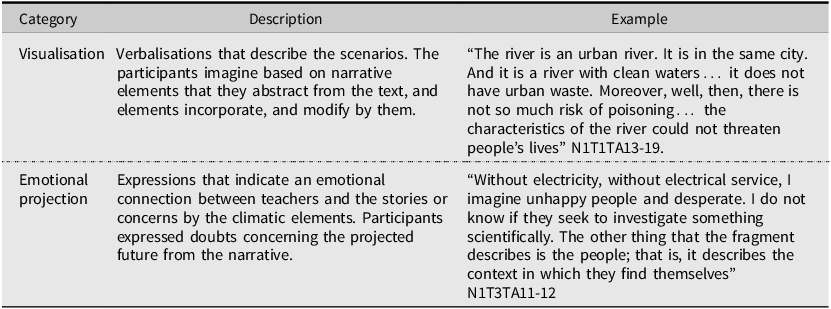
The visualisation category contributes to building an initial frame of reference to operate with the narrative content of the cli-fi. From the referential framework, participants focused their attention on specific narrative elements and others not mentioned in the cli-fi fragment were incorporated. For example, in quote N1T1TA13-19, the teacher abstracts the river as a narrative element and incorporates unsaid properties, speculating whether the river implies any risk to the citizens who go there.
The retelling accounts for the narrative elements to which participants will pay attention throughout the rest of the activity. Quote N1T3TA11-12 continued with reflections focused on the river:
“It seems the problem is how to get to the river. What difficulties must be overcome?… And then, once people reach the river, their space is also a problem… And to what extent will the river be filled with water if this climatic situation continues?” N1T3TA48-52
Narrative visualisation fosters an emotional connection between the teacher and the characters in the narrative. Narrative co-experience deploys the emotional projection of different narrative futures that frame teachers’ verbalisations (Breithaupt, Reference Breithaupt2023; Lakoff, Reference Lakoff2010) to represent the diversity of possible narrative futures and their consequences. For example, quote N1T3TA11-12 continued:
“I tend to think that, if this is the case, a major collapse will, to some extent, depend more on less technological issues… the possible difficulties have to do with resisting the weather conditions to reach the river, a whole series of unfortunate events where, at the end of everything, there is death” N1T3TA18-22
The emotional projection indicates that the participant is concerned about the events narrated (Table 2) and is interested in the risks of the river for people who go to cool off in it during the heat wave. Simultaneously, teachers’ emotional projections are an anchor for identifying or constructing problems that transfer the narrative to a frame of reference, enabling teachers to configure a problem (Lakoff, Reference Lakoff2010).
Segment 2. Climate narrative thinking
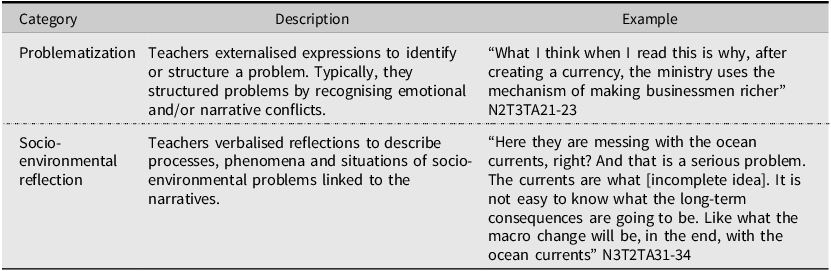
Table 3 shows how teachers utilised the guide during the actions linked to climate narrative thinking. The uses correspond to the steps suggested in Table 1: establish a goal and build a provisional model/question/problem/explanation.
Categories of climate narrative thinking

This segment of the interview addresses the structuring problems that teachers carry out based on the narrative. The participants structured problems by abstracting and expanding theoretical and conceptual elements from the narratives. In the example N2T3TA21-23 (Table 3), participant 3 identifies a conflict of economic inequality with the proposal to create the CarbonCoin. The teacher problematises the conflict as an issue of social and economic justice:
“If a ministry plans to protect future citizens, it cannot continue building the logic of inequality… what changes is the accumulation of capital due to the accumulation of carbon” N2T3TA25-29
“So we have to expropriate everything” N2T3TA34-35
“I intend to dismantle this system and make it, I do not know, another responsibility of society without the possibility of accumulating wealth to protect future citizens and propose a new currency, the CarbonCoin. For me, there should not be sectors that benefit from accumulating more, but rather the benefit of that CarbonCoin should be equitable, for all citizens” N2T3TA45-49
Problem structuring involves teachers’ complex reflections that describe socio-environmental situations, expanding the narrative. For example, quote N3T2TA31-34 expresses how the teacher is concerned about altering the flow of ocean currents when operating narrative three on the glacial geoengineering proposal to prevent glacier melting. The concern of the teacher broadens the reflections to ideas of an economic and environmental nature:
“What will happen to the economy, right? Without financing. Because many of the problems of science are that money is not unlimited. And if there is not a commercial benefit, it is difficult for someone to finance you” N3T2TA43-45
“The seabed intervenes here. And we know that this is going to affect the marine fauna there. The seabed is not empty. There are living beings, barriers are being put at the bases, and the curtains extend from the seabed. That is intervening.” N3T2TA48-51
Segment 3. School scientific climate thinking
Table 4 presents categories to expose the guide’s uses during the teachers’ execution of school scientific climate thinking actions. The guide’s uses in this phase correspond to (Table 1): Simulate the model/question/problem/provisional explanation, evaluate and validate, correction and final model.
Categories of school scientific climate thinking
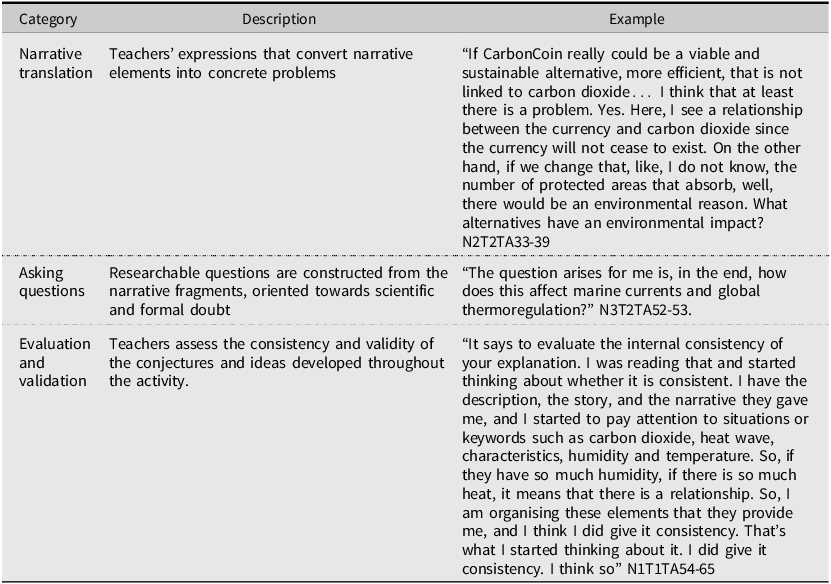
The quote N2T2TA33-39 in Table 4 is a reflection of a back-and-forth between the guide and the teachers’ thoughts aloud, since it is a continuation of the teacher’s soliloquy:
“They paint CarbonCoin as an alternative. This doesn’t seem like a problem, but there is a problem behind it. And this, here it says that we have to problematise” N2T2TA28-29.
In this segment, appointments reflect a more regulated and controlled teacher’ activity under the influence of the guide. The quotes N3T2TA52-53 and N1T1TA54-65 (Table 4) explicitly indicate the cognitive demand suggested by the guide; the teacher develops a final question and evaluates the expressed thoughts. In quote N1T1TA54-65, it is possible to read that the guide leads the participant to assess the thinking aloud consistently when evaluating the relationship between the elements (carbon dioxide, heat wave, humidity and temperature), and the teacher concludes by outlining consistency: “I think I did give it consistency”.
The quotes reveal the teacher’s autocontrol, even if the suggested action was not carried out:
“I do not think I explored it, I do not think I simulated it” N3T2RI43.
The teacher, in the third narrative during the retrospective interview, acknowledges not having explored or simulated the ideas thought. However, the usefulness of the guide stands out:
“Then I read the narrative and became more aware of it. And then I go back to the text, to the points [of the guide]. I can already start to see relationships. I go back to the guide and then, ah, ok, I indicate a problem. Ah, it says some problem. So I had to invent a problem” N3T2RI47-49
The third segment indicates that teachers use the guide to edit and correct as well as to self-regulate the activity through editing ideas.
Summary results
The results are summarised in three key moments of how the teachers used the guide:
Narrative immersion. This corresponds to the design and expected use of the guide. Narrative immersion occurs when the teachers emotionally project and visualise the narrative content (Table 2). It manifests itself in teachers’ mental actions, such as imagining and visualising the narrated scenes and abstracting contextual elements, which will be the basis for scientific problematisation. The guide supported teachers to a) building imaginary scenarios as frames of reference to then problematise and b) linking experiences that trigger emotional projections in an intentional and self-directed way. Participants achieved control and agency during narrative immersion by abstracting narrative elements and expanding visual and imaginary details (Table 2 and consequent quotes).
Problem structuring. This corresponds to the purpose of the guide’s design, which is to promote climate narrative thinking. Teachers used the guide and displayed mental actions, such as reflecting on the narrative to identify socio-environmental problems (Table 3). For example, they noted the distribution of wealth by CarbonCoin, problems with capturing carbon dioxide (Narrative 2), and the environmental and scientific financing problems (Narrative 3). Participants used actions such as reflecting, abstracting, and problematising to establish meaningful questions and used little content knowledge. The guide supported teachers in defining variables or entities to problematise (e.g. the distribution of wealth and currents and seabed, quotes from Table 3). However, teachers manifested a limited use of theoretical and conceptual entities, and the relationships involved, as they recognise:
“I do not understand much about economics” N2T3TA45
“It says, slow down the sliding of the ice sheets. I do not understand mechanics…” N3T1IR47-
Editing and correction. This corresponds to mental actions manifested as part of what was expected in the design to promote school scientific climate thinking. The results (Table 4) indicate the activities of cognitive regulation and control of expanding and modifying ideas, that is, editing and correcting. The teachers did not complete the activity by defining and specifying explanations or problems based on content knowledge. The limit in the theoretical, conceptual and technical knowledge of the teachers limited how they used the guide and the efficiency of the correction:
“This part is a bit difficult for me, evaluating and correcting… Furthermore, since I do not know much about economics, I think it is a more idealistic approach. Therefore, I do not know how to correct” N2T3RI27-29
The teacher cannot carry out the actions suggested in the guide (Table 1) to evaluate and correct them due to a lack of economic knowledge, as the teacher said. The ideas to be evaluated and corrected are the proposals to expropriate everything (quote N2T3TA34-35) and dismantle the economic system (quote N2T3TA45-49) that supports CarbonCoin. Consequently, the guide supports deliberately attempting correction; however, the teacher’s action is limited by their content knowledge.
In summary, teachers utilised the guide strategically to self-regulate their activity and edit ideas. They orient themselves with the guide to a) control mental actions and deliberately transform fiction into problems and explanations; b) edit their thoughts by expanding the content of reflections and reviewing, analysing and explaining fictional situations.
Discussion
The results show that converting cli-fi fragments into science problems leads to a complex interaction among cognitive actions, teachers’ prior knowledge and the instructional guidance provided. Therefore, this discussion involves exploring (1) how the guide mediates teachers’ mental activity, (2) future research and (3) the feasibility of exclusively guiding the control and editing of ideas to structure problems on climate change using cli-fi.
The guide as a mediating tool
The results support the assumption that the cognitive value of cli-fi lies in its potential to promote teachers’ agentive, oriented and intentional activity. For example, narratives 1 and 2 reflect that participants explore climate justice, economic inequality and community solutions to climate change. Teachers’ reflections lead them to construct meaningful science problems while expanding their perspectives on climate challenges.
The finding highlights the core of the theory of agentive activity, which underlines the value of cultural mediators in intentionally designing and structuring cognitive processes (Arievitch, Reference Arievitch2017), transcending the trial-and-error approach noted previously. The finding aligns with studies (D’Orto & Tasquier, Reference D’Orto and Tasquier2025; Soares et al., Reference Soares, Gonçalves, Jerónimo and Kolinsky2023; Yusoff & Gabrys, Reference Yusoff and Gabrys2011) that support the idea of systematically employing cli-fi narratives to enhance students’ learning about climate change. The guide prompts the teachers’ activity of transforming the cli-fi and mobilising narrative thinking towards formal thinking through self-regulation. For example, in the second narrative about CarbonCoin, teachers identified problems between a currency designed to encourage carbon dioxide capture and the possible social and economic consequences triggered by the narrative proposal. However, the results indicate that teachers had difficulties operating according to their content knowledge and accurately evaluating their mental actions, particularly with climate, economic and financial content.
The results have implications for rethinking the idea of mediation, a term of interest in the theory of agentive activity (Arievitch, Reference Arievitch2017). Mediation is associated with the external world - internal world direction, that is, individual internalisation of cultural knowledge. From this perspective, mediating tools enhance learning by accentuating the orientation in controlling and regulating the internalisation process of cultural knowledge. However, the orientation guide favoured controlling and regulating activity in the opposite direction, moving from the individual to the external cultural world. Thereby, emphasising how teachers’ experiences shape their understanding of narratives. Similarly, D’Orto and Tasquier (Reference D’Orto and Tasquier2025) found that different levels of meaning are projected outward regarding climate change, depending on the narrative format used. The orientation guide is helpful to teachers by deploying cognitive actions, projecting emotions and experiences and clarifying content knowledge (even if it is scarce and limited) linked to the cli-fi. The teachers used the guide to externalise and explain previously internalised skills and knowledge. This observation is relevant because it does not typecast mediation as unidirectional and expands the theoretical potential of mediation as a bidirectional term.
Future research
There are three main moments of the guide’s use: narrative immersion, problem structuring and editing and correction.
Narrative immersion. The guide was qualitatively tested with two fragments of a cli-fi novel and one from a science article. So, it is impossible to assert that the three fragments encompass all narrative properties. The complete narrative properties help readers achieve the highest levels of narrative significance (D’Orto & Tasquier, Reference D’Orto and Tasquier2025), including emotional and poetic reflections triggered by the narrative, as well as unveiling tacit assumptions within it. In this study, the fragments contain narrative properties to test the guide in concrete imaginary scenes at the first two levels of narrative significance: depicting an imaginary situation and explaining the natural world within that situation.
When participants transformed the narratives into problems, they demanded and sought explanations for the depicted world. The teachers expressed emotions and ideologies but did not engage with them to explore the consequences of adopting an emotional perspective or revealing the underlying assumptions, actions related to the third and fourth levels of narrative significance. The current finding opens the door to exploring the guide’s potential with narratives that fully embody narrative properties and aim to reach the highest levels of narrative significance.
Problem structuring. The study found that teachers operated with limited content knowledge and struggled to structure problems based on that knowledge. Regarding reduced knowledge, in narrative 3, the participants expressed their insecurity when evaluating the effectiveness of glacial barriers. They acknowledged their lack of knowledge about the dynamics of glaciers and ocean currents, among other knowledge gaps related to the narrative. It opens future research on how teachers can enhance problem structuring in cli-fi by integrating the related content knowledge into the guide.
Editing and correction. The limited content knowledge expressed in the interviews may not be exclusive to the findings of the present paper. Lakoff (Reference Lakoff2010) highlights the poor conceptualisation and verbalisation of ideas necessary to understand environmental content as environmental hypocognition. In other words, the understanding of climate change requires more than just scientific and technical perspectives on the environment. It is necessary to understand economic, political, technological, social, health, food and energy discourses related to climate change. Furthermore, the cli-fi exposes pro-environmental messages, climate concerns, cultural archetypes and critiques of environmental issues that encourage social activism (DiPaolo, Reference DiPaolo2018).
The environmental hypocognition and spiritual and cultural issues underlying climate change (DiPaolo, Reference DiPaolo2018) complicate for teachers the problematisation and the corresponding editing and correction. The findings indicate that teachers’ participation is insecure and overwhelming. The teachers acknowledge the challenging task of evaluating and correcting beyond scientific ideas (example N2T3RI27-29). The results highlight the need to explore how to handle environmental hypocognition with the guide (Table 1).
The feasibility of using the guide exclusively for the control and editing of ideas
At the higher levels of narrative significance, everyone reads cli-fi from their ideological, artistic and aesthetic backgrounds (Canavan, Reference Canavan, Canavan and Robinson2014; DiPaolo, Reference DiPaolo2018). High levels of narrative significance entail explicit expressions of one’s own cultural, ideological and spiritual beliefs that ground environmental concern and responses to environmental problems, that is, moral urgency (DiPaolo, Reference DiPaolo2018). Therefore, it would be necessary to explore how to guide teachers’ mental actions in operating with moral urgency content to transform cli-fi. However, this raises questions about which ethical frameworks should frame the guide (Table 1) – indigenous spirituality, secular humanism, social justice, ecofeminism, or religious ethics. It also generates debate about the ethical validity of directing teachers’ moral reasoning. Nevertheless, it remains to focus only on scientific ideas to guide teachers’ mental actions, as in the present paper.
Conclusion
The study aims to qualitatively test a guide that prompts teachers’ mental actions to transform cli-fi into a school science problem, thereby transcending the trial-and-error approach typically used in climate change education by utilising cli-fi.
The instructional guide proved effective as a mediating tool for teachers to transform cli-fi into educational problems, in terms of depicting an imaginary scenario and demanding explanations. The findings reinforce the importance of an agentive and systematic approach in utilising cli-fi, emphasising the need for developing mediating tools that enhance its effectiveness in climate change education.
It is concluded that the guide (Table 1) contributes to the deployment of teachers’ agency in using cli-fi in climate change education. However, there is a need to investigate the guides’ potential to prompt the problematisation of cli-fi that stimulates a higher level of narrative significance. At the same time, inquiries should focus on investigating students’ perspectives and performance to ensure the cognitive value of cli-fi in climate change education.
Acknowledgements
The author thanks SECIHTI for being supported with the Jóvenes Investigadoras e Investigadores por México programme.
Financial support
This research received no specific grant from any funding agency, commercial, or not-for-profit sectors.
Ethical standard
No institutional ethics committee approved the study due to the absence of a specific committee for educational research at the host institution. Nevertheless, the study adheres to the British Educational Research Association’s ethical guidelines, 5th edition (2024). The researcher obtained informed consent from all participants, ensured participant privacy, and posed no risks to participants.
Author Biography
José Manuel Ruvalcaba Cervantes is a Professor at CINVESTAV Monterrey, México. He teaches in the Master’s program of Education in Biology for Citizen Education. His research lines are teaching and learning about climate change, development of scientific imagination, thought experiments in science education and activity theory. His work usually employs science fiction as a cultural tool to study science learning.


 Open access

