





Introduction
Social scientists widely agree that politics in modern democracies is mediatized, and that mass media’s news coverage is the most important source of information about politics and society (eg Esser and Strömbäck Reference Esser and Strömback2014; Strömbäck Reference Strömbäck2008). Political actors who aim to spread their message to the public at large, therefore, spend more time on mass media communication than previously. A key goal is to appear in the news (eg Strömbäck and Van Aelst Reference Strömbäck and Van Aelst2013; Van Aelst and Walgrave Reference Van Aelst and Walgrave2017).
Even if interest groups do not always want media attention (Willems Reference Willems2024), seeking media coverage is generally an important strategy also for interest groups today (eg Binderkrantz Reference Binderkrantz2012; Kollman Reference Kollman1998). By appearing in the media, interest groups may influence the media’s agenda-setting, exert indirect pressure on political decision makers’ political agenda and policy positions, affect citizens’ issue priorities and opinions on policy issues, and signal the groups’ efforts to members and supporters (Willems Reference Willems2024). Media attention can hence help interest groups reach their goals of political influence and, in the longer term, organizational survival. Empirical findings show that all sorts of interest groups pursue media strategies, including insiders and outsiders to the system. Indirect media strategies supplement inside strategies of contacting different types of decision makers directly (Binderkrantz Reference Binderkrantz2005; Kriesi, Tresch and Jochum Reference Kriesi, Tresch and Jochum2007).
The extent to which interest groups actually get access to and attention from media outlets varies. Media attention is scarce, and journalists are selective in what they cover. Existing research shows that, whereas many interest groups seek media access, few interest groups enjoy high media visibility: most groups are never or seldom in the news (eg Binderkrantz, Bonafont and Halpin Reference Binderkrantz, Bonafont and Halpin2017; Thrall Reference Thrall2006; Willems Reference Willems2024). Previous studies find that media coverage of interest groups mainly is a matter of organizational resources. More resourceful interest groups generally get more media coverage, probably because resources aid in media-oriented work and make groups appear more important to journalists (Binderkrantz, Bonafont and Halpin, Reference Binderkrantz, Bonafont and Halpin2017, Binderkrantz, Halpin and Pedersen, Reference Binderkrantz, Halpin and Pedersen2020; Thrall Reference Thrall2006; but see De Bruycker and Beyers Reference De Bruycker and Beyers2015). Given that resources are also positively associated with direct access to political decision makers, such as the legislature and the government, these findings overall suggest that news coverage confirms existing patterns of access (eg Binderkrantz, Christiansen and Pedersen Reference Binderkrantz, Christiansen and Pedersen2015; Fraussen, Beyers and Donas, Reference Fraussen, Beyers and Donas2015).
In this paper, we examine whether the strength of interest groups’ organizational ties to political parties is associated with groups’ media attention, focusing on newspaper coverage. The term ‘organizational ties’ refers to the structured or institutionalized interactions that exist between parties and interest groups, such as regular meetings and joint conferences (Allern, Hansen, Marshall et al. Reference Allern, Hansen, Marshall and Otjes2024). They constitute another type of access to political actors and can serve as a means to media access, if we consider what interest groups can offer and what journalists, as gatekeepers, seek from interest groups in exchange for media attention. Ties facilitate collaboration between parties and interest groups and allow the actors to coordinate their media strategies. They furthermore enable the actors to draw on each other’s media networks. From the journalists’ point of view, stronger ties may signal prominence and connections to newsworthy political actors and conflicts – also when interest groups do not seek or try to avoid media attention themselves. If our argument holds, we furthermore expect the effect of ties to be positively conditioned by the news coverage of the parties to which the groups are tied during the same time period.
We examine the relationship between organizational ties and interest group media attention in four European democracies: Denmark, the Netherlands, Norway, and the United Kingdom. We use interest group survey data on the existence of a wide range of ties between specific groups and parties, and we record the media attention these actors get between 2016 and 2018 using a comprehensive corpus of daily news content from twelve newspapers. We find support for our hypotheses. Interest groups with stronger ties to political parties are generally more likely to appear in the news, and this association is strengthened when the parties themselves get more media attention.
These findings add to the literature on interest group strategies, and in particular, the sparse existing research on interest groups’ media attention. We highlight that collaboration between interest groups and other actors can constitute an asset in the pursuit of media attention. We furthermore speak to the literature on party-interest group relations. This field of research has mainly focused on explaining the existence of organizational ties (eg Berkhout, Hanegraaff and Statsch Reference Berkhout, Hanegraaff and Statsch2021; Rasmussen and Lindeboom Reference Rasmussen and Lindeboom2013; Witko Reference Witko2009). We address a potential effect of such ties. Lastly and more broadly, our findings contribute to the debate on bias in access to decision makers and thus possibly in interest representation and policy making (eg Binderkrantz, Christiansen and Pedersen Reference Binderkrantz, Christiansen and Pedersen2015; Boräng and Naurin Reference Boräng and Naurin2022; Eichenberger, Varone and Helfer Reference Eichenberger, Varone and Helfer2022; Gilens and Page Reference Gilens and Page2014; Weiler, Eichenberger, Mach et al. Reference Weiler, Eichenberger, Mach and Varone2019). We know from previous research that interest groups’ ties to parties are not only about the groups’ general resources but also about voter recruitment potential and ideological kinship (Allern, Hansen, Marshall et al. Reference Allern, Hansen, Marshall and Otjes2024). Ties can, in this way, contribute to wider media coverage of groups. However, the fact that stronger organizational ties, which already provide interest groups with direct access to political parties, also seemingly create opportunities for these groups in the media, above all, suggests that media coverage mimics existing patterns of access.
Theory and hypotheses
In their pursuit of political influence, interest groups can choose between a range of direct and indirect strategies and associated measures (eg Binderkrantz Reference Binderkrantz2005). In this paper, we focus on indirect, media-oriented activities. Traditionally, less resourceful interest groups without direct access to decision makers were thought to be the groups that mainly sought media access. Empirical findings, however, contradict this picture. Binderkrantz and Krøyer (Reference Binderkrantz and Krøyer2012: 117) summarize previous research on the strategies and tactics of interest groups in contemporary democracies as follows: ‘Rather than being a “weapon of the weak,” media tactics are heavily used by wealthy interest groups with good access to decision-makers’. Media strategies are hence seemingly not a substitute but rather a supplement to inside strategies (see also, eg Binderkrantz Reference Binderkrantz2012; Kriesi, Tresch and Jochum Reference Kriesi, Tresch and Jochum2007; Thrall Reference Thrall2006).Footnote 1
Although there likely are instances where interest groups do not want media attention, such as when they promote issues that are unpopular with the public (Willems Reference Willems2024), we assume that media coverage is something interest groups often want and seek. Moreover, even when interest groups do not want media attention, journalists may decide to cover the groups and their activities (Willems Reference Willems2024). This points to an important conceptual distinction between seeking media attention and actually gaining it. Actual media attention is obtained at the discretion of editors, news desks, and journalists who act as gatekeepers (Andrews and Caren Reference Andrews and Caren2010; Binderkrantz, Halpin and Pedersen Reference Binderkrantz, Halpin and Pedersen2020).
The interest group literature has focused on groups’ capacity to reach out to the media and what they can offer journalists in exchange for access and attention (Andrews and Caren Reference Andrews and Caren2010; Binderkrantz, Halpin and Pedersen Reference Binderkrantz, Halpin and Pedersen2020). Individual group resources, such as employees and income, have hence been at the center of attention – both because they signal strength and political importance and because they make groups able to pursue costly media work (eg Binderkrantz, Christiansen and Pedersen Reference Binderkrantz, Christiansen and Pedersen2015; Thrall Reference Thrall2006). Groups also have other means to use, however. Interest groups frequently collaborate and form coalitions with other groups to pool resources in order to reach their goals (eg Mahoney Reference Mahoney2007; Junk Reference Junk2020). Interest groups, moreover, collaborate with other political actors, such as political parties. We know little about the effects and outcomes of such collaboration. In this paper, we argue that structured or institutionalized interaction with – that is, organizational ties to – political parties positively affect interest groups’ media attention.
Whereas statutory ties, such as collective group membership in parties, are rare today, parties and interest groups still interact in a structured manner, and some are closely connected as organizations (Allern, Hansen, Rødland et al. Reference Allern, Hansen, Rødland, Røed, Klüver, Le Gall, Marshall, Otjes, Poguntke, Rasmussen, Saurugger and Witko2023). Organizational ties, such as formal co-operation agreements or regularized meetings and joint conferences, involve repeated interactions between parties and interest groups. In this way, the actors get stable access to each other.
Stronger – that is, more formal and numerous – organizational ties can affect interest groups’ media attention positively in several ways. First, stronger party-group ties facilitate collaboration and allow groups and parties to coordinate media strategies and tailor messages on specific issues. Second, stronger ties enable the actors to draw on each other’s media networks. The actors can advise each other on whom to contact and use each other as intermediaries.
From the media outlets’ point of view, newsworthiness is paramount. One central component here is the prominence of actors (Galtung and Ruge Reference Galtung and Ruge1965; Harcup and O’Neill Reference Harcup and O’Neill2017; Shoemaker, Chang and Brendlinger Reference Shoemaker, Chang and Brendlinger1987). Media outlets systematically consider some actors to be more newsworthy than others (Esser and Strömbäck Reference Esser and Strömback2014), and when it comes to interest groups, they tend to focus on actors ‘perceived to be legitimate and reliable sources of information due to their position in the political system’ (Binderkrantz, Bonafont and Halpin Reference Binderkrantz, Bonafont and Halpin2017: 315). Insider groups that also enjoy direct access to political decision makers are more likely to receive attention (Binderkrantz, Bonafont and Halpin Reference Binderkrantz, Bonafont and Halpin2017). Furthermore, interest groups that do not necessarily want media attention might still get it because ‘journalists decide which interest groups are newsworthy and get pulled into coverage’ (Willems Reference Willems2024: 840). Stronger organizational ties can signal prominence and newsworthiness to journalists and be a relevant criterion when they select sources and which actors they want to cover.
Another key component of newsworthiness is conflict (Galtung and Ruge Reference Galtung and Ruge1965; Harcup and O’Neill Reference Harcup and O’Neill2017; Shoemaker, Chang and Brendlinger Reference Shoemaker, Chang and Brendlinger1987). The media gives more attention to conflict and competition between political parties. Organizational ties to parties are more common among interest groups with ideological orientations that are embedded in the party system (Allern, Hansen, Marshall et al. Reference Allern, Hansen, Marshall and Otjes2024). Groups with stronger organizational ties may, therefore, fit into the narrative of conflict and competition between parties and hence be more relevant sources and actors to cover.
Overall, we assume that the pooled party-group resources and the newsworthiness of groups that maintain stronger organizational ties to parties make media attention more likely for these groups than other interest groups. Our first hypothesis is therefore:
The party ties hypothesis (H1): Groups with stronger organizational ties to political parties tend to get more media attention.
If our argument about organizational ties regarding pooled party-group resources and newsworthiness holds, we furthermore expect the effect of ties to increase with the involved party’s attention in the news during the same time period. Although ties should always provide a base level of resources and newsworthiness, parties are not able to offer groups piggyback rides into the news when they do not get much media attention themselves. Our argument underlying our first hypothesis thus implicitly suggests that groups are more likely to get media attention when the party with which they share stronger ties is more prominent in the news. Concretely, this could, for instance, happen if the party in question makes a reference to the group in interviews or in off-the-record conversations with journalists, if the party shares early information about an ongoing news story with the group, or if the news appearances of that party are, in fact, a result of some coordinated party-group effort. Hence, we expect a positive interaction, and our second hypothesis is:
The party visibility hypothesis (H2): The effect of stronger organizational ties to parties on interest groups’ media attention is positively conditioned by the parties’ media attention during the same time period.
Research design
To examine these hypotheses, we focus on interest groups in mature Western democracies. The datasets we use leave us with the following countries: Denmark, the Netherlands, Norway, and the United Kingdom. This means that we cover interest groups operating in systems with relatively similar historical and economic preconditions that vary in their institutional settings when it comes to, for example, electoral systems and levels of corporatism. From a media systems perspective (Hallin and Mancini Reference Hallin and Mancini2004), the United Kingdom resembles the liberal model characterized by a higher level of commercialization, journalistic professionalism, and polarization compared to the democratic corporatist model of the other three countries. Given this, our findings might generalize to other mature Western democracies with similar settings.
The interest groups we cover derive from PAIRDEM’s interest group survey dataset.Footnote 2 The underpinning survey was carried out between 2017 and 2018 (Allern, Hansen, Rødland et al. Reference Allern, Hansen, Rødland, Røed, Klüver, Le Gall, Marshall, Otjes, Poguntke, Rasmussen, Saurugger and Witko2023). PAIRDEM defines interest groups as non-party and non-governmental formal associations of individuals or organizations that advocate interests or causes in public and attempt to influence public policy. Interest groups that are unlikely to be involved in public policy processes, such as leisure groups, are hence excluded. Companies are furthermore excluded.
We use PAIRDEM’s purposive interest group sample. For this sample, experts in each country identified the ‘most important interest groups’, based on a list of specific criteria, within categories with high party-political relevance: (1) employers’, business, trade, industry, and manufacturing groups; (2) agricultural, farm, fisheries, and forestry groups; (3) trade unions and labor groups; (4) occupational and professional groups; (5) environmental, nature conservation, climate, animal welfare, and wildlife groups; (6) pro-immigration and anti-immigration groups; (7) humanitarian, development, and foreign aid groups,Footnote 3 and (8) religious groups and interfaith or non-religious spiritual groups.
The response rate for the purposive sample in the four countries we studied is relatively high: 46.94 per cent (146 out of 311 interest groups). Across the group categories, the response rates for trade unions and employers’ associations are especially high, whereas they are somewhat lower for agricultural, immigration, and occupational groups.Footnote 4 We, in other words, study major interest groups that are more likely to have positions along ideological policy dimensions and more resources compared to the average interest group. Smaller, less active groups are not part of the sample. The groups we study are, hence, most likely cases for media attention. Because the interest groups were guaranteed anonymity, we are unable to provide examples or details on the groups in the paper.
We study interest groups’ media attention in national newspapers. The comprehensive corpus we use consists of all daily news content – approximately 5.8 million articles – in three newspapers from each country we cover (twelve in total): the leading left-leaning broadsheet, the leading right-leaning broadsheet, and one mass-market newspaper. Thus, we include both newspapers that might be particularly interested in at least certain party-group ties and newspapers that do not have any particular preferences in this regard. Sources were selected based on a comparative study on political journalism (De Vreese, Esser and Hopmann Reference De Vreese, Esser and Hopmann2017). Online Supplemental Material A provides more details on the source selection and the construction of the news corpus.
We limit the sample of news content to the three years closest to the PAIRDEM data collection, namely 2016–2018. Given that the organizational ties we measure materialize over time and are relatively stable, the ties can also be assumed to have existed prior to this period of media coverage. Media attention, on the other hand, fluctuates over time, and studying a three-year period allows us to capture temporal variation and escape the idiosyncrasies likely to color a more restricted period.
We aggregate daily newspaper data to the monthly level. Our unit of analysis is a given interest group, political party, and month. Table 1 provides a breakdown of the number of groups, parties, and party-interest group dyads per country. Because of the exclusion of ten interest groups working with international conflicts and disasters (see Note 3), and missing observations on one or several of the survey-based variables used in the regression models, our initial number of 146 groups is reduced to 104 groups in the final analyses. Furthermore, note that the final dataset has a distribution of groups across categories that is notably different in the four countries. Although this does not invalidate general conclusions from the pooled analyses, it does not merit valid inferences relating to cross-country differences. In other words, to the extent that cross-country differences could be identified, they might stem from variation in non-responses across the original country samples of interest groups and not necessarily from political or media system properties. We therefore leave the exploration of country differences to future studies.
Number of interest groups, parties, and dyads by country

The total of 826 party-group dyads is observed over thirty-six months, resulting in a total of 29,736 observations. This structure allows us to examine the interaction effect concerning the media attention of the specific parties that the interest groups have ties to.
Dependent variable
To measure the media attention interest groups receive, our dependent variable, we run automated queries of the names of the interest groups that answered the PAIRDEM survey in the full-text news corpus. This approach poses some challenges. News articles often use various alternative (mis)spellings of group names. Furthermore, although several groups might be known by abbreviations, some of these abbreviations are in conflict with other named entities. We therefore test and adapt the individual group name queries for each group in our study to strengthen the validity of the measure. We, moreover, conduct test searches to determine whether groups can be clearly identified by abbreviations. Based on these queries, we construct a variable that gives the percentage of total news attention to each group. This is done simply by dividing the number of articles in which a group appears in a given month by the total news volume for that month and that country, multiplying the resulting share by 100. The mean value on this variable is 0.123, with a standard deviation of 0.22 (see online Supplemental Material B for complete descriptive statistics).
Independent variables
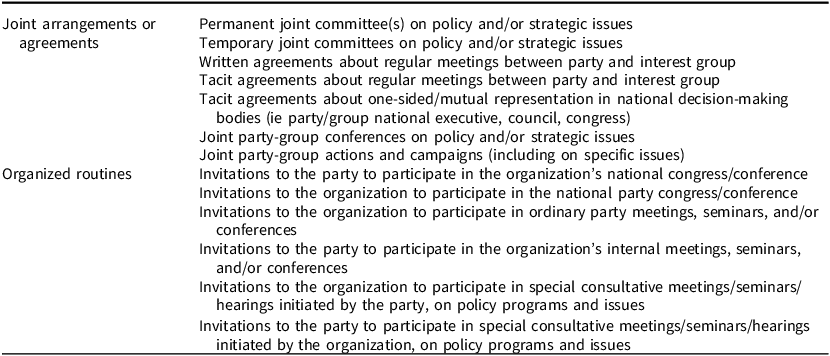
Our first hypothesis concerns the strength of organizational ties between interest groups and parties. We follow previous research and define organizational ties as structured or institutionalized interactions between parties and interest groups (see, eg Allern, Hansen, Marshall et al. Reference Allern, Hansen, Marshall and Otjes2024). We use the PAIRDEM interest group survey data to measure this. Interest group respondents were asked about the existence of thirteen different ties. As Table 2 shows, seven of these are more durable joint arrangements and agreements, and six are organized routines. We create an index by adding these ties together, given that stronger, more institutionalized joint arrangements and agreements – such as permanent or temporary joint committees – tend to go together with the weaker, less institutionalized organized routines – such as joint party-interest group conferences. The additive tie index we use hence, indicates the strength of ties between a given party and interest group. Across all of our observations, the mean number of ties is 2.46 with a standard deviation of 2.50 (see Supplemental Material B for more details).
Organizational ties
Our second independent variable is party media attention. Similar to the interest group measure, we construct this variable by querying the news corpus for party name mentions. We use the full party name and the most common party abbreviations. When necessary, we also use special characters, such as opening and closing brackets for the abbreviations (con) and (lab) in the United Kingdom. In Norway and Denmark, several of the major political parties furthermore have single-letter abbreviations. In these cases, we use regular expression filters to weed out common alternative uses of these letters.Footnote 5 Because parties often also appear in the news by way of their individual politicians, we include searches for mentions of the names of individual party politicians that were serving as members of parliament, government ministers, or party leaders in the time period we cover. Here, we look for the combination of the (first) given name and surname. For ministers, the queries include their formal title as an alternative to their given name (eg Secretary Johnson and Boris Johnson are valid hits). We limit these queries to news articles published during the time the politician in question was in office. Again, we divide the total number of articles in which a party appears in a given month by the total news volume for that month. The mean value here is 0.55, with a standard deviation of 0.54 (see Supplemental Material B for more details).
Control variables
We include several control variables that potentially explain organizational ties and both interest group and party attention in the news. Some of these variables come from the PAIRDEM interest group survey data. First, given that previous research shows that interest group resources are related to both ties and media attention, we control for this. We use two different indicators to measure interest group resources. The first is each group’s number of full-time employees. The categories the respondents could choose between were 0; 1–5; 6–10; 11–25; 26–50; 51–75, and more than 75 employees. The second indicator of group resources is the group’s annual budget. The response categories for this question were 0 up to 50,000 EUR; more than 50,000 up to 100,000 EUR; more than 100,000 up to 500,000 EUR; more than 500,000 up to 1 million EUR; more than 1 million EUR up to 5 million EUR, and more than 5 million EUR.
Next, given that long-established groups may be more likely to appear in the news and to have organizational ties, we control for when the interest group was established using information from the PAIRDEM survey. To preserve the anonymity of the groups, we use a dummy variable in the dataset that is coded as one if the group was established before 1980 and zero if not.
Previous research shows that economic interest groups appear more often in the news, across policy areas, compared to citizen groups (Binderkrantz, Bonafont and Halpin Reference Binderkrantz, Bonafont and Halpin2017, 323). Using PAIRDEM data, we therefore control for interest group type. We separate between trade unions and labor groups; occupational and professional associations; business groups; identity groups, and public interest groups.
We moreover expect that the level of competition between interest groups active within the same sector can matter for ties and group attention. Both can be harder to attain when competition is fiercer. We use a PAIRDEM survey question to control for group competition. The response categories distinguish between whether only one group organizes the types of interest the group represents, whether a few groups organize the types of interest the group represents, whether some groups organize the types of interest the group represents, and whether a lot of groups organize the types of interest the group represents.
From the news corpus, we extract data that allows us to control for two properties of the news content that are associated with the visibility of political actors. The first is the size of the news agenda, measured as the total count of articles across all sampled outlets in a given month. The second proxies the tone of the news. The latter relies on a word embedding model similar to recent applications in political communication and political science (Rheault and Cochrane Reference Rheault and Cochrane2020; Rudkowsky, Haselmayer, Wastian et al. Reference Rudkowsky, Haselmayer, Wastian, Jenny, Emrich and Sedlmair2018), which we explain in more detail in Supplemental Material A.
We add controls regarding the size and positions of the political parties. Both can affect ties and media attention. Using data from the ParlGov database (Döring, Huber and Manow Reference Döring, Huber and Manow2022), we include a cabinet party dummy separating parties in (single-party or coalition) government from others; a measure of parties’ left-right position and cabinet left-right position, and party size measured as seat shares in parliament. Finally, we include a dummy variable distinguishing election months (1) from months with no elections (0), and country fixed effects to control for time-invariant country differences.
Method of analysis
Based on the nature of our dataset and our dependent variable, we report multilevel regression models with country fixed effects and random intercepts that vary across party-interest group dyads. In Supplemental Material B, we show that our results are robust when we use alternative model specifications.
Empirical analysis
Our first hypothesis states that interest groups with stronger organizational ties to parties get more media attention. Model 1 in Table 3, which includes all independent and control variables, presents our main analysis of this hypothesis. The coefficient of the organizational ties index is significant and positive, corroborating our expectation. A group sharing no ties with a party would, according to our estimations, be present in 0.08 per cent of the news, a number that increases to 0.22 per cent with six ties, and 0.34 per cent with the observed maximum of eleven ties. Although these numbers are modest in absolute terms, they still suggest a quadrupling of media attention across the range of the tie variable. This is a noteworthy and substantively interesting result, especially when considering that the models control for the key resources known to affect interest groups’ media attention and organizational ties to parties.
Multilevel regression models, dependent variable: group media attention. Denmark, Netherlands, Norway, and United Kingdom, 2016–2018
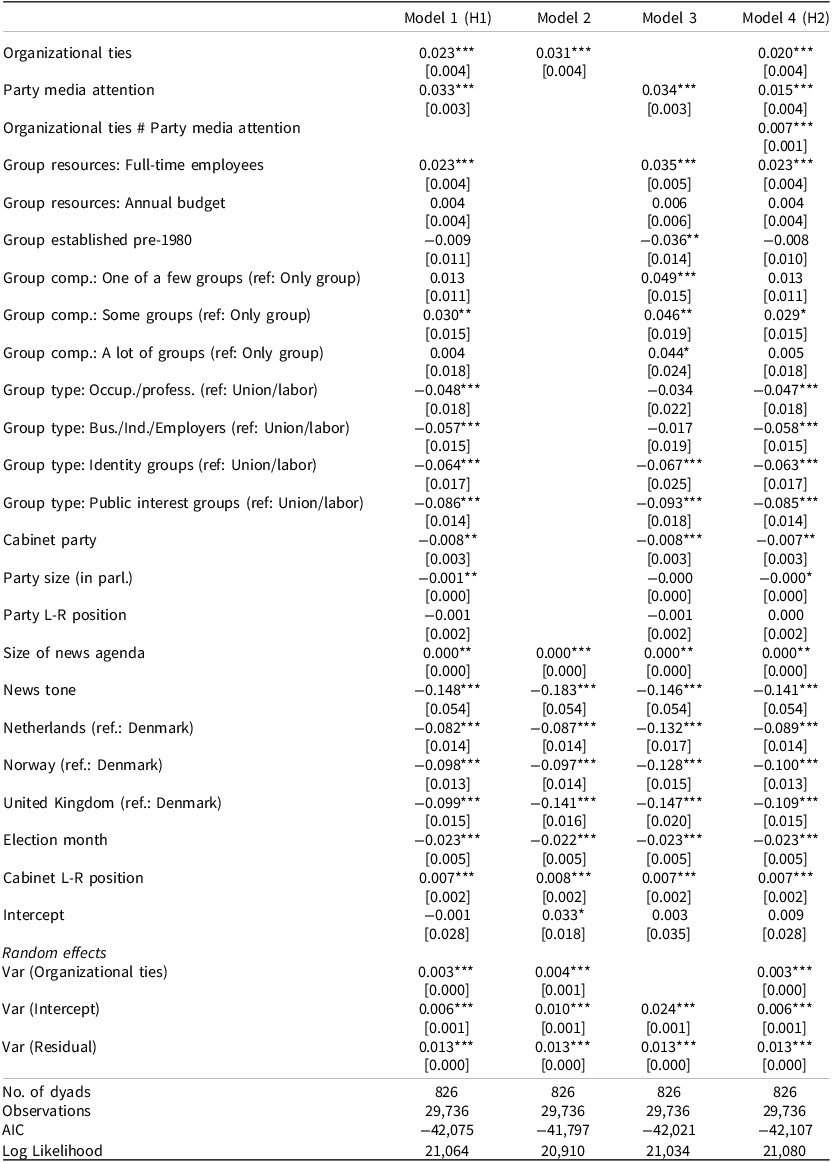
Note: *P < 0.1; **P < 0.05; ***P < 0.01, standard errors in brackets.
Table 3 includes three other models that provide an overview of how the tie coefficient changes as other important variables are excluded and included. Although we find no indication of strong collinearity between the independent variables, confounding effects may still occur and challenge our interpretations (Johnston, Jones and Manley Reference Johnston, Jones and Manley2018). The association between media attention and organizational ties (Model 2) and other, individual interest group resources (Model 3) appears stronger when modeled independently, suggesting a moderate level of confounding when either is left out of the equation. Nevertheless, the changes are small, and organizational ties and individual interest group resources are significant predictors in the full model. This indicates that we can discern the positive impact of organizational ties from that of the other control variables. Additionally, measures of model fit indicate that there is empirical value added from including a perspective on party-group ties when trying to model variations in the news visibility of interest groups. Comparing Model 1 to Model 3, we can see that the log likelihood and the AIC statistics are notably lower when the variable measuring organizational ties is excluded. A likelihood ratio test confirms that the change in fit is statistically significant (Chi2 = 58.3, p<0.001).
Our results, moreover, lend support to the traditional explanations of interest group attention in the news. Group resources in the shape of staff are positively associated with attention. Organizational ties, however, seem to also have a robust effect on groups’ attention, given that the coefficient is relatively stable in Model 1, where all group resource and party resource variables are included, and in Model 2, where these variables are excluded. Our main takeaway is therefore that the association between ties and news visibility holds and that ties potentially can explain visibility even when we include key resource variables that have proven decisive for a range of outcomes in interest group research. In terms of group types, unions and labor groups appear more often in the news, followed by other economic interest groups, while citizen groups are the least visible. Furthermore, interest group competition seems to fuel media attention, as groups that are in competition with a lot of other groups get more media attention.
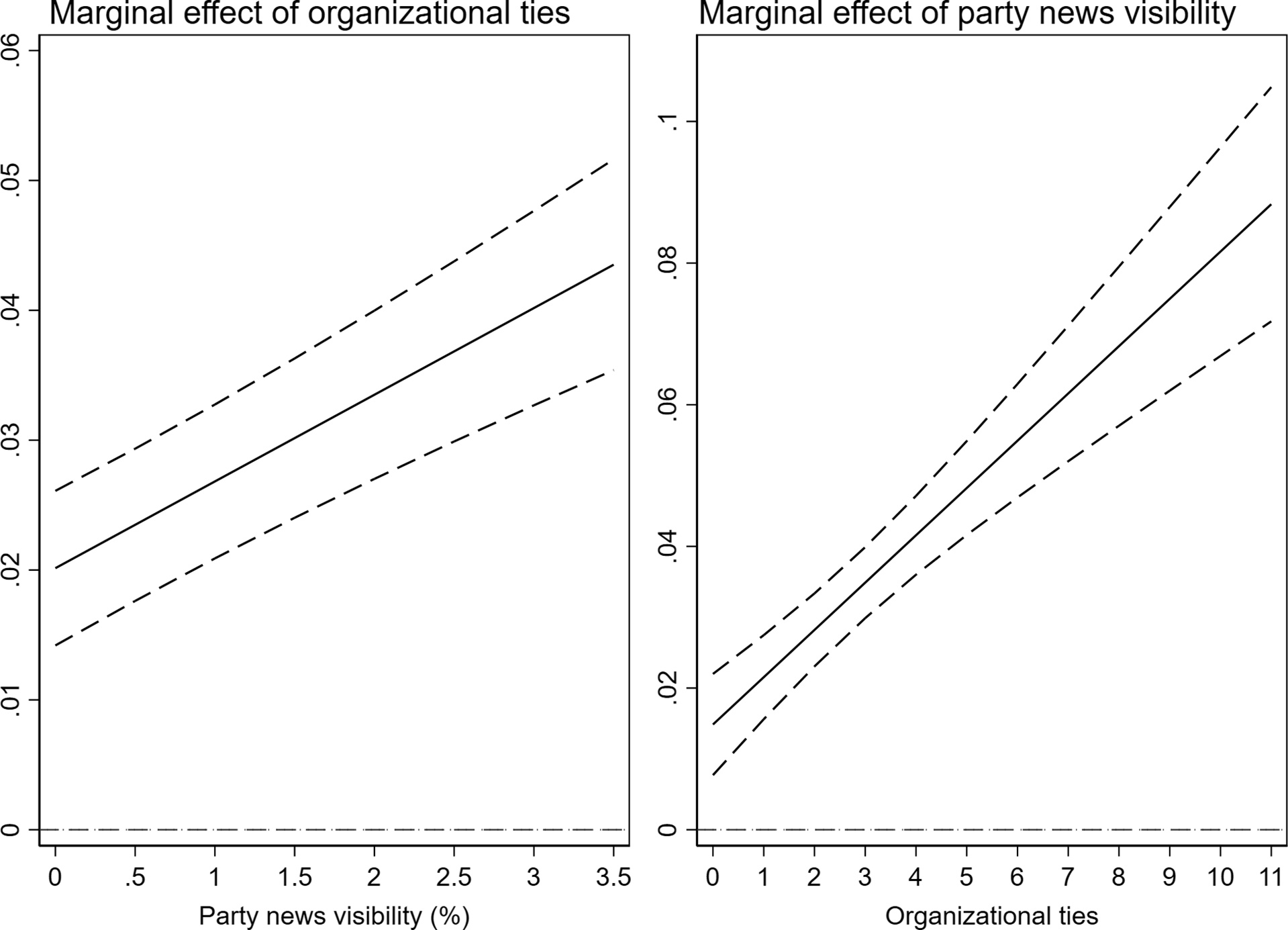
We also see that the news attention of the party with which a group shares ties also significantly contributes to an increase in group attention. Model 4 in Table 3 shows the results of the model applied to test the second hypothesis, expecting a positive interaction between organizational ties and party media attention. We observe a significant and positive interaction coefficient, but this is neither an intuitive presentation nor a sufficient evaluation of interaction effects (Brambor, Clark and Golder Reference Brambor, Clark and Golder2006). We therefore plot marginal effects (Figure 1), following suggestions from Berry, Golder and Milton (Reference Berry, Golder and Milton2012). Concretely, we plot the marginal effect of organizational ties (across party media attention, see left-hand plot pane) and the marginal effect of party media attention (across organizational ties, see right-hand plot pane) on group media attention. In both cases, the plots show a significant and positive marginal effect well above zero across the full range of the X-axis. We hence find support for the second hypothesis.
Marginal effects of organizational ties (across party media attention) and party media attention (across organizational ties) on group media attention. Results based on interaction model (Model 4) in Table 3.

To supplement the visual impression from the plots, Table 4 presents the predicted group media attention in various scenarios estimated on the basis of the interaction model. The results show that groups can expect notably more media attention as the number of ties they share with a party increases, even when this party is not visible in the news. However, this effect increases considerably when the party in question figures prominently in news coverage (mean attention plus two standard deviations). A group with one tie to a highly visible party is, on average, present in 0.12 per cent of news in a given month, but this share increases to 0.43 when groups are strongly connected to a party through eleven ties.
Predictions of group media attention across various combinations of ties and party media attention. Based on interaction model, Model 4, Table 3

Besides providing support and substance to the proposed interaction in the second hypothesis, this particular result reduces some of the uncertainty with regards to the inferences that can be drawn from our study. Arguably, we would not expect to observe such an interaction between ties and party visibility if our measure of organizational ties only tapped into some other unobserved properties of group resources or strategies. In other words, it makes sense that the association between ties and group visibility varies according to the media attention of the other half of the party-group dyad – which, in turn, also strengthens the inferences that can be made with regards to the first hypothesis.
Discussion and conclusion
Getting media attention is a key strategy for interest groups, if not for all groups and always, and interest groups constitute relevant political actors that journalists may want to cover (Binderkrantz Reference Binderkrantz2012; Binderkrantz, Bonafont and Halpin Reference Binderkrantz, Bonafont and Halpin2017; Kollman Reference Kollman1998; Willems Reference Willems2024). In this paper, we propose that interest groups’ organizational ties to parties are an important asset and a signal to journalists. We therefore expected a positive correlation between the strength of organizational ties and how much media attention groups get.
Stronger organizational ties may allow for co-operation between parties and interest groups on – among other things – media strategies and can in this way constitute an additional resource that interest groups have at their disposal when they seek media attention. Moreover, from journalists’ point of view, and irrespective of the interest groups’ strategies and goals, interest groups with stronger ties to parties may be more newsworthy. Media demands matter, and organizational ties can signal prominence and relevance for party competition and conflict.
Using detailed survey data on major interest groups in four countries and drawing on an extensive news corpus that allows us to track interest group appearances in prominent newspapers, we find that interest groups with stronger ties to parties tend to get more attention. This effect is stronger when the parties they have ties to also have more news appearances during the same time period. This is reassuring in that this type of interaction effect would be unlikely if the organizational tie measure only tapped into other unobserved properties of group resources or strategies.
These findings contribute to the literature on party-interest group organizational relationships which so far has focused mainly on describing and explaining the existence of ties (eg Berkhout, Hanegraaff and Statsch Reference Berkhout, Hanegraaff and Statsch2021; Rasmussen and Lindeboom Reference Rasmussen and Lindeboom2013; Witko Reference Witko2009). We move this literature forward by examining a possible consequence of such ties. Organizational ties allow interest groups to potentially influence the parties themselves (Røed, Allern and Hansen Reference Røed, Allern and Hansen2024), but seemingly also contribute to interest groups’ access and visibility in other arenas.
The paper also speaks to the literature on interest group strategies and their media strategies in particular which has concentrated on the role of general organizational resources, such as staff and income (eg Binderkrantz, Christiansen and Pedersen Reference Binderkrantz, Christiansen and Pedersen2015; Thrall Reference Thrall2006). We contribute by highlighting how another type of asset, organizational ties to parties, positively affects interest groups’ chances of succeeding with media strategies. Although interest groups need some degree of organizational capacity in the form of budgets and staff to be able to establish and maintain ties with parties (Allern, Hansen, Marshall et al. Reference Allern, Hansen, Marshall and Otjes2024), organizational ties can potentially help groups with fewer such resources to achieve their goals.
The study is limited in that we are unable to study changes over time, which makes it hard to draw strong causal inferences from our analyses. Whereas we control for ‘the usual suspects’ of possible confounders, including group characteristics, we cannot completely rule out that groups with different strengths of organizational ties to parties also differ in other relevant ways. More research is hence needed to investigate whether organizational ties cause more media attention by way of the suggested mechanisms. One way of approaching this could be to study cases and periods in which the strength of party-group ties clearly varies.
The data we use in this paper covers the time period between 2016 and 2018. More research is needed on whether the findings hold over time given changing media and political landscapes. Establishing organizational ties to political parties is not done overnight and tends to partly depend on an ideological match between the actors. The emergence of new parties and shifts in party strength can therefore alter the composition of party-group relations within a country. Nevertheless, once established, organizational ties between parties and interest groups tend to be relatively stable. The core mechanisms we argue that are at work – the newsworthiness of interest groups and the pooling of party-group resources – are therefore likely to remain relevant. What may change, however, is which specific groups receive media coverage over time.
Future research could also examine the extent to which our results travel outside Northwestern Europe and seek to investigate the possible effects of country-level variables, such as media systems (see also Vesa and Binderkrantz Reference Vesa and Binderkrantz2023), party systems, or the existence of strong corporatist traditions and arrangements. Moreover, we encourage future studies to include a more diverse set of interest groups to shed light on less likely cases of media attention.
Finally, the study of party-group ties and media attention can be further developed by studying different types of media outlets and engaging with issue perspectives from the agenda-setting literature (eg Green-Pedersen and Walgrave Reference Green-Pedersen and Walgrave2020). Issues are at the core of groups’ political engagement and, as such, inextricably linked to their media strategies: getting into the news is important because it offers an opportunity to elevate the issues and interests they care about, and pushing issues on the media agenda is important because it brings groups into the media limelight. Consequently, exploring the role of issues and agenda-setting in relation to organizational ties and news access, for groups and parties, appears as a promising direction for future research.
To conclude, our study throws new light on what factors drive media attention to interest groups, and offers a novel description of interest groups, parties, and power in politics and political communication. To the extent that organizational ties to parties help interest groups with fewer financial and human resources that seek media attention to actually attain this goal, ties may contribute to more diverse media coverage. However, since stronger organizational ties grant interest groups direct access to political parties, the findings above all indicate that media coverage of groups reflects existing patterns of access to key political decision-makers. This points to a system characterized by privileged pluralism where the same interest groups gain access across different political arenas and to different actors (Binderkrantz, Christiansen and Pedersen Reference Binderkrantz, Christiansen and Pedersen2015).
Supplementary material
To view supplementary material for this article, please visit https://doi.org/10.1017/S1475676526101169
Data availability statement
The dataset and code to replicate the analysis are available in the supplementary material.
Acknowledgements
Previous versions of this article have been presented at EPSA 2023 in Glasgow, SWEPSA 2023 in Gothenburg, and the general research seminar of the Department of Political Science at the University of Oslo. We thank the participants for their helpful comments.
Funding statement
The research for this article was generously supported by the Research Council of Norway and the University of Oslo (FRIPRO, YRT, grant no. 231755/F10), and the University Fund for Rogaland, Stavanger, Norway.
Competing interests
The authors declare none.
Ethical standards
The interest group survey used in this article was cleared with the Data Protection Official of Norway, the host country of the project. Reference: 48078.




 Open access

