


Introduction
Antimicrobial resistance (AMR) occurs when microorganisms develop strategies to render an antimicrobial ineffective, ensuring survival. Reference Hwang and Gums1 AMR is an ongoing global health threat, and it has been forecasted that approximately 1.9 million deaths could be attributed to AMR in 2050. Reference Naghavi, Vollset and Ikuta2 Low- and middle-income countries are disproportionately affected by AMR, even though antibiotic use in these settings is less than in high-income countries. Reference Alomari, Abdel-Razeq and Shamiah3 Effective antibacterial agents are important to reduce the risk of infection and associated mortality. Although essential in modern medicine, numerous studies on antibiotic use have shown that several factors are linked to rising rates of AMR. Reference Hwang and Gums1 Inappropriate antibiotic use has been recognized as a key driver in the emergence of AMR. Reference Bronzwaer, Cars and Buchholz4
In 2017, the World Health Organization (WHO) launched the Access, Watch, Reserve (AWaRe) classification to monitor and encourage the responsible use of antibiotics. Reference Sharland, Pulcini and Harbarth5 This classification considers clinical importance, spectrum of activity, and the potential of different antibiotics to drive the development of AMR. 6
Prescribing patterns of antibiotics have been investigated in several settings, providing a basis for improving practice. Although the literature on prescribing patterns is extensive in many countries, a systematic review conducted in the Caribbean Community (CARICOM) States found that research on antibiotic prescribing is limited. Reference Wade, Heneghan, Roberts, Curtis, Williams and Onakpoya7 Since the publication of this review, several studies on antibiotic consumption and use and AMR have been published. Reference Nagassar, Jalim and Mitchell8,Reference Marin, Giangreco and Lichtenberger9 These studies yield important findings; however, hospital-level prescribing details are necessary to design antimicrobial stewardship (AMS) interventions to improve prescribing practices within hospital settings. Understanding local prescribing practices is key to driving improvement. Reference Demoz, Kasahun and Hagazy10 The purpose of this study is to use the 2023 WHO AWaRe Framework 6 to describe the prescribing patterns of systemic antibiotics for hospitalized patients at a tertiary care hospital in a Caribbean country.
Methods
Study design, registration, and reporting
A cross-sectional study of systemic antibiotic prescriptions for hospitalized patients was conducted in the only tertiary care public hospital in Antigua and Barbuda. The protocol for the study was registered at the Open Science Framework OSF | The prescribing of antibiotics for systemic use in hospitalized patients. This study is reported according to the STrengthening the Reporting of Observational Studies in Epidemiology (STROBE) guidelines. Reference Von Elm, Altman, Egger, Pocock, Gøtzsche and Vandenbroucke11 Ethical approval was granted by the Institutional Review Board of the Sir Lester Bird Medical Centre (Ref: March 2022, UO).
Eligibility criteria
Prescriptions for patients hospitalized in the Surgical, Medical and Maternity Units from 1 January 2014 to 30 September 2021 were eligible for review. Prescriptions which included at least one antibiotic for systemic use were included. Prescriptions for anti-tuberculosis drugs, topical prescriptions, and incomplete prescriptions (prescriptions without recorded patient names, dosage or administration frequency) were excluded. Prescriptions from outpatient settings and repeat prescriptions within 6 months were also excluded to better reflect initial prescribing decisions and to avoid duplication of ongoing treatment.
Sampling approach
Greater than 600 encounters should be examined when investigating prescribing practices. Reference Ghei12 For this study, we collected and assessed data on all eligible antibiotic prescribing encounters.
Data collection and instruments
Prescription information was obtained from the hospital’s pharmacy, cleaned, and organized for analysis. We piloted and modified a standardized data extraction instrument to record antimicrobial treatments and used it to manually extract data from the data set. Reference Green, Joshi, Noorzaee, Siddiqui and Omari13 From the prescriptions, we extracted the prescription date, generic name of the antibiotic, dose, route of administration, frequency, prescribed duration, and unit of admission. We included antibacterials for systemic use (J01) as classified by the WHO Anatomical Therapeutic Classification (ATC) index. 14 Subcategories of interest were antibiotics on the 22nd Essential Medicine List, categorized under the WHO’s AWaRe classification, which was published in 2023. 6
Data analysis
Descriptive statistics were used to summarize the data. Prescription data were described using the mean, range, frequency, and percentages. Summaries of prescription characteristics included the average number of antibiotics prescribed per hospitalization and the average duration of antibiotics prescribed. We used prescription rates to follow annual trends and unit-specific variations. Prescriptions reflecting a switch from intravenous to oral antibiotics were not included in the annual trend to avoid duplicating antibiotic counts per patient. Antibiotic prescriptions were categorized as Access, Watch, or Reserve according to the 2023 AWaRe classification of antibiotics, 6 and the corresponding percentages were provided. Microsoft Excel and SPSS were used for data sorting and analysis. Data were aggregated across the study period to provide an overall comparison between units, assuming independence of observations across years. A χ2 test was used to determine whether the distribution of Access and Watch antibiotics differed across units.
Findings
After excluding duplicates (n = 457), prescriptions without patient names (n = 133), and prescriptions lacking antibiotic details (n = 43), our data set comprised 28,781 oral and intravenous systemic antibiotic prescriptions spanning 1 January 2014 to 30 September 2021. 4% (n = 1,104) of prescription entries in our data set indicated a switch to oral antibiotics. Of these, 33% (n = 368) were from the Maternity Unit, 56% (n = 624) from the Surgical Unit and 10% (n = 112) were from the Medical Unit. The remaining 27,676 prescriptions, issued to 12,165 patients, were used to show antibiotic prescribing trends. Patient gender and age were inconsistently recorded in the data set; therefore, summary demographics were not presented.
Fifty-two per cent (n = 14,285) of prescriptions were from the Surgical Unit, 38% (n = 10,556) were from the Medical Unit, and 10% (n = 2,835) were from the Maternity Unit. Seventy-five per cent (n = 21,538) of all reviewed antibiotic prescriptions for hospitalized patients were for parenteral use. Intravenous prescribing rates were 84% (n = 12,021) in the Surgical Unit, 70% (n = 7,373) in the Medical Unit, and 76% (n = 2,144) in the Maternity Unit. Seventy-seven per cent (n = 21,201) of antibiotics were prescribed for a duration of 7 days. The average number of antibiotics per patient encounter was 2.3, ranging from 1 to 8 antibiotics.
Prescribing patterns according to the WHO’s ATC
“Other beta-lactam antibacterials” (J01D) was the most frequently prescribed subgroup of antibacterials for systemic use (J01) as shown in Figure 1. Ninety-two per cent (n = 10,377) of prescriptions from this subgroup were cephalosporins, predominantly a third-generation cephalosporin (J01DD) and cefuroxime, a second-generation cephalosporin (J01DC).
Systemic antibiotic prescriptions for hospitalized patients by the WHO’s ATC classification in Antigua and Barbuda.

The second most prescribed subgroup of antibiotics, Other antibacterials (J01X), accounted for 25% (n = 7,025) of all inpatient prescriptions. In this setting, metronidazole and vancomycin comprised this group. The imidazole metronidazole accounted for 96% (n = 6,709) of prescriptions in this subgroup.
Beta-lactam antibacterials, penicillins (J01C), were the third-most-prescribed subgroup, accounting for 14% (n = 3,954) of all prescriptions. Amoxicillin with clavulanic acid made up 76% (n = 2,987) of prescriptions from this subgroup. The remaining 19% (n = 5,360) of prescriptions for inpatients in this setting included combinations of quinolones, aminoglycosides, sulfonamides and trimethoprim, tetracyclines and macrolides, and lincosamides and streptogramins.
Overview of prescribed systemic antibiotics
Hospitalwide, the most frequently prescribed group of antibiotics were cephalosporins, accounting for 37% (n = 10,377) of prescriptions. Of all prescribed cephalosporins, 60% (n = 6,207) were third-generation cephalosporins. Ceftriaxone accounted for 39 % (n = 4,051) of all prescribed cephalosporins, ceftazidime 18% (n = 1838), cefotaxime 3% (n = 318), second-generation cefuroxime 37% (n = 3,817), first-generation cefazolin 3% (n = 344), and cefalexin 1% (n = 9). In this setting, ceftriaxone was the second most prescribed antibiotic, accounting for 15% (n = 4,051) of all prescriptions, closely followed by cefuroxime. Metronidazole was the most prescribed antibiotic in this setting, accounting for 24% (n = 6,709) of prescriptions during the study period. Amoxicillin with clavulanic acid accounted for 76% (n = 3,175) of all penicillin prescriptions. Prescribing patterns by unit are illustrated in Appendix 1.
Annual trends for AWaRe prescribing
Using the WHO AWaRe classification, 56% (n = 15,410) of all prescriptions were classified as Watch, while the remaining 44% (n = 12,266) were classified as Access. Overall, prescriptions for Access antibiotics decreased from 2014 to 2021, with only minor fluctuations, as illustrated in Appendix 2. Prescriptions for Access antibiotics remained consistent at 52% for 2014 and 2015. This gradually decreased to 36% in 2019, with steady reductions from 2017 to 2019. Subsequently, a steady increase in Access prescriptions was observed from 2020 to 2021. There was no indication that reserve antibiotics were prescribed in this setting.
Trends in AWaRe prescribing by inpatient unit
The use of Access and Watch antibiotics varied across units. Overall, the surgical unit prescribed the highest proportion of Access antibiotics at 57% (n = 8,115), while the maternity unit had 48% (n = 1,353). In contrast, 27% (n = 2,798) of prescriptions for the medical unit were for Access antibiotics. Maternity antibiotic prescribing patterns show a marked shift from Access to Watch antibiotics over time. From 2014 to 2015, Access antibiotics accounted for approximately 60%–63% of prescriptions, while Watch antibiotics comprised approximately 37%–40%. As shown in Figure 2A, from 2016 onwards, Watch antibiotics began to exceed Access use with a progressive increase observed through 2019 to 2020. Notably, this pattern reversed sharply in 2021 with Watch antibiotics decreasing to 29%.
(A,B,C) Trends in Access and Watch systemic antibiotic use across inpatient units.
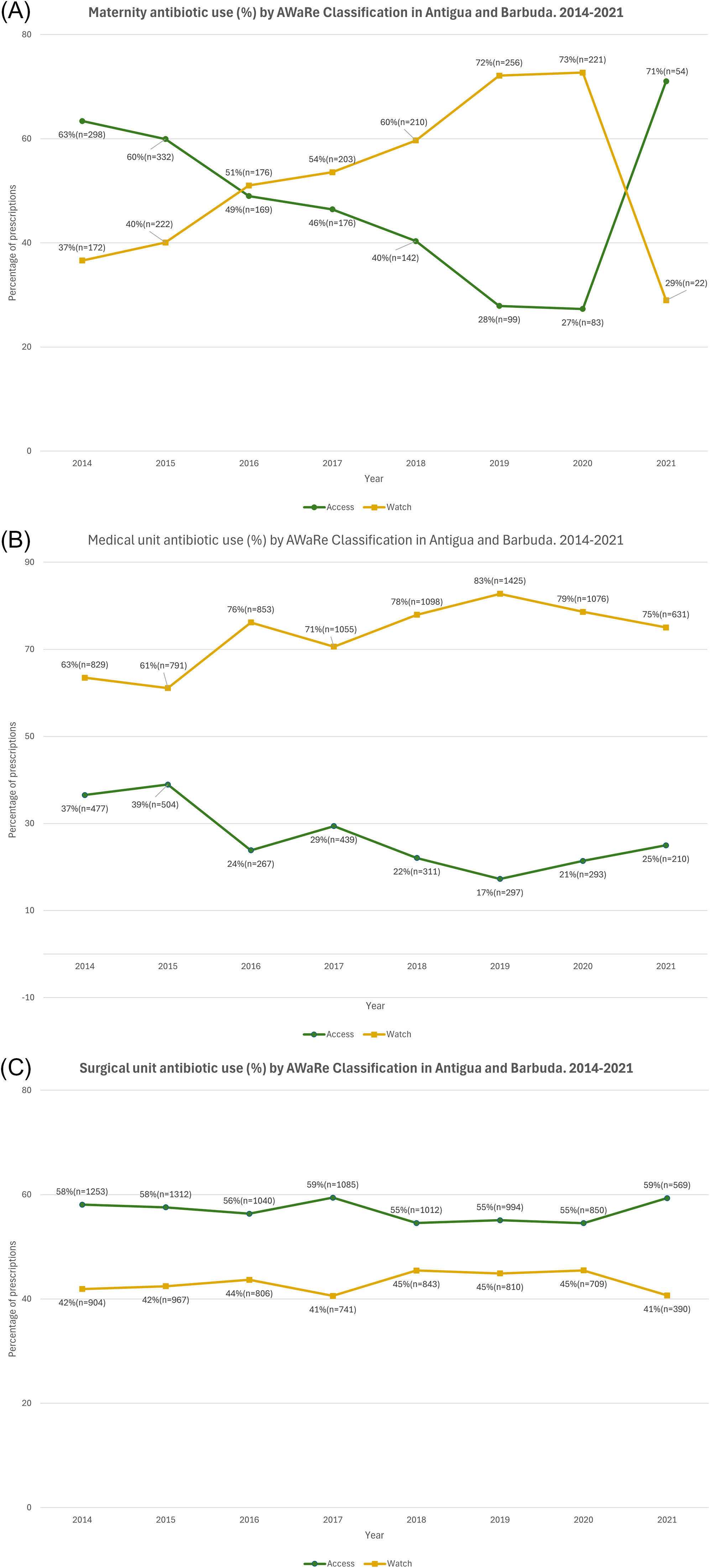
In the Medical Unit, there was a consistent predominance of Watch antibiotic use as illustrated in Figure 2B. At the start of the study period, 2014–2015, 61%–63% of prescriptions were for Watch antibiotics. Although there was a modest fluctuation in 2017, the overall trend shows a progressive increase in Watch antibiotics, which peaked at 83% in 2019. Antibiotic prescribing in the Surgical Unit, shown in Figure 2C, demonstrates a stable predominance of Access antibiotics throughout the study period with relatively minor fluctuations over time. Access antibiotics consistently accounted for more than 50% of prescriptions ranging from 54% to 59%, with no significant increase in Watch antibiotic use. There was a statistically significant difference (P < .001) in the distribution of Access and Watch antibiotics across units indicating that prescribing patterns varied substantially. The Medical Unit demonstrated a higher proportion of Watch antibiotic use compared to the Maternity and Surgical Units.
Discussion
This cross-sectional study investigated the prescribing patterns of systemic antibiotics for hospital inpatients and presented the findings according to the WHO’s ATC system and the AWaRe classification.
We reviewed 27,676 systemic antibiotic prescriptions from three adult inpatient units at a tertiary care public hospital in Antigua and Barbuda. The surgical unit was responsible for 52% of prescriptions in this setting. Across units, patients were prescribed between 1 and 8 antibiotics during hospitalization. This finding of up to 8 antibiotics per patient is similar to Martin’s 2006 study on antibiotic prophylaxis in appendectomy patients conducted in a tertiary care hospital in Antigua and Barbuda. Reference Martin and Anthony15 Seventy-five per cent of prescriptions were for intravenous administration, and 77% had a duration of 7 days. The prescribed duration is broadly consistent with Connor et al, who reported a median duration of 9 days (IQR 7–11) for specific indications, although direct comparison is limited due to differences in reporting metrics. Reference Conner, Harris and Bomkamp16
The most prescribed subgroup was “Other beta-lactam antibacterials” (J01D), with ceftriaxone accounting for the majority of cephalosporin prescriptions, consistent with findings from other studies in Latin America and the Caribbean that also reported high ceftriaxone use. Reference Marin, Giangreco and Lichtenberger9,Reference Rocke, El Omeiri, Quiros, Hsieh and Ramon-Pardo17 Other antibacterials (J01X) were the second-most prescribed subgroup, mainly comprising metronidazole prescriptions. Metronidazole was the most prescribed antibiotic in this setting. 56% of prescriptions were classified as Watch antibiotics, and, similar to a point prevalence survey conducted in the Caribbean, no Reserve antibiotics were used in this setting. Reference Rocke, El Omeiri, Quiros, Hsieh and Ramon-Pardo17 An overall increase in Watch prescriptions observed from 2016 to 2019 was followed by a decrease from 2020 to 2021 during the COVID-19 pandemic. A similar finding was reported in an antimicrobial consumption study conducted in Trinidad and Tobago. Reference Nagassar, Jalim and Mitchell8 WHO proposed that by 2023, 60% of antibiotic prescriptions in healthcare settings should be from the Access group, since its antibiotics are narrow-spectrum and exhibit lower resistance potential than those in the Watch and Reserve groups. Reference Sharland, Pulcini and Harbarth5,Reference Sharland, Zanichelli and Ombajo18 In this setting, antibiotic use in the Watch group was higher than in the Access group during the study period, a concern given their greater toxicity and potential for resistance.
Strengths and limitations
To our knowledge, this is the first study to examine general prescribing patterns of systemic antibiotics for hospitalized patients in Antigua and Barbuda. Prescription data over 8 years showed how antibacterials for systemic use were prescribed in three adult inpatient units of a tertiary care hospital. This study provides baseline findings on the use of AWaRe antibiotics in this setting. It contributes to the evidence base on antibiotic prescribing in Antigua and Barbuda and, by extension, the Caribbean and other small island developing states. Several limitations were identified in this study. In cross-sectional studies, verifying retrospective data is inherently challenging, as documented in the literature. Reference Talari and Goyal19 As a result, we had to exclude several prescription entries from the data set since antibiotic details and patient names were missing. Insufficient documentation of patient age and gender also prevented the generation of summary demographics. Additionally, we were unable to collect the full 2021 data set due to the COVID-19 pandemic, which disrupted the regular operations of pharmacists and data entry staff. This limited the analysis of 2021 data to a 9-month period. No clinical characteristics were included in the data set, making it difficult to determine whether prescriptions were for prophylaxis or treatment, and whether antibiotics were administered for the documented duration. As such, the observed proportion of Access antibiotics in the Surgical Unit would not accurately reflect compliance with AMS recommendations regarding therapeutic prescribing. Watch antibiotics are commonly indicated for sicker patients, however, the limitations of the data set prevented assessment of this association. Despite these limitations, useful insights into annual and unit-level prescribing patterns have been provided. As this was a single-center study, generalization of the findings to other hospitals in the Caribbean and other small island states is limited. Nonetheless, the evaluation of antibiotic prescribing using the AWaRe classification is meaningful for cross-country comparisons and for identifying gaps in AMS practices.
Implications for research
To improve understanding of antibiotic use in hospitals, future research in the Caribbean should focus on indication-specific data to better characterize antibiotic prescribing among patient cohorts. Overall, indication-specific data would enable more detailed, clinically meaningful analyses, improving the quality of evidence available to guide antimicrobial stewardship policies and prescribing practices.
Supplementary material
The supplementary material for this article can be found at https://doi.org/10.1017/ash.2026.10759.
Data availability statement
The data generated in this study is not publicly available; however, this information may be accessed following IRB approval from the Sir Lester Bird Medical Centre.
Acknowledgements
The authors gratefully acknowledge Mr Dave Bridgewater for granting access to the pharmacy dispensing data and Ms Aliyah Legay for her assistance with data consolidation.
Author contribution
TW conceptualized the project under CH’s supervision. YC assisted TW with data cleaning, organization and analysis. TW drafted the manuscript, which all authors reviewed and approved.
Financial support
This study received no funding.
Competing interests
All authors have no conflict of interest to declare.



 Open access

