


What groups are perceived to benefit from certain issue positions and priorities? In the study of public opinion, campaigns, and representation, political scientists have long been interested in the perceived connections between African Americans and public policies (Kinder and Sanders Reference Kinder and Sanders1996; Gilens Reference Gilens1999; Cannon Reference Canon1999; Mendelberg Reference Mendelberg2001; Tate Reference Tate2003; Minta Reference Minta2011; Grose Reference Grose2011; Haney-Lopez Reference Haney-López2015; Stephens-Dougan Reference Stephens-Dougan2020). This research suggests that issues of unique importance to African Americans remain off the political agenda, stemming from their perceived associations with the Black community.Footnote 1 When these connections are made, negative racial predispositions then shape not onlypublic opinion and candidate preferences but also elite behavior both on the campaign trail and within the nation’s political institutions (Frymer Reference Frymer2011; Harris Reference Harris2014). Empirical assessments of the impact of racial prejudice in campaigns (Haney-Lopez Reference Haney-López2015; Stephens-Dougan Reference Stephens-Dougan2020), on public opinion (Peffley and Hurwitz Reference Peffley and Hurwitz2002; Tesler Reference Tesler2012), and on the representation of African Americans (Cannon Reference Canon1999; Tate Reference Tate2003; Minta Reference Minta2011; Grose Reference Grose2011) thus depend on the public’s views about African Americans and the policies that are perceived to concern them as a group.
Race-policy perceptions are not isolated; they reflect broader societal attitudes, stereotypes, and historical contexts that shape the public’s understanding of policy relevance to Black Americans (Kinder and Sanders Reference Kinder and Sanders1996; Schuman Reference Schuman1997; Krysan Reference Krysan2000; Sears, Sidanius, and Bobo Reference Sears, Sidanius and Bobo2000; Frymer Reference Frymer2011). However, many studies assert, often without empirical evidence, that a limited set of specific issues—usually social welfare, civil rights, or criminal justice—are broadly and best understood as uniquely “African American issues.” There is surprisingly little research that seeks to empirically conceptualize, define, and measure how issue areas prioritized by candidates are perceived to impact the African American community. A top-down approach that assumes the racialized nature of policy areas cannot answer how the public actually perceives which issues are connected to the representation of African Americans. Race-policy associations among the mass public are important because, ultimately, they may influence how and whether politicians choose to prioritize those issue areas (Schneider and Ingram Reference Schneider and Ingram1993). By understanding the perceived connections between any issue area and particular racial groups, we can better explain and predict when and how racial prejudice might emerge as a key determinant of both attitudes in the mass public and substantive representation by elites (Cramer Reference Cramer2020).
We seek to uncover how certain issue priorities of elected officials are popularly and uniquely perceived to impact the representation of racial groups in the United States. Using a nationally representative survey of Americans with an oversample of Black respondents, we employ a simple but innovative research design to document these perceptions. We find that a majority of the public associates most issue areas with the representation of White Americans. However, we find a clear pattern in the issues perceived to matter for both Whites and Blacks: issues that are viewed as particularly unimportant for White Americans, most notably poverty and criminal justice, are the same issues that are viewed as being the most important for African Americans. We find this pattern not only among our full sample of respondents but among White and African Americans as well as Democrats and Republicans.
We also examine the relationship between issue priorities and perceptions of candidates’ ideology, partisanship, and race. These perceptions are themselves shaped by the issue cue, with the top “Black issue” (criminal justice) in particular increasing the likelihood that respondents perceive the candidate as Black, Democratic, and liberal. To further explore this relationship, we analyze whether candidate ideology mediates the effect of prioritizing criminal justice on perceptions of Black representation. While the direct effect of criminal justice significantly influences perceptions of Black representation, the mediating effect of perceived candidate ideology is not statistically significant. This suggests that voters’ evaluations are not solely driven by ideological perceptions but rather by the issues that candidates choose to prioritize.
Finally, to test whether these associations are also reflected in actual elite communications, we complement these survey results with an analysis of over 190,000 congressional newsletters to explore the top-down connections that are made between policy areas and African Americans. These messages reveal that while explicit references to race are rare across nearly all policy discussions, references to African Americans are most commonly seen in discussions of criminal justice and poverty, and these linkages are more frequently found in Democratic newsletters. This underscores the importance of studying public perceptions. Because race is often not named in elite communication, people’s assumptions about which groups are represented become a key window into how race-policy associations operate in American politics.
Ultimately, our research highlights the importance of examining the perceived link between candidates’ issue priorities and how well they represent different racial groups. We hope our findings and methodological framework can be used by other scholars to explore the boundaries of racial inequalities in public opinion, campaigns, and representation.
Associations Between Race, Representation, and Issue Areas
Scholars have long investigated the impact of racial prejudice in shaping political behavior at the mass and elite levels (for a review, see Cramer Reference Cramer2020; Jardina and Piston, Reference Jardina and Piston2019; Stephens-Dougan Reference Stephens-Dougan2021). Many studies have found consistent evidence of the deleterious impact of racial prejudice on the status and representation of African Americans. Whites’ negative racial views predict their preferences on policies purported to benefit African Americans (Gilens Reference Gilens1999; Peffley and Hurwitz Reference Peffley and Hurwitz2002; Tesler Reference Tesler2012; Wallsten et al. Reference Wallsten2017). In explaining the relationship between racial attitudes and policy preferences, scholars argue that 1) the mass public has established a cognitive link between the policy issue area in question and the Black community, 2) this link primes their racial attitudes, and 3) these “top of the head” considerations are brought to bear when forming their policy preferences and candidate evaluations (Zaller Reference Zaller1992).
These presumed race-policy associations are also marshaled by political candidates, namely Republican candidates, to mobilize electoral support from racially conservative White voters (for review, see Stephens-Dougan Reference Stephens-Dougan2021). Candidates elicit electoral support by either portraying themselves as opponents of policies that are associated with African Americans or by painting their opponent as a champion of these policies (Banks and Bell Reference Banks and Bell2013; Mendelberg Reference Mendelberg2001; Peffley and Hurwitz Reference Peffley and Hurwitz2002; Valentino, Hutchings, and White Reference Valentino, Hutchings and White2002). According to theories of racial priming, due to the change in racial norms, candidates can no longer be explicit about their antipathy toward African Americans and expect to emerge victorious on Election Day. Rather, in seeking to mobilize racially conservative White voters, these candidates instead rely on the use of implicit racial appeals and rest on the widespread perceived associations between particular public policies and the Black community (Haney-Lopez Reference Haney-López2015; Mendelberg Reference Mendelberg2001).
Given the growth in the number of African American representatives, a large body of scholarship also focuses on how racial descriptive representation influences substantive representation. Studies conclude that while the presence of African Americans in legislatures does not directly always result in the passage of legislation on civil rights, criminal justice reform, or social welfare, descriptive representation does yield greater general attention to these issues (Canon Reference Canon1999; Tate Reference Tate2003; Griffin Reference Griffin2014; Griffin and Newman Reference Griffin and Newman2008; Grose Reference Grose2011). At the same time, how politicians claim different issue priorities can influence whether they are perceived to represent racial minorities. For example, research on the presidency shows that Barack Obama, in order to undermine the perception that he would disproportionately cater to the interests of African Americans, failed to substantively represent the interests of the Black community during his tenure in the White House (Harlow Reference Harlow2009; Smith, King, and Klinkner Reference Smith, King and Klinkner2011; Harris Reference Harris2014; Stephens-Dougan Reference Stephens-Dougan2022; but see Nteta, Rhodes, and Tarsi Reference Nteta, Rhodes and Tarsi2016; Haines, Mendelberg, and Butler Reference Haines, Mendelberg and Butler2019).
Not all Americans may have unified perceptions of race, representation, and issue positions. White Americans are more supportive of punitive policies when they believe that African Americans are the target of such policies (Gilens Reference Gilens1999; Peffley and Hurwitz Reference Peffley and Hurwitz2002; Wallsten et al. Reference Wallsten2017). When they view policies as being beneficial to African Americans, they are less supportive (Haney-Lopez Reference Haney-López2015; Kinder and Sanders Reference Kinder and Sanders1996). If White and Black Americans have similar perceptions of the target populations of candidates’ issue priorities, then political strategies based on racial appeals might have less polarizing effects, potentially leading to a more unified public response to policy initiatives.
Schneider and Ingram’s theory (Reference Schneider and Ingram1993) on the social construction of “target populations” argues that policymakers often craft policies that favor groups perceived positively within society, typically those with more political power, while imposing stricter policies on negatively viewed, less powerful groups (Kreitzer and Smith Reference Kreitzer and Smith2018). This perspective is key in understanding how societal stereotypes and the political power of different groups shape policy agendas. It also informs the broader discourse on how political candidates’ issue priorities might align with these societal constructions, influencing their perceived effectiveness in representing diverse racial groups. In this context, it is particularly significant to understand how issue priorities set forth by politicians are perceived in terms of representing African Americans and other racial groups. The way candidates prioritize certain policies can be seen as a reflection of their commitment to addressing the concerns of these groups.
Taken together, the through line connecting these bodies of scholarship is the importance of how public policies and issue areas are perceived to be connected to the representation of African Americans. These perceptions are thought to be indirectly responsible for low levels of mass support for policies that might benefit African Americans and, thus, racial inequalities in substantive representation. Yet, missing from each account is systematic empirical evidence about racialized perceptions of politicians’ issue priorities. It is not clear who the public considers to be the “relevant” target populations (Schneider and Ingram, Reference Schneider and Ingram1993). A candidate prioritizing criminal justice reform might be perceived as advocating for African Americans, viewed as a disadvantaged group in this policy domain. Conversely, emphasizing policies like climate change or education might not evoke the same association. Existing research relies on top-down assessments of such cognitive connections, leading to questions concerning the reliability and validity of these assumptions. The implications of understanding these perceptions are profound. If these perceptions drive support for policies that might benefit African Americans, then reducing racial inequalities in representation is dependent on the racialized “pictures in our heads” about issue areas (Lippman Reference Lippmann1922).
Data and Methods
In order to better understand these perceptual connections between race, issue areas, and representation, we fielded a nationally representative survey administered by YouGov (n = 1,231) with an oversample of African Americans (n = 264) in August 2022.Footnote 2 We use a simple but innovative research design in which survey respondents were asked to infer which racial groups are represented best by various issue priorities. Respondents were asked to evaluate ten different candidates for state legislature who have each “indicated that, if elected, they will mainly focus on a single issue.”
Respondents saw this vignette for ten different political candidates with a new issue priority randomized from the full list of issues without replacement each time. By having respondents complete multiple “tasks,” we have more statistical power to detect effects with an N of 12,305 than if we asked about a single random issue as in a standard one-shot vignette experiment. We use a candidate-focused vignette to specifically understand how people view the representational implications of various policy agendas for racial groups. A different approach might be to simply ask respondents which issues African Americans care about the most, but this would not elicit trade-offs between different racial constituency groups for a diverse set of policy areas. Asking about a candidate’s issue priority more concretely measures how any given issue area has perceived political repercussions for racial groups.
Issue Selection
The issue priority for each candidate profile was randomly selected from a list of 16 domestic issues taken from Pew Research Center’s 2021 policy agenda report: strengthening the economy; dealing with the coronavirus outbreak; improving the job situation; defending against terrorism; reducing health care costs; securing social security; improving education; dealing with the problems of poor people; reducing crime; addressing the criminal justice system; reducing the budget deficit; dealing with immigration; dealing with climate change; strengthening the military; dealing with drug addiction; improving transportation.Footnote 3 We employ these sixteen issue areas to enhance the ecological validity of our experiment. As noted by the Pew Research Center, each of these priorities represents the “issues the public views as most important for Congress and the president to prioritize in the coming year” (Pew Research Center 2021). Given the importance of these sixteen issues to the mass public, we treat these issues as proxies for the types of domestic issues and policies likely to be considered and discussed by candidates in state and federal elections during this time.
Decades of research have found that for many Americans, particular policy issues are “owned” by certain political parties and are more likely to reflect specific ideological perspectives and attachments (Petrocik Reference Petrocik1996; Egan Reference Egan2013; Goggin and Theodoridis Reference Goggin and Theodoridis2017; Goggin et al. Reference Goggin, Henderson and Theodoridis2020). Given the strength of partisan and ideological heuristics in influencing mass opinion, we note that for many of the issues outlined above, the partisan and ideological “ownership” of each issue is relatively ambiguous. For instance, both parties can lay claim to strengthening the economy, dealing with drug addiction, and improving transportation. Similarly, both liberal and conservative ideological perspectives, while differing on the mechanism used to achieve the goal, are supportive of securing social security, improving education, and reducing the budget deficit. We view the ambiguity associated with each of our issue areas as a strength of the design, as the lack of clarity may mitigate the use of partisan and ideological heuristics, leading respondents to rely more heavily on their perceived links between issue areas and racial groups. Nonetheless, as we discuss in more detail below, to account for some of our issue priorities more clearly signaling an ideological or partisan direction, we measure and control for a respondent’s perceptions of the candidates’ ideology and partisanship as well.
Measuring Perceptions About Issue Priorities
Respondents answered four questions about each politician and issue priority. Our main dependent variable is measured with the question, “If this candidate was elected to office, which of the following groups do you think they would represent best?” with the response options (in a random order, fixed by respondent): White Americans, African Americans, Hispanic Americans or Latino/as, Asian Americans, Native Americans, and Middle Eastern Americans.
Given (1) the history, importance, and influence of the struggle of African Americans to gain equal socioeconomic and political status with White Americans; (2) the scholarly focus on African Americans in the literature on race, campaigns, representation, and public opinion; and (3) the lack of evidence that empirically establishes the perceptual association between particular policy areas and African Americans, our primary focus in this paper is on issues associated with White and Black Americans (Allport Reference Allport1954; Morris Reference Morris1984; Omi and Winant Reference Omi and Winant2014; Klinkner and Smith Reference Klinkner and Smith1999). We included additional racial groups to avoid artificially inflating the number of people who select “African Americans.” Including a more representative array of options reduces measurement error resulting from these responses due to demand effects or social desirability bias. Moreover, an additional contribution of the project is to provide a robust measure of associations between race (in general) and policy areas. Our data and method can be used by scholars studying similar research questions about issues and other racial groups in the United States, as well as other questions about the role of race for policy preferences.
To capture respondents’ other inferences about the issue priority, we also measure perceptions of the candidate’s partisan affiliation, ideology, and race. These additional outcomes help to avoid response substitution, or the tendency for respondents to answer a different question than the one asked, as well as account for the possibility that some issue priorities might convey an ideological or partisan stance. Given strong connections between issues, ideology, race, and the parties (Petrocik Reference Petrocik1996; Egan Reference Egan2013; Goggin and Theodoridis Reference Goggin and Theodoridis2017; Goggin, Henderson, and Theodoridis Reference Goggin, Henderson and Theodoridis2020), if respondents can only assess the perceived impact on race, they may register the candidate’s partisanship, race, or ideological affiliation instead. For example, respondents may infer the candidate is a Democrat from their issue priority and use the racial group outcome question to signal, however subconsciously, the partisanship of the candidate. By asking respondents to also indicate these perceptions, we reduce this possibility at the data collection stage as well as measurement error at the analysis stage by controlling for these perceptions in our models. We also examine these outcomes separately and explore the mediating role of candidate liberalism to examine the indirect and direct effects of issue priorities on perceptions of Black representation.
Still, an important limitation of our design is that it does not vary multiple characteristics simultaneously and instead focuses on just the policy area. A candidate’s race and partisanship are often included in candidate-choice conjoint experiments, yet both of these attributes would likely overwhelm the effect of the prioritized issue area on views about race. For this reason, we choose to provide information about the issue area alone so that we can directly measure inferences not only about group representation but about partisanship and ideology as well.
All analyses were conducted using survey weights provided by YouGov (see Appendix A for details). The research design was preregistered at Open Science Framework (see Appendix F), and, given the limited research in this area, we specifically registered the study as “exploratory” instead of defining a set of hypotheses about specific race-policy associations. In this way, we hope that the study will be used as a starting point for future analyses on how people perceive the racial implications of issue representation.
Results: Issue Priorities and Representation
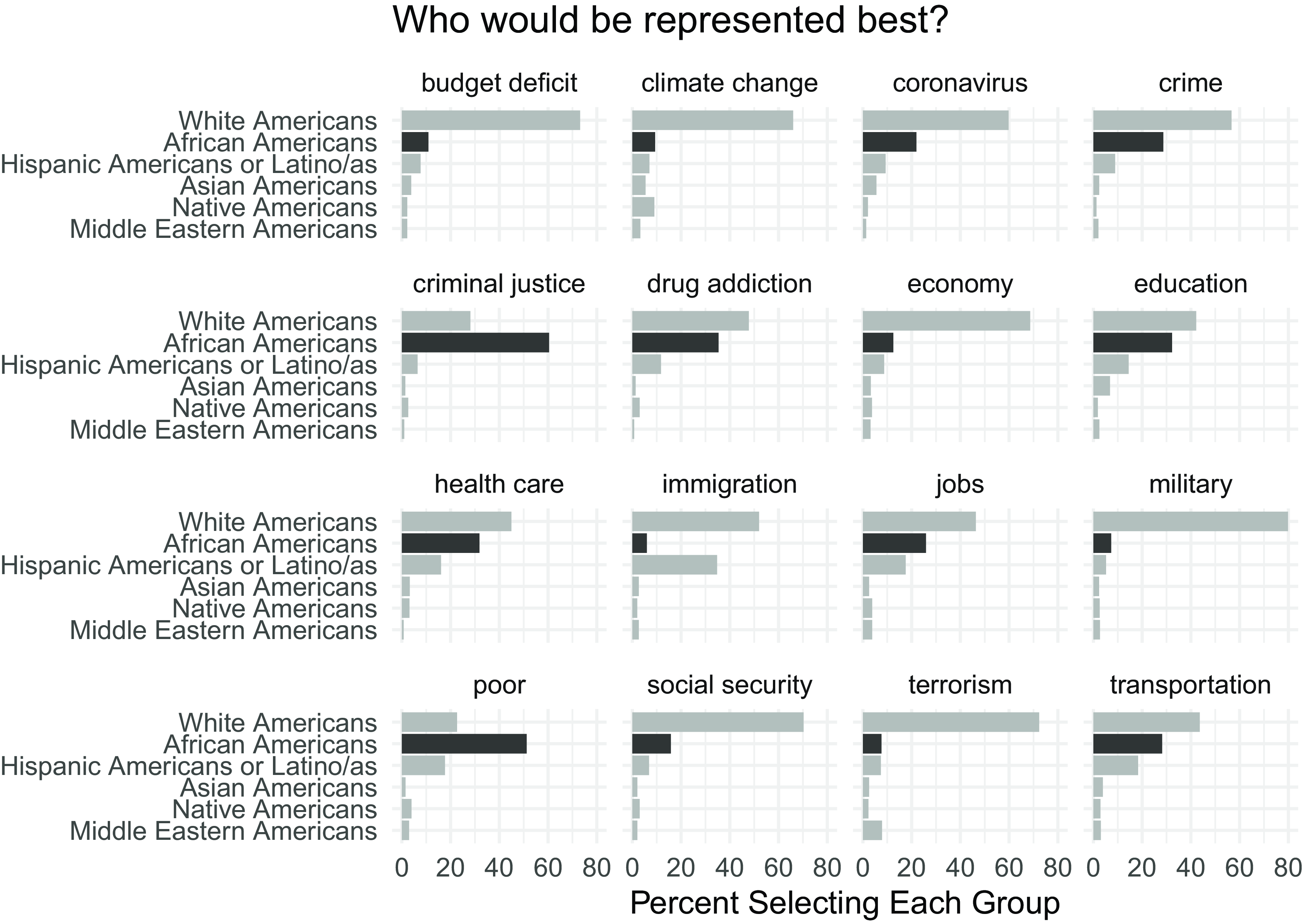
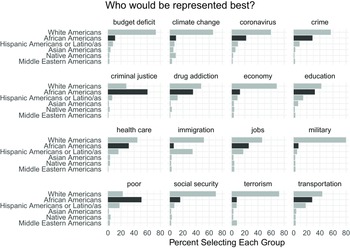
First, we focus on overall perceptions of the pooled sample. Figure 1 shows the weighted proportion of respondents (on the x-axis) selecting each racial/ethnic group (on the y-axis) for the main outcome question (“If you had to choose, if this candidate was elected to office, which of the following groups do you think they would represent the best?”). The majority of issue areas were most associated with being related to the representation of White Americans, and there is significant variation in how issues are perceived to influence African Americans. For example, about 11% of respondents selected African Americans for a priority on the budget deficit, 16% for social security, 32% for education, just over 50% for dealing with problems of poor people, and 60% for addressing the criminal justice system.
Perceptions of race and representation across issue priorities
Note: Weighted proportion of respondents selecting each racial group for each issue for “If you had to choose, if this candidate was elected to office, which of the following groups do you think they would represent the best?” Dark gray bars show the proportion of respondents selecting “African Americans;” light grey bars show the proportion of respondents selecting other racial categories. Respondents were asked to evaluate 10 random issues from the full set of 16 issues. Table with exact proportions shown in Appendix D.
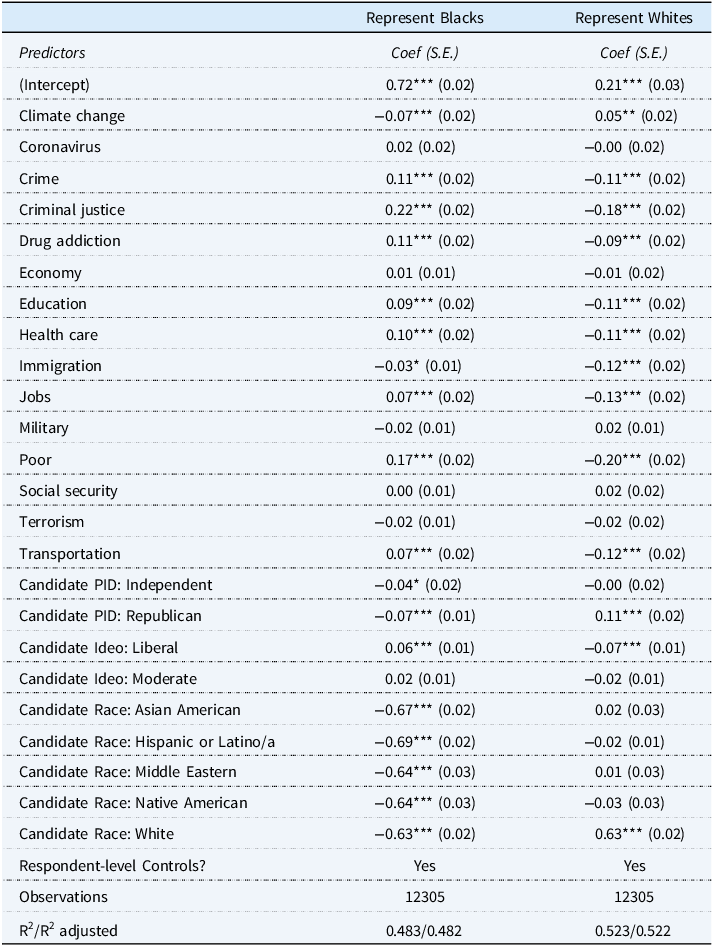
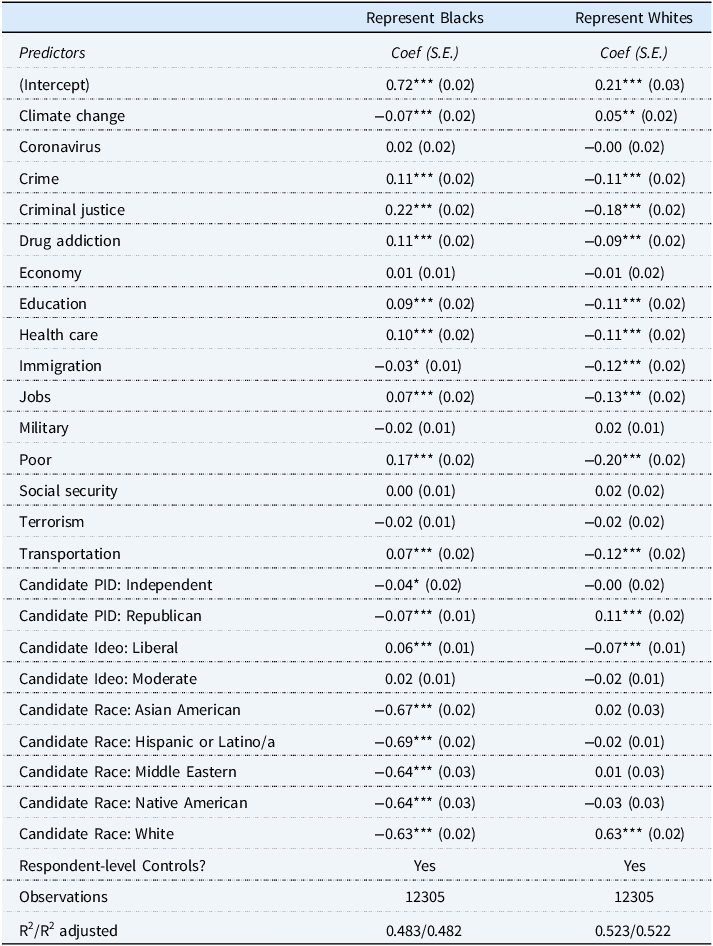
While this analysis shows average associations between issue priorities and racial groups, it does not control for respondent-level characteristics that might influence these associations. Table 1 shows the results from regression models holding constant respondents’ race, education, party affiliation, ideology, and perceptions of the candidate’s race, party affiliation, and ideology. After controlling for these variables, “addressing the criminal justice system” and “dealing with the problems of poor people” were still the most perceived to impact African Americans. Candidates who listed those issues as their top priority were the most likely to be perceived as representing the Black community over candidates who listed other issue priorities.
Linear regression estimating the effect of issue priority on group representation
* p < 0.05 **p < 0.01 ***p < 0.001
Note: Linear regression with cluster-robust standard errors by respondent. Control variables included respondents’ party, ideology, race, and education, but results are not shown here. Baseline levels= Budget reform (issue); Democrat (candidate PID); Conservative (candidate ideo); Black (candidate race).
Climate change, immigration, and the military were the issue priorities that had the lowest proportion of people perceiving quality representation of African Americans. “Dealing with climate change” and “strengthening the military” were the most strongly associated with the representation of White Americans. Conversely, criminal justice and poverty were the issues perceived to have the worst implications for White Americans. That the top issues for African Americans were the bottom issues for White Americans, and vice versa, is important for understanding which issues are uniquely perceived as influencing a particular racial group.
Responses about a candidate’s political party, ideology, and race also significantly influence the likelihood of selecting a candidate as representative of African Americans. Given African Americans’ loyalty to the Democratic Party, it comes as no shock that candidates who were assumed to be Republican (or conservative) were significantly less likely to be perceived as representing African Americans compared to candidates who were assumed to be Democrat (or liberal) (Dawson Reference Dawson1995; White and Laird Reference White and Laird2020). The candidate’s inferred race unsurprisingly had the strongest effect on perceived representation of African Americans. Respondents were between 0.63 and 0.69 points less likely to select African Americans as being represented best when they believed the candidate was another race compared to African American.
Race-Policy Associations by Race and Partisanship
While our results suggest that the mass public is more likely to identify certain issues, most notably criminal justice and poverty, with African Americans, given the ubiquity and strength of both partisan and racial divides in public opinion, it remains possible that these connections differ among partisan and racial groups. Differences in these associations could potentially complicate assumptions about the racialized nature of issue areas and, consequently, the strategic behavior of politicians who focus on certain policies to appeal to particular groups. For instance, if White individuals believe that a candidate emphasizing criminal justice is best suited to represent African Americans, but Black respondents do not, it could imply that using this issue to appeal to African Americans would be costly for politicians without any real gains.
To better explore differences by race, we oversampled African American respondents to uncover if they identify a distinct set of issues relative to White respondents. Second, we are also interested in heterogeneity by partisanship. The parties have sorted along racial lines (see Mason and Wronski Reference Mason and Wronski2018), and research on party issue ownership has demonstrated that certain policies are perceived as being closely aligned with one party or the other (Goggin and Theodoridis Reference Goggin and Theodoridis2017). Given differences in partisan affiliation and issue ownership, it is important to know whether Democrats and Republicans have different views on which issues influence Black individuals.
Figure 2 shows the predicted proportion that selected African Americans as being represented best for each issue priority compared to any other racial group. Predictions were estimated while holding constant the respondent’s race, education level, party affiliation, ideology, and their perceptions of the candidate’s race, party affiliation, and ideology (at the modal levels). People were more likely to select their own racial group as being impacted by each issue area. That is, African American respondents were significantly more likely to select African Americans as being represented best compared to White respondents (and the same pattern was found for White respondents; see Appendix E), but overall, the order of issues perceived to impact African Americans is consistent regardless of the race of the respondent.
Predicted proportion selecting African Americans by partisanship and race
Note: Conditional adjusted predictions from cluster-robust models regressing whether the respondent selected African Americans as being represented best (1) or another group (0) for each issue priority. Models include controls for race, education, party affiliation, ideology, and perceptions of the candidate’s race, party affiliation, and ideology. Left: results by party ID, including leaners. True independents and people who answered Not Sure for party affiliation are excluded. Right: results by race of respondent. Respondents who answered Asian, Middle Eastern, Native American, or Two or more races are excluded. 95% confidence intervals.
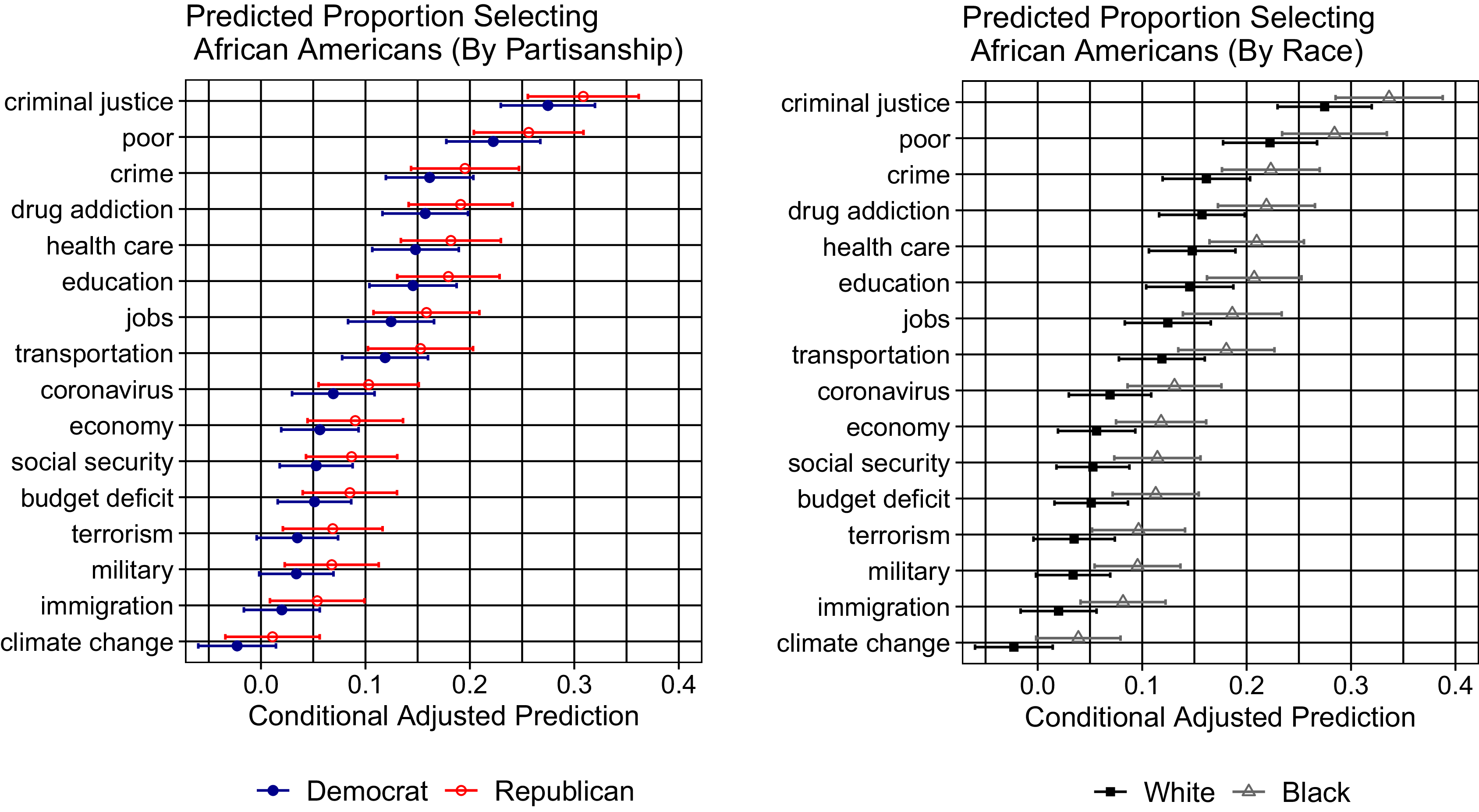
Republicans were slightly more likely to select African Americans for all issue areas than Democrats, though these differences are not statistically significant. Again, a similar pattern as the full sample is found across subgroups. Democrats, Republicans, White respondents, and Black respondents alike were likely to say that African Americans would be best represented by candidates who focused on criminal justice, poverty, and crime, and least represented by candidates who focused on climate change, immigration, and the military. The results for the representation of White Americans are shown in the Appendix, and again, few differences are found between White and Black respondents and Democrats and Republicans for the ranked importance of issues. The unanimity in responses across both partisan and racial groups demonstrates how robust and widespread these evaluations are. While all of these models control for the respondent’s level of education, we also replicate these analyses split by the most and least educated (see Appendix D) to more clearly account for the possibility that these perceptions are only shared by those who may have relatively sophisticated understandings of politics. The results do not markedly differ by level of education, with the same issues being associated with African Americans and White Americans.
Linking Issue Priorities to Candidate Partisanship, Ideology, and Race
What kinds of inferences do voters draw about a candidate based on their stated issue priority? Each issue may elicit different assumptions about the candidate, which may shape respondents’ views on how well a candidate would represent various racial groups. For this reason, the analyses above control for respondents’ answers to the other outcome questions about the candidates, which include perceptions of the candidate’s race, partisanship, and ideology. This helps isolate the direct effects of the issue priority on perceptions of African American representation. By accounting for these other perceptions, we can more accurately assess how specific issue priorities shape voters’ views on racial representation without confounding influences from their other beliefs about the candidate.
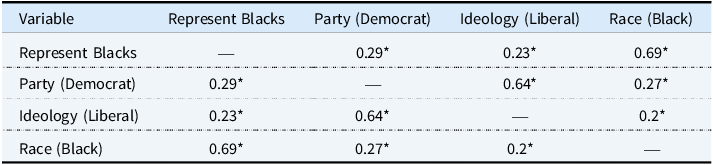
We note that these four key outcomes—whether respondents select African American as being best represented, the candidate’s perceived ideology (−1 conservative, 0 moderate, 1 liberal), the candidate’s perceived partisanship (−1 Republican, 0 Independent, 1 Democrat), and the candidate’s perceived race (1 African American, 0 Other race)—are all positively and significantly correlated (p < 0.001) as shown in Table 2. The strongest relationship is between perceptions that the candidate is Black and the belief that the candidate best represents African Americans (r = 0.69). Perceptions that the candidate is a Democrat (r = 0.29) or is liberal (r = 0.23) are also positively associated with perceptions of Black representation, though these associations are notably smaller. Perceptions of candidate partisanship and ideology are unsurprisingly strongly correlated (r = 0.64), indicating that these judgments often travel together. However, both are only moderately correlated with the belief that the candidate is Black, further reinforcing the distinctiveness of racial perception in shaping judgments about representation.
Correlations between outcome variables
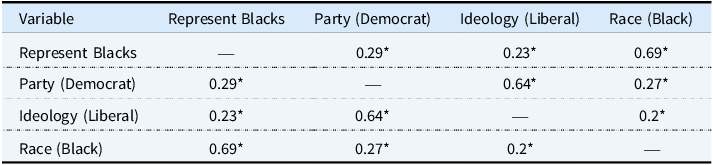
Note: Entries are pairwise Pearson correlation coefficients. *p < 0.001
To better understand how issue priorities influence these other perceptions, we also estimate separate regressions where the dependent variable is each of the three candidate traits: perceived ideology, perceived party, and perceived race. These models assess how respondents’ inferences about the candidate’s identity are shaped by the issue the candidate prioritizes. The results, presented in Appendix F, show that many issue areas increase the likelihood that a candidate is perceived as liberal and as a Democrat, particularly climate change, poverty, health care, education, and criminal justice. Several issue areas increase the likelihood that the candidate is perceived as Black, including drug addiction, poverty, education, and health care. However, criminal justice produces the largest shift in this perception, with a coefficient more than twice the size of most other issue effects. While the perception that a candidate is Black is not exclusive to criminal justice, this issue appears to serve as a particularly strong racial cue relative to others. This helps explain why criminal justice stands out earlier as most strongly associated with perceived African American representation. Respondents may be drawing conclusions about the candidate’s background based on the issue alone. This likely contributes to the observed effects on perceived Black representation.
Since many of the issues tested in our survey may imply certain ideological leanings (e.g., “addressing the criminal justice system”), it is especially important to understand the potential mediating role of ideology in particular. We conducted a mediation analysis to investigate whether candidate ideology mediates the effect of the selected issue area on perceptions of African American representation. Specifically, does the perceived liberalism of candidates alter the relationship between prioritizing criminal justice and respondents’ perceptions of group representation? The rationale here is that voters may interpret candidates’ stances on critical issues through an ideological lens. Given that criminal justice is the issue most closely associated with Black representation, it serves as an ideal case to use as the treatment, ensuring that our findings above are not solely driven by ideological perceptions. When an issue like criminal justice is listed as the candidate’s priority, voters may perceive the candidate as more liberal. This perception may lead voters to associate those candidates with progressive policies to better serve the interests of Black communities. Conversely, candidates who do not prioritize this issue may be seen as more conservative and, therefore, less favorable in the context of representing Black interests.
The results of the mediation analysis show that while the direct effect of criminal justice on the outcome (perception that the candidate best represents African Americans) is statistically significant, the indirect effect through the mediator (perception that the candidate is liberal) is not. The Average Causal Mediation Effect (ACME) estimates the indirect effect at 0.0036 (p = 0.37). In contrast, the Average Direct Effect (ADE), which captures the direct impact of criminal justice on African American representation, is 0.31 (p < 0.001). The proportion of the total effect mediated through perceived ideology is very small (1.15%) and not statistically significant. This indicates that the direct effect of criminal justice significantly increases the likelihood of selecting African Americans as the best-represented group, independent of the perceived liberalism of the candidate.
Race-Policy Associations in Congressional Communication
These results so far reveal how people associate certain policy areas with specific racial groups. The question of whether and how such associations are reflected in elite political messaging remains open. To explore this, we turn to a different form of political communication: congressional newsletters. These messages offer a complementary perspective by examining how members of Congress themselves choose to frame policy issues in routine, constituent-facing communications. This next analysis is exploratory, but it helps assess the extent to which legislators explicitly racialize policy in ways that mirror or diverge from public perceptions.
This analysis draws on 196,422 congressional newsletters collected from the DCInbox project (Cormack Reference Cormack2017), which archives official communications from members of Congress to their constituents. The newsletters span the 111th to the 119th Congress (approximately 2009 through March 2025) and include messages from 74,662 Democrats, 121,746 Republicans, and 14 Independents. Newsletters provide a uniquely valuable window into how members of Congress communicate with constituents outside of campaigns or public floor debates (see Cormack Reference Cormack2016; Blum, Cormack, and Shoub Reference Blum, Cormack and Shoub2023). Unlike media appearances or roll call votes, newsletters reflect strategic decisions by legislators about what issues to highlight and how to frame them for their home audiences. Because newsletters are often written with the intention of demonstrating responsiveness, they are especially well-suited for studying patterns in representation, including how racial identity is invoked in the context of public policy (Cormack and Gulati Reference Cormack and Gulati2024).
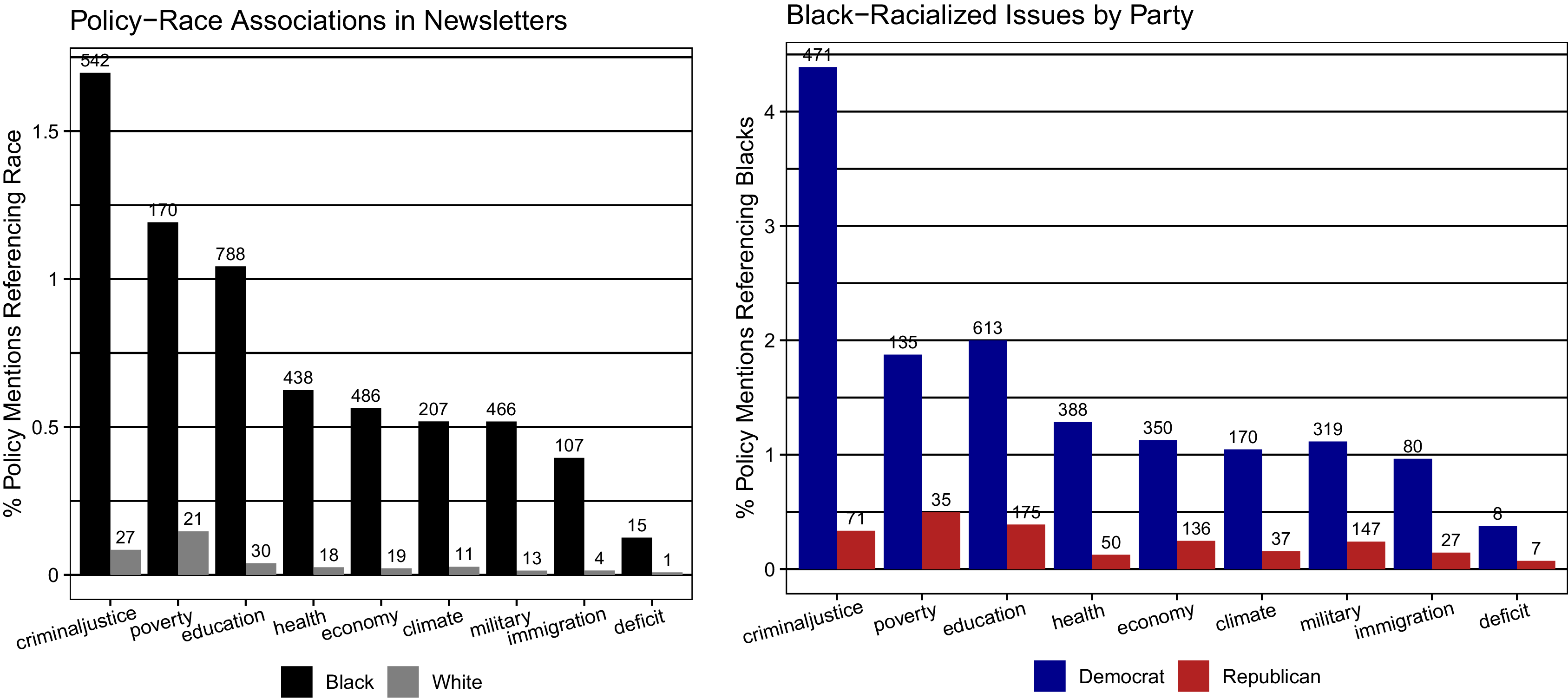
The goal of this analysis is to examine how frequently legislators reference African Americans when discussing policy issues in their constituent communications. Each newsletter was broken into overlapping 5-sentence windows. Within each window, the analysis flags a co-occurrence when both a policy term and a racial group term appear. This method captures cases where race is used to frame a policy discussion—for instance, when a legislator discusses the criminal justice system in the context of Black communities. Policy terms were identified using a dictionary of keywords related to nine broad issue areas that mimic the issue priorities outlined above: the economy, health care, education, poverty, criminal justice, the budget deficit, immigration, climate change, and the military. Racial group references were identified using a dictionary of common phrases referring to Black Americans, including both general (e.g., “Black people,” “Black Americans”) and more specific descriptors (e.g., “Black residents,” “Black constituents,” “Black voters,” “Black families”). Since the survey results focus on both Black and White associations, we repeated this analysis to identify policy discussions in reference to both groups.
For each pairing, we calculate the percentage of policy mentions that also reference Blacks or Whites as shown in the left-hand plot in Figure 3. Overall, such co-occurrences are rare: the share of policy mentions that include any reference to Black or White Americans within a five-sentence window is typically under 2 percent. The overwhelming majority of racial references are to Black Americans; references to White Americans are exceedingly rare across all issue areas. This aligns with expectations, given the normative status of whiteness as the unmarked “default” and implicit racial messaging found in campaigns given norms of racial equality (Jardina Reference Jardina2019; Mendelberg Reference Mendelberg2001).
Percent of policy mentions referencing race in Congressional Newsletters
Note: Percentage of newsletters that mention a given policy area and also reference Black or White Americans within a five-sentence window (2009–2025, n = 196,422). The left-hand plot shows results for Black and White references across parties, while the right-hand plot disaggregates results for Black references by party.
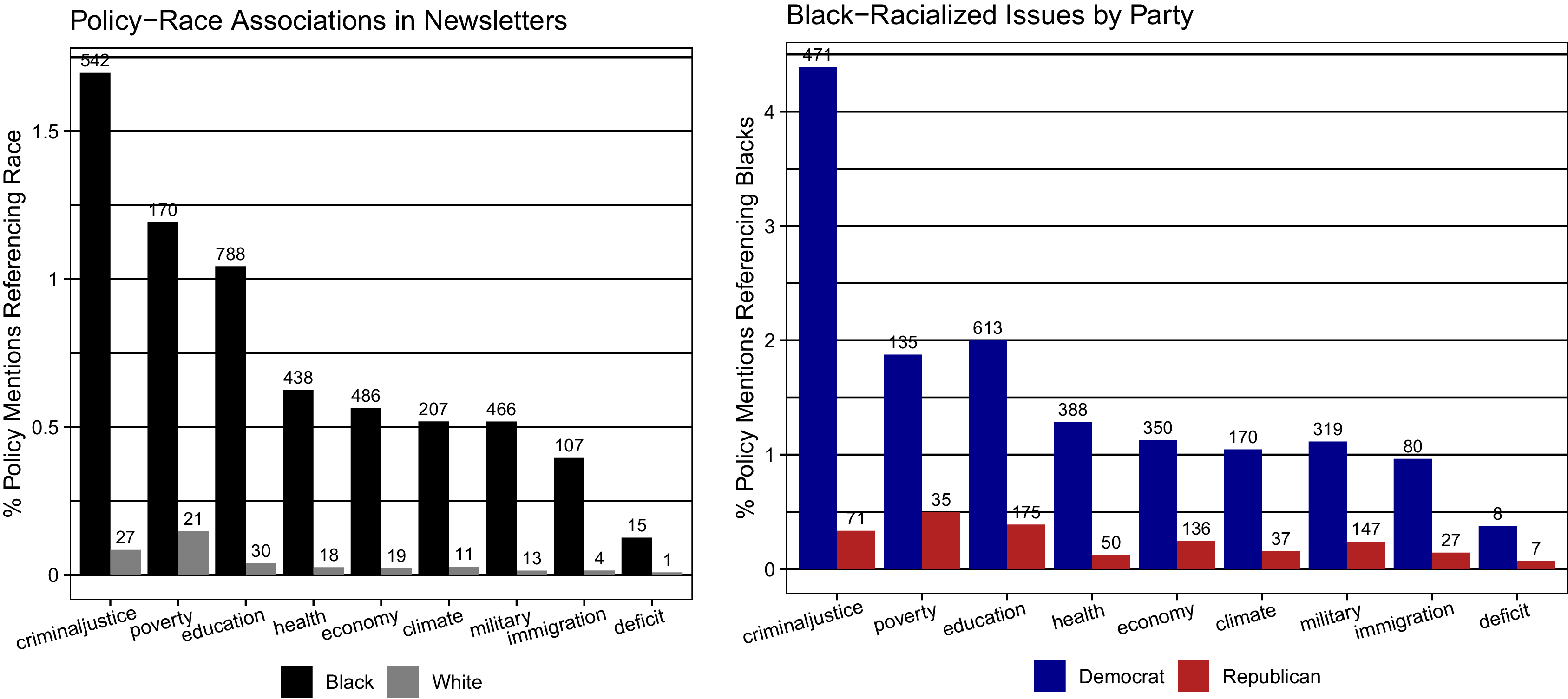
Criminal justice stands out as the policy area most often discussed in connection with Black Americans. Across all newsletters, 1.7% of criminal justice mentions reference Black Americans (compared to just 0.08% that reference White Americans). Many of these mentions occurred during the 116th Congress after the killing of George Floyd and in reference to the Black Lives Matter movement. Poverty follows, with 1.2% of messages referencing Black Americans. Education is also among the top policy areas linked to discussions of Black Americans. While the overall rate of such references is lower than for criminal justice or poverty, it remains notably higher than for many other issues. A closer examination of the education-related messages that mention Black Americans reveals that these references often appear in the context of symbolic recognition, such as Black History Month, or policy debates surrounding affirmative action in college admissions. Discussions of the military and the budget deficit are at the bottom of the list, each only barely ever mentioned in connection with Black Americans.
Breaking the results down by party reveals stark differences in how these topics are communicated. Democrats are far more likely to reference Black Americans across every policy area. For Democrats, 4.4% of all mentions of criminal justice also reference Black Americans. That figure drops to just 0.6% among Republicans. These partisan gaps remain for the remaining issues as well, with more Democrats referencing Black Americans when they discuss policy terms than Republicans.
In some ways, these results closely mirror our earlier findings regarding the bottom-up associations between issue areas and the representation of African Americans. In that analysis, we found that the public most often linked criminal justice and poverty to African Americans and least often linked the budget deficit and the military. Congressional communication reflects that same structure: criminal justice and poverty are the most likely to be discussed in connection with Black Americans, while the budget and military are almost never discussed this way. Unlike the survey results, poverty is actually the top issue for references to White Americans, but the overall number remains extremely small at just a handful of mentions out of tens of thousands of policy messages. These patterns underscore the value of studying public perceptions. Even though race is often not explicitly mentioned, people draw conclusions about who issues are for.
Limitations
Of course, our study is not without its limitations. First, our experimental design, while modeled off of a major nationally representative survey about issue priorities in the United States, introduces implied policy positions alongside some of the issue areas (e.g., “strengthening the military”) that are not perfectly equivalent. While this resembles campaigns that highlight both generic policy areas and the direction of candidates’ positions, future research should aim to clearly differentiate between issue areas, specific policy stances, and partisan affiliation.
To be sure, we find that the same issues that are most strongly associated with African American representation—such as criminal justice, poverty, and education—are also associated with perceiving the candidate as a Democrat, as liberal, and, in some cases, as Black. This overlap reflects the broader social meanings these issues carry and the interrelated ways that voters use issue signals to infer a candidate’s identity and agenda. Our goal in this project is not to disentangle these associations entirely, but rather to understand how people interpret issue priorities in the context of race and representation. The mediation analysis helps address one key component of this overlap: the possibility that the survey items themselves imply an ideological direction. Further work is needed to disentangle these concepts more explicitly, and we cannot say how our results would be different if we cued partisanship, for example, in the experimental vignette. Our minimalist design may amplify the observed relationships since the absence of additional candidate information (such as partisanship) likely increases the weight respondents place on issue priority. Moreover, as we are interested in the implications for representation, the design focuses on the top policy priority of a candidate, which differs from examining broad race-policy associations in general.
A third limitation is that the primary dependent variable, which asks respondents to select a single racial group that is represented best, may depend on respondents’ understandings of group policy priorities, which could vary widely. We were interested in forcing a selection of one group among the set to better answer our intended question: whether a specific issue focus is uniquely associated with the representation of a particular racial group. In this way, respondents have to rely on their pre-existing, stereotypical race-policy associations. By asking whether a candidate would or would not represent each group separately or by allowing respondents to select multiple groups, we would not force these trade-offs to uncover whether there is a singular and unique connection to a specific racial group. This would also encourage respondent anchoring and socially desirable responding. That said, the forced choice between racial groups might lead to the default to the most numerous group (White Americans), potentially obscuring associations made in a different context. And the measure may not capture more inclusive or multidimensional views of representation. Future studies would benefit from a measurement strategy that allows a clearer association between issues and racial groups without the constraint of a forced choice.
The newsletter analysis is limited in its scope as well. We show the textual co-occurrence of race and policy terms within a five-sentence window, which may miss more subtle or implied forms of racial framing that do not include explicit group references. We examine explicit mentions of Black or White Americans and therefore cannot capture coded language, tone, or imagery that may still carry racial meaning. The limited dictionary to find key issue terms may also fail to capture evolving or context-specific references to both race and policy areas. We also cannot say how legislators or candidates make race-policy references in other mediums or why they may do so. Rather, this analysis is one way to contextualize our survey findings by illustrating what kinds of race-policy associations politicians actually make.
Conclusion
Scholars have long studied the impact of “Black issues” on public opinion, campaigns, and substantive representation. While this research has provided important insights into mass opinion and the machinations of political elites, it offers little evidence of the actual content of these racial-policy perceptions. We argue that it is first important to understand what picture people have in their heads about how issue priorities are associated with the representation of different racial groups.
We find that Americans, regardless of race or party affiliation, have similar perceptions regarding the importance of issues for African American versus White representation. We also find evidence of a racial gap in these perceptions. The top issues most associated with White Americans—climate change, military, budget deficit, and terrorism—are the issue areas least associated with African Americans, and the issues most connected to African Americans—criminal justice and poverty—are perceived as impacting Whites the least.
Of course, these perceptions of issue priorities are correlated with broader inferences about candidate identity. Issues such as poverty and criminal justice not only increase the likelihood that respondents perceive the candidate as representing Black Americans but also raise the likelihood that the candidate is seen as a Democrat, as liberal, and as Black. These perceptions may help drive the observed effects on racial representation. Indeed, we find that Democratic politicians are far more likely than Republicans to explicitly connect issues to Black Americans in their constituent communications. Across the board, Democrats are more likely to reference race in their policy messages, particularly around the same issues that survey respondents associate with Black representation. This elite communication pattern reinforces the idea that certain issue priorities, like criminal justice, carry both racial and partisan meaning. However, we also find that the effects for perceived Black representation are not only explained by changes in how liberal the candidate is perceived to be, but listing criminal justice (the top Black issue) as a key priority directly influences perceptions of how well a candidate would represent the Black community.
This research has a number of implications for studying public opinion, representation, and race. First, we offer an empirical approach to examine the perceived racialized impact of elites’ issue priorities. Our data and methods can be used not only by scholars seeking to answer similar research questions about issue areas and other racial groups in the United States but also for other questions on the role of race for policy preferences and vote choice. For example, studies have begun to analyze racialized perceptions of COVID-19 mitigation policies (Gollust et al. Reference Gollust2022; Gollust et al. Reference Gollust2020; Skinner-Dorkenoo et al. Reference Skinner-Dorkenoo2022; Stephens-Dougan Reference Stephens-Dougan2022a). To what extent do these findings apply to legislators’ focus on COVID as their top issue priority? Is support for mitigation policies conditional on perceptions about the racial impact of candidates’ policy agendas? We also provide empirical confirmation of the assumed connection between African Americans, criminal justice, and poverty, which has long been a focus of attention (Gilens Reference Gilens1999; Peffley and Hurwitz Reference Peffley and Hurwitz2002; Hancock Reference Hancock2004). At the same time, our results show just how much American politics is perceived to be for and about White people. The overall cognitive picture is that most elites, regardless of their policy focus, are presumed to best represent White Americans. In many ways, this is unsurprising given the relative size and influence of White Americans in the nation’s history and politics. With the significant demographic changes that will result in a majority-minority nation and the concomitant growth in the political power of people of color, these perceived associations may also experience changes moving forward.
Our study also has implications for studies of political representation. A large body of literature, through the use of audit experiments, has shown that politicians discriminate against African Americans when it comes to constituency service (e.g., Butler Reference Butler2014). While this research has expanded our understanding of continued impediments to racial equality, the overwhelming majority of studies examine how politicians respond to service requests, or messages from constituents asking for help navigating the bureaucracy, rather than policy-based requests (see Butler, Karpowitz, and Pope Reference Butler, Karpowitz and Pope2012; Costa Reference Costa2017). Of the handful of studies that do focus on policy, few have analyzed how the issue area itself shapes politicians’ responsiveness. It has not been demonstrated whether the racial gap in responsiveness persists when African Americans contact their elected officials specifically about an issue that is popularly perceived to impact the Black community. Our study offers a method to more rigorously examine the perceived link between particular issue areas and African Americans, which can be used by scholars to subsequently explore the boundaries of racial inequalities in representation.
Supplementary material
The supplementary material is available online at https://doi.org/10.1017/rep.2025.10033
Acknowledgements
We thank Zachary Albert, Ivelisse Cuevas-Molina, Matthew Green, David Karol, and Brian Schaffner for feedback on earlier drafts of this paper and Adam Eichen for research assistance.
Funding statement
This work has been supported in part by Grant #G-2111-34927 from the Russell Sage Foundation. Any opinions expressed are those of the principal investigators alone and should not be construed as representing the opinions of the Foundation.



 Open access

