

Eighteenth-century European colonial expansion has been characterized as “war capitalism”: an aggressive form of state expropriation of land and labor.Footnote 1 Such re-evaluations of the Atlantic relations of production have done much to blur the lines between voluntary and involuntary labor participation. While slave labor was not waged labor, the development of the Atlantic slave trade was shaped by industrialization and at the same time generated profits that could be invested into canal development, coal mining, and textile production, thereby assisting further British economic development. The huge expansion of the Birmingham gun industry, for example, provided both a key item of exchange in the slave trade and fueled levels of warfare in Central and West Africa that led in turn to an increase in the supply of slaves in the form of captives.Footnote 2 In this chapter, we argue that European unfree labor also played a role in this process, supplying a flow of unwilling military recruits to police Britain’s Atlantic interests.Footnote 3
The numbers involved in this underexplored unfree labor system were far from insignificant. Many more prisoners served in the African and Caribbean colonial garrisons during the Napoleonic and Revolutionary Wars, for example, than were shipped to the Antipodes. Most recruits sourced through the criminal justice system were sent to penal units that have been the subject of remarkably little study. As Padraic Scanlan put it, their “history exists in scraps scattered across continents.”Footnote 4 Roger Buckley made a similar observation in relation to condemned soldiers who served in the West Indies. As he noted, “full recovery of the vast and vital data” on the recruitment of culprits, convicts, deserters, and rebels into the ranks of the army in the West Indies has yet to be undertaken.Footnote 5
In this chapter, we use a range of different sources to piece together the military deployment of convicted labor in the British Atlantic world in the period 1766–1826. We start with an account of the diverse ways in which criminal justice systems were used to recruit prisoners to police British interests in the tropics. We then attempt to reconstruct the flow of British militarized convict labor to the Caribbean and West Africa in the age of wars and revolutions. Finally, we end by exploring the many complexities that resulted from the parallel deployment of European and African coerced workers in the eighteenth- and early nineteenth-century Atlantic world. We conclude by arguing that European penal labor played a critical role in shaping British colonial practice in the Atlantic, including its disengagement from the slave trade.
“To go for a soldier”: Courts, Gaols, Crimps, and Recruiting Practices
The use of convicted labor to bolster the ranks of forces deployed in colonial ventures has a long history. The Portuguese used prisoners as both unfree soldiers and seaman in their 1415 campaign to capture the north African city of Ceuta. Thereafter, convict soldiers were regularly sent to military presidios in North or West Africa, Mozambique Island, Diu, and Muscat.Footnote 6 The Spanish also manned presidios in Florida, Louisiana, and Alta California with convict soldiers, while the Russian Empire made use of penal labor battalions until 1860.Footnote 7 The French use of militarized penal labor was particularly extensive. The Bataillons d’Infanterie Légère d’Afrique (BILA), originally formed in 1832, were used in colonial operations until they were disbanded by the French in 1970. BILA recruits were sourced from military offenders and civilian prisoners who – though discharged from jail – had yet to complete military service. While these men were not technically sentenced to transportation, convicting courts knew that colonial service in a penal unit would inevitably follow metropolitan imprisonment. At least 600,000 men, overwhelmingly drawn from working-class populations, served in the BILA during its 138-year existence.Footnote 8 This practice illustrates the difficulties involved in distinguishing convict labor from other forms of unfreedom (in this case, conscription), as well as the extent to which legal mechanisms were employed to co-opt the labor of offenders within the overall process of colonization.
The British also experimented with the recruitment of criminals into the armed forces. The practice dates back to at least the fourteenth century. It has been estimated that 12 percent of the men who fought for the English Crown between 1339 and 1361 were convicted criminals.Footnote 9 As the English (later British) acquired colonial possessions, they became increasingly reliant on the courts and other criminal justice mechanisms that sourced the recruits who provided the necessary manpower to operate both a fleet and overseas garrisons.
The defense of British slaving interests required a military presence on both sides of the Atlantic. The West Indies was a major theater of action in every eighteenth-century European conflict. Additional manpower ensured that there was a large enough force not only to defend Britain’s plantation interests but also to launch amphibious operations against island colonies controlled by competing European powers. Even in periods of peace, a garrison served as a bulwark against slave insurrection. Fewer troops were needed to maintain British interests in West Africa; nevertheless, some military presence was required to defend slave forts and factories from attack by other European powers. Boots on the ground were also useful in that they aided in the sorts of negotiations with West African polities that were crucial for securing access to slave markets. Military bands and ceremonial displays of arms, for example, could form an important backdrop to political and commercial transactions.Footnote 10
Yellow fever and other tropical disorders including malaria and dysentery took a high toll on European troops serving in the tropics. The British expeditions to Havana in 1762 suffered greatly from malaria, for example.Footnote 11 The four British battalions sent to defend the West Indies in 1780 experienced a mortality rate of nearly 50 percent in the first six months of service, as did the 86,000 British troops who served in the West Indies in the years 1793–1801.Footnote 12
The health risks associated with service in the tropics were well-known. British newspapers regularly carried stories about the ravages of the “black vomit” – a popular name for yellow fever.Footnote 13 In 1775, it was claimed that the government kept news of a yellow fever outbreak “a profound secret” for fear “that it would discourage the Officers and Troops that are now embarking for America.”Footnote 14 The catastrophic losses experienced by the British in the West Indies in the 1793–98 campaign similarly hindered recruitment.Footnote 15 To bolster the ranks of units slated for service overseas, recruiters resorted to a number of different strategies. These included the use of mercenaries, slaves, prisoners of war, debtors, criminals, and deserters. At first, recruits sourced through the criminal justice system were drafted into regular regiments. Toward the end of the eighteenth century, there was a shift in policy, and a series of dedicated penal battalions were raised for service in Africa and the Caribbean. Over time, the British came to increasingly rely on soldiers of African descent, as they were better acclimatized to tropical disease environments. Condemned soldiers played a critical role in the recruitment and training of these units, which slowly replaced their European penal equivalents, and the practice of recruiting British and Irish military and civilian prisoners for service in the tropics formally ceased in 1826.
Previous accounts of the British army in the eighteenth century have tended to downplay the extent to which the rank and file were recruited from criminals. Most have argued that convicted prisoners accounted for an insignificant proportion of serving troops at any given point in time.Footnote 16 A survey of court records would tend to support this view. While prisoners tried in the Old Bailey were given the option of joining “Their Majesties Service by Sea or Land, by their own free Consent” as early as 1693, such sentences were uncommon. In the years 1693–1816, just 207 prisoners sentenced in the Old Bailey, London’s principal court, were ordered to enlist in the army or navy. Yet, there were many other ways in which an encounter with a court could lead to enlistment.Footnote 17
Notably, the exercise of royal prerogative could be used to alter sentence outcomes. Thus, in 1824, twenty-five men in the Justicia, Leviathan, and Retribution hulks were pardoned of their crimes on condition of their enlisting in the Royal African Colonial Corps.Footnote 18 The timing was by no means coincidental. The outbreak of the First Anglo–Ashanti War (1824–31) created an unexpected demand for military labor on the Gold Coast. Similar judicial maneuvers were used to direct other convicted workers to theaters where there was a demand for their skills. Thus, in 1825, twelve smugglers were sent to the Cape Coast to serve as seamen for five years.Footnote 19 Invariably, such pardons were made conditional on colonial service.
Many recruits sourced through the criminal justice system were never brought to trial. Throughout the course of the eighteenth and early nineteenth century, able-bodied men were discharged from custody on condition of joining the army or navy. This ensured that they did not have to stand up in court.Footnote 20 Such early forms of plea bargaining are often poorly documented, as they are not usually recorded in court proceedings. A survey of the Shropshire Quarter Sessions for the years 1741–57 unearthed only one mention of the practice. In this case, the offender was dragged before the courts after having maimed himself in order to avoid military service – without this act of self-mutilation, the case would have gone unnoticed.Footnote 21 The few recorded instances that have come to light are heavily concentrated in years when Britain was at war. The practice was particularly common in the years 1792–1804, when “culprits,” to use the technical term for a person charged with committing a crime, were diverted in large numbers into units slated for service in the West Indies.Footnote 22 A similar system operated with military courts. Soldiers facing a charge might simply be transferred to an unpopular arm of the service without the need to enter into formal court proceedings.
Others who had been convicted “volunteered” for service rather than face other punishments. While it is difficult to know how many swapped a stint in jail or transportation for the “King’s shilling” – to use a popular euphemism for enlistment – surviving petitions shed light on individual cases. On August 31, 1824, John Barker requested permission to join the Royal African Colonial Corps after being sentenced to imprisonment for embezzlement for obtaining money under false pretenses at the Somersetshire Assizes. Upon passing a medical examination conducted by the surgeon of the 97th Regiment, he was duly admitted into the corps – with the commanding officer confirming that he did not object to the enlistment of men who were to be confined to a county jail.Footnote 23
There were other post-conviction avenues whereby inmates of jails and houses of correction could be funneled into the armed forces. Eighteenth-century carceral institutions were poorly funded; jailers relied on fees levied upon inmates to supplement meager or nonexistent salaries. Prisoners regularly had to pay for the use of their cell, bedding, food, and even their release (although the latter was made illegal in 1774).Footnote 24 Many prisoners were incarcerated beyond the expiration of their sentence as a result of becoming indebted to their jailer.Footnote 25 In such cases, they swapped a cell in the criminal division, crossing the corridor to the debtors’ yard. This rendered them liable to crimping – a practice whereby jailers pocketed an enlistment bounty in return for discharging the jail debt of a newly minted recruit.
The impressment of those found wanting by legal authority was encouraged by the operation of the law. The Press Act of 1756 empowered magistrates to forcibly recruit “able bodied Men as do not follow or exercise any lawful Calling or Employment or, have not some lawful and sufficient Support.”Footnote 26 While specifically targeted at vagrants, the legislation could also be applied to prisoners.Footnote 27 As with later French practice, there was a considerable danger that the discharged prisoner would be met at the jail door by the recruiting party, swapping one coercive institution for another.
Officering penal units appears to have developed in parallel. Some of those who filled positions of authority had pasts that were as undistinguished as those of the rank and file over which they had charge. Joseph Wall, who took command of the African Corps in 1779, had previously been convicted for sexually assaulting an heiress, for example.Footnote 28 Individual career trajectories suggest that others joined to escape the disgrace of being cashiered. John Ouzeley Kearney was commissioned as a lieutenant in the New South Wales Corps on New Year’s Day in 1808.Footnote 29 After serving through 1809 at regimental headquarters in Sydney, Kearney returned to London on the Dromedary in May 1810.Footnote 30 The following month, he exchanged positions with J. N. Nealson, a lieutenant in the Royal African Corps.Footnote 31 Although the New South Wales Corps (recently renamed the 102 Regiment) guarded convicts in Australia, it was not itself a penal battalion. Since this new position carried less prestige and a higher risk of mortality, it seems likely that this “exchange” was forced upon Kearney and that he was pushed toward, rather than drawn to, service in Africa.
Some of these recruitment mechanisms required consent, whereas others did not. Those condemned to the scaffold had an obvious incentive to enlist; others might be induced by the prospect of pay – although wages were meager. John Quinn, for example, received just six months’ pay for nine years of service in the Royal African Colonial Corps.Footnote 32 There was the added incentive that those who survived military service were repatriated and thus provided with an opportunity to reunite with family and friends, as opposed to being left to languish in a remote penal colony. Nevertheless, the dangers associated with service in the tropics – the place most were sent to serve – ensured that push factors predominated over pull, regardless of the nature of the encounter with military and civilian criminal justice systems.
Thus, convicts or those formally sentenced by courts to military service or pardoned on condition of military service made up a minority of military recruits sourced via the criminal justice system. Many more culprits were induced to join the army before their trials, and these were joined by vagabonds and debtors crimped into service. A substantial number of the latter enlisted in order to clear jail debts. A common term that might be applied to all such rank and file enlisted via the civil and military court systems might be felon recruits – a broad term that covers all accused of committing an offense.
Felon Soldiers and the Defense of Empire
The diverse ways in which recruits were funneled into the armed forces via jails and courts make it difficult to enumerate the scale of militarized penal labor. The frequency with which recruits were sourced via criminal justice systems, however, fluctuated according to demand for manpower. As Figure 6.1 illustrates, there was an inverse correlation between the number of convicts transported overseas and the strength of the armed forces over the course of the long eighteenth century. In times of conflict, civil transportation numbers fell, a trend that became more marked over time. In part, this reflected increased shipping costs. Merchant seamen’s wages increased when Britain was at war, cutting the profit margins of the contractors on whom the state relied to transfer the bodies of prisoners to colonial buyers. The accumulation of convicted labor that might otherwise have built up could be dispelled by swapping colonial buyers for naval and military recruiters.Footnote 33
Numbers of convicts transported to the American and Australian colonies and strength of the British Army, 1690–1820.

As Stephen Conway has shown, Highland Scottish and Irish recruits appear to have been sent to serve in the regular army in India in disproportionate numbers as “part of a deliberate policy to spare good Englishmen, and even Lowland Scots, from an early death in a disease-ridden imperial outpost.”Footnote 34 In similar fashion, units dispatched to the Caribbean relied much more heavily on criminal recruitment than did those deployed in more salubrious climates. Conway’s examination of pardons issued during the American Revolution on condition of military service highlights the degree to which those who entered the army via the criminal justice system were channeled into service in the tropics. Only a minority of pardons included specifications about the unit to which the reprieved convict was to be stationed, but in 58 percent of those cases, the convicts were sent to Africa, the Caribbean, or India.Footnote 35
Some units condemned to perpetual tropical service appear to have operated as quasi-penal battalions. The 60th Royal American Regiment of Foot was originally raised in 1755–56 for service in North America. In 1772, the regiment was redeployed to the West Indies, where two battalions continued to serve on a permanent basis. Even before this date, the 60th Regiment had a record of supplementing its ranks through the purchase of transported convicts who had landed in North Atlantic ports.Footnote 36 After its redeployment to the Caribbean, its strength was maintained with regular drafts of prisoners.Footnote 37 Although the 99th Regiment, or 99th Jamaica Regiment of Foot, had a shorter history, it too appears to have been principally manned by recruits sourced via the criminal justice system. This unit was raised in 1780 to assist with the defense of the Caribbean, and it disbanded in 1783 following the end of the American Revolutionary War. On the other side of the Atlantic, an independent company was established in 1766 and sent to Senegal, a colonial outpost that had been captured from the French eight years previously. While commonly known as O’Hara’s Regiment, after the name of its commanding officer, who doubled as provincial governor-general of Senegal, it was occasionally referred to as the African Corps.Footnote 38 These three units accounted for 39 percent of all recruits pardoned on condition of service in the period 1775–81.Footnote 39
The oldest, O’Hara’s Regiment, was initially composed of military deserters. Over time, its ranks were augmented by convicts pardoned on condition of service in Africa for life.Footnote 40 Private Murray McKenzie, who in 1782 was tied to the muzzle of a cannon on a fort rampart on the Gold Coast and judicially eviscerated for insubordination, was said to have escaped the gallows on two previous occasions. A former drummer in the guards, he had been capitally convicted for horse theft, only to be pardoned on “condition of serving in one of the regiments at the African settlements.”Footnote 41 Others had either been sentenced directly to transportation or to hard labor on the Thames, where they had enlisted.Footnote 42 The corps also took some “volunteers,” although in this context the term “volunteer” was at best slippery.Footnote 43 No one was likely to volunteer for service in West Africa unless they wished to avoid another truly unpleasant outcome. Thus, volunteer George Robinson was crimped into service after falling into debt.Footnote 44 The involuntary nature of the service is illustrated by the actions of the recruits. In April 1780, there was a mass desertion from a detachment of the African Corps stationed at Hilfey Barracks when news spread that they were about to be embarked for Senegal.Footnote 45 It is no wonder that “volunteers” were occasionally shipped out for service in Africa ironed to each other in pairs.Footnote 46
The principal base of operations for O’Hara’s Regiment was Gorée, an island off the coast of Senegal that was strategically important in the slave trade. It formed a particularly handy operational base for privateers during times of conflict. First occupied by the British in 1758, it was ceded back to France in 1763, only to be recaptured again by the British in 1779. Strategically situated, Gorée had the additional advantage of offering a climate that was more conducive to European constitutions than that of the Senegalese mainland. While the island served as an operational base, soldiers from the unit manned thirteen different forts dotted along the African coast from Senegambia to Whydah.
Slaving was a complex business. Europeans purchased slaves from West African polities and merchant oligarchs. This necessarily involved a degree of formal negotiation. International competition, particularly with the Dutch and the French, created a network of local alliances. In 1766, O’Hara, for example, was approached by “Several Chiefs of the country,” who complained “that some of the French traders on the coast made a practice of forcibly carrying off the natives whenever they found opportunity.” As newspaper coverage put it, because the “chiefs are in alliance with the English (sic), it is imagined his Excellency will endeavour to prevent such deprivations in future.”Footnote 47 The maintenance of existing trading arrangements required a military presence. Slaving bases also needed protection in times of war. The strategic nature of colonial outposts such as Gorée ensured that such tiny specks on the map featured prominently in international agreements and were bitterly fought over.
The signing of the Treaty of Paris in 1783 and the end of the American Revolutionary War reduced the Atlantic demand for condemned soldiers. Both the Africa Corps and the 99th Jamaica Regiment were disbanded in 1783–84. The lull, however, lasted less than a decade. The outbreak of hostilities with France in 1792 led to a rapid escalation in British military strength in the Caribbean. Between 1793 and 1801, a total of 86,000 British troops served in the West Indies, 51 percent of whom did not survive the experience.Footnote 48 The early losses were particularly crippling. The British were forced to retreat from Guadeloupe in 1794 and from St. Lucia the following year. At the same time, they had to contend with a slave revolt in Grenada and an insurrection in St. Vincent, while prosecuting a war with the Trelawny Town Maroons in Jamaica. Disease also crippled operations in Saint-Domingue, forcing the evacuation of the survivors in 1798.Footnote 49 As losses mounted, the army increasingly resorted to the recruitment of slaves and felons.
While irregular units of Black rangers had been raised during previous periods of conflict, in 1795 the British Army took the unprecedented step of purchasing freshly disembarked slaves to form a permanent military force, equipped, uniformed, and paid for in the same fashion as other line regiments. By 1798, a total of twelve West India regiments had been raised. As a result, over the course of the Napoleonic Wars, the British government became the largest single purchaser of slaves. It is estimated that during that time, more than 13,000 slaves were bought and turned into soldiers.Footnote 50
In many Caribbean jurisdictions, it was illegal to arm slaves. As a result, purchased recruits were treated in the same way as other soldiers and were discharged as freemen in receipt of a military pension. When they fell sick, they were treated in military hospitals alongside Europeans and were subject to military law rather than slave codes.Footnote 51 They could even be demoted to a penal unit as punishment, as reflected in the Army List. This was hierarchically arranged descending from the Life Guards down through the regiments in numbered sequence. Although the West India regiments appear toward the end of the Army List, they were ranked higher than the garrison and veteran establishment, units to which Black recruits could be invalided. Penal units were placed at the bottom, denoting their degraded status.Footnote 52
At the same time, the army redoubled its efforts to recruit debtors, rebels, culprits, convicts, and deserters to fill the ranks of its remaining European colonial garrison. This was necessary, in part, to placate planter opposition to the enlistment of former slaves. The British government agreed to limit the number of Black troops deployed in any single station in the West Indies to one-third of the total garrison.Footnote 53 Thus, to accommodate the sensitivities of the plantocracy, it was necessary to continue resorting to the law as an agent of compulsory recruitment of European troops. Buckley estimates that in the period 1799–1802, at least 20 percent of the British Army in the West Indies was composed of felons.Footnote 54 These included many Irish political prisoners incarcerated in the wake of the Irish Rebellion of 1798. In the period 1799–1804, around 3,200 of these prisoners were drafted into the army; most were destined for the West Indies.Footnote 55
In August 1800, a new penal unit known as Fraser’s Corp of Infantry was raised to serve on the West African coast. As with its predecessor, O’Hara’s Regiment, the rank and file of the new unit were composed of condemned soldiers, a prison hulk acting as its British depot. By 1801, the unit, now renamed the Royal African Corps, was in action in Senegal and was once more headquartered at Gorée.Footnote 56 On January 17, 1804, this strategic island was attacked by six French privateers who managed to overwhelm the garrison of one hundred men. At the time, the corps consisted of just two companies and had a notional strength of 220 rank and file.Footnote 57 Its strength was increased to three companies that were dispatched to retake the station.Footnote 58 With the increase in numbers, its British depot was switched to Alderney in the Channel Islands, where a temporary camp for 600 men was erected.Footnote 59 In 1809, this was moved to a more permanent base located within the walls of Cornet Castle, Guernsey.Footnote 60
Over time, the unit’s theater of operations expanded, too. By September 1806, a detachment of the Royal African Corps was serving in the West Indies alongside several British line regiments. To facilitate this expansion, an additional two companies were added.Footnote 61 A Whitehall directive of November 8, 1806, approved the augmentation of the corps as well as its split into two distinctive units, both of which were to continue to be composed of deserters and “persons confined for Petty Offences on board the hulks, who are desirous to serve abroad.”Footnote 62 The following year, these units were reorganized into a new regiment, the Royal West India Rangers, which operated as a second penal battalion recruited on the same lines as its parent regiment – the only difference being that its theater of operation was the Caribbean rather than the West Coast of Africa. In 1808, a third unit, the Royal York Rangers, was split from the Royal African Corps. It was also dispatched to serve in the West Indies. The combined strength of the three units in 1808 was 3,140.Footnote 63 In 1814, a fourth penal battalion was raised for service in the Caribbean. Styled the York Chasseurs, this battalion was to be composed of the better class of military deserter. By 1816, the combined strength of the four penal battalions was 5,433, although some companies of the Royal African Corps were composed of former slaves rather than felons.Footnote 64
After the end of the Napoleonic Wars, the Royal West India Rangers, Royal York Rangers, and York Chasseurs were demobilized.Footnote 65 The Royal Africa Corps, however, continued in service. The British abolition of the slave trade in 1807 meant that the unit acquired a new role. Rather than securing Britain’s commercial interests in the slave trade, the regiment was now tasked with assisting antislavery operations, although this did not always go as smoothly as planned. The line between gamekeeper and poacher was thin, and at least one former officer, John Ouzeley Kearney, turned his hand to slaving after resigning his commission. By the early 1820s, Kearney had become one of the most active slavers in the Galinas trade to Havana.Footnote 66 Others, including officers such as Lieutenant-Colonel James Willoughby Gordon, owned slaves or profited in other ways from the slave trade, reflecting the long and complicated link between the recruitment and staffing of penal units and the slave trade.Footnote 67
Increasingly, the focus of the Royal Africa Corps operations shifted to Sierra Leone, where the unit was tasked with securing recruits for the West India regiments. This colony had originally been planned by abolitionist Granville Sharp as a suitable place to relocate London’s indignant Black poor. The venture quickly collapsed, but in 1792 “Black Loyalists” who had supported the British in the American Revolution were settled in Freetown. In 1800, this small community was joined by 500 exiled Jamaican Maroons.Footnote 68 After the abolition of the slave trade in 1807, the British also sent “apprenticed” captive Africans there.Footnote 69
In February 1819, a detachment of the Royal African Corps was sent to the Cape of Good Hope to reinforce British forces engaged in the Fifth Xhosa War on the colony’s eastern frontier.Footnote 70 There they took part in the defense of Grahamstown in May 1819.Footnote 71 In September, the six White companies of corps stationed in West Africa were ordered home. The reminder of the Royal African Corps was disbanded in the Cape in June 1821, with the fifteen remaining officers becoming settlers in the vicinity of the Fish River. Some of the rank and file returned to Britain, while others appear to have stayed on as servants to their former officers.Footnote 72
The demise of the Royal African Corps was short lived. It was reborn the following year as the Royal African Colonial Corps, a unit once more composed of court-martialed soldiers and criminals. By July 1823, this new unit had again taken up residence in Cape Coast Castle. Further detachments were sent in September of that year and in January 1824. Another hundred men embarked for the Gold Coast in May 1824 following the defeat of British led forces at the hands of the Asante.Footnote 73 They were joined by a company of 120 men from the same regiment shipped from the Cape in February 1824.Footnote 74
Despite these reinforcements, the ravages of disease were such that by the end of May there were only twelve effective European troops left on the Gold Coast.Footnote 75 While the strength of the corps was raised to 1,000 men, many of these appear to have been recruited locally or were supplied from a company of the 1st West India Regiment transferred from Barbados.Footnote 76 Nevertheless, an additional detachment consisting of 126 Europeans was shipped out to West Africa from the Solent on October 8, 1824, followed by 600 more from Chatham in November 1824 and another 250 in July 1825.Footnote 77 A year later, “not one tenth” of these recruits remained alive.Footnote 78 Other posts along the coast were hardly more salubrious. In June 1825, 134 soldiers of the Royal African Colonial Corps were sent to serve in Bathurst town on the Gambia River. By November of that year, all but thirteen had died and none were considered fit for duty.Footnote 79 The last 250 European recruits were shipped out of Cowes in February 1826, bound for Sierra Leone.Footnote 80 Thereafter, it was determined that the Royal African Colonial Corps would no longer “receive any more deserters or culprits” but would instead recruit on the “Western Coast of Africa.”Footnote 81 By July 1826, the Corps had been reduced to just eighty effective European rank and file.Footnote 82 The unit continued in service staffed by African recruits until it was eventually disbanded in 1840.
Counting Felon Soldiers
It is difficult to determine the number of felon soldiers who served in the Caribbean and West Africa in the sixty years from the raising of O’Hara’s Regiment in 1766 to the disbanding of the Royal African Colonial Corps in 1826. Information is particularly scant for the period 1766–84. Reported numbers of those dispatched to West Africa suggest that at least 3,000 condemned soldiers saw service there – a conservative estimate given the high death rates associated with service in the region.Footnote 83 The numbers sent to serve in the West Indies were almost certainly higher. In the period 1775–81, for every ten condemned soldiers pardoned on condition of service in West Africa, seventeen were sent to the West Indies. Given this ratio, it is safe to assume that an additional 5,000 were sent to the Caribbean, providing a combined estimate of 8,000 for the period to the end of the American Revolution.
The registers for the Laurel and Perseus hulks in the period 1802–14 provide details about the places to which convicts were discharged (see Table 6.1). Of the 2,057 convicts entered into the records of these two floating labor depots from 1802 to 1814, 323 were diverted into the Royal African Corps or another penal battalion, and 123 were sent for service in the navy. Extrapolated to the entire hulk fleet, these figures would suggest that a little more 2,180 convicts were recruited into the army directly from the hulks and a further 830 pressed into the navy. Given recruitment practices, however, this is likely to account for only a minority of condemned soldiers. Many others entered service as culprits, pretrial deals ensuring that they avoided the hulks. Military courts provided an even larger source of recruits – a common fate for deserters was to be redirected into a penal battalion.

Buckley estimated that at least 20 percent of European troops serving in the Caribbean in the years 1799–1802 were composed of deserters, culprits, and prisoners.Footnote 84 While it is distinctly plausible that one-fifth of the 86,000 troops sent to serve in the Caribbean during the French Revolutionary War were recruited in this fashion, it is important to emphasize that if only half that number was supplied via military and civil courts, then it would still amount to more than 8,600 condemned recruits sent to the West Indies theater alone in the period prior to the partial demobilization of the army following the 1803 Treaty of Amiens.
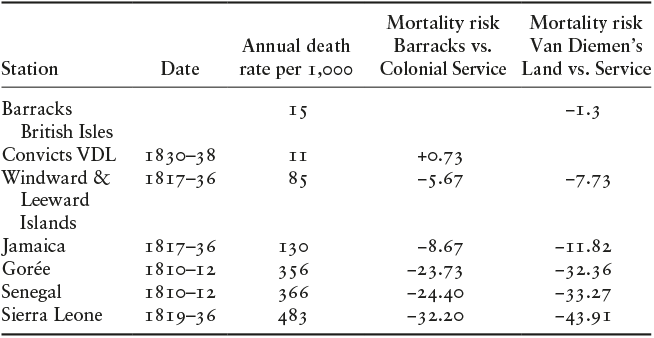
Another means of estimating the number of felon soldiers recruited in the Napoleonic Wars is to use the annual reported strength of each unit and the estimated attrition rate. Between 1810 and 1814, the British regular army lost on average 5.7 percent of its rank and file each year to a combination of deaths, desertion, and discharge.Footnote 85 The rate for penal battalions is likely to have been substantially larger due to the much higher rates of death experienced by troops in service in West Africa and the Caribbean. Philip Curtin’s estimates for mortality rates for British troops in different theaters are provided in Table 6.2. A soldier sent to the Leeward or Windward Islands was nearly six times more likely to die than one barracked in the British Isles. The risk rose to 8.7 times more likely for those stationed in Jamaica. It was greater still for those serving in Gorée and Senegal. They were 24 times more likely to die than those barracked at home. Even these stations were less deadly than Sierra Leone. The death rate for European troops stationed there was 32 times greater than that for troops in the British Isles.
Information about the European rank and file of the four penal battalions formed for service in the Napoleonic Wars and projections about losses from desertion and disease suggest that in the period 1800–26, a minimum of 6,000 served in the Royal African Corps. At least another 7,000 recruits would have been required to maintain the strength of the Royal York Rangers, Royal West India Rangers, and the York Chasseurs in the years leading up to their demobilization in 1819, given combined estimated annual losses of 13 percent due to disease and desertion.Footnote 86 Our conservative estimate is that in the period from 1766 to 1826, a minimum of 29,600 condemned soldiers saw service in the Atlantic theater with the British Army.
Tensions in the Ranks: The Deployment of Unfree Europeans and Africans
The loss of the American colonies in 1783 rendered the resumption of transatlantic penal transportation impractical. While the British government explored the possibility of establishing penal settlements on the African coast, it eventually abandoned these plans in favor of Botany Bay. The increasing racialization of coerced labor in the Atlantic world reduced the market demand for unfree European labor, a reflection of the rise of the Atlantic slave trade. Labor for the initial English colonization of the Chesapeake Bay region, Barbados, Jamaica, and the Leeward Islands had been heavily sourced from convicts, prisoners of war, and workhouse inmates who had been sold into service. While the brutal exploitation of European coerced labor catalyzed the tobacco revolution, the shift to sugar after 1660 saw a marked uptake in slave ownership. Thereafter, the proportion of White coerced labor deployed in field work decreased. While convicts and indentured servants continued to be used as overseers and skilled craftsmen in the later years of the seventeenth century, Caribbean demand for European unfree labor dried up entirely in the eighteenth century. At the same time, it became increasingly rare for European convicts and indentured servants to be employed in plantation work in Georgia, the Carolinas, and the Chesapeake.Footnote 87 The continued presence of unfree Europeans threatened to undermine the racial hierarchies that increasingly defined the division of labor in the Atlantic world. In the long run, the British solved this problem by transporting criminals to Australia, a continent where White unfree workers did not compete with enslaved Black labor.Footnote 88
The British had less room to maneuver, however, when it came to military deployment of penal labor. High death rates mandated a continued reliance on the use of felon soldiers or a switch to Black troops. Both options were problematic. The plantocracy, in particular, opposed the military recruitment of slaves, although the catastrophic mortality experienced by European troops in the Caribbean in the 1790s provided the impetus for change.Footnote 89 Despite the growing importance of the West India regiments, the British government was unwilling to rely exclusively on Black troops to garrison the West Indies as this would have alienated the plantocracy. Tellingly, the deployment of Black troops in Africa lagged a decade behind the Caribbean. In both theaters, felon soldiers were employed alongside African units, although over time the latter replaced the former.
While the navy also enlisted criminal recruits, it did so on a limited scale. In part, this reflects its specialized demand for maritime skills. Seamen who fell afoul of the law when Britain was at war were likely to swap shore-based detention for the confines of a ship. Yet, mass naval recruitment was difficult to manage since, unlike the military, the condemned could not be caroled within a particular arm of the service. The idea of penal ships was never contemplated, as the risk of mutiny was too great.
The continued use of felon soldiers in an Atlantic world otherwise characterized by the coerced use of Black labor could be justified, since military service disguised unfreedom. In theory, at least, condemned soldiers were uniformed, paid, and disciplined the same as other British regulars. In practice, however, pay was often delayed and field punishments were brutal. On occasion, this heightened race sensitivities. In the early 1780s, a series of scandals brought the African Corps to public attention. Authority on the African station proved difficult to maintain. Mutinies were not infrequent and desertion rates high. While the brutality of the punishments inflicted on soldiers elicited approbation, this was further heightened by the racialized nature of these judicial spectacles. When Private Murray McKenzie was tied to the muzzle of a cannon and blown apart, the enormity of the act was compounded by its public nature. It occurred in full view of a large crowd of around 300 assembled Africans. Soldiers were also punished by placing them in the slave hole – graphically exposing the thin line that separated the conditions under which they served and those of the Africans loaded from the barracoons onto British slavers.Footnote 90 Others were subjected to floggings so brutal that they later died of the wounds inflicted. These punishments were shocking because they were administered by Africans – not drummers, as was standard practice. This particular extrajudicial crime was considered to be of such a magnitude that it condemned Joseph Wall, the commanding officer of the African Corps, to the gallows.Footnote 91
Fears of racial inversion could be minimized by geographical segregation. Death rates for Europeans stationed in Sierra Leone were particularly high (see Table 6.2). For this reason, Black recruits to the Royal African Corps were maintained in separate companies and tasked with garrisoning this colony.Footnote 92 The few Europeans sent to this particular part of the coast were dispatched there as punishment. Thus, while twenty-five rank and file of the Royal African Corps stationed at Gorée were shot by firing squad for mutiny in September 1810, a further twenty-three were banished to Sierra Leone.Footnote 93 For many, this is likely to have amounted to a death sentence. Where Black and White troops served in the same detachment, the Europeans were placed in positions of authority as noncommissioned officers.
There were also concerns that the custom of sentencing soldiers to service in Africa would have further unintended consequences. As James Holman put it, “If we desire to enlighten a savage race, we could scarcely devise a worse plan than that of sending amongst them the refuse of a civilised country.”Footnote 94 The routes by which the “refuse of a civilised country” were channeled into bonded service, however, could be remarkably similar to those that characterized enslavement. Slaves could be procured in many ways, but conviction and debt provided common pathways into the Atlantic trade. In 1784, Thomas Paplet, an officer in the African Corps stationed in Senegal, testified that justice was fairly administered in the “neighbouring counties, and that no wars are made for the purpose of making slaves.” Instead, the “breaking of villages” was merely a mode of “executing the law against those who will not pay their taxes.” As such, it was an act that was no more inhumane than the “perpetual imprisonment of such debtors by the laws of Great-Britain.”Footnote 95 State-assisted crimping was an act condoned by “savage races” that were both Black and White, as was the use of the courts to produce unfree workers.
Over time, Black and White crimped workers came into closer contact. By August 1814, antislaving operations had succeeded in securing 124 slaving vessels. The cost of maintaining liberated slaves in Sierra Leone had risen to £4,039 per year. One way of operationalizing Britain’s growing investment in antislavery was to enlist the liberated. This had an added advantage in that such recruits were cheaper than slaves. To this end, a recruitment center for the West India regiments was created at Bunce Island, off the coast of Sierra Leone. The operation was to be overseen by the convict soldiers of the Royal African Corps. Under the guise of ending the slave trade, the corps helped to institute a second middle passage where “liberated slaves” were conscripted into service in the West Indies. By July 1814, nearly one-third of the 5,925 former slaves received in Sierra Leone had been redirected into the ranks of the West India regiments.Footnote 96 The process involved drilling. The first contingent of 350 boys and men aged 14–18 to be enlisted were described as “wonderfully docile.”Footnote 97 The liberated were regimented, converting them into an effective guard that would police Britain’s remaining plantation interests in the West Indies, where they were kept in line by White noncommissioned officers sourced from the Royal African Corps and other penal battalions.Footnote 98
Conclusion
In the sixty years from 1766 to 1826, the British transported more than 62,000 convicts to its North American and Australian colonies. Since soldiers with a criminal history were recruited in various ways, it is difficult to determine with precision the number of prisoners directed into the army. Nonetheless, we conservatively estimate that around 30,000 military recruits were sourced through the criminal justice system in this period. Indeed, at times, more prisoners were channeled into military service than were transported to penal colonies. During the Revolutionary and Napoleonic Wars, only 14,000 convicts were sent to Australia, whereas approximately 20,000 prisoners were pressed into military service – a practice that ensured that transportation into the Atlantic world continued long after the decision to send the First Fleet to Botany Bay.
While drafts of condemned soldiers were initially used to supplement the ranks of regular line regiments slated for service in the tropics, over time specialized penal units were raised. Yet, at least until the end of the Napoleonic Wars, some pardoned felons continued to serve in regular units. A motion in parliament to publish “a return of the convicts transported, pardoned or received into the army” was opposed in 1812 on the grounds that it would “tend to expose those men” who by dint of good conduct had been permitted to enter into regular regiments rather than condemned ones.Footnote 99
The co-opting of criminal justice systems to provide expendable recruits provides an illustration of the complex ways in which war capitalism operated. In effect, the British used the courts to divert culprits and felons from metropolitan labor markets to areas of colonial shortage. We argue that much of the drop in the supply of transported convicts in periods of war visualized in Figure 6.1 is illusory. When the tropical demand for military recruits increased, labor sourced via criminal justice systems was strategically spirited into the armed forces. The human cost of this was significant. The death rate for prisoner soldiers in Sierra Leone was 44 times greater than that for convicts transported to Van Diemen’s Land (see Table 6.2).
That these forms of recruitment remain under-researched is unfortunate since much can be gleaned from examining the way in which the British relied on the criminal justice system to maintain its colonial garrison. Race and criminal history were used to compartmentalize, manage, and justify the labor exploitation of Black and White unfree workers. Crucially, the British use of militarized penal labor illustrates how these processes intersected. While it was always in the interests of capital to segment labor, Black and White coerced workers served alongside each other in both the Caribbean and West Africa. The labor of felon soldiers was particularly important to the maintenance of British slaving interests. This included protecting both the supply source of the Atlantic slave trade and the plantation economies of the West Indies. Following the abolition of the slave trade, felon labor played a critical role in British antislaving operations. This included overseeing the recruitment of former slaves into Black units designed to police British interests in the tropics. Convict-trained Black soldiers served even farther afield. The 6th West India Regiment participated in the successful attack on Washington, DC, in 1814, and the 1st and 4th Regiments were part of the ill-fated 1815 attempt to seize New Orleans. In the long run, liberated slaves proved better adapted to serve British military interests in the tropics than did European felons. This was a story that was hardly novel. Most penal transportation systems were designed to sow the seeds of their own demise.Footnote 100 Just as the use of convict labor paved the way for the introduction of slave labor in the seventeenth-century Caribbean and free labor in the nineteenth-century Australian colonies, so it played a critical role in the mobilization of African soldiers more suited to withstand the ravages of the tropics than their criminal instructors.
The scale at which felon labor was co-opted into military service requires further study. This chapter has not explored, for example, private military recruitment by the Royal African Company and the East India Company, although both also utilized the services of prisoners. Indeed, we suspect that a process to similar to the one in the Atlantic operated in parallel on the Indian subcontinent, a process whereby felon soldiers were used to train the sepoys who incrementally replaced them. Through the operation of such practices, the British criminal justice system formed a vital cog in a public and private war machine that ultimately led to a major shift in global power structures. By contributing to the defeat of Britain’s European rivals, courts and prisons played an important and previously unrecognized role in establishing British colonial dominance in the nineteenth century.


 Open access