


Introduction
Most Antarctic apex predators breed during the austral spring in the Southern Ocean, the start of which in September is also the month of maximum ice extent around Antarctica (Gloersen et al., Reference Gloersen, Campbell, Cavalieri, Comiso, Parkinson and Zwally1993). The ice-covered ocean is difficult to access for ship- and helicopter-based surveys. Therefore, very little is known about the breeding season haul-out patterns, distributions and densities of the three pack ice breeding seal species: crabeater (Lobodon carcinophaga), Ross (Ommatophoca rossii) and leopard (Hydrurga leptonyx) seals.
In the Weddell, King Haakon VII and Lazarev Seas, it is particularly difficult to access the pack ice due to the workings of the Weddell Gyre and the build-up of multi-year sea ice and increasing ice extent (Vernet et al., Reference Vernet, Geibert, Hoppema, Brown, Haas, Hellmer and Verdy2019). With the exception of the surveys of the north-western parts of the Weddell Sea by Øritsland (Reference Øritsland and Holdgate1970) in 1964, Erickson (Reference Erickson1984) in 1983 and Joiris (Reference Joiris1991) in 1988, no other comparable data exist on abundance and densities for pack ice seals in spring in the larger Weddell Sea region. Recently, satellite census data were used to build potential habitat model distributions exclusively for crabeater seals in the entire Weddell Sea (Wege, Salas, & LaRue, Reference Wege, Salas and LaRue2020).
This note deals with the distribution and percentage contribution of pack ice seals encountered on the cruise track of the MV SA Agulhas II, in the marginal sea ice zone (north of 60°S latitude) off the Lazarev Sea during late October/early November 2019.
Materials and methods
The seal survey discussed here was ancillary to Ross seal research within this interdisciplinary SCALE (Southern oCean seAsonaL Experiment) research cruise in the south-eastern Atlantic sector of the Southern Ocean (Fig. 1) (SCALE Project, http://scale.org.za).
Cruise track (black) of the SA Agulhas II during the 2019 SCALE investigation of the marginal sea ice zone (ice edge indicated by blue line) along the Lazarev Sea.

Seals present in the pack ice were recorded continuously during daylight hours from an elevation of 23 m with observers standing on the bridge of the MV SA Agulhas II as the vessel transited the pack ice north of 60°S across the Lazarev Sea (located at 65° 0' 0” to 70° 19' 42.6” S, 0° 0' 0 to 14° 0' 0.2” E; https://www.marineregions.org/) in austral spring 2019 (Fig. 1). Strip censuses (n = 11), shown in Figure 2, were done while the ship was underway, variously between 03:45 and 20:00 local apparent time (LAT). The censuses were partly (censuses 1–3, 10) or fully (censuses 4–5, 8–9, 11) done between 10:00 and 15:00 LAT, which generally covers the peak haul-out period of both crabeater seals (Erickson, Bledsoe, & Hanson, Reference Erickson, Bledsoe and Hanson1989; Southwell, Reference Southwell2005) and Ross seals (Blix & Nordøy, Reference Blix and Nordøy2007; Southwell et al., Reference Southwell, Paxton, Borchers, Boveng, Nordøy, Blix and de la Mare2008) during summer. We observed seals 200 m to either side of the ship track (400 m total width). The census strip widths were determined through triangulation using sighting boards (Siniff, Cline, & Erickson, Reference Siniff, Cline, Erickson and Holdgate1970); we assumed no noteworthy undercounting given the narrow strip censused from the ship. We calculated density estimates for the seals encountered within the boundaries of the census strips. All seals sighted outside of the census strip widths and census periods were also recorded as time of day and geographical position.
Location of sequentially numbered ship-board censuses (n = 11), variously conducted on 22 October to 08 November 2019 between 03:45 and 20:00 LAT south of the ice edge (blue line). Inset: The survey pattern of census 8 within the Lazarev Sea.
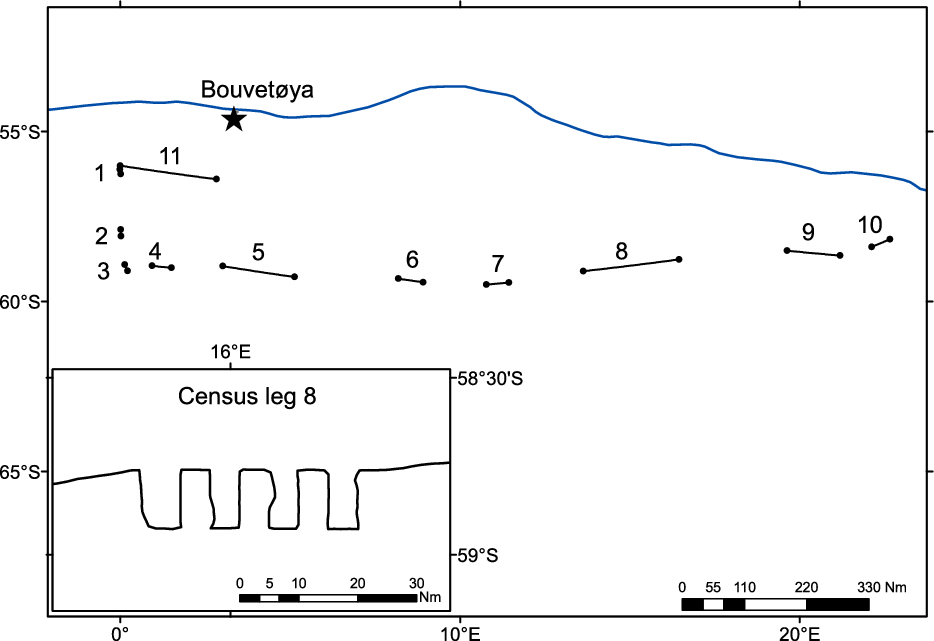
The ship’s track was mostly determined by other SCALE scientific endeavours, but on one occasion (census 8; Fig. 2) we were able to manipulate the cruise track. We successfully included 10 nm long north–south survey lines, spaced at 2.5 nm, within census 8 (Fig. 2). This we did firstly to cover the area in between longitudinally spaced, successive oceanographic stations as comprehensively as travel distance and speed allowed. Secondly, we aspired to an ideal survey design which would have multiple regularly spaced transects extending in a north–south direction across the ice gradient (Erickson, Siniff, & Harwood, Reference Erickson, Siniff and Harwood1993; Southwell et al., Reference Southwell, Bengtson, Bester, Blix, Bornemann, Boveng and Trathan2012). This, despite leaving the entire inner and the outermost regions of the pack ice not sampled during north–south strip censuses (this study), due to the vast extent of the ice.
Four observers searched for seals from the wings of the ship’s bridge. The ship’s position was recorded every 15 min from the ship’s GPS navigational system. Seal identification to species followed Laws (Reference Laws1993). Ice type (brash, cake, ≥small floes) and ice coverage (in tenths) were broadly classified following Erickson et al. (Reference Erickson, Siniff and Harwood1993), and predominant ice coverage (reported as percentages) estimated over 15 min intervals of travel. A constant vigil by one to two observers, rotating with the others in 1–3-h shifts, allowed identification of seals outside of the census periods to ascertain their presence within sighting distance of the ship.
Results and discussion
Several sources of bias and uncertainty underlie pack ice seal abundance estimates derived from ship-board surveys (Erickson et al., Reference Erickson, Siniff and Harwood1993; Southwell et al., Reference Southwell, Bengtson, Bester, Blix, Bornemann, Boveng and Trathan2012). Despite the drawbacks, we opted for a simple methodological approach, following previous ship-board surveys (Bester & Odendaal, Reference Bester, Odendaal, Davison, Howard-Williams and Broady2000; Bester, Ferguson, & Jonker, Reference Bester, Ferguson and Jonker2002; Bester, Wege, Lübcker, Postma, & Syndercombe, Reference Bester, Wege, Lübcker, Postma and Syndercombe2019) in the same general area (eastern Weddell Sea and inner Lazarev Sea). This ensured methodical congruence and thus comparability of data sampled in the present study with contiguous data sets from the earlier surveys (e.g. Bester et al., Reference Bester, Ferguson and Jonker2002, Reference Bester, Wege, Lübcker, Postma and Syndercombe2019).
The ship entered fields of brash and pancake ice from about 10:00 LAT on 21 October 2019, and at 14:00 LAT (56°05’S, 00°00’E) we commenced strip censusing. Shortly before, an adult male Antarctic fur seal Arctocephalus gazella was sighted on cake ice. A further 20 Antarctic fur seals, including 15 adult males, were recorded on the return leg (east–west) on cake ice and small floes in the outer reaches of the pack ice before exiting the pack ice (Fig. 1). The species are often seen during their foraging trips to the outer reaches of the pack ice in the proximity of the tip of the Antarctic Peninsula and associated islands such as the South Shetlands and South Orkneys (Bester & Odendaal, Reference Bester, Odendaal, Davison, Howard-Williams and Broady2000; Joiris, Reference Joiris1991), and Bouvetøya well north of the Lazarev Sea (Bester, Reference Bester1979).
Ship-board (within strip) censuses
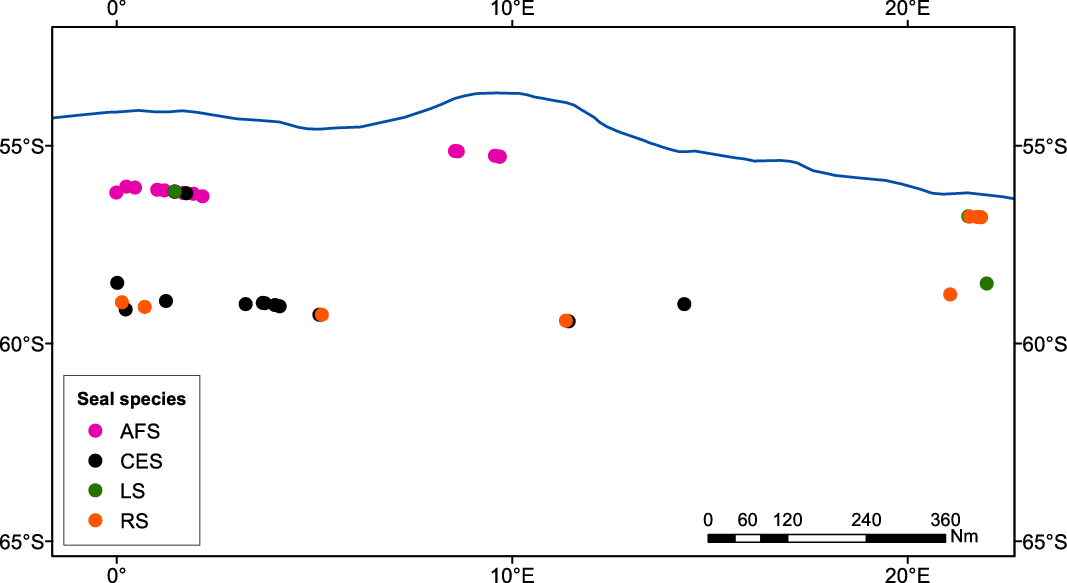
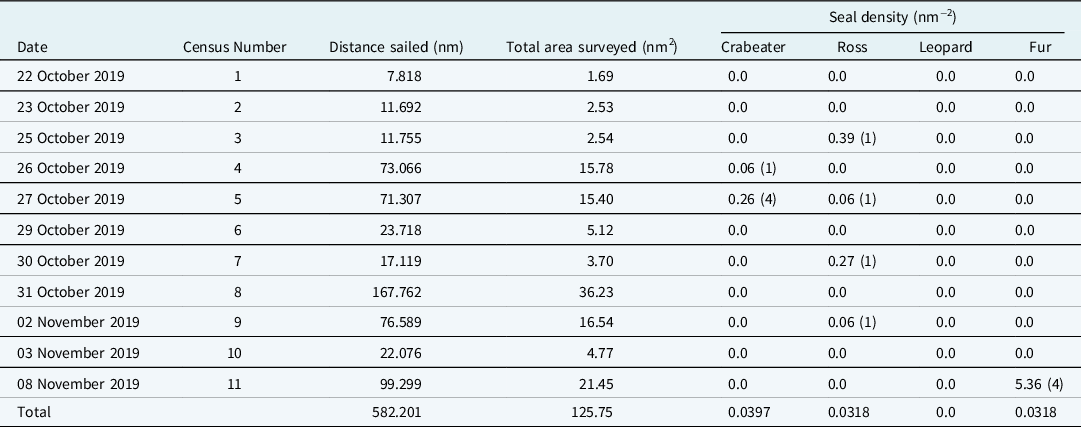
A total 582.2 nm of strip transects was surveyed during 11 ship-board censuses (Fig. 2). Crabeater seal juveniles (n = 2), adults (n = 5) and pups of the season (n = 2) were sighted, together with Ross seals (n = 4) and Antarctic fur seals (n = 4) in the marginal sea ice zone (Fig. 3) at low densities (Table 1). Crabeater seal densities along the track were exceptionally low (0.04 nm−2), a fraction of that recorded for ship-board surveys in the eastern Weddell Sea in mid-summer which varied between 2.46 nm−2 and 5.24 nm−2 (summarised in Bester et al., Reference Bester, Wege, Lübcker, Postma and Syndercombe2019), with 2.47 nm−2 recorded by aerial census in the inner Lazarev Sea in mid-summer (Bester et al., Reference Bester, Ferguson and Jonker2002). Similarly, Ross seals density (0.03 nm−2) was much less than the 0.45–2.91 nm−2 reported for mid-summer ship-board censuses (Bester et al., Reference Bester, Wege, Lübcker, Postma and Syndercombe2019) in the eastern Weddell Sea, yet exactly the same as that recorded by aerial census in the inner Lazarev Sea (Bester et al., Reference Bester, Ferguson and Jonker2002) within similar longitudinal boundaries (12°W–18°E).
The locations of seals sighted during census both within and outside of the census strip south of the ice edge (blue line). AFS: Antarctic fur seal, CES: crabeater seal, LS: leopard seal, RS: Ross seal. Ice data (sea ice edge defined as 15% ice concentration indicated as blue line) derived from the National Snow & Ice Data Center’s Sea Ice Index, Version 3 (https://nsidc.org/data/G02135/versions/3; Fetterer, Knowles, Meier, Savoie, & Windnagel, Reference Fetterer, Knowles, Meier, Savoie and Windnagel2017).
Summary of ship-board censuses (n = 11) of Antarctic pack ice seals older than pups of the season. Seals located within the 200 m/0.108 nm strip on either side of the ship’s track (400 m/0.216 nm total width) during local daylight hours of the SCALE oceanographic cruise of the MV SA Agulhas II from 22 October to 08 November 2019 across the Lazarev Sea are considered here. Seal numbers observed within the strips appear in brackets and are summed to calculate overall seal densities (total seal number/overall area surveyed)
Ship-board (within and outside of strip) sightings
The surveyed marginal sea ice zone produced only 58 seals: crabeater seals (n = 19, 4 with pups), leopard seals (n = 3, 1 with pup), Ross seals (n = 10) and Antarctic fur seals (n = 21) (Fig. 3). Proportional representation of the phocid species (excluding pups) translates to 59.3% crabeaters, 31.3% Ross and 9.4% leopard seals, compared with, for example, a phocid species composition of 97.8% crabeater, 1.7% Ross, 0.3% leopard and 0.2% Weddell seals in the inner Lazarev Sea during mid-summer (Bester et al., Reference Bester, Ferguson and Jonker2002). The disparity clearly is a function of season and the likely effect of latitude (marginal sea ice zone versus inner reaches of the pack ice). Including the Antarctic fur seals, the proportional representation is 35.8% crabeater, 18.9% Ross, 5.7% leopard and 39.6% Antarctic fur seals. Overall, during censuses pack ice cover varied little (mean ± standard deviation) at 81.0 ± 18 % (range: 20–100%).
Weddell seals
The absence of Weddell seals during the ship-board survey attests to their primary use of fast ice and nearby pack ice habitats close to the coast during the breeding season (LaRue et al., Reference LaRue, Salas, Nur, Ainley, Stammerjohn, Barrington and Nakamura2019; Nachtsheim et al., Reference Nachtsheim, Ryan, Schröder, Jensen, Oosthuizen, Bester and Bornemann2019; Southwell et al., Reference Southwell, Bengtson, Bester, Blix, Bornemann, Boveng and Trathan2012).
Leopard seals
Only three widely separated leopard seals (Fig. 3), one suckling a pup, were sighted near the outer edge of the pack ice. During the austral spring, leopard seals breed on the outer fringes of the circumpolar pack ice (Gilbert & Erickson, Reference Gilbert, Erickson and Llano1977; Siniff, Reference Siniff1991) which they seem to follow both during its seasonal expansion and contraction (Bester, Erickson, & Ferguson, Reference Bester, Erickson and Ferguson1995; Nordøy & Blix, Reference Nordøy and Blix2009), even hauling out on sub-Antarctic islands primarily in winter (e.g. Bester & Roux, Reference Bester and Roux1986; Gwynn, Reference Gwynn1953). Located on a small ice floe, in an area of primarily cake ice, the sighting of the leopard seal pup (3 November) was marginally before the pupping period (between 8 November and 25 December) of the species in East Antarctica (Southwell et al., Reference Southwell, Kerry, Ensor, Woehler and Rogers2003). However, it approximated the 2 November 1988 sighting of the first newborn leopard seal in the northern Weddell Sea (Joiris, Reference Joiris1991). The leopard seals’ impending pupping and breeding season probably explained their paucity in the outer pack as a portion of the adult population may spend the winter mainly in open water, off the edge of the pack ice, from mid-May to at least late September (Nordøy & Blix, Reference Nordøy and Blix2009). However, by 18 October to 16 November in spring 1988, most (97%) of all leopard seals sighted (n = 72, including pups of the season) were primarily found south of 60°S in the inner marginal sea ice zone and consolidated pack ice region of the northern Weddell Sea (Joiris, Reference Joiris1991).
Crabeater seals
Crabeater seals breed in the pack ice zone surrounding Antarctica in the austral spring (Siniff, Stirling, Bengtson, & Reichle, Reference Siniff, Stirling, Bengtson and Reichle1979; Southwell, Kerry, Ensor, Woehler, & Rogers, Reference Southwell, Kerry, Ensor, Woehler and Rogers2003) when pack ice is extensive and ship access is difficult (Shaughnessy, Jones, & Viggers, Reference Shaughnessy and Jones2019). Consequently, there have been few studies of crabeater seals during their breeding season (Joiris, Reference Joiris1991; Shaughnessy et al., Reference Shaughnessy and Jones2019; Wege et al., Reference Wege, Salas and LaRue2020). Crabeater seals, including triads (n = 1) as defined by Siniff et al. (Reference Siniff, Stirling, Bengtson and Reichle1979), comprising an adult female (presumably the mother) and its pup with an adult male nearby (Shaughnessy et al., Reference Shaughnessy and Jones2019), female-pup pairs (n = 3), singletons (n = 5) and unsexed groups (n = 4) of 2–3 seals were widely dispersed in the marginal sea ice zone (this study). This agrees with the single largest crabeater seal survey and habitat modelling for the Weddell Sea during breeding season, which showed crabeater seals are rarely found in the deep Weddell Sea, but around the outer fringes of the pack ice and in the northern Lazarev Sea (Wege et al., Reference Wege, Salas and LaRue2020). This breeding season distribution is associated with typical Antarctic krill (Euphausia superba) habitat (Wege et al., Reference Wege, Salas and LaRue2020), as it is during the austral summer (Nachtsheim, Jerosch, Hagen, Plötz, & Bornemann, Reference Nachtsheim, Jerosch, Hagen, Plötz and Bornemann2017), krill being the key prey species of crabeater seals (Hückstädt et al., Reference Hückstädt, Burns, Koch, McDonald, Crocker and Costa2012). Previous sightings in any year of a crabeater seal pup accompanied by an adult were between 2 October and 15 December in Eastern Antarctica (Southwell et al., Reference Southwell, Kerry, Ensor, Woehler and Rogers2003), which brackets the timing of sightings of pups in the present study (25–31 October). In the present study, almost all of those with pups and the majority of the remaining crabeater seals (78.9%) were hauled out in consolidated pack of 80–100% coverage. Similarly, crabeater seals were present principally as pairs and triads in spring 1988, their distribution reflecting a preference for extensive ice cover (Joiris, Reference Joiris1991), and perhaps with Antarctic krill habitat in the area as well (see Hückstädt et al., Reference Hückstädt, Piñones, Palacios, McDonald, Dinniman, Hofmann and Costa2020), during the crabeater seal breeding season.
The relatively poor percentage contribution of the crabeater seals (59.4%) to phocid species composition compared to the inner region of the Lazarev Sea (see above) during summer off the coast of Dronning Maud Land (Bester et al., Reference Bester, Ferguson and Jonker2002) is largely due to the considerably higher Ross seal contribution (31.3%). In addition, the paucity of crabeater seals probably also results from the earlier census dates in spring (late October/early November) in this study compared to summer (December/early January), the optimal time for visual surveys of crabeater seals (Southwell, Reference Southwell2005), of previous studies when the extent of seasonal pack ice cover would have diminished. Furthermore, there is an inverse relationship between pack ice cover and seal densities (Bester et al., Reference Bester, Erickson and Ferguson1995; Eklund & Atwood, Reference Eklund and Atwood1962). Perhaps crabeater seals prefer to haul out deeper in the pack ice for breeding, in the area south of 60°S latitude (not surveyed in the present study) where they preferred extensive ice cover in the northern Weddell Sea in 1988 (Joiris, Reference Joiris1991). Similarly, elsewhere in the southern Indian Ocean sector of the Southern Ocean in October and November 1987, between 64°S and 69°S and again in September 1995 between 62°S and 63°S, crabeater seal triads were in abundance in the inner regions of the pack ice (Shaughnessy et al., Reference Shaughnessy and Jones2019).
Ross seals
Ross seals use the pack ice surrounding Antarctica for breeding and moulting, and make long foraging trips north of the pack ice (Blix & Nordøy, Reference Blix and Nordøy2007). They breed in the austral spring (Shaughnessy & Jones, Reference Shaughnessy, Jones and Viggers2019; Southwell et al., Reference Southwell, Kerry, Ensor, Woehler and Rogers2003), when pack ice is extensive. Yet only few Ross seals (n = 10) were encountered in the present study. Curiously, only three Ross seals (15.8%) were sighted within the midday maximal haul-out window established for mid-summer. Most others were sighted during late afternoon and early evening in October/November, from 15:21 to 19:50 LAT (this study). We suspect this a result of a semi-diurnal (lunar or tidal) activity pattern as known from other ice seals (Bornemann, Mohr, Plötz, & Krause, Reference Bornemann, Mohr, Plötz and Krause1998), though we cannot provide any comprehensive analyses as yet. No Ross seal pups were seen, and all Ross seals were sighted between 56°S and 59°S (Fig. 3). More than half (n = 6) of the Ross seals were seen in discontinuous ice fields composed largely of brash, cake ice and the occasional small floe, of 80% coverage on the outer fringe of the pack ice in the region (Fig. 2, censuses 6 and 8). This was unlike the remaining Ross seals (n = 4) which were found in the more consolidated pack (80–90% coverage) similar to those during the breeding season (Bester, Wege, Oosthuizen, & Bornemann, Reference Bester, Wege, Oosthuizen and Bornemann2020) and moulting season (Bester et al., Reference Bester, Erickson and Ferguson1995, Reference Bester, Ferguson and Jonker2002, Reference Bester, Wege, Lübcker, Postma and Syndercombe2019). This suggests that most, if not all, of the Ross seals present were most likely resting within the outer marginal zone of the pack ice in early November during their commute to higher latitudes where they pup and breed (see below).
Blix and Nordøy (Reference Blix and Nordøy2007) satellite tracked three female Ross seals to continuous (14–17 days) haul outs in the pack ice from 6 to 10 November. The extended haul out was considered indicative of pupping and nursing. These animals hauled out between 60°S–63°S, 5°W–20°E and therefore south of the innermost area (58°S–59°S) searched in the present study (21 October–08 November 2019). Similarly, the breeding area for Ross seals in the Amundsen Sea is located between 65°S and 68°S (Arcalís-Planas et al., Reference Arcalís-Planas, Sveegaard, Karlsson, Harding, Wahlin, Harkonen and Teilmann2015), and Ross seal pups (n = 13) each with an accompanying adult or adults were observed in pack ice of East Antarctica, in the region of 63oS–65°S (Shaughnessy & Jones, Reference Shaughnessy, Jones and Viggers2019). Southwell et al. (Reference Southwell, Kerry, Ensor, Woehler and Rogers2003) summarised that the sightings of pups with an accompanying adult occur between 24 October and 22 November.
Conclusions
We hypothesise that presumed breeding Ross seals in the present study were (a) either still on their way to the deeper reaches of the pack ice to pup and breed or were non-breeders resting before returning to the open ocean to forage, and (b) that our survey was perhaps too early to locate mother–pup pairs during the peak in pupping which lies between 6 and 15 November (Southwell et al., Reference Southwell, Kerry, Ensor, Woehler and Rogers2003). In the austral summer, Ross seals may occur in open pack (Condy, Reference Condy1977), but seem to prefer dense concentrations of interior pack ice (Bester et al., Reference Bester, Wege, Lübcker, Postma and Syndercombe2019; Condy, Reference Condy1976; Gilbert & Erickson, Reference Gilbert, Erickson and Llano1977; Wilson, Reference Wilson1975). It is therefore hardly surprising that they do not pup in the outer, unstable regions of the pack ice in the spring breeding season (this study).
The decline in the proportional representation of crabeater seals (to 35.8%), from a high of about 97% of seal species present in mid-summer (Bester et al., Reference Bester, Ferguson and Jonker2002) in the Lazarev Sea, results from the dominance of Antarctic fur seals (39.6%). This situation is confined to the marginal sea ice zone in spring (this study), as it was in the northern Weddell Sea (~80% Antarctic fur seals) during spring (Joiris, Reference Joiris1991), and apparently during winter as well (Bester, Reference Bester1979). This dominance of Antarctic fur seals likely results from the presence of the large fur seal breeding population at the proximate (~165 nm/306 km distant) Bouvetøya (Bester, Reference Bester1979; this study). Located at 54°24’S, 03°21’E, the island supports about 66,000 Antarctic fur seals (Hofmeyr, de Bruyn, Bester, & Wege, Reference Hofmeyr, de Bruyn, Bester, Wege, Child, Roxburgh, Do Linh San, Raimondo and Davies-Mostert2016; Hofmeyr, Krafft, Kirkman, Bester, Lydersen, & Kovacs, Reference Hofmeyr, Krafft, Kirkman, Bester, Lydersen and Kovacs2005) most of which are foraging at sea in late October and early November (when this study was undertaken) before adults return to the island for the short austral summer breeding season of the species in late November/December (McCann & Doidge, Reference McCann, Doidge, Croxall and Gentry1987).
Acknowledgements
The Officers and Crew of the MV SA Agulhas II extended every possible courtesy to us in support of our research objectives. Chief Scientist, Tommy Ryan-Keogh is thanked for his support. The Department of Environment Affairs (DEA) is thanked for logistical support within South African National Antarctic Programme (SANAP), with the blessing of the Department of Science and Technology (DST), through the National Research Foundation (NRF). The authors acknowledge that opinions, findings and conclusions expressed in this publication generated by the NRF supported research are that of the authors, and that the NRF accepts no liability whatsoever in this regard. Derek Engelbrecht and Elisa Seyboth assisted with sighting records and photographic material. Participation of Horst Bornemann was supported by Dr Christine Wesche, Logistics and Research Platform Division of the Alfred Wegener Institute. Two anonymous reviewers provided insightful comments that vastly improved the manuscript.
Conflict of interest
None.
Compliance with ethical standards
The University of Pretoria Animal Ethics Committee cleared the procedures of this project (Number EC082-15) under South African Department of Environmental Affairs Permit 04/2015-16, pursuant to the provisions of Article 3 of the Protocol on Environmental Protection to the Antarctic Treaty, and Annex II and Annex V (Article 10(2)).



