


Introduction
Academic studies using anthropometric measures, primarily height, have shown that they are good predictors of individual health and life expectancy over historical periods (Blair et al., Reference Blair, Kohl, Barlow, Paffenbarger, Gibbons and Macera1995; Komlos and Baten Reference Komlos and Baten2004; López-Alonso Reference López-Alonso2007; Komlos Reference Komlos2009; Floud et al., Reference Floud, Fogel, Harris and Hong2011, Reference Floud, Fogel, Harris and Hong2014; López-Alonso Reference López-Alonso2012; Stulp and Barret Reference Stulp and Barrett2016; Stokes and Preston Reference Stokes and Preston2016; Komlos and Kelly Reference Komlos and Kelly2016; Marco-Gracia and Puche Reference Marco-Gracia and Puche2021). Body mass index (BMI) and physical fitness are two variables related to reproductive and endocrine health (Jensen et al., Reference Jensen, Andersson, Jorgensen, Andersen, Carlsen and Skakkebk2004; Cheng and Ng Reference Cheng and Ng2007). In addition, anthropometric measures, in particular height, BMI, and physical fitness, are strongly related to an individual’s perceived physical attractiveness and have an influence on their socioeconomic status and likelihood of passing on their genes (Pawlowski et al., Reference Pawlowski, Dunbar and Lipowicz2000; Puhl and Brownell Reference Puhl and Brownell2001; Lundborg et al., Reference Lundborg, Nystedt and Rooth2014; Barclay and Kolk Reference Barclay and Kolk2020). Thus, for men, positive relationships has been found between workshop body height, propensity to marry, and marriage duration (Murray Reference Murray2000; Herpin Reference Herpin2005; Hacker Reference Hacker2008; Manfredini et al., Reference Manfredini, Breschi, Fornasin and Seghieri2013; Sohn Reference Sohn2015; Tao and Yin Reference Tao and Yin2016; Yamamura and Tsutsui Reference Yamamura and Tsutsui2017; Marco-Gracia Reference Marco-Gracia2018a; Thompson et al., Reference Thompson, Quanjer and Murkens2020). Timing of marriage is also related to height (Hogan Reference Hogan1978; Fu and Goldman Reference Fu and Goldman1996), although these correlations are not universal (Dixon Reference Dixon1978). There is also a positive relationship between height and partners’ educational and economic levels (Case and Paxson Reference Case and Paxson2008; Stulp et al., Reference Stulp, Mills, Pollet and Barrett2014, Reference Stulp, Simons, Grasman and Pollet2017; Ponzo and Scoppa Reference Ponzo and Scoppa2015; Murasko Reference Murasko2019), although there is a lack of consensus regarding the latter point (Oreffice and Quintana-Domeque Reference Oreffice and Quintana-Domeque2010).
As a general pattern in Western societies, it is accepted that women prefer tall men (Pawlowski Reference Pawlowski2003; Courtiol et al., Reference Courtiol, Raymond, Godelle and Ferdy2010). This preference could be linked to the fact that historically, tall individuals enjoyed certain advantages, including higher average salaries and cognitive test scores (Steckel Reference Steckel2008, Reference Steckel2009; Chiappori et al., Reference Chiappori, Salanié and Weiss2017). In addition, a relationship has also been found between being taller, being more intelligent, and having better social skills (Persico et al., Reference Persico, Postlewaite and Silverman2004; Case et al., Reference Case, Fertig and Paxson2005; Case and Paxson Reference Case and Paxson2008, Reference Case and Paxson2010). Thus, taller individuals would have been able to satisfy two basic needs with regard to marriage in historical societies, namely those for greater economic security and physical desirability (Dixon Reference Dixon1978). However, it appears that the relationship between height and marriage probability is not entirely linear. Most studies have found that above a certain height point, the benefits of physical height begin to decline, with medium-tall individuals having higher marriage rates (Murray Reference Murray2000; Herpin Reference Herpin2005; Manfredini et al., Reference Manfredini, Breschi, Fornasin and Seghieri2013; Stulp et al., Reference Stulp, Buunk, Pollet, Nettle and Verhulst2013; Sohn Reference Sohn2015).
The aim is to study the relationship between height and likelihood of marriage and age at marriage in the very long term (birth cohorts 1835–1977), focusing on the change of nuptial patterns over time. In a society with a very low cohabitation rate until the last decade, being unmarried was clearly linked to being uncoupled (Kok and Leinarte Reference Kok and Leinarte2015). For this reason, this article focuses on height, as this anthropometric variable has been shown to be strongly linked to desirability in the dating market (Toma et al., Reference Toma, Hancock and Ellion2008; Hitsch et al., Reference Hitsch, Hortaçsu and Ariely2010; Weitzman and Conley Reference Weitzman and Conley2014). The reasons why taller men are preferred are not entirely clear although there are several possible explanations under discussion (Thompson et al., Reference Thompson, Quanjer and Murkens2020). Lipowicz (Reference Lipowicz2014) suggests that this preference could be a consequence of the positive relationship between height and health and humans’ perceptions of this relationship, while Stulp et al., (Reference Stulp, Pollet, Verhulst and Buunk2012) propose that it is an evolutionary trait given that taller individuals were more likely to triumph in physical confrontations. Using individual microdata from over 4,000 men, this study explored the probability of marriage, the age at which it was contracted, the effect of marriage patterns on offspring (number and timing), and the relationship between marriage and height in rural Spain according to change over time. The 19th and 20th centuries represent a particularly interesting period given that a process of economic and demographic modernization took place, the first and second demographic transitions occurred, and there were substantial changes in both the labour market (especially due to the improved position of women) and in a single individual’s ability to maintain a household. The present article is innovative in that it analyses the relationship between stature and marriage in rural Spain in the very long-term using longitudinal data and considering different historical stages over 150 years of economic and social transformation. Moreover, the available data allow us to focus on marriage patterns and offspring and how stature affected the process of family formation and development.
Area, Data and Methods
Characteristics of the area
This study focuses on a rural area in Aragon in northeastern Spain (see Figure 1). The border of the area is 19–40 km away from Zaragoza, the regional capital. This area consists of a combination of plains and foothills near the Huerva River. The area of study comprises 14 small localities: Alfamén, Aylés, Botorrita, Codos, Cosuenda, Jaulín, Longares, Mezalocha, Mozota, Muel, Torrecilla de Valmadrid, Tosos, Valmadrid, and Villanueva de Huerva. This region underwent a process of economic modernization from the second half of the 19th century that coincided with the first wave of globalization. Economic growth continued for most of the 20th century despite economic and social shocks (Germán Reference Germán1993, Reference Germán2012). This process of economic modernization was particularly pronounced in the regional capital, with the rural areas lagging behind (Germán Reference Germán2000). The privileged location of the Ebro Valley, which lies close to highly industrialized regions, favoured its economic development. In 1857, Aragon was not an important industrial area in comparison to other Spanish regions, as it ranked ninth out of 14 areas in terms of industrialization (Calatayud Reference Calatayud, Preston and Saz2001; Carreras Reference Carreras, Carreras and Tafunell2005). The first stages of economic modernization coincided with the first wave of globalization, and, in this region, the modernization was linked to the development of industry (Pinilla and Ayuda Reference Pinilla, Ayuda and Pinilla2009; Germán Reference Germán2012). The Spanish Civil War had a strong negative impact on Aragon’s economic modernization, from which it did not recover until 1960s (Germán Reference Germán2012). Most industries were located in the Ebro Valley, which is relatively close to the study area; this proximity may have favoured rural-urban migration (Silvestre Reference Silvestre2005).
Area of study: Middle Huerva (Aragón, Spain).
Source: Own rendering

The area of study covers around 500 kms2 and was home to a population of around 7,926 inhabitants in 1860, 8,196 in 1900, 10,672 in 1940, and 6,829 in 1981. The inhabitants mostly lived in nuclear households and were largely devoted to agriculture (mostly cereals and vineyards) and sheep grazing. Until the mid-20th century, around 80% of the male working population was engaged in the agricultural sector, where most of the population had living standards close to subsistence levels (Marco-Gracia Reference Marco-Gracia2018a). Almost all the agriculture in the area took place in unirrigated areas, with the exception of the land near the Huerva River, where fruit and vegetables could be cultivated.
Up to 1900, the average number of children was around 6–7 children among complete families, but this figure declined rapidly thereafter following the demographic transition. Infant and child mortality rates were very high, however, and only around half of the children born in the area survived to their fifth birthday. Mortality rates began to decline in the last third of the 19th century due to the progressive advance of the epidemiological transition. This decline first became clear among children in late childhood and spread later to younger cohorts (Marco-Gracia Reference Marco-Gracia2017). Anthropometric evidence also indicates that biological standards of living were low: the average male height was around 160 cm in the mid-19th century, meaning that men in the area were shorter than the counterparts elsewhere (Martínez-Carrión et al., Reference Martínez-Carrión, Cámara and Pérez-Castroviejo2016; Cámara et al., Reference Cámara, Martínez-Carrión, Puche and Ramon-Muñoz2019).
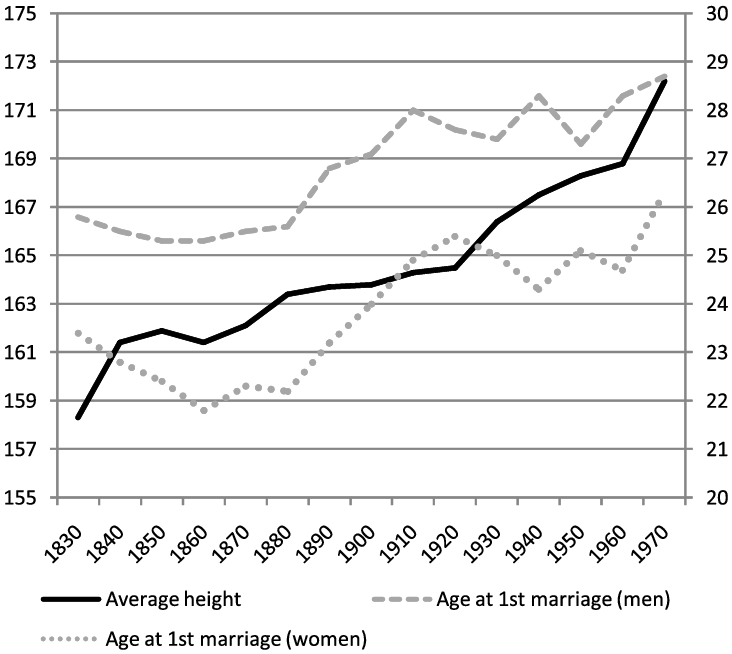
Figure 2 shows the secular trends of height and average age at marriage of men and women by birth cohorts in the study area. During the 20th century, height increased significantly from under 160 cm to over 170 cm. In the same period, the average age at first marriage for both men and women also increased, although with some variations. For most of the 19th century, the median age at first marriage remained relatively stable for men (around 25.5 years) and women (around 22.5 years), although with a slight tendency to decrease. During the demographic transition (first decades of the 20th century), there was a significant increase, with the median age at first marriage raising to 25 years for women and 28 years for men, that remained more or less stable until the 1970s, where one can observe an important increase that still characterizes contemporary society.
Change over time of the relationship between height and age at first marriage (men and women) in the study area, birth cohorts 1830s–1970s.
Note: The distribution of the number of cases by decade, village and other variables can be found in Table 1.
Source: Parish registers and conscription and call-up records; historical municipal archives from municipalities composing the anthropometric sample.
Data
This study uses three types of data: 1) height data obtained from military records, as young men were conscripted; 2) individual demographic data from parish registers (up to 1950) and surveys (from 1950); and 3) socio-economic data on occupation and literacy from censuses, population lists, and parish registers. The article uses military data concerning height for enlisted individuals from the 14 villages mentioned in section 2 between 1835 and 1977. Ninety-two percent of the data were obtained from the records kept in the municipal archives of each locality. To complete the sample, the authors requested copies of the available conscription records from the Historical Military Archive of Guadalajara. From this archive, 223 additional individuals were identified. Thus, the study uses a total sample of 2,783 complete life stories. During the period 1856–1885, age at military conscription was 20 years old; during 1885 (second call-up)-1899 19 years; between 1901 and 1905, it was 20; and between 1907–1939, it was 21 years old. Thus, the authors standardized the average height to the age of 21 years, employing the strategy developed by Ayuda and Puche-Gil (Reference Ayuda and Puche-Gil2014), which is based on calculating the 50th percentile of each of three age groups (19, 20 and 21 years), adding 1.2 cm to the height of 19 years and 0.4 cm to the 20 years. The results are similar to those obtained in other Spanish regions (Ramón-Muñoz Reference Ramón-Muñoz2011; Ayuda and Puche-Gil Reference Ayuda and Puche-Gil2014; Ramón-Muñoz and Ramón-Muñoz Reference Ramón-Muñoz and Ramón-Muñoz2017). The distribution of the height data is close to normal for the entire period. The null hypothesis of normality of average height was tested and could not reject the null hypothesis at a significant level of 5% (for example, Skewness/Kurtosis tests for Normality give us a Prob>Chi2 of 0.13 for the full sample of 4,501 and 0.10 for the subsample of married individuals of 2,005 individuals, and the rest of the normality tests analysed do not allow the null hypothesis to be rejected either). Figure 3 shows the distribution of the total sample and of the individuals whose age at first marriage is known by height intervals.
Distribution of the total sample and the sub-sample by height groups, birth cohorts 1830s–1970s.
Note: The distribution of the number of cases by decade, village and other variables can be found in Table 1.
Source: Parish registers and conscription and call-up records; historical municipal archives from municipalities composing the anthropometric sample

The demographic analysis relies on the complete church registers of these 14 villages, which provide high-quality information on all baptisms, marriages, and deaths that occurred between the 16th century and 1950, although the starting date varies by location (for more details about the “Alfamén and Middle Huerva Database” see Marco-Gracia, Reference Marco-Gracia2017, Reference Marco-Gracia2021). To obtain similar data for the period after 1950, 1,074 interviews were conducted with relatives of the analysed individuals asking similar information regarding dates of demographic events, occupation, and education. The database was built following the family reconstitution method devised by Fleury and Henry (Reference Fleury and Henry1956). It includes all individuals who were born and baptized in the reference parishes or who migrated to them and were registered there in connection with one of the previously described events. This dataset contains information on approximately 125,000 individuals, including, among others, name, sex, place and date of birth, and parents’ names and dates of death, and thus permits the reconstitution of the life histories of these individuals and their families.
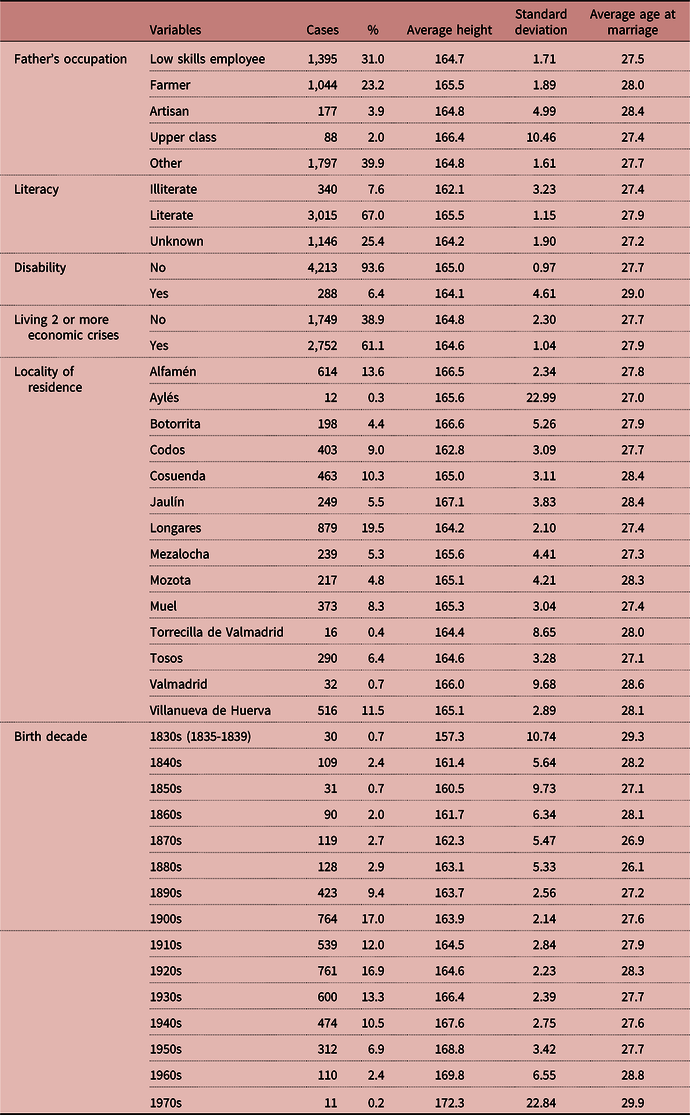
The occupations of the analysed individuals and their fathers, as well as data on literacy, were extracted from population lists (1857 and 1860), electoral censuses (1890, 1894, 1900, 1910, 1920, 1930, 1934, 1945, 1951, and 1955), and the parish registers. Information on professions, literacy, and heights was linked to the population record for each individual. Table 1 presents the distribution of the sample in terms of several of the available variables, including average height and average age at marriage. It is important to note that the number of observations is very low for the first decades of birth (especially for the 1830s and 1850s) and for the last decade (1970s). Therefore, the results obtained deviate from what would be expected for the province of Zaragoza (Martínez-Carrión et al., Reference Martínez-Carrión, Cámara and Pérez-Castroviejo2016).
Characteristics of the male’s sample in relation to the average height (4,501 observations) and average age at marriage (2,005 observations), 1835-1977
Source: Parish archives of Alfamén, Botorrita, Codos, Cosuenda, Jaulín, Longares, Mezalocha, Mozota, Muel, Torrecilla de Valmadrid, Tosos, Valmadrid and Villanueva de Huerva.
Place of birth was included as a control variable to determine whether there are significant differences among villages depending on the environmental and socioeconomic conditions. If so, these could be the consequence of differing standards of living in nearby locations. Birth decade is a good indicator of both the process of demographic modernization and the effects of social, economic, and political context on the process of improving living conditions.
Among socioeconomic variables, father’s occupation is a very useful proxy by which to determine the income level and living standards of individuals in the study area. In the area of study, traditionally, almost 80% of individuals were employed as day labourers or farmers (Marco-Gracia Reference Marco-Gracia2018a). Working conditions improved in Spain during the 20th century (Rodríguez Labandeira Reference Rodríguez Labandeira1991). Due to the particular occupational distribution of the study area, the individuals were divided into five occupational categories. a) The first group consists of agricultural day labourers and unskilled factory employees. b) The second group is composed of farmers, while c) the third group consists of landless or semi-landless artisans, such as potters, bakers, blacksmiths, tailors, and glassmakers. d) The fourth category includes individuals with non-manual skilled occupations, such as doctors, teachers, veterinarians, notaries, bankers, nurses, and stationmasters. All these occupations require a medium or higher level of education. e) The final group, “others,” includes other professionals working in a range of occupations, including shepherds, military personnel, muleteers, and drivers of various types of vehicles. This category also includes individuals for whom no information regarding occupation was available. Considering literacy allowed us to obtain deeper insight into the effect that access to education has had on biological well-being (Martínez-Carrión and Puche-Gil Reference Martínez-Carrión and Puche-Gil2009). The literacy rate in Spain increased from 27% in 1860 to 73% in 1930 (Núñez Reference Núñez, Carreras and Tafunell2005).
Spanish military conscripts provide other data of interest. Particularly interesting are the data on the state of health of conscripts at the time of measurement. Information on disability that was extracted from this source. Whether many years (at least two) during the infancy and adolescence of an individual (until 21 years of age) were characterized by economic crisis has also been included in the analysis. These crises could have had effects on the lifespans of individuals by affecting the quantity and quality of their food consumption. For the 19th century, the series of wheat prices for the city of Zaragoza (Peiró Reference Peiró1987) have been taken into account and identified the years in which the price rose at least 10% above the norm once the authors had removed the trend using a Hodrick-Prescott filter (Hodrick and Prescott Reference Hodrick and Prescott1997). These years were 1836, 1837, 1841, 1846, 1855, 1856, 1867, 1881, 1891, 1896, and 1897. For the 20th century, this study has information on the secular trends of the GDP per capita in the province of Zaragoza provided in a personal communication by the professor Vicente Pinilla (Universidad de Zaragoza, Spain). In this study, years in which the GDP per capita contracted below the levels of the previous year has being characterized as economic crisis. These years were 1910, 1926, 1928, 1931, 1933, 1936, 1937, 1938, 1945, 1949, 1953, 1959, and 2009.
Finally, two other variables were taken into account. On the one hand, the childhood mortality rate for the year of birth of each individual in the study area was calculated. The aim of the inclusion of this variable is to determine whether parents may have behaved differently towards their children in relation to their likelihood of surviving. On the other hand, for the regressions on the age at marriage of the conscripts, the age at marriage of their wives to determine whether the predicted relationship between these variables is confirmed has been taken into account.
Methods
This article is based on a combination of descriptive and regression analyses. In the descriptive analyses, this article makes a first approximation for understanding the changes over time of the likelihood of marrying in the study area. Thus, in the following section, the study analyses the secular trend of the rate of singleness at 45 years of age, the marriage rate by age group, and the number of children by age group of conscripts born between 1835 and 1877 in the study area. In addition, regression analyses to investigate the relationship between height and 1) odds of being single at 45 and 2) age at marriage of males, controlling for several significant factors, such as socioeconomic status or family size have been conducted. For the statistical analysis of the data, the study used probit models for odds of being single and ordinary least squares (OLS) linear regressions with heteroskedasticity-robust estimation for age at marriage.
A Descriptive Overview of Marriage by Height
In this section, based on descriptive statistics, the study determines the chances of marriage, the age at first marriage, and the average number of children per age group of men according to their height. For this purpose, in Table 2, presents the percentages of conscripts who remained single according to their height quintile. The sample has been classified into three sub-periods. The first sub-period, birth cohorts 1835–1877, includes individuals born in the period prior to the fertility transition, meaning that during their childbearing lives, they were still in a period characterized by high fertility and high infant mortality (although declining in the later stages). The second sub-period, 1878–1927, includes the men who were alive during the fertility transition in Spain during the first decades of the 20th century (Marco-Gracia Reference Marco-Gracia2018a). Finally, the last sub-period, birth cohorts 1928–1977, includes men born in a period of low fertility and low mortality. The results presented in Table 2 show that in the first sub-period, when average height was shorter, height seems to have been a particularly important determinant of marriage likelihood. Thus, while among individuals in the lowest quintile, 22.8% of conscripts remained unmarried, in the highest quintile, only 10% remained unmarried. Short bachelors were twice as many as tall bachelors in the study area among those born in the nineteenth century. In this case, the study cannot overlook the existence of a relationship between height and socio-economic status in rural Spain that was also transmitted intergenerationally prior to the fertility transition (Marco-Gracia and Puche Reference Marco-Gracia and Puche2021; Marco-Gracia and López-Antón Reference Marco-Gracia and López-Antón2021). Table 2 includes chi-square statistics. According to them, there is no statistically significant association between height and the proportion married in any of the three periods, though the association is strongest in the earliest period.
Percentage of unmarried males (45+) by height group and birth cohort
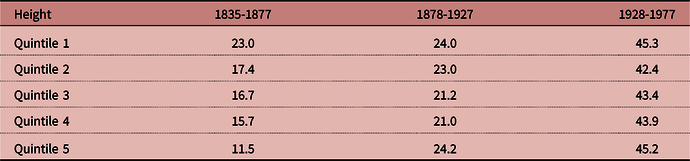
Note: 367 men in birth cohort 1827-1877, 2,481 in 1878-1927 and 1,679 in 1928-1977. The distribution of the number of cases by decade, village and other variables can be found in Table 1. The chi-squared statistic of the association between height and marriage in 1835-1877 is 3.569, in 1878-1927 is 2.590, and in 1928-1977 is 0.841.
Source: Alfamén and Middle Huerva Database (AMHDB)
However, a more variable trend is found in the following sub-periods. Thus, among the individuals falling into the 1878–1927 cohort, who were responsible for the demographic transition, the differences in marriage rates by height are greatly reduced until differences of less than five percent were found in all cases. Although with a slight generalized trend towards higher male singleness rates (the average singleness increased by more than five percentage points). The data reconfirm that short individuals were among those with the lowest marriage rates, but the results appear to have become polarized, with the tallest also being among those with the lowest proportion of marriages. During this period, the highest marriage rates were among individuals of average and above average height. Very tall and very short individuals were, from this point onwards, the most difficult to marry, with differences of 10% compared to individuals of average height. From the generations born in the fertility transition onwards, the phenomenon of intergenerational transmission of height – which is linked to living standards – from parents to children lost importance in the face of parental strategies of fertility control and investment in children (Hatton and Martin Reference Hatton and Martin2010; Marco-Gracia and López-Antón Reference Marco-Gracia and López-Antón2021). Perhaps due to this behaviour, height partially lost importance as an indicator of socio-economic status, which may explain the loss of attraction to tall individuals. Among those born between 1928 and 1977, there was only a three per cent difference between the lowest and highest marriage rate quintiles.
In the final sub-period, during which individuals were born into a period characterized by low fertility and mortality and the emergence of significant rural-urban migrations, the rates of unmarried people soared in rural areas. As can be seen in Table 2, individuals born in the twentieth century had up to four times higher rates of singleness than those born in the nineteenth century. On the one hand, this increase is likely due to the loss of importance of the institution of marriage itself and changes in mentality and gender imbalances caused by population movements from rural to urban areas (Marco-Gracia Reference Marco-Gracia2018b). The results indicate similar trends to those in the previous period but have a greater impact on the tallest and shortest men because they continued to stand out as those who married the least. Even so, the rates of singleness at age 45 doubled compared to the previous period (birth cohort 1878-1827) for all height groups, with this increase being more important than the minor differences in marriage rate between different height groups.
In addition to the singleness rate, this study also investigated the average age at first marriage to determine whether there are differences by height and whether they vary across periods. For this purpose, Table 3 presents the percentages of married men (excluding unmarried men) who married according to their age group and period of birth (using the same periods as in the previous section). The results show a more or less homogeneous distribution by height but with two periods with notable differences: marriages that took place before the age of 25 and those that took place after the age of 40. In all of the sub-periods, the individuals of smaller stature were those who married the least before the age of 20 (or even before the age of 25) and those who married the most at an advanced age (after the age of 40), which could suggest that they wished to marry but had not been able to do so previously. Thus, only 0.5 per cent of the individuals analysed who belonged to the shortest quintile were married before the age of 20 and 12.5 per cent before the age of 25. While in the tallest quintile, two per cent (four times as many) had married before the age of 20 and 16 per cent before the age of 25. This result is consistent with the greater difficulty that short individuals encounter when it comes to marrying seen previously for the same study area.
Percentage distribution of men who married according to age at first marriage and date of birth
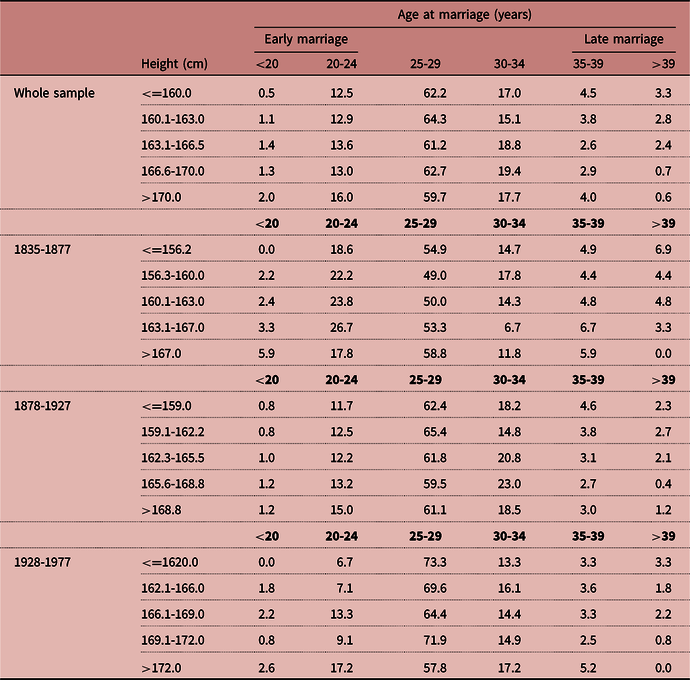
Note: Wedding date (age at first marriage) was available for 236 men for the birth cohort 1835-1877, 1,326 in 1878-1927, and 443 in 1928-1977. The distribution of the number of cases by decade, village and other variables can be found in Table 1.
Source: Alfamén and Middle Huerva Database (AMHDB)
The results of Table 3 are confirmed by the figures presented in Table 4, which analyses the average number of children as a function of height group. The shortest individuals had a lower average number of children at the youngest ages (as a result of their delayed marriages compared to the rest of the groups).
Average number of children born to married men (with children) as a function of father’s height and age

Note: N=532 complete families (both parents reached 49 years old and the complete information for all the members of the family is available). The distribution of the number of cases by decade, village and other variables can be found in Table 1.
Source: Alfamén and Middle Huerva Database (AMHDB)
Thus only one in five men in the shortest quintile had a child before the age of 20 and 1.2 children on average by the age of 25. Meanwhile, among men in the tallest quintile, in both age groups the figure was 0.1 higher. However, this effect is compensated for from the age of 30–34 onwards. In that age group, men in the shortest quintile already had fertility at the average of all other individuals. Differences by height group had lost their importance.
For the period as a whole, the differences in fertility were not compensated for until the last few years of the fertile cycle (i.e., when individuals who controlled their fertility from the transition stopped having children, meaning that their average marital fertility began to advance more slowly).
Results and Analysis
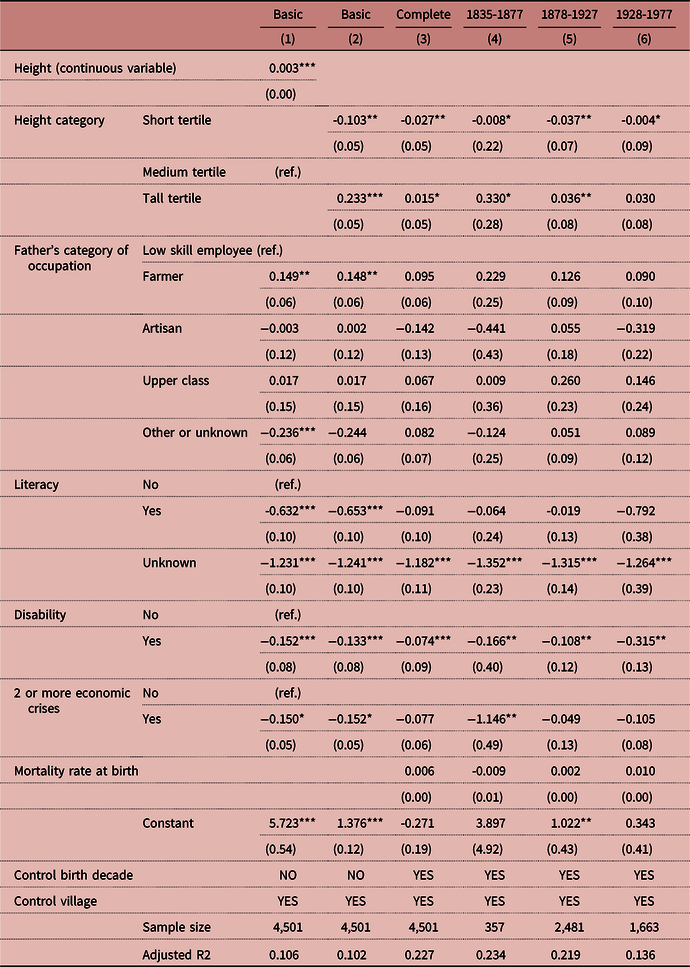
Table 5 presents the results of the analysis of the probabilities of marrying before the age of 45 (being the dependent variable a dichotomous variable and taking value 1 if the individual married before that age) through six probit statistical models. In the sample, approximately 26.5% of the male individuals did not marry (see Table 2). In the first model, it was incorporated height as a continuous independent variable, while, in the other models, it was introduced it as an independent variable categorized into three groups of similar size into which the heights were divided for each of the sub-periods. Models (1) and (2) present the model without the inclusion of variables that vary by decade, while models (3), (4), (5), and (6) include the childhood mortality rate for each year in the study area and the decade of birth. Finally, models (4), (5), and (6) show the full model for each of the sub-periods. The results for the relationship between the probability of marrying before age 45 and height show that short individuals had a higher probability of not marrying before age 45 (with this probability being significant in all models). Individuals in the shortest tertile of height were more than 10% less likely to be married according to the model. Conversely, tall individuals were more likely to marry. In fact, its coefficient (positive) is twice as high as the penalty of the shortest penalty (negative).
Probabilities of marrying before 45 years of age, male birth cohorts 1835–1977
Notes: OLS estimates; se denotes robust standard error. * Statistical significance at 10% level, ** at 5% level. *** at 1% level. The distribution of the number of cases by decade, village and other variables can be found in Table 1.
Source: Parish and municipal registers, censuses and conscription and call-up records.
Regarding the rest of the variables, farmers (landowners) were more likely to marry; increasing their chances by around 10% extra, Owning land to support himself and his family could be an attractive factor in finding a wife. Nevertheless, the result is significant only in the basic models, and the more complex models did not confirm these findings. The same is true for the negative effect of literacy on likelihood of marriage. More interesting is the effect of disability. People with severe physical problems at age 21 were up to 15% less likely to marry (very significant results in the model). Similarly, economic shocks may have affected the likelihood of marriage by reducing it by 10-15%, although the results are only significant at 90% for the basic models and 95% for the first sub-period. Therefore, in general, the results presented in Table 5 confirm that shorter conscripts faced greater difficulties in marrying and suggest that taller conscripts were more likely to do so.
In Table 6, presents the results of an analysis of the determinists of men’s age at first marriage using six ordinary least squares (OLS) linear regressions with heteroscedasticity-robust estimation. Again, the basic model (1) analyses height as a continuous variable, while the rest introduce height, which is categorized into three tertiles according to the sub-period of birth. Models (1) and (2) are basic and do not include two variables (in this case, the annual childhood mortality rate and the wife’s age at marriage), while the rest correspond to the full model. Models (4), (5), and (6) correspond to the three sub-periods of the study. The available sample consists of 2,005 individuals whose age at marriage, as well as that of their spouse, is known. The results regarding the main variable of interest, height, confirm that tall individuals married earlier than the other men in the sample did (around half a year earlier on average). However, the results do not significantly confirm the differences between short individuals and those of intermediate height. Therefore, in this case one could speak more of a premium for the tallest than of a penalty for the shortest. Moreover, the fact that the variable for tall individuals is not significant for the last study period (birth cohorts 1928–1977) could mean that height was no longer a major factor in age at marriage. This could also be a consequence of the small sample size or, perhaps, the role of other factors, such as education. More and more men, regardless of their height, could have postponed the decision to marry due to attending school and gaining education.
Determinants of male age at first marriage, birth cohorts 1835–1977

Notes: OLS estimates; se denotes robust standard error. * Statistical significance at 10% level, ** at 5% level. *** at 1% level. The distribution of the number of cases by decade, village and other variables can be found in Table 1.
Source: Parish and municipal registers, censuses and conscription and call-up records.
In relation to the rest of the variables included in Table 6, farmers again exhibit a distinct behaviour by marrying around half a year later on average. This behaviour may have been a consequence of the fact that some of these individuals chose to wait until they had taken ownership of their land from their parents before they married. A similar result was found for the sons of artisans, and a similar explanation may apply. In any case, the results are not significant for all models and periods. Literacy could also have delayed marriage by months or even years, but the results are again inconclusive. More interesting are the results for serious physical problems (disability). Individuals with disabilities were not only less likely to marry but, when they did marry, also took on average more than one additional year to marry. Finally, the age at marriage of the wife was strongly correlated with the age at marriage of the husband. In the area considered in this study, mean age differences between spouses never exceeded 5 years and were generally between 2 and 4 years.
Discussion
This paper presents a very long-term view on the effects of height on marital outcomes in rural Spain, focusing on those born in 1835 to 1975. To do so, this study adopted the dual perspective of analysing both the likelihood of marriage and the timing of the marriage process as several authors have done previously but for shorter periods of time (e.g., Murray Reference Murray2000; Herpin Reference Herpin2005; Manfredini et al., Reference Manfredini, Breschi, Fornasin and Seghieri2013; Thompson et al., Reference Thompson, Quanjer and Murkens2020). The results confirm the importance of height as an inclusive factor in marital outcomes but show that the importance of this factor decreased with the passage of the decades. Those at the bottom of the height range were the least likely to marry, in the case with about 10% less chance of having been married, which roughly confirms previous findings (Baten and Murray Reference Baten and Murray1998; Murray Reference Murray2000; Herpin Reference Herpin2005; Manfredini et al., Reference Manfredini, Breschi, Fornasin and Seghieri2013; Lipowicz Reference Lipowicz2014; Thompson et al., Reference Thompson, Quanjer and Murkens2020). In the case of this paper, as confirmed by both descriptive statistics and regression models, there also seems to have been a delay in marriage among shorter individuals. The tallest individuals married on average six months earlier than the medium-height individuals did, and this difference is even greater with respect to the shortest individuals. Therefore, in contrast to previous studies, the OLS model regressions performed for age at marriage in this paper indicate that there was a tendency among tall Spanish rural conscripts to marry early (e.g., Thompson et al., Reference Thompson, Quanjer and Murkens2020). Should this be the case, it would not be the shorter individuals who were delaying marriage but rather their taller counterparts who were marrying earlier. This could be a premium rather than a penalty for shortest as has been found elsewhere in the literature cited. Moreover, in the analysis with OLS regressions by periods, the height variable lost its significance. It is therefore possible that for the period 1928–1977, height had an influence on probability of marriage but not on age at first marriage. In any case, the small sample size for the last sub-period could have conditioned the results. Further research with Spanish data for this period is needed to confirm or refute the results obtained regarding the relationship between height and age at first marriage.
Moreover, in the area under investigation, it was found in the early stages, the tallest individuals did not suffer any major marriage penalties. However, according to the descriptive statistics, they could have been penalized from the end of the 19th century onwards, although to a lesser extent than short individuals could. Individuals of intermediate height may have benefited the most taking the best position. The finding that individuals of intermediate height have benefited the most is in line with what most studies in human evolutionary biology propose (see for example Stulp and Barrett Reference Stulp and Barrett2016; Bogin Reference Bogin2020). The penalty for tall individuals was not been confirmed by probit models using tertiles of height. This result could be an indication that only the very tall suffered from this penalty, so it is not proven when using larger height groups.
In addition, over time, height may have lost its importance as an indicator of social status. While until the fertility transition, there was a strong correlation between the biological well-being of father and child (mainly through the preservation of socioeconomic status), from the beginning of the transition onwards, parents in worse situations were able to use fertility control strategies as a means to break with height as a determinant of socioeconomic status, with the children of lower status parents showing the greatest intergenerational increases in height (Marco-Gracia and López-Antón Reference Marco-Gracia and López-Antón2021). The results of the OLS regressions by father’s socioeconomic status do not seem to show conclusive and significant results in the full models. Although in the simpler models, having significant amounts of farmland may have been associated with a 10-15% increase in the odds of marrying before age 45 but also with an increase in the average age at marriage of about half a year.
This article is also subject to important limitations that should be taken into account. Firstly, the entire analysis is based on data for men, so it is not possible to draw conclusions regarding women. Therefore, with this study, women’s height preferences for their spouses was identified, but not men’s preferences. Similar data are not available for women. Furthermore, the sample only included individuals who survived to the age of 21 and continued to reside in the study area, so there could have been a process of selection of individuals both by survival of the fittest and by migration patterns. In addition, this study focused on men seeking wives, so it may be considering as involuntary members of such groups who voluntarily chose not to marry, especially in the late 20th century (although cohabitation was not a common behaviour in the study area until the 2010s).
Conclusions
This study employed different methodologies to analyse male likelihood of marriage and age at marriage patterns according to the relative height of the individual in a rural Spanish area during the last two centuries. The analysis indicated that height was a decisive factor influencing the likelihood and timing of marriage (and, indirectly, the number of children in different age groups according to height). In general, body height did influence the timing of marriage and, indirectly, the number of children. In past societies, the age at marriage was related to reproduction because it indicated the beginning of regular sexual intercourse. Men who married later could have had fewer children.
In all cases, the shortest individuals were the worst off. They married in the lowest proportion (on average 10% less likely to get married over the period) and later than their peers did (the average age at first marriage increased by more than half a year). However, these differences seem to have become less important over time. In addition to the shortest, the tallest could also been negatively affected, although the results in this respect are inconclusive. In any case, the findings regarding this part of rural Spain seem to point to a higher likelihood of marrying (and marrying young) for boys of average or slightly taller than average height. It seems that the importance of height as an explanatory factor for marrying declined among individuals born in the period 1928–1977 and, in particular, in the second half of the 20th century. Thus, historically there was a correlation between height, age at first marriage and number of children that was only weakened by the demographic transition and the fertility control that went with it.
Disclosure statements
The authors assert that all procedures contributing to this work comply with the ethical standards of the relevant national and international committees on human experimentation and with the Helsinki Declaration of 1975, as revised in 2008.
The authors have not conflicts of interest to declare.
Funding
Research projects PGC2018-095529-B-I00 (Ministry of Economy and Competitiveness of Spain and co-financed with ERDF 2019-2021 “Una manera de hacer Europa”), PID2019-109336GB-I00 (Ministry of Sciences, Innovation and University) “Instituciones de acción colectiva, capital social y manejo de recursos en perspectiva histórica: Europa y América” and the Government of Aragon, through the Research Group S55_20R, and from the European Regional Development Fund (FEDER) ‘Building Europe from Aragon’.


 Open access

