1. Introduction
We are facing a polycrisis – the actualization of many risks at once, which overlap and interact. This polycrisis is not simply a ‘perfect storm’ of events erupting at the same time by coincidence, but stems from shared and deep roots. This includes a rapid increase in industrial and technological development, particularly post-World War II, which has accelerated the exploitation of our natural resources, a climate crisis, increasing disparities between people and nations, growing conflict around the world, and destabilized political systems. The polycrisis is thus not a neutral or natural phenomenon, but the result of failure to acknowledge and mitigate systemic risk.
This is due to a number of factors, not least of which is reliance on traditional planning, implementation, and evaluation to guide attainment of siloed goals based on a command-and-control approach, linear logic models, and better technical knowledge and tools. In fact, narrow objectives that traditionally define our approaches to risk – e.g., efficiency, cost minimization, ‘just-in-time’ nature of supply chains, etc. – have intensified, and are intensifying, systemic risk to societies and ecological systems, as well as resulted in a) risk transfer, and b) new risk creation as impacts of Global North are realized in the Global South and other parts of the world.
However, the polycrisis and the very nature of addressing systemic risk require a consideration of multiple objectives and perspectives beyond narrow ones. Systemic risk is volatile, non-static, non-linear, dynamic, indeterminate, and ambiguous, and can be considered ‘the potential for multiple, increasingly severe, abrupt, differentiated yet interconnected, and potentially long-lasting and complex impacts on coupled natural and human systems’ (ASRA, 2024).Footnote 1 As such, narrow approaches do not work. For large-scale initiatives in complex, dynamic environments aimed at systems transformation, we need to broaden our approach and ensure that we consider and act in accordance with the complexity of systemic risk.
Navigating such complexity requires principles. Principles tell us where we want to go and guide our vision; they are the directional markers to aim for – a world of peace, justice, and ecological integrity. Principles are also the compass that shows us how to get there by means of considering diverse evidence, embracing complexity and uncertainty, adapting to context, and harnessing individuals’ and societies’ agency to affect transformative change. Principles also ground us in their associated values – compassion, equity, accountability, and respect for non-human life – and thus help us find common ground in a world of increasing polarization.Footnote 2 Principles guide us through times of disruption and upheaval and facilitate dialogue on options, trade-offs, and choices.
2. A reference point for principles
Explicit statements of principles are becoming increasingly common across organizations and sectors. The term ‘principles’ has been used in different ways across fields. In natural sciences, principles have been used to mean ‘axioms’ or underlying truths, such as the ‘Principle of Least Action’ of bodies in motion (Maupertuis, Reference Maupertuis1740). In economics, the 19th century saw the emergence of canonical texts on principles, in particular ‘On the Principles of Political Economy and Taxation’ (Ricardo, Reference Ricardo1817) and ‘Principles of Political Economy’ (Mill, Reference Mill1848). These set out the authors’ understanding of the underlying factors (including capital, labour, land, rent, and trade) driving economic systems and the impacts of those systems on society. In business, principles have been used to describe what constitutes good practice in leading and operating organizations (notably Fayol, Reference Fayol1916, with his 14 principles of general and industrial management). In the domain of policy advice, the European Environment Agency supports the use of principles under conditions of uncertainty and complexity: principles are presented as an alternative to blueprint approaches, as a means of offering guidelines, knowing that policy interventions may not obtain their intended effects (European Environment Agency, 2024).
In line with this latter notion of operational guidelines (as opposed to statements of underlying axioms, drivers, factors, or truths governing different fields), principles have emerged across a range of domains. Figure 1 provides a broad, though not comprehensive, picture of those principles that provide such operating guidelines, considering political, economic, societal, technological, legal, and environmental (PESTLE) domains.
Figure 1.Examples of principles across PESTLE domains. PESTLE denotes political (P), economic (E), societal (S), technological (T), legal (L), and environmental (E). See text for full reference to each example.
Figure 1 Long description
The infographic presents principles across PESTLE domains. In politics, it lists 8 principles for sustainable governance of common-pool resources (Ostrom, 1990) and 2 principles of justice (Rawls, 1971). Economics includes 7 principles of doughnut economics (Raworth, 2017) and 4 principles for sustainable development (Daly, 1990). Society features 16 principles of the Earth Charter (Earth Charter International, 2000) and 3 core principles of human rights (United Nations, 1948). Technology covers 5 principles on AI (OECD, 2019) and 3 principles on critical and emerging technologies (Quad Countries, 2021). Environment includes 27 principles of the Rio Declaration (United Nations, 1992), 4 principles to address biodiversity loss (IPBES, 2024) and 10 principles for governing earth system tipping points (Milkoreit et al., 2024). Law lists 8 principles of legality (Fuller, 1964) and 7 principles of peace, security and international relations (United Nations, 1945). Cross-cutting principles include 10 principles of UN Global Compact (United Nations, 2000) and 11 principles of Blue Marble Evaluation (Patton, 2019).
In politics, Rawls’ principles of justice assert the right to ‘Equal Liberty’ for all, as well as the ‘Difference Principle’ – the organization of economic and social affairs to benefit the most disadvantaged (Rawls, Reference Rawls1971). Ostrom’s (Reference Ostrom1990) principles concerning the use of what she terms ‘common-pool resources’ highlight the importance of: clear boundaries for such commons; rules fit for local contexts; participatory decision-making; monitoring; proportionate sanctions; accessible conflict-resolution; recognition of rights for local governance; and nesting of local governance within higher-level governance.
In economics, as already stated, principles have been used primarily to describe key facets of economic systems, though more recently they have been used in the context of principles for sustainable economies. Daly’s (Reference Daly1990) principles of sustainable economic development concern: limiting human activities to those in line with the Earth’s ‘carrying capacity’; focusing technological progress on increasingly efficient and limited use of resources; exploitation of renewable resources within their regeneration rates; and appropriate pricing of non-renewable resources to ensure long-run substitution by renewable resources. Raworth’s (Reference Raworth2017) principles for a ‘Doughnut Economy’ highlight the need to: consider economics within a broader social and ecological set of systems; recognize the complexity of this systemic interconnectedness; move away from a focus on GDP growth; focus on thriving and basic needs being met within environmental limits; drive regeneration of natural resources; foster redistribution, justice, and inclusivity; and acknowledge the collaborative nature of people.
In society, the Earth Charter International’s (2000) 16 principles are organized into 4 overarching pillars: social and economic justice; ecological integrity; democracy, nonviolence, and peace; and respect and care for the community of life. The core principles of the United Nations’ (1948) Universal Declaration of Human Rights centre on universality (the recognition of all people's rights), equality (all people's rights are equally important), and interdependence (individual people’s human rights cannot be viewed in isolation from those of others).
In technology, the emergence of new technologies has stimulated statements of principles. In artificial intelligence (AI), for example, the OECD’s (2019) principles on AI call for its use and development to be in line with: inclusive growth; sustainable development and well-being; human rights and democratic values; transparency and explainability; robustness, security, and safety; and accountability. In 2021, the Quad countries (Australia, India, Japan, and the USA) published a joint statement on principles on technology design, development, governance, and use, highlighting the need to foster: consensus-based multi-stakeholder approaches; standards that promote interoperability, competition, inclusiveness, and innovation; and standards that support safety, security, and resilience (Quad countries, 2021).
In law, Fuller’s (Reference Fuller1964) principles of legality highlight the need for laws to be: general; publicized; non-retroactive in enforcement (when considering new laws); intelligible and clear; consistent; practicable; stable; and congruent with official actions, so that members of society can obey them. The United Nations’ (1945) Charter sets out principles of maintaining international peace and security, based on: sovereignty of its Members; adherence to the Charter in good faith; settlement of disputes through peaceful means; refraining from use of force; assistance to the United Nations in its actions to enforce the Charter; ensuring that non-members of the United Nations act in accordance with the principles; and refrain by the United Nations to intervene in domestic matters.
In the environment, the 1992 Rio Declaration on Environment and Development sets out 27 principles, encompassing: Member State sovereignty; the need for development and sustainability; cooperation and participation; prioritization of the least developed countries; common but differentiated responsibilities; and the vital role of youth, women, and Indigenous Peoples and their communities (United Nations, 1992). The Transformative Change assessment by the Intergovernmental Science-Policy Platform on Biodiversity and Ecosystem Services in 2024 outlines four key principles that are responsive to and address the underlying causes of biodiversity loss and nature’s decline, and guide the process of deliberate transformative change: equity and justice; pluralism and inclusion; respectful and reciprocal human-nature relationships; and adaptive learning and action (O’Brien et al., Reference O'Brien, Garibaldi, Agrawal, Bennett, Biggs, Calderón Contreras, Carr, Frantzeskaki, Gosnell, Gurung, Lambertucci, Leventon, Chuan, Reyes García, Shannon, Villasante, Wickson, Zinngrebe and Périanin2025). It argues that the breadth, depth, and dynamics of transformative change require attention to not only what is done, but also how it is done. More recently, a number of environmental principles have been proposed, for example, around the governance of Earth System Tipping Points (Milkoreit et al., Reference Milkoreit, Boyd, Constantino, Hausner, Hessen, Kääb, McLaren, Nadeau, O'Brien, Parmentier, Rotbarth, Rødven, Treichler, Wilson-Rowe and Yamineva2024), to ensure: global and multi-scale governance; prevention and precaution; anticipatory and adaptive governance and diversity in response capacity; intertemporal decision-making and intergenerational justice; and systemic risk governance. As well, the principles of the Cocoyoc Declaration call for a ‘cooperative world in partnership with nature’ (United Nations Environment Programme, 1974).
Finally, there are a number of cross-cutting principles, including the United Nations (2000) Global Compact for businesses, which focuses on: human rights; labour rights; environmental responsibility; and anti-corruption. In the evaluation field, principles-based approaches have emerged, through, for example, Patton's (Reference Patton2019) Blue Marble evaluation principles, highlighting: transboundary, global-to-local, and cross-silos thinking; acting with urgency and ‘skin in the game’; harmonizing across concepts and evaluating according to context; continuous learning; and incorporating transformation.
Rockström et al.’s (Reference Rockström, Kotzé, Milutinović, Biermann, Brovkin, Donges, Ebbesson, French, Gupta, Kim, Lenton, Lenzi, Nakicenovic, Neumann, Schuppert, Winkelmann, Bosselmann, Folke, Lucht and Steffen2024) paper, ‘The planetary commons: A new paradigm for safeguarding Earth-regulating systems in the Anthropocene’, argues the growing need for principles: ‘Planetary commons governance must … rely on a set of core principles, which would include existing principles of international environmental law … strengthened by new principles that align with novel Anthropocene dynamics and that could reverse the path-dependent course of current governance’.
Although constructed from separate domains, these principles together highlight a broad range of commonalities across domains, including peace and security, justice, participation and inclusivity, environmental stewardship, regard for the most vulnerable, cross-scale thinking and governance, rights, responsibilities, and interdependence, inter-temporal thinking with regard to future generations, and adaptiveness. That principles are repeated in different frameworks speaks to the fact that they are very generic, open to multiple interpretations, and need to be taken reflexively as a ‘guide for action’. These principles also highlight the need for inclusion of both outcome- and procedure-oriented principles, despite the inherent tension that such a choice entails. This adds salience to the consideration of principles for systemic/complex risk governance, as it adds perspective to the nature of the principles.
3. Effectiveness principles
Principles are derived from values, experience, expertise, and research. The term ‘principles’ applies to a variety of kinds of statements that serve different purposes. In the natural sciences, ‘natural principles’ explain how the world operates. Darwin’s Principle of Natural Selection states that within any environment, those most advantaged in that environment will survive (survival of the fittest). The natural sciences formulate, validate, and study ‘natural’ principles. They are evaluated using scientific principles of inquiry. Moral and ethical principles specify what right and good behaviour is. Many professions have developed moral and ethical principles that specify what constitutes integrity, the importance of treating people with respect, avoiding conflicts of interest, and transparency, as examples. Effectiveness principles guide change efforts. They specify how to make a difference in a chosen arena of action. Their niche and purpose are to direct efforts at making the world a better place in some way. Their content, substance, process, and specificity depend on the nature of the change initiative (Patton, Reference Patton2017).
We are in a world of ‘systemic risk’. Risks reflect normative judgements about ‘what matters’, and there exists plurality in underlying values, ranging from anthropocentric concerns around human welfare to ecocentric concerns based on the moral rights of species and ecosystems to exist. Effectiveness principles thus guide change efforts within this context to better understand and respond to risk. They inform choices about what actions are appropriate for what purposes, helping to navigate the treacherous terrain of conflicting guidance and competing advice.
What principles work for what situations with what results is both a strategic and an evaluation question. Thus, principles are hypotheses, not truths. They may or may not work. They may or may not be followed. They may or may not lead to desired outcomes. Whether they work, whether they are followed, and whether they yield desired outcomes are subject to collective review as work unfolds.
Principles thus become the focus of evaluation (the evaluand). Principles-focused evaluation examines (1) whether principles are clear, meaningful, and actionable, and if so, (2) whether they are actually being followed and, if so, (3) whether they are leading to desired results.
4. Methodology of development of systemic risk principles
Here, we present a set of effectiveness principles tailored to addressing systemic risk and the polycrisis, developed by the Accelerator for Systemic Risk Assessment (ASRA), a global network of risk experts dedicated to accelerating transformative action that protects the earth’s ecological systems and humanity from the threats of escalating systemic risks. The purpose of ASRA developing and adopting principles is to: inform and guide its decision-making; illuminate what is involved in systemic analysis; express shared values; inspire and support adaptation of ASRA’s work in diverse contexts; and provide criteria for evaluating ASRA initiatives. Principles thus act as a diagnostic tool to guide organizational strategy and functioning. However, as a set of principles related to the polycrisis and systemic risk, they are relevant to a vast range of actors and can be applied wherever engagement with and decisions about the future of human and non-human life on Earth are occurring.
The methodological approach to developing ASRA’s Principles for Systemic Risk (‘The Principles’) started with an initial consultation on principles after the first global conference on the polycrisis held in Korsør, Denmark (August 2022), with a group of 22 transdisciplinary experts.Footnote 3 ASRA was subsequently established in 2023, and its first priority was broad consultation with the initial core membership, which underscored the strong interest in ASRA being grounded in principles. The draft set from Korsør was brought to ASRA’s Principles Working Group (consisting of the authors of this paper); the set went through several iterations, after which an agreed-upon draft set was finalized to present to the full ASRA network at its inaugural convening, during which The Principles were introduced, workshopped, refined, and re-presented for approval. Also, the process was evaluated by external evaluators to address concerns about rigor, credibility, and utility.
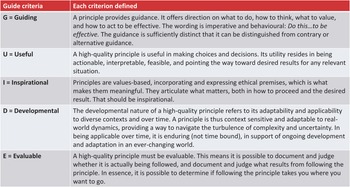
To underpin the process of development of The Principles, their use, and evaluation, the GUIDE (Patton, Reference Patton2017) framework (Figure 2) was utilized to ensure that The Principles provide clear guidance [G], are useful for informing decisions and actions [U], are inspirational [I], are developmental, that is, adaptable to diverse contexts [D], and are evaluable [E]. This was a deliberate and necessary move away from more traditional planning, implementation, and evaluation, which have been based on a command-and-control approach in which Specific, Measurable, Achievable, Realistic, and Time-bound goals are formulated with a logic model to guide attainment of those goals. That works for narrowly targeted projects like job training or increasing agricultural production. But such an approach does not work for large-scale initiatives in complex, dynamic environments aimed at systems transformation.
Figure 2 Long description
The infographic presents the GUIDE criteria for principles, each defined in detail. 'G = Guiding' explains that a principle offers direction on actions and values, with imperative wording to be effective. 'U = Useful' describes a principle's utility in decision-making, being actionable and feasible. 'I = Inspirational' highlights principles as values-based, expressing ethical premises for meaningful results. 'D = Developmental' refers to a principle's adaptability to diverse contexts, supporting ongoing development. 'E = Evaluable' emphasizes the ability to document and judge a principle's effectiveness, ensuring it leads to desired outcomes.
ASRA’s Overarching Principle is ‘to build, nurture, enhance, and embed the capacity to understand, apply, and use systemic risk assessment and to design, communicate, and support the implementation of transformative responses adapted to diverse cultural, political, societal, ecological, and economic contexts to be used wherever engagement with and decisions about the future of human and non-human life on Earth are occurring’.
The 10 associated operating principles include: Universal Responsibility, Non-Human Sanctity and Interdependence, Justice, Individual and Collective Agency, Complexity, Uncertainty, Cross-Scale, Multiple Ways of Knowing, Compassion, and Transformation. The operating principles flow from and support the overarching ‘big picture’ principle and provide more specific guidance on implementation. The Principles are not hierarchical but, instead, are interdependent and interrelated; they inherently initiate dialogue and provide guidance in the context of complexity. The Principles have been derived with specific reference to the features of the systemic risks and the polycrisis that we are facing, as shown in Figure 3.
Figure 3.Rationale for each principle to address systemic risk, from ASRA (2024).
Figure 3 Long description
The infographic presents a comparison between systemic risks and polycrisis characteristics on the left and principles required for navigating polycrisis on the right. The left column lists: self-interest, anthropocentrism, inequity and injustice, rule of the few, reductionism, overt focus on knowable risks, interactions across local and global, narrowly-focused evidence and methods, lack of compassion and current systems creating crises. The right column lists corresponding principles: universal responsibility, non-human sanctity and interdependence, justice, individual and collective agency, complexity, uncertainty, cross-scale, multiple ways of knowing, compassion and transformation. Each characteristic is paired with a principle, indicating a direct relationship between the two columns.
5. Principles for just and effective systemic risk governance
Some individual principles may not be unique to ASRA, but their totality and how they are organized are notably different: one overarching principle is followed by 10 operating principles that function as an integrated set, not a menu. An overarching principle is distinguished from operating principles. This is akin to the distinction between goals and objectives. Goals are broader, and objectives are narrower. Overarching principles provide broad guidance while operating principles provide more specific implementation guidance. Unlike goals, principles do not get met or achieved in any final sense; they are an ongoing way of operating.
5.1 Overarching principle
5.1.1 Mainstream systemic risk assessment and response principle
Build, nurture, enhance, and embed the capacity to understand, apply, and use systemic risk assessment and to design, communicate, and support the implementation of transformative responses adapted to diverse cultural, political, societal, ecological, and economic contexts to be used wherever engagement with and decisions about the future of human and non-human life on Earth are occurring.
5.2 Ten operating principles
1. Universal responsibility principle
Design and conduct systemic risk assessment and response as a means to realize our universal responsibility and accountability to each other, and natural systems and species, both for current and future generations.
2. Non-human sanctity and interdependence principle
Recognize the sanctity, inherent value, and agency of non-human life, and the interdependence and interconnectedness of human and natural systems and species, and make this recognition central to systemic risk assessment and response.
3. Justice principle
Incorporate the values of human rights, justice, and equity into systemic risk assessment and response, and take into account the expertise of and particular risks experienced by vulnerable communities.
4. Individual and collective agency principle
Harness the individual and collective agency of those who can produce and use systemic risk assessment and response to act on the possibility and opportunity for systems transformation, and strengthen whole-of-society participatory processes to mobilize collective action.
5. Complexity principle
Situate systemic risk assessment and response in the complex, dynamic, interactive, and interdependent impacts of risks, including trade-offs and unintended consequences, and in the need for rapid, continuous learning and experimentation.
6. Uncertainty principle
Integrate uncertainty, and what we do not or cannot know, into our understanding of risk and generate contextually sensitive and participatory scenarios and solutions in the face of that uncertainty, imperfect knowledge, and emergent dynamics, remaining humble, reflexive, transparent, and adaptable as conditions change and new possibilities emerge.
7. Cross-scale principle
Examine the intersection and feedback loops of planetary, global, regional, and local risk impacts and responses, and identify critical points of intervention for action to prevent systemic risk at all scales.
8. Multiple ways of knowing principle
Embrace, integrate, and make explicit a multiplicity of disciplines and worldviews, and multiple ways of perceiving, understanding, and acting on risk, and redefine and make transparent the values, assumptions, metrics, and associated planning, management, and evaluation appropriate to the nature of systemic risk.
9. Compassion principle
Have compassion in all actions with all stakeholders and nurture leadership focused on care and adaptive capacity to respond to risks and crises.
10. Transformation principle
Engage consistently with the magnitude, direction, and speed of proposed transformation to address systemic risk in a contextually sensitive manner, acknowledging the historical and current context/causation, such as power over and exploitation of earth’s ecological systems and each other.
The number of principles depends on what underlying values (beliefs in what’s important) are important enough to be expressed as principles (behavioural guidance on how to adhere to the value in practice). The ASRA working group determined that each principle articulates an important, differentiated value that would be too diluted if combined with others.
One way to enhance the clarity and meaningfulness of a principle is to articulate its opposite or identify contrary principles. Table 1 offers two examples from the ASRA Principles, the overarching principle and the principle aimed most explicitly at non-human sanctity and interdependence.
Table 1.Examples of contrasting principles
Table 1 Long description
The table compares ASRA Principles with contrasting non-ASRA principles in systemic risk assessment. It highlights two main contrasts: the approach to expertise and the value of nature. ASRA Principles advocate for mainstreaming systemic risk assessment across diverse contexts, while non-ASRA principles view it as specialized knowledge for experts. Additionally, ASRA Principles recognize the inherent value and interdependence of nature with human life, whereas non-ASRA principles see nature primarily as a resource for human use. These contrasts reflect differing philosophical approaches to risk assessment and environmental ethics.
Research shows that traditional risk intelligence and expertise are typically confined or siloed within disciplines, institutions, and sectors, or are sequestered within the private sector to deliver only on corporate objectives. As well, tools and methods are often singularly focused and not designed to account for interconnected risks or to anticipate their multi-dimensional impacts. Furthermore, evidence blind spots – shaped by limitations and/or bias in representation, participation, datasets, and collection methods, and the privileging of certain ideologies and worldviews – reinforce and exacerbate the drivers of systemic risk while also undermining decision-making. The absence of a defining set of principles, therefore, results in biased, narrow, and insufficient systemic analysis, especially in the face of the polycrisis. As an example, a bank might look to protect investments, considering the welfare only of its shareholders; a government might look to protect its people, which might endanger other people or ecosystems.
Significantly and to the contrary, The Principles for Systemic Risk help define and guide just and effective systemic risk governance in that they:
∘ Define risk for who and from what (e.g., universal responsibility, non-human sanctity, and vulnerable communities), being clear about risk definitions and their implications.
∘ Guide imperatives for how we understand risk in varying contexts (e.g., different ways of knowing and cross-scale).
∘ Acknowledge considerations not present in conventional/historical understandings of risk (e.g., deep uncertainty and complexity).
∘ Determine ways needed to approach risk assessment and response (e.g., compassion and agency).
∘ Define ultimate objectives of risk assessment and response contrary to the classical aim to avoid and/or mitigate risk for stability (e.g., transformation).
7. Example use cases of principles for systemic risk
The Principles for Systemic Risk constitute a whole: interdependent, complementary, cross-referenced, and mutually reinforcing. Ideally, The Principles constitute a systemic and meaningful whole, not a menu to choose from. When applied comprehensively and rigorously, this set of principles can fundamentally transform the way we understand, design for, respond to, and govern systemic risk.
Applying The Principles changes the narrative on risk. Central to effective risk governance is being explicit about the understanding of risk. Although there are numerous definitions of risk, at its most basic, risk is the possibility of something bad happening.Footnote 4 Traditional risk management has been concerned with the likelihood and severity of specific adverse events to individuals, communities, and organizations; the point of focus is on a single, or limited, set of risks, with probabilities of occurrence and damage that can be reasonably well quantified (Renn et al., Reference Renn, Lucas, Haas and Jaeger2019).
The classic understanding of risk has been heavily criticized. Winner points out that ‘risk’ is used to reduce environmental harm to a narrow concept that creates the illusion that risk (and associated probabilities) are a technical challenge to be managed, rather than a societal question that requires democratic deliberation (Winner, Reference Winner1986). Wynne argues that risk reduces the understanding of uncertainty and prevents reflexivity about the limits of scientific knowledge (Wynne, Reference Wynne1992).
The Principles for Systemic Risk lead us to question, challenge, and redefine conventional understandings of risk into a broader and deeper conceptualization of risk, recognizing that, depending on the specific risk (context) and disciplinary approaches taken towards conceptualizing risk, there will be different risk definitions and methodologies. At the heart, systemic risk thinking is a consideration of the different entities facing risks, where they are located, the timescales on which they face these risks, and the drivers and cascading impacts of these risks. In other words, risks for whom, where, when, from what, and how they are managed?
The Principles change the narrative on risk by: placing justice and equity (#3) and compassion (#9) – particularly for the most vulnerable communities, as well as future generations, the planet, its ecosystems and species (#1) – at the centre of risk assessment and the design and implementation of risk responses; making explicit critical drivers of systemic risk including resource over-extraction, environmental pollution, rapid technological changes, weakening democracy, and inequity (#10); being informed by diverse knowledge, a variety of perspectives and diversity of voices (#8), taking into consideration how risks could be actualized and interconnected across scales (#7) and in the context of diverse political, social, economic, and ecological systems (overarching); ensuring that risk assessment and response are developed to have relevance to, and in consultation with, affected communities (#3), underpinned by an analysis of who controls and benefits from dominant sociopolitical economies and who suffers harm and inequity from them (#10); and centring the notion that risks are characterized by complexity, indeterminacy, and ambiguity; hence, they are often not fully knowable, quantifiable, nor amenable to technical solutions (#5 and #6).
Applying The Principles guides data and evidence collection. In the 2021 paper ‘The Politics of Knowledge’, it is argued that ‘A narrow view of what counts as evidence, coupled with an entrenched willingness to maintain the status quo, means that transformative systems approaches are being kept from being understood, taken up, and acted upon. Decisions about what type of information is collected, researched, or deserves consideration are intrinsically connected to power … A broad diversity of evidence is left unconsidered and unheard’ (Global Alliance for the Future of Food, 2021).
The Principles for Systemic Risk, instead, guide data and evidence collection towards: the complex, dynamic, interactive, systemic, and interdependent impacts of risks including the interdependence and interconnectedness of human and natural systems and species (#2); the expertise of and particular risks experienced by vulnerable communities (#3); historically under-represented and marginalized voices such as Global South, Indigenous Peoples, women, and youth (#8); the intersection and feedback loops of planetary, global, regional, and local risk impacts (#5); and an approach that embraces whole-of-society participation requiring authentic collaboration and co-creation (#4) (Chatwood et al., Reference Chatwood, Paulette, Baker, Eriksen, Hansen, Eriksen, Hiratsuka, Lavoie, Lou, Mauro, Orbinski, Pabrum, Retallack and Brown2015; Carmona et al., Reference Carmona, Reed, Thorsell, Dorough, MacDonald, Rai and Sanago2023) away from a purely quantitative data-driven and modelled approach to risk analysis and a top-down approach to designing responses.
Applying The Principles informs systemic risk assessment framework development. Holistic and comprehensive systemic risk assessment is still in its infancy. Consideration of risk drivers, systems at risk, and the risks that systems themselves create, particularly around the risk interactions between different systems, is currently inadequate.
The Principles guide the development and use of systemic risk assessment frameworks by emphasizing: complex, dynamic, interactive, and interdependent impacts of risks (#5); the historical and current context/causation such as power over and exploitation of earth’s ecological systems and each other (#10); acknowledgement of uncertainty, and what we do not or cannot know (#6); integration of a multiplicity of disciplines and worldviews, and multiple ways of perceiving, understanding, and acting on risk (#8); and a call to redefine and make transparent the values, assumptions, metrics, and associated planning, management, and evaluation appropriate to the nature of systemic risk (#6).
The Principles for Systemic Risk guide the development of systemic risk response. The design of responses that can address multiple risks simultaneously, and systemic risk more broadly, requires a considerable enhancement, taking a transdisciplinary approach to support the design and testing of new responses, working closely with policy and decision-makers, as well as those impacted by and implementing responses on the ground, at multiple governance levels.
Application of, and the development of criteria deriving from, The Principles enables us to identify systemic risk responses by highlighting the need to: consider trade-offs and unintended consequences (#5); acknowledge uncertainty, imperfect knowledge, and emergent dynamics (#6); generate contextually sensitive and participatory approaches while remaining humble, reflexive, transparent, and adaptable as conditions change and new possibilities emerge (#4 and #6); identify critical points of intervention for action to reduce systemic risk at all scales (#7); rapidly, continuously learn and experiment (#5); and have compassion in all actions with all stakeholders and nurture leadership focused on care and adaptive capacity (#9).
The Principles for Systemic Risk also broaden the frame of systemic risk response within the spectrum of mitigation, preparedness, adaptation, and transformation, with the necessity of engaging consistently with the magnitude, direction, and speed required to address systemic risk in a contextually sensitive manner (#10).
ASRA network members applied these Principles to assessment and response in eight pilots undertaken in 2024,Footnote 5 spanning a range of governance scales, sectors, and geographies found in Table 2.
Table 2.Pilots to test The Principles related to systemic risk assessment and response
Table 2 Long description
The table details initiatives focused on assessing systemic risks through diverse methods such as workshops, data collection, and literature reviews. Key projects include wastewater testing in multiple countries, a workshop in New Delhi assessing systemic risks, and agroecology workshops in South Africa. Other notable entries involve case studies on global existential risks in the UK and UN, and participatory processes addressing food security in São Paulo, Brazil. The table highlights the geographical diversity of these projects, spanning continents from South America to Asia, and the varied focus areas, including socio-environmental risks, food systems, and biodiversity under climate change. This diversity underscores the global and multifaceted nature of systemic risk assessment efforts.
Applying The Principles to the pilots revealed the criticality of understanding systems, interconnections, and the strength of those connections; the use of storytelling, simple terms, and concepts, and plain language as a way to explore how principles can be applied to specific contexts; the need for clear and close links between systemic risk assessment and systemic risk response; and the need for dialogue and participatory processes. As well, taking a principles-based approach to systemic risk assessment and response through these pilots revealed important gaps in current practice, such as narrow, siloed governance structures with duty bearers’ responsibilities being overly sector focused.
8. Next steps and recommendations
The application of principles is simply the process of intentional consideration and implementation. ASRA has applied The Principles for Systemic Risk to build a common understanding of vision, mission, and values; to guide organizational development and substantive programmatic priorities; and as a reference for the definition of systemic risk, and associated criteria for assessment and response. The Principles for Systemic Risk were developed by and for ASRA, as well as a contribution to the wider societal task of navigating systemic risk and the polycrisis – as an open invitation to test, iterate, and apply them. They aspire to be relevant to diverse cultural, political, societal, ecological, and economic contexts and can be used wherever engagement with and decisions about the future of human and non-human life on Earth are occurring.
Those who would particularly benefit from applying The Principles include: multilaterals with multiple objectives on complex, interdependent, and global issues; practitioners engaging in risk assessment such as finance, insurance, military, etc.; practitioners engaging in risk response such as governments (at all levels), Civil Society Organizations, etc.; academics and educators teaching approaches to risk; data-generators and holders gathering evidence such as private sector, governments, military, etc.; and funders guiding granting and investment decisions.
To apply The Principles (using guidance adapted from Patton (Reference Patton2017):
∘ First, identify and codify primary intended uses and priority purposes in a deliberative and inclusive manner. Establish priority purposes/primary intended uses of application of The Principles, such as: professional practice; systemic inquiry; situational analysis; organizational evaluation; and funding criteria. Codify the objectives of The Principles application and primary uses.
∘ Second, identify, organize, and engage primary intended users. Identify primary intended users and/or those implicated in the application of The Principles. Determine and facilitate inclusive and co-creative processes that users want to be a part of and will commit to. Determine knowledge and build knowledge as needed. Facilitate a climate of openness; build trust for honest discussions. Involve intended users throughout all steps of the process.
∘ Third, build readiness for the application of The Principles. Further assess/understand the context for the application of The Principles. Review important documents, interview key stakeholders, etc. Secure and commit necessary resources. Determine how to share understandings and findings. Determine how to increase skills, knowledge, confidence, and sense of ownership.
∘ Fourth, apply The Principles and generate credible findings. Use The Principles to design, implement, and/or evaluate intended use by answering questions about: meaningfulness of The Principles; adherence to The Principles; and, if adhered to, the results of adherence. Be explicit about the assumptions brought to the understanding and application of The Principles. Understand and, if necessary, negotiate tensions/trade-offs between principles. Render judgements about the conclusions of applying The Principles and help intended users understand implications.
∘ Finally, determine implications for ongoing attention to the Principles. Make strategic choices about where to focus follow-up efforts. Plan and budget for follow-up. Identify champions for the findings. Enhance capacities in understanding, determining, and acting on the implications of The Principles. Report out to others; make results transparent; be accountable.
9. Conclusion
We are in a polycrisis, a polycrisis of our own making based on social, economic, and political systems that a privileged minority designed, built, and now maintain despite the growing evidence that these systems often do not serve humanity and ecological systems well. To navigate the polycrisis – to mitigate and adapt to systemic risk and transform the systems that block positive change – requires strong governance. For that governance to be just and effective requires principles that identify common values, provide a framework for decision-making, and lead the necessary societal change towards a shared vision. Principles thus take on increasing importance in an ever more complex and fragile world.







 This is an Open Access article, distributed under the terms of the Creative Commons Attribution-NonCommercial-NoDerivatives licence (http://creativecommons.org/licenses/by-nc-nd/4.0), which permits non-commercial re-use, distribution, and reproduction in any medium, provided that no alterations are made and the original article is properly cited. The written permission of Cambridge University Press or the rights holder(s) must be obtained prior to any commercial use and/or adaptation of the article.


 You have
Access
You have
Access
 Open access
1. Introduction
We are facing a polycrisis – the actualization of many risks at once, which overlap and interact. This polycrisis is not simply a ‘perfect storm’ of events erupting at the same time by coincidence, but stems from shared and deep roots. This includes a rapid increase in industrial and technological development, particularly post-World War II, which has accelerated the exploitation of our natural resources, a climate crisis, increasing disparities between people and nations, growing conflict around the world, and destabilized political systems. The polycrisis is thus not a neutral or natural phenomenon, but the result of failure to acknowledge and mitigate systemic risk.
This is due to a number of factors, not least of which is reliance on traditional planning, implementation, and evaluation to guide attainment of siloed goals based on a command-and-control approach, linear logic models, and better technical knowledge and tools. In fact, narrow objectives that traditionally define our approaches to risk – e.g., efficiency, cost minimization, ‘just-in-time’ nature of supply chains, etc. – have intensified, and are intensifying, systemic risk to societies and ecological systems, as well as resulted in a) risk transfer, and b) new risk creation as impacts of Global North are realized in the Global South and other parts of the world.
However, the polycrisis and the very nature of addressing systemic risk require a consideration of multiple objectives and perspectives beyond narrow ones. Systemic risk is volatile, non-static, non-linear, dynamic, indeterminate, and ambiguous, and can be considered ‘the potential for multiple, increasingly severe, abrupt, differentiated yet interconnected, and potentially long-lasting and complex impacts on coupled natural and human systems’ (ASRA, 2024).Footnote 1 As such, narrow approaches do not work. For large-scale initiatives in complex, dynamic environments aimed at systems transformation, we need to broaden our approach and ensure that we consider and act in accordance with the complexity of systemic risk.
Navigating such complexity requires principles. Principles tell us where we want to go and guide our vision; they are the directional markers to aim for – a world of peace, justice, and ecological integrity. Principles are also the compass that shows us how to get there by means of considering diverse evidence, embracing complexity and uncertainty, adapting to context, and harnessing individuals’ and societies’ agency to affect transformative change. Principles also ground us in their associated values – compassion, equity, accountability, and respect for non-human life – and thus help us find common ground in a world of increasing polarization.Footnote 2 Principles guide us through times of disruption and upheaval and facilitate dialogue on options, trade-offs, and choices.
2. A reference point for principles
Explicit statements of principles are becoming increasingly common across organizations and sectors. The term ‘principles’ has been used in different ways across fields. In natural sciences, principles have been used to mean ‘axioms’ or underlying truths, such as the ‘Principle of Least Action’ of bodies in motion (Maupertuis, Reference Maupertuis1740). In economics, the 19th century saw the emergence of canonical texts on principles, in particular ‘On the Principles of Political Economy and Taxation’ (Ricardo, Reference Ricardo1817) and ‘Principles of Political Economy’ (Mill, Reference Mill1848). These set out the authors’ understanding of the underlying factors (including capital, labour, land, rent, and trade) driving economic systems and the impacts of those systems on society. In business, principles have been used to describe what constitutes good practice in leading and operating organizations (notably Fayol, Reference Fayol1916, with his 14 principles of general and industrial management). In the domain of policy advice, the European Environment Agency supports the use of principles under conditions of uncertainty and complexity: principles are presented as an alternative to blueprint approaches, as a means of offering guidelines, knowing that policy interventions may not obtain their intended effects (European Environment Agency, 2024).
In line with this latter notion of operational guidelines (as opposed to statements of underlying axioms, drivers, factors, or truths governing different fields), principles have emerged across a range of domains. Figure 1 provides a broad, though not comprehensive, picture of those principles that provide such operating guidelines, considering political, economic, societal, technological, legal, and environmental (PESTLE) domains.
Examples of principles across PESTLE domains. PESTLE denotes political (P), economic (E), societal (S), technological (T), legal (L), and environmental (E). See text for full reference to each example.
Figure 1 Long description
The infographic presents principles across PESTLE domains. In politics, it lists 8 principles for sustainable governance of common-pool resources (Ostrom, 1990) and 2 principles of justice (Rawls, 1971). Economics includes 7 principles of doughnut economics (Raworth, 2017) and 4 principles for sustainable development (Daly, 1990). Society features 16 principles of the Earth Charter (Earth Charter International, 2000) and 3 core principles of human rights (United Nations, 1948). Technology covers 5 principles on AI (OECD, 2019) and 3 principles on critical and emerging technologies (Quad Countries, 2021). Environment includes 27 principles of the Rio Declaration (United Nations, 1992), 4 principles to address biodiversity loss (IPBES, 2024) and 10 principles for governing earth system tipping points (Milkoreit et al., 2024). Law lists 8 principles of legality (Fuller, 1964) and 7 principles of peace, security and international relations (United Nations, 1945). Cross-cutting principles include 10 principles of UN Global Compact (United Nations, 2000) and 11 principles of Blue Marble Evaluation (Patton, 2019).
In politics, Rawls’ principles of justice assert the right to ‘Equal Liberty’ for all, as well as the ‘Difference Principle’ – the organization of economic and social affairs to benefit the most disadvantaged (Rawls, Reference Rawls1971). Ostrom’s (Reference Ostrom1990) principles concerning the use of what she terms ‘common-pool resources’ highlight the importance of: clear boundaries for such commons; rules fit for local contexts; participatory decision-making; monitoring; proportionate sanctions; accessible conflict-resolution; recognition of rights for local governance; and nesting of local governance within higher-level governance.
In economics, as already stated, principles have been used primarily to describe key facets of economic systems, though more recently they have been used in the context of principles for sustainable economies. Daly’s (Reference Daly1990) principles of sustainable economic development concern: limiting human activities to those in line with the Earth’s ‘carrying capacity’; focusing technological progress on increasingly efficient and limited use of resources; exploitation of renewable resources within their regeneration rates; and appropriate pricing of non-renewable resources to ensure long-run substitution by renewable resources. Raworth’s (Reference Raworth2017) principles for a ‘Doughnut Economy’ highlight the need to: consider economics within a broader social and ecological set of systems; recognize the complexity of this systemic interconnectedness; move away from a focus on GDP growth; focus on thriving and basic needs being met within environmental limits; drive regeneration of natural resources; foster redistribution, justice, and inclusivity; and acknowledge the collaborative nature of people.
In society, the Earth Charter International’s (2000) 16 principles are organized into 4 overarching pillars: social and economic justice; ecological integrity; democracy, nonviolence, and peace; and respect and care for the community of life. The core principles of the United Nations’ (1948) Universal Declaration of Human Rights centre on universality (the recognition of all people's rights), equality (all people's rights are equally important), and interdependence (individual people’s human rights cannot be viewed in isolation from those of others).
In technology, the emergence of new technologies has stimulated statements of principles. In artificial intelligence (AI), for example, the OECD’s (2019) principles on AI call for its use and development to be in line with: inclusive growth; sustainable development and well-being; human rights and democratic values; transparency and explainability; robustness, security, and safety; and accountability. In 2021, the Quad countries (Australia, India, Japan, and the USA) published a joint statement on principles on technology design, development, governance, and use, highlighting the need to foster: consensus-based multi-stakeholder approaches; standards that promote interoperability, competition, inclusiveness, and innovation; and standards that support safety, security, and resilience (Quad countries, 2021).
In law, Fuller’s (Reference Fuller1964) principles of legality highlight the need for laws to be: general; publicized; non-retroactive in enforcement (when considering new laws); intelligible and clear; consistent; practicable; stable; and congruent with official actions, so that members of society can obey them. The United Nations’ (1945) Charter sets out principles of maintaining international peace and security, based on: sovereignty of its Members; adherence to the Charter in good faith; settlement of disputes through peaceful means; refraining from use of force; assistance to the United Nations in its actions to enforce the Charter; ensuring that non-members of the United Nations act in accordance with the principles; and refrain by the United Nations to intervene in domestic matters.
In the environment, the 1992 Rio Declaration on Environment and Development sets out 27 principles, encompassing: Member State sovereignty; the need for development and sustainability; cooperation and participation; prioritization of the least developed countries; common but differentiated responsibilities; and the vital role of youth, women, and Indigenous Peoples and their communities (United Nations, 1992). The Transformative Change assessment by the Intergovernmental Science-Policy Platform on Biodiversity and Ecosystem Services in 2024 outlines four key principles that are responsive to and address the underlying causes of biodiversity loss and nature’s decline, and guide the process of deliberate transformative change: equity and justice; pluralism and inclusion; respectful and reciprocal human-nature relationships; and adaptive learning and action (O’Brien et al., Reference O'Brien, Garibaldi, Agrawal, Bennett, Biggs, Calderón Contreras, Carr, Frantzeskaki, Gosnell, Gurung, Lambertucci, Leventon, Chuan, Reyes García, Shannon, Villasante, Wickson, Zinngrebe and Périanin2025). It argues that the breadth, depth, and dynamics of transformative change require attention to not only what is done, but also how it is done. More recently, a number of environmental principles have been proposed, for example, around the governance of Earth System Tipping Points (Milkoreit et al., Reference Milkoreit, Boyd, Constantino, Hausner, Hessen, Kääb, McLaren, Nadeau, O'Brien, Parmentier, Rotbarth, Rødven, Treichler, Wilson-Rowe and Yamineva2024), to ensure: global and multi-scale governance; prevention and precaution; anticipatory and adaptive governance and diversity in response capacity; intertemporal decision-making and intergenerational justice; and systemic risk governance. As well, the principles of the Cocoyoc Declaration call for a ‘cooperative world in partnership with nature’ (United Nations Environment Programme, 1974).
Finally, there are a number of cross-cutting principles, including the United Nations (2000) Global Compact for businesses, which focuses on: human rights; labour rights; environmental responsibility; and anti-corruption. In the evaluation field, principles-based approaches have emerged, through, for example, Patton's (Reference Patton2019) Blue Marble evaluation principles, highlighting: transboundary, global-to-local, and cross-silos thinking; acting with urgency and ‘skin in the game’; harmonizing across concepts and evaluating according to context; continuous learning; and incorporating transformation.
Rockström et al.’s (Reference Rockström, Kotzé, Milutinović, Biermann, Brovkin, Donges, Ebbesson, French, Gupta, Kim, Lenton, Lenzi, Nakicenovic, Neumann, Schuppert, Winkelmann, Bosselmann, Folke, Lucht and Steffen2024) paper, ‘The planetary commons: A new paradigm for safeguarding Earth-regulating systems in the Anthropocene’, argues the growing need for principles: ‘Planetary commons governance must … rely on a set of core principles, which would include existing principles of international environmental law … strengthened by new principles that align with novel Anthropocene dynamics and that could reverse the path-dependent course of current governance’.
Although constructed from separate domains, these principles together highlight a broad range of commonalities across domains, including peace and security, justice, participation and inclusivity, environmental stewardship, regard for the most vulnerable, cross-scale thinking and governance, rights, responsibilities, and interdependence, inter-temporal thinking with regard to future generations, and adaptiveness. That principles are repeated in different frameworks speaks to the fact that they are very generic, open to multiple interpretations, and need to be taken reflexively as a ‘guide for action’. These principles also highlight the need for inclusion of both outcome- and procedure-oriented principles, despite the inherent tension that such a choice entails. This adds salience to the consideration of principles for systemic/complex risk governance, as it adds perspective to the nature of the principles.
3. Effectiveness principles
Principles are derived from values, experience, expertise, and research. The term ‘principles’ applies to a variety of kinds of statements that serve different purposes. In the natural sciences, ‘natural principles’ explain how the world operates. Darwin’s Principle of Natural Selection states that within any environment, those most advantaged in that environment will survive (survival of the fittest). The natural sciences formulate, validate, and study ‘natural’ principles. They are evaluated using scientific principles of inquiry. Moral and ethical principles specify what right and good behaviour is. Many professions have developed moral and ethical principles that specify what constitutes integrity, the importance of treating people with respect, avoiding conflicts of interest, and transparency, as examples. Effectiveness principles guide change efforts. They specify how to make a difference in a chosen arena of action. Their niche and purpose are to direct efforts at making the world a better place in some way. Their content, substance, process, and specificity depend on the nature of the change initiative (Patton, Reference Patton2017).
We are in a world of ‘systemic risk’. Risks reflect normative judgements about ‘what matters’, and there exists plurality in underlying values, ranging from anthropocentric concerns around human welfare to ecocentric concerns based on the moral rights of species and ecosystems to exist. Effectiveness principles thus guide change efforts within this context to better understand and respond to risk. They inform choices about what actions are appropriate for what purposes, helping to navigate the treacherous terrain of conflicting guidance and competing advice.
What principles work for what situations with what results is both a strategic and an evaluation question. Thus, principles are hypotheses, not truths. They may or may not work. They may or may not be followed. They may or may not lead to desired outcomes. Whether they work, whether they are followed, and whether they yield desired outcomes are subject to collective review as work unfolds.
Principles thus become the focus of evaluation (the evaluand). Principles-focused evaluation examines (1) whether principles are clear, meaningful, and actionable, and if so, (2) whether they are actually being followed and, if so, (3) whether they are leading to desired results.
4. Methodology of development of systemic risk principles
Here, we present a set of effectiveness principles tailored to addressing systemic risk and the polycrisis, developed by the Accelerator for Systemic Risk Assessment (ASRA), a global network of risk experts dedicated to accelerating transformative action that protects the earth’s ecological systems and humanity from the threats of escalating systemic risks. The purpose of ASRA developing and adopting principles is to: inform and guide its decision-making; illuminate what is involved in systemic analysis; express shared values; inspire and support adaptation of ASRA’s work in diverse contexts; and provide criteria for evaluating ASRA initiatives. Principles thus act as a diagnostic tool to guide organizational strategy and functioning. However, as a set of principles related to the polycrisis and systemic risk, they are relevant to a vast range of actors and can be applied wherever engagement with and decisions about the future of human and non-human life on Earth are occurring.
The methodological approach to developing ASRA’s Principles for Systemic Risk (‘The Principles’) started with an initial consultation on principles after the first global conference on the polycrisis held in Korsør, Denmark (August 2022), with a group of 22 transdisciplinary experts.Footnote 3 ASRA was subsequently established in 2023, and its first priority was broad consultation with the initial core membership, which underscored the strong interest in ASRA being grounded in principles. The draft set from Korsør was brought to ASRA’s Principles Working Group (consisting of the authors of this paper); the set went through several iterations, after which an agreed-upon draft set was finalized to present to the full ASRA network at its inaugural convening, during which The Principles were introduced, workshopped, refined, and re-presented for approval. Also, the process was evaluated by external evaluators to address concerns about rigor, credibility, and utility.
To underpin the process of development of The Principles, their use, and evaluation, the GUIDE (Patton, Reference Patton2017) framework (Figure 2) was utilized to ensure that The Principles provide clear guidance [G], are useful for informing decisions and actions [U], are inspirational [I], are developmental, that is, adaptable to diverse contexts [D], and are evaluable [E]. This was a deliberate and necessary move away from more traditional planning, implementation, and evaluation, which have been based on a command-and-control approach in which Specific, Measurable, Achievable, Realistic, and Time-bound goals are formulated with a logic model to guide attainment of those goals. That works for narrowly targeted projects like job training or increasing agricultural production. But such an approach does not work for large-scale initiatives in complex, dynamic environments aimed at systems transformation.
Guide framework for principles, from Patton (Reference Patton2017).
Figure 2 Long description
The infographic presents the GUIDE criteria for principles, each defined in detail. 'G = Guiding' explains that a principle offers direction on actions and values, with imperative wording to be effective. 'U = Useful' describes a principle's utility in decision-making, being actionable and feasible. 'I = Inspirational' highlights principles as values-based, expressing ethical premises for meaningful results. 'D = Developmental' refers to a principle's adaptability to diverse contexts, supporting ongoing development. 'E = Evaluable' emphasizes the ability to document and judge a principle's effectiveness, ensuring it leads to desired outcomes.
ASRA’s Overarching Principle is ‘to build, nurture, enhance, and embed the capacity to understand, apply, and use systemic risk assessment and to design, communicate, and support the implementation of transformative responses adapted to diverse cultural, political, societal, ecological, and economic contexts to be used wherever engagement with and decisions about the future of human and non-human life on Earth are occurring’.
The 10 associated operating principles include: Universal Responsibility, Non-Human Sanctity and Interdependence, Justice, Individual and Collective Agency, Complexity, Uncertainty, Cross-Scale, Multiple Ways of Knowing, Compassion, and Transformation. The operating principles flow from and support the overarching ‘big picture’ principle and provide more specific guidance on implementation. The Principles are not hierarchical but, instead, are interdependent and interrelated; they inherently initiate dialogue and provide guidance in the context of complexity. The Principles have been derived with specific reference to the features of the systemic risks and the polycrisis that we are facing, as shown in Figure 3.
Rationale for each principle to address systemic risk, from ASRA (2024).
Figure 3 Long description
The infographic presents a comparison between systemic risks and polycrisis characteristics on the left and principles required for navigating polycrisis on the right. The left column lists: self-interest, anthropocentrism, inequity and injustice, rule of the few, reductionism, overt focus on knowable risks, interactions across local and global, narrowly-focused evidence and methods, lack of compassion and current systems creating crises. The right column lists corresponding principles: universal responsibility, non-human sanctity and interdependence, justice, individual and collective agency, complexity, uncertainty, cross-scale, multiple ways of knowing, compassion and transformation. Each characteristic is paired with a principle, indicating a direct relationship between the two columns.
5. Principles for just and effective systemic risk governance
Some individual principles may not be unique to ASRA, but their totality and how they are organized are notably different: one overarching principle is followed by 10 operating principles that function as an integrated set, not a menu. An overarching principle is distinguished from operating principles. This is akin to the distinction between goals and objectives. Goals are broader, and objectives are narrower. Overarching principles provide broad guidance while operating principles provide more specific implementation guidance. Unlike goals, principles do not get met or achieved in any final sense; they are an ongoing way of operating.
5.1 Overarching principle
5.1.1 Mainstream systemic risk assessment and response principle
Build, nurture, enhance, and embed the capacity to understand, apply, and use systemic risk assessment and to design, communicate, and support the implementation of transformative responses adapted to diverse cultural, political, societal, ecological, and economic contexts to be used wherever engagement with and decisions about the future of human and non-human life on Earth are occurring.
5.2 Ten operating principles
1. Universal responsibility principle
Design and conduct systemic risk assessment and response as a means to realize our universal responsibility and accountability to each other, and natural systems and species, both for current and future generations.
2. Non-human sanctity and interdependence principle
Recognize the sanctity, inherent value, and agency of non-human life, and the interdependence and interconnectedness of human and natural systems and species, and make this recognition central to systemic risk assessment and response.
3. Justice principle
Incorporate the values of human rights, justice, and equity into systemic risk assessment and response, and take into account the expertise of and particular risks experienced by vulnerable communities.
4. Individual and collective agency principle
Harness the individual and collective agency of those who can produce and use systemic risk assessment and response to act on the possibility and opportunity for systems transformation, and strengthen whole-of-society participatory processes to mobilize collective action.
5. Complexity principle
Situate systemic risk assessment and response in the complex, dynamic, interactive, and interdependent impacts of risks, including trade-offs and unintended consequences, and in the need for rapid, continuous learning and experimentation.
6. Uncertainty principle
Integrate uncertainty, and what we do not or cannot know, into our understanding of risk and generate contextually sensitive and participatory scenarios and solutions in the face of that uncertainty, imperfect knowledge, and emergent dynamics, remaining humble, reflexive, transparent, and adaptable as conditions change and new possibilities emerge.
7. Cross-scale principle
Examine the intersection and feedback loops of planetary, global, regional, and local risk impacts and responses, and identify critical points of intervention for action to prevent systemic risk at all scales.
8. Multiple ways of knowing principle
Embrace, integrate, and make explicit a multiplicity of disciplines and worldviews, and multiple ways of perceiving, understanding, and acting on risk, and redefine and make transparent the values, assumptions, metrics, and associated planning, management, and evaluation appropriate to the nature of systemic risk.
9. Compassion principle
Have compassion in all actions with all stakeholders and nurture leadership focused on care and adaptive capacity to respond to risks and crises.
10. Transformation principle
Engage consistently with the magnitude, direction, and speed of proposed transformation to address systemic risk in a contextually sensitive manner, acknowledging the historical and current context/causation, such as power over and exploitation of earth’s ecological systems and each other.
The number of principles depends on what underlying values (beliefs in what’s important) are important enough to be expressed as principles (behavioural guidance on how to adhere to the value in practice). The ASRA working group determined that each principle articulates an important, differentiated value that would be too diluted if combined with others.
One way to enhance the clarity and meaningfulness of a principle is to articulate its opposite or identify contrary principles. Table 1 offers two examples from the ASRA Principles, the overarching principle and the principle aimed most explicitly at non-human sanctity and interdependence.
Examples of contrasting principles
Table 1 Long description
The table compares ASRA Principles with contrasting non-ASRA principles in systemic risk assessment. It highlights two main contrasts: the approach to expertise and the value of nature. ASRA Principles advocate for mainstreaming systemic risk assessment across diverse contexts, while non-ASRA principles view it as specialized knowledge for experts. Additionally, ASRA Principles recognize the inherent value and interdependence of nature with human life, whereas non-ASRA principles see nature primarily as a resource for human use. These contrasts reflect differing philosophical approaches to risk assessment and environmental ethics.
Research shows that traditional risk intelligence and expertise are typically confined or siloed within disciplines, institutions, and sectors, or are sequestered within the private sector to deliver only on corporate objectives. As well, tools and methods are often singularly focused and not designed to account for interconnected risks or to anticipate their multi-dimensional impacts. Furthermore, evidence blind spots – shaped by limitations and/or bias in representation, participation, datasets, and collection methods, and the privileging of certain ideologies and worldviews – reinforce and exacerbate the drivers of systemic risk while also undermining decision-making. The absence of a defining set of principles, therefore, results in biased, narrow, and insufficient systemic analysis, especially in the face of the polycrisis. As an example, a bank might look to protect investments, considering the welfare only of its shareholders; a government might look to protect its people, which might endanger other people or ecosystems.
Significantly and to the contrary, The Principles for Systemic Risk help define and guide just and effective systemic risk governance in that they:
∘ Define risk for who and from what (e.g., universal responsibility, non-human sanctity, and vulnerable communities), being clear about risk definitions and their implications.
∘ Guide imperatives for how we understand risk in varying contexts (e.g., different ways of knowing and cross-scale).
∘ Acknowledge considerations not present in conventional/historical understandings of risk (e.g., deep uncertainty and complexity).
∘ Determine ways needed to approach risk assessment and response (e.g., compassion and agency).
∘ Define ultimate objectives of risk assessment and response contrary to the classical aim to avoid and/or mitigate risk for stability (e.g., transformation).
7. Example use cases of principles for systemic risk
The Principles for Systemic Risk constitute a whole: interdependent, complementary, cross-referenced, and mutually reinforcing. Ideally, The Principles constitute a systemic and meaningful whole, not a menu to choose from. When applied comprehensively and rigorously, this set of principles can fundamentally transform the way we understand, design for, respond to, and govern systemic risk.
Applying The Principles changes the narrative on risk. Central to effective risk governance is being explicit about the understanding of risk. Although there are numerous definitions of risk, at its most basic, risk is the possibility of something bad happening.Footnote 4 Traditional risk management has been concerned with the likelihood and severity of specific adverse events to individuals, communities, and organizations; the point of focus is on a single, or limited, set of risks, with probabilities of occurrence and damage that can be reasonably well quantified (Renn et al., Reference Renn, Lucas, Haas and Jaeger2019).
The classic understanding of risk has been heavily criticized. Winner points out that ‘risk’ is used to reduce environmental harm to a narrow concept that creates the illusion that risk (and associated probabilities) are a technical challenge to be managed, rather than a societal question that requires democratic deliberation (Winner, Reference Winner1986). Wynne argues that risk reduces the understanding of uncertainty and prevents reflexivity about the limits of scientific knowledge (Wynne, Reference Wynne1992).
The Principles for Systemic Risk lead us to question, challenge, and redefine conventional understandings of risk into a broader and deeper conceptualization of risk, recognizing that, depending on the specific risk (context) and disciplinary approaches taken towards conceptualizing risk, there will be different risk definitions and methodologies. At the heart, systemic risk thinking is a consideration of the different entities facing risks, where they are located, the timescales on which they face these risks, and the drivers and cascading impacts of these risks. In other words, risks for whom, where, when, from what, and how they are managed?
The Principles change the narrative on risk by: placing justice and equity (#3) and compassion (#9) – particularly for the most vulnerable communities, as well as future generations, the planet, its ecosystems and species (#1) – at the centre of risk assessment and the design and implementation of risk responses; making explicit critical drivers of systemic risk including resource over-extraction, environmental pollution, rapid technological changes, weakening democracy, and inequity (#10); being informed by diverse knowledge, a variety of perspectives and diversity of voices (#8), taking into consideration how risks could be actualized and interconnected across scales (#7) and in the context of diverse political, social, economic, and ecological systems (overarching); ensuring that risk assessment and response are developed to have relevance to, and in consultation with, affected communities (#3), underpinned by an analysis of who controls and benefits from dominant sociopolitical economies and who suffers harm and inequity from them (#10); and centring the notion that risks are characterized by complexity, indeterminacy, and ambiguity; hence, they are often not fully knowable, quantifiable, nor amenable to technical solutions (#5 and #6).
Applying The Principles guides data and evidence collection. In the 2021 paper ‘The Politics of Knowledge’, it is argued that ‘A narrow view of what counts as evidence, coupled with an entrenched willingness to maintain the status quo, means that transformative systems approaches are being kept from being understood, taken up, and acted upon. Decisions about what type of information is collected, researched, or deserves consideration are intrinsically connected to power … A broad diversity of evidence is left unconsidered and unheard’ (Global Alliance for the Future of Food, 2021).
The Principles for Systemic Risk, instead, guide data and evidence collection towards: the complex, dynamic, interactive, systemic, and interdependent impacts of risks including the interdependence and interconnectedness of human and natural systems and species (#2); the expertise of and particular risks experienced by vulnerable communities (#3); historically under-represented and marginalized voices such as Global South, Indigenous Peoples, women, and youth (#8); the intersection and feedback loops of planetary, global, regional, and local risk impacts (#5); and an approach that embraces whole-of-society participation requiring authentic collaboration and co-creation (#4) (Chatwood et al., Reference Chatwood, Paulette, Baker, Eriksen, Hansen, Eriksen, Hiratsuka, Lavoie, Lou, Mauro, Orbinski, Pabrum, Retallack and Brown2015; Carmona et al., Reference Carmona, Reed, Thorsell, Dorough, MacDonald, Rai and Sanago2023) away from a purely quantitative data-driven and modelled approach to risk analysis and a top-down approach to designing responses.
Applying The Principles informs systemic risk assessment framework development. Holistic and comprehensive systemic risk assessment is still in its infancy. Consideration of risk drivers, systems at risk, and the risks that systems themselves create, particularly around the risk interactions between different systems, is currently inadequate.
The Principles guide the development and use of systemic risk assessment frameworks by emphasizing: complex, dynamic, interactive, and interdependent impacts of risks (#5); the historical and current context/causation such as power over and exploitation of earth’s ecological systems and each other (#10); acknowledgement of uncertainty, and what we do not or cannot know (#6); integration of a multiplicity of disciplines and worldviews, and multiple ways of perceiving, understanding, and acting on risk (#8); and a call to redefine and make transparent the values, assumptions, metrics, and associated planning, management, and evaluation appropriate to the nature of systemic risk (#6).
The Principles for Systemic Risk guide the development of systemic risk response. The design of responses that can address multiple risks simultaneously, and systemic risk more broadly, requires a considerable enhancement, taking a transdisciplinary approach to support the design and testing of new responses, working closely with policy and decision-makers, as well as those impacted by and implementing responses on the ground, at multiple governance levels.
Application of, and the development of criteria deriving from, The Principles enables us to identify systemic risk responses by highlighting the need to: consider trade-offs and unintended consequences (#5); acknowledge uncertainty, imperfect knowledge, and emergent dynamics (#6); generate contextually sensitive and participatory approaches while remaining humble, reflexive, transparent, and adaptable as conditions change and new possibilities emerge (#4 and #6); identify critical points of intervention for action to reduce systemic risk at all scales (#7); rapidly, continuously learn and experiment (#5); and have compassion in all actions with all stakeholders and nurture leadership focused on care and adaptive capacity (#9).
The Principles for Systemic Risk also broaden the frame of systemic risk response within the spectrum of mitigation, preparedness, adaptation, and transformation, with the necessity of engaging consistently with the magnitude, direction, and speed required to address systemic risk in a contextually sensitive manner (#10).
ASRA network members applied these Principles to assessment and response in eight pilots undertaken in 2024,Footnote 5 spanning a range of governance scales, sectors, and geographies found in Table 2.
Pilots to test The Principles related to systemic risk assessment and response
Table 2 Long description
The table details initiatives focused on assessing systemic risks through diverse methods such as workshops, data collection, and literature reviews. Key projects include wastewater testing in multiple countries, a workshop in New Delhi assessing systemic risks, and agroecology workshops in South Africa. Other notable entries involve case studies on global existential risks in the UK and UN, and participatory processes addressing food security in São Paulo, Brazil. The table highlights the geographical diversity of these projects, spanning continents from South America to Asia, and the varied focus areas, including socio-environmental risks, food systems, and biodiversity under climate change. This diversity underscores the global and multifaceted nature of systemic risk assessment efforts.
Applying The Principles to the pilots revealed the criticality of understanding systems, interconnections, and the strength of those connections; the use of storytelling, simple terms, and concepts, and plain language as a way to explore how principles can be applied to specific contexts; the need for clear and close links between systemic risk assessment and systemic risk response; and the need for dialogue and participatory processes. As well, taking a principles-based approach to systemic risk assessment and response through these pilots revealed important gaps in current practice, such as narrow, siloed governance structures with duty bearers’ responsibilities being overly sector focused.
8. Next steps and recommendations
The application of principles is simply the process of intentional consideration and implementation. ASRA has applied The Principles for Systemic Risk to build a common understanding of vision, mission, and values; to guide organizational development and substantive programmatic priorities; and as a reference for the definition of systemic risk, and associated criteria for assessment and response. The Principles for Systemic Risk were developed by and for ASRA, as well as a contribution to the wider societal task of navigating systemic risk and the polycrisis – as an open invitation to test, iterate, and apply them. They aspire to be relevant to diverse cultural, political, societal, ecological, and economic contexts and can be used wherever engagement with and decisions about the future of human and non-human life on Earth are occurring.
Those who would particularly benefit from applying The Principles include: multilaterals with multiple objectives on complex, interdependent, and global issues; practitioners engaging in risk assessment such as finance, insurance, military, etc.; practitioners engaging in risk response such as governments (at all levels), Civil Society Organizations, etc.; academics and educators teaching approaches to risk; data-generators and holders gathering evidence such as private sector, governments, military, etc.; and funders guiding granting and investment decisions.
To apply The Principles (using guidance adapted from Patton (Reference Patton2017):
∘ First, identify and codify primary intended uses and priority purposes in a deliberative and inclusive manner. Establish priority purposes/primary intended uses of application of The Principles, such as: professional practice; systemic inquiry; situational analysis; organizational evaluation; and funding criteria. Codify the objectives of The Principles application and primary uses.
∘ Second, identify, organize, and engage primary intended users. Identify primary intended users and/or those implicated in the application of The Principles. Determine and facilitate inclusive and co-creative processes that users want to be a part of and will commit to. Determine knowledge and build knowledge as needed. Facilitate a climate of openness; build trust for honest discussions. Involve intended users throughout all steps of the process.
∘ Third, build readiness for the application of The Principles. Further assess/understand the context for the application of The Principles. Review important documents, interview key stakeholders, etc. Secure and commit necessary resources. Determine how to share understandings and findings. Determine how to increase skills, knowledge, confidence, and sense of ownership.
∘ Fourth, apply The Principles and generate credible findings. Use The Principles to design, implement, and/or evaluate intended use by answering questions about: meaningfulness of The Principles; adherence to The Principles; and, if adhered to, the results of adherence. Be explicit about the assumptions brought to the understanding and application of The Principles. Understand and, if necessary, negotiate tensions/trade-offs between principles. Render judgements about the conclusions of applying The Principles and help intended users understand implications.
∘ Finally, determine implications for ongoing attention to the Principles. Make strategic choices about where to focus follow-up efforts. Plan and budget for follow-up. Identify champions for the findings. Enhance capacities in understanding, determining, and acting on the implications of The Principles. Report out to others; make results transparent; be accountable.
9. Conclusion
We are in a polycrisis, a polycrisis of our own making based on social, economic, and political systems that a privileged minority designed, built, and now maintain despite the growing evidence that these systems often do not serve humanity and ecological systems well. To navigate the polycrisis – to mitigate and adapt to systemic risk and transform the systems that block positive change – requires strong governance. For that governance to be just and effective requires principles that identify common values, provide a framework for decision-making, and lead the necessary societal change towards a shared vision. Principles thus take on increasing importance in an ever more complex and fragile world.
Acknowledgements
This document was co-developed by members of the Accelerator for Systemic Risk Assessment (ASRA) to respond to this editorial opportunity, acting on the initiative’s goal to accelerate awareness of – and action on – the systemic risks we face.
Author contributions
R.R.: Conceptualization, methodology, supervision, writing – original draft, and writing – review and editing. S.H.-B., L.B., J.F.D., B.G., D.J.-P., J.K., Z.K., I.L., L.M., I.E.P., P.-J.S., M. Shipman, N.S., and M. Stauffer: Conceptualization, methodology, writing – original draft, and writing – review and editing. M.Q.P.: Conceptualization, methodology, validation, writing – original draft, and writing – review and editing. B.D.T.: Conceptualization and validation. A.G.: Formal analysis, visualization, writing – original draft, and writing – review and editing.
Funding statement
ASRA has received funding from the V Kann Rasmussen Foundation and Quadrature Climate Foundation.
Competing interests
The authors declare no competing interests. Any views expressed in this document do not necessarily represent the views of individual ASRA members or their affiliated organizations.
Data availability
There are no data associated with this paper.