





This study develops an alternative approach to analysing the electoral implications of core worldviews, specifically those concerning causal explanations of reality. Eschewing the popular ‘religious vs non-religious’ dichotomy, we instead emphasise the political relevance of an overlooked worldview: unconventional beliefs about the supernatural (eg astrology). We term these beliefs as heterodox in that they reject both empirically grounded rationalism and also established religious doctrine. By focusing on heterodox beliefs and comparing them to religious belief and to actual non-belief, we not only gain a better understanding of how fundamental worldviews influence electoral participation but also uncover an alternative explanation of rising electoral apathy and extremism in modern democracies.
Specifically, the study challenges the conventional contrast between ‘irrational religious’ and ‘rational non-religious’ worldviews, upon which popular readings of modernisation theory draw. Based on general socioeconomic shifts that characterise modern secular societies, this dichotomous perspective implies that the rise of non-religious citizens and the parallel decline of religious ones is crucial for the long-term vitality of liberal democracy. This is because rational, predominantly ‘non-religious’ citizens, although critical of the performance of democracies, adhere strongly to democratic principles and engage constructively with democratic institutions (cf. the ‘critical citizens’ or ‘dissatisfied democrats’ or ‘assertive citizens’ of secular modernity: Inglehart and Welzel Reference Inglehart and Welzel2005; see also Dalton Reference Dalton and Norris1999; Inglehart Reference Inglehart and Norris1999; Klingemann Reference Klingemann and Norris1999; Newton Reference Newton and Norris1999; Norris Reference Norris and Norris1999; Welzel Reference Welzel2013). Therefore, the advancing modernisation of democratic societies should lead to vibrant civic participation by these empowered rational, predominantly ‘non-religious’ citizens that are typical of advanced secular modernity.
However, despite the steady weakening of individual religiosity across Western democracies under secular modernity, political scientists have documented clear drops in formal political participation, particularly in voter turnout (Blais and Rubenson Reference Blais and Rubenson2013; Hooghe and Kern Reference Hooghe and Kern2017; Kostelka and Blais Reference Kostelka and Blais2021). Equally concerning is the electoral success of anti-establishment political actors that position themselves away from the moderate ideological centre and offer simplistic, unrealistic and generally ‘magical’ solutions to societal challenges (Mudde Reference Mudde2004; Arzheimer and Carter Reference Arzheimer and Carter2006; Rooduijn, Burgoon, van Elsas et al. Reference Rooduijn, Burgoon, van Elsas and van de Werfhorst2017; Guth and Nelsen Reference Guth and Nelsen2021).
Among attempts to address these puzzling changes in electoral participation against the backdrop of secular modernity, Inglehart (Reference Inglehart2021) suggests that these trends are driven mainly by a cultural backlash among the remaining religious citizens (see also Inglehart and Norris Reference Inglehart and Norris2017). This backlash thesis has not been corroborated by various empirical studies (Arzheimer and Carter Reference Arzheimer and Carter2009; Immerzeel, Jaspers and Lubbers Reference Immerzeel, Jaspers and Lubbers2013; Montgomery and Winter Reference Montgomery and Winter2015). For example, Marcinkiewicz and Dassonneville (Reference Marcinkiewicz and Dassonneville2022, Reference Marcinkiewicz and Dassonneville2023) show that religious citizens are often less, instead of more, likely to support radical-right parties compared to non-religious citizens. While these findings shed light on the complex and persistent role of religious worldviews in individual electoral behaviour, the answer to a key question remains elusive: can human worldviews explain increasing disengagement and extremism among modern and supposedly more rational electorates?
To answer this puzzle, we argue that when it comes to the role of mass worldviews in shaping electoral trends there exist three rather than two different worldview groups: first, the conventionally religious, and then, among the ‘non-religious’ it is necessary to distinguish between rational non-believers and the overlooked heterodox (cf. Adorno Reference Adorno1957; McGuire Reference McGuire2002: 121; Tobacyk Reference Tobacyk2004: 94; Baker, Bader and Mencken Reference Baker, Bader and Mencken2016; Campbell, Layman and Green Reference Campbell, Layman and Green2021; Patrikios and Huhe Reference Patrikios and Huhe2024). The important role of the heterodox worldview in electoral participation has been masked by the popular dichotomy of ‘religious vs non-religious’. The decline of conventional religious worldviews does not necessarily lead to the decline of the deeper human need for supernatural explanations (Lambert Reference Lambert2006). Empirical sociological research (Heelas Reference Heelas1996; Stolz Reference Stolz2010; Baker, Bader and Mencken Reference Baker, Bader and Mencken2016; Wilkins-Laflamme Reference Wilkins-Laflamme2021), social theory (Adorno Reference Adorno1957), anthropology (Scott Reference Scott1990), as well as developments in neuroscience (Krummenacher, Mohr, Haker et al. Reference Krummenacher, Mohr, Haker and Brugger2010), psychology (Pennycook, Cheyne, Seli et al. Reference Pennycook, Cheyne, Seli, Koehler and Fugelsang2012; van Prooijen, Cohen Rodrigues, Bunzel et al. Reference van Prooijen, Cohen Rodrigues and Bunzel2022), and recent evidence from comparative political science (Patrikios and Huhe Reference Patrikios and Huhe2024) have shown that heterodoxy is a persistent feature of human cognition and society. More importantly, heterodoxy tends to shape key political attitudes such as institutional trust across countries and correlates positively with anti-scientific attitudes (Patrikios and Huhe Reference Patrikios and Huhe2024; see also Pelizzo and Kuzenbayev Reference Pelizzo and Kuzenbayev2023). Drawing on these insights, we explore the unique role of the heterodox worldview in electoral participation and compare, systematically, heterodox believers against rational non-believers and conventional religious believers.
The paper employs comparative survey data from the Religion modules of the International Social Survey Programme for the period 1991−2018 (ISSP 2019; ISSP 2020), supplemented with contextual information. The empirical analysis confirms that the heterodox worldview remains widespread in modern society and amounts roughly to one-third of the total population. The declining presence of the religious worldview at population level is not followed by a corresponding rise of rational non-belief. Instead, societal modernisation is compatible with heterodoxy. More importantly, we find that heterodox believers behave differently in elections compared to both rational non-believers and conventional religious believers. Unlike the ‘critical’ rational non-believers, heterodox believers are less likely to vote. In other words, while rational non-believers are more likely to participate in elections, their positive impact might be offset by the presence of heterodox believers, who are not. Equally importantly, heterodox believers also appear more likely to support non-mainstream parties compared to conventional religious believers.
These findings propose a novel direction towards explaining the puzzling absence of the anticipated gains in electoral participation via the presence of ‘critical citizens’ in modern society. While our findings indeed confirm the positive role of ‘critical’ rational citizens in democratic politics (Norris Reference Norris and Norris1999), they also suggest that the overlooked heterodox milieu, which is receptive to intuitive, instinctive epistemic claims ranging from faith-healing and anti-intellectualism to conspiracism and other ‘magical’ offerings (Ward and Voas Reference Ward and Voas2011; Pennycook, Fugelsang and Koehler Reference Pennycook, Fugelsang and Koehler2015; Barker et al. Reference Barker, Detamble and Marietta2022; van Prooijen, Cohen Rodrigues, Bunzel et al. Reference van Prooijen, Cohen Rodrigues and Bunzel2022; Frenken, Bilewicz and Imhoff Reference Frenken, Bilewicz and Imhoff2023), exerts unique electoral effects. The considerable heterodox presence brings into focus an emerging threat to electoral democracies: the presence of voters that will not or cannot choose judiciously among the different options that face them (cf. Bertsou Reference Bertsou2019). This reading implies that the political implications of the epistemic crisis reflected in the heterodox presence in liberal democracies cannot be accounted for by overly optimistic modernisation-rationalisation narratives (see liberal meliorism, Gray Reference Gray1993: 286).
More generally, the findings highlight the importance of understanding how worldviews shape comparative electoral trends. As the present analysis demonstrates, core beliefs such as heterodoxy may help explain aspects of the current democratic malaise by suggesting this malaise is not a function only of economic deprivation, immigration pressures, status anxiety, problematic news diets, or institutional under-performance (eg Ivarsflaten Reference Ivarsflaten2008; Blais and Rubenson Reference Blais and Rubenson2013; Smets and van Ham Reference Smets and van Ham2013; Guth and Nelsen Reference Guth and Nelsen2021). It may be a more deep-seated phenomenon, which requires a better understanding of the complex role of worldviews in modern electoral democracies.
Why heterodoxy?
Core worldviews or belief systems regarding the ultimate meaning of reality, especially the presence of supernatural causation (Wuthnow Reference Wuthnow1976; Leege and Kellstedt Reference Leege, Kellstedt, Leege and Kellstedt1993; Koltko-Rivera Reference Koltko-Rivera2004; Campbell, Layman and Green Reference Campbell, Layman and Green2025), have long been accepted as a key influence in political behaviour. The prime historical example is belief in a deity as a description of the nature and purpose of the world, although other beliefs are also possible, such as causation linked to the relative position of the stars at the time of a person’s birth. Alongside other major electoral cleavages such as class, political scientists have found considerable evidence of ‘religious divides’ in voting behaviour (Lijphart Reference Lijphart1979), for instance, observed as different voting patterns among religious and non-religious citizens (eg Manza and Wright Reference Manza, Wright and Dillon2003; Esmer and Pettersson Reference Esmer, Pettersson, Dalton and Klingemann2007; Elff, Dassonneville and Marcinkiewicz Reference Elff, Dassonneville and Marcinkiewicz2026).
The role of religious beliefs in electoral politics is increasingly questioned given two profound changes across Western democracies. The first is the steady secularisation of modern society. As highlighted by Inglehart (Reference Inglehart2021) in Religion’s Sudden Decline, the overwhelming majority of countries have become less religious in recent decades. Second, there has been a significant restructuring in the relationship between religion and electoral politics (eg Norris and Inglehart Reference Norris and Inglehart2004; Goldberg Reference Goldberg2020; Smith and Boas Reference Smith and Boas2024), with the ‘political ambivalence of religion’ becoming the norm (Philpott Reference Philpott2007: 505). Together, these two trends seem to suggest that faith is becoming increasingly divorced from electoral politics. Yet, a closer look reveals that supernatural worldviews continue to serve as a fundamental force in shaping individual electoral behaviour (eg Kotler-Berkowitz Reference Kotler-Berkowitz2001; Tromp, Pless and Houtman Reference Tromp, Pless and Houtman2022; Huber and Mohamed Reference Huber and Mohamed2023; Pless, Tromp and Houtman Reference Pless, Tromp and Houtman2023; Elff, Dassonneville and Marcinkiewicz Reference Elff, Dassonneville and Marcinkiewicz2026). Raymond’s (Reference Raymond2011) path analysis indicates that religious variables can even affect political preferences indirectly, for example, via shaping relevant values (also see Ben-Nun Bloom and Arikan Reference Ben-Nun Bloom and Arikan2013; Ksiazkiewicz and Friesen Reference Ksiazkiewicz and Friesen2021).
The present study updates this voluminous literature to solve a key puzzle that has not been anticipated by popular readings of modernisation-secularisation theory: the steady decline of voter turnout and the increase of anti-systemic party choice under secular modernity. We link this puzzle to a problematic understanding of the modernisation-secularisation process as an ‘irrational religious’ vs ‘rational non-religious’ dichotomy. While secular modernity is often treated as ‘inseparable from rational thinking’ (Esmer and Pettersson Reference Esmer, Pettersson, Dalton and Klingemann2007: 485), we follow a growing literature that questions the assumed linear progression of modern society from religion to non-religion, and instead argues that secularisation does not necessarily produce more rational citizens (Willard and Norenzayan Reference Willard and Norenzayan2017; Campbell, Layman and Green Reference Campbell, Layman and Green2021; Wilkins-Laflamme Reference Wilkins-Laflamme2021; Pelizzo and Kuzenbayev Reference Pelizzo and Kuzenbayev2023).
For example, Thiessen and Wilkins-Laflamme (Reference Thiessen and Wilkins-Laflamme2020) show that the so-called ‘non-religious’ identity in the US and Canada is far more diverse than assumed. The decline in the conventional religious worldview (ie belief in God) does not lead to a similar decline in worldviews, typically more individualistic ones, that acknowledge other supernatural processes; instead, there is a considerable presence of alternative spiritualities (eg spiritual but not religious) that cannot be reduced to a binary ‘religious vs non-religious’ framework (Stolz Reference Stolz2010; Kucinskas and Stewart Reference Kucinskas and Stewart2022). Recognising this, Layman, Campbell and Green (Reference Layman, Campbell, Green and Sumaktoyo2021) argue for the need to distinguish between active or conscientious secular worldviews from plain non-religiosity that is still open to unconventional supernatural ideas, when studying political behaviour (see also Campbell, Layman and Green et al. Reference Campbell, Layman and Green2025). In this study, as shown in Figure 1, we follow this growing literature and move beyond the binary approach to emphasise the importance of heterodox beliefs in comparative electoral politics.
Comparing the dichotomous framework to the proposed framework.

The schematic comparison in Figure 1 contrasts a) the common dichotomous approach towards worldviews in political science and b) our updated framework of three basic types of worldviews that are politically relevant under secular modernity. First, heterodoxy entails belief in unconventional supernatural-orientated practices (eg astrology, faith healing, divination, and lucky charms) combined with the absence of religious belief. The heterodox worldview reflects an intuitive and ‘epistemically suspect’ way of reasoning about supernatural phenomena, similar to conventional religious belief (Pennycook, Fugelsang and Koehler Reference Pennycook, Fugelsang and Koehler2015: 427; Pennycook, Cheyne, Seli et al. Reference Pennycook, Cheyne, Seli, Koehler and Fugelsang2012). In this sense, heterodoxy attributes supernatural causation to human experience that is not related to a personalised deity (ie the personalised God of conventional religion) but to more impersonal forces, which can be manipulated and controlled by individuals. On the other hand, the religious worldview refers to the surviving presence in modern societies of conventional belief in a deity, as encountered in the world religions (Norris and Inglehart Reference Norris and Inglehart2004). Finally, our approach to non-belief reflects the ‘affirmative’ secular worldview that favours rationalism by rejecting supernatural ideas of all types, which lack a solid empirical basis (see also Layman, Campbell and Green et al. Reference Layman, Campbell, Green and Sumaktoyo2021; Campbell, Layman and Green Reference Campbell, Layman and Green2025).
Therefore, contrary to the crude dichotomy that has been popular in political science, non-belief does not reflect merely the absence of a religious worldview but also the rejection of heterodoxy, which although not religious in conventional terms still accepts supernatural causation. In other words, non-believers employ reflective, critical reasoning rather than ‘intuitions, gut feelings, and instincts’ to question ‘religious, paranormal, and conspiratorial concepts’ (Pennycook et al. Reference Pennycook, Fugelsang and Koehler2015: 425; Reference Pennycook, Cheyne, Seli, Koehler and Fugelsang2012: 335). As analytic thinkers, they are ‘less likely to attribute supernatural causation to uncanny experiences’ (Pennycook et al. Reference Pennycook, Fugelsang and Koehler2015: 427).
Our definition of heterodoxy includes beliefs in the validity of various practices such as faith healing and divination. Historically, heterodox beliefs, often suppressed as heretical, have served as the cultural basis of political dissent and anti-establishmentarianism. However, heterodoxy still survives in this age of rapid technoscientific progress, but also of increasing anxiety about the future. Recent reports of the popularity of astrology software with millions of users across various countries predict consumer spending in related products to reach $23bn by 2031, compared to $13bn in 2021 (Economist 2025). These heterodox-targeting products often use ‘Artificial Intelligence’ algorithms and are particularly popular among younger demographic segments. Similar reports from China, where various religious and spiritual practices have been systematically suppressed, indicate that young consumers are replacing traditional Chinese fortune-telling practices with software applications based on large language models, such as DeepSeek (Chen Reference Chen2025). One such user claims that DeepSeek serves as an ‘oracle’ that ‘can support her spirituality and also act as a convenient alternative to psychotherapy’ (Chen Reference Chen2025).
The nature of heterodoxy helps explain why it has received relatively little attention in comparative public opinion research. First, partly because of its seemingly apolitical and sometimes anti-establishment manifestations, scholarly attention has long centred on the more conventional sacred-secular dichotomy as the primary lens for understanding belief systems and political orientations. Second, the inherent heterogeneity of heterodox beliefs, from Italian stregheria to Chinese fortune-telling AI, makes cross-national comparisons particularly challenging.
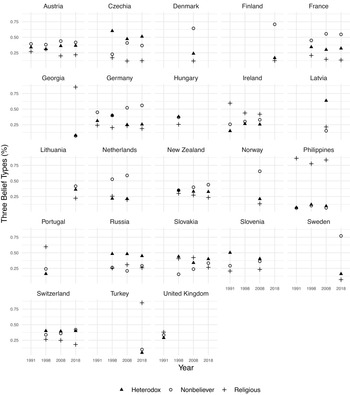
While receiving little attention in electoral research, heterodoxy has been documented as a widespread phenomenon in modern society, especially among young demographics, against the backdrop of declining conventional religiosity in the West (Lambert Reference Lambert2006; Voas and Chaves Reference Voas and Chaves2016; Pollack and Rosta Reference Pollack and Rosta2017; Inglehart Reference Inglehart2021; Wilkins-Laflamme Reference Wilkins-Laflamme2021; van Prooijen, Cohen Rodrigues, Bunzel et al. Reference van Prooijen, Cohen Rodrigues and Bunzel2022; Pelizzo and Kuzenbayev Reference Pelizzo and Kuzenbayev2023; Patrikios and Huhe Reference Patrikios and Huhe2024). In Figure 2, we plot the shares of heterodox believers, religious believers, and non-believers in the 23 countries surveyed across ISSP survey waves from 1991 to 2018 (see section Data and Variables for measurement details). The distributions in Figure 2 largely corroborate the established picture of a religious decline, particularly across Western democracies. However, in sharp contrast to the expectation of the popular binary framework, we observe only modest and limited increases in actual non-believers. In countries such as Austria, Czechia, and France, the share of non-believers even declined between 2008 and 2018. On the other hand, heterodoxy is not only present in substantial shares and stable over time in most countries in the ISSP data, but occasionally registers rises, such as in Austria and Ireland. Overall, Figure 2 shows that heterodoxy is a considerable presence in modern societies (see also online Supplementary Appendix A).

Heterodoxy and electoral behaviour
Citizens’ active and judicious electoral participation is the essential input of a healthy liberal democracy. We disentangle the contribution of worldviews in these electoral outcomes by updating the popular dichotomous framework of ‘religious vs non-religious’. Specifically, we split what the popular framework regards as a homogeneous ‘non-religious’ worldview into two further subgroups: heterodox believers and non-believers. The discussion that follows describes how these two worldviews differ and how they compare to the surviving religious worldview. Since heterodoxy has been ignored by the political behaviour literature until recently, our argument draws on a variety of evidence and theoretical claims from other literatures.
Historically, the heterodox worldview has been closely associated with distrust of the established normative order (for recent evidence, see Patrikios and Huhe Reference Patrikios and Huhe2024; cf. Norris Reference Norris2024). The negative reaction of authoritarian governments against forms of heterodoxy is suggestive of this potentially subversive character: ‘Communists ban the occult’ reported the Associates Press in 1950 on the Czech government’s action against fortune tellers (1950; see also Bruce Reference Bruce2003: 192). Examples of heterodoxy as the cultural foundation of subaltern reaction against institutional authority abound, ranging from agrarian revolts in pre-modern Europe to Pacific cargo cults (eg Scott Reference Scott1990). In turn, modern heterodoxy is often found at the fringes of various progressive, dissenting, and resistance movements; for instance, pro-environment, anti-globalisation, and anti-capitalism causes (eg Heelas Reference Heelas1996; see an attempt to connect spirituality with the Green vote in Siegers, Franzmann and Hassan Reference Siegers, Franzmann and Hassan2016). Therefore, heterodox distrust in institutions seen as illegitimate differs dramatically from the constructive distrust of rational ‘critical’ non-believers, which aims to improve institutions seen as legitimate (Patrikios and Huhe Reference Patrikios and Huhe2024).
Heterodox distrust also reflects an intuitive cognitive style expressed as fundamental scepticism of modern science and of empirical thinking. Heterodox believers tend to be gullible, uncritical processors of information; in contrast, non-believers exemplify the analytic mode of thinking (Pennycook, Cheyne, Seli et al. Reference Pennycook, Cheyne, Seli, Koehler and Fugelsang2012: 335–36). Analytic thinking requires more cognitive resources and uses objective information to reject misleading intuitions. In other words, heterodox believers are more susceptible to problematic phenomena such as misinformation, conspiracism, and magical solutions to complex problems, which are often associated with non-mainstream political actors located at the ideological fringes. This distinction in cognitive styles has already been connected to the legitimacy crisis experienced by various mature democracies (eg Oliver and Wood Reference Oliver and Wood2018).
Finally, modern heterodoxy reflects a distinctive socialisation that has been described as an ‘audience’ and ‘consumerist’ experience (Bruce Reference Bruce1995: 103; Reference Bruce2003: 194; Stolz Reference Stolz2010). Put differently, ‘there is no “church” of astrology’ (McGuire Reference McGuire2002: 122). Modern heterodoxy is understood as an inward-looking phenomenon, one that is disengaged and detached from a disappointing outside world (Heelas Reference Heelas1996: 1–3). We contrast this private disposition to the more positive, constructive scepticism of non-believers, the democratic ideal of the engaged ‘critical citizen’. Overall, heterodoxy reflects a culture of unhealthy distrust, intuitive rather than analytic reasoning, and social atomism, in a unique combination of traits that could help explain puzzling electoral patterns of apathy and non-mainstream choice in contemporary democracies.
Hypotheses
We develop two main hypotheses to test empirically the role of belief types in individual turnout and party preference in comparative perspective. Low electoral participation and the non-mainstream vote are generally seen as detrimental to the proper working of democratic institutions (Norris Reference Norris and Norris1999; Diamond Reference Diamond2008; Hansford and Gomez Reference Hansford and Gomez2010; Foa and Mounk Reference Foa and Mounk2016). Turnout has been declining steadily across most advanced democracies (Blais and Rubenson Reference Blais and Rubenson2013; Hooghe and Kern Reference Hooghe and Kern2017), while electorates are increasingly turning to parties that deviate from the ideological mainstream (Mudde Reference Mudde2004; Arzheimer and Carter Reference Arzheimer and Carter2006; Ivarsflaten Reference Ivarsflaten2008; Rooduijn, Burgoon, van Elsas et al. Reference Rooduijn, Burgoon, van Elsas and van de Werfhorst2017; Guth and Nelsen Reference Guth and Nelsen2021).
Regarding turnout, the popular ‘religious vs non-religious’ dichotomy expects that the predominantly ‘non-religious’ citizens of modern secular society, as a crude category that does not differentiate between heterodoxy and non-belief, are sceptical but at the same time aspirational about the potential of democracy. This idea is summarised implicitly by the concept of the ‘critical citizen’ and similar concepts that depict the idealised citizen of a secularised liberal democracy who does not exhibit ‘the deference to authority that once was common in many Western democracies’ and who is critical of political institutions but ‘simultaneously expressing support for the democratic creed’ (Dalton Reference Dalton and Norris1999: 74; see also Inglehart and Welzel Reference Inglehart and Welzel2005). According to popular readings of modernisation theory, this positive disposition keeps the crudely defined ‘non-religious’ group engaged politically in a constructive attempt to improve political institutions.
We re-examine this popular reading with hypotheses H1a and H1b. As discussed earlier, this thesis is based on a problematic dichotomous framework of ‘religious vs non-religious’ that overlooks heterodoxy, a culture of unhealthy systemic distrust, intuitive reasoning, and social atomism that exists outside of conventional religion (Figure 1). These features should render heterodox believers, who are neither religious nor actual non-believers, less likely to want to reform the democratic system in a constructive direction and, by extension, to participate in elections. This positive, constructive role is attributed only to actual non-believers, who are separated from the heterodox in our tripartite framework instead of being collapsed together under a crude ‘non-religious’ category. Therefore, H1a reflects the strong participatory ethos of actual non-believers as the proverbial ‘critical’ citizens. More importantly, H1b highlights the problematic presence of heterodoxy in modern society that has been previously overlooked under the generic ‘non-religious’ grouping. We expect that, despite their secular (non-religious) orientation, heterodox believers will not exhibit higher levels of electoral participation, thereby contradicting the modernisation thesis. Our point of reference in this discussion is the religious worldview (ie religious believers).
Individual turnout
H1a Compared to religious believers, non-believers are more likely to vote.
H1b Compared to religious believers, heterodox believers are not more likely to vote.
Regarding party choice, there is a strong connection between conventional religious belief and support for the institutions of temporal authority, typically the state and mainstream political actors. Concepts such as civil religion (Coleman Reference Coleman1970) anticipate a close association between holding a worldview that posits a single omnipresent-omnipotent deity and supporting established secular institutions. This translates into religious support for pro-systemic, mainstream political actors and into aversion to non-mainstream, radical causes. Empirical studies indicate that conventional religiosity shields the individual from anti-establishment political orientations (eg Hayes Reference Hayes1995; Knutsen Reference Knutsen2004; Norris and Inglehart Reference Norris and Inglehart2004; Van der Brug, Hobolt and De Vreese Reference Van der Brug, Hobolt and De Vreese2009; Raymond Reference Raymond2011; Patrikios and Huhe Reference Patrikios and Huhe2024; but see Immerzeel, Jaspers and Lubbers Reference Immerzeel, Jaspers and Lubbers2013). On the other hand, as discussed earlier, heterodoxy and non-belief alike reflect a more critical orientation towards established political institutions, albeit qualitatively different in character, which should translate as anti-systemic party support.
Based on this discussion, we test the following hypotheses:
Mainstream party choice
H2a Compared to religious believers, non-believers are less likely to vote for mainstream parties.
H2b Compared to religious believers, heterodox believers are less likely to vote for mainstream parties.
In summary, our tripartite framework allows us to test our core thesis that the heterodox worldview is key to our understanding of the problematic trends that characterise modern democracies: electoral disengagement and anti-systemic party choice.
Data and variables
We rely mainly on data from the four waves (1991, 1998, 2008, and 2018) covered by the Religion modules of the International Social Survey Programme (ISSP 2019; ISSP 2020). The analysis includes respondents from the following countries: Austria, Czechia, Denmark, Finland, France, Georgia, Germany, Hungary, Ireland, Latvia, Lithuania, Netherlands, New Zealand, Norway, Philippines, Portugal, Russia, Slovakia, Slovenia, Sweden, Switzerland, Turkey, and the UK. Among the 23 countries, 10 countries have participated in at least three out of the total four waves available (see Figure 2).
Countries in our sample differ markedly in such contextual features as population size, economic development, polity type, and historical legacies like communism. We thus augment our individual-level data with contextual data from the World Bank and the V-Dem project (Coppedge, Lindberg, Skaaning et al. Reference Coppedge, Lindberg, Skaaning and Teorell2016). Specifically, we retrieved various country-level data from the World Development Indicators (WDI, https://cran.r-project.org/web/packages/WDI/index.html) and regime information from V-Dem (https://github.com/vdeminstitute/vdemdata). Comparative variation makes these countries a good sample from which to explore the impact of belief types on electoral behaviour.
We do not perform any imputation for missing data in the following analysis. Observations with missing values are excluded, which may lead to a reduction in the effective sample size. This is to avoid introducing additional assumptions about the data-generating process, which are required for imputation.
Worldviews: religious, heterodox, and non-belief
We opted for a clear categorisation of worldviews to ensure cross-national comparability. We categorise the three basic worldviews available to modern populations by cross-tabulating two key dimensions: religious belief and heterodoxy (see also Patrikios and Huhe Reference Patrikios and Huhe2024). While heterodox believers are high in heterodoxy and low in religiosity, non-believers are low in both dimensions. On the other hand, religious believers are high in religious belief, regardless of heterodoxy. We gauge heterodoxy using four ISSP items that measure respondents’ assessment of whether the following are true or false:
-
(1) ‘Good luck charms sometimes do bring good luck’
-
(2) ‘Some fortune tellers really can foresee the future’
-
(3) ‘Some faith healers do have God-given healing powers’Footnote 1
-
(4) ‘A person’s star sign at birth, or horoscope, can affect the course of their future’
Responses to this battery, which has been found to be a reliable measure of the underlying concept (Cronbach’s α = 0.81; also see Patrikios and Huhe Reference Patrikios and Huhe2024), are recorded on the same four-point scale, from ‘definitely true’ (1) to ‘definitely false’ (4). We average the reversed answers to the four statements and create a binary variable of heterodoxy based on a cut-off point (whether the reverse mean score is larger than 2). Our cut-off point aims to capture respondents who are prone to admit to heterodoxy despite the social desirability bias against reporting such fringe beliefs in modern society (for the general tendency to self-censor unconventional opinions, see a recent overview in Norris Reference Norris2024). While the ISSP battery does not cover all aspects of heterodoxy (eg Tobacyk Reference Tobacyk2004; Baker, Bader and Mencken Reference Baker, Bader and Mencken2016), the four items avoid being too specific to particular cultures (eg by measuring context-specific superstitions or alternative spiritualities), cover a diverse range of generic beliefs encountered in most cultures, and serve as a useful comparative proxy of respondents’ overall heterodox disposition. However, as emphasised earlier, we acknowledge the inherent complexity of heterogeneity in worldviews that may distinguish different societies and, in our Conclusion, propose measurement directions for future research.
We construct the measure of the conventional religious worldview based on the survey item that asks about ‘belief in God’. The available response options are:
‘I don’t believe in God’
‘I don’t know whether there is a God and I don’t believe there is a way to find out’
‘I don’t believe in a personal God, but I do believe in a Higher Power of some kind’
‘I find myself believing in God some of the time, but not at others’
‘While I have doubts, I feel that I do believe in God’
‘I know God really exists and I have no doubts about it’
We coded a new binary variable as ‘1’ when respondents opted for the last option, which reflects unequivocal belief in God, and ‘0’ otherwise. We use this cut-off point to minimise the risk of ‘soft’, nominal or cultural religiosity still present in most countries that form our sample being mistaken for religious belief. We also note that while our use of this variable is focused on the comparison of worldviews (different beliefs regarding the ultimate meaning of reality, especially the presence of supernatural causation), religious belief has a complex relationship with other religiosity dimensions that include behavioural (attendance) and identity (affiliation) elements (eg Knutsen Reference Knutsen2004; Norris and Inglehart Reference Norris and Inglehart2004).Footnote 2
Together, the cross-tabulation of the above two binary variables allows us to identify three basic types of worldviews in cross-national contexts.Footnote 3 We note that although heterodoxy and religious belief are measured directly, non-belief (neither heterodox nor religious) can only be measured via its absence. ISSP surveys, and other comparative survey programmes, do not contain questions directly about rational or other cognitive styles and information processing (on the relationship between science attitudes and heterodoxy, see Patrikios and Huhe Reference Patrikios and Huhe2024; see also the specialised Cognitive Reflection Test, Pennycook, Fugelsang and Koehler Reference Pennycook, Fugelsang and Koehler2015: 426).
As discussed earlier (Figure 2), the presence of the heterodox worldview has been a persistent feature of modern societies and varies markedly across countries (see also Supplementary Appendix A).
Electoral behaviour: turnout and the mainstream vote
We examine the role of the three basic worldviews in electoral participation from two angles: voter turnout and mainstream party choice. First, for turnout we use respondents’ answers to the question whether they voted in the last general election (‘1’) or not (‘0’).
Second, to examine party preference in a cross-national manner, we focus on the ideological positions of the parties voted by respondents. We recoded ISSP’s comparative measure of the ideological position of each respondent’s party choice. This measure is readily available in the ISSP data and allocates party preference along a 1 to 5 left-right axis: far left (‘1’), left, centre left (‘2’), centre, liberal (‘3’), right, conservative (‘4’), and far right (‘5’), plus an excess ‘other’ category. The classification of parties for each country into these five categories is based on national experts’ judgements, documented in the background variable documentation for each ISSP participating country.
In our recoding of this raw variable, we measure voters’ choice of mainstream parties by folding the above left-right scale into a binary variable that contrasts mainstream party choice (‘1’ for left, centre left; centre, liberal; right, conservative) to non-mainstream party choice (‘0’ for far left; far right). Our theoretical expectations regarding heterodoxy as a vehicle of anti-systemic sentiment, together with our empirical comparisons of diverse party systems where specific party ideologies may lack comparability, lead us to opt for this general distinction (mainstream versus non-mainstream) rather than for more detailed and context-dependent ideological categorisations. We also conduct robustness tests by excluding countries where party classification may be problematic (ie Hungary, Russia, Turkey, see Supplementary Appendix E; for a list of non-mainstream parties by country, see Supplementary Appendix F).
Controls and mediators
Our analysis includes additional variables at the individual and the country level, including features highlighted in the political behaviour literature as determinants of turnout and party preference (eg Bernardi, Mattila, Papageorgiou et al. Reference Bernardi, Mattila, Papageorgiou and Rapeli2023; Cheng, Chung and Cheng Reference Cheng, Chung and Cheng2023), which might also covary with belief systems. The addition of the following controls at least ensures that any effects that we detect from belief types are net of the contribution of other processes. At the individual level, we incorporate respondents’ age (see also Supplementary Appendix G), gender, education (higher scores indicate higher educational qualifications), and life satisfaction (reverse coded, with higher scores indicating happier). At the aggregate level, we control for survey wave, population size, percentage of urban population, GDP per capita, regime type, and communist legacy.
The final part of our analysis employs mediation models to explore the three main mechanisms through which heterodoxy might affect political behaviour: institutional trust, cognitive style, and social atomism. We operationalise institutional trust by using the mean score of the following battery of survey items: ‘How much confidence do you have in: a) Parliament; b) Business and industry; c) Churches and religious organisations; d) Courts and the legal system; and e) Schools and the educational system?’ We use pro-science attitudes as a proxy of cognitive style (Likert scale: ‘We trust too much in science and not enough in religious faith’). Our proxy for social atomism is the survey item of social trust: ‘Generally speaking, would you say that people can be trusted or that you can’t be too careful in dealing with people?’ We reversed original codings where necessary so that larger values denote stronger institutional trust, a pro-science tendency, and stronger social trust.
Results
Our dataset is multilevel, whereby individuals are nested within countries and a majority of the sampled countries have multiple waves. We adopt multilevel analysis in this comparative study as it offers less biased estimates by accounting more effectively for both between-country and within-country variation (Gelman and Hill Reference Gelman and Hill2007). Specifically, we opt for a two-level design with the first level being individual and the second level country.
Table 1 presents multilevel logistic regression results of the relationship between worldviews and voter turnout. Model 1 is the baseline model that includes worldviews only. While there are negative effects of heterodox beliefs on voter turnout, such effects could be confounded by variables like education and age as these confounders affect both respondents’ worldviews and their turnout. For this reason, we add these individual-level controls, in addition to survey wave and country-level controls in a stepwise manner from Models 2 to 4. Three important findings stand out. First, we find that worldviews do affect voter turnout, particularly after important individual- and country-level controls are incorporated.
Multilevel logistic regression analysis of worldviews and voter turnout

Note: +P < 0.1, *P < 0.05, **P < 0.01, ***P < 0.001.
a ‘19 and younger’ as reference.
b ‘1991’ as reference (turnout not available in 1998).
c ‘Electoral autocracy’ as reference.
Second and more specifically, Models 2 to 4 indicate that non-believers are indeed more likely to vote than are religious believers. This finding supports H1a and is robust when various controls are included. This corroborates the importance of the presence of ‘critical citizens’ in maintaining a participatory democratic culture. While less trusting in institutions and less satisfied with the actual performance of governments, non-believers remain actively engaged with the democratic process.
Third, Models 2 to 4 suggest that heterodox believers and religious believers (reference group) are not significantly different in terms of their likelihood to vote. The absence of a significant turnout difference between the two worldviews supports H1b. Therefore, by distinguishing between non-belief and heterodoxy, instead of collapsing the two together into one crude idealised ‘non-religious’ category, the analysis reveals a counteracting pattern: only one subgroup within the crude ‘non-religious’ segment, non-believers, exhibits positive participatory behaviour vis-a-vis the religious reference group. This does not apply to the other group within the crude ‘non-religious’ segment, that is, heterodox believers.
Model 5 juxtaposes, for comparison only, results based on the popular ‘religious’ vs ‘non-religious’ dichotomy that has been the standard approach in political behaviour research. Although using a similar model specification, Model 5 points to no marked impact of worldviews on voter turnout. This suggests that the dichotomous worldview framework could lead us to wrongly dismiss the critical influence of fundamental worldviews on electoral politics.
Taken together, these differences in the participatory orientation of heterodox believers and non-believers produce an alternative understanding of the challenges facing modern democracies. In contrast to the sanguine forecast based on the ‘declining religious vs emerging non-religious’ dichotomy, which expects positive participatory outcomes, these findings suggest that a less religious population will not necessarily boost democratic participation. The positive presence of ‘critical’ non-believers may be offset by the extensive presence of heterodox citizens, if the latter grow in numbers in modern society.
The evidence presented so far shows that the crude ‘non-religious’ category is composed of two very different subgroups in terms of electoral participation: the heterodox and non-believers. This vindicates our tripartite definition of the role of worldviews in electoral behaviour. However, our tripartite framework also argues that heterodoxy differs from conventional religious belief. In this direction, multilevel logistic regression tested hypotheses H2a and H2b to explore the relationship between belief type and mainstream (vs non-mainstream) party affiliation. The main empirical relationships are plotted in Figure 3 (for full results, see Supplementary Appendix H). According to Models 6 to 9, heterodox believers and non-believers are less likely to vote for mainstream parties compared to religious voters. This supports H2a and H2b. Consistently with other empirical studies (eg Arzheimer and Carter Reference Arzheimer and Carter2009; Immerzeel, Jaspers and Lubbers Reference Immerzeel, Jaspers and Lubbers2013; Montgomery and Winter Reference Montgomery and Winter2015), we find no evidence of a cultural backlash among religious voters in the direction of non-mainstream parties. Instead, religious believers are more likely to stick to mainstream parties.
Belief types and mainstream party vote (religious believers as reference).

Possible mechanisms: institutional trust, pro-science, and social trust
The above analysis confirms the overall effects of heterodox beliefs, characterised by the distinctive combination of electoral disengagement and anti-systemic party choice. As we argued in Section Heterodoxy and electoral behaviour, people’s fundamental worldviews could shape their everyday political behaviour via three important mechanisms: 1) political orientations, particularly an anti-authority tendency (Patrikios and Huhe Reference Patrikios and Huhe2024); 2) cognitive styles, especially analytic vs intuitive reasoning (Pennycook, Cheyne, Seli et al. Reference Pennycook, Cheyne, Seli, Koehler and Fugelsang2012); and 3) socialisation patterns, in particular social atomism (McGuire Reference McGuire2002). The following analysis advances our understanding of how people’s fundamental worldviews work by exploring these possible mechanisms.
We use institutional trust to gauge respondents’ attitudes to authority, pro-science attitudes as a proxy for cognitive style, and social trust as a proxy for social atomism. From an analytical perspective, these three variables are treated as mediating variables via which worldviews affect voter turnout. We begin by regressing each mediator on respondents’ worldviews to assess whether and how worldviews shape these mechanisms (ie mediator models). Subsequently, we estimate a model predicting voter turnout, including both the worldviews and the mediating variables (ie outcome models). The results are presented in Table 2 (for full results, see Supplementary Appendix I).
Linear and logistic multilevel regression analysis of potential mediators and voter turnout

Note: *P < 0.05, **P < 0.01, ***P < 0.001.
a ‘Religious’ as reference.
The results in Table 2 indicate that worldviews have strong and varied effects on voter turnout by shaping individuals’ institutional trust, pro-science attitudes, and social trust. However, it is important to emphasise that these estimates are only suggestive and should not be interpreted as the mediated or indirect effects of worldviews through the three mediators. This limitation arises for two reasons: 1) worldviews are multi-categorical; and 2) turnout is a nonlinear outcome (Imai, Keele, Tingley et al. Reference Imai, Keele, Tingley and Yamamoto2011; VanderWeele Reference VanderWeele2011; Lange, Vansteelandt and Bekaert, Reference Lange, Vansteelandt and Bekaert2012; Pearl Reference Pearl2014). For these reasons, we make use of natural effect models (Steen, Loeys, Moerkerke et al. Reference Steen, Loeys, Moerkerke and Vansteelandt2017), which are better suited for estimating the causal quantities of interest on their appropriate scale. The results from these models are shown in Figure 4. We refer to the mediated effects of worldviews as indirect effects, whereas direct effects refer to worldview-induced changes in turnout when keeping the mediator fixed. In other words, the overall effects of worldviews in Table 1 are decomposed here into indirect and direct components.
Indirect and direct effects of worldviews on turnout (religious believers as reference, 90% bootstrap CI).

Figure 4 offers a more nuanced depiction of how fundamental worldviews can influence voter turnout in varied ways. Regarding institutional trust (left-hand panel), the pronounced and negative indirect effects highlight its role as a key mediator. This indicates that both non-believers and heterodox believers tend to exhibit lower levels of institutional trust compared to religious believers (Patrikios and Huhe Reference Patrikios and Huhe2024). Yet, the stronger direct effects observed among non-believers (0.142) offset the negative indirect effect (−0.089). This confirms the presence of ‘critical citizens’ who despite their critical stance towards institutions remain firmly committed to democratic norms and values. In contrast, the direct effects of heterodox believers are weaker (0.084) and unable to offset the negative indirect effects, making heterodox believers not more likely to vote in overall terms. Therefore, while heterodox believers are more sceptical of authority than are religious believers, they are significantly less committed to democratic participatory norms than are non-believers.
Regarding the pro-science mechanism (Figure 4, middle panel), the strong and positive indirect effects associated with non-believers as well as the absence of a direct effect suggest that non-believers’ stronger turnout is effectively driven by their pro-science attitude. On the other hand, heterodox believers exhibit slightly lower levels of pro-scientific attitudes, but this effect is modest and insufficient to offset their overall tendency towards electoral disengagement. Finally, regarding social trust (right-hand panel), we find limited discrepancies between Table 2 and Figure 4. The indirect effect of social trust in Figure 4 is marginally insignificant at 0.11, indicating a weak mediating mechanism.
Conclusion and discussion
Motivated by puzzling trends in electoral participation across modern secular democracies, which clash with the assumption that these democracies are increasingly populated by non-believing critical citizens, we re-examined the impact of mass belief systems. We focused on the unique role of heterodox worldviews, which have long been masked by the binary sacred-vs-secular modernisation framework. Our emphasis on heterodoxy not only produces a more nuanced picture of how worldviews are distributed in an age of secularisation, but also uncovers an overlooked explanation of the increasing electoral disengagement and delegitimation that mark the mature democracies of the twenty-first century.
Our comparative analysis draws on ISSP Religion modules (1991−2018) and shows that heterodox believers are ubiquitous in modern societies. More importantly, we find that heterodox believers exhibit markedly different electoral behaviour, thus challenging the optimistic view of democratic participation under secular modernity. Specifically, while ‘critical’ rational non-believers are generally more inclined to vote than are religious believers, heterodox believers are less inclined to do so. The latter are also more likely to support non-mainstream political parties than are religious believers. This unique combination of electoral apathy and non-mainstream partisan orientation sets heterodoxy apart from both rational non-belief and the conventional religious worldview.
Therefore, heterodoxy is the worldview that can 1) alienate individuals from collective causes, which are typically pursued via elections in democracies, and 2) favour party choices that challenge the liberal democratic order. However, these individual-level dynamics do not automatically translate into aggregate electoral outcomes. The actual electoral significance of heterodoxy can be moderated by other factors, such as the relative population presence of heterodoxy vis-à-vis religion and non-belief as shown in Figure 2, as well as institutional variation in electoral systems.
In revealing the long-overlooked role of heterodoxy in comparative politics, our reading of these findings has important theoretical and practical implications. We view these findings as confirmation of the persistent political consequences of people’s deep-seated worldviews about the supernatural, which also highlight the need to develop a more nuanced understanding of human beliefs in political research. Our study suggests that ongoing challenges to electoral democracies under secular modernity are partly driven by the presence of heterodox believers, who are prone to intuitive rather than analytic thinking and who remain distrustful of, detached from, and thus unreachable by established political institutions. Heterodox citizens are likely to remain open to arbitrary and implausible – that is, magical – solutions to complex societal problems. This combination of detachment from mainstream politics and openness to fantastical ideas represents a significant challenge to democratic politics. It points to a growing disconnect between certain voter segments and the institutional frameworks designed to address societal challenges through reasoned debate and evidence-based policymaking. Addressing this challenge requires further exploration of the nature of human beliefs in an age of secularisation and how these can reshape electoral dynamics across democracies.
However, this study of comparative electoral behaviour cannot adequately address questions about the role of political parties in this challenging environment. Given non-trivial or even rising heterodoxy in mature democracies that also exhibit related tendencies towards knowledge resistance and distrust of expertise (Ward and Voas Reference Ward and Voas2011), parties may come to identify compelling incentives to adopt ‘epistemically suspect’ or magical ideas and pledges, in an attempt to capture overlooked niche electoral markets located further apart from the ideological and epistemic centre ground (see recent rhetorical evidence in Aroyehun, Simchon, Carrella et al. Reference Aroyehun, Simchon, Carrella, Lasser, Lewandowsky and Garcia2025). We view this potentially self-reinforcing cycle of heterodox demand and supply as profoundly troubling. In our reading, a ‘vicious cycle’ of naïve extremism or extremist naïveté threatens the very fabric of modern representative democracy. It risks further shifting political discourse away from evidence-based and pragmatic solutions, undermining institutional legitimacy and creating a fertile ground for further polarisation and radicalisation.
This study thus points to the necessity of re-examining policies and strategies to foster more inclusive and resilient political systems. Ignoring the presence of heterodox believers could preserve overly optimistic interpretations and problematic diagnoses of declining turnout and anti-systemic partisan trends. This optimism assumes that the conventional religious worldview will inevitably become insignificant and will be replaced by a rational worldview (non-belief) under the inevitable, linear advance of secular modernity. This Whiggish reading drives interventions such as enhancing civic education and improving government communication. These interventions presume that better-informed citizens will respond ‘critically’, instrumentally, and judiciously to the efforts of established political institutions. However, this overlooks the complexities introduced by modern heterodoxy, thus underscoring the importance of revisiting these assumptions to develop effective approaches.
Our analysis leaves several important questions unanswered, pointing to promising avenues for future research.Footnote 4 While our conclusions concern mainly Western democracies covered by the ISSP, the politics of heterodoxy may assume different expressions in other, less modernised societies (eg see a case study of Togo in Gershman Reference Gershman2016; Harakan, Pelizzo and Kuzenbayev Reference Harakan, Pelizzo and Kuzenbayev2023; Kinyondo, Kuzenbayev and Pelizzo Reference Kinyondo, Kuzenbayev and Pelizzo2024; Pelizzo, Koepko, Kuzenbayev et al. Reference Pelizzo, Koepko, Kuzenbayev and Kinyondo2023). In a similar vein, heterodoxy is not a monolithic bloc in modern societies but rather encompasses diverse forms, ranging from those captured by the ISSP items to more localised and communal variants, such as Wicca in the UK and stregheria in Italy (eg Tubadji Reference Tubadji2022). Future studies with fine-tuned measurement of heterodoxy should be able to explore this important contextual distinction. A similar need applies to the measurement of the rational worldview. In this study, we operationalised it as the absence of the other two worldviews. Concrete affirmative measures that measure the actual presence of the rational worldview do not tend to appear in comparative survey programmes, but these exist in more focused empirical studies (eg the specialised Cognitive Reflection Test, Pennycook, Fugelsang and Koehler Reference Pennycook, Fugelsang and Koehler2015: 426).
Finally, future changes in mass worldviews warrant greater theoretical and empirical attention. While our main data source, the ISSP Religion modules from 1991 to 2018, has inconsistent country coverage across waves, there is some evidence available suggesting that heterodoxy has become increasingly popular among younger generations (Patrikios and Huhe Reference Patrikios and Huhe2024). A similar trend applies to the United States (Orth Reference Orth2022). Generational changes may signal a broader transformation in how individuals engage with non-empirical, supernatural questions in an age of rapid technological change, increasing economic insecurity, and cultural evolution. Future research steps should therefore assess whether heterodoxy will indeed persist in modern societies and explore how it might reshape democratic politics.
Supplementary material
The supplementary material for this article can be found at https://doi.org/10.1017/S1475676526101261
Data availability statement
The analyses were conducted using data sources cited in the main text. All replication datasets and codes are publicly available at the Open Science Framework (https://doi.org/10.17605/OSF.IO/8X4ST).
An interactive Quarto file is available as a second online Appendix.
Funding statement
The authors received no financial support for the research, authorship, and/or publication of this article.
Competing interests
The authors declare no competing interests.



 Open access

