

Introduction
Several studies have ascribed COVID-19 the role of a window opener (Auener et al. Reference Auener, Kroon, Wackers, van Dulmen and Jeurissen2020; Bodenheimer and Leidenberger Reference Bodenheimer and Leidenberger2020; Möck et al. Reference Möck, Vogeler, Bandelow and Hornung2023; Schmidt et al. Reference Schmidt, Sieverding, Wallis and Matthies2021; Shirazi et al. Reference Shirazi, Vahdaninia and Maleki2024; van den Dool Reference van den Dool2023) or accelerator for policy reforms. From the perspective of the multiple streams framework (MSF), windows of opportunity are a necessary condition for agenda and policy change, as they allow policy entrepreneurs to couple their preferred policies with problems, provided that political conditions are favorable. Swiss health care policy experienced a major reform in the aftermath of this window, but the reform remains puzzling given that the Swiss political system is characterized by federalism and highly consensus-oriented processes, which allegedly slow down policy change (Vatter Reference Vatter2020). This political stability usually hinders the ripening of the political stream and the adoption of path-departing reforms. While one could argue that COVID-19 sparked the reform, there remains the question of the role of the institutional context and how the relatively weak power of the supporters of the reform enabled successful policy entrepreneurship.
Addressing this puzzle, this article poses the question why and how the three streams were coupled in Switzerland, leading up to the use of the COVID-19 pandemic as a decision window. To answer this question, we combine the theoretical perspective of the programmatic action framework (PAF) (Bandelow et al. Reference Bandelow, Hornung and Smyrl2021) with the MSF (Kingdon Reference Kingdon2013). The PAF assumes that policy actors, under certain circumstances, form programmatic groups around policy programs and develop a distinct collective social identity (Hornung Reference Hornung2023). Policy change is then the result of programmatic action, which is the formation of the programmatic group and the constant promotion of the policy program by its members, who have a direct influence on policymaking.
The concept of programmatic groups allows for expanding the notion of collective policy entrepreneurs in the MSF (Capano and Galanti Reference Capano and Galanti2021; Petridou Reference Petridou2014). In MSF terms, policy entrepreneurs are those actors that couple the independent streams of policy, problem, and politics during a window of opportunity for agenda setting or decision-making (DeLeo et al. Reference DeLeo, Zohlnhöfer and Zahariadis2024). A theoretical cross-fertilization of both frameworks contributes to understanding mechanisms of partial coupling (Dolan Reference Dolan2021) of policy and problem stream (through programmatic groups), and to considering the necessity of timing and institutional resources of programmatic groups in what concerns favorable political constellations and windows of opportunities.
In combining these theoretical frameworks, this article makes three main contributions. First, it outlines an additional mechanism that can link policy and problem stream and contributes to understanding partial coupling: the programmatic group. Second, it introduces a complementary perspective on the internal functioning of programmatic groups, which can emerge from a strengthening in social identification. This contributes to the study of actors in MSF, which has been characterized as thriving from theoretical advancements (Zohlnhöfer and Herweg Reference Zohlnhöfer and Herweg.2024). Third, it outlines that in a political system shaped by direct democracy and consensus, such as Switzerland, people’s initiatives present institutional resources that programmatic groups, as collective policy entrepreneurs, actively use to create an agenda window, but the adoption of a proposal still depends on a window of opportunity. In doing so, the article contributes to a core gap in MSF research, which consists in providing a better depiction of policy entrepreneurship both regarding interaction within a network or community and regarding the embeddedness in an institutional context (Cairney Reference Cairney2024). Direct democracy broadens the number of actors who potentially emerge as programmatic groups and extends the possibilities for generating public approval for policy proposals.
The remainder of the article starts by presenting the Swiss case and its empirical relevance for the theoretical contribution of this paper, before reviewing the theoretical foundations of the MSF and the PAF along the lines of a) the coupling of policy and problem stream and b) the emergence of programmatic groups. Afterwards, the application of the MSF and the PAF to the Swiss political context is discussed. Taking the specific example of the Nursing Initiative and its development before and after COVID-19, we provide empirical evidence gathered through expert interviews on the explanatory capacity of cross-fertilizing MSF and PAF. We conclude with an outlook for further research.
Switzerland, direct democracy and the nursing initiative
Policymaking in Switzerland provides a very specific context for groups willing to foster policy change, shaped by three key institutional features: federalism, concordance, and direct democracy (Sager and Asticher Reference Sager, Asticher, Sager, Mavrot and Keiser2024; Vatter Reference Vatter2020). First, federalism ensures power-sharing across the multiple levels of government. Second, concordance ensures that political minorities and social and economic actors are closely involved in the policy process, leading to many veto possibilities at the political level, forcing politicians and policymakers to consider policy options with a high level of acceptance (Sager and Asticher Reference Sager, Asticher, Sager, Mavrot and Keiser2024; Vatter Reference Vatter2020). The power of representative groups in this concordance system is also reflected in the categorization of the political system as neo-corporatist, providing for the close integration of organized interests, such as employers’ associations and trade unions, into the decision-making processes and the mediation of conflicts (Sager et al. Reference Sager, Asticher, Pleger, Polk and Mause2022; Vatter Reference Vatter2020). Finally, closely linked to concordance, direct democracy offers distinct avenues to directly influence policymaking through popular initiatives and referendums. The ability for various actors to initiate popular initiatives by collecting 100,000 signatures at the national level, or to overturn a law passed by parliament collecting 50,000 signatures and holding a referendum, guarantees powerful gatekeeping and places issue definition and problem framing directly in the hands of policy entrepreneurs (Damore et al. Reference Damore, Bowler and Nicholson2012; Lutz Reference Lutz2012).
The popular initiative in particular is a powerful agenda-setting tool because it allows almost anyone to propose a constitutional amendment and, if they can gather the required 100,000 signatures, to submit it to the federal administration before it is put to a vote of the population eligible to vote (Lutz Reference Lutz2012). In this context, the Swiss people are called to vote up to four times a year (Vatter Reference Vatter2020), sometimes on initiatives that amuse the international press, as was the case, for example, with a popular initiative to introduce a ban on cow horn removal in the Swiss Constitution (Le Blond Reference Le Blond2018). The success of initiatives at the ballot box remains very moderate, with an overall acceptance rate of 10%, a rate which even fell at 6% between 2014 and 2019 (Vatter Reference Vatter2020). However, that does not detract popular initiatives from their agenda-setting power. Indeed, after submission, the parliament must examine the initiative and can decide to propose a counter-project, if it considers that the initiative does not adequately address the issue at stake. In this sense, submitting the initiative guarantees that the issue will be discussed within the political bodies at the federal level. In some cases, after a parliamentary counter-project, the initiators may decide to withdraw their initiatives, either because they consider the counter-project to be satisfactory or because they know that they will have no chance at the ballot box. The process itself of drafting and submitting a popular initiative therefore often compels decision-makers to address the issue, opening a window of opportunity for compromise and negotiation no matter the outcome (Vatter Reference Vatter2020).
The particular institutional context in Switzerland, although not favorable to radical and sudden policy change, therefore, under some conditions, offers opportunities and specific chances to influence policy change. But how do these mechanisms work in practice and how can we theoretically grasp sudden policy change in Switzerland? Scrutinizing this question, this paper focuses on the special case of the Nursing Initiative. The Nursing Initiative is a popular initiative launched in 2017 by the Swiss Nursing Association (SNA) which called for an amendment to the Swiss Constitution, adding recognition of nursing care as an essential component of healthcare by the Federal Government and the Cantons, hitherto requiring them to provide (1) adequate, high-quality nursing care for everyone, (2) a sufficient number of qualified nurses, and (3) the opportunity for nurses to work in a field corresponding to their training and skills. Despite a quick and successful collection of signatures the proposal was initially seen as having slim chances in the polls, particularly because union-driven measures tend to fare poorly in Swiss direct-democratic votes (Golder et al. Reference Golder, Mousson, Keller, Venetz, Seebacher, Jenzer and Rey2022). However, against all odds, the initiative was accepted in November 2021 by 61% of voters.
The adoption of the initiative by the Swiss people was likely dependent on the pandemic context, which increased visibility for nursing care as well as enhanced political and societal recognition of the profession (Monteverde and Eicher Reference Monteverde and Eicher2023; Stadelmann-Steffen and Rihm Reference Stadelmann-Steffen and Rihm2022). Indeed, the COVID-19 pandemic amplified public recognition of nurses’ systemic importance, reframing the debate and boosting trust in the nursing profession (Monteverde and Eicher Reference Monteverde and Eicher2023). Even some who typically opposed state intervention expressed agreement with the core concerns of the proposal, including the need to address staffing shortages and improve working conditions (Golder et al. Reference Golder, Mousson, Keller, Venetz, Seebacher, Jenzer and Rey2022). Furthermore, record-high voter turnouts during the pandemic, unseen since the introduction of women’s suffrage in 1971, reaffirmed the relevance of the initiative and public support (Golder et al. Reference Golder, Mousson, Keller, Venetz, Seebacher, Jenzer and Rey2022).
This case is remains puzzling for two main reasons. As the initiative was accepted, it represents an ideal crucial case (Muno Reference Muno, Pickel, Pickel, Lauth and Jahn2009) in terms of outcomes, as the process led to the reform desired by the policy entrepreneurs. At the same time, in the Swiss political system, this acceptance represents a special unusual case, that is one that deviates from the outcome expected on the basis of theoretical and empirical considerations (Seawright and Gerring Reference Seawright and Gerring2008), as the acceptance rate for initiatives remains extremely low. Overall, Swiss health policy remains shaped by the diverse preferences of different groups and electorates in light of direct democracy and veto possibilities (Immergut Reference Immergut1990).
Drawing on this both crucial and puzzling deviant case therefore allows us to understand the mechanisms behind collective entrepreneurship and programmatic action in Switzerland and to explain the coupling processes of problem, policy and politics streams leading to a policy outcome with the launch of the initiative and the final convergence in the form of its acceptance by eligible voters, and therefore the agenda setting and the decision-making phase, in a relatively unusual case. This paper sets out to investigate how Swiss programmatic groups successfully orchestrate stream couplings to achieve significant policy change and how individual and collective dynamics, including the role of shared social identities and power struggles, unfold in Switzerland’s direct-democratic context. Against the backdrop of the detailed institutional context, the next section develops the theoretical perspectives of MSF and PAF in detail and formulates expectations for coupling and programmatic groups in Switzerland, as well as our empirical study of the Swiss case.
Programmatic groups in multiple streams
The origins of the MSF lie in organizational studies and the assumption of ambiguity, which emphasizes the relevance of situational conditions in bringing topics onto the decision-making agenda (Kingdon Reference Kingdon2013). Building on these premises, the MSF has established itself as a framework for analyzing agenda setting and decision-making in public policy processes (Herweg et al. Reference Herweg, Nikolaos and Zohlnhöfer2023). The core elements of this framework are three independent streams (politics, policy, problem) and policy entrepreneurs who couple these streams during windows of opportunity.
Problems, politics, and policies are understood and observed as independent streams, whose convergence only can lead to a conclusive policy adoption in a fleeting opportunity defined as a policy window (Herweg et al. Reference Herweg, Zahariadis, Zohlnhöfer and Weible2018; Kingdon Reference Kingdon2013). Interaction between streams as a mechanism toward convergence is a foundation of the MSF and is further defined by Kingdon as the coupling process (Dolan and Blum Reference Dolan, Blum, Zahariadis, Herweg, Zohlnhöfer and Petridou2023; Kingdon Reference Kingdon2013). As put by Möck et al., coupling means “establishing links between problems, politics, and policies” (Reference Möck, Vogeler, Bandelow and Hornung2023, p. 356). According to Kingdon’s definition, couplings at given moments can be either partial or complete, depending on whether it links all the streams together or just two. Understanding coupling as a process also means that these partial links between the different streams evolve over time, made and unmade, until they eventually converge (Dolan and Blum Reference Dolan, Blum, Zahariadis, Herweg, Zohlnhöfer and Petridou2023; Kingdon Reference Kingdon2013).
Coupling
Coupling, and especially partial coupling, depends on a number of factors, firstly external, as the relevance of a stream depends on its readiness in a given context, but also tactical, since policy entrepreneurs will actively use strategies to promote these convergences in what are called micro-windows (Dolan and Blum Reference Dolan, Blum, Zahariadis, Herweg, Zohlnhöfer and Petridou2023; Möck et al. Reference Möck, Vogeler, Bandelow and Hornung2023). Indeed, partial and complete coupling are an integral part of the strategies used by policy entrepreneurs. The literature on MSF and coupling opportunities identifies an always growing number of strategies used by policy entrepreneurs (Meijerink and Huitema Reference Meijerink and Huitema2010), such as the salami tactic (Hinterleitner Reference Hinterleitner2019; Zahariadis Reference Zahariadis2003) or concessions (Herweg et al. Reference Herweg, Huß and Zohlnhöfer2015). In this idea of process and convergence, partial couplings are thus created and undone over time, in a perspective of consecutive and multiplied strategies, before the eventual coupling of all three streams (Dolan Reference Dolan2021).
Partial and strategical coupling have further been conceptualized as argumentative coupling, i.e. how couplings between streams are created within discourses (Blum Reference Blum2018), and building on that strand of research, relational coupling, i.e. from a discourse network analysis perspective, the focus on the links between policy entrepreneurs and each individual stream, as well as the link policy entrepreneurs seek to create between the streams (Möck et al. Reference Möck, Vogeler, Bandelow and Hornung2023). Further conceptualizations also provide for analytical differentiation on the basis of the policy cycle, proposing in particular a distinction between coupling in relation to agenda setting and decision-making (Dolan and Blum Reference Dolan, Blum, Zahariadis, Herweg, Zohlnhöfer and Petridou2023; Zohlnhöfer Reference Zohlnhöfer2016) or implementation (Fowler Reference Fowler2022). This conceptualization helps explaining the mechanisms at work in the policymaking process, and the variations between advancing the agenda and actually adopting a policy (Herweg et al. Reference Herweg, Zahariadis, Zohlnhöfer and Weible2018) and allows to show how different policy entrepreneurs can act at different stages of the policy process to couple different streams during open policy windows, leading to the successful adoption of ground-breaking reforms (Becker Reference Becker2019).
Some research gaps still exist. The first is a further inquiry into the mechanisms of coupling that extends the strategies of coupling and digs deeper into the inherent dynamics of collective entrepreneurs and their relation to streams. The relation to streams is, secondly, heavily dependent on the existence of collaborative institutions (Koebele Reference Koebele2021) and certain external factors conditioning entrepreneurs’ reactive behavior (Petridou et al. Reference Petridou, Johansson, Eriksson, Alirani and Zahariadis2024). By examining the mechanisms behind stream coupling via the analysis of the links between policy entrepreneurs, streams, and the institutional arena, we aim to fill this gap and shift the focus from how to why policy entrepreneurs use partial coupling as a strategic tool at a given point in time. To this end and to gain in explanatory power, we propose a cross-fertilization between the MSF and the PAF.
Programmatic groups as collective policy entrepreneurs
Central to the MSF are the policy entrepreneurs, agents actively working to link streams during open policy windows, with the aim of putting their policy on the agenda and ultimately having it adopted (Kingdon Reference Kingdon2013). Within this process, the MSF recognizes the limited rationality of these agents, and in particular the fact that they operate amidst different forces, driven by their own personal and professional self-interest, but also by their deep-rooted value systems and beliefs (Kingdon Reference Kingdon2013; Petridou Reference Petridou, Zahariadis, Herweg, Zohlnhöfer and Petridou2023). While the MSF focuses primarily on the policy entrepreneur on the individual level, in recognizing the importance of their network in entrepreneurial action, the collective nature of their actions (Roberts and King Reference Roberts and King1991), and the existence of common interests and goals, the MSF also accounts for the existence of collective entrepreneurship, when different individuals sharing a common goal enter coordinated action (Zohlnhöfer et al. Reference Zohlnhöfer, Herweg and Huß2016).
It has been shown that a policy entrepreneur’s network makes it possible to identify, to a certain extent, the actors capable of influencing the outcome of the process (Christopoulos and Ingold Reference Christopoulos and Ingold2015). Furthermore, the types of strategies used and their degree of success in relation to the political and institutional context have also been researched on numerous occasions (Brouwer and Biermann Reference Brouwer and Biermann2011, e.g.; Dolan Reference Dolan2021; Mavrikou et al. Reference Maria, Zahariadis and Karokis-Mavrikos2022). In relation to street-level entrepreneurship, collective action coupled with political mobilization enabled a coupling of streams and the advancement of policies carried by street-level bureaucrats, particularly in times of crisis (Gofen et al. Reference Gofen, Lotta and Da Marchesini Costa2021). Policy entrepreneurs are also closely linked to the problem stream and the social construction of policy problems, as they act as discursive and ideational agents in policymaking processes (Cino Pagliarello and Cini Reference Cino Pagliarello and Cini2023).
While the MSF highlights important components of policy entrepreneurship, it devotes less attention to how these actors come together in cohesive groups advocating for a shared policy program, or how collective identities can propel a unified policy agenda. But there is not just a theoretical gap in the MSF to be filled here: Since the inclusion of different actors in policymaking under the institutional feature of concordance is a central element in Swiss policy processes, we expect the origins and development of policy entrepreneurs to be a central explanation for their eventual success. It is with this focus on collective identities and the biographical origins of policy actors that we see an added value of cross-fertilizing MSF with the PAF.
The PAF is a recently established framework of public policy research that identifies programmatic groups and their policy programs as one potential driver of policy change (Bandelow et al. Reference Bandelow, Hornung and Smyrl2021). Regarding collective action, notably bounded rationality, networks, and the search for individual advancement, the PAF focuses on the mechanisms leading to formation of programmatic groups, the creation of a common policy program in a process of joint action via shared social identities and biographies (Hornung et al. Reference Hornung, Bandelow and Vogeler2019). Programmatic groups consist of policy actors who have a direct influence on the policymaking process, through their ability to co-write legislation or shape implementation. Programmatic actors are bound together by personal ties in their biographies, such as expert commissions or educational paths, from which a programmatic group develops and attaches to a jointly worked out policy program that builds the basis for individual preferences and behavior throughout the policy process.
In addition, the PAF tackles the question of power dynamics, an aspect often neglected in other theories of policy processes (Hassenteufel and Genieys Reference Hassenteufel and Genieys2021). For these reasons, we see the PAF as a useful tool to contribute to understanding the mechanisms of stream coupling in MSF research, while MSF research and the focus on situational constellations and institutional resources of entrepreneurs advance insights on the success factors of programmatic groups. From this, we derive two central expectations that are elaborated in the following.
Expectation 1: Programmatic groups emerging as collective policy entrepreneurs and coupling policy with problem stream
Through its focus on issues of shared social identities and grouping with a programmatic aim (Bandelow et al. Reference Bandelow, Hornung and Smyrl2021), the PAF allows us to conceptualize the link between policy entrepreneurs as agent of change and the different streams in a context of competition for political power and relevance, the acknowledgement of identity-defining issues as a public policy problem, and the recognition of the policy program as a desirable policy solution. By considering the internal constitution of programmatic groups and their relationship to the political and institutional context (Hornung Reference Hornung2021), this approach, coupled with stream analysis, sheds light on the juggling mechanisms behind attempts to make policy, politics, and problem converge, hence advancing both theories.
In the Swiss system, direct democracy operates alongside a strong tradition of neo-corporatism, which tightly integrates professional associations and unions into formal policymaking. Through popular initiatives and referendums, policy entrepreneurs can bypass parliamentary channels while leveraging corporatist networks, thereby gaining direct access to both the electorate and influential policymaking venues. Building on this distinctive institutional context, a cross-fertilization of the MSF and the PAF highlights the critical role of collective social identities, long-term professional trajectories, and power struggles. Existing PAF studies in Brazil outlined how health professionals formed as a collective actor in the 1970s and 1980s as so-called sanitaristas and had a substantial impact on the redistributive reforms within a strengthening of Brazil’s Universal Healthcare System, particularly as they placed themselves in power positions relevant to the implementation of the policies even at the subnational level (Davidian, Reference Davidian2021). This already points toward the potential relevance of professions in shaping a social identity that influences policymaking in the long term.
In examining the Nursing Initiative through this combined lens, we therefore expect that:
Strong professional identities, nurses and union representatives sharing educational backgrounds, workplace experiences, and career aspirations, enable the formation of a cohesive programmatic group capable of steering the policy process and acting as a collective policy entrepreneur because only such a group could profit from rather than suffer from the institutional constraints of the Swiss political system. (Expectation 1)
By mobilizing direct-democratic pathways and established corporatist networks, these actors could effectively align problem, policy, and political streams, despite initially unfavorable political conditions. As a result, we predict that the successful convergence of the streams in the Nursing Initiative hinged not just on its substantive merits, but on the collective power, shared identity, and strategic orchestration characteristic of programmatic groups that the PAF deems essential to long-term policy success.
Expectation 2: Programmatic groups as collective policy entrepreneurs benefiting from direct-democratic Swiss institutions
So far, the MSF has been used in various contexts in Switzerland, to explain variations in policy adoption at a subnational level, notably concerning smoking prevention (Kuenzler Reference Kuenzler2018), the promotion of hydroelectricity (Kammermann Reference Kammermann2018), multilevel implementation of asylum policies (Sager and Thomann Reference Sager and Thomann2017), or the extension of the federal framework in the adoption of health policies (Sager et al. Reference Sager, Rüefli and Thomann2019), but never considering specifically direct democracy and policy entrepreneurs in the analysis of different streams and their coupling leading (or not) to reform in Switzerland. Formal political institutions are decisive in the evolution of the policy streams in the agenda-setting phase (Bolukbasi and Yıldırım Reference Bolukbasi and Yıldırım2022), and popular initiatives and direct democracy in general are essential agenda-setting tools in Switzerland (Damore et al. Reference Damore, Bowler and Nicholson2012; Lutz Reference Lutz2012), representing a central strategic instrument of stream coupling for policy entrepreneurs. We therefore expect that:
Programmatic groups will strategically utilize direct democratic tools in Switzerland to align and couple problem, policy, and political streams, ultimately driving or stalling policy reform. (Expectation 2)
This expectation derives from the Swiss political context which should give particular power to policy programs and the policy entrepreneurs within the policy stream in relation to the political and the problem streams, since policy entrepreneurs theoretically can propose a program regardless of the political climate or the perceived salience of the issue through the use of direct democracy.
In cross-fertilizing the two theoretical perspectives, we argue that neither of them alone could explain the adoption of the SNI. The single focus on the windows of opportunities and the coupling of streams would neglect the fact that the content was prepared long before the windows of opportunities presented themselves, and that reconceptualizing policy entrepreneurs as programmatic groups allows for understanding how relatively weak actors and interests were able to actively utilize the Swiss political institutions to achieve their goals. This brings forth the argument that a policy solution is more successful if it is well worked out, strengthening the aspect of the policy stream being ready for coupling and the political stream being actively influenced by the programmatic group. Furthermore, without COVID-19, the programmatic group might have also had a chance at influencing policy adoption, but it would probably have taken longer and would have required other favorable conditions, such as tactical alliances with elected politicians or more resources (key positions) by the programmatic group.
Methodology
Analyzing the processes of policymaking around the Nursing Initiatives requires in-depth insights from policy actors who actively took part in the formulation of the policy and its design. In accordance with existing research on the MSF and the PAF, we adopted a qualitative research design based on the collection of interview data. In a first step, we conducted a systematic analysis of the healthcare policy arena and Switzerland and identified the relevant organizations and actors in Swiss health care policy that can be connected to the Nursing Initiative. In a second step, we contacted the institutions and secured a total of 11 expert interviews with key actors from these different institutions, with the aim of gaining as broad and representative a picture as possible. This number of interviews corresponds to the saturation level commonly discussed in qualitative research, which typically ranges between 9 and 16 interviews (Guest et al. Reference Greg, Bunce and Johnson2006; Hennink and Kaiser Reference Monique and Kaiser2022), and aligns with our own observations during data collection, as new topics ceased to emerge around interview ten. Furthermore, the composition of our sample covering political actors, administrative officials, professional associations, and representatives from education and healthcare reflects the recommendation for an ideal mix of public and private actors (Zohlnhöfer et al. Reference Zohlnhöfer, Herweg, Zahariadis, Weible and Workman2022).
The interviewees were all experts in the politics and policy health sector and included four women and seven men: one national-level politician and union representative; two cantonal-level politicians who had been responsible for public health and had chaired the Swiss Conference of Cantonal Health Directors; one person who had worked as a policy specialist in a cantonal public health department; one person who had worked as a scientific expert and project leader at the Swiss Conference of Cantonal Health Directors; four people who had held management positions at the Federal Office of Public Health, particularly in the regulation of health professions and the development of national health strategies; a representative of the Swiss medical association; a representative of the Swiss nursing association; and two representatives of health training providers, one from a public and one from a private training centers for healthcare professionals, as well as the director of a hospital group. The number of roles mentioned exceeds the number of interviews conducted, as several individuals hold multiple roles, either conjointly or at different moments of their careers. This composition enabled us to cover the entire political and policymaking process, considering the plurality of institutions involved in the issue of nursing care.
Semi-structured interviews were conducted with all interviewees, following a set of core questions and providing a framework for discussion, thus enabling the experts to contribute their expertise in an open way. The initial part of the interview covered general topics, including the healthcare system in Switzerland and the main reforms that have impacted it, before turning to specific factors that led to these developments, with a particular focus on nursing care. In this second part of the interview, the experts were asked to explicitly identify the key players in policymaking, describe their perception of the issues at stake and the drivers of collaboration, talk about their involvement in the health reform processes, their policy-preferences based on their background, and the dynamics throughout the processes leading to the adoption or rejection of health reforms in general and of the nursing initiative in specifics. The interviews provided over 10 hours of audio material, which was supplemented and cross-validated by documents on policy processes in healthcare in Switzerland and on the Nursing Initiative. These documents include all parliamentary debates on the drafting of the counterproposal, as well as documents concerning the administration’s position on the initiative.
The analysis of the material was qualitative and inductive, following a thematic approach. Our aim was to identify recurring themes and observations among the experts, as well as to explore the connections between the streams and the different policy actors. Particular attention was given to the role of nursing as a programmatic group within the broader policy area and its link to the different streams. This approach allowed us to capture and triangulate both shared perspectives and definitions, as well as the structural relationships shaping the policymaking process. This allowed for tracing the reform processes with the different influential factors of problems, solutions, and politics, as well as identifying the programs and programmatic actors driving the policy process.
To ensure anonymity and data protection, the names of the interview partners are kept confidential. All interview recordings and transcripts are securely stored on the university server in accordance with institutional data protection guidelines.
Results: Switzerland, programmatic groups and the coupling process
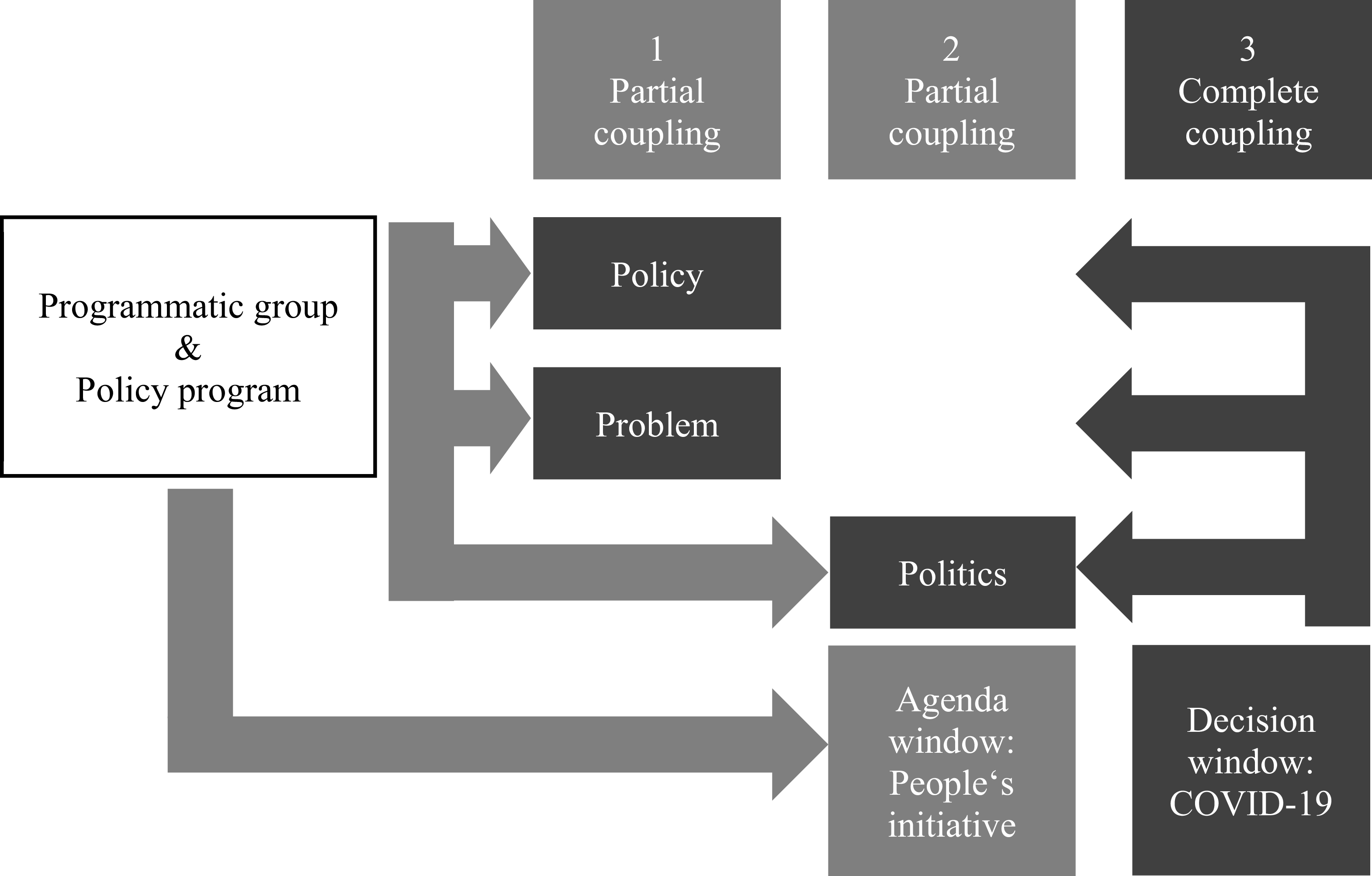
The results show a process in three main stages, illustrated in Figure 1: 1) the emergence of a programmatic group via the broadening of the identity of the SNA as an interest group and the creation of a program, coupling the policy and the problem stream, 2) the forced coupling with politics via the initiative by strong Nursing Care, 3) the acceptance of the initiative in a context of health crisis having transposed the problems relating to the care profession as societal and political. The mechanisms behind each stage of the coupling processes are analyzed in detail based on interviews and policy documents in the following sub-sections.
Mapping of the coupling process.
Source: Own visualization.

Coupling the policy with the problem: the emergence of a programmatic group
The interviews unanimously reported the professional and organizational strength of the nursing profession but also stressed the difficulties in coupling nursing issues, and their policy solutions, with problems that political elites consider worth addressing. In the Swiss neo-corporatist environment, power typically resides with large, well-established professional and sectorial associations, and these act as key gatekeepers in structuring the policy agenda. In the Swiss healthcare sector, power is divided among multiple professions and organizations, with some, such as doctors with the FMH, hospitals with H+, and insurers, holding far more influence than others, as observed by interviewee 6:
You always have to ask where is power and where is influence: With some professional associations, the FMH, H+, and the two health insurance associations.
It took considerable time for the SNA to fully develop a political identity as a professional group and effectively engage in the political arena. Since its foundation in 1910, the SNA worked for policies that meet the needs of the profession and society in terms of care, e.g., through the implementation of recognized training principles and federal examinations, or the improvement of working conditions (Braunschweig and Francillon Reference Braunschweig and Francillon2010). However, the professionalization of the political activities of nursing staff within the SNA began later, according to the estimates of the experts interviewed.
A key identified reason for this late political professionalization is that nursing in Switzerland has historically been considered a “female profession,” which has led to the undervaluing of care work and comparatively scarce opportunities for professional mobilization. Many nurses began their careers with limited opportunities for leadership. The nursing profession, lacking the long-standing associations and resources of male-dominated fields like medicine, has had fewer channels to influence policymaking. In turn, the shortage of women in decision-making roles at the political level further restricted nursing representatives’ access to established policy networks, perpetuating a cycle of weak lobbying capacity and delayed political organization. As revealed by the interviews, the healthcare world remained a hierarchical and for a long time highly gendered context. This lack of acknowledgment of the realities of the nursing profession, and of the demands and policies of the SNA, substantially strengthened the identity of the nursing profession not just at a professional level but also in terms of self-empowerment. Efforts to move the profession toward greater independence from medical doctors were often met with disinterest if not active resistance, for example on the model of advanced-nursing practitioners (i.e., trained professionals taking charge of certain medical services independently) or integrated care. Interviewee 1 remembers a specific politician who stated that he did not think that nurses needed advanced education to “clean the ass of the elderly.” They continue:
That was partly the level of the discussion. […] There were people who said that the doctor must remain an authority, that he must remain the person who takes responsibility for the whole thing. (Interview 1, 2023)
Nevertheless, over time, broader political and societal changes began to create opportunities for nurses to assert greater professional and political influence. In particular, the feminization of both politics and medicine marked a significant shift. Over the past few decades, the gender balance in the medical field has reversed, with a majority of women now entering the profession, slowly altering the dynamics between health-sector occupations. More women also gained representation in politics, contributing to evolving discussions about care work at the political level. At the same time, the aging population and persistent staff shortages put renewed focus on high turnover and difficult working conditions in nursing. These developments gradually reframed nursing challenges from an isolated, profession-specific matter into an issue of broader political and societal concern.
In the wake of these changes, the professionalization of the political activities of nursing staff became more pronounced. An extension of the professional associative identity toward a more political and systemic representation took place, as the SNA grew into an interest group with strategic objectives and a mandate to represent and lobby. This included employing professional lobbyists, networking with international associations, and strategically placing individuals with legitimacy in both the nursing and political arenas, all aimed at pushing the group’s agenda more effectively. Continuing education courses, such as master’s degrees in administration, further enabled nurses to form connections with stakeholders across the healthcare sector, some of whom also wield programmatic power, strengthening the SNA’s capacity to influence policy.
The SNA therefore broaden its identity from a primarily professional body to a cohesive programmatic group capable of engaging decisively in health policy debates. By organizing collectively, clarifying their policy demands, and leveraging emerging political avenues around their professional identity, nurses effectively coalesced into a programmatic group centered on addressing issues of working conditions, professional autonomy, and long-term staffing shortages. This transformation enabled them to create and sustain a new policy stream for nursing concerns, aiming at positioning their profession as a credible actor in shaping health policy.
Coupling policy program and problems with politics: the agenda window
Despite these advances, and the emerging of a strong policy stream through the political professionalization of the nursing profession as a distinct group of influence, coupling the newly formed nursing policy stream with the political and problem streams remained an uphill battle. Although the nursing profession had evolved into a recognized interest group, its political professionalization remained limited, compared to long-established stakeholders, which restricted the SNA’s ability to advance its policy solutions within the political arena:
[T]he degree of [political] professionalization in nursing is still modest, it’s still close to semi-professionalism. (Interview 3, 2024)
Two additional factors highlight the profession’s limited power and hamper efforts to bring the nursing agenda to the forefront. First, competing issues dominate Swiss health policy debates, notably cost management and financing. Calls for better wages or professional development frequently clash with the imperative to contain health spending. As noted by interviewees,
[T]he Swiss population is very convinced that we have a great healthcare system. (Interview 2, 2023).
Because citizens perceive the system as functioning well, and because state subsidies partially offset the burden of rising premiums, there is little sense of urgency to undertake structural reforms. Second, this lack of salience for nursing issues means that alternative policy concerns, particularly around cost containment, tend to overshadow demands from the nursing profession:
[T]he cost pressure is passed on to the largest cost block in an institution, and that is staff… And then to those who perhaps have the least lobbying power, the nursing staff. (Interview 4, 2024)
Despite these hurdles, the policy stream for nursing grew increasingly robust thanks to the SNA’s concerted efforts to refine and promote its policy program. Even when political elites remained largely unresponsive, the SNA’s expanding professional network and strategic positioning sustained momentum on the nursing agenda. Over time, this internal consolidation ensured that when external conditions shifted, the SNA would be ready to act as a programmatic group. Switzerland’s institutional context ultimately provided the mechanism to overcome political inattention. By launching a people’s initiative, the SNA compelled legislators and voters alike to address nursing policy issues:
When we realized that no one in parliament was really interested in care and that we were simply being spoon-fed some impossible reasons as to why the concerns of caregivers could not be addressed, we said now it’s done. We now have to force the national parliament to talk about care and our concerns. And if the politicians don’t want to, then we’ll just have to turn to the people for help. (Interview 4, 2024)
This “forced coupling” strategy opened an agenda window, compelling both policymakers and the public to consider nursing demands in a way that parliamentary lobbying had not achieved. In an environment of political stability and public inattention, the SNA’s limited programmatic power and the overshadowing focus on cost control initially made it difficult to bring nursing problems and solutions to the forefront. Nonetheless, the internal maturation of the nursing policy stream through the strengthening of the political professionalization of the nursing profession, combined with Switzerland’s direct-democratic tools, enabled the SNA to seize a strategic moment to couple the problem, policy, and political streams. By initiating a popular vote, nursing advocates forced the system to engage with their policy solutions, transforming a historically underrepresented profession into a central programmatic group in health policy reform.
Turning the agenda window into an adoption window: from bargaining to COVID-19
Successfully launching an initiative in no way means that voters will accept it. On the contrary, the odds are stacked against the initiators. However, and this was also one of the aims of the initiative for strong nursing care, this forced placement on the agenda forces parliament and the government to consider the issue seriously, thus opening the door to negotiation and compromise.
Interestingly, initially, the government refused to enter the matter and recommended total rejection of the initiative, pointing in particular to the competing cost issue:
[R]equests, such as the right to bill nursing care to the public health insurance scheme and better remuneration for nursing care […] would certainly be feasible within the scope of the Confederation’s current powers, but should be rejected, not least because of their impact on healthcare costs. (Message relatif à l’initiative populaire «Pour des soins infirmiers forts (initiative sur les soins infirmiers)», 2018, p. 7644).
It was Parliament that decided to enter discussions by preparing a counterproposal, which however also left aside the central aspects of the initiative rejected by the federal council, also focusing cost increases. Despite the COVID-context, when the Parliament agreed on a final draft in June 2021, it further reiterated that the possibility of independent invoicing would risk increasing costs disproportionately. In the national vote in November 2021, the SNA’s initiative was preferred to the parliament’s counter-project and accepted with 61% of votes in favor. Although history cannot be rewritten, experts and academics agree that the initiative would most likely not have been accepted outside of the pandemic context, which increased visibility for nursing care as well as enhanced political and societal recognition of the profession (Monteverde and Eicher Reference Monteverde and Eicher2023; Stadelmann-Steffen and Rihm Reference Stadelmann-Steffen and Rihm2022). Interestingly, it was therefore the salience of the problem at societal level at a given time, and its combination with direct democracy, that enabled to bypass the competition between costs and reform at the governmental and political level, hereby reinforcing the position of the SNA as a programmatic group within the political realm.
Even had the initiative failed at the ballot box, the forced coupling of streams through direct democracy would still have compelled policy negotiations, underscoring the SNA’s growing programmatic power. Although this victory strengthened nurses’ ability to push their policy agenda, the struggle is far from finished. The constitutional amendment requires legislative implementation; early indications suggest that working conditions remain overshadowed by cost-containment priorities. Consequently, the SNA’s advocacy has expanded to placing more nurses in Parliament and ensuring representation on key governing bodies. In this way, the nursing profession’s programmatic influence continues well beyond the initiative’s acceptance, as it strives to translate constitutional change into tangible policies.
Discussion and conclusion
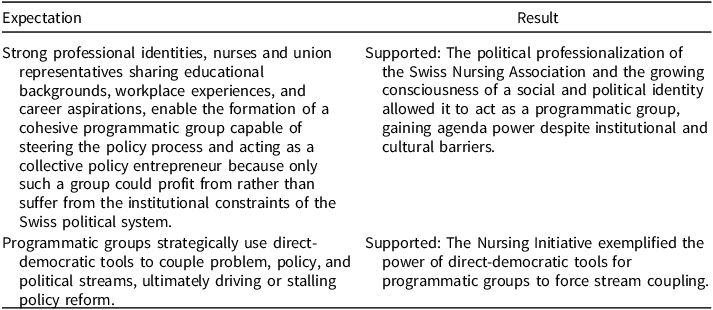
Starting from the question how a major policy reform in health care policy could be initiated and adopted in Switzerland as a highly unlikely case, and what role the COVID-19 pandemic played as a window of opportunity in this regard, this article analyzed the policy process around the Nursing Initiative from the lens of the MSF and the PAF. Relying on expert interviews with key policy actors from within the health policy sector in Switzerland, we draw the following conclusions, summarized in Table 1.
Overview of the findings

Source: Own visualization.
The problem stream for nursing matured as discussions over workload and professional competencies gained prominence. At the same time, the political professionalization of the care profession and the strengthened self-perception of care-workers as a social group enabled this group to elaborate a policy program and by doing so transforming into a programmatic group, thereby strengthening the policy stream. The nursing profession, led by the SNA, actively generated an agenda window via a popular initiative, thereby taking advantage of Switzerland’s unique direct-democratic system.
From a cross-fertilization standpoint, integrating MSF and PAF helped clarify the mechanisms of partial coupling, in this case, linking problem and policy streams through the emergence of a cohesive programmatic group with a well-defined policy program, while also showing how these could eventually be merged with politics. Under the PAF perspective, the SNA’s coordinated action and shared identity, grounded in professional interests and reinforced by evolving social perceptions, constituted the programmatic group that drove the initiative from within the policy process. The emergence of the programmatic group, which gained more power as a result of its self-perception as a social group, and its elaboration of a policy program, show how policies, problems, and politics can be coupled endogenously from within the policy stream.
With the focus on the programmatic group, the concept of collective entrepreneurship advances theoretically. The key characteristics of policy entrepreneurship, as Capano and Galanti (Reference Capano and Galanti2021) note, are not personal but habitual ones, and consist in the existence of coordinated action which partly combines with collaborate effort, as existing in e.g. small teams. Given that the notion of programmatic groups in a similar way is based on self-perception as a collective actor (a social group) with combined resources and coordinated action, our study shows that programmatic groups are one potential type of collective entrepreneur. Their placement in the politics stream highlights how the formation of a social group as programmatic group can in parallel strengthen the social group’s relevance in the politics stream, thereby shedding light on the interaction between policy entrepreneurs, policy stream, and the political stream.
Popular initiatives allow programmatic groups to circumvent traditional obstacles. The combination of direct democracy and Switzerland’s neo-corporatist structure, which integrates professional and sectoral associations into the policy process, can further reinforce identity elements, thus amplifying the relevance of programmatic groups to feed the policy stream and create linkages with politics. To guarantee the success of the program beyond the decision-making phase, particularly in the design and implementation of policies, it appears that the programmatic groups must take care to guarantee their presence at the various decision-making levels. As the nursing care initiative illustrates, a national vote forced Parliament to respond to nursing care demands, despite concerns about healthcare costs and the perceived limited urgency. Ultimately, while COVID-19 opened a decision-making window by raising awareness of the challenges facing healthcare workers, the programmatic power of the Swiss Nurses Association (SNA) and its well-structured policy program made it possible to transform this external shock into concrete policy reform, approved by 61% of voters. However, to ensure implementation that meets the expectations of healthcare personnel, the SNA must be able to assert the interests of the professional, programmatic, group outside the agenda setting and decision-making processes, particularly in parliament and in the cantons.
This study provides one of the very few to apply the MSF to Switzerland, a system shaped by federalism, direct democracy, and consensus like no other. The specificity of people’s initiatives coupled with neo-corporatism provides an important insight for windows opening for agenda change and policy change. As the case of the Nursing Initiative has shown, the programmatic group as a collective entrepreneur actively opened an agenda window from the policy stream by launching the initiative. Only later did the COVID-19 pandemic open the decision-making window and contribute to the acceptance of the initiative. These results outline that the decisive influence of direct democracy on agenda setting can be actively used by programmatic groups to their advantage, although the decision-making still depends on exogenous factors, such as focusing events and windows opening in the problem stream.
Beyond the Swiss case of the Nursing Initiative, the cross-fertilization of the MSF and PAF offers broader insights into how specialized professional identities and well-articulated policy streams can be coupled with political and societal concerns across various institutional contexts. In sectors such as healthcare, but also climate, where urgent challenges and specialized expertise are particularly salient, forming a programmatic group grounded in shared professional identity can provide the cohesive force and strategic know-how needed to elevate an issue onto the political agenda. By leveraging direct public engagement mechanisms or alternative institutional pathways, even groups facing strong institutional or cultural barriers may be able to couple problem, policy, and political streams. In more majoritarian or less corporatist environments, emphasizing collective identity, strategic coordination, and resource sharing can likewise help marginalized sectors or professions shape the policy process. Future research could examine how MSF–PAF dynamics unfold in different policy fields, particularly those where systemic pressures (e.g., aging populations, climate crises) create fertile ground for professionalized groups to push for transformative reforms.
Data availability statement
This study does not employ statistical methods and no replication materials are available.
Acknowledgements
We would like to thank the editors and anonymous reviewers for their constructive feedback and valuable suggestions, which greatly contributed to improving this paper. We are also grateful to Professor Fritz Sager and the Kompetenzzentrum für Public Management at the University of Bern for their support throughout this project. Finally, we sincerely thank all experts and interview partners for generously sharing their time, insights, and expertise.

 Open access

