


Introduction
Public trust in political institutions is a vitally important consideration in politics. Perspectives on public trust in judicial institutions are particularly significant, as they engage not only the general concerns about consent of the governed and political responsiveness, but also because in countries with robust separation of powers between institutions, courts are generally left with limited powers to independently enforce their decisions or fund policy changes that stem from them.
Public trust in courts has been extensively studied in the US context, from perspectives on policy agreement with courts, to underlying legitimacy of the courts, as well as the interplay between these two concepts (at the national level, consider Grosskopf and Mondak Reference Grosskopf and Mondak1998; Gibson, Caldeira, and Spence Reference Gibson, Caldeira and Spence2003; Bartels and Johnston Reference Bartels and Johnston2013; Gibson and Nelson Reference Gibson and Nelson2015; and at the state level, see Benesh Reference Benesh2006 and Cann and Yates Reference Cann and Yates2008 for examples). The exploration of these concepts has extended to the comparative politics context as well, though many such involve more established democracies (e.g., Gibson, Caldeira, and Baird Reference Gibson, Caldeira and Baird1998; Gibson and Caldeira Reference Gibson and Caldeira2003; Vanberg Reference Vanberg2004; Voeten Reference Voeten2013; Boateng and Makin Reference Boateng and Makin2016).
Understanding dynamics of attitudes about courts in young democracies, however, is important. Judicial institutions in such countries may have recent histories that involve corruption, and citizens lack the socialization regarding what to expect from courts and judges in a democratic system. Yet, these courts serve essential roles in developing democracies, and the decisions reached by these courts that can influence their ultimate success or failure.
The 2016 presidential election in Ghana reminds us of the importance of the judicial institutions in a young democracy. In this election, a sitting president (John Mahama of the National Democratic Congress (NDC)) was defeated by a challenger (Nana Akufo-Addo of the New Patriotic Party (NPP)) for the first time in Ghana’s Fourth Republic. The Ghana Supreme Court was asked to weigh in on multiple issues during the election, including maintenance of voter registration records and the decisions of the Electoral Commission of Ghana. This came on the heels of the 2012 election, where the Court was also asked to address even more substantial claims about the legitimacy of the election where Mahama prevailed over Akufo-Addo (Bob-Milliar and Paller Reference Bob-Milliar and Paller2018). Many observers believe that Ghana’s Supreme Court was able to make these decisions primarily due to the institution’s legitimacy.
However, given the controversy over decisions as important as the outcome of a presidential election, the Ghanian Supreme Court no doubt drew down some portion of the “reservoir of goodwill” that Easton (Reference Easton1965) uses to metaphorically describe the concept of public support for judicial institutions. But there have been many debits on the Court’s reservoir of goodwill. For instance, in 2015, investigative journalist Anas Aremeyaw Anas released a documentary showing Ghanaian judges taking bribes. The ensuing scandal significantly influenced public opinion and weakened confidence in the Court (Odartey-Wellington, Anas, and Boamah Reference Odartey-Wellington, Anas and Boamah2017; Bartels and Kramon Reference Bartels and Kramon2020).
As any country moves along the path toward becoming a more established democracy, it seems virtually inevitable that there will be hiccups and challenges en route to developing a robust culture of rule of law. We assess the level of trust in Ghana’s court system, and explore the extent to which truest in institutions can be developed in this context. We also consider whether there are patterns as to which individuals may develop such trust in courts.
Assessing trust in Ghana’s courts
In exploring these questions, this study focuses on the concept of institutional trust, which might be termed as a belief that an institution will perform properly in its functions in the long-term. This approach has clear commonalities with the concept of judicial legitimacy and is often included as an essential part of measurement of the concepts of legitimacy and procedural justice (e.g., Gibson, Caldeira, and Spence Reference Gibson, Caldeira and Spence2003; Tyler Reference Tyler2007; Cann and Yates Reference Cann and Yates2008). While our approach to studying trust independently of legitimacy likely reflects in important ways on that concept, institutional trust has shown to be an important factor for study in and of itself in general contexts (e.g., Uslaner Reference Uslaner2000, Reference Uslaner2002) and specifically in the context of Ghana as a developing country (Godefroidt, Langer, and Meuleman Reference Godefroidt, Langer and Meuleman2017).Footnote 1
Trust in governmental institutions tends to be lower in African countries, which are often more ethnically heterogeneous, have seen relatively high levels of state failure, have regular incidents of corruption, and often exhibit high levels of inequality (Kuenzi Reference Kuenzi2008). Building trust in that context is a challenge. Yet, as the public’s acceptance of decisions with substantial ramifications on the level of the outcome of a presidential election show, it would seem that some level of trust should persist in Ghana.
In an effort to quantify the level of that trust, we use data from the Afrobarometer round 6 survey, which, in addition to typical content, asked several additional questions pertaining to courts and judges. The survey was fielded May 20–June 10, 2014, which places it some time after the closely contested 2012 presidential election (won by Mahama), but before the rematch in the 2016 election (won by Akufo-Addo). The survey included a question on how much trust they have in several institutions, including a specific question asking how much the respondent trusts “Courts of Law,” and allowing a four-point ordinal response set as well as a “don’t know” option. The distribution of this item across the four response categories (omitting “don’t know” responses) appears in Figure 1. The figure shows relatively low levels of trust in Ghana’s courts, with only 22% of respondents expressing “a lot” of support for the court, and over half of respondents (about 57%) expressing trust in Ghana’s courts as either “not at all” or “just a little.” Given the substantial variation in levels of trust in courts across the range of this variable, it is natural to wonder why a fifth of the population has such high levels of support for the courts while nearly a third have such low levels of support. We move next to developing a better understanding of factors that help us to understand the variation in trust in Ghana’s courts.
Distribution of Trust in Ghana’s Court System. Note: Data from Afrobarometer Round 6.

Hypothesized influences on trust in Ghana’s court system
Because studies specifically on public trust in Ghana’s court system are rare, we develop our hypotheses regarding influences on trust using existing related literature. As a result, we offer the important caveat that most of this related literature is based on the United States or other Western countries. It is possible that the dynamics of court attitudes could function quite differently outside of the context where those findings were previously observed. Indeed, the possibility that dynamics of trust in courts could function differently in a young democracy like Ghana is a motivating factor for this study. In fact, Gibson, Caldeira, and Baird (Reference Gibson, Caldeira and Baird1998) find that court legitimacy (of which, they indicate, generalized trust is a key component) can vary substantially by age of the court; it is no substantial leap, then, to submit that the magnitude and even direction of predictors of court legitimacy could also vary by age of the court. Should findings diverge from the hypotheses that we develop based on the literature, we will reflect on possible reasons for such divergence as we conclude the paper.
Previous research suggests that citizen age figures into an individuals’ support for courts (Nicholson and Howard Reference Nicholson and Howard2003). We posit that this is especially true in the context of younger democracies, where older generations perspectives on courts may be based on years of lackluster court performance, while younger generations who lack the extended exposure to the sordid history of courts in a developing democracy may be more readily open to accepting notions that courts have adopted new sets of values. Indeed, in a multinational study, Aydın Çakır and Şekercioğlu (Reference Aydın Çakır and Şekercioğlu2016) find that older respondents profess less confidence in the judiciary. We measure age based as a respondent’s self-reported age in years. This reasoning motivates our first hypothesis:
H1: Individuals who are older will have lower levels of confidence in Ghana’s Supreme Court than those who are younger.
In the US context, higher levels of education are usually associated with greater confidence in courts (Benesh Reference Benesh2006; Cann and Yates Reference Cann and Yates2008). Education helps to familiarize citizens with the day-to-day workings of courts and make them aware of the positive achievements of courts. Further, it makes citizens more aware of the role of courts in a well-functioning democracy. Understanding that role has the potential to boost trust in courts. Indeed, in the US context, Gibson and Caldeira (Reference Gibson and Caldeira2009) show that those who know more about courts tend to hold them in higher esteem. While the extent to which this applies in the context of a developing democracy is less clear, this line of reasoning leads us to hypothesis 2:
H2: Individuals with higher levels of education will have higher levels of confidence in Ghana’s Supreme Court.
In our data, education is measured using a set of dichotomous variables reflecting those who have completed primary school, those who have completed secondary school, and those with some kind of post-secondary training, with the baseline category reflecting those who did not complete primary school.
Individuals’ direct experiences in court have a strong potential to influence their confidence in courts. Overby et al. (Reference Overby, Brown, Bruce, Smith and Winkle2004) indicate a statistically significant relationship between experience and knowledge of the American judicial system and court confidence. Similarly, Benesh (Reference Benesh2006) noted that citizens’ experience with American state courts boosts confidence. Both of these studies, however, were performed in contexts where court experience generally exposes the individual to positive court functioning and fair procedures. It seems quite reasonable to believe that in contexts where the rule of law and other legal norms are still developing that court experiences could leave individuals with lower trust in courts. The Afrobarometer Round 6 data shows that while a relatively small fraction of the Ghanaian population has experience with courts, of those that did, the experience was often challenging. For example, about 40% of respondents who had experience in a Ghanian court in the previous twelve months indicated that they were asked to give a judge or court official a bribe, gift, or favor in order to get the assistance they needed from the court. Salzman and Ramsey’s (Reference Salzman and Ramsey2013) analysis found no statistically significant relationship between Ghanaian’s experience with the court and citizens’ confidence in the judicial system, but we nevertheless posit that challenges navigating the legal system will lead to lower levels of trust. We measure court experience based on respondent’s self-response regarding whether they have had contact with a court of law in the last twelve months. This leads to hypothesis 3:
H3: Those who have experience with Ghana’s court system will differ in their level of trust from those who have no such experience.
Gender influences a wide variety of political attitudes. Fossati and Meeker (Reference Fossati and Meeker1997) posited a statistical relationship between gender and court trust, a relationship substantiated by Kelleher and Wolak (Reference Kelleher and Wolak2007), who found that women are less likely to express confidence in US state courts than men. Sun and Wu (Reference Sun and Yuning2006) find a similar result, showing that gender effects persist even after controlling for other factors such as race, education, and recent court experience. A variety of potential explanations could be posited for this, including traditional biases against women and women judges. Looking specifically at Ghana, Dawuni (Reference Dawuni2016) finds that while women serving as judges do indeed work to protect women’s rights, substantial progress needs to be made to balance the number of women judges with men in those positions. We suspect that until such progress is made, women will continue to have lower levels of trust in Ghanian courts than men. We measure gender on the basis of the respondents self-report, which leads to hypothesis 4:
H4: Women will have lower levels of trust in Ghanian courts than men.
Across Africa, Kerr and Wahman (Reference Kerr and Wahman2021) discovered that the opposition voters are more likely to have lower trust in the court than supporters of the government, which causes institutional biases in African democracies. In Mongolia, Jacob and Schenke (Reference Jacob and Schenke2020) found that partisanship and political preferences have a strong influence on trust and confidence in the court. This suggests that Mongolians view the judicial system as highly politicized, which may stem from disputes over judicial appointments and the constitutional court’s judicial powers. Bartels and Johnston (Reference Bartels and Johnston2013) state that when individuals exhibit ideological disagreement with the Supreme Court’s policymaking, they give the Court less legitimacy and confidence than when they perceive ideological agreement.
Thinking specifically about trust in the context of Ghana at the time the survey was fielded, respondents to round 6 of the Afrobarometer were answering these questions about a year after an election where the Supreme Court of Ghana ruled against a case brought by the New Patriotic Party (NPP) in regard to the election their candidate, Akufo-Addo, lost by about .5% to Mahama of the National Democratic Congress (NDC) party. With those events still in the minds of voters, we expect that respondents who affiliate with the NPP will have lower levels of support for the court system than those who affiliate with the NDC. Accordingly, we offer hypothesis 5 as:
H5: Individuals who affiliate with the NPP will have lower levels of trust in Ghanaian courts than members of the NDC. Those who have no affiliation or other party affiliations will similarly be less trustful of courts than NDC partisans.
We measure partisanship using a set of dichotomous variables, with one representing membership in the NPP, one representing individuals with no party affiliation (or with a minor party outside Ghana’s two-party system) and leaving membership in the NDC as the baseline category.
A variety of scholars writing in the context of courts in established democracies have found higher levels of institutional support among those with higher levels of socioeconomic status, whether measured by income (e.g., Caldeira and Gibson Reference Caldeira and Gibson1992) or level of inequality (Gilens Reference Gilens2005). Across a broader spectrum of democracies, Aydın Çakır and Şekercioğlu (Reference Aydın Çakır and Şekercioğlu2016) discovered that financial condition and life satisfaction significantly increase an individual’s confidence in the judiciary. Ward et al. (Reference Ward, Miller, Pearce and Meyer2016) posit that individuals who are unsatisfied with their standard of living are more likely to have a lower trust in the court. In short, there is strong evidence that when individuals are in a context where they are personally thriving, they are more likely to trust their judicial system, while those in a social and economic context struggling to meet basic needs (or expectations) will be less likely to support their courts. We measure standard of living on a 5-point scale where respondents rated their standard of living from 0 (representing “Very bad” living conditions) to 4 (representing “Very good” living conditions). This results in hypothesis 6 as follows:
H6: Individuals with a higher standard of living will have greater trust in their courts than those with lower standards of living.
Finally, Amagnya (Reference Amagnya2022) indicated dynamism regarding rural-urban confidence in the Ghanaian judicial system. Likewise, Pruitt and Showman (Reference Pruitt and Showman2014) state that rural areas in the United States face unique challenges in gaining access to justice, which affects their confidence in the judicial system and court procedures. On the contrary, Askvik, Jamil, and Dhakal (Reference Askvik, Jamil and Dhakal2011) indicate that individuals living in rural areas rather than urban centers are more likely to trust the court system. We make use of the survey interviewer’s classification of the respondent’s dwelling place as either rural or urban in measuring this variable. This results in hypothesis 7:
H7: Those living in rural areas will have lower levels of trust in courts relative to those in urban areas.
Methods and results
To test the hypotheses outlined above, we estimate an ordered probit model with our trust variable (described above) as the dependent variable, and independent variables as specified and described in our hypotheses above. As noted previously, we use Afrobarometer round 6, data made publicly available at http://www.afrobarometer.org. The survey originally involved 2,400 observations, but after listwise deletion of missing data, our analysis is based on 2,219 observations. We employ an ordered probit regression model due to the ordinal nature of the dependent variable. Results of the model appear in Table 1, which shows the coefficient estimate and standard error for each variable. To facilitate interpretation, we also provide the average marginal effect of that variable on the probability of each of the four outcome categories of the dependent variable (for dichotomous variables, this is a discrete change rather than a marginal effect). The overall fit of the model is reasonable, with a McKelvey/Zavoina r2 of .10.
Ordered Probit Model of Trust in Ghanian Courts
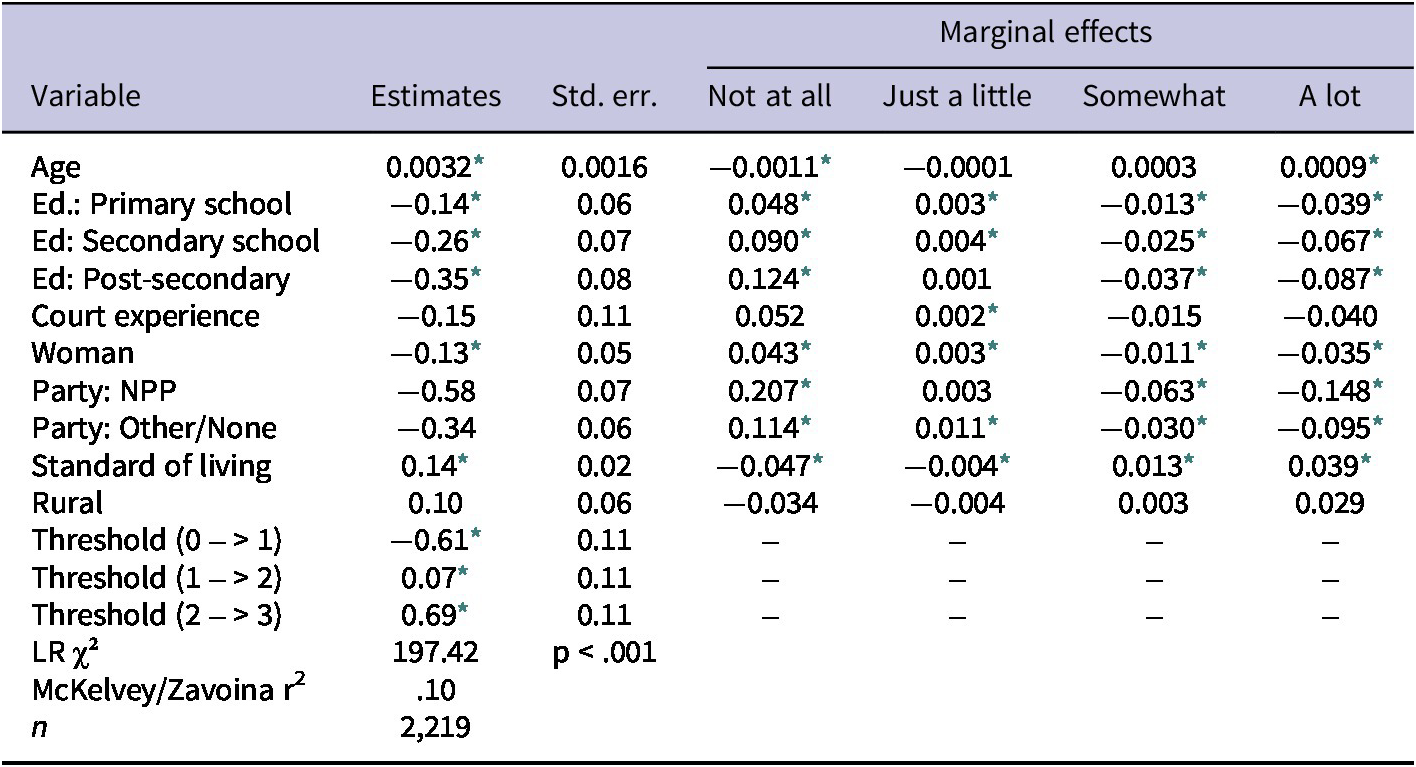
Note: Data from Afrobarometer Round 6. Parameter estimates are ordered probit coefficients with standard errors. Marginal effects are computed as average marginal effects across observed values in the data, or, for dichotomous variables, average discrete changes.
* p < .05 (two-tailed).
The most substantial effect we see in our model is the effect of partisanship. Individuals who affiliate with the NPP, the party that lost a court appeal regarding the outcome of the election preceding the administration of this survey, have substantially lower levels of trust in courts. These effects are rather substantial, with NPP members having a probability of being in the lowest category of trust that is about .2 higher (on average in our data) than NDC members (whose candidate was declared the winner of the election). Even individuals who have no party affiliation or who belong to a minor party (a party other than the NPP or NDC) express lower levels of trust in courts compared to NDC, though the effects are not as strong as for NPP members. Unaffiliated and minor party members have a probability of being in the lowest category of trust, that is .11 points higher than for NDC members (on average across our observed data). In this respect, our results in Ghana are similar to effects in more established democracies, which often have some degree of partisan lean in perception of courts, though the amount of such lean has been a source of dispute (see, for example, Bartels and Johnston Reference Bartels and Johnston2013; and Gibson and Nelson Reference Gibson and Nelson2015). In Ghana, we suspect these results are particularly profound specifically because of the role Ghana’s highest court played in resolving an election dispute just two years prior to the survey.
Consistent with studies that find that women tend to hold courts in lower esteem than men, we find that Ghanaian women have lower levels of trust in their courts than men. On average across our observed data, women are about .04 points more likely to fall in the lowest category of trust than man. While the effect is not enormous, it is substantial and consistent with gender effects in the literature from more developed democracies. We suspect this is due in part to the underrepresentation of women on the bench in Ghana.
Consistent with prior literature, we hypothesized that standard of living would influence trust in courts. Our results are consistent with this, showing an average marginal effect of about .04 on the likelihood of falling in the “a lot” of trust category; moving the full range of this variable would have a rather substantial effect. In this respect, our findings on income/standard of living fall neatly in line with findings from the literature.
Our variables of court experience and rural region were not statistically significant. The proportion of individuals in the survey who had an active court experience in the last year was relatively small, with only 4% of respondents falling in to that category; future research might be able to get better estimates of potential effects of experience by taking an oversample of people with experience (and measuring the specific nature of the court experience, such as being a witness, a defendant, or a plaintiff). In terms of region, we suspect that the political, social, and economic cleavages that are markedly present in the United States (upon which much of the findings in prior literature are based) are not necessarily as profound in Ghana.
In two areas, we found results quite different from what we hypothesized. In both instances, we suspect that the reason has direct bearing on the hypotheses being developed in the context of more established democracies rather than in the context of a young democracy like Ghana. In terms of hypothesis 1, rather than young people being more trusting of courts than their elders, we find that older Ghanaians have higher levels of trust in courts than youth. One possible explanation for this is that older Ghanaians may have seen improvements in their court system, leading them to have more trust, while younger Ghanaians simply see the issues and challenges that remain to be addressed. Whatever the case, the substantive effect of age is quite small (even though it is statistically significant, with the marginal effect on having “a lot” of trust is a mere .0009).
Education is the second area where our findings were surprising. The vast majority of the literature on court attitudes finds higher levels of education are associated with more positive perceptions of courts. However, in the context of Ghana and trust, we find those with higher levels of education have lower levels of trust in the court system than those with the lowest levels of education. As we grapple this empirical result, we suspect that higher levels of education familiarize citizens with what Cann and Yates (Reference Cann and Yates2008) refer to as the “sordid underbelly” of court machinations. Rather than socializing Ghanaians to be supportive of courts, we now surmise that education in Ghana likely enhances individuals’ understanding of systemic issues and inefficiencies in the judicial system, such as political interference and publicized scandals. In the context of countries with established norms of rule of law, we might predict that education would bring exposure to legitimizing legal symbols. But in Ghana, education brings exposure to a historical backdrop that includes instances of judicial partiality, scandals, corruption, and inefficiency, which may (for more educated respondents) make judicial symbols de-legitimizing rather than legitimizing. The effects are substantial. For example, the probability of not trusting courts at all is .124 points higher on average for those who have post-secondary training than for those who did not complete primary school, and nearly .09 points lower for having “a lot” of trust in courts.
Discussion and conclusion
This study of public trust in Ghana’s judicial system offers crucial insights into the broader challenges of fostering institutional trust in young democracies. Despite Ghana’s significant strides as a democracy, our analysis reveals a complex landscape of trust in its courts, shaped by various sociodemographic and political factors.
Our findings indicate that older Ghanaians tend to have more trust in the court system than younger individuals, contrary to our initial hypothesis. This may suggest that older citizens, having witnessed the judiciary’s progress over time, are more appreciative of its current state, whereas younger Ghanaians are perhaps more critical of its shortcomings.
Education, which is generally expected to enhance trust in judicial institutions, surprisingly shows the opposite effect in Ghana. Those with higher education levels express less trust in the courts, likely due to their greater awareness of judicial corruption and inefficiencies. This highlights a significant challenge for judicial reform: improving the perception and reality of judicial integrity and effectiveness among the educated populace.
Consistent with the findings of Fossati and Meeker (Reference Fossati and Meeker1997) and Sun and Wu (Reference Sun and Yuning2006), we find that gender disparities in trust persist, with women displaying lower trust in the courts than men, possibly reflecting ongoing gender biases and the underrepresentation of women within the judiciary. This underscores the need for continued efforts to ensure gender equity in the legal system and broader societal structures.
Partisanship emerges as the most influential factor, with supporters of the opposition NPP showing significantly lower trust in the judiciary compared to NDC supporters. This partisan divide underscores the importance of perceived judicial impartiality and the impact of political dynamics on public trust. The results support the findings of Jacob and Schenke (Reference Jacob and Schenke2020) and Kerr and Wahman (Reference Kerr and Wahman2021) that the opposition voters are more likely to have lower trust in the court than supporters of the government, which causes institutional biases. Moreover, consistent with earlier work in other contexts (e.g., Caldeira and Gibson Reference Caldeira and Gibson1992; Aydın Çakır and Şekercioğlu Reference Aydın Çakır and Şekercioğlu2016; Ward et al. Reference Ward, Miller, Pearce and Meyer2016), our analysis supports the hypothesis that socioeconomic conditions influence judicial trust. Individuals with higher standards of living are more likely to trust the courts, suggesting that economic stability and personal well-being are critical to fostering institutional trust.
Building and maintaining public trust in judicial institutions in young democracies like Ghana is no easy task. While Ghana stands out as one of the more robust young democracies in Africa, it is clear that additional work remains to be done in building trust in judicial institutions. This will require addressing corruption, enhancing judicial performance, promoting gender equity, and mitigating the influence of political partisanship. While additional research in the context of multiple developing democracies is necessary, the work done here is a promising start that may allow us to understand the diverse factors that influence trust. Only by identifying such factors can policymakers better support the development of a judicial system that commands broad public confidence and contributes to the overall stability and strength of democracy.
Data availability statement
Data and supporting materials necessary to reproduce the numerical and graphical results in this paper are available at the Journal of Law and Courts Dataverse archive at https://dataverse.harvard.edu/dataverse/jlc.
Financial support
We thank the College of Humanities and Social Sciences for funding through their graduate summer research mentorship program.
Competing interest
The authors have no competing interests with this paper.


 Open access

